



Abstract
Conversations on local governmental efficiency typically suggest that fragmentation—having “too many” local units—is the primary deterrent to efficient and effective regional governance, and that consolidation is the best solution. This analysis examines these implicit assumptions using evidence from the current literature and a comparative case analysis. It explores alternatives for unification by looking at city–county consolidation attempts in midsize jurisdictions with an urban–rural mix. It also presents a checklist tool to assist practitioners in considering important underlying factors in their jurisdictions. Finally, it applies an interpretive guide to the checklist to help select among the contingent paths toward jurisdictional unification.
Introduction
If commentators are correct, local jurisdictions with “too many” smaller units of government present a problem. They are barriers to a manageable system of local government that inspires citizen trust and creates a strong business climate (Indiana Commission on Local Government Reform 2007). Thinking about local government administration typically links these “fragmented” units of government to public sector inefficiency, administrative excess, and an inward-looking parochialism (Maciag 2012). This thinking rests on two assumptions: (1) local fragmentation leads to negative outcomes for efficient and effective governance and (2) consolidation is the best way to address these negative outcomes.
This article sets out to do four things. First, it explores the two assumptions given above. Second, it looks at cases of city–county consolidation in midsize jurisdictions with an urban–rural mix. Third, based on the “takeaways” from these cases and other agreed-upon findings, it presents a checklist tool to assist practitioners in thinking through the important underlying factors in their jurisdiction. Fourth, it applies an interpretive guide to the checklist to help select among the contingent paths toward jurisdictional unification. In doing so, it is hoped it will assist practitioners in thinking through these issues and also contribute to a literature that typically deals with larger, more urbanized areas.
Why would practitioners need help with this task? The answer is simple: local jurisdictions are similar in their structures and functions, but diverse in their circumstances; there are multiple factors that need to be taken into account and different routes to achieve greater integration. In each case, the situational factors to be considered for assessing the potential value of consolidation are not obvious; neither are the viable paths that fit them. The aim of this work is to provide a practical structure to help those making such decisions identify key situational elements and be sensitive in matching them with potential ways of proceeding, some of which are not as readily evident as city–county consolidation. It will help to ensure that important options are both recognized and weighed in making such decisions and that they are not overlooked or downplayed in the press of organizational or electoral politics.
Analytical Framework
Given the recent economic recession, public administrators have stressed the importance of a regional basis for economic efficiency (Barnes 2010). There is a perceived excess of local government units, which is at odds with an increasingly favorable disposition toward regional unification (Maciag 2012). Accordingly, practitioners’ conversations on streamlining local government are often framed in sweeping generalizations about local spending and the number of jurisdictions. Likewise, these conversations admit a perception of consolidation as a panacea for the perceived harms of fragmentation, perhaps because it is easy to understand and intuitively appealing to reformers (Savitch and Vogel 2000b, 162). Nonetheless, it is difficult to quantify either the effects of fragmentation or the need for increased collaboration or consolidation created by it (Maciag 2012). In spite of these ambiguities, however, the scholarly literature points to three chief considerations for efforts in government integration: public sector efficiency (an improved ratio between services received and tax burdens), taxation transparency (clarity for citizens regarding amount and purposes of taxation), and taxation equity (a distribution of the tax burden deemed just across varying groups of citizens).
Public Sector Efficiency
Most authors agree that fragmentation seldom happens through institutional design. Home rule restrictions, tax and expenditure limitations, and similar limitations on local autonomy can lead to increased proliferation of units of government (Bowler and Donovan 2004; Carr 2006; Joyce and Mullins 1991; McCabe 2000). Local officials use new districts as a tool to circumvent state constraints when they run into revenue limitations. Studies lend support to these ideas as motivators for fragmentation (Berry 2008; Bowler and Donovan 2004; Boyne 1992b; Campbell 2004; Dolan 1990; Farmer 2010; Schneider 1986), but with some disagreement about their effects. In addressing effects of fragmentation, Jimenez and Hendrick (2010) link regional integration to increased responsiveness and service efficiency, though others suggest that the opposite effect occurs (Tiebout 1956). Most studies of regional fragmentation take one or the other of these positions (Berry 2008; Boyne 1992a; Campbell 2004). Hendrick, Jimenez, and Lal (2011) conclude that local government fragmentation leads to reduced spending among general purpose units and increased spending among special purpose units.
The effects of these efforts on government efficiency and spending are ambiguous. Complete consolidation and other forms of government and functional integration have been distinguished from each other, but little can be said about their comparative efficiency (Rosenbaum and Henderson 1972). In many cases, expenditures continue to increase after consolidation, in spite of preconsolidation arguments to the contrary (Selden and Campbell 2000). Case studies often advocate for consolidated or metro governance even so (Feiock, Carr, and Johnson 2006; Savitch and Vogel 2000a; Leland and Thurmaier 2005). Despite mixed evidence and little consensus on outcomes, much of the literature points to clear concern with the potential cost efficiencies of these efforts.
Taxation Transparency
Alongside the efficiency literature, some scholars focus on features of tax structure as most important to unification efforts. Defenders of local control argue that fragmentation is beneficial, as it increases public choice in arrangements for taxation and service delivery. Tiebout (1956) argues that local government fragmentation is favorable, because multiple units compete to have lower tax rates to attract residents. Campbell (2004), in contrast, sees any taxation advantages in fragmentation as a “fiscal illusion,” noting that increased complexity in units of government leads to diminished accountability for raising taxes. Complex integrated structures arguably can result in scenarios where taxpayers have little awareness, or associated control regarding how and why they are taxed. While differing on the benefits, these scholars’ arguments focus on transparency as a key value for taxpayers.
Taxation Equity
Likewise, other scholars focus on the degree to which tax burdens are evenly distributed among varying service recipients. Berry (2008) demonstrates how overlap between jurisdictions is detrimental because it leads to “overfishing” of the same tax base, which can disadvantage groups living in the overlapped areas. This is echoed by Farmer (2010) and McCabe (2000) in their studies of special districts that “vertically” overlap within a single region. Consolidation literature highlights areas of tax disparity across racial and cultural groups, as well as situations in which sharing debt burdens proved challenging to these efforts (Leland and Thurmaier 2004). As such, although conclusions about the impact of efforts to more closely integrate jurisdictions are somewhat confusing, there does seem to be agreement that efficiency, transparency, and equity are important considerations, though just how and why is unclear.
City–county Consolidation Cases
As the foregoing indicates, consolidation is often assumed as the default approach to counter the assumed negative effects of fragmentation. This article will attempt to identify factors that have played an important role in city–county consolidation in midsized jurisdictions with an urban–rural makeup. The analysis is limited to cases of attempts to reduce fragmentation through formal city–county consolidation referenda since 1990 (Murphy 2012): these include both successful and failed consolidation attempts and a range of service alternatives. Table 1 depicts attempts with a city population of 100,000 or greater and a county-wide population between 100,000 and 300,000: these resulted in four successful and four unsuccessful consolidations.
City–county Consolidation Attempts Since 1990, Small- to Midsized Cities.

Case by Case Review: Comparing Consolidation Efforts
Following is a brief examination of the case histories of the jurisdictions in Table 1. Successful consolidations have been well documented and, where available, this article relies on peer-reviewed secondary case studies, particularly Leland and Thurmaier (2004). Unsuccessful consolidation attempts have received less attention in the literature on consolidation, but primary sources helped fill these gaps. Comparing the successful and unsuccessful cases illustrates the recurrence of several important factors in analyzing consolidation prospects: the proposed government structure (the organization and distribution of services and fiscal benefits and burdens anticipated by consolidation efforts), the surrounding demographic context (population density, ethnic, and cultural factors faced by consolidation efforts), the legal context (constitutional, statutory, and legislative framework encountered by consolidation efforts), catalyzing conditions (assumed conditions of government or economics that motivate consolidation efforts), and perceived future opportunities (assumed benefits and other results from consolidation efforts).
Successful Consolidations
Athens–Clarke County, Georgia (1990)
Motives for this consolidation included “good government” and service distribution arrangements. It was the product of three prior attempts at consolidation since 1969 (Durning, Gillespie, and Campbell 2004). By 1990, population growth in Clarke County outside of the City of Athens led to considerable demographic change. Throughout the 1980s, the two governmental entities squabbled about service provision in the unincorporated fringe, so the governmental structure in the proposed 1990 consolidation charter addressed high water rates and other fiscal inequities for county residents (Durning, Gillespie, and Campbell 2004). Also, proposed structural changes included both spending limits and an assurance that local government workers would not lose employment under consolidation. The potential for controversy over government structure associated with combining law enforcement organizations was minimal because the elected Clarke County Sheriff had responsibility only for the court system. Clarke County’s small geographic size may have contributed to a sense among voters that a single unit of government could provide adequate service.
Lafayette–Lafayette Parish, Louisiana (1992)
The Lafayette consolidation was motivated by prior success in professionalizing government, rather than a reaction to concerns about corruption or inefficiency like many efforts (Bacot 2004). Successful reform in the 1970s resulted in the professional manager form of government in both the city and parish, which assisted in the consolidation study and promotion. The local chamber of commerce and newspaper were enlisted to promote the consolidation as well. Demography played a role as in most Southern consolidation efforts with a principal concern of ensuring that minorities were not disadvantaged. To address these issues acceptably under federal restrictions, the proposed structure of the consolidated council districts mirrored existing school board districts. Likewise, to address concerns that the city was “bailing out” the parish, the proposed Lafayette consolidated government assumed control of all special districts in the parish, including assets and liabilities, but Lafayette City debt was to be paid off by only those living within what had been the city’s boundaries. Other structural changes such as unified planning were acceptable given the small geographic area of the region and resulting economies of scale.
Augusta–Richmond County, Georgia (1995)
After a failed effort in 1988, Augusta’s consolidation with Richmond County was motivated predominantly by demographic change. Due to both “white flight” and long-standing African American distrust of local government, Augusta’s population was declining (Campbell, Gillespie, and Durning 2004) and Augusta’s deepening revenue shortfalls were a strong motive for the consolidation. In the 1988 consolidation attempt, representation concerns were the sticking point for African Americans who largely opposed consolidation. The proposed 1995 charter provided for equitable racial representation and greater limitations on the new entity’s chief executive. The successful 1995 consolidation effort had local media support.
Kansas City–Wyandotte County, Kansas (1997)
Kansas City–Wyandotte County is one of the few Midwestern cases of consolidation in recent decades. It was motivated by two factors that often typify successful consolidation (Rosenbaum and Henderson 1972): major economic deterioration and lack of confidence in government (Leland 2004). To address the former, the city and county collaborated to create incentives (Moline 2005) to address the future economic opportunity of having a stadium located in the area. This cooperation and the perceived benefits eased consolidation. On the second factor, Wyandotte County lacked a professional government. It had neither a county administrator nor a functioning personnel classification system. Given these circumstances, consolidation was backed by business leaders and the newspaper. The legal context proved important as well with the Kansas legislature playing an active role by setting up the county’s Consolidation Commission. Structural and demographic factors were minimal in this case: the consolidation left separate the law enforcement entities of the County Sheriff and City Police, and neither race nor population changes were important contextual factors (Moline 2005).
Unsuccessful Consolidation Attempts
Wilmington and New Hanover County, North Carolina (1995)
Wilmington and New Hanover County, North Carolina, have been unsuccessful in four city–county consolidation attempts, evidencing contentment with the status quo (G. A. Johnson 2004). Largely, this is due to a lack of catalyzing conditions, some doubts about restructuring, and the legal context. Concerns about taxation levels in the areas outside the city were the driving force behind the consolidation’s failure. Proconsolidation forces in New Hanover County have been concentrated largely within the city of Wilmington, whereas anticonsolidation forces have generally come from the county jurisdictions outside the city. Also, the legal context presented some challenges as North Carolina state statute requires that the city be “abolished” into the county: the vagueness of this mechanism has made consolidation more challenging. Liberal annexation laws in North Carolina played a role as well: Wilmington reduced the potential benefits of consolidation by annexing much of the area that experienced growth and development before 1995 (G. A. Johnson 2004), reducing the need for consolidation.
Clarksville and Montgomery County, Tennessee (1996 attempt)
Clarksville and Montgomery County’s 1996 referendum represented its second unsuccessful attempt at consolidation in the last two decades. In this instance, the legal context took center stage. Tennessee state statute requires city–county consolidation referenda to pass not only at large, but in each involved jurisdiction. In the 1996 attempt, residents of the City of Clarksville passed the referendum, but it was unsuccessful in the outlying county mostly due to the structural concerns about local representation (V. Coleman, personal communication, April 23, 2013). Likewise, the proposed roles of the City Police Department and County Sheriff were a factor, and rural residents were concerned about tax increases. Generally, the Clarksville–Montgomery County community remained unengaged in the reorganization debate (Cook 2007).
Topeka and Shawnee County, Kansas (2005)
Topeka and Shawnee County’s consolidation attempt occurred after the successful Kansas City–Wyandotte County consolidation (Myers 1999) and may have been motivated by it. A Shawnee County consolidation study referendum passed in 2005, and a consolidation study commission released a plan for voter review (Consolidation Commission of Topeka 2005; The Topeka Capitol-Journal 2005; Hrenchir 2005). However, the referendum for approving this plan ended in the consolidation failing with 60 percent of the voters opposed (Consolidation Commission of Topeka 2005). Opposition was largely on structural grounds: given the absence of any genuine catalyst, current activity indicates that the incremental and specific changes may be preferable to the jurisdiction’s residents rather than full consolidation. Following the unsuccessful referendum, Topeka and Shawnee County have combined limited services, in keeping with a report issued prior to the consolidation attempt (The Topeka Capitol-Journal Editorial Board 2004; Hrenchir 2012). This has achieved expanded rural services and reduced urban–rural service differences. There continues to be dialogue about combining law enforcement agencies in the city and county (The Topeka Capitol-Journal 2012).
Evansville and Vanderburgh County, Indiana (2012)
Voters in the City of Evansville and surrounding Vanderburgh County faced a consolidation referendum in 2012. The referendum was defeated with 67 percent opposed (Vanderburgh County Clerk 2012). In large part, this case demonstrates how perceptions about opportunity can affect the consolidation outcomes. In early 2010, both the city and county legislative bodies adopted resolutions in support of a consolidation plan (City of Evansville 2011). The consolidation debate in the region had a lengthy history (Coures 2011). In the public debate, however, perceptions of expected fiscal impact were somewhat ill-defined (Mattingly 2012). Reduced financial pressures and increased governmental efficiency were touted as benefits of consolidation, along with accountability and transparency, professionalism in elected and appointed officials, and an improved urban–rural cost distribution (City of Evansville 2011). Immediate structural changes were not a factor as most county-wide elected offices were to remain in existence in the plan (City of Evansville 2011). Tax rate changes were to be phased in over three years. The consolidation plan did not address the combined law enforcement (Langhorne 2012), but the result was that the County Sheriff was a consolidation supporter (Mattingly 2012), while the local law enforcement union opposed consolidation (Langhorne 2012). Although elected officials in both units supported the consolidation (Mattingly 2012; Citizens Opposed to Reorganization in Evansville 2012), they met resistance from union members unsure of the economic impact on them. Urban versus rural differences on representation impacted residents’ perception of the proposed charter as well.
Case Takeaways
The cases presented provide a resource for practitioners in peer comparisons for small to midsized cities. As the cases illustrate, initial success in consolidation has a very low likelihood (Murphy 2012). Each case illustrates to some degree the recurrence and interaction of the several important factors noted above for analyzing the consolidation prospects: proposed government structure; demographic context; legal context; catalyzing conditions; and perceived future opportunities.
Proposed Government Structure
The structure and functional relations of the proposed new entities is greatly influential—what is in or what is out can make or break a consolidation effort. Even in successful consolidation cases, full consolidation is not always achieved. The intentional exception of some municipalities outside of the central city was a condition for success in nearly all the city–county consolidation cases. Likewise, chief executive powers, voter representation provisions, or the inclusion of a single entity, jurisdiction, or function can play a role. For example, municipal utilities complicated consolidation efforts where they existed, and debt or utility hand-offs had to be managed carefully. The importance of acceptable law enforcement structures cannot be underestimated.
Demographic Context
Of the eight cases above, the consolidation attempts that succeeded had an average difference in population density of just under 450 persons per square mile between the city and county. In contrast, the failed consolidation attempts had an average difference of over 1,430 persons per square mile. Several of the failed consolidation attempts point to urban–rural differences or distinctions in city–county service levels as important contextual components for the “fit” of their consolidation goals. In addition, racial equity served as a motivator for consolidation efforts in some cases. Particularly in the south, racial concerns heavily influenced whether consolidation plans were appropriate to their jurisdictions.
Legal Context
State legal institutions can also play a key role in the context of local consolidation efforts. States legislatures can support consolidation, set referendum thresholds, or create incentives for local governments to combine services, functions, or units of government. State constitutional frameworks are the context in which local governments become more or less fragmented (Stephens 1974; Krane, Rigos, and Hill 2001; L. S. Johnson 2004; Stephens and Wikstrom 2007).
Catalyzing Conditions
A perceived crisis of confidence is often required to catalyze the support for successful consolidation through the referendum process. For example, in Kansas City–Wyandotte County, concerns about patronage generated support for reform. Citizen distaste for perceived mismanagement in both the city and county governments provided a large base of support for reform of both jurisdictions. In cases where the consolidation referenda failed initially, perceptions of a worsening crises served to catalyze the support in each following referendum. The progressive image that the city–county consolidation provides for a region incentivizes efforts from reformers, business leaders, and academics (Feiock and Carr 2000; Savitch and Vogel 2000a)—they are a strongly rationalizing constituencies with much to gain from reform through consolidation.
Perceived Future Opportunities
One important ingredient in selling consolidation is the perception of future opportunities from reduced fragmentation through consolidated government. Economies of scale in economic development projects, service unification, and grant applications are purported benefits of consolidation (Indiana Commission on Local Government Reform 2007). While the prospect of future economic development opportunities contributes to the success of consolidation campaigns, actual gains provided by proffered opportunities are difficult to measure.
Eight Factor Checklist: Separation to Unification
In approaching a consolidation effort, literature on the topic suggests considering public sector efficiency, taxation transparency, and taxation equity. The analysis of the consolidation cases above has added the factors of proposed government structure, demographic context, legal context, catalyzing conditions, and perceived future opportunities. Taken together, these eight factors can help analyze the degree of readiness for consolidation or alternative efforts both as a priority and politically.
The checklist below is a tool to assist practitioners in applying these factors to their own jurisdictions and priorities. Although practitioners may have an intuitive sense of what will and will not work in their region, the checklist offers a way to systematically weigh the factors. It can provide practitioners with a way to present items that go beyond the often politically charged rhetoric of “too many units” or “power grabbing” that can occur in the political dialogue.
The Checklist
Value Section
Items 1–3 below are the potential outcomes of greater unification drawn from the research presented. These items are related to the “values” of a jurisdiction as expressed in the priorities it seeks in reducing separation. The elements, A through E, under each numbered item represent options and benefits associated with that item in the order of their strength of association with unified government. For each set of elements below, please rank the responses from one to five (using each number only once) in order of your greatest priority to least priority for your jurisdiction.
Public sector efficiency: ______ A. Reduced transition costs for policy and service change ______ B. Reduced inefficiency in service delivery ______ C. Flexibility in handling services ______ D. Improved case-by-case cooperation ______ E. Clear service distinctions provided to taxpayers
Taxation transparency: ______ A. Reduced/eliminated tax overlap ______ B. Taxation for only those receiving services ______ C. Minimized number of tax-sharing arrangements ______ D. Reduced complexity for taxpayers ______ E. Straightforward marketplace for taxpayers
Taxation equity: ______ A. Complete equality in taxation ______ B. Redistribution for most needed services ______ C. Debt paid by those who incurred it ______ D. Resources stewarded on behalf of taxpayers ______ E. Taxpayers choose their own tax burden
Fit Section
Items 4–8 below are contextual factors that influence efforts to achieve greater unification drawn from the research presented. These items are related to the fit between a jurisdiction’s current situation and the feasibility of a successful effort to reduce separation. The elements under each numbered item, A through E, represent situational elements associated with each factor in order of their strength of association with unified government. For each set of responses below, please rank the responses from one to five (using each number only once) in order of most accurate to least accurate in describing your jurisdiction.
4. Perceived future opportunity: ______ A. Improved prospects on state and federal grants ______ B. Progressive image for local government ______ C. Better project development and planning ______ D. Coordination on special projects ______ E. Incentives for the creation and implementation of new policies
5. Proposed government structure: ______ A. Straightforward solutions are important to local officials ______ B. Sufficient political capital to get through challenging restructuring ______ C. Willingness to experiment with new service delivery arrangement ______ D. Desire for intergovernmental cooperation ______ E. Preference for competitive and clear choices for taxpayers
6. Legal context: ______ A. Referendum required for local consolidation ______ B. Challenging to change local tax rates ______ C. Low thresholds for local annexation ______ D. Intergovernmental agreements provide flexibility ______ E. Referendum campaigns costly
7. Demographic context: ______ A. Population density similar across jurisdictions ______ B. Racial equity ______ C. Low suspicion of local “power grabs” ______ D. Local boards and commissions work well together ______ E. Constituents understand the government services they receive
8. Catalyzing conditions: ______ A. Strong consolidation champions present in community ______ B. Crisis conditions (e.g., corruption and lack of professionalism) ______ C. History of racial tensions ______ D. History of power grab concerns ______ E. Much of citizen population is highly informed
Using the Checklist for Deciding on Contingent Paths
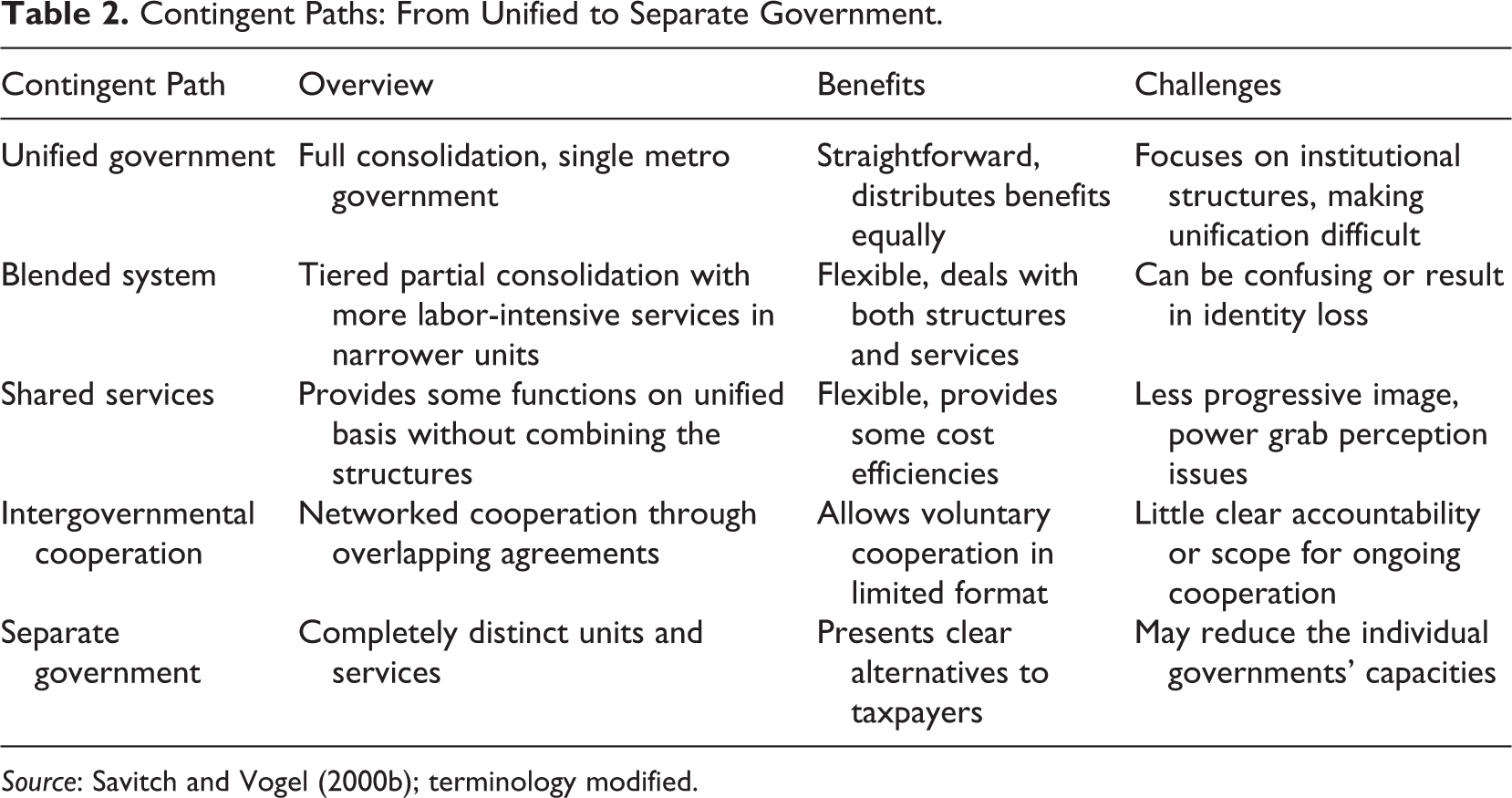
In addition to providing a way to check off the important goal and situational factors for a jurisdiction, by applying the interpretive guide found below, the checklist can help analyze contingencies for decisions about the best paths to follow to achieve the desired outcomes and address the strengths and weaknesses of jurisdictional situations. The guide helps to fit the factors above with five different contingent paths (unified government, blended systems, shared services, intergovernmental cooperation, and separate governance) that range from partial to full integration of jurisdictions (Savitch and Vogel 2000b; see Table 2).
Contingent Paths: From Unified to Separate Government.
Source: Savitch and Vogel (2000b); terminology modified.
These paths demonstrate the range of options available to local practitioners. The guide scores some of the goals and situational factors of the subject jurisdiction from the checklist tool to fit potential paths for the locality to achieve greater integration. With these possible outcomes in mind, practitioners can use the checklist tool to test which path might be the most desirable and practical fit for their jurisdiction.
Five alternative paths to integration that range in formality and intensity of cooperation are summarized in Table 2 (Savitch and Vogel 2000b). The five paths are arranged from most (unified government) to least (separate government) intense. The paths combine different degrees of formal, structural integration with informal, service integration, allowing for a more comprehensive array of alternatives for local governments considering opportunities for integration.
Scoring and Interpreting the Checklist
For each of the two sections (Value and Fit) of the checklist above, count how many first, second, and third rankings were given to each letter A through E, respectively. Then, multiply the count for each letter’s first, second, and third rankings by the value shown below in the associated column on the grid below (by 3 for first rankings, by 2 for second rankings, and by 3 for third rankings). Afterward, transfer the counts for each section to the appropriate letter on the grid in Table 3. Finally, total these counts in the appropriate cell under the column total, to the right.
Guide for Checklist Interpretation.
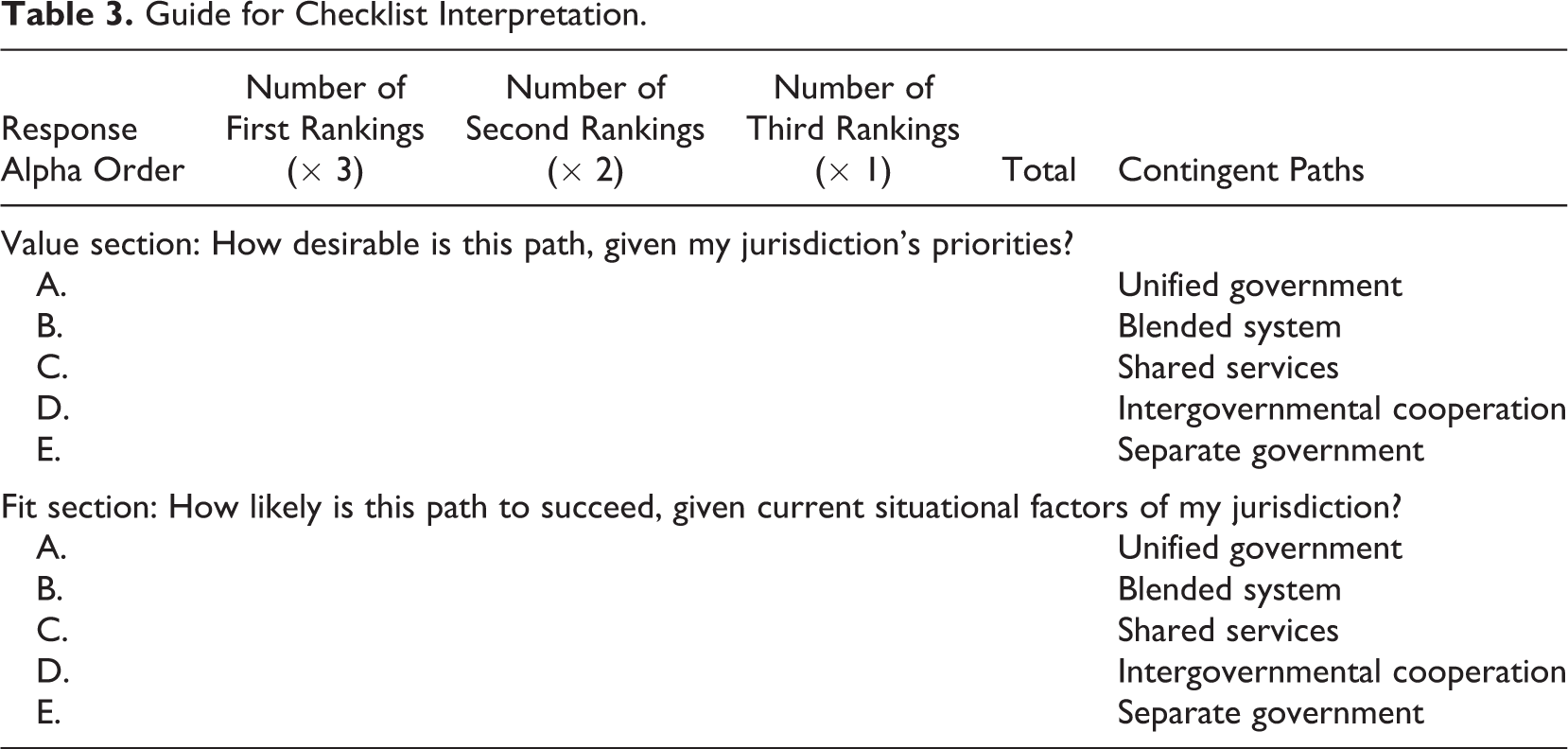
Higher totals indicate a better situational fit with a particular contingent path toward integration (from formal to informal ranging from full consolidation—unified government—to no consolidation—separated government). The first section (Value) of the guide scores the desirability of a path in respect to priorities for consolidation and the second section gives a rough estimate of the likelihood of the political success (Fit) of that path given jurisdictional characteristics.
One potential result is a match or near match between the scores for the contingent paths in each section. In this case, a jurisdiction’s circumstances are clear: taking the path indicated can both meet the goals of the jurisdiction and give them a good chance of being achieved. A second potential scoring result, opposed or nearly opposed scores for contingencies in each section, is clear as well, but somewhat more problematic. This scoring result may occur with some frequency because, as noted above, unified government (city–county consolidation) is a kind of default position for reform and improvement in local governments. In this case, the jurisdiction has three options: first, it can decide not to act at all and see whether priorities or situational factors change over time; second, it can attempt to shape public opinion to fit goals; and third, it can try to influence internal priorities to fit the political realities. Either undertaking will take some time, and the latter may wind up emphasizing political reality over operational efficiency. A third potential scoring result is that of a roughly equal distribution of scores for the contingent paths on the grid in one or both sections. In this case, action is inadvisable: the jurisdiction has a multiplicity of priorities, they are unclear, or the situation is politically divided or chaotic. In such a case, at the very least, priorities need to be worked on before any action can be taken.
Conclusion
This analysis has developed a practical checklist tool to assist practitioners in considering alternative approaches to local consolidation. The balance between the viability of the alternatives and the desirability of the outcomes of these alternatives needs to be considered for an optimum outcome. Since city–county consolidation efforts rarely succeed and efforts to pass major restructuring referenda are seldom without cost, smaller and midsized regional governments in particular may benefit from something other than the default approach of full consolidation.
The current literature on local governance emphasizes the importance of administrative efficiency and regional governance to combating the challenges in local public administration (Barnes 2010). It also emphasizes cases from high-population regions and most frequently explores full, structural consolidation efforts. A focus on how local governance can utilize degrees of structural or functional change provides local governments of varying sizes with options beyond a simple “yes” or “no” to full consolidation. The checklist developed in this piece above can assist local governments of diverse sizes in reviewing these options. Every tool used to apply theories to local realities has its limits. Future research could benefit from additional review of larger consolidations and from further applications of the checklist. Ultimately, though, looking past the too many units conversation allows local governments to focus on service efficiency. By considering coordination both within and across existing jurisdictional lines, this analysis expands practitioners’ tools for addressing alternatives beyond consolidation.
Footnotes
Declaration of Conflicting Interests
The author(s) declared no potential conflicts of interest with respect to the research, authorship, and/or publication of this article.
Funding
The author(s) received no financial support for the research, authorship, and/or publication of this article.