



Abstract
Governors are the most prominent political actor in state politics and a subject of continuous study by scholars. An analysis of the research produced over the past five decades reveals a pattern of topics investigated as well as trends in interest level of those topics. A brief review of some of the findings is presented as well as suggestions for additional research. Finally, a proposal to rethink how we study and evaluate governors is offered.
Keywords
Whether it is rejecting expansion of Medicaid under the Affordable Care Act or vetoing controversial legislation, governors in the current political environment receive considerable media attention. Is the attention paid to governors simply a popular media phenomenon or does it reflect the increased stature of governors as political actors? If the latter, has the academic community, in turn, responded by undertaking research to understand the implications of the heightened role played by governors? To understand the present state of research on governors, this article looks to the past to put the present into context, providing a 30,000-feet view of the research that has been conducted over the past fifty years. In so doing, research is placed into broad categories to gain a greater sense of the trends in the scholarship. Next, this article looks at selected topics to review some of the basic findings and offer suggestions for additional research. Finally, this article suggests that students of gubernatorial behavior need to learn a valuable lesson from baseball.
Five Decades of Gubernatorial Research
Table 1 presents an analysis of scholarship on governors over the past fifty years. 1 As can be seen in this table, members of the popular press are not the only people paying attention to governors. This investigation has uncovered over 532 manuscripts published over the past five decades that relate to governors. This is a much larger number than expected and the trend shows a significant growth in the research on governors. In the first two decades, 1966–1975 and 1976–1985, there were, respectively, fifty-three and seventy-five published manuscripts. Continued growth occurred in the next two decades. In the latest decade, 2006–2015, there has been an explosion of research on governors. More than 208 manuscripts were published; in other words, the last decade doubled the previous decade and saw an almost 400 percent increase in research relative to work completed in the first decade. A review of the literature reveals several trends with regard to research on governors. First, some topics have had less attention paid to them than one might expect and should garner more research. Administration, economic development, and gender would all fall within this category. In contrast, elections, as a topic, have been studied more than expected. The consistently high proportion of research focusing on gubernatorial elections and job approval is noteworthy.
Gubernatorial Research by Topic and Decade (1996–2015).
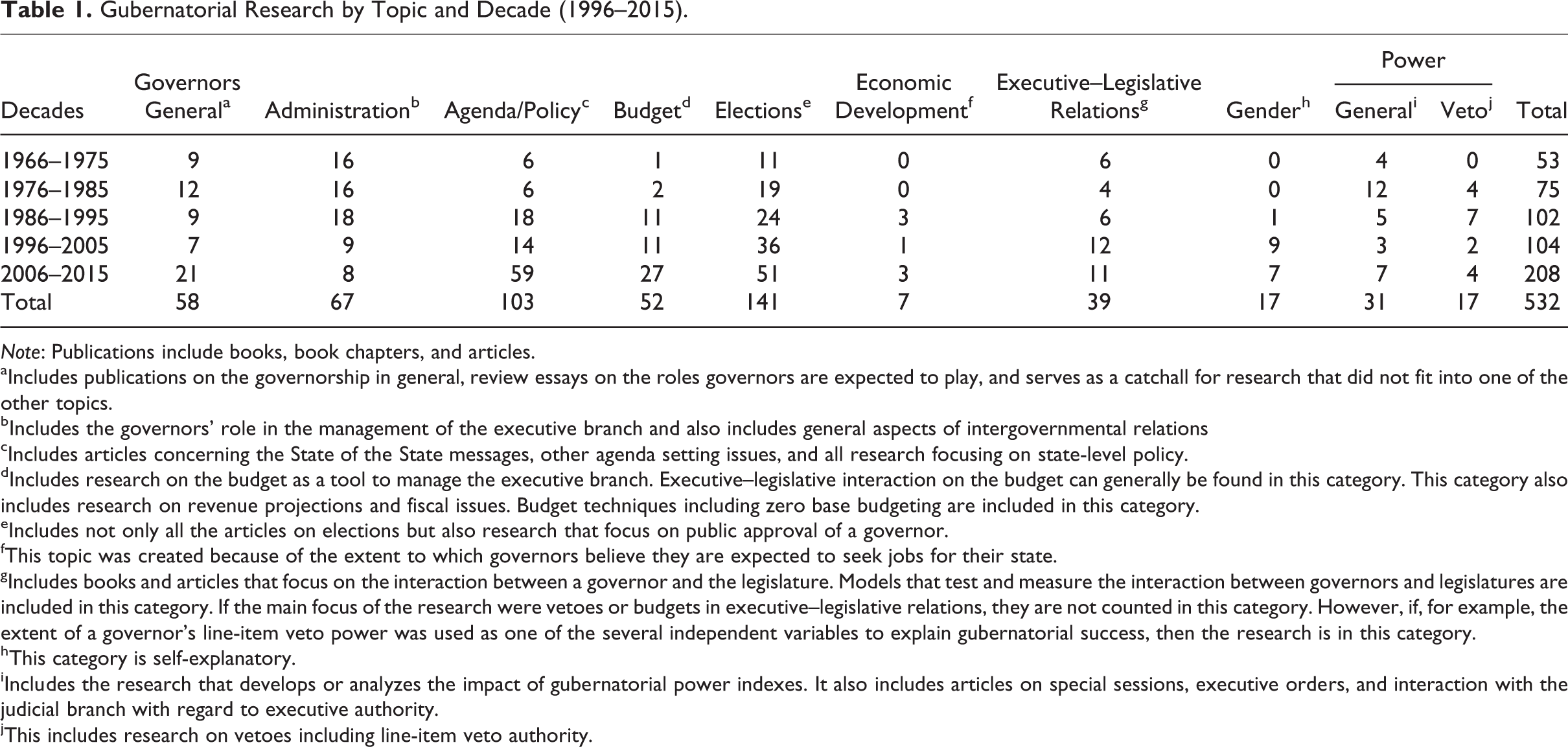
Note: Publications include books, book chapters, and articles.
aIncludes publications on the governorship in general, review essays on the roles governors are expected to play, and serves as a catchall for research that did not fit into one of the other topics.
bIncludes the governors’ role in the management of the executive branch and also includes general aspects of intergovernmental relations
cIncludes articles concerning the State of the State messages, other agenda setting issues, and all research focusing on state-level policy.
dIncludes research on the budget as a tool to manage the executive branch. Executive–legislative interaction on the budget can generally be found in this category. This category also includes research on revenue projections and fiscal issues. Budget techniques including zero base budgeting are included in this category.
eIncludes not only all the articles on elections but also research that focus on public approval of a governor.
fThis topic was created because of the extent to which governors believe they are expected to seek jobs for their state.
gIncludes books and articles that focus on the interaction between a governor and the legislature. Models that test and measure the interaction between governors and legislatures are included in this category. If the main focus of the research were vetoes or budgets in executive–legislative relations, they are not counted in this category. However, if, for example, the extent of a governor’s line-item veto power was used as one of the several independent variables to explain gubernatorial success, then the research is in this category.
hThis category is self-explanatory.
iIncludes the research that develops or analyzes the impact of gubernatorial power indexes. It also includes articles on special sessions, executive orders, and interaction with the judicial branch with regard to executive authority.
jThis includes research on vetoes including line-item veto authority.
Some aspects of research on governors have seen significant growth. Research on budgets has seen a steady increase reflecting an awareness that budgets are not only a spending document but also a policy tool. The study of governors as policy makers has been ripe for research because of the attention paid to some very public policy decisions made by governors and the issues those decisions pose for social scientists. As a result, scholarship on governors and policy was the dominant topic in the past decade. Finally, there are also topics that continue to be studied at a level one might expect because of the nature of the research. Research on governors in general, gubernatorial power and the veto can be included in this class.
Two additional points, not shown in Table 1, with regard to our understanding of gubernatorial research can be drawn from the over 500 compiled references. First, there are significantly more scholars studying governors today than fifty years ago. In the first decade, there were approximately two-dozen first authors listed on publications; in the 2006–2015 decade, there were over 160 different first authors on publications. Clearly, if the number of individuals publishing research on the governorship is any indication of a topic’s importance, then gubernatorial research has come of age. Second, the importance of governors as a subject of academic research has transcended the traditional suspect audience of scholars in political science and public administration. Research concerning governors is now being published in mainstream economics, education, and health-related journals, to name just three disciplines. In fact, more than six-dozen different journals published research in the past decade. In sum, research on governors has moved from being a narrow topic of interest to a few scholars to a subject investigated by a wide range of scholars across disciplinary boundaries.
What Do We Know?
The gubernatorial literature can be divided by topic of study. This article makes no attempt to discuss every topic in detail. In fact, the current review of the literature is limited to a discussion of three to five takeaways in each area of study. Further, suggestions for future research are made for each topic.
Governors and Budgets
There is considerable interest in the study of governors and their role in the budgetary process. Budgeting is a tool that lends itself to study since budgets require decisions and the interplay of a number of actors, especially the governor and a legislature. The result of using budgeting across the fifty states is a significant number of data points. The research on budgeting provides researchers several key takeaways: There are two different approaches to studying governors and budgets (Dometrius et al. 2013) with one using interviews and survey data (Abney and Lauth 1987; Goodman 2007; Dometrius and Wright 2010; Douglas 1999; Dometrius et al. 2013), while a second methodological path has researchers using large data sets to garner insight into gubernatorial influence in budgeting (Clarke 1997; Cummins 2012; Smith and Hou 2013; Thompson 1987). Regardless of the methodological approach, the research finds governors playing an important role in budgeting (Krause and Melusky 2012; Kousser and Phillips 2009; Thompson 1987). From scholars using survey data to work done by Sharkansky (1968) and Kousser and Phillips (2012), the conclusion is that governors play a dominant role. As Kousser and Phillips (2012, 152) state, “the chief executive’s proposed budget has a positive and statistically significant effect on the budget that is ultimately passed and signed into law.” In the budget process, the level of professionalism of the legislature, gubernatorial veto power, term limits, and partisanship are just a few of the factors found to have explanatory power (Dometrius and Wright 2010; Goodman 2007; Sharkansky 1968). There is some, though limited, research on how budget formats influence the budget process (Lauth 2014) and there is a very small body of research on how governors implement budgets once they are approved (Hale and Douglass 1977; Douglas and Hoffman 2004).
In future research, scholars may want to examine the governor’s role in each phase of the budgetary process. Specifically, there are four phases to budgeting and the governor is involved in all four phases. Therefore, scholars should investigate the following topics: Preparation: What type of instructions (to cut or increase spending) and formats does a governor use to influence the budget process? Lauth (2014) and others have conducted work on this, but more needs to be done. Moreover, research could explore activities that governors may undertake outside of the traditional budget instruction phase to alter agency budgets. For example, in late 2011, the Governor of Nevada sent representatives of higher education to a National Governors Association’s conference on metrics in higher education. After the conference, it became clear that budget allocations would change sooner or later to completion rates rather than an input measures: full-time equivalent. Approval: This is the area that has been most studied. However, we do not know the actual process governors use to control information between the executive agencies and the legislature. For example, in one state, the governor’s budget staff sit with every agency that goes before the legislature to ensure that the agency staff respond to legislative queries consistent with the governor’s budget proposal. Execution: The requirement for a state to have a balanced budget provides a governor the opportunity to make changes to the budget. One technique, available to most governors would be some form of impoundment authority. Douglass and Hoffman (2004) studied governors’ use of impoundments, but more on this procedure needs to be addressed. Is a governor’s involvement in the execution phase a management function or do governors use this phase of the process to alter programs and policies? Audit and evaluation phase: What do governors do after a budget year ends? States require agencies to use metrics in their budget documents (Willoughby 2004). Can governors, who serve limited terms, take a long-term perspective to effectively use those metrics to evaluate agencies and can they have policy implications?
Women in Gubernatorial Politics
The most important fact about women as governors is their scarcity. Over the five decades investigated, there have been 467 different governors and only 7 percent have been women. Unfortunately, the level of research on women reflects the fact that very few women have been elected to the governorship. Previous research, while limited, has come to several important conclusions: Research has shown women to be disadvantaged by media coverage in their race for the governorship (Kahn 1994; Bystrom, Robertson, and Banwart 2001; Banwart, Bystrom, and Robertson 2003; Jalalzai 2006). State-level political culture negatively affects females’ chances of winning the governorship (Windett 2014). Gender competes with party as a voting cue and can play an important role in voting (Plutzer and Zip 1996).
Scholars should continue to study the role of gender in gubernatorial politics by examining the following issues: Clearly more needs to be done on the career path for women and the governorship. Women win other statewide offices (Dolan 2001). Why does this not translate into more female governors? There are cases where men leave Congress for the governorship, but this does not seem to be as likely a political choice for women? (Not withstanding one prominent run by Kay Bailey Hutchison.) We have little understanding of the motivation to run for statewide races versus Congress? The focus of research, obviously, has been on the paucity of women serving as governors. This comes at the expense of fully understanding how women govern (Dickes and Crouch 2015). Research should more thoroughly examine whether women governors make a difference in style and in policy.
Administration
The research paid to the governor as manager is still sparse in spite of the fact that Hebert and Brudney (1988) maintained that the governor would play an increasingly important role with the then perceived devolution of government. Scholarship dedicated to the role of governors as administrators has enriched the literature by demonstrating: Governors, even if it is reluctantly done, play an administrative/management role (Abney and Lauth 1983; Cheek 1990; Polivka and Osterholt 1985). Governors can and do influence the bureaucracy through a variety of resources including both formal and informal powers (Dometrius et al. 2013; Hebert, Brudeny, and Wright 1983; Hebert and Brudney 1988; and Sigelman and Dometrius 1988). Governors have used executive orders as a tool to shape and control the bureaucracy (Bernick and Wiggins 1984; M. R. Ferguson and Bowling 2008). The governor is not the only constitutionally elected statewide official and the dynamics between these officials is shaped by several factors including partisanship and institutional capacity (Monardi 2003; Wall and Winder 1995; Winder and Hill 2006).
While previous research provides a solid foundation for studying governors in their role as managers, several questions remain unanswered: Does prior work experience influence a governor’s orientation toward his or her administrative responsibility? Do governors coming from the business world behave differently than governors with little management experience but significant policy experience? There is evidence that prior legislative experience aids in executive–legislative relations (Rosenthal 2012). Does prior business or management experience influence a governor’s ability to be the chief executive? Another potential research area could analyze the networks employed by governors to generate administrative reforms. For example, how much do governors rely on the National Governors’ Conference for strategies to improve the management of government agencies? On the other hand, do gubernatorial management reforms follow a diffusion of innovation process? Finally, research should focus on governors’ actual implementation of programs. Martha Weinberg’s Managing the State (1977) is one of the few in-depth studies on the role of a governor managing a program. Research that analyzes the gubernatorial decision on which programs to prioritize might aid in understanding their proclivity to manage and the policy implications for that decision.
Elections and Public Approval for Governors
Frankly, the number of publications on public approval (Hansen 1999; Beyle, Niemi, and Sigelman 2002) and elections provides evidence of how segmented the study of any topic can become and this author pleads guilty of not appreciating the extent and breadth of topics investigated by researchers with regard to election of governors. The research in this area has concluded that several factors affect how a governor’s constituents evaluate them during elections and in their time in office: The electorate evaluates governors on the economic well-being of a state (Adams and Kenny 1989; Stein 1990; Krause and Melusky 2014), but it is not as straightforward as predicted at the national level. Cohen and King (2004) found that as long as the state economy is better than the national economy, a governor is judged favorably regardless of the actual state performance. There is evidence that the electorate will employ noneconomic issues as determinants for voting, for example, crime (Cummins 2009), abortion (Howell and Sims 1993; Cook, Jelen, and Wilcox 1994), and the Affordable Care Act (Konisky and Richardson 2012). Other research on gubernatorial elections examines campaign spending (challengers are not always at a disadvantage; Bardwell 2002), challenger quality (Barghothi, Savchak, and Bowman 2010), and coattails, with at least one study finding that governors and presidents have somewhat of a reverse effect—presidents are actually negatively impacted by the publics’ assessment of a governor (Erikson, Folke, and Snyder 2015). Instability in the electoral environment as well as a repudiation of state-level politics between the two major parties serves as conditions for third-party candidate success (Lacy and Monson 2002; Best and Lem 2011).
Leal (2006) provides evidence that gubernatorial elections are different than other statewide elections.
Scholars could build on the public approval and elections literature by studying a number of issues: The really interesting question is: why? Why do people run for the governorship? What makes a federal judge give up his or her lifetime appointment to run for governor? Why does a former governor who has been out of office decide to run again? Minority party candidates win the governorship. We need a better understanding of how a minority party candidate can win the governorship? When this author asked a minority party governor how he won four times, he told me “the other party put up lousy candidates.” Is it as simple as that? There is some evidence in the literature that electoral success may translate into influence with the legislature (Morehouse 1996). If true, just how does that linkage work?
Governors: Agendas and Public Policy
Agenda setting is one of the key elements for a governor in setting policy (Schneider 1989). A governor’s State of the State messages (Crew and Lewis 2011; Weinberg 2010) can establish policy initiatives and set the tone for a legislative session. The policy topics used to study governors and policy are far ranging and include abortions, aging, immigration, environment, fracking, regulatory policies, and taxes. Education, welfare (Temporary Assistance for Needy Families), and the Affordable Care Act (relative to Medicaid) have by far come under the greatest scrutiny and are more likely to cross interdisciplinary boundaries. The literature on agenda setting, specifically, and public policy making, more generally, has determined that: Partisan politics plays an important role whether it is in the development of agendas or in a decision to accept, reject, or openly oppose a policy (Heidbreder 2012). In other words, Republican governors behave differently than Democratic governors. For example, only Republican governors have rejected the expansion of Medicaid as part of the Affordable Care Act (Barrilleaux and Rainey 2014; Haeder and Weimer 2013).
Barrilleaux and Berkman (2003) and others (Lewis, Schneider, and Jacoby 2015) have shown that governors’ spending preferences (policy preferences) are more likely to support “collective” policies rather than “particularistic” programs to aid in their electoral success. In a somewhat similar fashion, Fredriksson, Wang, and Mamun (2011) found governors supporting environmental policies that aid in keeping their job. Institutional factors associated with the office (i.e., governors’ budget authority) have been found to impact the policy process (Lewis, Schneider, and Jacoby 2015). There appears to be some ambiguity over the success governors have achieved in the policy process. For example, Rosenthal (2012) concludes that governors will usually be successful in the policy process while Kousser and Phillips (2012) maintain that a governor can be successful in the policy arena but less than when they focus on budget issues.
Future research should consider the following points: Research has primarily used State of the State messages as a source of understanding governors’ policy priorities. Scholars should look at governors’ budget messages and compare them to the State of the State messages. To what degree are they similar? If different, how are they different? Why do governors, during their tenure in office, seemingly change their position on a specific policy? The second-term Republican Governor of South Dakota, Dennis Daugaard (D. Ferguson 2015), proposed expanding Medicaid after earlier in the year rejecting the idea. There are at least three questions from this action that can lead to a variety of research projects. Do governors in their second term, their “legacy” term, move significantly away from policy positions they took in their first term? If so, is it because they are free from electoral retribution or could it be that they actually want to create a legacy? Perhaps it has nothing to do with their legacy. They may shift their position on a policy because they know the legislature will reject the policy so there is no harm in changing their position. In other words, was a governor’s shift purely a political calculation? There are a number of articles using multivariate analysis to explain gubernatorial policy making. However, the research does little to aid us in understanding why and when governors deviate from the analytical models’ predictions. For example, why have two out of the last three Republican governors of Nevada supported significant tax increases?
Power
The use of power has been a central focus in the study of politics and gubernatorial power is no exception. Perhaps the most important investigation into this topic was published prior to this five-decade retrospective. Joseph Schlesinger (1965) introduced the idea of developing a measure of gubernatorial power: index of gubernatorial power. Within the index, Schlesinger identified four formal powers believed to be important for governors including appointment, tenure, budget, and veto. The index has been updated and now consists of six power elements (Beyle and Ferguson 2008) and has been a source of scrutiny ever since its development (Beyle 1968; Dometrius 1979; Mueller 1985; Krupnikov and Shipan 2012). This scholarship has shaped the collective understanding of gubernatorial power in a number of ways: The utility of studying gubernatorial power has been validated by numerous studies. However, there has been an unequal treatment of the components used in the index with the veto and budget powers receiving the greatest attention.
Krupnikov and Shipan (2012) demonstrate that how one measures budgetary power makes a difference. The veto has been studied extensively and found to be important (Constantelos 2014; Herzik and Wiggins 1989; Sharkansky 1968). Those governors who possess the line-item veto have an additional bargaining tool and a means to help with their policy priorities (Alm and Evers 1991; Lauth and Reese 2006). Informal powers are a resource for governors (Bernick 1979; Rosenthal 2012).
While the topic of power has received a great deal of scrutiny in studies dedicated to governors, there is still more to learn. Future scholarship should explore several issues: Not all of the elements of index have been scrutinized at the level of the veto and budget powers. For example, the power of appointment is not a minor component in administering the executive branch. Governors, even when the legislature is of the same party, are jealous at the possibility of having to share the appointment power. Governors are not afraid to bring suit against the legislature when they believe the legislature has encroached on this right (Crowell 2015). A better understanding of the governors’ appointment power and how it is used needs to be undertaken. For example, does a governor’s ability to appoint individuals to boards and commissions lead to different policy decisions by those boards?
Kousser and Phillips (2012) indicate that a governor’s legacy year makes a difference in negotiating with the legislature. However, what happens to governors if they have no legacy year (in twelve states, governors are not term limited)? In other words, we need a broader and deeper understanding of tenure. There are other formal powers at a governor’s disposal that have received inadequate attention including executive orders and special sessions. While executive orders may seem mundane, they are anything but trivial (Gakh, Vernick, and Rutkow 2013). For example, as soon as John Bel Edwards officially took office as Governor of Louisiana, 2016, he issued an executive order expanding Medicaid (Kelly 2016). Scholars should examine when governors issue an executive order, how often are orders used as a substitute for a governor’s inability to influence the legislature, and to what degree are orders rescinded by subsequent governors and which ones? Another formal power at a governor’s disposal is the ability to call the legislature into special session and, in some states, limit the subjects of the session (Bernick 1994). A number of governors have called the legislature back into session to put the legislature under the public microscope. For example, Lamar Alexander (1984), when he was governor of Tennessee, called the legislature into session to achieve education reform. In his call for the session, the governor noted that the legislature needed to address education in a special session because “our children our special” (Alexander 1984). When and how special sessions are used to achieve a governor’s policy initiative need additional attention. Perhaps the most important power available to a governor is his or her own interpersonal skills. Most, if not all, governors have a good sense of who they are and have a high level of efficacy (Rosenthal 2012). We need to better understand how and why a governor’s sense of self leads to an ability to cajole other political actors to go along with him. In other words, we must move beyond focusing on only institutional powers.
Executive–Legislative Relations
The numbers of studies in the executive–legislative relations category are skewed by the classification scheme and the rule of not double counting. Many of the articles on budgeting, gubernatorial power (especially the veto), and policy could have been counted as research on executive–legislative relations. However, some of the most comprehensive work on governors falls in this category including Rosenthal’s The Best Job in Politics (2012) and Kousser and Phillips’s The Power of American Governors (2012) as well as Ferguson’s article “Chief Executive Success in the Legislative Arena” (2003). The literature on executive–legislative relations has informed our knowledge in the following ways: Studies of executive–legislative relations often, though not always, seek to determine the success level of governors. Success is measured by creating a “batting average” for a governor with the number of gubernatorial bills passed divided by the number of bills (gubernatorial initiatives) introduced. (Kousser and Phillips 2012; Rosenthal 2012). Research has demonstrated that gubernatorial success is neither automatic nor uniform. Some governors fail even though they may have the tools to succeed while other governors who are deemed “weak” succeed (Kousser and Phillips 2012, 132). Several factors help explain gubernatorial success or failure. Kousser and Phillips (2012) determined that characteristics of the governor matter. (i.e., tenure in office, approval ratings, and legislative experience). Governors in their first term and with higher levels of public approval seem to do better in achieving their goals. Formal powers (Bernick 1979; Beyle 1968) as well as other elements of the office including staff also make a difference. M. R. Ferguson (2003) found “the success of gubernatorial proposals can be attributed to the characteristics of the legislature rather than to the actions of the governor and his or her office” (p. 171). The institution is important (Lewis, Schneider, and Jacoby 2015). Unified or divided party control of the two branches as well as interest group activity makes a difference (Jacoby and Schneider 2001; Bernick and Bernick 2008; Bowling and Ferguson 2001). Rosenthal (2012) makes a strong case that gubernatorial behavior is shaped by the economic well-being of the state. Governors are strategic in what and how much to propose (M. R. Ferguson 2003; Rosenthal 2012) and when to bargain (Kousser and Phillips 2012).
Several topics, however, regarding executive–legislative have yet to be fully examined:
Kousser and Phillips (2012) have developed a comprehensive statistical model to explain gubernatorial success but recognize, in the end, that there are “idiosyncratic factors” (p. 65) and “too many moving parts” (p. 105) to capture all of the dynamics that happen between a governor and the legislature. But, understanding the interplay between a governor and a legislature is precisely what needs to be done. I would suggest that perhaps more mixed methods analysis of executive–legislative relations would be beneficial. If governors are strategic, and they are, then they may seek success over time rather than a single legislative session. In an interview with Governor Cecil Andrus, a former Governor of Idaho, he indicated that he had a three-year plan to pass a particular piece of legislation (Cecil Andrus, personal interview, 1975). In the first year, the concept would not even be considered. In the next session, the proposal might get a hearing, and by the third session some form of the legislation might have a chance of passage. Thus, it might be well to consider evaluating executive-legislative relations over time rather than in a single session. Scholars assume that governors want to be actively involved with the legislature. This may be an incorrect assumption. How does a legislature react to a governor who is either disinterested or negatively oriented toward working with the legislature?
Baseball Has It Right
While scholars have paid a considerable amount of attention to the office and role of the governor, future research on the performance of governors could benefit from thinking about baseball analytics. The first thing someone needs to know is that baseball measures and keeps track of a significant amount of data. Thus, there are data collected for each player (both offensively and defensively), every team, and even ballparks. The connection between baseball analytics and studying a governor’s performance can be highlighted by focusing on the data collected for pitchers. The baseball analytics people collect information on every pitch thrown including the type of pitch thrown, its velocity, and movement. That information, along with the results of the pitch, is employed to create a series of metrics used by managers, analysts, and fans to understand the value of every pitcher. One analytics site has more than seventeen different pitching facts, statistics, and analytical measures. Four evaluative measures of pitchers, specifically, may assist us in comprehending how baseball thinking can translate into our understanding of governors.
The first two measures (
Two other baseball analytics provide additional insight to how we should think about gubernatorial performance. The first is called wins against replacement (WAR) or WARP (wins against replacement player). In other words, baseball says one way to measure a player’s overall value is to determine how many wins can be attributed to the pitcher as opposed to a “replacement player” pitcher. Why is this important? Perhaps we should be evaluating each governor relative to a typical governor. In other words, saying that the current Governor of Kansas, Sam Brownback, is successful is somewhat meaningless if the average, or typical, governor could have achieved the same results. How much more value does a specific governor add to achieving policy objectives than a typical governor given the composition of the legislature, the nature of the state, and the tools available to him or her? In this measure as with the measures discussed above, one might want to look at governors relative to other governors and perhaps use Z scores. The final analytic, NERD, was a measure created because baseball enthusiasts sought to determine what makes a baseball game, or for our example, pitchers “aesthetically appealing.” Some pitchers are more fun to watch than others. Baseball fans enjoy watching pitchers throw strikes especially when a batter swings and misses; on the other hand, pitchers who throw balls make the game boring. Anyone who studies governors knows that some governors are more interesting than others. For example, the Governor of Nevada, Brian Sandoval, came into office with solid conservative credentials and then proceeded to accept Medicaid expansion as well as convince a legislature controlled by fellow Republicans opposed to taxes to approve a significant tax increase. Why and how he has “governed” is interesting and may provide greater insight into the job a governor undertakes. In other words, Sandoval might get a really high NERD score.
Conclusion
In sum, students of state politics have conducted an extensive level of research across a wide range of topics. We know significantly more about the governorship and those who have held the position because of the research conducted in the last few decades. But, there is still more research that can be undertaken to better understand the governor’s role in state politics and policy. Scholars should make a distinction between the office of governor and the individual who holds that office. In studying the individual, scholars need to think about how we can better measure governors’ performance. In that effort, new measures should be created, requiring the collection of additional data. Moreover, research should consider a governor’s performance both at a single point in time and over a term. Finally, information needs to be collected that allows us to learn more about processes. While a significant amount of research has been undertaken over the past five decades, there is room for scholars to come together to develop a better understanding of the governor in state politics.
Footnotes
Declaration of Conflicting Interests
The author(s) declared no potential conflicts of interest with respect to the research, authorship, and/or publication of this article.
Funding
The author(s) received no financial support for the research, authorship, and/or publication of this article.