



Abstract
Municipal takeovers proceed by a state declaring that a municipality is in fiscal crisis and placing it in receivership, handing over most local processes to a state-appointed manager. This policy of aggressive state intervention calls into question two principles of local autonomy enshrined in home rule: that allowing local matters to be handled by local authority removes the need for state special legislation and that giving local governments functional autonomy allows them to solve problems without state intervention. This article presents case studies of New Jersey and Michigan to examine differences in home rule protection as well as approaches to municipal takeover.
Many U.S. local governments have been unable to cope with the financial pressures of ongoing economic disinvestment and, more recently, the Great Recession. Some “municipal failures,” like Stockton and San Bernardino, California, have taken local decisions leading to bankruptcy and financial reorganization. Yet, other cases like Detroit and Benton Harbor, Michigan, East St. Louis, Illinois, Chelsea, Massachusetts, and Camden, New Jersey, have resulted in reduced local autonomy with intervention by the state, referred to here as “municipal takeover.”
Municipal takeovers proceed by a state declaring that a municipality is in fiscal crisis and placing it in state-led receivership handing over most local processes to a state-appointed manager. This effectively removes authority from local elected officials. In so doing, municipal takeovers raise doubts about the value and importance of community control. These policies also call into question two principles of local autonomy enshrined in home rule: that allowing local matters to be handled by local authority removes the need for state special legislation and that giving local governments functional autonomy allows them to solve problems without state intervention.
This article presents case studies of New Jersey and Michigan to examine differences in home rule protection from and the approaches to municipal takeover. Both states have utilized municipal takeover policies in recent years and illustrate important phases in the development and erosion of home rule legal concepts and approaches to municipal takeover. This article begins by laying out the development of home rule, explaining the two basic types. Then it presents the approaches—mix of key parties and tools—for the mechanisms used in municipal takeovers. It goes on to apply these ideas to the evolution of home rule and municipal takeover in the two state cases. Finally, it presents lessons drawn from these cases, which can be used to understand similar situations.
Municipal takeovers highlight the paradox of local–state relations in that strong state interventions suspend and restructure local government and restrict local autonomy, however, these cities are eager to secure state support. Distressed municipalities are placed in a precarious situation: they need and accept subsidies from their states, but in so doing further limit their decision-making autonomy. Municipal takeovers represent the clash between the need for intervention and the value of local decision-making. What are the legal frameworks that allow state power to trump local, community control? The following section focuses on the legal concept of municipal home rule and its relevance to municipal takeover.
Home Rule: Legislative and Constitutional
Home rule is the “legal device” used by local governments to assert at least partial autonomy from the state (Vanlandingham 1968). In the United States, “only national and state governments…enjoy [Federal] ‘constitutional legitimacy’” (Libonati 2006, 817). Given their subordinate status and lack of federal “constitutional legitimacy,” American municipalities obtain their existence and authority from their state constitution or state legislature. In the absence of a state provision for home rule, local governments are subject to state legislative control. It varies by state (Krane, Rigos, and Hill 2001).
Home Rule can be best understood as legislative or constitutional. In Legislative Home Rule states, “municipalities derive their power by legislative grant” (Burg 2006, 424). In other words, the power of local governments “is purely subject to the will of the state, and may be altered or removed at any time simply by amending the law” (Burg 2006, 424). Nevertheless, some Legislative Home Rule states have protections in their state constitution and laws against legislative interference in local government affairs. For example, New Jersey is a Legislative Home Rule state. Its constitution restricts it from “pass[ing] any private, special or local laws” or “Regulating the internal affairs of municipalities formed for local government” (New Jersey Constitution, Article IV, Section VII, p. 9). Such restrictions on passing special legislation and ensuring that the state legislature can only pass laws that apply equally to all towns and cities is a common home rule mechanism.
Other states, including Michigan, have stronger municipal protection in the form of Constitutional Home Rule. In this instance, the Home Rule powers of the local government are codified, and “bestow upon municipalities the authority to act in certain areas independent of state authorization” (Haas 2006, 683). The legislature cannot seize municipal power, without a constitutional amendment (Vanlandingham 1968).
While most states have adopted some form of home rule protection, “cities are free of state control under home rule only on matters purely local in nature” (Frug 1999, 17). When it comes to economic matters, states have fiscal oversight for local and municipal governments. Therefore, municipal takeovers are a mechanism of state fiscal policy, allowing the State to supersede home rule protections, even in constitutional home rule states.
Municipal Takeover Approaches
A municipal takeover is defined as the state-directed policy of declaring a municipality to be in a state of fiscal emergency and intervening by (1) placing the municipality under state receivership, (2) handing over control of most or all local government decision-making to a state-appointed manager, effectively relieving local elected officials of their governing authority, and (3) implementing a combination of tools to stabilize the local government’s fiscal condition. Municipal takeovers are a policy of last resort, used when both local government and the local economy are unstable and crisis prone. A state’s concern regarding credit downgrades, municipal bankruptcy, and fiscal contagion are common motivations for strong intervention (Pew Charitable Trusts 2013; Spiotto 2012). Wolman et al. (2007) highlighted this concern, noting “cities whose economies are stagnant, whose residents suffer from poverty and unemployment, whose budgets are in chronic fiscal stress, and who require state aid to sustain basic services are a drag on the entire state economy” (p. 1).
Takeover Laws
While Michigan and New Jersey’s use of municipal takeover laws are more recent, the roots of municipal takeover date back to the late nineteenth century. Between 1850 and the mid-1930s, municipalities struggled to meet their debt obligations. By 1935, there were 3,251 municipalities that had defaulted (Monkkonen 1995). Missouri was the first state to create a process for “state-imposed receivership,” but the first state-imposed takeover took place in Memphis, TN in 1880 (Kossis 2012, 1117). The takeover was “so controversial that it resulted in a challenge to the state receivership law in Meriwether v Garrett” (Kossis 2012, 1117). 1 In Meriwether, the court ruled that the state had a right to force the city into receivership, noting “the receiver appointed by the court was invested with larger powers than probably any officer of a court was ever before intrusted [sic] with.” Of particular importance to this article is the court’s statement on municipal governments and the right of a state to repeal a city’s charter, parroting Dillon’s Rule: “Municipal corporations are mere instrumentalities of the State for the more convenient administration of local government. Their powers are such as the legislature may confer, and these may be enlarged, abridged, or entirely withdrawn at its pleasure” (Meriwether v. Garrett 1880, emphasis added). Thereafter, Kossis (2012, 1117) argues, “states fell into a pattern of imposing receivership on fiscally distressed cities” thus diminishing the objections raised by local governments.”
By the mid-1930s, municipal defaults had become a national problem, and as a result, the federal government passed the Municipal Bankruptcy Act of 1934 (and 1937) to provide a mechanism for orderly debt adjustment for municipal governments. While the new legislation offered support to local governments, states continued as they had previously to intervene. Some states took complete control of local governments that were in fiscal distress, placing them in state receivership (Berman 1995). In Oregon, for example, the state legislature responded to local fiscal crises brought on by the Great Depression by passing legislation that allowed state courts to place municipalities that defaulted on their bond payments under receivership (Kossis 2012).
When the 1970s brought another cycle of urban fiscal distress, cities such as New York, Philadelphia, and Cleveland, were placed under financial oversight, renewing discussions over the benefits of strong state interventions. It was during this time, that many states developed local financial emergency laws in a proactive attempt to cope with the consequences of local financial emergencies (Kloha, Weissert, and Kliene 2005). State legislatures viewed these policies as necessary precautions to avoid municipal bankruptcy, credit downgrades, or fiscal contagion. Moreover, the Kloha and colleagues note, the state is legally obliged “to ensure that local governments are meeting their contractual obligations to provide services to citizens” (Kloha, Weissert, and Kliene 2005, 238).
Parties Responsible under Municipal Takeover
Under municipal takeover, the state has the authority to remove elected officials from office or suspend their decision-making powers and appoint a manager or board that is not democratically elected. The state-appointed manager has “broad authority…[including] firing public employees, selling municipal property, reducing public services, or reorganizing the structure of local government” (Kossis 2012, 1110). However, municipal takeover policies vary greatly from state to state.
Only about two-fifths of the states (19) have some form of intervention laws on the books: Connecticut, Florida, Illinois, Indiana, Maine, Massachusetts, Michigan, Nevada, New Hampshire, New Jersey, New Mexico, New York, North Carolina, Ohio, Oregon, Pennsylvania, Rhode Island, Tennessee, and Texas (Pew Charitable Trusts 2013). Of these, three states, Connecticut, New York, and Massachusetts, are special legislation states that address local fiscal concerns on a case-by-case basis. The remaining sixteen, including Michigan, have general legislation in place to monitor and address local fiscal conditions (Pew Charitable Trusts 2013; Scorsone 2014). Moreover, some states are more aggressive than others in how they intervene: some simply monitor fiscal conditions, while others allow for stronger forms of state intervention. There are three broad categories of “groups responsible” for state intervention, as identified by Pew Charitable Trusts (2013). Cahill and James (1992) noted that “the most extensive form” gives state officials the power to “supplant local decision making authority” (Cahill and James 1992, 91). Here, I refer to this form of state intervention as municipal takeover.
Many states that began adopting state intervention laws in the 1970s in the wake of New York City’s fiscal crisis, have continued to revise their laws. Ohio, for example, first adopted its emergency financial law in 1978 to address the fiscal crisis in Cleveland, but updated its law in 1996 to include townships and counties (Scorsone 2014). In Rhode Island, the state intervened and adopted general legislation after the city of Central Falls attempted to file for municipal bankruptcy. Both Michigan’s and New Jersey’s laws, much like the others, have evolved overtime.
Takeover Tools
State intervention, including takeover policies, also vary in terms of the tools available under the law. Pew Charitable Trusts (2013) identified six “intervention practices” utilized by states (see also Cahill and James 1992; Weikart 2013). Some states, like Michigan and New Jersey for example, allow for a single individual—whether they are called a receiver, a chief operating officer (COO), or an emergency manager (EM)—these individuals have sole authority to “take charge” of the local government’s budget and operations (Pew Charitable Trusts 2013). Figure 1 highlights the differences in both the responsible parties and the intervention tools.
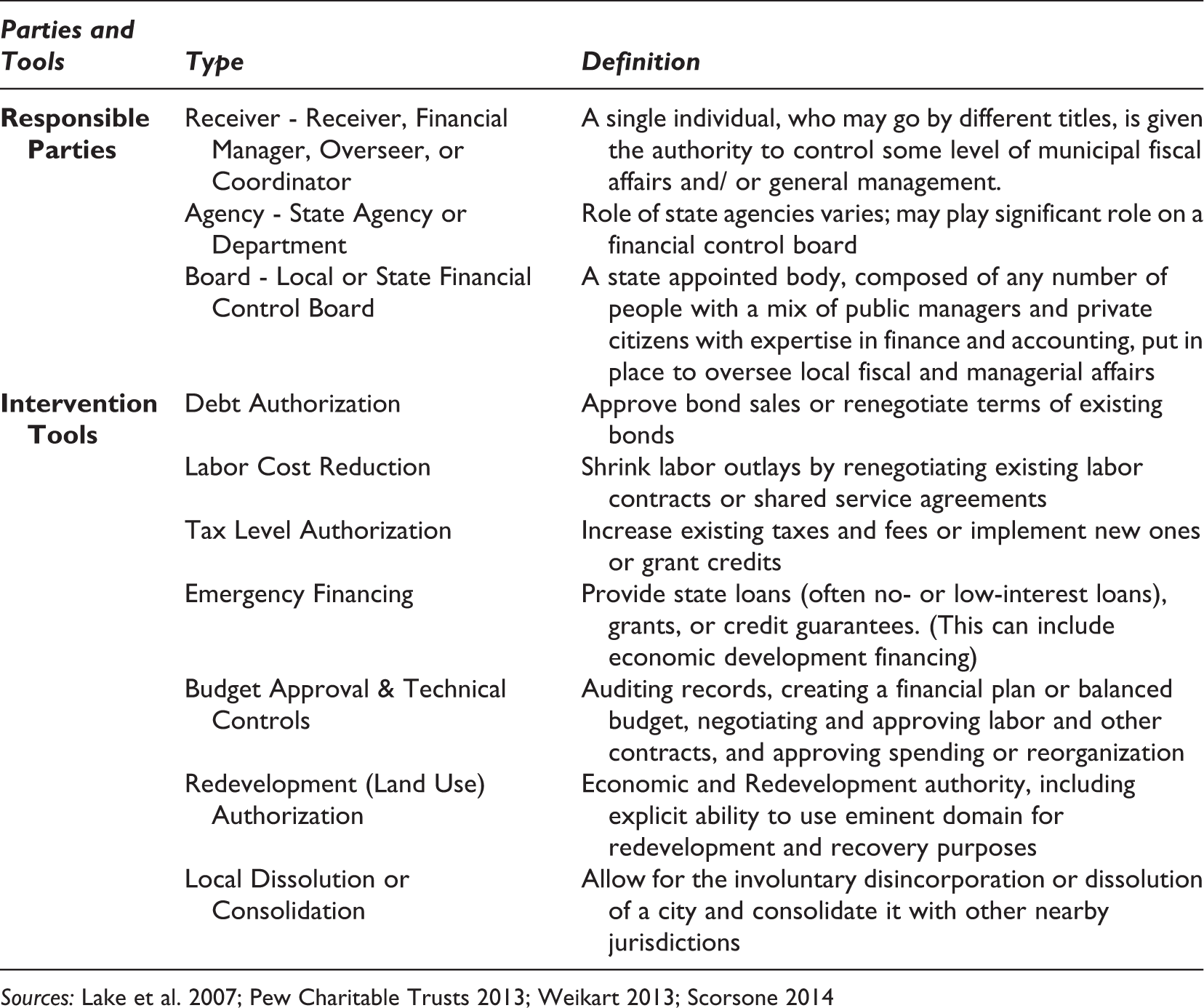
Approaches to state takeover.
The history of municipal takeover policy, its development, and its application has evolved overtime. The design of the policy varies across states, in terms of the powers provided to the party responsible, as well as the tools and strategies provided for under law. Moreover, the tensions between fiscal stability and local control have long framed the debate about whether states should intervene in local affairs, and if so, the extent to which the state should wield its power.
Case Studies: Home Rule Erosion and Municipal Takeover in New Jersey and Michigan
To understand the context of municipal takeover, this article provides a comparison of New Jersey and Michigan; two states that have utilized municipal takeover yet differ in their home rule legal structure. This analysis shows how home rule laws, in both New Jersey and Michigan, have been insufficient to shield local government from municipal takeover in both states. This analysis highlights the relationship the development of municipal takeover policy in both states.
New Jersey
New Jersey has one of the oldest state intervention laws, dating back to the Great Depression, but legislators significantly revised it by passing the Municipal Recovery and Redevelopment Act (MRERA) in 2002 to address the ongoing fiscal crisis in Camden. Further revisions of the law are being considered to avoid a municipal bankruptcy in Atlantic City by giving the state the power to alter union contracts (King 2016; Marcus and Livio 2016). New Jersey is also a Legislative Home Rule state.
Home Rule and Erosion in New Jersey
New Jersey’s current state constitution, adopted in 1947, limits legislative interference and promotes local autonomy. The New Jersey State Constitution states, “any law concerning municipal corporations formed for local government, or concerning counties, shall be liberally construed in their favor” (Article IV, Section VII, p. 11). This rule “works essentially to resolve doubts about local government powers in favor of their existence” (Williams 1997, 124). New Jersey’s Legislative Home Rule is also supplemented by the Home Rule Act of 1917 that grants broad authority, including police power, to local governments (Wagner v. Newark 1957). 2 Local governments and their electorate have the option to choose their own form of government (Faulkner Act 1950). 3
Nonetheless, both Legislature and courts have whittled away at the foundations. Legislative restriction of municipal power predates the New Jersey constitution. The Municipal Finance Commission (MFC) was passed in 1933. In 1947, the same year as the adoption of the state constitution, the Local Government Supervision Act (LGSA) was adopted in response to municipal defaults. It allowed the state to intervene in local government affairs or place “special restraints upon municipalities” that are in fiscal distress. In the 1950s, the state adopted the New Jersey Municipal Budget Act and Local Bond Law and Fiscal Affairs Law requiring municipalities to report all aspects of their budget and bonding procedures. Also, the Local Expenditure Law limited local government budget increases to 2.5 percent or the cost of living. Too, judicial opinions have undercut Home Rule in New Jersey. The New Jersey Supreme Court ruled against Newark’s Home Rule ability to institute its own rent controls (Wagner v. Newark 1957). New Jersey Chief Justice Weintraub supported legislative discretion in home rule applicability (Inganamort v. Borough of Fort Lee 1973). 4
The Evolution of Municipal Takeover in New Jersey
In New Jersey, the approach to state intervention has consisted largely in the use of a combination of State Agencies and Local Boards as management principles to lead intervention, conduct studies, and submit findings for state action. Findings have been left in the hands of state-constituted local boards. In turn, these local boards have the authority to appoint managers for the local government. Intervention is executed within the context of local governance and local government, rather than initiating and imposing policy from without.
In New Jersey, the roots of municipal takeover legislation go back to the LGSA which established the State Department of Community Affairs with authority to oversee municipal finances, audit, intervene in local affairs, and place distressed locales under the oversight of the MFC or a Local Finance Board (LFB). Currently, the legal mechanism for municipal takeover is the MRERA adopted in 2002 to deal with a structural deficit and dysfunctional governance culture, in Camden, New Jersey.
MRERA and Camden
Camden proved to be a significant challenge to the established system when in the 1990s, a response to Camden’s ongoing fiscal and governance problems became crucial. Using 1992 legislation on oversight for mismanaged municipalities receiving state aid, the state began investigating a takeover of governmental functions in Camden (Gillette 2005). In 1997, a financial review board was convened to assess the scope of Camden’s fiscal problems. Political conflicts over the state’s right to intervene erupted between the Republican Governor, Whitman, and the Democratic Milton Milan, the Democratic Mayor of Camden.
After investigations and hearings, the LFB appealed to the attorney general to file an application under the LGSA for judicial determination of “gross failure” by the city and allowing the LFB to appoint a business administrator (City of Camden v. Kenny 2000). 5 The city filed suit to stop the appointment of business administrator, and in the interim hired their own manager, claiming the state “does not have the power to appoint a business administrator for a municipality pursuant to the Supervision Act” and that such intervention was unconstitutional because it disenfranchised voters (City of Camden v. Kenny 2000). The court found that appointing a business administrator is within the legal purview of the LFB under the LGSA. Moreover, the court found, the “so-called Home Rule tradition in this State, strongly relied upon by the City, is not founded on our Constitution or any statutes pertinent to this circumstance.”
Against advice, Mayor Milan filed for bankruptcy on behalf of the City of Camden in July 1999, although in New Jersey, municipalities must have approval of the state to file for bankruptcy; another limitation on Home Rule. Not long after, Mayor Milan was indicted on charges of corruption and removed from office.
On the heels of Milan’s removal, the New Jersey Supreme Court ruled in City of Camden v. Kenny that the state’s authority to intervene was complete. Governor Whitman (representing the Republican party) immediately put forward legislation for a full takeover of the city. It called for appointment of a chief management officer, “who may override any action of the governing body if the chief management officer determined that the action is contrary to the rehabilitation and supervision of the municipality” (Gillette 2005, 196). The legislation and its bold assertion of power caused further conflict between the Republicans and the Democrats. For example, State Minority Leader Richard Codey stated that “it is simply wrong to tell voters in New Jersey that they might wake up one morning and discover their votes don’t count anymore” (Vassallo 2001, 213). Opposition also came from the New Jersey League of Municipalities, “fearing a bad precedent for state intervention” (Gillette 2005, 196).
State creation of the MRERA
By 2001, however, the city of Camden was drawing US$52 million in state aid each year (Vassallo 2001) and as Gillette (2005, 193) notes, though the state provided the financial stimulus, “annual city audits repeatedly emphasized administrative problems that Camden officials simply ignored.” The inability of the state to address the city’s structural deficit and mismanagement of local government highlighted some of the limitations of the state intervention system under LGSA and was the impetus for the eventual creation of the MRERA.
In 2001, State Senator Wayne Bryant introduced the Camden Rehabilitation and Economic Recovery Act (CRERA) bill to address the perceived shortcomings of the LGSA. The bill preserved some mayoral powers, including making appointments and initiating ordinances and resolutions, but introduced the idea that a COO would be appointed by the state for five-year terms. The COO would be responsible for “reorganizing governmental operations of the City of Camden in order to assure the delivery of essential municipal services and the professional administration of the municipal government” (Vassallo 2001, 216). However, to avoid legal challenge of “special legislation,” CRERA was renamed the Municipal Rehabilitation and Economic Recovery Act (MRERA) and was established as a general law, under which any municipality in the state (including school systems) would be covered. The MRERA was adopted and implemented in Camden with little initial resistance (Gillette 2005; see also Kromer 2010).
The New Jersey Approach to Takeover
As the case above illustrates, the New Jersey approach to state intervention leading to municipal takeover is fairly straightforward. It results in a takeover process that is more an intervention into local affairs than a wholesale appropriation of local power to the responsible state parties. Likewise, it limits the tools at the disposal of the executing party.
Responsible parties
The parties responsible for a local takeover are multiple and hierarchical in New Jersey. Under the MRERA, the key actors are the State Department of Community Affairs and a state-constituted local body or board which examines finance and operation. The former initiates the intervention of the latter which conducts studies and submits findings on local financial and governance deficiencies. The appointment of a local “manager” is triggered by these findings which effectuate the takeover. Nevertheless, although the executive powers of the state-appointed manager, a COO, include approvals or overriding local action, as the name of the position implies the focus is on operations. This limits the power and authority of the executive responsible for the day-to-day operation of the takeover. In some respects, the New Jersey COO is as much a supervisor of ongoing operations as a receiver or chief administrator. The COO model is one of state intervention and supervisory management rather than full-blown administrative responsibility.
Intervention tools
For the greater part, the intervention tools available to the state-appointed COO are in line with the conception of a focus on ongoing operations. Accordingly, the COO relies on debt and tax authorization and budget and technical control interventions to effect local change (see Figure 1). The COO has the power to approve or authorize local actions to make changes in tax and debt levels as operational inputs. Likewise, the power of budget authorization allows control and oversight of expenditure and output. Administratively, the COO has the ability to reorganize local operations for efficient service delivery and to ensure efficient government. These are as much technical adjustments as they are modifications in governance.
In Camden, the tool that garnered the most criticism, and ultimately led to a legal suit which the residents won, was the explicit ability to use eminent domain for redevelopment and economic recovery purposes (Lake et al. 2007); which in the Camden case would have displaced more than 1,000 residents (Ott and Graham 2004).
Michigan
Michigan is home of the Emergency Financial Manager Law and has gotten media attention regarding its municipal takeover policy. In fact, Michigan has the most aggressive state intervention policy (Scorsone 2014). Interestingly, Michigan was also home to one of the most avid supporters of municipal autonomy and home rule: Supreme Court Judge Thomas Cooley. As Evan Gross (2011) notes, Michigan is “a state of [constitutional] home rule, local autonomy, and emergency managers” (emphasis added); the latter a result of decades of home rule erosion perpetuated not just by the legislature and the courts but by cities themselves.
Home Rule and Erosion in Michigan
Michigan is considered a strong Home Rule state (Citizen’s Research Council of Michigan 1994). The state constitution states, “city and village shall have power to adopt resolutions and ordinances relating to its municipal concerns, property and government, subject to the constitution and law. No enumeration of powers granted to cities and villages in this constitution shall limit or restrict the general grant of authority conferred by this section.” This is the foundation of home rule in Michigan (Fino 1996). Also, the Michigan constitution allows for local control over municipal charter and restricts the state legislature from passing local or special laws that affect local government authority without prior approval of the voters. The Home Rule City Act (1909) 6 provides by statute for incorporation, adoption of own charter, enumeration of allowable charter provisions, and express limitations on municipal powers. Nevertheless, the Home Rule City Act has been amended numerous times to restrict municipal autonomy.
Both the Michigan electorate and cities themselves have been inconsistent in their views on state intervention in local affairs and have reduced local autonomy (Gross 2011). In 1978, the voters approved the Headlee amendment to the constitution that limited local government taxing power, but required at least 41.6 percent of state spending to be reallocated to local governments. By closely linking state and local revenue, “it degraded local autonomy to such an extent that state control over local government became imperative” (Gross 2011, p. 17). In 1993, the Michigan legislature abolished use of local property taxes for schools and voters approved proposal A, that prohibited local governments from using property taxes to fund schools and required them to hand over control of K–12 education funding to the state.
Evolution of Municipal Takeover in Michigan
In Michigan, the approach to state intervention leading to municipal takeover was aimed a large debt or budget deficit but was expanded beyond that concern. In Michigan, the local takeover process began with a state board which could make loans to struggling municipalities, but under the twin pressures of debt and recession this relationship morphed from board supervision into a state-appointed receiver or manager with emergency powers. Much of the political evolution has consisted in the attempt of the state to seize control of the appointment and powers of the manager. Currently, the appointed manager has broad powers and can use nearly all of the intervention tools at his or her disposal laid out in Figure 1. These include the ability to reorganize and dissolve local entities and to change labor and other agreements. So, unlike New Jersey, Michigan’s receivers may take action and make initiative policy outside the context of local governance.
In Michigan, the foundation of municipal takeover legislation is the 1980 Emergency Municipal Loan Act, otherwise known as Public Act (PA) 243. PA 243 created a state-level board with the ability to allocate emergency loans to distressed locales. The bill stipulated that in accepting the loan money, the local government was required to adopt a long-range plan to balance its budget and “employ a full-time professional administrator or contract with a person with expertise in municipal finance and administration to direct or participate directly in the management of the municipality’s operations until otherwise ordered by the board” (PA 243 1980). 7 Michigan also gave the state loan board the power to investigate local financial records and obtain sworn testimony from local officials and to give and enforce orders to municipalities receiving loans (Gross 2011). These provisions gave the state broad powers over local governments in financial distress.
State intervention and Wayne County
PA 243 was adopted to address the financial issues that plagued Wayne County, which includes Detroit. In 1979, Wayne County had become the first county in the United States to go into default since the Great Depression (Gross 2011). Unable to meet payroll, the county was struggling to deliver necessary services. By 1986, the situation in the city of Ecorse was so bad that the Wayne County Circuit Court placed it in receivership. The court-appointed receiver, Louis Schimmel, had an unprecedented level of control over Ecorse’s government functions. During his tenure, he eliminated the city’s debt by abolishing nonessential services, contracting out services such as public works and animal control, and selling off city assets (Citizen’s Research Council of Michigan 2000).
State reactions and enhanced emergency powers
Seeking to bring the power of the receiver back under state control, the legislature enacted the Local Government Fiscal Responsibility Act (LGFRA), PA 101, in 1988, which provided the state with a mechanism to determine fiscal distress and a process for state intervention, including an emergency financial manager. Initially, the appointment of an emergency financial manager was “more of a voluntary action that could be avoided if the city abided by consent agreement measures,” aimed at addressing local fiscal conditions (Gross 2011, p. 35). PA 101 was replaced in 1990 by PA 72—still the LGFRA—passed by Democratic Governor, James Blanchard. It was not utilized for a decade, however, until, in 2000, Hamtramck was placed under an emergency financial manager. Two other cities followed shortly: Highland Park in 2001 and Flint in 2002. As the Great Recession began to impact the state, more cities were placed under state control and appointed an emergency financial manager. From 2008 to 2010, under the Jennifer Granholm administration, the list included Three Oaks, Ecorse, Pontiac, and Benton Harbor.
By 2011, many local governments throughout Michigan were feeling the financial pressure of the economic downturn, increasing postretirement costs, and cuts to state revenue sharing. In response, the newly elected governor, Rick Snyder, sought to update PA 72 by giving the state, and its designee, more authority. PA 4 revised the process for intervention and gave greater powers to the state appointed manager, which dropped the term “financial” and was named the “EM.” Under PA 4, the number of “triggering events,” to set in motion municipal takeover, was expanded. A triggering event would lead to a preliminary financial review by the Michigan Department of Treasury. If there was “probable financial stress,” the treasurer’s office would recommend to the governor that a formal financial review team be appointed. If the review team found a financial emergency, the Governor, not the loan board, would directly appoint an EM who “…shall serve at the pleasure of the governor” (PA 4 of 2011). This addition helped streamline the process by eliminating the loan board.
Most importantly, the 2011 law gave the EM enhanced powers, including the authority to terminate collective bargaining agreements, reduce or eliminate the pay and benefits for local elected officials, and recommend consolidation or dissolution of municipal governments (PA 4 2011). 8 PA 4 explicitly outlined more than thirty actions that could be undertaken by the EM, including merging or eliminating local government departments, selling or leasing local assets, and entering “…into agreements with other units of municipal government to transfer property of the municipal government.” Additionally, three other elements were added to PA 4. First, the EM was placed in charge of the local pension board. Paired with the ability to replace board members, this meant significant control over pension board decisions. Second, the law gave the EM authority to terminate collective bargaining agreements. Finally, though it was never used, PA 4 gave authorization to the EM to “recommend to the state boundary commission that the municipal government consolidate with 1 or more other municipal governments” and “disincorporate or dissolve the municipal government and assign its assets, debts, and liabilities as provided by law.” Moreover, the law stipulated that the EM had sweeping jurisdiction to “Take any other action or exercise any power or authority of any officer, employee, department, board, commission, or other similar entity of the local government,” noting that “The power of the Emergency Manager shall be superior to and supersede the power of any of the foregoing officers or entities” (PA 4 of 2011).
While there was little public outcry regarding the state intervention in Wayne County in the 1980s, by 2010, local residents were growing concerned over the increased powers and utilization of Michigan’s municipal takeover law. Concern grew with the passage of PA 4 and the increased powers of the state-appointed EM. In November 2012, PA 4 was overturned by Michigan voters with 53 percent supporting the elimination.
Undeterred by the electorate, a month later, in December 2012, the Michigan legislature passed a new version of the law: Emergency Financial Manager Law, Local Fiscal Stability and Choice Act Process, PA 436. It made some changes to the state’s municipal takeover policy, which included requiring the salary of the EM to be paid by the state, and giving local government ability to vote out an EM after eighteen months. In addition, the new legislation outlined options process for addressing municipal fiscal distress including, consent agreements, EMs, neutral evaluations, and chapter 9 bankruptcy. One of the more controversial elements of the new policy was the stipulation that PA 436 could not be repealed by public referendum, as PA 4 had been. PA 436 has been utilized six times in Allen Park, Detroit, Ecorse, Flint, Hamtramck, and Pontiac.
The Michigan Approach to Takeover
In Michigan, takeover is a state function and is imposed on localities. It is prompted by local financial deficit. Ostensibly, the Michigan approach is to present a menu of takeover options to be negotiated between the state and localities. In implementation, it is a two-sided process with nearly all of the power on one side, the state. This results in a true takeover model: an appropriation of local power and placing it in the hands of an executor with broad authority to intervene. Local autonomy and authority are severely curtailed. In Michigan, local takeover has been a convoluted and contentious process both technically and politically as the previous public referendum shows. Nevertheless, power remains in the hands of the state due to the current limitation on public referendum.
Responsible parties
In the Michigan municipal takeover process, the key actors are the state and the locality. The state is represented by the Treasury Department and if takeover is deemed warranted, the state imposes its decision by appointing an EM, Thus, it is the state that is the responsible party and the EM is its agent in both governing and operating the local government. As the name of the position implies, the focus is on management of a municipality in a dire situation and the relationship and powers are on the model of a receivership (see Figure 1). A key notion which effectuates this is that of an emergency which broadens the conceptual scope of executive function beyond purely fiscal distress. This is reflected in the change of name from emergency financial manager to EM. It is a model of complete administrative responsibility for the locality.
Intervention tools
In keeping with the notion of an emergency and the receivership model in Michigan, the authority of the EM is far ranging—it is both broad and deep with respect to local governance. Based on the receiver model, the EM is able to use all of the intervention tools (see Figure 1). The EM can effect change by controlling finance through debt and tax authorization and budget and technical control interventions (see Figure 1). Yet, the reach of the EM goes beyond budget, finance, and operation. Also, the EM has the ability to impose labor cost reductions and local consolidation or dissolution of government. This means that local operating decisions about pay and pension levels or local representation and autonomy can be overridden by the EM acting unilaterally. This goes far beyond the administrative reorganization of local operations for efficient service delivery and to ensure efficient government. These are as much political tools to change local governance as they are technical adjustments.
Conclusion
As local governments continue to dig themselves out of the hole left by the economic downturn, they have been threatened by and subject to the specter of state intervention more greatly than they have been for at least a 100 years. More recently, this intervention has taken the form of municipal takeover discussed in this article. Academics and pundits alike have called municipal takeovers unconstitutional, citing home rule as a limiting factor. Home rule authority as determined by the legislature and the courts, is particularly relevant in understanding both the legal underpinnings of municipal takeover and how local autonomy is valued over time. The debate over municipal takeover highlights the tension among state intervention, local autonomy, and community control.
As suggested in the cases in this article, not only have home rule powers eroded, at best they only alter the form of a state’s intervention and do not serve as a bulwark against it. While home rule is still heralded as a means to limit strong state intervention, this article offers a picture of how it has not done so in both constitutional and legislative home rule states. As these two cases point out, home rule provisions are often eroded by state legislatures, courts, and even the electorate (particularly in the case of Michigan). Four key lessons or takeaways can be gleaned from what has been seen here:
Reduced local autonomy is a high price for state support. Local governments want state support; indeed, they often need it both financially and technically. Nevertheless, localities, and often citizens too, do not see that increased state responsibility for local assistance should result in decreased local authority. Clearly, states want authority commensurate with their responsibilities, but it is not clear that the obligation to assist entails increased day-to-day management rather than oversight. Localities want assistance, but on their terms, they want support and local autonomy, too.
Home rule does not imply a right to fiscal management. Localities can recover from many changes or missteps in most policy areas, but once local fiscal conditions are tied to state action or subject to state review, a reduction in local autonomy through state intervention or management is nearly a foregone conclusion. Even when home rule provisions are strong and the tradition of local autonomy robust, states can use the obligation to make sure the public’s money has adequate stewardship as a foundation to intervene. This is true especially in cases where state revenue collection funds local operations. Local autonomy is not protected by home rule provisions when intervention is veiled as fiscal policy.
Calls for assistance are not calls for intervention. It is comforting to think that local officials want the state to intervene when they cannot pay for what their local citizens want. This idea gives rise to the notion implicit in number 1, above, that intervention might be worth the price of autonomy. Nonetheless, as the cases in this article point out, municipal takeovers are often not implemented at the behest of the local governing officials but through the courts and the legislature. The takeovers themselves are not triggered usually by the parties needing assistance—as pointed out above they are more like hostile takeovers than they are like self-elected bankruptcy proceedings.
With great power comes great responsibility. This article has examined closely the models and tools at the disposal of states in municipal takeover (Figure 1). This examination points up not only an analytical understanding of the process, but the power and political relations implicit in the sort of municipal takeover model and tools employed. The tools used can more or less greatly alienate local authorities and electorate by providing greater or lesser involvement in the decision-making process and preserving or overriding local governance. In the way, they can supersede long-standing social, custom, collaboration and pacts, the tools allowable under municipal takeover can create distrust, and ultimately dissent, among local residents and community-based organizations. Likewise, they can engender distrust between these parties and the state.
Not addressing the problems faced by fiscally distressed local governments would be “ethically, socially, and politically unacceptable” (Cahill and James 1992, 94). However, the policy designed to intervene is both technical and political in nature. In the cases of municipal takeovers mechanisms where a single office, for example, the Michigan EM, is given authority over most of a city’s governance and the authority to terminate labor contracts, dissolve resident advisory boards, or dissolve local charters, it is no wonder that critics look to home rule doctrine for protection. In cases where imposed offices can for dislocate residents for economic development purposes like in New Jersey, it is easy to understand the desire for protection from intervention.
As postindustrial cities continue to face fiscal threats, states are increasingly getting involved in the direct governing of city institutions, affecting the community more broadly as recovery policies are applied, implemented, and institutionalized. Municipal takeovers are intended to be temporary and limited. When a locality recovers, power is intended to be restored to the city, yet many of the processes, procedures, and organizational changes intended to address the structural deficits of the cities remain long after the takeover. This article begins to unpack how local autonomy and home rule are limited in practice and why the debate over municipal takeover should be broadened to examine its impact on not only the local economy but also urban democracy and community control more broadly.
Most importantly, it may be time to think about whether such policies should be designed to foster democracy not undermine it. Perhaps a key principle to employ is that community representatives should have an active role in addressing the fiscal concerns of the city when takeover is imposed. Yes, democracy is messy, but decreasing access for local decision makers increases distrust among residents and provides openings for local elites to control or shape agendas. As such, local inclusion in deliberations is essential to effectively addressing state intervention.
Footnotes
Declaration of Conflicting Interests
The author(s) declared no potential conflicts of interest with respect to the research, authorship, and/or publication of this article.
Funding
The author(s) received no financial support for the research, authorship, and/or publication of this article.