



Abstract
Inadequate animal control ordinances can lead to increased health risks from dog bites, lawsuits from dog attacks, complaints about nuisance issues, improper care of and lack of protection for companion animals, and animal suffering. Yet, no research to date has explored the nature of extant local animal control ordinances nor assessed how closely they match best practice guidelines. This article provides information to public officials on model policy by examining local animal control ordinances in Michigan, comparing existing policy to best practice models, identifying the types of communities most likely to promulgate model policy, and making recommendations regarding local animal control ordinances. The findings make clear that cities on the whole do not have animal control ordinances that follow best practice guidelines. Generally, control issues are emphasized over animal welfare concerns, and policies are not sufficiently detailed to protect the community, animal guardians, or the animals themselves.
Public policies related to local animal control have not been well explored; yet, issues of animal welfare have long been tied to municipal politics (Wang 2012). Because “pet policymaking illustrates the complexity of conflicting public effort to cope with pets as objects of affection, economic value, respect, or abuse in a unique policy domain,” the issue of animals in the city is inherently political (Brisbin and Hunter 2016:26). A survey conducted in 1974 found that mayors ranked animal-related issues as the most common complaint to their offices (Clancy and Rowan 2003), and city managers currently note that animal control is the policy area they were least prepared to address when coming into their jobs (Swindell forthcoming). Inadequate animal control ordinances can lead to increased health risks from dog bites, lawsuits resulting from dog attacks, resident complaints about nuisance issues, improper care of and lack of protection for companion animals, and animal suffering.
This is particularly concerning since it is estimated that 37 percent and 30 percent of U.S. households include a dog or cat, respectively, with the total population around 69,926,000 (dogs) and 74,059,000 (cats) based on American Veterinary Medical Association data from 2012. It seems clear that greater attention to the local animal control function is warranted. While model animal control ordinances have been recommended by professional associations, no research has explored the nature of extant local animal ordinances. This article provides valuable information to public officials on animal control policy by: describing and comparing best practice models to the animal control practices of Michigan cities and identifying factors that explain the animal control practices of the Michigan cities included in the data.
Literature Review
State legislation and local ordinances related to animal control are now essential, and the courts have consistently upheld “well-written” animal control ordinances as legitimate extensions of state and local police powers (Favre and Borchelt 1999; Huss 2007, 2009) and there appears to be widespread public support for legislation and ordinances that regulate animal welfare (Brisbin and Hunter 2016). However, little systematic research has focused on them; indeed, no studies were identified that examined or assessed local animal control policies on the ground, although there is work comparing a limited set of state laws (Brisbin and Hunter 2016). This is surprising, given the very political and often controversial nature of animal control issues.
A variety of approaches can be taken regarding the structure of animal control programs and how the function is defined in local ordinances. And, the various options speak to how animal control is seen and what types of values are emphasized in local policy. Animal control can be viewed as a law enforcement responsibility, a community service, a public health program, or as an animal welfare function (Aronson 2010). Depending on which concept is emphasized, animal control responsibilities might be the purview of the police department, public works, health department, or a separate animal welfare unit, respectively. Cities that emphasize public health or police functions might have ordinances that stress nuisance abatement and the control of dangerous dogs while those that see animal control as primarily about animal welfare will likely stress animal cruelty regulations and the responsibilities of owners to ensure that their pets are safe, healthy, and well cared for.
The animal welfare function in U.S. cities is often seen as one of the “animal control” meaning that stray animals should be removed from the streets, held temporarily in case owners come forward, and then disposed of in some manner either through transfer to an animal shelter or through euthanasia. This view is rooted in historical frames of urban pests, whereby “the construction of animals as problems relies upon cultural understandings of nature/culture relationships” (Jerolmack 2008:72). Providing animal welfare services, on the other hand, requires more of local governments because the well-being of the animal more broadly defined must be taken into consideration (Huss 2009). Animal welfare policies must protect both the health and safety of the human population of a city but also the health and safety of the animals.
Model Animal Control Ordinances
State legislation generally sets the parameters for animal control, but local officials often determine that more detailed or stringent ordinances are necessary to protect both human and animal welfare in their communities; local ordinances may also include language similar to state legislation (Aronson 2010). Local ordinances may be more but not less stringent than state legislation. Ordinances should include the following categories of elements: Legal requirements that must be met by owners (licensing, proper care), prohibited acts (cruelty, public nuisances), provisions related to dangerous and vicious animals, and provisions about the operation of an animal control program (Aronson 2010).
There is a paucity of academic literature identifying elements of model animal control policy. Best practice guidelines have been promulgated by several professional associations, however, including the National Animal Interest Alliance (2005), the American Veterinary Medical Association, the Association of Professional Dog Trainers, and the National Animal Care and Control Association that emphasize model policy that protects both the public and the well-being of the animal populations. Taken together, these professional associations represent respected sources of model policy. Similar, but more detailed, recommended ordinance provisions are also outlined in Aronson (2010). Based on these recommendations, a model ordinance should include the elements noted in Supplement Table 1 (for more detail on each element, please see www.naiaonline.org/pdfs/NAIA_Model_Animal_Control_Law and Aronson 2010).
Other recommendations have gone beyond best practice guidelines to encourage state policies that emphasize specific aspects of animal welfare. Some states include requirements that public animal control facilities transfer animals to rescue groups or humane societies (e.g., California and Illinois), that such entities be required to obtain nonprofit status and/or be licensed by the state, that all animals being adopted from shelters be sterilized (including owned animals who have been running at large), language specifically addressing animal hoarding, and consideration of tax incentives or license fee differentials for owners who spay and neuter (Huss 2007). In the area of animal cruelty, commonly prohibited activities include dog fighting, poisoning, maiming, sexual abuse, animal abuse/neglect, or leaving injured animals in roadways. Implementation and enforcement activities are causes for concern, however, often due to limited resources on the parts of animal control, the challenges of prosecuting cruelty cases, and the fact that enforcement often relies on citizen complaints (Reese and Ye 2016; Brisbin and Hunter 2016).
Michigan cities provide the data for this project and Michigan statutes set the enabling parameters for local ordinances by identifying the minimally required elements of local animal control policy. Counties and municipalities can then go beyond these regulations to further define animal control. State statute is based on the Michigan Dog Law of 1919 whose primary purpose was to establish a licensing system for dogs. The law contains three primary categories of regulation: licensing and registration of dogs (viewing dogs as property that needed to be identified in case of loss), regulation of animal control facilities and pet shops, and concerns over bites as evidenced by a discussion of dangerous dogs. While the state requires that all dogs over four months be licensed, vaccinated for rabies, and wear a collar and tags, much of the language in the statute identifies what county or municipal entities may do such as hire animal control officers and establish animal control facilities. The statute is largely silent on many aspects of model ordinances. Supplement Table 1 summarizes Michigan statute and the elements of model animal control ordinances.
Methodology
This study focuses on local animal control ordinances in all cities over 10,000 population in Michigan, N = 92. The population criterion was selected because smaller communities tend not to have animal control ordinances that differ from or extend state statutes. Michigan was selected for several reasons. First, the authors have long-standing ties with local organizations involved in animal welfare and thus have a deep understanding of the case. Second, Michigan has been used in prior research to extrapolate animal welfare data to national conditions suggesting that it is a representative case for animal sheltering in particular (Bartlett et al. 2005). Finally, as noted previously, it is a case where state legislation regarding animal welfare and control is antiquated and detailed state-level regulations lacking. This combined with the fact that Michigan is a strong home rule state, leaves local governments with wide latitude (and hence potential variation) in the construction of animal control ordinances. The use of a population of cities within a single state also controls for state enabling legislation and allows for examination of policy in cities of various sizes and from differing regions within the state. Animal control ordinances were content analyzed to identify the presence of the elements of model policy listed in the Supplement Table. Ordinances were identified by searching the municode (Municipal Code Corporation) database for animal control ordinances for the state of Michigan with verification from local websites to check for recent updates; animal ordinance was placed in the search bar for each targeted city as well as looking through the ordinances menu for the “animals” topic. Supplement Table 2 provides data on characteristics of the population of cities that might affect the need for animal control (population, density, size), risk of dog bites (number of children), capacity (income, poverty, public workforce), vacancy (places for stray dogs to hide), and markers of disorder (crime).
Findings
Presence of Model Policy
The presence of the elements of model policy in local ordinances is reported in Table 1. Overall, the general finding is that a number of critical elements of model policy are rare among local ordinances in Michigan. The bolded items at the top of the table are those that are explicitly codified in state statute. As such they should be applied at the local level regardless of whether they are explicitly mentioned in city ordinances. There is a good bit of variation in the percentage of ordinances that are silent on or reiterate these policies. Thus, most city ordinances include specific definitions of dangerous dogs (64 percent) and require dog licensing (81 percent), and that dogs wear a collar with tags (74 percent). Ordinances tend to be silent on state requirements for conditions for owning dangerous dogs, license fee exemptions for service dogs, and mandatory rabies vaccination as part of the licensing process. Whether they are simply relying on state law or not locally enforcing these elements of animal law is impossible to tell.
Presence of Model Policy Frequencies.
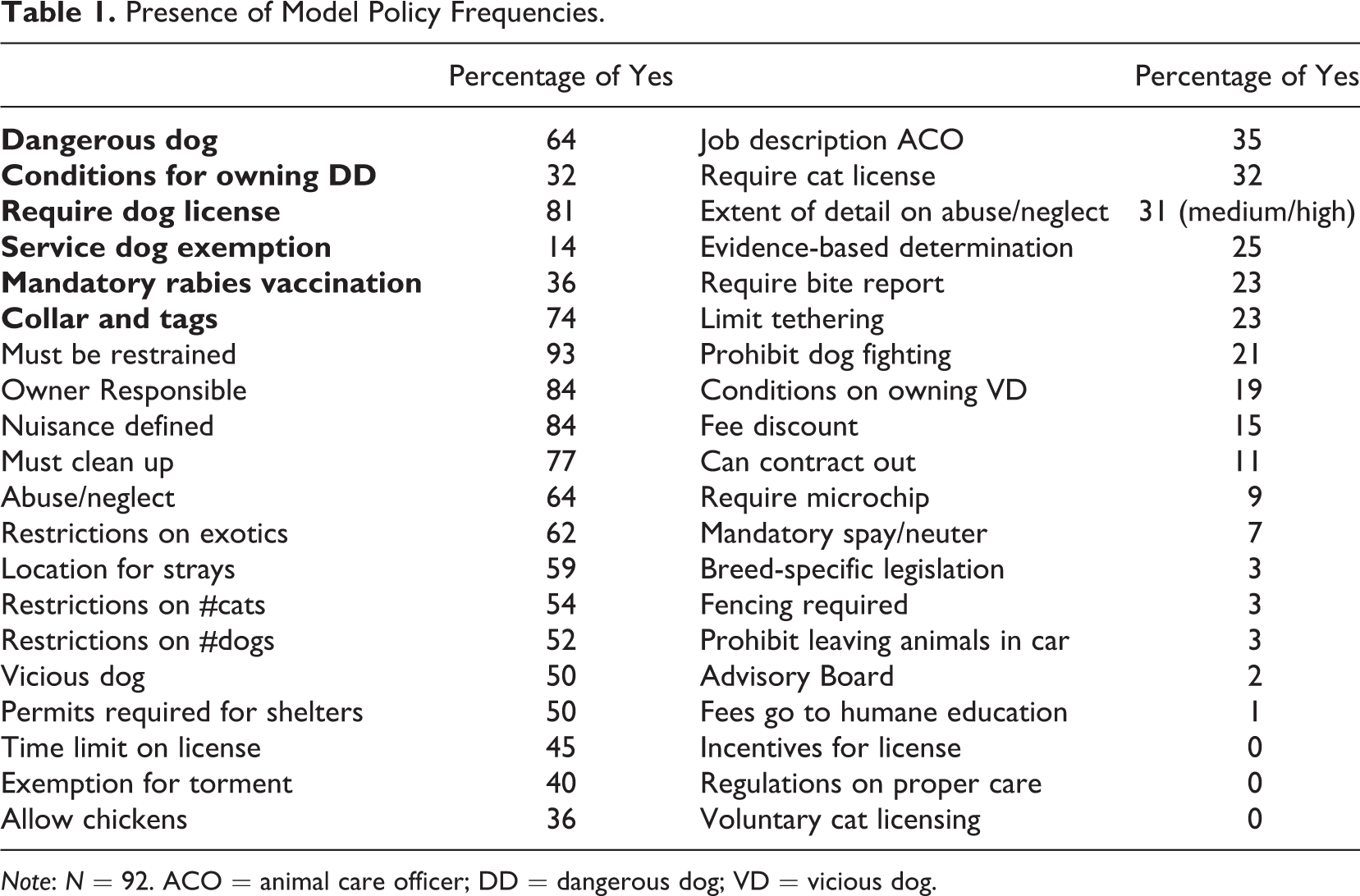
Note: N = 92. ACO = animal care officer; DD = dangerous dog; VD = vicious dog.
Beyond those elements of animal control mandated by state statute, the most common elements of local ordinances relate to controlling the potential nuisance aspects of animals in the community: requirements that dogs be restrained; that owners are held responsible (and liable) for their animal’s behavior; definitions of nuisance behaviors such as barking, wandering, and soiling; and that owners are responsible for cleaning up and disposing of pet waste. In contrast to model policy recommendations, many cities also have restrictions on the number of cats and dogs in a home: The possession of exotics such as wild animals, alligators, and some types of birds is also commonly prohibited. Over half of the cities include these sorts of nuisance issues in their ordinances.
Several aspects of model policy that are more closely related to animal welfare are also present in over half of the local ordinances. For example, 64 percent of cities include language that prohibits the abuse or neglect of animals, 59 percent explicitly indicate where stray dogs are taken when captured, and half require licenses for the operation of animal shelters. Finally, 50 percent of the ordinances include definitions of vicious dogs (separate from the definition of dangerous dogs).
The other 22 elements of ordinance best practices are present in less than 45 percent of the cities, and several are included in just a few or even no cities. Requirements that license fees be devoted to humane education are present in just 1 percent of the cities and incentives for licensing dogs (e.g., some communities in other states have offered free rides home from animal control if a licensed dog gets loose or lost), regulations that stipulate appropriate animal care such as requirements for food, water, shelter, and health care, and voluntary licensing programs for cats are not included in any ordinance. Provisions for an animal control advisory board, prohibitions on leaving animals in hot or cold cars, detailed descriptions of abuse and neglect, prohibitions on dog fighting, discounted licenses for particular types of dogs (those that are microchipped, spayed/neutered, or that have passed canine good citizen classes), and limits on the amount of time dogs can be kept tethered out of doors are all part of the animal welfare protections in model policy but are relatively rare in local ordinances. Ordinances also tend to lack detail on processes that protect both the safety of the public (mandatory reporting of bite incidents, specific conditions for ownership of a vicious dog, requirements that yards be fenced) and dogs (exemptions to dangerous and vicious dog classifications if a dog was tormented and evidence-based processes for determining if a dog should be classified as dangerous or vicious). Ordinances are also generally silent on several process issues; whether the city can contract out for animal control or sheltering services and the job descriptions or qualifications of animal care officers. Only 3 percent of cities prohibit ownership of particular types of dogs (i.e., pit bulls), and several communities have lifted their bans in recent years (Michigan Pit Bull Education Project).
Correlates of Model Policy
It is useful to understand what types of cities are most likely to have ordinances that more closely resemble model policy to identify what factors might be manipulated to encourage or foster model policy adoption. Because examining the correlates of each of the policy traits is unwieldy, factor analysis was run to reduce the data into a smaller number of conceptually distinct policies (see Table 2). Seven different aspects of local ordinances were identified by the factor analysis: inclusion of license or fee waivers for service dogs; a welfare emphasis that focuses on prohibitions on tethering and the earmarking of license fees for humane education; inclusion of details that are typically emphasized in animal sheltering or rescue—many shelters require that animals be microchipped, sterilized, and vaccinated prior to adoption (Reese et al. 2017); a welfare emphasis that prohibits dog fighting and leaving animals in cold/hot cars; detailed owner responsibilities; inclusion of breed specific legislation and other policies that could be interpreted to target the control of pit bulls or other dogs perceived to be dangerous; and policies that are high in detailed regulations. 1
Factor Analysis of Policy Elements.
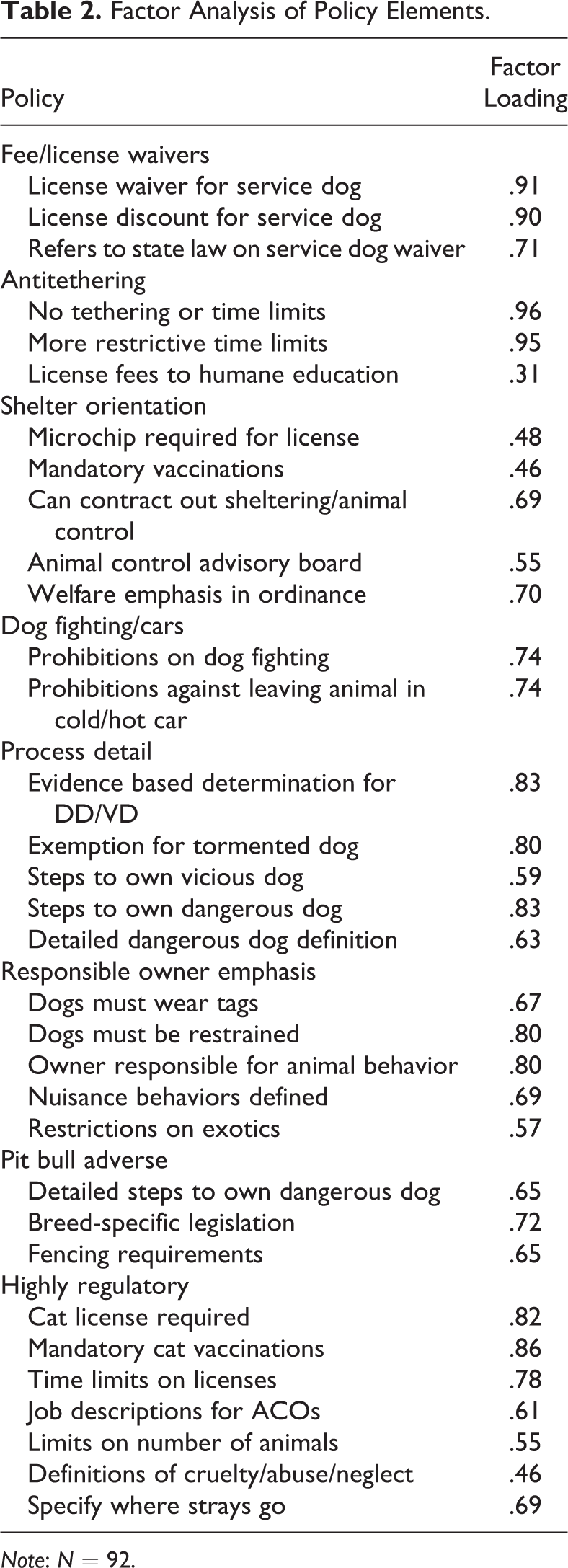
Note: N = 92.
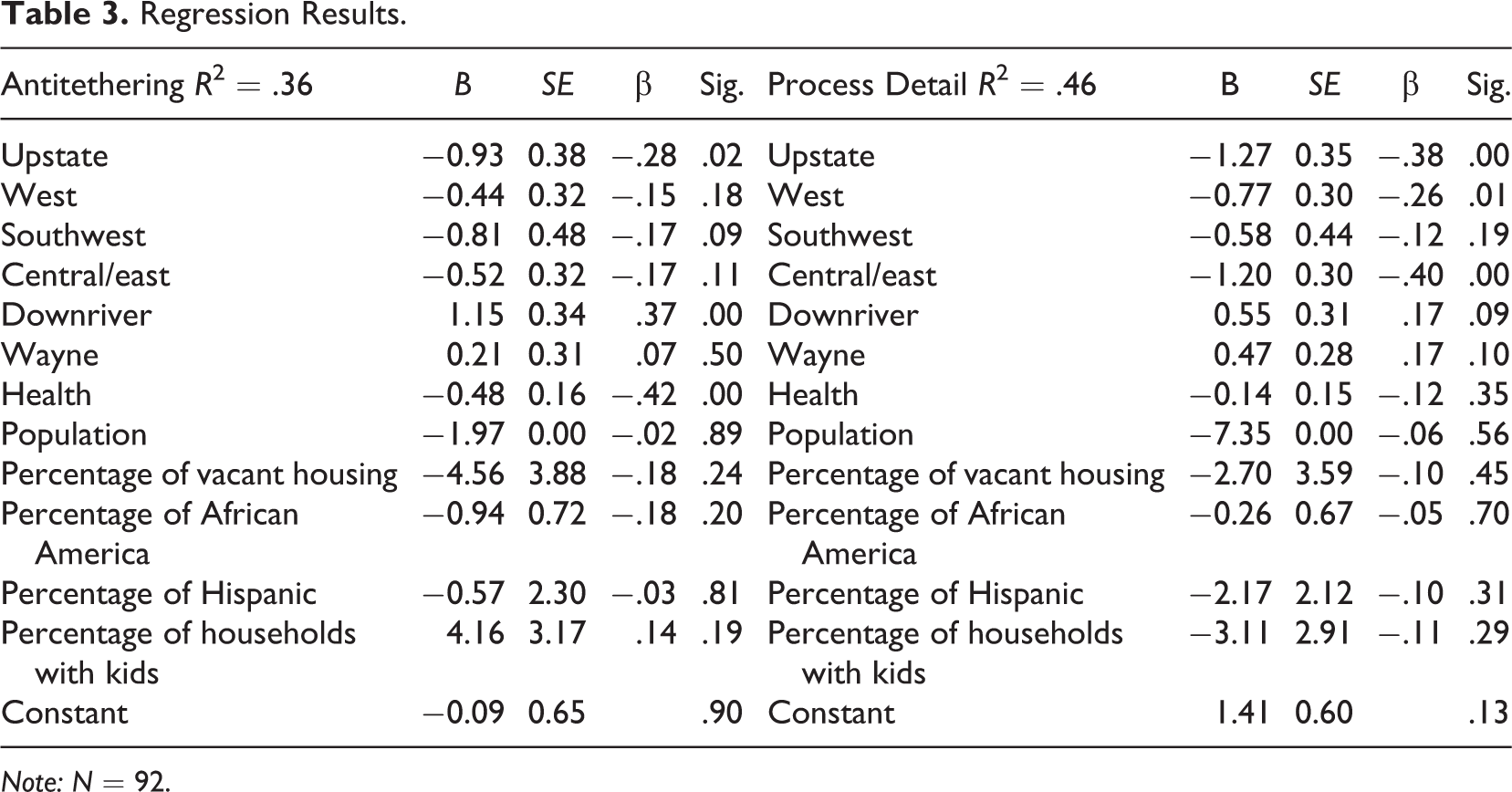
Multivariate analysis was performed on these eight policy factors, and the city traits identified in the discussion of population characteristics and profiled in Supplement Table 2 to determine which local traits are significantly associated with ordinances in multiple regression. Independent variables were tested for multicollinearity and those with variance inflation factor (VIF) over 2.6 were either removed from the analysis or used as an index. 2 Region of the state was added to the models to examine possible patterns of policy transmission. 3 Two of the factors—fee and license waivers and dog fighting/cars—did not have any independent variables correlated in multiple regression. For most of the rest of the factors, only one or two independent variables remained significantly correlated to policy in multiple regression. For illustration, the results for two of the models are provided in Table 3. Results for all seven models are available from the authors upon request. The models not presented contain either no significant correlations or just one or two significant correlations, typically with region.
Regression Results.
Note: N = 92.
For the factor representing ordinances that include prohibitions against chaining or tethering dogs in backyards, cities in the downriver area of the Detroit metro and those with higher residential economic health are significantly more likely to have such ordinances; cities in the upper lower and upper peninsula are less likely to have such ordinances. Cities in the upstate area are also significantly less likely to have detailed animal control ordinances as are those in the central/east and west portions of the state.
To briefly summarize the significant findings from the other regressions: Cities in the western part of the state and in Wayne County are significantly more likely to have restrictions on pit bull ownership while those with higher residential health are less likely to have restrictions. Cities in the central/east region of the state are significantly less likely to emphasize responsible ownership. Cities in Wayne County and those with larger populations are significantly more likely to have process-oriented ordinances and those with larger populations are more likely to have a sheltering focus. Average vote share for Democratic presidential candidate for the 2004 and 2008 presidential election was also used in multiple regression to assess whether the regional effects were due to partisan preference. R 2 were significantly lower using partisanship than when regions were included in the model, suggesting that the regional effects are not due to partisan preferences (at R 2 = .14 for antitethering and .13 for detailed policy). Further in neither regression was partisan vote significantly correlated with the dependent variable. Full results are available from the authors upon request.
Conclusion
It is clear that cities on the whole do not have animal control ordinances that follow best practice guidelines. Generally, control issues are emphasized over animal welfare concerns, and policies are not sufficiently detailed to protect the community, animal guardians, or the animals themselves. Further, there are very few city traits that correlate with any of the types of animal control ordinances, best practice or not. Region of the state is significantly correlated to several of the ordinance indexes, yet very few other traits are related to the nature of local ordinances.
The multivariate analysis does not provide a great deal of insight into the characteristics of cities with particular policy elements suggesting that the models are underspecified. A potentially important missing variable relates to the role of interest groups and policy entrepreneurs in the development of animal control ordinances. The cities with strong antitethering policies share several traits, for example, they are all in the Detroit metropolitan area, and most are south of Detroit in the downriver area. There is an animal welfare organization, C.H.A.I.N.E.D., which is active in the southwest area of Detroit and throughout the downriver communities. The mission of this organization is to educate owners who chain dogs in their yards and to provide shelter, straw, food, and in some cases, fencing for families through their outreach program. They also lobby local governments for both antitethering and pit bull friendly policies. As a result of these efforts, several downriver communities and the City of Detroit have enacted antitethering ordinances. This suggests two hypotheses about animal control policy: (1) Animal welfare groups, policy entrepreneurs, and nonprofits may have an important role in affecting local ordinances, and (2) there may be policy transmission in animal control policies as has been found in other policy areas such as budgeting and spending (see, e.g., Ghosh 2010; Bech and Laridsen 2009). Future research should include spatial analysis and explore for the presence of interest groups, particularly because region is one of the few variables correlated with policy in multiple regression.
Because region is important in many of the regressions, it is useful to consider other variables for which it might be acting as a proxy. Political ideology, economic health, race/ethnicity, vacancy, and the presence of children have no impact on animal ordinances. It is possible then that, in addition to policy entrepreneurs and policy transmission, region may be masking the effects of variables such as professionalism of local officials, partisanship of the city council or mayor, or attributes of the local animal population such as size or breed.
Larger communities include more process and other details that protect both owners and the public, suggesting that local officials in areas with more animals and citizens living closer together are prompted to create detailed ordinances because of the more pressing nature of the problem. It could also be that a certain level of resources must be available for animal control efforts, particularly enforcement. However, in practice, the connection between policy and implementation may be tenuous at best. Antitethering prohibitions, requirements that animals have proper food and shelter, and licensing and vaccination regulations are not self-enforcing. Police, animal control, or concerned citizens must make officials aware of violations and proscribed actions must result. Citizens in many communities may be loath to contact police or animal control about conditions at a neighbor’s house or cruelty that might be tied to crime activity such as dog fighting (Brisbin and Hunter 2016). In a larger sense the importance of animal control must be elevated among both citizens and local officials. There are a number of very tangible concerns that are dependent on animal control ordinance best practices: reducing dog bites and other threats to the public health; the usefulness of information about how many animals are in the community, where they live, and what their vaccination status; the important connections between animal abuse and neglect, crimes such as dog fighting and drug and weapons charges, and domestic violence and other human disputes (Reese, et. al, 2016); the treat and costs of law suits, for example. Seminars or other training programs and materials for local officials emphasizing these concerns may be a very good way to highlight the community-wide importance of model animal control ordinances.
Footnotes
Declaration of Conflicting Interests
The authors declared no potential conflicts of interest with respect to the research, authorship, and/or publication of this article.
Funding
The authors received no financial support for the research, authorship, and/or publication of this article.
Supplemental Material
Supplementary material for this article is available online.
Notes
References
Supplementary Material
Please find the following supplemental material available below.
For Open Access articles published under a Creative Commons License, all supplemental material carries the same license as the article it is associated with.
For non-Open Access articles published, all supplemental material carries a non-exclusive license, and permission requests for re-use of supplemental material or any part of supplemental material shall be sent directly to the copyright owner as specified in the copyright notice associated with the article.
