



Abstract
The United States is a nation of local governments. The growth in the number of local governments over the last sixty years has led many to ask whether the current fragmented arrangement is ideal or whether fewer local governments are preferred. This article explains the theoretical arguments on both sides, paying close attention to horizontal and vertical fragmentation. The empirical evidence on the effects of local government fragmentation is examined in three policy areas: public expenditures/revenues, public employment, and economic growth.
Introduction
The United States is a country of local governments. Of the 91,126 governments of any type in the United States in 2017, 99 percent of them are local governments. The U.S. system of local government is not static over time; there are immense changes in the structure and makeup of local governments over the long term. In 1952, the Census Bureau reported a total of 116,755 local governments. By 2017, 90,075 remained through a complex system of dissolutions, mergers, and new additions. Nearly 50,000 independent school districts were dissolved or merged over sixty years while almost 25,000 net special districts were created. General-purpose local governments (counties, cities, towns/townships) remain relatively unchanged over time by comparison. The local government landscape is dynamic with some areas seeing very little change and others seeing complete transformations.
This complex system of local government is often referred to as “fragmented.” But not all local areas are as fragmented as others. There is significant variance in governing arrangements in the United States, and it is well recognized theoretically and empirically that these differences ultimately lead to differing outcomes. This analysis examines the literature on the impact of these differences in the makeup local governance systems on a variety of outcomes. Particular attention is paid to the growth of overlapping governments such as special districts as a unique form of local government fragmentation.
Theoretically, there are two camps that offer differing opinions as to the costs and benefits of fragmentation. Those in the public choice tradition suggest increased fragmentation brings many benefits for local areas with few costs. The institutional reformers of the early- to mid-twentieth century suggest the opposite: Fragmented local government systems come at a cost and offer few benefits. The empirical evidence presented below suggests that horizontal fragmentation offers some benefits, but vertical fragmentation appears costly in terms of expenditures and employment but may promote economic growth.
This article begins by defining fragmentation in both the horizontal and vertical directions consistent with Boyne (1992) and exploring the theoretical implications of such governance arrangements. Next, the current state of affairs of local government fragmentation in the United States is examined. Special attention is paid to trends in different forms of government over time as well to the operationalization of fragmentation in the literature. Next, the empirical evidence of the impact of fragmentation on three outcomes: public spending/revenues, public employment, and economic growth. Lastly, implications for policy makers and future research are discussed.
Understanding Fragmentation
The term fragmentation, according to Boyne (1992), refers to the number of distinct units in a local government system. An area is considered “fragmented” if it has a large number of local government units, measured in absolute or per capita terms. The opposite of fragmentation is consolidation and is typified by a small number of units (and in the extreme one unit) of local government. 1 Fragmentation is but one attribute of local government structure. Potentially just as important is the distribution of service delivery and/or revenue generation responsibilities. Boyne (1992) refers to this as concentration. Similar to market share, a concentrated local government system endows only a few units of local government with most of the powers and responsibilities of service delivery and revenue generation. Concentration is in addition to fragmentation. A fragmented local government system can be highly concentrated as well (i.e., a large number of local government units but only a few of those units dominate the system).
In addition to the fragmentation/concentration distinction, either concept can be applied to the horizontal or vertical structure of local government. Horizontal fragmentation refers to the number of units within the same tier of local government (e.g., the number of municipalities in a particular area) while horizontal concentration refers to the market share of those units within the same tier. Vertical fragmentation refers to the number of tiers of local government, and vertical concentration refers to the distribution of responsibilities among the tiers. Theoretically, nearly any combination of fragmentation/concentration and vertical/horizontal structures can be constructed. An area may be vertically fragmented (i.e., many tiers of local government) while being horizontally consolidated (only one government per tier). Similarly, a single local government may hold all the market share, horizontally, but be relatively unconcentrated vertically. The near infinite combination allows us to describe the myriad arrangements of local governments that exist in the United States.
Much of the research on local government structure in the United States has concerned itself with the horizontal dimension; however, the vertical dimension has received significantly more attention in recent years. Additionally, the most effort has gone into understanding the influences on and consequences of fragmentation with relatively little independent examination of concentration. The theoretical arguments and empirical evidence that follow roughly hold to this trend and focus largely on horizontal and vertical fragmentation.
Horizontal Elements
Theoretically, there are two camps that advocate nearly opposite positions when it comes to the costs and benefits of horizontal fragmentation. On the side of more consolidation are the so-called institutional reformers that argue increased fragmentation will result in wasteful duplication of effort and reducing the number of local governments can be a path to increased efficiency. On the other side are those who follow public choice theory (sometimes called “polycentrists” [Ostrom 1972] or “localists” [Hall, Matti, and Zhou 2018]) and suggest that the proliferation of local governments, through the competitive forces that will likely ensue, can lead to more efficient provision of local goods and services.
The public choice argument is largely derived from the now-classic Tiebout (1956). In this piece, Tiebout (1956) argues that if asked directly, individuals will largely understate their preference for public goods in an attempt to free ride off those with higher preferences and avoid paying the tax required to achieve their desired level of service delivery. A mechanism is necessary to force the “consumer-voter” to reveal his or her true preferences. Tiebout (1956) suggests if a large enough variety of horizontally arranged local governments could be achieved, each providing a different combination of public services and tax price, the perfectly mobile consumer-voter will choose the municipality that most perfectly satisfies his or her preferences. The competition for residents between locations will induce municipalities to be as efficient as possible (Hall, Matti, and Zhou 2018).
Conversely, the institutional reform movement of the early- to mid-twentieth century suggests the horizontal proliferation of local governments leads to inefficiency. As the number of local government units rises, transaction costs also rise, the potential for duplication of services increases, and the opportunities to take advantage of economies of scale dwindle (Advisory Commission on Intergovernmental Relations 1974; Committee for Economic Development 1966; Committee for Economic Development 1970). The policy prescription is to reduce the number of local governments in a metropolitan area, in the extreme to one large multifunction government. In doing so, the source of inefficiency can be eliminated and the cost of service provision can be reduced.
In addition to efficiency arguments, the two camps suggest differing outcomes when it comes to political participation and/or accountability mechanisms. On the public choice side, more (smaller) units of local governments allow residents to be closer to their elected officials and potentially more involved in civic life (Ostrom 1972; Joshua 2019). Both should increase the level of political accountability as residents will be better informed and more familiar with the workings of their municipality because they are closer to the apparatus of government. Larger local governments, according to the proponents of public choice theory, place decision makers behind an increasingly large and complex bureaucratic machine that inhibits a resident from fully understanding the scope government and action necessary to hold them accountable.
The institutional reformers suggest the complexity born of increased local government fragmentation presents roadblocks to political participation and accountability. The proliferation of smaller units of government makes it difficult for residents to appropriately identify the relevant local government providing services and to hold that government accountable for their performance. Similarly, with the proliferation of local governments, the local ballot becomes similarly complex. This decreases the ability of the voter to adequately gather information on a large number of candidates in order to make an educated vote. The reformers again suggest a single, large, multifunction local government eliminates this issue by reducing governmental complexity and simplifying the local ballot. Appropriate districting of local elected offices can provide residents’ avenues to engage in the local political process (Lyons and Lowery 1989).
Vertical Elements
Much of the growth in local governments in the United States have been in the vertical direction. Similar to horizontal fragmentation, the theoretical arguments break down along the same lines. Those who follow public choice theory suggest the proliferation of vertical tiers of local government allow for the separation of the production of local public services from the provision of such services (Ostrom, Tiebout, and Warren 1961). The institutional reformers see the proliferation of vertically stacked local governments as a source of inefficiency due to duplication of services and a lack of administrative efficiencies (Ostrom 1972).
According to the public choice perspective, the decision about the quantity of public services provided need not be made by the same entity (government or otherwise) actually delivering the service. The former refers to the provision of public services while the latter refers to the production of said services. There are potential efficiencies from separating the two processes (Ostrom, Tiebout, and Warren 1961). An example is illustrative. A small municipality may wish to provide public transit services to its residents; however, due to the small size of the jurisdiction, it may not be feasible to provide such services in a cost-effective manner. If there are numerous small municipalities in this situation in close geographic proximity, they could band together and create a regional transit authority to produce transit services. The decisions about the level of transit services are decided locally (provision) while the production of said services happens regionally. Efficiency is likely enhanced in this arrangement as well.
The institutional reform perspective is skeptical of the above relationship. Many of the same criticisms of horizontal fragmentation still hold: Vertical fragmentation can increase transaction costs and more potential for duplication of services. While the institutional reformers spent relatively little time responding to Ostrom, Tiebout, and Warren (1961), more recent work has formalized the theoretical issues of vertical fragmentation as a common-pool resource problem (Berry 2008, 2009). That is, services are provided to (and taxes are derived from) a “common pool” of taxpayers; however, the decision-making processes are fragmented across many local actors. In the ideal world, this institutional arrangement would not matter. The collection of vertically arranged local governments would coordinate such that all potential externalities are internalized (i.e., they cooperate, so efforts are not duplicated), and the levels of public services provided would be roughly the same as if they were provided by a single multifunction local government. As Berry (2008, 2009) explains, there are a number of barriers preventing the ideal situation from occurring. Primarily, local elected officials seek reelection and this act will likely lead them to attempt to satisfy voter’s demands for service delivery (Bauroth 2005). Satisfying one’s own voters is likely to deviate from the socially optimal level of service provision. If these many service areas were made to compete in a single multifunction jurisdiction, local elected officials would have to weigh services against each other and the outcome is likely closer to the socially optimal outcome.
The Current State of Affairs
As alluded to in the Introduction, the current state of local government fragmentation in the United States is a reasonably high level of average fragmentation with a large standard deviation in both the horizontal and vertical directions. Over the last sixty-five years, the number of general-purpose governments (counties, cities, towns/townships) has remained relatively constant with the gross number of counties and towns/townships declining slightly and the number of municipalities increasing (see Figure 1). Much of the growth has been in special-purpose governments but in opposite directions. The number of independent school districts has declined significantly over sixty-five years. Fischel (2009) largely attributes this decline to the merger of largely rural, single-school districts into multi-school districts. Nonetheless, the gross number of independent school districts has declined by nearly 55,000 districts in sixty years. Over the same time period, the number of special districts has increased by nearly 26,000. However, this number belies a large amount of churn in special districts. These governments are created and destroyed often, so the gross change hides a large growth in the creation of these governments over time (Goodman 2019a). Taken together, the growth in these two broad forms of government, general and special purpose, has been largely a steady state of horizontally arranged local government and strong growth (both negative and positive) in vertically arranged governments.
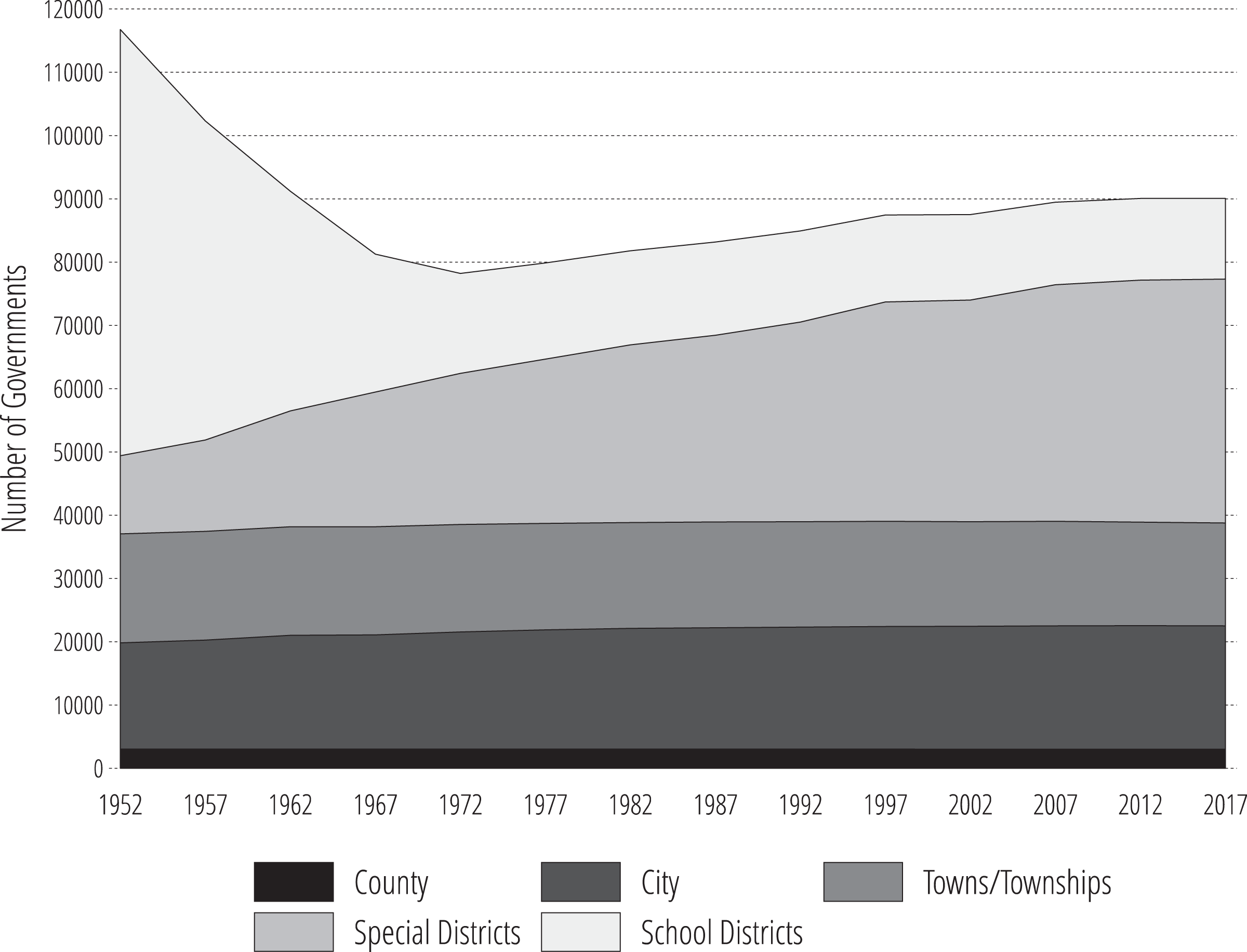
Trends in local governments (1952–2017).
Beyond the current state of local governments in the United States, there is significant disagreement in the literature over the “correct” method of measuring fragmentation (Kim and Jurey 2013). The literature is replete with similar and conflicting methods of measuring fragmentation and seemingly little agreement among them. In potentially the most extensive review of measures of local government fragmentation, Hendrick, Jimenez, and Lal (2011) outline twenty potential measures of fragmentation/concentration in both the vertical and horizontal directions. On the fragmentation–consolidation continuum, these range from measuring total, horizontal, and vertical fragmentation in absolute terms (counts of governments), governments per capita, governments per square mile, and the share of governments in a particular tier. On the dispersion–concentration continuum, measures include market share (either as a percentage of total revenues/expenditures or the percentage of state–local revenues/expenditures) or direct measures of concentration or dispersion such as the standard deviation, coefficient of variation, or various concentration indices (largely the Hirshman–Herfindahl Index). Alternative measures have been proposed that do not necessarily follow the horizontal–vertical, fragmentation–concentration framework proposed by Boyne (1992). These include the Metropolitan Power Diffusion Index (MPDI) proposed by Miller (2002), the six measures proposed in Foster (1993) that include measures of central city dominance, fragmentation of the suburbs, and school/special district overlap, and the taxing overlap proposed by Berry (2008, 2009) that is the ratio of taxing special districts and school districts to the number of municipalities in a county area to name a few.
Empirical Evidence
This disagreement in the literature over the proper method of measuring local government fragmentation has led to a confusing set of results as to the impact of fragmentation on various outcomes. This section examines the role of various methods of measuring local government fragmentation, both horizontal and vertical, on public expenditures or revenues, public employment, and economic growth. The idea is not necessarily to be exhaustive of the literature but to provide an introduction to these concepts and relationships for newer readers.
Public Spending and Public Revenues
The relationship between local government fragmentation and public spending/revenues is the most direct test of the efficiency argument made above. All else equal, more efficient local governments should spend less for a given unit of public service than less efficient local governments. 2 For many years, scholars have primarily been interested in the relationship between horizontal fragmentation and public spending; however, this has recently changed with a number of scholars explicitly examining the vertical dimension.
The literature is generally supportive of the claim that increased horizontal fragmentation, particularly among general-purpose local governments, is associated with decreased per capita public spending and public revenues. This is consistent with the claims of those among the public choice tradition that an increasing number of local governments promote competition and this competition promotes efficiency (i.e., lower public spending per capita). Importantly, this result is not confined to a particular time period or unit of analysis. Per capita municipalities are associated with lower per capita expenditures in municipalities (Schneider 1989b, 1989c; Sjoquist 1982; Craw 2008), county areas (Hendrick, Jimenez, and Lal 2011), and metropolitan area (Eberts and Gronberg 1988; Campbell 2004; Stansel 2006). Jimenez (2014) finds higher levels of per capita municipalities associated with lower per capita spending on allocational functions (finance, judicial, general staff, and public buildings) among poor cities while the same factor is associated with lower per capita spending on redistributive functions (health, hospitals, public welfare, and housing and community development) among affluent cities. Additionally, increased fragmentation has been shown to slow the growth in local government spending (Schneider 1986; Stansel 2006). Finally, increased horizontal fragmentation is associated with lower per capita revenues (Jimenez 2015). While there are dissenting findings (Goodman [2015] is a recent example), the literature is generally supportive of the public choice view on the relationship between horizontal fragmentation and public spending/revenues.
There is significantly more disagreement on the influence of vertical fragmentation on per capita expenditures/revenues. This may partially be the result of a lack of agreement on the appropriate method to measure vertical fragmentation. Measuring vertical fragmentation as special or school districts as a percentage of all local governments yields little correlation between per capita spending and revenues (Goodman 2015; Jimenez 2015); however, Hendrick, Jimenez, and Lal (2011) did find a positive relationship between such an operationalization and per capita expenditures among metropolitan counties in 2002. However, when operationalized as special-purpose governments per capita, many authors find a positive association between said variable and per capita expenditures (Stansel 2006; Hendrick, Jimenez, and Lal 2011; Goodman 2015). When vertical fragmentation is operationalized as the number of special or school districts per municipality, a positive relationship between “overlap” and per capita own-source revenues is found (Berry 2008, 2009). This relationship is most similar to the institutional reform perspective that suggests overlap is an overfishing of the fiscal common-pool problem.
Public Employment
The second area of interest, most closely aligned with the duplication of public services, is public employment. This literature is considerably smaller relative to public spending or revenues; however, it allows for the examination of one of the primary assertions of the theoretical arguments above. Generally, the institutional reformers suggest fragmentation in either the horizontal or vertical directions is likely to lead to duplication of services and administrative inefficiencies. At the most general level, either should lead to higher levels of public employment than would ordinarily exist. Public choice theory makes no such prediction.
Schneider (1989a, 1989c) finds that municipalities for more bordering municipalities, a signifier of increased horizontal fragmentation, lead to fewer full-time equivalent employees. Schneider (1989a) explains that the likely mechanism is something similar to the competitive effects of Tiebout (1956). Horizontally arranged local governments compete with each other on expensive, nonfiscal items, 3 and this competition constrains the growth of public sector employees. The influence of vertical fragmentation on per capita public employment is similar to public spending. Regardless of the method of measurement (per capita special districts or “overlap”), there is a positive relationship between vertical fragmentation and employment (Chicoine and Walzer 1985; Goodman 2018a). The general logic is duplication and/or administrative inefficiencies. If public services were provided by a single large local government, it is less likely such duplication or inefficiency would occur. The single local government would critically examine where the labor demands in the organization are and “budget” for them appropriately. With this function spread across multiple public entities, the level of public employment can grow inefficiently large due to a lack of coordination.
Overall, the pattern from public expenditure/revenues is retained. Increased fragmentation in the horizontal direction is a means to limit the expansion of the public sector, but growth in vertical fragmentation increases the size of the public sector. These results suggest the competitive effects espoused by public choice theory are only operative in the horizontal direction. Vertical fragmentation does not appear to endow similar benefits.
Economic Growth
The final area of interest is economic growth, broadly defined. In general, this literature posits that there are spillover effects of governance models (i.e., local government fragmentation) on the broader economy of a local area. The theoretical propositions fall along similar lines to what has been presented previously. Those among the public choice tradition suggest increased local government fragmentation should lead to increased economic growth through increased governmental efficiency. In the eyes of public choice theory, this competition-fueled efficiency permeates all functions of government, making the building blocks of growth easier (Goodman 2019b). Things like permitting, zoning and land-use decisions, and economic development choices should be more efficient and lead to future growth. In reference to population growth, this tradition suggests Tiebout (1956) sorting should allow new residents to more perfectly match their preferences for taxing and public services. The institutional reformers make a similar efficiency-led growth argument; however, the source of the efficiency is from more consolidated structures rather than fragmented ones. In particular, efficiency is gained by realizing economies of geographic scale (Bish 1971; Advisory Commission on Intergovernmental Relations 1974), internalizing externalities (spillovers) in public service provision (Rusk 1993), and lowering transaction costs associated with moving into a region (Committee for Economic Development 1970; Foster 1993). Among both theoretical traditions, there is little differentiation between horizontal or vertical fragmentation. Implicitly, public choice largely advocates for increased fragmentation and the institutional reformers argue for more consolidation.
In the empirical literature, economic growth has been operationalized in a number of ways. Typically, it is measured as population growth or employment growth. Some scholars examine the growth in wages; however, given how these wages are somewhat tied to regional cost of living differences, they are not a good measure of local economic growth. Early research suggests metropolitan areas with more consolidated suburban structures and larger center cities grow slower in terms of population and income growth (Foster 1993; Nelson and Foster 1999). Areas with more school districts per municipality tend to see their population grow more slowly (Foster 1993). These results suggest increased horizontal fragmentation is associated with higher economic growth but vertical fragmentation is not. The more recent literature is no less chaotic. Support for both the public choice and institutional reform traditions can be found. Stansel (2005) finds increased horizontal fragmentation (more counties and municipalities per capita) associated with higher long-run income growth. Yet, Grassmueck and Shields (2010) find nearly the opposite with increased local governments’ per capita associated with lower income and employment growth. Hammond and Tosun (2011) find a similar negative relationship between horizontal fragmentation and population and employment growth but only for nonmetropolitan counties. Special districts per square mile are associated with higher population and employment growth for urban counties. Lastly, Goodman (2019b) finds larger central cities (i.e., lower horizontal fragmentation) associated with lower long-run population growth while increased special district overlap (special districts per municipality) associated with larger population growth. These results appear to be largely contained to metropolitan areas in the southern census region. Clearly, there is little consensus in the literature as to the actual effect of horizontal or vertical fragmentation on economic growth.
Discussion and Conclusions
The purpose of this review is to understand the conceptual issues surrounding local government fragmentation with a focus on both horizontal and vertical fragmentation. There is somewhat of a disconnection between the totality of scholarly research on local government fragmentation and how fragmentation has been changing. Much of the prior research focuses on the horizontal dimension of fragmentation while much of the actual growth in local government has been in the vertical dimension. This review examines both aspects in theoretical terms, measurement terms, and the influences of such factors on three policy areas. Research on horizontal fragmentation has been generally supportive of public choice theory. That is, increased horizontal fragmentation has positive benefits through competition-induced efficiency of local government. Vertical fragmentation appears to have the opposite effect. By separating public functions among many overlapping local governments, the local public sector becomes inefficiently large due to lack of coordination between the various units.
The general trends documented here have clear implications for policy. If more horizontally arranged local governments can help to induce efficiency in the local public sector, this kind of growth should be promoted. However, there is clear evidence that horizontal fragmentation is no panacea with increased horizontal fragmentation leading to increased levels of racial segregation and urban sprawl (Howell-Moroney 2008; Jimenez and Hendrick 2010). The key concept is balance among positive and negative aspects of horizontal fragmentation. If states’ policy makers can find ways to mitigate the negatives while preserving the positives, horizontal fragmentation has the potential to lower the cost of local government. However, if the lower public spending associated with increased horizontal fragmentation is the result of declining service quality (i.e., horizontal fragmentation induces a “race to the bottom” among competing local governments), it is difficult to endorse further horizontal growth of local governments.
The empirical evidence does not suggest the increased proliferation of overlapping local governments is necessarily a good thing. It appears the lack of coordination between many overlapping jurisdictions leads to an overly large local government system, well beyond what is efficient or demanded by residents. While many overlapping special districts may not be the most efficient system, there is some evidence that local governments use such arrangements to circumvent state-level restrictions on their actions (Goodman and Leland 2019). 4 If this evidence is correct, it would suggest the proliferation of overlapping governments is a means for local governments to continue to provide public services demanded by its citizens, albeit more inefficiently than if those services were produced in house. Coupled with the less than stellar transparency records of many special districts (Burns 1994), it is difficult to endorse the proliferation of special districts as a means to deal with restrictions on general-purpose governments.
The implications for research are likewise clear. While measures of public service quality and local government efficiency remain somewhat elusive in the academic literature (Hall, Matti, and Zhou 2018), they are essential to sorting out the potential values and pitfalls to horizontal fragmentation. Much of the current research on quality, efficiency, and fragmentation is confined to policing (Krimmel 1997); however, other policy areas are likely affected by the level of fragmentation in the local area. Increased access to administrative data has the potential to vastly expand research in this area. Given the growth of special districts in the United States, more research is necessary on the implications of overlapping local governments. Other than institutional factors, there is relatively little research on why overlapping governments have proliferated while horizontally arranged governments have languished. There are some indication that multipurpose development districts (a form of special district) are being used as a means to interject private (often developer) interests into the public sphere (Carter, Deslatte, and Scott 2019), essentially enabling further suburban growth (Deslatte, Scott, and Carter 2019). This assertion is not new (Burns 1994), but the implications have not fully been explored in the literature relative to local government fragmentation. Similarly, there are many other unexplored areas relative to overlapping governments such as efficiency/service quality implications and the matching of citizen demands to actual service provision to name a few. Data quality is an issue (Foster 1997), but there is much state-level data yet to be unlocked in the scholarly literature.
Footnotes
Declaration of Conflicting Interests
The author declared no potential conflicts of interest with respect to the research, authorship, and/or publication of this article.
Funding
The author received no financial support for the research, authorship, and/or publication of this article.
