




Abstract
Political fragmentation has been conceptualized as a phenomenon which increases competition for mobile citizens and jobs between local governments within the same region. However, the empirical basis for this nexus between governmental fragmentation and increased competition for development is surprisingly lacking. Utilizing a newly constructed database that matches political fragmentation indices (horizontal, vertical, and bordered) to a nationwide survey of economic development officials in 2014, we begin to fill this gap by analyzing the influence fragmentation has on the use of tax incentives, regulatory flexibility, and community development tools in U.S. cities. Applying the political market framework and a Bayesian inferential approach, we find that the proliferation of local governments increases incentive use. However, more specialized governance increases the probability of using community development activities.
Metropolitan regions in the United States have long been recognized as constellations of diverse governmental types in which authority is partitioned between general-purpose municipalities and overlapping, special district, or single-purpose governments. A criticism of fragmented metropolitan governance in the context of economic development tends to follow a traditional logic: fragmentation increases competition by creating additional avenues for companies, realtors, developers, and investors to seek favorable incentive deals, reducing the focus on broader questions of sustainable environmental and social governance (Fleischmann, Green, and Kwong 1992). However, the empirical basis for a causal linkage between governmental fragmentation and increased competition for the usage of economic development incentives is surprisingly lacking.
This article begins to fill this gap by empirically examining the effects of fragmentation on different economic development activities. To do so, it examines economic development policy choices through two competing theoretical lenses: public choice and institutional reform. Public choice scholars have long suggested polycentric systems of governance produce more efficient allocations of resources through greater competitive pressure as local governments vie to attract mobile citizens (Ostrom, Tiebout, and Warren 1961; Tiebout 1956). The “institutional reform” perspective favors government consolidation or regionalism and expects generally that government spending and tax liability will increase in more fragmented regions through unnecessary duplication of services (Hendrick, Jimenez, and Lal 2011; Wheeler 2002). From this view, incentivizing economic growth through intramunicipal corporate relocations is a temptation for local government officials to “overspend.” This by no means restricted to the U.S. experience. Regional governance institutions such as multipurpose special districts in places like British Columbia, Canada, have drawn considerable recent attention from scholars as an alternative for U.S. metropolitan areas (Wolman 2019). The negative effects of fragmentation have garnered attention in places like the Netherlands (Klok et al. 2018), while U.S. levels of fragmentation have been labeled on par with urban regions in France, Germany, and Switzerland (UCLG 2008), and European interest in regional versus fragmented metropolitan governance arrangements is on the rise (Hulst and van Montfort 2007; Lidström 2017).
This article advances this discussion by applying a political market framework (PMF) to test the impacts of horizontal, vertical, and bordered (cross-state dimensions) fragmentation on the use of community development and tax incentive tools among U.S. cities. Employing a Bayesian analytic approach, this article finds evidence of an interaction effect between the institutional structure of executive authority in U.S. cities and the distinct dimensions of metropolitan-level fragmentation. Horizontal fragmentation is associated with increased economic incentive use by municipalities, while vertical fragmentation has the opposite effect. The proliferation of single-purpose or special district governments acts as a check, reducing the probability of reliance on property tax–based incentives.
Political Markets for Development Policies and the Dimensions of Fragmentation
In many contexts globally, local governments coexist in an ecology of competing and cooperating service delivery organizations (Blackmond Larnell 2018; Hall, Matti, and Zhou 2018). Concerning questions of efficiency, growth, and citizen responsiveness, U.S. local government research has devoted considerable attention to this landscape and demarcates the impacts of fragmentation between horizontal and vertical dimensions (Hendrick and Shi 2015). Horizontal fragmentation results from having a greater number of general-purpose political jurisdictions spatially adjacent to one another within a metropolitan area (Boyne 1992). Vertical fragmentation results from the layering of government (single and general purpose) with overlapping political jurisdictions contained within the metropolitan area. This distinction is important given that each produce varying allocations of service responsibility and tax authority between local governments (Deslatte, Feiock, and Wassel 2017). In terms of government spending and growth, public choice versus institutional reform scholars have developed fundamentally different views on what should occur when metropolitan regions are more fragmented, cutting across both horizontal and vertical dimensions (Hendrick and Shi 2015; Howell-Moroney 2008). Public choice scholars hold that more fragmented government service delivery tends to constrain spending due to competition between governments for mobile citizens, while institutional reformers claim fragmentation leads to inefficiencies and overproduction of public goods (Berry 2008, 2009). In his summary of the empirical evidence, Goodman (2019) notes that much depends upon how these concepts are operationalized. When it comes to government spending, the empirical evidence finds support for the public choice view, with greater horizontal fragmentation associated with lower per capita spending (Stansel 2005). However, vertical fragmentation operationalized as a percentage of all local governments has produced mixed evidence (Jimenez 2015), with evidence of expenditure growth in support of the reform view found when vertical fragmentation is operationalized as special districts per capita (Hendrick, Jimenez, and Lal 2011) or as the number of “overlapping” districts per municipality (Berry 2008, 2009).
Institutional Arrangements and Horizontal Fragmentation
While the fragmentation literature also considers economic growth (usually with population or employment as the outcome measure), the evidence is far more circumspect and does not support one perspective over the other (Hammond and Tosun 2011). While competition may influence developmental policies, development policy choices are also influenced by internal political demands of residents seeking to maximize home values (Fischel 2009), the proximity to other local government offering similar policies (Minkoff 2012), and income differentiation (Overton 2016).
This literature has largely overlooked the effects of horizontal fragmentation on the choices of alternative policy instruments such as the myriad economic development policy tools which have distinct distributional impacts on both governmental expenditures and growth (Feiock 2002; Salamon 1989). Rather, economists have focused indirectly on policies as capitalized through tax rates and welfare (Hoyt 1991), acknowledging that the inelastic number of cities and varying “market share” of larger cities may lead to imperfect competition (Fischel 2009). Summarizing this literature, while facets of the public choice perspective have found empirical support, a picture emerges that the optimistic Tiebout public marketplace does not often resemble actual metropolitan areas. Rather, they are characterized by a finite number of jurisdictions operating under conditions of information constraints, externalities, and imperfect competition (Fischel and Oates 2006).
Scholars have noted the need to account for the internal political dynamics of development policies in the context of the broader metropolitan ecology of governments (Craw 2008; Minkoff 2012). We argue attention to policy tools or instruments in the context of fragmentation is also necessary in order to ascertain the distributional intent of development policies (R. C. Feiock, Tavares, and Lubell 2008). A PMF has been utilized in recent years to link these perspectives by focusing on the collective choice rules within political institutions which influence the policy process through transaction costs and the distribution of benefits across community groups (Lubell, Feiock, and Ramírez de la Cruz 2005). Under a political market framework, policy change results from a dynamic contracting process in which government and industry actors seek institutional and policy arrangements set to minimize transaction costs and maximize group benefits (Lubell, Ramírez de la Cruz 2009). Adapted to development policies, firms are conceived of as policy demanders petitioning local governmental suppliers for favorable policy outputs in the form of developmental policies (Feiock and Kim 2001). Local government officials are the suppliers who provide tax incentives, reduced-price land, zoning or regulatory relief, job training, and screening or other inducements to lower the costs for firms to relocate within their jurisdictions (Ramírez de la Cruz 2009).
In the U.S. context, the institutional roles of the mayor and public managers are central because these heterogeneous actors involved in formulating supply have distinct payoffs (Carr 2015; Deslatte 2018; Feiock and Kim 2001). The council-manager form of local government invests executive authority and administrative responsibilities with an unelected, professional manager and emerged in the United States during the municipal reform movement of the early twentieth century as an institutional response to government corruption, cronyism, and graft (Nelson and Svara 2012; Svara and Watson 2010). Assignment of executive authority matters in the context of development policies because empowered city managers have been shown to favor comprehensive solutions to problems over symbolic ones (Krause 2011) and distribute the benefits of policy objectives more broadly (Deslatte, Swann, and Feiock 2017). Mayors respond to electoral incentives to deliver policy outputs to organized or wealthier groups capable of delivering reciprocal political support in the form of campaign contributions, votes, endorsements, or other side payments (Lubell, Feiock, and Ramírez de la Cruz 2009). Administrative actors have lower-powered incentives to pursue economic development in their communities but may also seek to adhere to long-term growth plans to safeguard quality-of-life and equity objectives (Deslatte, Tavares, and Feiock 2016). In both cases, economic growth is pursued, but the transaction costs and distribution of benefits may vary based on their institutional roles. Administrators empowered under a council-manager form of government may adhere more closely to professional norms of inclusiveness and comprehensiveness (Feiock and Kim 2001), while “strong” mayors are more sensitive to the electoral cycle and willing to use governmental policy instruments to deliver short-term benefits for credit-claiming (Sharp 1991).
These exchanges do not occur in a vacuum; rather, they are shaped by the level of competition between proximate governments (Minkoff 2012; Overton 2016). Cities rely on tax incentives to grow their tax bases and incomes, a dependence which appears unshakable in the aftermath of the Great Recession (Blackmond Larnell 2018; Zheng and Warner 2010). This pressure to provide incentives may be exacerbated by the level of horizontal fragmentation in a metropolitan region. Firms seeking tax abatements, credits, financing, or other incentives for job creation have the potential locations for their investments multiplied in metropolitan areas with greater fragmentation. Such conditions disadvantage governments because firms seeking incentive packages have information advantages and the ability to pit more bidders against one another to land more lucrative bargains (Steinacker 2002).
From the demander’s perspective, greater horizontal fragmentation produces an environment in which firms seeking to extract tax incentives, discounted land, or other inducements to locate or expand operations have multiple potential suppliers and may solicit and compare a wider array of alternative tax incentive offerings from competing local governments. Information asymmetries for cities come into play when government officials try to ascertain the positions of potential rivals, and the costs of failure in economic development negotiations are higher (Wolman and Spitzley 1996). Likewise, the bargaining position of policy demanders is strengthened when they have greater opportunities to exit for other locations and can hold this information over suppliers (Steinacker 2002).
From the supplier’s perspective, more horizontally fragmented metropolitan regions create stronger motivation to provide development policies due to the spillovers of political exchanges in surrounding jurisdictions. Consistent with the institutional reform perspective, a more fragmented environment would lead to inefficient economic development policy offerings. While extant research on the council-manager form of government suggests city managers are more willing to adopt innovative policies and favor comprehensive solutions to problems, both mayors and managers should be willing to supply development incentives or risk losing out on economic growth and absorbing the resulting negative political or professional repercussions (Jensen and Malesky 2018). The risk of negative impacts from lost incentive deals is heightened because the spatial scale of individual, general-purpose governments is smaller in more fragmented systems, and consumers or employees can be more mobile (Minkoff 2012). Because both mayors and managers are expected to be responsive to development demands, we test the relationship through interactive hypotheses in which the form of government (mayor council vs. council manager) is a moderating influence on government response to policy demands. Because the council-manager form of government as a structure was intended to promote efficiency, effectiveness, and equity, we expect that as the information environment becomes more complex, city managers will be more likely to rely on these professional norms in making development decisions (Edwards 2011; Nalbandian 1999). Thus, as horizontal fragmentation increases, manager-led governments should be relatively less supportive of tax incentives as a means to compete. However, we expect city managers to be more supporting of community development tools which present a more comprehensive solution to community development needs. To formalize these expectations, we develop interactive hypotheses (Berry, Golder, and Milton 2012) for the effects of form of government as horizontal fragmentation increases:
Vertical Fragmentation and the Fiscal Common Pool
Vertical fragmentation, on the other hand, reflects the ratio of special-purpose to general-purpose governments and distinctly shapes the mobility of capital and the incentives of governments to oversupply development policy. An assumption of efficient political markets is that the boundaries of local governments are fixed. Vertical fragmentation presents one way in which these boundaries and limitations on citizen mobility are redefined.
Specialized governments are the fastest growing type of local government arrangement in the United States (Hendrick and Shi 2015). While a few types of special-purpose governments such as economic or community development districts may be involved in attracting firms, the vast majority do not play a direct role in competition for economic development. However, they potentially provide an indirect influence through two means: First, their reliance on the same property tax base as cities may create greater strain on governments sharing the common fiscal pool, and second, their absorption of service responsibilities which general-purpose governments would otherwise have to finance may reduce the incentive to compete for mobile resources.
Overuse of the property tax base represents an externality which incentivizes single-purpose governments to resist the use of some types of incentives. The growth of special districts with their own, overlapping taxing authority has been understood to create a greater incentive for each government to impose higher property tax rates and essentially overuse this fiscal common pool (Berry 2008, 2009). This problem is more acute in states which impose tax and expenditure limits (TELs) in the form of limits on either (or both) local government appropriations or revenues collected (Maher et al. 2016). In some instances, the presence of TELs may prompt general-purpose governments to circumvent the limits through creation of special districts (Zhang 2018). In other circumstances, the causal sequence is reversed: Creation of special districts is a means of defection for more affluent residents and developers, diverting resources from cities (Burns 1994; Carter, Deslatte, and Scott 2019). Municipalities which must divide property tax revenues between a larger bevy of overlapping governments may choose to be less reliant on traditional economic incentives such as property tax abatements. In the face of greater vertical fragmentation, mechanisms such as tax increment finance also serve to divert future revenues from other taxing bodies like schools, libraries, parks, or fire districts. Governments exploiting this resource can come into conflict when one party seeks to divert tax revenue for economic development purposes. Thus, specialized governments may resist efforts—formally through legal challenges or informally through coercion—to offer incentives which effectively reduce their share of the fiscal pool.
Shifting greater service delivery responsibility to specialized governments can also diminish the need for cities to compete for development through offering a wider array of community development inducements. This is because the benefits would stay within the same shared tax pool. We expect such conditions to allow local governments to focus on more community-focused development needs such as affordable housing, environmental sustainability, and mass transit investment. This is consistent with the institutional reform perspective that would seek overlapping governing mechanisms to mitigate the competition between local governments in the face of policy demanders.
The boundaries of special districts can be defined to be matched with the scope of service needs such as water districts with watersheds. Special districts allow public administrators and district board members to develop greater policy expertise (Mullin 2009) and offer greater political and administrative flexibility for increasing public services through their own bonding and fees without raising overall taxes (Foster 1997; Thompson 2008). Special-purpose governments can provide public goods at greater scale across multiple general-purpose governments, reducing the range of services that general-purpose governments provide. When parks, fire, emergency medical services (EMS), libraries, water, sewer, conservation, and community redevelopment functions are handled by distinct governmental units across greater spatial scales, the basis for city officials’ arguments for offering tax incentives to compete with neighboring general-purpose governments—and even their ability to logroll such activities into larger, multipurpose budgets—is weakened. While polycentrist scholars have touted fragmentation as a governance arrangement which increases competition and efficiency, specialized governments may actually reduce the need for cities to compete with each other when many benefits their constituents receive are shared across municipal boundaries. While we cannot directly empirically differentiate between these two mechanisms, we can account for whether states have TELs in place and whether the form of government moderates the effect of vertical fragmentation.
Fragmentation across State Borders
A final, unexplored facet of political markets and fragmentation is the unique nature of metropolitan areas that span more than one state. When a metropolitan area spans multiple states, partitioned authority exists not just among horizontal and vertical dimensions but also between higher-level sovereign authorities that may grant or preempt local political powers distinctly. We define these arrangements as bordered fragmentation, where a metropolitan area is divided between more than one state. Thus, a metropolitan region contained within a single state does not exhibit any level of bordered fragmentation while other metropolitan areas like the District of Columbia or the New York metropolitan region span multiple states.
U.S. local governments are “creatures of the state” and derive taxing authority from the state in which they are nested (Miller and Cox 2015). This complicates the negotiations for incentive packages by involving additional actors at multiple levels. While it is true that competition for firms is not bounded intra-regionally, firms first decide on the region and then decide on the particular location (Wolman et al. 2008). While externalities do not respect state borders any more than those of cities, bordered fragmentation primarily disrupts efficient political markets through higher transaction costs. Both search and bargaining costs increase, in part, due to information asymmetries that exist between the government and the firm. Firms are afforded additional leverage to negotiate larger incentive packages given that the outside opportunity is greater for these firms. As governments are reticent to make their incentive offerings public, these information asymmetries are exacerbated and lead to greater offerings due to the proximity of competitors. State legislatures have historically played an outsized role in determining the policy space of local governments (Burns et al. 2009). Bordered fragmentation introduces another dimension of state-level policy suppliers and incorporates the ability of demanders to seek favorable policy outputs not just from other cities within the same state but in nearby localities in other states. Larger incentive deals to facilitate company relocations, research facilities, sports stadiums, or other types of clustered development are typically assembled by state and local economic developers in tandem. State-level economic development officials routinely require local governments to foot part of the cost of the incentive packages—either through tax abatements, land, or other benefits—intended to lure out-of-state employers to relocate.
Neighboring states in which state legislative majority coalitions hold divergent policy preferences may lead to metropolitan regions with differing economic competition and development policy. Given the more complex information environments where local governments may have authorization to use different sets of incentives, firms operating in bordered metropolitan areas may face higher transaction costs which distort the efficiency of a political market. This negative effect should be offset when horizontal fragmentation is higher as it increases the competitive environment.
Data and Methods
The data for this study are drawn from multiple sources. The 2014 International City/County Management Association (ICMA) economic development survey is administered to chief administrative offers of all municipalities in the United States with populations 10,000 or greater. The response rate was 23 percent (N = 1,201). When we limit responses to those in metropolitan statistical areas (MSAs), the N for our analysis drops to approximately 597 cities. The survey instrument includes questions on the types of economic development incentive offerings, perceived barriers to economic development, and social and economic characteristics of the local government. While this survey is widely used in economic development research, it does have greater response rate from more populated cities, those with a manager form of government, and those that are suburban which can limit the external generalizability.
Dependent Variables
Because our theoretical argument posits that fragmentation differentiates between economic incentives based on the nature of the benefit they deliver, we first estimated a multilevel, Bayesian ordered Probit model using local government use of tax abatements. Tax abatements are an obvious choice to represent traditional incentives given their ubiquitous nature in the United States and abroad and core focus on business attraction. We estimate a second multilevel Bayesian regression model to examine community development. Our second outcome measure combines 10 community development tools—use of community development corporations and loan funds, sustainability energy audits, or green building incentives; investment in public transit and high-quality infrastructure; job training for low-skilled workers; childcare; affordable workforce housing; arts/culture/recreation investment; and programs to promote age-friendly businesses for seniors. Each survey item asked respondent cities to indicate their “level of use” of the tools and listed four response categories—“not at all,” “low,” “medium,” or “high.”
Item response theory (IRT) allows for weighting each item in a survey-constructed index differentially depending on the level of commitment or difficulty required and the individual “ability” of the local government to engage in development competition (DeMars 2010). Because each of the measures combine items which have identical, ordinal response categories, a graded-response model is employed which estimates distinct discrimination parameters for each survey item and distinct difficulty parameters for each category of each item. The discrimination parameter indicates how well the individual item distinguishes between cities with otherwise similar levels of development capability, while the difficulty parameters are a partial estimate of the difficulty between levels of commitment within items. The individual bundles of parameter estimates are then combined into a single predicted latent “ability” trait for each city.
Competition and Fragmentation Measures
We create a measure capturing the perceptions of competition because it has consistently been shown to impact the usage of economic development incentives across a large number of studies (Overton 2016). Municipal leaders responding to the ICMA economic development survey were asked the extent to which local governments feel that increased competition is a motivator in their economic development decisions. Respondents could select that it is (1) not a motivator, (2) a minimal motivator, (3) a moderate motivator, or (4) a significant motivator in economic development decisions.
Using 2012 Census of Governments data, political fragmentation indices were generated at the MSA similarly to the guidelines of Hendrick and Shi (2015). Horizontal fragmentation is measured as 1 minus the ratio of the population to the number of general-purpose governments in the metropolitan area. Vertical fragmentation is measured as the number of special-purpose governments divided by the total number of governments. Bordered fragmentation is captured as an interaction between a border dummy variable (equal to 1 when the metropolitan area spans more than one state) and the horizontal fragmentation measure.
Dichotomous measures for whether the local governments are organized as council-manager or commission-only forms of government are included, with mayor-council forms used as the reference category. These dummy variables are then interacted with our horizontal and vertical fragmentation measures to test hypotheses 1 and 2.
Other Explanatory Measures
The following factors have been associated with the usage of additional economic development incentives. Facing higher levels of unemployment leads municipal governments to offer a larger number of economic development incentives (Feiock, Cable, and Legge 1992).
Evidence suggests that having a larger number of actors involved in the pursuit of economic development plans at the local level translates into a greater usage of economic development policies (Fleischmann, Green, and Kwong 1992; Stokan 2013). Deslatte, Schatteman, and Stokan (2018) found that government actors and business actors have differential impacts on governance arrangements. This distinction between actors is adopted to account for different competitive pressures around economic development competition. The government actor network is considered important in economic development decision-making (Morgan, Hoyman, and McCall 2019). We construct these measures using ICMA survey questions asking the extent to which government actors (city, county, state, or federal) and business actors (chambers of commerce, public–private partnerships, and private businesses) participate in development economic development strategies.
The ICMA survey includes nine different questions about barriers to economic development related to our hypotheses. We used these responses to create three IRT barrier measures: a cost measure capturing the barriers posed by labor costs, housing, or environmental regulations; a tax measure capturing the lack of capital/funding and taxes; and a land measure capturing land and building availability.
We include a measure for TELs by state with data from a Tax Policy Center analysis. This measure is coded “0” for states with no limits imposed on local governments, “1” for states which had either appropriation or revenue limits, “2” for cities that had both types of limitations or one limit and a binding legislative or referendum override requirement, and “3” for states that had both types of limitations and binding overrides. Population has been shown to influence incentive use (Clingermayer and Feiock 1990) and larger financial incentives (Greenbaum, Russell, and Petras 2010). Per capita property tax revenue has a slightly negative impact on the number of incentives being offered (Zheng and Warner 2010). This study relies on own-source revenue per capita (logged) given that many municipalities have come to increasingly rely on user fees in light of caps on the property tax.
Socioeconomic variables at the local and metropolitan level rely on 2014 American Community Survey data. At the metropolitan level, one-year estimates are acceptable given the large sample size for this unit of analysis; however, five-year estimates are used for local governments given the often small sample size. Data at the metropolitan level are collected from the Government’s Division of the U.S. Census Bureau. These data include the number of governments, metropolitan population, unemployment rate, and poverty rate. Additionally, state-level factors come from the 2014 population estimates of the U.S. Census Bureau. The unemployment rate is from the Bureau of Labor Statistics. The measure of citizen ideology at the state level is from the Berry, Fording, Rinquist, Hanson, and Klarner (Berry et al. 1998) Nominate scores for 2014.
State-level Controls
We control for state population and unemployment. We also control for the share of metropolitan population. This is the ratio of the municipal population to the metropolitan population. As that ratio increases, the municipality has a larger market share of the population. Thus, those municipalities are expected to have greater need for employment—leading them to use a wider array of economic development policies. We control for the difference in unemployment. The municipal unemployment rate divided by the metropolitan unemployment rate is a measure of whether the municipality is faring relatively worse than the metropolitan area. Numbers above one indicate that the municipality has an unemployment rate above that of the metropolitan area, while numbers below one indicate the metropolitan area has a higher unemployment rate than the municipality. This lowers the natural attractiveness of these cities within the metropolitan area (Steinacker 2002), which lead them to increase their usage of economic development incentives. It may also motivate outside governmental participants and prospective business interests to place more competitive pressure on local officials. Table 1 summarizes the descriptive statistics for each of the variables.
Descriptive Statistics of Local Government Incentive Adoption.
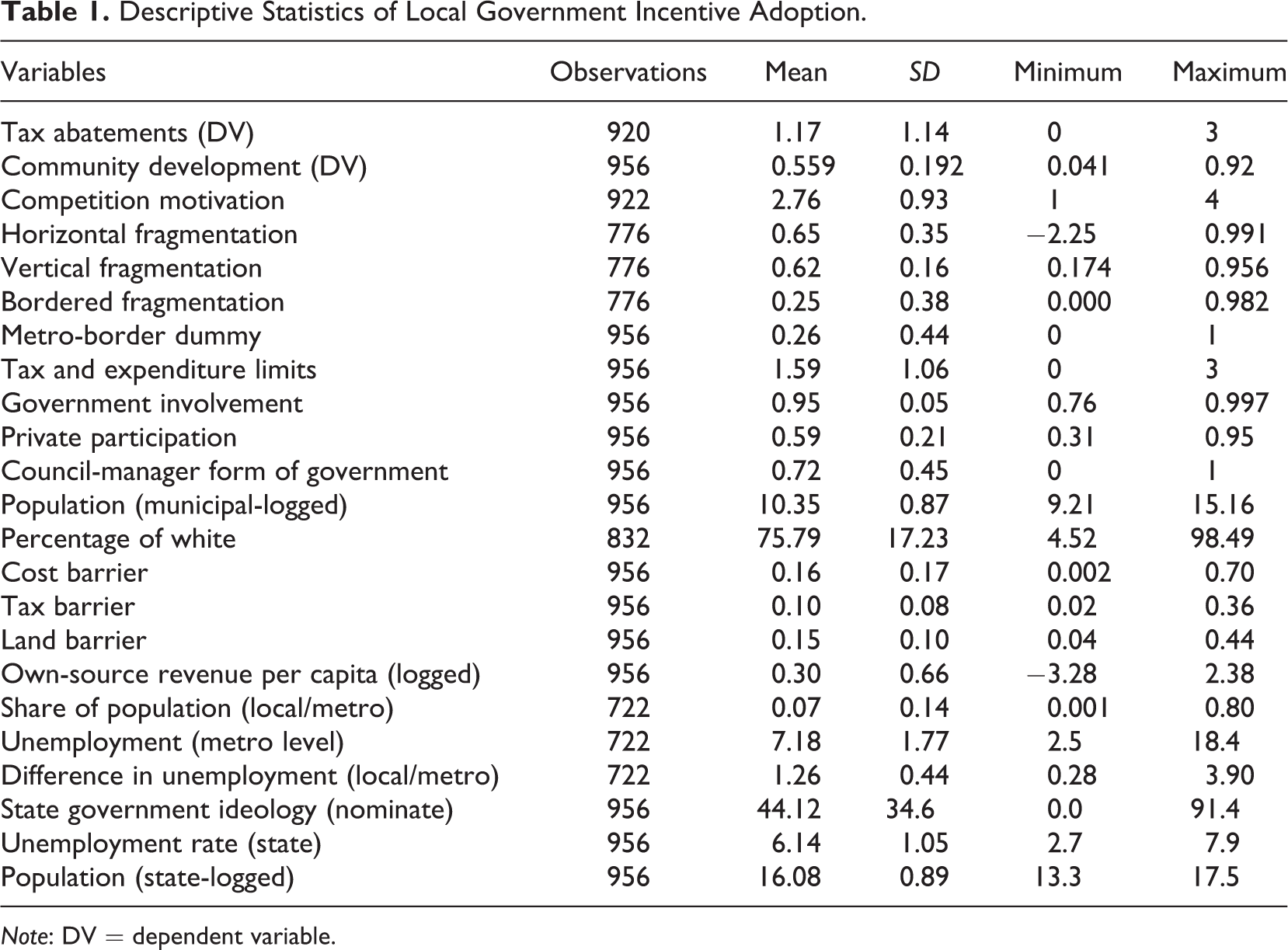
Note: DV = dependent variable.
Table 2 connects our hypotheses to the operationalization of our key independent variables and to the theoretical perspective of institutional reform and public choice. Institutional reform scholars believe that municipal competition, measured through horizontal fragmentation, would increase the usage of costly economic development incentives. Public choice scholars generally argue that these incentives are used in an efficient way, whereby the local government is balancing the taxes and services delivered. Institutional reformers, however, believe that governments which address concerns across a region, or among overlapping governments, will mitigate the negative consequences of this competition and by extension should reduce the number of incentives being offered. While public choice scholars would not favor high levels of vertical fragmentation, they would argue that overlapping jurisdictions increase costs on the overall system without leading to an increase in the usage of economic development incentives by general-purpose governments. Neither theory directly addresses the role of an increasingly complex information environment when regions span more than one state nor do they theorize about the interplay between competition and the form of government.
Theoretical Foundations of Each Hypothesis.
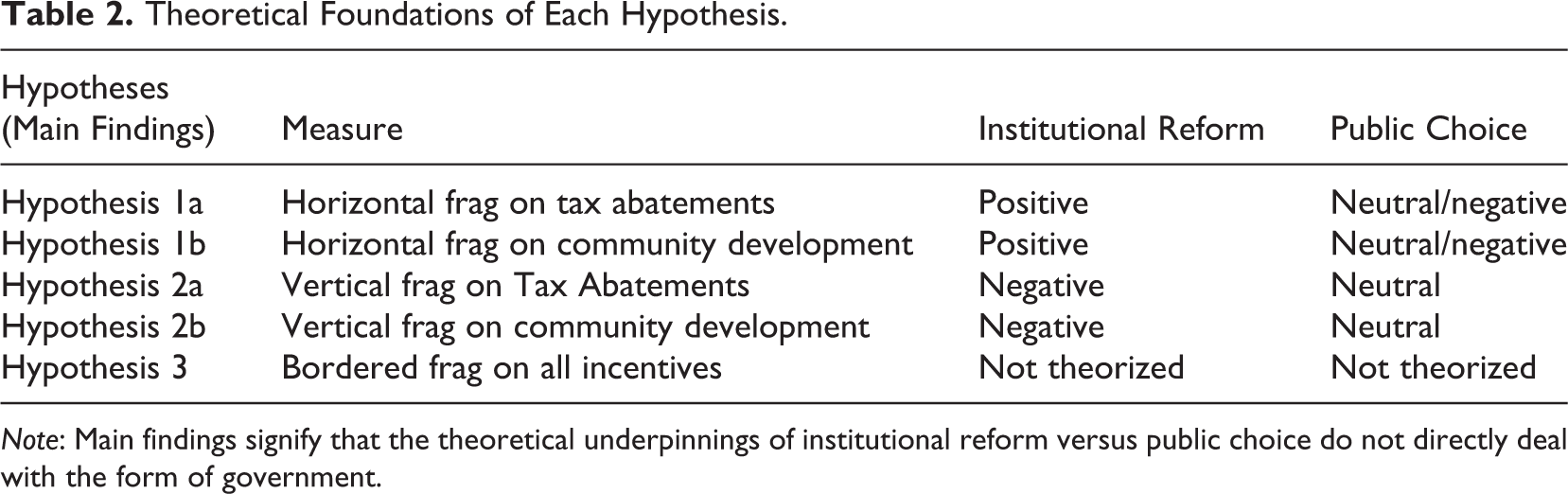
Note: Main findings signify that the theoretical underpinnings of institutional reform versus public choice do not directly deal with the form of government.
Bayesian Estimation
A Bayesian inferential design is utilized given its advantages in dealing with multilevel data and the intuitive interpretation of results it affords (Draper 2008). Because fragmentation is operationalized at the MSA level, Bayesian inference has a conceptual appeal as it naturally allows one to address limitations of too few city-level observations in any given MSA by incorporating the hierarchical structure of the parameters into the prior specifications (Gelman et al. 2013). Here, a Bayesian multilevel model shares information across states to aid our understanding of the phenomena in states where there are a small number of observations (which is common in the ICMA survey data). We use uninformative priors based on the lack of consensus in the empirical literature on the effects of fragmentation; thus, the models are technically pseudo-Bayesian allowing the data alone to influence the estimation. In this way, our estimates would fully converge on a frequentist approach that made use of a maximum likelihood estimation model. Bayesian inference also provides an intuitive summarization of the posterior distribution, which allows researchers to make probabilistic statements about the parameters of interest in a study (Gill and Witko 2013). Thus, one can summarize the probability that a key parameter falls within a specific interval (for instance, the probability of observing β > 0 or β < 0).
Results
Results are reported in Table 3. The analysis finds support for the hypothesized relationship between fragmentation, institutional structure, and economic incentive use. The strongest evidence is found for the effects of horizontal, vertical, and bordered fragmentation with tax abatement policy use. Greater horizontal fragmentation appears to have a modest, positive influence on abatement use (evidence in support of H1a), though the effect is offset by the presence of a council-manager government. Based on the Bayesian interval hypothesis tests, a 96.6 percent chance exists that the interaction of horizontal fragmentation and manager form is negative. Understanding the minds of city managers is beyond the scope of this study. However, the result suggests that while horizontal fragmentation generally increases incentive use in line with Minkoff’s proximity argument, city managers surrounded by more general-purpose local governments may be less likely to simply imitate their neighbors and instead rely on decision-making heuristics such as professional norms and standards for comprehensiveness. Such a comprehensive economic development approach would likely rely on a broader “toolbox” which assesses community, industry, and livability needs holistically and attempts to divide benefits of development policies accordingly.
Bayesian Regression Estimation of Tax Abatement and Community Development Policies.

Note: Bold phased values indicate evidence of effect; cut points for ordered probit model not reported.
It is also observed that there is a 99.9 percent chance that vertical fragmentation is negatively associated with the intensity of tax abatement use and that the effect strengthens in council-manager governments (H2a). We theorized that there could be two competing reasons for this phenomena. Either metro areas with more overlapping, special-purpose governments were in greater hazard of overtaxing their shared fiscal common pool (the property tax base) or the increased reliance on specialized governance for service delivery diminished the need for cities to compete for firms and mobile citizens and allowed them to satisfy citizen demands for services through special district formation. While it cannot be discern which of the two explanations are more likely, they also should not be considered mutually exclusive. To address the fiscal common pool argument, a measure for TELs is included in the model, and strong evidence is found that it is negatively associated with the intensity of local tax abatement reliance. States with more stringent TELs generally contain cities which rely on abatements less in support of the fiscal common pool contention.
The strongest evidence is found for our bordered fragmentation hypothesis (H3). Metros divided between more than one state present more complex information environments for firms and local government policy makers. It was posited that this was due to increases in bargaining and search costs. Cross-border competition is typically conducted at higher levels of government (state legislatures, for instance), and neighboring states present different regulatory environments and constraints on the incentive policies available to local governments. A 99.4 percent chance is found that bordered fragmentation has a negative effect on tax abatement utilization. Further, the size of the posterior mean (−.61) relative to the other coefficients for fragmentation suggests bordered fragmentation has a larger effect. This effect, however, is offset as horizontal fragmentation increases, with a 71 percent chance the effect will turn positive at the highest levels of horizontal fragmentation within the sample.
A final noteworthy result from the abatement model is the posterior mean estimate for the perceived level of competition. Perception is not always reality. While there are many ways to operationalize competition, we argue that our perceptual measure captures the degree of belief that local economic development officials are in direct competition with their neighboring governments for development. As such, the model isolates a behavioral construct in the form of spatial proximity and presents an alternative test (rather than perceptual conditions) of whether competition creates the conditions for greater incentive use. We find a 94 percent chance that perceived competition is positively associated with the level of tax abatement utilization. While this is hardly surprising by itself, we believe it strengthens our central argument that greater numbers of general-purpose governments induce stronger preferences for the utilization of property tax–based incentives to entice firms.
Turning to the community development model, the results suggest cities relying more heavily on community development policy tools are less motivated by competition, have higher costs, and are more independent in their economic development policy decisions. We find weaker evidence supporting our hypotheses (H1b and H2b). The model estimation suggests a 70 percent chance that horizontal fragmentation has a negative marginal effect on community development policy utilization, and the form of government appears to have no effect. We find a 77 percent chance that vertical fragmentation is positively associated with community development policies, although this evidence is also too weak to reach firm conclusions. The role of a professional manager does not change the nature of this relationship.
Compared to traditional tax incentives, community development tools that improve aspects of the community like its aesthetics and transportation infrastructure can create a range of positive externalities for localities (Golub, Guhathakurta, and Sollapuram 2012; Hilber 2017; Leonard, Jha, and Zhang 2017). It was expected that greater vertical fragmentation would lead to increased use of such community-based tools for several reasons. Greater reliance on specialized governments could reduce the need for cities to compete for development. Special-purpose governments can provide public goods at greater scale across multiple general-purpose governments, reducing the range of services that general-purpose governments provide. This could allow local governments to focus on more community-oriented development needs such as affordable housing. Vertical fragmentation also reduces the incentives for governments to compete against each other because the benefits would stay within the same shared tax pool.
Instead, our analysis finds strong evidence that a negative relationship exists between community development and perceived competition and outside government or business involvement in policy formulation. It further finds that cost barriers are positively associated with community development while reliance on own-source revenue displays a negative relationship. The metropolitan unemployment rate is also negatively associated with community-based tool reliance at the municipal level. The picture which emerges is that higher-cost cities with stronger regional economies and intergovernmental revenue/property tax streams appear more likely to place a greater emphasis on community development such as affordable housing, public transit investment, small-business support, job training, and arts/culture/recreation investment. The evidence that fragmentation plays less of a role in these decisions suggests these cities feel less threatened by larger economic forces or competition and have achieved some stable level of public revenues and a comprehensive suite of amenities. It is also found that there is a 90 percent chance that TELs are positively associated with the level of community-based tool usage.
Overall, the degree and dimensionality of governmental fragmentation at the metropolitan scale clearly impact economic development policy choices in accordance with a political market approach. This approach is rooted in the realities that firms and cities operate with imperfect information, limit to the mobility of investment capital, and constraint on the number of suitable suppliers and demanders. Horizontal fragmentation appears to drive competition by virtue of increasing the number of potential bidders for firm expansions and relocations. Vertical fragmentation seems to reduce the ability or desire for general-purpose government to compete via property tax–based tools. Fragmentation that spreads across state lines appears to impede incentive use, which speaks to the limits of capital mobility in complex information environments.
But the community development model suggests this influence is limited by the perceived suitability of localities for growing businesses. Firm-specific locational decisions are rooted both in “bottom-line” and quality-of-life concerns. So, while greater numbers of localities may theoretically increase the options of companies, it does not necessarily increase the mean attractiveness of these sites for businesses. Likewise, cities seeking specific sectors will tailor strategies in accordance with their needs and resource endowments.
Conclusion
Fragmentation has long been understood to be a force that compels local governments to engage in competition for people and businesses. This article makes three key contributions to the literature on metropolitan governance. First, the connection between fragmentation and economic development policy usage is complex and partially moderated by the institutional structure of the local government. While regional governance institutions appear more tractable politically outside the United States, lessons from the American metropolitan experience may also be relevant for a broader audience. Empowered mayors and managers have distinct political and professional incentives to pursue development in more or less distributional fashion. This is an organizational design consideration which we expect is generalizable to other country contexts in which professionalization of local government bureaucracies is under consideration.
Second, vertical fragmentation works through different mechanisms because having more overlapping jurisdictions eats into the regional collective pool of taxable resources and may mitigate the desire or willingness to compete in the same ways. Thus, areas that are more vertically fragmented tend to utilize tax abatements at a lower rate. Cash-strapped local governments in the United States have become more reliant on special districts to provide public goods and services as they have faced greater constraints on fiscal autonomy (Goodman and Leland 2019). We would be hesitant to recommend that adding layers of government may be a way to mitigate the inefficient use of development incentives, given that it complicates easy lines of accountability and transparency for citizens, but it does suggest that there are mechanisms which can reduce the competitive pressures to use these policies. Additionally, we are only focused on the usage of economic development policies, and a more thorough set of implications for other citizen values should be considered before deciding to add additional layers of government.
Finally, we introduce the bordered fragmentation concept. Being in a bordered metropolitan region initially reduces the likelihood of using development-based incentives; however, as the area becomes more horizontally fragmented, the propensity of using tax abatements increases. This moderating effect could suggest that while information asymmetry barriers may reduce the likelihood of using these development policies, having more local governments within these regions drive competition to the point that their usage of development-based incentives will increase.
Additional research should explore the connection between the dimensionality of fragmentation in metropolitan regions and the distributional impact they have on the use of different sets of economic development policies. While the polycentricity debate has directed significant attention to aggregate outcomes such as spending and welfare, inattention to both the distributional intent of policy tools and government types stymies theoretical and practical advancement. Greater attention to the institutional design features that channel appropriations disproportionately within metropolitan political markets can advance this debate.
Footnotes
Declaration of Conflicting Interests
The authors declared no potential conflicts of interest with respect to the research, authorship, and/or publication of this article.
Funding
The authors received no financial support for the research, authorship, and/or publication of this article.