




Abstract
This paper investigates four roles that local governments play in sustainability within the contemporary intergovernmental system—minimalist, implementing agent, entrepreneur, and regional champion. A conceptual framework is advanced to explain these roles based on the time horizons and capacities within which local governments operate. Interviews with local government managers offer insights into how these two dimensions shape the roles that local governments play in sustainability. Although the interviews offer support for the utility of the sustainability role framework, they also suggest additional factors influencing the roles that local governments play in sustainability.
Introduction
Multiple levels of government must play active and complementary roles in mitigating climate changes (Ostrom 2010), but partisan polarization has rendered the national government unwilling or unable to take a leadership role in climate and sustainability policy. The last few years have seen state adoptions of carbon pricing and renewable portfolio programs stall, the U.S. Clean Energy Plan abandoned, and the U.S. withdraw from the Paris Climate Accord. State, local, and regional governments have at least partially filled the vacuum left by national government inaction. States have played a role through actions such as adoption of renewable portfolio policy and empowering local governments in their states, but it is local governments that have taken the lead in addressing many climate and sustainability issues (Feiock 2020). Local governments have the potential to significantly influence environmental problems since they have primary responsibility for the local land use and building decisions that are critical to sustainability efforts (Feiock and Bae 2011). This paper seeks to better understand the different roles local governments play in sustainability within the contemporary intergovernmental system.
Changes at the national level and lack of federal guidance under the Trump administration have altered and politicized sustainability at the local level. A decade ago, sustainability was associated with resource conservation, healthy environments, and high quality of life goals that were common to most governments and not viewed in partisan terms. This became less so over the last ten years as the partisan politicization of sustainability accelerated with changes to federal and intergovernmental policy under Presidents Obama and Trump (Rabe 2011; Trujillo et al. 2016; Terman, Feiock, and Youm 2020; Matisoff and Edwards 2014).
For cities that engage sustainability, the policy role that they assume within the intergovernmental system varies tremendously—ranging from implementing directives from higher levels to initiating local level initiatives, to leading region-wide sustainability and climate efforts. While considerable research investigates whether or not local governments choose to pursue a sustainability agenda or not, the specific roles that cities play in pursuing sustainability has not been systematically investigated. Why do some cities and county governments focus primarily on sustainability efforts based on participation in state and federal programs? Why do some focus on initiating and developing localized sustainability efforts? And why do some focus on and champion regional collaboration?
This article begins to answer these questions by advancing a conceptual framework to define these roles based on the time horizons and capacities within which local governments operate and drawing insights on these roles from interviews with local government managers in Florida. Following this introduction, we present a conceptual framework to classify local government sustainability roles based on time horizons and capacities and describe the resulting roles. We then probe how these roles fit actual programs and practices based on interviews with local government managers in Florida. Drawing from these managers’ experiences, we identify differences in the short vs long term investments in sustainability and sustainability capacity in terms of fiscal collaborative and regional resources available to local leaders. We also identify other factors that shape sustainability roles that local governments take on and offer local government examples. In the conclusion, we assess the framework in relation to the experiences shared in the interviews and propose an agenda for future research.
Conceptual Framework—Local Governments’ Sustainability Roles in the Federal System
Local government leadership in climate protection is especially visible in the U.S. due to the absence of action by the national government, but cities have been leaders in nations across the globe (Krause et al. 2019). The literature has celebrated the activism of local governments suggesting that individual local actions in the aggregate can help fill the void left by the lack of efforts at the national level and by some states. To promote climate sustainability, it requires substantial investments but there are incentives to free ride on the efforts of others (Olson 1965).
Building upon political market and institutional collective action theories, we identify four roles that local governments can play in sustainability policy based on the time horizons and capacity constraints that cities operate under. The four roles are: sustainability minimalist, sustainability implementing agent, sustainability entrepreneur, and regional sustainability champion. Local governments can play these roles simultaneously, but the balance between them will vary across different places at different times depending on community and intergovernmental factors. We anticipate that each role for local governments will align with certain types of policies or programs.
We construct these role categories by cross-classifying local governments along two dimensions: 1) the time horizon they operate under and their return on sustainability investments; and 2) the capacity constructed broadly to include not just fiscal capacity but also managerial and regional capacity. Figure 1 below presents a visualization of the four role combinations that result from these two dimensions.
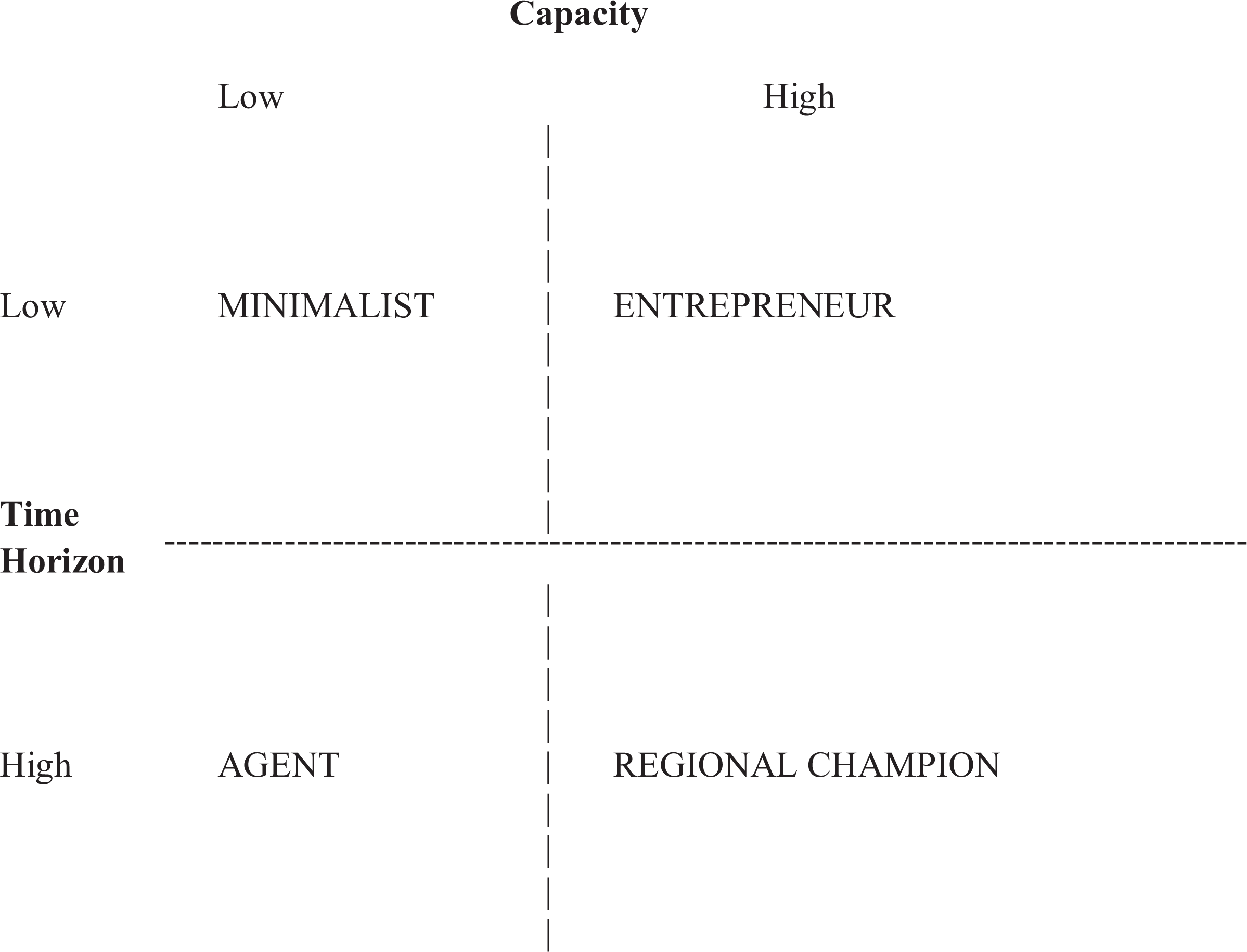
Typology of local government sustainability roles.
Sustainability Minimalist
Sustainability minimalists typically do not have a visible sustainability program as part of their organization or policy portfolio. This role is defined as operating on a short time horizon. This is often the result of sustainability not being a high priority in the community. This role is also linked to limited capacity for policy and collaborative activity, particularly as they are constrained by financial resources. Policy and programmatic activities relating to sustainability are limited in this role and policy actions that contribute to sustainability are purposely not framed as climate policy.
Sustainability Implementing Agent
Local governments can also play a critical role in sustainability as the implementor of programs designed and funded at higher levels. Often this takes the form of intergovernmental grant programs. The sustainability implementing agent role is defined by a long-time horizon, but low capacity. Sustainability activities are often focused on adaptation rather than mitigation, disaster resilience, or resource conservation. The states and the federal government have relied on cities and county government as agents to implement policy through mandates or intergovernmental grants. The Department of Energy’s (DOE) Energy Efficiency and Conservation Block Grant Program (EECBG) is a case in point in which $12 billion was directed to local energy efficiency and sustainability efforts (Terman, Feiock, and Youm 2020).
Despite the potential resources, intergovernmental programs often have substantial strings attached to the funding which may exceed the local benefits of the programs, particularly for small governments that lack technical and management capacity. The study of intergovernmental policy implementation has applied top down principal-agent frameworks to identify factors linked to effective implementation including well-designed oversight and accountability systems, goal congruence, resources and managerial capacity.
The extent to which any of these roles are taken on at the local level is determined by the scope of responsibility and by policy action at the state and national level. We also anticipate that the two dimensions we discussed earlier—local capacity and the time horizon for impacts to be realized—will shape the extent to which the role, which local governments play in sustainability, is defined by state and federal programs.
Sustainability Entrepreneur
Entrepreneurs are the policy initiators, and they harness political self-interests and market factors to promote sustainability policy innovation (Schneider, Teske, and Mintrom 1995; Schneider and Teske 1992). This role is defined as operating on a short time horizon but in an environment in which sustainability is a priority in the community for which abundant capacity and resources are available. This can promote narrow city-specific and sometimes symbolic actions. To address sustainability, local governmental leaders can exert influence by making a substantial difference through agenda-setting and coalition-building to engage local efforts to promote sustainability, resilience and climate protection. Innovative policy, such as solar power generation or alternative transportation, is facilitated by public entrepreneurs’ efforts to motivate their community in supporting transformation to new agendas. Local bureaucrats and elected officials can mobilize an array of public powers and functions that make them well-suited to playing an entrepreneurial role in sustainability within the community to, at least partially, fill the void left by a lack of state and federal action.
Sometimes local entrepreneurship simply reflects redefining sustainability functions to align with traditional local functions and responsibilities. This can be accomplished by expanding the scope of existing function or identifying local co-benefits of sustainability and focusing on these local effects rather than broader impacts such as climate change. For example, focusing on energy cost savings as the rationale for subsidizing solar PV installations.
Regional Sustainability Champion
Another alternative is for local governments to participate in sustainability through collaboration with and supporting efforts of other local governments within the region to complement internal sustainability actions. This can be accomplished with new initiatives, led by the champion, through a regional intergovernmental organization such as a regional council of governments or a metropolitan planning organization (MPO). The combination of a long-term orientation and high resource and regional collaboration capacity facilitate this role. Regional sustainability can also be championed through more ad-hoc regional collaboration networks, intergovernmental agreements or organizations through institutional collective action. Within metropolitan regions, the externalities imposed by problems such as climate change make regional action, rather than just individual action, essential. Nevertheless, there are significant incentives for local governments to remain inert or attempt to free ride on the actions of others. This is particularly true in the United States, where populations and resources are highly stratified along socioeconomic, political, and demographic lines (Deslatte, Feiock, and Wassel 2017). Coupled with the partisan nature of climate change in the U.S. context, local governments frequently seek out alternative rationalizations for their policy actions (Yi et al. 2018). As a result, it is unclear what common benefits participants can expect to gain from individual actions.
Local governments may opt to participate in regional sustainability efforts for a variety of reasons, including access to information and funding structures, greater political legitimacy and pooling influence on national governments (Lee and Koski, 2014), economic benefits from “green” jobs, and development and infrastructure investment (Portney 2013). Incentives to participate in sustainable policy through regional coordination vary based on local government constituent composition and fiscal and managerial capacity.
Research Design
We informed our analysis of the role of local government in sustainability with observations from ten Florida City and County managers gathered through interviews conducted in August 2020. The managers were drawn from local governments in differing regions across the state and respondents represented small, medium, and large cities, and medium size counties. Each jurisdiction is located in a different metropolitan service area within the state to attempt to capture the diversity in ideology and culture that exists within the state. The cities ranged in population from 8,314 to 133,997 and the counties ranged in population from 163,357 to 417,492. The population of the metropolitan service areas where they are located range from 38,881 to over 6,000,000. Table 1 summarizes who the city and county manager respondents are along with the population of the jurisdiction they represent, their geographic locations within the state, and their metropolitan service area populations.
Summary Statistics.

Source: City populations: https://www.floridademographics.com/cities_by_population; County populations: https://www.fl-counties.com/county-population-and-general-information; MSA populations: https://florida.hometownlocator.cities/msa/.
The roles of the managers and their governmental agencies can be situational, depending on whether sustainability initiatives have short or long term returns on investment, what capacity barriers they encounter, including the extent to which cross sectional and regional governing organizations are available, and the type of program and policy considered. Therefore, managers were asked to provide their open-ended assessments of local government roles by responding to the following questions: In what ways do short term verses long term cost benefits impact your agency’s consideration of, and ability to implement, sustainability initiatives? Can you offer any specific examples? What do you, as the manager, see as the greatest barriers to achieving sustainable initiatives? What ideas can you offer to overcome these barriers? Please consider your agency’s capacity from a fiscal and administrative standpoint, as well as past-experience and lessons learned. Thinking in terms of the role of local government in sustainability relative to state and federal government as: 1) policy initiator and developer; 2) regional collaborator and policy co-developer; or 3) implementer of policy developed at the state or national level.
What is the role taken for? LED streetlights. Expansion of dedicated bike lanes Electric vehicle charging stations Integrated measures to reduce air pollution and GHG
Analysis
These interview responses allowed us to probe managers’ assessment of the internal and external factors that shape what role local government plays in sustainability to fortify the analytic framework we advance and provide an assessment of its usefulness. We found clear evidence across cities, counties and programs, that where benefits were confined to the boundaries of the government, the more likely it was to play a role of entrepreneur rather than regional champion. We also found that benefit streams that were more long term generally encouraged regional collaboration and fostered the role of implementor of state and federal programs, if funds were available, as some communities took on long-term investments for sustainability and resilience to fill a void where state and federal action was absent or inadequate.
Time Horizons: Short and Long-term Returns on Investments
Return on investment (ROI), cost benefit analysis, and availability of grants and other funding resources were key when considering sustainability initiatives. The participating managers offered different opinions on the impact of short-term versus long-term cost benefits of sustainability initiatives, but all thought that it was a critical factor in policy decisions. The interview responses generally align with the expectation that it is often more difficult to generate support from local leadership when programs face long time horizons. For example, Charlotte County’s experience has shown that short term benefits with projects such as solar canopies at sports fields and energy efficient projects in buildings are much easier to gain approval for as they either have a high level of visibility to the public or have a very real and demonstrable ROI.
Longer term cost benefit impacts are more difficult to demonstrate the need to the public. For example, water quality to help restore seagrasses in an estuary is a long-term project and, according to the Charlotte County Manager, “will not generate the big win that helps move a project forward even though the result will be a significant benefit to the community and will significantly improve water quality.” On the other hand, the Manager opines that stormwater management projects can improve water quality and have a very real and demonstrable ROI. Both types of projects are long term, but the cost benefit is much shorter and more demonstrable for the stormwater project.
Regardless of the ROI, projects with long-term payoffs are more vulnerable to budget constraints. Leon County provides an example where decreasing revenues-imposed budget constraints not only impact long-term sustainability investments but also some medium and even some short-term sustainability projects. In Sarasota County, projects with longer term cost benefits, such as solar installations, are more closely evaluated and less often implemented due to budget constraints. Interestingly, solar installations were viewed as both long term and short-term projects by respondents.
Measurement of ROI cannot solely be based on monetary return. In Gainesville, the City Manager argued that “environmental achievement should always factor into the ROI calculation.” Regardless of one’s view on the degree that such achievement should be considered, all local governments surveyed reinforced the importance of showing an ROI on sustainability initiatives.
Capacity as a Barrier to Sustainable Initiatives
Lack of a consistent funding source, limited staff and time and capacity, state-preemptions, retrofitting built-out communities, changing elected officials, and lack of clarity on the significance of sustainability were all cited as barriers to achieving sustainability initiatives. Lack of fiscal and administrative capacities were both pointed to consistently as impediments to local sustainability entrepreneurship. A manager of a small city noted that “with less than 100 FTEs, we are focused on daily operations. Sustainability is not in our vocabulary and is not even a topic on our horizon.” The insights provided by Florida local managers regarding staff, resource and technical constraints are very consistent with evidence derived from national surveys of sustainability managers (Hawkins et al. 2018).
Limits on time and attention were also noted as important constraints. This has received only very limited attention in the literature but was noted independently by multiple city and county officials. Managers from the cities of Deland and Gainesville, and St Lucie County, all emphasized the impact time limitations have on achieving sustainability initiatives; citing the immense time and staff resources to prepare and execute sustainability grant applications and executions. They also noted that that it is not just limited time and capacity of local government officials by noting that there is a limited capacity on the part of citizens to engage multiple issues at the same time.
Another constraint, that is particularly relevant to local governments in Florida, is state-preemptions or mandates. State preemptions and mandates pose a binding constraint on local action. The Leon County Manager offered several examples of this including a state preemption on banning single-use plastic bags, and a state preemption on Power Purchase Agreements (PPA). These preemptions have significantly limited the County’s waste reduction and renewable energy policy options.
Long-term cost benefit analysis and associated long term projects typically outlive their sponsoring elected officials and are subject to change when new elected officials come on board. This is a barrier that impacts even the most basic service delivery initiative. The Naples City Manager emphasized the importance of defining what sustainability and resiliency is for the community at hand as the public wants to understand what these terms mean relative to the goals and objectives of the city.
Fiscal and administrative constraints can also impact basic service delivery initiatives. To overcome some of these barriers, the Sarasota County Manager recommended dedicated funding pools…and the need for state and federal grant assistance. Tamarac’s City Manager offered a practical perspective acknowledging that regional/intergovernmental collaboration was paramount as “transportation systems, roadways, waterways, water management, energy usage, alternative energy supply are all issues that are regulated by, and impacted by, multiple levels of government and span beyond the boundaries of any one municipality. Regional/intergovernmental collaboration that takes into account municipal priorities is necessary to overcome the challenge”.
Collaborative Capacity
The Leon County Manager summed up his perspective on cross-sector collaboration with his belief that “achieving true community sustainability requires the community, businesses, and large organizations to work collaboratively with the same vision in mind. Both the biggest challenge and the biggest opportunity lie in this collective effort—combining behavior change, education, and investment to create a real shift in our business as usual.” To this end, Leon County was one of the founding members of the Capital Area Sustainability Compact, a collective sustainability effort of eight of the largest organizations in the community with a joint goal of moving the needle together. In Charlotte County, the Board of County Commission also acted to become the inaugural member of the Southwest Florida Regional Resiliency Compact, a regional effort modeled after other Compacts around the state.
A good example of cross-sector collaboration involves the bike lane expansion project in St Lucie County which was implemented through partnerships with the Transportation Planning Organization and some boards and committees (i.e., a Technical Advisory Committee and Bicycle and Pedestrian Advisory Committee which includes representatives from the Florida Department of Transportation, local residents, city employees, and county employees). In Deland, the City Manager states with certainty that most of the alternative water supply projects would not have been possible, nor effective, without regional cooperation as the projects impact a regional watershed. He felt the same thing is true for trails and bike lanes.
Regional governance approaches have the advantage of a region-wide perspective that can capture economies of scale and spillovers, yet local governments are able to retain some autonomy (Feiock 2007; Kim and Jurey 2013). Regional bodies offer regional institutions to address regional problems. These institutions, which are not governments themselves, facilitate regional governance and self-governance among the underlying local government units (Gian-Claudra 2017). Regional governance organizations include regionally based organizations that are comprised of local governments, such as regional councils (RCs), councils of governments (COGs), metropolitan planning organizations (MPOs), and regional partnership organizations (Wolf and Bryan 2009; Feiock 2007). For cities, county government can sometimes play this role in pursuing the collective choices of local governments within their boundaries (Feiock 2007).
In addition to the aforementioned examples of collaboration, Charlotte County uses a regional approach to implement their Bike Path Master Plan as part of the Metropolitan Planning Organization (MPO). In St Lucie County, the Transportation Planning Organization (TPO) work program includes the development of an Electric Vehicle Charging Station Plan which will include criteria for siting electric charging stations and selection of locations.
Without being consolidated under a unitary government, local government can manage problems across jurisdictions through regional institutions. These institutions are voluntary in the sense that members participate at will and must approve the regional activities. The organization generally has limited authority to force members to do what they do not want to do and, unlike state and federal government, regional governance institutions typically cannot preempt municipal actions. Thus, the specific policy actions that regional organizations take are typically the product of bargaining and the available mechanisms of collective choice.
Additional Insights
The interviews with managers suggest that the role local governments play in sustainability can change with the specific program and is shaped by competing local government priorities. Comments from the managers reveal that the role that local governments play in sustainability can be shaped by the specific type of policy instruments involved. The substantive program areas and types that are commonly used in the academic literature to classify sustainability activities are much less relevant to the calculus of local government managers than the individual programs or policy instruments that are used. When asked whether local government played a minimalist entrepreneur, regional champion or implementer role for LED streetlights, dedicated bike lanes, EV charging stations and integrated air pollution reductions, they gave very nuanced answers that broke down each policy into specific programs or instruments. Individual programs or projects were viewed differently in terms of their targeted beneficiaries, potential financing method, the technical expertise, and spillovers. These findings can be linked to recent literature that focuses on how program design can be targeted to specific geographic areas, and policy instruments can be targeted to specific beneficiary groups (Curley, Feiock, and Xu 2020).
Leon County is an example where municipal planning departments, regional planning councils, and the Florida Department of Transportation collaborated on expansions of dedicated bike lanes; and in St Lucie County, most newly purchased county vehicles are now equipped with the auto-stop feature for reduced emissions while idling. In Gainesville, the city has a somewhat unique and an integral role in reducing GHG because the city is the operator of the area’s electric and natural gas supply and transmission.
Competing priorities are also salient. As with most other counties and cities, Leon County has seen a revenue decrease in the last year, leading to overall budget constraints. These constraints affect all departments and initiatives, including sustainability. For example, funds previously allocated for additional solar PV arrays were reallocated to a higher priority project. However, despite the challenges, the County is still able to move toward significant long-term projects and alternative cash flow rather than just focusing on near-term capital investments.
In Arcadia, the smallest and poorest local government in our survey, the challenge of competing priorities is even greater. Arcadia is an older city and, according to the City Manager, retrofitting the infrastructure to include complete rebuilds of the sanitary sewer system, potable water system, and roadway system are critical and anything that would interrupt the revenue streams would significantly detract from their ability to continue with these projects. Charlotte County, although a pre-planned community in the 1950s, must also focus on maintaining and retrofitting an aging infrastructure. According to the County Manager, the key is “to keep sustainability in mind when looking at projects.” For example, a significant initiative in the county is the septic to sewer conversion project. In some areas of the county that were originally built without sewers, the county is seeing considerable degradation of septic tanks and, therefore, impact to water quality. Fortunately, the Board of County Commissioners made a long-term commitment to address this issue which will put infrastructure in place to support the community for many years to come and have a direct impact on the area’s waterways.
The Tamarac City Manager summed up his assessment of his city’s competing priorities by stating that “retrofitting an already developed community is more challenging and costly. While redevelopment under newer standards may bring more sustainable projects, we need to balance economic development and sustainable development needs as we’re competing for redevelopment opportunities and partnerships.” The Sarasota County Manager takes this a step further by referencing the impact of the current pandemic and the national spotlight on racial inequities and how these are examples of circumstances that have caused the county to elevate the social pillar of sustainability and have encouraged staff and residents to consider the impact of decisions on low income and diverse populations.
Conclusions
The framework advanced in the introduction defines four general roles that local governments can take on relative to the state and federal governments: 1) Sustainability Minimalist, 2) Sustainability Implementing Agent, 3) Sustainability Entrepreneur, and 4) Regional Sustainability Champion. This framework defines two factors as critical in defining which role a local government plays based on local government financial, administrative and collaborative capacity to pursue sustainability programs and the time horizon for the impacts of the programs to be realized.
These roles offered a useful lens to view the assessments of local sustainability offered by the managers interviewed here. The true test of the usefulness of this framework will be to investigate its explanatory power in predicting policy framing, policy actions, and outcomes across a large set of cities. The interview accounts confirm the importance of these two factors and offer supporting examples. Nevertheless, the managers identify several other factors which were not originally considered as also playing an important part in defining the roles that local governments take on. One take away from this analysis is that policy in not monolithic. It involves a set of discreet programs that can be very different from each other and treated differently in terms of the role that a local government takes on, even when they are all components of the same policy.
Footnotes
Declaration of Conflicting Interests
The authors declared no potential conflicts of interest with respect to the research, authorship, and/or publication of this article.
Funding
The authors received no financial support for the research, authorship, and/or publication of this article.
