



Abstract
This research focuses on change within informal service provision networks, specifically examining the impact that changes within a key organization can have on the larger network. Employing a before and after survey design with a treatment at the midpoint and participant observation, it asks: What is the impact of a major change within one organization on the larger external network? What is the nature of the organizational ties? and, How do political factors exogenous to the network impact the network evolution process? The findings suggest that internal change within a focal actor can have ripple effects throughout the network increasing density. Public service provision at the local level can be enhanced through an increase in partnerships between the public and nonprofit sectors. However, network evolution can be limited by the larger political environment and lack of a coordinating role on the part of local government.
Under conditions of environmental stress ties in informal service networks are likely to be in flux (Paarlberg and Varda 2009; Doerfel, Chewning, and Lai 2013) and thus may be more open to changes between partners as the result of changes within partners. Few studies have explored the evolution of networks focusing specifically on the impact of internal changes within a key organization or actor on larger network ties (Padgett and Powell 2012; for exceptions see Stadtfeld et al. 2016; Amati et al. 2019). However, there is reason to believe that changes at the micro level can lead to changes at the macro level in a process that has been referred to as multilevel closure (Easley and Kleinburg 2010; Stadtfeld et al. 2016).
Network change can take a variety of forms and can be related to both external system shocks such as natural disasters or changes in the regulatory environment (Fisher et al. 2012), as well as those occurring within member organizations. While dense networks of organizations with shared identities can be quite stable over time (Provan, Isett, and Milward 2004), change within a key organization in the network can lead to alterations in the patterns of connections within the larger network (Stadtfeld et al. 2016; Amati et al. 2019). In other words, there is the potential for, “co-evolution of interorganizational networks and internal organizational strategies” (Amati et al. 2019, 3).
It is unclear under what circumstances an internal change in one network actor will affect the larger informal network, however. It may be that greater formalization through a network manager or orchestrator is required to cement network change or that “soft” mechanisms of coordination—trust, goodwill, personal relationships—will be enough to hold the network together (Cristofoli, Meneguzzo, and Riccucci 2017; Mandell, Keast, and Chamberlain 2017). Barriers within the larger political environment may limit the extent to which informal networks can become more formalized over time or that organizations from different sectors will cooperate (Cinar, Trott, and Simms 2019).
This research adds to knowledge about these multilevel dynamics by exploring the impact of significant structural and procedural changes within a city agency on the larger network of municipal and nonprofit providers of animal welfare services. It employs a before (2013) and after (2017) survey design with a treatment (significant internal organizational change in a key actor) at the midpoint along with qualitative information gleaned through participant observation. It addresses the following three research questions: i) What is the impact of a major change within one organization on the larger external network? ii) What is the nature of the organizational ties? How important are personal relationships in the evolution of an informal or self-organizing network? Does the evolution process affect the nature of ties between municipal and nonprofit entities? iii) How do political factors exogenous to the network impact the network evolution process?
The findings suggest that internal change within a focal actor can have ripple effects throughout the network increasing density. Public service provision at the local level can be enhanced through an increase in partnerships between the public and nonprofit sectors. However, network evolution can be limited by the larger political environment and lack of a coordinating role on the part of local government.
Service Provision Networks and Network Change
Membership in service provision networks extends beyond local government to encompass interactions between the public, private, and nonprofit sectors (Agranoff and McGuire 1998; McGuire 2006; Ansell and Gash 2007). The resources necessary to address critical urban issues are assumed to be dispersed across a range of actors, thus, networks form around a common goal that cannot be achieved by a single organization such as a local government (Koliba et al. 2017; Kapucu, Hu, and Khosa 2017); nonprofits are critical participants in many public service provision networks. Research on public service provision networks has grown exponentially creating “the age of networks and collaboration” (McGuire 2006, 34). There have been recent and consistent calls in the literature for a greater focus on network formation and, in particular, change or evolution (Robinson et al. 2013; Stadtfeld et al. 2016; Reese and Ye 2017; Tenbensel 2018).
While self-organizing networks can include both informal policy networks and those with formal contractual mechanisms (Hawkins, Hu, and Feiock 2016, 643), informal networks arise among members in the absence of central planning. Thus, they allow both public and nonprofit participants to maintain autonomy and enter and leave the network at will, due to lower transaction costs (Schneider et al. 2003; Feiock 2013). As a result, they may be more open to and affected by changes occurring within individual organizations. Informal networks can be attractive because they reduce the risks associated with more formal agreements and can lead to the building of social capital and trust among network members that can serve as the basis for more formal arrangements over time (Feiock and Scholz 2009; LeRoux, Brandenburger, and Pandey 2010; Hawkins, Hu, and Feiock 2016). The nature of the problem at hand can affect informal networks based on the amount of risk associated with participation (Feiock 2013). In the case of animal welfare, the problem is complex yet coordination among public and nonprofit service providers can increase the odds that by acting jointly, network members can all benefit.
Change in Networks: From Emergence to Evolution
It has been hypothesized that network change occurs through a sequential process of emergence, evolution, and ultimately, dissolution (Ring and Van de Ven 1994; Saz-Carranza and Vernis 2006). Within these stages, authors have identified a number of sub-steps; for example, pre-networking can lead to establishment of relations or the creation and consolidation of partnerships within the network in the emergence phase (Larson 1992; Lowndes and Skelcher 1998). Prior relationships and reputations among potential network members are particularly important in this early phase and the network becomes more formalized over time (Saz-Carranza and Vernis 2006). Evolution would then involve the implementation of programs or services and the solidification of network relationships.
It appears that more open networks with weaker ties among organizations and less density are more likely to change under conditions of stress in the environment (Paarlberg and Varda 2009) although preexisting ties are still likely to be retained due to path dependency (Doerfel, Chewning, and Lai 2013). Uncertainty in the environment leads network members to form additional ties with partners of their current partners, suggesting that shocks may lead to additional ties but be limited to organizations already connected prior to the environmental change (Andrew 2009). Under conditions of change the centrality of organizations will be dependent on perceptions of their trustworthiness, reputation, and influence among other network members and organizations that are able to embody these values will become more embedded over time (Provan, Huang, and Milward 2009). Similarly, informal networks can lead to more formal ones with contractual agreements among members based on a shared history of trust and collaboration (Hawkins, Hu, and Feiock 2016).
The Ties That Bind: Trust, Type, and Personal Connections
Informal networks can be particularly important in facilitating the sharing of information, capacity building, and ultimately, pooling of financial resources (Isett et al. 2011). They can be more easily formed if there is a set of congruent normative beliefs linking actors and where shared identities, activities, characteristics, and policy preferences can lead to network stability, endurance, and focal closure over time (Paarlberg and Varda 2009; Easley and Kleinberg 2010; Fisher et al. 2012; AbouAssi and Tschirhart 2017). The quantity and quality of ties within a network can impact its ability to come to cooperative and innovative solutions to shared problems (Uzzi 1997; Reagans and Zuckerman 2001; Daly and Finnigan 2011).
Organizations are more likely to be tied together if they are in some way similar in nature or proximate geographically (Goodreau, Kitts, and Morris 2009; Moynihan 2009; Jung and Song 2019). When networks are in the emergent stage, as potential partners are being identified and “courted,” personal ties and prior relationships among organizational leaders have increased importance. Then formalization occurs and ties begin to be based on roles so that the network connections can survive changes among individuals (Larson 1992; Kanter 1994; Saz-Carranza and Vernis 2006). As a result of the tendency for informal networks to operate based on trust and shared values, there are often visible sub-clusters of organizations wherein small groups of actors are tied together either based on shared values and experiences or on a “friend of a friend” rationale (Lee, Lee, and Feiock 2012; Siciliano and Wukich 2017). This is an important aspect of animal rescue networks which are based on a strong commitment to enhance animal welfare and a sense of service to vulnerable “others,” yet can be challenged by differences in attitudes about how best to solve animal welfare problems (Reese and Ye 2017).
Since a hallmark of service provision networks is that they are composed of organizations of different types or sectors—government, nonprofit, private—the tendency for friends to tie themselves to other friends may mean that connections within type are more numerous than those between types (Kossinets and Watts 2006; Belso-Martínez et al. 2020). Indeed, it has been suggested that the necessary trust underlying the formation of network ties may be more strongly related to the sector of the participants than actual “trustworthy” behaviors (Milward et al. 2010). Research has also suggested that public sector actors are more likely to be located at the core of a network, tied to each other, with nonprofit and private actors moving in and out of the periphery (Robinson et al. 2013). Limited ties between public and nonprofit actors can restrict the benefits of cooperative service provision: increased service levels, pooling of skills and other resources, and a greater reach in the community than government could achieve on its own.
Change in Networks: The External Environment
Networks, particularly informal ones, are “dynamic phenomena” in that the behavior of individual participants is likely to change, causing concomitant changes in the configuration of the larger network (Snijders 2005; Snijders, Steglich, and van de Bunt 2008; Daly and Finnigan 2011). It appears that a disruption in the environment may result in changes in relationships among organizations in the network (network ties) and in the participation of individual organizations (Pfeffer and Salanick 2003; Powell et al. 2005; Provan, Huang, and Milward 2009). Contextual pressures coming from the larger political and social environment as well as from within the network can affect density of the network and its ability to meet goals (Brass et al. 2004). While internal changes within organizations can impact the larger network, there are also feedback loops whereby changes in the larger environment can cause alterations within partners (Stadtfeld et al. 2016; Amati et al. 2019). When challenges arise in the external environment of organizations, they may try to address them by increased cooperation or interactions with other organizations, such as when caseloads increase, and partners are sought to help alleviate the pressure (May and Winter 2007).
Summary
While providing important insights, extant research still leaves room for additional study. First, the use of quantitative network analytical techniques has tended to provide robust measures of many aspects of networks while not necessarily getting at the qualitative details of what is going on inside the organizations in the network. Second, much of the network change research has focused on service or policy areas such as emergency management, hospital systems, telecommunications, economic development, and planning, often at the national or international levels (for an exception see Comfort and Kapucu 2006 example), or on networks that have been formed and operate based on formal agreements (Fisher et al. 2012; Jung, Song, and Feiock 2019). Third, very little research has examined the connections between intraorganizational change and the interorganizational network particularly in informal, self-organizing service provision networks.
This research uses mixed-methods to explore informal service network evolution by focusing on the impact of an internal change in a municipal animal control agency and how that rippled through the larger animal welfare service provision network. The animal welfare network under consideration is both self-organizing and informal in that there are no codified contracts or agreements among the members. This implies that change may be more fluid and that the network ties may be more responsive to the introduction of a significant “shock” such as the entrance of a potentially central organization than would be the case in more formalized networks. The research thus addresses calls in the literature to: focus more intensively on informal, self-organizing networks (Lecy, Mergel, and Schmitz 2014; Hawkins, Hu, and Feiock 2016); examine the evolution of networks over time (Robinson 2006; Provan, Huang, and Milward 2009; Kapucu, Hu, and Khosa 2017); include both qualitative methods and survey designs in network research (Provan and Lemaire 2012; Kapucu, Hu, and Khosa 2017); and, examine both content (the purpose for interaction) and context (the structure of the organization ties) of the network (Streeter and Gillespie 1993; AbouAssi and Tschirhart 2017).
Methodology
The overriding research question posed in this paper is: was a significant organizational change within one of the focal actors in local animal welfare service provision (Detroit Animal Care and Control) associated with development of a more centralized and dense animal welfare service provision network? This question is premised on an actor-based model of network dynamics where a change in the focal actor’s behavior creates new ties which in turn affect the connections of other actors in the network (Snijders, Steglich, and van de Bunt 2008). It involves a before and after design with a treatment based on surveys of animal welfare organizations serving Detroit as well as participant observation. A leadership change in a central organization is the treatment as is discussed below. The focus on a single metropolitan area allows for greater manageability of the resource intensive nature of data collection over time (Fisher et al. 2012).
As an exploratory case study, a mixed methods approach is used to provide both depth (participant observation/interviews) and breadth (survey) to the analysis (Yin 2017). First, data were drawn from two network surveys of animal welfare organizations in the Detroit metropolitan region as described below. The program UCINET was used to analyze the survey questions about network partners (Borgatti 2002; Borgatti, Everett, and Freeman 2002).
Second, participant observation was also employed to flesh out the nature of the relationships within the network organizations; the first author volunteered weekly at the focal actor, Detroit Animal Care and Control (DACC), over the course of the study and was privy to the internal changes in policy and procedures. Detailed notes were written after each weekly volunteer session typically covering three hours, over the course of two years, from January 2016 to November 2018. This author also works with two outreach groups that provide assistance to pet owners in Detroit and volunteers at an additional shelter also included in the study. More specifically, that participation included weekly animal care, kennel cleaning, interactions with staff and top leadership, preparation of food and medications, creating enrichment treats and toys, exercising dogs, cleaning grounds, and sorting and filing records and other written materials. The author was directly involved in arranging animal transfers to two partner shelters and providing transport. Face-to-face interviews with staff at DACC were also conducted.
The Case
The environment for animal welfare service provision in Detroit represents a perfect storm of limited public sector resources and high need: roaming stray and feral animals; public health risks from dog bites from owned animals that have escaped from their yards or broken off their tethers; backyard breeding and dog fighting; animal cruelty; lack of resources for animal population control; and, high and escalating intake of animals at the municipal shelter responsible for both animal control (protections for the human residents) and care (protections for the welfare of the city’s companion animals) (Reese 2018; Reese and Vertalka 2020). Because of a mismatch between municipal resources and the size of the animal welfare challenges, the most viable way to provide efficient and effective local service is through partnerships between, or networks comprised of, public and nonprofit sector organizations. Thus, animal welfare/control represents a common situation in municipal service provision where limited public resources necessitate cooperation among actors across sectors. It also constitutes a basic and long-standing public service. Legal regulations designed to protect the populace and property from dogs have existed as long as dogs have been domesticated, for example. Historical analyses point to the rise of urban animal control in the US from the 1800s, with anti-cruelty statutes becoming common in the 1860s (Huss 2007; Brady 2012). State legislation and local ordinances related to animal control are now essential and the courts have consistently upheld “well-written” animal control ordinances as legitimate extensions of state and local police powers (Favre, Borchelt, and Beck 1999; Huss 2007).
This research focuses on the City of Detroit where self-organizing informal networks for animal welfare services are critical due to several forces in the larger environment. Residents of Detroit experience dog bites at rates higher than many other cities in the country (Holmquist and Elixhauser 2010; Rhea et al. 2014). 1 The City also has high numbers of stray and feral animals with dogs being a particular health concern. While research modeling the US dog population has assumed that the number of feral or unowned dogs is “negligible” (Patronek and Glickman 1994), estimates of stray and feral dogs in the City of Detroit have ranged from 3,000 to 50,000 (Reese 2015). These roaming dogs exacerbate human health risks from both roaming and owned animals due to potential bites and transmission of diseases and increase the need for animal welfare services.
Detroit has experienced significant levels of economic and fiscal distress which challenge its ability to provide services generally and animal welfare/control services specifically. The economic decline of the City of Detroit has now been well documented (see for example, Binelli 2012; Galster 2012; Eisinger 2013; Reese, Sands, and Skidmore 2014; Sands 2015). The result has been extreme economic stress for Detroit residents. The economic misfortunes for residents have resulted in relocations leaving owned animals homeless and reducing already limited resources for animal healthcare, particularly for spay and neutering services. The roaming animal problem is exacerbated by mortgage and tax foreclosures, vacancies, and structural abandonment leaving habitats for stray and feral animals and for illegal activities such as dog fighting to be conducted (Galster and Raleigh 2014; Reese, Sands, and Skidmore 2014).
Development of the Population List
The starting point for the network analysis was to specify the boundaries of the animal welfare environment in Detroit. Neither the animals nor the groups involved with them remain neatly within the political boundaries of the city. Further, many nonprofit organizations that work with animal issues in Detroit are not located there. Because this research compares networks at two points in time, 2013 and 2017, the starting point for population identification occurred in 2013. Based on the initial population list developed at that time it was determined that nine counties encompassed most of the animal rescue organizations that appeared to be working within Detroit or received animals from the City: Oakland, Macomb, Washtenaw, Wayne, Monroe, St. Clair, Lapeer, Genesee, and Livingston.
The methodology includes an online survey conducted on the population of animal welfare organizations working in Detroit at the two time periods. 2 The population list of organizations was developed using data from Facebook, Adopt-a-pet, the Michigan Annual Animal Shelter activity report, the Rescue Shelter website, and the Michigan Dog Rescue Directory; 315 organizations fell within the geographic area of interest in 2013 and 320 in 2017. Analysis of news reports, interviews with selected nonprofit organizations and shelter administrators to provide contextual background, attendance at meetings related to animal welfare, and examination of social media indicate that all important organizations are included on the lists.
The survey requested that respondents identify other organizations they worked with; these were examined to see if any were missing from the original list and they also received surveys. 3 In 2013, ninety organizations did not have valid email or postal addresses and were removed from the population list. This occurred for fifty-eight organizations in 2017. Internet searches for these organizations determined that they were no longer in operation. Based on the 225 organizations with valid addresses, 69 responded to the survey for a response rate of 31 percent in 2013. In 2017, 53 organizations out of 262 with valid addresses answered the survey for a response rate of 22 percent.
The findings reported here are based on network panel data (Snijders et al. 2008). Only those organizations that responded to both surveys are examined with the exception of DACC which serves as the treatment. 4 A total of thirty-three organizations responded to both surveys. It should be noted that this does not mean that the responding organizations had to be part of the network in both time periods, just that they answered both surveys. While DACC received a survey in 2013, they did not respond; however, the new leadership did in 2017. While the absence of DACC in the 2013 survey is not ideal, based on their operating model at that time, they were only allowed to transfer animals to a single other entity and none of the other organizations responding in 2013 mentioned them as a partner for any activity. Thus, it is very unlikely that any ties between DACC and other organizations were missed in 2013.
There is a high nonresponse rate for both surveys raising concerns over the effects of missing data in the social networks to follow. Incomplete data within social networks can be the result of several problems: boundary specification; respondent inaccuracy; nonresponses; and study design (Kossinets 2006). In this case the boundary specification problem is mitigated to some extent because, although a geographic boundary was specified in the determination of the population, respondents were allowed to identify network partners outside this boundary. Further, they were not limited to fixed choices (i.e., a list of potential partners). Survey nonresponse, however, is not as easily addressed. Reciprocal nominations were allowed; an organization did not need to respond to the survey to be included in the network if mentioned by a respondent balancing the nonresponse to some extent (Stork and Richards 1992). Qualitative data from the participant observation is also used to provide depth to counterbalance the limited breadth. Nevertheless, the response rate is low, and it can be assumed that there are more members in the network than appear in the analysis and that there are missing links which can affect the graph structure as a whole (Krebs 2002); this is a clear limitation of the study. As a result, the analysis constitutes a subset of the network that submitted responses to both surveys, rather than a complete network analysis.
Survey
Identical question formats were employed on the 2013 and 2017 surveys. A link to the online survey was sent to the director of each organization. Respondents were asked about basic traits of their organizations such as geographic region of service provision, types of animals served, and whether they are a nonprofit or a municipal shelter or rescue. The survey then listed nineteen different activities asking respondents to indicate to what extent they were engaged in each one (very involved, somewhat involved, do not do) and whether they did the activity alone or in cooperation with other organizations. Respondents were then asked to indicate to what extent they cooperated with seven specific types of entities (city departments, country departments, licensed shelters. for example) and about the quality of those cooperative relationships. Finally, twelve animal welfare concerns were listed, and respondents were asked to indicate how important each concern was in the City of Detroit (very serious, serious, not very serious, not a concern).
Open ended questions then asked respondents to list the organizations they work with to share resources (forty-nine members), provide animal rescue services (forty members), and promote particular public policies (twenty-nine members). Research has indicated that network membership varies depending on the focus at hand (Milward et al. 2010). These specific areas were initially selected to address the primary focus of most organizations which is to provide animal rescue and welfare services. Resources such as information, volunteers, joint fundraising, food, and supplies are critical to providing animal welfare services yet tend to always be in short supply. Since it is possible that organizations might guard their own resources, cooperation in this area could provide a test of just how willing they are to work with others in the network. Finally, animal rescue operates in a political arena where contention takes place over animal control ordinances at the local (breed restrictions and limits on time dogs can be placed on a tether outside, for example) and state (puppy mill and pet store regulations, licensing and regulation of shelters and rescues) levels (Brady 2012; Brisbin and Hunter 2016; Reese and Remer 2017). The network for political/policy activities might differ from the ones related to service provision or resource sharing.
Nature of Responding Animal Welfare Groups
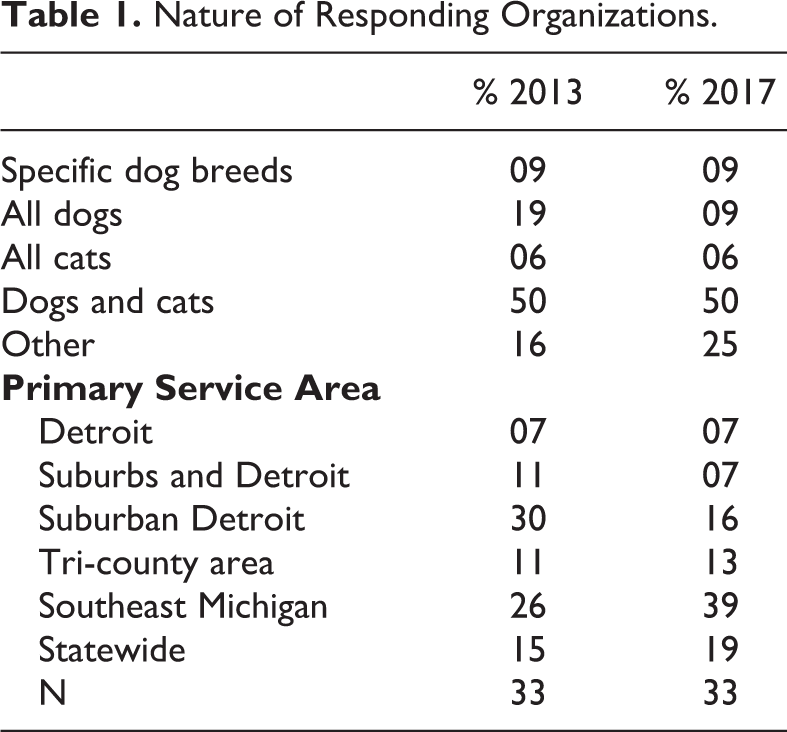
The majority of respondents to both surveys fall into the nonprofit category and focus on both dogs and cats followed by “other” types of animals with more organizations including other animals in 2017 (Table 1). Open ended responses to the “other” category at both time points elicited a wide variety of other clients with no type of animal predominating: wildlife, farm animals, ferrets, exotic mammals, hedgehogs, chickens. While all of the responding organizations serve the animals of Detroit, most engage with a larger geographic area such as southeastern Michigan, the entire state, or the suburbs of Detroit. Only a small percentage of respondents focus on Detroit specifically. While the service areas of respondents are similar in 2013 and 2017, organizations appear to be increasing their services in the larger region while reducing them in the suburbs of Detroit, specifically.
Nature of Responding Organizations.
The network maps to follow are coded by four types of responding organizations: municipal shelter (N = 32 in 2013/26 in 2017), nonprofit (N = 72/75), advocacy/interest group (N = 5/10), and veterinary clinic (N = 3/2). Organizations that are state-licensed animal shelters operated by either a city or county have been classified as “municipal.” Licensed animal shelters and licensed and unlicensed animal rescues can also be organized as a nonprofit and these have been classified as “nonprofit.” Veterinary clinics are included in the population because they provide low-cost health care to animals in shelters and rescues, board animals for rescues that do not have bricks and mortar shelters, and can also act as a site for the adoption of homeless animals. Finally, advocacy organizations or interest groups are those that focus on policy advocacy activities such as opposition to puppy mills, act as watch dog organizations, or promote shelter best practices as opposed to service provision and can be organized at the local, state, or national levels.
Findings
Insights from the participant observation and the network analysis are recursive in that they feed into one another. The discussion below begins with findings from the former to provide background on the internal change within a potentially central actor, Detroit Animal Care and Control. The participant observation findings discussed in the next two sections are enhanced with citations to secondary documents and analyses.
The Change: DAC to DACC
This research explores change in the animal welfare service provision network in Detroit after a “treatment,” specifically new leadership at the City’s public agency responsible for animal control. Up until late December of 2015, Detroit Animal Control’s (DAC) primary mission was public safety—getting stray animals off the streets and serving as a recipient of “found” and owner-relinquished animals. DAC did not adopt animals to the public, thus, the only possibility for adoption for the animals housed there laid in being transferred to another organization. But, because DAC only transferred animals to one other organization (the Michigan Humane Society, MHS), opportunities to develop partnerships with other shelters and rescues were very limited. Further, very few animals made the all-important trip from DAC to MHS and on to adoptive homes. Pit bull mixes were defined a priori as “not adoptable” and hence were not eligible for transfer and were automatically euthanized if an owner did not recover them during a four-day hold period. Further, MHS primarily accepted only smaller dogs for transfer (or small and fluffys as they were known). This combination of policies resulted in a 3 percent live release rate at DAC meaning that 97 percent of the animals arriving there were euthanized.
In late December of 2015, the long-term director of DAC was replaced by a new director with a long and respected professional history in animal welfare with both national and local groups. At that time there was no operating budget, standard operating procedures, staff training, preventative medical care or first aid, and basic animal care tools. There were no volunteers, no cooperation with rescue groups, very few transfers, and no animal enrichment (Reese 2018).
The impact of the new director was most visible in the shelter’s save rates which increased from 3 percent in 2012 to 60 percent by 2016. 5 The factors contributing to this significant increase were many and manifested in the change in name from Detroit Animal Control to Detroit Animal Care and Control (DACC). As part of the city health department (newly moved from within the police department), the new role of DACC emphasized both public health (prevention of bites and disease, licensing of dogs, catching stray and feral dogs) and the welfare of animals. 6 Because the new DACC director was supported by the mayor, health department, and city council, an operating budget was approved. The first volunteers were trained and in the shelter by the end of January 2016. A new veterinarian treated injured animals, provided pain relief and other medications, and began to administer basic vaccinations and flea and parasite treatments upon intake. And, most importantly for this research, animals began to leave the shelter on transfer to network partners across the state and even across state lines as the new director implemented sheltering best practices which specifically include using networks of transfer partners to send animals to other organizations when at capacity rather than resorting to euthanasia (Weiss et al. 2013; Hawes et al. 2019). While animals were initially transferred because they needed specialized medical care, over time, transfers aimed to reduce the shelter population and increase chances for adoption. Further, early transfers tended to take place between DACC and organizations with personal connections to the new director, while eventually processes were instituted to approve and register “transfer partners” reducing reliance on personal connections and increasing institutionalization of ties. The emphasis on transferring all types of dogs and cats to other rescues and shelters could be expected to have an impact on the nature of the network environment, particularly in connections between the municipality and nonprofits.
The Nature of the External Environment
The shift from DAC to DACC illustrates the impact of the larger political environment on the organization. The long term director of DAC had been removed for a variety of reasons: public concern over the high euthanasia rates that played out in demonstrations which included protests at the homes of city officials and even storming the building; extensive attention in local media including coverage that spread around the world when a particular pit bull mix, Ace, was euthanized despite offers of rescue 7 ; accusations of staff cruelty to animals in the shelter including a charge that a staff member had fed puppies to a snake; and, concerns about public safety in a city with increasing numbers of roaming dogs. There was little to no transparency in the functioning of DAC which has been noted in other research as a trait of Detroit city government in general. Detroit’s history of racial segregation and discrimination has shaped a culture of distrust (Bockmeyer 2000; Reese, Sands, and Skidmore 2014). This distrust extends both vertically (between citizens, neighborhood associations, non-profits, and their city government) and horizontally (between the city, its suburbs and the state government). While there is clearly nonprofit involvement in both service provision and advocacy in the city, past studies of other networks have suggested that there is an absence of strong, consistent, and coordinating nodal organizations, either nonprofit or public (Jackson-Elmoore, Hula, and Reese 2011). Animal welfare advocates tend to be overwhelmingly female and white (Weaver 2013). And those involved in the opposition to DAC mostly resided in the suburbs (Reese and Ye 2017). Thus, the demonstrations tended to be viewed as assaults by outsiders against a city bureaucracy with a diverse workforce that felt under siege, at times fearing for their safety. Environmental change in the form of a new mayor and health department director, in addition to pressure from welfare groups and the media, led to the internal organizational change at DAC.
At the same time that internal shifts were occurring at DACC, other aspects of the external environment related specifically to animal welfare were also changing and may have had an, albeit likely limited, effect on the service provision network. Below is a summary of changes in the environment that may have impacted the service networks in addition to the internal changes at DACC: The City experienced a modicum of economic recovery although research has suggested that it is very modest and does not include most of the city’s neighborhoods. It is not clear that conditions for animal welfare changed as a result of this, however (Reese et al. 2017; Reese 2018). A new nonprofit dog rescue shelter located in the city was licensed by the state in 2014 (Detroit Dog Rescue).
8
While this expands the capacity for homeless dogs in Detroit their intake levels are relatively small; 301 dogs in 2017 compared to roughly 4,000 at DACC (Michigan Department of Agriculture and Rural Development [MDARD] 2015, 2017).
9
Population levels in the City continued to decline which might reduce the number of animals, however, intake of animals at DACC does not indicate that this occurred according to annual shelter reports filed with the State (Reese et al. 2017; Reese 2018).
While the analysis is based on a before and after treatment design and hence does not control for other changes in the environment that potentially could also have affected the nature of the animal welfare networks, it is possible to get a sense of the amount of perceived change in the larger environment to assess other potential “history” effects. The pre- and post-surveys contained a set of questions about the most important problems in animal welfare in the city. These questions provide a sense of change in the general animal welfare environment. Responses are shown in Table 2. 10
Seriousness of Animal Welfare Issues.
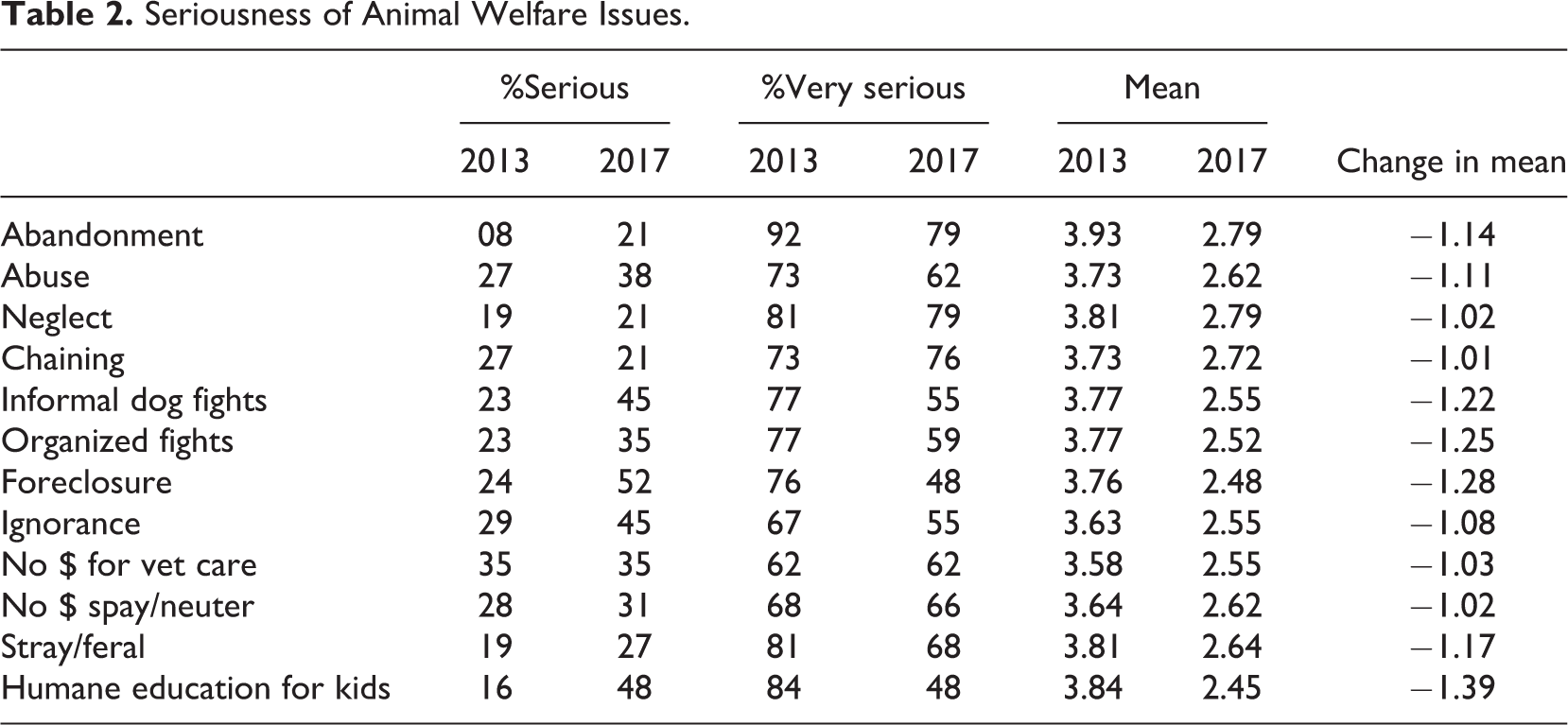
Respondents in both time periods tend to feel that all of the noted issues are important problems in Detroit. However, they also perceive a lessening in severity of all of the issues based on means. 11 This raises several possibilities regarding potential history effects. First changes in the environment in addition to those internal to DACC could have affected the overall level of animal welfare. Perceptions that lack of humane education for children, foreclosures, and dog fighting are serious issues have declined the most. While there are no data to assess the extent of humane education and dog fighting, foreclosure rates dropped between 2013 and 2017 making it likely that the impact of foreclosures on animal welfare did indeed lessen. However, it is also possible that the changes at DACC (and potentially to the larger network) contributed to the perceived improvement in animal welfare visible across the items.
Changes in Activities and Cooperation
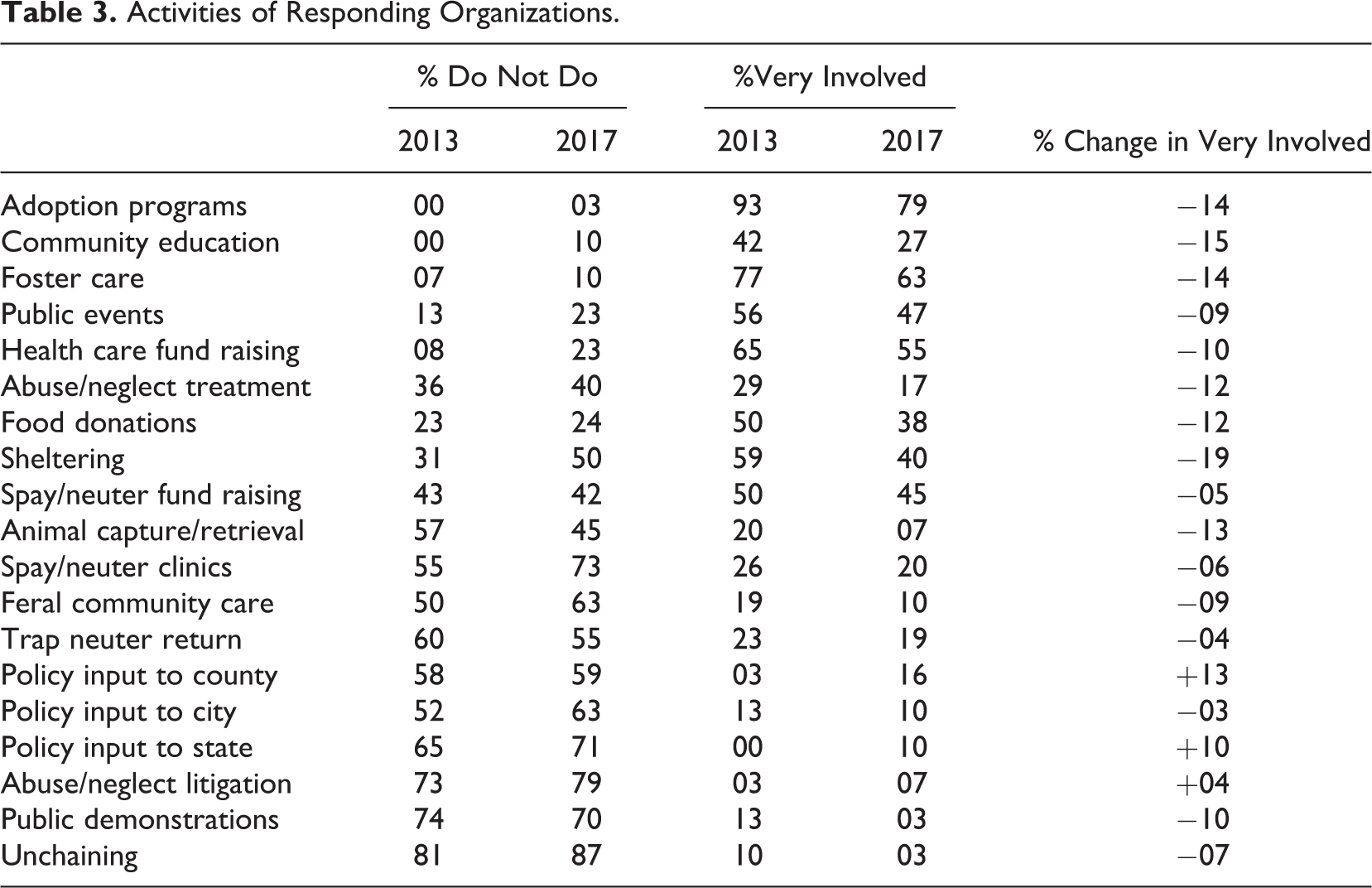
The activities of the organizations responding to the survey are shown in Table 3. Generally, across the activities, respondents appear to be moderating their focus with fewer being “very involved” in any one activity. In only three cases—policy input to the county and state, and abuse litigation—did the percentage of “very involved” increase. Sheltering animals, community education, adoption programs, and foster care dropped the most among the responding organizations.
Activities of Responding Organizations.
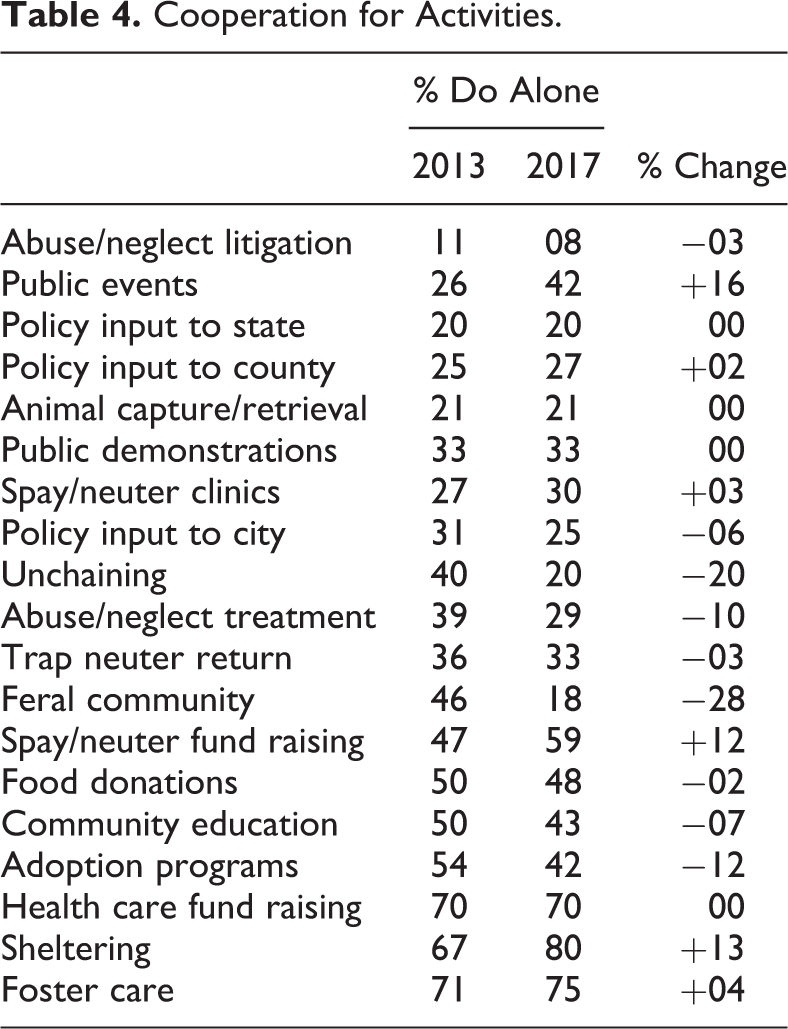
Cooperation for nine of the nineteen activities listed on both surveys increased over time while for four it remained the same; for only six activities are organizations more likely to act alone (Table 4). Reduced cooperation is particularly apparent for public events such as adoption fairs, animal sheltering, and for fund raising for spay/neutering clinics. Cooperation for support of feral cat colonies, removing dogs from situations where they are chained outside in yards, and adoption programs saw the largest increases. Nonprofit policy activity in the effort to address chained dogs has been particularly visible over the course of the study. Detroit has a significant number of dogs that are left outside, often on heavy chains, at all times and in all weather conditions. Several groups work specifically to provide services to such dogs (education to owners, fence builds, igloos, straw, and food) and a number of nonprofit organizations joined in the effort to lobby the city to enact an anti-tethering ordinance which it did in 2017.
Cooperation for Activities.
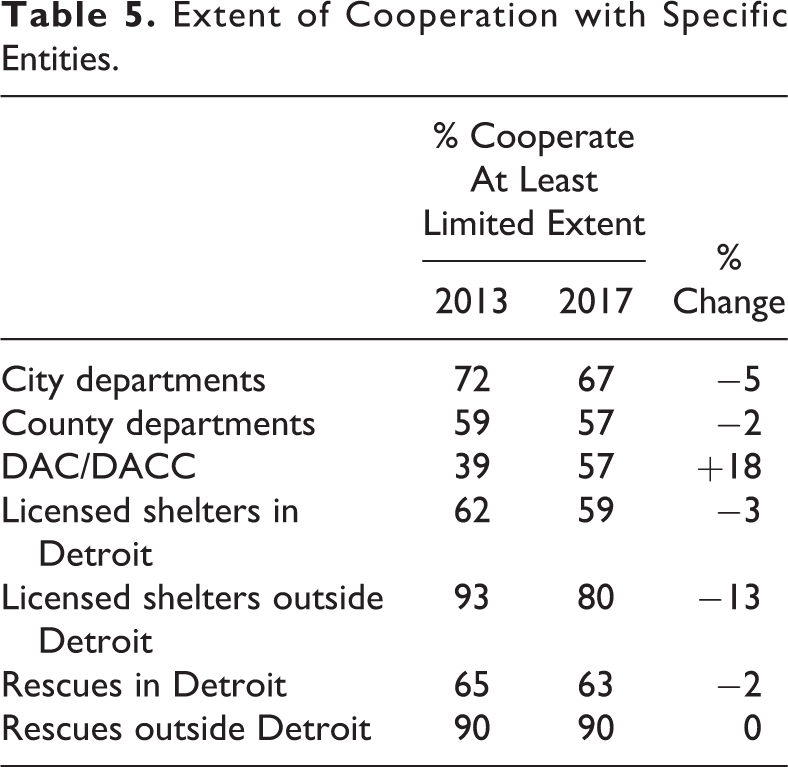
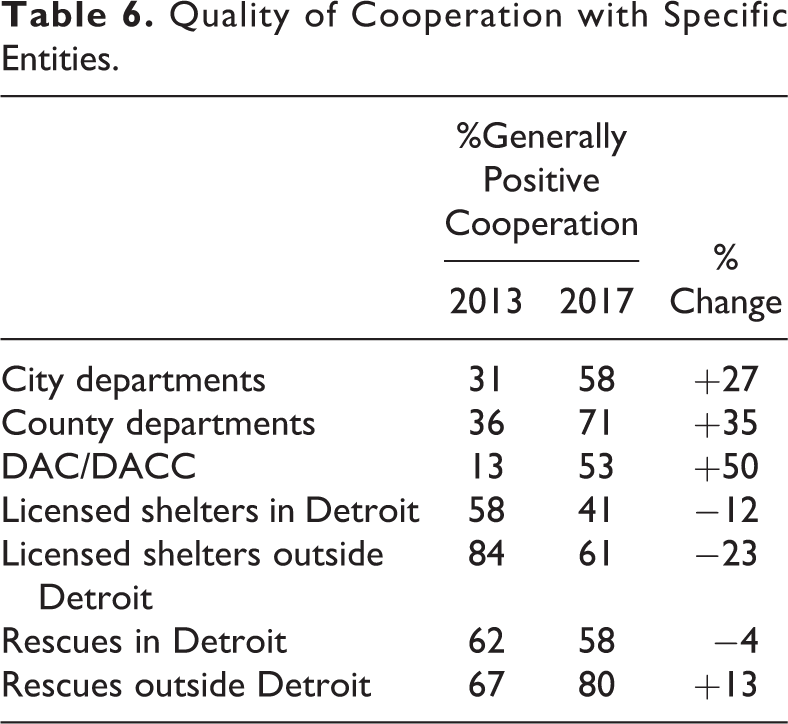
The extent of cooperation with specific entities has dropped over time, with the notable exception of cooperation with DACC which increased by 18 percentage points (Table 5). The perceived quality of cooperative relationships increased significantly between the mostly nonprofit organizations and public agencies such as DACC and other city and county departments (Table 6).
Extent of Cooperation with Specific Entities.
Quality of Cooperation with Specific Entities.
Network Analysis
Open-ended questions asked respondents to indicate what other groups they worked with to share resources, provide animal rescue services, and promote particular public policies. 12 It should be noted that the networks resulting from the survey involved unconfirmed ties and are non-directional. For example, in terms of animal welfare services, if DACC is connected to another rescue, it cannot be determined from the survey whether animals are moving from the former and transferred to the latter or whether resources are being donated from the latter to the former. The qualitative analysis provides insight into the direction of relationships, but it is not explored statistically in the network analysis. For clarity, the network diagrams presented do not indicate which organization mentioned the tie. However, diagrams with this information were created and examined. For all three networks there was only a single case where a two-way relationship was mentioned, thus little information was provided based on which organization mentioned the tie. 13 In all cases the majority of the ties involving DACC were mentioned by another organization.
Resource sharing
The network for sharing resources has gotten more centralized over time with the values for both mean degree centrality at the node level and degree-based centrality at the network level increasing (Table 7). While it has gotten denser, it became the least centralized of the three networks by 2017. The betweenness indicators for this network increased between 2013 and 2017 suggesting more intermediary organizations. In short, it has become denser over time with an increasing number of organizations in intermediary positions.
Network Statistics.
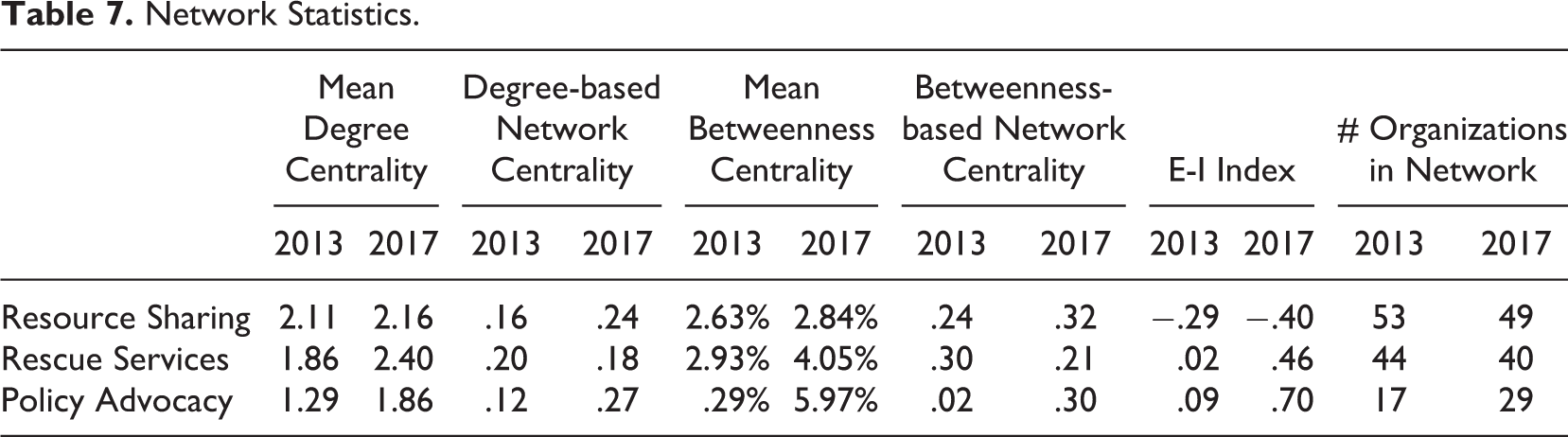
The E-I (external-internal) index calculates the number of ties of group to non-group members. In this case the groups represent the four different types of organizations as previously noted. In 2013, the resource sharing network was the only one that had more external ties between organizations of different types; by 2017, this pattern intensified. It remains the only network with more external than internal ties. The resources shared among network participants include money (joint fund-raising, grant funding), volunteers, foster homes, space (when an organization with room for an animal accepts it on transfer from a near-capacity partner), supplies (food, straw, kennels, toys), and information (referrals to other organizations that might help in a particular situation, open spaces at a spay/neuter clinic, social media shares). As noted, these resources are shared across the municipal/nonprofit divide in ways that rescue services and policy activity are not.
Figure 1 highlights network changes as well as the position of the new DACC in them. In 2013, DAC was not mentioned as a partner by any of the organizations since it was generally disdained in the larger animal rescue community. NBS Animal Rescue, 14 Shelter to Home, the Metro Animal Adoption Association, and Friends for the Dearborn Animal Shelter were the most central organizations; the first three are nonprofit foster-based rescues while the latter is a nonprofit that holds a municipal contract. There are very few municipal shelters in the network for sharing resources and those that are included tend not to have connective roles.
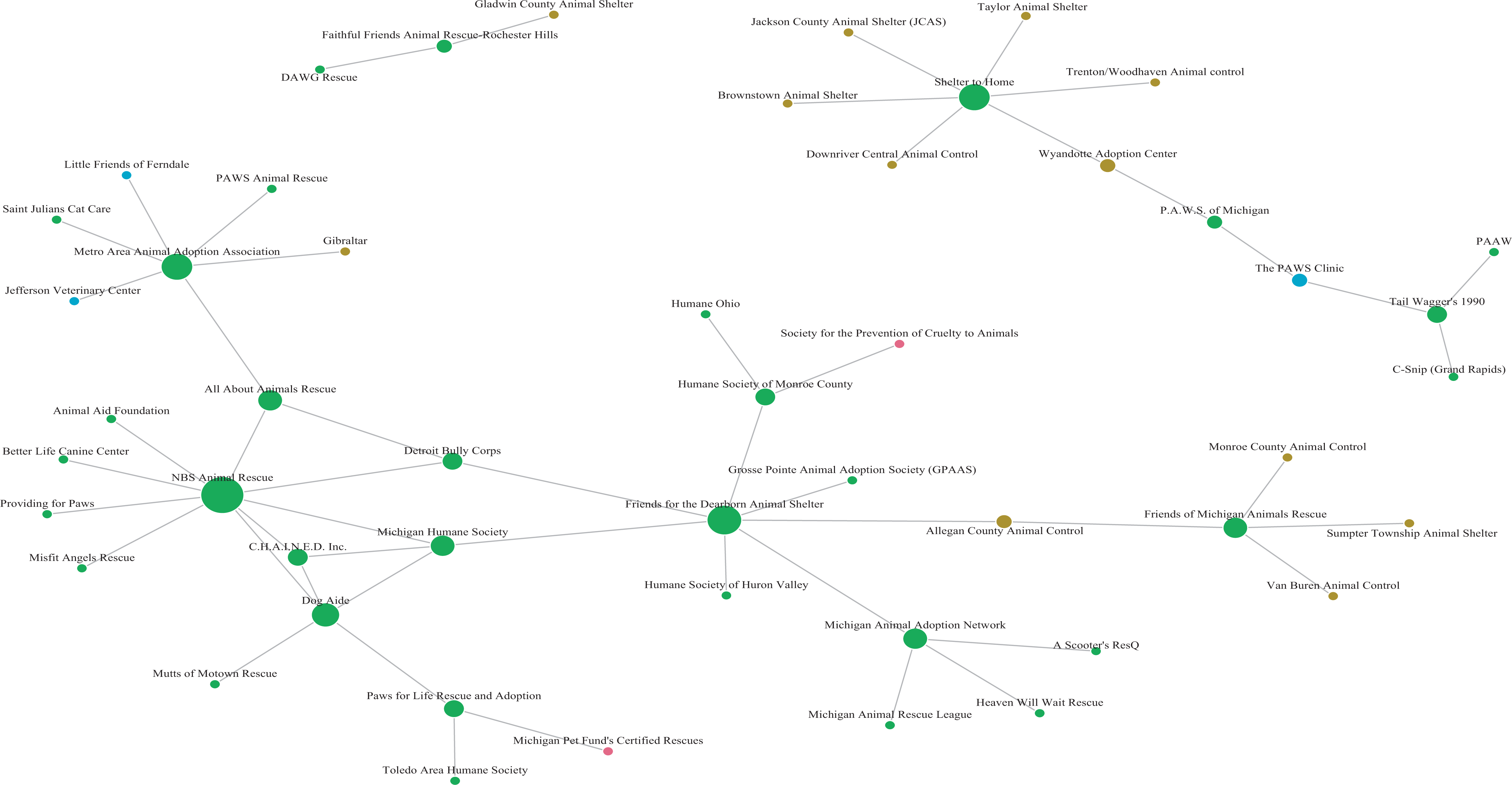
Resource sharing network 2013.
The increased density by 2017 is visible in the network diagram as is the presence and central role of DACC (Figure 2). While NBS has become even more prominent in the network, DACC has the second most ties and is involved in a large chain of intermediary connections. The purpose of these resource sharing arrangements is several-fold including overlaps in volunteers and donations of supplies and medical support from the nonprofits to DACC. While in most cases animals are transferred from DACC to the nonprofits; several of the field service organizations (such as CHAINED) notify DACC when they see animals in distress in the city and in need of a visit by animal control officers. Facilities are also shared to an extent as the DACC parking lot is home to the Dog Aide supply vehicle and is the venue for free spay/neuter clinics provided by Dog Aide and Bark Nation.
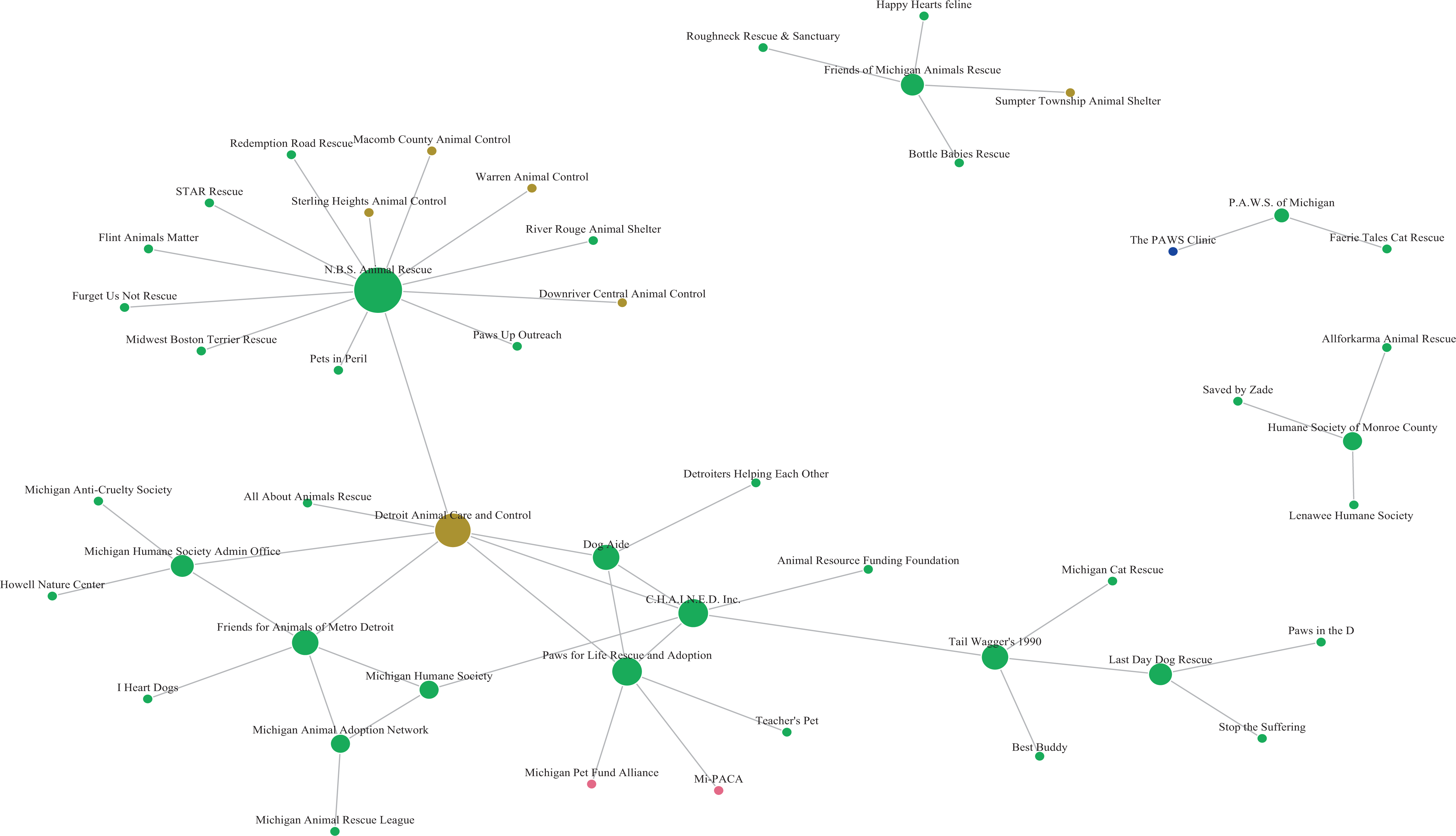
Resource sharing network 2017.
Many of the ties appear to have a geographic base in this network. For example, in 2017 NBS is primarily connected to other organizations north and west of Detroit; this geographic pattern was not visible in 2013. DACC is primarily tied to other organizations in Detroit and the near western suburbs. Friends of Michigan Animals rescue is largely tied to organizations in the same geographic area as well. Thus, while there are more public/nonprofit connections over time these tend to be among organizations that are geographically proximate.
Rescue services
The network for the provision of animal rescue services has also gotten more centralized or dense over time (Table 7). On average, organizations tend to have more collaborators as indicated by the mean degree centrality. However, the slight reduction in degree-based centrality indicates that the ties are more evenly distributed; in 2013 a few nodes were well-connected while others were not. By 2017, this network has become the most centralized of the three. Both indicators of betweenness increased over time indicating that there are more intermediary organizations. Finally, internal connections have increased substantially, i.e. there are fewer ties among organizations of different types.
The lack of ties between public and nonprofit entities is likely a result of the fact that cooperation on rescue services primarily means transfer partnerships. Nonprofit rescues tend to prefer to transfer to other rescues, particularly those with foster homes, so that animals do not have to go or return to a shelter. They are also concerned about the typically higher euthanasia rates at municipal shelters, feeling that another rescue would likely be a safer place for their animals to go. Thus, the nature of rescue services means that nonprofits will tend to transfer animals to each other if possible.
These changes are visible in the network diagram in Figure 3 Similar to the resource network, in 2013 no organizations mentioned DAC as a partner; by 2017, DACC had become a central node (Figure 4). Most of the rescue ties between DACC and other organizations are the result of the former transferring animals to the latter to increase their chances of adoption. Only in the case of CHAINED do the ties go in the other direction with animals identified during field services as being tethered without proper food or shelter or other types of cruelty and neglect concerns going to DACC.
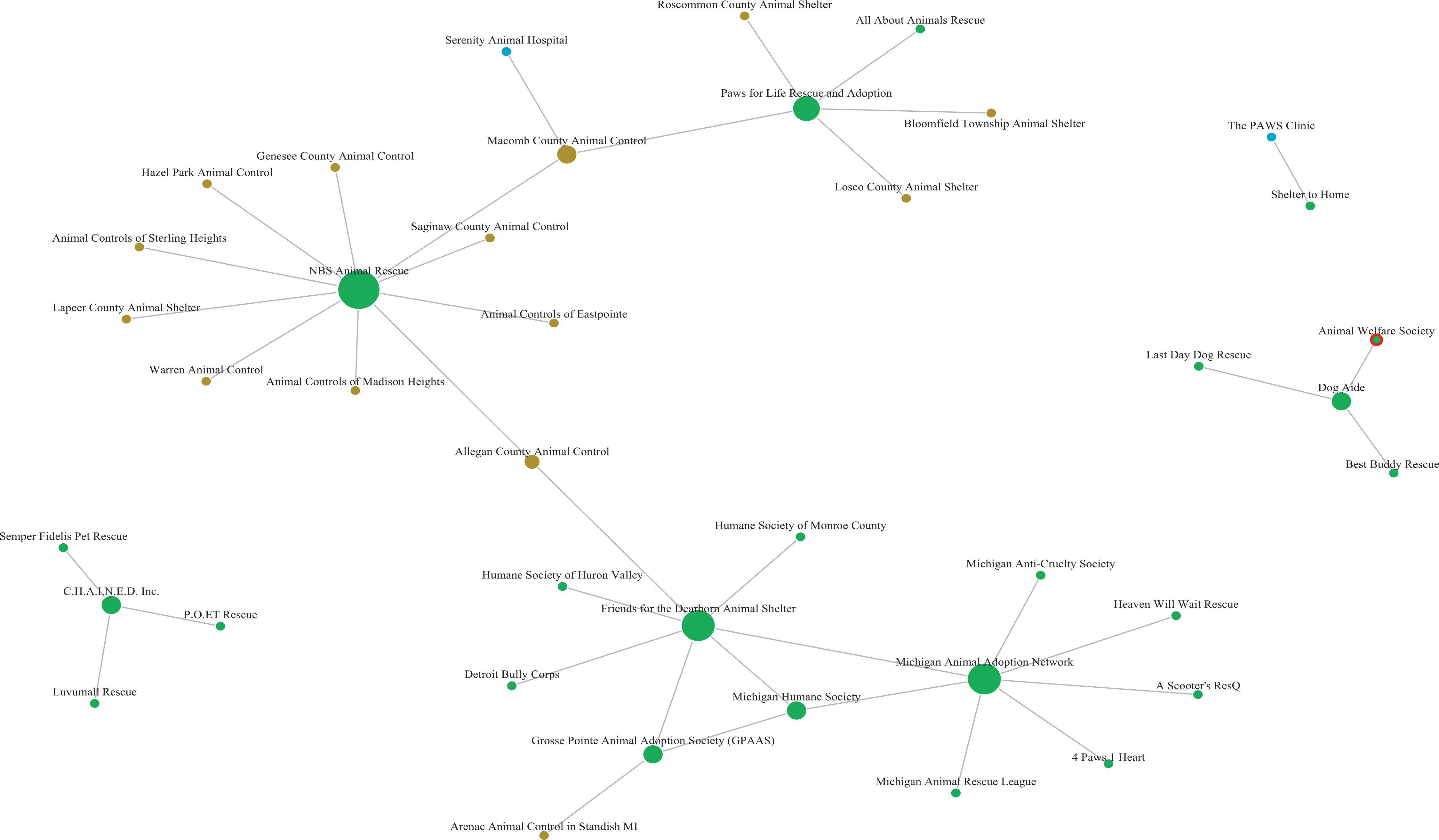
Rescue services network 2013.

Rescue services network 2017.
In 2013 two of the nodes (NBS, Michigan Animal Adoption Network) were connected to geographically proximate partners. By 2017 these patterns have diminished, there are no clear geographic patterns. This is the likely result of municipal shelters increasingly sending animals longer distances if another shelter or rescue has the space to accept them on transfer. Volunteers at DACC regularly transport animals (typically dogs) to organizations around the state as well as out of state and transport chains have been created where dogs are taken part way to their destination and met by other volunteers at the receiving organization.
Policy advocacy
The network for policy advocacy activities is the least dense and centralized in both time periods, although centralization increased between 2013 and 2017 (Table 7). Both betweenness indicators increased considerably over time suggesting a greater number of intermediary organizations. The E-I indexes suggest more ties among organizations of the same type, a pattern that has increased over time. This is the only network that includes more organizations in 2017. This is visually displayed in Figures 5 and 6.
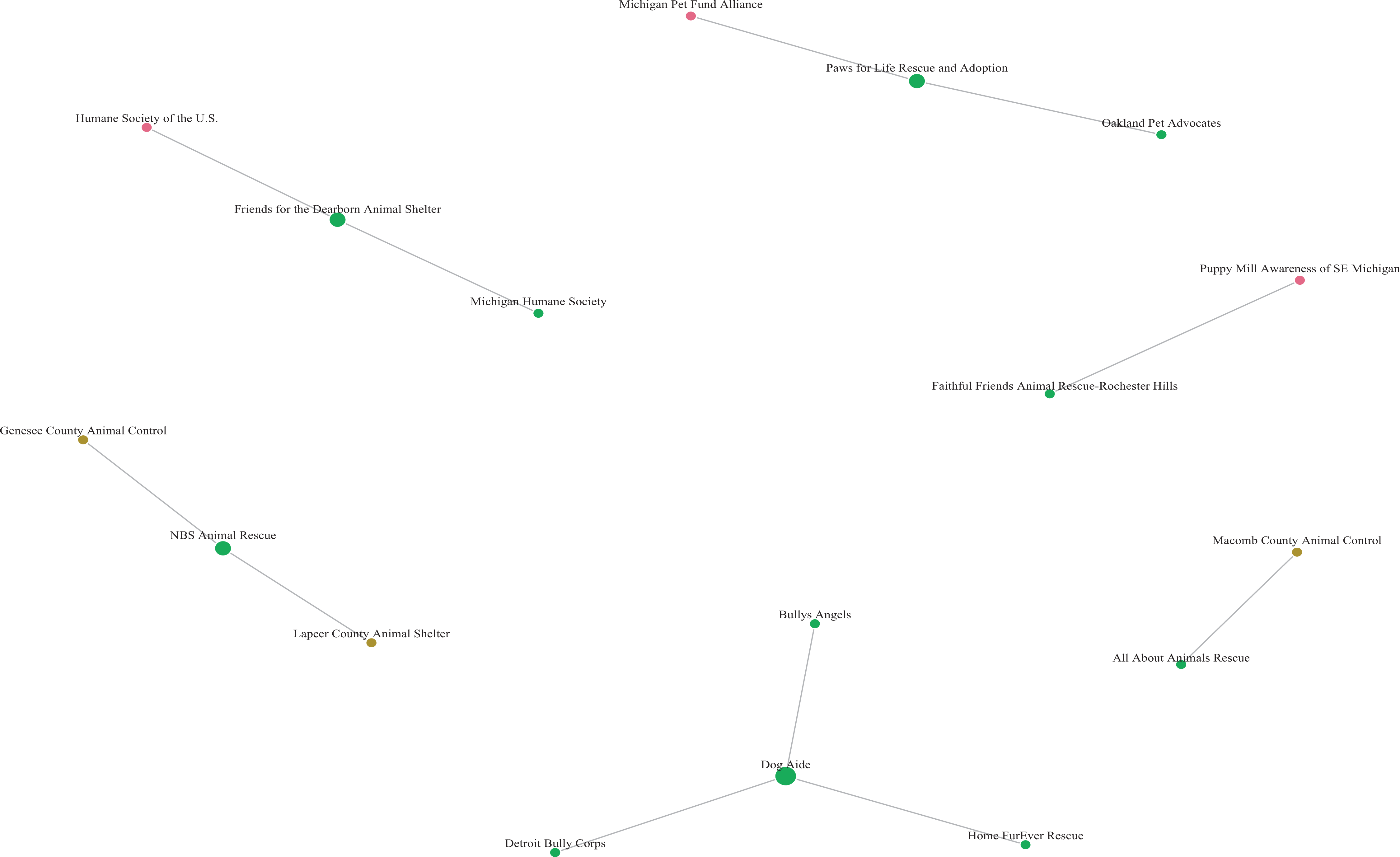
Policy advocacy network 2013.
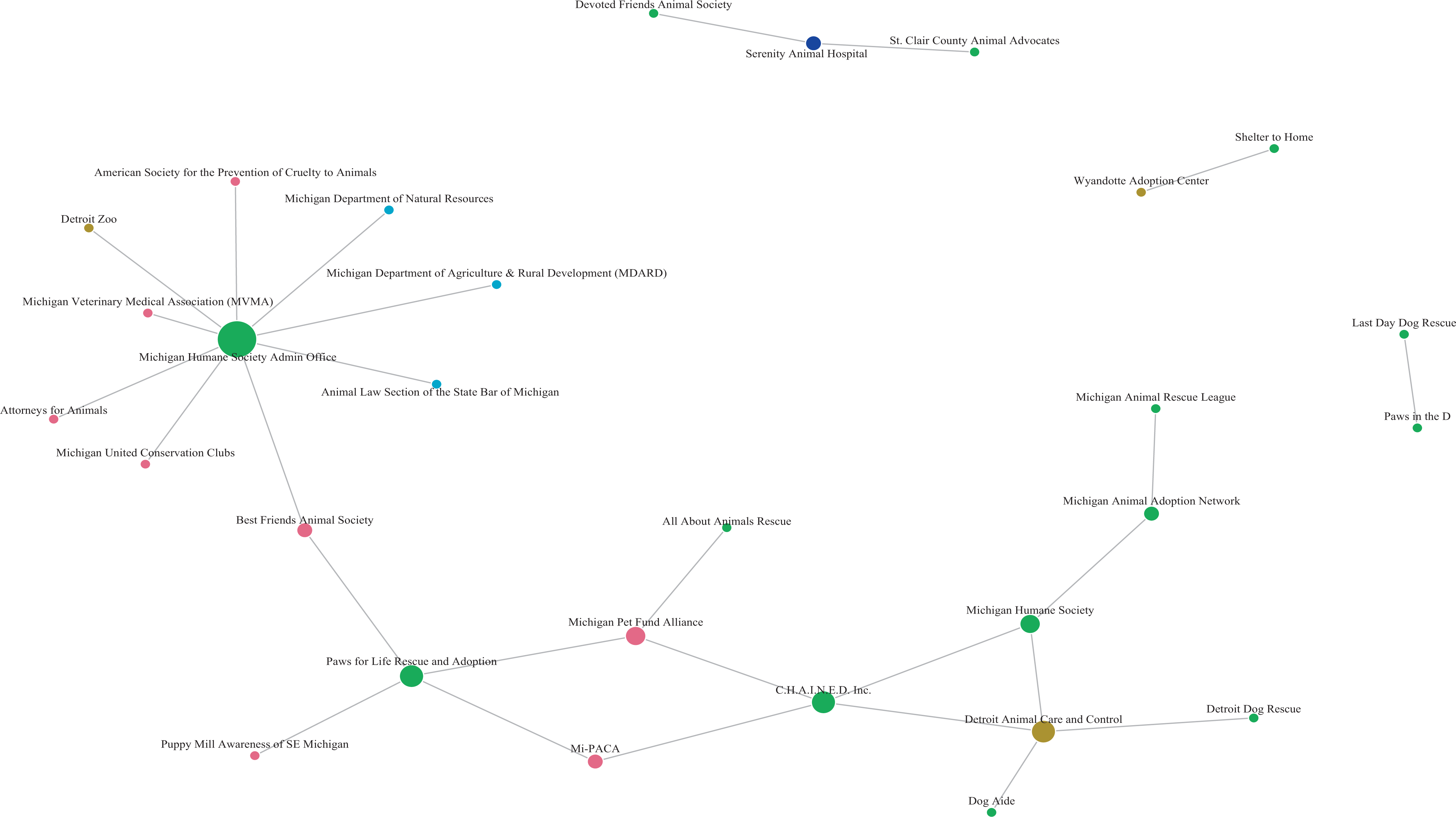
Policy advocacy network 2017.
The increased density of this network is clearly visible as is the fact that different organizations serve as central nodes for policy advocacy than for services or resources. The Michigan Humane Society main office was a minor player in 2013 but has taken on central importance by 2017 with connections to state animal-related agencies and other policy advocacy organizations at both state and national levels. CHAINED has also increased its role in animal advocacy for its work in Detroit on an anti-tethering ordinance and in the region and state pushing for the repeal of breed specific legislation. DACC again was absent from the policy advocacy network in 2013 but appeared in 2017 with several ties. It has taken positions on issues related to dog bite prevention, dog licensing, and anti-tethering. The MHS and Paws for Life nodes show no geographic patterns since most of the ties are with state and national advocacy organizations. The CHAINED node only includes organizations based in Detroit.
The E-I index is highest for policy advocacy suggesting that governmental and nonprofit entities do not work together to promote particular policies. This is logical given that the nonprofits are typically lobbying state, county, and city officials for changes in statues or ordinances.
Discussion and Implications
Several general patterns are clear from the data. First, across the nineteen activities included on the survey, the percent of organizations cooperating has increased for over half of them. Cooperation with DACC specifically increased between the two survey points and the quality of those interactions improved. In the 2017 survey, after the leadership change at DACC, the networks became denser, there were more nodal organizations with more connections, and there were more intermediary connections. The diagrams show that DACC has become a node in all three of the networks explored; internal changes at DACC fostered increased connections with other animal welfare organizations. For rescue services and policy advocacy there are both more nodal organizations, and those nodes have more connections by 2017. For resource sharing there is roughly the same number of nodal organizations, but again, they have more connections. The E-I indexes do not indicate much change in the extent of ties between organizations of different types, if anything internal ties have gotten stronger. Resource sharing is the only network where external ties are stronger, a pattern that has increased over time.
As a whole, these findings suggest that significant changes within a potentially important actor in informal service provision networks can have effects that ripple throughout the larger network, changing the patterns of collaboration. The changes at DACC clearly allowed them to become a nodal organization in all of the service networks (although to a lesser extent for policy advocacy). And it is likely that the increasing collaboration and density in the networks has had a role in perceptions that all of the animal welfare problems in Detroit have lessened somewhat.
Insights for Urban Service Provision Networks
The increase in density in the animal welfare service provision networks explored here supports the contention that change within a potentially important organization involved in the provision of a local government service can lead to substantial changes among partners in the larger network. Implications/insights of the findings for understanding urban service provision networks are identified below organized by the three research questions: the impact of change within an actor on ties between actors; the nature of those ties; and the effects of the external environment.
Change in Networks: From Emergence to Evolution
Insight 1: A critical change in a central partner can impact the whole network but network stabilization has not been attained in this case. Continuing fluidity can limit formalization and shared governance. Change within a nodal partner may not be enough to create a tight knit group sufficient to ensure repeated interactions and trust building. Greater formalization, perhaps through a network manager function may be required.
It appears that the animal welfare service network in Detroit has begun to shift from the emergence to evolution stages. After the change in DACC in 2015, increasing attention was directed at courting partners, establishing initial contacts, and reaching agreements to partner. There were more disparate sub clusters in the networks in 2013 but more connections between those clusters by 2017. By 2017 partners in the network were increasingly engaged in the implementation of joint services. However, the evolution stage of development appears not to be complete in that relationships have not solidified (Saz-Carranza and Vernis 2006). The networks for resource sharing show geographic patterns in both 2013 and 2017 but for the other two networks, geographically proximate ties lessened over the time period. This may indicate that shared beliefs became more important or that trust increased as subgroups became connected to each other. The E-I indexes indicate a tendency for networks to stay within types of organizations which may suggest congruent normative beliefs but may reflect the lack of a network manager in a “boundary spanner role” in this still informal network (Cristofoli, Trivellato, and Verzillo 2019). Shared language, or the language of coordination (Mandell 2001), has been shown to be an important glue holding self-organizing networks together. In the context here references to mixed breed dogs as “Detroit Specials,” and to the act of moving from DACC to a “transfer partner” as a “freedom ride” suggest that such a shared language has begun to develop. While the networks have become more centralized and interconnected over time, it does not appear that this had led to formal agreements among the organizations or between organizations of different types.
Although the networks have increased in density, the nodal organizations and the specific ties have changed; it does not appear that the pre-existing ties remained in place as suggested by Andrew (2009). This fluidity in membership suggests that the network has not achieved closure and remains in an earlier stage where the emphasis should be on the effort to “strengthen relations among partners, govern the collaboration, and favor the assimilation of partners’ mission with the network mission” (Robinson et al. 2013; Cristofoli, Trivellato, and Verzillo 2019, 1783).
The Ties That Bind: Trust, Type, and Personal Connections
Insight 2: In the absence of formalized coordination and control mechanisms, “soft” mechanisms such as the development of trust, goodwill, shared language, and an absence of “opportunistic behaviors” may be able to enhance network functioning as appears to be the case here (Cristofoli, Meneguzzo, and Riccucci 2017; Mandell, Keast, and Chamberlain 2017). Trust in particular can serve as the foundation for greater formalization through the creation of standard operating procedures and can have a positive effect on outcomes regardless of other aspects of network structure (Markovic 2017).
Increasing levels of trust in DACC, largely based on personal connections and reputation of the new director, fostered a willingness to work with the organization among other welfare service providers. Without this trust, connections to DACC would not have emerged. Further, such trust is a particularly important binding agent in the absence of other local governance mechanisms (Van Slyke 2009). Trust has been measured operationally by an examination of the quality of relationships in a network (Provan et al. 2009). The fact that the survey shows higher perceptions of the quality of relationships with DACC and the city and county more generally also illustrates the role of trust in facilitating entry of DACC into the network and increasing density of ties overall. Insight 3: The fact that most network ties remain between organizations of the same type may imply that trust can be a dual-edged sword. In one sense it can serve as the glue between organizations that already share similarities. On the other hand, it may create barriers to bridging with organizations that have different structures or missions. Insight 4: An important soft mechanism of coordination in informal networks has been identified as personal relationships among members of partner organizations (Cristofoli, Meneguzzo, and Riccucci 2017). The extensive overlaps in volunteers and staff among organizations in the network may be a critical feature for future network effectiveness. Insight 5: A “network orchestrator” within one or more of the central nodes may be required to bridge across organizations and reach out to more potential members so that new participants can be drawn in and that greater ties among existing members do not create capacity constraints.
It is an open question whether the new ties with DACC are additive or substitutive, i.e. did the organizations connected to DACC in 2017 shed prior ties? Since the rescue network ties primarily consist of partners transferring animals from DACC into their shelters or foster homes, it is possible that the new partnerships resulted in a lower capacity to help former partners. Changes in the rescue network are inconclusive on this point. For example, NBS, a foster-based rescue, was connected to more organizations in 2013 than in 2017. This may indicate that the partnership with DACC meant that they could not help as many other shelters.
Change in Networks: The External Environmental
Insight 6: Barriers related to the political environment can limit the extent that self-organizing networks can increase formalization (Cinar, Trott, and Simms 2019).
The culture of distrust in Detroit created almost a total barrier to any network connections for DAC prior to a city and shelter administrative change. That most of the potential animal welfare partner organizations are not located in Detroit and are run by white “outsiders” will continue to limit the formalization of network partnerships as such groups have historically been seen as trying to take over city roles and resources (Reese, Sands, and Skidmore 2014). There has been some discussion about the possibility of formally contracting out the “care” portion of DACC’s mandate to a nonprofit group, but they have not moved past the talking stage due to an apparent lack of interest by the city. Thus, network evolution can and is being inhibited by lack of political support on the part of the local government. It should also be noted that DACC has had six Directors (one interim director from the health department twice) since 2015. This turnover has in large part been the result of the difficulty the directors experienced in working with the city: obtaining necessary resources in a timely fashion (basic and recurring supplies such as dog and cat food and medical tests and treatments had to be approved by purchasing every time something was ordered causing significant delays in getting items for animal care), the budget was never settled, gaining approval for policies was always complex with a variety of bureaucratic hoops. Thus, the external city governing environment, led to recurring resignations and new appointments, making it almost impossible to focus on longer term plans such as the option of contracting out part of DACC’s services. The external political environment continues to limit the advantages the City might reap through increased cooperation with nonprofits.
Limitations and Future Research
There are clearly a number of issues associated with the methodology for this study which limit the certainty of the conclusions, specifically that changes at DACC caused the visible changes in the networks. First, it is possible that other changes in the environment also impacted the network connections or that greater collaboration might have occurred over time regardless of the entry of DACC. Second, while there were no limitations on the number of organizations respondents were able to indicate they cooperated with, the reality is that they may have only listed the most frequent collaborators. This is definitely the case for DACC where only a limited list of collaborators was included while the number of shelters and rescue partners transferring animals from DACC is considerably larger. In short, for shelters like DACC with many rescue partners, the survey is likely underestimating the number of network ties. And the high number of nonresponses may well have affected the structure of the networks as portrayed here. Third, the relatively small number of respondents can impact the network analysis in that results are dependent on the nature of the responding groups. While a qualitative investigation of only DACC ties in 2013 and 2017 would have more directly measured the evolution in the network based on the change from DAC to DACC, the fact that DAC only transferred animals to MHS in 2013 obviated this avenue of investigation. Fourth, due to the design of the survey the network analyses involve unconfirmed and nondirectional ties.
Finally, because the qualitative data were drawn through participant observation by the lead author, it is possible that bias, particularly the possibility of “going native” affected interpretations. This potential bias of the methodology was balanced by the ability to gain rich insights but again, interpretation of those insights is likely colored by the author’s close ties to and participation in the early struggles of DACC. She has respect for the staff at DACC and continues to provide support to the organization through enrichment activities and the transfer of animals to her own nonprofit rescue (not included in the network analysis).
In summary, it does appear that significant changes within DACC led to ripple effects throughout the larger animal welfare service provision network. And it may be the case that these changes have improved conditions for Detroit’s animals. However, there are a number of questions still open that are ripe for future research. For example, the animal welfare situation in Detroit and the role of DACC in it is still very much in flux. The current emphasis on animal control (getting roaming animals off the streets) has led to increasing intake of dogs in particular with no changes in holding capacity. As a result, euthanasia rates have been fluctuating. It is possible that, under conditions of resource limitations, the animal control and animal care functions may be mutually exclusive. If the network was to be examined at another point in the future, how these changes are affecting partnership ties could be explored.
Footnotes
Declaration of Conflicting Interests
The authors declared no potential conflicts of interest with respect to the research, authorship, and/or publication of this article.
Funding
The authors received no financial support for the research, authorship, and/or publication of this article.
