



Abstract
This paper assesses state efforts to both restrict and enable local government discretion by using data from Project Vote Smart's “Key Votes” database. The results show that state legislation, both successful and unsuccessful, is more likely to limit local autonomy than to enhance it, although both tendencies occur. Republican legislators are more likely to support efforts to restrict discretion than Democrats are. Further, preemption attempts are particularly evident on “hot button” issues, such as guns, sexuality and gender roles, and immigration, although such initiatives are not necessarily more likely to successfully become law, especially under conditions of divided government.
Introduction
One of the fundamental arguments for the American federal system is that state and local governments are “laboratories of democracy.” It is a mistake to accept this analogy at face value, as political pressures shape any attempt to clinically weigh the costs and benefits of outside policy experiments (Boushey 2010). Moreover, state and local level politicians may lack incentives to innovate for a variety of reasons, ranging from risk aversion to the questionable impact of policy on electoral outcomes (Schleicher 2017).
Nevertheless, the “laboratories of democracy” ideal served as a rationale for devolution of policy responsibilities to state governments from the 1970s through the Great Recession. More recently, local governments, including those serving large metropolitan areas, have become innovators. Katz and Nowak (2018, 2) argue that “problem solvers now congregate disproportionately at the local level.” Providing local governments governing leeway can, at least theoretically, heighten responsiveness and policy creativity (Bowman and Kearney 2011). Based on this premise, Zimmerman (2001, 9) has argued that state governments should give localities “wide discretionary authority to implement their policies,” as well as the accompanying financial support.
The current dynamics of the state–local relationship can hamper local-level innovation, however (Goodman, Hatch and McDonald 2020). Local units do not enjoy the constitutionally protected autonomy that states do. While subordination of local governments is no longer as total as it once was, as home rule provisions have become more common, states clearly have the upper hand in determining what powers can be exercised (Sellers and Scharff 2020). There is at least anecdotal evidence that states are clamping down on discretion and limiting localities’ ability to create policies their citizens want. North Carolina's famous HB 2 of 2016, later partially repealed, overruled Charlotte's ban on LGBT discrimination. Similarly, a number of states have tried to cut funding for implementing “sanctuary city” policies that refuse local law enforcement cooperation with efforts to deport or otherwise punish the undocumented. During the COVID-19 epidemic, some governors used executive orders to rein in localities’ policy efforts. An emerging trend may involve state governments enacting “hyper-preemption” to regulate local action across several domains simultaneously (Scharff 2018a). For instance, North Carolina's HB 2, mentioned above, not only overrode Charlotte's protections against transgender discrimination, but also prohibited local minimum wage increases or stricter child labor regulations, among others (Scharff 2018a).
These examples notwithstanding, the extent of and political implications relating to state oversight of local powers remains uncertain. While preemption has received increased scholarly treatment, attention to the concept may give an incomplete view of state-local relations, as it is not clear how and whether it balances with empowerment. As Heidbreder and Bowman (2016) note, the patterns of restricting and enabling local governments are more nuanced than they first appear, and both may be occurring simultaneously in different states. Using Vote Smart's “Key Votes” data, this paper examines systematically how legislation has attempted to affect government power and discretion in recent years, and how successful these efforts have been. Specifically, it seeks to answer the following questions: Is state-level legislation affecting the powers of local government more likely to enhance or limit autonomy? Is restricting discretion a partisan matter? Is it more likely to occur under unified party control of government? Finally, does the subject matter of legislation relate to patterns of preemption or empowerment?
The next section provides a brief review of the existing literature on this topic. Later, trends in state legislation affecting local government are examined empirically. After analyzing basic patterns, statistical models are used to gauge the impact of partisan and subject matter variables on the likelihood of bills being considered and becoming law.
Literature Review
While state government's role and powers vis a vis the federal government has received exhaustive attention, state-local relations have arguably been understudied and may be ripe for closer examination (Bowman 2017; Schrager 2019; Goodman, Hatch and McDonald 2020). A recent essay identifies “the policy authority of local governments” to be “a central focus of a reinvigorated research agenda” on local government (Bowman et al. 2021). Existing research suggests a trend toward state preemption of local government discretion, although this practice is long-standing (Zimmerman 2012). As noted above, however, this emphasis may obscure more subtle trends of empowering and restricting local governments. Thus, while the subsequent discussion in this literature review reflects the focus on preemption of much existing research, the current study takes a broader view of recent state legislation affecting localities.
With that said, preemption can be defined as “the use of coercive methods to substitute state priorities for local policymaking” (Goodman, Hatch and McDonald 2020). As an illustration of this trend, a report from the National League of Cities examined preemption statutes in seven policy areas, finding that “state-level politicians are actively working to overturn the will of the people in cities” (DuPuis et al. 2018, 1). This study further observed that single-party control of state legislatures increases preemption legislation. Political divisions among big city delegations may make it more difficult to stop such preemption (Gamm and Kousser 2010). A subsequent report from the National League of Cities observes that preemption comes in various forms. Examples include floor preemption, whereby a state sets a minimum standard and allows cities to enact stricter standards and ceiling preemption, when a state prohibits requiring anything beyond what state law mandates (Wagner et al. 2019). Historically, states have granted more discretion to cities than to other types of local governments (Zimmerman 2012). Recent events, however, suggest that dynamic may be changing.
Survey research also supports the idea that state preemption appears to be increasing. Polls of city managers as well as state legislators who chair local government committees found that both perceived a trend towards localities losing power to state government (Bowman and Kearney 2011). Another survey of mayors suggests a similar fear that states often stifle urban innovation, especially when Republican controlled states confront Democratic cities (Einstein and Glick 2017). Furthermore, states have not devolved power, as the state share of combined state and local expenditures has increased (Bowman and Kearney 2011).
Legal scholars have also weighed in on this question. Frug and Barron (2013) look at existing laws affecting local government in seven major U.S. cities. They conclude that states stifle urban innovation, particularly hampering their ability to promote amenities for the middle class, such as strong public education, and the ability to enhance regional cooperation. Briffault (2018) examines existing state laws that preempt local action in a variety of policy settings. He notes that efforts to limit discretion can take a variety of forms, including direct financial restrictions or making it easier to sue local units or their officials, implicitly limiting their willingness to exercise power. Scharff (2018b) and Schragger (2019) observe that some aspects of preemption have both a legal and financial dimension, citing tax policy and state/local revenue sharing. Briffault (2018) further identifies potential partisan dimensions to this conflict, as Republican state legislatures appear to be blocking progressive initiatives at the local level. This partisan conflict reflects underlying urban versus rural divides in many states (Scharff 2018a). Republican gains in state legislatures after the 2010 midterm elections, combined with the Supreme Court's Citizens United decision may have set the stage for conservative legislators to rein in liberal city governments (Haddow, Gad and Fleury 2019).
Comparative social science research in this area is emerging. Some studies are limited to particular policy areas. For example, Pomeranz and Pertshuk (2019) find that confusion about the content and impact of legislation, as well as corporate lobbying influence, contribute to preemption in the area of food, nutrition, and agriculture. Another study of disaster management policy discovers that governors often, but not always, use executive orders to preempt cities’ efforts to protect public health and safety, including with respect to the COVID-19 pandemic (McDonald et al. 2020). Yet another single policy area article, suggests that cities with relatively more Republican representation in the state legislature are less likely to raise the minimum wage, due to apparent awareness of the possibility of preemption (Langan and McFarland 2017).
Other studies examine the causes of state restriction of local government discretion. Riverstone-Newell (2017) finds that increased conservatism in state legislatures, along with reinforcement by related interest groups, leads states to preempt local ordinances in areas such as fracking bans, the minimum wage, sanctuary cities, and LGBT rights. Fowler and Witt (2019) observe that Republican legislative control and legislative professionalism are associated with measures preempting local control. Wagner et al. (2019) note that unified party control of government leads to legislation taking away local government discretion. The most recent and comprehensive study (Flavin and Shufeldt 2020) finds that Republican control of state government, racial diversity, and the involvement of the organization Americans for Prosperity were associated with state-level efforts to preempt local governments. Other state-specific variables, such as legislative professionalism were not important. As the authors note, however, the sample of preemption-related policies they consider may be skewed in a liberal direction. While much of the research discussed above focuses on legislatures, Swanson and Barrilleaux (2020) find that state courts often protect localities from preemption legislation, particularly in home rule contexts.
This paper goes beyond existing research to examine a sample of legislation affecting local government powers in all fifty states. While there is substantial evidence that states are acting to limit localities, prior studies do not necessarily look at these restrictions in the larger context of legislation that affects local governments more broadly. In other words, there are unanswered questions about how often state governments restrict as opposed to enable local units. Thus, while this paper will consider cases where preemption or restriction occurs its focus is broader. It ultimately seeks to examine legislation pertaining to localities in line with the concerns expressed by Zimmerman (2001), noted earlier in the paper, as to whether or not states are providing the discretion necessary to carry out local policies. This discretion includes, as Zimmerman also specifies, providing, or at least not restricting, financial resources. In addition, little is known about bills affecting local government discretion that don't become law. Using data from Vote Smart's Key Votes, this paper assesses trends in legislation affecting local government powers, both enabling and restricting.
Data Description and Variable Coding
The definition of local government used in this paper includes municipalities, counties, townships, and special districts, including school districts. This conceptualization is broader than that used in some previous studies, but should provide a wider-ranging account of states’ treatment of local governments. Bills affecting local government were identified using Vote Smart's “Key Votes” program. Each year, hundreds of pieces of state and national legislation are highlighted as part of the organization's efforts to inform voters about politicians’ issue stances, as well as voting records on specific bills.
Key votes are those that have received media attention, are particularly relevant to understanding where an elected official stands on an issue, and are contested by a close legislative vote (Vote Smart 2021). The actual votes are selected by Vote Smart's staff and interns and reviewed by political scientists and journalists who are familiar with the state's politics. Information professionals recognize it for being “non-partisan, informed, and judicious” (O’Leary 2000). In addition, it is an important, if underutilized source of big data on American politics (Matter and Stutzer 2015). Since the bills that Vote Smart selects are the most important and controversial ones, it does not provide a full accounting of all state-level legislation affecting local governments. Moreover, bills that do not have a roll call vote in at least one house of the legislature are not included. In fact, the bills reported below are likely a fraction of the total that state legislatures consider and pass related to this issue (Bowman and Kearney 2014). Nevertheless, as noted above, this legislation is likely to be the most important.
Bills related to distributing power and discretion between state and local governments powers were identified in three ways. First, Vote Smart's “Key Votes” website allows issue searches. One category is “Federal, State, and Local Relations.” This grouping includes bills going back to 2007. Each piece of legislation reported in this category between 2007 and 2019 was examined to determine whether it related to state/local power relations. Separately, the researchers conducted keyword searches, focused on the same time frame, using the phrases “local government” and “preemption” and similarly scrutinized these bills. Finally, a report on the issue of state preemption by the National League of Cities identified seven specific areas of concern: minimum wage, paid leave, anti-discrimination, home sharing, ride sharing, broadband, and tax and expenditure limitations (DuPuis et al. 2018). Keyword searches were conducted for each of these terms, and they were also examined for their relevance to state-local power relations. Not surprisingly, there was considerable overlap among the searches, and duplicate bills were eliminated.
The description of the bill from the Vote Smart website (https://votesmart.org/bills#.XrxLoMBOmUk), or, when necessary the bill itself, was used to determine if and how it affected local government power and discretion, including through financial means. Specifically, did the legislation empower local government and enhance its ability to enact policy, or did it restrict power? Empowerment often, although not exclusively, involves granting local governments authority to act in a particular policy realm. Ironically, sometimes this empowerment can be used to achieve the larger political aims often associated with preemption. An example would be giving local governments authority to restrict transgender restrooms.
Bills were excluded if they were simply mandates ordering local governments to do something, such as requiring school districts to use a particular standardized test or ordering them to certify that children had gone to the dentist, but did not enhance or restrict discretion more broadly. Similarly, if, say, a bill prohibited smoking in all public places, it was excluded. If, by contrast, the legislation, prohibited cigarettes in bars and restaurants, but allowed local governments to impose additional regulations, it would be considered an enhancement of local government power.
As alluded to above, states can enhance or restrict state discretion through financial means (Zimmerman 2001). This influence can occur through a number of channels. Perhaps the most obvious would be to enhance revenue sharing. Other methods would include enabling or restricting the ability to tax or making it easier or more difficult to sue local governments. Bills that affected the financial standing of local governments, either positively or negatively, in these or similar ways were included, but those that simply appropriated money, and did not make statutory changes were not. For example, legislation that increases revenue sharing to local governments is considered an enhancement of their power, as they enable by providing resources.
Ultimately, 403 bills during the period between 2007 and 2019 were identified as enhancing or restricting local government powers. Bills were coded into three categories: those that limited local government power/discretion, those that enhanced local government power/discretion, and those that did both. The latter grouping includes provisions that took power away from one unit to give it to another, say shifting capability from townships to counties, or simply enabled and limited local governments within the same bill. Examples would include a 2019 Illinois bill that prohibited townships from regulating wind farms, but empowered counties to do so, or a 2009 Iowa provision that allowed a county in a disaster area to raise sales taxes, but only once, and required voter approval. Some bills limited both state and local government powers, for example by restricting the use of eminent domain by either level in particular circumstances. Bills were further coded according to whether they directly prohibited a local government from acting in a policy area, had financial implications, and whether or not they passed the legislature and became law.
The independent variables in this preliminary analysis relate to partisanship and subject matter, although additional control variables are added later. Partisanship was measured by a party support variable defined in terms of which was relatively more likely to favor the bill in the roll call votes reported on “Vote Smart.” In other words, if forty percent of Democrats and fifty percent of Republicans supported the bill, it would be defined as a Republican supported bill, regardless of how many legislators from each party voted in total. Although it was not included in the multivariate analysis due to its high correlation with the party support variable (r = .653) the descriptive patterns section that follows briefly considers how party control of the legislature relates to bills limiting discretion. Somewhat relatedly, the impact of unified or divided control is also considered, as are state by state patterns. Finally, the implications of how various legislative subject matters affect bills and their passage are discussed more fully below.
Descriptive Patterns
Beginning with the basic question of whether states are reining in local powers, or, instead, enabling localities, of the 403 bills considered, 218 limited discretion, while 120 enhanced it and sixty-five had a dual impact. Of the 211 bills that became law, 117 weakened local government, fifty-seven strengthened it, and thirty-seven had dual impacts. Therefore, consistent with the literature cited above, state legislatures appear more likely to try to rein in local governments than to enhance their powers. Nevertheless, only about fifty-four percent of the total legislation, and a similar proportion (fifty-five percent) of bills that became law, unequivocally weakened local power. Looking at the subset of bills that affected local governments financially (e.g. affecting revenue sharing, ability to raise taxes, lawsuit liability of local government units or officials, etc.), forty-six percent (sixty-six of 144) weakened local discretion. Meanwhile fifty-four enhanced it, and twenty-four fell into the “both” category. Of the seventy-two bills affecting local governments financially that became law, a comparable forty-six percent weakened local discretion. Specifically, thirty-three limited discretion, twenty-five enhanced it, and fourteen did both. Thus, it appears that state legislatures are somewhat more likely to use direct rather than financial means to limit local discretion.
Figure 1 shows trends over time in terms of a total number of bills affecting local powers (top line), those that limited local government discretion (middle line), and the subset of limiting bills that became law (bottom line). Although there are some spikes of activity toward the beginning and at the end of the period, in general, relatively few laws limiting discretion were enacted, around ten or below in most years, although increasing in 2019. It appears that in more recent years, especially 2016–2018, a higher percentage of legislation was limiting, as opposed to enabling compared to the earlier period shown in the figure. Moreover, per the literature review, bills reining in discretion increased gradually, albeit slightly, since the 2010 Citizens United decision.
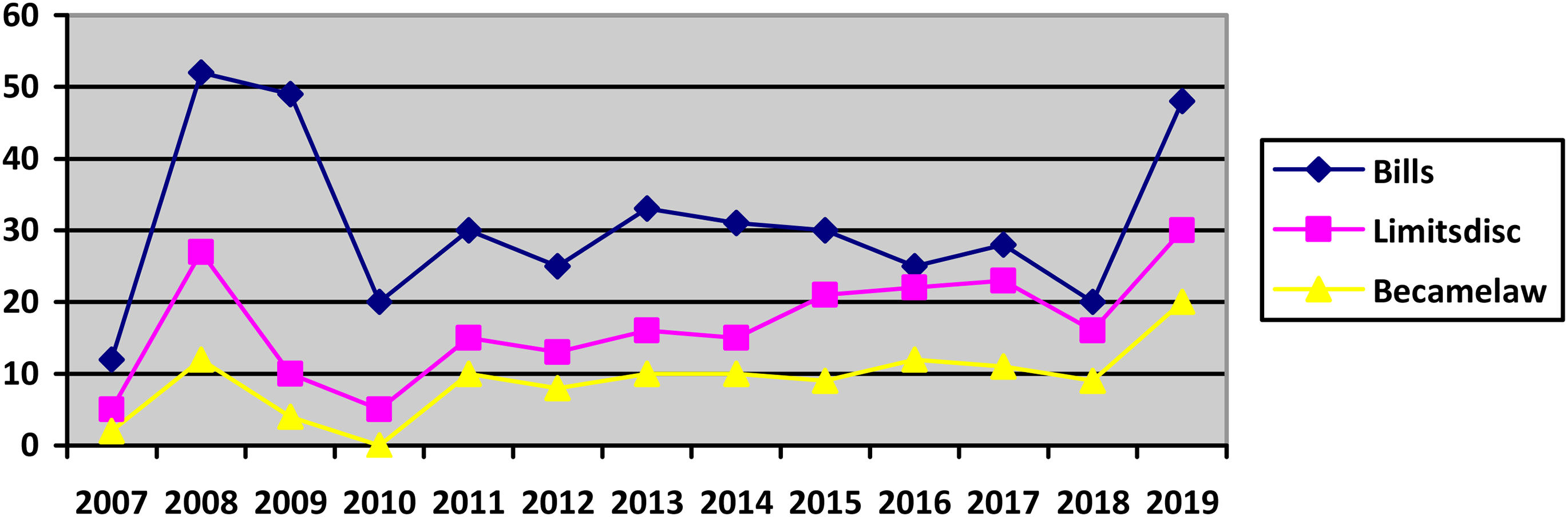
Bills relating to local discretion over time.
As also discussed in the literature review, legislation that expressly prohibits or preempts local governments from acting in a policy area, thereby substituting state for local priorities, has been of particular interest (DuPuis et al. 2018). While it is clear that overt preemption is not the only way to limit local authority, given the widespread interest in this activity, it is worth taking a look at this subset of legislation. Examples of such preemption range from disallowing sanctuary cities to forbidding higher local minimum wages to prohibiting prohibitions of plastic bags. Of the total bills considered, 171 involved direct prohibitions of local action in a policy area. Ninety-five of these bills became law.
Figure 2 illustrates the trends in bills involving direct prohibition/preemption over time. The top line shows the total number of bills that would prohibit a local government from acting in a particular policy area, while the bottom line shows the number of these proposals that became law. The middle line shows legislation that directly prohibited local governments from doing something. The figure suggests that most bills that limit local government discretion involved direct prohibition, a trend that was especially apparent in recent years.
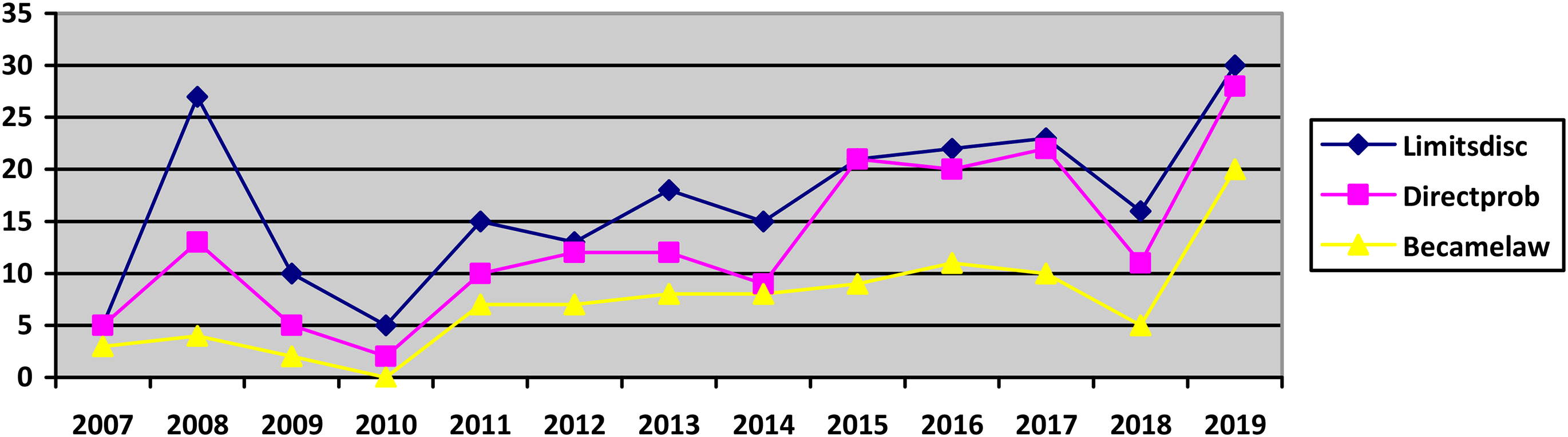
Bills limiting discretion and direct prohibitions over time.
The local government bills in the data set covered a wide variety of topics from prohibiting local governments from regulating sleeping in vehicles (California) to requiring county-level approval of bison relocation (Montana) to empowering local governments to restore land for conservation purposes (Florida). The most common topics in order of how many relevant bills were considered were: taxes, energy and environmental regulations, immigration, education, wages/benefits (predominantly minimum wage, but also related topics such as union bargaining rights, prevailing wage, etc.) structure of local government, guns/weapons, smoking/drinking/drugs, law enforcement and methods thereof (including the use of technology like red light cameras), sexuality/gender roles, land use/zoning, and transportation. Table 1 shows the total number of bills on each topic, the percentage that restricted local government discretion, and the percentage of those restrictive bills that became law.
Bills Related to Local Government Discretion by Topic.
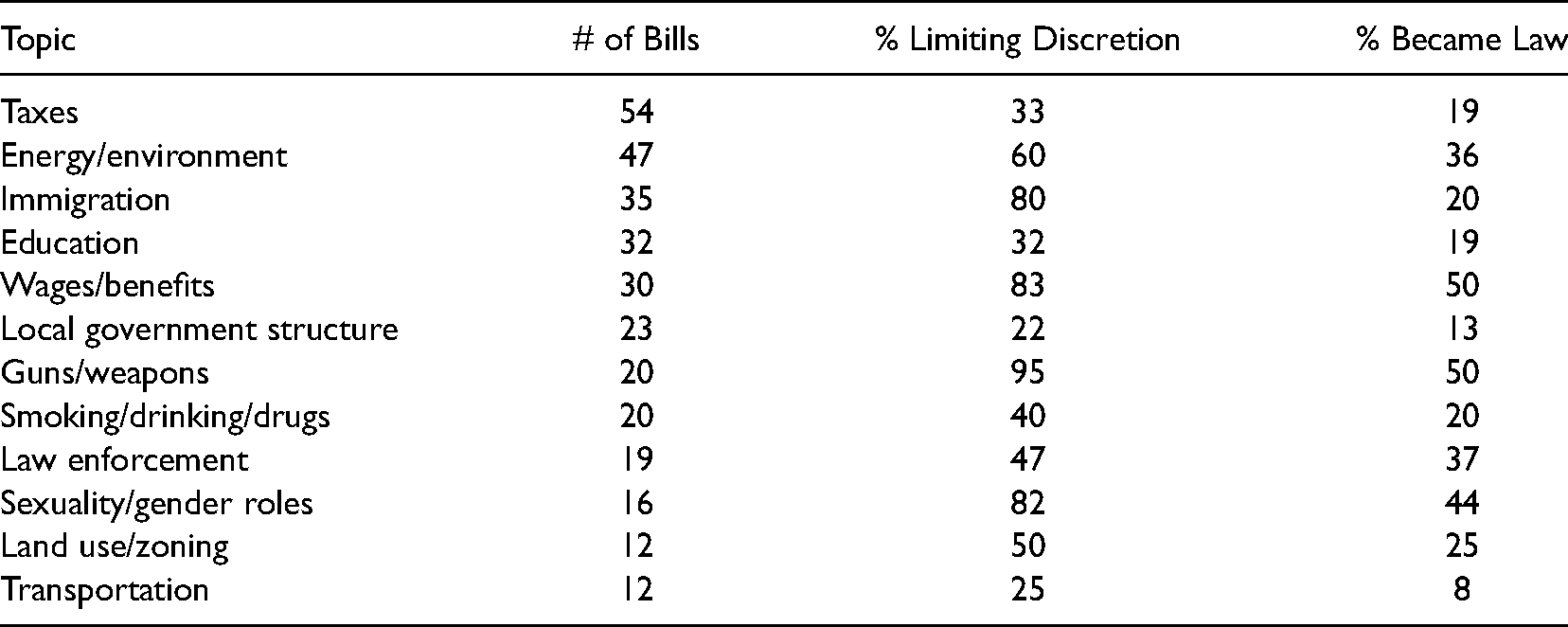
It is undoubtedly a mistake to draw definitive conclusions from the relatively small numbers for most of these topics. Nevertheless, the results in the table's third column suggest that states are more likely to
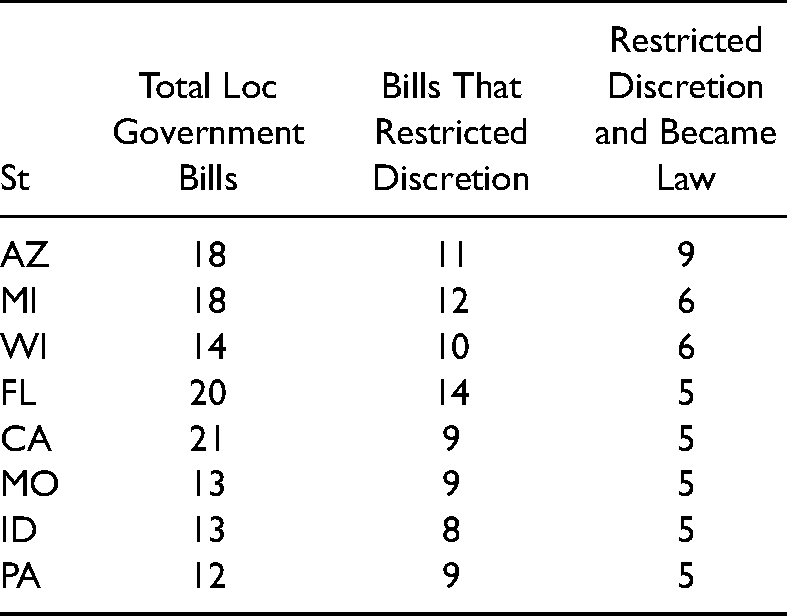
Table 2 shows the states that were most successful in passing bills that limited local government discretion, i.e., those states that passed at least five bills during the period under consideration limiting local government power. The numbers are shown in the fourth column of the table. The third column shows the number of bills in the state that limited discretion, and the second column shows the total number of bills affecting local government that was part of the Vote Smart database during the time period. The table contains some of the usual suspects, large states, such as California and Florida. Perhaps more surprisingly, Arizona was the top state for successfully restricting local governments, and other relatively small states, such as Idaho and Missouri were also relatively active in this realm.
Top States for Bills Affecting Local Discretion.
The literature review suggests partisan dynamics to state efforts to restrict or enable local governments. Specifically, prior research argues that many if not most power limitations or outright preemptions involve conservative state legislatures restricting the more putatively liberal local governments, especially those in big cities. That is not always the case, however. For example, in 2019 Illinois prohibited local right to work laws. California restricted local governments from taxing groceries in 2018, and New Jersey prohibited school districts from discriminating against transgender students in 2017. Earlier (2010), Washington State limited local governments from imposing restrictions on homeless shelters. Other legislation, such as checking the abilities of local governments to use red-light cameras, do not have clear partisan implications. Clearly, states can restrict local autonomy for a variety of reasons. That said, and while the partisan dynamics of limiting discretion will be explored more fully later, it appears that Republicans are far more likely to support bills directly preempting local governments. Of the 170 bills involving direct prohibition/preemption, 141 received greater support from Republicans compared to twenty-nine by Democrats.
Looking at the broader universe of legislation, similar patterns appear. For example, of all the bills limiting discretion, sixty-eight percent received more legislative support from Republicans than Democrats, while only thirty percent received more Democratic backing. (Bills from Nebraska and one from Ohio that passed both chambers unanimously are excluded from this calculation.) Table 3 shows the percentages of total bills that limited discretion and passed the legislature in three conditions: Republican controlled legislatures, Democratic controlled legislatures, and those that either have split control or are non-partisan (i.e., Nebraska). Bills to limit discretion are more likely under Republican control of legislatures. GOP advantage is also associated with the actual passage of discretion restricting laws. Bills are least likely to pass under split control.
Patterns of Legislation by Party Control of the Legislature.

Examining patterns of vetoes, Republican governors vetoed only nine percent of bills that limited local government discretion, while Democratic governors vetoed thirty-eight percent. For bills that enhanced discretion, likelihood of a veto was similar – seventeen percent for Republican governors and eighteen percent for Democratic governors.
Methods and Analysis of State Attempts to Restrict Discretion
The discussion so far suggests that Republican support, and the nature of the issue (i.e., hot button social issue v. more technical concern) seem to relate to whether a bill limits local government discretion. In addition, one would expect that a unified government makes it easier to pass bills that restrict local power. As an example, in 2016, the Virginia legislature, controlled by Republicans, passed legislation to prohibit local government removal of war memorials and minimum wage increases at that level, while financially punishing localities that were uncooperative with federal immigration law. All three were vetoed by the Democratic governor, while in nearby Tennessee, with unified party control, legislation limiting local governments was successful.
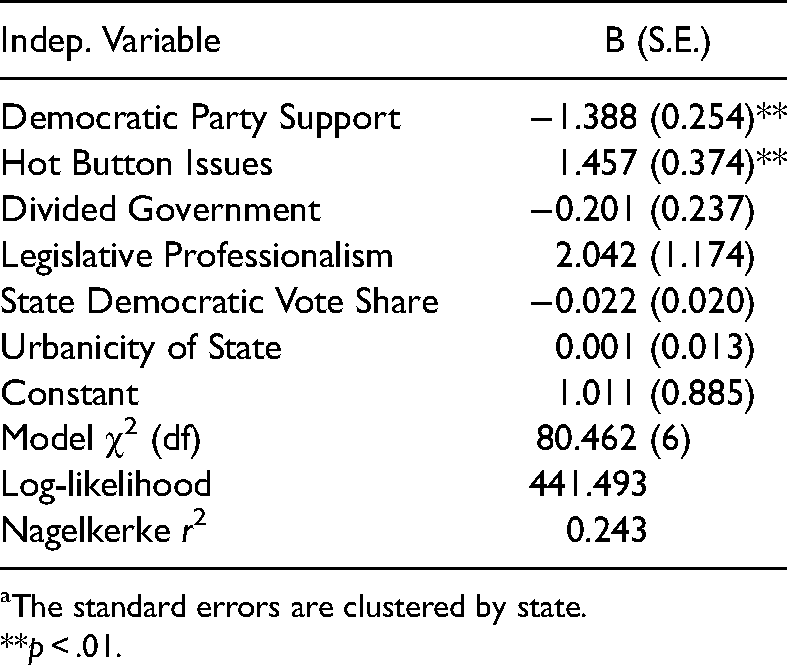
To further examine these relationships, two binary logistic regressions were conducted. The first included all bills with the effect on discretion as the dependent variable. It was defined as “1” for legislation that restricted discretion and “0” for those that either enhanced discretion or did both. Six independent variables were included. The first relates to the effect of partisanship. Party support in the legislature was defined as “0” for when Republicans supported the bill at a higher percentage than Democrats and “1” for when Democrats supported the bill at a higher percentage than Republicans. Nebraska's non-partisan, unicameral legislature is excluded from this analysis, as is one bill from Ohio that received unanimous support from both parties. The subject of the legislation was defined as “0” for all subjects except guns/weapons, sexuality/gender roles, and immigration, and “1” for those three “hot button” issues. Divided government was defined as “1” and unified government was defined as “0.” Unified government referred to cases where both houses of the legislature and the governorship were all controlled by the same party. (Again, Nebraska, and the Ohio bill mentioned earlier were not included in this analysis.) Legislative professionalism is defined using Squire’s (2017) measure. The state party vote variable is the percentage of the state presidential vote for the Democratic party candidate. It is the Democratic percentage of the state vote from the nearest presidential election. (Even-numbered non-presidential years are grouped with the previous presidential election.) Urbanicity is the percent of a state's population defined as urban in the 2010 Census.
Table 4 shows the results of the analysis. Two variables, Democratic party support and hot-button issues were statistically significant predictors of bills that limited discretion. The negative sign for the Democratic support variable indicates that Republican support of a bill increased the likelihood that the bill would restrict discretion. Hot button issues were more likely to contain restrictions on discretion, as indicated by the positive coefficient. None of the other variables were statistically significant. These results suggest that the internal political dynamics in each state and the nature of the issue being considered are more important in predicting efforts to limit discretion than are more macro factors, such as the level of urbanization or voter preferences.
Logistic Regression Predictors of Legislation Restricting Discretion (With Clustered Standard Errors).
The standard errors are clustered by state.
**p < .01.
Predictive probabilities were calculated by holding all the independent variables at their mean and changing Democratic party support and hot button issues from 0 to 1. For non-hot button issues and Democratic party support, the chance of a discretionary bill being restrictive is 28.66 percent. On hot button issues and Democratic support, the chance of a discretionary bill being restrictive is 63.3 percent. When a non-hot button issue has primarily Republican party support, the chance of a discretionary bill being restrictive is 61.88 percent. When it is a hot button issue and has primarily Republican party support, the chance of a discretionary bill being restrictive is 87.36 percent. Thus, both Republican party support and it being a hot button issue can have a large substantive effect on a discretionary bill being restrictive as opposed to enhancing local government power.
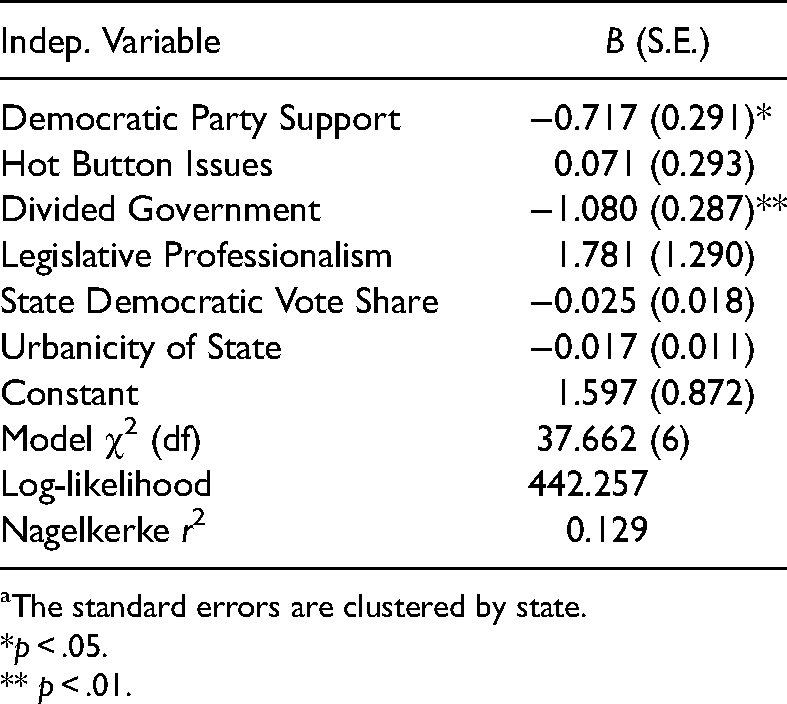
A second logistic regression focused on bills that limited discretion and became law as the dependent variable, defined as “1” for those that did so and “0” for those that did not. It included the same independent variables as the previous analysis. Table 5 shows the results of this analysis. The Democratic party support and the divided government variables are statistically significant, but the model has little predictive power. Substantively, Republican support was associated with an increased likelihood of restrictive bills being passed. Unified government increased the likelihood that restrictive bills would be passed. Echoing the results in Table 4, factors like legislative professionalism, voting patterns, and level of urbanization have little impact on the enactment of bills to limit discretion.
Logistic Regression Predictors of Successful Legislation Restricting Discretion (With Clustered Standard Errors).
The standard errors are clustered by state.
*p < .05.
** p < .01.
The lack of significance for the subject variable, compared to the previous analysis in Table 4, suggests that there may be a symbolic politics dimension to proposing limits to local discretion on hot button issues. In other words, bills on hot button issues are more likely to restrict discretion, than to enhance it, but that does not make them more likely to pass. Further supporting this interpretation is the fact that of the bills that limited local discretion, forty percent of those dealing with the three “hot button” topics (guns, immigration, and gender roles) became law, as compared to fifty-nine percent on other subjects. Another major difference between the two models was that divided government predicted the likelihood of restrictive legislation becoming law, but not being introduced. This finding, of course, makes sense, as divided government puts up additional barriers to enactment, but not necessarily to proposal.
Predictive probabilities were also calculated for this model with the two significant variables, Democratic party support and divided government. When there is Democratic party support and divided government, the chance of a restrictive bill becoming law is 9.58 percent. When there is Republican party support and divided government, the chance of a restrictive bill being passed is 17.84 percent. The probabilities increase even more under unified government. Unified governments with Democratic party support of the bill have a 23.79 percent chance of becoming law. Finally, under unified government with Republican party support, a restrictive bill has a 31.15 percent chance of passing.
Conclusion
This paper considers state efforts to both restrict and enable local governments in an era of preemption. It goes beyond the previous literature in this realm in three ways. First, as just noted, it considers legislation that both enhances and limits local power within the same data set. As such, it extends the focus of the previous literature to consider the interplay of restricting and enabling local governments. Second, it engages with a broader set of issues relating to state power of local government than most previous studies have. Relatedly, it examines state restrictions or empowerment of local government across a broad spectrum of units/types, rather than focusing on municipalities or even a subset of large cities, as some of the previous literature does. This finding is noteworthy given the attention that such issues receive in the context of debates over preemption. Finally, it considers legislation that did not become law.
The analysis above shows that during the time period examined, state legislatures were somewhat more likely to both consider and to pass bills that restricted local discretion than those that enhanced it. Nevertheless, to a degree, states both enable and restrict local governments, and their willingness to do so depends on a variety of factors, particularly party support in the legislature. Specifically, Republicans are more likely to support limiting discretion. Moreover, if the topic involves “hot button” concerns, such as guns, immigration, and sex roles, efforts to limit discretion are more likely, although they are not necessarily more successful. Finally, enacted legislation restricting local discretion is less likely under conditions of divided government.
The larger significance of these patterns of policy preemption relates to both political and policy concerns. With respect to the former, preempting local initiatives can potentially undermine democratic responsiveness by restricting the activities of units of government that are “closest to the people.” From a policy perspective, taking away autonomy may also hamstring localities economically, limiting their ability to do things that make them attractive in the global economy (Schragger 2019).
The findings suggest that these concerns merit attention, as they relate to the larger question of whether states are limiting local government's ability to perform as “laboratories of democracy.” Still, the diversity of legislation affecting local governments means that states are not necessarily adopting a monolithic stance of stripping their localities of power. In fact, they are more likely to restrict discretion on issues that “learning” is least likely, i.e., those that elicit emotionally, rather than technical responses. Relatedly, the symbolic dimension of some high-profile legislation, noted in the previous discussion, may provide a skewed view of states’ actions with respect to giving or taking away discretion.
An issue that would be ripe for further research is to examine the state political factors that shape whether legislation relating to the powers of local government is even considered by a state. Clearly states vary considerably in their willingness to grapple with these issues, with some states proposing many bills during the time period under consideration, and a few having none. Future work can conceptualize new independent variables beyond those considered in this study, as well as collecting data that will provide researchers with new avenues to explore the dynamic evolution of state and local power in an era of preemption.
Footnotes
Declaration of Conflicting Interests
The authors declared no potential conflicts of interest with respect to the research, authorship, and/or publication of this article.
Funding
The authors received no financial support for the research, authorship and/or publication of this article.
