



Abstract
Since its genesis in public administration, social equity has framed the field’s discussions of fairness in governance and management. Here we explore how local public managers conceptualize and operationalize social equity as a public value in the communities they lead. Based on in-depth interviews with 23 local government leaders, we find that these managers often define social equity in ways that emphasize procedural fairness. In addition, while social equity was a priority among the public managers, several expressed that they often face resistance from their elected officials when attempting to prioritize equity.
Introduction
Over the past several years, local governments have found themselves challenged with addressing issues of race, managing a pandemic, and responding to evolving demands from constituents about the proper role and involvement of government in community matters, while also dealing with the ebb and flow of federal funding that can support their efforts (Pynes and Rissler 2017). These problems are often associated with issues of equity in local government—be it the disparate treatment of certain community members, the fair allocation of public resources and benefits, or balancing the demands of different interest groups. Working at the level of government closest to constituents, local administrators often find themselves in the crossfires of these equity issues (Spina 2013).
As a value in public administration, social equity traces back to the 1968 Minnowbrook Conference (Gooden and Portillo 2011). Minnowbrook was a space for scholars to evaluate the field’s role in resolving the most salient social issues in the United States at that time (Frederickson 2010; Wooldridge and Gooden 2009). Attending scholars believed that normative premises and practices guiding the field were inadequate to mitigate the country’s social problems (La Porte 1971). In response, Frederickson proposed the field give more attention to social equity (Frederickson 1990).
From Frederickson’s (2005) perspective, inequities developed due to pluralistic governments favoring traditional bureaucracy and powerful constituents, while overlooking those lacking political and economic resources. Furthermore, he argued that public administrators must promote equity and ensure the voices of the less powerful are not lost (Frederickson 2010).
Since the genesis of social equity, scholars have called for a clearer definition of the term (Rosenbloom 2005), pushed for more conceptual clarity (Gooden and Portillo 2011), and argued for a greater emphasis on social equity in practice (Blessett, Fudge, and Gaynor 2017; Larson, Jacob, and Butz 2017). In this article, we attempt to address these calls by exploring how local public managers define and operationalize social equity. Our central purpose is to use practitioner perspectives to enhance our theoretical understandings of social equity in public administration.
Social Equity and Public Administration
Although social equity was introduced to the field in the 1960s, its popularity would ebb and flow over the next several decades. One notable development in this time was the National Academy of Public Administration (NAPA) generating a definition of social equity to be used by scholar in the field in 2000. Specifically, social equity was defined as: The fair, just and equitable management of all institutions serving the public directly or by contract, and the fair, just and equitable distribution of public services, and implementation of public policy; and the commitment to promote fairness, justice, and equity in the formation of policy (See Norman-Major 2011, 237).
Another notable development was in 2005, when NAPA adopted social equity as a pillar of public administration (Norman-Major 2011; Svara and Brunet 2005), highlighting that discussions of equity were here to stay.
While there have been criticisms of social equity research for having an overly normative focus, lacking empirical evidence, and failing to provide a clear definition (Durant and Rosenbloom 2017; Rosenbloom 2005), social equity scholars have sought to address these concerns by applying social equity to practice (Blessett, Fudge, and Gaynor 2017; Gooden 2017; Gooden and Rissler 2017; Larson, Jacob, and Butz 2017), and developing an operational definition of social equity that highlights its four dimensions: procedural fairness, access, quality, and outcomes (Svara and Brunet 2004, 2005). In addition, both empirical and normative studies have been conducted regarding the importance of social equity across various fields including education, policing, and healthcare (Berry-James, Gooden, and Johnson 2020; Bradbury and Kellough 2010; Wright and Merritt 2020).
Over the past several years, scholars have continued to advance the field’s understanding of equity in theory and practice. Notably, work from Rivera and Knox (2023) has explored the complications between equity and bureaucratic discretion. Other scholars have conducted extensive literature reviews to identify and highlight important patterns of equity research in the field. For example, Ruijer et al. (2023) explore the connection between data-driven public services and equity, while Cepiku and Mastrodascio (2021) explore how equity is conceptualized and determined. In addition, some studies have focused on incorporating a global perspective that addresses equity concerns beyond the U.S. (McCandless et al. 2022). Current research has also built on prior work from Svara and Brunet (2004, 2005), as well as Johnson and Svara (2011) to develop new frameworks for exploring social equity, such as Stokan, Hatch, and Overton’s (2023) polycentric social equity framework, or Kim et al.’s (2023) social equity for wicked problems framework.
The Role of Local Administrators: Public Values and Decision-Making
Public managers are tasked with possessing the technical skills necessary to lead their organizations (Stone, Stone, and Price 1940). Furthermore, in the public sector, a manager’s responsibilities center around three fundamental duties: (1) managing local government employees; (2) directing government agencies; and (3) providing guidance to the mayor and council (Stillman 1974).
Local managers are challenged to make social equity a priority when they must also focus on the other pillars of public administration: efficiency, effectiveness, and economy (Norman-Major 2011). Traditionally, administrators have been told to place efficiency at the forefront of their work, which involves completing tasks, “at the least possible cost of either money or of energy” (Wilson, 1887, 197). Following close behind efficiency, is economy, which emphasizes, “the careful and sparing use of resources” (Norman-Major 2011, 234). Finally, is the concept of effectiveness, which describes accomplishing the desired outcome or objective set by an organization (Norman-Major 2011).
Although each pillar of public administration guides the actions of public managers, these value-laden concepts are often in competition with one another—administrators may have to concentrate less on one value, so they can commit more of their attention to another (Guy and McCandless 2012). Emphasizing efficiency, economy, and effectiveness, can make it difficult for public managers to operationalize the ideals of social equity (Hassett and Watson 2002). However, having influence over their organizations and communities, local managers are in a position to actively pursue equity and have organizational members and constituents see their efforts (Ott 2023). Examining their perceptions of how social equity is defined and operationalized provides scholars with a nuanced understanding of social equity in practice. Here we explore how local public managers discuss and operationalize social equity as a public value within the communities and organizations they lead.
Design and Analysis of Interviews
For this study, we rely on semi-structured interviews with 23 local public managers. To recruit participants, a member of the International City/Council Management Association (ICMA) responsible for event coordination provided an initial list of seventeen prospective participants viewed as highly engaged members due to previous participation in professional events. From the initial list, eleven administrators agreed to an interview. Through recommendations from first round participants, we identified twelve more administrators willing to be interviewed. While purposive, snowball sampling and the number of interviews prevents generalizability, this exploratory study still provides rich data through the detailed explanations gained from participants.
Interviews followed an open-ended format focused on obtaining narratives explaining how each administrator operationalized and defined social equity. Using in-depth, semi-structured interviews with open-ended prompts means all participants were asked the same set of questions, but also could explain scenarios in their own words. During each interview, participants were prompted to share a narrative detailing how they have operationalized the pillars of public administration, and to define social equity. Specifically, we asked participants to share a story of a time that they resolved a community problem. Once they finished sharing their story, we asked them to describe how they believe the pillars of public administration applied in the situation. We then asked the participants how they would define social equity. This provided insight to common problems faced by the local administrators and how they view core public values in the context of those situations.
The use of narratives was essential to understanding the complexities of operationalizing equity in local government. Narratives, “capture interpretations of reality as well as shared social constructions among a given community” (Dodge, Ospina, and Foldy, 2005, 289), which provide insight to the social context framing an individual’s experience (Cohen and Rogers 1994; Marshall and Rossman 1999; Oberweis and Musheno 2001). While the narratives provided are not necessarily objective descriptions, they reveal the nuance of how administrators convey their understanding of their work and their attempts to operationalize and prioritize equity within their organizations and communities (Ewick and Silbey 1995; Maines 1993; Portillo 2010).
Interviews took place between June and December of 2015, with demographic information being self-identified by participants at the conclusion of the interview (See Table 1). Each interview was digitally recorded after receiving written consent from the administrator. Participants worked at 15 different municipalities across Kansas and Missouri. Interviews averaged approximately one hour in length.
Sample Characteristics.
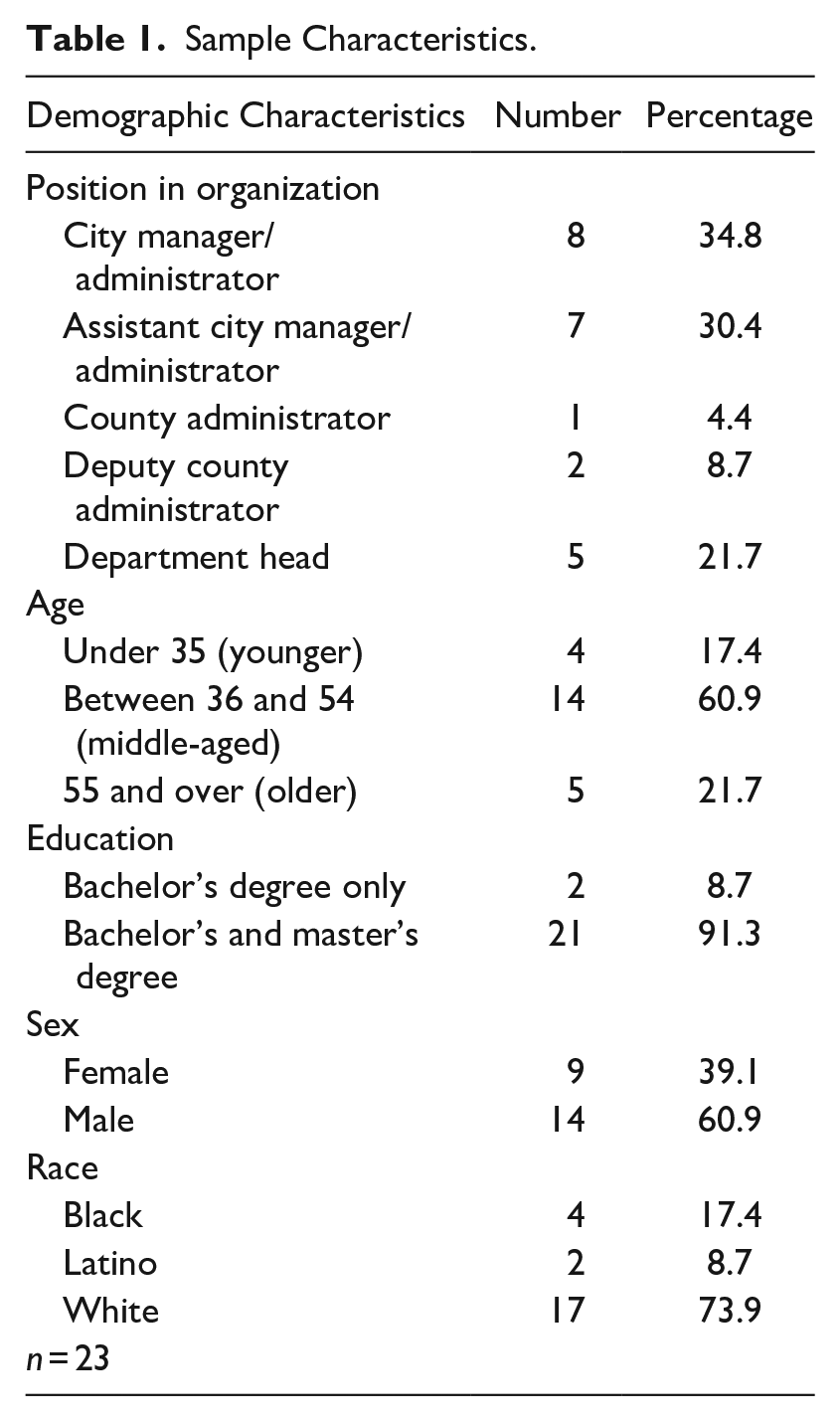
The analysis procedure relied on an integrated coding process, which uses an “inductive (ground-up) development of codes as well as a small deductive list of preset codes (start list)” (Bradley, Curry, and Devers, 2007, 1763). The preset codes focused on identifying if equity was discussed in a manner that fell into one of the four dimensions of equity from Svara and Brunet (2004, 2005)—procedural fairness, outcomes, quality, and access.
Data analysis took place simultaneously with data collection to refine our analysis (Pope, Ziebland, and Mays 2000). This means that once an interview was complete, it was immediately transcribed and reviewed for broad themes regarding the four dimensions of equity. The codebook was developed and refined by both authors. Approximately 155 pages of transcript were hand coded by the primary author. Following the completion of all interviews, the primary author again reviewed the transcribed interviews for additional familiarization with the data and to identify themes across interviews (Pope, Ziebland, and Mays 2000). This brought forth additional themes regarding the importance of community input and the influence of elected officials.
To protect participant confidentiality, all identifying information has been removed from the interviews, and all participants will be referred to by their position and a number (e.g., City Manager #1 or Assistant City Manager #2). This is to help indicate when multiple statements from a single administrator have been used. For example, each time a statement is attributed to City Manager #1, we are referring to the same individual.
Findings
Through our analysis, we found that many local public managers view social equity through a procedural lens, with an emphasis on constituent input. This perspective led them to operationalize social equity through community engagement activities. For example, meeting with individual constituents, hosting public forums, and attending community events where they can interact with the public. While social equity did seem to be a priority among the participants, several expressed they often face resistance from their elected body and dominant constituents when attempting to prioritize equity. We explore both of these themes in more detail.
A Procedural Approach to Social Equity
Within our sample, 39% of local managers (9) conceptualized social equity in a manner that emphasized achieving equity through procedural approaches. Procedural fairness scholarship has historically emphasized legal procedures and fairness in legal processes (Svara and Brunet 2004). With time, procedural fairness research has expanded beyond a legal context and instead has been used to understand fairness in workplace and organizational processes (Lavelle et al. 2009). Thibaut and Walker (1975) highlight two models of procedural fairness, the inquisitorial model and the participation model. The inquisitorial model interprets procedural fairness as the decision-maker collecting evidence when deciding how to resolve the situation, while the participation model interprets procedural fairness as the decision-maker allowing input from those who will be impacted by the final decision (Blader and Tyler 2003). Managers in this sample primarily relied on the participation model of procedural fairness, emphasizing the importance of providing constituents opportunities to share their perspectives before a decision should be made. Specifically, managers discussed equity in terms of providing constituents with a “seat at the table” or “including everyone in the conversation.” See Table 2 for examples.
Participation Model Examples.

These statements highlight the administrators’ alignment with the participation model of procedural fairness, which stresses the importance of input (Blader and Tyler 2003). In addition, these statements also align with the ICMA’s Declaration of Ideals, which states that members of ICMA must, “Recognize the right of citizens to influence decisions that affect their well-being; advocate a forum for meaningful citizen participation and expression of the political process; and facilitate the clarification of community values and goals” (International City/County Management Association [ICMA] n.d.a). In sum, these statements not only align with theoretical understanding of procedural fairness and participation, but also meet expectations of professional practice.
Assistant City Manager #2 expanded on this idea—that social equity is a form of procedural fairness that includes seeking input—stating that social equity is when, “everybody has worth and everybody’s voice can be heard.” She went on to give the following example: Think about community engagement, who wants to do that? Nobody wants to do it, but it’s important and you have to do it, and when you do it you have to make sure you have the right people at the table so everybody is heard whether or not you want to hear them. You just have to make sure it happens. So, social equity to me right now, when you talk about municipal government, it is from my perspective a weakness. We don’t want to deal with it, but if we don’t, then we are missing the boat on this because if people aren’t heard, you can’t get things done.
Assistant City Manager #2 made it clear that people in her organization did not look forward to community engagement activities because of the challenges they faced in community meetings and forums. However, even with these challenges, public comment was a necessary procedure to help ensure equity within her community.
Assistant City Manager #3 defined social equity as “making sure that the people that don’t have a voice, have a voice.” This administrator served on a committee tasked with finding ways to support and engage the growing Latinx population in her community. By listening to experiences often not represented at council meetings, she and others began to recognize the barriers present within the community among non-English speakers. She stated: So when they have an encounter with a city employee and our employee does not speak their language, it’s awkward and it can be disconcerting on both sides, and especially if it’s police or fire—when you’re coming to try and help somebody and they may be in great need, but you can’t understand what the need is and how you can help, that’s a barrier for our community to overcome. So, we’re working to try and address some of those issues.
By intentionally seeking input, this administrator learned there was a need for more translators in her community. Furthermore, her description of equity not only emphasizes the importance of input, but also places significance on getting insights from groups that may often be excluded from decision-making processes. This additional step of ensuring that marginalized groups can participate aligns with the ICMA definition of equity, which emphasizes that due to the unique circumstances of community members, “resources may need to be allocated differently . . . in order to ensure that processes and outcomes (both intended and unintended) are fair and disparities in conditions and outcomes are addressed” (ICMA n.d.b).
In sum, when asked how they operationalize equity, administrators framed the execution of this value as listening to community needs and including commonly overlooked perspectives. This means they often aligned themselves with the participation model of procedural fairness where input from those impacted by the decision is essential (Blader and Tyler 2003). Public participation research also indicates that allowing constituent input can be important in terms of building trust between the community and public servants (Van Ryzin 2011), as well as improving perceptions of institutional legitimacy (Herian et al. 2012). When these factors are considered in the context of pursuing social equity at the local level, an emphasis on participation has the potential to improve trust and perception of organizational legitimacy among historically marginalized groups.
The Challenge of Prioritizing Equity
Ten administrators (43%) within our sample described allocating resources and services in an equitable manner as difficult due to resistance from elected officials and powerful community groups (See Table 3 for examples). This often places managers in a position where they have to directly challenge the elected body and attempt to achieve equity within the controls set by elected officials, or abandon their pursuit of equity.
Elected Official Influence Examples.
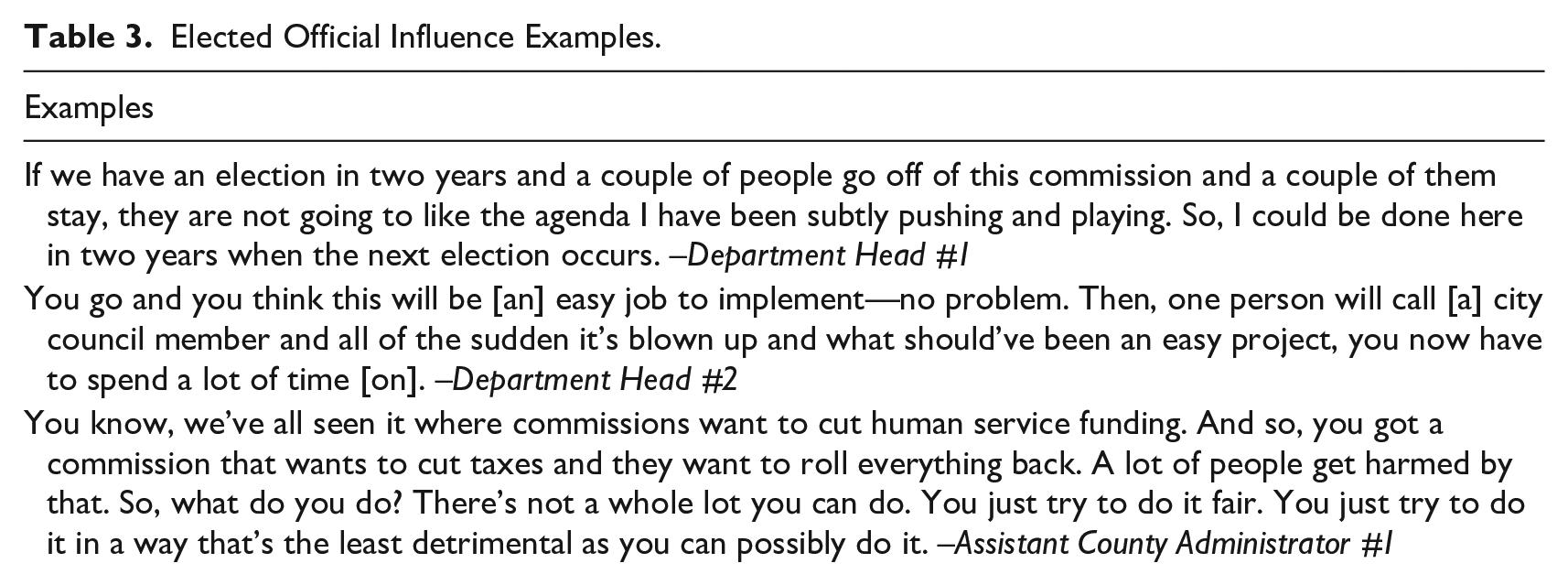
The positionality of local managers as organization and community leaders, allows them to assist in the construction of local government policy and facilitate democracy (Nalbandian 1999), while also overseeing the implementation process of these policies. Furthermore, assistant managers and department heads are also being expected to engage tasks often reserved for the manager. Historically, assistant managers and departmental leaders were responsible for representing the interests of their specific division (Morgan et al. 1996), but now we see these positions acting an agent of the city manager and participating in the political arena (Nalbandian et al. 2013). The statements provided in Table 3, highlight the complexities of entering the political arena. While there might be a desire to prioritize equity, actions of the administrators will be influenced by elected bodies.
City Manager #3 discussed the need to focus on social equity in order to prevent marginalized groups from being “left behind,” but dealing with “political leaders” and “business owners” presented a challenge. He began to share the following story from a previous job when he was working as an assistant city manager: Former administrations and political leaders had promised the African American community that a neighborhood park would be built. The land was there and they just wanted amenities placed in and some design put to the land. They’d been promised this for decades. I went and told my boss they think that our government are liars and that we’re unreliable and that we’re not committed and that we don’t care about their community. I just went down the list trying to make it real for him because it was something so abstract and distant. When I finally talked to enough people on the governing body and convinced my boss that it was a high priority, we finally plugged it in to this capital improvement plan. It got funded and so we began the excavation of the land.
However, after excavation of the land began, several business owners asked the city to purchase the property. With pressure from business owners and elected officials to sell the land, the administration had to decide how to move forward. This manager credits his boss for standing up to elected officials and making sure the park was completed: “My boss at the time was at the right level of experience and had earned the respect of the different community members over the years and was just in the right place in the right time. [He was] the right person with the courage to follow through.”
In a similar experience, County Administrator #1 also highlighted how he felt the need to challenge the elected body in pursuit of equity within his local community. When his community needed a new location for their homeless shelter, he felt as though the city’s elected body was treating the homeless community unfairly. He stated: The city commission would never approve a place for a permanent arrangement. I suggested that we provide the church as a temporary facility until they could find a permanent facility. I had the support of the county commission to do that but I got calls from the mayor at the time, saying “We don’t want the homeless shelter close to [the center of town].”
Upset about the response from the city commissioners, this manager sought to come up with an alternative that would allow for the government to build a shelter. The county administrator identified a potential location and proposed it to the commission. In the end, this administrator was able to find a solution—the city would maintain a shelter in a place the commission deemed suitable. However, to achieve this solution, the administrator had to challenge the elected body, but still work within their set parameters. His experience highlights the difficulties in pursuing social equity, and the evolving political role of public administrators at the local level (Demir and Nyhan 2008; Svara 2001; Van der Wal 2020).
Discussion and Conclusion
This study provides an initial exploration of how local public managers perceive and operationalize equity. The findings suggest that many local public managers view social equity through a procedural lens with an emphasis on community input. However, they struggle to implement the information they gain during their administrative procedures due to conflicts with elected officials.
These themes speak directly to work from Svara and Brunet (2004, 2005) on the dimensions of equity and address calls for a greater emphasis on equity in practice (Blessett, Fudge, and Gaynor 2017; Larson, Jacob, and Butz 2017). Specifically, Svara and Brunet (2004, 2005) note that there are four dimensions of equity: procedural fairness, access, quality, and outcomes. Interviews from this sample suggest that at the local level there is an emphasis on the procedural dimension of equity, with an additional focus on procedures that prioritize public participation. This focus might stem from the proximity of local administrators to their constituents, or could be a facet of local administrators following professional expectations outlined by the ICMA. Regardless, public participation research suggests a procedural focus can benefit public servants and their organizations in terms of improving constituent trust and perceptions of institutional legitimacy (Herian et al. 2012; Van Ryzin 2011). The primary challenge administrators described in their pursuit of equity was managing the expectations of elected officials and powerful community members. While managers are tasked with communicating community values and problems to help elected bodies make policy decisions (Nalbandian 1999), the administrators in this sample expressed the difficulties they face in getting equity issues within their communities to be a priority among their elected officials.
While our study provides helpful insight into understandings of social equity in local government, we recognize the limitations that exist. The primary limitation stems from the use of purposive sampling. The consequences of this sampling method become more obtrusive when coupled with the 23 participant sample size, all participants being based in the Midwest, and participants primarily identifying as White. A larger and more diverse sample of local administrators could provide additional nuance to the field’s understanding of equity in local government.
While this study provides some exploratory insights, there are many opportunities for future research in this area. First, while this study primarily focuses on equity interpreted as procedural fairness, there are many other ways to define equity (i.e., outcomes, quality, access) that could be focus of future research (Svara and Brunet 2005). In addition, future research should incorporate the perspective of elected officials. Because local elected officials play an important role in the prioritization of equity issues, future research should incorporate their perspective to provide an understanding of social equity in local government that goes beyond the role of local administrators. This research can provide additional nuance on how local government employees navigate the complex expectations of their jobs.
Footnotes
Data Availability Statement
The participants of this study did not give written consent for their data to be shared publicly, so due to the sensitive nature of the research supporting data is not available.
Declaration of Conflicting Interests
The author(s) declared no potential conflicts of interest with respect to the research, authorship, and/or publication of this article.
Funding
The author(s) received no financial support for the research, authorship, and/or publication of this article.
