



Abstract
Since the perceived efficacy of unions is one of the best predictors of an individual’s willingness to vote for or join a union, this article examines the relationship between union membership and perceptions of unions. In particular, we ask: How do union members feel about unions in comparison to nonunion members? How do former union members feel about unions in comparison with those who were never members? How do different groups of workers perceive unions? We answer these questions by analyzing large-scale, cross-national survey data on perceptions of unions. The data contain 14,733 observations in twenty-four countries and are taken from the 2005 wave of the International Social Survey Program (ISSP). The survey asks how respondents feel about the effects of unions on both job security and working conditions. From our analysis, we can conclude that union-membership status (both current and past) and gender matter in determining perceptions of the efficacy of unions. In particular, we find that union members feel more positive about the ability of unions to improve working conditions and job security than nonunion members and that former members tend to be more positive than never union members in these views. We also find that among nonunion members, women tend to hold a more positive view than men of the effect of unions on job security.
Keywords
If men define situations as real, they are real in their consequences
While we know well what unions do, evidence on how people feel about what unions do is much spottier. However, knowing what workers think about unions—whether members and nonmembers, men and women, high-skilled and low-skilled workers differ in their perceptions of unions’ role in improving working conditions—is crucially important. Since perceptions have “real-life” consequences, both the actual and the perceived effects of unions will be key to securing sustainable unions in the long run. Not only do members need to believe that their dues and their engagement are worth the investment, but nonmembers also need to believe in the positive effects of unions in order to vote for or join a union. Both are necessary to ensure a sustainable level of union membership.
This article therefore seeks to further our understanding of how workers feel about unions and answers the following questions: How do union members feel about unions in comparison to nonunion members? How do former union members feel about unions in comparison with those workers who were never members? How do different groups of nonunionized workers, that is, women versus men and high-skilled versus low-skilled workers, perceive unions?
We answer these questions by analyzing large-scale, cross-national survey data and exploiting within-country variations. Our data enable us to distinguish between different groups of employees and to examine whether those who have had more direct experiences with union membership have different opinions than those who have never been exposed to unions. This distinction is particularly salient in the United States where many workers have never had any exposure to unions.
The argument presented in our article is based on two assumptions: first, it is easiest to mobilize particular demographic groups around workplace issues, and second, it will be easiest for unions to organize those who feel positively disposed toward unions among the nonunionized. Charlwood’s (2002) research in the UK, for example, shows that “perceived union instrumentality,” that is, the notion that unions improve working conditions, is a significant predictor of willingness to join the union. By questioning which groups of nonunion workers have this positive view, we follow up Charlwood’s conclusion. In particular, we focus on women and low-skilled workers.
We presume that women are more aware of the benefits of unions because they are vulnerable to gender discrimination, which may affect both working conditions and job security. This suspicion is based on research that showed that women who are union members are better equipped to fight sexual harassment (Crain 1995). In addition, Fiorito and Greer (1986) also report gender-specific perceptions of unions. While they find differences between men’s and women’s beliefs about unions, they attribute these differences to individual and workplace characteristics, such as occupations and skill levels. Gottfried’s (1992) research confirms the importance of both gender and skill level in understanding union-membership rates, and we extend this inference in our contention that both gender and skill level will matter in terms of perceptions of unions, not just membership.
Our analyses of the perceptions of nonunion members contribute to the literature on public perceptions of unions, which has predominantly been done on the United States (Freeman and Rogers 1999) as well as to the literature on union revitalization as it suggests which groups may be more appropriate targets for union-organizing drives (Hurd, Milkman, and Turner 2003; Lopez 2004; Milkman and Voss 2004; Turner and Cornfield 2007; Turner, Katz, and Hurd, 2001). Building on these two streams of literature, we develop hypotheses on the perceptions and attitudes toward unions by current members, former members, and those who have never been members as well as men and women and workers with varying skill levels. After a brief overview of our data set and methodology, we present and discuss our findings. We conclude with some lessons from this analysis and questions for further research, particularly regarding the salience of national institutional differences in explaining the differences between countries that we do not analyze here.
Union Status and Unions’ Perceived Effects on Working Conditions and Job Security
Ongoing union decline in the United States has led scholars to question whether there is unmet demand for unions—demand that is frustrated either due to management opposition to unions or unions’ lack of organizing resources (see, for example, Freeman [2007]; Freeman and Bryson [2006]). In general, existing research finds that union members feel more positive about the role of unions than nonmembers (Chacko and Greer 1982) but that the feelings of nonmembers toward unions are quite complex and determined by a broad set of factors (Martinez and Fiorito 2009). Schnabel and Wagner (2007), for example, utilize data from the European Social Survey (ESS) in an analysis of actual union membership (as opposed to perceptions of unions as we do) and find that both individual and workplace characteristics play a role in determining an individual’s likelihood of union membership. Booth, Budd, and Munday (2010) and Budd (2010) report that prior experience with unions is much more important than age in predicting an individual’s likelihood of joining a union.
In theory, two conflicting predictions as to whether union membership will be positively associated with the efficacy of unions can be made based on the large stream of research on the effects of unions (Addison and Castro 1987; Belman 1992; Bender and Sloane 1999; Bennett and Kaufman 2007; Berger, Olson, and Boudreau 1983; Bryson, Cappellari, and Lucifora 2004, 2010; Colvin 2009; Deery, Iverson, and Erwin 1994; Ebbinghaus and Visser 2000; Feldman and Scheffler 1982; Freeman and Medoff 1984; Hirsch and Schumacher 1998; Katz 2002; Kaufman 2005; Western 1994). On the one hand, working for higher wages, less hours, or in a safer working environment are the typical reasons for individuals joining a union. Because of these better working conditions, union members should hold more positive opinions about the work of unions than nonunion members. Research on the relationship between unionization and job satisfaction, on the other hand, has consistently shown that union members are less satisfied with their jobs than nonunion members (e.g., Hammer and Avgar [2005]). Therefore, union members may have higher expectations for what their jobs should be and thus hold less positive opinions about unions’ role in improving working conditions and job security.
However, based on research from social psychology, we have more reason to believe that union members hold more positive views about unions than nonunion members. According to relative deprivation theory (e.g., Crosby [1982]; Stouffer [1949]), which shows that attitudes and perceptions depend on how individuals see themselves in comparisons with others, union members should hold more positive opinions about the work of unions than nonunion members—despite lower levels of job satisfaction—not because they have good working conditions and great job security but because they have better working conditions and greater job security than their nonunionized counterparts.
Another reason to expect that union members will have positive feelings toward their union may be self-justifying behaviors when union members judge the importance of unions. In his theory of cognitive dissonance, Festinger (1957) suggested that people who deal with the uncomfortable state of holding inconsistent cognitions either change one or both of them. For example, if a worker pays her union dues every month but does not get a higher wage than a nonunion member, she may either leave the union or try to convince herself that the situation is better than it actually is, that it will improve shortly, or that paying union dues is a moral thing to do. Union members should thus be convinced that unions are important for the improvement of working conditions because of the quality of their actual working situation, the comparison with others, or self-justifying behaviors. That is, we expect a positive association between union membership and the perception that unions are important for improving working conditions and job security.
Considering differences between those workers who previously were members of a union and those who were never a member of a union, our predictions are less clear since there are many reasons for why workers leave their unions. Workers leave their unions, for example, because they move from a unionized to a nonunionized job, because they are unhappy with their union, or because they can benefit from the union without paying dues (free-riding), which is possible in some countries. Therefore, we suggest two contradictory—though equally plausible—hypotheses regarding the differences in the opinions of former union-members and never union-members. On the one hand, we have reason to believe that those who have formerly been a member of a union should also hold more positive opinions about unions’ roles in improving job security and working conditions than those who have never been a member of a union. Here again, we can draw on research from social psychology. Relative deprivation theory suggests that it is the comparison with others—especially those in similar positions, of similar age, and of comparable experience, or those perceived as the prototypical employees in a specific sector or occupational rank (e.g., Crosby [1982]; Stouffer [1949]; Zelditch Jr. et al. [1970])—that impact a person’s perceptions of how good or secure a job is.
Since unions indeed have a positive impact on job security and working conditions, the group of those who were previously unionized are likely to compare their current situation to what they had in previous times or what others in comparable jobs have. Therefore, they should be particularly aware of the benefits associated with unionism and more positive about unions’ ability to improve working conditions and workers’ job security than those who were never members of a union. This suspicion also echoes the findings of earlier US research (Chacko and Greer 1982).
The opposing hypothesis would be that ex-members hold more negative opinions about unions’ efficacy in improving working conditions and job security than those workers who were never members. Here, the rationale is that workers leave their unions because they are dissatisfied with the work of the union. For example, in countries where there are no closed shops, former members may leave the union because of a perceived lack of value for money from their dues or because of negative experiences they had with the union (Waddington and Kerr 1999).
Demographic Differences and Unions’ Perceived Effects on Working Conditions and Job Security among Nonunionized Employees
A key question in the debate about union revitalization is which of the unorganized workers believe most strongly in the efficacy of unions. It is important for unions to know which workers might make the most appropriate organizing targets when considering the vast landscape of the unorganized (particularly in the United Kingdom and United States, with their low union density and coverage). While unions may occasionally choose to start organizing processes based on factors other than the likelihood of success, we presume that, in general, unions can most effectively expand their membership by organizing workers who believe in the efficacy of unions (for more on the difference between reactive organizing and more strategic tactics, see Fine [2007]).
Scholars of union revitalization have consistently suggested that those groups that are most central to the new economy, that is, women and low-skilled service workers, may be the key to future union-organizing success, and indeed may be the heart of the future labor movement. These scholars have tended to focus on the importance of organizing low-skilled workers, particularly in the service sector. While some of them have assessed the role of working-class women (such as Cobble [2007]) or immigrants (for example Milkman [2006]) as central to any resurgent labor movement, particularly in the United States, others have asked whether there is particular unmet demand for unions among specific demographic groups, such as young workers or women. Schur and Kruse (1992), for example, found that women workers in the United States had a high, but frustrated, demand for unionization. Similarly, Bryson, Cappellari, and Lucifora (2005) found that young workers had a particularly high unmet demand for union representation in the United States, Britain, and Canada. Taken together, these quantitative and qualitative studies suggest that demographics matter in desire for union representation, although they do not address the question of whether demographics, job characteristics, or something else might largely determine nonunion members’ views of unions and therefore their likelihood of unionization.
There are two possible effects of membership in particular demographic groups on views towards unions. While membership in a group that has historically had higher union membership may make one more favorable toward unions, because of positive experience, it may also make one less favorable toward unions if the secondhand experience was negative (Chacko and Greer 1982; Waddington and Kerr 1999). Not all union members have a positive opinion of unions and therefore one cannot assume that workers who are members of the most unionized demographic groups are more likely to be positive about unions. In countries where closed shops are permitted, many union members may not have actively chosen to join the union, and therefore one cannot assume that their perceptions of the union will be positive.
Regarding gender differences, we anticipate that women will feel more positively than men about the effects of unions on job security and working conditions (Fiorito and Greer 1986; Schur and Kruse 1992). Although men tend to be working in the more highly unionized sectors of the economy, gender discrimination (whether real or perceived) may make women feel a greater need for unionization and therefore, women should be the group among unorganized workers who should—on average—be more likely to believe in the positive effects of unions than men. As mentioned above, earlier research supports this contention.
We also believe—as does a large part of the union-revitalization literature (Hurd, Milkman, and Turner 2003; Milkman 2006; Milkman and Voss 2004; Turner and Cornfield 2007; Turner, Katz, and Hurd 2001)—that among nonunion members, low-skilled workers will be most positive about unions because they have the greatest need for unions. These workers have low labor-market power, that is, tend to have low wages, poor working conditions, and little job security (e.g., Bacharach and Lawler [1981]; Edwards [1979]; Fox [1974]). We therefore expect to find that, since low-skilled workers generally have the most to gain from union membership, they will have a more positive view of unions than their higher-skilled counterparts, both with respect to unions’ role in improving working conditions and in improving job security.
Data and Methodology
To test our hypotheses, we utilize data from the 2005 wave of the International Social Survey Program (ISSP). The ISSP is an ongoing, collaborative survey of a wide array of countries, with annually changing survey topics. The 2005 wave was dedicated to individuals’ “work orientations” and included questions on union membership and the assessment of unions’ roles for job security and working conditions. Our sample consists of 14,733 employees who work in different occupations and industrial sectors in twenty-four different countries. 1 A little more than one-third of the respondents in our sample are currently members in a union (4,899).
Dependent Variables
The two dependent variables in our analyses are the perceived importance of unions for working conditions and the perceived importance of unions for job security. Both measures are drawn from the extent to which respondents agreed or disagreed with the following statements and are measured on a five-point Likert scale (higher values indicate higher agreement):
Trade unions are very important for the job security of employees.
Without trade unions the working conditions of employees would be much worse than they are.
Independent Variables
Our main independent variable is the respondent’s union membership. We distinguish between current union members and nonunion members. The group of nonunion members is further distinguished into those who were never a member of a union and those who had been but no longer are members of a union. To examine the associations between various demographic groups and unions’ perceived efficacy, we examine differences between men and women as well as between low-skilled and high-skilled workers among the group of the nonunionized workers.
Control Variables
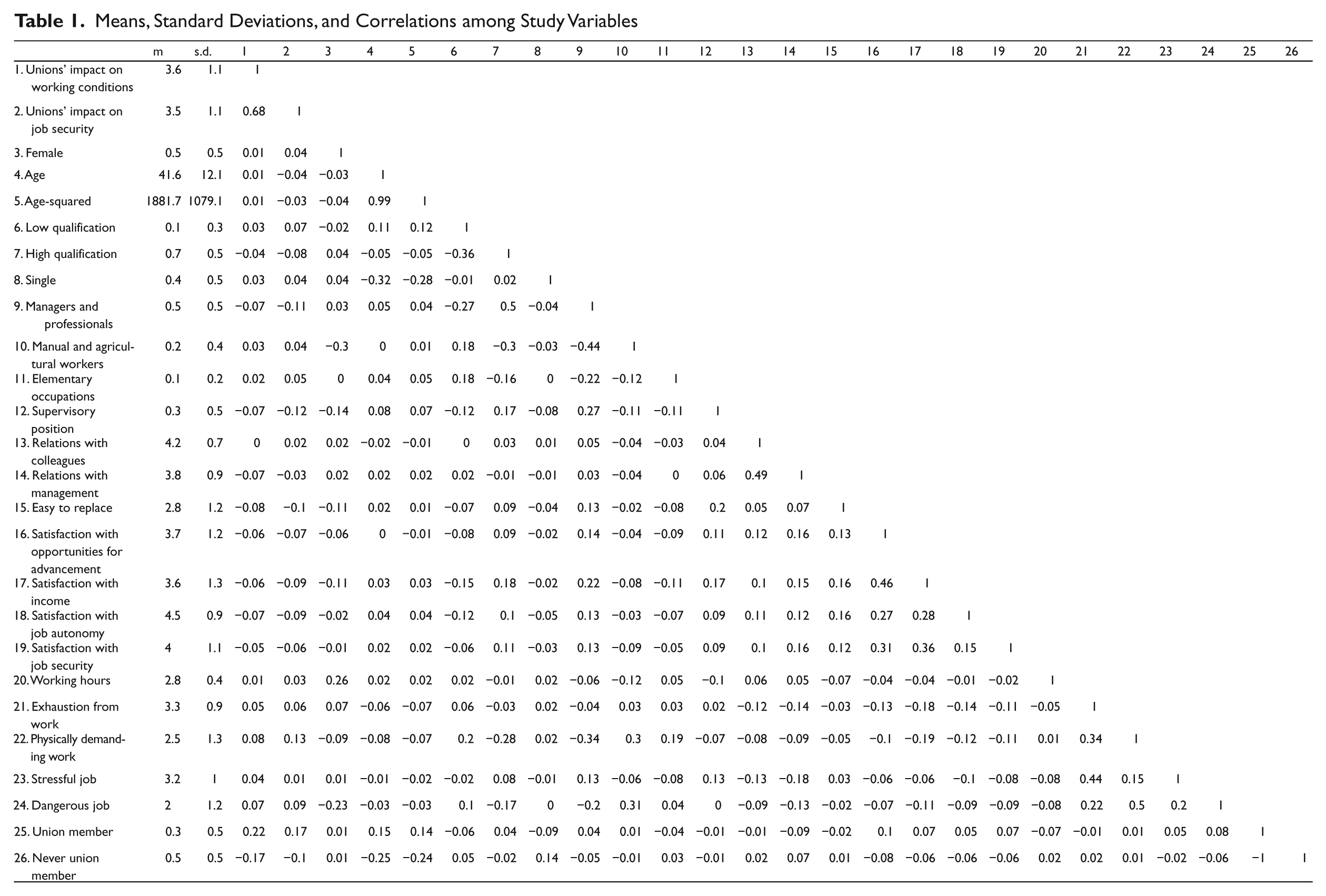
Because the assessment of unions’ roles for workplace outcomes can be influenced by a variety of issues, such as job characteristics and personal background, our analyses account for alternative explanations by including the following control variables: gender, age and its square term (to allow for a nonlinear effect of age), education, marital status/cohabitation, occupational status, 2 being in a supervisory position, the quality of relationships with colleagues and management, the respondent’s perception of how difficult it is to be replaced, satisfaction with the opportunities for advancement, income, work organization, job security, working hours, exhaustion from work, and the extent to which the job requires physical activities, is exhaustive, stressful, and dangerous. We use these controls following earlier research (from smaller samples of countries), which finds differences in attitudes to or demands for unions among workers of different demographic background and with different job characteristics (Bryson et al. 2005; Freeman, Boxall, and Haynes 2007). A detailed description of all the variables is provided in the Appendix; the means, standard deviations, and correlations among all variables are displayed in Table 1.
Means, Standard Deviations, and Correlations among Study Variables
Descriptive Results
Before we present the results of our regression analyses, we first consider mean differences between union members and non-members as well as nonunionized men and women and nonunionized high-skill and low-skill workers in our study countries. Figure 1 provides some descriptive support for our hypothesis that union members hold more positive opinions about unions’ impact on working conditions. In all of our sample countries, union members have a more positive impression of union efficacy for working conditions than nonunion members (left hand columns). Given that the responses are based on a five-point Likert scale, these differences are of noticeable size in most countries. For example, the mean difference in the assessment of unions’ impact on working conditions between union members and nonunion members is 1.1 in Canada and 0.9 in Sweden. Likewise, for a large proportion of the countries in our sample, the mean perception that unions positively affect workers’ job security is much higher among union members than non-members. Spain and Taiwan are the only exceptions. 3

Unions’ perceived impact on working conditions and job security by union status
Next we turn to the differences between men’s and women’s perceptions of unions’ efficacy in improving working conditions and job security among those workers who are not a member of a union. Figure 2 indicates that the differences between men and women among the group of the nonunionized workers is, on average, smaller than the differences between unionized and nonunionized workers. In addition, the figure also shows that in some countries nonunionized women (second column) are even more pessimistic than nonunionized men about unions’ role in improving working conditions (namely, Bulgaria, Hungary, Norway, Great Britain, Denmark, France, Spain, Portugal, and South Korea). With respect to women’s assessment of unions’ efficacy in improving job security, however, we can observe lower means for women in Portugal (fourth column).
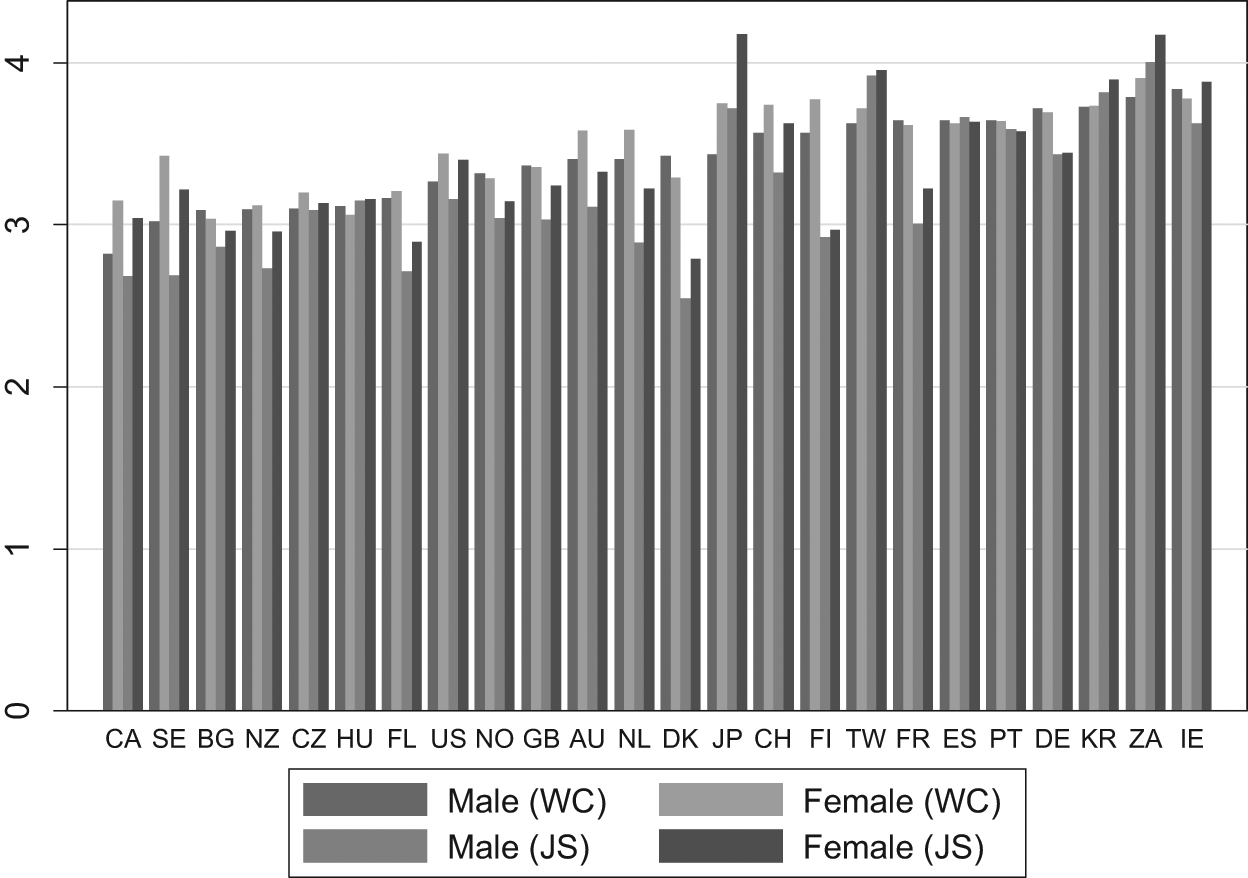
Unions’ perceived impact on working conditions and job security by gender (Non-Members Only)
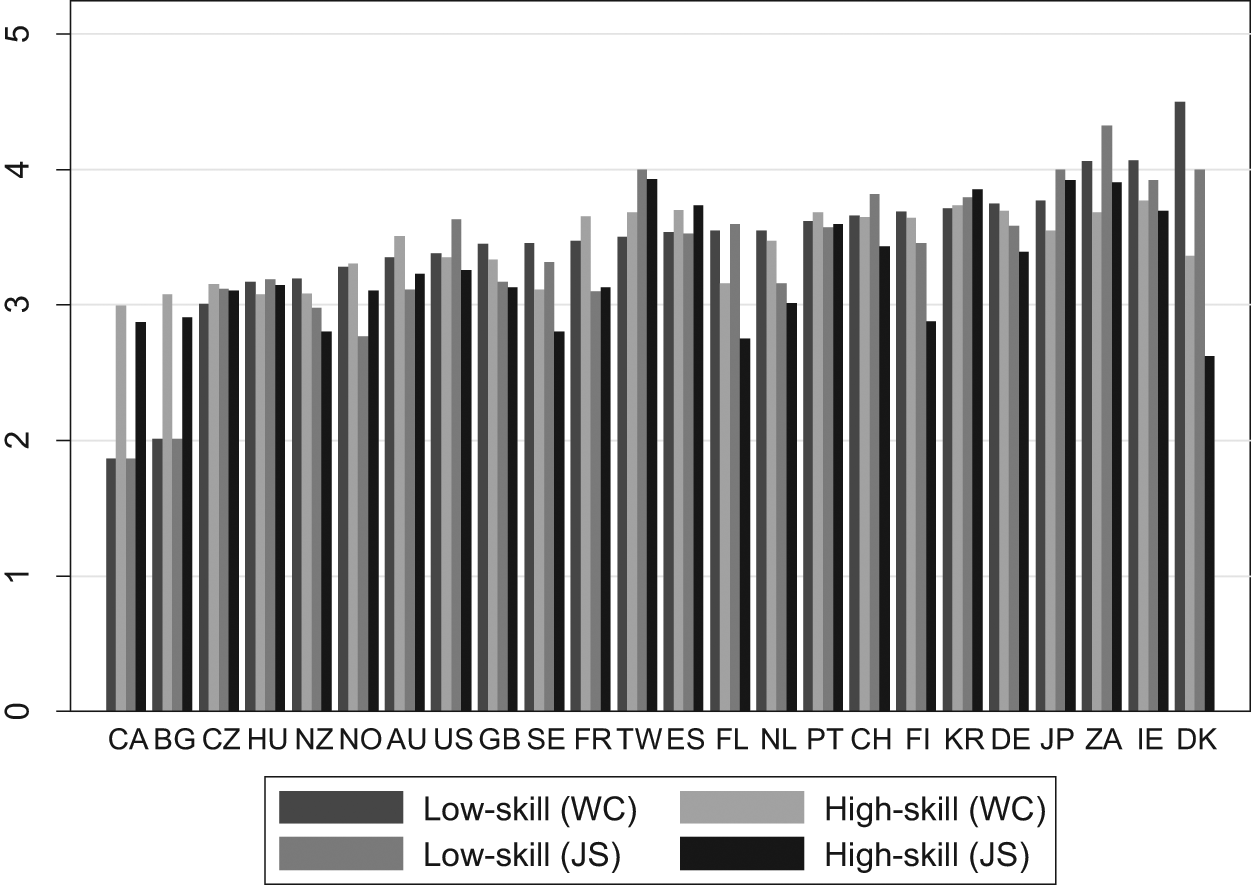
Unions’ perceived impact on improving working conditions and job security by education
By examining the perceived efficacy of unions by education, we observe great differences in the assessment of unions’ role in improving working conditions and job security between those with low levels of education and those with high levels of education. Despite the great variation in the perceived role of unions in improving job security, we can see that in only fourteen out of twenty-four countries, low-skilled workers are on average more positive about unions’ propensity to improve working conditions. Turning to the perceptions of unions’ role in improving job security among the group of the nonunionized workers, where we also observe wide variation, we find that in eleven out of twenty-four countries low-skilled workers hold more positive opinions than high-skilled workers. One explanation for this finding—which is in stark contrast to our outlined hypothesis—may be that employment regulations in many countries, which often vary depending on job types, may actually be more important for workers’ feelings of job security than unions’ propensity to protect workers against lay-offs (e.g., Anderson and Pontusson [2007]).
Although these descriptive findings provide mixed evidence for our claims about the associations between the perceived efficacy of unions and union status as well as demographic differences, we nonetheless believe that current and former union membership influences workers’ perceptions of union efficacy and that women and low-skilled workers are those among the nonunionized population who are the most likely to believe in the positive effects of unions on working conditions and job security. To probe these hypotheses beyond our descriptive statistics, however, we need to take other explanatory factors, which presumably also affect workers’ perceptions of unions, into account. The following section therefore explains the statistical models we use to test our hypotheses.
Multilevel Analyses
Because we analyze workers’ assessment of unions in different countries, we need to take the nested structure of our data into account. Ignoring the fact that workers within the same countries tend to be more similar to each other (including in their assessment of unions) than to workers in other countries would lead to underestimated standard errors and erroneous conclusions about the statistical significance of relationships between the study variables (Rabe-Hesketh and Skrondal 2005). Since we do not model differences across countries, such as economic conditions or union regulations, we choose to estimate linear, fixed-effects models for both dependent variables (i.e., the country-specific intercepts are treated as fixed unknown parameters). The model takes the following form:

where
Yijis the variable capturing perceived efficacy of unions to improve working conditions/job security for individual i in country j
Xijare the individual level characteristics for the individual i in country j
ß0 is the overall intercept
αjis the deviation of the country j from the overall intercept
ßk are the fixed country level parameters
ϵij is the residual for the ith individual in country j.
To take advantage of the fact that our dataset includes data on workers from twenty-four countries, we also run OLS regressions on each single country so that we can show where the hypothesized associations indeed occur and speculate about potential explanations.
Results and Discussion
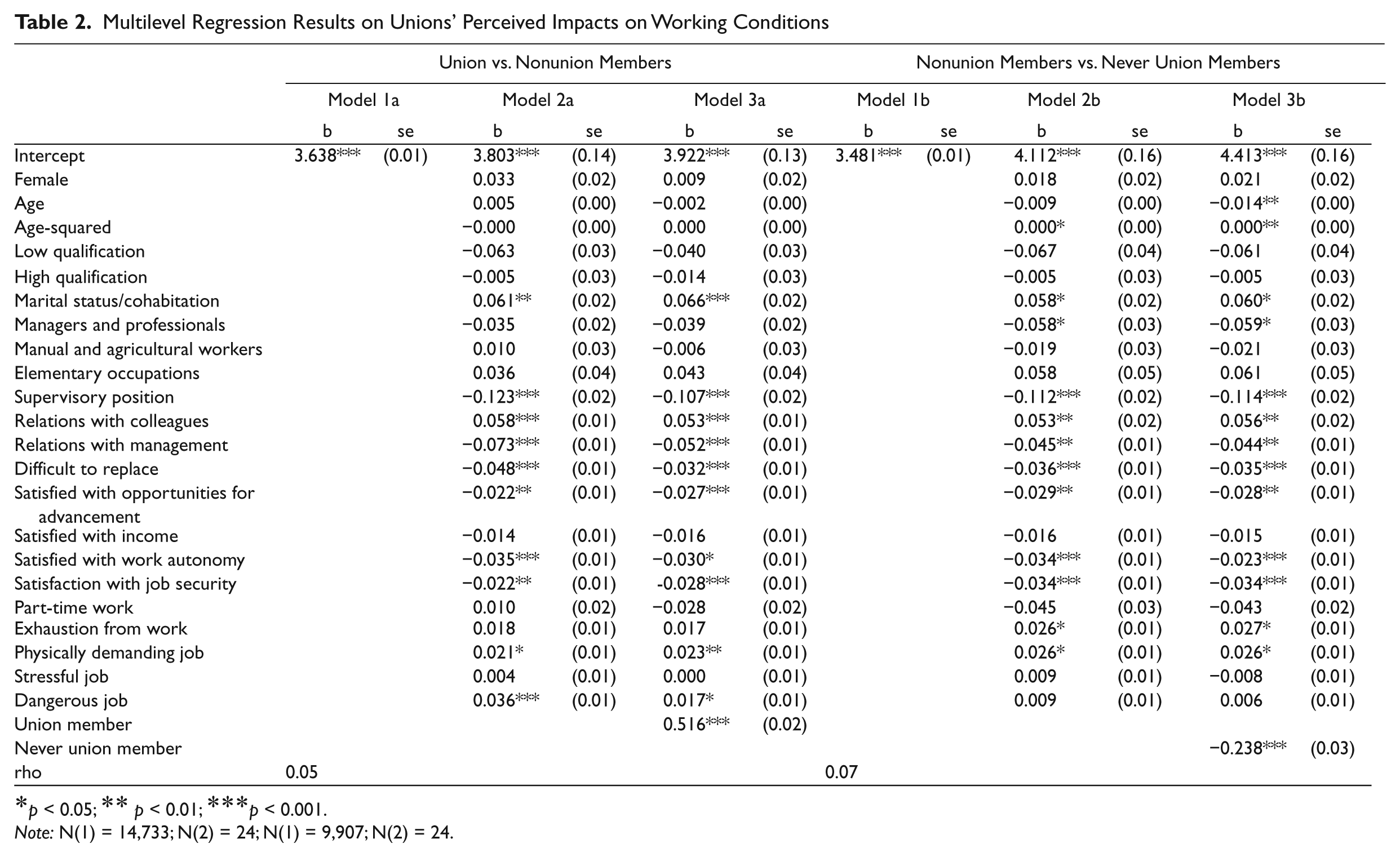
Tables 2 and 3 summarize the results of each of the dependent variables, that is, the perceptions of unions’ efficacy in improving working conditions and in improving job security. The first model in each table includes only the intercept. Based on this empty model, we calculate the intra-class correlation ρ (ICC), which indicates how much of the variance in the dependent variable is due to differences between individuals as opposed to differences between countries. 4 The second column in each table (Model 2) presents the model that includes all individual and country-level control variables. The predicting variables for the hypothesized relationships are introduced in the third model in each table. In the following, the evidence for and against our hypotheses is discussed separately for each of the two dependent variables.
Multilevel Regression Results on Unions’ Perceived Impacts on Working Conditions
p < 0.05; ** p < 0.01; ***p < 0.001.
Note: N(1) = 14,733; N(2) = 24; N(1) = 9,907; N(2) = 24.
Multilevel Regression Results on Unions’ Perceived Impacts on Job Security

p < 0.05; **p < 0.01; ***p < 0.001.
Note: N(1) = 14,733; N(2) = 24; N(1) = 9,834; N(2) = 24.
Perceptions of unions’ efficacy in improving working conditions
Table 2 displays the findings on unions’ perceived effects on working conditions for the entire sample (Models 1a - 3a) and nonunion members (Models 1b - 3b). Models 1a and 1b are based on an empty model, that is, a regression that does not include any of the independent variables. The intra-class correlation coefficient based on this empty model is 0.05, which means that around five per cent of the total variance can be explained by differences between countries, which confirms our use of multilevel modeling techniques.
Model 2a, which introduces all of our control variables, does not yield any surprising results. Employees in a supervisory position do not believe that unions improve working conditions. Likewise, those who feel that they are easy to replace in their organization and those who have good relationships with management also do not ascribe a positive influence of unions on working conditions, and neither do those who are satisfied with the various aspects of their work, that is, with the opportunities for advancement, work autonomy, and job security. In contrast, workers who say that they have good relationships with their colleagues, who have physically demanding jobs or work under dangerous conditions, and those who are single believe that unions can improve working conditions. The other control variables are not statistically significant at p < 0.05.
When adding the variable that captures union membership in Model 3a, we find a positive association between union membership and the assessment of unions’ effect on working conditions, which confirms our initial contention that union members hold more positive opinions about unions’ role in improving working conditions than nonunion members.
When excluding all current union members from the sample to examine the differences between those workers who never were members of a union and those who formerly were union members but aren’t any longer, the sample size goes down to 9,907 observations. In Model 1b, we can see that by this reduction in the sample, the intra-class correlation provided in the empty model increases by 2 per cent, which means that the differences among nonunion members in the assessment of unions’ impact on working conditions are even greater than when considering the entire working population.
When adding the control variables in the model (Model 2b), we can observe that the signs of the coefficients of the various predictors do not differ from what we observed for the entire sample but the level of statistical significance of some variables changes. For example, the coefficients of “managers and professionals” and “exhaustion from work” are still positive but now statistically significant at p < 0.05. Working in a dangerous job, which was positively associated with the perception that unions are important for working conditions at a p-level of 0.05, is no longer statistically significant when only nonunion members are analyzed.
By introducing the variable representing those workers who never were a member of a union (Model 3b), we test the hypothesis that those workers who have never been a member of a union are less positive about unions’ efficacy in improving working conditions. The negative coefficient of this variable confirms our initial thinking. Those who have never been unionized do not believe that unions positively influence working conditions. In addition, this last model also shows that our hypotheses on the associations between perceived union efficacy and demographic characteristics are rejected. Among the nonunion members, workers with (or with less than) the lowest level of qualification do not seem to hold more positive opinions about unions’ role in improving their working conditions than workers with high or medium skills and neither do women (positive coefficient but no statistical significance at p < 0.05).
In order to examine whether the association between union status and demographic characteristics and perceived union efficacy is the same across all of our study countries, we also run separate OLS regression analyses for each of our study countries (analyses not shown but available upon request). In all countries except Hungary, Spain, and Taiwan, we find that union membership is positively and significantly associated with a perception that unions can improve working conditions. This demonstrates that in the great majority of our study countries, union members themselves see the advantage of unions.
Examining nonunion members only, we find a positive and statistically significant association between gender (being female) and the perception that unions improve working conditions in Australia, Canada, Japan, and South Africa, which confirms our initial contention at least for some countries (the only negative and statistically significant association we observe between gender and the perception of unions’ impact on working condition is for Norway). In terms of skill levels, we find that nonunion members with lower skills are less likely to believe in the power of unions to improve working conditions in several countries. These are Bulgaria, the Czech Republic, France, the Netherlands, Spain, and Taiwan. This group of countries is institutionally quite diverse, and it is hard to speculate on a common cause for this finding, but it is clear that nonunion members in these countries with low or no educational qualifications are much less likely to believe in the positive impact of unions on working conditions, perhaps because of lack of exposure to unions, or because of a resignation to poor job quality.
Perceptions of unions’ efficacy in improving job security
Table 3 displays the findings of workers’ assessment of unions’ effects on job security. The intra-class coefficient for the entire sample is 0.08 (Model 1a). In substantive terms, this means that the correlation in the perceptions of how unions contribute to job security between two randomly selected individuals in the same country is 0.08. This indicates that unions’ role in securing jobs is perceived differently across countries.
Model 2a displays the effects of all our control variables on the perceptions of unions for job security. Here again, we do not observe unexpected results. Women attribute a greater impact to unions in providing job security than men (p < 0.001) as do singles compared to those who are married or live with a constant partner. The relationship between age and unions’ perceived role in securing jobs is nonlinear (negative coefficient “age” (p < 0.01) and a positive coefficient of its square term (p < 0.001)). Employees in a supervisory position, with positive relationships to management, who feel that they cannot easily be replaced, and are satisfied with their job security do not believe that unions have positive effects on their job security (p < 0.001). Occupations also seem to matter. Workers in professional and managerial occupations do not believe in the positive effects of unions on job security (p < 0.001), while workers in elementary occupations do (p < 0.05).
When adding union membership into the analysis (Model 3a), the sign of the coefficients of the various control variables and their levels of statistical significance remain unchanged. Union membership has a positive and statistically significant effect on the perception that unions are good for workers’ job security, which confirms our hypothesis.
By reducing the sample to nonunion members, we test our hypotheses on the perceived efficacy of unions for job security by non-members The intra-class correlation coefficient of 0.15 calculated based on Model 1b indicates that perceptions of unions’ propensity to influence job security by the nonunionized workforce considerably depends on country-specific differences. When adding the control variables into the analysis (Model 2b), we can see that the same characteristics that influence the opinions of union members about unions’ role in providing job security also influence the opinions of nonunion members. In other words, we do not observe any differences in the variables’ signs and statistical significances between the models with and without the union members.
Turning to Model 3b, we can see that those who have never been union members have a less positive opinion about unions’ effects on job security than those who have been unionized at some point in their lives. In general, women tend to be more positive than men. However, we do not find enough evidence for the hypothesis that workers with no or low education should be more positive about unions’ role in providing job security. The coefficient of low-skilled workers is positive but not statistically significant at p < 0.05. Nonunionized women, however, are more positive in their assessment of unions in improving job security than men (p < 0.001).
Based on the results of an OLS regression, we can identify differences between the perceptions of union members and nonmembers in our study countries. In most countries (again all but Hungary, Japan, Spain, and Taiwan) we find that union membership is significantly and positively related to a belief that unions can improve job security. Among nonmembers, there is some demographic variation in the perceived effect of unions on job security. In Australia, Canada, Ireland, Japan, New Zealand, South Africa, and the United States, women are more likely than men to believe in the positive effect of unions on job security. Having the lowest level of educational qualifications has a positive effect in Denmark and South Africa, but a negative impact in Bulgaria, Norway, and Spain, perhaps suggesting a different perception of where their national unions focus their work. In several countries we see that never having been a member of a union has a negative relationship to the perception of this union effect. In Australia, Bulgaria, Canada, the Netherlands, New Zealand, and the UK, we find that never having been in a union is significantly and negatively related to perception of this effect. This could be interpreted positively for unions in these countries: past experience of union membership is associated with more positive perceptions of unions’ role in improving job security.
Discussion
Our analyses show that individual characteristics matter for workers’ perceptions of unions. We focus on the similarities between different groups of workers across countries instead of examining how country-level differences, such as union structures, bargaining regulations, or economic conditions, impact employees’ perceptions of what unions do for workers. More specifically, we examine the differences between those who currently are, those who previously were, and those who never were members of a union in their feelings about unions. Union members hold the most positive opinion about unions’ impact on working conditions and job security, probably because union members tend to be more sensitive about workplace issues than their nonunion counterparts (Barling, Fullagar, and Kelloway 1992; Berger, Olson, and Boudreau 1983; Freeman and Medoff 1984). Therefore, they tend to be more likely to be aware of the role and the necessity of unions and may have greater expectations about job outcomes. The same may apply to those who have previously been a member of a union.
When only analyzing nonunion members we find that those who previously had joined a union but no longer are members have a more positive view on unions than those who never were unionized. This finding is an important insight for organizing strategies. Concentrating on those who have already had experiences with unions may be much more efficient than those who have never been connected to unions. Moreover, concentrating organizing efforts on women may also be promising, while the outcomes for low-skilled workers may be less certain.
In order to provide specific policy recommendations and organizing strategies, however, we need to focus on single countries. For the United States, for example, we find that women are more likely to believe that unions improve job security, implying that unions can (or are perceived to) mitigate gender bias in the workplace. This suggests that there may be demand for unions among women, and suggests that unions might focus their organizing efforts on women. In South Africa, we find that being female and having a low level of educational qualification are both significantly related to a positive view of the effect of unions on working conditions; interestingly, in South Africa there is no significant difference between never union members and sometime members, demonstrating that in this context the demographic factors are much more important. In South Africa, given the role of unions in the transition from apartheid, it is perhaps to be expected that never union members would still have a strong sense of the role and potential of unions.
Similarly, in Denmark we find no significant difference between never members and sometime members in their views of unions and job security, but we find a significant and very large effect from workers with low skills. These Danish low-skilled workers are much more likely to believe that unions have a positive effect on job security. Again, we can see how countries where all workers have some exposure to unions, whether in the workplace or because of involvement in national politics, show fewer differences between sometime union members and never members. This finding tends to hold up when looking at nonmembers beliefs on unions and job security, but not unions and working conditions. This suggests that these unions may be perceived as having an effect on national regulations (regarding job security specifically) but not on relationships and conditions within workplaces.
Conclusions
In our twenty-four-country study we find stark evidence of differences in workers’ perceptions of the efficacy of unions. From our analysis, we can conclude that union membership status and past experience, and gender—at least to some degree—matter in determining perceptions of the efficacy of unions. In particular, we find that union members feel most positive about the ability of unions to improve working conditions and job security and that former members tend to be more positive than never union members in these views. This affirms Budd’s (2010) findings from the United States for this broad set of countries. This implies that in general, workers who have had more exposure to unions and unionized workplaces hold a more positive view of unions. The positive view of former union members about the efficacy of unions suggests that unions might work to reach these sometime members.
Moreover, we find that among nonunion members, women tend to hold a more positive view than men of the effect of unions on job security (although the parallel effect on working conditions is not confirmed). Women are generally more susceptible to various forms of workplace discrimination, which creates a greater need for the kind of protection provided by unions. Nonunionized women may thus be particularly open to organizing efforts and unions would therefore be wise to focus on female dominated occupations in their quest to recruit more members.
Although our analyses deliver some important insights about unionized and nonunionized workers’ perceptions of the effectiveness of unions to improve working conditions and job security, our study is not without limitations. For example, our data do not allow us to determine whether immigrants (temporary or permanent, documented or undocumented) hold different views from citizens on the efficacy of unions (for an excellent US account, see Rosenfeld and Kleykamp [2009]). While many scholars have made forceful cases for both the need for unionization among immigrant workers, and the vital role immigrant workers can play in rebuilding unions, our survey data do not allow us to test these arguments. Future research should therefore be based on data that also contain information on the respondents’ nationality and country of origin.
Furthermore, future research should also examine to what degree relationships between union status and perceptions of unions differ across countries and which institutional differences and similarities across countries determine these different perceptions. The within-country comparisons presented in our study need to be complemented by cross-national comparisons, since some of the explanations for the more or less positive outlook on unions by subgroups may rest on variations in country-level configurations of institutions. For example, in more heavily regulated countries, the state may substitute for unions in ensuring reasonable levels of job security and good working conditions.
Footnotes
Appendix
| Unions’ impact on working conditions | 1 – without trade unions the working conditions of employees would be much better than they are |
| 2 – without trade unions the working conditions of employees would be better than they are | |
| 3 – without trade unions the working conditions of employees would neither be better nor worse than they are | |
| 4 – without trade unions the working conditions of employees would be worse than they are | |
| 5 – without trade unions the working conditions of employees would be much worse than they are | |
| Unions’ impact on job security | 1 – trade unions are very unimportant for the job security of employees |
| 2 – trade unions are unimportant for the job security of employees | |
| 3 – trade unions are neither important nor unimportant for the job security of employees | |
| 4 – trade unions are important for the job security of employees | |
| 5 – trade unions are very important for the job security of employees | |
| Female | 1 – being female |
| 0 – otherwise | |
| Age/age-squared | Age in years/age in years squared |
| Low qualification | 1 – no formal qualification or lowest formal qualification |
| 0 – otherwise | |
| (Reference Category: “above lowest qualification”) | |
| High qualification | 1 – higher secondary, above higher secondary, or university degree |
| 0 – otherwise | |
| (Reference Category: “above lowest qualification”) | |
| Marital status/cohabitation | 1 – being single |
| 0 – being married or living with partner | |
| Managers or professional | 1 – Manager, Senior, Professional, Technician (ISCO 1000 – ISCO 3000 classification) |
| 0 – otherwise | |
| (Reference Category: Clerk, Service, and Sales Workers(ISCO 4000 and ISCO 5000)) | |
| Manual and agricultural worker | 1 – Skilled Agricultural, Craft, or Trade Worker as well as Plant and Machine Operator (ISCO 7000 – ISCO 8000) |
| 0 – otherwise | |
| (Reference Category: Clerk, Service, and Sales Worker (ISCO 4000 and ISCO 5000) | |
| Elementary worker | 1 – Elementary Occupation (ISCO 9000) |
| 0 – otherwise | |
| (Reference Category: Clerk, Service, and Sales Worker (ISCO 4000 and ISCO 5000) | |
| Supervisory position | 1 – supervises others at work |
| 0 – otherwise | |
| Relations with colleagues | 1 – relations between colleagues/workmates are very poor |
| 2 – relations between colleagues/workmates are poor | |
| 3 – relations between colleagues/workmates are neither good nor poor | |
| 4 – relations between colleagues/workmates are good | |
| 5 – relations between colleagues/workmates are very good | |
| Relations with management | 1 – relations between management and employees are very poor |
| 2 – relations between management and employees are poor | |
| 3 – relations between management and employees are neither good nor poor | |
| 4 – relations between management and employees are good | |
| 5 – relations between management and employees are very good | |
| Difficult to replace | 1 – very easy for firm to replace you |
| 2 – fairly easy for firm to replace you | |
| 3 – neither easy nor difficult for firm to replace you | |
| 4 – fairly difficult for firm to replace you | |
| 5 – very difficult for firm to replace you | |
| Satisfaction with opportunities for advancement | 1 – very dissatisfied with opportunities for advancement |
| 2 – dissatisfied with opportunities for advancement | |
| 3 – neither satisfied nor dissatisfied with opportunities for advancement | |
| 4 – satisfied with opportunities for advancement | |
| 5 – very satisfied with opportunities for advancement | |
| Satisfaction with income | 1 – very dissatisfied with income |
| 2 – dissatisfied with income | |
| 3 – neither satisfied nor dissatisfied with income | |
| 4 – satisfied with income | |
| 5 – very satisfied with income | |
| Satisfaction with job autonomy | 1 – very dissatisfied with job autonomy |
| 2 – dissatisfied with job autonomy | |
| 3 – neither satisfied nor dissatisfied with job autonomy | |
| 4 – satisfied with job autonomy | |
| 5 – very satisfied with job autonomy | |
| Satisfaction with job security | 1 – very dissatisfied with job security |
| 2 – dissatisfied with job security | |
| 3 – neither satisfied nor dissatisfied with job security | |
| 4 – satisfied with job security | |
| 5 – very satisfied with job security | |
| Part-time work | 1 – employed part time |
| 0 – employed-full time | |
| Exhaustion from work | 1 – never come home from work exhausted |
| 2 – hardly ever come home from work exhausted | |
| 3 – sometimes come home from work exhausted | |
| 4 – often come home from work exhausted | |
| 5 – always come home from work exhausted | |
| Physically demanding work | 1 – never have to do hard physical work |
| 2 – hardly ever have to do hard physical work | |
| 3 – sometimes have to do hard physical work | |
| 4 – often have to do hard physical work | |
| 5 – always have to do hard physical work | |
| Stressful job | 1 – never find work stressful |
| 2 – hardly ever find work stressful | |
| 3 – sometimes find work stressful | |
| 4 – often find work stressful | |
| 5 – always find work stressful | |
| Dangerous job | 1 – never work in dangerous conditions |
| 2 – hardly ever work in dangerous conditions | |
| 3 – sometimes work in dangerous conditions | |
| 4 – often work in dangerous conditions | |
| 5 – always work in dangerous conditions | |
| Union member | 1 – being a union member |
| 0 – otherwise | |
| Never union member | 1 – never been a union member |
| 0 – otherwise |

The author(s) declared no potential conflicts of interest with respect to the research, authorship, and/or publication of this article.
The author(s) received no financial support for the research, authorship, and/or publication of this article.