




Abstract
In this paper we attempt to assess how labor unions affect cross-national variation in life satisfaction. We argue that cross-national differences in the extent of labor organization play a significant role in determining why citizens in some nations express greater subjective satisfaction with life than others. We examine this proposition using data on nations that cover the political and economic spectrum. To anticipate our findings, we show that individual union membership has a consistent positive effect on individual well-being. Our main focus, though, is the effects of the national level of union density on the general, overall level of satisfaction within a country, considering both union members and nonmembers. We find that union density is strongly associated with the general level of well-being but that this effect is conditioned, as we expect, by the level of democracy: in democratic countries, union density produces greater levels of life satisfaction, while in highly authoritarian settings, it appears to reduce satisfaction. In each case, these effects obtain for members and nonmembers alike, thus highlighting the importance of labor unions for the general, overall level of quality of life across nations.
Do labor unions, as one of the central institutions of the modern market society, ultimately contribute to or inhibit the quality of life that citizens experience? Such a question fits squarely within the growing literature on the sociopolitical determinants of life satisfaction across nations (for reviews, see Graham, 2010; Diener, Helliwell, and Kahneman, 2010). Explicitly political factors, while initially neglected, are increasingly coming to the fore. Research incorporating political factors has demonstrated how broad concepts such as democracy (e.g., Inglehart 2006), the size of the state (Bjornskov, Dreher, and Fischer 2007), and the partisan composition of the government (e.g., Alvarez-Diaz, Gonzalez, and Radcliff, 2010) affect subjective well-being. Increasingly then, a rapidly expanding literature views subjective well-being as an expressly political phenomenon.
Scholars have clearly devoted much attention to transparently and conventionally political institutions, such as political parties and state budgets, but have paid far less attention to the equally political but less studied institution of the labor union. It is widely agreed, of course, that unions play a critical role in politics by promoting policies that support their constituents. More important, much scholarly work supports the suggestion that unions (at least in the context of an established liberal democratic political order) generally fill a void in both pluralist and class-based interpretations of politics by coming to represent the interests of the working and middle classes or, even more expansively, “society’s nonrich” (see, e.g., Cohen and Rogers 1983; Radcliff and Saiz 1998; Korpi and Shalev 1979; Kuttner 1986). Thus, in this vein Levi (2003, 45) argues that even in decline, organized labor is arguably still “the most effective vehicle for achieving a democratic and equitable society.” It thus seems that a general understanding of the determinants of life satisfaction across nations should include an appraisal of the role of organized labor. This article attempts such an analysis.
The importance of labor unions as vehicles for “achieving a democratic and equitable society” points our attention toward the continuing importance of class and class conflict in the contemporary world. Classes compete over the direction of public policy, but workers are also in an adversarial relationship with employers over wages and working conditions. Both levels of conflict are potentially mediated through labor organization. Thus, social theorists of all persuasions generally agree that labor organization is important, and large empirical literatures in political science, sociology, and economics document the cross-national impact of unions on a range of social outcomes. Yet to date, few have empirically tested the proposition that labor unions improve the quality of life for citizens and then only in a small set of advanced stable democracies at a single point in time (Radcliff, 2005).
In this article, we attempt to assess how labor unions affect cross-national variation in life satisfaction across nations. We argue that cross-national differences in the extent of labor organization play a significant role in determining why citizens in some nations express greater subjective appreciation with life than others. We examine this proposition using data on the universe of nations, democratic and autocratic, industrial and developing, for which data from the World Values Survey (WVS) and the International Labour Organization are available (WVS Integrated File 1981-2004; International Labour Organization 1997).
Labor Unions and Subjective Well-Being
Unions are argued to affect subjective well-being through a variety of mechanisms. Some are direct in the sense that they affect organized workers as individuals per se. Others are indirect in the sense that they occur, not specifically because one belongs to a union, but because of the effects of unions (presumed to be proportional to strength or density of organized labor) generally on the social, economic, or political conditions of life. Both the direct and indirect contributions of labor unions are discussed in the following. Throughout the discussion, we generally presume a democratic context, such as that existing in the model Organisation for Economic Co-operation and Development (OECD) countries, in which unions are (ideally) independent organizations that represent (and are controlled by) workers; the negative effects in other contexts may be inferred.
Scholars generally agree that the main sources of life satisfaction come from outside work (e.g., Lane 2000). It remains the case, however, that work is one of the most demanding, and often among the most important aspects, of most people’s lives (Seeman and Anderson 1983). In developing countries, the importance of the workplace is magnified even further given the stakes attached to employment. In any case, labor market participants certainly spend a large portion of their waking lives in the workplace. To the extent that the work experience is an agreeable one, people ought to be more satisfied over all. The links between job satisfaction and a number of physical and mental health issues (also themselves determinants of life satisfaction) are well documented (Jenkins 1971; Cooper and Marshall 1976; Rahman and Sen 1987). Empirical studies confirm that proposition; satisfaction with one’s job is a powerful determinant of overall life satisfaction (Sousa-Poza 2000; Argyle 2001).
Similarly, belonging to a labor union may tend to increase job satisfaction (Pfeffer and Davis-Blake 1990), which in turn should contribute to greater overall life satisfaction in an obvious fashion. Some evidence in the literature suggests that union members are actually more dissatisfied than nonmembers but also that they are far less likely to quit then nonmembers (Freeman and Medoff 1984). This puzzle was resolved by applying the “voice hypothesis,” in that unionization allows members to complain about their working conditions since they are in a position to ameliorate them through collective action. Workers thus sought to improve their working conditions rather than “exit” because they could and presumably because they valued their jobs enough to try. There is also an endogeneity problem that Pfeffer and Davis-Blake (1990) successfully explain. Clark (1996, 202) nicely addresses the issue: “if unions address worker dissatisfaction, the more dissatisfied workers will be the most attracted to union membership,” so that union shops will emerge in those industries and under those employers that create the most initial dissatisfaction. When controlling for this effect, Pfeffer and Davis-Blake demonstrate that “unionization has a significant positive effect on [job] satisfaction” (see also, Bender and Sloane, 1998). That said, it must be admitted that there is still some scholarly skepticism about how the relationship between union membership and job satisfaction is (Hammer and Avgar 2005).
In any case, the core argument for the relationship is straightforward: job security and a positive work environment contribute to satisfaction with one’s job (Sousa-Poza 2000). Unions—at least independent unions that truly represent workers—increase the production of both these goods. Contracts that protect workers from arbitrary dismissal are likely to increase job security. Similarly, members of (independent) unions may feel empowered by the existence of grievance procedures that give one the ability to appeal decisions made by employers. In these ways, unions facilitate the creation of a workplace that functions through “due process” with felicitous consequences (Sutton 1990). Recent empirical work by Abraham, Friedman, and Thomas (2008) convincingly illustrates that union members exhibit greater levels of job satisfaction then nonunion workers and are thus less likely to “exit” the organizations of their employment (because they possess the option of “voice” provided through organization).
In addition, unions may reduce alienation by giving members a collective say in how workplaces are run. The less alienated, in turn, are more likely to be satisfied with their jobs and thus their lives. Alienating work imposes psychological costs on people that contribute to depression (Erikson 1986), job dissatisfaction (Greenberg and Grunberg 1995), and a general decline in life satisfaction (Loscocco and Spitze 1990). Similarly, scholars generally agree that autonomy on the job is vital for well-being. As Kohn et al. (1990, 964) state, “occupational self-direction . . . affects values, orientations, and cognitive functioning” in exactly the way one would imagine: those who lack self-direction are more prone to psychological “distress” (anxiety and a lack of self-confidence). To be sure, alienation and especially autonomy are largely determined by occupation, but there are reasons to expect union members to evidence these pathologies to a lesser degree for any given type of occupation.
While the union workplace may actually reduce autonomy in the abstract—given that contractual rules are indeed more rules that must be adhered to—unions are contextually more supportive of self-determination in two respects. First, they establish a degree of autonomy for their members through collective bargaining at a level that is almost by definition higher than in nonunion workplaces. Workers thus rightly interpret autonomy as something collectively achieved, that is, as a benefit of organization (Edwards 1979). Further, as Fenwick and Olson (1986) observe, the experience of union membership fosters cognitive changes that encourage exactly the workplace participation that unionization allows, which may in turn foster more self-direction. To the extent that unions lessen alienation, it follows that we should again see a positive relationship between membership and well-being, net of other factors.
Unions may also contribute to well-being through their effect on another variant of connectedness. The social psychology literature has demonstrated that individuals are afforded some protection against the deleterious consequences of stress, especially job-related stress, through social support networks (Cohen and Wills 1985). Even enjoyable work can be a major source of stress, particularly when performance affects one’s livelihood. While support from all quarters is surely helpful, evidence suggests that buffering is most effective when the source of support is from the same domain as the source of stress. Work-related stress, then, is best buffered by having sources of emotional support at work (Jackson 1992). Common sense would suggest that unions may facilitate such support in that they help build not only connections but also a sense of solidarity among coworkers. Indeed Uehara (1990) goes so far as to specify “solidarity” as a critical agent in effective social support networks. By nurturing solidarity, unions may thus provide an ideal context in which to find the type of social support that helps insulate against work-related stress.
There are few rigorous empirical studies of the general role of unions, social connection, and stress, but the extant literature does offer some evidence suggesting that unions facilitate both general social support (Lowe and Northcott 1988) and protection against job-related stress per se (Brenner 1987). The evidence in regard to the negative effect of job stress on life satisfaction is clearer still (Loscocco and Spitze 1990). Unions may thus again contribute to higher quality of life among their members. Unions may also contribute to the well-being of their members and perhaps to society at large, through their capacity (in varying degrees) as participatory institutions. It is often argued that participating in organizations such as unions tends to teach individuals cognitive and social skills. People learn how to communicate with one another as well as to analyze and solve problems better. Evidence also suggests that belonging to an organization helps individuals understand their preferences and interests more clearly.
The participatory or developmental strand of democratic theory encourages worker participation and involvement in decision making in the workplace because such participation is believed capable of creating better citizens—citizens who are more sophisticated, more knowledgeable, more tolerant, and more civic minded (Pateman 1970). An extensive body of analysis generally supports the empirical veracity of this presumption (for a review, see Radcliff and Wingenbach 2000). Thus, if participation in organizations contributes to human development and if being a union member implies at least some degree of participation in the organization, then more union membership should mean more developed citizens. If we are willing to accept that more developed citizens will tend to be more satisfied citizens, then union membership should contribute to satisfaction in this way. Further, while Frey and Stutzer (2002) do not frame their argument in a developmental framework, they do demonstrate that institutional settings produce greater levels of subjective well-being. If so, then unions should similarly contribute, at least to the extent that they offer participatory opportunities.
The arguments above bring us to social capital (Putnam 1993, 2000). At its core, “social capital refers to connections among individuals—social networks and the norms of reciprocity and trustworthiness that arise from them” (Putnam 2000, 19). Generalizing slightly, the implicit idea is that social networks facilitate positive psychological and cognitive changes in individuals that not only are politically desirable but also conducive to greater personal well-being (Putnam 2000, 333-34). Indeed, the literature is unanimous in suggesting that social connectedness fosters greater subjective well-being. This argument is made most persuasively by Robert Lane (1978, 2000), who places the blame for declining levels of subjective well-being in the United States and Western Europe on a growing “famine” of interpersonal relationships (2000, 9). A variety of other studies have documented the importance of social connection (Myers and Diener 1995; Veenhoven 1996).
That unions facilitate the building of social networks requires no elaboration. That they are likely as fraternal organizations to foster norms of reciprocity and solidarity is equally clear. We have already noted the positive effects of union membership on social connections in the workplace. We thus have reason to hypothesize that union members—given that they tend to enjoy their jobs more and suffer less from work-related stress, to say nothing of having more social connections (and indeed more social capital)—are likely to be better able to build and maintain intimate and rewarding relationships. Labor organizations can thus affect the quantity and quality of personal connections among people, which in turn surely contribute to life satisfaction (Lane 2000). To the extent that social capital and social connectedness contribute to a better quality of life, we consequently return again to the hypothesis that unions promote well-being.
Before proceeding to the effects of labor union density rather than individual union membership, it is worth noting that while some of the effects on the individual noted above certainly depend on a liberal democratic environment that allows the union to function as an independent and legitimate representative of its constituents, some of the effects of organization—those that may accrue to one belonging to any kind of social organization—may not. Thus, the sense of social connection that comes from union activities, meaning the purely social or personal benefits that might come from interpersonal interactions, may materialize even in settings in which the union does not live up to West European standards of independence or internal democracy. Put baldly, the sense of shared experience, perhaps even of camaraderie, may still accrue from participation in union events simply from the social interactions, even if the union’s independence is dubious. An obvious (if to some readers, an indelicate) comparison might be to church attendance: one may benefit socially, via the sense of belonging and community that comes from attending services and related church-sponsored events, even if one does not share the religious convictions, the expression of which is the presumptive purpose of attending. Indeed, such social benefits might even accrue to individuals who did not particularly wish to attend services but happen to find friends or kindred spirits nonetheless.
In addition to the direct impact of unions on the life satisfaction of their members, the social level of unionization should indirectly contribute to the life satisfaction of everyone, members and nonmembers (again, at least in liberal democratic societies) through two mechanisms. The first and most obvious, alluded to above, is through diffusion via social networks or, to put it more simply, what me might call a contagion effect. It seems obvious that an individual’s subjective well-being is to some extent determined by his or her interactions with other persons. As such, people are likely to be more satisfied themselves the more they interact with other satisfied people. Those in countries with a higher proportion of more-satisfied-than-otherwise union members are likely to be more satisfied, on average, than those in countries with fewer proportional union members. This effect will be most apparent in the intimate relationships discussed above, but the logic extends to all forms of social interaction.
The other avenue through which unions may affect the general level of well-being in society is through their political effects. In nearly all the Western countries, at least, labor unions have been instrumental in developing and supporting the welfare state in the most expansive sense of the notion that a central purpose of the government is to provide for the well-being of its citizens through unemployment insurance, pensions, access to medical care, medical disability payments, and so on. Unions have also been strong political advocates for labor market regulations, ranging from the eight-hour workday to the minimum wage to prohibitions on child labor, to take but a few examples. One could go on to list policy after policy that has at least an ostensible and probable connection to a higher standard of living for the typical person that can be at least partially attributed to organized labor in virtually all democratic countries. Its role in authoritarian societies is, of course, more suspect, but that fact in turn suggests yet one more path by which unions may contribute to higher levels of human flourishing: much evidence suggests that unions are important players in the democratic process, ranging from the relatively mundane (Davis and Radcliff [2000], for instance, show that union density is the most important determinant of cross-national rates of voter turnout) to the most profound (organized labor being a key aspect of civil society necessary for the development and maintenance of the democratic order itself).
Given the scholarly attention devoted to quality of life and subjective well-being worldwide, as well as the role of unions as political actors, a more expansive empirical investigation of this relationship is warranted. In what follows we attempt to analyze the possible effects of unionization on satisfaction with life.
Analysis
A small cottage industry has emerged in the last two decades devoted to the question of whether we can study as complex a phenomenon as an individual’s life satisfaction with survey data. Despite some initial skepticism about reliability, validity, comparability across nations, social desirability bias, and other potential pitfalls, the consensus of opinion is that these “doubts can be discarded” (Veenhoven 1996, 4). Confidence over measurement is reflected in the large and growing literature on the cross-national determinants of life satisfaction (for recent reviews, see Graham, 2010; Diener, Helliwell, and Kahneman, 2010). 1
Our analysis utilizes individual-level data on levels of life satisfaction for a range of industrial and developing countries. The sample is all countries in the World Values Survey for which reliable union density data exist. The analysis of individual-level data makes it possible to test the contention that both individual union membership and the social level of organization affect life satisfaction. Utilizing the World Values Survey not only makes it feasible to use individuals as the units of analysis but also allows the sample to include a broad a range of industrial and developing countries.
Life satisfaction is measured using the following question from the World Values Survey: “All things considered, how satisfied are you with your life as a whole these days?” 2 The principal independent variables, drawn from the World Values Survey (waves 2-4) and the International Labour Organization’s Yearbook of Labour Statistics, respectively, are whether an individual is a member of a labor union and the country’s aggregate level of labor union density. 3 Given that the positive effect of labor unions on satisfaction is predicated upon a democratic political context, we also include an interaction between union density and a measure of a country’s level of democracy, using the cumulative Polity Score since 1972 (up to the year of the observation; Polity IV Project 2007). 4
In addition to including the variables of theoretical interest, we include as controls a set of basic individual-level determinants related to gender, age, marital status, number of children, education, employment status, household income, church attendance, and religious denomination. 5 For national-level controls, we include real gross domestic product per capita and social capital (operationalized as the national mean level of generalized interpersonal trust). 6 We also include the year of the World Values Survey to capture the possibility of secular fluctuations in satisfaction over time (particularly the generalized downward trend proposed by Lane 2000). Finally, scholars have documented the commonsense view that a nation’s level of civil conflict and violence affects perceived life satisfaction in the expected fashion (Frey, Luechinger, and Stutzer 2007). We thus use the Uppsala/Prio Armed Conflict Dataset (2007) to create a measure of how peaceful and stable nations are. 7
The models presented below test two hypotheses. The first is that individuals are likely to be happier if they belong to a union. The second, and ultimately more important, is that aggregate union density affects the general level of happiness but that this effect is conditional on the level of democracy. Thus, when unions operate as autonomous political actors in an open democratic system—as they do in the liberal democratic environment that finds the most clear and institutionalized expression in OECD countries—higher levels of union density will have a positive effect on well-being. Conversely, in highly authoritarian and oppressive contexts, in which unions (to the extent they are allowed to exist) will almost by definition not be independent representatives of workers but instead merely additional agents of state oppression, higher levels of organization are likely to have a negative effect on well-being. Our hypothesis thus requires the inclusion of an interaction term between union density and the level of democracy, given that the effect of unionization on happiness is argued to be conditional upon the level of democracy in society.
Estimation is via a hierarchical linear model, which accounts for the nested and pooled nature of the data, fitting random national-level random-effect intercepts for each nation. 8
Table 1 reports our initial results. Column A provides a preliminary and, because it omits the density-democracy interaction term, purposely miss-specified model. It shows that, indeed, individuals who belong to unions lead more satisfying lives (much as those belonging to other social organizations do, as arguments from social capital would suggest) but that the overall effect of union density for the full sample of nations is negative and insignificant. Column B reduces the sample to a homogeneous set of nations—the stable democratic OECD countries, where the level of democracy is consistently and uniformly high—and here we find with this specification precisely what we would expect to find when holding the level of democracy constant at this high level: both individual union membership and aggregate union density are positive and highly significant. Clearly, when the degree of democracy is high, the slope effect of union density on satisfaction is strongly positive, suggesting of course that higher rates of unionization have strongly positive consequences for the quality of life that people experience.
Labor Unions and Life Satisfaction: All Individuals
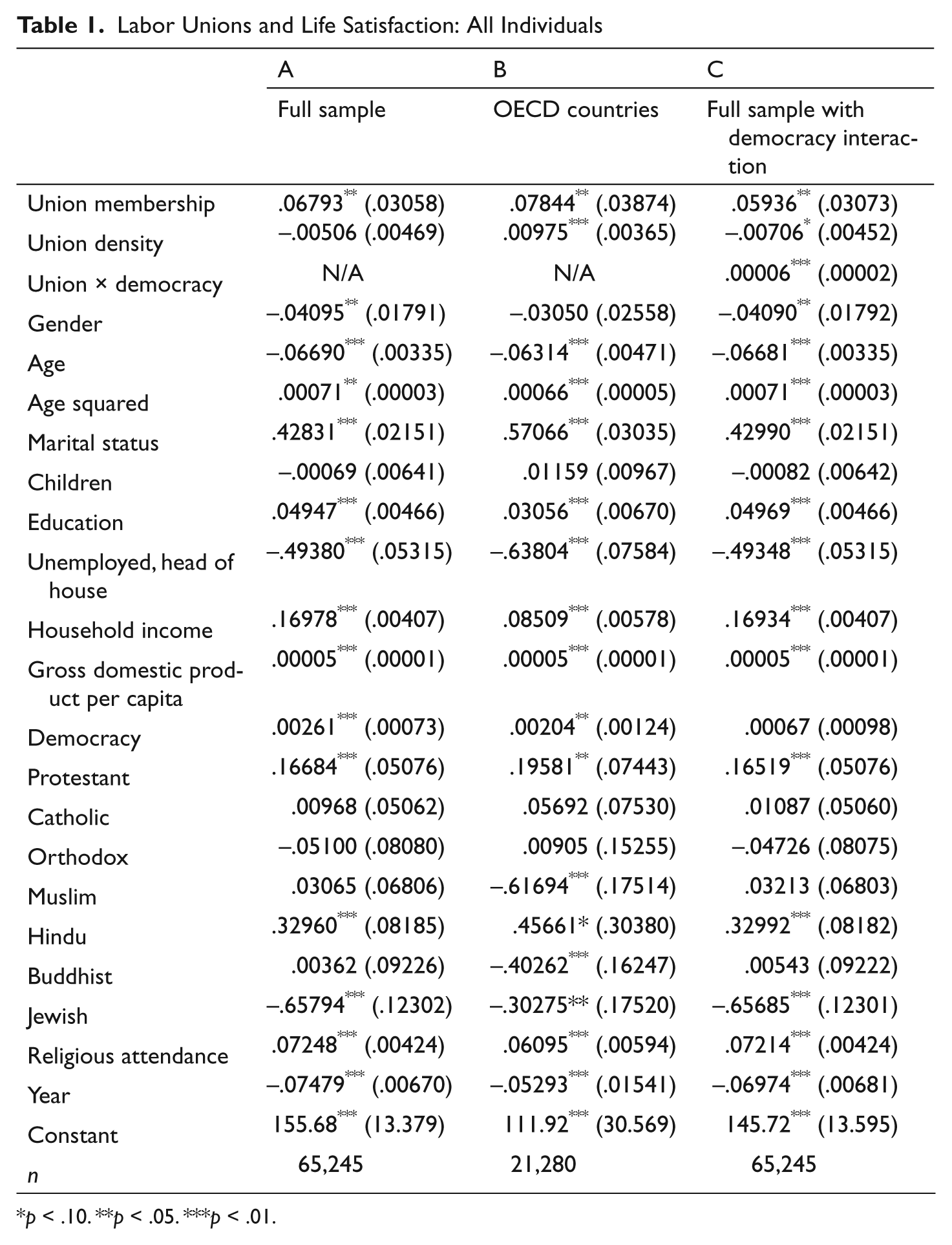
p < .10. **p < .05. ***p < .01.
To confirm this evidence—that the overall pattern is in fact the interaction between density and democracy hypothesized above—we estimate the model including the appropriate interaction in column C. We find precisely what is predicted: the coefficient of density is now both negative and significant, while the interaction term is positive and significant. Substantively, this means that so long as one lives in a reasonably democratic country, the effect of higher levels of unionization are positive; alternatively, for those living in authoritarian countries, greater density produces lower rates of satisfaction. For the sake of clarity, this can be readily seen by considering how to interpret the regression equation. To simplify, we have in effect

We are interested in the total net effect of density on life satisfaction, which is the first partial derivative of the above equation:

So, per the estimates in the last column, b is negative and d is positive (the value of c is, of course, not itself relevant for computing the effect of density). This means that at a zero level of democracy, the effect of density is negative (unions make life worse), but as countries become increasingly democratic, the effect of unions becomes increasingly positive. At high levels of democracy, such as those in OECD countries, the effect of unionization is strongly positive.
Hence, for instance, if we set democracy at its highest value—the democratic norm exemplified by the OECD countries that maintain “perfect” values on the measure over time—the slope of density is .0098, or about .01. 9 It is worth observing that this expectation is confirmed by the result in column B, were the computed slope for the OECD countries match this computation exactly. It is also illustrative to compare the practical implications of a country of having high versus low levels of density, again holding democracy constant at this level. Doing so, we find that the predicted impact on satisfaction for a high-density country, with 90% of workers organized, would be positive .90—that is, about one full point of satisfaction (on the 1-10 scale on which it is measured). Conversely, a low-density country, with 10% organized, would receive a “unionization bonus” of just .10 points of satisfaction. Empirically, that difference of .80 points of satisfaction is enormous, being almost twice the impact of either being married or (in absolute value) being unemployed, usually considered the two most important determinants of satisfaction. To take an example with a decidedly less pronounced difference in density, comparing a country that is one standard deviation above the mean in density versus a country that is one standard deviation below suggests a difference in density of about 44%, which in turn suggests a change in satisfaction of about .44—less than before, still about equal to either marriage or unemployment. 10 Thus, our first major conclusion is that, within the world of the liberal democratic polities in which unions are of the most interest to students of democratic theory, public policy, and labor relations, the practical effect of labor organization on quality of life is unequivocal: higher levels of organization are associated with dramatically higher levels of satisfaction, other things being equal.
Considering nondemocratic contexts is also illustrative, if rather less encouraging for both organized labor and quality of life. Given that the slope of density for a given country depends on the level of democracy and given that the value of the democracy measure is symmetrical from complete democracy to complete autocracy, the slope coefficient simply declines in a linear fashion from the OECD maximum value of .10 noted above, finally reaching its minimum value of −.10. For a country located right at the zero point, balanced equally between democracy and autocracy, the impact of union density is negative, though it would of course grow positive as the nation became a more institutionalized democracy. We may thus state in summary fashion the article’s second and perhaps most fundamental and important finding: labor union density has a strongly positive effect on life satisfaction that is at its maximum in countries with a continuous history of stable democracy, but it decays in a linear fashion as a country’s present level and past history of democracy decline.
The models discussed above pool those who do and those who do not belong to unions. While this is the obvious strategy and the only one that allows us to estimate the effect of an individual being a union member, it is instructive to consider the effect of union density (as, of course, a societal-level phenomenon) on nonmembers per se. If we can demonstrate that higher levels of density are associated with greater life satisfaction among nonmembers, we have further evidence in support of the hypothesis that labor organization benefits society (at least as regards life satisfaction) in general, not merely those represented by a union. We thus provide in Table 2 models similar to those presented above but only for nonunion members. These models must of course exclude the individual union membership variable and thus focus our attention on the main variable of argument of interest: the effect of the national rate of union density on the general rate of life satisfaction within a nation.
Labor Unions and Life Satisfaction: Nonunion Members
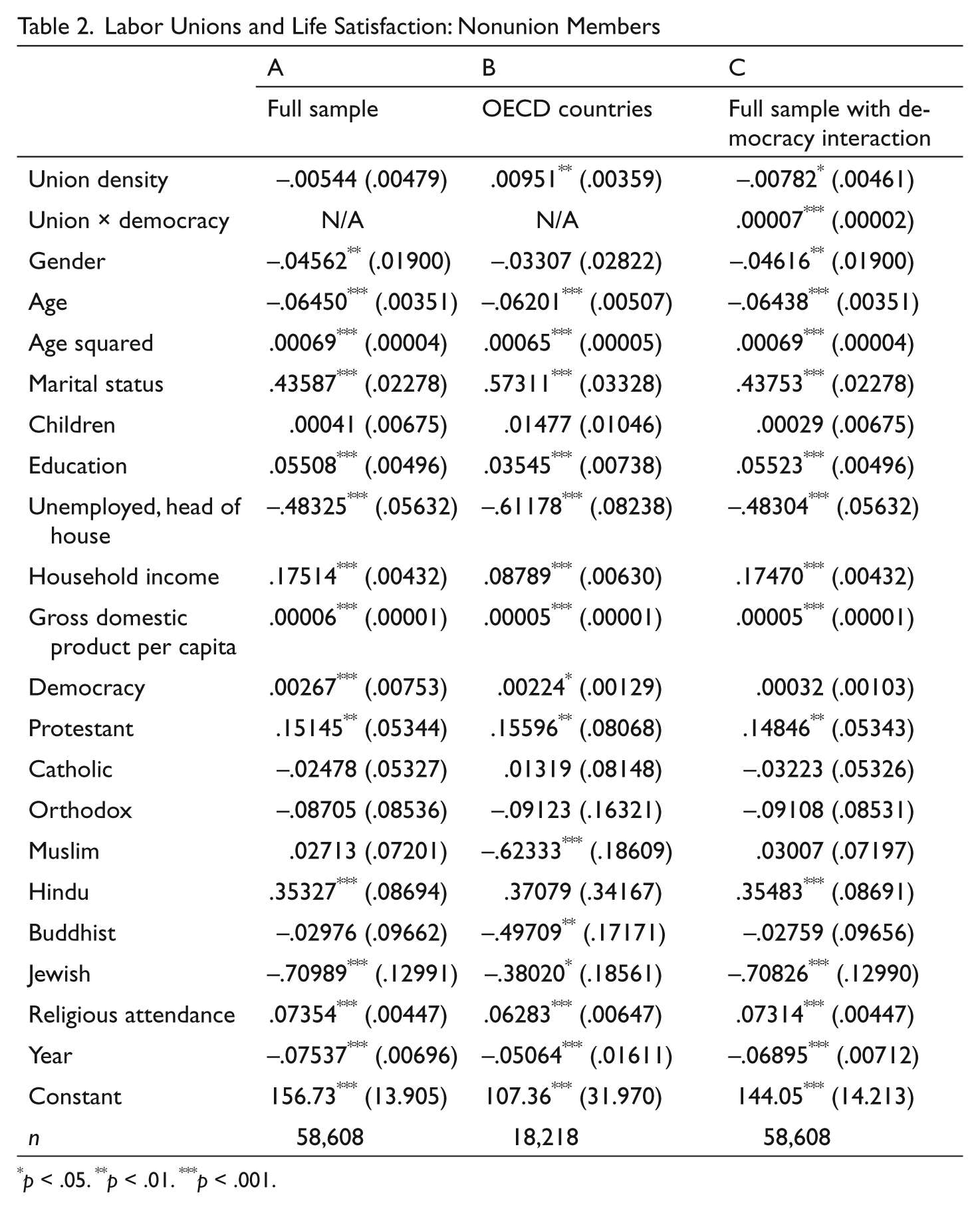
p < .05. **p < .01. ***p < .001.
The relevant coefficients show precisely the pattern expected. For the total sample (column A), the effect of density is, as before, nominally negative but insignificant. For the OECD countries (column B), where we are considering a homogeneous set of democratic countries, the effect of density is once again positive and strongly significant. In the final model, considering the full sample of countries with the density-democracy interaction term, we find, as before, that density is negative and significant, while the interaction term is positive and significant. The substantive implications are equally as before: the effect of density on life satisfaction depends on the level of democracy such that democratic countries benefit from a high level of labor organization, while authoritarian countries suffer.
The difference, of course, is here we are considering only those who are not represented by unions. Thus, our third basic finding is that our results apply both to union members and nonmembers. In particular, when focusing only on the democratic countries in which labor unions are highly salient (and frequently) controversial political actors, our results imply that higher levels of aggregate union density contribute to the well-being of everyone in society, including nonunion members. Put differently, a strong labor movement contributes to a society in which everyone—members and nonmembers—lead more satisfying lives. The data thus suggest that organized labor is a collective good for everyone in society, insofar as we view satisfaction with life as an appropriate evaluative metric. 11
Discussion
The specific empirical findings discussed above do not require restatement. Generalizing, our basic conclusion is clear: in democratic societies, the subjective appreciation of life is positively affected by the degree to which a nation’s workforce is organized. Everyone, whether represented by a union or not, benefits from union organization. These results depend, it must be emphasized, on the democratic context in which they are phrased. As we have been at pains to document, the felicitous effects of unions for human well-being decay as the level of democracy wanes. With that important caveat ever in mind, we feel comfortable in suggesting that our analysis offers this judgment on the consequences of labor organization: whatever else it may it do—whatever positive or negative implications it may have for this or that particular economic or political question—the organization of workers contributes to societies where people are more likely to enjoy being alive.
This conclusion would appear to be of some moment. It implies, most obviously, that the institution of the labor union is one with desirable social consequences. This point is especially important given that the organization of workers has ever been an ideologically contested practice in market economies. This political ambivalence afforded labor movements is mirrored in the academic treatment of organization within the social sciences. As is typically the case for other ideologically relevant—and thus truly important—social institutions, unionization has been a scholarly as well as a politically divisive concept. The vast empirical and theoretical research on labor organization in the social sciences has often (though by no means always) had a latent tendency to wish to offer empirical evidence to the ideological debate about the desirability of unionization. While seldom expressed in so stark or explicit terms, it would be only a slight exaggeration to contend that economists, sociologists, and political scientists have been involved in an implicit argument over the issue of whether unions are, in the end, good or bad for the world. To be sure, the explicit focus of research has always been—and appropriately so—limited to ascertaining what the consequences of unionization were for particular, tangible phenomena, such as economic growth, unemployment, inflation, interest group activity, electoral participation, political sophistication, social stratification, and so on.
These are, of course, all vitally important questions to which this article does not speak. Thus, while the analysis offered above tells us nothing about the possible impact of labor organization on, say, economic performance, it does imply that unions make a net positive contribution to quality of life. Thus, whatever deleterious or ambiguous consequences unions may well have for specific economic or social problems, they do appear to make a positive contribution to the degree that people find their lives rewarding. This hardly settles the ideological debate about the desirability of unionization, but it surely suggests at least one undeniably important dimension in which the consequences of organization are commendatory.
We conclude with an observation about the substantive implications of our analysis for subjective well-being across the world. In both advanced/industrial and developing democracies, organized labor has been under stress for decades. Certainly the decline of labor unions in the United States and the United Kingdom is well chronicled. To a lesser extent, this trend has appeared across much of the industrial world (e.g., Blanchflower 2006). To an even greater extent, labor in developing countries often finds itself either, on the one hand, at the mercy of neoliberal policies that hinder organization, bargaining, or political activity or, on the other hand, under the thumb of despotic governments that themselves may either repress organization or create state-controlled faux unions. Our results further highlight how these trends and conditions have deleterious consequences for human well-being. On a more hopeful note, there seems at least some reason to believe that long-term trends are increasingly favorable to democratic aspirations across the world, and a more democratic world is one that is more conducive to not only the collective aspirations of workers but also the successful expression of human beings in general.
Footnotes
Declaration of Conflicting Interests
The authors declared no potential conflicts of interest with respect to the research, authorship, and/or publication of this article.
Funding
The authors received no financial support for the research, authorship, and/or publication of this article.