




Abstract
The critics of pro-worker labor laws argue that employment protection legislation (EPL) hurts productivity and employment generation by creating rigidity in employment adjustments. The discourse on labor market rigidity has taken center stage in this neo-liberal phase of the global economy and is now being echoed by the state as well. However, the sharp growth in informal employment over the last two decades, cutting across developing as well as developed countries, puts a question mark over the tenability of the “flexibility thought” invoked by employers while demanding abrogation of job security legislation. In this study, we argue that there exists a substantial flexibility in contemporary labor markets. Using a panel dataset on twenty-eight industrial sectors across thirteen major states of India for the period 1999-2000 to 2007-2008, we find that EPL does not affect total factor productivity of industries. The impact of EPL is not significant even in highly volatile industries. The paper underlines the failure of the state to translate EPL into meaningful job security. The findings of this study suggest that the debates on labor regulations must be expanded to bring into its focus the issues of growing informalization and its consequences on workers.
Keywords
Introduction
There have been growing demands from employers and the neo-liberalists for the abrogation of pro-worker employment protection legislation (EPL) to bring flexibility in the labor market. The critics of pro-worker labor laws hold EPL responsible for the sluggish performance of industrial business in developing countries. Theoretical literature in labor economics explains that EPL has the potential of creating rigidities in employment adjustment by raising the dismissal cost (see, for example, Nickell 1986; Hopenhayn and Rogerson 1993). 1 The findings of empirical studies on EPL, however, offer a mixed picture (Betcherman 2014). While Messina et al. 2007) and Besley and Burgess (2004), in their econometric analysis of India and European countries (respectively), find that EPL does reduce employment and productivity, several other empirical studies conclude that it has a minimal impact on industrial performance (see, for example, Bertola 1990; Roy 2004).
The debate on labor regulations has taken center stage over the last two decades and is being echoed by the state also. But surprisingly, the focus of the debate is confined to labor market flexibility alone, ignoring the abysmal implementation of the labor laws and the fallout of the emerging trends in labor markets (such as informalization) on workers. The state, more like a spectator, has been merely watching the erosion of pro-worker labor laws and seems to be rather in favor of employers in this neo-liberal phase of global economy. For the last two decades, there has been a sharp growth in informal employment (it includes temporary workers, contract workers, non-standard workers, and casual workers), cutting across developing as well as developed countries. The informalization of employment has been mushrooming in most of the Organisation for Economic Co-operation and Development (OECD) countries, including the United States (OECD 2009). Informal employment has been growing notably in European and Scandinavian countries also (International Confederation of Private Employment Agencies 2007). In the Canadian labor market, jobs have become more precarious with the upward trend in temporary (or contract) employment, which is not covered by the labor laws (Cranford et al. 2003). Between 1997 and 2003, temporary employment in Canada has increased twice as fast as regular employment (Fuller et al. 2007). Employers have been justifying the informalization of employment by stressing the importance of flexibility necessitated, purportedly, by the increasing market volatility in recent years. Although the whole gamut of labor legislation exists more in books than in praxis, it has been treated as anti-business. The neo-liberalists believe that laxer labor laws will stimulate investment and employment generation.
In this study, we investigate the veracity of the ongoing “labor market rigidity debate” and figure out its repercussions for workers. Our study reveals that “rigidity” hardly lies in the contemporary dualistic labor markets and the actual motive behind vehement demands for flexibility is to debilitate labor and trade unions, rather than gaining flexibility in employment adjustments. Using econometric analysis, this study finds that EPL does not affect total factor productivity (TFP), under the dualistic labor market. The effect of EPL is not significant even in highly volatile industries, which require employment adjustments frequently. The study is based on the Indian manufacturing sector, which represents a perfect case of a dualistic labor market with a stringent body of job security legislation in papers (OECD 2007). The findings of this study indicate that dualism in the workforce—co-existence of formal and informal employment—does increase the vulnerabilities of workers, while enabling the employers to overpower labor unions.
The rest of the paper proceeds as follows. In the next section, we describe the EPL and the labor market dualism in the Indian context and the repercussions of the latter for the workers. This section is followed by the review of previous literature on economic effects of EPL.
Following which, we describe the technique used to measure EPL and TFP, and methodology of this study. Then we describe the data source. Finally, we discuss the empirical results and then conclude the study.
EPL and Labor Market Dualism in the Indian Manufacturing Sector
The plethora of labor laws governing industrial relations in Indian manufacturing have been the center of attention of economists and researchers from across the world, more so since the postliberalization period, which started in 1991. 2 There is a perception among some economists that the industrial inertia in India has been mainly caused by labor market rigidity, which is in turn attributed to EPL. Buckling under the pressure of growing demands for labor market reforms, the Indian state seems to be giving into the rigidity debate. The calls for anti-labor amendments on existing labor laws have also resonated repeatedly in the government’s official reports in recent years (see, for example, Second National Commission on Labour 2002).
The most debatable set of job security–related labor laws in India is implemented under the Industrial Disputes Act (IDA), 1947 and the Contract Labor Act (CLA), 1970. Chapter V-B of the IDA, 1947 requires that firms employing 100 or more workers obtain government permission for layoffs, retrenchment, and closures. It is believed that employers have to go through a lengthy procedure to finally get the permission (Bhattacharjea 2006). Besides, under section 25-B of the IDA, a worker can seek regularization of his/her service after working continuously for more than 240 days. Further, under section 25-F of the IDA, an employer employing more than 100 workers has to pay a “severance cost” 3 besides issuing a formal notice (to the workers) in the event of layoff or retrenchment. On the other hand, the CLA, 1970 provides for contractual employment in the non-perennial or non-core activities of firms. Section 10 (1) of the Act provides for the “prohibition and abolition” of contractual employment as and when required. Meanwhile, one of the principal unfulfilled demands of the Indian labor union is the so-called “automatic absorption upon abolition”: in the event of abolition of contract employment, the contract workers involved be absorbed, in the firm, and regularized (Sunder 2012). The employers, however, have managed to fight off such demands of trade unions thus far. In addition, under rule 2 (V)-(a) of the CLA, employers are required to pay equal wages to contractual and regular workers if they perform the same type of work.
Under article 246 of the Indian constitution, the “Labor” (as a subject) is incorporated under the concurrent list and thus both the Central and the State governments are competent to enact laws and/or make amendments in the existing labor laws. Thus, apart from the aforementioned central labor laws, there are more than fifty state-level major labor laws, which are related to job security (Sunder 2012). However, the government has failed to translate the bulk of such pro-worker labor laws into a real social security for workers. The EPL wields a negligible influence on the “hiring and firing policy” of Indian manufacturing industries. As noted by Sapkal (2014), there is a glaring discrepancy between the de jure job security (job security in paper) and the de facto (actual job security) in India. Besides, there is evidence of stealthy reforms (Nagaraj 2004). Despite the existence of EPL, more than 1.1 million workers were fired just between 1995-1996 and 2000-2001, hinting at the ineffectiveness of job security regulations in the midst of a weak enforcement machinery (Nagaraj 2004).
Having described the pro-worker labor laws forming the core of the ongoing debate on labor market rigidity in India, let us now question the “rigidity school of thought.” The business activities of the firms in the Indian manufacturing sector, and elsewhere also, are generally classified into core and non-core activities. While core activities include those business activities that are performed regularly, non-core activities include non-perennial activities. Generally, it is believed that non-core activates are more susceptible to volatility in market demand; therefore, firms require frequent employment adjustments in such parts of the business. Recognizing the irregular nature of non-core business activities, the CLA, 1970 does allow the use of contractual employment, which is inherently flexible as it does not come under the ambit of job security regulations. On the other hand, the core business activities are more regular in nature, and the employment in such activities is less affected by short-run market fluctuations. Therefore, one can argue that the need of frequent employment adjustments in the core business activities must not arise at all. Thus, in principle, the demands for flexibility must be limited to well defined, non-core activities only or those activities that are highly affected by the short-run ups and downs in the market.
While putting the employers’ demands for flexibility against the existing amount of flexibility in Indian manufacturing, one may conclude that the ongoing call for labor market flexibility is more of a ploy to overpower the workers and labor unions than a desirable agenda. For the last two decades, the Indian manufacturing sector has registered a spiraling growth in contractual employment, which, as mentioned earlier, falls outside the purview of EPL. Contractual employment has increased from 13 percent in 1993-1994 to 35 percent in 2010-2011 (see Figure 1). There is evidence that contractual employment exists, significantly, even in the core activities of business (NCEUS 2009). The neo-liberalists claim that the sharp growth in informal employment is a result of rigidity created (purportedly) by EPL (Goldar 2009; Sen et al. 2013). However, while assessing the condition of contractual workers in India, this line of thought seems to be too hard to defend. Ideally, there must be a premium on “flexible labor”: an employer may offer relatively higher wages to a contract worker as long as the former is desperate to obtain flexibility. However, on the contrary, the average daily nominal earning of the contract workers in Indian manufacturing, as per Annual Survey of Industries (ASI) data for the period 2003-2004 to 2010-2011, were just 71 percent of the permanent workers (see Figure 2). Using the consumer price index for industrial workers (CPI-IW: base = 2001), we calculated the real daily earnings of contract workers and that of the directly employed workers who are covered by EPL. Figure 3 shows that there is a big gap between daily earnings (in real terms) of contract workers and regular workers. Generally, the earnings of workers seem to be growing only marginally over time (see Figure 3). Thus, blaming the labor laws for the informaliation seems to be rather unfair.
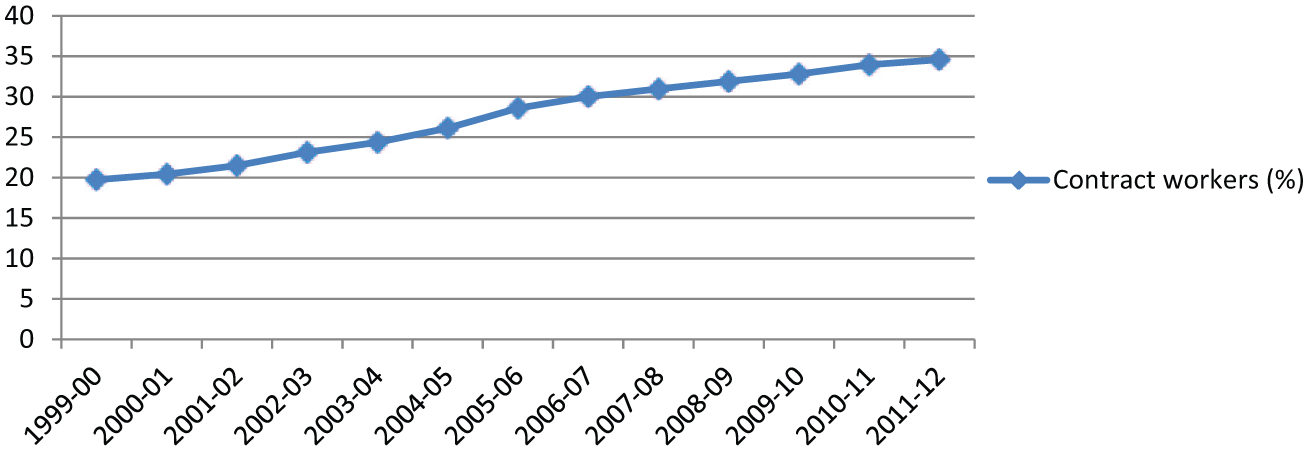
Share of contractual employment in Indian manufacturing sector.
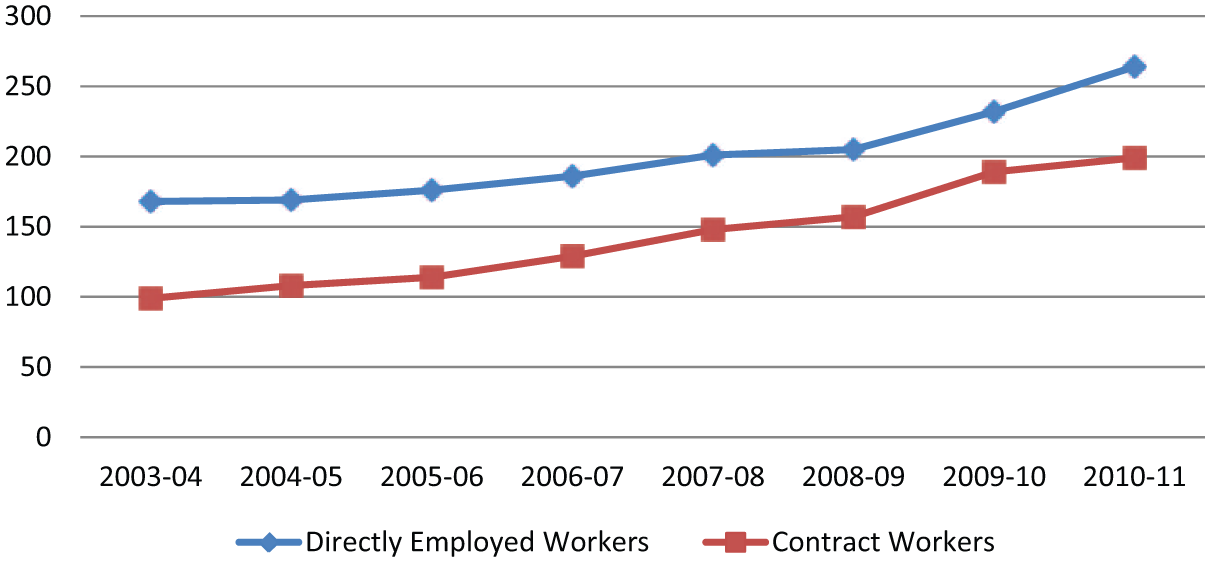
Average daily nominal earnings (in Rs.) of contract workers and directly employed workers.
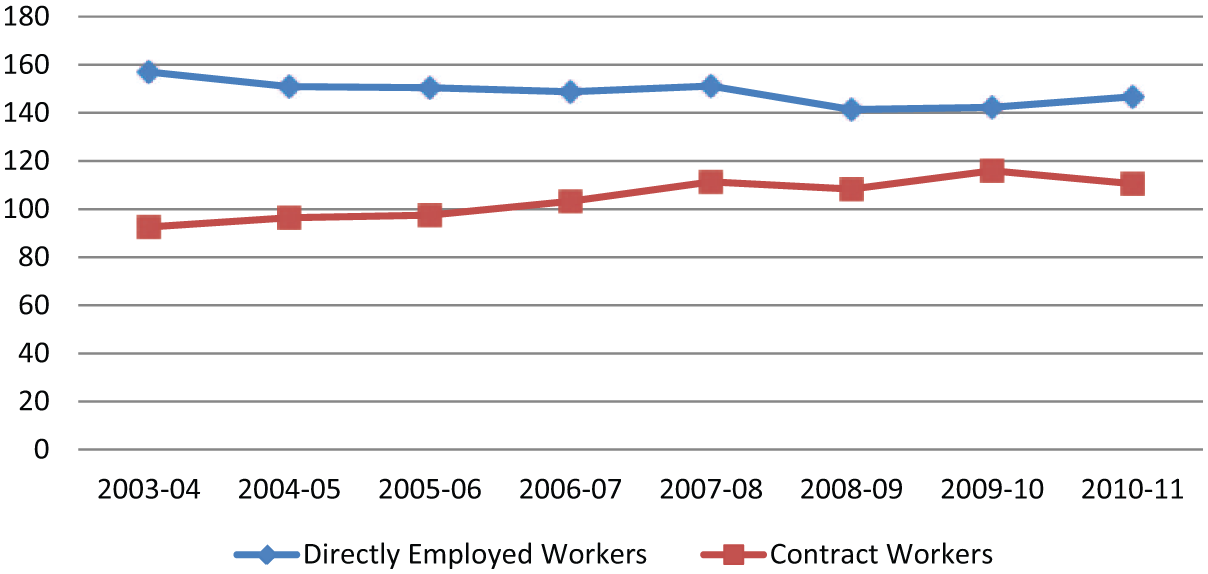
Average daily real earnings (in Rs.) of contract workers and directly employed workers.
Moreover, since contract workers are not represented by any of the registered labor unions either, unfair exploitation among the former in the form of longer working hours and hostile working conditions, besides scanty wages, is common. Besides, unlike regular workers, contract workers in India do not receive on-the-campus training and do not happen to be the beneficiaries of firm-specific skill enhancement programs, resulting in lower labor productivity and incompetency among such workers in the long run.
Thus, despite the huge body of labor laws, it is the worker who actually bears the fallout of tightening competitive pressures driven by the rising tide of globalization in the commodity markets. Given the blatant exploitation of informal workers, the emerging dualism in the Indian formal labor market seems to be an outcome of employers’ aggressive practices to fulfill their rapacity. At the same time, the Indian state has been rather apathetic (towards the worsening conditions of workers) and has played the role of facilitator in a stealthy neo-liberal setting to realize the growth agenda. The “rigidity debate,” at best, seems to be an exaggeration of what they (employers) seldom face at the ground—the ineffective EPL in papers.
Previous literature
The debate on EPL is inspired by Nickell (1986), Hamermesh (1993), and Hopenhayn and Rogerson (1993). These studies conclude that EPL has the potential to make employment adjustments costlier and thereby create inefficiencies in the business. However, Bertola (1990), in his empirical study, concludes that job security regulations cannot be blamed for unemployment problems in European countries. The recent literature on economic effects of job security offers an inconclusive picture. For example, while studies like Bassanini et al. 2007); OECD (2007); Bassanini, Nunziata, and Venn (2009); and Cingano et al. (2010) find a negative impact of job security regulations on productivity growth in the OECD countries, several other empirical studies find a positive effect (see, for example, Nickell and Layard 1999; Koeniger 2005; Belot and Ours 2004).
In the Indian context, Besley and Burgess (2004) construct an index using the amendments on the IDA, 1947 undertaken by the state governments over time. The study classifies the amendments into three categories—pro-worker, pro-employer, and neutral—and assigns scores “1,” “–1,” and “0,” respectively. By cumulating the scores over time, they construct an index that shows how rigid a labor market a given state has. Using the index along with control variables, they assess the impact of EPL on industrial performance. The study concludes that EPL has a negative impact on output, employment, and investment. However, the study has drawn many criticisms from researchers on several grounds such as incorrect interpretation of certain amendments and the faulty coding (and cumulation) procedure (Bhattacharjea 2006). Nevertheless, some studies modified the index while taking suggestions of Bhattacharjea (2006) into account (see, for example, Ahsan and Carmen 2009; Adhvaryu, Chari, and Sharma 2013). These studies conclude that EPL has affected productivity in the Indian firms.
More recently, in their firm-level analysis using the OECD index for twenty-one Indian states, Dougherty, Frisancho, and Krishna (2013) find higher productivity in the firms operating in states with flexible labor markets. Similarly, using the BBBesley and Burgess index, Mitra and Ural (2006) find a positive effect of industrial de-licensing on productivity in relatively flexible states.
Among several serious methodological issues, the most serious methodological concern that is common to all the aforementioned studies is the problem of “attribution bias,” which, in this context, means wrongly attributing the relatively lesser industrial productivity in a given state to EPL. Though previous literature did use several state-specific control variables to eliminate the attribution bias, it has failed to control for the productivity differential existing across the states due to labor market dualism, as discussed in section 2. The literature on informalization shows that the informal worker is inferior and a less-productive labor input as compared to the regular formal worker (see, for example, Maiti 2013; Sen 2013). On the other hand, evidence shows that in the states having relatively rigid labor markets, the firms do use a large number of contract workers to circumvent the EPL (Goldar 2009; Sen 2013). Going by such evidence, the states with rigid labor markets are likely to have a dominant share of contractual workers, and due to the overuse of contractual employment, the industrial productivity may decline. Hence, before attributing the relatively lesser productivity in rigid states to EPL, it is crucial for the empirical researchers to control for (or to take into account) the productivity differential between informal and formal workers. This is what the existing literature on EPL has failed to do, resulting in exaggeration of the debate on job security. Furthermore, these studies also fail to control for the flexibility already enjoyed by the employers due to contractual (flexible) labor. Given the fact that contractual employment constitutes, on average, about 35 percent of the total work force in the Indian formal manufacturing sector, the firms have enough flexibility to adjust the size of employment (if and when required) by adjusting the number of contract workers.
Our study contributes to the theoretical and empirical literature on labor laws by investigating the economic effects of EPL in the dualistic labor market context while going around the abovementioned limitations of the previous literature. Unlike previous literature, we take into account (or control for) the productivity differential arising due to dualism in the workforce. Simultaneously, we are also able to control for the flexibility already enjoyed by the firms due to contractualization. The basic objective of this study is to figure out whether job security regulations harm productivity in the firms. Besides, we also study the impact of informalization on productivity.
Measurement of EPL and TFP
To capture the effect of EPL, we exploit state-level variation in the labor laws. As discussed in section 2, the states in the Indian union are competent to enact and/or amend the existing labor laws. Therefore, there exists a considerable variation in EPL across Indian states. We construct a quantitative index of EPL for thirteen major states of India by using the information on labor laws available in Besley and Burgess (2004), OECD (2007), 4 and Bhattacharjea (2006). Like Gupta, Hassan, and Kumar (2009), we follow “majority principle” to classify the states into rigid, flexible, and neutral and assign scores “1,” “–1,” and “0,” respectively. Under majority principle, for example, if a given state is classified as rigid by at least two out of the three sources, then we pick it as rigid and assign score “1.” Likewise, if a given state is treated (by at least two sources) as having neither a flexible nor a too rigid labor market, then we take the state as “neutral” and assign score “0.” Similarly, if the given state is taken (by the majority) as having a flexible labor market, then we assign score “–1” and designate it flexible. The “majority principle,” in this context, has manifold merits. First, it weeds out the potential errors that the individual sources (considered here) may be subject to, unless the error lies systematically with each of the sources. Second, since the OECD index is the latest index as compared to the other two studies, it takes care of (under majority principle) the labor reforms undertaken, if any, between 1999-2000 and 2007-2008, by the central or the state governments. However, as noted by Gupta et al. 2009), there has been a very limited amendment activity between 1992 and 2007-2008.
We adjust the scores assigned by Besley and Burgess (2004) on Gujarat and Madhya Pradesh. Gujarat, which is marked as pro-worker by Besley and Burgess (2004) on account of a single amendment, turns out to be a neutral state if this inconsequential amendment is ignored (Bhattacharjea 2006). Hence, we designate Gujarat as neutral state and assign it score “0.” Similarly, in case of Madhya Pradesh, the mean of the cumulative scores on amendments in Besley and Burgess (2004) is approximately zero. Therefore, we effectively put it “0.” Thus, following the majority principle, we construct a quantitative index of EPL, which varies from −1 to 1. This is shown in column 5 of Table 1.
Employment Protection Legislation Index (EPLI)—Based on “Majority Rule” on BB Index, Organization for Economic Co-operation and Development (OECD) Index, and Bhattacharjea (2006).
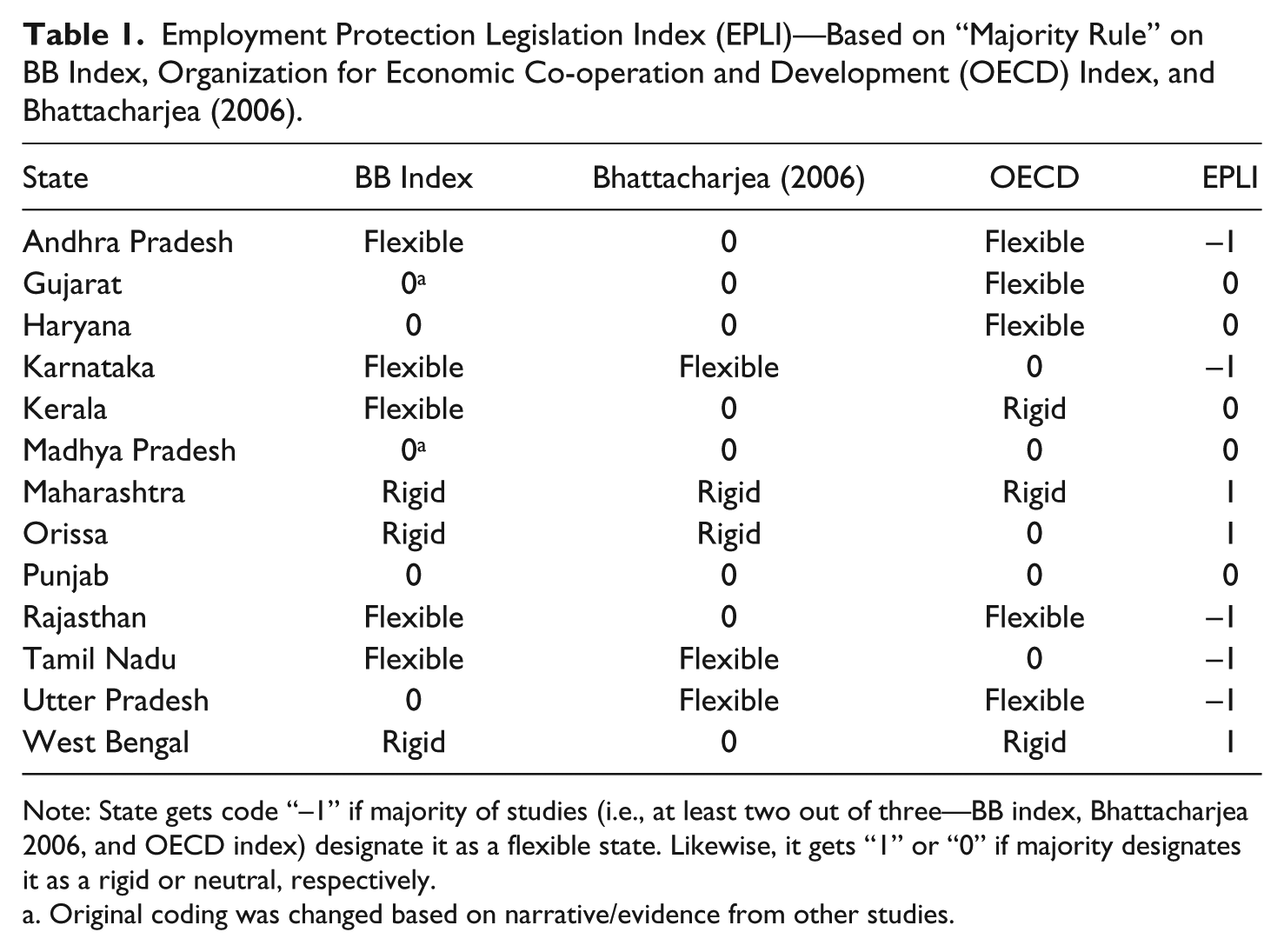
Note: State gets code “–1” if majority of studies (i.e., at least two out of three—BB index, Bhattacharjea 2006, and OECD index) designate it as a flexible state. Likewise, it gets “1” or “0” if majority designates it as a rigid or neutral, respectively.
Original coding was changed based on narrative/evidence from other studies.
TFP, 5 which is a dependent variable in this study, is calculated through data envelopment analysis. 6
Empirical Methodology
To investigate the impact of EPL and informalization on TFP, we utilize a panel dataset on twenty-eight industrial sectors across thirteen major Indian states for the time period 1999-2000 to 2007-2008. To capture the impact of contractualization besides controlling for the productivity differential arising due to contractual employment, we include a ratio of permanent workers to total number of workers (PW/TW) in the model. The coefficient on PW/TW captures the impact of increase in relative share of permanent workers on TFP. 7 We interact the EPL index (EPLI) with the ratio of PW/TW so as to control for the productivity differential and the flexibility arising due to dualism in the workforce. The coefficient on the interaction gives us the impact of increase in rigidity (on TFP) in the industries having relatively higher shares of permanent workers. Thus, the productivity differential and the flexibility associated with contractual workers are taken care of to a large extent. The reason we interact the EPLI with PW/TW rather than interacting it with the ratio of contractual workers to total number of workers is that we are interested in pursuing our analysis from the rigidity perspective. Apart from including the fixed effects, we also include a set of relevant state-specific and industry-specific control variables so as to take care of omitted variable bias (see description in section 7-a). We also measure the impact of EPL on highly volatile industries by interacting the EPLI with a dummy variable that takes value 1 for the highly volatile industries (see section 7-b).
We take care of the potential autocorrelation problem in our model by estimating robust standard errors clustered at the state level (see Bertrand, Duflo, and Mullainathan 2004). 8
One of the potential concerns in our model is the endogeneity problem in PW/TW. The stringency of EPL, given that EPLI appears as an independent variable in the model, can influence the share of permanent workers, causing endogeneity in PW/TW. Besides, the share of permanent workers can also be driven by the variation in TFP growth appearing as a dependent variable, thus aggravating thereby the endogeneity concerns in the model.
To overcome the endogeneity issue, we follow instrumental variable two stage least square estimation. Under this procedure, we first estimate PW/TW, using some valid instruments—first stage least square (FSLS). Then, we incorporate the “estimated (or predicted) PW/TW” in our original equation—second stage least square (2SLS). The predicted PW/TW is free from endogeneity. As noted by Botero et al. (2004), the left political parties are in favor of enacting pro-worker stringent labor legislation, and they do respond (quite often) positively to labor union demands. Similar evidence is found in the Indian context also (Aghion et al 2008; Cali and Sen 2011; Sen 2013). Therefore, the share of permanent or contract workers is likely to have a bearing with the relative share (in electoral seats in the state legislature) of political parties with different fundamental political orientation. Thus, the share (in the electoral seats) of a political party serves as an appropriate instrument for the PW/TW ratio. The instruments are as follows: Congress—left of center; hard left parties; soft left parties; and the Bharatiya Janata Party—right of center. 9 Besides, we use the ratio of number of strikes to number of lockouts—proxy for the “bargaining power” of permanent workers—as the fifth instrument. 10
Data Source
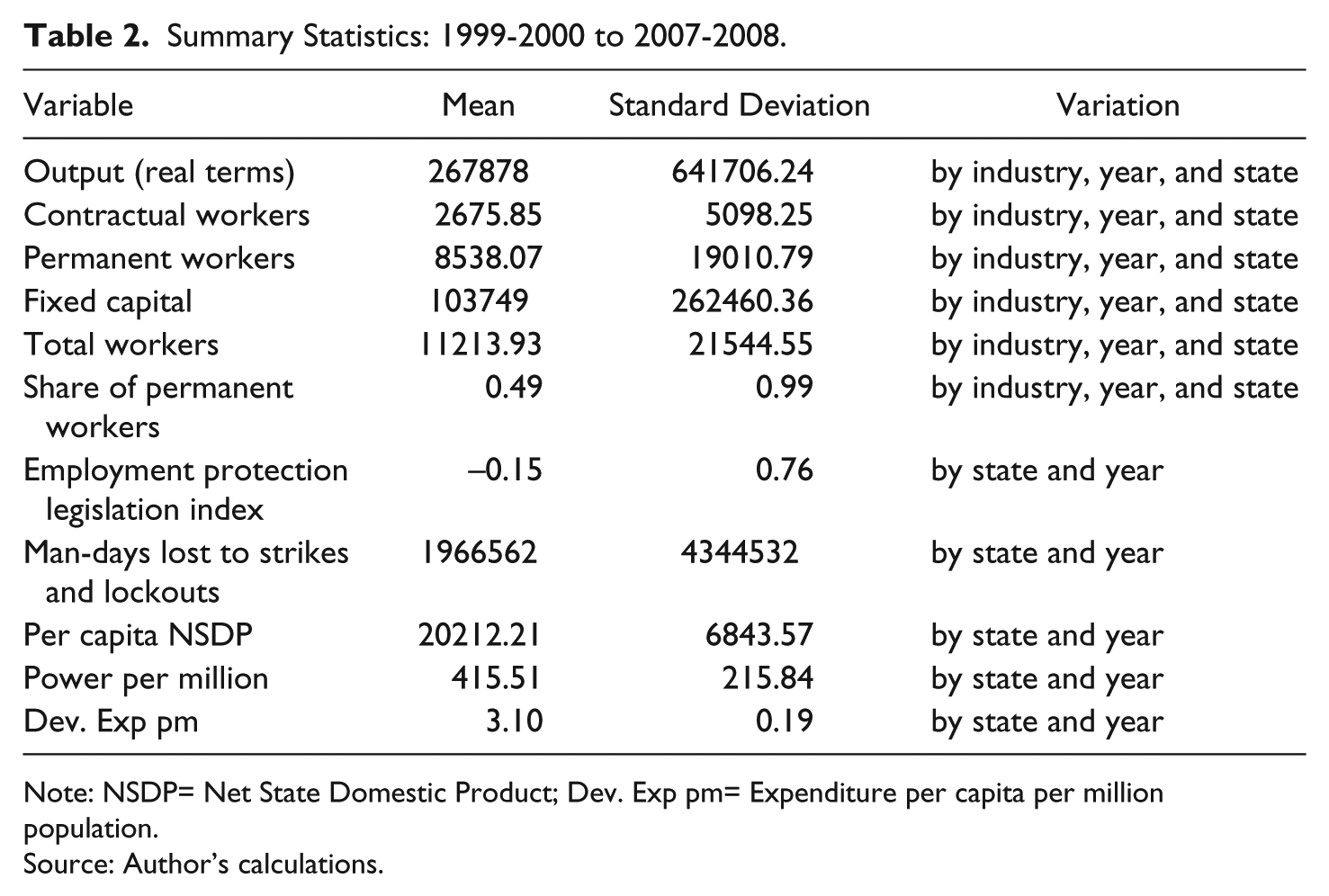
Our analysis uses three-digit ASI data (NIC-1998 and 2004) on twenty-eight industrial sectors across thirteen major states of India, for the period 1999-2000 to 2007-2008. The data on fixed capital, number of workers employed through contractors, directly employed workers, per capita net state domestic product (PCNSDP), wholesale price index, daily earnings of contractual and directly employed workers, and CPI-IW are collected from the Ministry of Statistics and Program Implementation, Central Statistical Organization, and the Labour Bureau, Government of India. Data on control variables, like development expenditure, per capita power consumption, number of strikes to lockouts, and man-days lost due to strikes and lockouts are collected from the Centre for Monitoring Indian Economy and the Indian Labor Bureau, Government of India. The data on output are available in monetary terms. We convert them into constant prices by using the wholesale price index (base = 2004-2005). On the other hand, the data on daily earnings of contractual and regular workers are converted into constant prices using CPI-IW (base year: 2001). The summary statistics of the key variables are presented in Table 2. The average value of “regulatory environment” is −0.153 with a standard deviation of 0.769. The negative mean value of the regulatory environment suggests that the Indian labor market is by and large a rigid one, as per the labor legislation in the books. The percentage share of contractual workers for the selected twenty-eight industrial sectors across thirteen states is 0.491for the sample period, with a standard deviation of 0.997.
Summary Statistics: 1999-2000 to 2007-2008.
Note: NSDP= Net State Domestic Product; Dev. Exp pm= Expenditure per capita per million population.
Source: Author’s calculations.
Empirical Results
(a) Impact of EPL and Contractualization on TFP
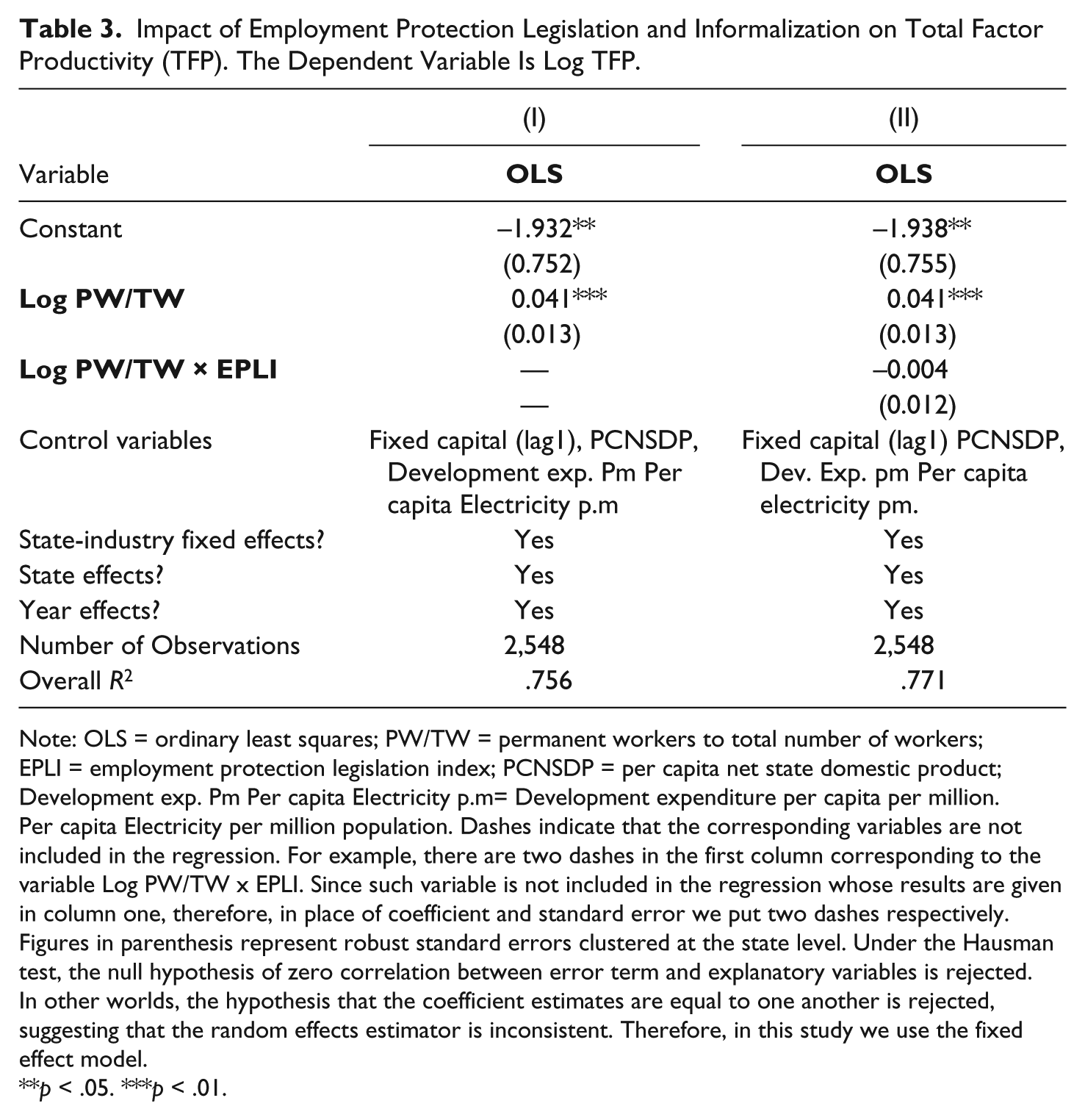
We first estimate the effect on TFP of EPL and contractualization under the ordinary least squares (OLS) framework, and then under the instrumental variable two stage least square framework. The difference between the OLS and the 2SLS estimates arises due to the problem of endogeneity, which may drive the estimates under the former approach. Therefore, for the policy implications, our focus remains on 2SLS estimates. The OLS results are presented in Table 3. In the first regression, we are interested in analyzing the effect of contractualization on TFP. As it is shown in column I, Table 3, the coefficient on PW/TW is positive and highly significant, indicating that higher share of permanent workers has a positive impact on TFP. In other words, it implies that contractualization has a negative impact on TFP. Then, we introduce the EPLI by interacting it with PW/TW in the second regression. The coefficient on the interaction, as shown in column II, is negative but insignificant. As explained in section 5, the coefficient on the interaction captures the effect of increase in rigidity of EPL (on TFP) in the industries having a relatively higher share of permanent workers. Thus, the insignificant coefficient on the interaction term indicates that EPL does not harm TFP when dualism exists in the labor market. In both the regressions, we control for fixed effects and year effects to eliminate the omitted variable bias. Besides, we also include a set of relevant control variables such as fixed capital, PCNSDP, development expenditure (per million populations), and per capita electricity per million populations. The variables such as electricity and development expenditure (taken as proxies for infrastructure) and fixed capital are generally considered to have a positive effect on TFP (see, e.g., Anders 2007). Similarly, the PCNSDP controls for the economies of scale (Mitra and Ural 2006).
Impact of Employment Protection Legislation and Informalization on Total Factor Productivity (TFP). The Dependent Variable Is Log TFP.
Note: OLS = ordinary least squares; PW/TW = permanent workers to total number of workers; EPLI = employment protection legislation index; PCNSDP = per capita net state domestic product; Development exp. Pm Per capita Electricity p.m= Development expenditure per capita per million. Per capita Electricity per million population. Dashes indicate that the corresponding variables are not included in the regression. For example, there are two dashes in the first column corresponding to the variable Log PW/TW x EPLI. Since such variable is not included in the regression whose results are given in column one, therefore, in place of coefficient and standard error we put two dashes respectively. Figures in parenthesis represent robust standard errors clustered at the state level. Under the Hausman test, the null hypothesis of zero correlation between error term and explanatory variables is rejected. In other worlds, the hypothesis that the coefficient estimates are equal to one another is rejected, suggesting that the random effects estimator is inconsistent. Therefore, in this study we use the fixed effect model.
p < .05. ***p < .01.
The final results (the 2SLS estimates) are presented in columns I and II, Table 4. For the FSLS estimates, see the appendix. As shown in column I and II of Table 4, the coefficient on the interaction is negative but insignificant, indicating that EPL does not affect TFP. Interestingly, the coefficient on the instrumented PW/TW in columns I and II is positive and highly significant, indicating that TFP is higher in the firms using relatively higher shares of permanent workers, and further it indicates that there is a negative impact of contractualization on TFP. The coefficients on control variables such as fixed capital and electricity are positive and significant and are in line with the existing literature. Likewise, the coefficients on development expenditure and PCNSDP are positive, though not significant. Finally, in these regressions, we also include a proxy for industrial relations—man-days lost due to strikes and lockouts. There is evidence in the literature indicating that a cordial relation between labor and management has a positive impact on industrial productivity (see, e.g., Kumar 2013). The coefficient on the number of man-days lost due to strikes and lockouts is negative and highly significant, suggesting that adverse industrial relations have a detrimental impact on TFP. This finding is thus in line with the findings of the previous literature. We also carry out a robustness check of the EPLI used so far in this analysis. We use the OECD index instead of the EPLI to check whether our results are robust to a different measure of EPL. As shown in Table 4, column III, the results are in line with the earlier estimates.
Impact of Employment Protection Legislation and Informalization on Total Factor Productivity (TFP)—Second Stage Least Square (2SLS) Results and Robustness Checks. The Dependent Variable Is Log of TFP.

Note: PW/TW = permanent workers to total number of workers; EPLI = employment protection legislation index; OECD = Organisation for Economic Co-operation and Development; PCNSDP = per capita net state domestic product. Dashes indicate that the corresponding variables are not included in the regression. Figures in parenthesis represent robust standard errors.
p < .10. **p < .05. ***p < .01.
(b) Impact of EPL on TFP in Highly Volatile Industries
Here, we analyze the impact of EPL (on TFP) in highly volatile industries or in those industries that are more vulnerable to market fluctuations. To measure the volatility, we follow Krishna and Levchenko (2009). We first calculate the coefficient of variation of the annual growth rate of industrial output. Then, we categorize the industries into “highly volatile” and “less volatile,” using the median formula. Then we include a dummy for the highly volatile industries in the model. The results are presented in Table 5. First, we are interested in analyzing the impact on TFP of volatility alone. As shown in column I, the coefficient on volatility is negative and highly significant, suggesting that the highly volatile industries do experience relatively less TFP growth. Then in column II, we interact the EPLI with volatility and PW/TW. The coefficient on the interaction captures the impact (of EPL) in the highly volatile industries having higher shares of permanent workers. As shown in column II, the coefficient is negative but insignificant, suggesting that EPL does not have any effect even in volatile industries, though “volatility” by itself affects TFP. This, in turn, indicates that employers do enjoy enough flexibility due to informal employment.
Impact of Volatility on Total Factor Productivity (TFP). The Dependent Variable Is Log TFP.

Note: OLS = ordinary least squares; PW/TW = permanent workers to total number of workers; EPLI = employment protection legislation index; PCNSDP = per capita net state domestic product; Development exp. Pm Per capita Electricity p.m.= Development expenditure per capita per million population. Per capita Electricity per million population. Dashes indicate that the corresponding variable is not included in the regression. Figures in parenthesis represent robust standard errors clustered at state level.
p < .05. ***p < .01.
Conclusion
For the last two decades, employers have been up against EPL, claiming that such pro-worker labor laws hamper investment and hurt productivity by creating rigidity in business. The discourse on EPL has been growing in developing as well as in developed countries. However, the empirical literature measuring the economic effects of EPL on industrial performance offers an inconclusive picture. In this study, we argue that the contemporary labor markets are mostly flexible. The main motive behind the ongoing debate (on EPL) mooted by employers and the neo-liberalists is to weaken the labor unions and reduce the bargaining power of workers to carry forward the aggressive business strategy. Our study shows that the workers (in India) with no coverage of job security regulations (i.e., informal workers) earn 30 percent less wages than those with some job security coverage. Using a panel dataset for the Indian formal manufacturing sector, we empirically investigate the effect of EPL on TFP of industries. Our results indicate that EPL does not affect TFP. We do not find a significant impact of EPL even in highly volatile industries in which the need of flexibility is relatively higher. Our findings suggest that firms do (already) enjoy substantial flexibility due to dualism in the workforce. Employers use contractual employment to ward off the EPL to reduce the bargaining power of workers, so as to be able to exploit them. The pro-worker labor laws may exist hugely in papers, but they hardly provide any job security to workers, the reason being the apathy among states towards the worsening condition of workers in this neo-liberal phase of the global economy. With the state playing the role of a facilitator of stealthy neo-liberal setting, the employers not only find it easy to evade the labor laws; they also are able to pass the brunt of the increasing business risks (due to globalization) on to workers by infringing upon their other rights as well. The findings of this study suggest that the debate on labor regulations must be inclusive, and the main focus must be on how to combat the informalization. The genuine issues such as weak enforcement of labor laws, deplorable working conditions, inefficient labor administration machinery, and cumbersome grievance redressal machinery must be the center of attention.
Footnotes
Appendix
Acknowledgements
The authors are thankful to Aditya Bhattacharjea (Professor and Head, Delhi School of Economics, University of Delhi), Kunal Sen (Professor of Development Economics, University of Manchester), Rana Hassan (Principal Economist, Asian Development Bank), and the anonymous referees for their valuable suggestions. The remaining errors in this paper are of the authors.
Declaration of Conflicting Interests
The author(s) declared no potential conflicts of interests with respect to research, authorship, and/or publication of this article.
Funding
The author(s) received no financial support for the research, authorship, and/or publication of this article.