



Abstract
This work adds a systematic understanding of the diverse relationships of immigrants and minorities to organized labor in the United States. Using Current Population Survey data from 1994 to 2013, I interrogate the unionization of Hispanic, Chinese, and Filipino Americans. In comparison to whites, native-born and established immigrant Hispanics have higher rates of unionization, Filipinos (both immigrant and native born) are much likelier to join unions, and Chinese immigrants are less likely to be unionized and more likely to leave unions. Labor market position continues to have a profound effect on unionization; however, solidaristic characteristics also shape patterns of unionization.
Although organized labor in the United States has been declining for more than 50 years, several highly visible organizing drives over the last two decades have excited the possibility of reinvigorating the labor movement. A new focus on organizing the “unorganizable,” especially immigrant workers, has drawn the attention of activists and scholars. Drawing from case studies of organizing drives, scholars have produced a wealth of knowledge and theorization about immigrants, minorities, labor, and incorporation. However, little of this work, with the notable exception of Rosenfeld and Kleykamp (2009), has provided systematic analysis of national-level unionization patterns of post-1965 immigrant populations. For the most part previous studies have focused most heavily on Latinos and their experiences in California and the Western United States. While this is a natural starting point for this work given the significance of Latino immigrants in visible organizing campaigns, a more expansive comparison is necessary to fully understand the contemporary landscape. Along with Latino workers, Asian American Pacific Islanders (AAPIs), especially of Chinese and Filipino descent, are the fastest-growing ethnic group in both the United States generally and the union workforce (Rho et al. 2011). Yet their relationship with unions remains undertheorized. National-level, comparative analysis of different ethnic and immigrant groups holds the potential to deepen our understanding of unionization and economic incorporation.
It remains to be seen what the future of unionization holds for immigrant groups in the United States, but it doubtless will play an important role in the economic incorporation of those able to secure union work. Immigrant workers, particularly from Latin America and the Caribbean, tend to have higher rates of poverty and are more likely to work in low-wage jobs (Portes and Rumbaut 2006; Schmitt 2010). Unionization improves wages and benefits for all workers (Freeman and Medoff 1984) and in particular the wages and benefits of immigrants (Schmitt 2010). Labor organizing, therefore, presents a critical opportunity to improve material life conditions of immigrants and ethnic minorities, as historically unions have played a crucial role in the economic advancement of immigrants in the United States (Lichtenstein 2002; Alba and Nee 2003).
Including Asian workers with Latinos in this analysis is an important step in understanding unionization and new organizing efforts. We gain little by conflating immigrant with Latino or failing to disaggregate the “immigrant population” by national origin. 1 While many aspects of the immigrant experience are shared across ethnic groups, the particular contexts of immigration, experiences in the sending and receiving countries, and patterns of labor migration are particular to different nations and regions. By assessing the way these commonalities and differences affect union membership within different communities we gain greater insight into processes of incorporation and unionization.
AAPIs are a growing segment of the labor force and represent over 700,000 unionized workers (Rho et al. 2011). In 1992, The AFL-CIO indicated a commitment to organizing AAPI workers by forming the Asian Pacific American Labor Alliance Organizing Institute in 1992. The Asian Pacific American Labor Alliance was created with the aim of training new Asian American organizers, organizing Asian American workers, and bringing together the needs of AAPI communities (Wong 2000). Whether this will bring about wide-scale change in organizing AAPI workers remains to be seen. The AAPI population in the United States is incredibly diverse and hails from more than 20 nations and has not been consistently counted by most major surveys (including the Current Population Survey [CPS], which did not even count Asian Americans until 1989) (Rho et al. 2011). Rather than attempt to generalize about Asian American immigrants, I consider (separately) the two largest Asian groups in America, Chinese and Filipino Americans, the second and third largest immigrant populations in the United States behind Mexican Americans (Grieco and Trevelyan 2010).
Following the example of Rosenfeld and Kleykamp (2009, 917) I provide “comprehensive analysis of Hispanics 2 and organized labor in the United States” but extend this analysis to include a comparison of Filipino and Chinese Americans. In this examination I hope to shed light on the relationship between unions and several ethnic/immigrant populations by elucidating group differences in the effects of labor market position and mobilizational advantages. Positional accounts of unionization explain aggregate differences in union membership as the result of workplace position (Waldinger and Der-Martirosian 2000; Milkman 2000; Freeman and Medoff 1984; Rosenfeld and Kleykamp 2009), while solidaristic perspectives stress the unique characteristics of immigrant workers that breed solidarity and assist mobilization (Milkman 2006; Delgado 1993; Wells 2000b; Rosenfeld and Kleykamp 2009). By controlling for positional characteristics I am able to glean effects of unique solidaristic advantages.
I disaggregate the Hispanic, Chinese, and Filipino populations by generation and time since immigration to determine how the factors affecting unionization change in impact across these various subcategories and between groups. In addition to a simple measure of union membership, I also examine the likelihood of joining 3 or leaving a union during a single-year period. By creating mini-panels I am able to track individual-level change in union membership over one year. These measures enable me to evaluate whether Filipino, Chinese, and Hispanic ethnicity and subgroup qualities affect the odds of gaining or losing a union job. The results from these models illuminate whether organized labor’s efforts to organize immigrant workers have made inroads into these various populations. Ultimately, the data reveal a complex relationship between immigration, unionization, and recent organizing efforts, which are shaped by the unique characteristics of Chinese, Filipino, and Hispanic American workers.
My research offers support for both solidaristic and labor market explanations of immigrant and minority unionization. While occupational and industrial union density, sector, and firm size significantly predict and explain much of the variation in unionization, they do not fully capture group differences. Solidaristic theories identify three vital characteristics/experiences that make some immigrant and ethnic communities more prone to union organizing—deep networks, pro-union attitudes, and negative context of reception. Using data from the National Latino and Asian American Survey (NLAAS) and the General Social Survey as well as prior case studies I illustrate the solidaristic characteristics of Hispanic, Filipino, and Chinese Americans. Predictions based on these solidaristic characteristics are borne out by differences in unionization and union joining and leaving. Ultimately my findings demonstrate that while positional factors determine a large part of unionization, divergent results indicate that the organizing characteristics of people from different ethnic backgrounds and countries of origin do significantly impact unionization.
Unionization and Incorporation
Theoretical explanations of immigrant unionization can be broadly organized into two categories. On one side, scholars focus on the solidaristic advantages of immigrant groups. This line of inquiry explores the unique cultural and structural characteristics that make immigrant groups (immigrants and their descendents) in the United States more or less likely to organize (or be organized) at work. Other scholars have focused on positional explanations, concentrating on labor market location. These studies argue that it is mostly static regional, industrial, and occupational location and other workplace variances that determine the likelihood of union membership.
Labor Market Position
Despite the advantages or disadvantages of organizing immigrants, in the United States, the best predictor of union membership is the type of workplace of the individual worker. In other words, the preferences of individual workers are not what determine whether a worker belongs to a union, but rather it is whether or not the worker is hired at a union shop (Waldinger and Der-Martirosian 2000). As Ruth Milkman explains, “given the structure of the NLRB [National Labor Relations Board] system, and the erosion resulting from the past few decades of deunionization, the main determinant of whether a given individual is a union member today is where he or she happens to be employed, and whether that workplace became (and remained) unionized at some previous point in time” (Milkman 2000, p. 63). Immigrants are most likely to work in the most marginalized sectors of the economy and to work in unregulated or informal work (López and Feliciano 2000). Immigrants are underrepresented in unions primarily because they are unlikely to work in jobs that provide them access to unionization (Waldinger and Der-Martirosian 2000; Milkman 2007). Positional accounts of unionization stress that union jobs are much more likely to be located in large firms, capital-intensive industries, the public sector, and highly unionized regions (Rosenfeld and Kleykamp 2009), precisely the jobs most immigrants are unlikely to secure.
Workers’ occupations are also central to the likelihood that they belong to a union (Freeman and Medoff 1984). The kinds of occupations immigrants enter in the United States are highly correlated with their countries of origin. The assets and training that various immigrants possess upon arrival in the United States tend to be limited by the kind of labor migration between their country of origin and the United States (Borjas 1989). Mexicans, Chinese, and Filipinos are the three largest groups of foreign-born peoples in the United States (Grieco and Trevelyan 2010) and have very different types of labor migrations.
For the last century, at least, Mexican (and to a lesser and more recent extent Central American) labor migration to the United States has been characterized by displaced peasants with little capital (financial or human) recruited into low-wage, low-skill, and exploitative work in agriculture, construction, and the informal service sector (González 2006; Telles and Ortiz 2008; López and Stanton-Salazar 2001; Portes and Rumbaut 2001). Contemporary migration from the Philippines is typically highly skilled. These migrants have come to be almost synonymous with nursing and the medical field in general and are increasingly working in information technology and education; they tend to work overwhelmingly in professional and middle-class occupations (Choy 2003; Castles and Miller 2008; Schirmer and Shalom 1987; Portes and Rumbaut 2006). The post-1965 period of immigration saw predominantly two types of Chinese immigrants arriving in the United States as a consequence of the duel goals of the ’65 Act: skilled, educated, professional, and entrepreneurial immigrants on one end and working-class immigrants on the other (Glenn and Yap 1994; Zoldberg 2006). However in 1990 Congress passed a series of laws that increased quotas for wealthy and professional immigrants. Since then Chinese immigration has increasingly favored entrepreneurial and professional immigrants (Glenn and Yap 1994; Kwong and Chen 2010). These variations in labor migration patterns carry with them variations in job skills and occupational outcomes and are likely to impact the unionization rates of immigrant populations. As assimilation theorists point out, over the course of generations the labor market participation of descendants of immigrants is more likely to reflect the dominant trends; conversely the closer in generation to immigration the more likely one is to work in immigrant enclaves or related sectors of the economy.
CPS data indicate that whites are much more highly concentrated in high-union industries and occupations than their Hispanic, Filipino, and Chinese counterparts and are more highly represented in the public sector. On the other hand, Filipino and Chinese Americans are more concentrated in large firms than whites and much more likely to live in metro areas and in more highly unionized states. Hispanic workers have the lowest representation in the public sector and in large firms, and they are less likely than whites to work in high-union industries or occupations. Though it is difficult to disentangle the multitude of labor market factors that predict unionization, occupation, industry, and public sector are most strongly correlated with unionization; therefore I expect based on a strictly labor-market-position model of unionization that whites would be most unionized and most likely to join a union.
Labor Unions and Immigrant Organizing
Historically the relationship of immigrants and organized labor has ranged from intense hostility and violence to solidarity and collaboration. Southern and Eastern European immigrants, for example, went from being unorganizable strikebreakers to important and influential members and leaders of the labor movement in the first half of the 20th century (Griffin, Wallace, and Rubin 1986; Lichtenstein 2002; Olzak 1989; Hirschman 1982; Milkman 2006). The final third of the 20th century going into the 21st century witnessed a similar wave of immigration, this time from Latin America and Asia. Again much of the U.S. labor movement responded with apathy or hostility (Milkman 2006). Since that time immigration has been steadily increasing, while union density has been steadily declining.
As the decades wore on and labor’s crisis continued to deepen, some participants within the movement began to seriously challenge organized labor’s aversion to organizing immigrant and minority workers. During the 1980s with John Sweeney as president, Service Employees International Union began its push to “organize the unorganized,” with immigrant workers constituting a central target for organizing (Fletcher and Gapasin 2008; Rosenfeld 2014). These efforts rose to the national spotlight with the spectacular success of the Justice for Janitors campaign organizing predominantly Latino immigrant building service workers and ultimately winning regional contracts guaranteeing a living wage. In the wake of these successes there was an eruption (though a very limited one) of interest in new organizing, especially of immigrants. In 1995 a new slate of candidates, headed by Sweeney, was voted in to replace the AFL-CIO leadership on a platform of change. The new leadership embraced new organizing as the only way to save U.S. labor from its dire straits, and immigrant workers were seen as playing a central role (Lichtenstein 2002; Milkman 2006; Rosenfeld 2014). However, dissatisfaction with the amount of focus and resources dedicated to organizing in the decade after the leadership change was one of the primary reasons the Change to Win Federation separated from the AFL-CIO in 2005 (Estreicher 2006).
As the labor movement attempts to take up the challenge of immigrant organizing, scholars have provided rich case studies of successful and unsuccessful attempts. Many of these researchers have illustrated the unique solidaristic characteristics of immigrants that facilitate unionization. These scholars highlight three main group characteristics that create advantages for labor organizing within immigrant and minority communities: deep social networks, negative context of reception, and pro-union views.
Ethnic Solidarity and Organizability
Solidaristic theories of immigrant organizability draw our attention to three major aspects of immigrant and minority experiences to better explain group differences in unionization that go beyond the workplace. The context of reception experienced by immigrants to the United States may play an important part in encouraging union organizing. Milkman argues that the stigmatization that immigrants experience in the United States may breed a solidarity that is conducive to labor organizing. Racial hostility and the difficulty of daily life that immigrant and minority groups face in the United States may foster a group consciousness that can be channeled into labor activism and organizing (Milkman 2006). In these struggles union activism is expanded from a struggle for justice at the workplace to a space to fight for broader social issues (Chandler and Jones 2003; Self 2008). As Portes and Rumbaut (2006, p. 126) write, “Ethnic markers, originally used to fragment the working class, were redefined by reactive formation into symbols of pride and rallying points for mass political participation.” Portes and Sensenbrenner (1998) argue that the difficult experience of immigrant communities, confronting a hostile host society, may breed a bounded solidarity. This solidarity crucially encourages the development of deep social networks in immigrant communities.
Immigrants in the United States are deeply enmeshed in social networks as a matter of survival and adaptation. These networks provide crucial support in organizing and a foundation for workplace solidarity (Milkman 2006; Delgado 1993; Wells 2000b). Networks are even stronger when family members work together, a common hiring practice at immigrant workplaces; noting the dangers of network hiring one Los Angeles employer remarked “families lead to unionization” (Waldinger and Lichter 2003, 119).
As Steven Lopez (2004) observes, potentially one of the largest (though surmountable) obstacles to union organizing is the anti-union sentiments of workers. However, their experiences and histories with unions and activism in their native countries may make immigrants more open to unionization than U.S. natives (Lichtenstein 2002; Milkman 2006). In fact, for the most part immigrants have consistently been shown to have more pro-union attitudes than their native-born white counterparts (Milkman and Wong 2000; DeFreitas 1993; Delgado 1993), Chinese immigrants presenting the biggest exception (Wells 2000a). Although immigrants tend to be more receptive to unions than native-born workers (especially whites), these attitudes are not monolithic and are shaped by unique histories.
In her study of a San Francisco hotel-organizing campaign Miriam Wells (2000a) finds that immigrants had divergent experiences and views of unions, based on their nation of origin. Latinos were very receptive to union organizing not only because they came from countries with “strong and legitimate labor movements” (p. 119) but because many had had to engage in difficult authority-challenging fights during their migration. Central Americans had the strongest pro-union views, but Mexicans were firm supporters as well. The two largest Asian groups and the ones relevant to this study, Chinese and Filipinos, had very different perspectives. The Chinese workers had the most anti-union views that they had formed in struggles against government unions in China. Chinese workers tended to view unions as “outside forces” separate from workers. In addition, cultural norms within the Chinese immigrant community “encourage[d] deference to authority.” In contrast, when Filipino workers got involved in union organizing activities, they tended to be strong union supporters and activists. Filipino workers’ views have been attributed to favorable exposure to unions in the Philippines and anti-Marcos activism. As Karen J. Hossfeld explains, “Filipino immigrant communities have a tradition of labor militancy that is tied to labor and resistance movements in the Philipines. Under former president Ferdinand Marcos, outlawed labor unions were clandestine and were part of the insurgency against the regime” (1995, 425). Historical and case study data suggest that Latino and Filipino workers are more likely to hold pro-union views than U.S.-born whites and that Chinese workers have stronger anti-union views.
Although these data are by no means perfect for making judgments about the organizational advantages or disadvantages of the immigrant and ethnic groups under consideration, they do provide some leverage in this regard. The NLAAS doesn’t survey whites, so I can’t make direct comparisons on network connectedness, but whites have been found to have the least dense social networks when compared to African Americans, Hispanic Americans, and those identified as “other” at the time (Marsden 1987). Based on available survey data, Filipino Americans are most embedded in social networks, followed by Hispanics and Chinese Americans. Chinese Americans perceive themselves to be treated unfairly at the highest rate, followed by Filipinos and then Hispanics. Consistent with Wells’s (2000a) findings Hispanic respondents had the most pro-union views, followed closely by Filipinos, while on the other hand only a minority of Chinese respondents held pro-union views (in contrast, only 38 percent of whites in the General Social Survey surveys held pro-union views).
Though scholars don’t clearly delineate which of these factors is most crucial to creating an organizing advantage or is most likely to result in unionization, given Lopez’s (2004) commentary pro-union views may be most vital. He reports that the anti-union sentiments of workers create a major obstacle for labor organizing. Therefore someone with pro-union views has more resilience against counterarguments and requires fewer resources to be recruited for organizing. Perhaps more importantly, most people do not come to unions because they are involved in a union drive; they become union members because they get work at a union job and then choose to become members (or do not choose to opt out of union membership). Even outside of union drives, pro-union sentiments do impact whether someone is a union member. As Farber (1983) shows, despite obstacles to obtaining union work (low availability and queues), the desire for union representation does significantly increase the probability that a worker will have a union job. It seems likely then that a pro-union perspective would help to translate other solidaristic characteristics—negative perceived stigmatization and dense social networks—into successful labor organizing. Group consciousness bred from stigmatization is unlikely to translate into union activism if the group does not believe in unions as legitimate organizations; the same can be said for networks. Therefore, given the data in Table 1, I expect that Filipino and Hispanic Americans would be more likely to unionize than both whites and Chinese Americans.
Labor Market Characteristics of Hispanic, Filipino, and Chinese American Workers, 1994-2013 (in percentages).
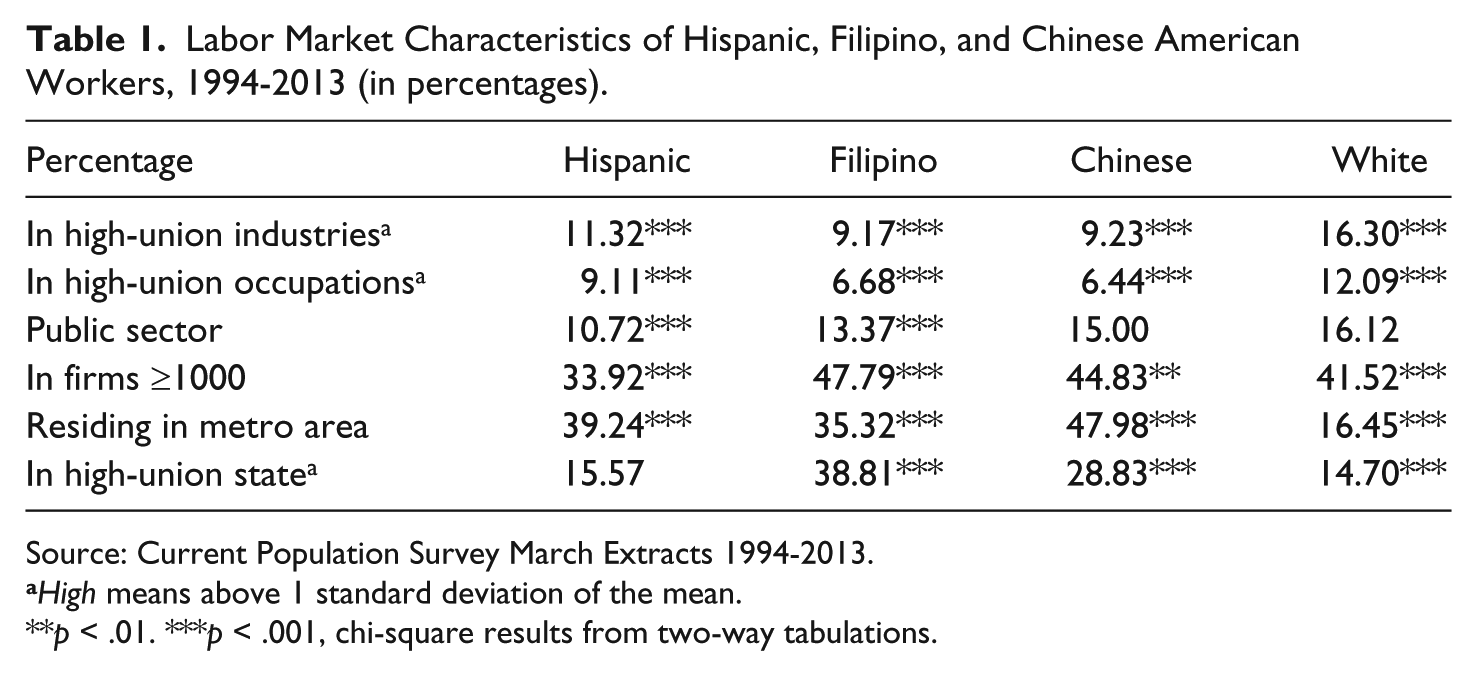
Source: Current Population Survey March Extracts 1994-2013.
High means above 1 standard deviation of the mean.
p < .01. ***p < .001, chi-square results from two-way tabulations.
In considering the union trajectories of immigrants and later generations it is important to consider assimilation as a process. Classic and new assimilation theorists argue that assimilation is a process whereby immigrants and their descendants steadily absorb and influence the broader society. By and large the assimilation perspective contends that immigrant and majority groups converge over time both socially and economically. The longer since immigration (both as time and generation is concerned) the less discernible immigrant groups will be from the majority population (Gordon 1964; Alba and Nee 2003). Theorists posit that when immigrants arrive in the United States they generally start off as culturally and structurally unassimilated. We can think of the union job as a site of assimilation and upward mobility. Immigrants enter the country unassimilated and are less likely to work in a union job, but over time immigrants and later generations assimilate more into the economy and are more likely to be union members. Indeed this is borne out by Waldinger and Der-Martirosian (2000) who show that the longer an immigrant has been in the United States the more likely he or she is to belong to a union.
Conversely, Rosenfeld and Kleykamp (2009) argue that if solidaristic perspective was correct and immigrants possessed significant advantages then recent immigrants would be more likely than established immigrants or the children of immigrants to unionize (which would especially be reflected in the union join rate) because they are more closely linked to the solidaristic culture and experiences of the sending country. And this follows a certain kind of logic in the assimilation perspective—over time immigrants (and certainly their children) could adopt the dominant anti-union position.
However, this understanding severely underestimates the persistence and durability of cultural understandings (particularly economically advantageous ones), which scholars have argued are not only maintained by the immigrant generation but are often passed on to later generations. Kasinitz et al. (2008) describe this as the “second generation advantage” in which the children of immigrants retain the advantageous characteristics of their parents’ culture to assist in the assimilation process. If this was the case then we would expect that solidaristic culture, pro-labor stance, and deep networks would not necessarily fade if they remained advantageous. This is at least partially borne out by the NLAAS data, which show similar trends in network embeddedness and perceived stigmatization among immigrant and U.S. born. Rosenfeld’s (2014) findings demonstrate support for this assertion, finding that second- and third-generation Hispanic immigrants are more likely than (similar) whites to belong to a union. Despite solidaristic characteristics, new immigrants, particularly undocumented ones, may be structurally prohibited from unionization, and therefore the fruits of these characteristics may take time or generations to bear out.
Data and Methods 4
My analysis utilizes data from samples of 1994 to 2013 CPS. The CPS is a monthly survey of 50,000 to 60,000 households proportionally selected to represent the U.S. population conducted by the Census Bureau for the U.S. Department of Labor. The CPS is ideal for this project because it contains information on demographics (age, sex, race, location), immigration status, and union membership. Although Chinese and Filipino respondents make up a statistically small portion of the overall CPS sample, the survey is large enough that the sample from these populations is comparable to other large surveys of immigrants, such as the National Latino and Asian American Study (NLAAS) or Immigration and Intergenerational Mobility in Metropolitan Los Angeles (IIMMLA). Table 2 reports basic descriptive statistics of the samples along with those of key variables. I use a pooled sample of March-CPS data for the comprehensive analysis of union membership odds; these results are detailed in Table 3. CPS-March is more suited to this analysis than CPS-Merged Outgoing Rotational Groups (MORG), which is a larger sample, because it contains important labor market position measures, particularly firm size, which are not available for MORG. I pool the data to get a sufficient sample size and begin with 1994 because that is the year that CPS began asking questions on national origin and parental origin, allowing for the identification of Filipino and Chinese respondents. In addition to firm size, labor market position models offer controls for major industrial, occupational, and geographic characteristics that may affect unionization. Rather than including dummy variables for broad industrial and occupational categories as others have done (Rosenfeld and Kleykamp 2009; Catron 2013), I use continuous variables that measure the percentage unionized within detailed three-digit occupation and industry categories. This provides a much more finely tuned measure of the effect of industry or occupation on the unionization of individuals. Not incidentally modeling the effects of industry and occupation this way explains approximately 10 percent more of the variance predicting unionization than using the broad category dummies. Because unionization is so unequally distributed within the broad industrial/occupational categories and because ethnic groups are not equally distributed either, this is a superior measure.
Selected Descriptive Statistics of Current Population Survey (CPS) Data Sources.
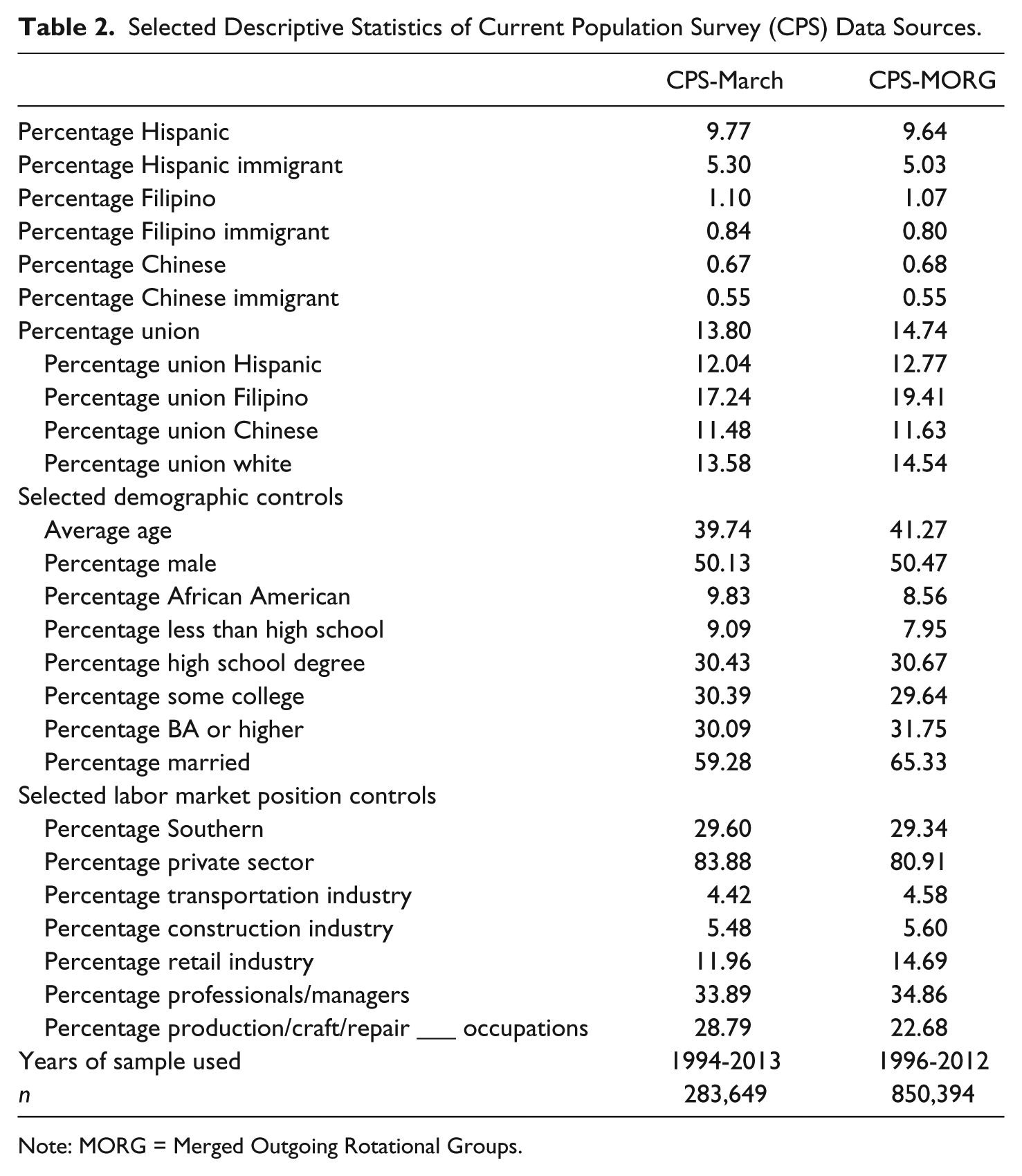
Note: MORG = Merged Outgoing Rotational Groups.
Odds Ratios from Logistic Regressions Predicting Unionization, 1994-2013.
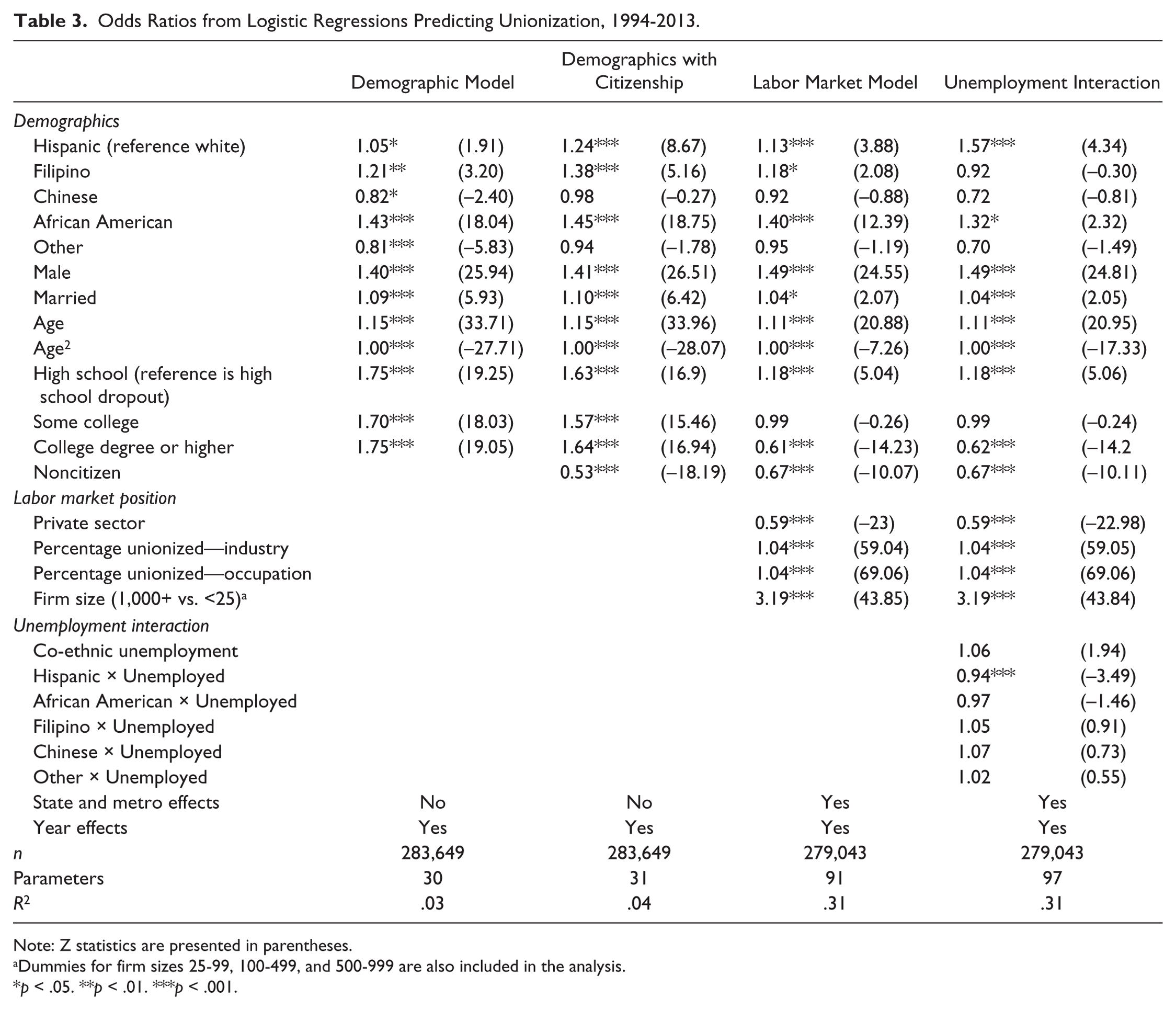
Note: Z statistics are presented in parentheses.
Dummies for firm sizes 25-99, 100-499, and 500-999 are also included in the analysis.
p < .05. **p < .01. ***p < .001.
All models also control for basic demographic characteristics shown in the literature to affect unionization including sex, education, marital status, age, and an age-squared term. Only non-self-employed workers ages 18 to 65 are included in the analysis. Additionally I utilize year dummies to control for year-to-year factors like business cycle effects that may influence unionization. As Catron (2013) found, the negative effects of the recession, particularly unemployment, are likely to affect unionization. To account for this event, I include a term for the co-ethnic unemployment rate for March the year of the survey and interact that effect with the other independent variables. 5 Results of this analysis are reported in Tables 3 and 4.
Odds Ratios from Logistic Regressions Predicting Unionization, 1994-2013.
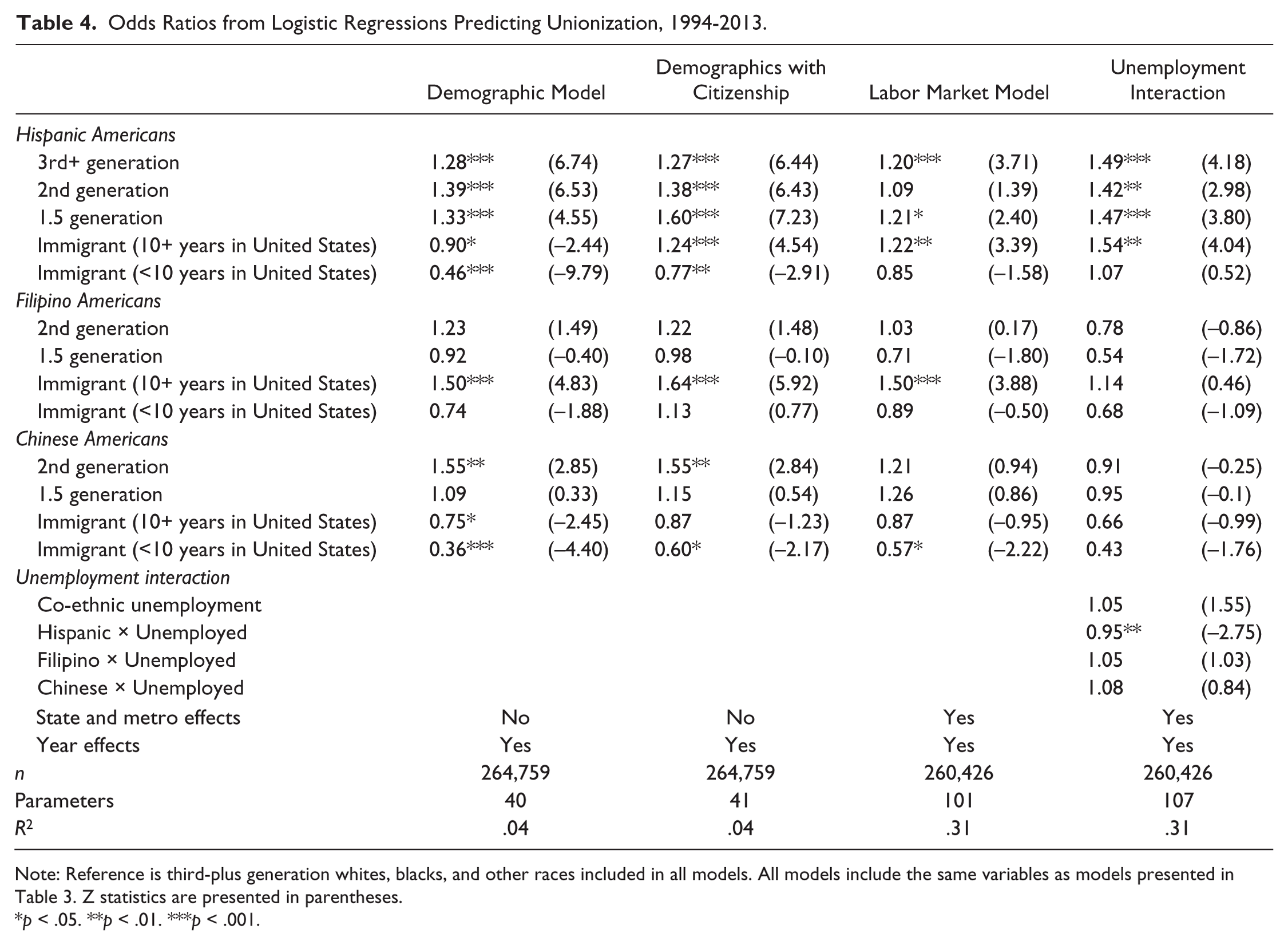
Note: Reference is third-plus generation whites, blacks, and other races included in all models. All models include the same variables as models presented in Table 3. Z statistics are presented in parentheses.
p < .05. **p < .01. ***p < .001.
Since the dependent variable is binary, logistic regression is most appropriate for measuring the effects of independent variables. To promote ease of interpretation I present the results of logistic regressions as odds ratios. Table 3 presents results of these analyses with aggregated categories for Hispanic, Filipino, and Chinese American respondents. Table 4 presents results from disaggregating the Hispanic, Filipino, and Chinese American categories by generation and time since immigration.
To test whether recent efforts to target immigrant groups for unionization have any effect on recent union memberships I model individual changes in union membership. The CPS-MORG sample has a limited longitudinal component because all CPS respondents are interviewed then put on hiatus and then interviewed again over a one-year period. A portion of any year’s sample is interviewed again the next year. Using the framework of Rosenfeld and Kleykamp (2009) I match 6 the respondents who were interviewed in two sequential years across the two data points. The resulting mini-panels contain respondents’ union status at two separate time points.
I model both joining and leaving a union over this time. Both outcomes are important indicators of the relationship of union organizing to immigrant and minority workers. I conceptualize union joining as a binary variable. Not joining a union (the null case, coded as 0) includes those who are not union members in both time 1 and time 2; joining a union (the positive case, coded as 1) includes respondents who are not union members in time 1 but are union members in time 2. Similarly, I conceive of union leaving as a binary variable in which the null case includes respondents who were union members in both time 1 and 2, and the positive case, union leavers, includes respondents who were in a union in time 1 but not in time 2. I again utilize logistic regression, represented with log odds, to estimate the odds of both joining and leaving a union. Presented in Tables 5 and 6, these models include all of the variables utilized in the labor market position model predicting unionization, with two exceptions: CPS-MORG does not include firm size, and because many respondents are likely to change jobs from year to year I also include a dummy to capture staying in the same industry and occupation.
Odds Ratios of Joining a Union (Compared to Never Being in a Union).
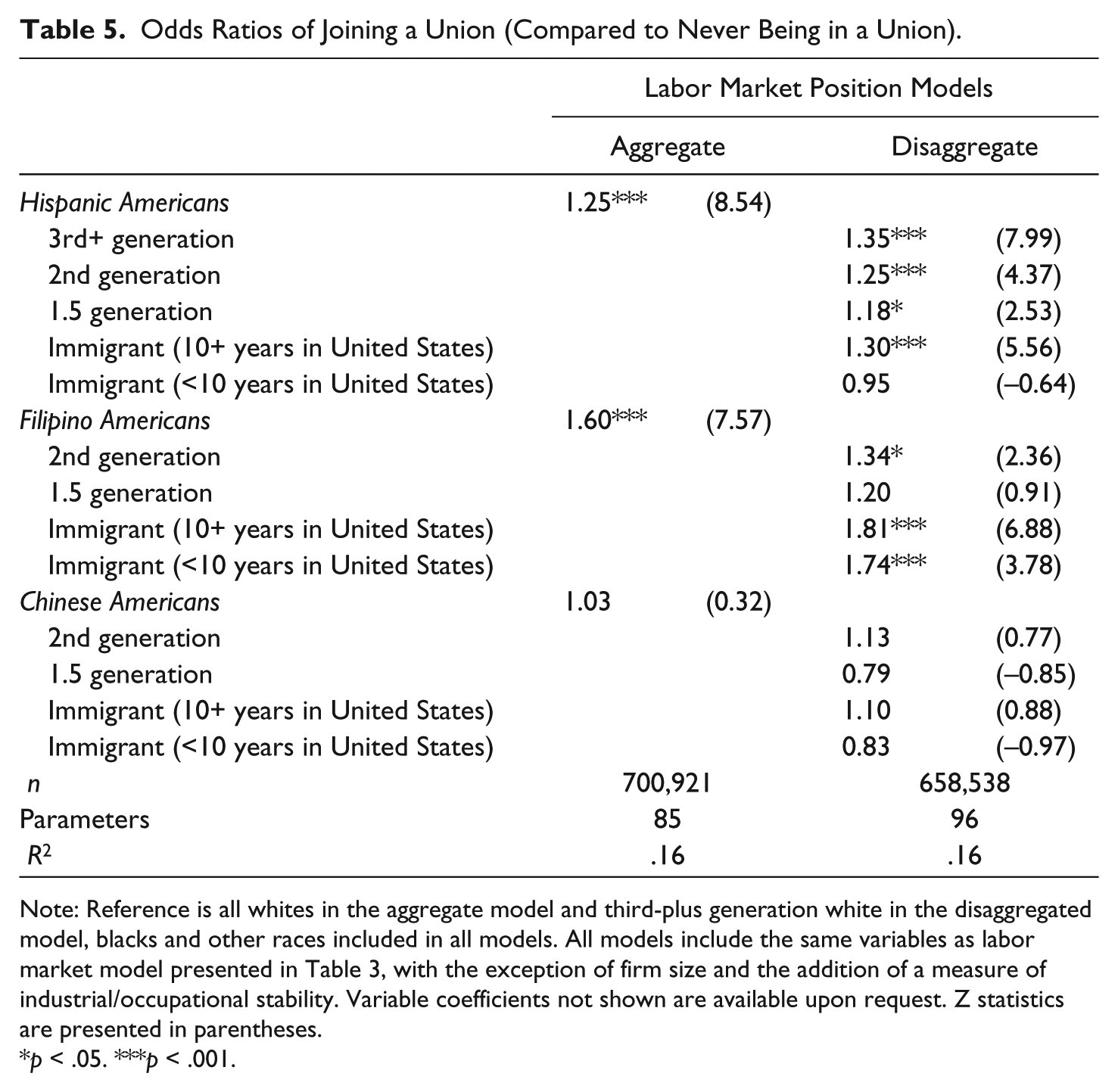
Note: Reference is all whites in the aggregate model and third-plus generation white in the disaggregated model, blacks and other races included in all models. All models include the same variables as labor market model presented in Table 3, with the exception of firm size and the addition of a measure of industrial/occupational stability. Variable coefficients not shown are available upon request. Z statistics are presented in parentheses.
p < .05. ***p < .001.
Odds Ratios of Leaving a Union (Compared to Staying in a Union).
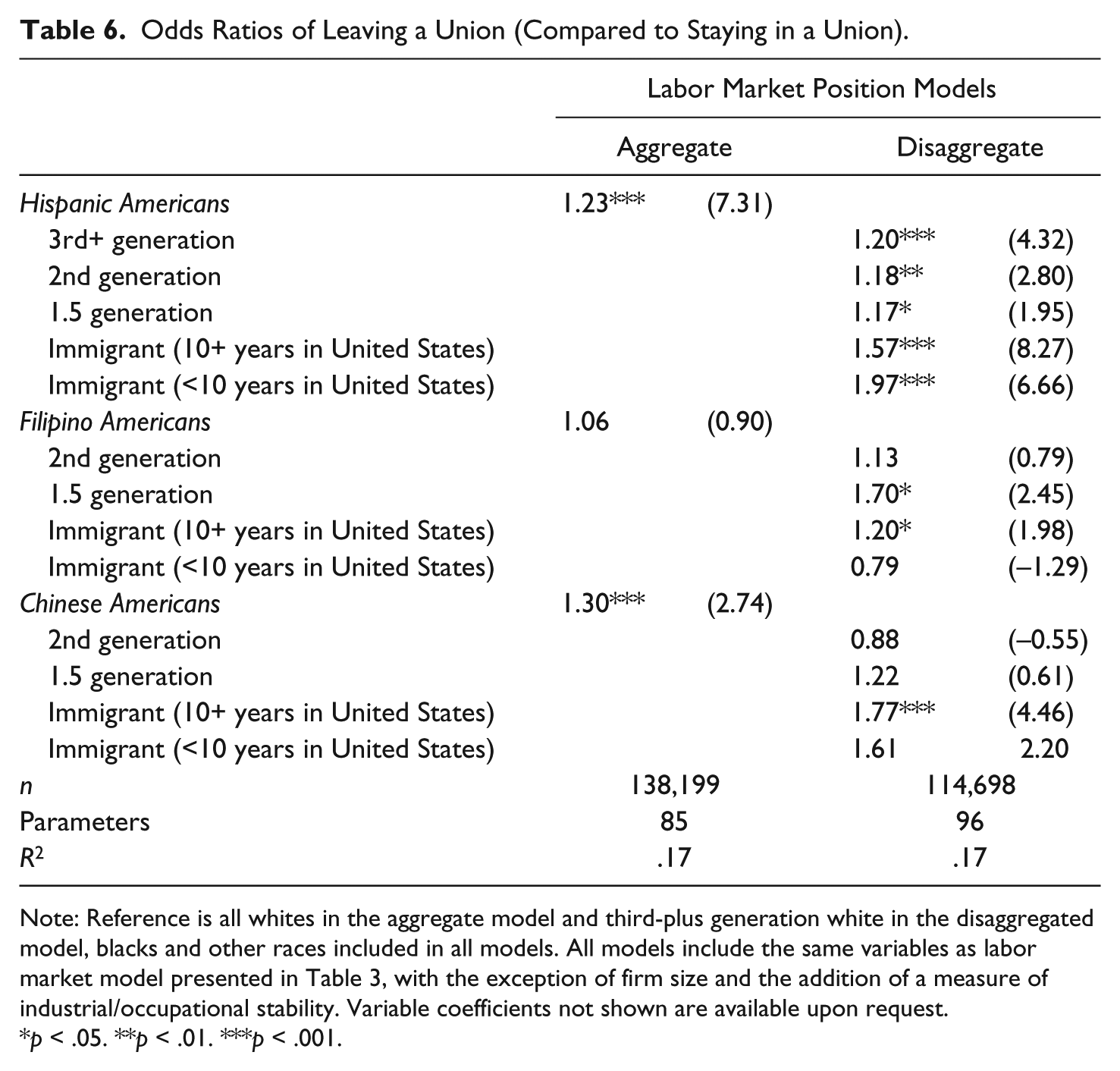
Note: Reference is all whites in the aggregate model and third-plus generation white in the disaggregated model, blacks and other races included in all models. All models include the same variables as labor market model presented in Table 3, with the exception of firm size and the addition of a measure of industrial/occupational stability. Variable coefficients not shown are available upon request.
p < .05. **p < .01. ***p < .001.
Findings
Table 3 presents findings from multivariate analyses that examine the positional factors explaining unionization of Hispanic, Filipino, and Chinese American (both immigrant and native-born) workers among others, using the pooled CPS-March files from 1994 to 2013. In the simple demographic model Hispanic workers were 5 percent more likely than whites to be union members (p < .05), Filipino workers were 21 percent more likely than whites (p < .01) and Chinese workers were 18 percent less likely than native whites to be union members (p < .05). The second model adds citizenship along with the demographic controls. Not being a U.S. citizen decreased respondents’ likelihood of belonging to a union by 47 percent (p < .001). Though Milkman (2006) and Delgado (1993) find that legal status does not affect immigrants’ willingness to organize, the costs and legal barriers to hiring noncitizens, particularly low-skilled and/or undocumented immigrants, increases the likelihood of working in informal and marginal sectors of the economy, which likely decreases the chances of unionization. Importantly when citizenship is added into the model the magnitude and significance in difference between whites and both Hispanics and Filipinos increased dramatically to 24 percent more likely and 38 percent more likely (p < .001), respectively. Similarly the difference between white and Chinese respondents virtually evaporates.
When labor market controls were introduced into the model Hispanics were 13 percent more likely than whites to belong to a union (p < .001), Filipinos were 18 percent more likely (p < .05), and the difference between Chinese respondents and whites was not significant. These findings indicate that while some of the difference between whites and Hispanic and Filipino workers is due to labor market position, solidaristic differences may also be affecting unionization. The final model introduces the co-ethnic unemployment variable and commiserate interactions. Introducing unemployment into the model changed the direction of difference between Hispanics and whites again. With coethnic unemployment and interaction effects accounted for along with positional factors, Hispanic respondents were 57 percent more likely than whites to belong to a union (p < .001). Additionally there was a significant negative interaction effect on unionization between Hispanic and unemployment, but not for Chinese or Filipino workers. The Hispanic × Unemployment interaction term was .94 (p < .001), which indicates that for every 1 percent increase in the Hispanic unemployment rate Hispanic workers are 6 percent less likely than whites to have union jobs. This may be because Latino workers are employed in the most vulnerable union work that is most affected by economic downturns. It is also possible that as the labor market tightens and union work becomes more competitive they are less able than whites or Asians to secure union employment. Either way the data suggest that for unionization, like employment and income, Latinos are more severely affected by poor macro-economic performance.
Table 4 presents the results of the positional models from 1994 to 2013 when applied to disaggregated samples by time and generation since immigration. For all three groups the most recently immigrated were the least likely to be unionized by large margins. Though the pattern holds, it is worth noting how much of a difference citizenship matters, for of virtually all the immigrant subcategories citizenship dramatically increases the comparative likelihood of being union members. In the labor market position model recently immigrated (less than 10 years) Chinese workers were 43 percent less likely than native whites to be union members (p < .05). Though established Chinese immigrants were less likely than native-born whites to be union members and 1.5- and 2nd-generation Chinese respondents were more likely than whites, these differences were not statistically significant. Recent Hispanic immigrants were not significantly less likely than whites to be union members, established immigrant, 1.5-generation and 3rd+-generation Hispanic workers were all significantly more likely than whites to be union members (p < .01, p < .05, and p < .001, respectively). There was no significant difference in the unionization of 2nd-generation Hispanics and native whites. Once labor market controls were introduced established Filipino immigrants were the only Filipino American respondents more likely to belong to unions than whites (p < .001). In the unemployment interaction model a similar effect is observed as in Table 2; the magnitude and significance of difference between whites and all Hispanic cohorts, with the exception of recent immigrants, increases dramatically. The deficit that was displayed for recent Hispanic immigrants is erased.
The generation and time effects on unionization were most apparent in the basic demographic model (particularly for Hispanic and Chinese Americans) with a fairly clear trend towards increased unionization as time and generation since immigration increased, though there was a slight dip between second- and third-generation Hispanics. The decreased effect of time and generation with the introduction of labor market variables indicates that positional factors were driving a significant portion of the generational differences. In other words, long-term immigrants and later generations are more assimilated into the labor market than more recent immigrants, which makes them more likely to be unionized. This effect was strongest for Hispanic respondents. This progression points to the importance of duration in the United States for both economic incorporation (DeFreitas 1993; Piore 1979) and unionization. Granted that there appears to be generational trends in unionization across groups, there are important differences to note between these three populations. The first difference of note is that recent and established Chinese immigrant workers’ extreme unlikeliness of belonging to a union across the models. Second is the comparatively high likelihood of unionization for all but the most recent Hispanic immigrants across the models. Last is the relative insignificance of being Filipino (for any cohort besides the established immigrants) in predicting unionization in any of the models.
In my final set of models I utilized the matched CPS-MORG mini-panels from 1996 to 2012 to determine the likelihood of joining or leaving a union during the course of a year. Table 5 presents odds ratios from logistic regression predicting joining a union. With labor market controls, Hispanic and Filipino workers were significantly (p < .001) more likely than whites to join a union; the difference between Chinese and white respondents was not significant. The second model disaggregates the samples by generation and time since immigration. All but recent Hispanic immigrants are significantly more likely than native-born whites to join unions. Second-generation and both cohorts of immigrant Filipinos were significantly more likely than whites to join unions. None of the Chinese cohorts was significantly more or less likely than native whites to join unions.
Table 6 presents odds ratios from logistic regression predicting leaving a union. In the aggregated labor market model Hispanic and Chinese respondents were significantly more likely to leave a union (p < .001) than white respondents, while there was no significant difference between Filipinos and whites. Conversely the difference in union joining was significant for Filipinos, but not for Chinese workers. In addition the coefficients predicting union leaving for Chinese and Hispanic respondents were larger than the coefficients predicting union joining, while the opposite was true for Filipinos. This leads to the obvious conclusion that while Filipinos may be more likely to join unions than to leave, Chinese and Latino workers appear to be more likely to leave unions than to join them. This seems to be corroborated by simple descriptive statistics. Over the period 1996 to 2012, 4.5 percent of Hispanic respondents, 4.1 percent of Chinese respondents, and 6.1 percent of Filipino respondents joined unions. Over the same period 4.6, 4.2, and 5.6 percent of Hispanic, Chinese, and Filipino respondents, respectively, left unions or lost their union jobs. More Chinese and Hispanic workers left unions than joined, and more Filipino workers joined unions than left.
Discussion and Conclusions
My analysis offers a robust analysis of Hispanic, Filipino, and Chinese Americans’ patterns of unionization and relationships to organized labor. This analysis expands existing knowledge on immigrants, organized labor, and incorporation by demonstrating the common and unique factors that shape this complex interrelationship. My findings corroborate research that points to the centrality of labor market position in influencing the unionization of immigrants (Waldinger and Der-Martirosian 2000; Milkman 2000). Unionization rates of occupation and industry, as well as sector and firm size, were persistently significant factors of unionization across my models. The unionization rates of Filipinos present the strongest evidence for labor market position theories; the higher likelihood of unionization is greatly reduced in degree and significance when labor market position controls are introduced into the models.
However, these positional factors failed to explain all group differences in unionization or joining/leaving unions. Patterns of unionization, in fact, appear fundamentally different across the four ethnic groups examined here. While 62.4 percent of white unionized workers work in both highly unionized industries and highly unionized occupations, only 33.8 percent of Filipino, 40.2 percent of Chinese and 48.4 percent of Hispanic unionized workers do. Labor market position does not account for the persistently higher likelihood of unionization for 3rd-, 2nd- and 1.5-generation Hispanics, the much higher likelihood of union joining for Filipinos, or the persistently low rate of unionization and high rate of union leaving of recent and long-term Chinese immigrants. Solidaristic theories identify three vital characteristics/experiences that make some immigrant and ethnic communities more prone to union organizing—deep networks, pro-union attitudes, and negative context of reception. Based on the data on these qualities (presented in Table 7) I expected that Hispanic and Filipino workers would be most likely to unionize while Chinese would be the least likely of the three. For the most part this is what I found. Ultimately my findings demonstrate that while positional factors determine a large part of unionization, divergent results indicate that the organizing characteristics of people from different ethnic backgrounds and countries of origin do significantly impact unionization.
Solidaristic Characteristics of Hispanic, Filipino, and Chinese American Workers, 1994-2013.
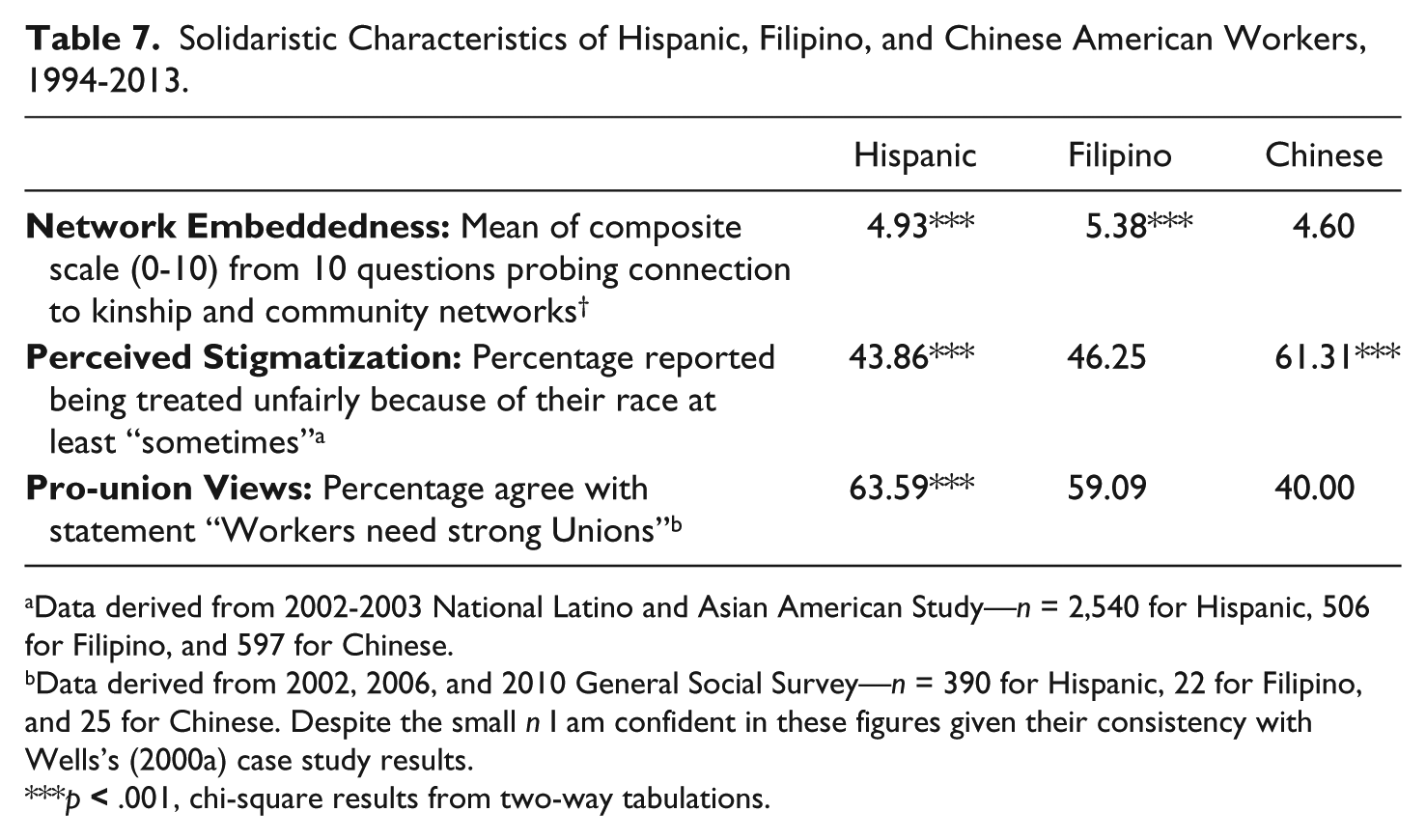
Data derived from 2002-2003 National Latino and Asian American Study—n = 2,540 for Hispanic, 506 for Filipino, and 597 for Chinese.
Data derived from 2002, 2006, and 2010 General Social Survey—n = 390 for Hispanic, 22 for Filipino, and 25 for Chinese. Despite the small n I am confident in these figures given their consistency with Wells’s (2000a) case study results.
p
Time and generation since immigration tend to increase the likelihood of union membership when only demographic controls are accounted for. Once labor market position controls are introduced this clear delineation begins to break down, which suggests that while positional advantages are likely to increase as immigrants and their children assimilate into the labor market, solidaristic advantages are not. None of the groups become strongly less likely to unionize or join unions in later generations, supporting the idea of a “second-generation advantage” as opposed to an assimilation towards the mean theory.
The results of the mini-panel data may not present much of a sign of light for the future of U.S. organized labor. The main labor federations have spent years and invested a lot of money to reinvigorate the labor movement with social movement unionism often focusing on immigrant communities as new ground for organizing. They’ve partnered with worker centers, worked on living wage campaigns, and been on the front lines of immigration reform efforts. And Latino and Filipino workers are more likely to join unions than whites are. But the problem is for all that, they are almost as likely or even more likely to leave unions than to join them. Additionally unemployment has a disproportionately negative effect on the unionization of Hispanic workers, and as the economy continues to languish this may have lasting effects on their chances for obtaining union work. Given the dismal state of organized labor today and the low rates of membership and organizing of whites, higher rates of union entrance in immigrant/ethnic communities are still very low in absolute terms. Over the period 1996 to 2012 only about 4 percent of Hispanic and Chinese Americans joined unions, while about 6 percent of Filipino Americans joined; unfortunately almost as many left unions. Asians and Latinos are the fastest-growing segments of the American workforce, and they are making significant inroads in labor organizing, but they are unlikely to prove any sort of magic solution for U.S. labor unless successful organizing somehow increases by orders of magnitude.
Footnotes
Appendix
Probit Analysis with Heckman Selection Correction Predicting Leaving a Union.

| Labor Market Position Models |
||||||||
|---|---|---|---|---|---|---|---|---|
| Aggregate |
Disaggregate |
|||||||
| No Correction | Heckman | No Correction | Heckman | |||||
| Hispanic Americans | 0.15*** | (8.90) | 0.15*** | (8.92) | ||||
| 3rd+ generation | 0.10*** | (4.18) | 0.09*** | (3.94) | ||||
| 2nd generation | 0.11** | (3.22) | 0.12*** | (3.72) | ||||
| 1.5 generation | 0.08 | (1.75) | 0.09* | (2.23) | ||||
| Immigrant (10+ years in United States) | 0.26*** | (8.54) | 0.26*** | (9.27) | ||||
| Immigrant (<10 years in United States) | 0.37*** | (6.54) | 0.21* | (2.48) | ||||
| Filipino Americans | 0.08* | (2.19) | 0.10** | (2.74) | ||||
| 2nd generation | 0.08 | (0.97) | 0.07 | (0.87) | ||||
| 1.5 generation | 0.28** | (2.57) | 0.26* | (2.48) | ||||
| Immigrant (10+ years in United States) | 0.13** | (6.88) | 0.11* | (2.54) | ||||
| Immigrant (<10 years in United States) | –0.14 | (−1.54) | –0.01 | (−0.08) | ||||
| Chinese Americans | 0.22*** | (4.09) | 0.17*** | (3.19) | ||||
| 2nd generation | –0.06 | (−0.53) | –0.08 | (−0.72) | ||||
| 1.5 generation | 0.35 | (1.87) | 0.28 | (1.54) | ||||
| Immigrant (10+ years in United States) | 0.30*** | (4.35) | 0.23*** | (3.49) | ||||
| Immigrant (<10 years in United States) | 0.33* | (2.20) | 0.47* | (2.20) | ||||
| n | 658,538 | 658,538 | 658,538 | |||||
p < .05. **p < .01. ***p < .001.
Acknowledgements
The author thanks Judith Stepan-Norris for her indispensable guidance and support throughout the process of writing this article. I would also like to thank Cynthia Feliciano, Stan Bailey, Jennifer Lee, Frank Bean and 3 anonymous reviewers for their comments and suggestions that greatly helped to improve this article. An early version of this article was presented at the 2012 American Sociological Association annual meeting in Denver, CO.
Declaration of Conflicting Interests
The author declared no potential conflicts of interest with respect to the research, authorship, and/or publication of this article.
Funding
The author received no financial support for the research, authorship, and/or publication of this article.