




Abstract
This article examines the early economic track record of Indiana’s “right-to-work” (RTW) law on labor market outcomes. It analyzes various labor market metrics to compare the experience in Indiana relative to nine neighboring states, as well as to the United States in the aggregate. Data are analyzed both 36 months before and 36 months after Indiana passed RTW. Initial “difference-in-difference” estimates find that the labor market performance of Indiana has not surpassed that of neighboring states following passage of the law, contrary to the claims promised by its proponents. Wage and employment growth in Indiana’s construction industry, in particular, has fallen significantly behind the rest of the region. Regression analyses are subsequently performed, which conclude that RTW’s unique effect has been to lower hourly wages in the state economy by 1.1 to 1.5 percent on average and have little to no impact on employment. The combination of effects results in state income tax revenues that are annually $16 to $52 million lower than they would be in the absence of the RTW policy.
Keywords
Introduction
On February 1, 2012, Governor Mitch Daniels of Indiana signed a “right-to-work” (RTW) law (Davey 2012). Once signed, the policy immediately went into effect, but collective bargaining agreements in place as of March 14, 2012 were considered valid—RTW’s provisions would only apply once those contracts expired, were modified, or were renewed (Ogletree Deakins 2012). RTW was sold to the Indiana public as a policy that would generate positive economic benefits to the state, including the attraction of new businesses to the state, the creation of new jobs, and an increase in wages (Olson 2012)
In actuality, of course, a RTW law is merely a statewide regulation that bars labor unions from including “union security clauses” in collective bargaining agreements with employers. Union security clauses, as a solution to social and economic problems caused by business cycle fluctuations, were codified in the National Labor Relations Act of 1935 (often referred to as the “Wagner Act”). The clauses protect worker freedom of association, self-organization, and representation over the terms and conditions of employment. The Wagner Act not only guarantees the right to organize but also protects minority rights under a “duty of fair representation,” as outlined in the 1944 Steele v. Louisville & N.R. Co. et al. Supreme Court case. In the decision, the Court held that the labor union, as the exclusive representative of employees in the workplace, has the duty to represent all bargaining unit members “without hostile discrimination, fairly, impartially, and in good faith” (323 U.S. 192). Unions, as a result, must fairly represent all employees in a given collective bargaining unit regardless of whether they are members of the union. A union that breaches the duty of fair representation is liable for both actual damages and attorney’s fees.
Union security clauses ensure that all members of a bargaining unit who receive the benefits of collective bargaining contribute their fair share of dues. In the absence of a RTW law, fair share fees payers are charged for the cost of services “germane to collective bargaining,” such as a good wage, health insurance benefits, retirement benefits, and representation through the grievance system. An RTW law, in baring union security clauses, makes the payment of dues or fees optional for bargaining unit members. Effectively, an RTW law allows workers to free ride and enjoy all the benefits earned by the contributions of others.
While political battles continue over RTW in Indiana, economic data are increasingly becoming available to assess the actual effect, if any, that the policy has had on the state’s economy. Previous research suggests that RTW decreases an average worker’s income by about 2 to 3 percent (Gould and Kimball 2015; Gould and Shierholz 2011; Manzo and Bruno 2014; Stevans 2009) and has little impact on the employment level (Kalenkoski and Lacombe 2006; Lafer and Allegretto 2011; Stevans 2009). At the same time, the preponderance of evidence finds that RTW laws reduce unionization by between 5 and 10 percentage points (Hogler, Shulman, and Weiler 2004; Manzo and Bruno 2014; Moore 1980). This finding, paired with the inconclusive effect of RTW on employment and generally negative impact on wages, has induced Hogler (2011) to conclude that the true intent of RTW laws is based on “hidden objectives” that are more ideological than economically pragmatic: “less influence for unions, less bargaining power for workers, more wealth for the wealthy, and more misery for the immiserated” (303).
RTW in Indiana
In 1957, Indiana adopted an RTW law. In this first enactment, Indiana barred union membership as a condition of employment and prohibited job suspension or separation of a worker who refuses to join a union or “[fails] to maintain his membership in a labor organization.” Penalties included a $100 fine and imprisonment up to 10 days. The law, however, only targeted union shop agreements and did not prohibit “the requirement of payment of fees or charges to a labor organization.” Thus, fair share clauses that required collective bargaining unit members to pay dues or fees remained legal. Due largely to labor discontent with the law’s passage, Republicans suffered a significant blow in the 1958 state elections. Seven years later, a coalition of Republicans and Democrats—who controlled both the Indiana legislature and Governor’s office—successfully repealed the RTW law (Walsh 1987).
Indiana remained a fair share collective bargaining state for the next five decades. Nevertheless, union membership in the state followed the national trend of decline. Data from the Bureau of Labor Statistics (BLS) of the U.S. Department of Labor indicate that Indiana’s unionization rate was more than halved from 24.9 percent in 1983 to 10.7 percent in 2014 (Hirsch and Macpherson 2015). Still, political support for a RTW law in Indiana was slim for most of the next five decades.
In a July 30, 2004 letter to the International Union of Operating Engineers Local 150, then-gubernatorial candidate Mitch Daniels wrote that he understood the union’s
support for the current Indiana law providing a common construction [prevailing] wage for many state contracts, as well as [its] viewpoint that no need exists to enact a “right-to-work” statute in our state. I am in agreement on both counts.
As Governor, Daniels created the “Major Moves” public works program and promoted other infrastructure improvements, efforts that helped save or create thousands of union jobs in construction. Although Governor Daniel’s relationship with Indiana’s labor movement was precarious, he continued to express opposition to RTW laws in discussions with Local 150 representatives throughout his tenure. On December 15, 2011, however, Governor Daniels met with several Indiana union leaders and notified them that he would be flipping his position on the issue and would be supporting an RTW law. Minutes later, he announced his support to the state in a press conference (Fagan 2012).
Partisan division and guile characterized Indiana’s political climate throughout the month of January 2012. On January 2, Republican Bryan Bosma, Indiana House speaker, stated that passage of RTW was the party’s “No. 1 priority” (Greenhouse 2012). Over the next week, while the Senate Pension and Labor Committee voted six to four in favor of the proposed RTW bill, Indiana House Democrats delayed committee vote in their chamber by preventing a quorum. Ultimately, in a six-minute meeting on January 10 that prohibited amendments to and discussion on the bill, the House Employment, Labor, and Pensions Committee voted eight to five in favor of the bill. The next day, Minority House Leader B. Patrick Bauer filled a formal protest, arguing that the process was an unprecedented restriction on the right of the minority party to be heard. However, the protest fell on deaf ears. Subsequently, in the middle of the month, “House Speaker Bosma rejected calls for a public referendum vote on Right-to-Work, claiming that a referendum was unconstitutional” (Fagan 2012). On February 1, 2012, the Indiana House, Senate, and Governor, all officially signed the RTW bill.
Data and Method
All data used in this report are derived from the U.S. Department of Labor BLS. To avoid analysis based on preliminary data, the analysis is limited to information up to early 2015. To understand monthly trends both before and after the law, this report utilizes information from February 2009 to February 2015, which includes thirty-six months of data before and thirty-six months of data after the law was passed.
The BLS’ “Databases, Tables & Calculators by Subject” feature includes monthly data on employment and earnings for both the national population and individual states, derived from the Current Employment Statistics (CES) data set. The tool also includes monthly data on the national and state unemployment rates. Furthermore, quarterly data on business openings and closings can be obtained. All employment estimates in this report are seasonally adjusted to reveal underlying labor market trends.
In addition, advanced analyses are performed using data from the Current Population Survey Outgoing Rotation Groups (CPS-ORG), which is collected, analyzed, and released by the BLS. CPS-ORG data report individual-level information on twenty-five thousand respondents nationwide each month. The records include data on wages, unionization, hours, sector of employment, demographic, geographic, education, and other work variables. Weights are provided by the BLS to match the sample to the actual total U.S. population sixteen years of age or greater. These weights adjust the influence of an individual respondent’s answers on a particular outcome to compensate for demographic groups that are either underrepresented or overrepresented compared with the actual population. The data set was extracted from the user-friendly Center for Economic and Policy Research Uniform Data Extracts and uses the preferred real wage variable that converts all worker incomes into uniform hourly wages and amends them to 2014 dollars using the Consumer Price Index for all Urban Consumers Research Series (CPI-U-RS) inflation adjustment (Center for Economic and Policy Research 2015).
Indiana’s economic performance is compared with the performance of two regions. One comparison group is the United States as a whole, contrasting Indiana with the national average. Indiana is also compared with the aggregate performance of nine neighboring Midwest states: Tennessee, Kentucky, Ohio, Michigan, Wisconsin, Minnesota, Iowa, Missouri, and Illinois. The nine-state group allows for a determination of whether Indiana’s performance diverges from regional trends.
Findings
Employment
Proponents of Indiana’s RTW law claimed that the policy would provide an economic development incentive for firms to locate to the state. If RTW is truly an important factor in a firm deciding to open shop in a particular state, net private-sector establishment data should demonstrate that business activity has picked up in Indiana since February 2012. However, quarterly BLS data indicate that this is not the case. In the twelve quarters prior to RTW’s passage, 340 more private establishments opened than closed in Indiana (from 154,250 establishments to 154,590 establishments). About thirty-five thousand more businesses opened up than closed across the nation during that same time from 2009Q1 to 2015Q1. In the twelve quarters since RTW was passed in Indiana, openings accelerated in the United States, as the country added 524,000 new private establishments. Indiana, however, saw 864 more private establishments close their doors than open for business in the twelve quarters following RTW’s enactment (from 154,590 establishments to 153,726 establishments). Indiana’s significant economic divergence from the rest of the nation suggests that RTW has not been a boon to economic development (Bureau of Labor Statistics 2014).
Even though RTW has failed to substantiate the claims of its proponents that new businesses will be attracted to Indiana, proponents may nevertheless believe that existing firms have been able to add more jobs as a result of the policy. Figure 1 displays monthly data on private-sector job growth in each of the three study regions. For comparability, the data are represented as a percentage of the number of private-sector jobs as of the end of January 2012, the final days before RTW went into effect in Indiana. Thus, all data cross the vertical axis at 100 percent. For ease of interpretation, if a region begins on the left at a lower percentage than other regions, then that region grew faster than the others prior to February 2012. On the right, the inverse is true: if a region ends at a higher percentage than the other regions, then it grew faster than the others after February 2012.
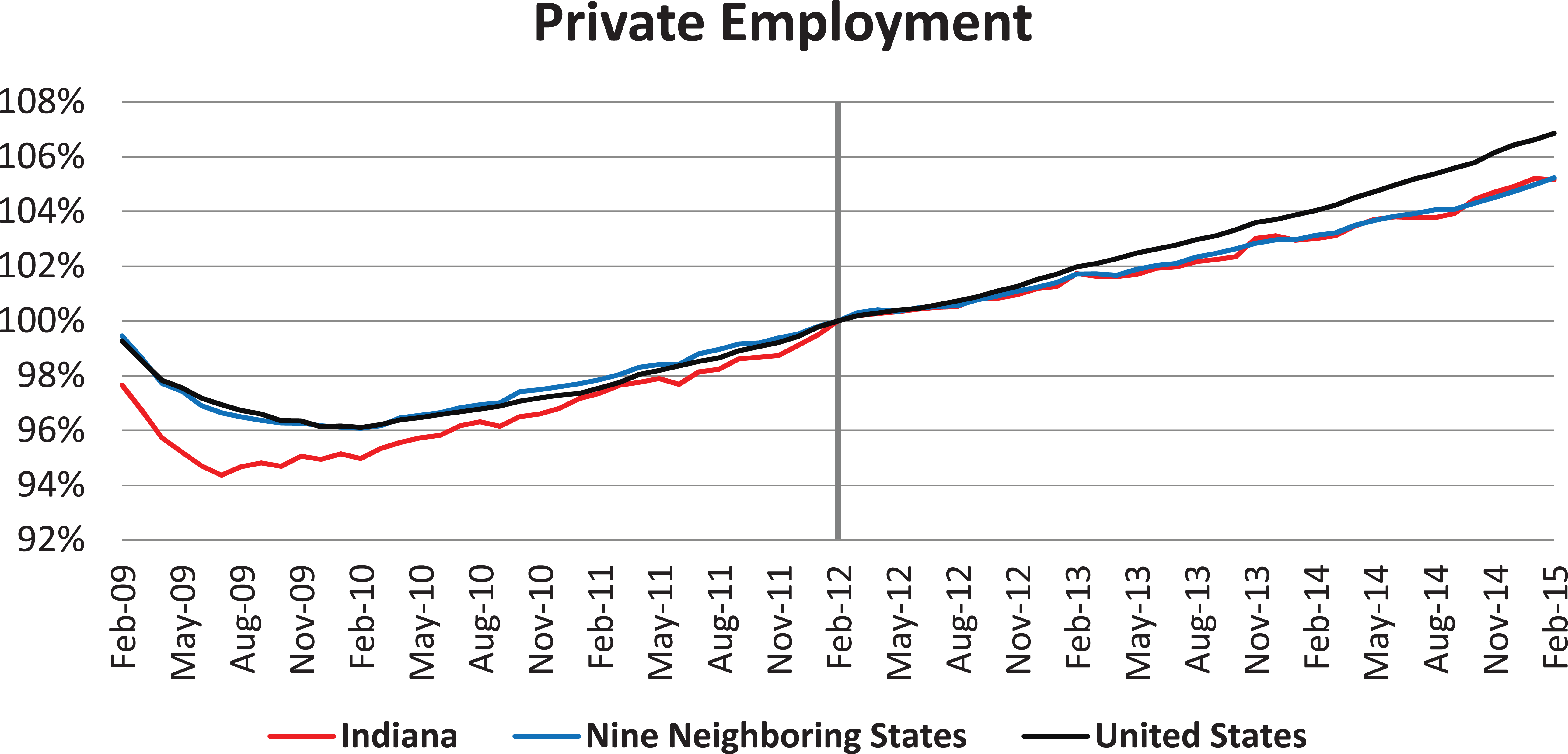
Private-sector employment as percentage of February 1, 2012 level, February 2009 to February 2015.
Private-sector job growth has been slower in Indiana than the national average (Figure 1). If the RTW law was an overriding factor in bringing jobs to Indiana, then Indiana’s private-sector job growth should have exceeded the national average. In addition, jobs in Indiana’s private sector have expanded at essentially the same rate as the nine neighboring states (5.2%), so attributing any post-enactment job growth to the law would ignore the regional trend. In fact, private employment was already growing faster in Indiana than in any of the other study regions prior to the RTW law. Since RTW went into effect, the “difference-in-differences” provided in Figure 2 shows that employment growth has decelerated in Indiana compared to the region and the nation. That is, RTW did not spark new private-sector job gains or improve the position of Indiana relative to the rest of the region. There is no discernible bump compared with the nine neighboring comparison states.
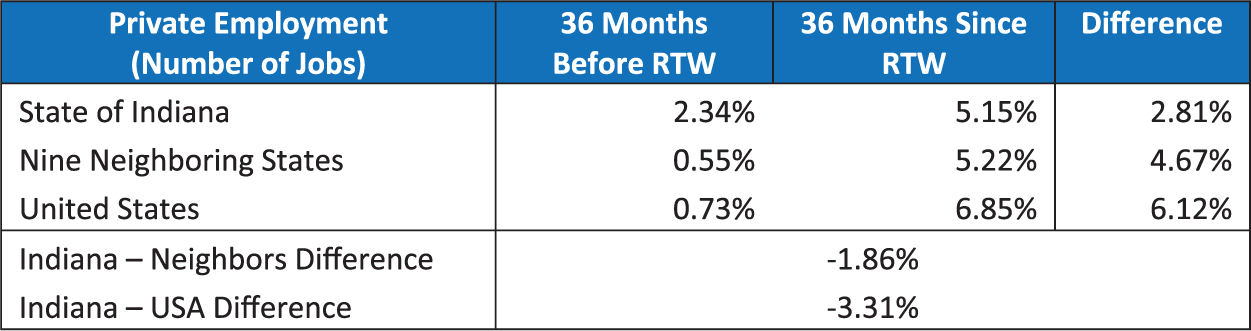
Private-sector employment growth, February 2009 to February 2015.
Another economic indicator to measure RTW’s potential impact on jobs is the unemployment rate. Figure 3 presents the unemployment rates of the three study regions over the seventy-two months of analysis. Since RTW was enacted, the Indiana unemployment rate has declined by 2.4 percentage points (Figure 3). Over the same time, the national unemployment rate and unemployment rate has fallen by 2.8 percentage points while the aggregated nine-state comparison region also saw a 2.4 percentage point decline.

Unemployment rate, February 2009 to February 2015.
Before RTW, however, the Indiana unemployment rate was declining by more than the national average (Figure 4). The unemployment rate decline in the thirty-six months since RTW was passed is only 1.2 percentage points better than the drop in the previous thirty-six months. Meanwhile, the drop in the unemployment rate was 2.7 percentage points better for the entire United States. The takeaway is that the U.S. economy experienced a steep drop in unemployment from February 2012 onward, while the unemployment rates of both Indiana and the nine-neighbor comparison group saw smaller declines in unemployment. Since Indiana’s pre- and post-February 2012 difference falls between the equivalent differences for the nine neighboring states and the entire United States, the effect of RTW on the state’s unemployment rate is uncertain. Ultimately, RTW’s effect on Indiana employment metrics has been ambiguous.

Unemployment rate changes, February 2009 to February 2015.
Private-Sector Wages
Figure 5 displays the average hourly wages growth for private-sector workers in the three study areas. On the surface, it appears that RTW has helped raise private-sector worker wages. Hourly wages for the private sector have grown by $1.73 per hour since RTW was passed, up $1.60 from the $0.13 average per hour growth experienced in the period prior to the policy change. This $1.60 per hour difference in wage growth exceeds the $0.44 hourly difference in wage growth for the nine neighboring states and the $0.51 difference for the U.S. economy (Figure 5). However, private-sector wages in Indiana have historically been low compared with both the region and the nation (Figure 6). Any compensation growth attributable to RTW is very likely to be biased by conflating the impact with growth that would have existed in the absence of the law. Under the Solow growth model first outlined in 1957, economic theory predicts that incomes in poorer states will grow faster over time and eventually converge with richer states, especially if they operate within an integrated economy and share relatively similar characteristics (Solow 1957). This is because the lower-earnings starting point provides an inherently higher marginal rate of return to investors. Thus, wages could be growing faster in the state economy in the thirty-six months since RTW’s passage due to the lower starting point.

Average private sector hourly wage growth, February 2009 to February 2015.
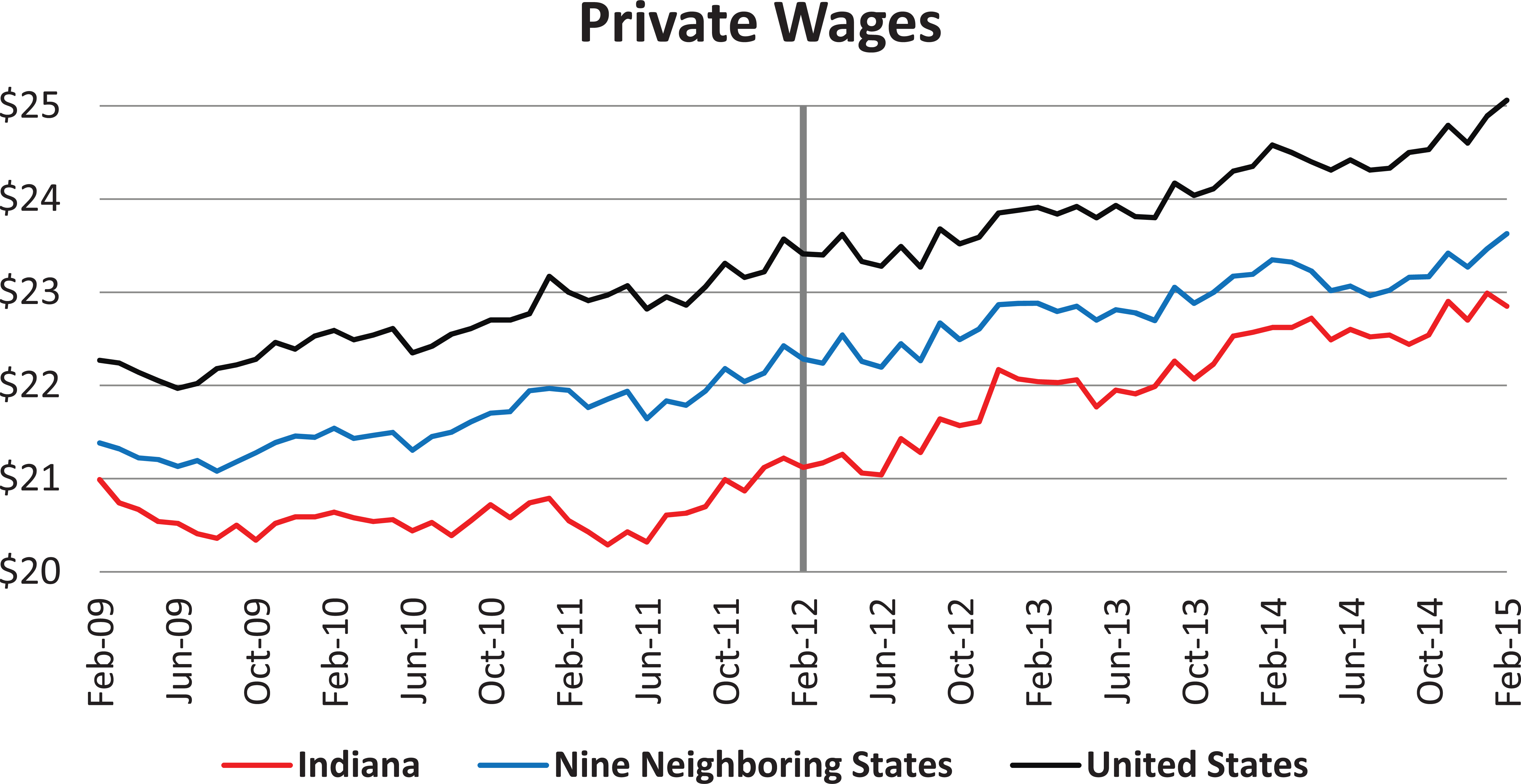
Average private sector hourly wage, February 2009 to February 2015.
Construction Industry Case Study
RTW has had a negative effect on construction workers in Indiana. Prior to RTW’s passage, construction employment was rising considerably in Indiana. Despite steady construction employment initially, there has been a noticeable decline in construction jobs in Indiana since RTW was passed. Meanwhile, the number of construction jobs has consistently increased for the nine neighboring comparison states and for the U.S. labor market (Figure 7). Overall, difference-in-difference estimates suggest that the policy has reduced construction employment growth by between 22.5 and 27.3 percentage points in Indiana (Figure 8).
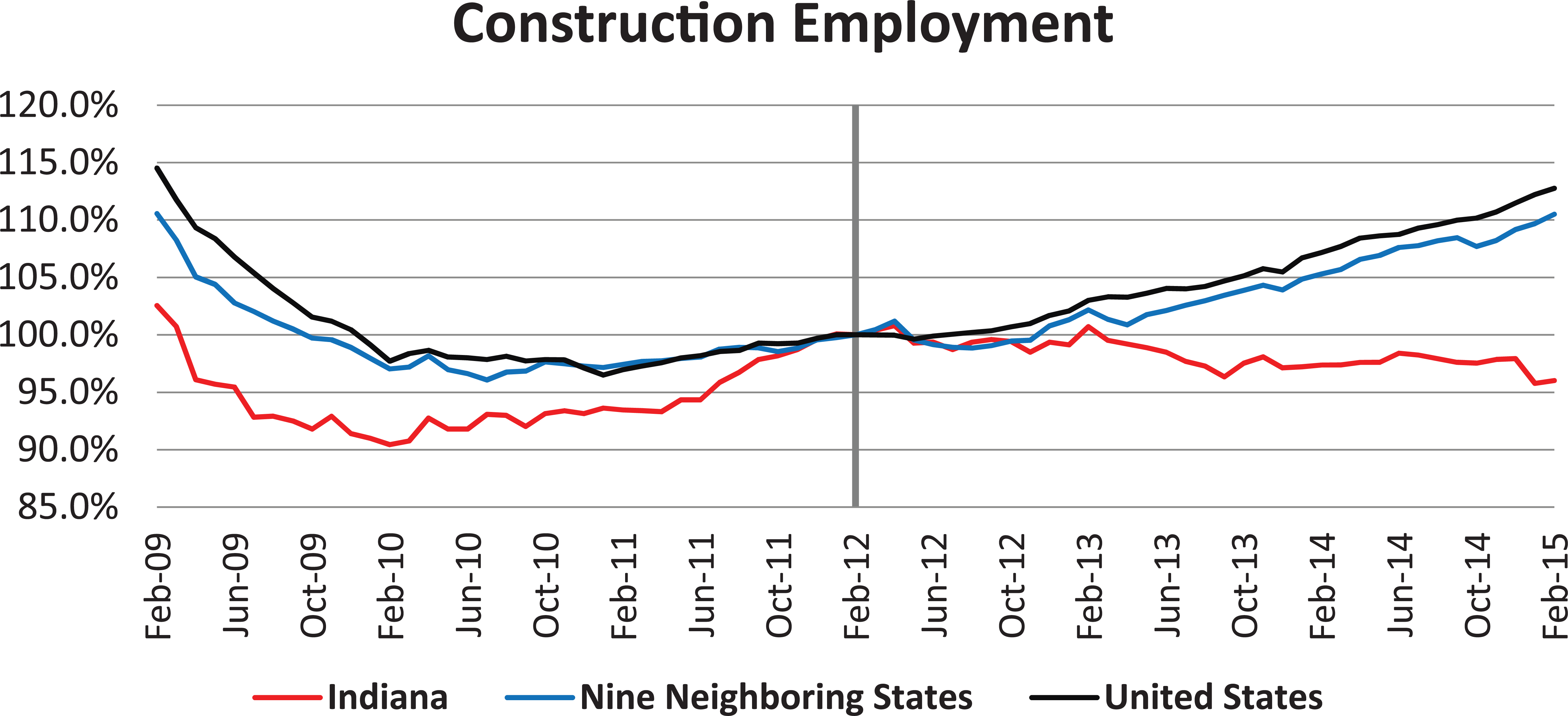
Construction employment as percentage of February 1, 2012 level, February 2009 to February 2015.
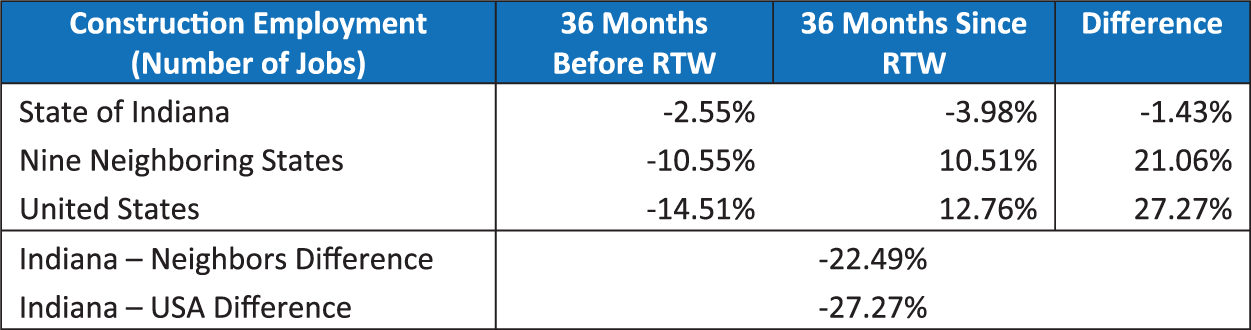
Average construction employment growth, February 2009 to February 2015.
There has also been a stagnation in wages for Indiana construction workers since RTW. In Indiana, the average hourly wage for a construction worker is now below the national average and is $1.69 per hour lower than the average for his or her counterpart in the nine neighboring states (Figure 9). Before the law, construction wages in Indiana had grown by $2.41 per hour over three years. Over the three post-RTW years, however, hourly wages have improved by only thirty-eight cents per hour (Figure 10). In comparison, hourly construction wages in the neighboring states grew by sixty-five cents per hour until February 2012 and have since grown by eighty-eight cents per hour. For the United States, the analogous figures are $1.00 per hour and $1.43 per hour. Accordingly, RTW reduced construction wage growth by between $2.27 and $2.46 per hour compared with the regional and national construction labor markets. RTW has simply not helped construction workers in Indiana.
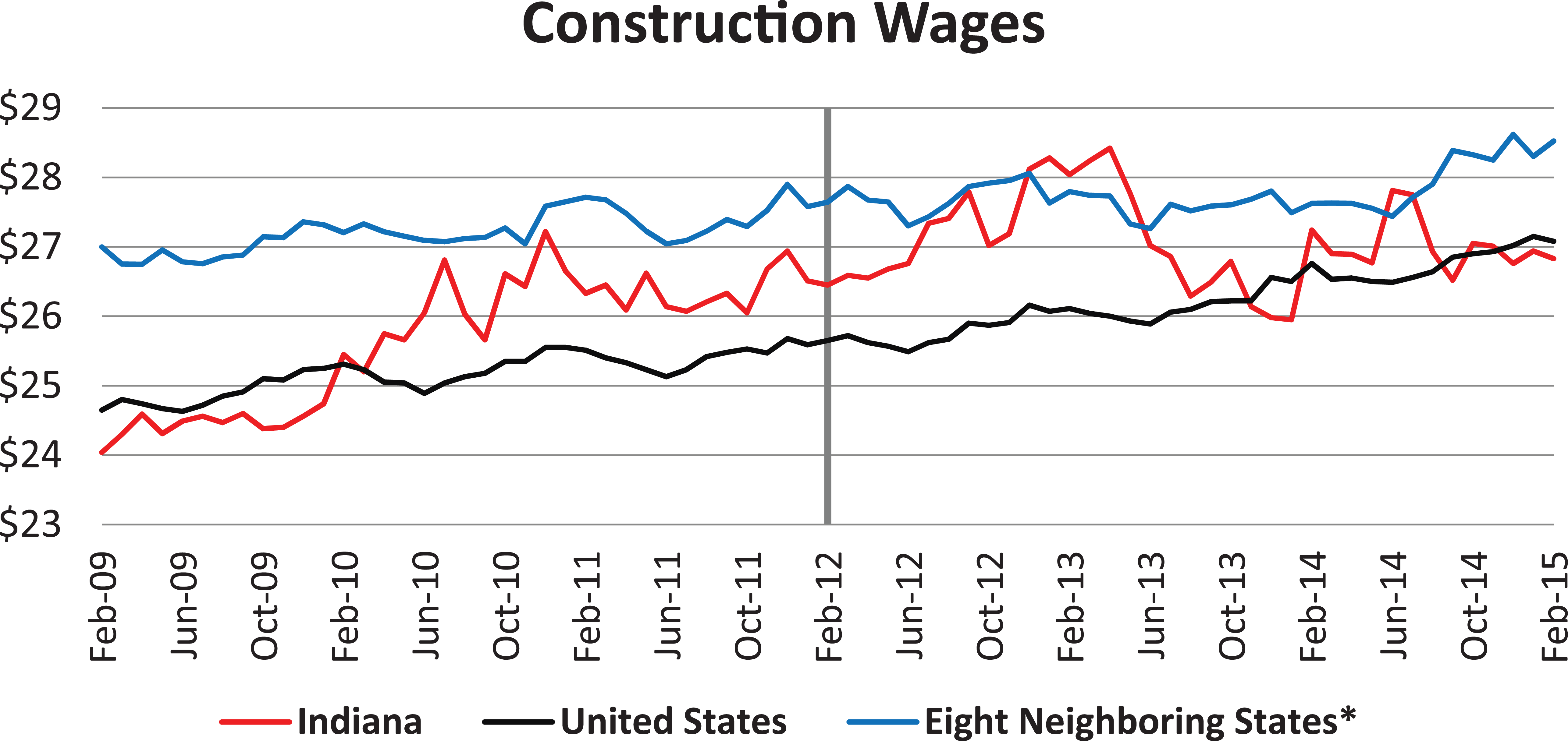
Average construction industry hourly wages, February 2009 to February 2015.

Average construction industry hourly wage growth, February 2009 to February 2015.
Regression Analyses
The regression analyses conducted used two statistical approaches that aim to account for unmeasured characteristics, parsing out the actual causal effect that Indiana’s RTW law had—or did not have—on a given labor market outcome. One empirical strategy utilized is an “ordinary least squares (OLS) regression model.” OLS regression models are run on the natural logarithm of average hourly wages and the natural logarithm of usual hours worked per week. Natural logarithms “normalize the data” to allow for evaluation of results in terms of percentages. The OLS analyses are run two times: first, on Indiana and the nine neighboring states used as a comparison, and second, on the national sample. Each includes controls for the following variables: age, gender, race or ethnicity, educational attainment, veteran status, citizenship status, immigrant status, sector of employment, an indicator if the worker lives in the Chicago metropolitan area, and year effects. In all cases, importance weights are applied to match the sample to the overall U.S. population.
The other strategy involves a “probit regression model” to analyze the effect of RTW on the probability that a given labor force participant is employed. This approach allows for estimates that predict the likelihood of a binary outcome (e.g., whether or not a person is employed) due to RTW. The reported results are average marginal effects, which provide the average impact of RTW for the entire sample. Probit models also allow for importance weights to match responses to the actual population. Similar to the OLS regression models, the probit strategy is used two times. Regressors include age, gender, race or ethnicity, educational attainment, veteran status, citizenship status, immigrant status, an indicator if the worker lives in the Chicago metropolitan area, and time effects.
RTW has generally had a negative impact on worker wages in Indiana (Figure 11). In the regional analysis, RTW is found to be strongly associated with a 3.8 percent drop in worker wages throughout the Midwest. A RTW × Indiana interaction term, which indicates if RTW’s effect on wages was stronger or weaker in Indiana than the rest of the region, is a statistically significant 2.3 percent. This means that the overall (additive) impact of RTW on Indiana is a 1.5 percent decrease in hourly wages in the ten-state model. A national model finds that RTW lowers hourly incomes by an average of 6.6 percent per worker. With statistical significance, however, the interaction term for Indiana finds that RTW’s effect has been 5.5 percent “less negative” in the state than in the nation, for a 1.1 percent total negative impact on average hourly wages. Put plainly, RTW has reduced worker earnings by between 1.1 and 1.5 percent in Indiana.
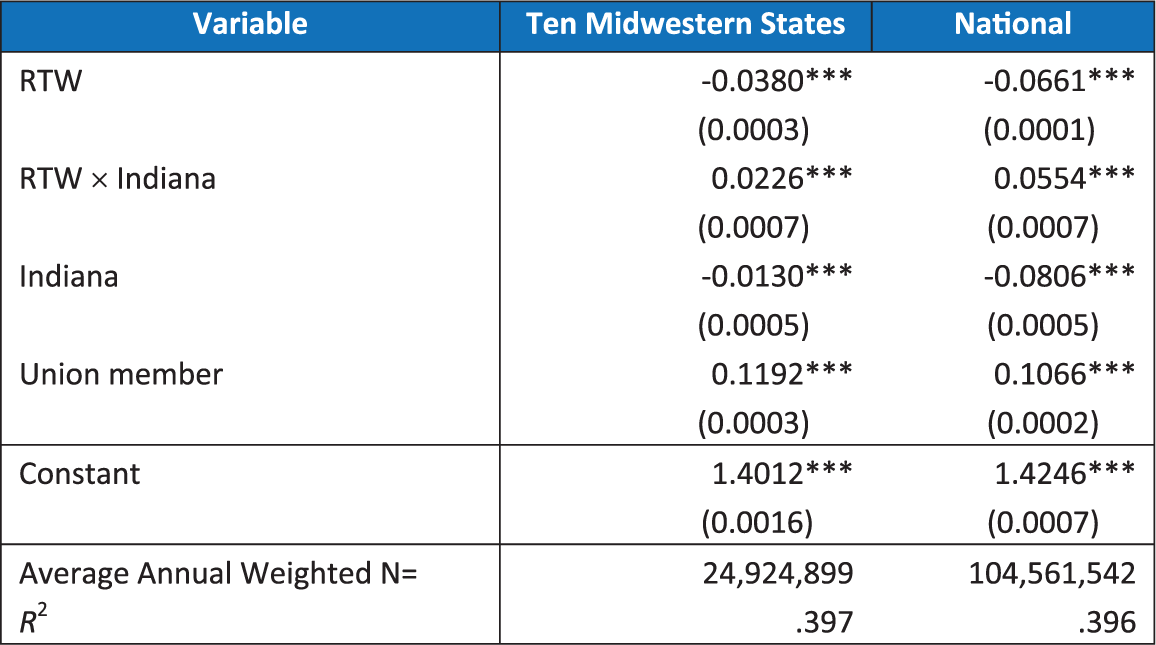
OLS regression results of impacts on in (real wage), 2009 through 2014.
Union membership, however, is found to increase average worker wages across both models. Union membership statistically raises a worker’s hourly wages by between 10.7 percent and 11.9 percent on average (Figure 11). Thus, if RTW results in a significant reduction in Indiana’s unionization rate, the policy will further diminish the average hourly income of workers in the state.
RTW’S impact on employment outcomes is mixed. Figure 12 reports results from the probit regression. In the first specification, RTW is estimated to raise an individual labor force participant’s probability of being employed by 0.5 percentage points. The RTW × Indiana interaction term, however, reveals that RTW’s impact is 0.4 percentage points lower in Indiana. The regional model thus finds that RTW improved employment by 0.1 percentage points in Indiana from what it otherwise would have been. The second run of the model finds the average marginal effect to be 1.5 percentage points for the nation. However, the policy’s impact is 1.0 percentage points lower in Indiana—an estimate that yields a small 0.5 percentage point increase in the employment rate of those in the labor force due to RTW. OLS regressions on the natural log of usual hours worked per week likewise report ambiguous results. After accounting for the interaction terms, RTW is found to reduce a worker’s hours worked per week by 0.3 percent in the regional approach but increase the workweek by 0.1 percent in the national approach (Figure 13). To summarize, RTW minimally increases the likelihood that a labor force participant has a job by between 0.1 and 0.5 percentage points but has an uncertain and nearly insignificant impact on an average worker’s workweek, with estimates ranging from a −0.3 percent to a 0.1 percent effect on hours worked. The promised employment benefits of RTW have not been fulfilled.

Probit regression results of impacts on prob(employment), 2009 through 2014.
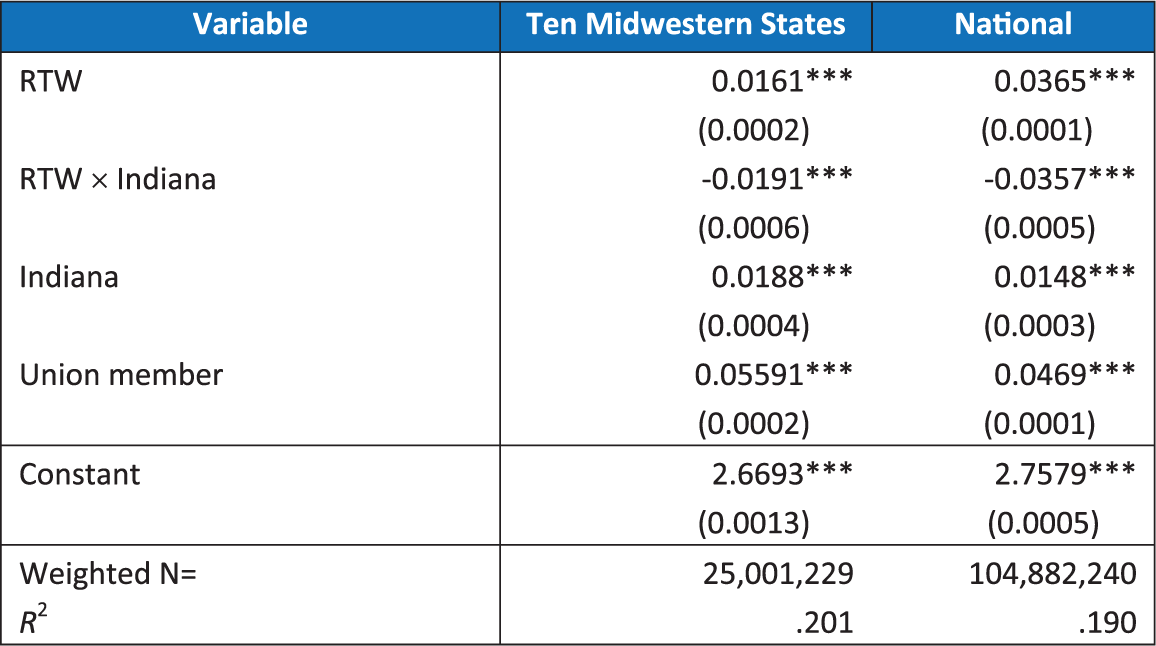
OLS regression results of impacts on ln(usual hours), 2009 through 2014.
RTW has also lowered state income tax revenues (Figure 14). In January 2012, the final month in which the state did not have an RTW law, there were 3.18 million labor market participants in Indiana, of whom 91.73 percent had a job. At the time, the average wage was $21.23 per hour statewide, and usual hours worked averaged 34.5 per week for the typical worker. Holding all else constant, results from the regression analyses indicate that RTW reduced total labor income by $539 million to $1.72 billion per year. Conservatively assuming both an average income tax rate of 3.0 percent and 50 workweeks per year, RTW is estimated to have resulted in a loss in annual state income tax revenues of between $16 million and $52 million.
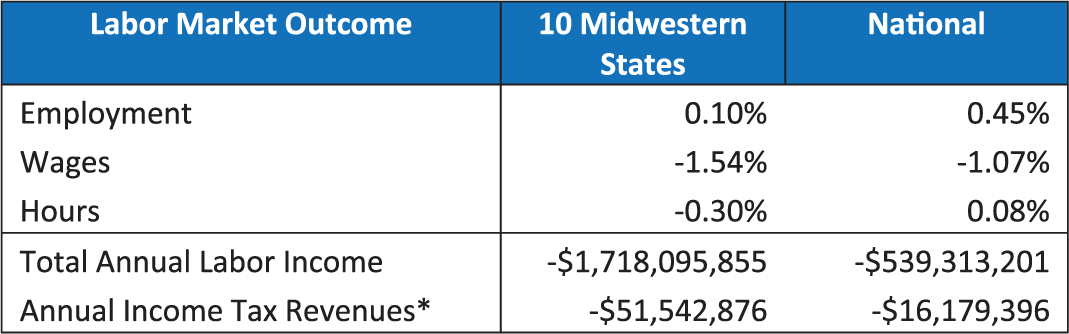
Estimated impacts of Indiana’s RTW law on labor income and income tax revenues.
These estimates align with the actual reported declines in individual and corporate income tax revenues from 2011 to 2014. According to the State of Indiana Comprehensive Annual Financial Reports by the Indiana Auditor, total individual and corporate income tax revenues were $5.78 billion in 2011. Revenues decreased by $357 million in 2012 (the year in which RTW was enacted) and by $53 million further in 2013 (Comprehensive Annual Financial Reports (CAFRs) of the State of Indiana 2011-2013).
Discussion and Conclusion
RTW’s economic track record in Indiana has thus far been mixed at best and poor at worst. Private-sector job growth has slowed since RTW was signed into Indiana law and mirrors, but does not surpass, regional trends. In the thirty-six months following RTW’s passage, 864 more business establishments have closed than opened in Indiana, unemployment has not declined more in Indiana than in the region, construction employment has plummeted by 4.0 percent in the state while it has increased everywhere else, and construction wages have fallen further behind the rest of the country by over $2 per hour.
Advanced analysis suggests that any gains in average private-sector wages have been due to statewide trends and policy changes other than the RTW law. RTW’s unique effect has been to lower per hour wages in the state economy by between 1.1 percent and 1.5 percent on average. This analysis does not include RTW’s negative effect on union membership. Results from the analytic models demonstrate that unions raise worker incomes by between 10.7 percent and 11.9 percent. If RTW has reduced union membership in Indiana, former unionized workers have lost this wage premium, and average worker wages have decreased even further.
RTW also has a minimal impact on the employment level. The policy is found to increase the probability that a worker has a job by between 0.1 percentage points and 0.5 percentage points but have an ambiguous effect on a worker’s usual hours worked per week (between a 0.3 percent decrease in hours and a 0.1 percent increase in hours). The combination of effects has resulted in annual income tax revenues that are an estimated $16 million to $52 million lower for Indiana that they would have been in the absence of the RTW policy.
Two cautionary notes should be mentioned. First, all the data presented are short term. Many collective bargaining agreements in Indiana may remain valid, so the effect of RTW on labor market outcomes may not yet be fully realized (e.g., union contracts in place keep wages high in Indiana; when they expire, the average private-sector wage is likely to fall). Future research in a follow-up study is needed as more data become available. Second, CPS-ORG data used in the regression analyses report a worker’s state of residence rather than state of employment, so the results may be slightly biased by workers who live in Indiana but work in a fair share collective bargaining states such as Illinois.
Despite these cautionary notes, the data do not support the notion that RTW has had any real positive economic impact on Indiana. At best, Indiana’s experience illustrates that RTW is not a quick fix to poor labor market performance. At worst, RTW has a negative impact on various labor market outcomes, particularly worker incomes. Law makers throughout the country should avoid succumbing to the weak, unjustified claims made by proponents of RTW laws. Instead, workers need sensible, “high-road” policy solutions that spur the respective state economies and pay long-term dividends. Indiana’s experience demonstrates that an RTW law is not one of those solutions.
Footnotes
Acknowledgements
The author thanks Robert Bruno, Marc Poulos, Victor Devinatz, and an anonymous reviewer for helpful comments and suggestions.
Declaration of Conflicting Interests
The author(s) declared no potential conflicts of interest with respect to the research, authorship, and/or publication of this article.
Funding
The author(s) received no financial support for the research, authorship, and/or publication of this article.