




Abstract
This article traces the development, method, and mission of Denver’s Romero Theater Troupe, beginning with its origins at the University of Colorado Denver. The article also connects the troupe’s process and foundation to the important antioppression work of Paulo Freire and Augusto Boal. The Romero Troupe has developed an all-volunteer, arts-based approach to community organizing and pedagogy that provides a unique model for today’s weakened labor movement. The troupe’s “organic theater” also provides a challenge to traditional forms of pedagogy that exclude too many students from working-class backgrounds.
Keywords
I believe that all truly revolutionary theatrical groups should transfer people the means of production in the theater so that the people themselves may utilize them. The theater is a weapon . . . a weapon of liberation.
Over the past eleven years, the Romero Theater Troupe in Denver, Colorado, has performed plays on such topics as the history of the labor movement, a people’s history of Colorado, and the story of a current organizing campaign of custodians at a local university. The troupe has developed and performed eleven plays and countless performances, using numerous venues and drawing total audience numbers in the thousands, the majority of whom are working-class members of the community. We have been able to do this without a true budget while giving away the funds that we collect in donations at our shows. The Romero Troupe also operates without a director or staff, and with an all-volunteer cast of performers who lack any kind of theater training. This is a story about the Romero Theater Troupe and how the arts can engage and educate entire communities. This year, the troupe was honored by the National Education Association with their Cesar Chavez Civil and Human Rights Award (Figures 1–4).
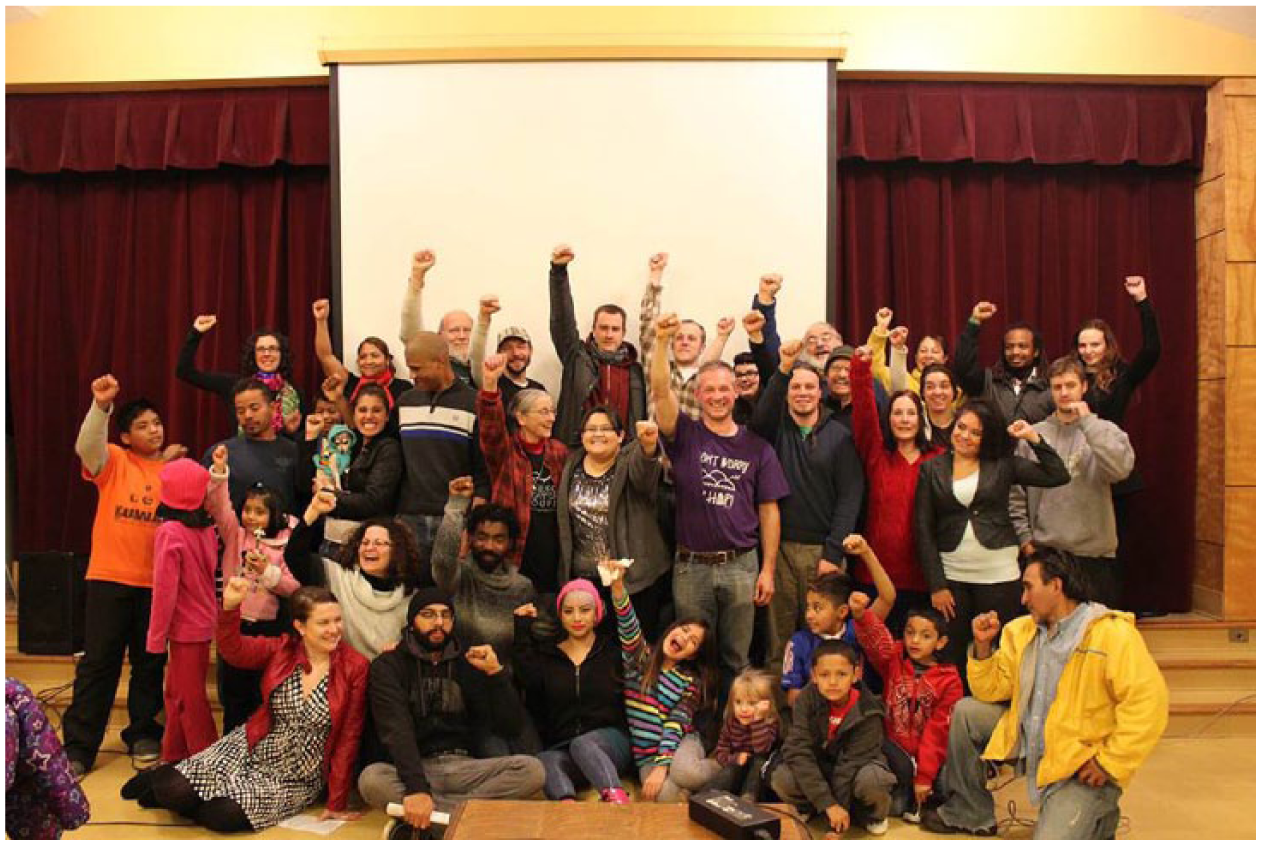
One of our recent team photos captures the spirit and community that we have developed.
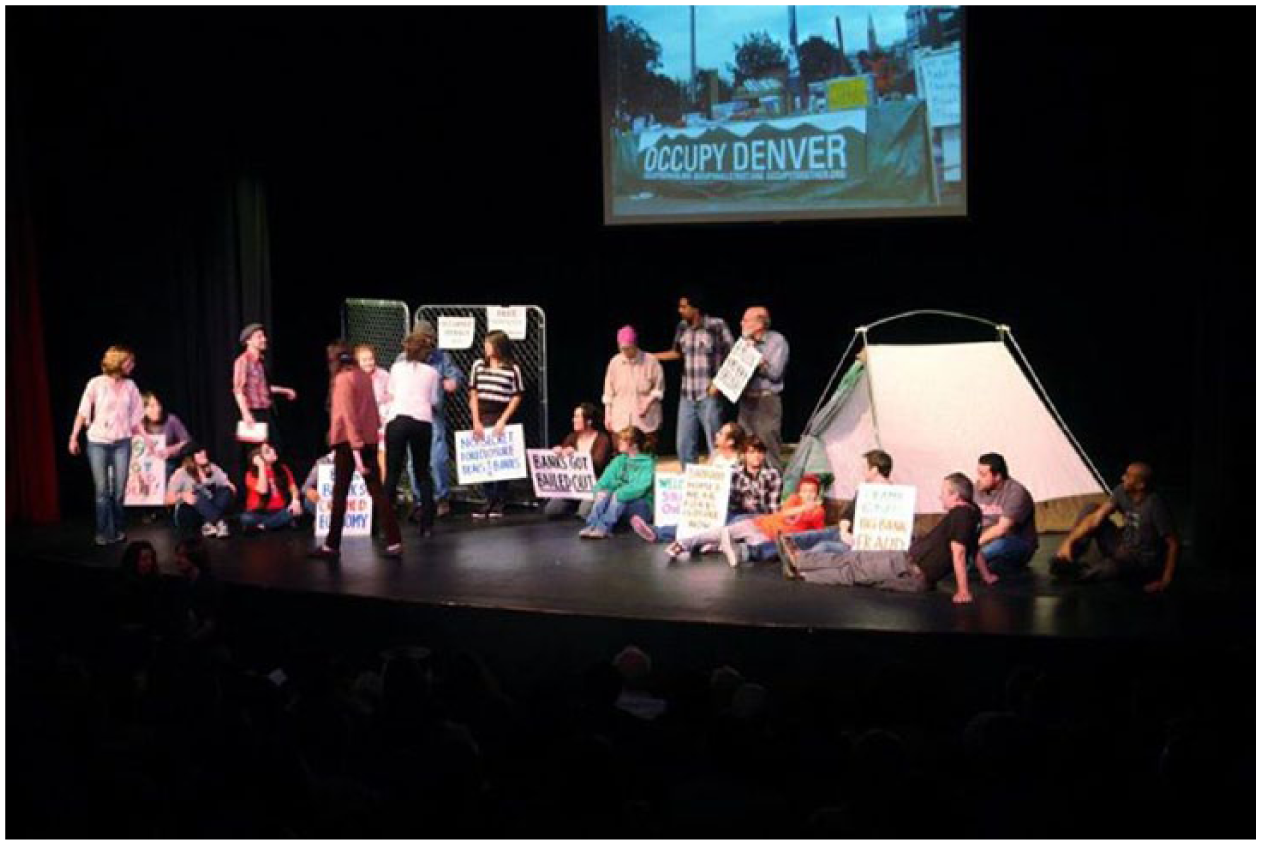
Romero Troupe performances involve a cast of 40-50 people. At times, audience members have spontaneously joined troupe on stage.
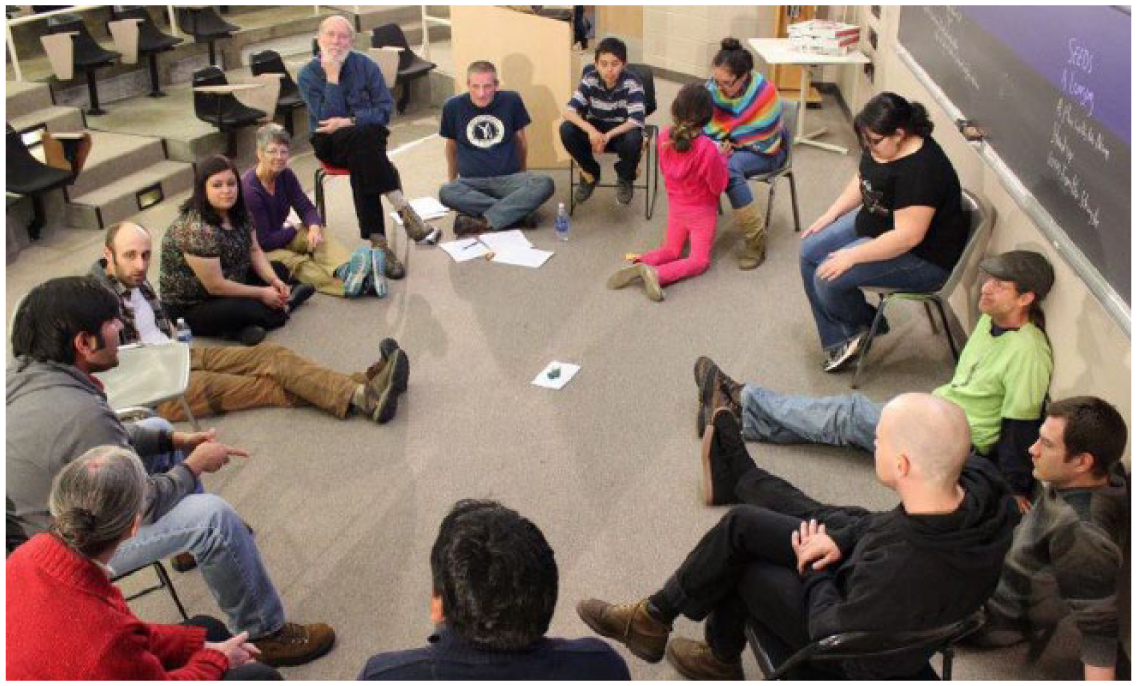
Every meeting and rehearsal begins with a circle where each member of the community shares something about their own lives. A lit candle usually is placed in the center of the circle. Frequently, the troupe spends more time talking in the circle than they do actually rehearsing.
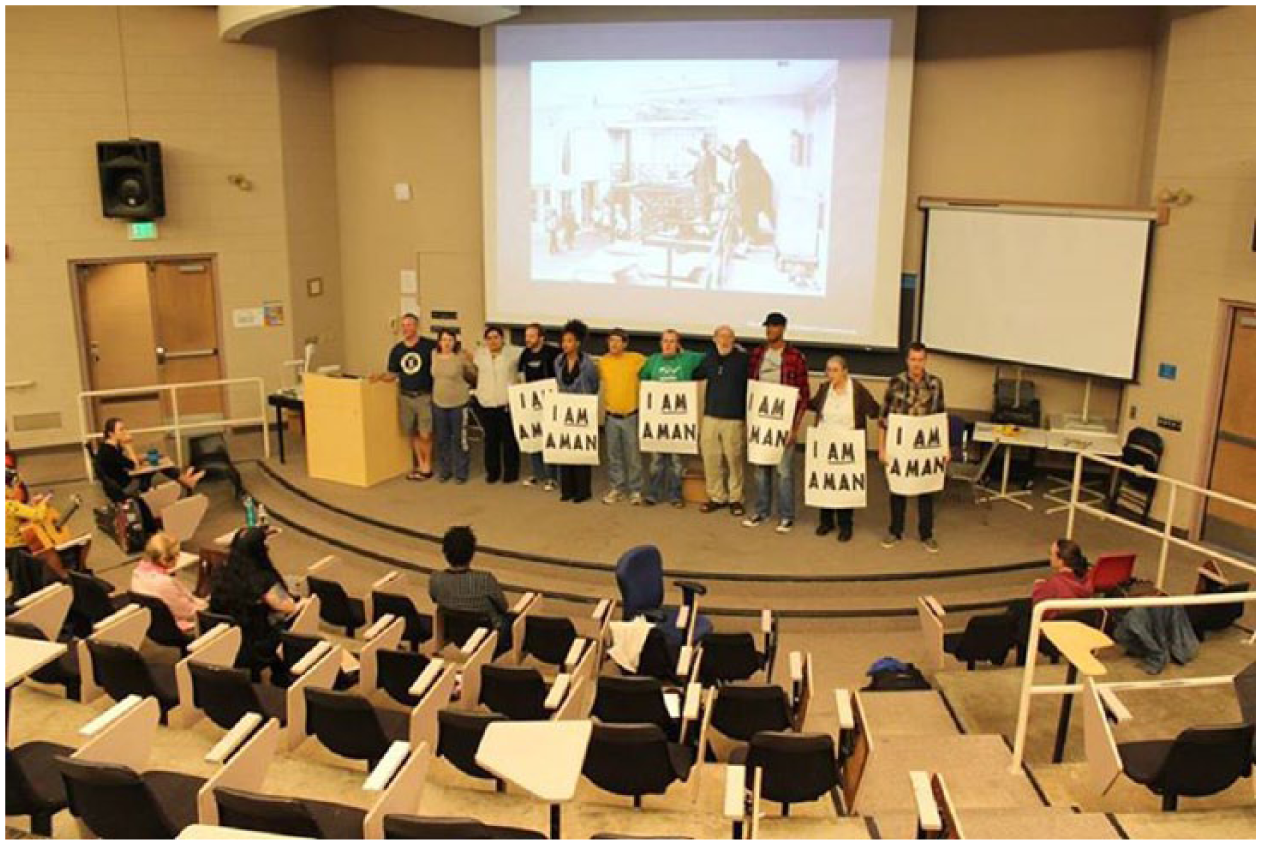
The troupe uses a large lecture hall in the North Classroom building at the University of Colorado Denver for rehearsals.
This is also a story about the art of teaching, about how theater saved my career and redefined my ideas about teaching and learning. It is a story about trying to find a way to connect to university students from working-class backgrounds. It is a story about how the arts can transform our schools and challenge the standardized-testing hierarchy that essentially ranks students by the income level of their parents. Mostly, though, this is a story about community and solidarity and an arts-based approach to resurrecting the labor movement and preserving the important history of labor activism. This is a story about love and human potential and Paulo Freire and storytelling. It is a story that our labor community should pay attention to.
Class in the Classroom
The universe is made up of stories, not of atoms.
I have taught for twenty years at the university level, eighteen of those years at the University of Colorado Denver (UCD). I began teaching at UCD with classes that regularly enrolled between 150 and 200 students. This exploitation that I experienced as an adjunct instructor ended up being a blessing in disguise because it regularly put me in front of thousands of students, students eager to venture outside of the bounds of conventional classroom norms. This exploitation afforded me the opportunity to organize.
I was very uncomfortable with the traditional lecture/exam model of higher education, with its sanitized, controlled, measured atmosphere, which was completely alien to the emotional, animated expression that I grew up with in an Irish Catholic family in the working-class steel town of Butler, Pennsylvania. Where I come from, people express themselves with the tone of their voices, with emotion and storytelling and laughter. I felt extremely uncomfortable in the cold, scholarly atmosphere of higher education.
I noticed the students sitting on the margins, pretending to pay attention. These were the students from working-class and low-income communities, first-generation college students for the most part, adjusting themselves to the culture of higher education and desperately trying to figure out how to assimilate to the academy, trying to suffocate the way that they were taught to communicate and emote, in hopes of learning the social coding of privilege. These were the students that I set out to identify and to work with.
Theater in the Classroom
As individuals or as peoples, by fighting for the restoration of [our] humanity [we] will be attempting the restoration of true generosity. And this fight, because of the purpose given it, will actually constitute an act of love.
During these early, formative years in my teaching career, I had the opportunity to co-teach a large class with Dan Caldwell, a colleague in his fifties, a Vietnam War veteran with Cherokee and Scots Irish heritage. Dan taught me the importance of teaching with love. He introduced me to Paulo Freire and to the idea that education is the practice of freedom.
Dan regularly waded up into the aisles of our enormous auditorium-style room, wiping perspiration off of his forehead, touching those students on the margins with loving words and returning to the podium with a new connection. I marveled at his storytelling approach to teaching, his ability to validate the experiences and attitudes of apathetic and even embittered students, and his complete rejection of what Freire refers to as the banking method of teaching and learning. I learned about the importance of spontaneity and improvisation in the classroom. Teaching with Dan Caldwell every semester for six years offered me my greatest education in pedagogy. He gave me permission to let go of the banking method that I had learned as a graduate student, and to make myself vulnerable to students. He taught me to tell stories as a way to introduce concepts, events, and ideas. He humanized our classroom and became for me an indispensable mentor. He taught me that I did not have to adopt an academic voice in the classroom, a voice that was not my own, but instead, to celebrate my own working-class roots. Those six years offered me a model of what Freire writes. Dan Caldwell encouraged me to teach in my own skin.
After our first year of co-teaching, Dan and I decided to remake our course requirements and assessments. We threw out midterms and final exams and replaced them with theater. We decided to challenge our students to create drama in the classroom as a means of asking our students to become student-teachers (in Freirian terms). The act of slowly surrendering the power of the podium in the classroom opened up the needed space for student creativity and potential to flourish. The results inspired us and affected us deeply. These classroom performances allowed for student-on-student teaching moments where complex historical events and ideas were broken down and translated into the vernacular of a younger generation. Laughter, anger, despair, jealousy, hope, and the rest of the human experience visited our classroom. We adapted the project to include a post-performance dialogue, allowing the performing students to offer insights into their ideas, challenges, conclusions, and research. We slowed down the process and let the students teach each other. This method took flight, the reputation of the class spread, and the size of our already large class swelled to over two hundred students per semester.
Although I could not put words to it at the time, I was learning how to build a student-centered classroom. In his seminal work, Pedagogy of the Oppressed, Freire writes about the importance of empowering students to teach from their own expertise of the world, from their own stories of struggle and oppression, developing a dialogue that transforms education. I was also learning how to organize people. Surrendering power to my students frequently meant seeing them take off in new directions, in many cases, toward greater activism.
The focus of my teaching since that time has taken a decidedly class-based turn, toward labor and immigration, the history of social movements and important moments of solidarity and resistance; challenging students to create plays from below, from the scattered sources and voices of the working poor, the transient, and the marginalized. Many first-generation students and students from low-income backgrounds are now solidly engaged in my courses, even sitting in the front rows and leading discussions. Privilege in my classroom flipped across the economic divide and led to one of the greatest ideas of my life.
Into the Community
Dominator culture has tried to keep us all afraid, to make us choose safety instead of risk, sameness instead of diversity. Moving through that fear, finding out what connects us, reveling in our differences; this is the process that brings us closer, that gives us a world of shared values, of meaningful community.
At some point, the idea came to me to pursue the power of organic theater to influence my larger community. If theater with a labor and working-class focus could so thoroughly transform my classroom and my ideas about teaching and learning, what could it do in the greater community? I set out to create an all-volunteer community theater troupe whose mission would be to empower and engage working-class audiences in the same way that my classroom theater project engaged students from nonprivileged backgrounds. I felt called to follow this vision.
Without any theater background or training to speak of, I waded into the world of community theater with only a vision and a conviction that the arts can open up the history of worker resistance and structural violence to those who have been denied any kind of empowering literacy in their formal education. Patrick Finn (2009) writes about the vast differences that separate the kinds of literacy taught in privileged schools with the more “functional literacy” provided to youth in working-class areas. I could not have articulated it at the time, but I was determined to bring Finn’s Literacy with an Attitude to marginalized communities. I had my own background to draw from. When I arrived at Duke University in 1985 on a wrestling scholarship, I quickly learned how different my education was from my fellow classmates, most of whom had attended private or well-funded suburban high schools. I had never even heard the word brunch. I did not know what it meant to challenge a professor, to think critically, to imagine history as a subject that included low-income communities, or to see education as in any way connected to social change and community solidarity or resistance. I was an object in my education rather than a subject.
Thus, in 2005, after several years of using theater in my classrooms, I began calling former students to pitch the idea of a theater troupe, eventually cobbling together a team of seven former students and colleagues. Our first gig was to perform a kind of biography of the life of Oscar Romero for a commemoration at Regis University on the twenty-fifth anniversary of Romero’s death. The more we learned about Romero, the more taken we were with his story of martyrdom, and more importantly, his story of transformation, from a conservative bishop and a tool of the established power structures in El Salvador to his decision to speak out against the regime—a decision that cost him his life. Because his story and legacy symbolizes the kind of transformation that we seek both in ourselves and in our audience, we adopted his name. Five minutes before curtain that night, the host poked his head between the curtains. “Quick, what do you call your group?”, he asked. After a short pause, I replied “The Romero Troupe.”
Our next play was the story of Jean Donovan, an American churchwoman murdered in the 1980s in El Salvador. Immersing ourselves in the history of U.S. imperialism in Central America shaped us in many ways for what would follow. It was an easy leap from Central America to the long history of struggle of workers and immigrants in the United States. Our first feature length play was titled Speak American, an exploration of the roots of xenophobia in the United States. The play consisted of immigrants, documented and otherwise, telling their stories in first person, coming out to the larger community at a time when very few undocumented immigrants dared to come out of the shadows. We performed this play three times for eight hundred people and began to see our profile and our popularity rise. We followed this play with a performance called 9/12, a play created in the aftermath of 9/11 that explored the islamophobia, xenophobia, and militarism that we were seeing all around us. This play was performed twice in February of 2007 for approximately five hundred people.
In the fall of 2007, the Romero Troupe began the work that has come to define us. We attempted to tell the history of the American labor movement in a single two-hour play. The play was called Which Side Are You on? It involved a series of stories about prominent strikes and labor leaders. We told stories such as the Flint sit down strike of 1937, the Triangle Shirtwaist factory fire, the Ludlow Massacre, the Memphis garbage workers’ strike and death of MLK Jr., and the United Farm Workers and Dolores Huerta. The ghosts of A. Philip Randolph, Woodie Guthrie, and Mother Jones all made appearances in the play. The play debuted on a cold October evening at Denver’s International Brotherhood of Electrical Workers union hall on a linoleum floor and was an immediate hit. To our great surprise, we performed this play to packed houses averaging nearly three hundred people per show. The play was so successful that we continued to schedule a performance every other month and this went on for two years! The community kept asking us to perform the play again and we complied again and again. In the end, the play was performed eleven times for nearly three thousand people. Our next play, A People’s History of Colorado, was equally successful and ran for one and a half years with two thousand two hundred people in attendance for the eight shows. Since then, we have offered various plays about local Colorado history involving unknown activists, acts of resistance, and labor actions, attempting to create a kind of theatrical archive of local civil rights and labor history, one that includes many recent stories.
Hitting a Nerve in the Community
It’s been a lot, truly it’s been a lot. Because believe it or not, before this I was a really quiet person. In school no one really knew me. No one can say oh, her name is Anna, because I never really expressed myself. I was in the IB program, it helped me a lot in high school because it was small groups, the same people, so we created our family there. But the Romero Troupe has helped me become more, like more open, now I talk a lot with people. I don’t get really nervous anymore, like being in front of other people speaking. So I think it’s helped me in speech, talking more, being more open and really, really showing how I feel and all those things.
The greatest surprise that we have encountered is the number of people who come to our shows. Our advertising is limited to social media and email, but our average audience is around 250 people, making us one of the most successful theater groups in the city, one without a real budget, any staff members, or a director.
The size of the troupe also continues to grow. Members give what they can, when they can, which makes it impossible to ever have a solid feel for the number of active members. Nonetheless, nearly eighty people now contribute something to our shows and at least 350 people have participated in the troupe during our history. The average cast size on the night of our shows numbers in the forties. Roughly half of our members are former students of mine who have participated in organic theater in my classroom and feel drawn to social activism. I teach courses about labor and immigration politics, social movements, and community organizing. These courses deal directly with the same issues that the Romero Troupe highlights, making this an easy transition. I have learned that most students crave some kind of active role in their community and would much prefer art over being a faceless intern at a local nonprofit organization.
The concept of solidarity is new to most of my students. Feeling solidarity in the classroom, studying it in the past, and listening to activists in the community who pursue it shifts the way that students view the purpose of education. The transition from my classroom to the rehearsal circle of the Romero Troupe is usually seamless, save for the social anxiety that comes with meeting a large group of strangers. In some cases, my students bring their friends, partners, children, even their parents, to rehearsals. Other newcomers to the troupe show up at rehearsal via connections to other members, some kind of previous awareness of our work, or because they saw one or more of our shows and were inspired to become involved. Our door is open to everyone; we do not use any kind of audition, criteria, or interview. In this way, we belong to the greater community.
Our greatest lesson is the notion that there is a deep hunger in the community for the history of struggle, a hunger to learn about social movements and unknown acts of courage and solidarity. This hunger is particularly pronounced for those who did not enjoy an empowering literacy in their education, those from low-income and marginalized communities. We know this because we have felt it and listened to members of our audience talk about it. We know it because hundreds of people flood to our shows in an era when many professional theaters are folding. Quite accidentally, we believe that we have stumbled across an important and powerful tool for revitalizing the labor movement and class-based activism in general. This is the story of a model that we have created with nothing except our instincts and dreams, a model that we believe is entirely unique.
Method, Practice, Structure, Principles, and Process of the Romero Troupe
I will tell you something about stories. They aren’t just entertainment. They are all we have to fight off illness and death. You don’t have anything if you don’t have stories.
The Romero Troupe has slowly developed and shaped a very distinct, complex, and unique model of storytelling and story making, one that we believe does not exist anywhere else. Our umbrella term to describe this messy and beautiful process is organic theater. In this section, I will attempt to explore the culture, practices, structure, process, and method of the troupe, to clarify the kinds of practices that make our work so unique and different.
Consensus-Based Decision Making
We operate on a consensus model. This means that although I serve as the facilitator of the troupe, scheduling rehearsals and meetings, as well as developing connections in the community and managing the day-to-day operation of the troupe. Larger decisions that relate to our mission and work are made by the Romero community. This ensures that all of our members have a hand on the steering wheel, shaping our work and our values. It is not always a neat and tidy process, but the center always holds. This model necessitates that those in our community with privilege, seniority, and confidence step back and be constantly aware of the space that they consume. For me, this is a constant struggle and one of our great challenges. Having founded the troupe and led it through a decade of difficult work, I am aware that my voice carries a kind of hegemony over other voices. I try to make space for more quiet voices, try to make gentle suggestions, and try not to become too married to any particular idea or vision. Somehow, this has worked. I attribute this to the “elders” in our community and the deep respect that they have earned across the membership. Some of them are very comfortable in telling me when they see me moving too much to the front, using my power to push a vision instead of facilitate a process, or becoming too much the face of the troupe. I use this term elders loosely, as I am now old enough to qualify for membership in this category, but I refer directly to a small, very committed and dedicated group of people over fifty who rarely miss a rehearsal and soften much of the emotional baggage that the rest of us bring to our meetings. One of our members, Helen Powers, is ninety-three years old, and shows no signs of slowing down. This cadre of elders, some of them retired activists and educators, constitute the heart of the Romero Troupe and solid grounding for our younger members. In many ways, they understand the process of consensus much better than I, reminding me at times to step back and allow the process to work as it is intended. This process is similar to the Quaker practice of determining the will of the group.
Budget-Less Operation (Almost)
We operate with a very small budget of roughly $500 per year. This money comes from small donations made by organizations that invite us to perform at conferences or symposiums. These funds live at our fiscal sponsor, El Centro Humanitario, and cover annual awards, an occasional special prop or costume, and Romero Troupe t-shirts. One of the most difficult decisions that we have had to make with our consensus model is how to exist as an all-volunteer organization. This has become the clear will of the group, that we would not venture into the realm of having any paid staff, meeting a payroll, becoming a 501c3, or having to become dependent upon the grant-writing industrial complex. We also decided that we would be careful not to fall into any pattern of becoming dependent upon grants, and to remain committed to a shoestring operation where our material needs are donated from the community. This is who we are. We believe that this model liberates us from the constraints of the 501c3 trap, where a large percentage of an organization’s resources and energies go toward writing grants proposals, meeting payroll, and covering the rent. Our energies go toward our art and our community solidarity. Without a physical space of our own, we are forced to perform in community spaces, cultural centers, churches, outdoor venues, and artsy cafes. This ensures that we are always exploring new spaces and connecting with new communities. It ensures that we are fluid, flexible, and completely grassroots.
Organic Rehearsal Method
Augosto Boal’s (1979) Theater of the Oppressed offers several methods of using theater to explore and identify problems and solutions with power structures in society and to engage the community in problem posing and problem solving. One of his most influential methods is forum theater, the practice of inviting members of the community in the audience to enter into a scene and present alternative approaches to shaping the story and solving the problem. While we have used forum theater in various workshops and performances, and while we find it very useful and powerful in terms of engaging the community on a deeper level, we have come to rely upon a method that has a similar practice but a different purpose. Our stories begin with either a loose script or no script at all. From there, our consensus model shapes the scene, building a kind of Boalian dialogue after every rehearsal of the story. This dialogue sometimes involves a member stopping a scene to make a suggestion or even jumping into the scene to demonstrate a suggestion. This democratic, or forum theater approach to shaping the scene and offering suggestions ensures that the final product is a collective vision and carries the values and complexities that define our work. Organic theater means that every story and every scene is alive and fluid. The actors in each scene are also constantly in flux. Our method is to practice a scene, stop and start the scene as feedback and ideas flow from the members, and when the scene ends develop a dialogue about the scene, shaping it collectively before we run it again and again with the same process.
The final products of this process become the moving pieces of our plays. We embrace the method of Boal’s forum theater, and every one of our rehearsals is a kind of practice of forum theater, but in a milieu where less confident and more injured voices find the space and support to shape the stories in their image and experience. This process is messy and sometimes painfully slow, but in the end we give birth together to beautiful stories that we consider more authentic than those developed in a traditional director model where the vision of one person is enforced. This also involves a constant effort to get behind the confident voices in the room, in order to access the ideas that have been held hostage to privilege. We call this messy, beautiful method organic theater, recognizing that the stories are alive. Each story is told differently every time we decide to tell it, continually migrating to a place of greater truth. As one of our members Phil Woods says in the documentary about the Romero Troupe, Unbound, “When the performance becomes just a performance and there isn’t anything left to discover [in the stories], then we know that it’s time to move on.” 1
The stories change and shift with each performance and with shifting actors playing different roles. This keeps the stories fresh. Any member of the troupe is also free to contribute new research or ideas about a scene, shifting the way that we might see the story and requiring us to make changes in the performance. Actors can even radically change a scene spontaneously on stage, or turn and engage the audience with questions. The audience thus senses that the production is very loose and that they themselves have an important role. This process of discovery, as Woods says, eventually turns stale, and then we know that it is time to move on.
Class Solidarity
All of the forum theater that I have observed involves people who are already politically empowered and confident engaging in a practice that was designed to empower marginalized, deferential, and oppressed people. The difficulty is that the marginalized and oppressed are working and struggling to survive and do not generally have the time or energy—not to mention the funds—for theater of the oppressed workshops. We have worked hard to create an organization where the majority of voices are working-class voices, or voices with roots in the working class, people dealing directly with the kinds of oppression that we seek to highlight. Michael Kilman wrote his MA thesis about the Romero Troupe for Portland State University. As part of his project, he completed demographic surveys of the members of the troupe as well as the audience. He discovered in his research that 73 percent of the members of the Romero Troupe earned less than $40,000 annually. Nearly half earned less than $20,000. Our audience represented a similar income level with 64 percent earning less than $40,000/year (Kilman 2014, 59). People who have experienced oppression in their lives project a powerful authenticity on stage. Both our audience members and our membership identify with class-based stories told by working-class voices. This offers us an opportunity to connect on a deep, personal level and to transform people from working-class communities. Although we ask audience members to donate to specific community organizations on the night of the shows, the show itself is free and no one is turned away. This practice ensures that our theater is accessible to members of the working poor. Another practice is to welcome children of all ages into the theater. Frequently, a child will wander onto the stage and join a scene, to the delight of the audience. The occasional complaints about active or disruptive children usually come from those who expect the polite deference that usually accompanies professional theater. Our purpose is to shape a theater culture around the idea that everyone is welcome and that everyone is there to discover something. This is one of the greatest reasons for our success and popularity, creating a space that feels like the people’s space.
Donating All Proceeds to Social Justice Organization
Our mission is to invite those who have been excluded and priced out of the theater to recreate the tradition of radical theater with a class-based and economic justice focus. At each of our shows, we solicit donations for various social justice organizations whose work we respect. Because our shows draw such large crowds, we have been able to raise tens of thousands of dollars to support organizations such as Iraq Veterans Against the War, the Harm Reduction Action Center, El Centro Humanitario de los Trabajadores (an immigrant worker center and our fiscal sponsor), Denver Metro Sanctuary Coalition, Colorado Anti-violence Program, Four Winds American Indian Council, Colorado Progressive Coalition, Rights for All People, the American Friends Service Committee, and the Denver Justice and Peace Committee. By sending all of our donations out into the activist community, we live our values and our mission. We also become another funding source for other organizations. Each show is a partnership with an important community ally, which further increases the size of our audience and our exposure in the greater community. We also believe that we are offering a model that counters the idea that funds are necessary for activist organizations to survive. Giving provides us with a different form of currency, one that we have come to see as much more powerful than receiving. Without any real budget of our own, we are able to contribute greatly to the budgets of others. We like to joke that we are not nonprofit as much as we are antiprofit.
Community Workshops
Our major stage productions are only a part of our work. Each year, we give dozens of workshops in the greater community. We perform these workshops at schools, shelters, businesses, community groups, day labor facilities, and conferences. The format involves introducing the participants to our work, our mission, and to the organic theater process that we have developed. We break the participants into small workgroups and invite members of each group to share stories from their own experiences about struggle, resistance, and social justice. The workshops, usually two-hours long, culminate in a kind of performance where each group performs their stories, followed by dialogue with the larger group. The purpose of these workshops is to promote healing and to engage the participants in the cathartic energy of storytelling. We also seek to introduce participants to the social capital in their personal stories and to imagine using their stories as part of future activism. The dialogue that follows each skit offers the participants an opportunity to educate others about the kinds of oppression and marginalization that they face and the kinds of struggles that they have endured. Many of our members consider these workshops to be the most powerful element of our work, as they present a kind of intimacy and direct community engagement that our large performances do not have. We consider this work a kind of story liberation and a powerful method of inviting marginalized communities into dialogue by telling stories that put their own experiences into a larger context. Many participants in these workshops have later joined the troupe out of a desire to deepen the empowerment that they experienced in the workshop.
Diversity
We have been fortunate in that many of our members are rooted in the immigrant rights movement or work for organizations that work directly with immigrants, such as El Centro Humanitario, Rights for All People, the Colorado Immigrant Rights Coalition, or Colorado Opportunity for Latina Opportunity and Reproductive Rights. Due to these connections, many of our members are themselves immigrants, documented and undocumented, and this has grounded us deeply in the immigrant rights movement. Some of our members are monolingual Spanish speakers. We also have many bilingual members and others who have some grasp of the second language and can help others who do not. These members bridge this language chasm and allow us to create stories and shape them together, leading to a beautiful and nourishing multicultural community. These members provide translation during meetings and rehearsals. Rehearsing a story that involves monolingual Spanish actors and monolingual English actors requires much patience, commitment, artistic vision, and care. The rewards, however, are enormous, as our audience can witness firsthand how the great language barrier can be bridged collectively. Several undocumented immigrants have made the decision to tell their own stories on stage as part of our performances. These stories always elicit the loudest and most emotional responses from the audience, sensing the courage and catharsis at work on stage where the most vulnerable in our society open themselves and share their stories.
Our method, mission, and values have also made our community inviting for people of all racial and cultural backgrounds and we consider ourselves to be among the most culturally diverse arts community in the state. Other dimensions of diversity that we enjoy are socioeconomic and age diversity, as well as diversity in sexual orientation and gender identity. We feel the value of these kinds of diversity at every rehearsal when our membership become educators and experts in their own experiences. When we focus our stories on important social movements, such as the lesbian, gay, bisexual, transgender, and queer (LGBTQ) struggle, the wages of fast food workers, immigrant rights, or the fight against police brutality, our community begins to reflect the stories we are telling. We do not need a diversity committee or any kind of special recruitment strategy; we simply find that inviting everyone’s stories to the table leads to open doors and intersections of experiences. In other words, we have learned that the stories themselves can act as inroads into communities where we have not been historically represented, offering us a kind of street cred. Age diversity is not something that is generally included in most diversity programs, but we consistently hear accolades after our shows about the intergenerational dimension of our community. We all feel this generativity and the way that wisdom and stories flow across generational and cultural boundaries.
Inviting Those Who Lived the Stories to Join Us on Stage
Using oral histories to research our stories led to the idea of inviting those who participated in the stories that we are telling to address the audience after the story is performed. Every play involves three or four people being introduced to the audience and taking the stage to share their memories and lessons. This is also a valuable way to honor the stories of those left out of traditional history textbooks and unknown to the general public or even to the activist community. I clearly recall the silence in the auditorium as Bob Fuchigami addressed the audience and shared his memories of Amache Japanese Internment Camp; when Lupe Briseno talked to a packed house about a seven-month strike of Chicana floral workers that she led in 1968, culminating with several of the striking women chaining themselves to the company fence; or when Donaciano Martinez spoke to a recent audience about his memories of an LGBTQ rights march that took place in Denver following the police killing of a young drag queen in 1978. By offering these activists an opportunity to share their stories firsthand after we have performed the stories theatrically, we are shaping an alternative model for what we value in history. We are also saluting those who have come before us in the struggle and offering gratitude to them. Nearly every oral history speaker whom we have introduced in our plays has been met with a standing ovation. The stories that we tell are nourishment for current activists, giving them the opportunity to learn from and hear from those who have paved the way, to realize that their efforts are part of a long arc through history, and hopefully to find strength in that realization.
Audience Participation
In 2007-2008, we performed the story about the Memphis garbage workers’ strike of 1968 and the involvement of MLK Jr. in that strike. In this scene, it was customary to end with the sound effect of a gunshot, followed by the iconic image of MLK Jr.’s colleagues standing on the balcony of the Lorraine Motel in Memphis pointing across the street to the place where the shots came from. In this instant, all of the actors point straight ahead and above the audience, as if joining the men on the balcony 40 years later. One by one, all of the actors in the troupe walk onto the stage, stop, and point. On this particular night, the audience was so moved by this scene that some stood, turned around, and pointed in the same direction as the actors. The rest of the audience followed, and we all stood in silence, three hundred people, pointing, frozen in time. Members of the troupe frequently refer to this moment as their most memorable moment on stage. Mike Ramsey, a member of the troupe, recalls: And there is something about that energy that really fed what we were doing. In the MLK scene we would all point. There was one performance at the Oriental Theater that was filled with a lot of students; they were middle school and high school students. They started it (the students) but by the end of that scene, the entire crowd was up and pointing with us. And it was a moment that I will never forget, because we were all a part of it. It wasn’t just us on the stage, every member of the audience felt compelled to stand. It was unbelievable, we almost couldn’t go on because we were speechless. (Kilman 2014, 28)
This is the best example of the relationship and the culture that we have attempted to build with our audience, inviting them to participate in the show in any way that they feel drawn to. This always involves singing, yelling, sometimes hissing at villains, and even taking to the stage. I can recall numerous times when I have noticed people I did not know acting on stage with me. They were usually friends of members who decided to jump up on stage after feeling inspired. Children not directly associated with the play are always a fixture on and around the stage. In a scene about a human encirclement of Rocky Flats nuclear plant in 1983 that involved seventeen thousand people, we turn to the audience in the middle of the scene and invite anyone who was present at the action in 1983 to come forward and join us on stage. Inevitably, three or four individuals step forward and share their stories to thunderous applause.
By the end of the shows, the troupe and the audience have come together into one entity. Through the art of storytelling and theater, we have discovered solidarity. This kind of relationship with the audience represents the power of organic theater and its potential as a tool for a revitalized labor movement for economic justice. Inspiring people to become involved in the labor movement today involves at some point making them feel as if they are part of a larger story. Theater accomplishes this in a profound way.
Conferences and Partnerships
Along with our workshops, we also perform at various conferences and programs. These include the annual conferences of the American Sociological Association, Oral History Association, Working Class Studies Association, National Education Association, National conference for the Commission on Basic Adult Education, National Conference for Media Reform, Black Student Leadership Conference, Biennial of the Americas, Denver Green Festival, and the American Federation of State, County, and Municipal Employees (AFSCME). We also partner with Regis University, Iliff School of Theology, and the University of Denver Law School in various capacities, along with national storytelling organizations such as the Telling Project and the Center for Digital Storytelling. Many of our strongest connections are with labor unions such as AFSCME, Colorado WINS, and the National Education Association.
Multi-issue Organizing
Because our performances focus on multiple social justice issues, we have learned something about the importance of organizing across issues. Every social struggle is connected to basic issues of liberation and human dignity. When we bring members of each movement together, we find a synergy and power that we do not feel in other contexts. Our experiences have convinced us that organizing across the boundaries of various social issues is essential to creating social change and to raising the consciousness of the greater community. Each movement has something to learn from other movements. Our shows are known for the energy that builds between the actors and the audience, culminating in a kind of shared vision. We believe that highlighting the connections that bind movements together is what creates this consciousness. Themes for our plays are chosen only if they represent the basic human dignity and liberation that we try to represent. Themes that we consistently have consensus around include immigrant rights, the labor movement and economic justice, civil rights and racial justice (including mass incarceration and police brutality), homelessness, environmental justice, antiwar and nonviolence movements, LGBTQ rights movement (involving sexual orientation, gender identity, and gender expression), and support for teachers and against the corporatization of public schools. We have highlighted other issues and movements, but these are the ones that bind us together. The number of stories within these movements is vast, and mainstream education rarely ventures into these areas, offering us an endless source for stories and for solidarity.
Solidarity and Spirituality
Before each rehearsal, we sit in a circle around a lit candle, and spend time sharing stories and ideas, simply listening to each other. Frequently, we spend more time talking in our circle than we do actually rehearsing our play. It is very important to us to nurture our community and to build solidarity. The lit candle is a reminder that our time together is sacred, that if we jump right into acting without checking in and reminding ourselves of why we are working together, then our time and our purpose becomes diluted. Many members of our community believe that this has created an almost spiritual culture. Mike Ramsey, a member of the troupe, puts it this way: But there is something about when we gather before a performance and we are all holding hands and we are all holding on to each other and it is almost a prayer when we are setting our intentions for the show and what we hope to accomplish. There is a spiritualness to what we do. And there is something really sacred about taking these moments in history that are sometimes incredibly tragic and terrible and then making something beautiful out of it, that I don’t think I expected and I don’t think the audience often expects. But there is something really sacred about what happens open stage with the Romero Troupe. (Kilman 2014, 26)
Arnie Carter, a longtime member of the troupe, reflects on this idea of spirituality in the troupe: It’s definitely a spiritual experience. The workshops are very spiritual. Rehearsals are very spiritual. Just riding to rehearsal with some of the Romero Troupe is spiritual. To me, you really feel the oneness. You feel that we’re all different, but you know, dangit were all one. We’re all very connected and we’re not just individuals we’re literally one being. And I really feel that in the Romero Troupe. (Kilman 2014, 26)
It is difficult to relate this theme in academic terms, but what is clear is that there is something ingrained in the experience of telling these stories on stage, a group of forty people from all backgrounds, that carries immense emotional and spiritual capital. This is our discovery, and we believe that this capital can become a powerful tool in a revitalized labor movement and strategies to grow and build momentum for this movement. Stories from labor and civil rights histories are themselves social and political capital. These stories can be told in any art form, but we believe that we must be telling them with vigor. Those who come from working-class backgrounds rarely have access to these stories in their education. The Romero Troupe is a counter narrative against the kinds of oppression that people feel every day and the kinds of abuse that people are subjected to in our culture, the ways that people in their workplaces are dehumanized and injured spiritually. We are attempting to build a space where this kind of oppression does not exist.
Previous Literature and Context
Most of the previous literature about community or participatory theater focuses on very specific communities or issues. Participatory theater refers to approaches and strategies of involving the audience in the production and also inspiring them to act in their communities as a result of seeing a particular play. These projects include the Westville Prison Project in Durban, South Africa (Singhal 2004a); the Western Edge Youth Arts theater project to combat racism in Melbourne, Australia (Sonn et al. 2015); the Radical Wallflowers and other grassroots disability theater groups in California (Lewis 2006); and Portland’s Labor Players, one of the first labor theater troupes in U.S. history (Lembeke 1981).
These groups all fall into an important history, usually categorized as participatory or peoples’ theater, involving efforts to reclaim the stage from elite and corporate interests (Lewis 2006, 88). Christopher Sonn et al. (2015, 248) suggest that this kind of art works because “identity and community-making processes are potentially disrupted, reconstructed, or strengthened through participatory theater projects.” Jerry Lembeke, in his oral history about the Portland Labor Players, writes about the transformative effect that the work had on the actors themselves, suggesting that this transformation could be the most important aspect of this kind of theater. He writes, “One of the most gratifying results of the project has thus been the metamorphosis of the group itself” (Lembeke 1981, 54). We have certainly experienced all of this in the Romero Troupe during our eleven-year history. We are also aware of the important work of troupes that have preceded us such as the San Francisco Mime Troupe; Teatro Campesino and the United Farm Workers; First Strike Theater, Su Teatro, and Vox Feminista (all from Colorado); and the University of Michigan’s Labor Theater Project. We stand on their shoulders, even as we wade into new territory.
The organic theater of the Romero Troupe, however, is in its own way a new model. All of the above groups have been tied to a particular institution (Portland Labor College or the University of Michigan), funding source (unions, foundations, and labor studies programs), or to advocacy for a particular issue (labor, disability rights, LGBTQ issues, etc.; Davis 1975). What separates the Romero Troupe from these earlier efforts is that we are operating free from the constraints of fundraising and outside the bounds of any institutional influence. Furthermore, we are the only radical community theater troupe that I have been able to find that tackles multiple issues in each play, uniting various movements and activist communities along the way. Teatro Campesino limited itself to the issues directly facing farmworkers. The size and breadth of our community allows us to reach multiple issues, struggles, and communities. Through focusing on multiple movements, the Romero Troupe has been able to enjoy the rewards that come with seeing these movements inform and teach each other.
The similarities that we share with these earlier movements is that we are tied at least partially to the ideas of Brazilians Friere and Boal and to their seminal works Pedagogy of the Oppressed and Theater of the Oppressed. We are all part of the historical arc of people’s and participatory theater and to the idea of theater as a form of resistance and activism. The Romero Troupe, however, is an example of radical community theater free from any outside pressures and not limited to any particular issue or cultural community. In short, we believe that we are creating something rare and unique and that while we benefit from these important traditions, we are free to focus on any issues that we like, educating each other along the way.
Direct Advocacy: How Organic Theater Can Help Labor
The Romero Troupe and the discussions they promote with their plays are fundamental at allowing people to come out of the woodwork to talk, to have conversations about issues that they normally don’t have. But the conversations and the discussions that have perpetuated and created by the Romero Troupe are just the first step in a long set of steps that the Romero Troupe and its members are engaged in. The Theater Troupe itself and the performances are part of a larger context where they are promoting momentum that allows, for direct action, allows for demonstrations, allows for individual acts of resistance, for people to assert themselves in their own workplace and in their own community.
One of the most important and empowering events in our history is a project we took on two years ago when we were approached by a group of custodians at the university where I have taught for years. These custodians were attempting to organize a union to challenge some of the abuses that they faced in their workplaces. We arranged eight workshops on Saturday afternoons at their union hall, timing them with the end of their meetings. For eight Saturdays, these workers gave two to three extra hours of their time to create organic theater. These workshops provided opportunities for us to listen to the custodians’ stories and to try to understand them in a deeply human way. The project culminated in a public presentation where the custodians’ played themselves and shared their stories by acting them out. The performance attracted a couple of hundred people and raised support and awareness around the workers’ plight. A march across campus was organized after the play and major news organizations picked up the story. This is the kind of work that we would like to evolve toward—more direct advocacy of workers through theater. In other words, we hope to build toward using organic theater as a powerful tool that can be used by workers everywhere to build solidarity and support. This would involve all-volunteer organic theater troupes across the country, telling local stories as a means of educating the public, building new coalitions, and growing the movement. These troupes would also use public performances as a means of spreading awareness and support around current struggles, disputes, and strikes. We hope for a revitalized labor movement in this country and that our work might inspire the liberation of thousands of stories hidden in aging union halls, church basements, family oral traditions, and cultural centers. Boal said that if it can be acted out on stage, then it can be acted out in real life. Without a solid knowledge of our own history, living in a society saturated with an antilabor mass media, it is up to workers to build their own form of community media. The printed word only reaches us in isolation. The stage reaches across generations.
How the Labor Movement Can Support and Partner with Community Theater
I am not like a sign holder or a chanter. I’m not going to yell about things. I want to voice my experiences and my observations in a way that is accessible to people, but not only accessible, but also enjoyable… I think acting and singing are really great ways to reach people, to touch people.
This connection to the traditional labor community is important, as we are building a kind of arts-based social union, where the power of community solidarity is directly apparent and where possibilities and strategies can expand. We do not believe that our acting is anything special, but we are well aware of the symbolic power of our community and our solidarity and the potential that this power holds. We are aware that the stories we are telling offer our audience a counternarrative in a culture where it is very difficult to see beyond corporate forms of media. Our labor movement has been trying to organize working-class people who have been denied access to labor education and to any sense of where their own stories fit into a larger narrative. Instead of pushing art to the margins of organizing efforts and workplace struggles, why not elevate it into a central role? Why not use art as the powerful tool that it is and build organizing strategies around theater, music, and the spoken word?
Labor Studies programs in higher education have a role to play in this partnership by first creating space within their programs for arts-based activism and storytelling. Second, identifying faculty and students who might be able to launch such initiatives is important, along with providing research support and identifying local stories of significance to tell. The Romero Troupe envisions armies of researchers in low-income communities mining the powerful stories that live there. Local labor councils and unions must recognize the role that organic theater and other art forms can play in building new coalitions, educating their members, and bringing allies into the movement.
Labor community, are you listening to this story? This ending is a challenge to a beautiful tradition in decline. Workers have long forgotten that their own stories are a powerful tool, and organic theater offers a means of preserving and celebrating these stories in a way that is accessible to people of all educational backgrounds. We did not invent this strategy; it has long been used to boost the morale and the knowledge of working people. At the recent Great Labor Arts Exchange gathering in Washington, D.C., I learned of other groups that used theater in the seventies and eighties to educate the public. What has been missing, however, is a systematic effort among labor unions and labor studies programs to support, create, and prioritize the arts, and theater in particular. As a community, the Romero Troupe would like to use our story as an example of this potential and our model as an inspiration to other groups. If we can do this without any institutional support whatsoever, then what can be accomplished with this support? This experience has transformed our lives and our ideas about social change and working-class empowerment. El pueblo unido hamas sera vencido.
Footnotes
Acknowledgements
I wish to thank Dan Caldwell, Mark Foster, and Tony Robinson, for the value that they place in nontraditional pedagogy. I am deeply grateful to the entire Political Science department at the University of Colorado at Denver for offering me the support and the space to continue my work. Special thanks to the countless volunteers, actors, musicians, workers, poets, agitators, students, and others who engage in the struggle through the art of storytelling and organic theater. I carry more than a lifetime of beautiful memories and indescribable moments where we have touched something larger than we can describe, a light that we all carry forward.
Author’s Note
The Romero Theater Troupe continues to perform in the Denver area, telling important stories of struggle. Please see our facebook page for more information. The documentary Unbound about the Romero Troupe can be found at the Auraria library’s digital archive.
Declaration of Conflicting Interests
The author(s) declared no potential conflicts of interest with respect to the research, authorship, and/or publication of this article.
Funding
The author(s) received no financial support for the research, authorship, and/or publication of this article.