



Abstract
This article uses labor history and black history to highlight how labor education can be a crucial tool for unions to respond to the Black Lives Matter (BLM) movement in a way that supports and respects its main demands. It suggests that unions are unlikely to answer the American Federation of Labor-Congress of Industrial Organization’s (AFL-CIO) call for the labor movement to be “partners, allies, and fellow community members” of the BLM movement unless they recognize the structural nature of contemporary “colorblind racism” and confront the root causes of divergent attitudes about the fairness of the criminal justice system. Such causes include the long-standing associations of blackness with criminality and whiteness with innocence, which have long justified the punishment of black workers and the control of all U.S. workers. This article highlights the structural violence of mass incarceration, the spectacular violence of police murder, the symbolic violence of anti-black cultural production, and the sexual violence directed at black women and lesbian, gay, bisexual, and transgender (LGBT) blacks. Building on black feminist theory, it argues that labor education that foregrounds the interwoven histories of race and crime, and examines how racism works through class, gender, and other kinds of hierarchies, could serve to capacitate grassroots bridge-builders inside unions. The article suggests that the history of domestic work could be a particularly valuable way for labor educators to discuss the fundamental messages of the Movement for Black Lives.
Leslie McSpadden, the mother of Michael Brown, the black teenager shot by a white police officer in Ferguson, Missouri, in 2014, belonged to the United Food and Commercial Workers International Union (UFCW). Alicia Garza, a staff member of the National Domestic Workers’ Alliance, cofounded the #BlackLivesMatter Twitter hashtag, a key social media forum for mobilizing against police racism after Brown’s killing. Yet union support for the Black Lives Matter (BLM) movement has been limited, despite the urgent relevance of its demands for the working classes and despite unions’ consistent appeals for more collaboration with the “community.” Unions’ absence partly stems from contrasting organizing styles, declining union strength, and unions’ checkered and contradictory histories of both contesting and reinforcing white supremacy. Yet it also reflects the impacts of the “colorblind racism” of the post-Civil Rights era, which operates not through the language of biological fitness but through the racially coded language of criminality (Alexander 2011; Bonilla-Silva 2014). Despite the full-throttled attack on unions in the last half-century, black, white, and non-black immigrants often agree that unions are good. But they do not often agree on the fairness of the criminal justice system, particularly if the suspects are black (Jones 2014; Pew Research Center 2014).
Unions, this article suggests, are unlikely to answer the American Federation of Labor and Congress of Industrial Organizations’ (AFL-CIO) call for the labor movement to be “partners, allies, and fellow community members” of the BLM movement (AFL-CIO 2015) unless they confront the root causes of disagreements about the fairness of the police. One root cause is the racialized association of blackness with criminality and whiteness with innocence, which has long justified the punishment and incarceration of blacks, and which U.S. elites have long used to control all U.S. workers. As Fletcher Jr. and Gapasin (2003) have argued, multi-racial union collaborations are bound to reinforce racism and encounter explosive “racial trip wires” unless they challenge racism at its structural roots, rather than try to avoid it. As black feminist theorists have shown, coalition work must critically examine the politics of bridge building to foreground how racism works through class, gender, and other kinds of hierarchies, rather than outside of them. As influential organizations in the BLM movement have made clear, black lives do not matter in the face of all kinds of state institutions and not only with police or in prisons. For many of the queer women of color who galvanize the movement, today’s focus on police killings of black men should amplify and highlight, and not conceal, the unique forms of violence black women and lesbian, gay, bisexual, and transgender (LGBT) blacks face, from the “fast” terror of police sexual assault to the “slow” violence of poverty (Chatelain 2015; Dyson 2015).
This article uses labor history and black history to highlight how labor education can be a crucial tool for unions to develop a response to the BLM movement that supports and respects its main demand—that black lives matter as much as white lives. To do so, it turns to one of the nation’s greatest labor scholars, W. E. B. Du Bois, and his writing on the “wage” of whiteness for workers in the Jim Crow South after the Civil War. Instead of opting for class solidarity with black laborers against a tiny elite of white planters, poor Euro-American workers opted for racial solidarity with the planters, who promised them select “psychological” and “public” benefits for doing so. These workers remained poor, but they were granted a racial wage—the prestige of not being in last place. To prove their loyalty to the planters and their system, these workers had to continually “invest” in their whiteness to maintain themselves as fundamentally different from—and above—blacks. They had a stake in maintaining racism (Du Bois 1938; Lipsitz 2006).
By considering the present era in terms of the dynamics of the Jim Crow social order, this article follows a range of scholarship that theorizes connections between chattel slavery and recent historical periods. 1 It discusses not only the structural violence of mass incarceration and the spectacular violence of police murder, but also the symbolic violence of anti-black cultural production and the sexual violence directed at black women and LGBT blacks. First, the article provides an overview of literature on race, unions, and coalition building, and then discusses the union response to the BLM movement in 2014 and 2015. Next, the article presents a framework for a labor education curriculum designed to develop the capacities of grassroots bridge-builders in unions. The framework seeks to challenge the distinct racial trip wires of the colorblind era, and in particular the racialized division over the fairness of the criminal justice system. To do so, it focuses on the history of the association of blackness with criminality and whiteness with innocence—of blacks as blamable and whites as worthy victims—and suggests that the history of domestic workers could be a particularly valuable way for labor educators to present the fundamental messages of the BLM movement.
Method
This article is based on a multi-faceted, qualitative research methodology. It draws from twenty-five semi-structured, in-depth interviews with activists and organizers whose work bridges racial and economic justice issues. Interviewees were members, staff, or elected leaders of organizations like the Coalition of Black Trade Unionists (CBTU), the Service Employees International Union (SEIU), the AFL-CIO, 9to5, Jobs with Justice, BLM, and other related organizations. The study also draws on twelve interviews about coalition building with Jobs with Justice local and national activists conducted in late 2014 and early 2015. It is also based on my review of the recent literature on policing, mass incarceration, and the BLM movement, including websites, articles written by movement activists, and social media. Finally, the article draws on the author’s experience in labor education settings and in teaching multi-racial groups of working- and middle-class university students who hope to pursue careers in the criminal justice system.
Literature Review: Racism and Union-Community Collaboration
“Community is the new density” became one of the central slogans of the 2013 AFL-CIO convention, yet the importance of building community ties has been central to union reform efforts for the last several decades. In a moment when unions have less economic leverage than ever, they increasingly look to community support to build power. Different models of union-community coalitions, from networks of Jobs with Justice local coalitions to “regional power building,” have emerged, and labor scholars have sought to identify the characteristics of successful coalitions. Increasingly, they have noted how union-community coalitions must feature unions as “partners” with community groups, rather than directing and using the latter for union-defined ends (Dean 2009; Tattershall 2010). Dean, for example, has emphasized the importance of “deep coalitions.” Many identify the importance of grassroots “bridge-builders” to develop local and community-based affinities between groups (Dean 2009; Rose 2000). Brecher and Costello’s (2009) oft-cited work, for instance, characterizes bridge building as unions’ increasing willingness to work with “different” interest groups, like environmental, “identity,” and consumer organizations.
Other scholars and activists have noted the difficulties in creating true “partnership” or “common-cause” coalitions when one group’s resources—in terms of money, political and social capital, and racial/gender privilege—dwarf those of partner organizations, which is often the case in community-based organizations’ alliances with unions (Heckscher and Palmer 1993; Nissen 2004). Scholars and activists who focus on race and coalition building have, in particular, noted the difficulty of mutually beneficial coalitions with unions. Coalitions can threaten grassroots structures and grassroots leadership of smaller, black-led organizations. For Ture and Hamilton (1967), unless blacks organized themselves, defined their agenda, and then determined who potential allies could be, coalitions would likely lead to their absorption or betrayal (see also Rameau 2008; Reagon 1983). 2 Some black feminist theorists have argued that coalition work with whites can dissipate the energy and resources needed for their own organizations to strengthen themselves, or redirect their goals or directions to those prioritized by whites (Burack 2001, 40). 3 Fletcher Jr. and Gapasin (2003) have theorized that true, long-term partnership can only emerge across racial lines if an anti-racist analysis is central to the coalition. If not, coalitions that come together on issue-based commonalities or common enemies will inevitably encounter a “racial trip wire” along the way (see also Bayard 2015). 4
Finally, black feminist theory offers an additional, critical angle on “bridging” and coalition work. Effective coalitions must examine how difference and sameness—“us” and “them”—is constructed in the first place. Coalitions will never feature true partnership among members unless they confront the root causes of how difference is socially assigned meaning—for instance, associating blackness with crime and violence, and whiteness with virtue and innocence. 5 Second, they note how identity is dynamic, relational, and multiple. Workers, after all, are also community members. Many face class subordination with, or through, gender, race, and other forms of subordination. These “intersecting” oppressions compound themselves—they are not experienced separately—and groups and coalitions should acknowledge that class oppression cannot be accurately discussed outside of the broader webs of power in society (Combahee River Collective 1983; Crenshaw 1991; Davis 1981; Hill Collins 1991; Lorde 1984b). 6 Nevertheless, critically engaging with difference and interdependency to create “principled coalitions” can be an opportunity for the transformation of all members of the group or coalition, rather than an obstacle to unity (Lorde 1984a; B. Smith 1983, xxxv). Other theorists focus on the labor of bridge building for black women and LGBT blacks. Inequalities force subordinated groups to hone skills at bridging for survival. They have to constantly “stretch out and bridge the gap,” as Lorde has suggested, and they often must bear the burden of bridging their own multiple communities, separated as they are in a highly segregated society. “Black and Third World people are expected to educate white people as to our humanity. Women are expected to educate men,” Lorde (1984a, 114) has written. Lorde and others saw that bridging can be an exhausting regime of translation. As Barbara Smith once said, “A bridge,” after all, “gets walked over” (Moraga 2014, xxxvii, emphasis added). 7
While the metaphor of bridges and bridging is frequently employed in discussions of coalitions, the bridge building conceptualized by black feminist theorists, then, differs from the “mutual outreach” vision of Jeremy Brecher and Tim Costello’s Building Bridges and others. Despite how Brecher and Costello praise the importance of building shared collective visions through coalition work, many of the case studies exemplify a “you scratch my back” exchange of favors, or a lowest-common denominator or “common enemy” vision based on relatively shallow solidarities. Moreover, it treats groups as pre-constituted collectivities, whose different concerns are commensurate elements on a single plane. Fighting racism, then, is one issue among many others, or an “identity” issue, rather than a foundation through which social systems function (Jones and Eubanks 2014 8 ; Moraga and Anzaldúa 1981).
Unions and BLM: Confronting Silence through Labor Education
While many theorists of union-community coalitions note the importance of the ideal of partnership in coalition work, my interviews with organizers around the country and a review of the recent literature on the movements suggest that those kinds of partnerships have not yet developed between unions and the BLM movement.
Since 2014, the AFL-CIO and select unions and BLM organizations have discussed collaboration through strategizing around how racial justice overlaps with economic justice. 9 Citing “an ugly history of racism in our own movement,” in February, AFL-CIO announced the formation of its Labor Commission on Racial and Economic Justice. It asserted that unions must stand by the BLM movement as “partners, allies and fellow community members” (AFL-CIO 2015). The federation turned its attention to race and imprisonment after the killing of Trayvon Martin in 2013, and it is now developing a module on mass incarceration for the new version of Common Sense Economics, its labor curriculum for union and community members. The federation also provided important resources for the Ferguson October protests in 2014 and the Movement for Black Lives National Convening in 2015 (Loftin 2015; Ordower 2015; Robalino 2015). 10 Many of its activities are overseen by Carmen Berkeley, the federation’s director of Civil, Human, and Women’s Rights, and recent Young Workers events have featured attention on crime, policing, and the BLM movement. 11 Prominent BLM groups have also created community-oriented economic justice programs, and the “Freedom Side” collective features young leaders of color from unions and racial justice organizations around the country. 12 Activists and intellectuals inside the movement published several reports in 2015 that explored connections between labor and BLM as well (Brown and Bayard 2015; Bayard 2015; Jaz 2015; Thomas-Breitfeld et al. 2015; Young Workers Media Project 2015).
Some unions are considering black worker organizing with collaborations of BLM activists. They’re focusing not on “rising the tide” but on “lifting the floor” (C. Davis, 2015; Thomas-Breitfeld et al. 2015). The SEIU, and particularly 1199SEIU United Healthcare Workers East, has worked with BLM activists, especially in terms of the prominent “Fight for 15” campaign in fast food (Colburn 2015; Lee 2015). In Chicago, the youth-led Black Youth Project hosted a “#BlackWorkMatters power hour” on Twitter ahead of major Fight for 15 protests on April 15. 13 The “OUR Walmart” campaign has recently held national-level talks with BLM activists (Kaur 2015), and some local Jobs with Justice and other coalitions worked with BLM activists for a Black Friday boycott in November 2014. Labor organizations like the National Black Worker Center Project (and its affiliates) and the National Domestic Workers Alliance have powerfully challenged distinct forms of anti-black racism. 14 In Atlanta, the rise of BLM helped create a political environment in which the labor organization 9to5 could make its final, successful push for the first statewide Ban the Box law in the South (C. Davis 2015). 15
Some unions have also lent support to actions and campaigns against police racism or state violence. CBTU members were key in generating labor support for BLM in the St. Louis area after Brown was killed (Esters 2015), and the national CBTU supported the #Say Her Name actions in May, which visibilized black women and girls victimized by state and police violence. 16 Locally, some New York City unions supported protests against the lack of indictment in the Eric Garner killing (Fletcher 2015); In Florida, SEIU locals have donated significant resources to BLM organizing, and Jobs with Justice locals there and elsewhere have supported BLM efforts against anti-black racism and police violence. 17 BLM movement leader Alicia Garza (2015) noted the importance of St. Louis Jobs with Justice in pushing for a civilian review board of the police. On May 1, 2015, the International Longshore and Warehouse Union (ILWU) Local 10 led a one-day strike at the Port of Oakland in the name of “Labor against Police Terror.” Labor leaders from many unions protested the district attorney on behalf of fourteen BLM protesters who faced charges for blocking local rapid-transit trains on Black Friday of 2015.
Still, most unions have been silent about BLM claims, and that silence is tied to anti-black racism and the issue of crime. Black workers and their families have little choice but to struggle with police violence in their everyday lives, and it is a matter they have long denounced. As one important Twitter hashtag has asserted, police violence is part of being #AliveWhileBlack. One member of the CBTU said that the youth being killed by police “look like my child. They look like my co-workers’ children” (W. Smith 2015). “[U]nions represent . . . the rest of the public” on matters of criminal justice, one AFL-CIO activist recently noted (Dominguez 2015), and recent social scientific studies conclude that white Americans tend to support harsh punishments more if they believe the suspects are black (Hetey and Eberhardt 2014). The silence of unions was particularly notable in the St. Louis area itself. Unions in Ferguson and St. Louis mostly remained on the sidelines after the killing of Brown, tacitly supporting the powerful area (white) police union, especially after players on the St. Louis Rams National Football League (NFL) team showed solidarity on national television by raising their arms in a “Hands up, Don’t Shoot” gesture. 18 Even while national leaders of unions like the UFCW offered statements on the importance of battling racism, the local UFCW discouraged protests about Brown’s killing. 19 An SEIU leader referred to unions’ response to the BLM movement as a “missed opportunity” (Lee 2015).
Despite the differences and challenges outlined above, interviews with organizers, and the coalition framework advocated by the BLM organizers itself, suggest that labor education and grassroots leadership development could be crucial components for generating a powerful union response to the BLM movement. Indeed, the importance of education and grassroots leadership development is a point of encounter between theorists of coalitions, labor studies scholars and labor organizers, and BLM organizers.
In interviews with union-based and racial justice organizers, for instance, many emphasized the need for education to “bridge the gaps” in understandings of race and police violence among union members. They emphasized the need for conversations about race and policing (C. Davis 2015; Dominguez 2015; Fletcher 2015; Lee 2015; Loftin 2015; Soler 2015). Likewise, theorists of union-community coalitions note the importance of leadership development and grassroots “bridge-builders” in creating successful coalitions (Briskin 2011; Dean 2009; Nissen 2004; Tattershall 2010). 20 Finally, the movement-building model of BLM organizers, while distinct from most unions, shares the focus on grassroots leadership development.
Drawing on Black Freedom movement activist Ella Baker’s model of “group-centered leadership instead of leader-centered groups,” BLM organizers advocate a participatory, “leader-full” movement structure. 21 The Black Freedom movement, after all, featured not only charismatic male leaders but also locally based “bridge leaders.” Their leadership relied on grassroots trust building and leadership development as well as articulations with larger strategy networks and vertical institutions (Payne 2007; Ransby 2003; Robnett 1997). 22 Many BLM organizers follow black feminist theorists in insisting that black communities can only “step in to their power” if their organizing efforts actively respect all black identities. #BlackLivesMatter leaders like Garza and Darnell Moore have lamented how homophobia led LGBT black leaders (like civil rights leader Bayard Rustin) to silence parts of their identity—to “cut pieces of themselves off”—in order to do black freedom organizing (Garza 2015; Moore and Stephens 2014).
This shared focus on the importance of grassroots leadership development opens the way for labor education to play a crucial role in helping define unions’ responses to the BLM movement. How could labor education facilitate unions as “partners, allies and fellow community members” by pushing them to recognize and challenge anti-blackness, including in their own organizations and communities? How could that education respect black communities’ grief and rage, and accentuate the aims of the BLM, and how could it challenge common obstacles to union-community partnerships, and particularly anti-black racism, in a colorblind era? The remainder of the article elaborates a framework for doing so, particularly for use with groups of white and non-black workers of color.
Mass Incarceration: Structural Racism in a “Colorblind” Era
“Post-racialism” and “colorblindness,” like many racial reconciliation narratives before them, suggest that anti-black racism has moderated over time, a sentiment that the election of a black president helped reinforce. Racism, according to these frameworks, is individual prejudice and outright hostility toward blacks; it is mainly a remnant of the past or the province of extremists. While many white Americans deny harboring racial prejudice, studies consistently show the depths of anti-black attitudes and “implicit bias.” Today, white job applicants get more job callbacks than black applicants with equivalent credentials—even if the white applicants have just been released from prison (Bertrand and Mullainathan 2004; Pager 2007); Americans are quicker to buy a used cell phone if they think the seller is white; they’re quicker to shoot an intruder if they think the intruder is black. Yet colorblind discourse suggests that racism cannot be cited legitimately to explain racial power differentials. While “rags-to-riches” stories have long been used to blame workers for not ascending out of their poverty, today’s media-generated “hyper-visibility” of black success—particularly through athletes or entertainers like Oprah Winfrey or Jay Z—works as a doubly potent kind of rags to riches. These kinds of post-racial rags-to-riches stories use the spotlight of black mega-success to cast a glare on the black working class as an incorrigible underclass (Marqúez 2012).
Yet racism also works through structures, rather than individual attitudes. Today’s social structures encourage whites’ continued “investment” in their whiteness (Lipsitz 2006). They generate racist outcomes and foster not only white fear of blackness but also white “racial indifference” to black suffering. Following Martin Luther King Jr., Alexander (2011) suggests that such indifference to black suffering, and not necessarily explicit hostility, is a core component of racism in the colorblind era. Likewise, the racism embedded in social structures is less about individual motives and more about mechanisms (Reskin 2003). Simply following society’s “rules of the game”—seeking a house with appreciable value; a “good” school for a child; a living-wage job in many working-class, rural communities; or turning on many popular television shows or news programs—reinforces economic and cultural structures that directly or indirectly depend on the ghettoizing, incarcerating, and distancing of blacks from whites. Recent studies of “last place aversion” help conceptualize these dynamics in terms of the white working class. A second-to-last group’s deep terror of ending up last, these studies suggest, turns it against the last-place group in devastating ways (Kuziemko et al. 2014). For instance, employers have historically used blacks as strikebreakers in white workers’ strikes to pit the second to last against last-place groups. 23 Social structures with a thin economic margin between last and second to last further inflame anxieties about falling, and union staff frequently see how arguments about “raising the floor”—whether of a bargaining unit or of a state or city—can generate ire from mid-level workers. As Du Bois theorized, white workers’ racism was partly tied to structures that pit subordinated groups against each other.
Today’s system of mass incarceration is one more social structure that runs on racial indifference and fear, and turns whites against blacks. Du Bois noted specifically how allowing working-class whites to police blacks was one component of the wage of whiteness. Yet until recently, most labor educators and unions did not see mass incarceration as a relevant topic for labor education. 24 Alexander’s argument in the New Jim Crow is that the War on Drugs initiated after the 1960s has so penetrated the daily lives of black communities that it alone has created a racialized system of control akin to that which Du Bois was describing. Today, as Alexander notes, there are more blacks under correctional control than there were in slavery in 1850 (see Figure 1).
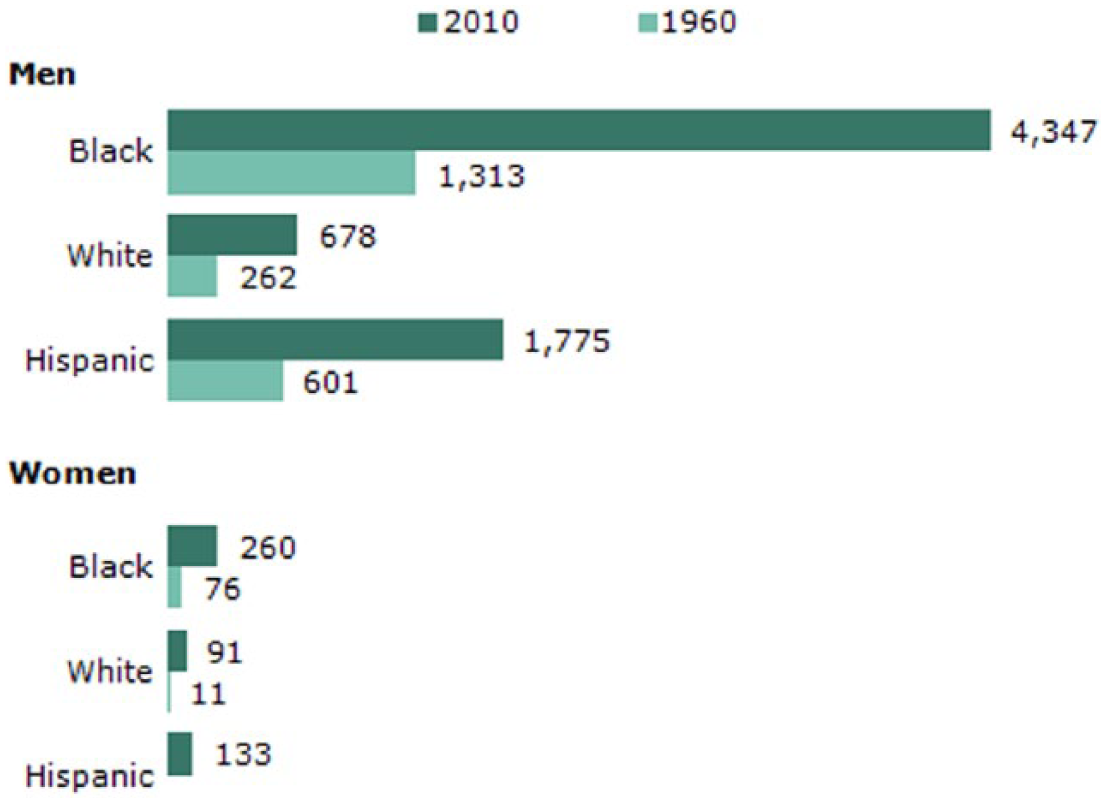
Incarceration rates, 1960 and 2010 (inmates per 100,000 U.S. residents).
Although a number of factors helped spur the creation of today’s mass incarceration, critical analysts also trace the distinctive ways the origins of this “War on Crime,” as Richard Nixon called it, were rooted in efforts to contain the Black Freedom movement and other 1960s-era movements. 25 They did so by fashioning a “moral panic” about the threat of black crime and disorder. As Alexander shows, white elites had long suggested that the “civil disobedience” preached by King and practiced by the Civil Rights movement was criminal and would lead to more crime. Maintaining “law and order” became a central way whites, particularly in the emergent Republican Party with its “Southern strategy,” spoke of controlling black mobilization. One Nixon aide later admitted that the administration sent “subliminal appeals to the anti-black voter” through the language of restoring “law and order” (Alexander 2011, 44). 26 Although Johnson, Nixon, and others imposed draconian new policing bureaucracies by citing “facts” about rising crime rates, scholar Katherine Beckett has shown that aggressive anti-crime initiatives did not respond to growing public preoccupation of crime. Instead, they helped manufacture that preoccupation (Beckett 2000). As newly fashioned mandatory minimum sentencing and other laws took effect, incarceration rates skyrocketed and would quickly grow with the onset of the “War on Drugs” in the 1980s.
The story of mass incarceration and its origins fits awkwardly among several tendencies in labor and labor education. While the explosion of the prison system has increasingly affected the U.S. working class, and workers and union leaders often see its everyday impacts, shame and the individualizing isolation of contemporary punishment likely push it from open discussion. In addition, recent scholarly research on mass incarceration reveals how traditional union allies participated in the very construction of prison nation (Murakawa 2014). 27 In addition, it was precisely during the early years of mass incarceration that unions became direct participants in, and beneficiaries of, its growth. Today, American Federation of State, County and Municipal Employees (AFSCME), the biggest union in the AFL-CIO, and the SEIU are among the handful that represent prison guards and other workers in the criminal justice system. Finally, the slow increase of the penetration of the state—through law and policing—over the last several decades, which has been particularly directed at communities of color, conflicts with labor educators’ general picture of this era as one of globalization, “free trade,” a shrinking state, and footloose, multinational corporations.
Despite the importance of recent efforts to highlight mass incarceration as a matter relevant to labor unions, not attending to the anti-black foundations of mass incarceration would leave racial trip wires intact. By arguing that today’s prison nation is another example of wasteful “big government,” the Tea Party, for instance, uses the same kind of cost-benefit logic that has often justified attacking unions and leaves anti-black sentiments undisturbed (Gottschalk 2015). 28 As the following sections show, the suspicion, indifference, fear, and hate directed at blackness today—often articulated through languages of crime and policing—helped shape not only today’s mass incarceration but also served in remarkably similar ways as a linchpin for the control of U.S. workers since the Jim Crow era.
Slavery by Another Name: Frameworks for Labor Educators
For whites, most of whom view the criminal justice system as fairly providing security by enforcing laws created by a government that rules through the consent of the governed, the relatively direct relationship between prisons, the police, and slavery is likely to surprise. Douglas Blackmon’s documentary Slavery by Another Name (2012) is an excellent resource for labor educators to open discussions with unionists about the connection between slavery, prisons, the police, and labor, and in the process introduce a character familiar to many unionists: the boss. Blackmon’s film graphically discusses how the Thirteenth Amendment, ratified in 1865, made slavery illegal, “except as a punishment for crime.” By making slavery illegal but legalizing it in punishment, whites could use court fees and discriminatory laws to capture blacks, and then lease the convicts to local farms and mines. Vagrancy laws limited black mobility and forced them to prove employment to police upon request. Deception, inflated sentences for minor infractions, and sheer force allowed police to round up blacks with pronounced gusto during harvest season. It was “slavery by another name.” While white workers remained poor, they enjoyed the “public” wage of access to school and police support, and the “psychological” wage of status superiority to blacks. Far from passive recipients of the racial wage, though, they regularly invested in it by maintaining the distinction between white and black at work. Richard Wright’s (1940) powerful stories, including his vignette about race and labor in a Southern optical factory, are another powerful way to illustrate the function of the racial wage. 29
The ghettoization of the twentieth century serves as a crucial tie between Jim Crow segregation and the mass incarceration of recent decades. While white workers may be poor, they are not pushed into zones of concentrated poverty (Jargowsky 2015). As Alexander and others show, mortgage policy, highway construction, and other credits subsidized the suburbanization of white workers. It allowed them to build equity wealth and approach middle-class status while segregating blacks into zones with disinvested schools, hospitals, and infrastructure. 30 Black men in heavy industry increasingly won access to unions, yet seniority policies and job segregation kept black workers in low-wage and precarious work. Ghettoization suburbanization in the North made blacks and whites’ interests distinct and competing, and structurally limited the political power and job opportunities of blacks. Even as blacks gained access to jobs and local- and state-level political power after the 1960s, the neoliberal shift of the post-1968 era led to the outsourcing of industries blacks had only recently accessed. The Reagan-era doctrine of “government is the problem” slashed federal investment in cities just as black mayors took control and quickly resegregated the few schools that had integrated. Today, the spatial separation of blacks and whites is almost as severe as in Jim Crow, and 75 percent of whites report having no non-white friends (Jones 2014). It also created ways police could spatially target black populations, and facilitate white racial indifference and denial, both of which became central features of the War on Drugs.
As with the “Black Codes” and vagrancy laws of Old Jim Crow, policing strategies in the contemporary era homed in on the mobility and autonomy of blacks. The War on Drugs creates incentives for police officers to round up “shallow end” drug offenders, and ghettoization makes finding black and brown offenders like catching “fish in a barrel.” 31 Rule changes have granted police departments more power to search individuals, seize property, and prosecute. Whites sell and consume drugs at similar rates as blacks, but suburbs, space, and assumptions about white innocence protect them from over-policing. While black drug offenders began to face hyper-punitive drug sentences in the 1980s, drunk drivers—who were disproportionately white and whose crime was far more deadly than street-corner selling—were often prescribed rehabilitation or light sentences (Alexander 2011).
As during the Jim Crow era, the “symbolic violence” of the media of the Reagan era increasingly demonized black America as incorrigibly criminal in ways that insulated whites, and particularly rich whites, from police vigilance. 32 Police focused law enforcement on minor property violations—like “broken windows”—in black and brown neighborhoods by suggesting that they were not mere reflections of poverty but gateways to pathological, criminal social decay. The federal War on Drugs created vast sentencing disparities in black and white drug crimes. In New York and elsewhere, such policing policies have helped cities shape their urban landscapes for outside investors and gentrifiers. “Stop and Frisk” policies led to police stopping and searching thousands of non-white men, with 90 percent of those searches resulting in nothing incriminating (Goldstein 2013). 33 Meanwhile, nearby Wall Street banks whose subprime lending schemes helped lead black Americans to lose nearly half of their wealth in the recent recession have been virtually unpunished (Taibbi 2014). Today’s “gang lists” serve as the latest incarnations of the racialized criminal profiling of Jim Crow (Cacho 2012).
Today, society’s “rules of the game” in the punishment industry depend on black lives not mattering. Working-class communities facing jobs crises advocate for prison construction for jobs and economic development. Prosecutorial teams (which are overwhelmingly white) are charged with winning cases, not securing justice, and exaggerate evidence to lock people up. 34 Private prison companies pressure elected leaders to stiffen criminal sentences. Instead of organizing prison laborers who struggled in the 1970s to unionize (Tibbs 2012), unions organized their supervisors, prison guards, who benefit from the expansion of prisons. Black lives, in these structures, are the “collateral consequences” of white jobs and institutional stability. 35
Despite the importance of “mechanisms,” instead of individual “motives,” in understanding the growth of the anti-black structures of today, bridge-building educators who focus too heavily on the profit motive of the punishment industry will likely leave in place racial trip wires. In recent years, AFSCME and its locals that represent prison guards have challenged the privatization of prisons—but not mass incarceration itself—by arguing that the problem with massive numbers of prisoners is not the growth of prisons but their insufficient size and breadth. Overcrowding, the union has argued, is an example of how the profit motive in prison management leads to cutting corners that makes workers more vulnerable and creates less dignified imprisonment for prisoners. 36 However, as Gilmore has recently pointed out, focusing on private prison and corporate profits as a way to explain mass incarceration and structural racism is destined to fail. Although prison labor and private prisons are part of the logic of mass incarceration, they’re only a small part. Labor educators can use the film Slavery by Another Name to show how racism and the most brutal forms of punishment were, and are, the provinces of unethical individual businesses or corporate “bad apples” but were tacitly or expressly sanctioned by the state. Today’s mass incarceration is an overwhelmingly public, not private, system (Gilmore 2015).
Police Killings: Jim Crow Origins of Spectacular Violence
A century ago, black bodies were lynched every four days. These public spectacles of violence—sometimes advertised beforehand—were forms of racial terror meant to keep blacks subordinated. Wealthy black towns like Rosewood, Florida, or the “Black Wall Street” in Tulsa were burned by lynch mobs who resented their wealth. Today, blacks are killed by the police at about the same rate as lynchings one hundred years ago. States tacitly or explicitly supported “mobs” and rarely investigated; likewise, the cases of Trayvon Martin and Walter Scott, like so many others, were hastily processed by the police with no real investigation—until their communities demanded it (Wilkerson 2014). Lynched bodies were left hanging to send a message. Michael Brown’s body was left for more than four hours in the August sun. As historian Isabel Wilkerson claimed, Brown’s killing and Jim Crow lynching “have too much in common.”
NFL football player Richard Sherman’s observation that “‘Thug’ is the new ‘N’ word” in 2013 was a prescient insight into how figures like the “thug” have become this era’s new “controlling images”—stereotypes that regulate conduct, rationalize violence, facilitate indifference and fear, and feed white illusions of possessing masterful knowledge about whole populations (Hill Collins 1991). As the power of the Black Freedom movement forced whites to push explicitly racist discourse into the shadows, white elites, as captured so well in a now-famous recording of Republican speechwriter Lee Atwater, relied on a series of code words to say the “N word” without saying it. 37 As political scientists have shown, images and assumptions of “target populations” can have important effects on the shaping of public policy, and demonizing blacks as violent anti-citizens constituted one of the driving forces of the vast bureaucracies of control of mass incarceration (Schneider and Ingram 1993). One way labor educators can structure their discussions in visual and engaging ways is to highlight controlling images like the thug and reflect on the historical conditions that helped legitimate them. For instance, they can trace the ways the term thug echoes—or is haunted by (Saleh-Hanna 2015)—the “black brute” image of the Jim Crow era.
Slavery By Another Name shows how securing the labor force in convict-lease arrangements—which was crucial to Southern cotton harvest and mining production—required amplifying notions of black criminality. Like today, white society wielded contemporary criminological science to rationalize the connection between punishment, profit, and control. Early criminologists, for example, advanced emerging social Darwinist ideas about the biological determinants of criminal behavior. Like today, the increased numbers of black prisoners reinforced white ideas that blacks required especially harsh forms of punishment (Hetey and Eberhardt 2014).
White slave owners radically changed the way they represented black life before and after emancipation as they sought ways to reestablish black servitude. Before the war, as labor educators can display with widely available antebellum images, whites portrayed blacks as ignorant and childlike in ways that justified white paternalistic supervision and care; afterward, blacks were suddenly dangerous, unruly, and biologically programmed for violent savagery. As Martha Hodes (1997) has argued, white panics about black “savages” and their animalistic desire for white women were created after emancipation. During the Civil War, white men left plantations to wives, daughters, and slaves; after emancipation, white panics about inherent black savagery would have made such a thing impossible. During Jim Crow, whites justified violence or lethal force, including in labor conflicts, by circulating fantastical stories about “giant Negroes” and “Negro superfiends” defying bullets or fending off dozens of white police officers. 38
Today, whites use similar, fantastical narratives of monstrous black anti-citizens that justify controlling, violent responses to black bodies, despite clearly apparent inconsistencies. Psychological studies have decoded a “superhumanization bias” in the white imagination (Waytz, Hoffman, and Trawalter 2015). Despite beating black motorist Rodney King for eighty-one seconds, of which he was mostly laying on the ground, Los Angeles police officers in 1992 justified their violence by testifying that King was possessed with an otherworldly strength. The officers were acquitted. George Zimmerman, who had a history of physical violence, including against a police officer, convinced a jury that the much smaller, much younger Trayvon Martin was a mortal threat to him. Darren Wilson testified that Michael Brown was like a “demon” and made inhuman noises as he resisted bullet fire. Tamir Rice, the twelve-year-old shot dead by a Cleveland police officer, appeared twenty years old, the officer said (Blow 2015). Several high-profile murder cases in the 1980s and 1990s featured whites taking advantage of popular anti-black discourses to blame black men or boys for murdering white women, only to later acquit them—or for the white plaintiffs to be the guilty parties. 39
Few resources highlight how the media and police reduce black lives to “thug lives,” as well as the BLM’s own social media (see Figures 2 and 3). After activists criticized how the media put Michael Brown’s character on trial after his death by releasing photos of him that illustrated media assertions that brown was “no angel,” activists created a Twitter hashtag that asked the question “If they gunned down . . . which photo would they use?” 40 Just as George Zimmerman profiled Trayvon Martin as dangerous because of his hoodie and skin color, black and brown youth posted personal photos of themselves in hoodies and street clothes but paired them next to photos from their graduations, birthday parties, or military careers. “Which photo would they use?” was a powerful hypothetical question to the media and criminal justice system about their subtle—and not-so-subtle—attempts to use skin color and clothing as stand-ins for deviance and threat. Videos and testimonies on the hashtags #AliveWhileBlack and #crimingwhilewhite graphically show the discrepancy between how whites and blacks are treated by police. Prosecutors held a black teenager who broke an empty police car’s windows during Baltimore demonstrations on $500,000 bail—more than for most accused murders. Police invited Dylann Roof, who had murdered nine blacks at the Charleston African Methodist Episcopal (AME) church, to Burger King before they processed him.

Posted by Kenny Douglas, #IfTheyGunnedMeDown.

Posted by Zion Ware, #IfTheyGunnedMeDown.
Domestic Work: Exposing Structural and Sexual Violence
“No One Showed Up to March for Rekia Boyd Last Night.”
This headline in April 2015 (Foster 2015) illustrates what BLM activists have consistently highlighted since the killing of Michael Brown: confronting the prevalence of police killing of black boys and men should highlight, not obscure, the police and economic violence directed at black women and LGBT blacks (C. Davis 2015; Garza 2014; Garza 2015; A. Ritchie 2006). Boyd, an unarmed twenty-two-year-old black woman, was killed by a Chicago police officer who was acquitted of all charges on April 20, 2015.
Despite how the media and social movements have visibilized the police murder of black boys and men since 2013, the focus on heterosexual black men as the primary victims of racism sometimes obscures the violence faced by black women and LGBT blacks (Crenshaw 2012). In 2015, the Black Lives Matter website prominently featured three numbers to capture the multidimensionality of indifference toward black lives: every twenty-eight hours, a police or vigilante kills a black person; a black trans person’s life expectancy is just thirty-five years; and 25.1 percent of black women live in poverty (Black Lives Matter 2015). Much like the Black Freedom movement of the 1960s, the BLM movement has highlighted how the same institutions that claim to represent, protect, and serve society—courthouses and schools in addition to police—operate on racial indifference and assumptions that black lives do not matter.
These public policies and institutions leave black women and LGBT blacks distinctly vulnerable to abuse in public and “private” spaces, including work. For instance, recent changes in the law, including labor law, increasingly leave women of color unprotected (Crain and Matheny 1999; Martin 2013). Discriminated against in official housing markets, public housing increasingly exposes black and LGBT blacks to invasive policing and environmental contamination. Discriminated against in labor markets, including because of past felony convictions, the criminalization of “survival economies” like drug sales or sex work leave them vulnerable to abuse, including by police. Gender expressions that do not adhere to police officers’ ideas of normative gender identities, as well as vague laws and police discretionary power, allow officers to make “walking while trans” a crime, especially for black trans women (Jaz 2015). Representatives of financial institutions, some with histories in the slave trade, targeted “mud people” with “ghetto loans,” even if they qualified for better terms, and then bet against them in financial markets (Brescia, 2012). A “racial empathy gap” affects even medical institutions; Americans tend to believe blacks feel less pain than whites, which leads medical professionals to undertreat black pain (Trawalter, Hoffman, and Waytz 2012).
While the contemporary neoliberal economy increasingly relies on sub-contracting and “sweating” labor to small firms operating in the margins of state regulation, domestic workers have always endured the way state policy tacitly condones worker vulnerability in intimate workspaces like the home. Discussing the history of domestic work, in fact, can serve as a compelling way for labor educators to capture the dynamics of the distinct kinds of violence black women and LGBT blacks face. In a U.S. economy increasingly defined by care labor, the National Domestic Workers’ Rights Alliance has led efforts to connect labor justice to the multiple forms of injustice and violence that women of color face. 41 Just like the spaces of domestic work left black women invisibilized and vulnerable in slavery and Jim Crow, black women today encounter violence in privatized work and recreational sites, in the home, and behind the walls of the criminal justice system (B. E. Ritchie 2012). 42
Sexual and Symbolic Violence: Controlling Images of Black Women
Controlling bodies for labor exploitation was only one component of slavery and Jim Crow. Sexual violence was central to how white customs disciplined black women, divided white women from black women, and sought to neutralize black women’s resistance. During slavery and particularly at the height of Jim Crow, black women domestic workers were often the only blacks with access to the white home and the white family, and their isolation there threatened them with invisibility and separated them from a larger black support network. For slave owners, impregnating slave women meant more future slaves; for owners’ sons, slave women and girls meant objects for sexual experimentation. For traders, slave women meant both personal sexual objects and prized sexual commodities, since some black women were auctioned at “fancy girl” markets specifically for their sexual use (Davis 2002; Hine 1994, 38). 43 As property, black women had few options for legal redress, and shame often silenced this form of sexualized workplace violence, even as black women developed powerful ways to evade, heal, and denounce (McGuire 2010; Nadasen 2015a). Far into the twentieth century, white sexual discipline in spaces like the home or workplace continued to be a form of social discipline tacitly supported by state and society (Hine 1994; McGuire 2010). 44 Former domestic workers recall the indignities of New York City day labor markets in the 1930s, when white employers examined their bodies, seeking evidence—like scarred kneecaps—that proved the women scrubbed floors on their knees (Nadasen 2015b).
This sexual form of labor discipline was justified through degrading images of black womanhood circulated by whites. Labor was integral to one’s standing in the dominant gender and sexual order of the day, and elite white men created a scale of racial incentives and highly restrictive expectations that promised select benefits to a few groups—like middle-class white women—if they abided by the day’s racial and class logic. Just as white men invested in their whiteness by maintaining themselves above blacks, white women gained status in the Jim Crow era by hiring black domestic workers. Since a “True Woman,” according to the dominant discourse, was fragile, submissive, motherly, and meant to maintain the home as a sphere of Christian value unthreatened by the “dirty” and “immoral” public world, the physical work of running a house was unnatural for a woman. As Sojourner Truth proclaimed in 1851, white rule required black women to do “men’s” work, thus denying them a claim to True Womanhood, and the symbolic resources and moral authority that came with that category. Chattel slavery forced black women—unlike black men and whites—to work in ways that directly contradicted the dominant gender norms. Almost all slaves, regardless of their sex, were field laborers.
Throughout this period, whites also deftly deployed stereotypes of the “Mammy” and “Jezebel” to devalue black women’s labor and womanhood, express the impossibility that black women could truly embody feminine ideals, and explain away the prevalence of white sexual abuse of black women workers (Hill Collins 1991; King 2014). 45 As Hill Collins has argued, the sexless, masculinized Mammy figure cloaked the sexualized and gendered vulnerabilities black women faced in private workplaces in Jim Crow, and also obscured their labor: the Mammy, according to the popular stereotype, was the utterly contented servant. She was not a worker; she was “the help.” The “Jezebel,” in contrast, was almost the complete opposite. This oft-portrayed stock character had an endless sexual appetite, and her libidinous hyper-sexuality was responsible for sexual contact between her and white superiors. While the construction of the “True Woman” stigmatized the labor of working-class white women as well, the deviance attributed to the “Jezebel” fundamentally divorced her from claims to womanhood. The “Jezebel” image explained away white sexual assault in domestic settings by suggesting that sex was consensual or that black women’s bodies were so disconnected from womanhood that violating them was not a true moral violation. Just like Jim Crow turned white male workers against black men, white men deftly turned white women against black women by maintaining them in the same “sexual marketplace” in the house (Painter 2002). 46
Structural Violence: Domestic Work and the “Politics of Disgust”
While focusing on mass incarceration tends to center the narrative of racism and freedom on black men or misleadingly isolate post-1960s mass incarceration from the tradition of control it emerged from, tracing the contradictory images of black women workers allows us to see how the structures and institutions of society—like the New Deal—were propelled by ideas that black women’s lives did not matter. If the workers’ mobilizations of the 1930s helped generate the protections enshrined in the Wagner Act, Social Security Act, and the Fair Labor Standards Act, those acts denied many protections to industries most closely tied to chattel slavery and non-white workers: domestic workers and farmworkers (Nadasen 2015a). 47 For most of the century, domestic workers were denied most of the protections promised to workers under law. As in the Jim Crow era, the intimacy of work in the private home continues to render domestic workers vulnerable to distinct kinds of psychological, verbal, and sexual abuse. Labor law exemptions—like those on small employers, for example—continuesto leave women of color “invisible and unprotected” in their workplaces (Burnham and Theodore 2012; Yeung 2015).
Labor educators starting conversations about the relationships of these histories to today could begin with one contradiction: while black women’s waged domestic work for others was precisely what defined black women as unwomanly and unmotherly in Jim Crow, it was the opposite—their unwaged domestic work in their own homes—that allowed for their stigmatization in the New Jim Crow. Because they worked and were therefore not proper mothers, black women during Old Jim Crow were denied the “mother’s pensions” guaranteed to widowers. A century later, their labor to raise their children—indeed, to be mothers—was, ironically, precisely what neoliberal elites used to target them as deviantly unproductive, unwilling to “work,” and as legitimate targets for disinvestment and criminalization (Baldwin 2010). Fear and the creation of a “moral panic” (Hall 1978) about government waste and slothful “welfare queens” became a central feature of social control and division. The implicitly black welfare queen controlling image emerged partly as an effort to contain low-income black workers organizing for welfare rights (Nadasen 2005), and it allowed Reagan-era elites to justify attacks on working classes and energize white racial resentment. Spectacles of the parasitical excesses of government dependency and black familial deviance characterized this new “politics of disgust,” which ultimately helped allow Democrats and Republicans to restructure work and life for all poor workers in the 1990s (Hancock 2004). The controlling images of the black “underclass” after the 1960s—a “class” defined as pathologically dependent and deviant, utterly distinct from an industrious “working class”—turned whites against blacks precisely when the Reagan-era attack on unions most necessitated solidarity (Kelley 1997; Roediger 2002). They made inter-racial recognition of shared fate an increasing impossibility.
Conclusion
The BLM movement that has emerged since the 2013 killing of Trayvon Martin has changed the way many Americans view the police. Yet the movement, for many of its founders, is about more than police racism and violence: it is about the many ways black lives do not matter to society’s principal institutions, whether the police, the school system, the courthouse, or workplaces. Despite clear differences in strategy and structure, overlapping interests in grassroots leadership in the BLM movement and in recent union-community coalition theorizing could open the way for labor education to play a key role in energizing unions’ response to the BLM movement and the issues it raises. Some labor efforts seem to be increasingly foregrounding the anti-black structures of their work. Recently, the Restaurant Opportunities Center United (ROC United) has challenged tipped labor arrangements by highlighting how tipping is a holdover from chattel slavery. It disproportionately affects women workers of color and often leaves them vulnerable to sexual assault as well as economic risk (Jayaraman 2016).
Crime and policing have been critical components of the control of the U.S. working classes, since they have been crucial arenas through which whiteness and blackness have been defined. Given the way criminality has become a code word for blackness in a purportedly “colorblind” era, this article has suggested that labor education after Ferguson should examine the interwoven histories of race and crime as a way to capacitate grassroots bridge-builders in unions. Other strategies, I argue, will likely leave “racial trip wires” in place, and particularly the racialized division regarding the fairness of the criminal justice system. Strategies that do not feature an anti-racist analysis of race and crime will likely reinforce existing abuses black workers and unionists face, as well as isolate unions from this generation’s version of the Black Freedom movement. Ultimately, the union movement has a moral obligation to engage with the BLM movement in ways that respect and amplify the movement’s main demand—that black lives matter as much as white lives. Labor education could play a key role in making this happen.
Footnotes
Acknowledgements
I would like to thank Tryon Woods, Elise Bryant, Alethia Jones, and Nick Wertsch for their helpful conversations about this topic, and Bill Fletcher Jr. for his comments on an early draft of this article. I would also like to thank all the Black Lives Matter, and union-based activists and organizers who took the time to be interviewed. The anonymous reviewers of this article, as well as issue editor Elizabeth Hoffmann, offered insightful and plentiful comments on drafts of this work, and their criticism helped improve the paper immensely. I would also like to thank the United Association of Labor Educators and the Labor Research Action Network for opportunities to present this research. Finally, many thanks to my colleagues in the Department of Crime and Justice Studies at the University of Massachusetts Dartmouth for their ongoing support.
Declaration of Conflicting Interests
The author(s) declared no potential conflicts of interest with respect to the research, authorship, and/or publication of this article.
Funding
The author(s) received no financial support for the research, authorship, and/or publication of this article.