



Abstract
Through a case study of the taxi industry in San Diego, where 89 percent of drivers leased their vehicles as independent contractors (IC), we show how local regulation has enforced precarity. We find that the interaction of policies from various local governmental agencies has actually required lease drivers to operate as ICs and has simultaneously undermined the very control and economic independence that is fundamental to the IC designation. While the literature on precarious employment and IC misclassification tends to emphasize the role of macroeconomic structures, employer action, and federal government policy, this article highlights the role of local regulatory agencies.
Introduction
Worker precarity takes many forms but independent contracting is one of the more nefarious as it exempts workers from key protections including minimum wage, overtime, unionization rights, retaliation protections, and worker’s compensation (Bernt 2000; Carré 2015; Jaffee and Bensman 2016; Smith, Marvy, and Zerolnick 2014). Even as workers and their advocates are able to mitigate some of the worst elements of precarity through increases to minimum wages, mandatory provision of paid sick days, and health insurance coverage, millions of workers are left out of these gains because they are treated as independent contractors (IC). Independent contracting is particularly problematic when workers do not have the actual autonomy or economic independence that legally defines the IC designation. Misclassified workers are doubly disadvantaged by a lack of protections and an absence of control.
Research shows that a substantial number and variety of workers are treated as ICs in the United States, with taxi drivers among the most common in the designation. While accurate data on the prevalence of independent contracting is difficult to obtain (Hipple 2010), the most recent national estimate, from the 2010 General Social Survey, is 12.9 percent of those employed (Government Accounting Office 2015). The IC designation is common in occupations encompassing a wide range of wage levels and skills including Information Technology (IT) specialists, construction workers, physicians, lawyers, and delivery drivers but is most common among taxi and limousine drivers (Romero 2011).
The struggle of workers to be recognized as protected employees, rather than treated as ICs, has garnered much academic attention recently, especially in the realm of those who work as drivers (Bonacich 2008; Briney 2008; Mathew 2005; E. Mitchell 2015; Mitra 2003). Uber drivers, port truckers, and FedEx Ground drivers have all sued for employee status in high profile cases (Cohen and Eimicke 2013; Jaffee and Bensman 2016; Sprague 2015; Woo and Bales 2016). Taxi drivers in different locales have also sued over abuses created by the IC designation, albeit with less success.
What has received less attention is the multiple ways in which local governmental agencies have supported the IC designation. Most of the literature on the emergence and misuse of independent contracting focuses on the policies and actions of employers (Cohen and Eimicke 2013; Means and Seiner 2016; Romero 2011; Woo and Bales 2016), the courts (E. Mitchell 2015; Sprague 2015), and the federal government (Belzer 2000; Bensman 2016; Bernhardt 2012; D. J. Mitchell and Zaidi 1997). We add to the understanding of structural forces behind this precarious position by analyzing specific policies and their implementation at the local level. Through our case study of the taxi industry in San Diego, California, based on a close examination of local regulation, more than 300 surveys, twenty in-depth interviews, observations, and analysis of government data, we are able to tease out the ways in which local policy constructs labor relations for these workers. We find that the interaction of policies from various local governmental agencies actually requires lease drivers to operate as ICs. More surprisingly, we find that worker precarity is intensified by local agencies’ policies that undermine the very control and economic independence that is supposedly inherent in the IC designation.
The Emergence and Growth of Precarity
Much of the research on precarious labor has focused on macroeconomic processes. In the 1970s, businesses began to restructure themselves in order to remain competitive in the increasingly global market and to boost profits, breaking the social contract that had exchanged long-term employment and wage and benefit rewards from employers for stable uninterrupted work and productivity from employees (Bluestone and Harrison 1988; Kalleberg 2011). According to Standing (2011), increased globalization and the rise in neoliberal economic policies fostered flexible labor relations, bringing to life an entirely new class of workers: the precariat.
A second area of concentration has been the federal government’s neoliberal deregulation process that boosted organizational freedom at the expense of employees’ rights and protections (Carnoy, Shearer, and Rumberger 1983; Kalleberg 2009; Vosko 2010). For instance, the trucking industry has been subjected to intense deregulation under the 1980 Motor Carrier Act. As a result, independent contracting based on per trip compensation rather than per hour pay became the common employment relationship in this increasingly competitive environment (Belzer 2000; Bensman 2016). In 1974, the National Labor Relations Board (NLRB) approved the legality of leasing arrangements in the taxi industry, leading to drivers across the country being treated as independent contractors (Mathew 2005).
A third, overlapping, area of research is on specific strategies used by companies to adjust to market demand. Some businesses focused on internal flexibility by deploying workers to different tasks (Piore and Sabel 1984), while others focused on external flexibility by fluctuating the size of the workforce with contingent laborers (Bernhardt 2012; Kalleberg 2011). The latter led to increasing arrangements such as temp workers, employee leasing and independent contracting (Connelly and Gallagher 2006). While the use of ICs was fairly generalized throughout the labor market, researchers found that organizational size and complexity increased the likelihood of treating workers as ICs (Davis-Blake and Uzzi 1993).
The literature on the proliferation of precarious labor has generally focused on globalization and the rise of neoliberal deregulation, along with employers’ response to these conditions. However, the acceptance of the contingent model and its implementation may also be embedded in local policy, where it directly impacts workers’ experience in a variety of ways.
Definition and Misclassifictation of ICs
Research has emphasized the ways in which legal frameworks, and varying employment models, have made the definition of independent contracting illusory (Negrey 2012; Osnowitz and Henson 2016). Under the Fair Labor Standards Act, the Internal Revenue Code (IRS), and the Supreme Court ruling in Darden (Nationwide Mutual Ins. v. Darden 503 U.S. 318 (1992)), ICs are supposedly nonpermanent workers who use their own equipment, demonstrate a high level of control over their work, exercise economic independence, and provide services to clients that are not an integral part of the clients’ business (Harris and Krueger 2015). However, in response to business-owner complaints, Congress weakened the definition in 1978 by establishing a “safe harbor” rule that allowed businesses to classify workers as ICs for tax purposes if there was equal treatment for all similar workers, consistent reporting, and a reasonable basis for the classification (Cohen and Eimicke 2013). Scholars have further pointed out that the varying specifics of definitions provided under U.S. labor law, federal tax law, and differing state laws add to the ambiguity of the IC designation (Cohen and Eimicke 2013; Smith, Bensman, and Marvy 2010). Sprague (2015) recently argued that IC definitions are outdated given the “gig” economy, where Uber drivers and others must work for multiple companies. He proposes that the test be if the company is dependent on a given group of workers rather than if the worker is economically dependent on the company.
Researchers have documented the widespread misclassification of would-be-employees as ICs. Leberstein (2015), in a review of numerous studies from across the country, found that millions of workers are misclassified as ICs and that the numbers are rising. Particular increases are noted in construction, trucking (Smith, Bensman, and Marvy 2010), and home care (Leberstein and Ruckelshaus 2016). National studies show that between 10 percent and 30 percent of all ICs are misclassified, and newer state-level audits reveal similar or higher rates. Moreover, Leberstein (2015) claims that these studies are an underestimate as they miss much of the underground economy where misclassification is highest.
Contradictory definitions of independent contracting at the federal and state levels clearly create an environment where misclassification flourishes. Carré (2015) argues that misclassification results most commonly from ignorance or criminal misconduct. However, it is also facilitated by lax regulatory enforcement and the allowance of “safe harbor” claims (Cohen and Eimicke 2013; Leberstein 2015; Smith, Bensman, and Marvy 2010). We seek to add to the understanding of the ways in which governmental entities contribute to misclassification by scrutinizing policies at the local level that further undermine the integrity of any IC definition.
Case Study: Taxi Drivers in San Diego
In this article, we delve into the inner workings of the taxi industry and regulation in San Diego. Taxi driving throughout the country is a bastion of independent contracting, although prima facie these workers seem to be employees as they carry out the central function of the industry, driving, and rarely own the primary equipment, the cab. This industry, therefore, offers a window into how the contradictions of this designation may be structured. We use the local taxi industry in our city to answer the following research questions: what role do local regulation and policy play in drivers’ designation as independent contractors? How do local agencies uphold or undermine the integrity of the IC status?
Method
For this research, we used multiple methods. We analyzed taxi policy, regulations, research reports, and news articles from San Diego, including Metropolitan Transit System (MTS) regulations and contracts, city policy (both proposed and adopted), and airport authority policy. We attended dozens of meetings of the MTS, the Mayors’ Taxi Advisory Committee, the United Taxi Workers of San Diego, the Airport Authority, and the San Diego City Council. At some of these meetings, we were simply observers; at others, we were participant observers, presenting the results of our 2013 study. We conducted follow-up interviews with United Taxi Workers of San Diego (UTWSD) staff about the implementation of 2014 reforms.
In 2013, our research team conducted 331 driver surveys. We mapped all taxi stands in the City of San Diego and approached drivers randomly at those twenty-five locations, offering $10 compensation for taking twenty minutes out of their fare-seeking. Of the 331 survey participants, 311 were lease drivers, a significant number given that there were approximately 1,840 lease drivers in the city of San Diego at the time.
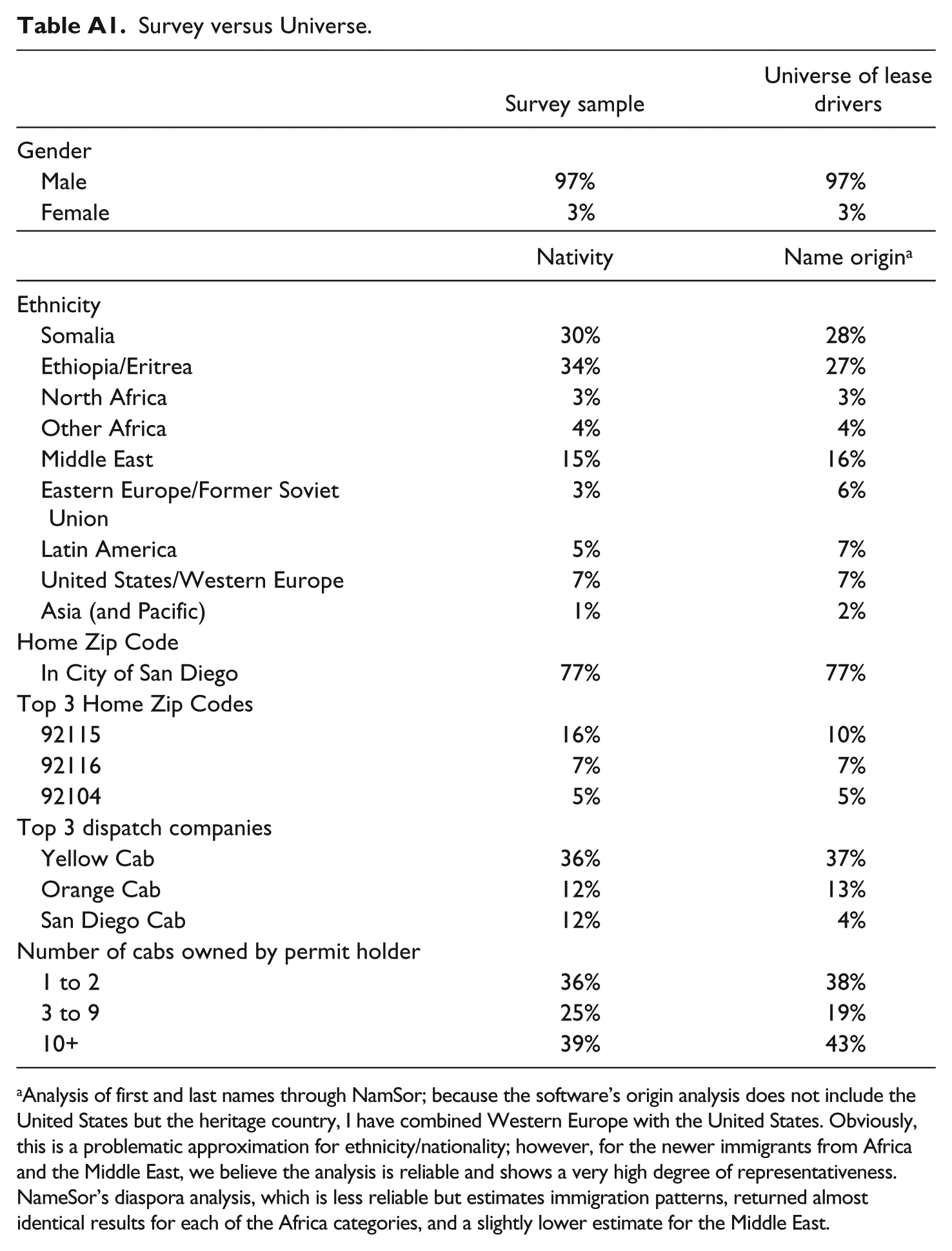
Our analysis of information obtained through Public Record Act requests from the sheriff on taxi drivers and the MTS on permit holders allowed us to determine the representativeness of our sample and to understand the ownership patterns in the industry. We found our sample of lease drivers to be representative on all measures we had: gender, residence zip code, ethnicity, radio dispatch, and size of company. 1 By cross-referencing all names from the sheriff’s list of licensed drivers with those of MTS permit holders, we found that the 245 permit holders licensed to drive made up only 11 percent of licensed taxi drivers, with the remaining 89 percent being lease drivers. Only 6 percent of taxis had only the owner and no lease driver licensed to drive them, calling into question how many of the 245 were actively driving. We refer to lease drivers as “drivers” throughout this article; we sometimes refer to permit holders as “owners” as they also own the vehicle and are commonly called owners.
Only twenty of those surveyed were owner-operators, that is owners who also drive the taxi themselves. While this made up 6 percent of our sample and corresponded to the 6 percent of taxis driven only by owner-operators, the number of respondents was not sufficient to produce a reliable analysis of owner characteristics. We did, however, use owner surveys to gather valuable contextual information. In order to delve deeper into the dynamics and processes uncovered in the surveys, we also conducted interviews with seventeen lease drivers and three owners.
Independent Contracting System in the San Diego Taxi Industry
Two main forces were responsible for the predominance of the independent contracting system in San Diego: owners responding to striking employees and deregulation. In the 1970s, the taxi industry in San Diego was dominated by Yellow Cab, which owned 65 percent of the taxis and employed its own unionized drivers, with company-paid uniforms and dry-cleaning allowances, among other benefits (Spadacini 1988). In 1976, when contract negotiations failed and workers went on strike, the holding company for Yellow Cab—Westgate Corporation—locked workers out and declared bankruptcy. The new ownership at Yellow Cab reopened with a regime of mostly ICs and only a small contingent of employees (Spadacini 1988). While independent contracting began as a response to the strike, deregulation after 1979 expanded the practice (Gelb 1983). The strike’s disruption of holiday service, an earlier scandal over Yellow Cab’s alleged bribery of city officials, complaints about service, and the threat of a transit strike in 1978 led to deregulation (Gelb 1983; Stirling 2011). In 1979, the City Council deregulated the number of cabs and the fares. According to Larry Stirling (2011), a member of the City Council at the time, “Those reforms effectively deconstructed the taxicab business throughout the nation as cab companies retreated from operating taxis with unionized employees to becoming cab-service bureaus leasing cars to independent contractors.” New York also adopted a leasing system in 1979, shortly after the NLRB sanctioned this structure (Mathew 2005). In 1984, the City of San Diego reinstated limits on taxi permits but now within a predominantly leasing system. In 2014, drivers won back the open permit, this time in order to escape IC status. The 2014 reform consisted of lifting the limit on the number of permits so that any qualified driver or taxi owner could obtain a permit. Our initial survey took place in 2013 before the reform, but we conducted follow-up research on the reform process and outcomes.
Drivers and Working Conditions
In San Diego, the vast majority—94 percent according to our survey—of taxi drivers were immigrants, predominantly from East Africa. San Diego is home to a very large refugee community, most of whom have legal status but often do not have the training, English ability, or recognized credentials to find stable, well-paid jobs. These dynamics are reinforced by discrimination within the labor market faced by black job seekers (Pager, Bonikowski, and Western 2009). Taxi driving has become a niche occupation for this population of legal but disadvantaged workers.
According to our 2013 survey, drivers were taking home approximately $4.50 per hour, including tips. At the time, lease prices in San Diego were unusually high (explained below), and the price of gas was more than $4 per gallon. During the average seventy hours a week spent driving, lease drivers were making approximately what a minimum wage worker made in forty hours. A total of 91 percent were not bringing home the equivalent of minimum wage, and even more did not reach this threshold when considering overtime rules. Of course, as ICs, these legal protections did not extend to the drivers. Virtually no driver had workers’ compensation or job-sponsored health insurance. Our results are reflective of studies in other cities that have found particularly low wages and long hours for taxi drivers (Blasi and Leavitt 2006; Bruno 2008; City of Portland 2012).
Findings
Local Government Support for a Contradictory IC System
Their classification as ICs meant these workers were not guaranteed the protections and rights discussed above; however, in many respects, these drivers were not actually treated as ICs either. According to the Department of Labor’s (DOL) 2015 guidelines, the key is “to determine whether the worker is economically dependent on the employer (and thus its employee) or is really in business for him or herself (and thus its independent contractor)” (Weil 2015, 2). 2 The six factors establishing independence are: the work is not integral to the employer’s business; workers’ managerial skill affects their opportunity for profits; the relative investment of the worker is high compared with the employer; the work requires special skill or initiative; the relationship is not permanent nor indefinite; and the employer has a relatively high degree of control over the work.
In San Diego, local regulation basically required drivers to be ICs by requiring a business license from the City to pick up fares within its boundaries. Yet, the City and other local governmental agencies undermined many of the elements of independent contracting listed above. Table 1 summarizes how and by whom these criteria were undermined, and the following narrative details the implementation of these practices.
How Local Government Undermines Independent Contracting Status.
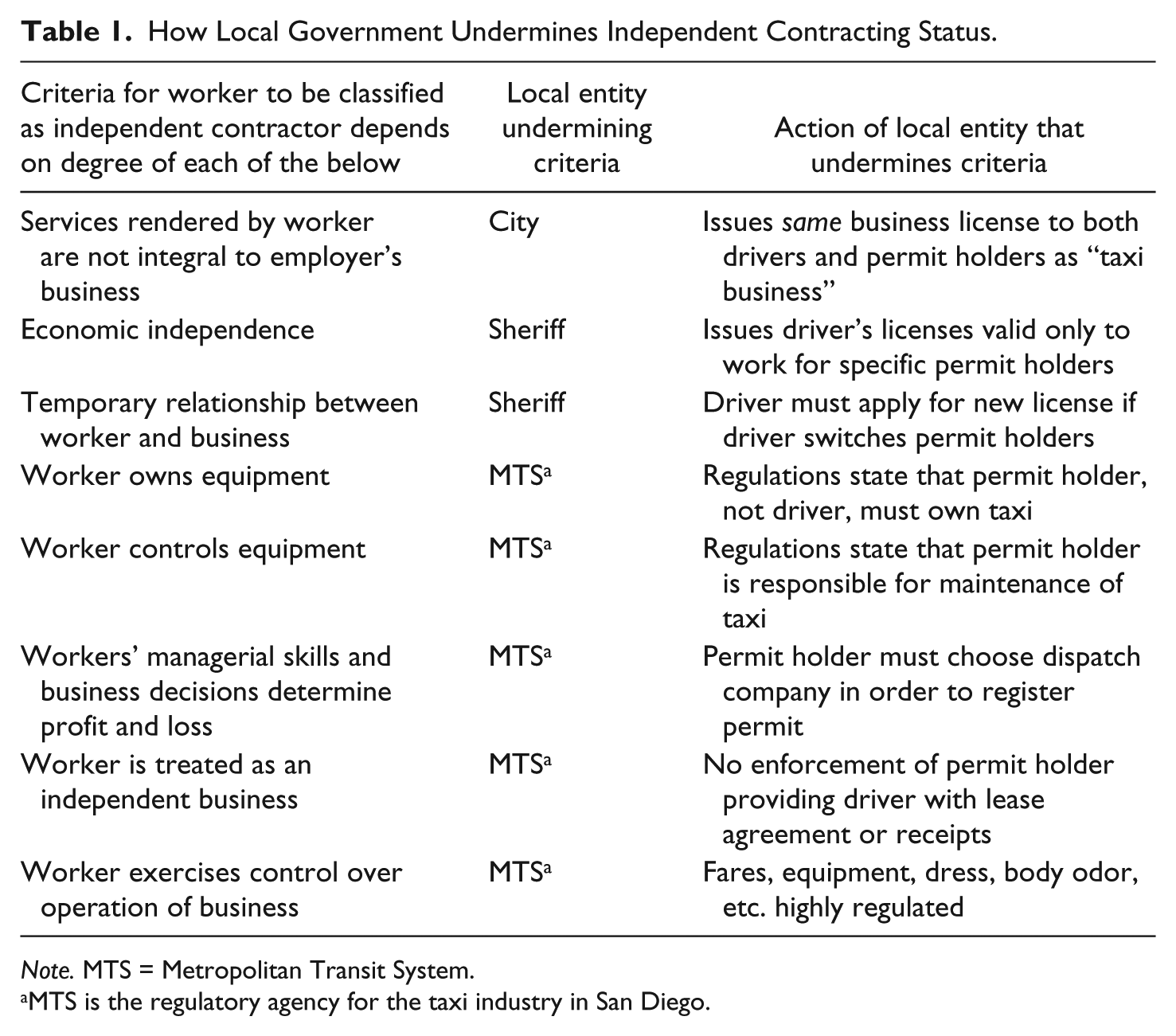
Note. MTS = Metropolitan Transit System.
MTS is the regulatory agency for the taxi industry in San Diego.
Contributing to the problematic (non)employment relationship were policies of the City, the Sheriff’s Department, and MTS, which is a joint powers authority agency that regulates the taxi industry in much of San Diego County. While the fallacy of drivers’ independence and the abuses their misclassification engenders were facilitated by various local entities, city policy simultaneously functioned to restrict drivers to the position of ICs by pushing actual ownership out of reach. In addition, at the state level, the IC relationship was reaffirmed by the courts, athough attempted state legislation to cement in place drivers’ treatement as ICs for the taxi industry never passed.
Business License Issuance
The City of San Diego set up a system requiring a business license to drive a taxi. In fact, the city issued both permit holders and lease drivers the exact same license as a taxi business. MTS requires the license for an owner to register their permit. The Sheriff requires the business license to obtain the special taxi driver’s license for those picking up fares in the City of San Diego. It should be noted that the Sheriff’s application does not require a business license to pick up fares for other cities in the county. The City of San Diego and Sheriff together are ensuring that first, drivers must be ICs with their own registered business, and second, the driver registers a business that is in essence conducting the core activity (driving) of another business (running a taxi company). According to the DOL guidelines, a primary test of whether someone should be an employee or an IC is whether the person performs work that is “an integral part of the employer’s business” (Weil 2015). Requiring a separate business license for drivers is a violation of this principle.
Taxi Driver’s License Issuance
In order to receive the required taxi driver’s license from the Sheriff, the driver must also obtain a “hire slip” signed by a specific permit holder within the previous seven days. The driver’s license is only valid to drive a cab for that specific permit holder and is indefinitely tied to that permit holder. If either party severs the relationship, the driver must get a “hire slip” from another owner and then pay and wait for a new sheriff’s license. Driving for another owner is otherwise illegal. A driver can register, through separate applications, with up to four permit holders. However, most drivers are only registered with one permit holder at a time. As leases are for a minimum of twelve hours a day, drivers can only realistically work for one permit holder.
Independent contractors in other industries, such as plumbers or electricians, are free to work for whomever hires them without obtaining a new license or permission. In contrast, the Sheriff’s Department reinforces workers’ economic dependence on specific permit holders, creating significant barriers to switching employers. Additionally, ICs are supposed to work for the employer for a finite period of time. By tying drivers to specific taxi owner(s), the Sheriff’s Department is undermining economic independence and sanctioning long-term woker-company relationships of drivers they have essentially required to be ICs.
Ownership and Control of Taxis
An important measure of the IC classification is whether workers own their equipment. Lease drivers are legally prohibited from owning the main piece of equipment, the cabs they drive. MTS (2016, 8) Ordinance 11, the local regulation of the taxi industry, states that the permit holder “must be the owner of the for hire vehicle.” The ordinance further stipulates that no agreement between the permit holder and the driver can change this requirement.
Moreover, the 2015 DOL guidelines specify that, “If the worker’s investment is relatively minor, that suggests that the worker and the employer are not on similar footings and that the worker may be economically dependent on the employer” (Weil 2015, 6). In this case, the drivers have minimal investments (beyond those ironically required by the bureaucratic process of obtaining a business and sheriff’s license). The drivers own small items such as flashlights, cellphones, map books, and trip logs. However, owners make investments in the vehicle, the permit, the credit card machine, the insurance, and the dispatch company fees.
In San Diego, we found that in a small number of cases, permit holders illegally leased their permit at a reduced price to a driver who owned the cab. In these cases, the driver must register the cab in the permit holder’s name so that, following regulations, the permit holder and car owner match. One driver in this kind of arrangement told us that he was fired and the permit holder tried to keep the car, which was registered to the permit holder. Fortunately, the police took the driver’s side, and the permit holder forfeited the car. Nevertheless, the policy puts a driver at risk of losing his car if he does own it.
Not only does the driver not own the vehicle but he does not control the “equipment” either. Ordinance 11 also specifies that the owners must maintain and repair the vehicles, although many fail to do so. This negligence was clearly demonstrated in our survey and interviews, during which drivers regularly complained that owners refused to pay for or delayed maintenance and repairs. The only way for workers to “control” the equipment was to pay additional expenses for which they are not legally responsible. Almost 20 percent of lease drivers reported paying for routine vehicle repair and mechanical maintenance, and 27 percent paid for accident repairs. One driver had put black electrical tape over the check engine light, per his owner’s instructions, so as not to worry customers. Several different drivers told us that their owner put new tires on the vehicle before inspections and then switched them for the old tires afterward. Because the workers did not control the vehicle, except in contravention of the regulation, owners determined conditions of work such as safety and customer satisfaction with the vehicle.
Choice of Dispatch Company
Drivers also lacked control over basic decisions that affected their businesses. Most significantly, the owner must choose dispatch affiliation. MTS requires the permit holder to specify the dispatch company when the permit is registered. Selection of a dispatch company affects both costs and revenues. Dispatch companies vary significantly in services and fees, which range from $50 to more than $1,000 per month. This range affects not only the lease price, which is often directly used to cover the dispatch payment, but also the credit card deductions, which range from 5 percent to 10 percent of fares and of tips when those are added to the credit card charge. Dispatch company policies also dictate the timing and form of payout for credit card fares, which can be deducted from the lease or paid out daily or weekly. Finally, the dispatch companies have very different policies concerning the distribution of work, directly affecting driver income. Another test used to classify someone as an IC is whether the worker’s “managerial skills,” as well as their “business skills” and “judgment,” can affect profit or loss (Weil 2015). Choosing a dispatch company is arguably the most important taxi business decision and yet, by regulation, it is made by the permit holder.
Owners also control other “business decisions.” For example, lease drivers do not have control over, or generally get the revenue from, advertising that is displayed on the cars they drive. These ads are frequently for bars or other businesses that may violate the religious beliefs of the predominantly Muslim drivers.
Regulation of Selective Aspects of Business
The lack of standard business practices in the relationship between drivers and permit holders also calls into question the classification of drivers as ICs. Almost half (49%) of drivers had no written lease agreement with their permit holder, and even more (63%) reported that they had no written information about the lease. Moreover, half of all drivers did not get receipts for their lease payments, and another 10 percent only sometimes received receipts. Considering that 97 percent reported paying their lease at least partially in cash, this means that tens of millions of dollars was changing hands each year without documentation. Drivers are expected to operate as small businesses but were not provided records of their largest business expense.
MTS regulated the taxi industry based on an IC system while refusing to regulate the relationship between the permit holder and the driver. MTS’s Ordinance 11 is a forty-plus-page document regulating drivers down to such details as the length and type of shorts they can wear and the prohibition of body odor, leaving little control to drivers about how they conduct themselves. However, the ordinance left much more room to permit holders about how they conducted their business. MTS limits the regulation of the relationship between the permit holder and driver to requiring that only properly licensed drivers can be “employed” and that permit holders must maintain a copy of the lease agreement and lease receipts, but not that these must be provided to drivers. Moreover, during 2013 negotiations over the renewal of their contract with the City, MTS inserted the following clause, MTS shall not be required to be a party to contracts between holders of taxicab permits in the CITY and their subcontractors (i.e. lease drivers), nor shall MTS be required to regulate the business relationship between taxicab permit holders and their subcontractors (i.e. lease drivers).
The clause then went on to specify what MTS would not regulate, including contract disputes, contract terms, lease rates, hours, and accusations of retaliation—in short, most of the issues that drivers had requested assistance with. Despite detailed regulation of drivers’ behavior in their role as workers, MTS made clear that it was not willing to intervene in a defense of drivers’ treatment as business owners.
Legal Barriers to Ownership for Drivers
In San Diego, permit holders, dispatch owners, and their associations have touted the industry as one of “small independent owner-operators.” However, up until the 2014 reform, this was largely a myth due to city policy regulating ownership. The City limited permits, allowed for their transfer with little oversight, and did not require permit holders to drive. As a consequence, permits became an investment opportunity with most permit holders not even licensed to drive, and entry into ownership for lease drivers blocked by inflated permit prices.
According to City Attorney Jan Goldsmith, permits were not legally designed to be property but a privilege that could be granted, withdrawn, altered, or revoked. However, the City established a legal transfer process with a fee for administrative expenses. By administering transfers with no price controls, the City facilitated an open market system of buying and selling permits as if they were property. While permits were issued by MTS for $3,000, they were resold for up to thirty-five times that amount. In 2010, an MTS consultant reported permit resales at $35,000 to $110,000 (True North 2010). Based on eight owner-operators’ reports, we estimated the 2013 value to be $140,000, a number confirmed by an independent investigation (Sharma 2013). Moreover, the MTS-commissioned study stated that the City’s five-year prohibition on transfers of newly issued permits during the 2000s only served to delay the practice. The report (True North 2010, 11) found that, “profit-taking has occurred on a grand scale in San Diego’s taxicab permit market.” Profit-taking (and seeking) on city permits created a cycle in which permit holders recouped their investment principally through high lease rates, forcing workers to drive unconscionably long hours for very little take-home pay.
The absence of new permits, which the City had not released since 2007, and high permit price on the informal market also created obstacles to drivers’ desire to move from independent contracting to owner-operatorship. City policy further obstructed the path to taxi ownership for lease drivers by giving preference to companies over individuals for future permit issuance. According to City Policy 500-02, adopted in June 2012, 60 percent of new taxi permits would be issued in blocks of five to taxi companies, while 40 percent would be issued as single permits to experienced drivers.
Courts Support Independent Contracting Designation
The court system in San Diego also upheld independent contracting as the proper designation for taxi drivers. In 2006, two drivers filed a class action lawsuit in Superior Court of San Diego County against USA Cab, alleging violations of minimum wage, overtime, and workers’ compensation laws due to misclassification as ICs. According to court documents, Ali, the lead plaintiff, alleged that USA Cab “exercised ‘pervasive and significant’ control over putative class members’ conduct, indicative of an employee relationship” (Ali v. USA Cab Ltd. 2009). Methods of control included requiring drivers to use the USA Cab’s dispatch company, providing drivers with all significant tools, enforcing the installation of credit card machines, and regulating the appearance of drivers and their vehicles. Drivers were also provided with a detailed instruction manual.
Control over work schedule was a central point of contention in the case. The DOL, the IRS, and the courts have indicated that control over work schedule, including whether full-time work is required and whether the employer sets the hours, is one factor, among many, in determining IC status (FindLaw, n.d.; Joint Committee on Taxation 2007; Weil 2015). The taxi drivers we surveyed were working an average of seventy hours a week, far more than full time. While they technically have control over how much they work within the lease time, they do not have any control over how many hours they lease the vehicle. Virtually all drivers were leasing the vehicle for at least eighty-four hours a week according to our survey, with almost everyone having a twelve- or twenty-four-hour, seven-day-a-week lease. Moreover, workers had to lease the car for their designated shift even if they were unable to drive. We spoke to many drivers who described driving while sick rather than losing the potential income. In this legal case, workers contended that they were not allowed to have someone cover their shift, although in depositions, some drivers admitted to doing so. In fact, under the licensing rules, covering would generally not be legally permitted as the replacement driver would have to already be registered to drive for that particular taxi owner.
Another factor in the judge’s decision that indicated “control” was that drivers could take time off during the day for personal reasons. In our study, we also found that drivers could run errands or drive their kids to school during their work hours. For the judge, this indicated that they were not employees. However, according to data from the General Social Survey, 72 percent of all employees are able to take time off from work for personal or family matters, with 40 percent saying it is “not at all difficult.” Hourly employees have almost the same rate of flexiblity as salaried employees (Golden 2014). The DOL memo on misclassification warns that control over hours should not override the more determining factor of economic dependence.
We argue that the drivers lack real control over their hours because they are forced by economic necessity to drive more than full time and to limit going “off shift.” Unlike employees, drivers can only control their schedule insofar as they go into debt while doing so. When taxi drivers take time off, they are not just not making money, as is true with most ICs and some hourly employees, but they are actually losing money as they continue to pay the lease. The court conversely argued that control over which hours to drive and the ability to decide whether to lose money were risks that the taxi drivers assumed, which was evidence of economic independence. This, along with other factors, led the judge to deny the workers’ claims. The state appellate court upheld the lower court’s ruling.
Attempted State Legislation
Finally, there was unsuccessful state legislation to cement in place the independent contracting system specifically for taxi drivers. In 2013, California Assembly Member Ben Hueso introduced AB 1243 to raise the legal bar for employee status by “establish[ing] a presumption, rebuttable by clear and convincing evidence, as specified, that the driver of a taxicab is an independent contractor rather than an employee of the taxi company” (California Legislative Information 2014). Ben Hueso is the brother of the owner of USA Cab, which is San Diego’s second largest dispatch company and the defendant in the failed lawsuit discussed above. The bill was introduced right after San Diego’s new mayor, Bob Filner, began a process of reforming taxi regulation and in the midst of intensified organizing by the UTWSD. The bill died when Hueso was elected to the state senate. The move, however, was an attempt to further entrench, the now challenged, misclassification of taxi drivers into law.
Continued Local Government Support for Independent Contracting
In November 2014, after years of organizing and lobbying, lease drivers in San Diego won the opportunity to become truly independent business owners. The City Council voted to lift the cap on permits. However, MTS and new City policy has continued to create obstacles for drivers attempting to transform themselves from ICs to owner-operators. Moreover, now that more drivers are becoming owner-operators, city policy and the regulatory agencies seem to be giving advantages to the competing Uber and Lyft drivers, who are all ICs.
The permitting process, which finally released drivers from the IC-leasing trap, was much slower than City Council expected when they voted to open up the system. First, it took many months for MTS to decide on their process and hire staff (Garrick 2015). The new process included one-on-one meetings with each applicant, and requiring a business plan with evidence of savings sufficient to cover startup costs. In these meetings, MTS staff warned applicants of the riskiness of the enterprise, citing financial burdens and the uncertainty of their investment given a pending lawsuit to halt the permitting process. In March 2015, permit holders had filed suit claiming that the reform was an unlawful “taking” that devalued their permits, and that deregulation had not followed an environmental impact process. After four months of the program, MTS reported that only fifty new vehicles had been approved for operation (Garrick 2015).
The permitting process sped up once MTS eliminated the individual orientations and Judge Pollack dismissed the legal challenges in November 2015. UTWSD, working with supportive City Councilmembers, was able to pressure MTS into holding group orientations. By January 2017, out of 1,300 initial letters of interest, 269 drivers had completed the entire permitting process, a number reduced by rising costs and competition.
Incoming permit holders are subject to new regulations, making entry more difficult. Lease drivers actually advocated for improved vehicle safety but the rules went into effect exactly as these drivers were becoming owner-operators. In 2013, according to our survey, 38 percent of taxis on the road in San Diego were 10 years or older. The majority (53%) of cars had been driven more than 200,000 miles. A local investigative journalist reviewed all taxi titles in the City and also found that “nearly 40 percent were 10 years or older” and that 20 percent had salvage titles (Burks 2013). City Council adopted requirements that newly permitted or replaced taxis had to be less than ten years old, not salvaged, and meet fuel-efficiency standards. These three upgrades significantly raised startup costs. New permit holders were also hampered by a regulation that only applied to newly permitted taxis to be parked off-street when not in service, which is difficult for those who live in shared housing and apartments.
As conditions for entry were becoming stricter, competition was rising with the quick expansion of ride-sharing companies like Uber and Lyft. Ironically, while MTS originally discouraged taxi drivers who were trying to transform themselves from ICs to small businessmen, government entities (MTS, the Airport Authority, and the City) simultaneously gave several advantages to this new set of IC drivers from Uber and Lyft. First, ride-share drivers were not regulated by the City. They saved on fees for permits, business licenses, and special driver’s licenses. They did not go through fingerprinting, drug testing, or MTS vehicle inspections. Moreover, despite the fact that taxi owners pay fees to MTS, MTS actually “partnered” with Uber in 2016 to offer “MTSUber” discount coupons for visitors to use during taxi drivers’ busiest and most profitable times of year: Comi-Con and All-Star Week.
In addition, since July 2015, the Airport Authority has enabled the operation of ride-sharing vehicles at the San Diego airport. They provided a holding lot and removed the fingerprinting requirement “to help facilitate the issuance of [Ridesharing Company] permits and ensure a level playing field for all ground transportation providers,” according to the Airport Authority website. However, as all taxi drivers are fingerprinted by the Sheriff, this policy does not level the playing field but simply eliminates the requirement for Uber and Lyft drivers. Also, ride-share drivers come into the airport under a blanket permit issued to the company, whereas taxis must have individual permits, which are limited and unavailable except on an inflated transfer market. Even with the airport permit, most taxis only have access on alternating days. At the airport, only taxis have to be low emissions and must be inspected. From 2015 to 2016, taxi rides fell from a half to a third of all fares, while the rideshare companies’ percentage increased from 44 percent to 64 percent. In 2016, the former lease drivers who had now become owner-operators lobbied the Airport Authority to allow open entry. In January 2017, the Airport Authority voted to keep a closed system for taxis for at least three years. This decision was a bitter defeat for the new owner-operators who had escaped IC status only to find themselves shut out of the most profitable market in the city, while Uber and Lyft’s IC workforce had full access.
Discussion
Our study documents the ways in which local government in San Diego not only required the IC designation for lease drivers in the taxi industry, but also simultaneously undermined the designation’s legitimacy through specific policies that, among other things, forbade driver ownership of equipment, tied drivers to specific permit holders, required permit holders to control important elements of decision making, and recognized drivers as independent businesses despite conducting an integral activity of the taxi company and doing so on an indefinite basis. All of these aspects of the industry directly contradicted the criteria the DOL, IRS, and courts have established for treating workers as ICs. Moreover, city policy confined lease drivers to this system by making it nearly impossible for them to become owners.
Drivers struggled to change the status quo as documented in our survey of seventy-hour work weeks, pay under $5 an hour, and lack of control over the condition of the vehicle, not by becoming employees with more rights under the law but instead by opening up paths to actually own their own business—their own permit and taxi. In 2014, after many years of driver organizing and lobbying, the City Council lifted the numerical cap on permits. However, just as significant numbers of drivers were finally able to escape independent contracting for ownership, Uber and other ride-sharing companies not only undercut the whole taxi industry but did so with both the tacit and active support of local government agencies. Not coincidentally, Uber itself is built on the IC model and, in fact, has come to publicly exemplify the struggle over independent contracting.
While our case study is not necessarily generalizable in its specifics, it does indicate a need to pay attention to dynamics at the local level when analyzing worker precarity. Previous studies have explained the relationship between macroeconomic processes, employers’ policies, and the emergence and proliferation of independent contracting (Bensman 2016; Kalleberg 2009; Osnowitz and Henson 2016). Studies have also linked government deregulation and inaction on the federal level to the proliferation of the IC designation and widespread misclassification (Kalleberg 2011; Smith, Bensman, and Marvy 2010). This case study establishes that local-level policies may require independent contracting status and, moreover, may also create conflicts with the very criteria on which that designation is based. In this sense, local government agencies may, in fact, be an overlooked but important contributor to worker precarity.
In the ride industry, independent contracting is negatively affecting two sets of competing drivers. In both cases, the employers are able to pass off increased risk of competition onto the drivers. In the taxi industry, medallion owners—San Diego’s “permit holders”—frequently “roll” rising costs on to taxi drivers by increasing lease rates (Dhar 2013; Mathew 2005), just as Uber drivers assume the risks of fluctuation in consumer demand (Woo and Bales 2016).
There is a growing debate over whether and how ride-sharing companies should be regulated (E. Mitchell 2015; Rogers 2015). While taxi drivers often argue that regulations should apply equally to ride-share drivers who operate in the same market, many researchers emphasize that the current taxi industry regulations are obsolete (Miller 2016; Posen 2015; Rauch and Schleicher 2015). Researchers have pointed out that taxi drivers are at a disadvantage because ride-sharing companies employ an automatic price surge algorithm that taxis cannot compete with due to regulated fares (Harding, Kandlikar, and Gulati 2016), and taxi drivers are required to pay fees of licensing and leasing while Uber and Lyft drivers easily use their own vehicles without additional expenses (Farren, Koopman, and Mitchell 2016). We point out that there are actually many more intricate regulations and practices that impinge on taxi drivers’ ability to control their livelihoods and ultimately to compete with Uber.
However, this competition creates an opening for taxi drivers to push for reform, as they successfully did with the City of San Diego and unsuccessfully did with the San Diego Airport Authority. While taxi permits had been limited, the free market competition of ride-sharing companies gave drivers a basis from which to argue for an open taxi system. The old logic of protecting the market for current drivers, or really owners, made no sense in the context of ride-share companies. There is some irony in the fact that Uber’s unlimited IC workforce legitimated taxi drivers’ arguments to City Council and gave them a potential route out of their IC position. However, the continued presence of low-cost Uber remains a grave threat to taxi drivers’ livelihoods. Taxi drivers could push for other reforms that level the playing field, either by minimizing regulations that apply to themselves or maximizing those that apply to ride-share drivers. In 2015, California implemented stricter insurance requirements for ride-share drivers and, in 2017, more rigorous background checks. One struggle that lease drivers and ride-share drivers have in common, though, is challenging misclassification.
A proposed solution for misclassification, especially for the growing gig-economy workforce, is formal recognition of a new employment category. Former Deputy Secretary of Labor, Seth Harris, and former Chairman of the Council of Economic Advisors, Alan Krueger (2015), advocate for the creation of a third category of “independent workers” who would enjoy some, but not all, of the benefits of employees. Importantly, they propose that such workers have the right to unionize and to employer-subsidized social security and medicare benefits. Because these workers often work for multiple companies, sometimes simultaneously, their plan would not include the right to minimum wage, overtime, or unemployment insurance. Matthew Taylor and his colleagues (2017) proposed renaming the British third category “dependent contractors,” in the midst of a suit that has initially, and on first appeal, found two Uber drivers in London to have the right to minimum wage and paid rest breaks. Many twenty-first century workers do not fit the old U.S. binary between employees and independent contractors, particularly drivers who await fares from more than one platform (e.g., Uber and Lyft) at the same time. In contrast, taxi drivers in San Diego generally work more than full time for one permit-holder. Distinguishing the specifics of any given case, and parsing benefits accordingly, would help some workers while potentially bringing more ambiguity to the situation for others. However, if courts and the federal government allow the continued exploitation of the IC category, creating a third category is probably a necessary step—although such reform would undoubtedly be a long-drawn-out process.
In the meantime, the findings of this study indicate that workers and their advocates might do well to not only challenge the misclassification of ICs through worker protection entities (e.g., the NLRB) and in the courts, as they have been doing, but also to investigate how local government agencies might be fostering misclassification. Challenging local governmental policies offers an additional path to fighting misclassification, perhaps one that is more susceptible to pressure in the current political environment.
Footnotes
Appendix
Survey versus Universe.
| Survey sample | Universe of lease drivers | |
|---|---|---|
| Gender | ||
| Male | 97% | 97% |
| Female | 3% | 3% |
| Nativity | Name origin a | |
| Ethnicity | ||
| Somalia | 30% | 28% |
| Ethiopia/Eritrea | 34% | 27% |
| North Africa | 3% | 3% |
| Other Africa | 4% | 4% |
| Middle East | 15% | 16% |
| Eastern Europe/Former Soviet Union | 3% | 6% |
| Latin America | 5% | 7% |
| United States/Western Europe | 7% | 7% |
| Asia (and Pacific) | 1% | 2% |
| Home Zip Code | ||
| In City of San Diego | 77% | 77% |
| Top 3 Home Zip Codes | ||
| 92115 | 16% | 10% |
| 92116 | 7% | 7% |
| 92104 | 5% | 5% |
| Top 3 dispatch companies | ||
| Yellow Cab | 36% | 37% |
| Orange Cab | 12% | 13% |
| San Diego Cab | 12% | 4% |
| Number of cabs owned by permit holder | ||
| 1 to 2 | 36% | 38% |
| 3 to 9 | 25% | 19% |
| 10+ | 39% | 43% |
Analysis of first and last names through NamSor; because the software’s origin analysis does not include the United States but the heritage country, I have combined Western Europe with the United States. Obviously, this is a problematic approximation for ethnicity/nationality; however, for the newer immigrants from Africa and the Middle East, we believe the analysis is reliable and shows a very high degree of representativeness. NameSor’s diaspora analysis, which is less reliable but estimates immigration patterns, returned almost identical results for each of the Africa categories, and a slightly lower estimate for the Middle East.
Acknowledgements
Thanks to Muna Aden, Andy Anderson, Amy Ash, Linzi Berkowitz, Roberto Danipour, Lea Marzo, Janelle Perez, Andrew Quinn, Rebecca Quinn, Karina Russ, Helga Staalhane, Carolina Valdivia, and Dr. Peter Brownell for research assistance.
Declaration of Conflicting Interests
The author(s) declared no potential conflicts of interest with respect to the research, authorship, and/or publication of this article.
Funding
The author(s) disclosed receipt of the following financial support for the research, authorship, and/or publication of this article: The authors received funding for this research from the Dean’s office of the College of Arts and Letters at San Diego State University.