




Abstract
Looking beyond the increasingly common trope of “slacktivism” that frames students as weakly “liking” causes or “tweeting” support through social media, our research analyzes how current students in the United States perceive and participate in action on college campuses. This action note reflects on three insights our research yields about contemporary student engagement: their ambivalence about embracing an “activist” label, their disinclination for direct action, and their thoughtful approach to digital tools. Complicating the view that college students are apathetic or disengaged, we find that students continue to be passionate and engaged, perhaps just not in ways that scholars of social movements might anticipate.
Personal Reflexive Statement
Hailey Chalhoub: Do It Anyway, Courtney Martin's powerful book chronicling the lives of young activists fighting for justice around urban poverty and violence, global conflicts, failing education systems, and class inequality, profoundly impacted my understanding of activism. It also prompted questions. Like the students we interviewed, I struggle with identifying as an activist because of the associated connotations and expectations. Today's youth are charged with “saving the world” and our futures are framed by expectations of being movers and shakers. Through my involvement with various social justice campaigns and movements, I question how I can effectively make a difference in the world. I have committed myself to a life of questioning structures of inequality, challenging oppressive institutions, and finding solutions to injustice. I prefer to call myself an agent of social change, a broader identity that allows me to embrace and act upon the ideas I have for creating a more equitable society.
Domenique Ciavattone: After growing up with a passion for social justice, my youthful visions of marching in protests and chaining myself to something during college were not happening. Activism at Stonehill College was lacking and contentment enveloped our campus. Venturing outside the “bubble” was for the few tree hugging, tote carrying “hippies.” I inhabited a world of “ask for permissions,” poster campaigns, and Facebook groups. This did not sit well with me and sparked numerous conversations with fellow student activists and professors. Discussions with Hailey and Chris centered on why there was a lack of activism and engagement, and what could be done to create change. We read about and reflected on global social justice as well as calling on Stonehill students to discuss innovative leadership on campus and in the world. When we still wondered if our campus was anomalous, a project of interviewing student activists was born.
Christopher Wetzel: I have spent most of my adult life immersed in struggles for social justice on the campuses of large public research universities in California and Michigan. When I arrived at Stonehill College, a small private liberal arts college in Massachusetts, I felt puzzled by what seemed like a lack of activism. Rather than remain frustrated, I thought it was critical as a sociologist to take a step back and better understand what motivated Stonehill students as well as where the institution fit in a larger landscape of engagement in higher education. This pursuit was informed by C. Wright Mills' challenge to envision how biography and history intersect as well as by my conversations and collaborations with students like Hailey and Domenique who are deeply involved with a wide range of issues. I am continually inspired by their passions, initiatives, and questions. I wouldn’t classify myself as an activist. There are times when I get scared to. I think about “well I don’t have the time or the energy” or, you know, “it’s too big of a risk” and things of that nature.… So I wouldn’t classify myself as an activist at times. But there are other times when … I’m going to be brave enough to have a disagreement and maybe rock the boat a little bit. Then I would consider myself an activist. So for me the question of are you an activist or not is not necessarily a label which I can probably wear proudly or disown.
As activists engaged in struggles for social justice, members of a campus community, and scholars interested in processes of social change, we set out to qualitatively analyze contemporary cultures of activism, using semi-structured interviews to talk with students to understand how they make sense of the social movements with which they engage on and off campus (Polletta 2008; Swidler 1995). Social movement scholars have shown the importance of cultural processes like cognitive liberation in shaping possibilities for action (Alinsky 1971; McAdam 1999). Framing processes similarly do meaning-making work, helping define pressing social problems, attribute blame for issues, delineating steps that can be taken to affect change, and outlining rationales about why individuals should participate (Snow and Benford 1992; Snow et al. 1986).
Existing research highlights a number of ways that cultural meanings matter for student activism. Personal relationships are particularly powerful in encouraging people to become active during the transitional years of college (Munson 2009). Student activist subcultures lead particular universities to be recurring sites for protest actions (Van Dyke 1998). At different types of institutions, local culture and norms may lead students to prefer different tactics even when working on the same issue (Binder and Wood 2012). Tactics diffuse more rapidly between similarly prestigious institutions where students regard one another as peers (Soule 1997). Studying the cultural meanings of contemporary action requires us to pay attention to cultural meanings, while holding open the possibility that there are varied articulations across, and even within, campuses.
Students’ questioning the meaning of activism coincides with the changing landscape of higher education. Neoliberalism, in celebrating individualization, privatization, and deregulation, transcends the economic and affects intellectual, bureaucratic, and political realms (Mudge 2008). Unifying these strands is a moral framework that defines markets and economic value as sacred (Fourcade and Healy 2007). Colleges and universities, subjected to these very pressures, seek to rationalize their operations and act more like businesses from creating new organizational structures (Smelser 2013), outsourcing workers (Dolgon 2002), and commodifying research (Berman 2012). Students’ experiences with neoliberal colleges also shape their expectations related to politics and activism. A national survey of first year students in 2014 found only 5.6 percent said the chances were very good that they would participate in student protests or demonstrations (Eagan et al. 2014). While on campus, students experience the results of being a “customer,” at times by minimizing their focus on academics in favor of cocurricular activities or socializing (Armstrong and Hamilton 2013; Arum and Roska 2011). They also want to leverage their education for market outcomes, namely, to get a good job and allow them to manage increasingly large educational debts (Franke et al. 2010). Being socialized to focus on individually defined future goals, namely, certain job types and income levels, may further direct students away from advocating for social change and toward activities that better fit culturally privileged trajectories. As they arrive at college, during the experience, and as they graduate, activism is not always a high priority for contemporary students.
To represent a range of colleges and universities across the United States, we first contacted students through organizations and networks with which we were connected. Our snowball sample thus emerged from groups like Best Buddies and the Social Justice Training Institute as well as campus-based civic engagement centers and alternative spring break programs. We conducted 48 interviews with students from 43 colleges and universities between May and August 2012. Within our sample, we spoke with more women (n = 35) than men (n = 13). Given our interest in understanding current campus cultures, we focused on contacting enrolled students and recent graduates. The largest group came from the class of 2013 (n = 23), followed by the classes of 2012 (n = 13), 2014 (n = 9), and other classes (n = 3). Students enrolled in private institutions represented the majority of our interviewees (n = 36), with a smaller number attending public colleges and universities (n = 12). Among the 36 students at private schools, a relatively even number attend secular institutions (n = 17) and religiously affiliated colleges (n = 19). Enrollments at these institutions were as small as 1,500 and as large as more than 100,000 students. Of the 17.7 million people participating in undergraduate education in the United States in 2012, approximately 76 percent were enrolled at public institutions (Snyder and Dillow 2015). As such, our sample skews toward representing the experiences of students from private schools. Our sample was predominantly white (n = 36), with a smaller number of students of color, biracial, or multiracial students (n = 12). Recognizing the growing costs of attending college, the vast majority of students we interviewed held a job on or off campus (n = 39). However, the average amount of hours worked per week varied by the kind of institution, with students at public colleges working the most (26 hours per week on average) followed by students at private institutions (17 hours per week on average).
While we conducted interviews in person whenever possible, we also made extensive use of Skype. Skype allowed us to hear from students beyond southern New England, observe nonverbal communication that is critical to conveying information, and connect with students through the use of technology. We felt that having current undergraduate students interviewing their peers would foster different conversations. As such, Hailey and Domenique, both members of the class of 2013, conducted the interviews.
In the next sections, we reflect on three key lessons learned from our research on contemporary cultures of student action: disclaiming the label of activist, perceptions of shifting tactics, and the role of digital media in contemporary student engagement. We conclude by reflecting on what this work suggests for directions for future research and renewed engagement by humanist sociologists.
Disclaiming the Title of Activist
We were surprised by the regularity with which students rejected labeling themselves as activists. Although we intentionally reached out to students through activist networks, less than half chose to self-identify as activists—even when using their own definitions of activism. Among the majority of students, a number definitely answered no, while others gave contingent explanations related to why they were uncomfortable with adopting the label of activist.
Allison Darsha, a member of the class of 2012 at a large private university, was among the students who simply refused to label herself as an activist: No I wouldn’t [consider myself an activist]. There’s not a single cause that I’m campaigning for. There’s not policies [sic] that I specifically work or set out to fight. So I don’t necessarily consider myself an activist. That isn’t to say that I wouldn’t become one if a certain issue came about but I don’t consider myself to be an activist.
Among those students who qualified their answers, several indicated that their identity would change depending on the context and circumstances. For example, Lillian Graham, a member of the class of 2011 at a small private college, explained: How I feel as an activist changes almost day to day ‘cause like being in [my city] we’re in the thick of it all the time. Right now there’s a group of people who have just occupied an elementary school that is being closed and they’re sending out texts asking for support. And I’m like I really want to go and show my support but I’m kind of tired. And so I think to myself, like, am I an activist today? Gee-wiz, I don’t know.
Again, we were surprised by the regularity of these denials, particularly because we worked from a convenience sample of students that were involved with programs, offices, and initiatives for social change. Students’ narratives challenge us to think more critically about what it means to them to self-identify as an activist. Clearly, there is a narrowness to how these students perceive the categorical identity. Even though many embraced a broad, inclusive vision of what constitutes activism (Fisher 2015), being an activist seems in these students’ minds to require a singularity of focus, purpose, and time. We want to know more about whether there are factors that make activism a distinctly problematic categorical identity, the ways in which these conversations about self-identifying as an activist are informed by campus climates, and how students regard the potential risks and rewards of being an activist.
Changing Forms of Activism
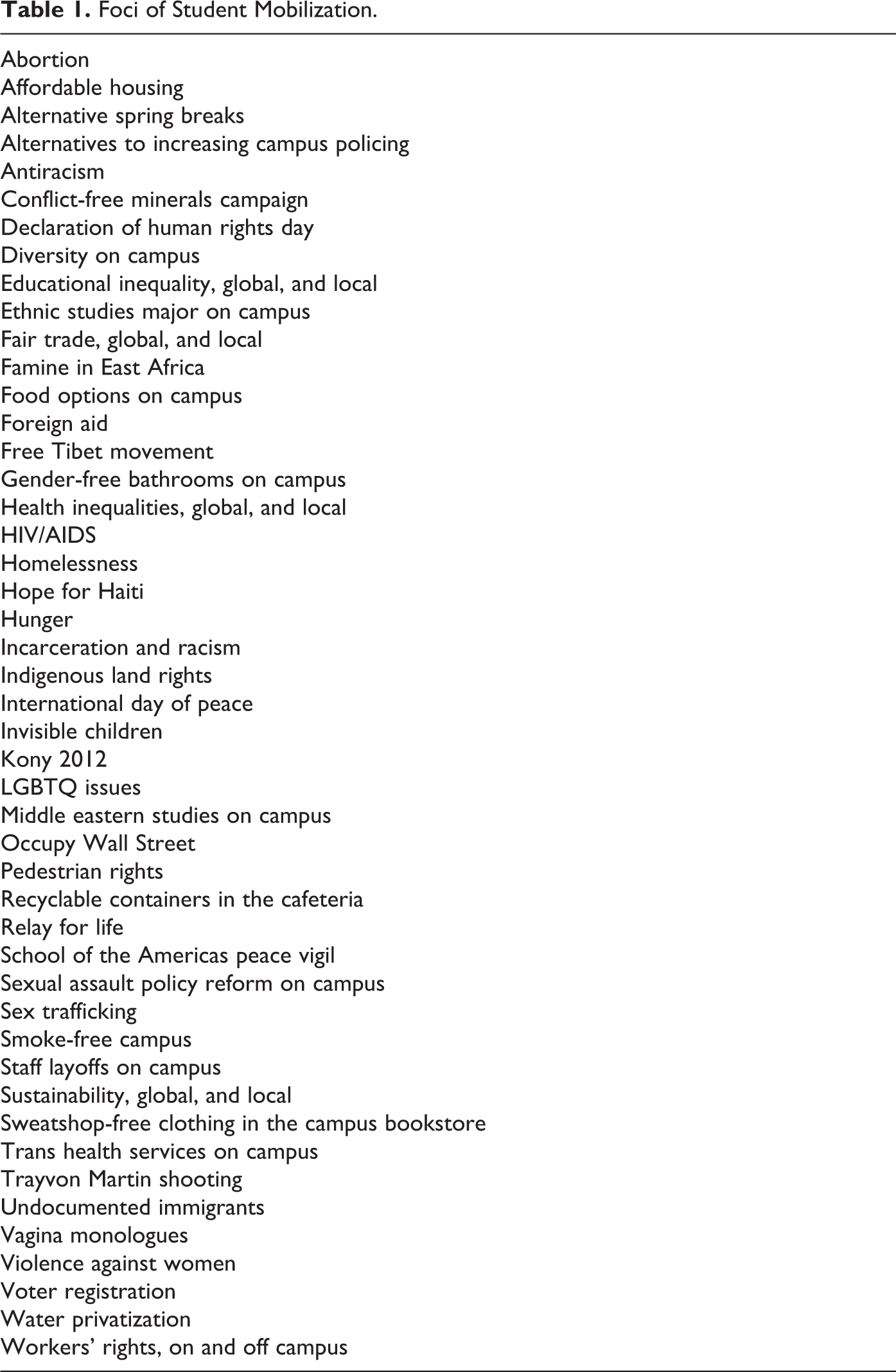
We found that students were dynamically responding to changes in the world, describing campaigns in their communities that ran the gamut from grappling with issues of access to services, curriculum, and workers’ rights on campus to solidarity, with communities around the world that are struggling with the consequences of neoliberalism. Topics that came up most frequently in interviews included diversity on campus—particularly sexual orientation, race, and ability—related to concerns that feel particularly present in many students’ lives. Other prominent national and international events were the emergence of Occupy Wall Street in September 2011, the shooting of Trayvon Martin occurring in February 2012, and “Kony 2012” going online in March 2012 (Table 1).
Foci of Student Mobilization.
There were clear questions among respondents about what form action should take. The propriety of various tactics was recurring theme, especially as students distanced themselves from tactics perceived as confrontational or divisive. Miranda Smith, a member of the class of 2013 at a large private university, explained why her peers regard traditional social movement tactics as passé: “Rallies are sort of a joke. They happen every single day [in Washington, DC] and they are always for something different. And it kind of cheapens your opinion of rallies when you see different groups of people protesting anything.” Alex Kane agreed, noting peer pressure to not stand out and that “the students at [my] school just don’t seem interested in the idea of a rally. Maybe it feels too 60s.… . They don’t work.” In offering these critiques of tactics, students speak honestly from their experiences. What these evaluations lack, however, is a more structural perspective on resources, legacies of struggle, and the changing terrain of contentious politics.
Several students’ commentaries on the de-emphasis of direct action as a mechanism for making change highlighted institutional limitations. Addison Shields, a member of the class of 2013 at a religious college, questioned the political efficacy direct tactics. Reflecting on a demonstration she attended, she noted: I was like obviously [thinking] this isn’t working.… . It was cool to be with all these people who supported [the cause] and things like that. It was very reassuring to see that many people who share your view, but at the same time …. Congress and the media are so easily ignoring us.… [For institutional powers] it’s just kind of like deal with it for a day and then you move on.
If direct action tactics were regularly described as undesirable, whether because students found them to be “sort of a joke” or because those in power had adapted, students were considerably more comfortable embracing strategies like education, service, and fund-raisers in pursuit of social change. Dannie Grufferty (2012), vice president for society and citizenship for the National Union of Students UK, argues that because “traditional lines” of politics and movement tactics of the 1970s do not work for today’s students, “we need to develop a series of tactics that our community can use to work effectively to secure social change in their own interests.” As with our finding about (dis)claiming an activist identity, it is imperative for sociologists to consider questions including, what structural forces foster students’ disinclination to use direct action tactics? To what extent do their preferred tactics of awareness raising, educational talks, and charitable walks affect structural change?
Digital Tools and Social Media
Social media has become a widely utilized tool for college students to leverage the Internet’s low cost and easy access to support social movements (Earl and Kimport 2011; Theocharis 2012). At the same time, some argue that merely tweeting or liking posts is not generative activism. Malcolm Gladwell (2010) contends that digital tools like social media are “effective at increasing participation—by lessening the level of motivation that participation requires.” The so-called slacktivist millennials are critiqued as a “lazy generation,” whose digital actions are “feel good” rather than transformative (Morozov 2009). Lewis, Grey, and Meierhenrich (2014) found that the vast majority of “participants” in the Save Darfur Cause on Facebook neither recruited anyone else nor donated to the movement. Slacktivism narratives also resonate with broader American cultural tropes about millennials being selfish and lacking initiative (Stein 2013; Twenge 2012). Yet when students talked with us about digital tools and social change, they regarded social media neither as unambiguously good nor an end in itself. More than an end in itself or solely as a tool to recruit, they saw how social media could be a tool to excite and motivate conversations around pressing social issues.
Most discussions started by acknowledging the prominence of tools like Facebook and Twitter as well as the volume of social media their peers consume. Melissa Williams, a member of the class of 2012 at a private university, noted that these tools are “more and more ubiquitous.” However, students saw the need for education and organizing beyond technology. Wesley Doherty explained: Some have termed it as slacktivism, meaning that it’s really easy to like a Facebook status, or tweet something, but it’s another thing to actually go into a community and have the humility to ask questions and really get a better understanding of the information before you go and you choose to be an activist for something. People are getting bombarded with all the [mass announcements of] events. If I get an individual message I, the user, would think of it more like, “Okay … I should go because I would be a valuable member in whatever is happening.” Word of mouth is always really strong, people hearing it from other people and encouraging them to act.
We saw a clear example of how students thoughtfully connect digital tools and broader engagement. A member of the class of 2013 at a large religious university, Emily Manchester explained that “we’ve never had a strong need for activism” because her university is “extremely diverse” and “open.” Yet appalled by instances of racist and homophobic graffiti in a campus building, students took action. The movement: wasn’t given any type of formal name or anything … there was a lot of student voices, just general conversation and then also organized events. We had a vigil where a lot of students got up and spoke. Some read poetry, some talked and other people performed. And there was an actual march where students marched from a part on campus to off campus … to draw attention to their cause. I think everyone on campus, regardless of whether they wanted to or not, had some involvement with it just because … it was such a presence …. It was in the news, it was all over Facebook, so whether you wanted to be or not, you were involved.
Next Steps
The students we interviewed are passionate and engaged, albeit not in ways that scholars have typically regarded as activism. As sociologists, we need to assess what students are doing and saying to understand their worlds. Examining cultures of meaning concerning student action promises not just to enrich scholarly research on contemporary social movements but also to inform how we teach a range of courses and signal directions for advocates to engage more people in their work on campuses. Of particular importance are three questions related to identification, tactics, and technology. Even when students are extensively involved in action to promote social change, why are most disinclined to call themselves activists? This brings us back to forging a critical understanding how students define social problems and perceive themselves and their peers as potential agents of change. We are eager to continue these critical conversations.
Our sample drew upon students who are involved in social justice networks and, as such, reflects how this group understand cultures of activism. We recognize the limits of this sample. There would be a benefit in exploring the views of students who are not participants in formal organizations. This could certainly include students who are inactive and see these initiatives as far away from their lives and experiences. Indeed, research shows the tremendous amount of cultural work involved in avoiding politics (Eliasoph 1998). At the same time, future research should also consider the experiences of radical activists who envision mainstream groups as overly social and not truly activist. Both of these lines of inquiry are important to understand the contours of contemporary mobilization.
The data from our interviews also point to additional questions that would necessitate different methods of gathering information about contemporary cultures of action. For example, given the age-group of many students and the closeness of campus communities, to what extent does peer pressure to conform lead might-be activists to refrain from taking public action for a cause, or in a way, that might make them be perceived as outsiders? In reflecting on the transition out of college and the ways in which students prioritize college as a means to better jobs, how activism affects students’ future employment? Finally, in thinking about change over time, is public activism by students perceived as more risky than it was in earlier time periods? While interviews could provide some insights, nuanced answers to these questions raised in a range of thoughtful reviews would necessitate ethnographies, comparative/historical work, or surveys.
Our preliminary findings also point to the important role an engaged humanist sociology can play in fostering more conversations about contemporary student activism. As we recognize both the questions about students’ perceptions of activism and the increased rationalization of colleges and universities, we hold on to humanist sociology’s promise “to inquire, to study, to document, to inform, to agitate, to name, and to teach of the promises and perils in change and the inadequacies of current conditions” (Adair 2015:19). Through engaged, innovative teaching and research with our students “not only do we encourage our students to think that sociology is different from other subjects and thus possibly liberating but also we create environments where other students want to ‘commit sociology’” (Dolgon, Harvey, and Pennell 2015:133). In taking these actions, we live out the promise of sociology to connect personal troubles of milieu and public issues of social structure as well as foster critical understandings of the world (Mills 1959). In committing sociology, contemporary students could structurally analyze the landscape of power (in its current form as well as how it has changed over time) and then work intentionally from the roots to transform systems of injustice. These movements would necessarily entail learning more about histories of social movements and the tactics they employed. What might this teaching and learning look like? Research shows myriad examples of interventions with students that happen in or across classrooms (the May 2015 issue of Humanity & Society illustrates a range of such endeavors), at the level of institutions (Reiff and Keene 2012) or around constellations of interconnected concerns like the Student Nonviolent Coordinating Committee (Zinn 2002). Just as Association for Humanist Sociology (AHS) members have organized recent conferences on engaged pedagogies, so too might we renew collective efforts to engage our students on the topic of activism.
Footnotes
Authors’ Note
The authors contributed equally to the article and are listed in alphabetical order.
Acknowledgments
We are grateful to the students who shared their insights and experiences with us. Thanks also to the reviewers from Humanity & Society, Corey Dolgon, and Jessica Vasquez for their comments on earlier drafts of this manuscript.
Declaration of Conflicting Interests
The author(s) declared no potential conflicts of interest with respect to the research, authorship, and/or publication of this article.
Funding
The author(s) disclosed receipt of the following financial support for the research, authorship, and/or publication of this article: This research was supported by a Stonehill Undergraduate Research Experience grant from Stonehill College.