



Abstract
This article explores historical processes of land dispossession through an in-depth case of the Narragansett Indians of present-day Rhode Island. Using an eventful historical methodology, I uncover three primary mechanisms, each temporally situated, that dispossessed the Narragansett tribe of their land: violence, debt, and state governance. I proceed by first considering Narragansett life before the incursion of settler colonialism. Following this brief exploration, I turn to an analysis of both the historical events and processes that dispossessed the Narragansett of their land. This analysis contributes to the literature on empire and colonialism, as well as theoretical debates on primitive accumulation and settler colonialism, by exploring and identifying the mechanisms by which primitive accumulation operated within a specific settler-colonial context. In the end, I argue that sociology must expand analytically and conceptually to include indigenous experiences of ongoing dispossession in order to end the disciplines complicity in the elimination of the native.
Reflexive Statement
Growing up in Rhode Island, you are taught that the relations between Roger Williams (viewed as the founder of Rhode Island) and the indigenous peoples of this region were amicable. This notion never quite sat well with me, given the fact that indigenous people were invisible, despite having many towns, cities, beaches, and roads named after various words from their language. I couldn’t help but wonder what happened to the Narragansett Indians. If relations between colonists and indigenes were so friendly, why have most people never met a person of Narragansett descent? Why don’t most people know about their history? After moving away for my undergraduate studies, and eventually coming back to the region for graduate school, I finally gained the tools (and opportunity) needed to explore this history as related to broader processes of dispossession and the establishment of a settler-colonial society. This article is a part of a broader project to bring silenced, invisible, and neglected histories into sociology, particularly the histories of dispossession and enslavement, at the dawn of a racialized modernity.
Introduction
Banished from the Massachusetts Bay Colony in 1635, the English theologian Roger Williams sought solace in the wilderness first in the company of the Wampanoag and a year later within the territory of the Narragansett Indians. Prior to his banishment, Williams made a living trading with the native peoples of “New England,” and over time came to know their language and customs better than any other English colonist. In 1643, he published a book called A Key into the Language of America: Or, An Help to the Language of the Natives in that Part of America, Called New England. It contained more than just translations of important words and phrases; A Key was one of the first ethnographic accounts of Native Americans in the region and contained insights into the culture of the Narragansett, ranging from their household and familial organization to their agricultural practices.
Writing about the Narragansett, Williams (1866) observed that there were “no beggars amongst them” (p. 58). Once the most powerful and respected native nation in Southern New England, by 1880, the Narragansett had lost most of their land and autonomy. Prior to colonization, in the late sixteenth and early seventeenth centuries, the tribe is estimated to have been between 35,000 and 40,000 people strong, with territory that extended throughout most of what is now Rhode Island and into parts of Connecticut and Massachusetts (Geake 2011; Simmons 1986). Within three centuries, the Narragansett in Southern New England was reduced to less than 500 people fighting not only to maintain their cultural heritage and identity, but their lives. Although eventually the Narragansett would regain some of their political sovereignty and land in the late twentieth century, 1 exploring their historical experience of dispossession offers insight into the social logics and mechanisms that eventually pauperized one indigenous group of people by displacing their relationship to the land in the broader process of settler-colonial expansion. Although aspects of my analysis are particular to the Narragansett, their story is a part of the larger process in which white settlers from Europe sought, and succeeded, in establishing a new society in a “new world.” 2
Recently, Geisler (2013) writes about the process of Native American dispossession in his article “Disowned by the Ownership Society: How Native Americans Lost Their Land.” 3 He argues against the view of legal historian Stuart Banner (2005) that Indians lost their land mostly through purchase and market forces than through violence and coercion. Geisler (2013) instead proposes “Indians in America lost their land through coercion muted by market-like negotiations on some occasions and coercion without pretense on others” (p. 3). The present study intervenes in this discussion by offering an in-depth historical case study of an early North American settler colony. Contra Banner (2005) and I too argue against the view that Native Americans chose to sell their lands more from market pressures than coercion, problematizing the choice to sell in the first place. Here, I consider why the Narragansett would come to sell their land in the first place, and argue that coercion (whether direct or indirect) and structural constraints associated with settler colonialism are central to understanding the historical process of dispossession, despite what on the surface might appear as market mechanisms. I find violence, debt, and state governance, along with the power of the law and its enforcement, as the principal mechanisms underlying the indigenous loss of land (as summarized in Figure 1).
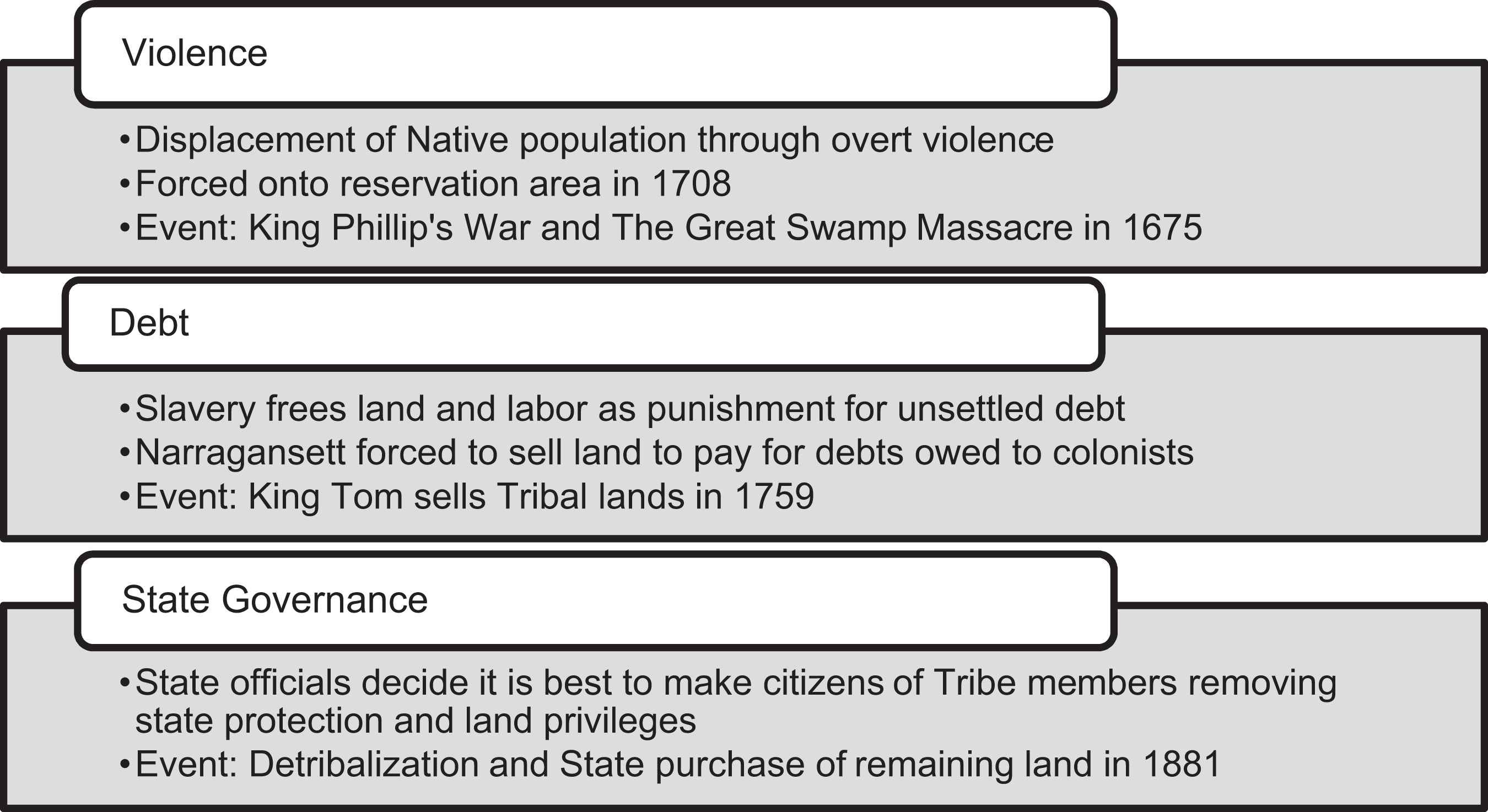
Mechanisms of dispossession.
Methodological Note
Today, “method” and “methodology” are used rather interchangeably in the social sciences. This has caused confusion about the meaning of both. To clarify, I use method to refer to the tools and techniques of data collection and analysis, whereas methodology refers to the epistemological and ontological assumptions that guide my approach to the research. Methodology, therefore, is about the theoretical assumptions that inform the researcher throughout the process, while methods are about the means by which data are collected and analyzed.
My orientation toward social research is fundamentally interpretive in the sense articulated by Reed (2011). Arguing against a conceptualization of interpretive sociology simply as description, standing in opposition to realism as explanation, Reed (2011) posits “methodologies are ‘interpretive’ precisely in so far as they guide us toward […] meaning-reconstruction, whereby social mechanisms are finally comprehended in their concrete, sometimes vicious power because the meanings that form them are brought to light” (p. 161). Although this article is ultimately interested in the causal pathways, or mechanisms, through which native peoples lost their land and autonomy, understanding the historically situated system of meaning upon which colonists and indigenes acted is of central importance.
Additionally, Sewell (1990, 1996, 2005) and Abbott (1984, 1990, 2001) both highlight the importance of events for a robust historical sociology. Overall, my analysis engages with eventful temporality in that I “recognize the path dependent, causally heterogeneous, and contingent nature of temporality, [and] put the question of how structures are transformed or reconfigured by [meaningful] social action” at the core of my inquiry (Sewell 1990:24). Historical sociologies are important precisely because they situate phenomena within their sociotemporal context, and paying attention to the eventfulness of social life has aided in the performance of a robust analysis.
Finally, in terms of methods, the historical analysis of colonial documents from the Rhode Island Historical Society and the Rhode Island and Providence Plantations State Archives forms the core of the research presented here. 4 These documents, spanning from 1636 to 1880, consist of meeting notes of the general assembly, correspondence between British colonial authorities in England and the settlers in North America, colonial legislation, land deeds and transactions, petitions, and governmental reports. As a single case study, my aim is to illuminate how “general social forces take shape and produce results in a specific setting” (Walton 1992:122). By investigating how the Narragansett people lost their land, my aim is to attend to how the broader social force of settler colonialism as it took form in the context of New England and more specifically Rhode Island, thereby generating insights that might serve as the basis for further comparative analyses.
Theorizing Dispossession: Primitive Accumulation, Settler Colonialism, and How the Indians Lost Their Land
Before moving forward, it is important to establish the theoretical basis upon which this article rests. While colonialism and empire have long been of sociological concern, interest has certainly fluctuated over the years (Go 2009). The literature has considered the many political economic aspects of empire (Alavi 1972; Arrighi 2007; Boswell 1989; Eisenstadt 1993; Go 2007), while others have studied the way in which Western notions and practices are evaluated and incorporated within the colonial context (Go 2006; Lo, Bettinger, and Fan 2006; Prasad 2006). While highly productive, this literature has failed to fully engage with colonialism in the North American context. 5 Settler colonialism, as a distinct colonial form worthy of sociohistorical analysis, is only recently gaining some interest in American sociology (Glenn 2014; Steinman 2015).
Within the sociological canon, Marx’s writing on primitive accumulation stands out as an obvious starting point to think about the dispossession of indigenous lands.
6
In Capital, Volume One, Marx writes: The so-called primitive accumulation, therefore, is nothing else than the historical process of divorcing the producer from the means of production. It appears as primitive, because it forms the pre-historic stage of capital and of the mode of production corresponding with it. (1978:432)
Like primitive accumulation, colonialism takes different forms. Colonization in North America took a distinctive form commonly referred to as settler colonialism. What makes settler colonialism distinctive is precisely the fact that it entails the permanent settling of a foreign group on land already occupied by various indigenous peoples (Veracini 2010; Wolfe 2006). Recently, Evelyn Nakano Glenn (2014) has argued for the necessity of a settler colonialism framework for a historically grounded and inclusive analysis of racial formation in the United States that moves beyond the black/white binary. For Glenn (2014), settler colonialism was (and is) a race–gender project in that white colonists harnessed conceptions of race and gender to construct a hierarchy of human beings. In this hierarchy, the white male colonists stood above women, the indigenes, and African slaves, laying claim to landed property and the coercion of labor.
For the purposes of this article, I consider primitive accumulation and settler colonialism to be theoretically and historically linked. The processes of dispossession that characterize settler colonialism are at the same time processes of primitive accumulation in the sense that the dismantling of indigenous sovereignties and relationships to land form the basis upon which white European capitalist accumulation are built. There would be no American industrial revolution, for instance, without the acquisition of American Indian lands and resources necessary for capitalist production. It is therefore crucial that scholars consider primitive accumulation and the settler-colonial form in tandem, carefully tracing the mechanisms of dispossession that alienate indigenous people from their land, in turn providing the foundations upon which a racialized, gendered, and class-based society can be built and maintained. As Yellowknives Dene scholar Glen Sean Coulthard (2014) argues, “we should see [primitive accumulation] as an ongoing practice of dispossession that never ceases to structure capitalist and colonial social relations in the present. Settler colonialism is territorially acquisitive in perpetuity” (p. 152). 7
In How the Indians Lost Their Land, legal historian Stuart Banner (2005) writes that “there is not sharp distinction between voluntariness and involuntariness” (p. 3). For as Banner puts it, “At most times, and in most places, the Indians were not exactly conquered, but they did not exactly choose to sell their land either” (p. 4). What is most problematic about this argument is that it does not take seriously the structural constraints imposed on the natives of North America through English settlement. In examining how Native Americans lost their land, one must take seriously the structural transformations that the indigenous people had to contend with upon the arrival of an ever-growing foreign population. For as Patrick Wolfe (2013) so eloquently puts it: Land is settler colonialism’s irreducible essence in ways that go well beyond real estate. Its seizure is not merely a change of ownership but a genesis, the onset of a whole new way of being—for both parties. Settlers are not born. They are made in the dispossessing, a ceaseless obligation that has to be maintained across the generations if the Natives are not to come back. (Wolfe 2013:1)
My analysis contributes to the literature on empire and colonization, as well as theoretical debates on primitive accumulation and settler colonialism, by exploring and identifying the mechanisms by which primitive accumulation operated within a specific settler-colonial context. In doing so, my aim is to show that primitive accumulation is an on-going feature of settler colonialism rather than a single event that lays the stage for later capitalist development. The analysis proceeds by first considering Narragansett life before the incursion of settler colonialism. Following this brief exploration, I turn to an analysis of both the historical events and processes that dispossessed the Narragansett of their land. Each section represents a major historical event or series of smaller events. I begin this section with a reflection on the initial colonial expansion of English settlers into Narragansett territory and the preliminary legal structures set in place by colonial government that first imposed limitations on the Narragansett way of life. What emerges from my analysis is a pattern of dispossession characterized by mechanisms with varying degrees, and forms, of coercion.
Overall, my analysis illuminates the various mechanisms through which the Narragansett lost their land: violence, debt, and state governance. For analytic clarity, I discuss each individually and where possible as connected to an historical event. However, each mechanism is deeply connected with the others. Slavery, for example, was a consequence for unpaid debt but was also certainly bound to violence.
“No Beggars amongst Them”: The Political and Economic Organization of Narragansett Society Prior to Invasion
As noted in the introduction, Roger Williams observed in the early seventeenth century that within the Narragansett community “there [were] no beggars amongst them, [and] no fatherless children unprovided for” (1866:58). 8 The significance of this observation rests in the fact that within a century, the Narragansett would see their way of life decimated incrementally as the English presence increased. Here, I briefly explore Narragansett political and economic organization before British colonization began to take a major toll.
The tribe had a simple division of labor between men and women but also in terms of craft. As Roger Williams notes, “They have some who follow only making of Bowes, some Arrowes, some Dishes, and the Women make all their earthen Vessells some follow fishing, some hunting” (p. 180). 9 Women were in charge of planting crops and collecting edible plants, while men did most of the fishing, hunting, and trapping.
Throughout the indigenous societies of the region, there was no institution of private landed property, as all land within a given territory was open for communal use (Bragdon 1999; Merchant 1989). Sharing was the central norm governing economic relations. For instance, Williams states that: whomsoever commeth in when they are eating, they offer them to eat of that which they have, though but little enough prepar’d for themselves. If any provision of fish or flesh come in, they make their neighbors partakers with them. (1866:45)
“Why Come the Englishmen Hither?” Colonial Expansion into Narragansett Country
Roger Williams (1866) wrote, “This question they [the Narragansett Indians] oft put to me: Why come the Englishmen hither?” (p. 87). This is precisely the question that needs to be addressed in writing about how the Narragansett, or any other Native American tribe, lost their land. Settler colonialism in North America meant that the English came to the continent to stay. It meant that every time the Narragansett provided the colonists with the right to use land (which the colonists viewed as a transfer of all rights of ownership), the colonists had no intention of ever ceding it back. In this section, I explore the initial colonial expansion into what was Narragansett country (and present-day Rhode Island) in the seventeenth century.
The first important land transaction was made in the spring of 1636, when Roger Williams obtained a tract of land lying between the Pawtuxet and the Pawtucket (Seekonk) rivers, on which he founded to the town of Providence with a few of his followers. There was a short period of peace between the native inhabitants and their new white neighbors, and this is evident in the large tracts of land that were exchanged in the period just after settlement (Chapin 1931).
From the perspective of a group of people trying to establish themselves in a foreign land, gaining mastery over that land was of utmost importance. It cannot be forgotten that when the English colonists made their way to North America, historical enclosures of common lands had already been underway in England for almost 100 years (Wordie 1983). This meant that the English settlers in North America were more than familiar with political and economic organization around private property (Cronon 1983). When the English colonists established themselves in North America, they sought to create the same political economic arrangements present in their motherland.
Settler colonialism meant creating restrictions, and political arrangements, that the Narragansett had never been subject to before. The earliest law on the historical record with direct reference to the “Indians” was passed by the general assembly in Portsmouth in 1640 setting into law the first recorded restrictions of indigenous agency. It limited where the Narragansett could light fires and hunt and trap wildlife. The law also states: that upon their trading and bargaining, having agreed, they [the Indians] shall not revoke the said bargaine or take their goods away by force, and that they shall not be Idling about nor resort to our howses, but for trade, Message, or in their Journeys. (Bartlett 1856:107)
While they signal conflict to the observer of history, these laws might have meant little to the Narragansett early on without the necessary enforcement mechanisms. For instance, the historian Henry Dorr (1985) noted, “wherever one of them fou[n]d among the white settlements, a field uncultivated, he had no hesitation in planting his corn with a mere ‘squatters’ title” (p. 169). However, as the number of colonists increased (with increased legal authority given to them by the King Charles II of England), the colonial government increasingly used the law to restrict Narragansett behavior with the force necessary to carry out punishment. In this regard, the law began to threaten more severe punishment. For example, in 1657 and 1659, laws were passed “‘that no Indians sit down to inhabit in this Neck’” (p. 199) and additionally “restricted the damage by Indians, stealing and pilfering, and their injuries to cattle, fences, fruit-trees and ‘corne houses [by] impos[ing] severe penalties no less, in some cases, than the sale of offender into slavery in another colony’” (p. 201). As discussed in a later section, the threat of slavery was real and many Indians residing in the area became slaves through legal means.
Whereas the Narragansett once moved freely within their given territory hunting, fishing, and planting as need be, the laws of colonists with their concomitant punishments, limited the freedom of the native Rhode Islanders and heightened tensions between the two groups. The Narragansett could not foresee the harsh restrictions on their agency that would ensue by warmly welcoming the English and by allowing them to use their land. Furthermore, the fact that the colonists sought to control the behavior of the Narragansett is telling of their intent in settling in what is now known as New England.
King Phillip’s War 11 and the Great Swamp Massacre 1675
As tensions rose in present-day Rhode Island between colonists and Natives, conflicts were arising in the neighboring Massachusetts Bay Colony. These conflicts culminated in the declaration of war between the Wampanoag Indians and the colonists residing in Massachusetts. The English and Wampanoag Indians had long been suspicious of each other. King Phillip, or Metacom, was often fined and summoned to meet with the authorities of the colony in Massachusetts, and he suspected the English of murdering his brother. In 1675, the colonial government asked the Wampanoag to give up their weapons. Also, in this year, three Wampanoag were tried and executed for the murder of a Christian Indian who had been an informant to the English authorities. Enraged, the Wampanoag raided the town of Swansea and other outbursts of violence followed. The so-called First Indian War was underway.
In the colony of Rhode Island, the period of peace and mutual exchange between the colonists and natives had long been over as evidenced by a letter from Roger Williams to the authorities in Massachusetts asking for weapons. He wrote: We are informed that tickers [guns] have rarely been denied to any English of the country; yea, the barbarians (though notorious in lies) if they profess subjection, they are furnished; only ourselves, by former and later denial, seem to be devoted to the Indian shambles and massacres. The barbarians all the land over, are filled with artillery and ammunition from the Dutch, openly and horridly, and from all the English over the country (by stealth). I know they abound so wonderfully, that their activity and insolence is grown so high that they daily consult, and hope, and threaten to render us slaves, as they long since (and now mostly horribly) have made the Dutch. (Bartlett 1856:324)
More than five years before Massachusetts’ colonial authorities asked the Wampanoag to give up their weapons, the Rhode Island authorities had asked the Narragansett to do the same. In May 1667, it was ordered by the general assembly: […] that Thomas Willmott, of Secunk [Seekonk], hath informed the Council now sitting, of such deportments of the Indians, especially Philip, which giveth great occasion of suspicion of them and their treacherous designs. It is therefore ordered, that the Indians residing upon this Island shall be forthwith disarmed of all sorts of arms, and that the Captain and militarie officers meeting with any Indian armed, they are authorized to seize the arms […] And it is ordered, that if in Rhode Island, or in any other towns, any Indian shall be taken walking in the night time, he shall be seized by the watch and kept in custody till morning, and brought before some magistrate, which said magistrate shall deal with him according to his discretion, and the demerit of the said person so offending. (Bartlett 1856:193)
When the war between the Wampanoag and English began, the authorities of the colony in Rhode Island and Providence Plantations urged the Narragansett for their support. Ninigret, the head sachem of the time, heeded the call of the English informing them of King Philip’s activities. However, the sachem had no control over the lesser sachems and their support for Wampanoag. Many years prior to this conflict, Miantonomo, a prominent leader of the Tribe, argued that the native people of the region should band together to fight off the white invasion: But the English having gotten our land, they with sithes cut downe ye grass, and with axes fell the trees; their cowes and horses eat ye grass, and thr hogs spoyl our clambanks, and we Shall all be starved: therefore it is best for you to doe as wee, for wee are all the Sachems from East to West […]. (Rubertone 2001:79)
12
Eventually, colonial officials charged the tribe with harboring Wampanoag fugitives and decided to take action. Troops from the Massachusetts Bay Colony and Connecticut were sent to where the Narragansett were residing in a swamp in present-day southern Rhode Island, where they attacked Narragansett people in what it today known as the Great Swamp Massacre. Here, hundreds of elderly men, women, and children were killed and their wigwams torched. The Narragansett found themselves actively engaged in the war. Calamity and violence would ensue in New England until the end of the war in 1676 with the defeat of the indigenous people. The conflict with the colonizers had significantly decreased the numbers of Narragansett such that the decimated tribe integrated with the Niantic forming a new Narragansett tribe with far less power. Between 1660 and 1710, more than 200 new townships were established in New England (Geake 2011). While according to Chapin (1931), “the able bodied [Narragansett] men had been reduced from 2000 to 200” (p. 91). Table 1 shows the population of the colony in 1708.
Population in the Colony of Rhode Island and Providence Plantations in 1708.
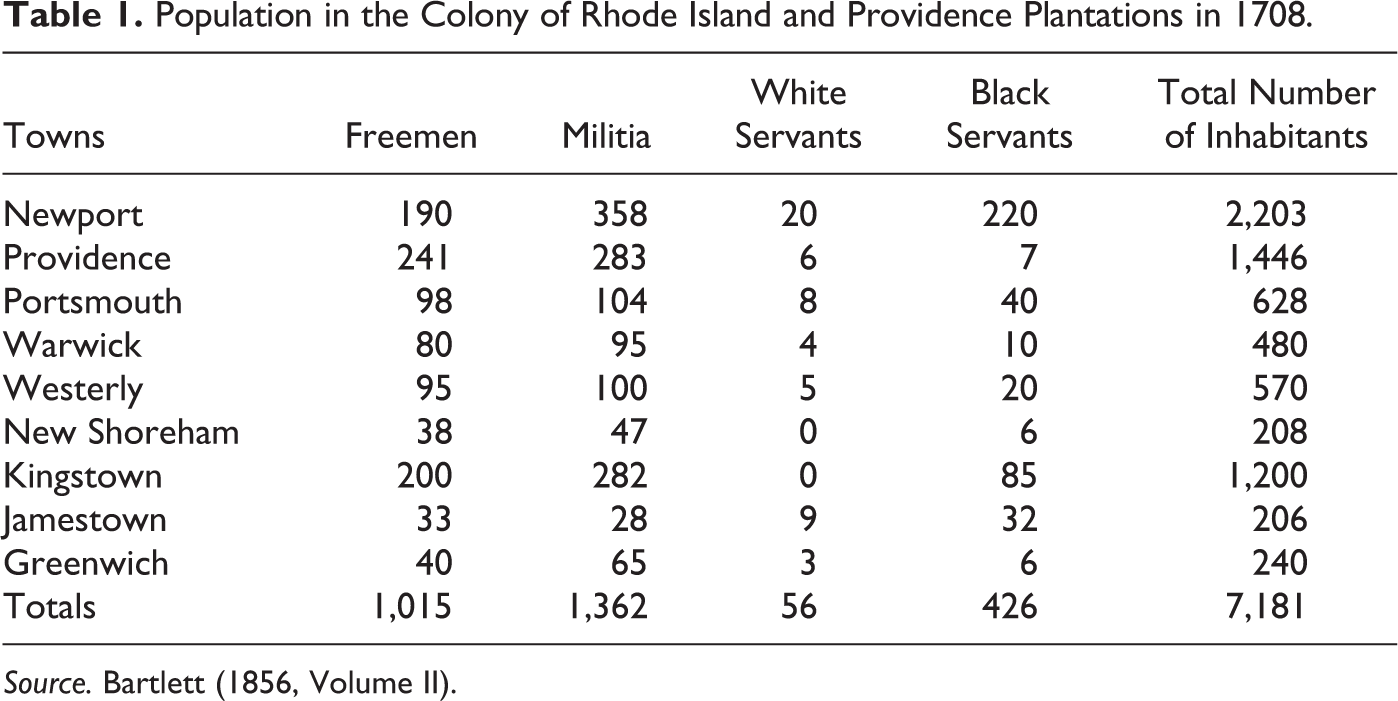
Source. Bartlett (1856, Volume II).
In addition, another barrage of laws was passed restricting Narragansett autonomy, including curfews and consequences for holding weaponry, and for the first time the settlers were the majority with the power to enforce their rules. Many were sold into slavery and sent to the Caribbean, while others simply left the area and went to settle among other tribes in New York and the Midwest.
This historical event forever changed the social structures by which the Narragansett exercised their agency. Having lost a substantial portion of their population in the long and violent conflict with the English colonists from the surrounding colonies in Massachusetts, Rhode Island, and Connecticut, the Narragansett were no longer in a position of power. From this point forward it would be complete farce to talk about the Narragansett as having chosen to sell land to white colonists. As Marx once wrote, “Force is the midwife of every old society pregnant with a new one” (1977:436).
Ninigret II and the Creation of a Reservation in 1709
By the turn of the seventeenth century, the Narragansett would lose much of their land and autonomy as a result of the violent conflict with the English colonists. After the war, the period of the lone “wandering Indian” began, and the skirmishes and alcohol-related incidents that ensued led the victorious colonists to pressure indigenous people to gather onto reservations (Geake 2011). The historian Robert Geake (2011) purports that the pressure on Ninigret II, then leader of the tribe, was such that in 1709, “he and his council willingly agreed to give Providence Plantations all remaining Narragansett land in exchange for such a reservation in Charlestown that included the area where tribes had lived since the gathering with the Niantic” (p. 55). However, the reservation did little to protect the tribe from exploitation and expropriation of land. Colonists bought land and wood from Ninigret II at low prices, and in 1713 the Colony intervened by passing an act that prohibited purchase of land or wood from the tribe without license.
Indian debt became such an extensive problem in the colony that in 1718 an act was passed that protected the Narragansett from being sued for debt citing their exploitation as impetus for such a law: Whereas, several persons in this colony out of wicked, covetous and greedy designs, often draw Indians into their debt, and take advantage of their inordinate love of rum, and other strong liquors, by selling the same to them, or otherwise to take advantages, by selling them other goods, at extravagant rates, upon trust, whereby said Indians have been impoverished, to the dishonor of the government. (Bartlett 1856:30)
Debt, Slavery, and Dispossession
In his book Debt: The First 5000 Years, David Graeber (2011) describes how throughout history debt has been used as a means of justifying violence: If history shows anything, it is that there’s no better way to justify relations founded on violence, to make such relations seem moral, than by reframing them in the language of debt—above all, because it immediately makes it seem that it’s the victim who’s doing something wrong. (p. 5)
As early as 1659, the colony in Rhode Island legislated that slavery be used as punishment for criminal offense and the settlement of debt: It is therefore by the authority of the present Assembly enacted and established, that if any Indian or Indians have, or shall at any time feloniously take away the goods, monies, cattell, or other things that amount to the vallew of twenty shillings or more, according to white peage, six a penny; or if any of the Indians or any Indian shall spoyle or damnify the cattell, fence or fruite trees, corne house or other goods of any of the English, or other inhabitantinge, sejournige or beinge within this jurisdiction, the damage whereof amountige to the vallew afresayd; and being done wittingly, willingly or insolently, the sayd offender beinge an Indian or Indians, shall be apprehended […] And being convicted of any offence aforesaid, the sayd Indian or Indians beinge not able presently to procure and pay and discharge all the damages, costs and restitutions by law due, to be done and made; it shall be lawfull for the judges of the court where such tryall is, to condemn sucha offender or offenders to be sold as a slave to any forraigne country of the English subjects. (Bartlett 1856:413)
Following King Phillip’s War, many Narragansett were forced into slavery both within the colony and abroad on account of these laws. Some were sent to plantations in the West Indies while others were sent to work on the burgeoning plantations in Rhode Island (Geake 2011). Census records show an upward of 223 slaves in Providence, Warwick, and South Kingston alone, and a generation later still as much as 193 listed on these town registries (Geake 2011).
The price for each Indian slave varied, but they were altogether worth less than African slaves. During this period of slavery, the Narragansett often intermingled with other slaves of African descent, producing many mixed race offspring referred to as “mustees.” Geake (2011) writes: These mustee generations of the Narragansett often grew up in slavery. If they were not born in a master’s house and added to the property, they were dropped on the doorsteps of estates, farmhouses or even meetinghouses by free Narragansett women who were often impoverished and sometimes shamed by their relatives for their interracial unions. (p. 62)
King Phillip’s War left the Narragansett with little more than land and labor to cover the debt that many found themselves in. In the cases in which slavery was not sanctioned as punishment for debt, land was sold in order to settle accounts. Even the leaders of the tribe found themselves in debt and had to sell land to settle them. In 1759, the sachem known as King Tom petitioned the colony to sell some land to pay debt and was granted permission to do so. However, this upset many Narragansett living on the reservation lands because they claimed that he was selling too much. In response, the colony passed an act in 1763 that prohibited the sale of any further land. Yet in the sachem’s death a few years later, colonists accused him of having outstanding debts, and more land was sold to settle them. In response, members of the tribe wrote to the general assembly calling for the protection of their remaining land: That some of our late sachems, through extravagance and indiscretion, had heretofore run themselves largely in debt; and for the discharging those debts, we have consented to the sale of the greatest part of the most valuable lands belonging to the tribe; so that there now remaineth but a small tract, compared with what they once possessed; and that they have remaining only one small piece of Fort Neck, by which they can get to the salt waters, from which they fetch great part of the support of themselves and families. […] We therefore humbly petition this Honorable Assembly, to pass an act, to secure to the said tribe, forever, as well the said small part of Fort Neck, as all the other lands now of right belonging to them; and that the same be not, for the future, liable to the payment of debts. (Bartlett 1856:214)
No Race, No Land: The Detribalization of the Narragansett
Despite the general assembly’s efforts to protect the Narragansett from losing any further land, the political economic arrangements of settler colonialism, which entails the perpetual dispossession of the original inhabitants of the land, forced many poor members of the community into debt with little way out but to sell their land or labor. Land disputes became common as land transactions between the Narragansett and the white colonists increased. In 1879, the then leader of the Tribal Council, Gideon Ammons, petitioned the state of Rhode Island to assign a committee “to investigate their affairs in reference to the encroachment of the whites upon the tribal lands, and whether it was better to continue the tribe as a tribe or enfranchise them, and how it was best to proceed” (Adams, Carmichael, and Carpenter 1880:24).
Testimonies from members of the tribe reveal that an overwhelming majority were against becoming citizens. As Joshua Noka, a member of the Tribal Council, powerfully proclaimed: Now, for me as an individual to ask to be a citizen, under the present existing circumstances, I don’t see anything that would be interesting to me. For a colored man to be citizen, he will remain about the same as at the present time. He is merely brought out in a position like this: a chance to vote for somebody, but he can’t expect to ever to be President of the United States, or an Attorney-General. It makes no difference how well he is qualified, he can’t be put into a jury box, to be drawn as a common juror, or anything of the kind but if you have a got a cesspool to dig out, put him in there. But to be put in a position whereby men shall be recognized as men in the position, and he is not found. Now what would be the object[ive] in throwing off the tribal authority and come out and be called a citizen, with nothing to do as a colored man? (Adams et al. 1880:32)
Only one member of the tribe, Sam Congdon, testified in opposition to the majority held opinion that citizenship and the abolition of tribal relations would be good for the tribe because to him the Tribal Council took advantage of their position of power to make a profit at the expense of the tribe’s landed property. Yet overall, there was an acknowledgment among members of the tribe that citizenship would be detrimental to the well-being of tribal members and would result in the further loss of land. As Daniel Sekater puts it: And I can’t see for my life wherein we shall be benefitted any more than we are the present time by coming out as citizens under the present circumstances. We have now here a little mite of property that belongs to the Narragansett Indians, conveyed to them by their foreparents, and it belongs to them; and it does seem to me that they ought to have the handling of it as they see fit. There is the Indian cedar swamp, whereby many in this tribe are benefitted by it. I am not so much as many are. If they want any wood, fencing stuff, or shingles, they can go in there and cut it; and there are a good many of them that now do, and perhaps would, own land against the white people, and they would compel them to fence some places; and there are very few that could do it, and their land has got to be forfeited; and I can’t see that citizenship is going to do them any good. (Adams et al. 1880:38) We learn that there is not a person of pure Indian blood in the [T]ribe and that characteristic features, varying all the shades of color, from the Caucasian to the Black race, were manifest in the several meetings of the Committee. Their extinction as a [T]ribe has been accomplished as effectually by nature as an Act of the General Assembly will put an end to the name. There will evidently be a feeling of regret when the name of a [T]ribe so long known in the history of our State passes from existence. (p. 6)
As a historical event, the state government’s decision to detribalize the Narragansett should be thought of as the final event in a long series that divorced the Narragansett from their land and means of production. It would take 80 years, and plenty of litigation, to regain status as a tribe and a minutia of the land the Narragansett once claimed sovereignty over.
Eclipsing Indigenous Sovereignty and Autonomy, One Land Grab at a Time
This article has elucidated three primary mechanisms that divorced the Narragansett from their land each temporal situated. Violence, first, depleted the Narragansett population and helped to eventually relegate the remaining group to a section of land in present-day South County. The violence associated with King Phillip’s War created a situation of dependence, in which borrowing from colonists was the only way that the Narragansett remaining in the region could survive. The steady invasion of settlers, with their hankering for land, slowly eclipsed indigenous sovereignty and autonomy by limiting Narragansett agency with coercive practices.
Debt, then, served as a means of severing the Narragansett from their lands by making slaves out of members of the tribe on the hand, and on the other, by forcing them to sell their land to settle accounts. Settlers established their own political economy on the land carved out of Narragansett territory. With this new political economy, based upon private property and market relations, the Narragansett had little choice but to exchange land and labor in order to survive. Colonists, in turn, created their own sovereign territory on lands acquired through this process of dispossession, receiving statehood with the ratification of the U.S. Constitution in 1790.
State governance served as the final mechanism to dispossess the Narragansett of their ancestral land by declaring them citizens and stripping them of tribal authority and protections that tribal status entailed. Following a trope common to settler-colonial contexts—that of the disappearing Indian—state officials argued that the Narragansett had been effectively eliminated through their intermixing with other races and therefore were no longer entitled to rights and protections as a sovereign nation of native people. Making the Narragansett citizens entailed dissolving their last bit of territory.
Dispossessing the Narragansett, whether through violence or contract, was always an act of coercion. Although Banner (2005) asserts, “the idea of a spectrum bounded by poles of conquest and contract […] in understanding how the Indians lost their land” (p. 4), the case of the Narragansett in Rhode Island clearly demonstrates how the law served as a means through which the Native Americans could lose their land. Perhaps more than anything, the case of the Narragansett reveals that the distinction between conquest and contract is a false one. Banner further alleges, “At most times, and in most places, the Indians were not exactly conquered, but they did not exactly choose to sell their land either. The truth was somewhere in the middle” (p. 4). Yet this assertion only makes sense within a logical framework that distinguishes between conquest and contract. In this study of how the Narragansett lost their land, I’ve shown that contract has been used as a means of conquest since the beginning of European settlement in the region. Distinguishing between contract and conquest obfuscates the fact that the primary means by which the Indians lost their land is coercion often veiled in the language of contract and legality.
How the Native Americans lost their land is part of a larger story in which capitalist expansion divorced people from their land and their labor. In present-day Rhode Island, the indigenous Narragansett people were alienated from their land, simultaneously creating a class society where there had been none before. As Walter Rodney (1974) once asserted, “When one society finds itself forced to relinquish power entirely to another society, that in itself is a form of underdevelopment” (p. 224).
Conclusion: Unsettling American Sociology
This article has centered on the historical experience of one group of Native Americans as entrée into exploring the social forces of settler colonialism that perpetually relegate this continent’s original inhabitants to the margins. By focusing on colonial history from the perspective of the dispossessed, I believe that my analysis has opened up alternative ways of thinking about the rise of America’s racialized, gendered, and classed social system from the subaltern standpoint. After all, the United States, as a settler-colonial society, was built upon—and is maintained through—the perpetual erasure of indigenous sovereignties through dispossession (Byrd 2011). As the Geonpul scholar Aileen Moreton-Robinson (2015) argues: [T]he question of how anyone came to be white or black in the United States is inextricably tied to the dispossession of the original owners and the assumption of white possession. The various assumptions of sovereignty, beginning with British “settlers,” the formation of individual states, and subsequently the United States, all came into existence through the blood-stained taking of Native American land. The United States as a white nation-state cannot exist without land and clearly defined borders; it is legally defined and asserted territorial sovereignty that provides the context for national identifications of whiteness. In this way I argue that Native American dispossession indelibly marks configurations of white national identity. (p. 51)
When critical sociologists of race like Joe Feagin (2001) assert that “Native Americans have not played as central a role in the internal socioracial reality of the colonies or the United States as have African Americans” (p. 207), they unintentionally contribute to the collective misremembering of the indigenous presence throughout the history of this country. What these scholars fail to recognize is that from the vantage point of white settlers, the American Indian was always meant to disappear, whether through the genocidal wars against them or their forced assimilation into settler society. African Americans, on the other hand, originally property, were racialized such that their blackness remained in perpetuum, congealing their place as an exploitable labor force. By emphasizing the racialization of blacks as more central to the constitution of socioracial reality in the United States, we become complicit in indigenous erasure, while simultaneously limiting our understanding of racial domination and the possibilities of overcoming it. We must recognize the different, but interrelated, experiences of racialized others as united by the logics of white supremacy and possession. To overcome, we must form antiracist solidarities based upon the wide range of historical relationships that colonialism itself has created (Wolfe 2016).
Sociology, therefore, must reconsider the place of indigenous experiences in shaping the racialized, gendered, and capitalist social system that we live in today, and the ongoing dispossession of indigenous territory should be our analytic starting place. If not, we as sociologists will continue to be complicit in the historical aphasia of indigenous peoples’ dispossession, further aiding in the settler-colonial project of eliminating the native. It is my hope that this article moves the discipline in the right direction.
Footnotes
Declaration of Conflicting Interests
The author(s) declared no potential conflicts of interest with respect to the research, authorship, and/or publication of this article.
Funding
The author(s) received no financial support for the research, authorship, and/or publication of this article.