



Abstract
How can the average person influence environmental policy making? To answer this question, we draw on 21 in-depth, semi-structured interviews with environmental activists, lobbyists, and legislative staff members at the state level. In addition, we supplement our data with field notes at lobby days and legislative hearings as well as 22 interviews with state capital interns. We find that public feedback (e-mails, letters, phone calls, and lobby days) focuses attention on environmental bills and turns them into public issues. We discuss the rare conditions under which e-mail advocacy is modestly effective and also detail the continued importance of personalized communication in interactive lobbying by phone and in person. Environmental activists strategically deploy moderate identities (i.e., concerned parent) in order to transform public issues into personal stories that legitimize their concerns, depoliticize problems, and establish connections with legislators. Personal stories, in turn, benefit from a logical fallacy or the assumption that vocal constituents likely represent concerns shared by additional community members. This interpretation has the potential to convert individualized problems back into public issues with policy solutions.
Personal Reflexive Statement
Janet A. Lorenzen is an assistant professor of sociology at Willamette University in Salem, OR. She teaches classes on social problems, sustainability, theory, and qualitative methods. Her work explains the gradual process of transitioning to a green lifestyle, the strategies employed by actors to spread those changes through their social networks, the relationship between lifestyle change and social movements, and the co-construction of green technology and users. This article is the beginning of her next major qualitative research project on environmental policy making and her first time working with undergraduate research assistants—who were invaluable to the timely completion of this pilot project. At a time when addressing environmental problems is increasingly dominated by the market place, many sociologists stress the importance of policy initiatives and structural changes. If academics do not want people buying their way to safety, how can the average person influence environmental policy making? The answer to this question will ideally assist “regular” people and environmental advocacy groups in their lobbying efforts.
Elizabeth Gill and Mark Andreoni are undergraduates at Willamette University who worked as summer research assistants for this project. In addition to contributing to this article, they assisted with library research, conducting interviews, and coding data. The average person is more important than a paid lobbyist.
For our pilot project, we interviewed three groups of people involved with different aspects of the lobbying process. We draw on data from in-depth, semi-structured interviews with seven environmental group leaders involved with lobbying, six professional lobbyists primarily working in favor of new environmental policies, and eight legislative staff members at the state level. We supplement our data with field notes (lobby days and legislative hearings) and 22 interviews with undergraduates who recently interned at the state capital. Our goal is to gain a better understanding of both the strategies the public can use to influence environmental policy making and, more importantly, the way those strategies are received.
Legislators deal with hundreds of bills each session; public attention can single out a bill to bring it to the attention of legislators. In contrast, public silence, according to our informants, is often interpreted as a lack of concern—as opposed to disillusionment with politics, perceptions of limited access, or lack of knowledge about how to navigate political institutions. The public can also influence how a bill is understood (benign vs. controversial, building momentum vs. creating a roadblock). Emily, quoted above, explains that the strength of the environmental movement is in people, not money or professional lobbying power.
It is difficult to generalize about the way public feedback is received at legislative offices because there is a wide range of responses, some state legislators have their interns create spreadsheets for e-mails and phone calls, others are rumored to log phone calls but “dump” e-mails. In order to minimize the time commitment of activists, avenues of participation have become less personalized. There is typically an inverse relationship between the number of people engaging in communication and the personalization of that communication. For example, e-mails written using templates that share the same subject line require large numbers to have an impact. People who “just click” (forward a form e-mail unaltered) are viewed by staff members as only marginal supporters of an issue. According to an environmental group leader, some legislators question the motivation behind template e-mails and wonder if environmental groups are convincing indifferent people to send them.
In contrast, individual e-mails, handwritten letters, phone calls, and particularly in-person meetings convey that an issue is, according to one intern, “very dear to your heart.” Communications that convey personal stories also benefit from a logical fallacy—or the assumption that if one average person (i.e., unconnected to an activist group) was moved to contact their legislator, then there must be others like them remaining silent. For legislative staff members, personal motivations and spontaneous, unorganized feedback have more value than environmental movement activism. Environmental groups use several tactics, from personalizing e-mails to deploying moderate identities during lobby days, to negotiate this demand for experiential storytelling. Deploying moderate identities (i.e., outdoor enthusiast) helps establish an affinity with legislators, distance activists from controversies (over climate science), and justify their involvement in supporting divisive proenvironmental bills which are often framed as antibusiness. In addition, moderate identities enable a focus on personal stories which can be more effective than angry demands, appeals to opinion polls, or expert knowledge about environmental harms. We argue that telling personal stories, which environmental activists use as a persuasive tactic and legislative offices define as a best practice for communication, individualize problems, highlight experiences over expert knowledge, and dissociate private aims from environmental group goals. This article is another example of the strategic avoidance of political talk in contentious politics (Eliasoph 1998; Kennedy 2016; Lorenzen 2014a).
In what follows, we explore how the average person can make a difference in environmental policy making. Why the public cares about something, and how they express their concern, matters. We begin by briefly discussing the literature on personal stories as a social movement tactic and e-mail or Internet activism. After describing the methodology used here, we examine the way public feedback can transform a bill into an issue. Substantively, we detail the conditions under which e-mail advocacy is minimally effective and the enduring significance of one-on-one communication in lobbying. We discuss the use of and request for personal stories in public feedback, and the way perceived motivation (concern over personal problems vs. public issues) affects the receipt of political messages. Individualizing problems using personal stories legitimizes concerns over environmental problems and, ironically, frames private motivations and experiences as shared.
Literature Review: Personal Storytelling and Email Activism
Informants identified two common tactics for involvement in environmental policy making—personal storytelling directed toward state actors and e-mail advocacy. Literature from both topics is briefly explored here. Relevant to this article, e-mail activism seems to inhibit personal storytelling making any union between these tactics a challenge.
Personal storytelling is often understood in two ways. First, it is a tactic used in identity politics or new social movements, where the identity itself is a forum for empowerment and dispute (Bernstein 1997). Second, collective identity also supports recruitment to and longevity of social movements (Polletta and Jasper 2001; Snow and McAdam 2000). More specifically, personal stories about identity and motivation may highlight pivotal awakening moments (Johannesen 2012); take advantage of “discursive opportunity structures” like the media (Longard 2012:55); and “celebrate or suppress differences” in the interest of empowerment, critique, education, and legitimation (Bernstein 1997:531).
In contrast to other new social movements, personal stories may play a comparably small role in environmental movements (Ladd 2011). Whether a group employs stories about identity as a tactic depends on several factors including the personal impacts of a political issue and the organizational structure of social movement groups, their protest arena, and their political context (presence of opposing movements; Bernstein 2008, Lievanos 2012). Audience composition is also influential in terms of access to policy makers and existing regulatory pathways; as well as expectations of appropriate behavior, narrative consistency, and conventions imposed by external authorities (Bernstein 2008; Lievanos 2012; Polletta 2006). For example, members of a professional environmental group may have few opportunities for face-to-face communication to wrestle with identity issues (making identity deployment less likely) but be expected to build connections with legislators and avoid blame during lobby days (making identity deployment useful). When identity is called on, environmental movement participants are more likely to strategically deploy depoliticized identities like cancer survivor, neighbor, parent, or grandparent (Lievanos 2012, Lorenzen 2014a), which explains motivations and justifies involvement in the movement (Naples 1998). This tactic of deploying moderate identities is explored further in the discussion.
Most activist groups operate with a combination of conventional and technological tactics for organizing (Christensen 2011). Computer-mediated communication can improve a group’s ability to recruit and retain members, organize in a less hierarchical way, and embed themselves in local context while addressing issues with national or global impacts (Pickerill 2003). Online networking can publicize an event, gather media attention, and influence the public agenda (Bennett and Segerberg 2013). Despite the difficulty in measuring e-participation (Gibson and Cantijoch 2013) and in separating conventional and technological tactics, the debate surrounding e-mail and Internet activism attempts to do just that.
The literature in support of e-mail activism revolves around three major themes. First, many authors argue that e-mail activism is a valid political act that can make a difference in the policy-making process (Bergan 2009; Halupka 2014; Christensen 2011; Oostveen 2010; Wang 1999). E-mail activism benefits citizens and grassroots campaigns in terms of raising awareness and promoting off-line activism (Christensen 2011). Mass e-mails and online petitions are essentially the functional equivalent of letters and paper petitions (Karpf 2010). Second, the authors argue that e-mail and the Internet allow for economically disadvantaged, historically underrepresented, and younger constituents to participate in the political arena (Gibson and Cantijoch 2013; Wang 1999). The third major theme in the literature supporting e-mail activism is the conclusion that the stigma against e-mail and online activism (aka “slacktivism”) is unwarranted and needs to be addressed in order to allow this type of activism to reach its full potential (Christensen 2011; Halupka 2014).
Some authors who support e-mail activism go further and argue that Internet activism broadly (e.g., Twitter) is an effective way to influence the public agenda (Hodges and Stocking 2016). These academics promote the idea that the Internet creates a level playing field in the political world no matter what type of online activism is used (Wang 1999). Online activism has created alternative public spheres for everyone from disability activists to antiglobalization protesters (Van Aelst and Walgrave 2004). And online participation has not detracted from off-line forms of activism, as both online forms of activism and traditional forms of activism have increased over time (Christensen 2011).
In contrast, the literature against e-mail activism or so-called clicktivism argues that e-mail is not an effective form of activism. These researchers find that e-mail and online activism are used by the same groups of individuals who participate in more traditional avenues for activism. In a review of the debate over e-mail activism, Smith et al. (2009) find that high socioeconomic status and education still play a large role in who participates in e-mail activism. Accordingly, this conclusion questions the effectiveness of e-mail and online activism to mobilize diverse groups at the grassroots level. Overall, opponents argue that Internet activism as a whole has made collective action more difficult and less effective (Shulman 2009).
There is a subsection of this literature that proposes that Internet activism, broadly, fails to promote effective political engagement (Shulman 2009; Wall 2007). More specifically, Internet activism does not allow groups to express identity or to create a movement through collective action (Wall 2007). For example, Galusky (2003) is concerned that environmental information conveyed over the Internet intended to empower people to avoid toxins actually creates passive, consumptive roles for activists. Additionally, this literature looks critically at the effectiveness of Internet activism as a long-term form of activism. Online advocacy groups may not be able to adapt quickly as technology changes (Karpf 2010). Much of this debate is concerned with broad questions such as: Has technology changed social movement activism? Or has technology changed political culture? This article is asking narrower and more practical questions: How is the tactical use of e-mail advocacy received in legislative offices today and how can those tactics be refined to convey personal stories?
Methodology
This article focuses on how individuals can influence environmental policy making through mostly informal forms of communication; whereas other studies focus on formal, institutionalized requests for feedback from the public about particular policies. We did not go into this project with the intention of studying “e-mail advocacy”—this was a theme, and a phrase, that emerged from the data. We draw on 21 in-depth, semistructured interviews and participant observation conducted in the summer of 2015. Professor Lorenzen took field notes at lobby days, legislative hearings, and information sessions related to environmental policies. To supplement this data, we also refer to 22 interviews with state capital interns—conducted, transcribed, and coded by Professor Lorenzen’s qualitative methods class in the spring of 2016.
Our primary data source includes interviews with three different groups of people who work on environmental policy at the state level: seven environmental group leaders, six professional lobbyists, and eight legislative staff members. We define members of environmental groups as people who work with any environmentally focused nonprofit lobbying for change at the state level, lobbyists are a combination of professional people lobbying for environmental groups or business interests, and staff members include any current or former paid workers at the state level who work with legislators. Two primary informants were found by accessing the professional networks of faculty members. All subsequent informants were asked for recommendations of potential interviewees in a snowball fashion.
Interviews were conducted in the Western United States. All informants are involved with the same state legislature. Interviews lasted from 35 to 90 minutes; the average interview was 60 minutes. Recorded audio files were sent to a professional transcriber then coded using Dedoose. Coding was both theoretical (using preexisting codes based on trends in the literature) and emergent (where patterns emerge from the data). We used the grounded theory method in order to gather unexpected data. We allowed our interview questions to evolve over time—dropping unproductive questions and adding new ones that corresponded with trends in the data already collected.
The perspective of interns was important to capture because of their role answering phones and responding to e-mail messages. The 22 interviews of state capital interns conducted, transcribed, and coded by Professor Lorenzen’s qualitative methods class used a similar methodology. Interns were contacted through faculty members. Interviews lasted from 20 to 30 minutes and explored internship experiences as well as interaction with the public. Interview questions were based on about 30 hours of field notes completed by the class.
We should note that when informants were asked about how the average person could impact environmental policy making, there was little said about rallies and demonstrations. Thus, comments on rallies and demonstrations did not create robust patterns in the data and are not included in the data section. One intern suggests that legislators like positive rallies and dislike negative demonstrations, while other informants mention that anything happening outside the building is easy to ignore. In this article, we use the phrase “interactive lobbying” to include two-way communication by phone or in person and exclude one-way e-mails or rallies which may receive no response from legislators.
Elevating a Bill and Creating an Issue
In the data section, we discuss how the public brings attention to a bill, assists in redefining it as an issue, and how communication tactics—from form e-mails to lobby days—are received. Interviewees disagreed on the effectiveness of e-mail advocacy but agreed that one-on-one communication was more persuasive because it was easier to convey personal stories about motivation and concern.
Environmental groups have few resources to hire lobbyists or donate money to election campaigns. As a result, they often rely on “turning out the grassroots” to communicate their concerns to legislators. Nancy, an environmental group leader, explains that public feedback matters and offers a “reality check” to the “inside the building mentality.” Nancy explains, They’re nervous nellies over there. Right? [They might assume that a bill is] pretty straight forward…and then they get flooded with 500 calls from constituents that day. Then they start to [say to themselves] “Wait a minute. Let’s take a more careful look at this. What’s going on here? Why is this group opposed to this? Or why am I hearing from people?…[and to the staffers] What didn’t you tell me?”
Engagement is typically coordinated by an environmental group that sends out an action alert to their members. Veronica continues, I don’t think I’ve ever seen sort of a flood of phone calls or e-mails that are not prompted by an advocacy organization. So you know the [recent] bill was sort of all those calls and e-mails on the pro side, were you know, sort of prompted by a certain organization and then on the con side by another one and it seems like that’s sort of what it takes for people to sort of know, “Oh, okay this is what I need to do to call my legislator.” It’s [privatization of wilderness] a huge issue…we wound up having you know like double our usual number of e-mails pour into the capital on that issue without doing anything different. Just because that issue really resonates with people and people took that action alert and the next thing we knew that bill was super controversial, we had legislators contacting us saying, “What can I do to kill this bill?” Which is not really that usual and so I think that the average citizen really made a difference in that bill’s not doing well. I don’t think it will pass, we’ll see. But we had…something like 2,500 people e-mail their legislators, which is a big deal.
Environmental leaders cannot easily predict what bills will be considered controversial until the bills are introduced into the legislature. What is defined as controversial emerges from the context of the situation and is produced through a negotiation of several variables: perception of public concern; available data from reliable sources like university reports; and competition over framing between legislators, powerful lobbying factions, and the media. What will build momentum (uncontentious bills) and what creates a roadblock (contentious bills) are difficult to predict. A roadblock occurs when politicians use a large amount of political capital to pass a bill (meaning their vote is controversial and subject to attacks by conservatives or media outlets) and, as a result, they are unwilling to put forth more effort in that area. Although we find little evidence that low-stakes household bills are blocking broader, systemic changes (Lorenzen 2014a), giving the environment one high-profile win could cause other proenvironmental bills, planned for later in the session, to be ignored.
Coalitions of environmental groups have a role to play in coordinating public efforts to communicate their concerns in large numbers. When coordinating action alerts with other groups, e-mails can reach upward of 5,000. Emily continues, So yeah our range is like 1,500 to 2,500 when we push some action like that but then that’s just our organization and usually we work in concert with other groups…so you put it all together and maybe you had 5,000 people e-mailing their legislators and that’s something that not very many groups can do.
E-mail: Templates versus Personalized Messages
Everyone in this study championed one-on-one, repeated, and personalized communication as the ideal form of political persuasion. However, given the practical constraints of everyday life, form e-mails are viewed as a pragmatic and moderately successful approach to communication with a long list of caveats (see Table 1). Few people we spoke to think form e-mails alone and unaltered are a successful tactic. The most obvious caveat to the success of e-mail advocacy is the number of form e-mails needed to make an impact. Environmental leaders spoke of numbers from 500 to 5,000, while legislative staff members said that even lower numbers, 24–100, make a difference. Jacob, a legislative staff member, states “sheer volume absolutely matters” and “yes we do count them.”
Form E-mails: Questions from Legislative Staff Members and Best Practices.
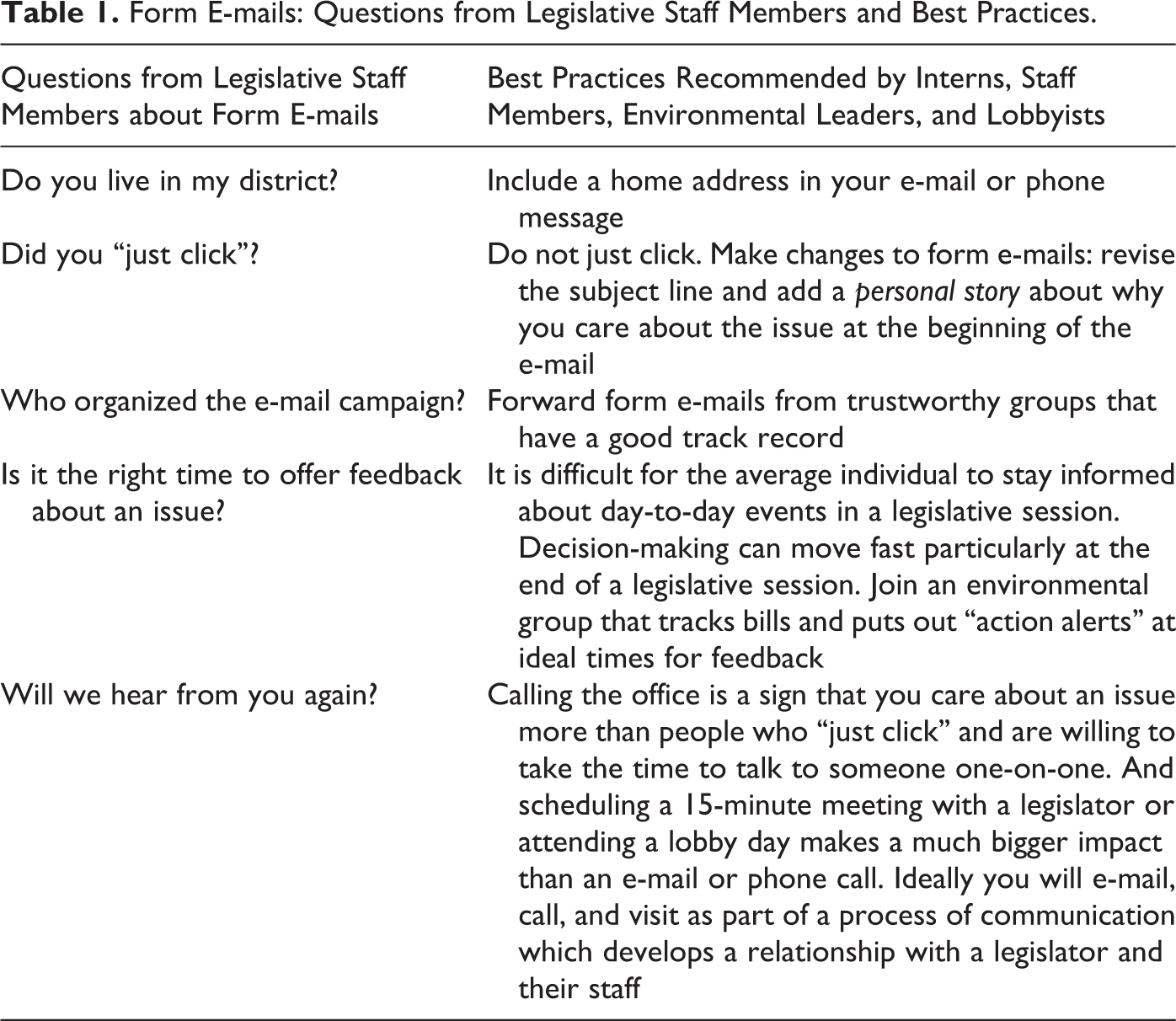
The list of best practices in Table 1 reveals the importance of personal stories and one-on-one communication—neither of which are well conveyed by form e-mails. Throughout our interviews, personal stories were highlighted as a particularly persuasive tactic. Olivia, a legislative staff member, states, Well I think that people who have their facts right are going to be listened to more often and people who understand the legislative process will be heard. I think that telling personal stories [is important], like I said earlier, a lot of the e-mails that we get with constituent outreach are form e-mails, but if we got 700 e-mails of personalized—each one of those being personalized, we would really have to think a lot more about how that issue affected every single person. We read every e-mail. If they say the same thing we will hardly look at the name of the person who sent them, but if they tell us how it really affects their life and why it’s important to them, I think that’s a really useful and persuasive strategy. We personally like getting the more personalized e-mails. You know, I understand why people send those [form e-mails]. I don’t think—I think it’s hard to understand what it’s like to get hundreds of the same e-mail unless you actually work in the office where you get hundreds of the same e-mail so that’s, yeah, I don’t know—I’m not too opposed to it. It doesn’t bother me that much—maybe as much as other people.
In contrast, older, more-experienced staff members were more skeptical of e-mail communication—personalized or not. Bonnie, a senior legislative staff member, states, [E]mails are not particularly effective and if they’re templates then they’re especially not effective. Now whether or not that’s true for the bulk of the legislators I don’t know. That would be my guess. But I think that’s more human nature than anything else. If you just get somebody clicking a button to send you a message versus spending time in writing something original I think you’re just more likely to pay attention to the second one.
Similarly, Elise, an environmental group leader, adamantly supports public involvement in policy making but questions the effectiveness of form e-mails and petitions. Elise discusses her experience, I’m shocked at how little that [getting people to take action] matters. You have to have such huge numbers of people. So we are talking many, many tens of thousands, not just 10,000. I’ve heard legislatures say they dump all the e-mails that people send, they don’t even open [them]—e-mails have become such a dime a dozen when everybody can draw up an e-mail, you know, they don’t even look at petitions anymore. I remember when petitions were the thing to do. It’s laughed at [at] the legislature. The response rate of the public is higher if they don’t have to think, they can click, it’s a “yeah, send the letters, yeah put my name on [it].” Legislators react to that now. They think it’s just—they make it out as if nonprofits are coercing people to take action and they normally wouldn’t take action. They have made it so easy that it has no meaning anymore. But I’m not saying don’t do it, I’m saying that this is what has become of the digital age. So we don’t do that. I always write alerts with bullet points so they can’t exactly copy; or they actually have to frame or shape their own sentence.
Informants are defining and categorizing form e-mails and personal e-mails very differently. But does the personalization of written communication really matter? Maryann, a former legislative staff member, explains the consequences of receiving a template versus a personal communication: If you get 5000 postcards that all say the same thing. You read the first one and you put all the rest of them in a box and you say, “I got 5000 postcards.” But if you get 5000 that say one thing. And 3 that have substance that say something else, you’re going to pay as much or more attention to 3. So I don’t think those [tactics are effective]. I see it all the time.
In contrast, Abby, an environmental leader and former legislative staff member, argues that e-mails, no matter what the content, miss the mark. Most e-mails are coordinated by social movements groups and are thus less authentic expressions of concern. She argues in favor of phone calls, which staff members and interns view as more personal. Abby states, I think there’s just a recognition that it takes more initiative to make a phone call and so I mean in congress they sort of assume that you know e-mails are super easy whatever but making a phone call it has more weight I guess. Like so when I worked for Senator [X] he wanted every week a total and a spreadsheet of the calls that came in, not the e-mails. Because e-mails…are only a factor of which group is sending out e-mails [action alerts] at what time. So if the group decides you know if [an environmental group] decides okay this is the day we’re sending out an e-mail that’s when that legislator is going to get all those e-mails. That’s not necessarily as good of an indicator as phone calls.
Interactive Lobbying
In preparation for lobby days, environmental groups offer brief training sessions (in person or on the phone) before small groups of people meet with their legislators. These training sessions lay out specific priorities, encourage people to find a personal connection with legislators, and recommend ending the meeting with a specific “ask”—from voting for a bill to reading a report. We find that personalized stories that originate concern with the individual, rather than a political group, are highly valued—even when an environmental group organizes the meetings between constituents and legislators. In one training session for an environmental lobby day, the organizer mentioned that she often begins conversations with legislators by showing them pictures of her new baby. This creates a personal connection and offers a less controversial (than climate science) motivation for concern about the environment.
Caroline, a proenvironmental lobbyist, argues that meeting with legislators is the most effective tactic that the average person can participate in. Caroline states, I think lobby days are extremely effective, I do think legislators care when 100 people show up wearing…Sierra Club t-shirts, people notice. But I think that the best activists are ones that are pragmatic and smart and don’t blow [their temper or fly off] the handle…you just have to remember that legislators are just regular people too and they’re trying to do the best they can…the best activists are the ones that can create lasting relationships with legislators and can be smart and thoughtful and just do a good job. Personal stories I think are really good. Legislators really do well with those and making it about why you care, why this is important to you.
All of the people we interviewed were strong supporters of public engagement in political decision-making at all levels. Steven, a professional lobbyist, sums up the role of different kinds of public engagement and the importance of perception. Steven states, And so you know, so the e-mails, phone calls, you know that sort of thing are kind of the immediate manifestation to sort of remind them [legislators] when they are in [the capital] and a long way from their home district, but yeah, it has to be more than that. It has to be that showing up at most every town hall and showing…and it’s not just a bunch of, you know, crazy fringe people but it’s like, you know, my aunt’s bridge partner, I went to pick her up it’s like, “why aren’t you doing something about that?” It’s like, you know, it has to be the perception that it’s everywhere. It doesn’t necessarily have to be everywhere, but you know again the math has to add up…there’s probably at least another X thousand people that I’m not hearing from but who feel the same way. And yeah right now we don’t have that but you know it’s very difficult to get that level of engagement today on these [environmental] issues. [Email and phone calls] might be the immediate manifestation [of public interest] but at a local level you know a legislature has to come [around]—it’s like “damn if we don’t do something about this people—I go to the supermarket and people accost me with this, I go to my Rotary meeting, I go to the Junior League, I go to my local schools, and everywhere I’m getting hit with this. And I could—I could give a rat’s bottom about this but everybody is really [concerned]—and I’m here and there are people that are going to run against me if I don’t do something about this. So let’s do something about it.” Or you know, “I’m from a district that doesn’t care about this but you know, boy, I’d really like to be Governor someday.”
Brandon, another professional lobbyist, also stresses the importance of one-on-one communication and telling a personal story. Brandon says, I think the most effective [tactic] is if they actually met with, or called and spoke with, their legislator, if they have that relationship. Right? Or if they have an opportunity to do that. I think if you have a legitimate story to tell that I think actually sitting down face-to-face, or talking on the phone directly with your legislator, is the most effective thing. I mean beyond though then, you know, a Lobby Day is good because you do get to sit down directly with your legislator. Those are usually set up by district and you have much more [of] a chance of being able to get that meeting scheduled…So I think that’s definitely more effective than form e-mails. Or form letters. Or a robo-call type of, you know, pass through thing. You know there’s a time and place for those things but I think definitely that, you know, one person’s story [matters].
In calls for “diverse stakeholders” and public involvement, experts are rarely mentioned. Rory, an environmental group leader, explains, So when they [legislators] don’t want to listen to the data, they say, they call [it] “forum shopping,” right. Well anyone can get anyone to say anything just worth a point, right. Which is true. I mean if you’ve ever done litigation, I mean you’re shopping around for expert witnesses who will support your claim. It’s not an unfair point, but it gets called out all the time. We present facts and…the other side will say, you know, our scientists say otherwise. And if the winds are already blowing the way of [a particular side]…their data is going to be the one that matters…it would be great to have researchers who would be willing to come in as neutral information providers, but they’re no longer neutral if they come in to debate one of these issues (laughing).
Annika, another professional lobbyist with a focus on bringing data into legislative decision-making, explains that people often ask her “What can I do to help?” She used to tell them to call or meet with their legislator but few actually did. Annika explains, I had so few people actually call their legislator or actually meet with them and, you know, “I am a constituent and I need you to do this.” That actually can have an influence. The problem is if they’ve totally made up their mind it doesn’t. If they’re on the fence or you know they haven’t been paying attention. Or they feel like there is an opening for them to vote for this without sticking their neck out. Or you know incurring [the speaker’s] wrath like it can make a difference. But it has to be like in that space.
Zoe explains that coordinating a positive lobbying experience can convert people from living a green lifestyle to formal political activism. Her goal is to help new activists concerned about climate change become more involved in the political process. Zoe argues, And to break that [consumer] mindset takes a kind of deep recalibration of how we see ourselves in the world, not as consumers but as citizens, and to do that you need an affirming experience of engaging in the public space and ultimately that’s what we are trying to provide…A well prepared lobby meeting with a responsive legislator becomes an addictive experience and we want people to get addicted to that sense of making a difference and being heard and effecting change that is a collective process—knowing that it is a long road and you have to have stamina to do that.
Discussion: Personal Stories about Public Issues
Our research confirms doubts about the effectiveness of template-based e-mail advocacy and confirms findings on the continued importance of interactive lobbying by phone and in person. We also take our research one step further to identify ways to refine e-mail advocacy (Table 1) and the circumstances under which it is more effective. When faced with an action alert and a request to forward a form e-mail constituents should change the subject line of the e-mail, add a personal story to the beginning of the e-mail, include their name and home address at the end of the e-mail, and follow-up with a phone call to help establish an ongoing relationship with their legislator. Constituent feedback, even via e-mail, can elevate a state bill onto the public agenda. In terms of content, informants strategically avoid controversies over environmental issues by deploying moderate identities to tell depoliticized, personal stories.
For our discussion, we will concentrate on three main interrelated themes: the tactic of personal storytelling by environmental groups, the demand for personal stories coming from legislative offices, and how the perception of motivation shapes the significance assigned to a message. From the literature on social problems, we know that personal stories are often more effective forms of persuasion than facts or data. From an activist perspective, groups rely strategically on personal stories to avoid political talk and controversies like climate change (Lorenzen 2014a). Activists who tell personal stories may avoid expressing anger and minimize blame, seem less partisan and more mainstream, and benefit from a logical fallacy—when legislative staff members and interns assume anecdotal evidence from regular people is representative of experiences shared among constituents. Part of the strategic use of identity involves “drawing attention to the motivations of activists” (Bernstein 2008:285). Although a hard sell to angry activists on lobby day, environmentalists are asked to deploy mundane identities like parent, grandparent, outdoor enthusiast, or longtime resident. Deploying moderate identities fits well with the deportment required for political lobbying and avoids the politicization of climate change. In other words, these identities mark activists as moderates (not radicals), distance them from controversial discourses (climate science), help establish a connection with legislators (we’re just like you), and offer personal stories to justify their involvement in supporting controversial proenvironmental bills.
Personal stories have long been considered an important tactic in achieving social movement goals, but that does not explain why legislative staff members and interns are requesting personal stories from their constituents. By highlighting personal stories, legislative staff members are privileging: unorganized opinions over partisan advocacy groups, experiences over scientific knowledge, and local problem-solving over systemic change. From this perspective, regular people are defined as: nonexperts unaffiliated with political organizations and focused on personal problems (which may or may not correlate with a public issue).
For example, activists expressed concern during lobby day training that they did not have enough facts about problems or solutions to lobby effectively. Environmental leaders assured them that a personal story was more important than facts on pollution or climate science, although they should know the basics about the bills that they are trying to support or block. Legislative staff members and interns confirm this advice. The personal story—in e-mails, letters, phone calls, and meetings—is a rhetorical device which fulfills legislative conventions for dealing with the public by depoliticizing problems, downplaying expert knowledge, and decoupling political opinions from environmental groups. By conforming to expectations for “regular people,” environmentalists may have a better chance of avoiding being dismissed as a special interest group.
Additionally, requesting personal stories separates the affected public from the concerned public and enables an examination of motivations. Is motivation internal (originating with the individual) or external (originating with an environmental group)? Stories often root political opinions outside of the political arena—in family relationships, a health crisis, and so on. Showing that a public issue is actually a personal problem legitimizes concerns (the reverse of the sociological imagination). Authentic concern is defined as arising from concrete personal experience as opposed to abstract scientific data. A logical fallacy occurs when politicians assume that personal motivations are shared and also represent silent constituents, which has the potential to transform personal problems back into public issues. Therefore, personal stories that convey individualized motivations and depoliticize problems do not necessarily individualize or depoliticize solutions. Unfortunately, form e-mails impede this type of communication in favor of expediency (Bennett and Segerberg 2013), leaving legislative staff members and interns with little personal information to assess. Form e-mails, lacking an explanation of motivation, do not benefit from a logical fallacy because it is the motivation or experience that is (expected to be) shared. Form e-mails are more likely to suffer from underestimating (ignoring numbers or downplaying commitment) rather than overestimating due to the assumption that environmental groups are persuading individuals into forwarding e-mails when they have little concern about an issue. This convention, of judging constituent feedback through the lens of personal stories, favors individual voices over movement interests and interactive lobbying by phone and in person over mass communication like e-mail. When it comes to climate change, requests for personal stories may largely rely on the backformations of strategic activists because, for example, experiences of flooding are rarely tied to climate change by individuals (Whitmarsh 2008). And while experiences of smog are more likely to be tied to climate change, they only result in market-based, individualized actions like biking to work or improving household energy efficiency (Whitmarsh 2008).
Conclusion
This article has explored how public feedback can bring attention to a bill and turn it into an issue of public concern. Communication from the public can also help frame a bill negatively as controversial or positively as inevitable. However, when environmental groups ask their members to send form e-mails to their representatives, these e-mails have a mixed reception. Form e-mails can achieve moderate success in getting their message across assuming hundreds or even thousands of form e-mails are sent to the state legislature by constituents. Alternatively, personal stories told through interactive lobbying (over the phone or in person) are considered the ideal form of persuasion. Activists perform politically moderate identities (i.e., longtime resident) in order to establish a personal connection with legislators, downplay partisan controversies, and explain their involvement in supporting controversial bills. Telling personal stories also allows activists to avoid angry confrontations and disputes over expert knowledge, while communicating what motivates them (besides environmental concerns) and how policies impact their lives. This individualization of environmental issues into personal problems legitimizes concerns by distancing individuals from movement rhetoric. In addition, personal stories benefit from a logical fallacy to a much greater extent than form e-mails—or the assumption that each personal story represents silent constituents in a similar situation. At a time when climate change remains a deeply partisan issue, this work demonstrates the ongoing importance of personalizing environmental politics.
Footnotes
Acknowledgment
We would like to thank Professors Wendy Peterson-Boring and Melissa Buis-Michaux in connecting us to primary informants for this research. Professor Lorenzen would also like to thank her qualitative methods class for interviewing state capital interns.
Declaration of Conflicting Interests
The author(s) declared no potential conflicts of interest with respect to the research, authorship, and/or publication of this article.
Funding
The author(s) disclosed receipt of the following financial support for the research, authorship, and/or publication of this article: This research was funded by the Willamette University Center for Religion, Law, and Democracy.