



Abstract
This article examines the narrative and visual construct of the lowrider vehicle as part of the barrio aesthetic. The central argument is that the display of lowrider art can be better understood as an artistic community mechanism of resistance used to contest cultural exclusion from white art spaces. The principles of Gloria Anzaldúa’s borderlands theory provide exceptional insights into the analyses of aesthetic lowrider displays from the margins. We use this approach to theoretically frame lowriders’ artistic representations as a Chicana/o identity effort to build contemporary cultural spaces for themselves. This study employs a qualitative triangulation method that includes participant observations, photo documentation, and six semi-structured interviews. Between December 2006 and September 2007, data were collected from the cities of Lansing and South Haven as well as from two lowrider car shows in the state of Michigan. This study found that lowrider art works as a source of stability and structure for Chicana/o young adults who live on the margins of society. For young adults isolated from mainstream cultural spaces by the essentialist interpretations of art, the lowrider aesthetic represents an identity–resiliency component introduced through family and friends—consciously or unconsciously—to resist cultural oppression.
Personal Reflexive Statement
Alejandro Gradilla, PhD Student. My research interest focuses on the intersection of mobility and the Chicana/o educational experience. Born and raised in Los Angeles, my life experience as a minority stakeholder provides an exceptional insight into everyday dynamics of a Mexican and Latina/o community. Because my research interests include the Chicana/o educational experience, racial relations, and ethnographic research methods, I have adopted a strong commitment to social justice research and embraced a culturally responsive development model to understanding life in minority communities.
Juan José Bustamante, PhD. As a scholar who embraces academic activism, my interest lies on studying settlement patterns of newcomers—particularly Latina/os—to new destinations. I employ a constructivist method as a theoretical compass to guide my research inquiries from the participant perspective. With this in mind and inherent to my interactive and dynamic research style, I hope to shed light about the way social actors construct their realities out of the interplay between larger structures and their personal experiences. I place particular emphasis on social actors’ voices, events, and settings to establish a policy relevant research through a community-centered model that focuses on issues of human rights and social justice.
One of the most persistent cultural means of aesthetic representation within urban, low-income Chicana/o communities of the U.S. Southwest has been the presence and display of lowrider vehicles. In these communities, called barrios, lowrider aficionados utilize public spaces to present their “art on wheels” (Stone 1990:87)—that is, cars and bicycles artistically painted and uniquely modified with mechanical hydraulic systems. This form of lowrider participation embodies a cultural perspective that situates the construction of barrio art within the individual experiential position as part of a relational connection between place and vehicle aesthetics (Van Dahm 2015).
In this context, a growing body of literature suggests that these cars are representative of an expressive style directly associated with the way the barrio and lowriders foster a Chicana/o artistic appreciation (Sandoval 2003; Stone 1990). Mendoza (2000:6), in this way, has proposed the concept of Chicanarte as a way to understand how the Chicana/o community sees lowrider displays through the aesthetic lens of a true representation of barrio art. Others posit that lowriders play a major role in Chicana/o community life in contesting racialized social patterns as a critical, artistic manifestation of the oppressed (Grady 2002:174). Grady (2002:174-76) argues that, rather than taking a passive position at the margins of society, young artists use lowrider art as a vehicle through which to claim visibility and gain space at the center.
In contrast, there is also a stigma associated with lowriders. Chappelle (2006, 2012) has documented the ways in which institutional and social perceptions work to undermine this particular kind of identity representation. Many times, it is interpreted as demonstrative of Chicana/os’ unwillingness to assimilate into the mainstream and their preference to live on the margins of society. Furthermore, this pervasive image of the lowrider as a culturally deficient product of Chicana/o community life is viewed as a potential source of social dysfunction—manifested by a display of identity that precludes integration into mainstream society (as critiqued by Bender 2003). Two assumptions underpin the negative image of lowriders and their impact on Chicana/o communities. The first suggests that youths of color who embrace the attributes of economically deprived communities are more likely to enter a segmented assimilation process that leads to downward mobility (Portes and Zhou 1993:82). The second frames community life within a culturally bonded structure permeated by disorganization and poverty (Huntington 2004:221). Images and practices associated with individuals who do not embrace the values of the dominant group suffuse the political discourse, situating Chicana/os as prone to “idleness, promiscuity, failure to assimilate, criminal mindedness, and lack of intelligence” (Bender 2003:114).
Although a serious attempt to repair these deficiencies has been made by several scholars (Chappelle 2012; Sandoval 2003; Stone 1990), there is little research that examines the narrative and visual construct of the lowrider vehicle as part of the barrio aesthetic. In filling this research void, this article draws on Anzaldúa’s borderlands model to theoretically situate lowrider art through the lens of an asymmetrical relationship with white, mainstream conceptualizations of artistic work. The border, in this context, maintains and, to a certain extent, perpetuates a divide between these two contrasting understandings of aesthetics.
Responding to this essentialist interpretation of art appreciation, we examine how and to what extent the display of lowrider art in barrios can be better understood as an artistic response to cultural exclusion conditioned by “white racial domination” (Withers 2017) models of aesthetics. This means not only contesting mainstream interpretations of art but also embracing barrio art as a cultural force that fosters a unique sense of Chicana/o aesthetic community resilient enough to resist artistic oppression from dominant white spaces.
Drawing on ethnography, photo documentation, and semi-structured interviews as techniques of inquiry, we collected data between December 2006 and September 2007 from Lansing and South Haven in Michigan. In these cities, we ethnographically documented participants’ experiences in an aesthetic world of lowriders located beyond the traditional spaces of the American Southwest (Chappelle 2012).
In our attempt to define the lowrider concept, we draw on Mendoza’s (2000:7-10) work that provides two descriptions to delimit the lowrider reality. The first refers to the customized vehicle as the traditional “lowrider” representation. The second presents the “low rider” as the participant—owner, aficionado, or enthusiast. Unlike Mendoza (2000), we think of lowriders not just as vehicles but also as the people who build them and embrace the style. Society generally does not differentiate between lowriders and low riders. This article uses the social construction of lowrider as a distinctly expressive style of the Mexican-origin community unless otherwise noted.
Theory and Relevant Literature
Literature from borderlands studies draw on concepts related to asymmetrical relations of power. Anzaldúa (2007) defines these relations by using racial and ethnic components to delimit the place where two asymmetrical worlds, brown and white, collide to create a third entity—the borderlands. Here, a border emerges as a dividing line used to “…define the places that are safe and unsafe, [and] to distinguish us from them” (Anzaldúa 2007:25). In this context, the border also refers to an abstract site in which two contrasting worlds—while sharing the same space—operate as buffers between two racial, social, and class-differentiated societies (Anzaldúa 1998:165).
The principles of Anzaldúa’s (2007) borderlands theory provide exceptional insights into the analyses of lowriders and cultural exclusion. We use this overarching approach to study how normative models of art appreciation driven by a white racial order place representations of Chicana/o’s artists as clear examples of a cultural anomaly. Previous studies reveal theoretical and empirical evidence of the way whiteness (Withers 2017) shapes the divide between what is considered normal and what is not, the way the cultural production of racialized logics and meanings perpetuates the reproduction of whiteness (Brunsma, Won Kim and Chapman 2020), and, as can be seen in Arredondo and Bustamante’s (2019) article, the way brown cultural/recreational places are appropriated as white spaces.
Given this understanding, Anzaldúa (1998:163) reminds us that because “la negación sistemática de la cultura Mexicana-Chicana en los Estados Unidos [ha impedido] su desarrollo haciéndolo este un acto de colonización” (“the systematic rejection of the Mexican-Chicana culture in the United States restricts its development [by] making it an act of colonization”), Chicana/o artists have used their own representations of art as a way to build a place for themselves. We argue that lowrider aesthetics are no exception to this practice. Many Chicana/os, engaging in lowrider art from the margins of society, design and build cars not only to challenge the oppressive experience of negating their Mexican heritage but also as a way to cross over the border of mainstream aesthetics. This means contesting essentialist interpretations of art from the other side of the racial border.
In the social science literature, lowriders have been the subjects of several empirical studies. Many scholars have interpreted this group’s expressive practices as symbolically representative of the Chicana/o community’s position within society at large (Bright 1998; Plascencia 1983; Sandoval 2003; Stone 1990; Vigil 1991). To speak of lowriding is not to say that everyone subscribes to this aesthetic identity behavior; still, many accept the modified lowrider car as a symbol of Chicana/o identity.
According to Bright (1998), Chicana/os participate in the ritual of displaying vehicle creations as a way to express community identity. Pride and ownership constitute important components of this community representation. Lowriders, for example, embellish their vehicles with symbols and/or images that represent Mexican beliefs to emphasize their Mexican heritage. Bright (1997) observes that images such as the Virgin of Guadalupe and Aztec Warriors are aesthetic symbols of identity painted on lowriders. Bright (1997) situates these displays as part of Chicana/o nationalism since they convey representations of national membership.
In making these contentions, Bright (1998:603) observes that several “Chicano forms of ethno-cultural expression tend to overlap” within the community’s activities, like the public display of lowrider art during the Cinco de Mayo celebration. Similarly, Stone (1990:86) indicates that lowriding is “considered as a public enactment of a renegotiated sense of Mexican American identity.” Here, the public activities of cruising and display provide powerful opportunities for those inside the community, as well as those outside of it, to imbue lowriding with “fluid, multiple, and often conflictive meanings” (Stone 1990:86). In addition, Plascencia (1983) suggests that lowriding is a way for Chicana/os to express their cultural identity to a general public audience.
According to Plascencia (1983), people are led to construct different meanings for their experience by combining images. His analytical study of early issues of Lowrider magazine—first published in 1977 in San Jose, California—delineates a fusion of Chicana/o aesthetic expressions related to the pachuco (zoot suit), cholo, and lowrider displays. However, Plascencia also suggests that the fusion of different forms of Chicana/o expression helped to create some confusion within mainstream culture via the erroneous assumption that artistic representations of Chicana/o groups were interchangeable. Perhaps this is one of the many reasons why lowrider art is stigmatized as culturally undesirable. Despite Plascencia’s (1983) critique, Bright (1994) and Sandoval (2003) contend that Lowrider magazine appreciates lowriding as a form of Chicana/o identity. The mass coverage and appeal of the magazine make lowriders an intricate part of the popular expression of being Chicana/o.
Best (2006:4) similarly points out that “driving a particular kind of car has the power to transform how we feel about ourselves as individuals and as members of a specific group.” Best posits that lowriders have transitioned from individual manifestations of aesthetic expressions to collective representations of Chicana/o identity. This is mostly represented by the images of art associated with Mexican American traditions.
As we expand our understanding of the lowrider as a form of artistic expression on the following pages, Anzaldúa’s (2007) borderlands theory helps us to frame the experiences of those Chicana/os who embrace this style of art from the side of barrio cultural life. Moreover, because lowriding has become a puzzling concept to explore from the side of the white-dominant, aesthetic model, we share in this article the ways lowriders’ artistic displays resist essentialist interpretations of art. In doing so, we document the extent Chicana/os make a significant effort to challenge exclusionary artistic practices by building cultural narratives and spaces for themselves.
Method
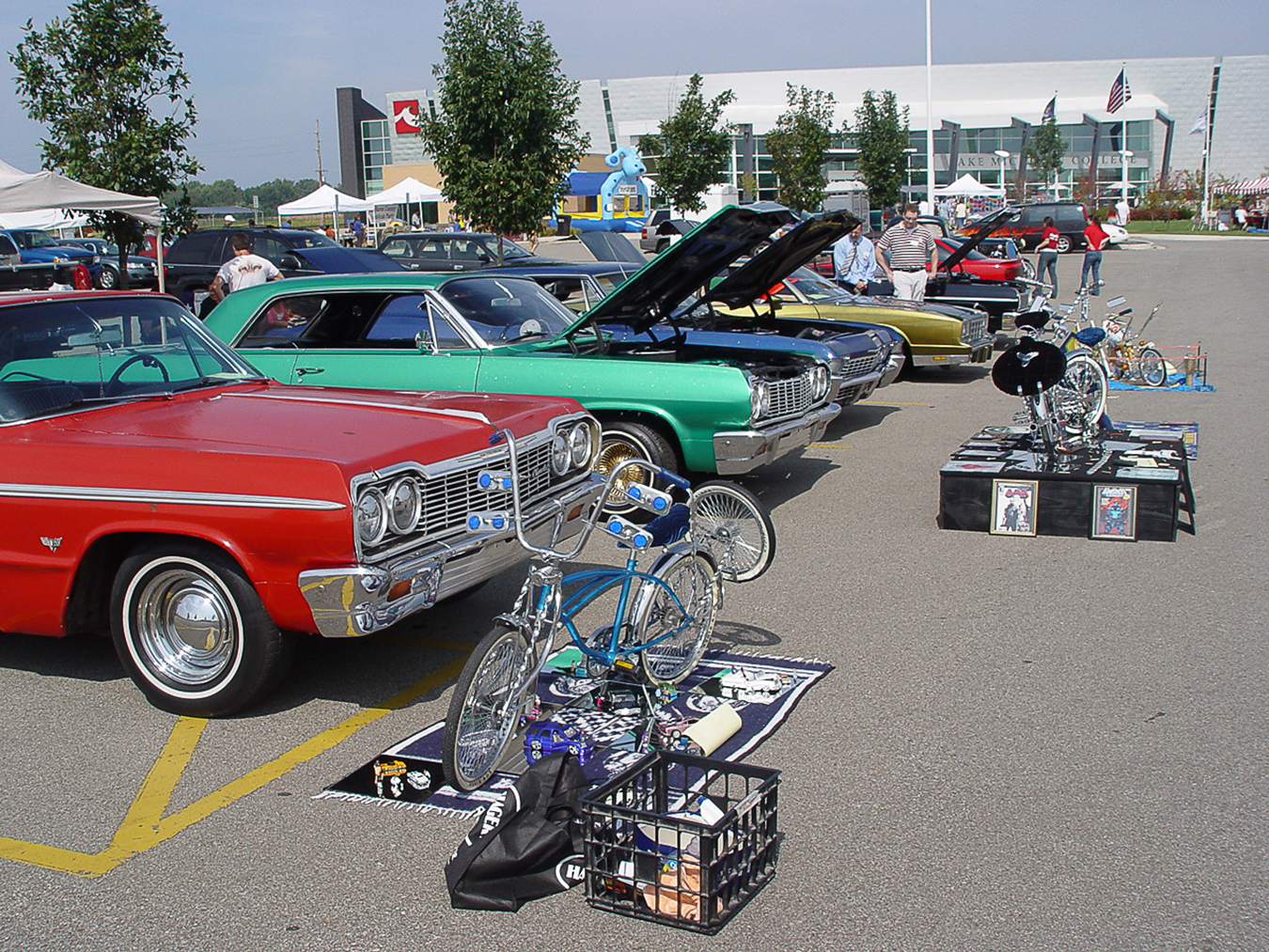
To truly capture the cultural experience of a small Michigan Chicana/o community in making lowrider art, we gathered ethnographic data from Lansing and South Haven between December 2006 and September 2007. We collected these data through a triangulation approach (Berg 2004:5) that included participant observation, photo documentation, and semi-structured interviews as qualitative research techniques. We considered this method operationally suitable not only to ease our access to a hard-to-reach Chicana/o community in a predominately white Midwestern region but also to visually and ethnographically validate each participants’ experiential narrative as well as their Chicana/o lowrider creative expressions. In addition to the information provided by the interviews, we trekked to the Mid-Michigan area and photo-documented two lowrider car shows to illustrate—with photographs and field notes—community life, landscape, and people.
To facilitate our entry into the lowrider artistic community, we positioned ourselves as two Chicana/o participant observers and community insiders. Actually, this insider position allowed us to establish contact with prospective participants in Lansing and South Haven’s car shows. As we walked around taking photographs, we introduced ourselves to the attendees of the exhibition. We shared the way we were inducted into the practice at young ages to such an extent that we now embrace it as part of our identity. We found that our interests in the aesthetic aspects of lowriding not only helped to ease our access into the community but also abetted our efforts to build rapport with lowrider artists. Later, in course of the fieldwork, we also partook with displayers the appreciation for the lowrider practice. Just to be clear, we did not engage in the making of lowrider art. Yet as Chicano lowrider enthusiasts, we informally participated by appreciating art, design, and cruising performances.
As Figure 1 illustrates, displayers, who provided us with detailed explanations of how they modified and decorated their vehicles, willingly posed for photographs with their vehicles. And as we kept asking questions about the artistic meanings of lowriding, we relied on this rapport-building technique to secure referrals with other potential interviewees. Note that photographs also provided visual information and documentation regarding the modified material components—cars and bikes—used by the individuals. For example, lowrider cars and bikes were displayed in ways that allowed individuals to independently express their aesthetic identity. Each photograph provided the opportunity to revisit those displays and reexamine them many more times. In addition to using pictures for photo-documentation purposes, as Becker (1974) suggests, our visual images served as illustrative devices in explaining some interactions between participants and researchers.

Building community. South Haven lowrider car show, South Haven, Michigan, 2006. Source: Photograph by Alejandro Gradilla.
As a way to observe institutional review board’s (IRB) protocols, we followed Michigan State University’s IRB compliance guidelines. We also grounded the ethical guidelines of our visual fieldwork according to Gold’s (1989:103-7) “sensitivity and covenant model of research ethics,” particularly in the case of participants fully identifiable in Figure 1.
While the sensitivity ethical model encourages securing verbal consent for identifiable participants in images, it also recommends that the researcher protect the study’s participants by taking the time and effort to know them in a deeper way, by being thoughtful about the ethical ramifications of taking pictures of individuals and their activities, and by caring about the privacy implications of the dissemination/curating plan (Gold 1989:103). Otherwise, as shown in Figure 2, for the case of minors in public settings, they are intentionally unrecognizable as they are distant and beyond the camera’s depth of field. Note however, as Gold (1989) suggests, it is the acknowledgment of children’s presence that is important not their identity.
Parades. South Haven car show, South Haven, Michigan, 2006. Source: Photograph by Alejandro Gradilla.
As the third key data gathering element of this study, we employed a snowball technique to recruit participants for the semi-structured interview component of the study. Using this recruitment approach posed no impediment to our search for participants, as the majority of the interviewees were part of car clubs, and members would introduce us to other club members. According to Berg (2004:36), “snowballing is sometimes the best way to locate subjects with certain attributes or characteristics necessary in a study.” This was precisely one of the reasons for relying on a convenience-purposive model to select young Chicana/o participants actively engaged in lowriding aesthetics and activities.
As mentioned above, after being introduced to the research setting, we identified and contacted six interviewees to participate in these semi-structured interviews, five men and one woman. The interviews provided each individual the opportunity to share life experiences with lowrider vehicles, activities, and artistic culture. While pseudonyms were given to the verbally interviewed participants for confidentiality purposes, neither demographic nor socioeconomic data were collected. Each interview session lasted approximately 30 to 90 minutes. Then, as the data analyses unfolded, we followed the twofold coding process suggested by Charmaz (2014). First, we open-coded the transcripts of each interview as well as the field notes. Second, drawing on the focused coding approach, we identified the overarching themes conceptualized in this article. Last, we curated the photographs shown in this article by following Gold’s (1989) sensitivity ethical model.
The Making of Chicana/o Art: Lowriders
As our data analyses centered on social actors’ narratives and fieldwork, three central themes transpired from the ethnographic accounts of our participants: The first, “I just grew up with it,” takes the barrio as the place in which young adults are introduced to the concept of lowrider art. Whether or not young adults are “born into the [Chicana/o] culture,” we found that affection for these artistic representations shapes a deeper level of the appreciation for lowrider art. The second, “I’m Mexicano,” examines how the combination of a set of Mexican visual objects displayed as art in cars and bikes allows individuals to cultivate a sense of ownership for the lowrider community. In doing so, we observed the way Chicana/os organized car exhibitions and cruising as displaying events that reflected their experiences with visual images. The third, “it’s part of my culture,” demonstrates the end result of embracing lowrider art as a mechanism of artistic resistance. This is where Chicana/os come to recognize this practice as a community effort not only to build a place for themselves but also to invite others to appreciate lowrider art, displays, and practices. In general terms, our argument is that by focusing on these three central themes, we are able to offer an in-depth sociological examination of the way lowrider art, objects, and activities, as visual constructs, can be rethought as pillars of Chicana/o aesthetics, as well as a cultural force to challenge dividing, essentialist interpretations of art appreciation.
I Just Grew Up with It: The (Re)Production of Barrio Aesthetics
In the context of Mexican American history in the Midwest, some scholars provide exceptional historical insights about the growth of Chicana/o communities in Michigan. Vargas (1999:168), for instance, suggests that migratory streams driven by the labor needs of the sugar beet farms and the auto manufacturing industry during the early twentieth century shaped Mexican settlement patterns. In recent years, however, the maintenance of these settlement patterns has been driven by the larger agricultural labor needs of seasonal migrant workers from South Texas (Richardson 1999:25) and low-wage service industry (Bustamante and Alemán 2007). In addition, according to Bustamante (2007:371), settlers’ access to media—for example, satellite television, Internet, telephone—and transportation—for example, buses and flights—not only maintains the connection between both regions but also aids in the reproduction of customs and practices from other Mexican-populated areas.
Considering this argument, thinking of lowriders as more than simply a “Southwest” or “West Coast” social phenomena allows us to gain a clearer understanding of their presence in Midwestern communities that are often considered predominantly white spaces. We asked participants to share their introductory experience to the lowrider community. Many shared stories about the ways in which they were exposed to this cultural experience at young ages. Oscar, a native of South Texas who now resides in Mid-Michigan, commented on how family members, friends, and neighbors introduced him into the oral and visual aspects of lowriding:
when I was 11 years old, one of my friends introduced me to lowriding. Because in Holland [Michigan] during that time there was a lot of lowriders. There were a lot people building [car] interior and building lowrider bikes. It was in a migrant camp, so that’s where a lot of lowriders got introduced. Because a lot of them came from California, Florida, and Texas, so they brought that culture to the migrant camp.
Similarly, Eric, who around the age of 15 or 16 started by buying Lowrider magazine, commented, “it opened my eyes and you know it was something that I liked and still like it.” Eric continued on and shared, “lowriding is part of my life, man. I grew up with it. My first car at the age of 16 was a ‘64 Impala with hydraulics and it’s been a way of life ever since.” What is striking about these remarks is that part of Oscar and Eric’s cultural experience not only reveals the way they have embraced lowrider aesthetics as a socializing force but also illustrates the extent young Chicana/os learned to value this artistic practice.
Moreover, whether Michigan’s barrio art transpires out the frequent movement of Mexicans between the Midwest and other regions, we noticed that what makes barrios interconnected places among distinct geographical locations is the link in which lowrider practices move through fluid boundaries. Whereas Oscar, coming from a migrant camp, found himself living in a social environment that provided the inspiration to embrace lowrider art, Eric instead immersed himself in the visual components of California’s Lowrider magazine, learning thus to value the artistic contribution of these vehicles as a young adult. Others, like Freddy, did not recognize the lowrider phenomenon as part of a social remittance concept introduced to Michigan from other places with a high concentration of Mexican residents. Instead, Freddy only remembers how he “…just grew up with it”:
I can’t say when was the first time I heard about lowriders, kind of just grew up with it. The neighborhood that I grew up in…it was something that my friends did; my neighbors had a lowrider. So ever since I was born, I kind of came into the culture, seeing lowriders and seeing how people just put their imagination into their vehicles.
Note, however, as Anzaldúa’s (2007) borderlands theory reminds us, these Michigan places shaped by racial and ethnic components have delimited the social space of interaction between whites and Mexicans, alienating Chicana/os from mainstream spaces. Lowriders’ aesthetics, in this context, represent a vital resource not only to foster an artistic identity but also to attract the attention of other Chicana/o participants who were not “born into the culture.” These young adults, who did not have access to lowrider knowledge, reveal different accounts of their initial experiences to barrio art.
Stephanie, for instance, became aware of it through other social forms, first learning of lowriding when she attended high school: “informally, I would notice them in my high school and around town.” However, she also mentioned one critical reason for her early detachment from the Chicana/o culture:
I wasn’t trained to feel like I belong to Latino people or Latino culture. So, I did not hang out with those people in high school and I did not have any Latinos in most of my classes. I was trained to be culturally respectful, but I never felt that culture was me, like I was part of that culture, like that culture was mine. It was always theirs and to be respectful of it.
The insight underlying Stephanie’s remarks is that multiple factors affect the familiarity of these young adults with the concept of lowriding—for example, residence in a white neighborhood, higher income. Moreover, it is possible these impeding factors can also lead to the development of an ignorant view of lowriders’ aesthetic expressions, making it difficult for these young adults to establish a connection with Chicana/o artists from the barrio.
Given what this participant’s account attempts to tell us, it reminds us, however, of Anzaldúa’s (1998) writing about the marginalization of Chicana/o art from the center. It helps us understand Stephanie’s experience: “as a people who have been stripped of our history, language, identity and pride we attempt again and again to find what we have lost by imaginatively digging into our cultural roots and making art out of our findings” (Anzaldúa 1998:163).
From the evidence presented in this research, we found two arguments that make relevant the importance of the lowrider concept as a cultural force influencing a Chicana/o aesthetic identity development. The first takes the socializing process of young adults into lowrider aesthetics as a critical component of barrio life. The second sees the possibility for Chicana/os not born into the culture to appreciate lowrider art and consider it a foundational component of the Mexican legacy. Both case scenarios, as noted above, have demonstrated that young adults can embrace artistic expressions from the margins of society as legitimate sources of community stability, social support, and structure for children.
I’m Mexicano: The Art of Lowriding Displays
Due to the emblematic nature of the lowriders’ aesthetic practices, a sense of ownership appears to derive from Mexican cultural artifacts being presented alongside or on the vehicles. The merger of Mexican cultural images and the lowrider objects was evident in our fieldwork. As we see in Figure 3, many participants displayed various Mexican images along with their lowrider cars and bikes. One of the interviewees, Eric, shared his reason for displaying Mexican images alongside his car: “I’m Mexicano regardless, originated from down there—that’s where our Raza is from.”

I’m Mexicano. South Haven lowrider car show, South Haven, Michigan, 2006. Source: Photograph by Alejandro Gradilla.
Because people become aware of the art of lowriding through car shows, these events are more likely restricted to Chicana/o communities. On the one hand, car and bike exhibitions become places of cultural awareness for all generations and provide an opportunity for the introduction of lowrider practice to the community. On the other hand, we found that in white-dominated artistic spaces, Chicana/o visibility has been virtually nonexistent. During our fieldwork, for instance, we observed that many lowrider artists attempted to defy the aesthetic border of culture. In doing so, many dared to show their lowrider art in places outside of their living environment as a way to demonstrate resistance against a racialized white understanding of art appreciation. We observed, however, that in Michigan’s predominately white areas, a local racial order dictated the type of and level of exposure to lowrider creative visibility.
Much of this white essentialist interpretation of art can be understood through the lens of two theoretical frameworks. In the first one, research into Chicana/o representations has taken a conventional approach to frame Mexican objects and cultural practices through the lens of nativism (Huntington 2004). This means, as Martinez (1994) suggests, that Chicana/o images that emphasize a nonconforming position perpetuates an undesirable Mexican visibility associated with cultural deviance. In contrast, Withers (2017), who approaches race through a critical theoretical lens, suggests that whiteness as “…a system of racial power” shapes the divide between what is considered normal (or mainstream) and what is not. The insight underlying this point is that the acceptance of lowriding as a truly artistic representation, not only in white venues but also as a mainstream art interpretation, is defined by the intersection of whiteness and culture. Therefore, it is implied that whiteness, defined in mainstream culture as the norm, perpetuates what Anzaldúa (2007) calls a border between them and us.
According to Bender (2003), the lack of control by Chicana/os over larger institutions produces and reproduces stereotypes and generalizations that promote false images of the Mexican community. Moreover, Mirandé (1985:72), who formalized this position back in the 1980s, is particularly clear: “since Chicanos lack power over the schools, media, and other agents of socialization, most prevalent images of them are externally induced.” Therefore, with limited options to access mainstream venues of artistic display, lowrider artists face greater cultural and institutional challenges when it comes to displaying their creative representations in white places.
Reacting to these cultural and structural constraints, we observed that cruising transpires as the emblematic venue in which artistic customs between lowrider cars and bikes can be exchanged. This is the place in which Stephanie, a Mexican raised in a white neighborhood, shared her appreciation, “I would like seeing Latinos that would have those kinds of cars, those really shiny, beautifully painted, dropped old-fashioned cars.” Cruising—in terms of lowriding display—is not common in many areas. However, in areas largely populated by Chicana/os, cruising is also considered an artistic passerella, a creative expression of the barrio aesthetic. Mendoza (2000), a leading scholar on lowrider aesthetics, even further suggests that cruising also serves as an invitation for people from other cultures to admire this particular side of the Chicana/o community. As a case in point, Stephanie shared her experience from a cruising event:
One time when I went, I think we were in a regular brown Honda or whatever you want to say. It’s the most generic car in the world, but I saw a lot of lowriders and people of color. I think I was with a group of white friends at that point. I don’t think I had any friends of color that were taking me out to this event or that kind of outing. They looked like they were in some sort of dialog between cars…a unique type of interaction. And we weren’t involved or anything, just curious kind of. I never associated lowrider cars with the white students or white youth in my city.
For decades, issues of Lowrider magazine have shown how lowrider vehicles participated in parades that celebrated Mexican heritage. We also observed while conducting our fieldwork that similar traditions showcased in lowrider cars are still very much alive. Cruising, in this way, epitomizes another form of how aesthetic ownership is displayed. In our ethnographic work, for instance, we saw not only people, mostly youth, driving on the main street of the community in the form of a parade at a low speed, but we also observed that open parking areas served as on-the-spot exhibition spaces for lowrider enthusiasts. Given what we saw, we can say that cruising offers an opportunity to display artistic objects that represent ethnicity to fellow Chicanos/as as well as an open space to socialize with onlookers not born into the culture.
To make these points relevant is to validate the effects of what Anzaldúa (2007) conceptualized in the borderlands theory. We refer to the ways a white racial order has shaped a structural isolation of many Mexican communities and thus prevented Chicana/os from constructing bridges to mainstream society. In this article, we argue that lowrider aesthetics represents a cultural attempt to contest the marginalization of Chicana/o art in white spaces. Lowrider art, objects, and practices not only act as a mechanism of resistance against cultural and artistic exclusion but they also actively redirect attempts to gain visibility from the center to the margins. In doing so, many social activists link this practice—as a key cultural component to foster a sense of ownership of the Mexican community—to young adults from different social backgrounds. Still, while lowrider art is an important element of the Chicana/o culture, we found that participants used lowrider aesthetics as a resilience mechanism to underscore the qualities of the Mexican community that mainstream society have failed to appreciate.
It’s Part of My Culture, yet Everyone Is Welcome
As mentioned above, participants shared their admiration for the practice of lowriding because it represents an aesthetic manifestation of culture in Chicana/o barrios—outside of mainstream boundaries. David, a Chicano who resides in Michigan, shared: “it was part of my identity, part of my culture, and I would see it everywhere.” Amador, another Chicano who resides in the western part of Michigan, also shared his experience:
I show pride in my work on [lowrider] cars. People come up to you and they tell you that you have a beautiful car; it’s a sense of pride. You being able to put something out there for La Raza to look at and as well as the other cultures, you know what I’m saying. So, it’s more like, sabes que, this is our culture we want to invite you to see what we can do that is positive, not negative.
In general terms, according to Eitzen, Baca Zinn, and Smith (2010:107), culture is defined as the “…knowledge that members of a society or other social organization share….” The purpose of culture is to socialize individuals—the process of learning the knowledge of a society—to immerse them into a homogeneous belief system. In many societies, culture also works as a boundary-maintaining system. This implies, according to Huntington (2004), that individuals who do not embrace the dominant value system—for example, manifestations of art—are many times considered culturally deficient.
While conventional research has framed Chicana/o community life along a pervasive image of disorganization and poverty, mainstream culture has still failed to recognize that lowriding aesthetics facilitate Chicana/os’ ability to connect with young adults from different social environments. Still, as demonstrated by Grady (2002), a better understanding of the Mexican community—its social, political, and economic conditions—can be achieved if mainstream education cultivates the ability to connect this type of aesthetic representation to other racial/ethnic groups, thereby rethinking it as something more than solely a Chicana/o practice. In trying to contextualize this point, the following narratives reflect the willingness and openness of many lowrider enthusiasts to welcome more people from outside the community. Freddy commented on his experience:
I don’t anymore [practice lowriding] for a lot of reasons, money being one of them and time. But it is something that I always had a special place for it. I think it requires a lot of talent in it. And it’s something about our culture that really influences lowriding. I mean, when you go to lowrider shows you see a lot of Chicanos and not only that but you’re getting a diverse group of people who are also beginning to introduce lowriders into their cultures.
Unlike many futile efforts made by Chicana/os to validate lowrider art in white spaces, Freddy’s comment reveals that the proximity of the barrios to white communities offers members of other population groups a window of opportunity to cross over the frontier of art appreciation. To make this point relevant is to suggest that other groups of people not only need to cross into Chicana/o spaces to appreciate lowriding as a form of artistic expression but also that they should do it to learn how to make lowrider art on their own. Oscar, a native of Holland, Michigan, and lowrider enthusiast, told us:
Pues it’s kind of good because even though it started like con Latinos, con Mexicanos, and Chicanos, it is something that is spreading and so a lot of individuals are getting involved with the same passion. I am kind of excited because it started con Chicanos…Latinos, but now it’s extending globally. That is good because they are celebrating our culture that we created.
The willingness of many lowrider artists to bridge with mainstream culture is important because they have brought visibility to the space occupied by Chicana/o culture. However, to think of lowrider art as part of mainstream society is to imply a reciprocal relationship from the other side of the frontier of art appreciation. And as we discussed through the article, many Chicana/o artists are still excluded from mainstream cultural events. This is not to say that U.S. ideology has not achieved some understanding of lowrider aesthetics. However, the idea of the lowrider aesthetic as a cultural anomaly remains pervasive in U.S. society. In fact, artistic representations from the margins are far from being tolerated or even accepted in many white spaces. And when it does happen, lowrider art faces much pressure to adopt the dominant white model of aesthetics. It means taking place through a normalized, sanitized understanding of aesthetics along the cultural line of a racialized white model of art appreciation (Withers 2017).
Anzaldúa (1998) tells us, however, how important is to develop a critical voice as a strategy of resistance against white racial domination. Although we observed the extent lowrider exhibition events are zealously regulated and very much approached with intellectual suspicion, defiance of this cultural control is critical to challenge a racialized marked repression against anything related to lowriding—vehicles, people, and practices. Actually, to advance our argument about embracing lowriding as a way to build critical mass and thus link Chicana/o art with other cultures, we suggest engaging other population groups by inviting them into barrio spaces to participate in display exercises in which they can learn to welcome and appreciate lowrider art.
Conclusion
In this article, we began by addressing three overarching themes—culture appreciation, visibility displays, and resistance through bridging—Chicana/o artists use to reclaim the lowrider vehicle as an aesthetic symbol of Mexican barrios in the Midwest. We found that lowrider art works as a source of stability and structure for young adults who live on the margins of society. Isolated by the racial larger order from mainstream artistic spaces, the lowrider aesthetic represents a community-building component introduced through family and friends—consciously or unconsciously—to build resilience against cultural and institutional exclusion.
We also found that lowrider aesthetics transcend the mainstream notion of art constructed by a white racial domination model of culture. In a racialized society such as the United States, the lack of control by Chicana/o’s over larger institutions continually distorts the image of the Mexican community. A clear example is the stereotyped image of the lowrider created by the popular media, thereby feeding the practice of interpreting lowriding through the lens of a cultural deficiency model. We observed, instead, that young Mexican adults vigorously resist the marginalization of Chicana/o art by increasing the visibility of lowrider art in artistic car exhibitions and cruising events. In doing so, the central idea of merging Mexican images with their own creative interpretations is that this practice legitimizes the idea of lowrider aesthetics as a valid artistic representation of the Chicana/o culture.
Finally, we recognize that the practice of lowriding as being part of Chicana/o barrios cultivates a sense of ownership. However, we also found that lowrider art helps to connect with people from different races and cultures. Rather than working as a boundary-maintaining system, we suggest that lowrider artistic expression does in fact permeate other cultural spaces. We have shown evidence to demonstrate that the lowrider artistic concept can help to bridge the border between brown and white aesthetic models. However, we have limited knowledge about the extent non-Chicana/os participate beyond the barrio space in making lowrider art and the motivations behind such artistic desire. Obviously, more in-depth and comprehensive work is needed to understand the extent non-Chicana/os engage in lowrider artistic practices of resistance against the racialized white model of art and culture. We anticipate that others may take up this endeavor.
Footnotes
Declaration of Conflicting Interests
The author(s) declared no potential conflicts of interest with respect to the research, authorship, and/or publication of this article.
Funding
The author(s) received no financial support for the research, authorship, and/or publication of this article.
