




Abstract
American popular culture was established to appease a white audience and continues to operate in such a manner. This pervasive white gaze in the entertainment industry manifests in anti-Black depictions and ideologies. Black celebrities have resisted this distinct form of racial oppression by overtly affirming their Black identity in entertainment spaces. To further explore this phenomenon, the present article examines: How do Black celebrities employ unapologetic Blackness as an embodied resistance tactic to challenge racial inequality in pop cultural spaces? We analyze five cases of contemporary celebrity activism across various pop cultural platforms (YouTube, film, sport, music, and television) and find that just as race is socially constructed, varying across social locations, resistance to racial oppression also varies depending on the site in which it occurs. We further argue that Black celebrities’ embodied resistance converts pop cultural spaces into social movement scenes, thus transforming moments of entertainment into opportunities for political mobilization.
Keywords
Personal Reflexive Statements
Shaonta’ Allen: I believe in the radical potential of sociology. My sociological imagination is informed by the Black feminist epistemological tradition, paved by Ida B. Wells-Barnett, Patricia Hill Collins, and many others, which sees the taken for granted aspects of Black life as sites of knowledge—knowledge that can empower and mobilize. I have not had the luxury of experiencing pop culture as merely a form of entertainment and leisure. Instead, throughout my life, pop culture has always provided illustrations of Black oppression and revealed strategies of Black resistance. As a Black millennial, I deeply engage with Black celebrities through social media. Their politics inform mine and their resistance inspires me. As a scholar-activist, it is my goal to produce scholarship that will help people make sense of their lived experiences, to provide context to the oppression that impacts their opportunity to thrive, and to promote mechanisms for radically imagining and actively constructing new futures. I hope that my work empowers people to realize their full capabilities as social agents. Just as Eduardo Bonilla-Silva once stated, “My sociology would be meaningless if it did not move people to action.”
Brittney Miles: My scholarship is activism in that it indicts systems of violence and consumption—the systems that digest and regurgitate Black bodies and Black creative labor until they are legible to whiteness. I draw on sociology, women’s studies, and Black studies to interdisciplinarily rearticulate the meaning-making of everyday Black folks and their resistance into theory. I am committed to complicating the ways we see and understand the products of Black labor as they are subjugated within hierarchies of power. The sociological frame I approach the world with is the same one from which Black folk sit at grandma’s kitchen table and talk about the things they know without ever having to read it in a book. Then, I try to write about those. The lived experience knows first, and I give permission to texts to hold them in permanence. In my research, I permit the incoherency of free Black girlhood to white supremacy by keeping some of the secrets of its magic. In the classroom, I disrupt the expected ways of being with my unapologetic politics as a queer disabled Black girl. My activism is situated in reminding Black youth to be free.
At the 69th Emmy Awards in 2017, actress, writer, and producer-director Issa Rae was asked who she was rooting for that evening, during a red-carpet interview. She responded, “I’m rooting for, um, everybody Black!” 1 While praised by the Black community, commemorated in memes, gifs, think pieces, and swag apparel, white viewers did not find her response amusing (Scott 2017; Stedman 2017). In fact, many deemed her quip to be racist and expressed their disdain on social media. This is just one of many cases in which unapologetically Black celebrities have received backlash for openly valuing Blackness in an anti-Black society, indicating a need to further examine Blackness, Black celebrities, and incidents of resistance in pop culture.
Varied conceptualizations of Blackness, as ontological, cultural, performance, and unapologetic, offer critical and comprehensive ways to know and understand the Black experience in America. For instance, ontological Blackness understands Blackness as a distinct aesthetic of racial reasoning, encompassing a philosophy of Black consciousness 2 (Anderson 1995). Theories of Blackness as culture celebrate processes birthed from Black knowledges and situates them within a racialized context, such as the case with the Black radical imagination (Curruthers 2019). Understandings of Blackness as performance yield ideas of how Black people navigate complex social conditions through notions such as Black authenticity (Nguyen and Anthony 2014) and practices like code-switching (T. K. Myers 2019). Blackness is dynamic and expansive, involving a spread of beliefs and ideologies that exist dialectically with white hegemony (Anderson 1995). Most recently, unapologetic Blackness particularizes African American racial being in the current sociopolitical moment. 3
Unapologetic Blackness entered public discourse as a proclamation that Black life has value and as a reminder that Black culture requires propagation. It became a unifying affirmation during the Black Lives Matter Movement which coalesced in 2013 amid the frequent instances of state-sanctioned violence against unarmed Black people. Despite its popularity and frequent usage, the notion of unapologetic Blackness is underconceptualized within academic literature (Lenning 2017; Shange 2016). We define unapologetic Blackness as the centering of Black identity and culture in places and spaces where race is neutralized and racial politics are silenced or ignored. American pop culture serves as a prominent example of a space where racial politics are often erased. Because pop culture was established and continues to operate with a white audience in mind (Hall 1993), whenever race is centered in a way that draws attention to the racial hierarchy, it becomes problematic, just as Issa Rae’s “rooting for everybody Black” declaration illustrates. White consumers are hypersensitive to actions that disrupt their race-less lifestyles (DiAngelo 2011). In this way, unapologetic Blackness serves as a form of resistance. 4
To this end, the present study examines the following research question: How do Black celebrities employ unapologetic Blackness as an embodied resistance tactic to challenge anti-Blackness in pop cultural spaces? We specifically focus on how Black celebrities, across a variety of mainstream pop cultural spaces (YouTube, film, sport, music, and television), affirm their Blackness and in doing so, subvert the pervasive white gaze inherent in the entertainment industry (Erigha 2019; Mueller, Williams, and Dirks 2018). While these platforms have been previously interrogated in media and pop culture research, the contemporary Black celebrity activism that occurs within them has not been fully explored. This article addresses this oversight in the literature. Our case study analysis reveals that the embodied resistance of Black celebrities differs depending on their distinct media platform because anti-Blackness is realized differently within each space. More specifically, we find that just as race and racism are socially constructed, evolving across time and social locations, resistance to racism is also fluid. We ultimately argue that when Black celebrities employ distinct forms of unapologetic Blackness, they convert pop cultural spaces into social movement scenes (Creasap 2012; Leach and Haunss 2009). These findings provide nuance to understandings of everyday forms of resistance and make room for a more fluid conceptualization of activism which is imperative for the ongoing struggle for justice, given the multifaceted nature of oppression.
White Gaze and the Entertainment Industry
American popular culture is racist (Erigha 2019; Kidd 2014; Yuen 2017). Stemming from the legacy of minstrel shows during slavery celebrating problematic caricatures of Black life, the entertainment industry is linked with racial oppression in general and anti-Blackness in particular. Traditional forms of entertainment displayed deficit notions of Blackness to gratify white consumers’ desire for racial fantasies to be brought to life (Mueller et al. 2018). Many studies discuss how various aspects of pop culture have changed over time, yet its glaring racism has remained steady. For example, Behnken and Smithers (2015:x) note that media evolved to include advertisements, cartoons, and even popular fiction yet “the presence of discriminatory stories or visual representations [of race and racism] became naturalized to the point of invisibility.” In other words, racism in pop culture has become institutionalized—embedded into the various subprocesses that constitute the industry.
White gatekeepers play a significant role in upholding the racist underpinnings of pop culture. Kidd (2014:46) defines gatekeepers as the “cultural leaders and institutions that mediate between cultural objects and their audiences.” More specifically, Yuen (2017) finds that these gatekeepers are frequently white male executives who center ethnocentric cultural ideals in not only their storytelling but also in their casting. Gatekeepers possess the positional authority to create cultural products. Yet, when these gatekeepers are overwhelmingly white, most cultural productions are biased to privilege white perceptions. Erigha (2015a:79) clarifies this problematic when stating, “Because cultural products are inextricably linked to meanings derived from the people working in culture industries, at stake in the production of popular culture is the ability for various social groups to develop and disseminate their own meaning systems.”
It is evident that popular culture has been and remains subjected to a pervasive and pernicious white gaze. This white gaze involves “objectify[ing] the Black body as an entity that is to be feared, disciplined, and relegated to those marginalized, imprisoned, and segregated spaces that restrict Black bodies from ‘disturbing’ the tranquility of white life, white comfort, white embodiment, and white being” (Yancy 2017:xxx). Although the fragility of whiteness relies on these “controlling images” of Black people and Black culture (Collins 2000), the overuse of such misrepresentations also inspires resistance. McLean (1995:111) contends that “[t]he power of images, coupled with their expansion into all corners of the globe, suggests more than ever a need for decolonizing the imagination.” As both racial tensions and radical imaginations are influenced by media images, how celebrities assist with decolonizing pop cultural spaces within the entertainment industry is significant.
Black Celebrities and Embodied Resistance
Recent shifts and fleeting definitions of the term celebrity question to whom this label applies, how deeply this title matters, how much respect and prestige it affords, and how consumers reinforce this status (Turner 2014). Answers vary by platform, media style, genre, and aesthetics. Gender and race similarly complicate how celebrities negotiate between external consumption and the manipulation of their agency for personal and political empowerment (Edwards 2013). For Black celebrities, their identities have often served as a catalyst for social activism that historically has prioritized the uplift of marginalized folks. However, this type of work by celebrities has also been rife with consequences. For example, Paul Robeson’s activism added to his dynamism as a talented athlete, singer, and actor, but his communist affiliation led to him being Blacklisted by the U.S. government and entertainment industry (S. J. Jackson 2014). During the McCarthy era, similar trajectories occurred in the political lives of Eartha Kitt, Harry Belafonte, Lena Horne, and many others (Washington 2014). This dissent carried over into the Civil Rights Movement, where celebrities like Mahalia Jackson, Dick Gregory, and Sidney Poitier leveraged their clout and names (Raymond 2015). Black celebrity activism in the 1960s was defined by finessing one’s social location in the industry to advocate for change and improve Black people’s civil rights (Hartmann 1996; Marqusee 1999). Furthermore, this approach was embodied in Nina Simone’s political music and Josephine Baker’s criticism of racism both domestically and abroad (Dudziak 1994; Feldstein 2005).
Gangsta rappers of the 1980s and 1990s similarly weaponized their lyrics to be tools in movements for social change. Artists like Tupac and N.W.A. challenged a corrupt and unjust legal system with their music (Lusane 1993; McCann 2012; Nisker 2007; Stanford 2010). As we look to the influence of Black celebrity activism today, their use of hashtag activism to support Black Lives Matter bolsters celebrities’ perceived status and influence, further defining the movement, and legitimizing the collective action in their protest (Duvall and Heckemeyer 2018). Activist efforts by Black celebrities today are built upon a long legacy of countering white supremacy across various political eras. Modern unapologetically Black resistance is unique in that celebrities can speak to consumers without a mediator, but otherwise functions similar to the aforementioned embodied strategies.
Embodied resistance is a relevant framework for exploring Black celebrity life today; embodiment describes the experience of carrying one’s body through the social world and considers the subsequent corporeal negotiations that are made (Vannini 2016). Embodiment additionally involves the symbolic interactions between bodies that are raced and gendered which politicizes identities and complicates narratives of subjectivity (Threadcraft 2016). The power dynamics in these interactions mimic the layered violence produced from macrostructural systems of inequality, necessitating resistance in response to these oppressive experiences (Iton 2010). The earlier examples of Black celebrities in various forms of protest depict this resistance in how they use their mind and voice to produce songs and lyrics, their famous faces as symbolic capital, and the movement of their bodies through time and space to subvert systems of injustice.
Pop culture has a long history of anti-Blackness and racism that has functioned across multiple genres and media forms (Mueller et al. 2018). Additionally, the pervasive racism in popular culture continues to reinvent itself to construct new violent stereotypes and reproduce preexisting ones (Dirks and Muller 2007). Black artists have a history of employing tactics that disrupt narratives of suppression. This is resistance against the silencing of the ways their art tells stories of their experiences as knowledge (Iton 2010). The stringent policing of Black bodies in popular culture and under the watchful eye of white executives, consumers, and peers compels many Black celebrities to metaphorically breathe. Attempts to breathe by Black celebrities, through their incoherent maneuvering in the face of whiteness, are oppositional stances that explicitly disrupt, or at the very least manipulate, the expected body politic—this is embodied resistance (Fahs and Swank 2015). And, this is unapologetic Blackness in action. Embodied resistance describes the use of one’s body and its characteristics to counter dominant narratives about how Black bodies are supposed to perform in their temporary access to these otherwise historically white spaces.
Pop-cultural Spaces as Social Movement Scenes
In refusing to accept the performance scripts expected of them, unapologetically Black celebrities engage in embodied resistance. We contend that this embodied resistance shifts entertainment spaces into sites of political opportunity. Specifically, we see instances of Black celebrity activism, in spite of the pervasive white gaze, as transforming pop cultural spaces into social movement scenes (Haunss and Leach 2007)—linking each celebrity case to the broader movement toward Black liberation. Social movement scenes are defined as “a network of people who share a common identity and a common set of subcultural or countercultural beliefs, values, norms, and convictions as well as a network of physical spaces where members of that group are known to congregate” (Leach and Haunss 2009:259). We see Black celebrities who operate with and in an oppositional consciousness, which bell hooks (1989:148) defines as “a location that has provided space for the kind of decolonization that makes loving Blackness possible,” as comprising a countercultural network and forming a symbolic social movement scene in pop culture. Social movement scenes are additionally described as doing political work by using everyday practices to “make a scene” (Creasap 2012:189). Black celebrities who unapologetically center their Blackness within anti-Black entertainment spaces, certainly meet this qualification.
Creasap’s (2012) study utilized the concept of social movement scenes to make sense of a variety of political expressions including squatters resisting housing inequality and even white power groups’ performances of rituals and violent demonstrations. To date, no such study has extended this concept into the pop cultural realm to make sense of celebrity activism. We contend that Black celebrities who employ an unapologetically Black stance represent a group of people with a common identity and countercultural beliefs. Further, we see the varied pop cultural spaces that Black celebrities occupy as symbolically linked as a result of their collective experience in navigating the ubiquitous white gaze embedded into the industry. bell hooks (1992) draws attention to how the white gaze is linked to a specific type of self-reflexive agency or embodied resistance. She states, “[s]paces of agency exist for Black people, wherein we can both interrogate the gaze of the Other but also look back, and at one another, naming what we see” (p. 116). Here, hooks articulates that the white gaze can produce critical vision regarding perceptions of inequality. Awareness of the gaze, she argues, simultaneously provides one with the ability to name the oppression that they see. In addition to naming oppression, she notes that the gaze inspires one to use their body for resistance when stating, “In resistance struggle, the power of the dominated to assert agency by claiming and cultivating ‘awareness’ politicizes ‘looking’ relations—one learns to look a certain way in order to resist” (hooks 1992:116). We seek to determine how this process plays out for contemporary Black celebrities. Specifically, we question: How do Black celebrities employ unapologetic Blackness as an embodied resistance tactic to challenge anti-Blackness in pop cultural spaces? And, we additionally ponder what the political implications of such resistance are.
Data and Methodological Approach
The present study seeks to determine how Black celebrities employ unapologetic Blackness as an embodied resistance tactic in pop cultural spaces. A multiple case study, or the detailed examination of a series of principally related events (Mitchell 1983), permits the examination of Black celebrity activism and how it varies across multiple pop culture platforms. This methodology best facilitates the analysis required for such an inquiry. In selecting our cases, we relied on systematic sociological introspection or the methodological strategy of recollecting thoughts and feelings of a particular life experience and interpreting that experience in light of its sociohistorical context (Ellis 2008). In other words, as avid consumers of pop culture, we have drawn on the knowledge generated from our own lived experiences to determine which cases to examine. While many celebrities initially came to mind, we intentionally selected individuals to represent each of the dominant pop culture platforms—sport, film, television, music, and the Internet—which each have a distinct history and cultural legacy. For instance, the sociocultural impacts of sport, such as facilitating the socialization process and promoting social roles and expectations date back to 700 BC (Delaney and Madigan 2015). The film industry has served as a dominant form of cultural production, depicting stories, and ideologies since the early 20th century (Erigha 2019). The music industry originated in the 1920s solidifying music and performance entertainment as a prominent aspect of American culture (Kidd 2014). Shortly after in 1926, television simultaneously broadcasted images and information into the homes of everyday people (Kidd 2014). And, finally, the widespread use of the Internet took off in the early 1990s, resulting in its unprecedented digital impact on our social, cultural, and political lives which we continue to see today (Daniels, Williams, and Buggs 2017).
Ultimately, we settled on five contemporary unapologetically Black celebrities who demonstrate embodied resistance toward the white gaze: YouTuber Jackie Aina, filmmaker Ryan Coogler, athlete Colin Kaepernick, recording artist Kendrick Lamar, and showrunner Shonda Rhimes. 5 The data for each case derive from a variety of sources such as interview transcripts, news and media articles, social media accounts, performances, and more. To make sense of the data, we conduct a descriptive analysis, which Kidd (2014:113) defines as, “a form of inquiry that allows the researcher to map out the prominent landmarks of a given social world.” Kidd further emphasizes that descriptive analyses allow for the exploration of sociological issues within media and pop culture. We surveyed the data to identify manifestations of Black affirming actions—instances where Blackness was intentionally centered and/or mentioned—to get a sense of how these celebrities employ unapologetic Blackness as a resistance tactic and more importantly if the pop cultural space influences that resistance. Altogether, this study is rooted in the Black feminist epistemological tradition, which is premised on the ideas that lived experiences are credible sources of knowledge claims, and that more subordinated groups have clearer understandings of oppression (Collins 2000). In this way, we expect that Black celebrities’ responses to racism might offer insights on how to resist the realizations of racial oppression in daily life. The following sections further detail these insights.
Jackie Aina and the Politics of Representation in the Beauty Industry
Makeup and beauty vlogger, Jackie Aina, challenges colorism, the prejudice against individuals with darker skin tones and/or the preference for those with lighter skin, and the exclusion of Black women in the beauty industry with the content on her YouTube channel established in 2009 (Aina and Schallon 2019). The extensive use of YouTube by the general population changed how we understand fame, influence, and consumer reach. Starting her channel intending to demonstrate that Black girls could wear brightly colored makeup, Aina subverts traditional notions of Black femininity (Houlis 2018). The Nigerian American veteran is more than just a makeup artist and beauty enthusiast. She “…blurs the lines between content creator, social media star, and activist in her inspired and important calls for inclusivity within the beauty world” (Simmons 2018a). Aina provokes the beauty industry to reckon with its history of racial bias.
Aina has approximately 3.27 million subscribers as of December 2019 (Social Blade 2019). Her celebrity status, by way of her influence, is indicated by the most popular videos on her channel. Aina’s top three most popular videos, ranging from 4.3 to 5 million views, include two that are parody critiques of makeup trends. At 4.8 million views, her second most popular video is a collaboration video with another Black beauty-tuber, Alissa Ashley, critiquing the poor shade range of a color-correcting complexion product. Additionally, one of her most viewed videos, “The Worst Beauty Brands EVER for POC!” exemplifies her commitment to advocating for underrepresented consumers (Aina 2019).
Beyond discussing makeup, Aina has previously critiqued problematic colorblind racial politics. In one video, she describes the consequences and fallacies of not acknowledging someone’s race and ethnicity (Dirshe 2018). Despite often speaking out about problems in the industry, Aina also takes practical steps to enact tangible change. After critiquing Too Faced Cosmetics for not displaying their lipstick shades on darker skinned models, Aina became one of their models (Simmons 2018b). She later collaborated with the same brand to create nine extension shades for one of their foundations, and she has worked to release other collaborations that are formulated to be pigmented enough to show on darker complexions (Garcia 2018). Aina’s been widely recognized for these efforts. In 2018, she received two major awards: Women’s Wear Daily Influencer of the Year and the National Association for the Advancement of Colored People’s (NAACP) YouTuber of the Year (Cacciatore 2019). Her awards further highlight the implications of diversity and inclusion work in the beauty community. Aina said, “I don’t think it’s political; I’m just talking about experiences that are true to me. My goal is to always make people of color feel good when they come to my channel” (Aina and Schallon 2019). However, it is well established that particularly for Black women, the personal is political (Combahee River Collective 1997). Her activism to overturn the structural exclusion of women of color, through critiquing the beauty industry and creating products and opportunities addressing the representation gap, creates a social movement scene that empowers viewers to value themselves.
Beyond being a vlogger, Aina is a trailblazer in social media. Specifically, “…Aina is a teaching and encouraging force in the social media and digital community, demonstrating that there’s tremendous power in beauty—a power that everyone, no matter your identity, can tap into” (Lawrence 2018). Aina’s embodied performance positions a Black woman’s voice in the beauty industry as relevant and necessary. Despite her consistent calls for increased representation, Aina is not confused about the ways the bodies of women of color can be used as props to exploit a need for representation (Garcia 2018). Instead, she calls for representation and a critical examination of the underlying politics and biases behind choices, consumption habits, and products that neglect the needs of women of color. While folks of all racial and ethnic backgrounds and gender identities continue to problematize Aina’s incessant discussion of race and exclusion, her contribution is changing larger narratives in the beauty industry and social media (Aina 2017; Upton 2017; Zatat 2016). For example, she said, “[a]bout four years ago, before I got over a million subscribers, I had raised awareness about an issue on YouTube that there’s always kind of been this glass ceiling for darker-skin creators” (Houlis 2018). Here, she draws attention to how colorism impacts access to success and opportunity that is supposedly attainable. Her successes on YouTube, though, serve as sites of validation and politicized resistance to the silencing of content creators who hold marginalized identities (Steele 2011). Ultimately, Aina’s activism promotes self-valuation for people of color in three prominent ways: (1) ensuring consumers can find makeup that matches their skin complexion, (2) providing YouTube viewers with beauty product analyses that center and affirm marginalized standpoints, and (3) demonstrating the opportunities for success and the resistive possibilities of digital content creation. Aina’s political beauty work, through persistent rejection of colorblind and anti-Black ideologies, embodies the radical potential of Internet-age influencers as celebrities.
Ryan Coogler and Black Storied Lives in Film
Ryan Coogler’s work as a film director refutes the monolithic narrative of Black folk and instead offers nuances and diversity in characters and imagery (D’Agostino 2019). Coogler’s commitment to extensive research for his roles is central to his authentic and inspired storytelling (Macaulay 2012). For his films, Coogler has traveled to Africa, talked to families and people he met on the street, and reflected on his own life as a Black man in America (Betancourt 2018). Coogler’s narrative building and storytelling is an affront to whiteness in its intention to capture authentic Blackness.
His celebrity status was undoubtedly solidified when Black Panther grossed $1.344 billion USD worldwide (Box Office Mojo, n.d.). Even more so, the film was the largest gross domestic weekend for a Black director as well as the biggest global premiere for a primarily Black cast (Vary 2018). Coogler’s direction of the films Black Panther, Fruitvale Station, and Creed are why we have come to celebrate and see his work as part of his embodied resistance. For example, Black Panther rejects the white gaze; it calls the audience to see themselves in this fictional world that does not center whiteness, nor white characters (White 2018). The resistance of Black Panther is grounded in the ways Coogler uses Afrofuturistic possibilities to present and redeem Blackness beyond a colonized framework (Coetzee 2019; Faithful 2018). Coogler’s contribution to this movie includes subtle references to pro-Black politics that do not use Black bodies as merely props but instead weaves broad pro-Black ideological variances across nuanced Black characters. Specifically, Coogler draws on Pan-African philosophies and imagery related to Black liberation (Onyango 2018). For instance, in the casino scene of Black Panther, T’Challa, Nakia, and Okoye are intentionally wearing the colors of the Pan-African flag: black, red, and green (Janay 2018).
While Black Panther and other films by Coogler are still highly corporatized products that are by no means perfect or complete representations of Black lived experiences, the validation and agentic consumption by Black people are legitimate sites of empowerment (Marco 2018; Zwissler 2018). The opportunity to reclaim Black imagery and art as their own by seeing it as a stepping-stone to more diverse representation and inclusion trumps the inevitable contribution to white corporations. Coogler’s work on Black Panther, punctuated by music from Kendrick Lamar, redefines why African Americans can be proud of who they are and aware of the systemic violence and inequality in their lives (Garside 2018). A similar ethic can be found in other films directed by him, which also challenge the dominance of white narratives in the U.S. film industry. For example, Coogler has established such a reputation for radically articulating Black stories, he has already been solidified as a producer of the upcoming Fred Hampton biopic (Danielle 2019).
His projections of Black life in film, imbued with depth and dimension, become a social movement scene because they oppose the typical homogenization of Black culture and provide alternative conceptions of Blackness for viewers. Further, his Afrofuturistic presentations in Black Panther became a rallying point for Black folks around the world. The symbols and references in the film assist viewers with imagining uncolonized, unexploited, free Black people (Strong and Chaplin 2019; White 2018). In this way, Coogler facilitated experiences of Black self-validation and self-definition by constructing the radical imagery of liberated Blackness. The collective power of Black action pushed this film to its point of success compelling Coogler to publish a letter expressing deep gratitude for the overwhelming support. In it, he states, Never in a million years did we imagine that you all would come out this strong. It still humbles me to…see people of all backgrounds wearing clothing that celebrates their heritage, taking pictures next to our posters with their friends and family, and sometimes dancing in the lobbies of theaters. (Sharf 2018)
Coogler carries his love for Blackness in his every day life. after the success of Fruitvale Station, he continued to work as a juvenile counselor, highlighting the beauty and struggles of his neighborhood in film and embodying the values that come from being the child of a probation officer and community organizer throughout his work (Macaulay 2012; Newhouse 2007). Overall, Black filmmaking is presently situated at a critical horizon point where it is thriving despite being up against the massive media industrial complex. Coogler is one of the Black directors changing the modern landscape of Black feature film entertainment (Everett 2014). Black folks have used Coogler’s strategies to inspire their lives, their storytelling and art, and their own perspectives of what Black liberation can be and look like (Thomas and Stornaiuolo 2019). Coogler’s storytelling techniques are about his life and the lives of real Black people. His scene work on the big screen mobilizes people into being forces for change.
Colin Kaepernick and the Defense of Black Bodies in the National Football League (NFL) and Beyond
In August 2016, former quarterback Colin Kaepernick kneeled during the national anthem ceremony of a prime time NFL game. At the time, Kaepernick was the starting quarterback for the San Francisco ‘49ers and had previously led his team to a Superbowl championship, one of only six Black quarterbacks to ever do so. His kneeling demonstration protested ongoing police brutality occurring throughout Black communities nationwide. During that day’s postgame interview, Kaepernick explained his actions stating, “I am not going to stand up to show pride in a flag for a country that oppresses Black people and people of color” (Wyche 2016). In doing so, Kaepernick disrupted the race-neutral script expected of him as a professional athlete (Brown 2017). The NFL field, like other entertainment platforms, is subjected to white consumption (Leonard, George, and Davis 2016). Cramer (2019:60) notes that the NFL surveils its Black players, taming their “Black masculinity for the consumption of an audience that predominantly occupies white masculine positionality.” In this way, anti-Blackness in the NFL is rooted in the overt policing of Black bodies. Black players are expected to acquiesce white norms, thus appealing to the predominantly white consumer. Kaepernick’s resistance within the institution of sport, though, involved drawing attention to the policing of Black bodies both within local communities via police brutality and on the football field, as well.
Despite having the constitutional right to peacefully protest, Kaepernick experienced extreme backlash for his demonstrations. The negative responses to his activism were in part due to a distortion of his cause by news and media outlets. While Kaepernick intended to protest the murders of unarmed Black citizens by police officers who swore to honor and protect the communities they served, his demonstrations were misinterpreted primarily because they took place during the national anthem. As a result, his activism was misconstrued as unpatriotic. This cooptation of his political agenda was exacerbated by a variety of figures including Donald Trump who amplified the distorted narrative that Kaepernick and other athlete-activists were against the flag and military veterans (Martin and McHendry 2016). For instance, on September 23, 2017, he tweeted, “If a player wants the privilege of making millions of dollars in the NFL, or other leagues, he or she should not be allowed to disrespect our Great American Flag (or Country) and should stand for the National Anthem” (Trump 2017).
In the years following his initial protest, Kaepernick has continued to resist racial oppression and problematic policing of Black bodies. Kaepernick’s embodied resistance involved three elements. First, he adopted a physical pro-Black aesthetic. Prior to the demonstrations, Kaepernick was known to wear his hair in cornrow-style braids. During the protests, he began wearing his hair in an Afro—a style that was popularized amid the Black Power Movement and remains a symbol of unapologetic Blackness today. This deliberate choice operates as resistance because football, like most other professional sports, is supposed to be race-neutral (Kaufman 2008). By wearing an afro, as an NFL starting quarterback, Kaepernick centered his Blackness at a time when he was supposed to be race-less. Second, his chosen format of protest, to disrupt a highly televised sports ceremony, attached his political actions to the strong lineage of athlete activism. From John Carlos and Tommie Smith’s demonstration during their 1968 Olympic medal ceremony to Muhammed Ali’s many media interviews denouncing America’s participation in the Vietnam War, Black athletes have routinely used their sport platforms to vocalize social issues.
Lastly, Kaepernick launched a Know Your Rights campaign, with the intention of advancing the “liberation and well-being of Black and Brown communities through education, self-empowerment, mass-mobilization and the creation of new systems that elevate the next generation of change leaders.” 6 On September 1, 2016, as part of this campaign, Kaepernick pledged to pour a total of $1 million USD into the broader Black community (Peter 2016). While some might consider philanthropic donations such as this slacktivism, or “actions performed via the Internet in support of a political or social cause but regarded as requiring little time or involvement” (Weiss 2015), Kaepernick was intentional about donating to organizations that serve the social, cultural, and political needs of Black communities nationwide. In an interview he stated, “I’ve been very blessed to be in this position and make the kind of money I do, and I have to help these people. I have to help these communities. It’s not right that they’re not put in the position to succeed or given the opportunities to succeed” (Evans 2016). Some of the organizations that benefited from this pledge were Mothers Against Police Brutality, Meals on Wheels, and Black Veterans for Social Justice (Fucillo 2018). These donations not only indicate Kaepernick’s commitment to actualizing social change but also allowed him to upend the narratives that his efforts were unpatriotic. Kaepernick’s embodied resistance tactic incriminates the hypocrisy of an industry that exploits Black bodies while turning a blind eye to their modern-day lynching. In this way, his unapologetic Blackness “makes a scene” in inspiring other athletes, at professional, collegiate, and secondary school levels to also use their sports platforms to resist (Allen 2018; Weffer, Dominiguez-Martinez, and Jenkins 2018).
Kendrick Lamar and Musical Transcendence as Liberation
Kendrick Lamar’s rap and hip-hop music cannot be divorced from his lived experiences as a Black man raised in Compton, CA. Rap as a genre and chosen form of expression indicts systemic oppression from its origin, form and style, and its oppositional nature (Martinez 1997). Lamar critiques white structural violence through his music as well as other forms of violence against Black folks (Oware 2018). Rap, as performed by Black people, serves as a critique of the very industry it navigates to achieve mainstream success (Martinez 1997). Lamar’s celebrity is best indicated by his most recent Grammy Award for Best Hip-Hop Album in 2018, contributing to his 13 total Grammy wins (Driscoll, Miller, and Pinn 2019). These victories are particularly noteworthy because of his countercultural aesthetic. Rap destabilizes white supremacy and its notions that work to erase Black contributions to history, pop culture, and the world (Rose 1994). Lamar’s music could not be apolitical even if he wanted it to.
While music that has a political message often receives pushback and criticism, Lamar has escaped this fate. In 2018, his DAMN. album was awarded the Pulitzer Prize for Music for “capturing the complexity of modern African-American life” (Pulitzer 2019). Lamar exposes his listeners to content that is saturated in Black narratives. By centering Black political life, daily struggles, and systemic inequality, his music facilitates a complicated yet vital relationship between him and Black activists. His song “Alright” was used during Black Lives Matter protests, his lyrics have controversially mentioned the murder of Trayvon Martin, and his videos and award show performances have centered a spectrum of different political issues (Barnes 2015; King 2016). Lamar’s musical resistance pushes back against the marginalization of Black musical styles. He succeeds in maintaining a subversive approach that concerns and speaks to Black liberatory practices and movements.
Lamar’s music closely interrogates the struggles that he’s familiar with, including gun violence and misogyny. Additionally, Lamar does not stray away from critically exploring individual accountability for peace, particularly at the intersection of calling for structural change (Allen and Randolph 2019; Love 2016). He has openly discussed how Christianity offered him new ways of seeing and approaching the world compared to what was previously provided by his socialization in the inner city of Compton. He came into his faith after the death of his friend (Ugwu 2015). Despite being in a genre considered to perpetuate violent ideologies, his faith is a counternarrative that subverts expectations. Lamar’s faith centers an ethic of progress and evolution that is mirrored in his political values. Despite previously not believing in voting, he came to reconcile Black civic and political engagement with his spirituality (Allen 2019; Robinson 2019). Lamar received the key to the city of Compton, the California State Senate’s Generational Icon award, and worked with President Barack Obama on his Pay It Forward program (Legaspi 2018). All of these sites of civic engagement have centered hope and prosperity regardless of one’s circumstance, maintaining spiritual undertones. As Lamar’s lyricism and tongue challenge whiteness and the subsequent Black erasure in music, his work rests at the intersection of faith and protest for Black uplift, literally becoming the backdrop to scenes of disruption and protests (Driscoll et al. 2019).
Shonda Rhimes and the Revolutionizing of Prime-Time Television
No Black woman had dominated an entire lineup of prime time television, that is, until Shonda Rhimes brought her talents to ABC (Paskin 2013). As the founder and namesake of Shondaland television production company, Rhimes is committed to generating the content, both on-screen and off, that aims at “building community and encouraging action” (Laporte 2017). The content she develops assists the larger movement toward Black liberation. Much of her success is attributed to the nationwide, live Twitter discussions of her television content attached to the #TGIT hashtag which stands for “Thank God It’s Thursday” (Everett 2015). While this online community-wide conversation undoubtedly enhances viewers’ experiences, Rhimes’ overall influence has always extended beyond Thursday nights. Through her show-writing skills and show-running crafts, Rhimes has single-handedly refashioned racial representations on the small screen. Her impact is evidenced by the numerous honors and awards she’s received including multiple Primetime Emmy Award nominations and NAACP Image Awards, being named one of Time Magazine’s “100 People Who Shaped the World” in 2007, and through her influence on younger content creators and showrunners. For instance, when asked about Rhimes, Issa Rae stated, “She paved the way for so many of us…so, yes, I definitely look to her for inspiration for just starting a movement” (Chu 2018).
Rhimes’s movement includes expanding the cannon of successful television production and casting which previously constricted the representations of Black characters in prime time shows. When she was presented with the opportunity to produce a mid-season replacement series in 2005, she relied on subjugated, experiential knowledge to conceive Grey’s Anatomy. She continued this practice when forming her other hits like Scandal and How to Get Away with Murder. Instead of appeasing the white gaze, she insisted on modeling her shows after real life. Rhimes has previously stated, “I created the content that I wanted to see and I created what I know is normal” (Professional Women’s Magazine 2017). Her embodied resistance is evident here—she uses her distinct vantage point to inspire her shows and in doing so undermines the validity of white consumers’ expectations. The characters and story lines she construct expand viewers’ conceptualizations of the social and occupational capabilities of racial, gender, and sexual minorities. It is in this process that she revolutionizes television.
Rhimes’s revolutionary spirit and embodied resistance has been referred to as strategic ambiguity or the “choice to take on a certain amount of risk, to play with fire, to appropriate something that is used against you and make it work for you” (Joseph 2016:305). Her audaciousness, in attempting to transform network television from oppressive to liberatory, paid off as she unapologetically drafted complex characters and story lines which for too long had been neglected. In an interview with Elle Magazine, Rhimes said, “[t]he entire world is skewed from the white male perspective…. ‘Normal’ is white male, and I find that to be shocking and ridiculous” (R. Myers 2015). Not only did she problematize the tendency to reify white patriarchy in television, she also encouraged her viewers to do so as well. For example, in 2016, she stated, “[i]t’s my hope that this series will inspire audiences to be part of a change that leads us into a stronger, more equal future” in an EPIX press release. Here, she indicates that her political intentions are not limited to television show scripts but also include facilitating social action that would impact people’s real lives. In charging her viewers to take interest in social change, each episode of Rhimes’s series serve as opportunities for political mobilization.
While some have criticized Rhimes, claiming that she promotes colorblind ideologies (Warner 2014) and her characters perpetuate racist imagery (Stanley 2014), others find she has benefited from a “crossover effect,” described as when “Black issues, themes, images, debates, and personalities appeal to both Black and white audiences” (Erigha 2015b:10). Rhimes’s resistance involves exploiting this crossover effect to expand viewers’ understanding of the Black experience in America. For example, with the notable, “The Lawn Chair,” episode of Scandal, Rhimes forced white viewers to engage with the pressing issue of police brutality and the socioemotional trauma it causes in Black communities. This episode, along with many others across all of her shows, encourages public discussions of race and racism. This is particularly significant because it coincides and contrasts with nationwide postracial rhetoric that suppresses the acknowledgment of racial oppression.
It is important to note that Rhimes not only resists the anti-Blackness in television but also intentionally challenges sexism and heteronormativity through her shows, as well. As one scholar notes, the Shondaland product presents a cast of marginalized people who live powerful, complex and unabashedly morally ambiguous lives wherein those types of classifications are minor aspects of their character. Rhimes offers…a world more true to the reality many currently strive to attain, where no individual can be encompassed within or consumed by a category forced upon them. (Pixley 2015:31)
Conclusion
The present study set out to examine how Black celebrities employ unapologetic Blackness as an embodied resistance tactic to challenge anti-Blackness in pop cultural spaces. We analyzed five cases of Black celebrity activism and find evidence of embodied resistance and political mobilization. Each celebrity assessed the anti-Black mechanisms within their respective media platforms and exploited opportunities to highlight and affirm Black identity and culture (see Table 1). This analysis further theorizes what it means to be unapologetically Black and what its broader implications are. Future studies should examine how unapologetic Blackness operates within other prominent social institutions such as education, family, and religion.
Summary of Case Analysis.
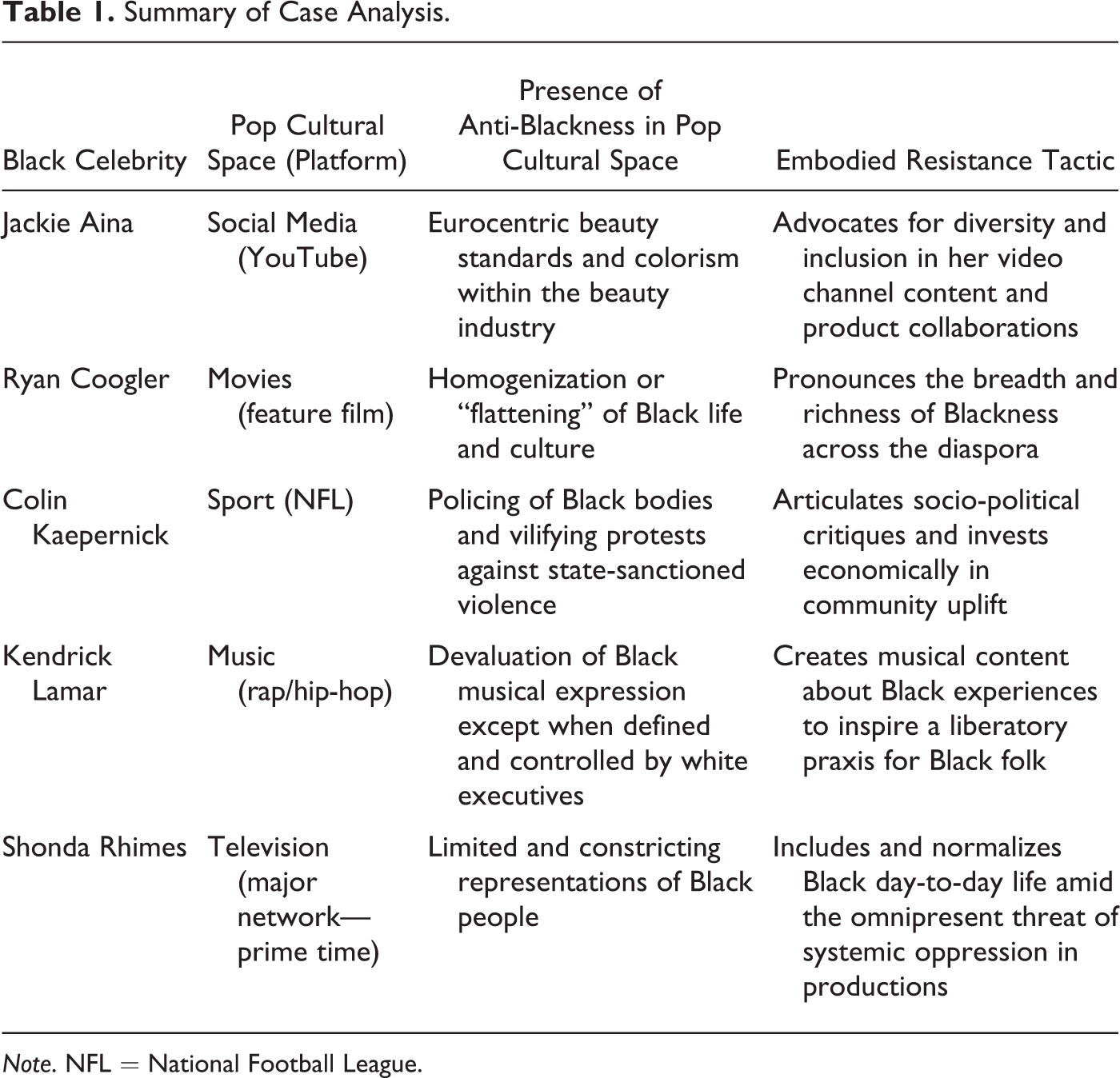
Note. NFL = National Football League.
The five cases presented illustrate that unapologetic Blackness, in challenging white standards, expectations, and norms, involves elements of self-definition and self-valuation. In addition to reframing broad perceptions about groups of people, self-definitions have political significance because they empower individuals to implement social change (Collins 2000). While under the watchful eye of the white gaze, Black celebrities are situated in a unique position to speak to the Black experience and be heard by a variety of audiences. Their dissent against white politics subverts mainstream cultural expectations to reinforce power hierarchies. As this study has shown, Black celebrities leverage their public appeal to shed light on cultural knowledges and ideologies that are too often ignored to inspire social change. S. J. Jackson (2014:172) notes that technology “allows Black celebrities to speak directly to their fans and followers, [and] presents unique twenty-first-century opportunities for dissent and for non-Black audiences to consume Black perspectives unaltered by traditional media institutions.” This is especially true today, given the level of intimacy the general public fosters with celebrities through social media.
Altogether, this study has examined how Black celebrities employ unapologetic Blackness—or create opportunities to make their Blackness hypervisible—as a form of embodied resistance against the institutionalized anti-Black racism in American popular culture. We have conducted a descriptive analysis of five celebrity cases across a variety of media platforms and find that celebrity resistance is situational, varying according to the social location it occurs within. More specifically, we find that Jackie Aina’s advocacy for the inclusion of diverse representation within the beauty industry challenges colorism and global Eurocentric beauty standards. We claim that Ryan Coogler’s thoughtful film depictions of Black life draw on sociohistorical traditions and innovative methodological techniques to display and convey the depth, beauty, and pain of Black life across the Diaspora. Colin Kaepernick’s NFL protests initially admonished the persistent issue of police brutality then later evolved into a broader critique of Black oppression and a financial commitment to Black sociopolitical success. We see that Kendrick Lamar draws on denigrated elements of Black culture and represents them as a source of encouragement in his lyrics, music videos, and performances. Finally, we claim that Shonda Rhimes revolutionized contemporary prime time television with her approach to show-running, which pushes back against willful ignorance regarding systemic oppression and its interlocking capabilities.
We ultimately show that Black celebrities, through the social movement scenes they cultivate, energize Black people by promoting the practices of self-validation and self-valuation (Collins 2000). These processes challenge and resist racial inequality at institutional, ideological, and interpersonal levels. Because Black culture is frequently co-opted and commercialized without appropriate credit to its origins, pro-Black representations are increasingly necessary. By extracting from each celebrity case how one can embody and perform unapologetic Blackness, this research contributes to our understanding of everyday forms of resistance which we all can adopt to push back again oppressive structures (Vinthagen and Johansson 2013). Given white hegemony in pop culture, this study provides evidence of insurgent mechanisms to subvert Black oppression. Thus, unapologetically Black celebrity activism is powerful because it radically transforms pop cultural spaces into opportunities for political mobilization. It is significant because it illustrates the need for resistance to be fluid and variable. Racism and anti-Blackness have and continue to evolve, therefore, resistance to these forms of oppression must also be able to adapt and respond to the intricacies of social inequality. Future studies should further examine the nuances of Black resistance, establishing a typology or tool kit for agitators to draw upon. It is only by having access to extensive mechanisms of resistance, ones that will encourage and promote unapologetic Blackness in action, that the efforts toward social justice will be successful and Black liberation will be realized.
Altogether, unapologetic Blackness offers a framework for understanding the racial politics of current and future celebrity activism and agency, including recent incidents such as Lizzo’s Black body positivity and the newfound Tyler Perry Studios. Unapologetic Blackness additionally offers a lens through which we can acknowledge and affirm the resistive labor of Black people that often goes unrecognized. Future studies should particularly examine Black celebrity activism, how it diffuses from entertainment to the interpersonal, and how it often is met with backlash. Each of these lines of inquiry will contribute to our general understanding of how Black people survive and thrive in suppressive social conditions where anti-Blackness perniciously evolves across time and space.
Footnotes
Authors’ Note
Early versions of this project were presented at the 2017 Annual Meeting of the Association for Humanist Sociologists in Havana, Cuba, and the 2018 Annual Meeting of the Association of Black Sociologists in Philadelphia, PA.
Acknowledgments
The authors would like to thank the “Inequalities in Contemporary Cultural Spaces” special editors and peer reviewers for their feedback. They would also like to thank Earl Wright II and Derrick Brooms for their critical feedback and suggestions on this article.
Declaration of Conflicting Interests
The author(s) declared no potential conflicts of interest with respect to the research, authorship, and/or publication of this article.
Funding
The author(s) received no financial support for the research, authorship, and/or publication of this article.
