




Abstract
While women are drinking more craft beer in the United States, the association between masculinity and beer remains intact. Yet sparse research has considered how involvement in craft beer culture may differ across public and elite beer spaces. Public spaces are open settings such as bars or breweries, and elite settings are more closed settings such as bottle shares and beer clubs. In this article, we analyze a questionnaire of 1,102 craft beer drinkers to compare the ways that men and women gain and enact cultural legitimacy within different craft beer spaces. Our focus on public and elite consumption spaces generates two interconnected insights. First, in public spaces, men are assumed to have a natural basic beer knowledge. Women, however, are dismissed as “not real beer drinkers” through men’s gatekeeping. Second, within elite spaces, both men and women must prove their belonging as elite drinkers and ultimately navigate gatekeeping mechanisms. As a result, our work extends consumption and gender literature by showing how inclusive cultural movements rest on the gendering of contextually specific knowledge and the policing of elite status and prestige in public and elite leisure spaces.
Personal Reflexive Statement
The authors of this piece are sociologists as well as craft beer lovers. The research presented here acknowledges this and addresses any inherent biases the authors may have. Additionally, the authors are aware of the potential methodological pitfalls that may arise from examining a culture of consumption that they are closely tied with. Bearing this in mind, the authors have presented their analysis as objectively as possible.
Beer is a cultural symbol for masculinity (Chapman et al. 2018; Darwin 2017, 2018; Kirkham 1996; Peralta 2007; Thurnell-Read 2013). The construction of beer as masculine depends on the relational construction of femininity as its opposite: If men are beer drinkers, women are not. Despite the strong association between beer and masculinity, women’s active participation and consumption of beer in the United States have increased rapidly within the past several years. While beer has remained the preferred alcoholic beverage of men ages 21–34, craft beer has surpassed wine as the most popular beverage by women within the same age-group in the United States (Klonoski 2013). Additionally, roughly 37 percent of all craft beer drinkers are women (Darwin 2017). Researchers theorize that with more gender-equitable or gender-targeted marketing, increased labor participation, equality and independence, and liberal attitudes about consumption from capitalism (Atkinson, Kirton, and Sumnall 2012; Bogren 2011), craft beer has become an “untapped” market targeting women. Yet, as others have noted (Chapman et al. 2018; Darwin 2018), this shift does not suggest that beer is now a genderless object that all are equally welcome to enjoy, but instead a gender hierarchy is reinforced through strict norms regarding the accomplishment of gender through the legitimized craft beer consumption practices.
There has been little recognition in previous craft beer research that there are varying levels of involvement and spaces in which consumption takes place. Trying a craft beer at a local pub is different than attending a beer release at a well-known brewery. As such, the purpose of this study is to understand how craft beer consumption shapes men and women’s experiences within different social contexts. We are interested in connections between gendered stereotypes and mechanisms, such as gatekeeping and cultural capital, that regulate beer drinkers’ inclusion at different levels of participation in craft beer culture. We explore gendered differences in craft beer consumption between men and women in both public and elite spaces.
Our focus on public and elite consumption spaces generates two interconnected insights into gender and craft beer cultures. First, in public beer spaces, such as a bar or taproom, we contend that men are assumed to have an inherent basic beer knowledge—a “natural” advantage accessing legitimacy within craft beer cultures (see Chapman et al. 2018; Darwin 2017, 2018; Thurnell-Read 2013). Women, however, are regularly dismissed as “not real beer drinkers” through men’s use of gatekeeping which includes challenging women’s knowledge and recommending stereotypical gendered beers. Second, we extend previous research by finding that both men and women are subjected to gatekeeping within elite spaces, such as bottle shares and beer clubs, and therefore must prove belonging as elite drinkers. This does not suggest that gender no longer matters in elite spaces, but rather elite beer drinkers attempt to reinforce elite boundaries from public and “snobbish” consumption through displays of cultural capital. As a result, inclusion in U.S. craft beer culture rests on the gendering of contextually specific knowledge and the policing of elite status and prestige in public and elite leisure spaces.
These findings contribute to the sociology of consumption, culture, and gender by complicating our understanding of how consumption practices are a lens through which we can view gender inequality. Further, we challenge previous assumptions about a universal craft beer culture to highlight how varying spaces require, maintain, and further contribute to cultural capital disparities. Finally, we raise questions regarding the supposed move toward “inclusion” and “equality” in terms of qualitative differences between groups.
Literature Review
Sociological research on consumption has noted that consumption choices are not only about personal taste but also social structures and networks (Mark 2003). As Chapman, Lellock, and Lippard (2017:12) write,
Beer consumption, whether a mainstream Bud Light or a craft Hop Devil IPA, sets consumers apart in socially stratified situations. In other words, beer can highlight issues of identity and power in terms of the ways craft beer is used to challenge or reinscribe distinctions based on social class, race, and gender.
We argue that gender differences in craft beer consumption and participation do not result from biological differences between men and women but are socially constructed through interactions that exclude certain beer drinkers (Atkinson et al. 2012; Bogren 2011; Chapman et al. 2018). First, we discuss how beer is a gendered object and confers gendered cultural capital upon the drinker. We then theorize how field structure impacts the extent to which gendered dispositions are exchangeable for capital as a form of distinction.
Beer as a Gendered Object
The overwhelming majority of both domestic and craft beer drinkers have been white, middle-class straight men (Kerr et al. 2004; Rowe 2016; Townsend 2017). Within pub, sport, and fraternity cultures (Darwin 2018; Maciel 2017; Messner and de Oca 2005), men have to negotiate masculinity through stylized consumption behavior surrounding beer (Peralta 2007; Thurnell-Read 2013). Thurnell-Read (2013:3) demonstrates that drinking is the
“Doing” of masculinity through consumption in the quantity and pace of alcohol consumption and, notably, the management of physical symptoms as “holding” your drink. The idealized male drinking body is therefore one that freely consumes alcohol, in doing so, demonstrates restraint and control to the potential detrimental effects of drunkenness on bodily composure.
Described as a performance, this “doing” of masculinity (Connell and Messerschmidt 2005; West and Zimmerman 1987)—including the quantity, type, flavor, and bodily comportment men choose to exhibit in alcohol spaces—communicates hegemonic ideals of strength, bodily control, competitiveness, and autonomy. Masculinity is embodied through the stylized, yet seemingly effortless and natural, actions in which men compete to prove themselves as the idealized male drinker, and therefore a “real” man. As reflected in alcohol advertisements, a “desirable lifestyle” is constructed and expected of men in relation to shifting contemporary gender roles (Atkinson et al. 2012; Bogren 2011, 2013; Messner and de Oca 2005). As early as the 1950s, beer advertisements originally depicted white, heterosexual couples sharing a drink in their home or backyard, meant to depict postwar economic and domestic prosperity. Messner and de Oca (2005) document a shift in the 1970s, wherein women were largely removed from ads except as sexual objects, wherein men were the target audience. Men were depicted drinking beer, often in pub-like settings, as a pleasurable reward after a hard day’s work, accompanied with tag lines such as “For all you do, this Bud’s for you.” As a result, alcohol consumption became central to accomplishing hegemonic masculinity, connecting leisure time to interacting with other men, their laboring bodies, and their dominance over women and other, less masculine, men.
With the emergence of the craft beer market, which is known for its wide range of styles, bolder flavor profiles, and rootedness in local production, it is assumed that craft beer culture would be distinct from domestic beer culture. Recent research on the increased participation of women within craft beer cultures, however, have documented a continuance, not a shift, of hegemonic masculine norms (Chapman et al. 2018; Darwin 2017, 2018). Certain styles of beer are legitimated as “real beer”—those associated with masculinity—such as darker, more robust flavors like stouts and porters, hop-forward beers such as India Pale Ales (IPAs), as well as higher alcohol by volume and international bitterness unit, or aged beers. Meanwhile, beers that are akin to wine or mixed drinks such as sours, fruits, or wheat, also known as “chick” or “pink” beers, are considered feminine and are devalued (see Chapman et al. 2018). Darwin (2018) argues that because men are culturally dominant within a patriarchal social structure, beers that are labeled as masculine are not objectively better but accrue more cultural capital. Given their dominant position, men are able act as tastemakers, or cultural intermediaries, who through their “symbolic imposition of meaning” frame goods that match up or “go together” with consumer’s tastes (Bourdieu 1984:232). In addition to perceptions of preference based on gender, beer itself is perceived to be more or less feminine/masculine along with a set of corresponding behavioral norms for craft drinkers. As a result, not only is beer associated with gender, but the very consumption practices—what beer you drink and how you drink—serve as a way to distinguish oneself by drawing upon ideals of what a “real man” or a “real woman” drinks (Atkinson et al. 2012; Bourdieu 1984; Goffman 1976; Leyshon 2005; Peralta 2007; Thurnell-Read 2013).
Darwin (2018; see also Chapman et al. 2018) draws on Bridge’s concept of “gender capital” and argues that because feminine beers are considered illegitimate or “not real” beer, women are devalued within craft beer cultures while men enjoy a naturalized belonging within craft beer spaces. Even within omnivorous cultural spaces such as craft beer, masculinized consumption practices facilitate higher cultural and symbolic capital accrual to men drinkers. Because gender is done at the risk of assessment by others, women must orient their actions to “do as a woman does” (Chapman et al. 2018; Hollander 2013; West and Zimmerman 1987). Women beer drinkers face a catch-22, wherein either they must conform to feminine gendered expectations and drink feminized beer, thereby losing out on cultural capital within craft beer cultures, or they transgress these roles to exclusively drink “real” masculine beer and lose out on gender capital and not be considered failed women (Darwin 2018). Men, however, have more flexibility to transgress their gender roles and consume more feminized beers because they can reassert their masculinity through other stylized masculine comportment including binge drinking, sexualization of women, and experimentation (Darwin 2018). As a result, only men get to enjoy the omnivorousness of craft beer culture, while women are relegated to a second-class status.
Cultural Fields, Habitus, and Distinction
As craft beer production grows exponentially—from 2012 to 2017 the number of craft breweries increased from 2,420 to 6,266 (Brewer’s Association 2018)—the spaces in which beer is produced, distributed, and consumed have also drastically multiplied. No longer is craft beer limited to homebrew networks or small, local breweries. Instead, it has expanded to local breweries, bottle shops, craft beer bars, social media apps, online communities, festivals, underground trading, bottle releases, beer tourism, and more. While alcohol research has noted the symbolic importance of identity and place (Daniels, Sterling, and Ross 2009; Flack 1997; Thurnell-Read 2017), sociological research on craft beer has often overgeneralized craft beer culture as a unilateral and universal environment (Thurnell-Read 2017). Rather than treating craft beer interactions in different spaces as the same, we contend that craft beer research must consider the ways that drinking spaces are created by various actors who produce, consume, and regulate the character of both the settings and the manner of behavior that takes place within them. Those within the community police how beer knowledge is performed and who can perform it—this differs from space to space, thus potentially creating multiple ways to accrue legitimacy in craft beer culture.
As Darwin (2018) demonstrates, an order at a “dive” bar differs significantly from an order at a brewery or craft beer bar. To order, a Budweiser at the dive bar may render the drinker culturally legitimate through the enactment of working-class masculinity. The same order in a craft beer bar or a brewery may render the drinker as culturally illegitimate as the field values beer types differently. Similarly, a person who might order a bourbon-barrel aged imperial stout at a dive bar may be considered illegitimate, pretentious, or even potentially feminized as they failed to enact the appropriate context-dependent masculinity.
To fully understand consumption behaviors, one must conceptualize consumption as a reflection of position within the social structure and field. Miller (2016) notes cultural fields are both products of and producers of one’s social habitus. Habitus, or the habitual embodied ways of thinking, feeling, and acting, is structured by past and present social circumstances (such as family); structuring to shape behavior; and a structure in itself because it is comprised of a system of dispositions which generate tastes and preferences (Bourdieu 1984; MacArthur et al. 2017). Further, habitus is used to draw social distinction between groups in cultural fields and bounded social spaces with unique principles. Cultural capital in the form of skills, knowledge, and mannerisms communicates belonging and status. This capital is then used to legitimate some while excluding others. Cultural intermediaries within these fields attempt to preserve these boundaries and their belonging within them by defining tastes and reinforcing norms of consumption (Bourdieu 1984:299).
Craft beer culture has risen from low-brow working class masculinity to a serious leisure activity through the process of “embourgeoisement” (Thurnell-Read 2016, 2018). Applying Stebbins’s (2007) six qualities of serious leisure, Thurnell-Read (2018) contends that craft beer culture has gained cultural legitimacy in becoming the domain of middle-class consumers. This higher class, or elite, version of craft beer is distinguished from domestic and casual craft drinkers through perseverance in pursuit of the activity, a career of learning and developing skills, effort that leads to durable benefits, a unique ethos of specialized language and values demarcate members of the community, and centrality of the activity to one’s identity. Yet critiques of the emergence of serious/elite leisure spaces stem from stereotypes of being “too” serious and insular. Cultural theory has suggested that cultural capital has moved away from acquiring solely high-brow status to a more “cultural omnivorousness” (Peterson and Kern 1996). Because consumption is said to be a marker of cultural distinction, individuals who exclusively pursue one cultural taste or leisure activity may accrue less social status (Thurnell-Read 2018). For instance, in examining the serious leisure activities of “Real Ale” enthusiasts, Thurnell-Read (2018) finds that participants were appreciative of a wide variety of “Real Ales” yet distanced themselves from the “Beer Ticker”—someone who drinks beers only once to accumulate unique beer counts—archetype. Similarly, in examining beer “aficionados,” Maciel (2017) argues that aficionados enact a cultural omnivorousness in the sense that they valorize breadth of beer knowledge and consumption and appreciate a wider range of beers. Additionally, he finds that aficionados rarely exclude women and believe that gender inclusiveness of beer cultures upholds a similar value of inclusion and diversity within consumption. While elite drinkers still have preferences for more masculine beers, they also place value in the appreciating well-executed feminine beers to distinguish themselves as a middle-class masculinity compared to the exclusiveness of lower class working masculinity. Darwin (2018), however, concludes that only men have omnivorous cultural capital because it signifies that he is an open-minded “beer geek” as opposed to a closed-minded “beer snob,” while women are limited in their consumption options to be taken seriously. It is important to consider that while elite consumption has both benefits and costs, these activities are contingent upon one’s social identity and relative position within the field (Thurnell-Read 2018).
We consider the relationship of gendered expectations within a hierarchy of low-brow and high-brow cultural fields (i.e., public and elite spaces of consumption). We are less interested in what people consume so much as to how people are expected to consume craft beers in different settings to distinguish between legitimate and illegitimate belonging. We examine the expectations and experiences of craft beer drinkers in relation to gender norms in both public and elite craft beer spaces.
Data and Methods
We used purposive, nonprobability sampling to conduct an open-ended online questionnaire about r preferences, consumption, and experiences of U.S. craft beer consumers participating in online beer communities and beer groups on Facebook and Reddit. While there are methodological limits to carrying out research within online communities (e.g., determining population demographics, researcher access, ethical issues), the Internet is closely linked to the rise of the craft beer movement and is an important social space within which to explore the cultural dynamics of craft beer consumption (Clemons, Gao, and Hitt 2006; Chapman et al. 2018; Darwin 2018; Kozinets 2010). Online beer communities allow us to survey drinkers that are enmeshed in geographically different beer spaces yet also interact with one another in beer subcultures through online postings and beer trading. Additionally, sampling from online communities allows us to reach beer consumers that are otherwise not present or feel unwelcome in physical beer spaces. Further, those who participate in these groups are more likely to be involved in craft beer culture including more elite practices. These groups were organized based on general interest, bottle share groups, women’s beer collectives, and regional beer groups in the United States.
The questionnaire was structured around six areas of interest. First, participants were asked demographic questions including age, gender, race/ethnicity, education, income, political affiliation, marital status, occupation, and religious practices. Next, we asked about the participant’s beer consumption practices such as how frequently, on what occasions, and in which contexts participants consume and purchase both domestic and craft beer. We define domestic beer as nationally and globally produced and distributed beer (e.g., Anheuser-Busch). Additionally, we asked participants to indicate their beer style preferences by choosing their top three favorites from a list of 32 styles. Fourth, we asked participants to indicate whether they believed particular styles of beer were more preferred by men, women, or neither/equal. We then asked respondents to provide accounts of situations of positive experiences of inclusion or negative experiences of exclusion regarding craft beer culture. These questions asked about experiences ordering beers, beer recommendations, intimidation, and how they became interested in craft beer. Last, we included questions regarding participants’ level of involvement in craft beer culture. Data were collection began on December 6, 2016, and ended February 26, 2017. Our sample consists of 1,102 responses.
Analytic Procedure
We analyzed the open-ended responses to the experiential questions by gender and level of involvement. Based on respondent’s answers, to further distinguish between public and elite spaces, an attribute code was created to measure involvement in more elite spaces. We considered elite participation to include those activities that require the drinker to possess more cultural capital in order to participate including bottle trading, participating in beer enthusiast groups, homebrew or work in the beer industry, or participate in bottle sharing regularly. Public participation was less involved, with less craft beer consumption (compared to domestic consumption) or only consuming beer in public (bars or breweries) spaces. Based on previous literature findings (e.g., Benzecry 2009), we assume that individuals with higher levels of involvement also possess higher levels of cultural capital and are more likely to be involved in elite beer spaces.
Our coding procedure followed grounded theory methods guidelines described by Strauss and Corbin (1990) and Charmaz (2014). We first open coded the text responses by systematically labeling words, phrases, and sentences that represented meaningful expressions to get a sense of what was “happening” in the data. We then used axial coding to thematically cluster and create categories and subcategories by reorganizing and refining our coding scheme throughout the analysis. By examining emergent patterns and relationships between our codes and categories, we were able to identify several recurring themes. Below, we begin an overview of our sample, followed by our analysis of specific gatekeeping mechanisms in craft beer spaces.
Findings
Sample
Our sample consisted of 1,102 individuals aged 21–70, 1 averaging 34 years old. Most of the sample identified as white (91.2 percent) with the remaining as Latinx (2.6 percent), multiracial (2.5 percent), Asian (1.5 percent), African American/black (0.8 percent), or Indigenous (0.4 percent). While cis men made up most of the sample (56.4 percent), 40.5 percent of the sample were cis women, and 1.2 percent identified as trans, gender nonconforming, or genderqueer. Of the 1,102 participants, most identified as heterosexual (90.4 percent). Half of the sample reported being married (49.9 percent), while almost a third reported being in a committed relationship, either cohabiting (17.4 percent) or dating (11.0 percent). Additionally, most participants work full time (83.3 percent) and have at least a college degree (53.4 percent with college degree, 27.1 percent with advanced graduate degree). Annual income ranged from less than US$10,000 to over US$150,000 with almost half of the sample earning less than US$75,000 (46 percent) and 38 percent reporting an income of US$75,000 or more. The sample consisted mostly of individuals who described themselves as nonreligious (43.3 percent not religious, 26.6 percent not very religious) and politically liberal (16.7 percent liberal, 45.4 percent somewhat liberal). Demographics of our sample can be found in Table 1.
Demographics.
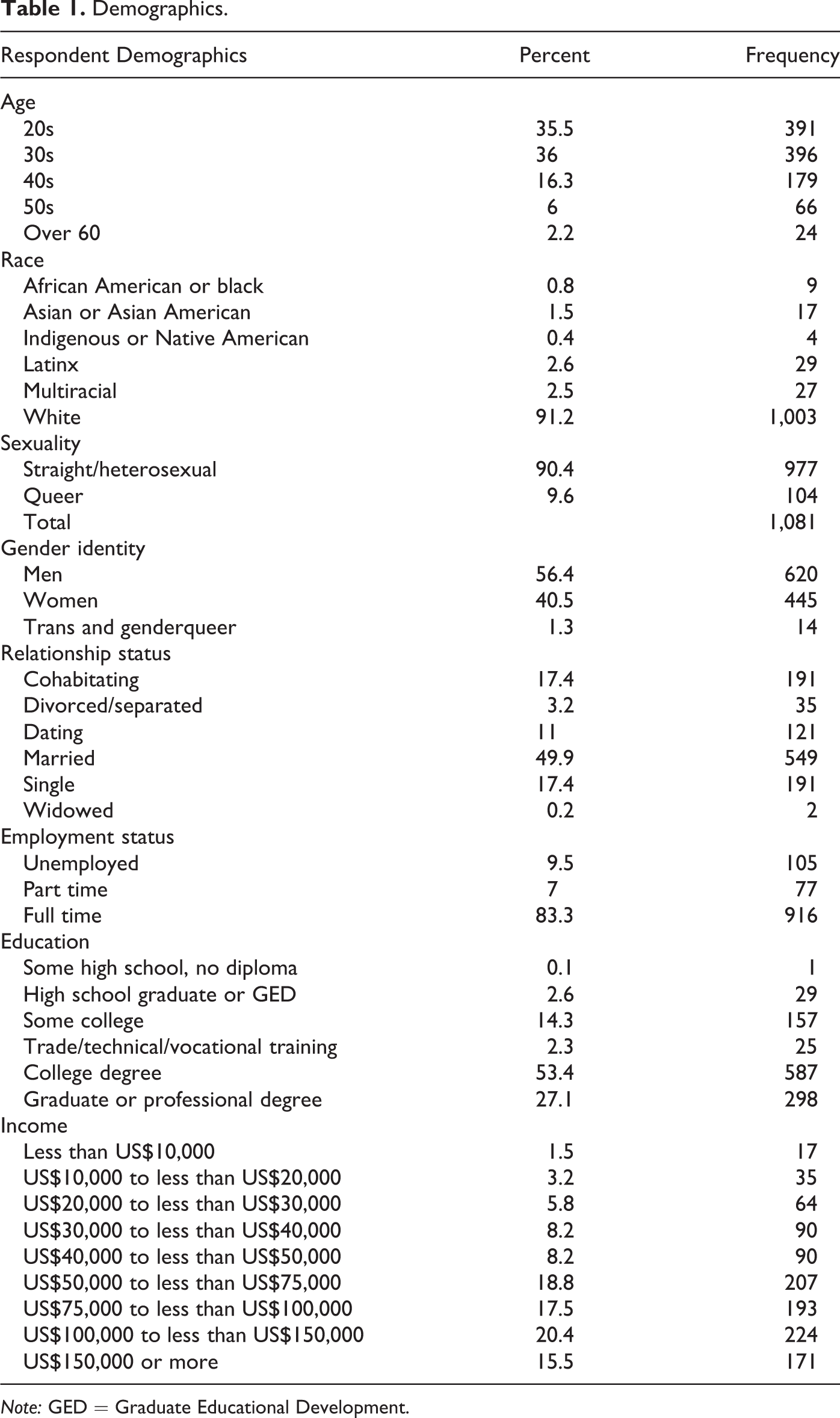
Note: GED = Graduate Educational Development.
While our sample size for minority populations is small, previous research has found that white, middle-class straight male populations are overrepresented within craft beer consumption communities. In 2014, African Americans/blacks consisted of only 3.7 percent of craft beer drinkers, while Asians consist of 5.5 percent and Hispanics 8.4 percent of the market (Rowe 2016; Townsend 2017). While these low rates of participation can be telling of the levels of inclusion in craft beer, further research should examine why non-whites are not as active within craft beer cultural spaces. Further research should attempt to examine the specific mechanisms of exclusion and low participation for these populations (e.g., Anderson’s [2015] work on the “White Space”).
Consumption in Public Beer Spaces
When craft beer was consumed in local bars or breweries, we considered this consumption “public”—in theory, anyone should be able to access these craft beer spaces. We find, however, that men and women’s access to these public spaces is controlled through normative expectations regarding beer as a masculine object. Men are put on an invisible pedestal—a metaphorical leg up—to access public craft beer spaces. This works through the legitimization of men’s beer knowledge. As a result, men are taken more seriously regardless of what they order. Women, on the other hand, face this naturalized knowledge as a barrier to their inclusion. Because men have an assumed affiliation with beer, women are constructed as not real beer drinkers. As a result, they must put forth extra effort to prove their knowledge and belonging to raise to the bar that is set before them. Compare, for instance, how men and women shared their experiences about being taken seriously by wait staff at a local bar.
Men in our sample most often discussed how they were perceived in these settings as the people who know beer the best, and it was their responsibility to offer recommendations or information, even if not solicited for such information. For example, a male respondent, recalling a brewery visit, said, “no need to prove (my knowledge). They (the staff) already know I’m knowledgeable.” Women, on the other hand, more often explained that their opinions, orders, and even presence was ignored or questioned by staff and other male patrons.
People (men) have been dismissive of my opinions and recommendations regarding beer while hanging on my (less knowledgeable) husband’s every word. A guy at a bar asked me what beer I was drinking, and after hearing it was something from a larger craft brewery (Stone) he referred to me as “one of those,” implying that my choice meant I wasn’t really into beer or didn’t know that much about it.
Here, we can see a woman at a bar ordering a beer being critiqued or questioned by a male customer. Men explained that this sharing of knowledge or correcting other people was welcomed, or at least necessary, in order to improve the knowledge of others (as a service) or at least maintain a particular status of craft beer. Women, however, found this unsolicited advice and knowledge to be not only unwelcomed but also implicitly questioning and delegitimizing of their presence a craft beer space.
Men’s association with craft beer, particular styles of craft beer, afforded them more legitimacy and capital than others. Men often discussed how their appearance and presence in these spaces led wait staff to automatically assume they were craft beer drinkers and preferred masculine styles. Several men suggested that because of their size, race, and presence of facial hair signaled a stereotypical “image” of a masculine craft beer drinker. This image, like that of a working-class masculinity in domestic beer, embodies the “hipster” stereotype with a relaxed yet well-curated look and fashion: “I’m a thick guy with a beard who has been offered IPAs a few times.” Yet, not every man likes the acquired taste of masculine-coded beers. As one man indicated, “Apparently bartenders think all guys like IPAs; I think they taste like a pinecone urinated in my water.” As such, while men were assumed to have an inherent taste for craft beer, when their masculinity failed within these spaces they were held accountable by others and needed to legitimize their decision through the performance of other masculine behaviors. As one man demonstrated, “At bars you get looked down soon if you ask noob 2 questions like ‘what do you have that’s light?’ or ‘what do you have that’s good?’ A basic knowledge of beer styles or malty vs. hoppy makes the bar tender [sic] engage with you more in my experience.” As he suggests, “noob” questions such as about light beers or what is “good” do not show that the person is curious about beer, but rather he has failed to demonstrate the natural masculine preference for and knowledge about craft beer. Light beers signal failed masculinity because they are associated with feminine beer preferences and styles akin to dieting, meanwhile asking “what is good” suggests that the drinker lacks the adequate cultural capital to choose a beverage and is reliant on the knowledge of others. As such, men share the knowledge they have about beer so that others can acknowledge and legitimize their masculine knowledge as a “real beer drinker.” This posturing gives male drinkers a “leg up” or more naturalized knowledge in these spaces.
While men are provided with easy entrée into public craft beer spaces such as bars and breweries, women do not experience the same advantage. Rather, women are subjected to heightened instances of gatekeeping by male drinkers and beer service providers that limit their access and participation to public beer spaces. Although a few men reported being recommended more traditionally masculine beers or were held accountable for more feminine orders, they were able to overcome their failed masculine orders through other overtly masculine behaviors. Women, however, were more often met with hostility, reprimanded, or completely rejected for ordering beers that were unfeminine. According to our sample, 17 percent of women responded they had been discouraged from ordering a particular beer at the bar, while only 7 percent of male respondents reported similar experiences. Women frequently offered examples of when they were asked the discouraging question, “Are you SURE you want that beer?” One woman recalled such an experience, explaining: “I’ve been told a beer was too ‘intense’ for me and been encouraged to order something with a milder flavor and lower alcohol content.” Another woman recounted, “At a bar, a male bartender once told me that it is unladylike to drink beer and should reconsider my choice.” One woman even mentioned that before ordering more masculine beers, she had been “forced to sample IPAs and BA (barrel-aged) imperial stouts before getting a full glass, even my husband, it’s just poured the same no questions asked.” As these women reflected, they were gate-kept from drinking beer at the simplest of level—drinking beer at all—by being explicitly told that they should not drink beer because they would not enjoy it and should choose another beverage. In the same breath, this also suggests that women cannot like beer because of stereotypes or biological difference, thus upholding men’s ownership over the beverage—that it is literally “unladylike” to like beer.
Should women pass the initial round of gatekeeping and intimidation within public craft beer culture (e.g., when ordering a beer), they faced heightened scrutiny regarding the style of beer that they ordered. Just as the woman quoted above notes, she was discouraged from ordering a darker or hoppier beer because it is assumed that women cannot handle or would not like a more masculine beer. Not only were women discouraged from drinking masculine beers, but they were also encouraged to drink traditionally feminine beers as well. In fact, women in our sample were nearly 15 times more likely to ever have been recommended a different order or suggested a stereotypically gendered beer compared to men. As one woman in our sample jokes, “‘You’ll love this (beer) list…this one tastes just like pears! So yummy!’…. I don’t want to drink a fucking pear.” When discouraged from drinking darker, more robust beers, women were pushed toward more fruity or lighter beers that are more akin to mixed drinks that realigned their consumption behaviors with their gender roles. If not being asked are you sure, women are offered its counterpart statement, “The ____ is light and sweet and a lot of women really like it.” Women are treated as a special drinking market apart from men; bars put forth an extra effort to encourage women to drink including special programming and, as one respondent mentions, having special beer menus with “chick beer” containing fruit-forward offerings. Yet, because these beers are not considered legitimate beers, women straddle the double-sided pressure to both conform to femininity and be taken seriously as a real and serious beer drinker.
In response to this catch-22, women in our sample most often chose to reject feminine norms and enact more masculine behaviors including proving one’s knowledge and displaying the required cultural capital to be taken seriously and to raise to the level of valued masculine consumption. One woman described a situation where she was first recommended a feminine style of beer, but only received validation when ordering a more “masculine” style: “While bartenders have started by offering a ‘girly’ or ‘easy’ beer, none bat an eye when I order a stout or sour.” Another noted that “I have had bar tenders [sic] and others change their minds about what to offer me when they realize I am more knowledgeable about beer styles and what I like than they assumed.” In an effort to display knowledge, many women employed tactics such as wearing beer-associated clothing, talking in technical terms, or communicating the breadth and frequency of their beer consumption through “check ins” on apps such as Untappd. To some extent, these tactics worked to include women in public craft beer spaces. Some men and women saw this masculine-contingent acceptance of women as a sign of a more gender egalitarian culture. Respondents explained that they thought craft beer was experiencing shifting social dynamics, “Instead of guys drinking beer together, a mixed crowd is engaging each other and enjoying the same thing.”
We would like to agree with this statement; however, the data, particularly from women, tell another story. As one woman demonstrates, “I think it’s funny how from a beer history standpoint, women actually were the original beer brewers. Yet today, it’s still a struggle to be taken seriously in the industry and sometimes even at the counter in your favorite brewery.” While the act of ordering masculine beers and being affirmed by others as a real beer drinker legitimizes the assumption about masculine knowledge about beer, it also consequently constructs feminine beers as the opposite. The gendered assumptions of knowledge in public spaces serves to put men on a pedestal of natural belonging within craft spaces thus relegating women to a lower, subordinate status.
Snobs versus Noobs: Proving Knowledge in Elite Spaces
While it was rare for men to report intimidation and barriers toward ordering beer in public spaces such as bars and breweries—and if they were, there were able to overcome it easily by asserting their masculinity—both men and women reported experiencing more instances of exclusion in elite levels of cultural participation such as bottle clubs or trading groups. As Thurnell-Read (2016) argues, with the rise of elite craft beer spaces, craft beer knowledge is used to function as a marker of social status and through the agency of cultural intermediaries, such as bartenders and wait staff, used to draw distinction and exclude other consumers according to taste and status. Rather than distinguishing between masculine and feminine behaviors, elite consumers embraced the omnivorousness of consuming multiple styles of beer—both masculine and feminine—as well as enacting more feminine-coded behaviors including routinized tasting and trading etiquette, beer cellar care, and discussing beer with a particularized language. Elite craft consumption, in other words, has become a serious leisure hobby that has an acquired knowledge, socialization, and taste. Men’s perceived beer knowledge offered them no advantage over women in elite spaces in terms of naturalized knowledge. As such, the inclusion of beer drinkers is dependent upon the enforcement of exclusion criteria, by cultural intermediaries, that distinguishes elite consumption from lower brow consumption—the difference between “tasting” beer and “drinking” it (Thurnell-Read 2018).
Elite consumers seeking to accrue status and legitimacy had to prove their belonging through the assertion of their acquired knowledge about elite culture, thus distinguishing themselves from “noobs.” This requirement was well known among elite drinkers. As one man expressed, “Within the craft community there seems to be a perceived level of knowledge, one who doesn’t demonstrate a base level of knowledge might feel left out/behind.” Another noted, “Craft beer, like other things, is an interest where some people equate knowledge with devotion/legitimacy.” Just as women use knowledge-proving as a tactic to be taken seriously in public settings, men also use this tactic to compare themselves to the other “big boys” within elite spaces. For example, several participants—women and men alike—used the colloquialism of “beer dick” or “dick swinging.” One respondent stated, “I’m a fairly hardcore beer geek, so I have to occasionally show my ‘beer dick’ is big enough to hang out with the big boys. Not in an intimidating way, but in a friendly competition way between friends.” One woman stated, “Being a woman, sometimes my showing off my beer knowledge puts me on an equal playing field with them. We then are able to talk about other items without them feeling as superior to me.”
This knowledge extends beyond the realm of simple style identification and preference to include the rarity of a beer, the reputation of a brewery, appropriate glassware, trading and shipping networks, or the merits of the style. This performance signals to others who are already in the group that they, too, possess the requisite knowledge about elite culture. As one woman stated, “My friends know I’m into craft beer and sometimes brew, so I feel like any recommendations I make need to be on point.” For her, by offering a well-informed recommendation—one in which there appears to be a correct answer in an otherwise subjective area—signals to others that she possesses elite cultural capital and should be recognized as a legitimate elite beer consumer.
Rare and highly sought after beers, called “whales are not commonly available in public bars and are usually only obtained by attending a brewery release, acquired via trade, or sampled at a bottle share”. As one man critiqued, he disliked noobs that “bring a cheaper or inadequate beer compared to others.” Similarly, other critiqued nonelite people who “(disregard) proper glassware. Come on!” and generally those who are “dumb as hell.” While glassware style or beverage temperature are seemingly feminized expectations of beer, a unique ethos surrounding elite craft beer has developed where context-specific terminology, meanings, and values demarcate the community of serious drinkers versus all others. As a result, elite consumers see their position in relation to elite culture as being central to their identity (Thurnell-Read 2016, 2018). As one man stated, “At a brewery someone was misinforming another patron how beer was made, and I stepped in and showed that I actually knew how to brew beer.” This perceived duty to “step in” and take over because of his ability to brew beer communicates a particular, specialized knowledge and signifies elite status.
There also emerged a pattern, wherein elite participants sought not only to distinguish from “noobs” through proving their knowledge but also distinguish themselves from other elite participants, particularly those who were overly involved, elitist, or “snobbish.” In fact, the use of the word “snob” itself was used by 67 of our participants, and snobbish behaviors were referred to by 87 more. Being considered a craft beer snob was devalued by these participants as snobs tend to exclude too many people and further limit the possibilities for people to participate in elite settings. Snobs were characterized by taking craft beer culture to the extreme, as in proving oneself too much, questioning others’ behavior too much, or collecting too many whales. As one elite beer drinker stated, “Snobby, elitist dicks are aplenty. They are becoming worse than wine snobs.” As wine collecting has become a form of a status marker, collecting craft beer has too become a way to mark one’s status. Chasing after “whales” is okay; however, the rarity and elitists attitudes associated with “whales” becomes a marker of exclusion. For example, another respondent explained, “People can start to be a bit elitist. Beer has just become another thing for people of means to flaunt as a status symbol. ‘Look I attended this expensive ultra-rare bottle share or I bought this 1,500 dollar bottle you’ll never taste.’” This distinction between elite and elitist, therefore, is the distinction between, as one respondent states, “craft beer enthusiasts” and “craft beer collectors.” Enthusiasts enjoy craft beer for the taste and community of craft beer culture, while collectors value their elite status.
Finally, while both men and women were required to prove their knowledge in order to distinguish their level of participation, men are afforded a level of naturalized craft beer knowledge. Women, in both elite and public spaces, encounter the gatekeeping mechanisms that assume they lack the knowledge and cultural capital to consume craft beer. This gendered expectation of knowledge led many women to feel excluded from participating in various cultural fields of craft beer consumption. While women are assumed to lack the knowledge that men “naturally” possess, this assumption does not prevent women from engaging in craft beer consumption. When confronted with gatekeeping, women are more likely than men to feel the need to prove their knowledge with more outward and explicit displays of cultural capital, most often in the form of beer knowledge and past drinking experiences.
Conclusion
With rapidly increasing numbers of women consuming craft beer, previous research has found that numerical inclusion does not equate to substantive equality within craft beer culture (Atkinson et al. 2012; Bogren 2011; Chapman et al. 2018; Darwin 2017). Women’s inclusion within craft beer is limited, at best, and women face heightened intimidation due to prevailing gender hierarchies that reinforce masculinity’s dominance and legitimacy within beer spaces. Put simply, gender inequality is redone rather than undone (West and Zimmerman 2009). Despite these findings, little research has sought to examine the specific mechanisms that are deployed in interactions between men and women that create these hostile environments. To address this gap, we drew upon the opinions and experiences of both women and men craft beer consumers in a nationally distributed survey to illuminate underlying mechanisms of sexism and gendered legitimacy in the craft beer culture. Our research allows us to examine how an individual’s beer consumption is not a result of one’s gender but rather is actively communicated, renegotiated, and accomplished through the interactional construction of gender itself. Beer becomes a gendered object that affords status and prestige through the social norms, rules, and expectations surrounding who can drink craft beer, as well as how, when, and where.
We find that while both men and women reported intimidation within craft beer culture, these experiences are constructed differently through gendered mechanisms of gatekeeping that reinforce gender hierarchies and norms. Due to beer’s link to hegemonic masculinity, men are presumed to be knowledgeable, legitimate, and natural beer drinkers. Men are afforded the role of cultural intermediary and are positioned as tastemakers in the craft beer culture. Only when men’s knowledge is lacking do they begin to experience gatekeeping mechanisms that then render them as “less than” men. Women, on the other hand, are subjected to having their beer knowledge questioned and doubted by others within both public and elite spaces because they are assumed to not possess the same basic level of knowledge of beer. As such, women must prove their knowledge and belonging within these spaces by stepping up to the metaphorical and literal bar set before them through doing masculinity. Calling fruity beers “feminine,” “light,” or even “girly” constructs a barrier of ways that people (both men and women) are expected to perform in these spaces that ultimately reject and exclude the feminine. While this rejection of the feminine is problematic, perhaps another angle to examine this is not a redoing of masculinity’s power per se, but rather a reappropriation of the masculine in a way that undoes men’s ownership over masculinity.
Future research should be qualitative in nature, including interviews of women drinkers, bartenders, and brewers, to understand the nuances of their experiences as well as with men who fail in performing masculinity in these spaces. Additionally, our sample did not include enough racial, class, or gender diversity to examine experiences intersectionally. Although these populations are small, it is important to understand why these populations are not participating or included in beer culture. Relatedly, our survey was distributed via online beer groups, thus targeting people already involved in craft beer culture and only examining the experiences of those who are not intimidated to the point that they feel not included or leave the culture altogether. Future research needs to find ways to include populations, especially of marginalized communities that are not active in craft beer cultures as well as people just entering or participate in more common beer setting.
While we do not suggest our findings are generalizable to women’s consumption in other masculine spaces, other research has examined the ways in which women participate in male-dominated cultural arenas, particularly subcultural settings (see Haenfler 2010; Thornton 2006). Future research should examine the ways in which these gatekeeping mechanisms function in other spaces.
Footnotes
Declaration of Conflicting Interests
The author(s) declared no potential conflicts of interest with respect to the research, authorship, and/or publication of this article.
Funding
The author(s) received no financial support for the research, authorship, and/or publication of this article.
