




Abstract
The norms and expectations of “father involvement” have changed rapidly within a generation, and yet, the labor force and state institutions have not supported low-income families in a way to achieve this. In this article, we examine the narratives of 138 socially and economically marginalized fathers to identify the frames that they adopt to represent themselves as fathers, tell a coherent story about their lives, and project an identity of themselves into their futures. Despite the political–economic forces that have dramatically increased inequality in an era of neoliberal capitalism, fathers rarely alluded to structural explanations for family instability, father absence, marital dissolution, and gender distrust in low-income communities. Instead, fathers attempted to adopt socially valued identities along three symbolic boundaries that distinguished themselves from their own fathers, from welfare frauds, and from the iconic deadbeat dad. They also adopted individualistic frames that took the form of therapeutic narratives and life-course transitional narratives. In general, despite harsh structural constraints, the men imagined themselves doing better, and, in nearly all cases, being engaged fathers was at the center of these hopeful constructions. Without structural change, however, these aspirational frames are likely to become little more than false hopes.
Personal Reflexive Statements
Tim Black’s work focuses on socially marginalized populations in three respects. First, it examines how larger social forces shape the human complexities and social contingencies through which individuals create their lives. Second, it engages the challenges of representing a marginalized group in an effort to humanize them. And third, it is a form of bearing witness to the harm and destruction that racial capitalism imposes on marginalized groups. In this article, he turns his attention to socially and economically marginalized fathers dishonored by dominant ideology as “deadbeat dads.”
Sky Keyes is a passionate advocate for marginalized populations, with a particular focus on families, on many levels: first, as a provider of direct services to pregnant women and homeless families in crisis, assisting them to navigate a system that often punishes them for their attempts to survive; second, as a participant in regional discussions with major stakeholders about systemic contradictions and ways of improving services for families; third, as a researcher and writer in sociological studies, papers, and books; and finally, as an activist involved in grassroots and community work to challenge capitalism and put human need before the imperatives of profit.
The era of neoliberal capitalism has made it more difficult for low-income men to be fathers, and at the same time, the expectations for them to be engaged fathers has increased. The norms and expectations of “father involvement” have changed rapidly within a generation, and yet, the labor force and state institutions have not supported low-income families in a way to achieve this. In this article, we examine the cultural frames and narratives socially and economically marginalized fathers use to represent themselves as fathers, tell a coherent story about their lives, and project an identity of themselves into their futures.
Rarely did the fathers’ narratives convey an understanding of the systemic class, racial, and ethnic inequalities and barriers that confront them. Instead, fathers were reactive to moralistic discourses that cast them as irresponsible, unreliable, negligent, deadbeat dads. They attempted to derive socially valued identities along a range of symbolic boundaries (Lamont 1992, 2002) that included distinguishing themselves from fathers who relied on welfare, from fathers uninvolved in their children’s lives, and, most of all, from their own irresponsible, absent fathers. They also adopted individualistic narratives that emphasized their intentions to make fatherhood central to their lives, which often followed the script of getting a job, going to school, and staying away from negative things. For some, this included a resilience or therapeutic narrative, where they focused on past and current struggles that needed to be overcome or managed, such as growing up in abusive households or in violent neighborhoods, living with disabilities, managing drug and alcohol addictions, and atoning for past mistakes when associating with “wrong crowds” (Silva 2013). Despite systemic barriers and individual challenges, the men imagined themselves doing better, and in nearly all cases, being engaged fathers was at the center of these hopeful constructions.
The Casualization of Family Relationships and the New Fatherhood
In a very short period of time, family roles and norms have changed and so has the economy and labor force, the state welfare system, and prisons. In other words, we live in an era of flux, in which uncertainty has become the norm. Moreover, the burdens of uncertainty have fallen heavily on individuals and families, as the privatization of risk (Hacker 2006), social reproduction (Bhattacharya 2017), and the triumph of entrepreneurial reason (Brown 2015) have taken hold. In this regard, the buffers of uncertainty that had been provided by full-employment initiatives and a safety net to preserve and prepare a workforce have collapsed, laying bear the stresses and uncertainties for individuals and families to manage in a globally competitive economy and increasingly precarious workforce (Curran and Abrams 2000; Orloff and Monson 2002).
We do not want to overstate the point, however, by suggesting that the period after the war was a golden era for all working-class families. While the postwar economy may have been dominated by manufacturing jobs that provided clearer routes to working-class stability, only a part of the working class was able to achieve a family wage and nuclear family arrangement, and these patterns were deeply segmented by race. In the 1950s and 1960s, about one half of white children and one fifth of black children were born into the mythologized Leave It to Beaver Family—a married, patriarchal household in which the children were born within the marriage, the father worked a full-time, year-round job, and the mother did not work outside the home. By the time children reached adulthood, only about one fourth of white children and less than 10 percent of black children would have lived their entire childhood in this popularly revered family formation (Cherlin 2014). Family stability varied considerably within the working class, while intersecting racial and class hierarchies were maintained after the war. Nonetheless, this period of state-managed capitalism, or Keynesianism, would provide a clearer pathway toward family stability than what would follow.
In the subsequent era of neoliberal capitalism, beginning circa 1980, the proliferation of the transnational mobility of capital, the vigorous coordination of international commodity supply chains, the organization of core and periphery workforces, and increase in job precarity have attenuated work pathways and casualized work. This casualizaton of the labor force is manifest in the casualization of family relationships (Cherlin 2014). Gerson (2011), who has studied family trends closely across all social classes, describes families today as “situations in flux, not fixed arrangements. Labels such as ‘dual earner,’ ‘single-parent,’ and ‘traditional’ are only snapshots, while family life is a moving picture” (p. 215). When the institutions that stabilize adulthood transitions through resource distribution and security, normative routines and expectations, continuity and predictability, no longer hold for a broader swath of the labor force, the grooves through which life is guided become less certain (Sennett 2006). Work, education, marriage, and family—the presumed drivers of adult transitions (Laub and Sampson 2003)—have become less stable institutional pathways in the past 40 years.
At the bottom of the labor force, this uncertainty has its own unique configuration. The increasing number of temporary jobs and jobs that do not pay sustainable wages (Kalleberg 2011; Sum et al. 2011; Weil 2014), the withdrawal of government support for those precariously employed or no longer looking for work in a bleak labor force (Soss, Fording, and Schram 2011; Pierson 1994), and the concentration of poverty, social isolation, and idleness policed in urban ghettoes and prisons (Wacquant 2009) create dismal conditions that manifest in interpersonal family relationships (Furstenberg 2001; Hamer 2001). Within this mix, fathers are hearing different messages about fathering than was characteristic of their own fathers. The controlled, emotionally distant, breadwinner image of fatherhood and its attendant forms of masculinity have been rapidly replaced with the expectation that the father will be involved in his children’s lives as a nurturing, caring father who will contribute to their emotional development. Fathers receive these messages from a variety of sources—from the media, institutional authorities, social service programs, court personnel, intimate partners, and peers. The proliferation of fatherhood programs at the turn of the new century emphasized the dual role of the father—to provide financially and to be emotionally involved (Mincy and Pouncy 2002; Randles 2017; Roy and Dyson 2010).
What seems to emerge from the literature on father involvement among economically unstable families is that fathers are more involved than is commonly believed by the public but that also father involvement decreases over time after intimate relationships dissolve for all racial groups, even though less so for black fathers (Edin, Tach, and Mincy 2009). The fault lines for father disengagement cut and crisscross in different directions—economic insecurity, extended families and multiple households, crowded housing, paternalistic state intervention, neighborhood and family violence, incarceration, drug and alcohol addictions, protest and street masculinities, and the emotional vicissitudes of repartnering (Furstenberg 2001; Nelson, Clampet-Lundquist, and Edin 2002; Roy 2004, 2014; Roy, Buckmiller, and McDowell 2008; Roy and Lucas 2006; Waller and Swisher 2006).
Fathering across these fault lines also occurs but not without forging new paths for relating. In some families, neotraditional family forms are constructed, whereby couples negotiate new gender territory concerning work outside and inside the home but nonetheless maintain the outlines of traditional roles, especially when institutional support is lacking (Gerson 2011). The casualization of family life and the new package deal, where the parents’ relationships are largely defined by their relationships with their children, may create shifting kin networks of caregiving. At times, this may involve both paternal and maternal extended families (Cherlin 2014), or liminal fatherhood in which the father is neither “here nor there,” searching for place amid ambiguous roles (Roy 2006). It may involve relationship suspensions and renewals over time, or second chance relationships (Roy et al. 2008), reinforcing Gerson’s point that family configurations are adequately characterized as snapshots in time. Even lives saturated in family and neighborhood violence that reproduce violence, disrupt intimacy, shape fathering dispositions, and inform parenting capital may also provide the prospects for compassion and healing (Roy and Dyson 2010; Waller and Swisher 2006). Parenting may also take the form of “two-generation fathers,” in which fathers mature and settle into fathering in ways they were incapable of doing at younger ages (Abdill 2018).
Low-income fatherhood is located within the interstices of structural dynamics that have made the impermanent permanent. Fantasies and longings emerge from the unanchored moorings of life, leading those most victimized by disinvestment and institutional abandonment to imagine their way out of the chaos and uncertainty into pathways that still designate lives with some modicum of dignity and respect—fatherhood among them. Fatherhood projects new possibilities: for being the fathers that their fathers were not, for leaving the empty promises and risky exigencies of the streets, and for attaining the fading prospects of working-class respectability (Black and Keyes 2020; Edin, Nelson, and Paranal 2004; Nelson et al. 2002). These aspirational frames, however, are battered by the realities of unemployment, precarious employment, and dwindling state support.
But how do fathers on the social and economic margins make sense of the new fatherhood? What are their perspectives, their identities, and their constructions of themselves as fathers? What resources and experiences do they draw on to locate themselves and understand their lives as fathers amid these larger forces of change? These are the questions we turn to in the remainder of the article.
Methods and Data
Three studies were conducted at the University of Hartford’s Center for Social Research (CSR) during the first decade of the new millennium that provides the data for our article. The CSR was a research partner to the Children’s Trust Fund (CTF), then an independent state agency, to provide home visiting services to vulnerable first-time mothers in Connecticut. By 2010, the program had expanded to every birthing hospital and to 40 communities in the state. The program defined vulnerability very loosely, using a parental risk assessment instrument that was typically administered at the birthing hospital to determine eligibility. Mothers were eligible if they met a combination of factors that might include being single, poor, young, socially isolated, having less than a high school education, mental health problems, cognitive deficits, family problems, substance abuse issues, a cognitive deficit, late or limited prenatal care, or repeated abortions.
In 2002, the CSR designed a life story study of program participants to learn more about vulnerable families across the state (Erdmans and Black 2015). Fathers were not the target of home visitation services and had more or less been left out of the program orbit. The CSR had an interest in learning more about them and were able to acquire consent from 48 fathers to participate in the life story study. Male interviewers were trained and sat with these men for a period of two to four hours across two interviews to record their life stories. Interviewers traveled to 15 different communities throughout the state to carry out the interviews. The life stories from 41 of these fathers are included in this study. 1
Around the same time of the life story study, the CSR also was working with the Department of Social Services in Connecticut to study their Fatherhood Initiative program. The program was located at three very different sites in the state. One program site served mostly white men and was located in a small city in the eastern part of the state. A second program was located in one of Connecticut’s poor cities and served mostly black and brown fathers heavily recruited from an alternative to incarceration program. The third program provided services inside a prison and then followed up with fathers when they returned to their communities. Program participants were almost exclusively African American and Puerto Rican. We include the 62 interviews that were conducted with fathers from these program sites: 14 from the predominantly white site, 19 from the poorer city site, and 29 from the prison program, where 21 were still incarcerated at the time of the interviews. Interviews lasted between 60 and 90 minutes and were conducted at program sites, homes, and at the prison (Black et al. 2003).
The third study took place at the other end of the decade from 2008 to 2010. Again, the CSR coordinated with the CTF to identify 35 fathers to participate in a multiple-interview study. Working directly with program sites, selected to create a racially, ethnically, and geographically diverse sample, study participants represented 13 program sites throughout the state and lived in 16 different cities and towns in Connecticut. The 2008 Recession was particularly disruptive to the men’s lives; nonetheless, one half of the fathers (49 percent) were interviewed at least three times over a period of about one year (Black, Walker, and Keyes 2010).
Combined, we have interview data from 138 fathers during the 2000–2010 decade. As shown in Table 1, ages of fathers ranged from 17 to 49 at the time of the interview, although most were younger, with an average age of 25 and a median age of 23. Fathers were racially and ethnically diverse, with 29 percent identified as Puerto Rican, 26 percent white, and 24 percent African American. About one half of fathers identified their relationships with the mother of their most recent child as a girlfriend, one sixth were formally married, and one third were no longer romantically involved.
Characteristics of the Sample.
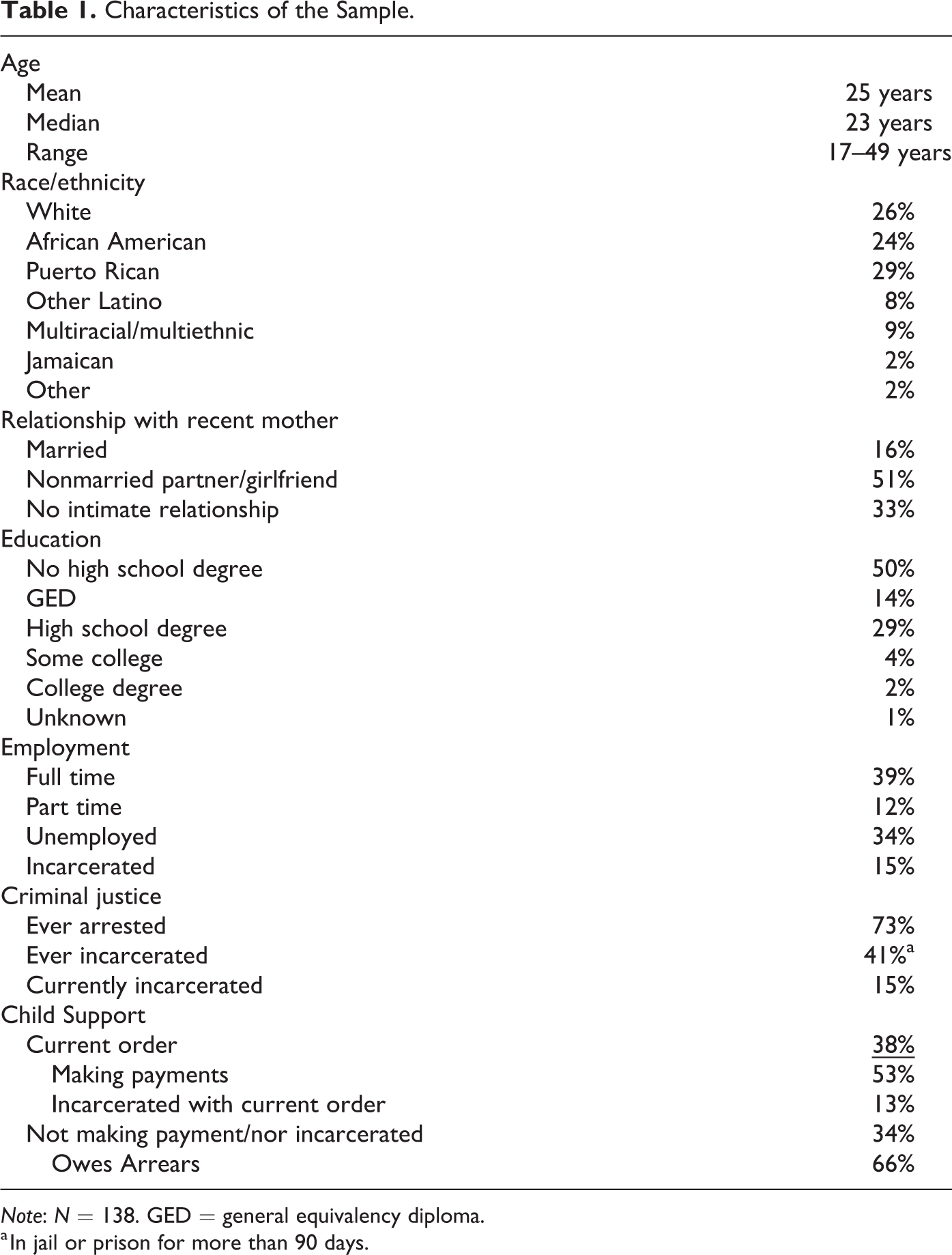
Note: N = 138. GED = general equivalency diploma.
a In jail or prison for more than 90 days.
Fathers were poorly educated. Only 35 percent had completed high school, while another 14 percent had earned a general equivalency diploma (GED). Only 39 percent of fathers were working full-time at the time of the interview, 2 while another 12 percent were working part-time. Seventy-three percent of fathers reported that they had been arrested, 41 percent had spent time in prison, while 15 percent were incarcerated at the time of the interview. Thirty-eight percent of fathers reported that they had child support orders. A little more than one half were paying the court-ordered amount, and two thirds were in arrears for past child support.
The fathers represented vulnerable families in Connecticut. Only a few appeared to be economically stable, while the rest were either just-getting-by working class or economically marginalized. The different data sets provide different snapshots that together tell a broader story about the lives of fragile families in Connecticut.
Working the Boundaries
Fathers unlikely to acquire much status from their ability to be family providers derived moral value from “boundary work.” They invoked symbolic boundaries through which comparisons with other groups enabled them to construct moral identities that projected a defensive narrative to charges of being negligent fathers (Lamont 1992). These narratives claimed moral value along three symbolic boundaries: by comparing themselves to their own fathers, by distinguishing themselves from welfare-dependent families, and by demonstrating that, irrespective of their circumstances, they were not deadbeat dads.
I Don’t Want to be Nothing Like my Father
To talk about themselves as fathers almost always invoked talking about their own fathers. Comparisons were unavoidable, comprising their measuring stick, their moral standard, and very often their efforts to derive self-worth. Moreover, their fathers were easy foils—two thirds described their fathers as not present in their lives when they were growing up. Many were angry and described their fathers as “cowards” and “sperm donors,” and they felt strongly about rejecting the rejecter. These fathers made it clear that, above all else, they did not want to be like their fathers, and they conveyed considerable emotion when they expressed this, as they staked out their determination to be involved, committed fathers.
Nonetheless, despite these avowals, only about one third of study participants whose fathers had not been present in their own lives had reversed this status and were involved fathers with their own children—at least at the time of the interview. Maurice was one of them. Twenty-year-old Maurice was angry at his father because “he ain’t been in my life.” His parents had both struggled with drug dependency, which Maurice attributed to the 1980s crack cocaine years that had “fucked up their life.” Maurice began working at age 14 and, at the time of the interview, was a present father, had a state job, was cohabitating with the mother of his children, and was determined not to be his father.
Of course, Maurice was a young father and we do not know whether his determination would win out over a lifetime. After all, nearly one half of study participants who had uninvolved fathers were not regularly involved with their own children (in part, this is because 15 percent of fathers in our study were incarcerated at the time of the interview). Close to another fifth of the men were present in at least one of their children’s lives but not involved with other children. In other words, despite deep desires to not be like their fathers, many of these young men had already become like their fathers. Moreover, we noted that the more their lives seemed to replicate their fathers’ lives, the more animosity they expressed toward them. Tyler exemplified as described below.
A white father, 24 years of age, Tyler was one of the most down-and-out fathers whom we encountered. He was unemployed, homeless, looking for work, and eating at soup kitchens when we interviewed him. He struggled with drug addiction, had been incarcerated, owed US$9,000 in child support arrears for three children whom he had with three different mothers, and whom he rarely saw. Tyler was trying to get back on his feet when we knew him, and he was fearful that his arrears would land him in jail. In this predicament, however, his last line of defense was directed at his father, when he angrily declared, “You want child support for this kid? Go after my father. He still owes me for 18 years. You know what I mean? Go get it from him.”
Donte was a 23-year-old, African American father from Hartford. His situation was not as bad as Tyler’s, but he could not catch a break in what he described as a prolonged search for work. He was struggling to get by but was a present father to a three-month-old infant. Donte grew up without his biological father, nor did he develop good relationships with two stepfathers. His father was incarcerated at the time of the interview, and Donte asserted, “I call him my sperm donor—he’s not a father, he was never around.” Donte was struggling financially due to his unemployment but nonetheless derived moral status vis-à-vis his father, a victory that was underscored through his public protestations toward his father.
The deeply emotional formations of father–son relationships produced long shadows in the lives of the fathers we interviewed. The more they were struggling with life circumstances, the more they appeared to blame their fathers and the more they worked this symbolic boundary to squeeze some modicum of moral status from their own marginalization. Dominant narratives concerning father absence nourished their understandings of theirs and their fathers’ lives. However, the intensity of these interpersonal dynamics did not provide any space for reflecting on how larger social structures and processes may have impeded fatherhood, the family, or the communities in which their families resided. These forces remain largely invisible, poorly developed by the media and public discourse. As the forces of social reproduction channeled fathers into similar racial and social class grooves that their fathers had traveled, their explanations for their own marginalized struggles searched within the webs of relationships with their fathers.
Those Deadbeat Dads and Welfare Cheats
For the fathers in our study, no label was more demoralizing as the “deadbeat dad.” The term gained popularity in the 1990s and 2000s as specialized courts were set up around the country to collect child support arrears. Child support cases were opened on fathers whenever one of their children applied for state assistance, and fathers were issued warrants to attend court to determine child support orders and to collect arrears. Part of these payments went to the mothers, but the majority went to the state to compensate for welfare costs (Wheaton and Sorenson 2007). While “getting the money” may have been the ostensible role of the court, the paltry amount of money that they could collect from poor fathers was hardly enough to justify state investments of time and money into this endeavor. At its peak in 2002, states were able to recover 31 percent of money spent on cash assistance, but the recovery rate dropped to 18 percent by the end of the decade. Meanwhile, states’ expenditures on these efforts continued to climb to where states were running a deficit of over $700 million in 2010 (Solomon-Fears 2012). If the intention was to collect arrears, these investments failed miserably, as total arrears owed across the nation skyrocketed from $14 billion in 1987 to $110 billion in 2010 (Haney 2018, Solomon-Fears 2012).
If “getting the money” was not the primary motive, what was? The role of the state is not simply to carry out technical or administrative functions that are guided by policy, but it constitutes the symbolic practice of classifying and stratifying populations and reproducing and legitimating social hierarchies (Bourdieu 1979, 1984; Wacquant 2010). In the neoliberal era, this has been shaped through social welfare and criminal justice policies intended to discipline and punish marginalized populations (Wacquant 2009). Neoliberal paternalism, characteristic of social welfare agencies (Soss et al. 2011), and criminal labeling and sorting, derivative of a criminal justice labyrinth, constitute an institutional organization of symbolic power (Wacquant 2010). In this regard, “deadbeat dads” join the ranks of “welfare queens” in advancing categories of disrepute and in deserving state surveillance and management. The symbolism of the deadbeat dad in categorizing marginalized fathers was articulated and enacted by magistrates in child support enforcement courts, staff in responsible fatherhood programs, social workers in welfare offices, police officers in deadbeat dad roundups, and probation and parole officers in routine office meetings (Black and Keyes 2020).
Fathers’ reactions were defensive. Some saw the system in gendered terms as being biased toward women. They blamed both women and magistrates and often believed they were in cahoots against them. Justin posited: “The whole system was working against me. They just wanted to take my money and hold me from my kid. The lawyers and then the judge and then the mother.” Richard recalled I brung the fatherhood papers in and everything just went bad. They didn’t even care about me. … And the judge looked at my baby’s mother and asked her what she wanted to do and she said, ‘Lock him up.’ And the judge locked me up and I had $250 in my pocket.
Rayshawn’s children had been taken into state custody while he was incarcerated for trafficking cocaine. Immediately after his release, he was summonsed to court because of child support debt that accumulated during his incarceration. The court magistrate had a reputation of being tough on fathers and using the threat of incarceration to coerce compliance. At 22 years of age, and just out of prison, this young, African American father was struggling to regain custody of his children, to get a job, and to pay down his arrearage. After his first appearance, he returned to the court several times to provide documentation that he was working and to make payments, all under the continued threat of incarceration. Rayshawn felt misunderstood by the magistrate, but when discussing this with us, he not only felt that being cast as a “deadbeat dad” was unfair and misguided. He stressed that he was not a deadbeat by defining and distinguishing himself from the “real deadbeat dads.” He explained: A lot of fathers—I don’t want to say all—but a lot of these, especially the fathers of the cities in these type of circumstances, do not do their job basically. And they make it bad for people like me or fathers like me. There are some of them that just don’t care. Because there are some it makes it bad for all of us. So, let’s say me, for circumstances, I be taking care of my son, but the state doesn’t know that. … She’s been collecting state. … Just because she collecting state they treat you like obviously you haven’t been doing your job so you are a deadbeat dad. It’s not true at all. Maybe for some people it is. But don’t treat everybody like that.
The fathers in our study were more likely to deny the heavy symbolism of the deadbeat dad by invoking a boundary and pointing across it at others. Like Rayshawn, Jadzia was clear about what a deadbeat dad was: “A deadbeat dad is a pathetic person that can’t control his kids or won’t be there for his kids. That’s my understanding of a deadbeat dad. He doesn’t want to be there for his kids.” In reaction to state scrutiny and haranguing, Jadzia insisted, “A deadbeat dad I will never be.”
The other symbolic boundary along which fathers attempted to derive dignity and respect concerned reliance on social welfare. Dependence on state assistance was largely viewed as a father’s abdication of his provider role and a threat to his masculinity. This was articulated in different ways. Some fathers split off state welfare along gender lines—their partners and their children utilized welfare, not them. They hunted down income wherever it could be found—from off-the-books jobs or from the streets. Steven, for instance, made it clear, “There is always an alternate route,” and stressed that he would “rather take from the streets than take from the state, if need be.” The other way that masculine efficacy was articulated was, again, by working the symbolic boundary or by distinguishing themselves from the “welfare leeches,” as Ray put it. Fathers typically supported welfare-to-work programs that were expanded after the 1996 Welfare Reform Act and joined the chorus in insisting that fathers get off their butts and into the workforce. They invoked the imagery of the lazy, welfare dad, while they failed to see how other forms of state support, like the earned income tax credit, Supplemental Security Income, and unemployment insurance, were also forms of state welfare.
The self-affirmation that working provided in a context of state paternal scrutiny enabled fathers to sidestep, at least temporarily, demoralizing state discourses about those living off of uncle Sam. It allowed Hayden to avow that welfare-to-work programs were “long overdue” and welfare “an easy way out.” For many, though, they had to reconcile contradictory experiences in their own biographies to stake these moralistic claims. Some, like Bobby, had relied on state assistance earlier in his life but was now working at a decent paying job in a paper mill. A 27-year-old, African American father, Bobby, and his wife received public assistance around the time of their five-year-old son’s birth. Looking back on this, Bobby commented, “I didn’t really like the state thing. It just makes me feel like I’m not doing enough and I’m not working hard enough.” When we discussed the welfare to work program, Bobby stated, “They’re gonna make you work and I think that’s excellent.” Here, he paused, though, and empathetically responded, “I don’t know. If you get rid of it, then, people who actually need help are gonna be suffering in the long run and you might have more problems in the long run.” After all, Bobby had needed it at one time in his own life. But he quickly recovered his resolve and added, “but if you shorten it even more, then, that might be the fire under their tails that they need to get into doing the work that they’re supposed to be doing.” He insisted, “There’s places that you can work your way into. All you gotta do is look.” At 27 years of age, Bobby had achieved working-class respectability, but he conceptualized this along the symbolic boundary that distinguished him from those who relied on state assistance and therefore were not working hard enough in behalf of their children.
Bobby had to smooth out his own biographical contradictions to work this symbolic boundary and so did Maurice. The father described above, who was angry at his father’s neglect and his parents’ addictions to drugs, Maurice grew up with his grandmother in the Charter Oak housing development in Hartford. The father of four-month-old twins, Maurice, graduated from high school and was working for the state processing tax forms. He too was supportive of time limits and the welfare-to-work program. He invoked common metaphors and clichés when condemning welfare dependency, accusing men of “looking for a handout,” or of being unmotivated and “never going to want to do nothing for yourself.” Growing up in in a poor housing project, however, Maurice also understood the challenges facing street youth. He, too, had to process his narrative through his own personal experiences. Intolerant of welfare-dependent dads, he nonetheless defended street hustlers. Taking aim at the government, he asserted, “Now, they always talking about we people be on the street. All right. Give us some more jobs. You all won’t even give nobody no jobs.” Building up steam, Maurice continued, “They say, ‘Oh, we out there thugging and all this. We ain’t dumb. You brought the thing in that’s going to kill us all and it just backfired on them.” Maurice exonerated drug dealers, We just started making money out of it. We’re just natural born hustlers and the only way you all try to kill us, well, we’re going to sell it back to you all. If it ain’t going to change, something going to happen bad—another riot. Better stop fucking with us.
Working the symbolic boundaries provided fathers with narratives of self-worth. Whether distinguishing themselves from their own neglectful fathers, from welfare-reliant, unemployed fathers, or from the popular trope, the deadbeat dad, these fathers were navigating the boundaries where they could claim dignity and respect. In all of these cases, symbolic boundaries were invoked to describe father’s current circumstances—to derive moral self-value in their current lives vis-à-vis their foils. When they imagined their futures, they were more likely to adopt individualistic frames that conveyed noble intentions to step up and be responsible fathers and to take care of their business.
Getting Your Shit Together
The men in our study expressed a great deal of emotion and determination in changing their lives. They intended to make better decisions, atone for past mistakes, and make fatherhood central to new life directions. These narratives fell into two categories: (1) therapeutic narratives that emphasized the need to heal from past suffering associated with family violence, substance abuse, and prison and to adopt new identities and self-conceptions and (2) life-course transitional narratives that stressed adult responsibility, in which finding work, moving out of unsafe areas, saving money for a house, staying away from crime and the streets, and being engaged fathers were articulated.
Therapeutic Narratives
In her book, Coming Up Short, Silva (2013) examined neoliberal economic restructuring and its cultural articulations in the lives of young working-class men and women. She expressed surprise to find that most of her respondents “were absolutely fluent in the language of therapeutic needs, desires, emotional suffering and self-growth” (p. 21). Confronting early experiences of trauma was the key to this process. Further, Silva explained how precarious work and the increasing demands on the family to navigate an uncertain world have made intimacy and marital commitment risky and fraught with tensions, fears, and resentments. Silva maintains that the hidden injuries of risk and uncertainty in the neoliberal era have not only undermined parental relationships but have privatized happiness and risk and advanced narratives of personal redemption and transformation.
In our study, we found similar patterns among some of the men. Living amid social and economic marginalizations often took the form of addressing past traumas and seeking personal transformation. Typically, this involved confronting haunting histories of domestic abuse and drug addiction. Some like Demitri shared vivid memories of their mothers being beaten by their fathers, and they attempted to disrupt these destructive patterns of relating in their own lives. Twenty-two-year-old Demitri declared, “when my father beat my mother, the way he treated me, well I know that I couldn’t do that because I suffered, understand? And I wouldn’t want [my son] to suffer what I had suffered.” Other fathers admitted to trying to change their own violent patterns of behavior in the household. They were “reformed abusers,” whose exposure to domestic violence prevention and anger management programs provided a language through which to better understand these intergenerational dynamics. Felix illustrated as described below.
Growing up with an abusive father, Felix said, “I was very abusive. I picked that up. You can say I picked that up. And I didn’t ever see anything wrong with it. It’s like, you know, it was something that came with the territory. You know, a man does this.” Exposed to domestic violence programs in prison, Felix lamented that “basically the kids saw what I saw, you know like the controlling, the slamming of doors, the domestic violence, coming home late.” At the time of the interview, Felix said he had not been arrested for five years. He had lived with the mother of his most recent child for three years and said he had refrained from violence. He was attempting to sustain a new self-narrative.
Shane, a 28-year-old, white father, talked about growing up in an abusive home with an alcoholic mother, and he provided a narrative that connected his upbringing to his own psychological make-up. Shane’s parents divorced after his father was diagnosed with schizophrenia and repeatedly hospitalized. His mother remarried, but Shane’s stepfather was violent toward his mother, resulting in a cycle of break-ups and make-ups, never with better outcomes. Shane explained that the way he grew up: affected me in a lot of different ways. I didn’t even realize how I was affected until these last couple of years.…. When I was in school I wasn’t close to a lot of people. And I didn’t like getting close to people. I’ve learned not to really trust many people. I trust certain people to a certain extent, but I have boundaries when it comes to everybody. I noticed when it comes to my relationships I am very skeptical. When it comes to my girlfriends, I am very overprotective towards everybody in my life, more overprotective of them than myself. I notice I always try to run from any type of problems. I’d rather stay enclosed because of what I’ve seen.
In a similar way that violence disrupted households, so did alcohol and drug abuse. Several fathers struggled with their own addictions and committed to recovery through Alcoholics and Narcotics Anonymous (AA/NA) programs. Their lives were informed by these therapeutic narratives. Saulo confessed, “This ain’t my first time. This ain’t my second time. This ain’t my third time I relapsed [sighs]. So now I know I got a sickness which I got to deal with for the rest of my life.” He asserted, “You got to want to help yourself. You know? Because if you don’t help yourself, there is nobody that’s going to help you.”
Daniel and Ted agreed. “It ain’t too late,” Daniel said. Lacking a commitment to recovery in the past, Daniel insisted that he had turned a corner. “This time I’m straight now.” He was trying to clean up the suffering he caused others and explained that his oldest daughter “is playing it sideways right now and I don’t blame her for that one.” Similarly, Ted explained his commitment to the AA program: “I have a sponsor now you know. One person helps the others, that’s how the program works, one alcoholic helping another to stay sober one day at a time.”
These fathers represented a different masculinity than their fathers’ generation. They were not stoically suffering the indignities of poor educations and precarious jobs, the damaged grandeur of masculine self-determination, or the racial and class dynamics of marginalization through inebriated barroom brawls, household terror, or drug and alcohol anesthetization. Instead, they were emerging from the dark corners of repressed and controlled identities and crafting expressive selves that embraced a therapeutic language of self-transformation. This turn inward to confront one’s own demons was projected outward as a therapeutic self. It focused on healing emotional suffering but not on the social and economic contexts in which emotional suffering was concentrated.
Manning Up
While several of the fathers were preoccupied with therapeutic healing and expression, most advanced a forward-looking individualistic narrative that underscored personal sacrifice, responsibility, and determination. Because so many were young, these narratives reflected a commitment to life-course transitions—to find work or be a provider, to save for a home and a car, to take care of their children, and to stay away from crime and bad influences. They described this as a form of masculinity—of manning up. As Rex put it: “If I can walk, talk, I can find a job. I still don’t expect nothing from nobody.” For others, like Marcus, it meant staying strong even when things were bad—never giving into depression. Marcus continues: So, I have to stay strong, I have to stay strong because I have my kids here.…. If I can’t help myself I can’t help them. See, I go down, [I’m] never going to be able to help my mother. She need my help. So, I have to stay strong. I have to stay on my feet, no matter what I receive. This is what make me go on strong and have the determination to keep going.
Lorenzo imagined his future in the interview: “enrolling in some type of employment activity, gaining my financial necessities. Hopefully pursuing my education.…. After my education I want to invest in my own business, which would probably be the music thing or maybe a clothes fashion.” When the interviewer pursued this with Lorenzo, he emphasized that he had to make sacrifices and needed to be more educated. He was then asked how he was planning to get his education. Lorenzo responded: Hopefully a student loan, something. Something, man. Some kind of sacrifice. I don’t care if I got to the library and read books. As long as I get the knowledge that I need for what I am going for, I’ll be all right. In five years, I’ll be all right.
Many of the fathers in our study had embraced this powerful cocktail of American individualism. They did so despite being unemployed or working in precarious, poorly paying jobs, living with family members in crowded conditions in deprived neighborhoods, coming out of prison with criminal records, being thousands of dollars in child support and court debt, or having no other income streams except the street economy. They hope to make something out of nothing through determination, and they intended to be engaged fathers.
Systemic Inequality
It was rare that fathers described to us their life circumstances and struggles in terms of racial or class inequality. This is not surprising since these frames are not readily available to them, certainly not within the institutions that govern their lives, but also, it would appear, not much within their own social spheres either. The hegemony of cultural individualism and meritocracy shaped the men’s perspectives, and like Maurice above, even those with street histories were more likely to adopt a defiant individualism, in which they valued their self-efficacy and masculine prowess within difficult circumstances (Sánchez-Jankowski 1991).
There was some systemic critique, akin to what Jay MacLeod, in his classic, Ain’t No Makin’ It, referred to as a partial penetration of the dominant meritocratic ideology. Of course, it is possible that the men possessed a more critical consciousness that they did not share with us in the interviews—perhaps forms of “hidden transcripts” that were more likely to be shared in safe spaces, removed from the agents of dominant culture (Scott 1990). Even if this were the case, it is hard for us to imagine that a broader, coherent social critique was possible without vibrant cultural and political institutions that could nurture such a perspective. As MacLeod (1995: 249) eloquently explained, given the hegemony of cultural individualism, critical views may be penetrating, “but insightful opinions are of little use in isolation; their needs to be an ideological perspective and cultural context in which their insights can be applied that leads to positive and potentially transformative rituals, symbols, territories, and political strategies.”
References to systemic inequalities included experiences of racial discrimination in the workforce and the courts. Two African American fathers believed that their appearances had prohibited them from getting jobs, one referring to his dreadlocks and the other to tattoos, and both attributed the discrimination to employers associating these styles of expression with drug dealers. As Alford put it, “It’s a color thing. Some people out there see I got a couple tattoos or whatever…[they think] I am a drug dealer and stuff, but they don’t even try to find out first.” Bernard, a 19-year-old, Nicaraguan father described his experiences with racial discrimination in the juvenile detention system. He stated, “I see white boys, do a lot of crazy shit, stealing cars, doing this. And I just broke one rule and they hit me up with the maximum. And I see these little mother fuckers going home.”
Some of the fathers also provided insights about social class dynamics. Robert, a 31-year-old, white father, described what he wanted for his son as he grew up. He didn’t “want him to be a bum on the street,” but neither did he “want him to be really wealthy.” To Robert, “rich people are all snobs,” and he imagined that if his son could not find a living wage job, that his bet was to “join the military.” He explained, “It’s guaranteed work and you won’t get fired.” Hector, a 35-year-old, Puerto Rican father also provided interesting observations about social class and the criteria for being a good father. Hector believed that the conventional thinking was that you were a good father if “your kid goes off to college somewhere.” On the other hand, he said, “If your kid is a drop-out, to other eyes, you are not a good father.” Hector added, “But they don’t know because they don’t live under your household.” Hector provided another way of thinking about the “good father,” a perspective that represented his own class location. He claimed that “I been with kids they been three or four years in college that are addicts and messed up, locked up, robbery background with college degrees. So, I don’t believe in that shit.” Moreover, he asserted I am saying a kid could drop out…and find that, I don’t know, get a girl pregnant, get married, find a job, and take care of his. That doesn’t mean you are a bad father if you drop out of school. You got somebody pregnant and you taking care of his.
Discussion
Most of the fathers in our study were born in the 1970s and 1980s, amid the transition to a neoliberal political economy that has reshaped the labor force and opportunity structure. For households located at the bottom of the labor force, these changes have been brutal, producing precarious jobs for many, while pushing others into the straits of structural unemployment. At the same time, state resources for these households have been retrenched, privatizing the burdens of caring for children in the twenty-first century. In other words, as the share of income for the bottom quintile of the labor force has fallen, state resources that might help to buffer these losses have also decreased, leaving families to fend more for themselves.
Structures are lived, and as such, we are left to make sense out of our own lives amid theses structural forces and transitions. In sociological terms, that means we attempt to subjectively understand the objective conditions that structure our lives (MacLeod 1995). As we listen to the men in our study, it is clear that they rarely see how these larger structural dynamics are relevant to them. There are insights into the systemic processes through which intersecting hierarchies of race and social class create advantages and disadvantages, but insights are not likely to get developed into coherent worldviews without political and cultural institutions and organizations that can help to sustain and enact them in meaningful ways. Without this, structural insights give way, largely, to a hegemony of cultural individualism.
Fathers in our study attempted to make sense out of their life circumstances along symbolic boundaries that had been established by moralistic public narratives directed at them. They wrestled with the narratives of father absence, state dependence, and father irresponsibility by comparing themselves favorably to their own neglectful fathers, to welfare frauds, and to deadbeat dads. It did not matter how marginalized these men were, these were the symbolic boundaries that preoccupied them and along which they attempted to construct narratives of dignity and respect.
When fathers conveyed their future orientations and strategies to create meaningful lives, they advanced personal narratives that took two different forms: therapeutic narratives and life-course transition narratives. In the former, they adopted language that focused their gaze inward and backward to conceptualize trauma and emotional suffering, often stemming from familial violence and substance abuse. This was a language of healing and coping, which rarely, if ever, made connections made between systemic inequalities and emotional distress. Instead, this was construed as a personal journey to come to terms with one’s own demons, embedded in interfamilial webs of pain.
In the latter, fathers intended to change their life course—to man up, get jobs, take care of children, and get their “shit together.” Almost invariably, whether they were wrestling with demons of the past, or manning up to meet their responsibilities, or both, fatherhood was at the center of these projections. They wanted to be engaged fathers, and they expressed determination to change their lives and to do it for themselves and their families. Their frame was not unfamiliar as it echoes through state institutions—welfare offices, child support enforcement courts, and prisons—and through AA/NA programs, anger management programs, and fatherhood programs located in varying institutional spaces.
Fathers had internalized these messages, and they espoused the language of individualism. Men expressed considerable desire to be engaged fathers. The father identity gave them social status, meaning, and the prospects for change. When men imagined their futures, their motivations to “do the right thing” was usually related to taking care of children and being a father whom their children would respect. Some described doing the work of fatherhood—changing diapers, playing with children, feeding, and walking them to school; some were fighting in the courts for the right to see their children; some were attempting to reconnect with children after absences; some were trying to figure out how to father in unsafe neighborhoods and schools; some were daydreaming about their children in prison; some were charting out new directions in their lives around fatherhood; some were trying to be like their own fathers, while more were trying to be the opposite; and some were aging into fatherhood as second-generational fathers.
Fathering was central to most of the men in our study. It provided a key conceptual frame through which they measured themselves, imagined their futures, held on to dignity and respect, staked their masculinity, and searched for meaning in their lives. Whether these men were just-getting-by working class or the more economically and socially marginalized; white, black, or brown; or men with criminal pasts, their articulated visions of themselves converged around a fatherhood narrative. In fact, the more marginalized they were, the more likely they appeared to adopt a father-as-central, individualistic perspective.
Without broad systemic change to truly address the intersecting racial and class hierarchies that create and reproduce inequality, we suspect that fathers are being set up. Some will find a way to succeed—they will be superdads who work two or three jobs, pay off their child support debt, remain crime free, and become involved fathers (Haney 2018). Or, perhaps, they will draw on a reserve of family resources or claw together the lifestyle of the just-getting-by working class and manage to keep their relationships intact, or perhaps they will age into some form of fatherhood as second-generation fathers (Abdill 2018). However, this group of fathers will be vulnerable to any crisis that may occur that will shatter their fragile stability. Nonetheless, the successes and the personal resilience of this group will be publicly heralded.
But what about the others? We suspect, that given the social and economic conditions in which the fathers’ hopeful narratives are erected, that most will fall short of their visions. They may want to do it alone, but they cannot. Their passionate narratives about manning up and financial and emotional involvement with their children is not enough. And when they fail, what then? What are the consequences—for them, their children, the mothers, and the larger society?
We might then ask, what would it take to support these desires for engaged fatherhood—to provide a narrative that counteracts the institutionally embedded hegemonic narrative of individualism. If they cannot do it alone, as we have suggested, then what is the direction forward. It would be easy to join the chorus of liberal voices and identify the myriad social policies that are needed to support low-income families: increasing the minimum wage, universal health care, food stamp expansion, early education investment, progressive and enforceable taxation, guaranteed family income, affordable housing, baby bonds, universal child care, expanded earned income tax credit, a federal works program…an exhausting list, perhaps, but not an exhausted one—we could go on. While these policies are no doubt needed, they look more like a wish list in an era of neoliberalism and austerity politics (Dolgon 2017).
In a historical moment in which social movements are gaining traction to demand racial justice, to avert a climate catastrophe, and to reconsider what it means to be an essential worker and to collectively support families in a context of a pandemic, how might a social movement strategy also include transforming low-income fatherhood? One direction might be to reconceptualize work and family so that it advances gender equality within a context of social reproduction needs that does not put the “making of profits” above the “making of people.” And here, we take our inspiration and guidance from feminist social reproduction theorists.
The thrust of feminist social reproduction analysis theoretically identifies the organization of institutional and cultural practices and resources needed to reproduce the economic and social order of a society (Bhattacharya 2017). In a capitalist-dominated society, for instance, an essential part of this social organization is the need to produce labor to meet the needs of capital. However, social reproduction goes well beyond labor force needs; as Nancy Fraser explains, the well-being of any society requires the systematic and institutional development of its social capacities “for birthing and raising children, caring for friends and family members, maintaining households and broader communities, and sustaining connections more generally.” Fraser (2016:99) asserts, “Without it there can be no culture, no economy, no political organization.” Further, she explains that capital accumulation has always relied on this, while at the same time, the economic need for expansion and accumulation has undermined it. Neoliberal capitalism has increased the privatization of social reproduction, which means that the withdrawal of public support for nurturing these social capacities has increased the burdens on families and households. This is apparent in the stress and anxiety that exist among higher income groups to balance family needs and work, which has increased the use of exploited immigrant household labor, as well as the demand for marital therapy. Families at the bottom of the labor force, however, have, once again, become the canary in the mines, begging for attention to the looming disaster that Fraser warns us about. “No society,” she writes, “that systematically undermines social reproduction can endure for long” (Fraser 2016:99).
Social reproduction is a feminist issue because the role of social reproduction has been mostly relegated to women, but as the authors of the manifesto, Feminism for the 99 Percent, point out, it is “also shot through at every point by the fault lines of class, race, sexuality and nation” (Arruzza, Bhattacharya, and Fraser 2019:22). Written by social reproduction theorists, the manifesto asserts that the response to the crisis in care needs to be anti-capitalist and to draw broadly on a range of social movements that are addressing inextricably interrelated issues. For the crisis of care is derivative of a “crisis of society as whole,” including the “economy, ecology, politics and care”—a crisis of “the entire formation of society,” “a crisis of capitalism” (Arruzza et al. 2019:16). As such, these are not just women’s issues, but issues for all who are “exploited, dominated and oppressed” (Arruzza et al. 2019:5). The authors propose that as scholars, we too need to “join with every movement that fights for the 99 percent, whether by struggling for environmental justice, free high-quality education, generous public services, low-cost housing, labor rights, free universal health or a world without racism or war” (Arruzza et al. 2019:15). Accordingly, movements need to center the “making of people” in resistance movements and in their vision for change—in contrast to the primacy placed on the “making of profits”—and need to raise the question, what kind of people do we want to develop—what kind of labor, what kind of citizenry, what kind of human being (Arruzza et al. 2019:21)?
Fathering from the margins needs to be seen in this light—within the scope of this narrative and these political movements. The increase in hours worked by all members of households, the uncertainty that the precarious nature of these jobs creates, the retrenchment of public assistance, the increase in punishment and debt, and the processes by which all of these are conveyed as the natural order of things have had multiplicative effects on a crisis of care. Expecting marginalized fathers to adopt the “new fatherhood” as engaged, involved fathers in this mix, and to do it largely on their own constitutes a setup.
In this article, we have focused our gaze on low-income fathers. It is our point of entry, but it is not intended to minimize the struggles of low-income mothers, who, for all intents and purposes, have been victimized by similar forces and who are left largely to themselves to find their way forward, too often, without the support of men—especially men who are incarcerated, sick, enraged, lost, or demoralized. But we take the approach outlined by McNally (2017:95), who writes that “truth resides in the processes of critical thinking, which can only move through the partial and one-sided understandings toward richer and more comprehensive ones.” We work our way through the experiences of low-income fathers to see more broadly the forces of oppression and marginalization at work. In doing so, we also see the basis for gender distrust and the intensive anger and blame that mothers and fathers direct at one another. To ease the gender wars in these areas, we need a new discourse through which marginalized mothers and fathers can reframe their own experiences that integrate class, racial, and gender dynamics. We need a discourse that makes class and racial (as well as sexual) marginalizations visible in our understandings of family, and we need this discourse to be accessible to these populations, through symbols, rituals, strategies, and practices that valorize parenting on the margins.
Neither the fathers in our study nor parents and couples anywhere will be able to achieve true gender equality in the rich sense that social reproduction feminists have advanced without social and economic transformations that place as much social and moral value on work in the home and community as work in the labor force and that recognize and cultivate the human capacities for carrying out this work. Certainly, true gender equality cannot be created in the current system of neoliberal capitalism and austerity politics, but neither do we believe it can be created in any form of capitalism where “the making of profits” is put before “the making of people.”
Footnotes
Authors’ Note
An expanded version of this article appears as Chapter 8 and the Conclusion of It’s a Set-up: Fathering from the Social and Economic Margins (Oxford University Press 2020).
Acknowledgments
We would like to thank our reviewers, Corey Dolgon and Woody Doane, for their thoughtful, well-crafted comments. We also want to thank the Children’s Trust Fund, now a division of the Connecticut Department of Social Services, for providing funding for this study and the Connecticut Department of Social Services for funding they provided independent of the Children’s Trust Fund.
Declaration of Conflicting Interests
The author(s) declared no potential conflicts of interest with respect to the research, authorship, and/or publication of this article.
Funding
The author(s) disclosed receipt of the following financial support for the research, authorship, and/or publication of this article: We want to thank the Children’s Trust Fund, now a division of the Connecticut Department of Social Services, for providing funding for this study. The Children’s Trust Fund’s contributions included funds provided by the Community-based Child Abuse Prevention Program from the U.S. Department of Health and Human Services, Administration of Children and Families, Children’s Bureau. We also want to thank the Connecticut Department of Social Services for funding they provided independent of the Children’s Trust Fund.
