



Abstract
We argue that for scientists and science communicators to build usable knowledge for various publics, they require social and political capital, skills in boundary work, and ethical acuity. Drawing on the context of communicating seasonal climate predictions to farmers in Australia, we detail four key issues that scientists and science communicators would do well to reflect upon in order to become effective and ethical intermediaries. These issues relate to (1) the boundary work used to link science and values and thereby construct public identities, (2) emplacement, that is, the importance of situating knowledge in relation to the places with which people identify, (3) personal and organizational processes of reflexivity, and (4) the challenges of developing and maintaining the social and political capital necessary to simultaneously represent people’s identities and lifeworlds and the climate systems that affect them. Through a discourse analysis of in-depth interviews with Australian agro-climatologists, we suggest that three distinct “modes of extension” are apparent, namely, discursive, conceptual, and contextual. Our participants used these three modes interdependently to create knowledge that has salience, credibility, and legitimacy. They thereby generated new narratives of place, practice, and identity for Australian agriculture.
Keywords
Introduction
Scholarship on the usability of science has a long history across diverse disciplines and discourses. Literature in both agricultural extension (Vanclay and Lawrence 1995) and science policy (e.g., Pohl 2008) has highlighted the limitations of bottom-up, demand-driven and top-down, supply-driven approaches to knowledge production. An important rallying point is the need to reconcile supply and demand for information (Sarewitz and Pielke 2007), for example, by avoiding the supply-driven framing of questions by researchers, which often generates scientifically interesting but irrelevant answers (Cash et al. 2003). Scholars have suggested more iterative (Dilling and Lemos 2011) and participatory approaches to framing questions (Carolan 2006), conducting science (Pohl 2008), and assessing technology (Russell, Vanclay, and Aslin 2010). Such approaches tend to embrace the ideals of post-normal science: extending the peer community beyond science to include lay citizens in the production of knowledge that is relevant in complex, high-stakes decision situations (Funtowicz and Ravetz 1993). The creation of this sort of “socially robust knowledge” (Nowotny 1993) often optimistically (usually implicitly) assumes “ideal speech situations” (Habermas 1984) in which power is distributed relatively evenly among participants. In reality, knowledge and power are always at play in human interactions (Foucault 1980). This is related to Jasanoff’s (2004) argument that knowledge and values are coproduced through science: that statements about what we know tend to infer normative judgments about how we should live. Yet, with a few notable exceptions (e.g., Innes and Booher 2003; Craig and Vanclay 2005; Armitage et al. 2011), analyses of the outcomes of such knowledge/values/power relationships in collaborative knowledge-making processes remain scant, especially where such engagement and communication emerge spontaneously from necessity and the pragmatism of practitioners rather than being planned.
This article details a case of such emergent coproduction. We examine how some Australian climate scientists, agricultural systems scientists, and extension agents iteratively made their particular form of knowledge—about climate risk and uncertainty—usable for farmers. The case and context are useful as they provide a view of the interactions across scales from the very local to national scale coproduction, and so provide ways of rethinking how science is placed within different contexts. We thus argue that the issues negotiated by participants to make their science usable have currency well beyond the context of our case.
Climate Variability in Australia: A Science Policy Context
The El Niño Southern Oscillation (ENSO) is now widely accepted as a key driver of seasonal rainfall variability in Australia (Nicholls 2005). Various indices and models link changes in ENSO with seasonal rainfall conditions across large swathes of the driest inhabited continent, Australia. The Southern Oscillation Index (SOI), for example, is an index of the differential in sea-surface air pressure between Darwin and Tahiti and provides a strong predictor of likely future three-monthly rainfall across much of eastern Australia (Stone and Auliciems 1992). The association between seasonal rainfall and ENSO provided a scientific basis for the adage (from Dorothea Mackellar’s iconic poem, My Country) that Australia is “a land…of droughts and flooding rains.” This link between El Niño and drought contributed to the Drought Policy Review Task Force (DPRTF) describing past drought relief as being anachronistic “disaster arrangements” that reflected a bygone government interventionist mentality and encouraged poor management of what are recurring and inevitable periods of low rainfall (DPRTF 1990a). The National Drought Policy redefined “drought” to be a normal part of the Australian landscape that needed to be managed as a matter of conventional practice, although it recognized that the concept of climate as a manageable risk was not widely accepted by farmers at the time (DPRTF 1990b). This and subsequent policies emphasized that creating knowledge for farmers to manage climate risk was fundamental to “managing for dryness” (Drought Policy Review Expert Social Panel 2008).
Whereas earlier governments had funded public extension to ensure that scientific knowledge was delivered to farmers where it was needed, more recent approaches emphasized the production of information. The extension of scientific risk information was seen largely as providing private benefits to farmers and was therefore not to be publicly supported (Hunt et al. 2014). The separation of knowledge production from its uptake and use resulted in the dismantling of state agricultural extension over the last few decades (Vanclay and Lawrence 1995; Hunt et al. 2012). This shift, propelled by successive neoliberal governments, presents one among many hurdles that limit the effective communication of climate risk and uncertainty. The various Australian federal and state agencies also produced different, sometimes conflicting, seasonal rainfall forecasts. Maps showing the probability of receiving above median rainfall over the next three months reflected regional associations of historical rainfall with the oceanic and atmospheric conditions which were spatially variable, making them hard to decipher. The likelihood of wetter than average conditions is generally decreased in El Niño conditions and increased in La Niña events, with regional variability in the strength of associations. Yet, despite such cautious language, El Niño quickly became synonymous with drought in the public lexicon from the early 1990s onward. A lexicographer even suggested that drought should be called the “El Niño season” (Arthur 2003, 181).
Presenting forecasts as objective analyses of risk meant that rainfall probability maps were often poorly understood or misinterpreted (McRea, Dalgleish, and Coventry 2005). A key difficulty for climate scientists is convincing different audiences of the applicability of their probabilistic information, largely because of the notion that humans are poor intuitive statisticians. In this article, we detail how such barriers to communicating climate information were dealt with by Australian agro-climatologists who cautiously deployed specific language and artifacts to mediate social and cultural boundaries. The aim of their communication strategies was to generate particular understandings of phenomena such as El Niño, La Niña, and their implications for farm decision making. As we detail in this article, in order to do this effectively, some communicators developed a discourse of climate that was underpinned by narratives of identity, place, and practice. For farmers, climate variability transforms their landscapes, lifestyles, and livelihoods at different timescales and in different ways and is thus central to their lifeworlds and to the language through which identity, place, and practice are constructed and negotiated. The analysis in this article suggests that linking the technical, social, cultural, and human aspects of knowledge and place is increasingly required to engage diverse publics in the policy making and sciences relevant to farm management. In our conclusion, we provide insights into how this communication might be advanced to address some components of what has frequently been referred to as “the crisis of legitimacy” facing scientists and scientific institutions.
Theory and Methods
Over the past three decades, a variety of concepts have been developed for the analyses of action and language at the boundaries between scientific (Gieryn 1983), policy (Jasanoff 1987), and public understandings of environmental issues (Wynne 1992). These analyses often invoke the concept of “boundary work,” which refers to people’s use of language to assist in settling what Gieryn (1999) refers to as “credibility contests.” Contests of credibility among scientists tend to be arguments about scientific rigor via either supportive or disparaging commentary on methodologies, practices, or the assumptions of researchers. Scientists tend to defend the rigor of their work through reference to favored institutions, paradigms, methods, theories, discourses, and authors (Gieryn 1983).
Boundary work can also relate to the way people represent aspects of knowledge that affect its usefulness or usability. Cash et al. (2003) synthesized a substantial body of research to argue that, in addition to credibility, there are two other elements that influence the applicability of knowledge in different contexts, namely, salience and legitimacy. Salience (defined by them as relevance to decision makers) relates to local conceptions of how or whether information or knowledge can have bearing on specific decisions or actions. Legitimacy is conferred by groups or individuals on the basis of their perceptions of fairness, equity, and the inclusion of the relevant actors in the processes of knowledge production. We analyze the boundary work of Australian agro-climatologists through the lens of salience, credibility, and legitimacy.
Two concepts are particularly useful to our analysis, namely, boundary objects and boundary-ordering language. Boundary objects are artifacts that are used to help mediate meaning between different communities. For instance, maps and graphs can serve to stabilize particular understandings of phenomena (Star and Griesemer 1989). The meanings of boundary objects are developed through negotiation and dialogue such that they become key points of discussion across communities. These objects are often used repeatedly by scientists to drive home a particular message. Such objects can become significant points of public and policy interest or controversy, and therefore are usefully considered in analyses of the social negotiation of information.
Boundary-ordering language refers to language that is used to shore up authority, often by creating or stabilizing particular ways of communicating about phenomena, institutions, practices, and/or identities (Jasanoff 2004). From this perspective, the communicative work required to develop an appropriate public understanding of a concept such as ENSO is not trivial. Analyzing such communication can help make explicit what is often implicit in the ways scientists and lay people talk about climate, risk, uncertainty, and knowledge (Fleming and Vanclay 2010; Vanclay and Enticott 2011). It can also help researchers to reflect, for example, on how they construct practices and identities of farmers in specific ways alongside their representations of the climate (Fleming et al. 2014).
Our focus on how boundary-ordering language can balance salience, credibility, and legitimacy required analysis of the language by which identities and knowledge claims are contested and made stable. Three specific narrative elements are useful foci for such analysis, namely, scripts, parables, and story lines. Scripts can be considered as being “a culturally shared expression, story or common line of argument, or an expected unfolding of events, that is deemed to be appropriate or to be expected in a particular socially defined context and that provide a rationale or justification for a particular issue or course of action” (Vanclay and Enticott 2011, 260). In short, scripts are narrative elements that present particularly stable identities and ways of knowing or assessing knowledge. Parables are normative stories that farmers tell about mythologized, hypothetical farmers (Howden and Vanclay 2000; Vanclay et al. 2006). They are often presented as cautionary tales about the consequences of particular courses of action or belief (Leith, Ogier, and Haward 2014). Following Hajer (1995), story lines are argumentative narratives used to position oneself in relation to others or a particular issue. They are sometimes expressed as opposition to more stable scripts, parables, or descriptions of practice or identity. Thus, story lines are often used to highlight emerging practices or identities that are distinct from accepted ones. Criticisms of the standard approach to addressing an issue can be a form of story line that is deployed to differentiate an individual actor from a group or practice. Where a story line is widely adopted by a group, it can become a script or parable.
Through the analysis of these three narrative forms—scripts, parables, and story lines—our work employs an approach to analyzing knowledge boundaries in terms of the discourses of salience, credibility, and legitimacy with particular attention to how knowledge and identity are rendered simultaneously through such narratives. Our focus on recurrent and divergent scripts and parables, and the argumentative story lines that are used to stabilize or undermine these, highlights pathways for improving the conduct of applied climate research and communication of climate risk and uncertainty.
Seasonal climate forecasting and communicating climate risk in Australia provides an informative context for examining boundary work between scientists and publics. Rainfall variability in Australia creates large fluctuations in livelihoods and there are high stakes and thus often heated politics involved in managing this variability. Also, while parts of Australia can potentially benefit from probabilistic forecasts, this outcome is not certain, simple, or deterministic (Meinke and Stone 2005). Contingency and uncertainty need to be managed across scientific, communicative, and decision-making processes. Australian agro-climatologists have acknowledged these and many other constraints and opportunities and are regarded highly around the world, especially for their engagement with agriculture (Cash and Buizer 2005).
Our research was undertaken at the end of some fifteen years of concerted effort by agro-climatologists. Since the early 1990s, through hundreds of seminars, field days, and radio and television broadcasts, a diverse community of researchers engaged in an ongoing, informal dialogue about climate and weather with farmers. The researchers were mostly employees of national or state government research agencies and included climate scientists, agricultural systems researchers, and extension agents. They frequently collaborated across agencies and their respective disciplines to develop improved applications of climate prediction for Australian agriculture. Between 2003 and 2006, key informant interviews were conducted with thirty-five of these researchers. Participants were selected from a review of relevant literature and through snowball sampling during preliminary telephone conversations. The media outputs and other publications of these researchers were also considered. More details about the methodology are available in Leith (2009).
For the analysis reported here, a discourse analysis of the transcribed interviews, media transcripts, and other public documents was undertaken to examine how climate communication was constituted, to what effect, and what points of tension or argument were pervasive across these interviews. Analyzing scripts, parables, and story lines, we detail how the participants described and performed communication of climate variability, prediction, risk, and uncertainty. In technical terms, the qualitative analysis was conducted by shifting analytical focus between the constitutive and interactional (Gubrium and Holstein 2000), and argumentative (Hajer 1995) aspects of discourse in order to interpret boundary work across organizations, disciplines, and jurisdictions. Put another way, boundary work was considered through social representations of what is important, how it is made to seem important, and how it is counterpoised against things constituted as less crucial or unimportant.
Results
Through our analysis of the scripts, parables, and story lines within the interviews and other materials, we identified three modes of extension, which we call discursive, conceptual, and contextual, and which we discuss subsequently. These modes intersect and reinforce one another. Participants did not necessarily explicitly make distinctions between these modes; rather we constructed them as useful categories to organize our analysis. The three modes can be differentiated in terms of the different geographical scales at which they operate, the differing ways by which they constitute knowledge, and their differing use of discourses, narratives, and language.
Discursive Extension of Climate
Discursive extension is the active and interactive development of public discourses, in our case relating to climate risk management in Australian agriculture. It does not operate through the provision of scientific information per se, but via scientists engaging in public discourse. As one agro-climatologist suggested: “We have actually gone a long way in [terms of] the mental map of most Australians, of improving [their] understanding of the shape of climate.” This reshaping can be understood in terms of a shift in public understandings of climate, not necessarily as a dynamic ocean-atmospheric system but as presented in a commonly used phrase: “climate is what we expect and weather is what we get.” Agro-climatologists saw a role for themselves in fostering more realistic expectations of seasonal rainfall conditions among publics.
ENSO was a central element in scientizing the Australian climate, for instance, by representing it using statements such as “naturally inclined to extremes” and “average conditions are not normal.” Yet, as boundary objects, the various probabilities, maps, and graphs used to make ENSO visible were deployed in many different ways, partly because of the different roles and mandates of the various State and Commonwealth organizations in the climate business. The Australian Bureau of Meteorology (hereafter, the Bureau) played a substantial role in constituting the climate for the nation. However, the Bureau’s national focus appeared to limit its capacity to contextualize information in relation to the specific needs of particular geographical areas and industries. Bureau climate scientists were committed to providing climate forecasts via probabilities and maps in order to describe seasonal climate risk as accurately as possible. From their perspective, the onus was on the individual users to work out how to use the boundary objects, such as maps of the likelihood of above- or below-median rainfall. Such maps were described as neutral objects which conveniently summarize scientific understanding of current conditions as a number. There was an assumption that once the probabilities were known, they could influence decision making, and so further translation of these numbers was the task for the users, for example, the farmers, industry bodies, and government agencies. In short, Bureau scientists emphasized “improving products, rather than improving publicity,” while employees of state agencies tended to want to typify communication as being integral to improving the application of climate information.
The Bureau’s purportedly objective representation of “climate-as-risk” is very different to the more regional and local renderings of climate which recognize that climate affects and is affected by social, cultural, psychological, and political processes. In Queensland, for instance, where the farm sector is politically important and ENSO’s impacts on agriculture are substantial, the discursive extension of climate links diverse concerns with the likelihoods and uncertainties associated with rainfall. A prominent Queensland agro-climatologist, Roger Stone, described communicating climate with respect to his relationship with farmers which had developed over years of interaction: What I do,…[is] set up the risk management profile that primes these guys [farmers] to be aware of the problems. Rather than just saying, “The forecast is good,” they might say, “I will go and buy more cattle” or something—you prime them to be watching. And then I say things [like]: “Let’s watch it together over the next months. I don’t know if there is an El Niño coming, but if the SOI [the Southern Oscillation Index] keeps dropping, and the Pacific continues to warm up, then you have got problems. So let’s watch that together over the next month.” So they get ownership over the situation, and say: “Oh, there is actually a website, you can watch it. Is that right?” And they watch it. So they become participants in the whole process. That’s what I do. I don’t put out the forecast. I actually involve them in [it]—this is participative stuff, I suppose—so I say this on the radio: “Let’s watch it together.” [Dr Roger] Stone [from Queensland] says most farmers across Queensland would be already preparing for the possibility of another El Niño weather event. He says there is only a 10 percent chance of drought-breaking rain during spring. “Many parts of the state are actually suffering enough as it is,” he said…“It’s yet again another pretty careful approach to risk management, as we say, and it’s a pretty cautious approach to the whole farming system at the moment to dig down [i.e., ‘dig in’] and survive another fairly dry period” (Australian Broadcasting CorporationRadio Queensland 2006, online transcript).
In the above mentioned quotes and others like them, a discursive climate was built up through national and regional narratives that associate broad climate phenomena with local practices and identities. Constructions of farmers as risk managers, survivors, and astute observers of “climate-as-system” in the abovementioned quotes tap into preexisting scripts which construct climate as integral to the well-being and daily work of farmers. These and other examples of nontechnical, colloquial, and vernacular talk about climate link climate science, risk, and uncertainty with relevant and legitimate discourses of rural life and agricultural identities and thus may have the ability to alter these discourses (Fleming et al. 2014).
Conceptual Extension of Climate
In histories of rural Australia, drought and deluge appear as punctuation in the lives of industries, communities, and individuals (Dovers 1994). The overlayering of rainfall records with the history of ENSO and its underpinning mechanisms is deployed to rebuild farmers’ conceptual models of climate and the relationships between climate, farming, and decision making. This reconceptualization of climate is oriented to changing the attitude of randomness and fatalism that has historically pervaded rural understandings of what the future holds, climatically speaking as well as in other respects (Campbell 1958; Rickson et al. 1987). Despite the limited and declining budget for public extension in Australia, substantial effort has gone into extending information about the relationship between ENSO and rainfall. This effort has tended to take a fairly traditional approach: scientists or extension agents explain some of the statistical and mechanistic aspects of ENSO and its association with Australian rainfall to groups of farmers in workshop settings. These mechanistic aspects of the climate can redefine what is deemed appropriate for farm management, and thereby contribute to reshaping conceptual understanding among farmers.
Explaining the mechanisms of ENSO was described in interviews as being a necessary grounding for establishing public credibility of the statistical forecasts. Such explanation often proceeds from explaining how particular weather systems generate rain (e.g., via cyclones, fronts, monsoonal troughs) and how these systems are affected by ENSO conditions. A basic mechanistic understanding of climate via weather was described as being a necessary step in making the very idea of climate prediction tenable to farm decision making, rather than the fatalistic attitude of climate being an unpredictable and unmanageable external risk. As one extension agent put it, “You’ve got to make the connection between a warm patch of ocean in the Pacific and rain at somebody’s backyard.” It is by explaining the links between the global mechanisms that result in local rainfall (or lack thereof) that the credibility of climate forecasting is built. Talking about weather processes first and climate later was described by participants as preparing people to engage more readily with seasonal climate forecasting. It was also regarded as equipping decision makers with tools to interpret weather maps, to reconfigure in climatic terms their knowledge of the agro-ecosystems they manage, and to engage with the language and boundary objects of climate and weather.
While mechanistic descriptions may be only partially explanatory, the historical association between ENSO and rainfall was constituted by many participants as being convincing through its salience. Agro-climatologists have gone to substantial lengths to communicate analyses of climatic history as a means of demonstrating the strength of this association. The SOI phase system (Stone and Auliciems 1992), for example, gives farmers a means of comparing current SOI conditions with analogous years in the historical record. Farmers often have their own rainfall records that stretch across generations, so “analog years” with similar SOI conditions can be examined in a very local and, often, intergenerational context. Thus, farmers are effectively able to test the SOI system on their own records and thereby ground the SOI forecast system in their own knowledge. Agro-climatologists often suggested that probabilities, once understood and trusted through such association, made the decision process less subjective and stressful. As one researcher put it, there’s some exercises where you get people to, you know, write down options and look at even simple probabilities, [which] actually I think can be liberating for them…I think it’s often a useful way of thinking about the uncertainty…and being probably explicit about what it is.…I think some notion of rainfall and seasonal forecasts and so on…can be an empowering thing to think about. “Well, we don’t know what’s happening in the future, but these are the odds of going this way or that way.” Also, so that people don’t beat up on themselves too much if things do go wrong, because they still know that, well, that was probably the right decision at that time.
Hidden behind the publicly purported objectivity of probabilities, however, were quiet concerns among some scientists that the scientific basis of seasonal rainfall forecasts was being eroded. As one climate scientist put it, “It would be easier to make seasonal forecasts if the ‘background’ climate was not changing so rapidly. I suspect that this is changing the relationships on which we base our forecasts.” Human-induced climate change, by this account, could be undermining the stability of climate associations between ENSO and Australian rainfall, at least theoretically. These concerns present a substantial challenge for agro-climatologists: how should they translate the multiple forms of uncertainty associated with climate variability without undermining the salience, credibility, and legitimacy of their forecasts?
From the interviews, it appeared that researchers from different disciplines had very different approaches to these questions. For climate scientists, concern centered on the credibility of models and forecast systems, emphasizing the need for improvement on the supply side. Systems scientists and extension agents, on the other hand, had a more demand oriented and pragmatic approach. They were often concerned with building more flexibility into the boundary objects and better communication to balance uncertainties with the imperatives of application. For systems scientists particularly, there was a pervasive concern that better decisions about crop, livestock, and land management could be made if scientific support was provided in a timely and meaningful manner. Some argued that the supply-driven climate science agenda was leading to “analysis paralysis” and hindering improvements in land management. The inference here was that the existing climate science models were adequate for most existing applications and that excessive resources were still being channeled to climate science over the systems science and extension that enabled their application. Systems researchers and extension agents were also interested in how information might be used and misused by farmers. To this end, extension agents, whose core work is social engagement and communication, were always interpreting responses to information and adjusting how boundary objects were framed in order to try to produce very specific meanings and effects among audiences and individuals.
The extension of conceptual climate can thus be described as a process of creating usable boundary objects and ensuring they are not misused. Extension of a conceptual climate might, at first glance, appear to be agro-climatologists attempting to explain their understanding of climate in ways that are meaningful to farmers. Viewed through the conceptual lens of boundary work, it is clear from the interviews that stabilizing the boundary objects of climate science requires substantial negotiation. This extension relies on iterative interpretations of how boundary objects of science are and should be constituted to be meaningful to particular groups of farmers in specific places.
Without a conceptualized climate, the boundary objects of climate prediction may well be free-floating, relatively meaningless, and have little traction on the decisions of farmers. Worse yet, without conceptual extension, these boundary objects might be stabilized among farmers in a form that is incongruous with scientists’ understandings. The process of translation of the risks and uncertainties of climate via framing boundary objects throws into relief the interdependence of the legitimacy, salience, and credibility of information for potential end users. Extension of the conceptual climate therefore comes to be seen as an interpretive and negotiated process of the translation of scientific concepts for particular contexts and the ongoing management of the risks of this translation.
The Contextual Extension of Climate
Applied climate forecasting tools for agriculture began to proliferate in the early 1990s. These tools were largely based on agronomic systems models initiated with outputs from statistical climate models (McCown 2001). They integrated diverse variables relating to soils, pests, management options, and climate. Some were developed into Decision Support Systems (DSSs) to assist farmers to make decisions. This integration of risk factors at local and farm scale allowed the history of ENSO impacts to be relived and re-managed in a virtual setting. Such modeling expresses climate prediction in context: in relation to place, history, productivity, management options, and profit.
The reason for contextual extension of climate is neatly summed up by Hammer et al. (2001, 531): “the leap directly from a seasonal forecast to a decision is too great to be done (well) intuitively.” The added value of applying climate forecasts via agronomic models, however, is difficult to quantify and tends to rely on farmers’ own estimations of the validity of the model (Meinke et al. 2006). We argue that such value is mediated by the work agro-climatologists do in representing biophysical and social systems simultaneously.
The transformation from DSSs to Discussion Support Systems (Nelson et al. 2002) marks an important shift in thinking among agricultural systems researchers. It is, first, an acknowledgment that, rather than formal validation to bestow scientific credibility on models (cf. Oreskes et al. 1994), models should be made salient, credible, and legitimate to farmers through their ability to produce qualitatively realistic hindcasts and forecasts (Meinke and Stone 2005). Second and more importantly, it also acknowledges that these models need to be mediated by discussion between scientists and farmers in order that both can better learn how the socioenvironmental system functions. Once sufficiently legitimate, credible, and salient, modeling experiments of difficult farm decisions can be simulated over many seasons. These can then become a proxy for the learning from trial and error associated with the real on-farm experiments of farmers over generations (Carberry et al. 2002; Meinke et al. 2006). Salience and legitimacy, however, are created through social engagement, not by the hard science underpinning the models. Nevertheless, “discussion support” for managing climate risk has engaged very few farmers as it is time consuming and tends to require participation of systems researchers familiar with both climate and systems models in order to maintain credibility (Carberry et al. 2002). This means the “discussion” cannot be easily outsourced to more generalist extension agents. Such discussion also usually only engages highly educated or motivated farmers who have previously been involved in climate extension programs (Nelson et al. 2002).
Where systems researchers have engaged in the close collaborative work of contextual extension, they gain a deeper understanding not only of the biophysical aspects of farmers’ work, but also the social and cultural ways of being and thinking that are crucial to understanding the functioning of farms (Vanclay 2004). This understanding enables some agro-climatologists to convert their own language of risk and uncertainty into more locally appropriate forms, as described earlier in relation to discursive extension. For one systems scientist, participatory research had provided insights into the diversity of farmers and the enigma of farmer decision making, which had reoriented his understanding of the role of extension and research: Some people are only at the stage of just needing to be excited into the possibility that there’s a decision to be made. Others are a long way down the track and know exactly what the decision is, and they really want quite technical responses to it. And cutting across all of that, some people just want to talk about it, and will never put pen to paper, or whatever, and so you need real rules of thumb, and things you can just transmit like that [clicks fingers]. Other people want to engage with other human beings and do it in a workshop sort of situation. There’s still others that don’t like doing that and want to sit privately and do it on paper, and still others might do that, but are happy to actually get on to a computer. And so the idea that you have a computer decision support system as the only output was stupid. That’s just one tool in a pantheon of things which altogether can actually contribute to this decision-making process.
Discussion
To briefly synthesize the above analysis, we present the key differences between the three modes of extension in Table 1. While delineation between the discursive, conceptual, and contextual modes of extension is not absolute, Table 1 provides insight into the interdependency between these modes. For example, in discursive extension, the legitimacy of scientists to constitute themselves as empathetic, and farmers as survivors or risk managers, relies on their ability to genuinely listen and authentically deploy salient colloquial narratives of farmers. The interpersonal work of conceptual and contextual extension thus underpins the legitimacy of discursive extension, while that discursive extension provides institutional credibility, which encourages farmers to engage in (and potentially invest in) the conceptual and contextual extension and the research on which it rests.
Synthesized Characteristics of the Three Modes of Extension.
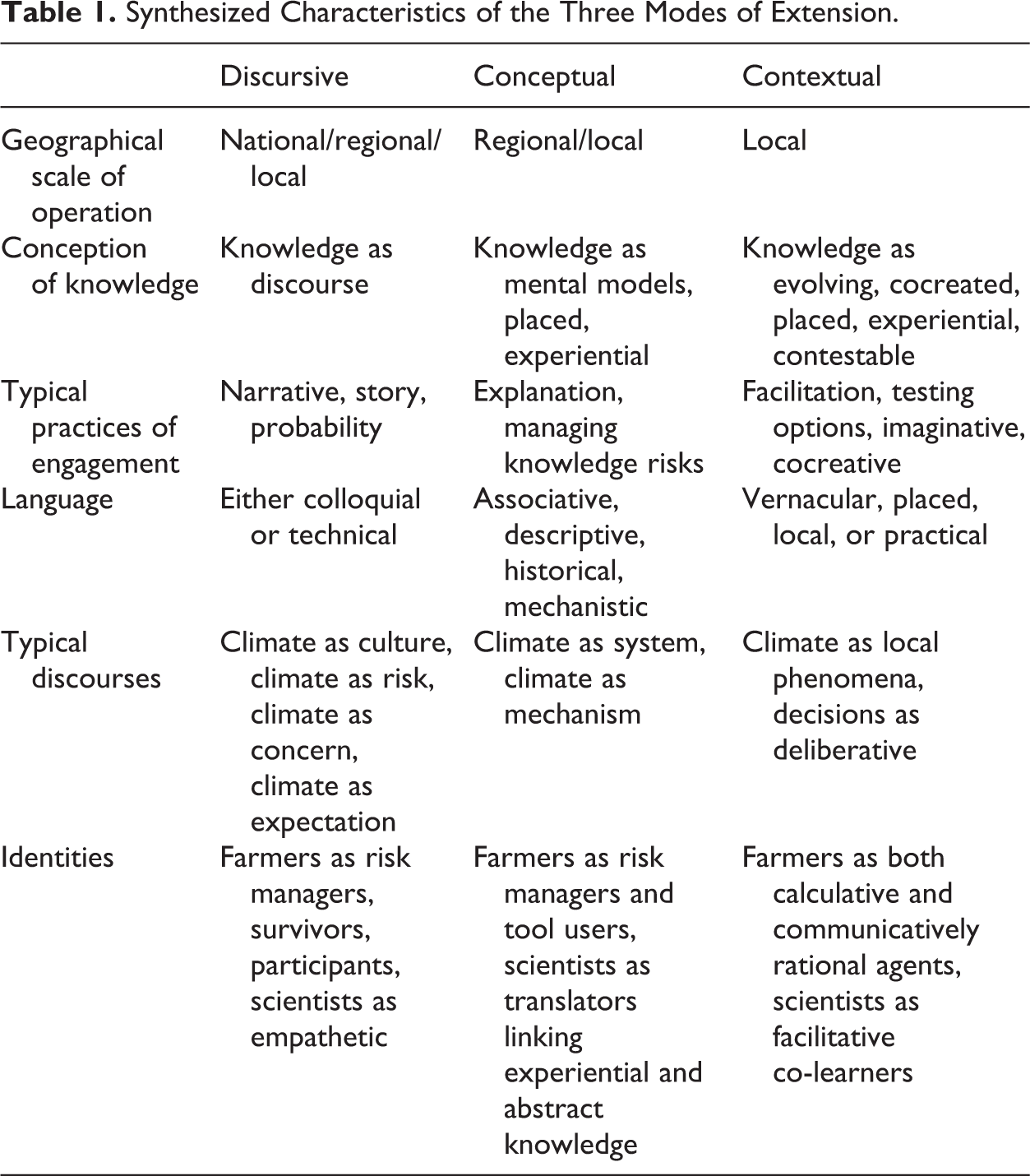
One useful way of thinking about the complex associations between the natural, technological, and social is summed up by the term, coproduction. Jasanoff (2004, 2-3) describes coproduction as “shorthand for the proposition that the ways in which we know and represent the world (both nature and society) are inseparable from the ways in which we choose to live in it…society cannot function without knowledge any more than knowledge can exist without appropriate social supports.” Coproduction as the interlinkage of social and natural orders embraces the sense that shared understandings can recreate discourses, norms, beliefs, institutions, and practices (Armitage et al. 2011).
Translating risk and uncertainty into usable knowledge was achieved by the practitioners in our research by building new associations between interests, identities, and phenomena. The production of such associations appears to have been mostly undertaken by individuals who pragmatically responded to context to encourage use of seasonal climate information, often based on their own tacit social and cultural constitutions of usable knowledge. Such translations relied on individual ability to translate arcane indicators of climate variability into a language that resonates with the everyday lifeworlds and vernacular of specific subcultures. Thereby these individuals are also brokering the ongoing development of certain forms of cultural constructions of risk, uncertainty, and climate. If scientists and science communicators are to consciously contribute to the production of culture and identity, there is a clear imperative for substantial individual and institutional reflexivity in order to guide their work.
We suggest that the imperative of reflexivity for coproduction might usefully be considered in terms of four interwoven topics that link the three modes of extension identified in the aforementioned analysis: (1) how boundary work is used to link science and values and thereby the production of public identities, (2) what personal and organizational processes of reflexivity can and should be used within and across research communities, (3) the importance of articulating knowledge in relation to the places with which people identify, and (4) the challenges of developing and maintaining the social and political capital implied by coproduction.
Boundary work is the means by which salience, credibility, and legitimacy are created, maintained, and challenged through language (Gieryn 1999). In extension services, for example, top-down communication often unreflexively reproduces economic, environmental, and social assumptions about how farmers should live or act (Leeuwis and Aarts 2011). Meanwhile, agricultural scientists and extension professionals tend to have close links with agricultural elites (Vanclay and Lawrence 1995). The “missing cohorts”—those who are not engaged with science and extension—often constitute life on the land very differently from these “top farmers” (Howden and Vanclay 2000; Mesiti and Vanclay 2006). This can mean that scientists and extension agents represent farmers in ways that are illegitimate, which in turn can estrange people and undermine the perceived credibility of scientists (Wynne 1992). For instance, agricultural scientists may constitute farmers as being proactive risk managers, autonomous and adaptive decision makers, or as unscientific laggards or luddites with their heads in the sand, or as any of a myriad of other ways of labeling them. The resonance of such constructions varies across communities, including scientific ones. For example, climate scientists tend to emphasize managing climate risk through the refinement of predictions and projections, while social scientists tend to lean toward building adaptive capacity in the context of a broader set of plausible global change scenarios (Dessai et al. 2009). Being able to analyze boundary work in such settings can provide fertile ground for more explicit discussion about intents, assumptions, and the context-appropriate framings of people and their concerns. Disciplinary allegiances and related, often tacit, advocacy for research or policy trajectories can be made more explicit, transparent and thereby legitimate through good processes that encourage open and critical reflection. Such reflexivity can happen at individual, group, project, and organizational levels. Key questions to reflect on include the following: how should social norms, values, and identities be challenged or reinforced? How can the homogenization of cultural norms and identities be avoided? We would suggest that such questions need to be addressed carefully through transdisciplinary work to orient research projects and programs in a democratic and informed manner (Leith, O’Toole et al. 2014).
The idea that collaborative knowledge making for agriculture is necessarily a placed activity creates challenges for scientists to tap into, curate, and translate local representations of identity and culture and to link these with their own technical knowledge. “Placing” technical knowledge will be a central challenge to organizations and governments with regional and national interests at heart. The production of scientific knowledge has always been underpinned by trust among scientific peers (Shapin 1994). The degree to which climate communicators can legitimately represent the climate of a locality may well be contingent on the peer community being extended into places: the amount of time scientists spend there, listening carefully to locally legitimate representations of the climate and culture of that place. If coproduction involves reimagining people and places through collaboration between scientists and lay people, it requires new forms of accountability between participants. Articulating people’s concerns in relation to scientific renderings of problems, as we have suggested here, can result in legitimate framing of problems and ways of dealing with them at wider spatial and discursive levels. However, this scaling up to discursive extension appears to depend on syntheses between multiple places where climate has been coproduced contextually and conceptually.
While the farming and climate research context examined here is specific and time bound, we suggest that the integration of conceptual, contextual, and discursive extension has a wider currency. The recent uptake of coproduction as a normative direction for engagement between scientists and the public presents challenges to develop approaches to coproduction that are adaptable to specific contexts. Such coproduction is inherently political because it represents values and identities alongside climate and ecology. The three modes of extension identified here could provide a framework to encourage engaged scientists and practitioners to reflect on their approach to coproduction, especially on what they are doing with language, why, how, and to what ends. Social scientists can play an important role here in building reflexive capacity, which in turn ensures that particular political, economic, and social identities are not unintentionally, unconsciously, or illegitimately produced. The interdependence across the modes may itself provide a means of informal democratization of scientific knowledge, through creating lines of accountability that work across scales and contexts. For example, the interaction between conceptual, contextual, and discursive modes provides a potential means of situating scientific knowledge in places and placed knowledge within scientific contexts. It also provides for the articulation of abstracted concepts with the politics and ethics of the storytelling associated with scientific renderings of problems and solutions, and thus identities.
Conclusion
We have demonstrated how certain Australian scientists and science communicators iteratively developed targeted ways of translating climate risk and uncertainty in order to make it mesh with colloquial language, cultures, places, and identities. Although underpinned by diverse forms of engagement and communication, we suggest that such translation can be typified as occurring within three “modes of extension”: discursive, conceptual, and contextual. While these modes of extension operate at different geographical and intellectual levels, they also build on one another in important ways. In the discursive mode of extension—which served for instance to make El Niño a meaningful boundary object, yet not synonymous with drought—credible, salient, and legitimate narratives about drought and identity were deployed. These narratives ensured that the gravity of farmers’ predicaments was not glossed over while their autonomy as decision makers and especially as risk managers was highlighted. Developing the capacity to ensure that these narratives cohere with the ways of knowing and being of the target audience required close engagement between researchers and farmers so that, at a minimum, the former had some understanding of knowledge systems, identities, and ways of communicating that are seen as being legitimate among the latter. The processes of conceptual, and especially contextual, extension appear to be the building blocks of such an understanding.
Linking cultural, placed identities with scientific notions of climate risk and uncertainty is not accidental. Rather, it appears to be a pragmatic choice made by some agro-climatologists in order to create scientific information that is usable. Yet, such work is not straightforward or unproblematic and requires closer attention than it currently receives (Elliot 2012).
We have argued that careful consideration of four overlapping topics can improve the practices of engagement and communication of climate among scientists and science communicators, namely, (1) how boundary work is used to link science and values and thereby the production of public identities; (2) what personal and organizational processes of reflexivity can and should be applied; (3) the importance of articulating knowledge in relation to the places with which people identify; and (4) the challenges of developing and maintaining the social and political capital implied by coproduction.
Scientists and scientific organizations may respond to such suggestions by denying that they do or should have any role in constructing social identities and places. Many will shy away from making any utterances that are vaguely human or social, for fear of being seen as advocates. Yet evidence is mounting that such unreflexive rejection of these modes of communication will poorly serve them and the publics they are meant to assist. Many will persist with their scientific efforts to better understand and reconstruct the landscape or the climate, but will often do so in an alien, technocratic language that does not reverberate with social meaning. They may then feel safely removed from the politics of knowledge production and use, even as they advocate for ongoing resources to transform their uncertainty into someone else’s risk. Yet, for such knowledge to gain substantial traction, it would do well to engage with languages which animate public knowledge, informed decision making, and action.
Footnotes
Declaration of Conflicting Interests
The author(s) declared no potential conflicts of interest with respect to the research, authorship, and/or publication of this article.
Funding
The author(s) received no financial support for the research, authorship, and/or publication of this article.