




Abstract
Scientific authorship has become a contested terrain in contemporary science. Based on a survey of authors across fields, we measure the likelihood of specialist authors (sometimes called “guest” authors): people who only made specialized contributions, such as data, materials, or funding; and “nonauthor collaborators” (sometimes referred to as “ghost” authors): those who did significant work on the project but do not appear as authors, across different research contexts, including field, size of the project team, commercial orientation, impact of publication, and organization of the collaboration. We find that guest and ghost authors are common, with about one-third of publications having at least one specialist author and over half having at least one nonauthor collaborator. We see significant cross-field variations in both overall rates and types of specialist authors and nonauthor collaborators. We find there are generally fewer specialist authors among highly cited papers and more graduate student nonauthor collaborators in single location projects. The results suggest authorship practices vary across fields, and by project characteristics, complicating the use of authorship lists as a basis for evaluation (especially when comparing across fields or types of projects). We discuss implications of these findings for interpreting author lists in the context of science policy.
Assessment of the quality, quantity, and style of role-performance is required for social systems to operate with some degree of effectiveness.
Introduction
Authorship is a key currency in the credit system of science and is the basis for the recognition–reward structure of incentives in science (Dasgupta and David 1994; Merton 1973). This credit is translated into positions, salary, promotions, and research funding. Scientific teams have grown across all fields, and remote (multisite) collaborations are also becoming more common (Milojević 2014; Wuchty, Jones, and Uzzi 2007).
This increase in collaboration size creates problems for assigning credit in these collaborative projects (Biagioli 2003; Birnholtz 2006; Zuckerman 1968). In addition, larger teams are associated with increasing division of labor, specialization and hierarchy as well, making it more difficult to clearly identify who should be given credit as “authors” of the paper (Haeussler and Sauermann 2016; Shibayama, Baba, and Walsh 2015; Shrum, Genuth, and Chompalov 2007; Walsh and Lee 2015). The problem is especially critical in the current era of high-stakes evaluation (Hicks and Katz 2011). Melin (2000) argues that the need to access specialized equipment or materials is often the basis for collaboration, but that this intellectual cooperation may not always lead to coauthorship. Laudel (2002) argues that collaborations can be driven by a variety of factors, and finds that what she calls “division of labor” collaborations generally result in coauthorships, while providing services or equipment access rarely does. She finds that about half of collaborators are not included as coauthors.
Changes in the structure of scientific collaboration create a need to analyze the process of assigning credit as author to collaborative scientific work. There has been substantial discussion about the problems of “guest” and “ghost” authors (Birnholtz 2006; Cronin 2001; Drenth 1998; Flanagin, Carey, and Fontanarosa 1998; Haeussler and Sauermann 2013; Laudel 2002; Mowatt et al. 2002; Rennie, Yank, and Emanuel 1997; Sismondo 2009; Wager 2009). In this literature, “guest authorship” means authorship awarded to individuals who made minimal (or no) contribution to the research. While guest is the term usually used in the literature, one might also refer to such people as “specialist authors,” especially in the case where their contribution to the project consists of fulfilling a specialized role such as providing samples, test equipment, computer programming, data, and so on (Larivière et al. 2016). On the other hand, “ghost authorship” occurs when individuals who made substantive or important contributions to a publication are not included as authors (Heffner 1979). Again, while the literature generally refers to these by the term ghost, we might more correctly describe them as “nonauthor collaborators.” The presence of guest and ghost authors may lead to an uncoupling of authorship lists from the efforts that generated the research results (Biagioli 2003; Cronin 2001; Wager 2009). While authorship is nominally based on assessing substantive contributions in these collaborative projects, authorship may also reflect social factors such as eminence or hierarchical position (Birnholtz 2006; Drenth 1998; Flanagin, Carey, and Fontanarosa 1998; Haeussler and Sauermann 2013; Laudel 2002; Mowatt et al. 2002; Rennie, Yank, and Emanuel 1997; Sismondo 2009; Zuckerman 1968). Authorship can also reflect field-level norms about the extent to which coauthorship (and authorship position) represents sharing of credit (Laband 2002).
While much of this debate concerns normative judgments about who “should” be an author (Biagioli 2003; Flanagin, Carey, and Fontanarosa 1998), we argue that this discussion may be better framed by recognizing the increasing specialization of scientific work (Jones 2009; Walsh and Lee 2015) and the greater likelihood that members of a team may have made a focused, specialized contribution to the overall project (Haeussler and Sauermann 2016; Larivière et al. 2016). This creates a tension regarding which contributions are likely to translate into authorship. While contemporary policy debates about authorship rules tend to focus on an older image of an integrated scientist collaborating with peers (Hagstrom 1964), increasingly, we are observing groups of specialists participating in a complex division of labor, facing a need to match author lists to a complex constellation of these contributions. For example, Hackett (1990) argues that, increasingly, scientific teams involve both division of labor and hierarchy, making it increasingly difficult to discern what levels and types of contributions should merit authorship. Stokes and Hartley (1989, 105) argue that “The contributions of the coauthors of a paper range from the substantial to the negligible––a scientist may be listed as a coauthor simply for providing matériel or performing a routine assay. Coauthors will often include postdoctoral fellows, postgraduate students, technicians, and the like, who have worked under direction from a senior scientist.” This quote suggests such contributions may not be worthy of authorship, while also noting authorship was granted. Thus, we interpret so-called guest and ghost authorships as representing variations in a threshold across which particular contributions may or may not be included into the authorship club. Therefore, we consider the terms guest and ghost as descriptive rather than normative. Rather than view these types of (non)authors as a form of deviance, we argue this is evidence of changing norms that reflect a change in the organization of science.
Hence, we will explore authorship practices across disciplines and show the significant variation in authorship norms. The goal is to develop an understanding of some of the drivers of authorship lists (and how those vary systematically by field and by project characteristics net of field) in order to address concerns in the sociology of science and in science policy about the meaning of authorship lists for evaluation and careers in science.
We begin with a discussion of authorship norms in science. Next, we develop hypotheses regarding how the likelihood of specialist authors and nonauthor collaborators are affected by research contexts. To test these effects, we use a large-scale survey of scientific projects that collected data on authorship practices and project organization. We show field-level differences in rates of specialist authors and nonauthor collaborators and how project characteristics affect these. We conclude with discussion of the implications of these findings.
Authorship Norms in Science
While authorship is widely seen as a marker of credit and responsibility (Biagioli 2003; Zuckerman 1968), the criteria for qualifying as an author have become a contested domain. While such debates have a long history in science (e.g., the case of Rosalind Franklin and the discovery of the structure of DNA), the recent growth of teams in science has led to calls for clarifying the meaning of and criteria for authorship (Cronin 2001; Wager 2009). For example, the current International Committee of Medical Journal Editors (ICMJE) criteria for authorship are: substantial contributions to the conception or design of the work or the acquisition, analysis, or interpretation of data for the work, drafting the work or revising it critically for important intellectual content, final approval of the version to be published, and agreement to be accountable for all aspects of the work in ensuring that questions related to the accuracy or integrity of any part of the work are appropriately investigated and resolved.
In addition to being accountable for the parts of the work he or she has done, an author should be able to identify which coauthors are responsible for specific other parts of the work.
Furthermore, the guidelines specifically excluded authorship based solely on acquisition of funding or general supervision of research group (i.e., being lab head). In the 1980s, Stokes and Hartley (1989) argued that authorship based on being the lab head was common practice. We are left with the empirical question as to whether these older observations or recent ICMJE guidelines more closely match current practices. Sismondo (2009) argues that such guidelines may not match well with the division of labor in team science, especially in commercial medical research, and it is possible that no team member would qualify for authorship (i.e., there would be no author) under these guidelines. These guidelines were originally developed in the 1980s and have been adopted by over 600 biomedical journals (Wislar et al. 2011). However, even these formal standards are not universally accepted by the biomedical research community. Wager (2009) reviews a variety of studies showing significant disagreement about the appropriateness of the ICMJE guidelines, even among journal editors, and substantial variety in the criteria considered legitimate for authorship. Thus, authorship disagreements may not be disagreement about each person’s contribution to the project but rather about which contributions meet the criteria for authorship. Shapin’s (1989) discussion of Boyle and his assistant Papin illustrates the point. Even though Boyle (unusually) credits Papin with building the instrument, running the experiments, recording and interpreting the results, and writing the paper, Papin was not an author. According to Boyle (consistent with the standards of the time, and, perhaps, even into the present day), Papin’s tasks were technical contributions under Boyle’s direction and therefore did not merit authorship. Hence, given differing standards about what contributions merit authorship, it is not surprising that authorship problems are common.
While such objective criteria are the desiderata of science policy, in practice, assigning authorship can be complicated and controversial. Authorship assignment is a subjective decision made within research teams, based on customary rules and individual negotiations, and the results also reflect bargaining power and incentives within the research group (Lissoni, Montobbio, and Zirulia 2013). For example, in contrast to biomedical journals, some large experimental physics projects grant authorship on all papers to all those who worked on the experiment, after putting in at least one year of effort on the project (with authorship continuing for one year after they leave the project; Biagioli 2003). Such differences across fields and projects suggest that there are no universal definitions of authorship, with the formal and informal rules distinct across disciplines and even institutions.
There are implications for perceived reputability and quality when determining authorship attribution. Lee, Walsh, and Wang (2015) find papers with more authors have higher impact, net of the novelty of the paper, suggesting that having more authors may directly affect visibility of the paper, net of quality. Haeussler and Sauermann (2013) argue that adding highly respected scientists to a paper can increase perceived legitimacy, and therefore publication prospects, of the findings. An extreme case is academic faculty who are paid by pharmaceutical or biotech companies to add their name to the author list to increase the legitimacy of the publication (Sismondo 2009). Furthermore, Shibayama, Walsh, and Baba (2012) note that the growing commercial orientation of academic science is associated with greater demands for authorships as payment for specialist contributions such as data and materials.
The presence of nonauthor collaborators (ghosts) has received less attention, although there are also concerns here. Zuckerman (1968) notes that junior and less eminent scientists are likely to give less credit to collaborators (e.g., graduate students or technicians) on authorship lists, suggesting that these projects would have more nonauthor collaborators. Heffner (1979) finds that women are disproportionately likely to be nonauthor collaborators, that those in low-status roles (graduate students, research assistants, and technicians) are frequently excluded from authorship lists, and that likelihood of becoming a nonauthor collaborator varies by field. Similarly, work on the role of technicians in science suggests that, while they make important contributions to scientific findings, technicians may fall into the category of invisible labor. For example, Shapin (1989) details the roles of nonauthor collaborators even in Boyle’s seventeenth-century lab. Barley and Bechky (1994) argue that technicians possess most of a lab’s contextual knowledge and skill and play a critical role in the production of scientific knowledge, but, because contextual knowledge is lower status than formal knowledge, technicians may experience status inconsistencies. Hong (2008) argues that technical capital tends to be undervalued in the lab compared to theoretical capital and is less likely to be translated into inclusion on the authorship list (see also Lariviere et al. 2016). Latour and Woolgar (1979) argue that technicians fulfill subordinate, technical roles, and hence are generally not included on author lists but occasionally can rise to the status of coauthor, if they possess especially valuable skills or combine technical and theoretical capital. Shinn (1982) notes that the relative status of technicians varies by field (in part related to the relative routinization of the fields), which suggests that inclusion in authorship lists might also vary by field. Laband (2002) argues that fields vary in the extent to which authorship lists are tightly linked to contributions and that in fields where this is the case, there are fewer nonauthor collaborators. Finally, Sismondo (2009) documents that in commercial medical research, in addition to medical writers, company statisticians, and other company researchers, there are “publication planners,” who manage the labor of other authors and nonauthor collaborators to facilitate the strategic flow of publications from a drug-development project. All of these project team members are likely to be excluded from the authorship list (i.e., to be nonauthor collaborators). Thus, one contribution of our research is documenting which fields are likely to exclude technicians, students, or research scientists from authorship lists.
While there has been widespread discussion of the existence of guest and ghost authors, there is limited data estimating the rates of various kinds of guests and ghosts, especially outside of biosciences. Flanagin, Carey, and Fontanarosa (1998) find 19 percent of biomedical papers had guest authors and 11 percent had ghost authors. Among Cochrane Library reviews, 39 percent included guest authorship, while 9 percent had a ghost author (Mowatt et al. 2002). Wislar et al. (2011) find 21 percent of general medical articles had a guest author and nearly 8 percent may have had a ghost author. Note that much of the prior literature focuses on guest and ghost authors (and uses these terms). But, as the discussion above shows, there is lack of agreement about what is included in these terms (e.g., some refer to ghost writers, some to honorary authors who made no contribution, some refer to those in the acknowledgments). So, for this article, we will focus on specialist authors and nonauthor collaborators (defined below) instead of the more widely used but vague (and perhaps more morally loaded) terms guest and ghost.
Predictors of Specialist Authors and Nonauthor Collaborators
Prior work on inclusion in authorship lists has focused on individual characteristics, such as gender, seniority, and rank (cf. Haeussler and Sauermann 2013; Larivière et al. 2016; Lissoni, Montobbio, and Zirulia 2013). An additional line of research has focused on the economics of authorship, such as monitoring costs and signaling (Laband 2002; Mixon and Sawyer 2005; Nagaoka and Owan 2014). In this article, we develop this line of research by focusing on project characteristics as key drivers of specialist authors and nonauthor collaborators. We also examine different types of specialist authors and nonauthor collaborators as well as comparing across a broad sample of fields. We examine the effects of the visibility/impact of the project, its commercial orientation, and whether it is a local or remote collaboration on rates of specialist authors and nonauthor collaborators. In our analysis, we make no judgments about whether particular contributions are “appropriately” credited. Rather, we examine how likely particular types of contributions are to be included or excluded. We characterize particular project characteristics as leading to stingier author lists, meaning fewer specialist authors and more nonauthor collaborators.
Scientific Impact
As authorship is a key mechanism for translating the contribution to science into rewards to the scientist, willingness to share authorship should be related to the scientific contribution embedded in the article. The impact of scientific papers is highly skewed, with a few papers having major impact (generally operationalized by many citations), while most papers make little or no impact (Cole and Cole 1972). Many of the rewards in science accrue to the authors of these very high-impact papers (the Nobel Prize being the canonical example; Dasgupta and David 1994; Merton 1973). To the extent that a paper is perceived as important, scientists may be less willing to dilute the credit and hence may be stingier about author lists. For example, no more than three people can share a Nobel Prize. In contrast, for a low-impact paper, the cost of adding additional authors may be very low. If the primary (senior or lead) author expects that the article will be a high-impact publication, we would expect her or him to be stingier with the author list. Hence, the authorship list on high-impact papers are likely to include fewer people who only performed menial tasks, meaning more nonauthor collaborators, and fewer people who made only minor contributions (such as providing data or materials), meaning fewer specialist authors. Indeed, Mixon and Sawyer (2005) find that highly ranked economics journals have more nonauthor collaborators. However, articles with high scientific impact may require more resources, which would increase authorship lists. Because of this, we estimate specialist authors and nonauthor collaborators net of size (author count).
Of course, given uncertainty about the likely impact of a paper at the time the author list is finalized, there is likely measurement error that may attenuate the predicted effects. Hence, we will be providing a conservative test of this relationship.
Commercial Application
Following similar logic, we expect commercially oriented projects to be stingier about authorship, resulting in fewer specialist authors and more nonauthor collaborators. Prior work comparing patent-paper pairs finds patents are stingier with inventor lists than the corresponding papers are with author lists (Ducor 2000; Haeussler and Sauermann 2013; Lissoni, Montobbio, and Zirulia 2013). By extension, journal papers from projects that are also likely to generate patents should be stingier than papers from projects that will not generate patents. Knowing the possibility that any earnings will have to be shared among named creators will motivate authors to reduce the size of the author list.
Note that greater commercial activity is also associated with more demands for authorships as payments for data and materials (Shibayama, Walsh, and Baba 2012), so we might, in contrast to the above arguments, find more specialist authors in commercially oriented projects.
Again, there is likely to be some uncertainty about the expected commercial value of the published results, and, indeed, it is likely that even patented findings will have a low median value (Scherer and Harhoff 2000). In addition, academic researchers patent for a variety of reasons beyond the commercial payoffs (Walsh and Huang 2014). Hence, we might expect only weak effects from the commercial orientation of the project, again suggesting that this will be a conservative test.
Multi-institutional
A major component of the era of “Big Science” is sharing resources among multiple institutions, which has implications for authorship norms. Melin (2000) notes that informal interaction among colleagues in the same organization might not lead to coauthorships. This might be due to a system of localized reciprocal exchange where the repeated information sharing suffices to discharge the obligation (Blau 1955). Walsh and Maloney (2007) and Cummings and Kiesler (2005) highlight the difficulties remote collaborations face related to coordination and also related to differing norms and expectations. Such differences in local norms are likely to include differences in authorship norms, which may also affect rates of specialist authors and nonauthor collaborators (Laudel 2002). This might imply that in multi-institutional collaborations, it is harder to exclude others’ nominees for authorship. Shrum, Chompalov, and Genuth (2001) note that remote collaborations are especially subject to conflicts over claims for credit. Such disputes might be settled by “buying off” the disputants with offers of authorship, leading to more generous author lists. Nagaoka and Owan (2014) argue distance makes monitoring more difficult and less effective for the principal investigator and hence results in greater reliance on alphabetical authorship. Following this logic, we expect to see that single-site collaborations have fewer specialist authors and more nonauthor collaborators, because it is easier to monitor all those associated with the project, and thus determine who deserves to be assigned authorship. Finally, it is likely that remote collaborations might involve those with specialized skills or materials that can demand authorship as a form of payment, which would lead to more specialist authors (Shibayama, Walsh, and Baba 2012). Each of these arguments suggests that local collaborations would have fewer specialist authors and more nonauthor collaborators.
These arguments about remote collaboration are all premised on the assumption that the default is to limit authorship lists in order to avoid dilution of credit. To the extent this assumption is not valid, we may not see strong effects.
Data and Method
We use a survey of scientists in the United States to test these hypotheses. The survey provides information from a large sample of projects spanning fields and institution types. Such survey-based measures of the collaboration allow us to better capture both specialist authors and nonauthor collaborators compared to bibliometric methods. The survey began with a sample of 9,428 Web of Science (WoS) publications, covering publication years 2001-2006, stratified by twenty-two WoS journal fields and by forward citations, with an oversampling of the papers in the top 1 percent of citations in each field in each year (citation counts retrieved on December 31, 2006). About 3,000 of the sampled papers were in the top-cited papers and about 6,000 were from other random papers.
Cases were excluded when no valid contact was available (e.g., the author was deceased or had moved out of the country). Furthermore, to reduce respondent burden, for those scientists who appeared more than once in our sample, we randomly sampled one paper, giving priority to the top-cited papers. This process led to a total of 8,864 papers. The survey was conducted from September 2010 to January 2011. We received at least partial responses from 3,742 scientists (42 percent), with 2,327 completed responses (26 percent response rate). 1 For this analysis, we limit responses to those in universities and hospitals (N = 1,643). We categorize papers into ten fields based on WoS journal field classifications: agricultural science, biology, computer science/mathematics, chemistry, engineering, environmental/geoscience, material science, medicine, physics/space science, and social science (with “multidisciplinary” journal papers assigned to one of the ten according to the main field of the references in the paper). We use survey weights to control for the differential sampling and response rates between top and other papers and across fields. The survey weights used are based on the overall population of publications, so that weighted means account for the underlying population distributions on field and top versus other papers (Kalton 1983). All statistics are estimated taking into account the sampling structure and weights (Lee, Forthofer, and Lorimor 1989).
Dependent Variables
Specialist authors
To measure specialist authorship, we used a survey question similar to Flanagin, Carey, and Fontanarosa (1998). Our survey asked “Please indicate whether any of the following types of researchers are included among the authors: (a) Any researcher who only supplied research materials analyzed in the research, (b) Any researcher who only supplied data analyzed in the research, (c) Any researcher who only supplied or developed the research facilities or equipment used in the research, (d) Any researcher who only supplied or developed computer programs or databases used in the research, and (e) Any researcher who only supplied funds used in the research.” 2 Hence, our measure focuses on authorships related to a specialist role in the collaboration (not including those specializing in writing up others’ research results or those whose only contribution is lending their name to a paper written by somebody else). For specialist authorship, we have five separate measures, based on the question above, and a summary measure “AnySpecialist” (if at least one specialist author was present in the publication). Note that, according to the ICMJE guidelines, none of these should qualify as authors, although by other criteria, such people might reasonably be included as authors.
Nonauthor collaborators
Nonauthor collaborators were measured by asking “Please indicate the number of PhD-level researchers, students (graduate and undergraduate), and technicians who played a significant role in the implementation of the project but are not coauthors of the focal paper.” 3 Respondents were asked to enter a count for each type of member or respond, “don’t know.” Nonauthor collaborators are separated into these four types (scored as 1 if there was at least one project member of that type) and an aggregate “AnyNonAuthorCollab” measure (if at least one nonauthor collaborator was present in the project). 4 Note that this measure may be broader than the measures used in many prior studies, which limit nonauthor collaborators to either those who appeared in the acknowledgments (Laband 2002) or those who the lead author felt “had made a contribution that merited authorship or who had assisted in drafting the review but was not listed as an author or mentioned in the acknowledgment section of the review” (Mowatt et al. 2002, 2770).
Independent Variables
Our key independent variables are impact, commercial orientation, and local collaboration. We operationalize papers representing “high” impact as those being in the top 1 percent most cited papers in that WoS field in that year, based on citation counts as of December 31, 2006 (“top”). To measure commercial orientation, we asked the respondents if the findings from the research project led to a patent application (“patent”). To determine how multi-institutional collaborations affect authorship practices, we used the number of institutions affiliated with the author byline, from the WoS. Those with a single institution listed are coded as “one institution” = 1.
Control variables
We also controlled for additional variables that are likely to affect rates of specialist authors and nonauthor collaborators. The size of the project team is measured by the natural log of the total number of authors on the publication, collected from the WoS (“lnAuth”). The minimum in our sample is 1 author and the maximum is over 150 authors (prior to transformation). The overall levels of specialist authors and nonauthor collaborators are expected to vary by scientific fields. Similarly, the probability of having technicians, postdoctoral researchers, and so on, in the research group as well as the probability of needing data, materials, or specialized equipment from outside the researcher’s own lab also likely vary by field (Fuchs 1992; Shinn 1982). We control for this by using scientific field dummy variables as control variables (ten fields, with chemistry as the excluded category). We also control for publication year to correct for any temporal trend in rates of specialist authors or nonauthor collaborators.
Results
In the following sections, we report the descriptive statistics, the differences in specialist authors and nonauthor collaborators by field, and logistic regression models reporting the effects of impact, commercial activity, and local collaboration on rates of specialist authors and nonauthor collaborators.
Descriptive Statistics
Tables 1 and 2 summarize the measures and correlations. Single-institution publications are 54 percent of the sample and mean team size (log number of authors) is 1.22 (i.e., about 3.5 authors). Eight percent of projects resulted in a patent application. About one-third have at least one specialist author (similar to findings from prior studies). Also, about half (54 percent) have at least one nonauthor collaborator (which is higher than found in prior work in biomedical research, although our measure may also be broader than in prior studies). The rates for each type of specialist author range from 13 percent to 30 percent, while for each type of nonauthor collaborator, the range is from 6 percent to 19 percent.
Descriptive Statistics.
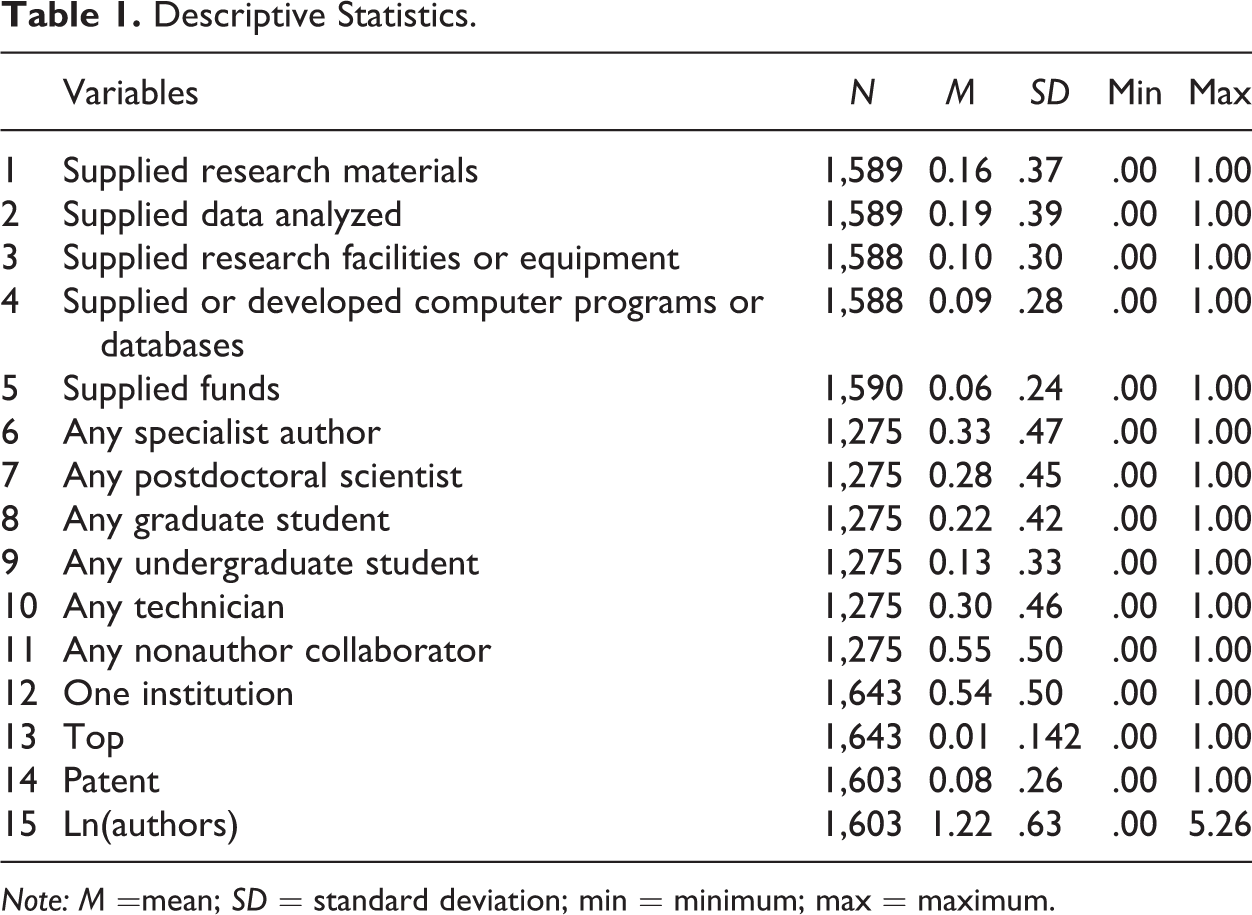
Note: M =mean; SD = standard deviation; min = minimum; max = maximum.
Correlation Matrix.
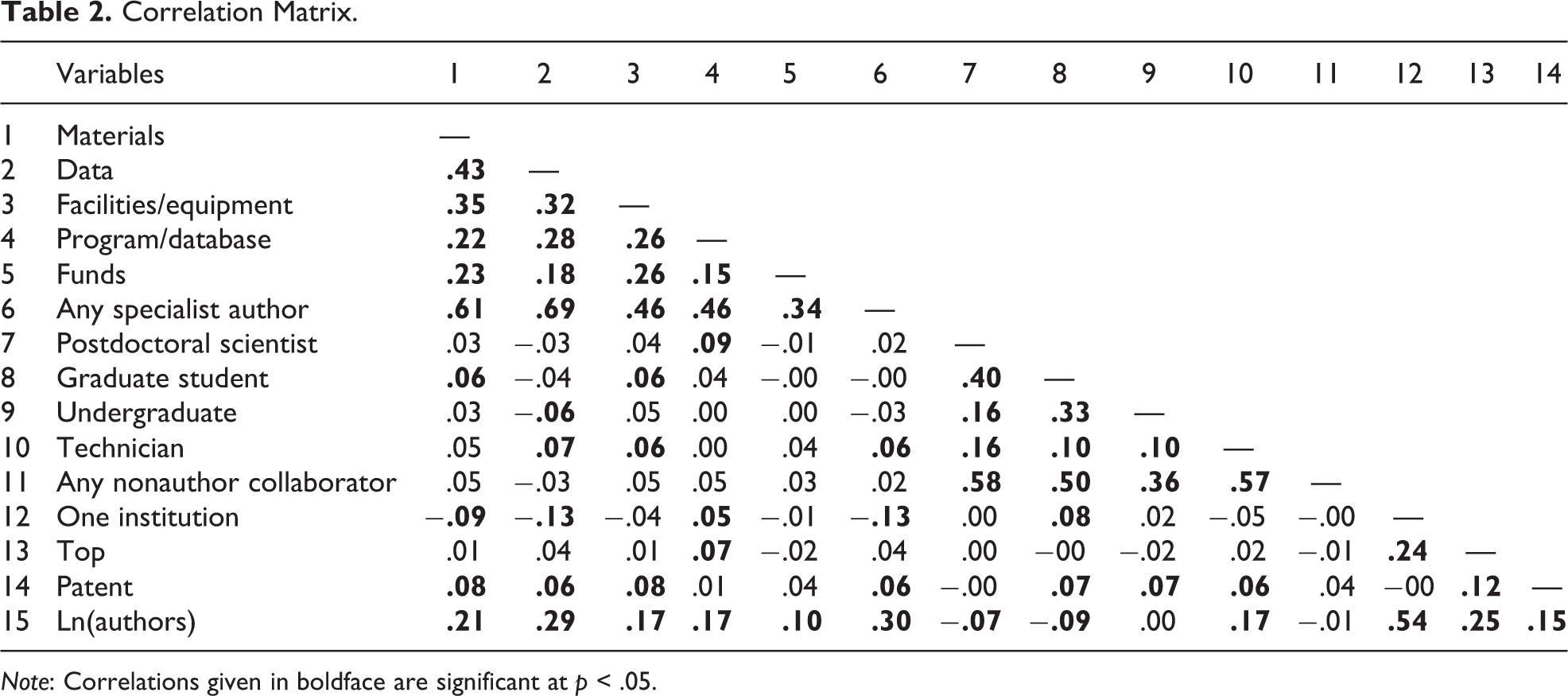
Note: Correlations given in boldface are significant at p < .05.
Field Differences in Specialist Authors and Nonauthor Collaborators
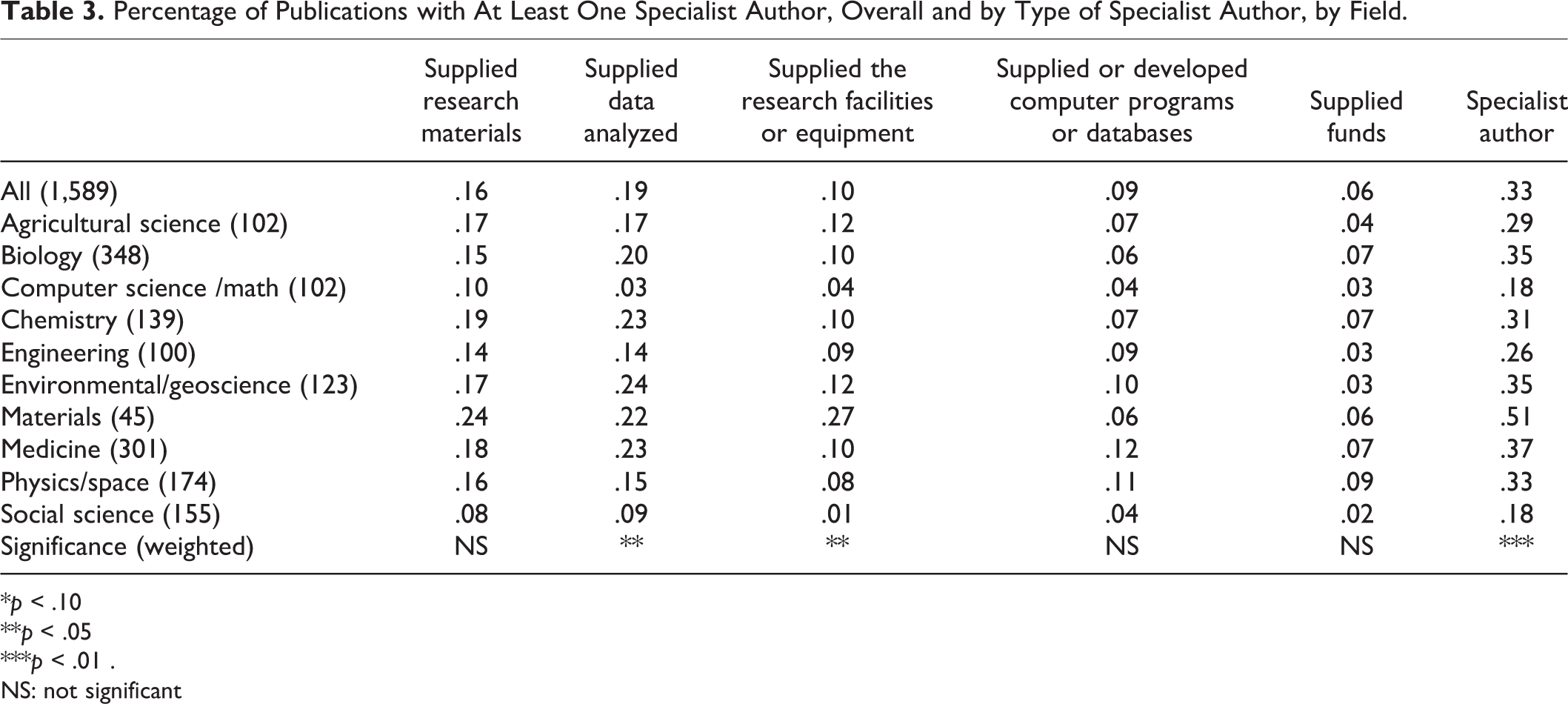
Table 3 shows the percentage of publications with at least one specialist author (those who only supplied research materials, data, facilities/equipment, computer programs/databases, or funding), overall and by type of specialist, by field. We find significant field differences in the aggregate measure, and for supplying data and supplying facilities/equipment, as a basis for authorship. However, which kind of specialist tasks lead to authorship differs across fields. For example, environmental/geoscience (24 percent), chemistry (23 percent), and medicine (23 percent) have high rates of authors who only supply data. On the other hand, materials science (27 percent) has a high percentage of publications with authors who only supply research facilities or equipment. For AnySpecialist, materials science (51 percent) and medicine (37 percent) have high rates of specialist authors, while computer science/math (18 percent) and social science (18 percent) have low rates. Note that some of these differences may be due to differences in the underlying production process, which might affect the need for, and distribution of, particular resources (Fuchs 1992; Shinn 1982).
Percentage of Publications with At Least One Specialist Author, Overall and by Type of Specialist Author, by Field.
*p < .10
**p < .05
***p < .01 .
NS: not significant
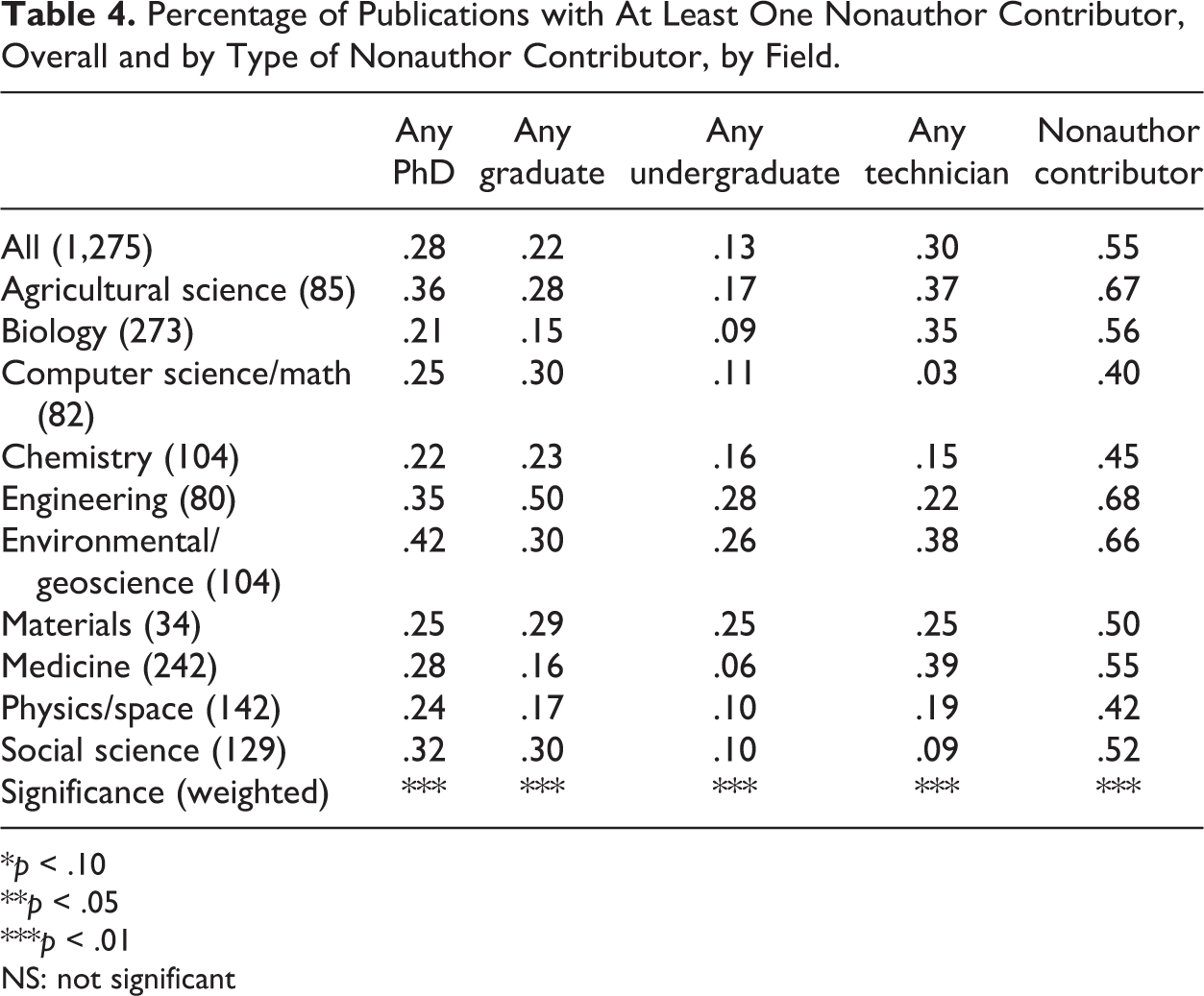
Similarly, Table 4 shows the percentage of publications with at least one nonauthor collaborator (postdoctoral researchers/scientists, graduate students, undergraduate students, or technicians, who worked on the project team but did not appear on the author list), overall and by type of nonauthor collaborator, by field. For nonauthor collaborators, significant field differences exist in the aggregate measure and for each type of nonauthor collaborator. While environmental/geoscience (42 percent) has a high share for PhD-level nonauthor collaborators, biology (21 percent) and chemistry (22 percent) have low shares. The field with the highest rate of nonauthor graduate student collaborators is engineering (50 percent), while the rates of nonauthor graduate student collaborators are lowest in biology (15 percent) and medicine (16 percent). Undergraduates have a similar pattern. Nonauthor technicians are more common in the fields of medicine (39 percent) and environmental/geoscience (38 percent). The aggregate measure of AnyNonAuthorCollab has low shares in computer science/math (40 percent) and physics/space (42 percent), while high shares occur in engineering (68 percent) and agricultural sciences (67 percent). These numbers are generally higher than those found in prior work (cf. Flanagin, Carey, and Fontanarosa 1998; Mowatt et al. 2002). However, these prior studies defined ghost authorship very narrowly, by asking survey respondents, if there was anybody who should be an author but was not. However, our survey was agnostic on whether these people should or should not be an author. Rather, we asked if there was anybody who made a significant contribution to the research but was not listed as an author. We argue that in a world with large project size and a significant division of labor, there may be multiple people who contributed to a project but did not get included on the author list. Our findings suggest that this is not rare, and, furthermore, that it is much more common in some fields (such as engineering or agricultural sciences) than in others (such as physics). We argue that this is likely to be a combination of differences in work practices (how likely such roles are to exist in projects) and in field-based norms (with the contrast between biomedical research and experimental high energy physics described above as an example).
Percentage of Publications with At Least One Nonauthor Contributor, Overall and by Type of Nonauthor Contributor, by Field.
*p < .10
**p < .05
***p < .01
NS: not significant
One implication of these findings is that no scientific field is consistently stingy or generous with how they allot authorship privileges. Moreover, there are differences in generosity and what each field is willing to give authorship for.
Predictors of Specialist Authors and Nonauthor Collaborators
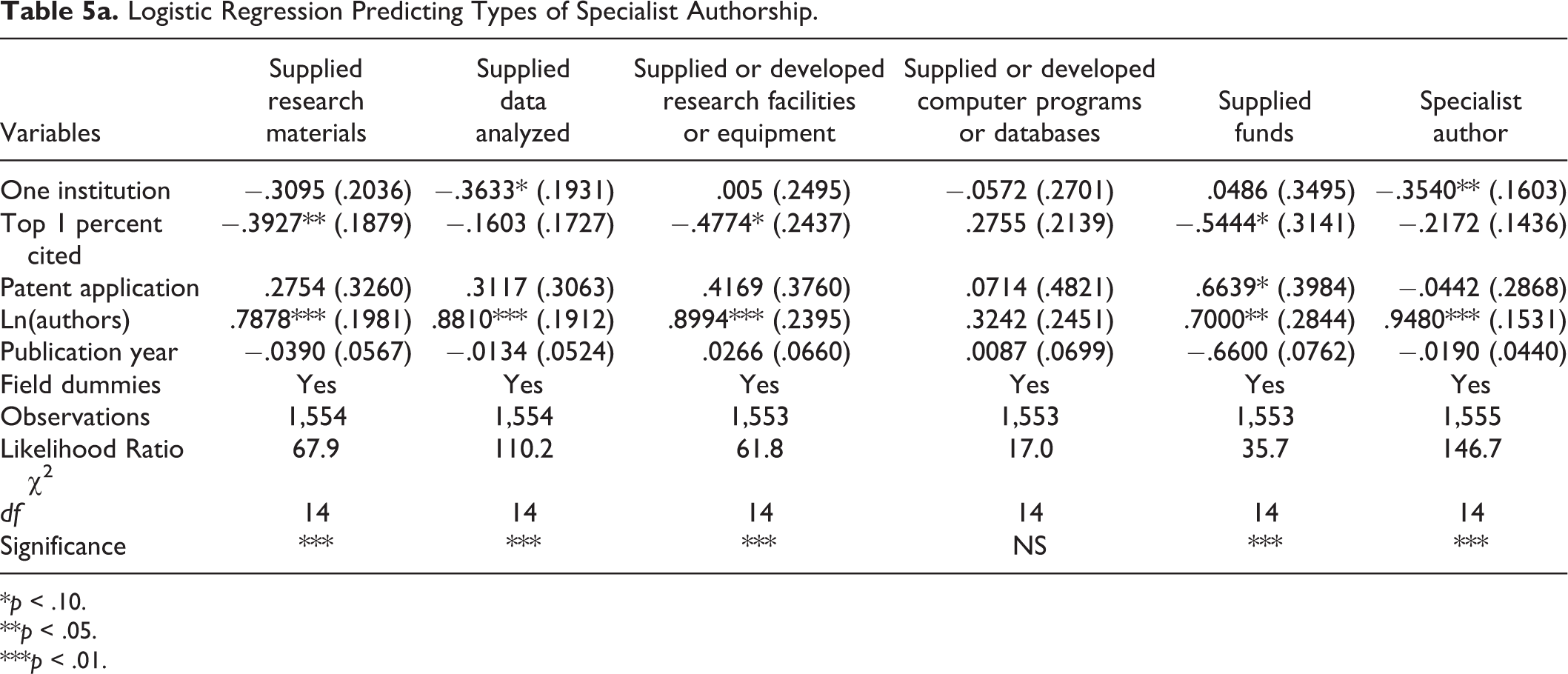
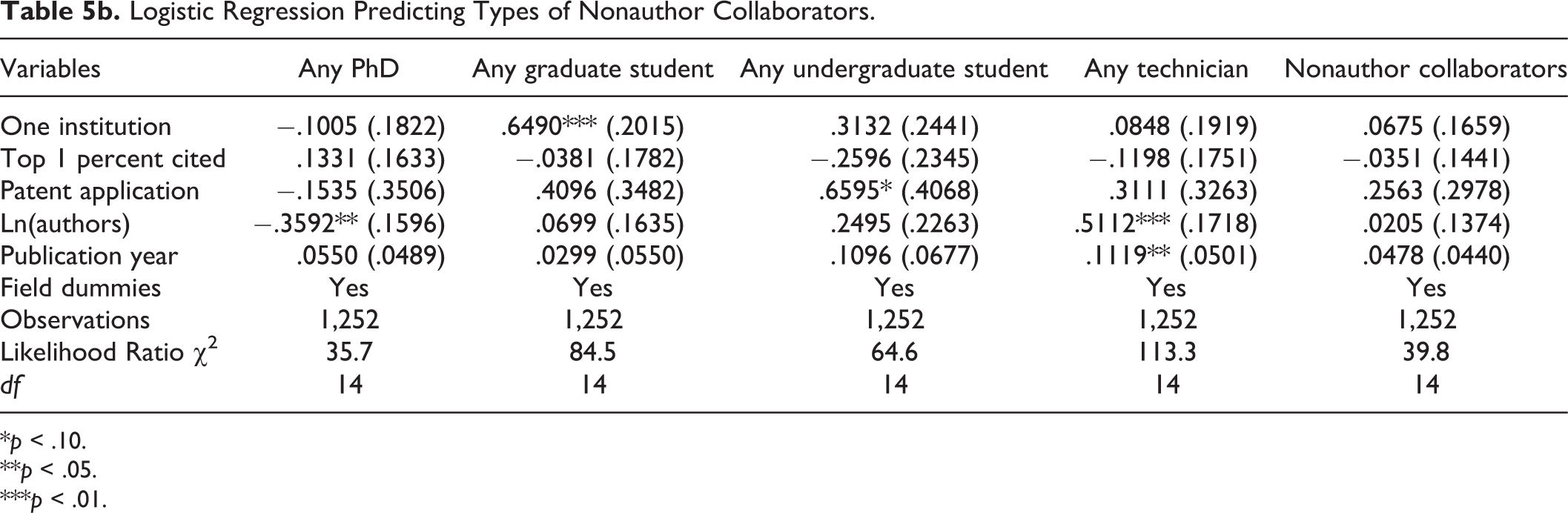
To further explore the bases for authorship, we examine project characteristics that may affect rates of specialist authors and nonauthor collaborators (and that might account for some of the field differences noted above). Based on our hypotheses, Tables 5a and 5b show the logistic regressions predicting specialist authors and nonauthor collaborators authorship. We predict that highly cited papers (Hypothesis 1), commercially orientated projects (Hypothesis 2), and those at a single institution (Hypothesis 3) should each be associated with fewer specialist authors and more nonauthor collaborators (stingier). We control for author count and field in these models to correct for the overall probability of any kinds of authors and to control for field-level differences in the demand for different kinds of resources and project member composition.
Logistic Regression Predicting Types of Specialist Authorship.
*p < .10.
**p < .05.
***p < .01.
Logistic Regression Predicting Types of Nonauthor Collaborators.
*p < .10.
**p < .05.
***p < .01.
We find specialist authors are generally less prevalent in top papers, with computer programming specialist authors as an exception and with materials, equipment, and funds all statistically significant (Table 5a). This finding gives us more confidence in the causal direction of our argument, since if top 1 percent was endogenous to specialist authors, we would expect the effect to be positive, as prior work argues that guest authors are added to increase the visibility of the paper (Haeussler and Sauermann 2013). Nonauthor collaborators are largely unrelated to impact (Table 5b). Thus, we have partial support for Hypothesis 1 (generally stingier on specialist authors but not on nonauthor collaborators).
For commercial orientation (Hypothesis 2), in Table 5b, we find that nonauthor collaborators are generally more common, although only undergraduates are statistically significant (i.e., for commercially oriented projects, students are especially likely to be left off author lists). For specialist authors (Table 5a), effects are mixed (generally not significant, except for a positive effect on providing funding leading to authorship). This may be a result of the conflicting incentives, with Principal Investigators (PIs) desiring fewer coauthors (Ducor 2000; Lissoni, Montobbio, and Zirulia 2013), while those supplying materials, data, equipment, and so on, in commercially oriented domains being more likely to demand coauthorship in exchange for providing the resource (Shibayama, Walsh, and Baba 2012).
Finally, in Table 5a, we can see specialist authorship tends to be less common in single-institution collaborations, with the effects on supplying data and any specialist author being statistically significant. Graduate student nonauthor collaborators are more common in single-institution projects. Thus, multisite collaborations include more specialist authors and also are less likely to have graduate students who are excluded from the author list (consistent with Hypothesis 3).
In addition, when controlling for field, we find specialist authors more prevalent when there are more total authors (Table 5a). Also, as the number of authors increases, there are fewer postdoctoral, but more technician, nonauthor collaborators (Table 5b).
Conclusions
These results suggest that authorship lists are the result of a complicated process involving negotiations, field norms, and differences in visibility and that these vary across projects in systematic ways. These findings have important implications for understanding the academic science system as well as for policies related to academic labor markets and evaluation of scientific performance.
Project structure (local vs. remote) and team size influence authorship assignment, which poses a major question for collaborating scientists: will you be included or not? Our results suggest projects with more authors will include more research contributors on authorship lists, leading to more specialist authors and fewer nonauthor collaborators (less stingy author lists). This may be related to monitoring costs, or to the difficulty of drawing a clean line along a fine gradient of contributions, as well as exertions of power related to provision of rare data or materials. It might also be related to the declining marginal cost of adding the nth author as n increases. 5 Thus, it becomes more difficult to exclude those who have worked on or contributed to the project as the number of authors increases. Although it is likely that more authors increases the odds of multi-institution collaborations, we still see the relations between team size and specialist authors/nonauthor collaborators net of multi-institution, suggesting an effect beyond the remote collaboration effect. We also find that multi-institution collaborations are more generous with authorships, particularly for graduate students, consistent with the monitoring costs argument or with negotiations/power dynamic arguments.
Our work contributes to the existing literature by broadening the field coverage examined. We also move beyond existing literature on rates of guest and ghost or that focus on individual-level predictors such as gender and seniority/eminence. For example, Haeussler and Sauermann (2013) note that contributions such as technical/laboratory work and providing materials or data often result in authorship. On the other hand, Shapin (1989) argues that technicians are often invisible on the publication. Our analysis shows the project characteristics that make it more or less likely that these contributions result in authorship. Future work should examine the characteristics of the work activity of the technicians, perhaps with ethnographic data, that distinguish technician nonauthor assistants from technician coauthors (Barley and Bechky 1994; Shapin 1989). We also test the effects of commercial orientation (beyond patent-paper pairs). We find commercially oriented projects have more student nonauthor collaborators but not fewer specialist authors. In fact, those who provide only funding are more likely to appear as authors on commercially oriented projects. Thus, we find some support and some inconsistency with prior work emphasizing the stricter guidelines for commercially oriented work (Lissoni, Montobbio, and Zirulia 2013). Our results are consistent with arguments that suggest that the terms of trade for the supply of funding (and maybe also materials) might also be affected by the commercial orientation of the project (Shibayama, Walsh, and Baba 2012).
Our results, and other prior work in this area, highlight the vulnerability of the credit system in science, especially in a world of interdisciplinary projects and multiple audiences. This uncertainty about the meaning of author lists may be especially critical in a world of high-stakes evaluations that are based on author lists as the currency for accessing the resources to conduct science (Hicks and Katz 2011). At the same time, while we observe a variety of rules across fields and our data show significant variation in practices across fields, anecdotal experiences (often triggered by presentation of our results or authorship disputes to which we have been party) suggest that scientists will often assert, with great certainty and even vehemence, that there is a right answer to the question of who should be author or nonauthor, and that using other decision rules is wrong. However, the basis for this assertion will vary significantly across fields, as we have shown. We are struck by the simultaneous existence of large cross-field variation combined with moral certainty that each field’s local norms are universal. Hence, policy debates about assignment and interpretation of authorship take place in a morally charged context in which those from distinct milieux may be asserting their authority based on a locally generated normative structure that is not accepted by the others in the debate.
One limitation of our study is that we do not have detailed information on the roles of the nonauthor collaborators (cf. Shibayama, Baba, and Walsh 2015; Larivière et al. 2016). Such detail would have sharpened the interpretations of our findings. Furthermore, while our question is worded to focus on the production aspects of the research and is probably excluding “ghost writers” (those hired to write the final paper as in medical research) and probably also publication planners (those hired to coordinate the research; see Sismondo 2009), we cannot entirely rule out these as included in our statistics (although such people are unlikely to be either students or technicians, and probably not postdoctoral researchers, so perhaps our survey item would not capture them). Since these roles are largely limited to medical research, to the extent that we are overestimating the rates of nonauthor collaborators, it is likely limited to that field.
Furthermore, our results also highlight the difficulties for the careers of those in dependent roles in scientific teams (Hackett 1990; Walsh and Lee 2015). Latour and Woolgar (1979) highlight the importance of investments in credibility. However, if these investments are not acknowledged with coauthorship, technicians or research scientists may be unable to extract rents from that investment. Barley and Bechky (1994) note that credibility may be localized, even to the point of dependence on the judgments of a single lab head, and is not easily transferred to new contexts. This vulnerability should be greater in fields and in project structures that are likely to relegate technicians and research scientists to nonauthor collaborator status. At the same time, specialist authorships can muddle the credibility accounts, such that audiences are not sure how to allocate credibility or evaluate claims to credibility. Policy makers need to be cognizant of these differences when evaluating the contributions of individual scientists. This may be especially the case at the level of university policies regarding promotion and tenure, where evaluation committees need to understand that the norms into which each member was socialized are far from universal.
Overall, our results suggest that authorship practices may be changing in the age of bureaucratic science. Hence, there is a need for authorship policies and norms that are fitted to this new bureaucratic science structure. More detailed footnotes specifying the particular contributions among authors are an attempt to recognize this more specialized division of labor and the need to match authorships to contributions (Wager 2009). While contributorship is seen as one method of addressing these issues, our findings suggest that even such more detailed accounting systems are likely to be vulnerable to the same structural and field differences that are associated with variations in authorship criteria. Put differently, we are arguing that the problem is not primarily a debate about who did which tasks (the focus of the detailed division of labor lists) but whether doing that task merits inclusion on the list. Given this uncertainty about what contributions ought to qualify for authorship, it is not surprising that authorship disputes are common. Wager (2009) cites two studies each finding that about 40 percent of scientists have had an authorship dispute (and one finding that three-quarters had been added as authors to papers they did not know they were authors on). Heffner’s (1979) earlier study found about 12 percent of respondents had experienced being excluded from authorship lists they thought they should have been on. Our findings suggest that the answer to the question of who should be on the authorship list depends on the field and on the specific structure of the project (its size, whether it is multi-institution or local, etc.). The results suggest that authorship is a process of negotiation, with outcomes dependent on both individual power (Lissoni, Montobbio, and Zirulia 2013) and the structures of the collaboration (Shibayama, Baba, and Walsh 2015; Walsh and Lee 2015). Hence, we need to recognize these processes and develop guidelines that are sensitive to these structural issues, especially as competition for positions and funding increases and the allocation of these resources increasingly depends on authorship.
Footnotes
Acknowledgments
The authors acknowledge data from Hsini Huang, Masatsura Igami, Sadao Nagaoka, and Yeonji No (data collection funded by the Japan Society for the Promotion of Science). The authors also received helpful comments from Edward Hackett, You-Na Lee, Emanuele Massetti, Fabio Montobbio, two anonymous reviewers, and participants at the BRICK Workshop on the Organization, Economics and Policy of Science, Collegio Carlo Alberto, Turin, Italy, and the American Sociological Association Annual Meeting, Chicago.
Declaration of Conflicting Interests
The author(s) declared no potential conflicts of interest with respect to the research, authorship, and/or publication of this article.
Funding
The author(s) disclosed receipt of the following financial support for the research, authorship, and/or publication of this article: Data collection funded by the Japan Society for the Promotion of Science.