



Abstract
The ocean’s properties and processes are now mostly known through distributed sensor networks. Among the most widespread of such networks are those that connect wave-measuring buoys. Buoys have been deployed and consulted by national meteorological organizations, state militaries, multinational corporations, and citizens. This paper zeroes in on the Directional Waverider, the most widely used buoy, manufactured since 1961 in the Netherlands by Datawell. I am interested in this buoy’s material qualities and networks of use, its life within legal frameworks, and its media ecology. Staging my account against the metaphysical Italian author Italo Calvino’s “Reading a Wave,” I explore what it means to “read” a sensing technology.
Keywords
In Italo Calvino’s short story, “Reading a Wave,” the protagonist, Mr. Palomar, standing on a beach, seeks to follow with his eye the arrival, passage, and eventual decoalescence of a single ocean wave. Hoping in this way to achieve a calming reverie, Mr. Palomar endeavors to “carry out an inventory of all the wave movements that are repeated with varying frequency within a given time interval” (Calvino 1983, 6). He finds that any single “wave” is crosscut and suffused by others, interrupted by “the overlapping of crests moving in various directions” (p. 7) and by “many dynasties of oblique waves” (p. 7).
Calvino later explicated this tale as one inquiring into how to interpret the nonlinguistic—how, as he phrased it, to “read something that is not written” (Lucente 1985, 248). Calvino’s character of Mr. Palomar, however, already has plenty of hermeneutic tools at his disposal. He parses what he sees in terms of “frequency,” “interval,” and “directions,” making his reading thoroughly sieved through a technical grammar that has some of its most canonical expressions in the form of written equations. Insofar as Mr. Palomar’s “perceiving and decoding practices” (Gabrys and Pritchard 2018) are keyed to his attempts to arrive at a rhythmically attuned visual discernment, they are already filtered through a grid of interpretation.
In this essay, I think with and against Calvino about waves, using the analytic of “reading” to interpret the material, semiotic, and political work of a technology created expressly to achieve what Mr. Palomar attempts. That technology is the wave buoy, an instrument deployed in ocean waters to monitor and telemetrically report wave heights, periods, and directions to regional and national weather services as well as to private companies that operate oil drilling platforms, to networks of container ships, to fishing boats, and to surfers. Like Mr. Palomar, such buoys are tuned to pick out “the pattern of the waves” (p. 5), tracking “forms and sequences that are repeated” (p. 4). Unlike Mr. Palomar, though, such devices are not imagined as seats of phenomenological or subjective experience, but rather as mere material recorders and relays of measure, as instruments that take readings rather than do readings in the sense of offering informed exegeses. And yet, just as Mr. Palomar’s human apperceptions are saturated with the technoscientific, so too are wave buoys necessarily constructed and situated within worlds of human interpretative concern.
In what follows, I read one of the most popular wave buoys in the world: the Directional Waverider (Figure 1), manufactured since 1961 in the Netherlands by a company called Datawell (and adopted early on, in the 1960s and 1970s, by users at the Institute of Oceanographic Sciences in the UK, the Trondheim University of Technology in Norway, and the Scripps Institution of Oceanography in the United States 1 ). I examine the buoy’s history and critically dissect its material qualities as well as the media and social ecologies within which it exists. At a time when the ocean’s properties and processes are increasingly known remotely, through satellites (employed by government meteorological agencies, shipping companies, militaries, and fishers), wave buoys retain a kind of steampunk heft, as cumbrous metal and mechanical devices situated in the floating world of sea sensing, enmeshed in ever-newer networks of sensors that quantify qualities such as temperature, salinity, currents, and acidity (on distributed ocean sensing, see Benson 2012; Gabrys 2016; Lehman 2016). 2 Buoys continue to provide emplaced local measures in ways that satellites—using scanning radar altimeters, scatterometers, and synthetic aperture radar—cannot always supply, hampered as they may be by cloud cover or, in some cases, by geocentric orbits that afford only periodic windows of observation (see Zirker 2013).
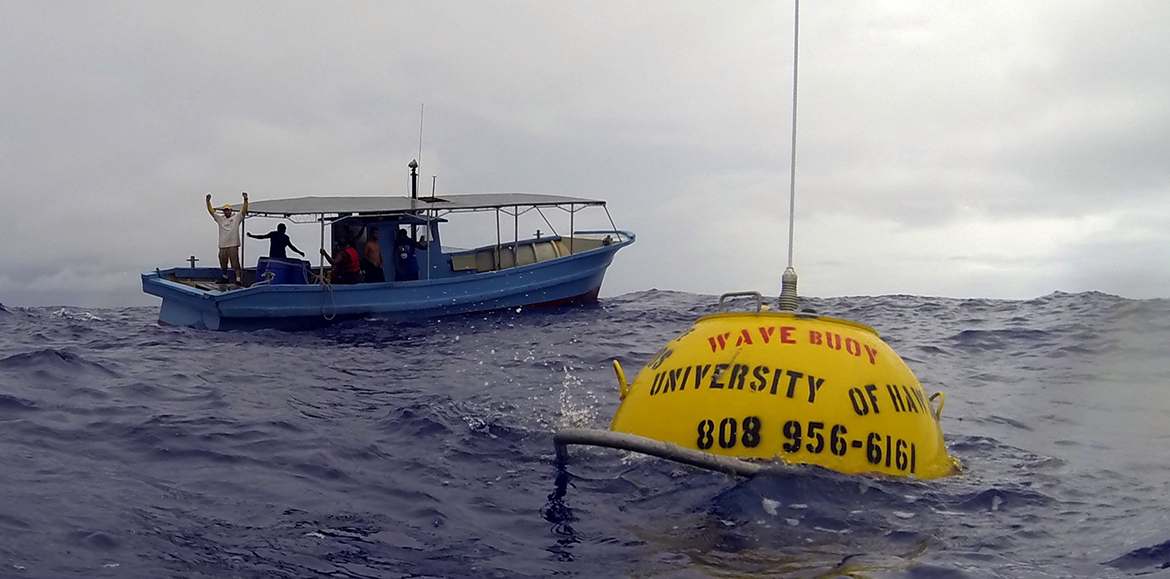
Datawell Directional Waverider buoy moored off Majuro Atoll in the Republic of the Marshall Islands as part of the Pacific Islands Ocean Observing System. Photo by Greg Zegas. http://www.hawaii.edu/news/2014/07/10/wave-buoy-in-majuro-helps-keep-islanders-safe/.
Where might one locate oneself to “read” a Waverider and what might such a reading reveal? Watching a buoy bob up and down in the sea might enable a kind of seasick, Mr. Palomar-style scansion. Physically deploying a Waverider from a boat might afford a sense of the thing’s weight in air and water, its infrastructure of elastic mooring, and the awkwardness of situating it in a constantly sloshing medium. Accessing a data feed from a specific buoy through a dedicated screen receiver—a more remote, digital lens—might deliver a reading like the one in Figure 2.

“An example of a National Data Buoy Center (NDBC) buoy observation in FM-13 code.” The sequence
Looking at an Internet display showing cleaned up and formatted information (complete with labels about which numbers mean what) would offer the sort of wave-monitoring view many professionals employ at national meteorological or coast guard or oil company desk jobs. The home page of the US National Oceanographic and Atmospheric Administration’s National Data Buoy Center (NDBC; http://www.ndbc.noaa.gov/), a project of the US National Weather Service, and in place in some form since 1967, is a key portal through which buoy users can query individual buoys and obtain readings such as significant wave height, dominant wave period, average wave period, and mean wave direction.
All of these readings would be, in some sense, superficial readings—taking the buoy and its outputs at face value. Much can be gained from this approach, not least an empirical sense of how these buoys are meant to appear to their users as sea-situated instruments of mechanical objectivity (Daston and Galison 2007). But if reading is a practice tuned to make sense, to link syntactical parts, grammar, concepts, inter- and hyper-textual references, glosses, titles, structures, letters, paper or digital pages, [and] to move through, within, and beyond what we are used to understand as a text and a frame (Gandorfer 2016),
I here draw from all of these approaches, though am also interested in how such definitions and modes of reading align with, redefine, or require fresh accounts of sensing practices, understood by Gabrys and Pritchard (2018) as fusing “an assumed human-centered set of perceiving and decoding practices” with those of “extended entities, technologies and environments of sense” like remote sensors, a definition that repositions sensing as parceled out across a range of entities (p. 394). To frame some of what follows, I might remark that insofar as buoys themselves “read” waves, they do so through a mathematical idiom, their measures filtered into a sign system that, as Brian Rotman (2000) has suggested, has no place for an experiencing, speaking subject (unlike natural languages, the “language” of mathematics has no “I,” “me,” or “us,” nor any deictic pointers like “here,” “now,” or “today”). Conjoined human-buoy “readings” of waves thus hybridize local, embodied knowledge/experience with situated practices of mechanical measure and manipulation.
I begin my analysis from old and new materialist angles, looking at the Waverider buoy’s relations of production as well as its elemental, material composition, and I start that project by reading the buoy from its place of manufacture and maintenance in the Netherlands. That starting point permits me to see how the material making of the buoy anticipates and adjusts to the formal qualities of the waves it is designed to measure, which in turn provides clues to what kinds of waves are considered matters of concern by various anticipated users (e.g., storm surge waves that follow hurricanes, waves that batter oil platforms, waves that can be read as signs of sea level rise). I am inspired in part by an analytic due to historians Steven Shapin and Simon Schaffer (1985) who, in Leviathan and the Air-Pump, suggest that Robert Boyle’s circa 1660 mechanism for producing a vacuum, his air-pump, can be understood through the material, literary, and social technologies that concretized, explained, and authorized it. Reading the Datawell Directional Waverider, I treat it as a material technology with literary/informational tendrils out into the world, a world stitched together through a media ecology of instruments and social institutions. At paper’s end, after reading the buoy, I ask how the buoy itself reads waves and for what purpose.
Material Technologies at the Waverider Factory
During anthropological fieldwork among ocean wave scientists in the Netherlands in fall 2016, I visited the Datawell Directional Waverider production facility. Taking a train from Amsterdam to the small hamlet of Heerhugowaard, I arrived at the site of Datawell service, production, and sales. 3 Harry Pannekeet, a Datawell sales representative, kindly picked me up at the station and brought me to a modest clutch of modern office buildings. Pannekeet, dressed in casual jeans and a plaid shirt, had worked for Datawell for thirty-five years, starting out in the company’s warehouse and working his way up. He was a store of immense knowledge, though modest in retelling Datawell tales, referring me for elaboration to a book Datawell published on the occasion of the company’s fifty-year anniversary (Joosten 2013).
Pannekeet walked me through a facility that had the look not of a massive production line but of a small factory that made use of craft labor. Three Dutch women, around middle age, sat at desks, next to large windows, chatting while they assembled circuit boards and set these on metal chassis that would eventually be inserted into buoys. Those circuit boards, with parts manufactured somewhere else in the global assembly line, would attach to various GPS and transmission devices.
Pannekeet ushered me next into a laboratory to show me the interior plastic orb of a Waverider, a fishbowl-like globe that would eventually be cradled within the metal sphere of a buoy casing (see Figure 3, a schematic cutaway diagram of the Waverider and Figure 4, a photograph of the interior globe). The globe materializes a design that has been in place (and patented) since the 1960s, when Datawell began making these devices—a task for which the company was founded after the Dutch floods of 1953, which killed nearly 2,000 people: The need for a wave height-measuring buoy originated from the tragic floods in the province of Zeeland, in 1953. In order to prevent such catastrophes in the future, the government decided to close the sea-arms and raise the dikes. The required dike height is not only determined by the maximal water level, but also by the height of the waves threatening to wash over the dikes. (Datawell BV 2011, 1)
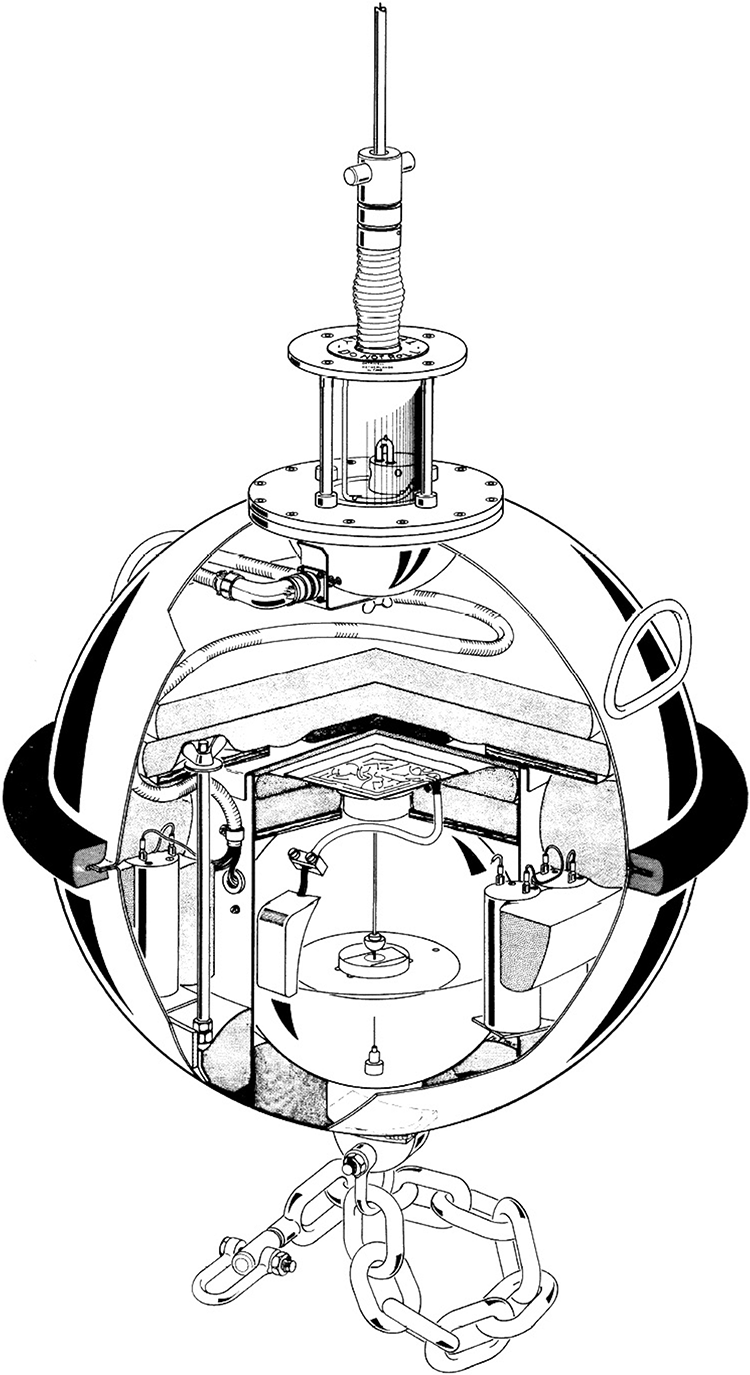
A schematic of the Datawell Directional Waverider.
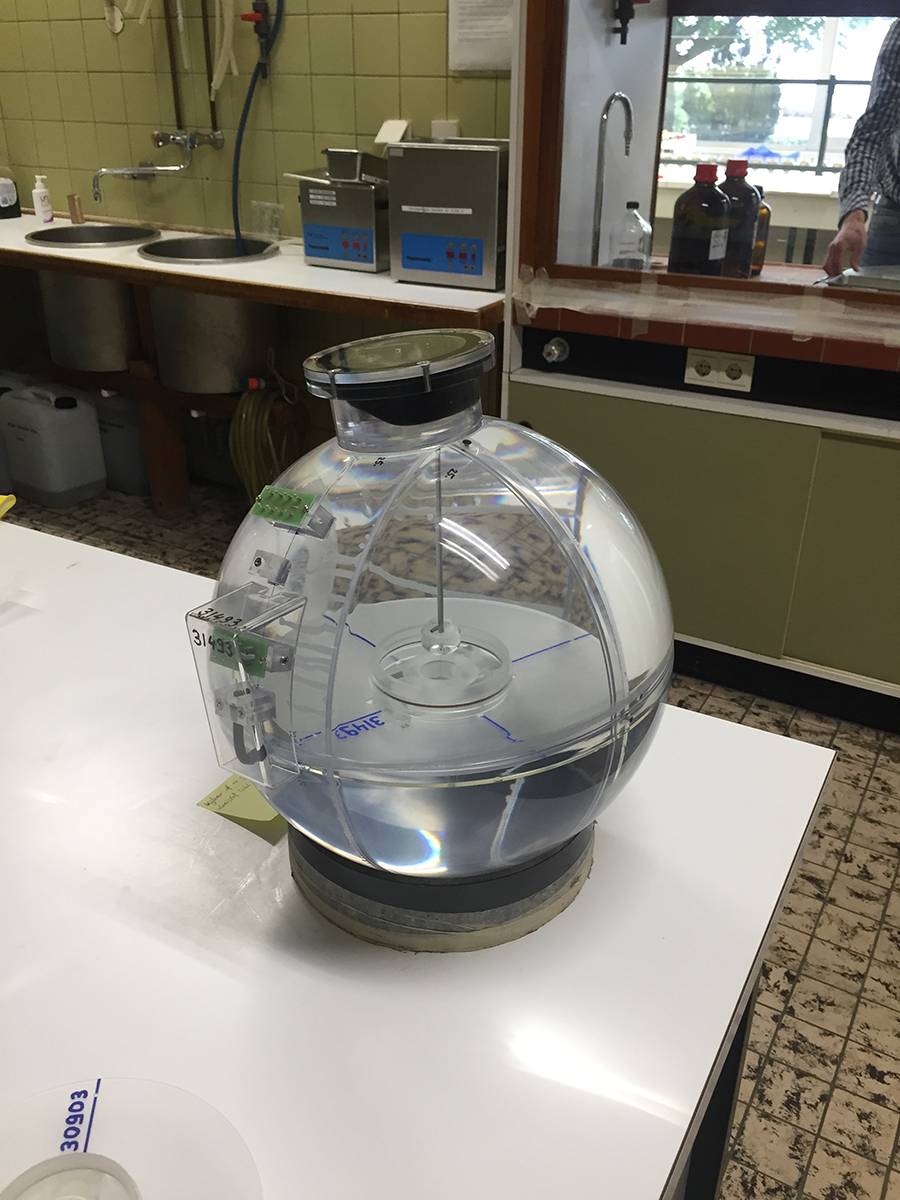
The interior globe of a Datawell Directional Waverider buoy, in the factory/lab at Heerhugowaard. Photo by author.
The impetus for making something like a Waverider came from the Dutch Rijkswaterstaat, a state organization dedicated to water control. The buoy thus has an origin in the marine and maritime concerns of a particular national history. The kinds of waves for which it was originally designed were those storm surge waves to which the Dutch coast was particularly vulnerable. The buoy is a sentinel, inheriting a tradition sometimes celebrated in maritime prose and poetry—as we hear in Kipling’s (1896, 1) “The Bell Buoy,” in which a buoy speaks as narrative voice, as a loyal colonial servant: “they made me guard of the bay, And moored me over the shoal. I rock, I reel, and I roll—…”
Looking at the Waverider orb in the lab, I needed help decoding it. Pannekeet told me that the center of the apparatus hosted an accelerometer, a sensor that tracks the changing speed of a thin sideways-mounted platinum–iridium rod waving up and down inside a plastic box filled with an electrically conductive liquid. The rod’s waviness, generated by and acting as an interior scale model of the waviness of an animating ocean wave on the buoy’s immediate surround, is tracked by two electrodes that measure oscillating electric potential difference (voltage). That oscillation (relayed via two electric wires up to a buoy’s transmitter) serves as a proxy for vertical acceleration—and therefore for wave height. 4 The model of the ocean world that is instantiated here is an abstract one that has the sea as, by default, flat and still until disturbed. If, as Deleuze (1985) once wrote of surfing, “the form of entering into an existing wave…no longer [demands] an origin as a starting point, but a sort of putting-into-orbit [of the surfer]” (p. 121), the buoy, borne up by orbiting water molecules, nonetheless retroactively recreates or simulates an originary stillness. 5 This enables not just the becoming environmental of computation (Gabrys 2016) but also a baseline for the becoming computable of environment.
Measures of wave height can only be properly extracted if a buoy can separate vertical acceleration from the pitch, yaw, and roll of “a randomly swaying buoy” (Datawell BV 2011, 2). The solution to isolating up-and-down movement, the company’s literature reports, “was found in introducing a so-called stabilized platform, serving as an artificial horizon, on which the accelerometer is mounted” (Datawell BV 2011, 2, emphasis added). In other words, the buoy needs to bring the level of the world—the horizon—into its innards. How is this accomplished? The answer requires a design tuned to the physics of the near sea surface, one that is dependent upon precisely chosen fluids, plastics, and metals. Think, fancifully, of the buoy as a giant floating eyeball that can only read waves properly when it is filled with just the right mix of liquids. Or not: the buoy’s “reading” of waves is not really akin to Mr. Palomar’s visual scan but is, to make another analogy to organismic sensing, about touch and proprioception (the sense of movement and position), the registration of the pressure, and location of impinging phenomena.
The assemblage of accelerometer and disk-shaped horizon platform is nested near the “equator” of the plastic globe, with that globe filled with liquid that enables the measuring apparatus to behave as though it is “floating” in the ambient seawater. A key puzzle here, Pannekeet told me, was to get interior liquid and plastic to have matching thermal expansion coefficients, so that the “submerged weight of the platform and the accelerometer [would be] virtually nil” (Joosten 2013, 50)—so that the buoy, in other words, immersed in seawater, wouldn’t be measuring itself, which would deliver a misreading, one enabled through an undesirable mechanical reflexivity. Because, in the initial design, “plastics intended for the design of the accelerometer and the platform were all heavier than water” (p. 50), an early Datawell inventor experimented with adding sugar to the water to increase its density (inspired, the lore goes, by the inventor having spent a childhood keeping bees and feeding them sugar water). Company literature records that, in early days, “dissolving enormous amounts of sugar in hot water…gave Datawell to the surprised passer-by the appearance of an illegal distillery” (Datawell BV 2011, 2). Sugar water, however, was abandoned as it “made everything into a sticky mess” (p. 51). After further trials, a combination of polystyrene plastic matched with a mix of distilled water and glycerin provided the solution. The original copper wires traveling out from the electrodes had to change, too: they turned out to dissolve in the sensor liquid after only a couple of years; Datawell began using platinum. This permitted the buoy to be both in the sea but not of it and in the sea and of it.
At the heart of the Datawell Waverider, then, is an almost alchemical balance. For the Waverider to read waves, its apparatus has to be just so. It goes on: the central polystyrene sphere in which the Datawell sensor sits is itself held loosely within another polystyrene sphere. That permits the inner sphere to stay “still” and the outer to move with waves, an arrangement that prevents “the transfer of the buoy’s pitch and roll motion to the [inner] sphere” (p. 56). All this adjustment struck me as requiring a kind of craft or artisanal grappling with the device. Pannekeet told me I was not far off, informing me that it would take two months of on-the-shelf aging for each globe to be ready to be locked into the signature metallic, yellow-colored container that houses the device (waiting here for liquid and plastic to settle into steady suspension). A set of globes on a shelf sat nearby, aging, I thought, like fine wines or cheeses.
In its earliest manifestation, this double sphere was able to measure height but not direction. The Directional Waverider, introduced in 1988, added another accelerometer, in the perpendicular direction, coupled with a compass to convert to a North–West coordinate system, adding a kind of magnetoception, a sensory mode mostly alien to the human (present, e.g., in homing pigeons). This introduced another puzzle—controlling for possibly magnetic properties of the Datawell buoy’s metal casing (p. 148).
The material composition of the buoy thus matters at every level: (1) globes, (2) casing, (3) paint, and (4) batteries (in early days zinc-carbon, now alkaline). Rubber is used in mooring lines that anchor buoys. The shape of the device matters, too. The spherical form offers advantages but also risks falling into “immersion resonance” with the waves, which would exaggerate the data (p. 247). A “fender” around the equator of the casing reduces that sympathetic vibration (p. 77). The buoy is an amalgam of multiple materials under constant testing and evaluation (on conducting critical social theory reading by thinking with and through chemical elements and compounds, see Starosielski and Alaimo n.d.).
I had read in the company’s literature of the ocean conditions to which the device had materially to adapt, seawater. There was also pollution, which would eat “into the stainless steel hull within half a year,” a problem addressed by using copper-nickel. There was the ice cold: “The raw north proved that rubber cords can freeze, and that ice on the antenna can make the buoy tumble upside down: plunged into the salty water, the ice melts off and the buoy comes up again, resulting in a transmission at intervals” (Datawell BV 2011, 3). Sometimes fish ate into the mooring system. The buoy could become an ecosystem for marine creatures—in which case it would be subject to “biofouling,” which could influence the “accuracy of the transducers which are integrated into the hull of the buoy.” The solution was an “antifouling paint on the transducers”—a paint that, as a biocide, demanded Datawell’s compliance with environmental regulation.
Waves are physical processes that happen in a vital, alive, ocean. That aliveness can jam the measurement of processes understood to be analytically separable as “physics.” Wave buoys read waves as formal structures and less as chemical heaves of swirling hydrogen oxide dosed with sodium, chloride, sulfate, magnesium, calcium, and potassium ions (aka seawater). Waves are not here apprehended, either, as moving ecologies of microbes, plankton, or fish. Pannekeet told me that some buoys have sunk below the waterline due to water ingress, which has then permitted animals—barnacles, mussels—to grow on them. Sometimes they sink far enough that they implode, which happens when they get below their pressure rating.
Pannekeet walked me toward the shipping area of the production facility. I saw fleets of buoys (Figure 5)—ninety centimeter in diameter yellow copper-nickel orbs suspended from steel armatures on wheels, ready to be rolled out. They reminded me of nothing so much as minions, those cartoon characters from the children’s film Despicable Me. And, indeed, these instruments are kinds of helpers distributed around the world (numbering in the thousands) to feed information to their institutional masters.
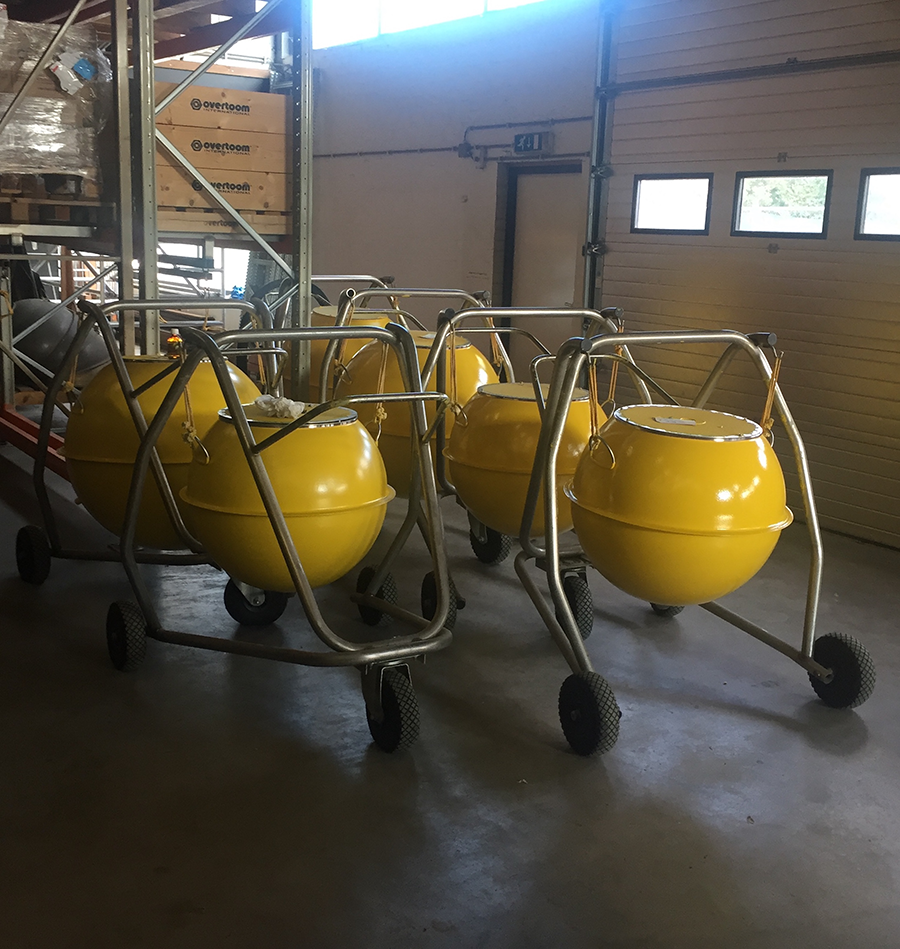
Datawell Waveriders on the factory floor, ready to be shipped. Photo by author.
Pannekeet gave me a tour of the repair shop, which featured all sorts of damaged buoys, many being worked on by groups of male technicians. Some buoys had been run over by ships. Some had been used by fisherpeople and recreational boats as moorings. Buoys from US and Canadian waters, he told me, sometimes come back to Heerhugowaard with bullet holes in them—a sign either that people are using them for target practice or are seeking to disable them. Some looked like they’d been in the process of being taken apart for scrap metal or parts, perhaps by pirates (see https://www.gc.noaa.gov/gcil_buoys.html, on buoy vandalism). If buoys are nonhuman sensory organs for apprehending the ocean, these organs can be bound up into politics and practices that point to processes other than the oceanographic; one might read buoys, against the grain, as signs of local politics of resistance, appropriation, or resource inequality (as with people who steal buoys to secure ransom from their owners, whose organizational names are often painted on their exteriors).
What does a reading of the material technologies of the Datawell Waverider here tell us about ocean sensing? That waves are known through machinic sensors that depend on measurement instruments that, in harnessing the properties of metals, plastics, and calibrated liquids to capture aspects of the world, become amalgams of human and nonhuman sensing. That waves are known through materials that hail from widely distributed and changing political economies of mining (platinum, iridium, copper, zinc, nickel), the manufacture of synthetic materials (polystyrene plastic), and plantation agriculture (rubber; cf. Starosielski [2015] on the materials making up undersea cables). Spooling an inventory of elements out from the Waverider would provide a snapshot of the shifting relations of resource access, regulation, and modification over the last fifty or so years of European industrial manufacture.
Literary and Social Technologies
Buoys gather data and transmit information to shoreside and ship recipients. It may be a stretch to treat such information technologies as what Shapin and Schaffer would call literary technologies, but exploiting the pun on reading as information assessment and reading as interpretative performance can help us understand how buoy data are used—which also permits a view into the social technologies that make buoys function in their media networks and ecologies. Shapin and Schaffer (1985) argue that material, literary, and social technologies operate as objectifying resources (p. 77), designating scientific instruments rather than their creators as arbiters of the phenomenal world. Tracking the informational life of buoys reveals an aspiration for these tools to be transparent reporters, modest witnesses (Haraway 1997), sending in communiqués from the ocean surface.
What kind of information do Waveriders provide to those people who query them? Answer: general statistical information about significant wave height, period, and direction sampled from a patch of water over thirty minute spans of time (long enough to discern regularities, short enough to serve as a “snapshot”). The word “significant” in significant wave height is…significant: referring to the mean wave height of the highest third of waves in a time-sample, significant wave height, originally created to align with heights that might be picked out by a “trained observer” in a small vessel (Munk 1944), remains a measure tuned to purposes of human navigation, port design, and more. Such an accounting does not provide anything like a biography of a single wave, in the way that Mr. Palomar, at some moments, desired—or which wave scientist Hisashi Mitsuyasu (2009) in his book, Looking Closely at Ocean Waves: From Their Birth to their Death, seems to deliver, describing waves as having “lives” that begin and end. Rather, it delivers data points that can be assembled into a population profile, a spectrum of frequencies—making another kind of reading practice, statistical reading, necessary in order to understand wave dynamics. Nonhuman sensing of the sea in this instance, then, actually does deliver one aspect of what Mr. Palomar sought: “an inventory of all the wave movements that are repeated with varying frequency within a given time interval,” a form of information, it bears repeating, that Mr. Palomar’s author, Italo Calvino, has already assimilated as a genre of knowledge by himself adapting reading conventions in the sciences for his work of prose.
How do Waverider measurements travel outward from buoys? The earliest Waveriders transmitted data to shore using high-frequency transmitter antennae, sending out signals at a frequency of about twenty-seven megahertz. One virtue of sending over seawater is the fact that salt water is electrically conductive, so that signals can propagate along the curvature of the earth rather than hitting a wall at the horizon. The communities of human readers of such data would have had receiving practices ready for this radio channel. Not long after the Waveriders’ introduction, though, such persons would need to be mindful of other communities trying to read the electromagnetosphere. Nowadays, in the Datawell buoy installation guide, we learn that “In case a transmitter is used within territorial waters a radio permit from the local authorities is obligatory.” And that “The transmitting frequency band 28.0–29.7 is reserved for amateur radio operators and needs to be avoided.” The media ecology of the electromagnetic spectrum is densely settled, and buoys are part of local and global media infrastructures of “signal traffic” (Parks and Starosielski 2015).
Signals from buoys have to fit into legal frameworks. In the early days, the Dutch authority that hosted the Rijkswaterstaat was the same as the one issuing transmitter licenses, a convenient convergence that made Dutch waters “the great outdoor laboratory of Datawell” (p. 185). In many ways, then, dynamics from Dutch waters (e.g., assumed wind speeds) became models for dynamics elsewhere, so that the Waverider carries around with it wave models originally developed for one part of the world (with Waverider scientists and technicians then working over the years to adjust to different dynamics elsewhere).
Anthropologist of sensing Nadia Serematakis (1994) has argued that sensory histories, habits, and gestures “sediment” into the lived experience of human embodiment—and also, by a kind of contagion, into the objects and artifacts we sense. Thus the sensory is not only encapsulated within the body as an internal capacity of power, but is also dispersed out there on the surface of things as the latter’s autonomous characteristics…sensory interiors and exteriors constantly pass into each other in the creation of extra-personal significance. (p. 6)
And, of course, such buoys are far more than of “extra-personal significance.” Buoys float inside and outside national nautical territories, and their data are differentially and unequally accessible to users. The European Center for Medium Range Weather Forecasting, for example, makes use of buoy data for weather prediction but does not make those predictions public, providing them only to national meteorological organizations that subscribe to its weather models. In the 1970s, during the oil crisis, many non-Organization of the Petroleum Exporting Countries (OPEC) countries sought to prospect for oil in their territorial waters, which led to a rise in buoy orders from companies keen to keep their drilling practices from competitors. 6
Buoys have, since the 1990s or so, also become part of an Internet infrastructure. Over the years, they have been tethered to satellite systems (bouncing data between geostationary and low-orbit systems), to networks of high-frequency receiving stations on oil platforms, and even to cell phones that “regularly call…[their]…owners to relay the measured wave conditions” (p. 241). Onboard computers now nest within the buoy, too, calculating wave motions and arranging these data into frequency profiles (spectra). GPS systems have become standard—something that has required Datawell to build new antennae, transmitting and receiving in the ultrahigh frequency band so that “buoy position…[can be] added to the datastream that is transmitted to shore” (p. 229). All of this data collection, of course, needs to be formatted for reading both by other devices and by humans; in this sense, wave buoys deliver, at some moments in their relays of data, something like “operational images,” representations that need not be explicitly viewed by humans in order to be processed and handed along to eventual visual or textual interfaces (see Paglen [2014] on “operational images” such as those used by missile targeting systems). Perhaps, however, “image” is the wrong word, given the tactile, proprioceptive, and magnetoceptive registrations the device makes. Operational impressions may be more fitting. Along these chains of operational impressions, there may emerge what Edwards (2010) has called “data friction,” resulting from the contingent and often slippery links between elements in the relay of information in networked systems. The media ecologies in which the buoy is entangled are constantly being monitored for such friction. 7
Where does transmitted data end up? In early days, wave records took the form of punched paper tape. Nowadays, there are a variety of receivers. During my visit to the Datawell factory, Pannekeet showed me some.
Some ship harbormasters use these receivers as their portal for buoy data (see Figure 6). But others (“port authorities, offshore companies”) use a more detailed computer screen interface that Datawell makes called “Waves4.” This Windows interface shows “2D plots of wave data,” including significant wave height and other wave properties. As company literature explains, The buoy will try to establish a connection to the Internet at a predetermined rate using a dial-up connection. The dial-up interval can be chosen between 30 minutes and 24 hours. Once the Internet connection is established, the buoy will connect to your Waves4 server to deliver its data. Generally, this data will be DMF messages, like heave spectra, GPS positions, etc. Many Waveriders we supplied have been equipped with a Superstar GPS receiver. Recently it has come to our attention that the Superstar generates a faulty date in the logger files. The problem can be explained by an unexpected “GPS week rollover.” The internal date obtained from the GPS satellite system is incorrect. Typically the date is set to the year 2096. To convert the incorrect data we are currently developing a software tool. The only solution to this problem however is to replace the Superstar GPS receiver.
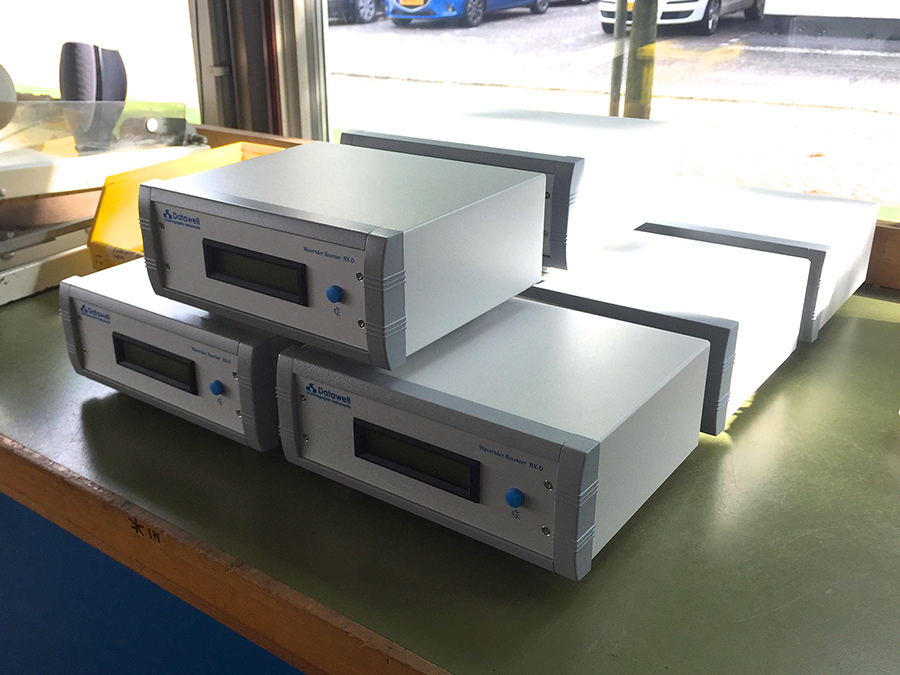
Datawell Directional Waverider buoy reciever, in the factory/lab at Heerhugowaard. Photo by author.
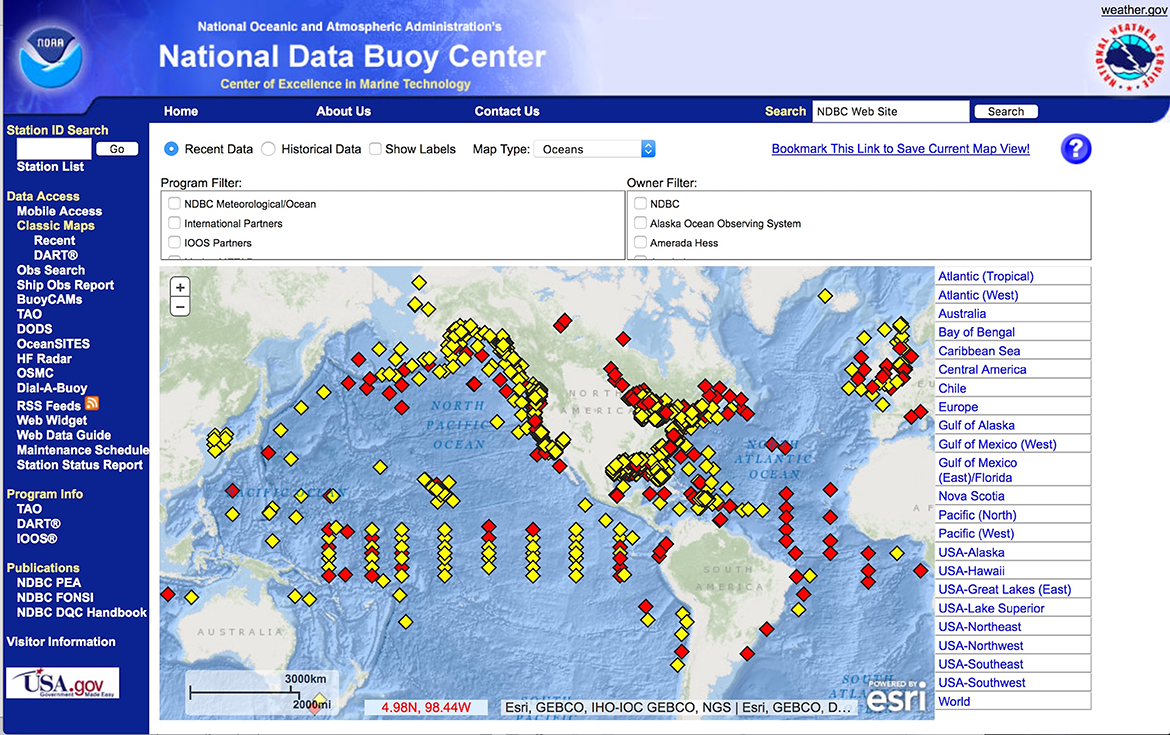
Landing page for National Data Buoy Center website.
Users can query individual buoys, not all of which—but many of which—are Waveriders (some even have webcams, providing another level at which to read waves; maybe like a long-form twenty-four-hour Andy Warhol film). Shapin and Schaffer suggest that the purpose and effect of a shared literary technology (as I am treating the Internet, here) is “to create an experimental community, to bound its discourse internally and externally, and to provide the forms and conventions of social relations within it. [A]…literary technology of virtual witnessing extend[s] the public space of the laboratory [or, here, the field] in offering a valid witnessing experience to all readers of the text” (p. 77). The virtual witnessing afforded by a site like this opens up additional questions of how we might “read” it. Here, one could step away from the close reading of an individual buoy and engage in something more like the “distant reading” that people now write of in the digital humanities. Such readings may move away from textual to visual, diagrammatic representation—either spotlighting interpretative regularities or, perhaps, offering a misplaced surety (Rhody 2017). What we would learn here would have to do with the institutions and sites that are monitored. The US National Weather Service turns out to be a huge player in this sea, making much of its wave data publicly available (to fishers, surfers, port managers).
What kinds of waves are matters of concern? As the map makes clear, coastal waves—monitored for their manifestations as both harbingers and effects of hurricanes, measured to secure coastal infrastructure, kept track of for harbors—are crucial. The stakes of wave measurement—of significant wave height—connect to maritime business and, in some cases, to tracking sea level rise. Such data may also be used for citizen science and activism; consider, for example, people working in the “Forensic Oceanography” project, which seeks to track and reconstruct oceanborne human rights violations, particularly in connection with migrant travels across the Mediterranean, by going “against the grain” in their use of surveillance technologies. With Forensic Oceanography’s “Left-to-Die” boat project, which investigates how technologies of sea surveillance were used systematically, if perhaps not always in a coordinated way, to avoid rescuing migrants, activist-researchers avail themselves of such forms as buoy data, which they can use to track trajectories of drift and neglect (Heller, Pezzani, and Situ Studio 2012; Pezzani and Heller 2019). Reading the waves with buoys can have many, many applications and outcomes.
Conclusion
In Stoker’s (1897) Dracula, the character of Mina Murray describes a watery sentinel floating just off a nearby shore: “a buoy with a bell, which swings in bad weather, and sends in a mournful sound on the wind. They have a legend here that when a ship is lost bells are heard out at sea” (p. 65). Today’s wave buoys have as ancestors these sorts of earlier buoys, devices that were often outfitted with bells to warn seafarers of dangerous seas—as also with the bell of Robert Southey’s 1802 “Inchcape Rock”: “On a buoy in the storm it floated and swung and over the waves its warning rung.” The readings of waves that these buoys rendered—and the readings of buoys that authors such as Stoker, Southey, and Kipling offered—were auditory in character. Nineteenth-century European maritime sensory practices to do with buoys operated not like today’s machine-mediated operational impressions but, often, through sound, making “reading a buoy” a matter of listening (see Goodale [2011] on “reading sound”) and, also, of being physically present or proximate.
By the time Mr. Palomar is reading waves in Calvino, the idiom is visual, more textual, about scanning. Mr. Palomar’s reading is also a shoreside meditation rather than a fearful at-sea terror. Mr. Palomar is at a remove—something flagged by the mathematical language he employs. Rotman (1998) has suggested that mathematics as a sign system does not have a speaking subject, with the reader of mathematical sign sequences “never asked to interpret a message which makes reference to the subject’s embodied presence” (p. 63). As I have pointed out here, the Waverider is designed to extract formal, mathematical information from the sea, encountering the sea as a medium whose material qualities need to be taken into account only to be then factored out. In other words, for the Waverider to be a medium for relaying wave information, it needs to be abstracted out from its ambient surround. The ocean itself as a medium—as scholars such as Melody Jue (2014, forthcoming) and Astrida Neimanis (2017) suggest, thinking of seawater as a substance that can carry communication, history, material memory—here comes to have a parallel life, becoming a background to itself. Wave buoys miss sea materiality, constantly trying to overcome and survive the sea, trying to deliver clean, mathematical lines.
That formalist approach has been leveraged by artist David Bowen in his 2011 installation piece “Telepresent Water,” which draws information from the intensity and movement of the water in a remote location. Wave data is…collected in real-time from National Oceanic and Atmospheric Administration data buoy station 46246, 49.985 N 145.089 W (49°59′7′′ N 145°5′20′′ W) on the Pacific Ocean. The wave intensity and frequency is scaled and transferred [via marionette-like strings] to [a] mechanical grid structure resulting in a simulation of the physical effects caused by the movement of water from halfway around the world.
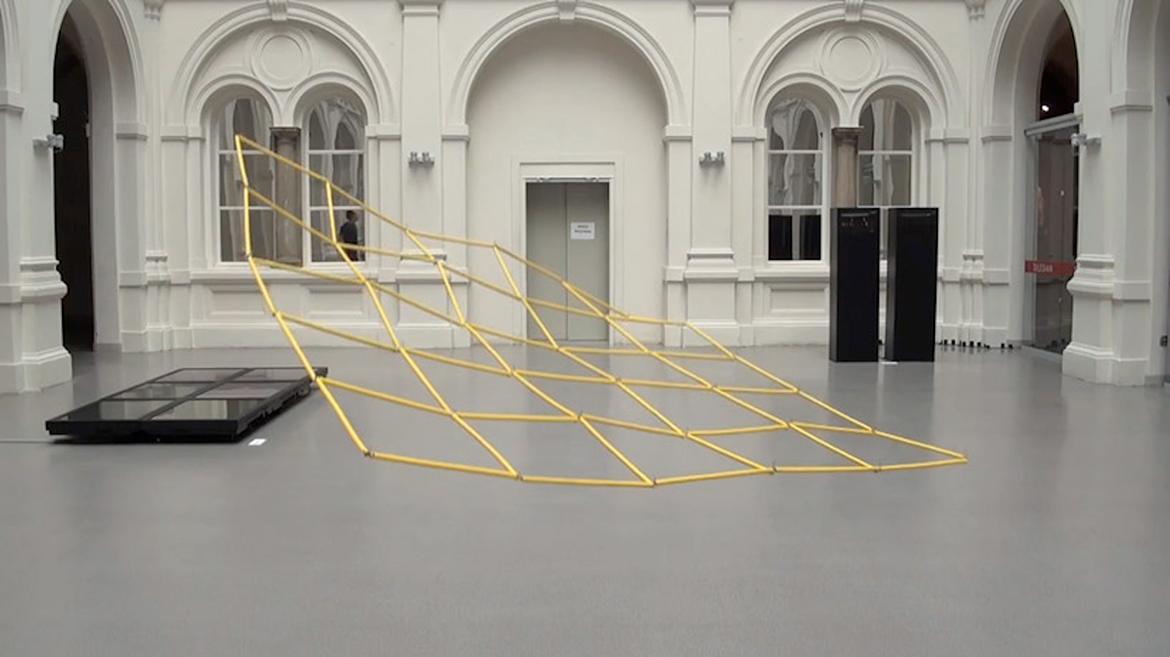
Freeze frame from video on David Bowen’s “Tele-present water,” 2011, on display at the National Museum, Poland Wroclaw.
The conservative political theorist Carl Schmitt ([1950] 2003), writing of the sea as a blank slate between nations, once dismissed waves this way: “The sea has no character, in the original sense of the word, which comes from the Greek charassein, meaning to engrave, to scratch, to imprint.…‘On the waves there is nothing but waves’” (pp. 43, 42; see Steinberg and Peters 2015). This is, of course, a reading at odds with the evidence of wave buoys, which are crafted precisely to record the tracks of waves on the sea and their implications for the character of human uses of the ocean. Thinking about waves as harbingers as well as specters of human loss (recall the buoy in Dracula), consider Sharpe’s (2016) In the Wake: On Blackness and Being, which presses readers to remember “the transverse waves of the wake” (p. 57) of Atlantic slave ships. For Sharpe, following the Saint Lucian poet Derek Walcott, the sea is history—and waves, particularly ship-made waves, are its haunting inscriptions. Thinking of waves as form alone, or as material alone, apart from their simultaneous force as significant for those who would interpret them, is to miss how waves are part of culture and history.
There are many modes, then, through which to engage in Calvino’s task of “reading a wave.” The at-first-glance workaday artifact of the Datawell Waverider, along with the processes it employs to register ambient waves, can help us to amplify what might be meant by such “reading.” The hybrid human–nonhuman sensing practices (Gabrys and Pritchard 2018) of buoys are organized by a mathematical syntax, a semantics of correspondence, and a pragmatic attachment to scientific, social, and political demands, whose histories are legible in part through the metals, plastics, and liquids of which buoys are made and through the media ecologies in which they are located. The yellow sphere of the buoy, in other words, is a black box that may be opened up to be read as a material and semiotic delegate for some humans’ purposes. The buoy might even be approached as what Haraway (1997) would call a “figure,” a material and semiotic entity (like the cyborg or the genetically modified mouse) that gathers up hopes, dreams, anxieties, contradictions, and puzzles for the forms of life in which it is situated. But if the buoy can be read as a human–nonhuman sensory delegate, a switching relay for signal traffic, it can also be understood as generating new species of hybrid writing, operational impressions, and sensory practice. There are fresh kinds of reading yet to be created.
Footnotes
Acknowledgments
The author would like to thank Jennifer Gabrys, Helen Pritchard, and Lara Houston for inviting this contribution. The author also thanks Melody Jue, Jessi Lehman, Heather Paxson, Christy Spackman, and Nicole Starosielski for comments as the piece came together. The author is also grateful to Daniela Gandorfer for a close reading and for the invitation to participate in the Reading Matters conference at Princeton University in fall 2018, where, in conversation with many generous interlocutors, the author was able to further develop the ideas in this essay. A special thanks to Harry Pannekeet for his hospitality at Datawell.
Declaration of Conflicting Interests
The author(s) declared no potential conflicts of interest with respect to the research, authorship, and/or publication of this article.
Funding
The author(s) received no financial support for the research, authorship, and/or publication of this article.
