




Abstract
This article builds on the affective turn in Science and Technology Studies (STS) analyses of public engagement with science to explore the tension between epistemological interrogation and social and political transformation. The empirical basis for this exploration is a year-long interdisciplinary public engagement project about routine data use in critical care. Partly conceived as a form of “otherwising” in relation both to determinist tropes of health data and reductionist forms of patient and public involvement in health research, the project sought to open up dialogue and debate using design-led methods, namely cultural probes. Widely regarded as a success, the project was, however, less subversive than originally envisaged, in spite of its commitment to playful and speculative processes. In order to explain this, we draw on feminist STS literature on the inseparability of knowledge and care, where care is conceived as a form of mutually transformative relating between beings—or attaching. Interdisciplinary collaboration, we suggest, was an effect of attaching, enabled by our methodological orientation to play. We show how playfulness as a mode of otherwising goes beyond the hollow critique of critical constructivism and fosters caring relations, both toward the objects of science and between scientists, clinicians, sociologists, and designers.
Introduction
#DataSavesLives. With this hashtag, the organization by the same name, headquartered in Brussels, tapped into a long-standing, multi-platform social media campaign to raise patient and public awareness about the importance of health data (Scott, Emerson and Henderson-Reay 2021). At the time of writing, the hashtag has been tweeted over 20,000 times, and the slogan adopted by numerous networks and organizations, from the UK's national institute for health data science (HDRUK) to the European Patients’ Forum and the World Health Organization. The slogan's catchy simplicity and catch-all potential means it has wide appeal across the vast array of fields now seeking to capitalize on data to improve healthcare. From AI-enabled diagnostics to time-critical precision medicine, it is data that saves lives.
The interpretive flexibility of #DataSavesLives begs so many questions: which data, whose lives, and how exactly? Or alternatively, whose data and which lives? Whichever way you look at it, the technological determinism in this statement invites critical reflection and—for those who envisage a richer dialogue between data-intensive medicine and its publics—intervention. How to go about this?
The relation between epistemological interrogation and social and political transformation in public engagement with science (PES) is the foundation of this paper. To illuminate this relation, we present a public engagement project called Critical Care Futures, in which we used cultural probes to help people imagine and articulate a preferable future for data-enabled research and consent in the intensive care unit (ICU). The use of designerly approaches to PES is now well-established, enriching a wider literature which has variously problematized the performative, partial, and reductive nature of “formalized mechanisms of voicing” (Michael 2012a, 530; Horst and Michael 2011; Michael 2018; Michael, Wilkie and Ovalle 2018; Davies 2014; Irwin, Jensen and Jones 2012). Inspired by Irwin et al.'s (2012) analysis of PES criticism not as an end in itself but as constitutive and performative, our own public engagement project was designed as an experiment in “otherwising” (Calvert 2023; Woolgar 2014), 1 which aimed to unsettle both the determinist tropes of data-driven medicine and the reductionist forms of patient and public involvement (PPI) which more broadly characterize the democratic impulse in UK-based health research. We aimed to achieve these using techniques from design research centered on ludic engagement (Gaver 2001, 2002; Gaver et al. 2013; Gaver et al. 2004; Gaver, Dunne and Pacenti 1999). Therefore, while our paper speaks to the PES literature, here we largely confine ourselves to drawing out the methodological threads of work which has championed other ways of knowing, namely the speculative, the playful and the idiotic, which have become part of the Science and Technology Studies (STS) repertoire of engaging the public with science.
The productive tensions of interdisciplinary collaboration, particularly between STS scholars, designers and scientists provides the analytic ground for asking what Critical Care Futures ultimately achieved in practice. We argue that whereas we sought to subvert the dominant framing of data-driven medicine through the use of playful, speculative methods, this goal itself was subverted by a competing clinical agenda in which the STS scholar among us was enrolled as the voice of the social. Rather than seeing this as a failed attempt at otherwising, we instead think this through the lens of “careful attaching” (De Laet, Driessen and Vogel 2021). Putting our work into conversation with the feminist STS literature on care (De la Bellacasa 2011; 2017; Martin, Myers and Viseu 2015), we analyze interdisciplinary collaboration as an effect of attaching, enabled by our methodological orientation to play. We show how playfulness as a mode of otherwising goes beyond the hollow critique of critical constructivism (Irwin, Jensen and Jones 2012; Latour 2004) and fosters caring relations, both toward the objects of science and between scientists, clinicians, sociologists, and designers. We find that play as a performative method of care and critique enables STS to “find a relationship to public engagement that moves beyond criticism alone” (Irwin, Jensen and Jones 2012, 121).
In this paper, we show how a key feature of culture probes, namely their playfulness, was central to three outcomes in the public engagement work: (1) catalyzing epistemological critique of routine data use in health research; (2) grounding that critique in affective modes of relating between researchers and publics; and (3) enabling a team with divergent disciplinary and normative commitments to work together successfully. Our analysis brings together and develops ideas located across diverse literatures, namely critical speculative design (CSD), PES, feminist STS, and studies of interdisciplinarity. Our contribution, grounded in a theoretically informed empirical case study, is to demonstrate the generativity of playfulness as a methodological choice, in both practical and theoretical terms.
Designerly PES and the Affective Turn
This history of STS scholarship on PES is a long and rich one, which in recent years has turned from a focus on the discursive and representational aspects of engagement to concerns with the aesthetic and affective (Davies 2014; 2019; Lindén 2020; Michael, Wilkie and Ovalle 2018). Designerly approaches to PES draw together elements of both, working precisely where meaning-making and sensory experience meet, and are said to enable STS scholars to recover the misbehaviors and overspills often sanitized out of engagement events (Michael 2012a). In drawing out the non-discursive dimensions of PES, Davies (2014) focuses on the emotions of pleasure and delight. This has synergies with forms of ludic engagement, but obscures the discomfort and critique of discursive analyses, or what Davies calls the “de-mythologization” of deliberation in critical public understanding of science studies. Querying the separability of the epistemic and the affective, Michael and colleagues (2018) focus on how aesthetics open up, expand and allow publics to inventively re-frame issues such that they become “matters of potentiality.”
One question which has received less attention is the extent to which epistemic subversion and embodied affect are in tension. If we take the hardest case scenario so beloved of STS: what happens when we use playful and deliberately open-ended methods to intervene in a field—critical care—characterized both by traumatic experience and a need for decisive action? What business do play and ambiguity have intervening in serious debates about how patients incapacitated by critical illness consent to the use of their data? What kinds of knowledge and relations are forged and what “good” can come of it?
In order to answer these questions, we first provide an account of why a ludic approach has merit, drawing on the speculative philosophy of Alfred North Whitehead, and its subsequent influence on design and STS. Our account is informed by Gaver and colleagues’ longstanding work on ludic engagement (Gaver 2001; 2002; Gaver et al. 2004; Gaver et al. 2013) and our own explorations of playful methods. We frame these as a form of otherwising, a move which emphasizes the critical and subversive synergies between CSD and STS, with a focus on the relations of researchers to their sites of engagement. The latter has been extensively theorized in feminist STS work on care, which foregrounds the relations between the affective and the epistemic, a theme we explore in our empirical case study. We draw on both CSD and care as forms of otherwising to interpret our experimentation with cultural probes in a year-long public engagement project in the UK, focusing in particular on the intended subversion and how this itself was subverted through prevailing clinical agendas around the reform of the informed consent process in the ICU. We conclude by linking what has thus far been described as engagement to recent work on the relations between knowledge production and care (De Laet, Driessen and Vogel 2021). We argue that working in an intentionally playful way was the means to accomplish both epistemic challenge and relations of care, demonstrating how “otherwising” itself could be otherwise.
Critical Speculative Design as Otherwising
The speculative philosophy and process ontology of Alfred North Whitehead have been influential in shaping approaches to futures research in both design and STS. A hallmark of speculative research is an orientation toward events which cannot be anticipated and which defy probability and linear time (Wilkie, Savransky and Rosengarten 2017). Moving beyond the “logics, rationalities, and habits that govern the problematic of the present” (Wilkie, Savransky and Rosengarten 2017, 1), speculative research is sensitive to an “eventful” temporality in which the unexpected, ambiguous and inventive become endlessly possible; in the words of designers Dunne and Raby (2013, 189), “a catalyst for social dreaming.” Working against prevailing logics of utility and commercialization which had come to characterize design practice, in the 1990s Dunne and Raby started a countermovement in the guise of critical speculative design (CSD). Decoupling design from capitalism and modernist functionalism, they problematized technological development with a focus on the social and political worlds of futures yet to be realized. CSD sought a new role for design, using designed objects to provoke public debate about technological futures (Ward 2021).
The potential of the speculative—what Wilkie, Savransky and Rosengarten (2017) refer to as the “lure” of possible futures—has inspired a growing corpus of work in the social sciences. This has been most pronounced at the intersection of design and STS, two fields which have found generative alliances both methodologically and in terms of sociopolitical interventions (Salter, Burri and Dumit 2017; Marres, Guggenheim and Wilkie 2018; Storni et al. 2015). Drawing on work in the philosophy of knowing by Whitehead (1985) and Stengers (2005; 2011), Meskus and Tikka (2022) develop the notion of “the gap” of uncertainty. Responding to the need for more empirical studies of how speculative research works in practice, they propose this concept as a way of delineating the research relationship when investigators invite participants to work with them in a speculative mode. In line with previous theoretical work (Wilkie, Savransky and Rosengarten 2017), “the gap” draws attention to the situated, contingent, open-ended and ambiguous relations which speculative research engenders. In Meskus and Tikka's (2022, 5) analysis, by ascribing value to “what is thought of as emptiness, hesitation and temporal disjuncture in practices of knowing,” researchers provide an opening for themselves and their study participants to repeatedly reposition themselves in relation to one another. This necessarily implies a suppression of the usual hierarchies of knowing when scientists and publics gather; both Meskus and Tikka (2022) and Michael, Wilkie and Ovalle (2018) have reflected on the challenges this poses during engagement projects, since participants may struggle to step outside their usual frames of reference.
Meskus and Tikka are not alone in advocating for the use of design methods in this context. Cultural probes, a method from design research, have long been used to re-draw the possibilities of engaging with research participants. First introduced by Gaver and colleagues as part of the Presence Project in the late 1990s, cultural probes have since become a popular tool in design research, and inspire a small but steady amount of interest in the social sciences. As first articulated by Gaver, Dunne and Pacenti (1999), cultural probes are “packages of maps, postcards, and other materials…designed to provoke inspirational responses” from participants. At the time, Gaver and colleagues sought to move beyond traditional methods in user research, which they felt limited the possibilities for design. In contrast to the impersonal, safe and controlled methods often associated with Human-Computer Interaction, cultural probes focused on generating insights through personal connection, ambiguity, risk and playfulness. Gaver, Dunne et al. (1999, 25) cast themselves in the role of provocateurs seeking to encourage a “provocative dialogue” with their interlocutors. This entailed reducing various forms of distance between themselves and the groups they were working with, in particular the “distance of officialdom” (Gaver, Dunne and Pacenti 1999, 25). Gaver et al. describe their influences as the Situationists, Dada and the Surrealists, whose traces appear in the probes’ hallmarks of ambiguity, mystery and, at times, absurdity. They were unequivocal that the probe returns were not designed to be analyzed.
In all of these respects, probes represented a critical re-orientation of the field of user studies and were subversive in their resistance to formal analysis. The latter has been an ongoing source of epistemological tension for those using probes, and is an aspect of subsequent probe studies which has generated criticism (Gaver et al. 2004; Boehner et al. 2007). The original intent of the probes was to playfully inspire new ideas for design. It was explicitly not to understand a phenomenon, produce definitive new knowledge, or solve a problem (Boehner, Gaver and Boucher 2012). Boehner, Gaver and Boucher (2012) caution against utilitarian and linear uses of probes in the context of the social sciences, where the impulse is one of information-gathering and analytic closure. Against this logic, the probes embrace ambiguity, partiality, idiosyncrasy and enigma. The aim is to multiply sources of inspiration rather than reduce data to a narrow and definitive answer.
Common to much of this scholarship is a concern with the methodological stuff of public engagement and its role in provoking, subverting and otherwise challenging singular and/or linear narratives of scientific progress—what we might otherwise refer to as “causing trouble” (Woolgar, Coopmans and Neyland 2009). While Gaver and colleagues have often framed this in terms of ludic engagement (Gaver 2001; 2002; Gaver et al. 2013; Gaver et al. 2004), the “ludic” dimension has been little explored in the crossover to STS, where interest in the speculative and its philosophical underpinnings has predominated (Meskus and Tikka 2022; Michael and Wilkie 2020; Wilkie, Savransky and Rosengarten 2017). In this paper, we attend to this deficit by reflecting on our project's use of playfulness in the form of cultural probes to subvert dominant framings of data-intensive medical research. In doing so, we draw attention not only to the epistemic work involved, but also to the kinds of relations—both within and beyond the research team—which this playful approach engendered. To help theorize this, we turn to feminist STS, where the forging of such relations—often under the sign of care—has been foregrounded.
Care as Otherwising
[T]he commitment to care can be a speculative effort to think how things could be different. (De la Bellacasa 2011, 100)
The relations of researchers to their sites of engagement have long been a concern of feminist STS. The effects of our knowledge practices, the erasures and neglected things of research, the objectification of research subjects, harmful representational practices, and in its broadest terms the politics of care have been sustained matters of concern (De la Bellacasa 2011; 2017; Haraway 1997). Within this tradition, care and knowledge practices go hand in hand, where care is not an epistemological standard (De la Bellacasa 2011, 96), but rather a form of mutually transformative relating between beings (De la Bellacasa 2017; De Laet, Driessen and Vogel 2021; Martin, Myers and Viseu 2015). Drawing on Haraway, De la Bellacasa (2011, 98) observes that caring requires “knowledge and curiosity regarding the needs of an “other”—and these become possible through relating, through refusing objectification. Such a process inevitably transforms the entangled beings.” This is an argument subsequently elaborated on by Martin and colleagues in their articulation of the potentiality of care, and the precondition that researchers working with care first allow themselves to be moved by an other—what elsewhere has been referred to as an ethic of response-ability (Barad 2007; Haraway 2008). Providing a heuristic to analyze these relations, De Laet and colleagues (2021, 799) draw on the language of actor-network theory to develop an account of “attachments:” the “relations between the social and the technical, between knowers and objects known, and between sociotechnical work and the affective sensibilities that enable, and are brought to life by, such work.”
The work of being moved, and of attaching, is said to occur within “moral and affective economies” (Martin, Myers and Viseu 2015, 631), which shape the relations of knowledge production and within which researchers configure their own normative commitments. The last decade has seen an increase in the articulation of care as critique as one such commitment (De la Bellacasa 2011; Martin, Myers and Viseu 2015; Murphy 2015; Lindén and Lydahl 2021). Within this genealogy, critique is framed both as a way to trouble care, and as a form of care itself, ultimately leading scholars to articulate how technoscience could be “otherwise.” The reconstructive impulse here responds to long-voiced concerns about the critical excesses of constructivism (Latour 2004); it affirms a role for STS as a generative normative endeavor, where to be “normative” is not simply to be for or against a given position, but means “opening up to being moved by the situated normativities of the worlds one inhabits as researcher” (De Laet, Driessen and Vogel 2021, 814).
Within STS, the theoretical worlds of care and speculative design have remained siloed; in design, by contrast, there has been an emerging consideration of their interconnections (Elzenbaumer 2018; Pennington 2022). These have centered on the ethics of care, with Pennington (2022), for example, building on Michael's (2012a; 2012b) work to propose “inventive ethics” as an immanent feature of inventive problem-making. Inventive ethics asks that designers respond to ethical problems arising in speculative projects in care-ful ways, and in ways which shift the direction of their practice. While an attention to ethics fruitfully extends the notion of inventive problem-making that is consonant with feminist commitments to care, ethics in the context of medical research is a heavily loaded term. Indeed, due to the power of bioethics in driving and delimiting the narrative surrounding data-driven medicine, it is one we choose not to focus on. Instead, we consider playful speculation as a means of cultivating interdisciplinarity, and in so doing providing the conditions of possibility for careful attaching (De Laet, Driessen and Vogel 2021). What we find is that methodologically, playful approaches facilitate both epistemic critique and care when used consciously and skillfully in multidisciplinary engaged research.
Empirical Analysis
Background
Our interest at the start of this project was in health research promising to use large datasets of routinely collected data to change the face of patient care and outcomes. Underpinned by serious considerations of bioethics, information governance and value-for-money, health research has variously positioned patients as vulnerable (and therefore in need of protection), as potential claimants (who must understand their rights and obligations), and as a scarce commodity (whose use must be efficiently rationalized). 2 In their metamorphosis to “research subject” (the preferred language now being research “participant”), the patient becomes the object of bureaucratic technologies of governance, including patient information sheets, consent forms and General Data Protection Regulation statements. In addition to stripping back the patient in this way, patient and public involvement in health research, or “PPI,” enacts a further reductionist move whereby those identified as having experience of a particular health condition are enlisted to give feedback on funding proposals and study documentation. While PPI aims to involve people with relevant experience in the design, conduct and dissemination of health research, studies have pointed to the challenges of PPI as a formalized mechanism of voicing (Renedo and Marston 2011; Madden and Speed 2017; Pearce 2021; Russell, Fudge and Greenhalgh 2020). Whether in the name of democratization, consumer choice, or experiential representation in healthcare, PPI as a form of engagement often presumes a linear process whereby scientific knowledge is presented to patients for review and/or consumption. Largely absent from this process is a truly open-ended dialogue in which the unanticipated may be spoken, or the existing epistemic hierarchy upended.
To move beyond processes which enact an active/passive dualism whereby patients may be figured as passive, voiceless, and lacking capacity, we designed a public engagement project led by an STS scholar, a critical care consultant, and a critical care nurse researcher, with creative expertise provided by a team of designers. We wanted to open up narrow framings of the patient as someone whose identity resides solely in their critical illness and instead create a space to explore the data/care relationship more broadly. The playful and future-oriented possibilities of speculative design appealed as a way to explore alternatives to the prevailing bioethical framing of data use in research as a matter of consent (Rivas Velarde et al. 2024) on the one hand, or “informed refusal” on the other (Benjamin 2016). What else is going on here that would enable us to reframe the problem more inventively?
The Critical Care Futures project had two aims: one substantive, one methodological. Firstly, we sought to catalyze conversations between different stakeholders about what future ICU research should look like. The premise here was the greater use of routinely collected data for research (Meissen et al. 2022; Shillan et al. 2019), and an acknowledged need to open up dialogue about the meanings, values and relationships this will entail. The second aim was to pilot cultural probes for health-related public engagement. The idea here was to explore the potential benefits of the playful, ambiguous and open-ended in a field dominated by pursuit of the linear, rational and certain.
This project came about as a collaboration between Annemarie, a critical care consultant, and Cath, an STS scholar. Annemarie wanted to engage the public in her research in ICU, which uses routine healthcare data to improve outcomes for critically ill patients with co-existing cardiovascular disease. In ICU, around 75 percent of patients are admitted as an emergency, over half of these admissions take place outside normal working hours, and nearly one in five patients die in hospital (Galloway et al. 2018). Most patients lack capacity to consent to treatment decisions (including participation in research) and their closest relative (or welfare guardian/person with power of attorney) must give consent for research participation on their behalf (Ecarnot et al. 2017). As technology develops and secure mechanisms to analyze data evolve, the boundaries between research and clinical care are shifting (Angus 2015). What does this mean for how patients and relatives consent to research, and what could the future look like if we re-thought current processes of consent?
These questions animated a public engagement project to help people imagine and articulate a preferable future for research and consent in the ICU. Among its core concerns was to empower the public to better articulate and share perspectives on research in ICU, and to involve a more diverse set of voices in the discussion about the changing ICU/research environment. Rather than asking people what they thought about the existing system, the concern was to go beyond the logics of the present and explore what could be possible—in short, to speculate about the future of critical care. The project was approved by the Edinburgh Medical School Research Ethics Committee at the University of Edinburgh, and participants provided written informed consent before taking part.
Thinking Through Making
The goals of Critical Care Futures were both deconstructive and reconstructive: disrupting received knowledge, crafting new knowledge, and making things which could toggle between the two in a dialogic way with a broad range of interlocutors. Cultural probes were the vehicle we chose to achieve this.
To ensure the probes were well designed, we recruited four lay co-designers from our stakeholder groups to work with us: former ICU patients, clinicians, researchers and ethics committee members. The whole group—four professional designers, two nurses with different roles in research, two critical care consultants, an STS scholar, an ICU survivor and an ethics committee member—then gathered to design the probes. The process can be described as what Groten (2022) envisages as “situations of collaborative making,” which work as “social prototypes and sites of friction for probing and challenging notions about individual and collective design and knowledge practices” (Mareis, Greiner-Petter and Renner 2022, 24). A key friction was bringing the playfulness of the proposed tools to work on a topic of obvious seriousness: being critically ill in the ICU. Other frictions included the very different normativities each representative group brought to the table, from removing barriers to routine data use in medical research, to protecting patients via ethical frameworks, to broadening the horizons of what the issue is deemed to be in the first place.
If we had sought a conversation about how to reconcile these different interests and standpoints, we suspect we would not have got very far. Instead, we asked not for people to believe in a particular version of data use in ICU, or even to declare their position on this, but simply to suspend disbelief about how we know this topic in the first place. This involved making probes together through a process which is best described as playful, a form of what De Koven calls “coliberation” (Pearce 2020, xii). Key to this was engaging all of us in a practical activity, moving around the room physically, sticking paper to the walls, moving ideas around materially, rearranging the group's thinking. The game was to generate as many ideas as possible for project-specific probe tools, aided by an “inspiration bank” of generic approaches. Ideas that the group came up with included drawing your data animal, writing a chain letter, building a jargon chatbot, emotional mapping of the consent journey, graffitiing a consent form, and Trip Advisor-style reviews of taking part in medical research.
A playful ethos was foundational to getting people from very different starting points to share ideas in an uninhibited way. It's important to articulate what we mean by playful and to specify key dimensions of this, both to address concerns that play is flippant, and to draw out what is useful methodologically. Sicart identifies various attributes of play and playfulness which describe the dynamic in the room. Firstly, play is appropriative, in that it “takes over the context in which it exists and cannot be totally predetermined by such context” (Sicart 2014, 11). In our case, the usual context in which data and consent are discussed in the ICU is through a biomedical lens, variously adjusted to sharpen clinical or ethical priorities. In the co-design workshop, we transformed the functional nature of the context into one in which participants were encouraged to engage creatively and emotionally, and in which they had the freedom to play with perception—their own and that of imagined probe users. Secondly, and as a result of being appropriative, play is disruptive. In taking over the context, it reveals our assumptions, expectations and biases, showing us “the inner workings of the context that we inhabit” (Sicart 2014, 15). This is useful when the goal is to disrupt the status quo and find new ways to look at or frame an issue—here, the bioethical framing of data use in healthcare. Thinking up ways to graffiti consent forms, for example, challenges the presumed sanctity of principles embodied in those forms. Thirdly, play is creative. It affords an interactive space for people to make and explore new worlds, and in so doing, to express themselves. In a world where we all have a data animal, the liveliness of data suddenly comes into view—it may be tame and domesticated, like a cat or a dog, but also seductive yet dangerous, like a death's-head moth. The creative act of world-making may be shared with others, but is also inherently personal. Each individual brings their own biographical experience to play, including their moral, political and affective sensibilities. In combining these dimensions, Playfulness reambiguates the world. Through the characteristics of play, it makes it less formalized, less explained, open to interpretation and wonder and manipulation. To be playful is to add ambiguity to the world and play with that ambiguity. (Sicart 2014, 28)
Keeping on Playing
In the decades since cultural probes were first elaborated by Gaver and colleagues, there has been a surge in their popularity in various fields (Brown and Kara 2025; Ibrahim et al. 2024; Mattelmäki 2005; Woodward 2020), alongside criticism that probes were never designed as just another tool for data collection and analysis (Boehner et al. 2007). Boehner et al. argue that cultural probes were never intended to function as standardized instruments for producing stable, codifiable findings; rather, they were designed as deliberately ambiguous, aesthetic, and interpretive provocations for unsettling designers’ assumptions and opening up imaginative possibilities. In our own project, the ingrained expectation to produce outputs from the public engagement exercise was ever-present and exerted a strong pull on the ways we related to the probes. In line with our methodology, and as a form of resistance to this, it seemed salient to keep on playing, to keep the appropriation, disruption, creativity and personal sensibilities alive. Below, we expand on how we did so as we moved from receiving the probe returns to producing a final report.
Our goal was to move beyond common methods of public and patient involvement (PPI) which are often grounded in a deficit model of engagement (Russell, Fudge and Greenhalgh 2020). The latter assumes that the public lacks knowledge, understanding, or the “right” attitudes, and that the role of experts is to fill this gap by providing information. It frames engagement as a one-way transfer of knowledge from experts to non-experts, rather than as a dialogue or collaboration. In relation to PPI specifically, a deficit framing presumes the need to correct patients’ misunderstandings or secure their participation in health research, rather than valuing their experiential knowledge, negotiating priorities, or sharing decision-making power. We foregrounded the use of probes in this context as experimental—in other words, that we might fail—precisely to subvert any presumed authority that we brought to the project. This was rendered particularly acute by the presence of Annemarie, whose reputation in both clinical medicine and data science lent the project a high degree of respectability and purchase across our stakeholder groups. It introduced vulnerability to the heart of the project, and advertised its risky and ambiguous nature to groups we often seek to attract by way of certainty and epistemic prowess. This vulnerability was a necessary prerequisite for the kinds of conversations which could open up the meanings of data and consent in the ICU among those with skin in the game: patients, their relatives, clinicians, researchers, and ethics committee members.
Remaining true to the probes’ original purpose as a tool for generating design inspiration rather than a means to analytic closure, we did not formally analyze the returns. However, their use as a means to elicit information was ever-present and it would be disingenuous not to acknowledge this. One of the goals of the “debrief workshop” was to produce a set of principles for critical care research, a goal which inevitably led to distilling views in the room into a narrowly codified schema. There was a risk that the richness of the returns, with their humor, contradictions, ellipses, and playfulness, would be reduced to a list of “shoulds” which stripped the conversation of its most human attributes: the stops and starts, mess and meanderings, dreams, dreads and desires. To ensure this was not the outcome, we yoked the principles in our final report to a set of provocations, which surfaced the unfinished nature of the conversation. Alongside the cleanly delineated principles were photographs of the probe returns and the questions they inspired: What if accessing patient data was like going to the library? Should patient data be stored in a fortress? Is the research system robust enough to get rid of consent? Can an ill-fitting consent model cause harm? How does a research environment provide sensory forms of care?
Our curation of the principles, the probe returns and the provocations in the report were designed not only as a form of inventive problem-making, but as a way—in Boehner et al.'s (2007, 1082) words—“to project a series of speculative possibilities.” This fundamentally undermines the #DataSavesLives sloganeering, we suggest, and complicates it in interesting and meaningful ways.
Subversion Subverted
In the months following the report publication, it became apparent that in spite of its playful methods, in spite of the ambiguity, and in spite of the many questions we posed, the project was being enrolled into an existing clinical agenda to reform informed consent. The principles became a springboard for events in which this agenda was foregrounded among policy makers and key stakeholders in the ICU research landscape. Undoing all pretenses to deep forms of STS agnosticism, Cath became unwittingly enrolled in these events as the credible mouthpiece for reform. She was positioned in the agenda as the critical, independent voice who could speak to the ICU community about what patients, relatives and others really thought and really needed, thus insinuating a form of analytic realism which was antithetical to the original work of the cultural probes, but deemed necessary for political action. Increasingly, the briefs for invited talks focused on the principles rather than the process, erasing the playful, speculative, and subversive goals of the project.
Cath had fallen into the essentialist trap of thinking that ludic technologies of engagement would have ludic effects. Ironically, the project demonstrated perfectly how her anti-essentialist desire for epistemic disruption was grounded in essentialist thinking. The uses to which the engagement project was put did not depend on any inherent “nature” of the engagement project as ludic, speculative, or design-based. The politics and values of the Critical Care Futures report did not lie in its form—as Cath had envisaged—but in its deployment and interpretation by a range of actors involved in critical care research.
So. Subversion subverted.
Subversion Is Dead. Long Live Subversion!
Or was it? As part of the project, we produced a series of artifacts which would go out into the world to continue sparking conversations about routine data use in ICU. These included mugs and pens, with drawings, quotes and questions from the cultural probe returns, which we introduced into ICUs, research governance offices, and gave to a variety of people.
The pens and mugs were mundane, but also challenged common ideas about public engagement in health research: who controls it, when it takes place, and what its parameters are. They brought the technosolutionist slogans of big data down to earth, respecifying them as an aspect of the unglamorous, material and everyday work of healthcare. Drawing on Lysen and Wyatt's (2024, 14) work on refusal, we can see them as an instance of refusing to perpetuate “clichéd visual and textual depictions of AI that do not reflect the conditions of its production.” The mugs and pens build on the tradition of claiming women's domestic artifacts as radical instances of resistance and more recent elaborations of craft activism (Black 2017; Greer 2014; Sanders-Bustle 2022); typically seen as mundane or even symbolic of subjugation within the domestic sphere, critical theorists have shown how certain objects can become radical instances of resistance when used to subvert dominant social norms, reclaim power, or express defiance. Furthermore, the pens and mugs troubled the presumed temporality of public engagement as a one-off or time-limited event; we don’t know how long the pens and mugs will remain in circulation, how many conversations they will spark, where they will end up, or in which contexts they will ignite a new idea for someone. As researchers, we ceded control to the wider world of patients, relatives, clinicians, cleaners, visitors, inspectors, monitors and survivors.
The mugs and pens were not only instrumental, however; they were also designed with everyday pleasures in mind. It is an aphorism that the NHS runs on tea; pristine mugs to drink it out of, with original, aesthetically-pleasing designs, are a way to improve small moments of respite in a busy and sometimes draining environment. The People’s History of the NHS (n.d.) observes that, historically, tea-drinking fostered a culture of social solidarity in hospitals and was a focus for the micro-politics of care, something which our mugs may signify once more. Pens, too, are a prized item in this setting; we chose ours to be pleasing to hold and use, with a satisfying click and a smooth ink flow. And so, while public engagement in health research is often oriented to linear tasks such as ensuring health literacy and improving research recruitment, the mugs and pens refuse to adhere either to a deficit narrative or to work instrumentally to achieve such ends. Instead, they work in affective ways to bring pleasure and spark dialogue.
What is being subverted here, then? We suggest it is the very idea that the rational and the affective are not thoroughly entwined, and furthermore that the divergent normativities entailed in this project demand detachment (what was originally envisioned as the subversion of otherwising). Each of the partners in the project was motivated by an idea of care, but the form in each case was very different: for Cath it was caring about disruptive methods; for Corrienne and Annemarie it was caring for patients in the ICU and efforts to use routine data to help them; for Santini and our design collaborators, it was about caring for aesthetics. These three normativities are not incompatible; the mugs and pens were the material manifestation of how we were collectively opened up and moved by the situated normativities of the worlds we playfully created during the project. Furthermore, the mugs and pens keep open the possibility of shifts in attachment; each time someone drinks out of a mug, they may find it pleasing to the senses, disturbing in its provocations, or morale-boosting in its efforts to catalyze conversation around a taboo subject: how informed is consent?
Thinking with Attachments
De Laet, Driessen and Vogel (2021, 3) have suggested the phrase “thinking with attachments” to unpick how care and normativities are made to count in knowledge-making. Drawing on both feminist and actor-network approaches, they seek to trouble the presumed bifurcation between sensory-affective sensibilities and “objective” techno-scientific work, instead drawing out the “valences of connections” which are the making of this work. Thinking with attachments directs us to relate reflexively to our own normative and intellectual commitments and how these affect and are affected by the others we encounter in our research—be it humans, animals, or things. As such, the focus is on “being-as-relating,” where this necessarily invokes a social world that is shifting and always emergent. The question, then, is how things hang together; as De Laet, Driessen and Vogel (2021, 7) propose, “togetherness is the question rather than the premise of sociologies of association and attachment.”
In the Critical Care Futures project, togetherness was indeed the question, since none of us had worked in this configuration of medicine, nursing, STS and design before, and none of us had used cultural probes. Santini and the design team had never set foot in an ICU, and Annemarie and Corrienne had never set foot in a design studio. Cath had visited both spaces and was the bridge between the two, but had substantive experience in neither design nor medicine. Bringing these disciplines to bear on the practice of patient and public participation—its own field of expertise—was an experiment in making things hang together in a specific way, namely enacting interdisciplinarity through play.
Interdisciplinarity has been the subject of decades of scholarship. Barry, Born and Weszkalnys (2008, 29) incisive analysis of the “logics of interdisciplinarity” provides a touchstone for our own work, which fits what they term the agonistic-antagonistic mode, springing from “a self-conscious dialogue with, criticism of or opposition to the intellectual, ethical or political limits of established disciplines or the status of academic research in general,” rather than simply a synthesis of two or more disciplines, or a simple division of labor. Within this mode, the goal is epistemic and ontological transformation, wrought out of the collaboration itself, where what is transformed may be the object of research or the relations between research subjects and objects (Barry, Born and Weszkalnys 2008, 25). In Critical Care Futures, the team was animated by a desire to move beyond prevailing bioethical approaches to routine data use as a matter of consent, and simultaneously by PPI frameworks, which have de facto retained (and thereby reinforced) this premise. Whereas the former is a question of what is at stake in ICU research (object), the latter is a question of how we decide, debate, and transform what is at stake (relations). Coming together from the disciplines of medicine, nursing, STS and design was a self-conscious attempt to disrupt the status quo through new ways of working, both together, and with people for whom data use in ICU is a matter of concern.
The way of working which proved so effective in this collaboration was not only antagonistic in the sense described by Barry et al. but also playful, and it is this playfulness which we can characterize as forming attachments. There is an extensive literature on play across disciplines as diverse as anthropology, psychology, education, game studies, art, design and linguistics (De Koven 2020; Barnett 1990; Eberle 2014; Ham 2016; Lieberman 1977; Lugones 1987; Rapti and Gordon 2021; Sicart 2014; Tsai 2012; Masek and Stenros 2021), but common to many conceptualizations of playfulness is that it is a means of becoming involved rather than creating distance (Masek and Stenros 2021, 15). Drawing on both Huizinga (1950) and Schiller (1967), Vellodi (2019) theorizes play as a “constructive and transformative principle of freedom…uniting…the two human impulses of the sensuous and the formal.” This highbrow framing of play in the context of the aesthetic is useful for alerting us to what it might be about play that makes it interesting in the context of interdisciplinary work. That is, what does play look like in practice, and what can we learn about epistemic and ontological transformation through this?
Figure 1 shows an extract from the Critical Care Futures Slack workspace.
3
Slack is a cloud-based team communication tool that can be used for collaboration between groups and across organizations. This extract is typical of project interactions; the self-conscious flagging of disciplinary fissures, the gentle ribbing—both to suggest incredulity and to counter it, the use of emojis to express humor and empathy. It embodies “plork,”
4
a term coined by the artist-educator Corita to express “the joy we feel when play and work are one” (Kent and Steward 1992, 159). Plork is a concept with traction and potential, resonating with Gaver's writings about ludic design, in which: pleasure comes before performance, and engagement before clarity. Designing for Homo Ludens requires a new focus that seeks intrigue and delight at all levels of design, from the aesthetics of form and interaction, to functionality, to conceptual implications at psychological, social and cultural levels.…designers should be provocateurs, seeking out new possibilities for play and crafting technologies that entice people to explore them. In the end, designers themselves need to be Homo Ludens. They need to recognise that they are playful creatures, and that their work depends on their play. (Gaver 2002)
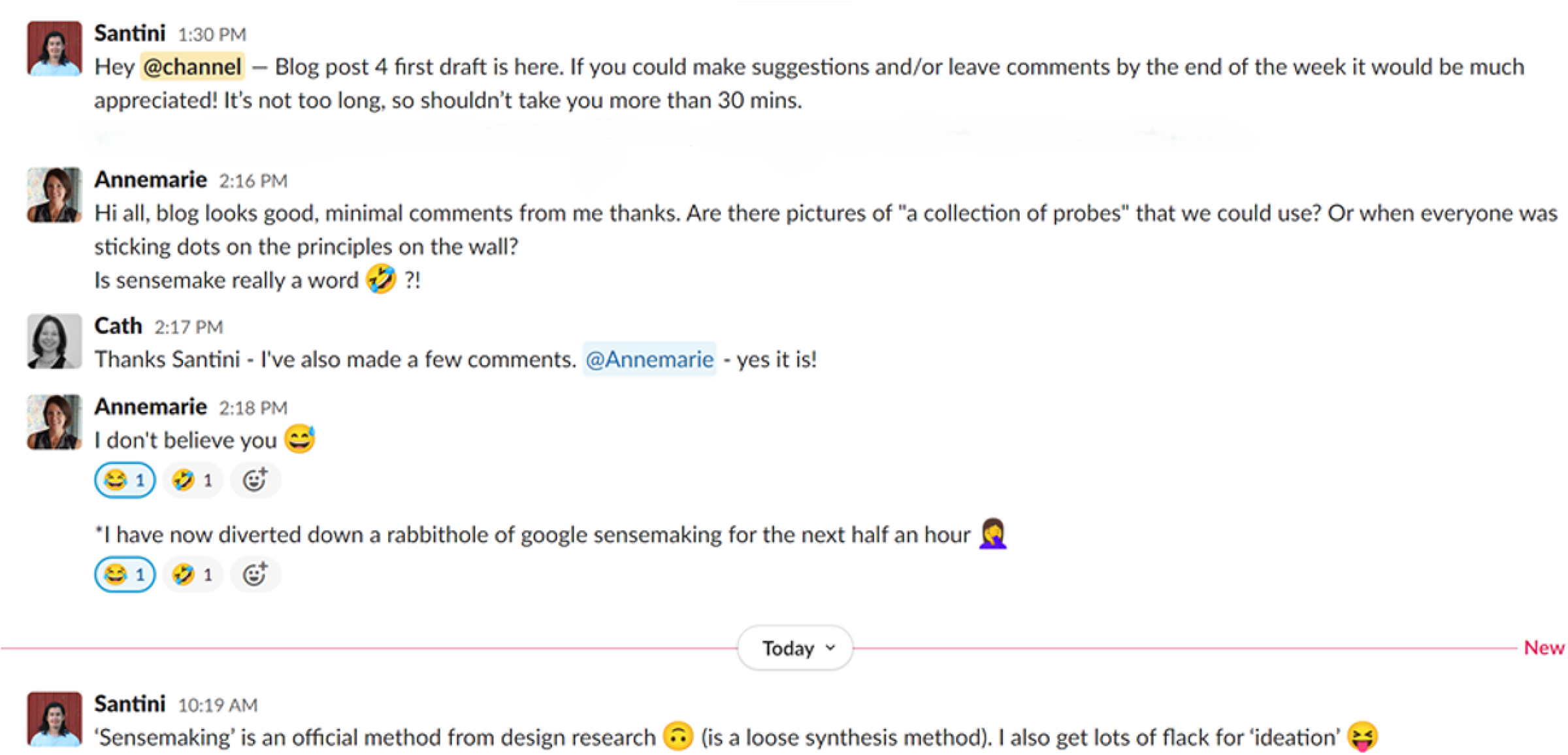
Extract from the Critical Care Futures slack workspace, March 2023, Edinburgh.
Re-affecting PPI
Just as the relations of interdisciplinarity were playful, so too were its objects. This may sound counterintuitive—careless even—in a project about critical care. Indeed, as a team, we were concerned that the speculative nature of the probes could lead to traumatic re-experiencing for ICU survivors in the absence of an appropriate framework of support. Important to emphasize here is that playfulness was not about entertainment or flippancy, about a disregard for the depth of people's experiences, but about providing a creative space of elicitation through which people could “intermesh their own stories” with those hinted at by the probes (Gaver 2002). A number of theorists draw attention to the dark sides of play, including its potential to reflect existing social hierarchies, reinforcing inequalities related to race, gender, or class; how gamification, often framed as “playful engagement,” can exploit workers or consumers by masking labor as fun; and how play can reinforce dominant ideologies rather than subvert them (Mortensen, Linderoth and Brown 2015; Trammell 2023). In this project, we sought to avoid these situations by consciously decoupling the creation of playful tools and spaces from the powerful scientific and medical institutions with a stake in the outcomes. The involvement and resourcing of an independent design studio was central to this.
The values at play here were ambiguity, sensoriality, and an openness to the unexpected—values which ran through the design and completion of the probes, as well as the production of the project insight report and the designed objects (Figure 2). The playful outputs of our interdisciplinary public engagement subverted the abstract technosolutionist slogan #DataSavesLives by turning it into a matter of mundane conversation over a cup of tea. Paraphrasing De la Bellacasa (2011), we can say it was about re-affecting an objectified world, that is, materially transforming knowledge outputs about scientific developments into matters of care.
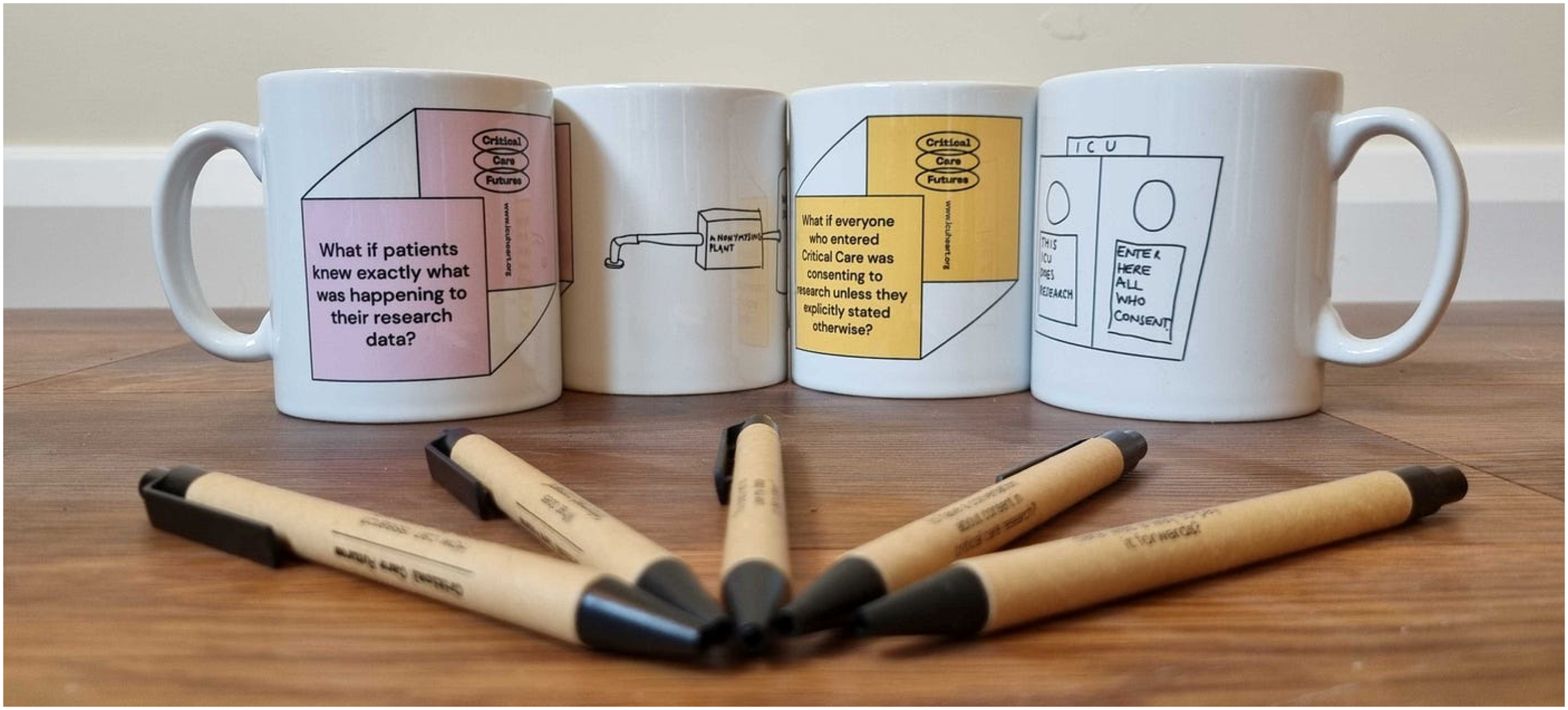
Mugs and pens, March 2023, Edinburgh. Mugs have the following provocations on them: (i) What if patients knew exactly what was happening to their research data? (ii) What if everyone who entered critical care was consenting to research unless they explicitly stated otherwise? (iii) What if critical care research had more of a public platform? (iv) What if using data better saved critically ill patients’ lives? Pens have the following text printed on them: (i) When is the best time to have a conversation about consent in critical care research? (ii) “It's crazy not to use my data to help others” (iii) How can research care for patients? (iv) What does “informed consent” really mean in critical care research? (v) What if sharing your data was a way to pay it forward? (vi) “I wish I could watch my data and see how it is used.”
Public engagement, then, is an achievement that is crafted through attachments and at the same time forges them. Ludic engagement is precisely concerned with leaving open-ended the ways in which people meet design objects. We didn’t collect data on how the mugs and pens were received, on how many conversations they sparked, on whether or not they were a “success.” That was not the point. Instead of insisting on engagement as a process of subject-object relations, of “us” engaging “them,” which entails the possibility of measurable effects, we created material openings for being affected from which we, as researchers, relinquished control and in which temporal circumscription was undone.
Conclusion
In the perspective proposed here, foregrounding care at the heart of critical constructivism reminds us that, in order to be liveable, a critical cut into a thing, a detachment of a part of the assemblage, involves a re-attachment. This means, on the one hand, that we become able to cut in a certain way because of our own attachments, because we care for some things more than others. And it means, on the other hand, that to produce a caring account, critical cuts shouldn’t merely expose or produce conflict but should also foster caring relations. (De la Bellacasa 2011, 97)
What is the relationship of epistemology to social and political transformation in PES? How can thinking with attachments help us answer this question? Firstly, how we know and how we generate knowledge is affective and relational. Secondly, working across disciplinary boundaries in an interdisciplinary way leads both to new relations and to new objects in an ontological sense. Thirdly, playfulness as a mode of working can shape both the relations and the objects in ways which prioritize the ambiguous, the speculative and the unexpected. This playfulness has long been a hallmark of STS, whether in the guise of provoking, ironicizing, or otherwising. However, as we have shown in this paper, whereas these have often served as a way to distance ourselves from others, playfulness as a mode of otherwising is, rather, about attaching—or put another way, it is about the inseparability of knowing and caring (De Laet, Driessen and Vogel 2021).
De Laet, Driessen and Vogel (2021) observe that “in the making of knowledge, care and normativities count. How they are made to count matters.” In this paper, we have reflected on how our very different normativities in a public engagement project worked not to undo relations but rather to make them stick. Through a collective valuing of playfulness as work ethos, methodologically and materially embodied in cultural probes, our diverse commitments and agendas coalesced in a form of togetherness which was the outcome rather than the prerequisite of interdisciplinary collaboration. The story is not one of smooth reconciliation in the politics of knowledge production; indeed, for all of us, there was an implicit discomfort associated with some dimensions of our work together. However, our willingness to be moved and changed through this interdisciplinary work resulted in a project in which the rational was wedded to the affective, the cognitive to the aesthetic, the playful to the serious.
CSD, which formed the ground for the ludic engagement we present, has been criticized for being elitist and serving the interests of designers and academics rather than addressing real concerns in the public sphere. With its focus on abstract, speculative futures, its ability to catalyze practical outcomes that contribute to meaningful social change has been questioned (Dunne and Raby 2013). What then, of the social and political transformation we have been writing about here, and Cath's reaction to the instrumentalization of this work into practical recommendations for data use in healthcare? As we have shown in this paper, otherwising is not antithetical to normative commitments in PES—either in the way it is conducted or the resulting “outputs.” Play challenges the boundaries of the imagination and opens new spaces of the possible. In this we find Calvert's (2023, 129) formulation helpful: “we can think of otherwising as belonging in the realm of the subjunctive—the possible, the ‘could’—rather than the normative, roughly glossed as the ‘should.’”
In this project, opening up new possibilities for interdisciplinarity, for engaging with different publics, and fundamentally for considering how we frame the question of data use in healthcare, have all been transformative. While the change has not been linear or immediate, we have observed a new propensity among colleagues to open up the terms of debate around routine data use, rather than tick boxes about patient involvement, and a willingness to move the agenda beyond simplistic renderings of bioethical concerns. In part, this has come about by sharing outcomes from the project with decision-makers via a well-designed and accessible report, which was widely circulated (Docherty et al. 2023). The reimagined visions from the probes—which included those not just of former patients but also ethics committee members, researchers and clinicians—formed the basis of an ongoing dialogue in which we succeeded in moving beyond passive/active subject positions. This included presenting the reimagined visions of consent for routine data use to members of the Scottish government parliamentary working group for adults with incapacity, and the Scotland A Research Ethics Committee (which reviews studies requiring ethical approval under the Adults with Incapacity (Scotland) Act 2000), and inviting further dialogue and creative interaction with these. Two years after the end of the project, participants still tell us how meaningful they found the discussions.
The affective nature of this work is important. Play, we suggest, can be used as an intentional way to cultivate affective moments and out of these moments to do work which is thoughtful, careful, and otherwise. That is to say, work which does not run along the tracks of the status quo, but which is inspired both by a love of knowledge-making—which STS scholars often share with scientists—and a desire to show how it could be otherwise. Play disrupts both the distance of objectification in science and the hollowness of critique without care. Ludic engagement re-affects our relationship with the objects of science and opens up the possibility not only of caring attachments, but indeed of what has variously been called neighborliness (Balmer et al. 2016) or friendship (Fortun 2023). Key to this are the elements we identified above: risk, vulnerability, creativity, and an orientation to the speculative. The question, then, is not “otherwising or attaching,” since as we have shown here, attaching through playfully speculative means can itself be a form of otherwising. Instead, our analysis raises the question of how to play and how to play well.
Footnotes
Acknowledgments
We thank Jean Antonelli, Monika Beatty, Goutam Das, and Joanne Mair for collaborating with us as co-designers in Critical Care Futures and Freyja Harris and Lizzie Abernethy for their work on the project. Special thanks to all the participants in the Critical Care Futures project. Versions of this paper were presented at meetings in Edinburgh, London, Manchester, and Maastricht. We thank the participants for their comments.

Funding
The authors disclosed receipt of the following financial support for the research, authorship, and/or publication of this article: This work was supported by UK Research and Innovation [EP/Y027620/1] and the Wellcome Trust [217078/Z/19/Z].