




Abstract
This article examines the transformation of terrarium building from a colonial-era hobbyist practice into a contemporary YouTube-based citizen science movement, analyzing how this shift reflects changing conceptualizations of nature's relationship to capital. Through a case study of AntsCanada, a prominent YouTube channel focused on ant-keeping terraria, the article demonstrates how traditional terrarium design's “logic of closure” has been subordinated to a “logic of function” within social media's attention economy. The channel's evolution from simple ant colonies to complex community terraria reveals how contemporary platform capitalism preserves and mobilizes multiplicities of nonhuman matters of concern as speculative inventory for future business opportunities. Drawing on actor-network theory and Alain Badiou's theory of multiplicities, the article argues that this YouTube entrepreneur exemplifies the new vectoralist class in the current software capitalism, where profit derives not from direct resource extraction but from redirecting system excesses into new affordances. The article concludes that while this vectoralist approach to scaling ecosystems appears to mirror Badiou's concept of truth procedures, it ultimately serves as capitalism's novel instrument for capturing nonhuman multiplicities.
Terrarium and the Modern Constitution
Terrariums, a horticultural hobby of cultivating a tiny ecosystem in a container, seem to epitomize what Latour (1993) calls the modern constitution better than any laboratory he analyzed. This is partly because terrariums fetishize nature by keeping it pristine inside the containers, away from human culture. More importantly, their deployment within the urban landscape has aroused certain aesthetic feelings and ethical concerns toward nature that have sustained this hobbyist industry. Since their invention in the mid-19th century by British biologist Nathaniel Bagshaw Ward to import fern species from tropical Jamaica to his British homeland, 1 terrariums have offered a way to display non-Western nature to the public gaze without letting it perish or transform when exposed to foreign environments (Figure 1). The commercialization of terrariums as horticultural commodities, whether marketed as “a fashionable home accessory for middle class Victorians” or for “biology teaching” in classrooms, has carved out nature's new niches within modernity without disturbing its fetishized self-sufficiency. Terrariums transformed nature into a therapeutic object benefiting “the sick, elderly and mentally afflicted,” or moderns suffering from the ills of culture (Hershey 1996, 278). As Latour (1993, 13) says regarding the modern constitution, this subgenre of modern culture arose “from the masking of the conjoined birth and the separate treatment of” humans and nonhumans.
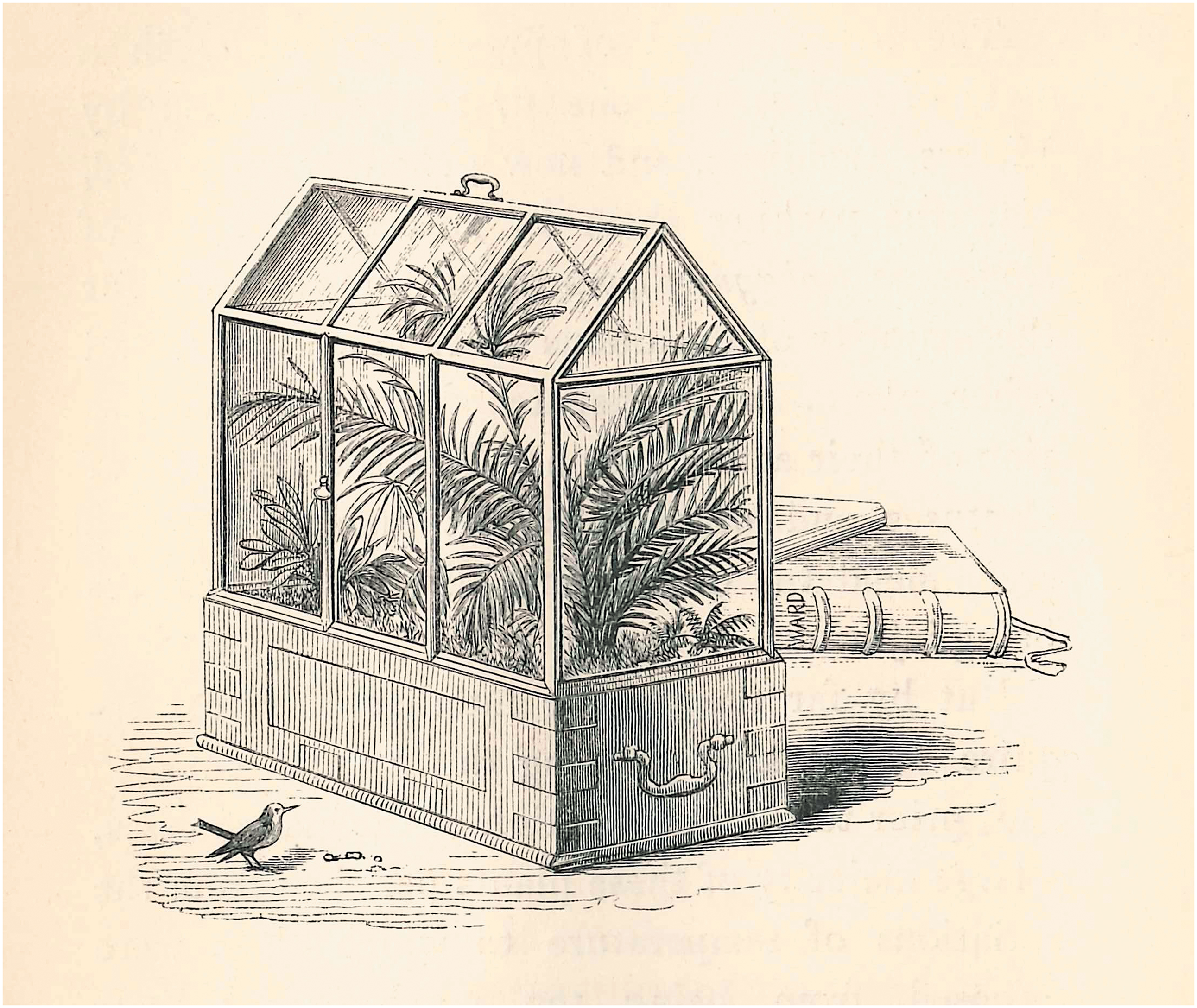
A Wardian case to move plants on long sea voyages (Ward 1852).
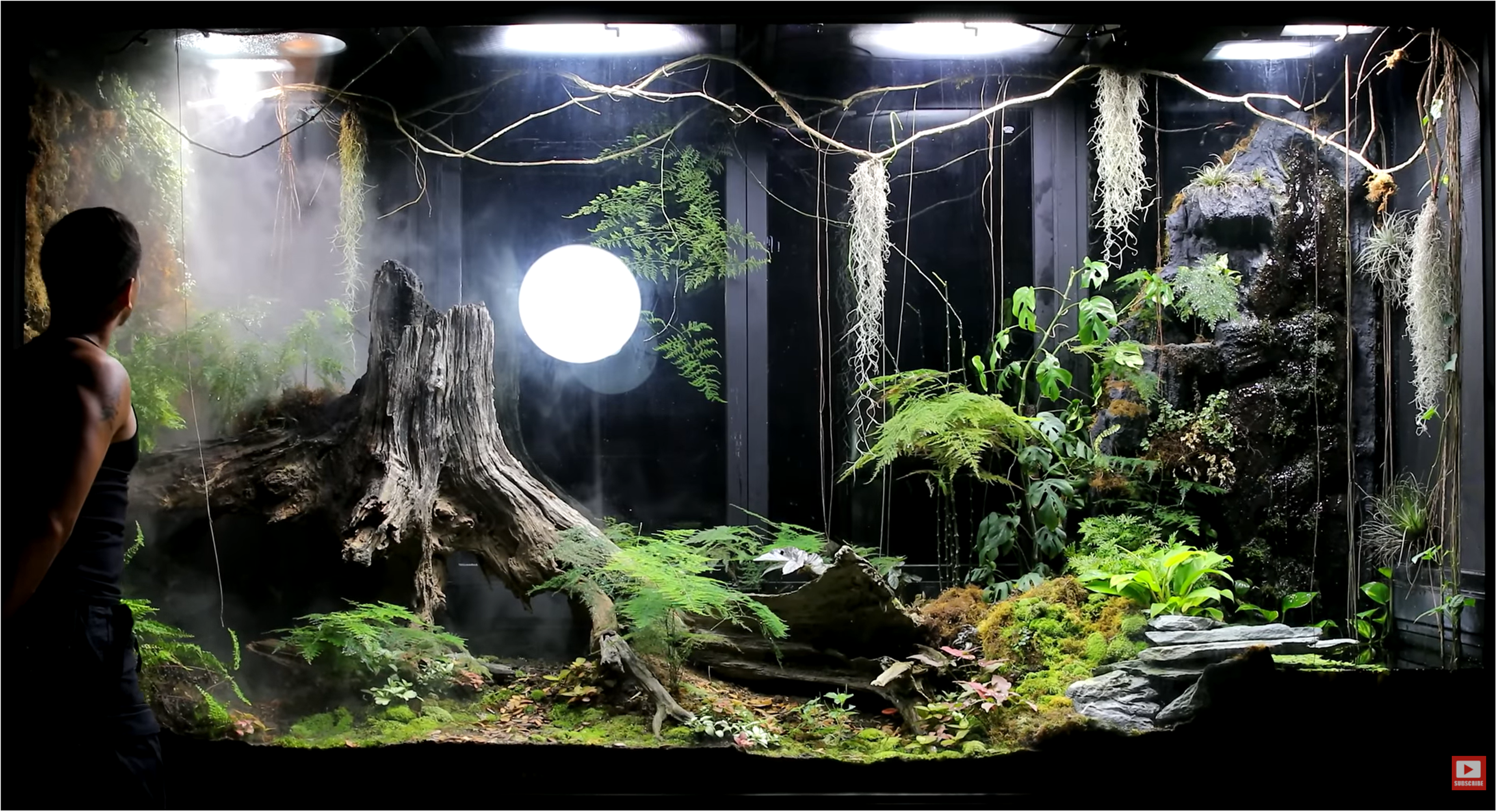
Pantdora, a community terrarium. Still from a YouTube video (AntsCanada 2024c).
On the other hand, the emergence of YouTube channels 2 devoted to terrarium building around the 2010s was a turning point, reprograming this century-old hobbyist science into something “nonmodern” (Latour 1993). This shift occurred as micro-entrepreneurs on YouTube carved out new niches for terrariums within its attention economy. Beyond self-sufficiency, another fetishized notion of the earth that terrariums suggest to YouTubers is plasticity, referring to the earth's capacity to generate endless new figures of multispecies cohabitation in response to disturbances caused by the platform's participatory culture. To sustain their enclosed microcosms, their new platform niches now need to be supplied with enough attention—a resource as important to fixate audiences’ interests in nature preservation as sunshine is for plants and bacteria to fix carbon. While “The theoretically ideal state of trophic equilibrium” that terrariums display in their constant “regeneration of chemical nutrients in an ecosystem, without loss or gain from the outside” was what ecosystem science founder Raymond Lindeman (1942, 410-11) 3 found enthralling, on YouTube this peaceful outlook is not sufficiently engaging or clickbaitable. In the attention economy, what makes a terrarium a specifically profitable system is its attention-grabbing metastability, 4 or the fragility of the current whole created by its extreme disentanglement from the outside. Its hyper-responsiveness to any tiny disturbance suggests the existence of other possible wholes that the small earth inside could unravel as disturbed animals and plants eventually re-territorialize its soil.
Regarding the previously emphasized self-sufficiency of terrariums, Derek Woods (2019a, 122) says “the ecosystem as an idealized unit” they represent is characterized by “the logic of closure and balance more than the logic of function and purpose.” 5 Terrariums, as an invention of the modern Constitution, displayed this trophic economy of nature in perfect balance and pristine condition amid human cultures. Their horticultural commodification enabled these natural economies to be relocated anywhere, regardless of the locations’ differing functional logics. On the other hand, terrariums’ incorporation into the giant attention-grabbing machine of social media now exposes how the imagined closure of nature by autonomous multispecies cohabitation has never been modern, or how it has always been created as a hybrid, “natureculture” (Haraway 2003). This nonmodernity of terrariums is demonstrated by polls and creators’ comments that terrarium YouTubers 6 use to ask their audiences about the new species they want to introduce to their beloved terrariums. Audiences in the comments sections 7 then express how much they take care of existing animal species whose territorial behaviors have already been enrolled 8 as a functional element of a closed ecosystem, and thus how careful they should be when choosing new species lest the existing ones drop out while the invasive one finds its own niche from excessive materials produced by others’ territorializations. On YouTube, terrariums are reprogramed into a form of citizen science project, in which human interventions must routinely occur to re-fetishize their closure in each new episode. And here, their logic of closure becomes subordinate to the logic of function, as a closure is now created only as the terrarium' temporal readiness to another disturbance that the creator strategically chooses as the means to draw further audience interest and engagement into its new platform niche. Despite its seeming stasis, the fragile metastability of the enclosed ecosystem attracts the gaze of people as it alludes to something constantly subtracted from the current whole. These others are nonetheless never graspable because, like Badiou's (2005) pure multiplicities, their speculative existences lie rather in their constant withdrawals from the current enrollment, arousing audiences’ continuous ethical and aesthetic concerns about differently interested worlds that terrariums could unravel in response to human-caused disturbances.
In this respect, the popularity of terrarium YouTubers during the COVID pandemic was not a mere coincidence but symptomatic, given the “botanic boom” (Gleeson 2021); “lockdown terrarium” was reintroduced as a new hobby, which is “almost maintenance-free” (Oxford Botanic Garden and Arboretum 2020), “one thing you can control” (The New York Times 2021), an object for “meditation” (A Journal of the Plague Year 2020) with “psychological benefits” (Senavarayan and Akbar 2020), and sold as part of a “Pandemic Survival Kit” (All The Buzz 2020). Humanity was forced to quarantine itself against the intrusiveness of the SARS-CoV-2 virus, demonstrating the fragility of modernity's constitutional separation between nature and culture. Meanwhile, the self-sufficiency of nature, encased and fetishized by traditional terrarium design, faced new challenges from YouTube's participatory culture, where creators who rediscovered the value of terrariums as inexhaustible resources for generating potentially unlimited YouTube episodes, began to periodically reopen them to accommodate new invasive species, often at their audiences’ request.
The COVID pandemic was indeed linked to human-caused habitat loss, declining biodiversity, and increased exposure to zoonotic disease (Heyd 2020; Horn 2021; O’Callaghan-Gordo and Antó 2020). It was a crisis stemming from capitalism's excesses—ones that exceeded the capacity of the earth's ecosystem services to reuptake them. However, more is at stake in analyzing terrariums as a geo-fetish than just symptomizing sustainability-related castration anxiety: explaining how their miniaturized earth serves as therapy for this anxiety. 9 And through their therapeutic and meditative generation during and after the pandemic, what terrariums have fetishized is a speculative totality of the earth, which is plastic enough to accommodate multiple species, including humans, and their “restricted economies” of resource use and waste (Ahn 2024). On YouTube, terrarium builders and their audiences explore this over-territorialization of the earth through the multiplicities of plant, animal, and microbial interests and how they find from each other's surplus production the favorable externalities for their niches to settle in. In the rest of the article, I develop a framework to analyze this geo-fetish in the Anthropocene from my reading of multiplicities in STS ontology and Badiou's materialist dialectics, addressing: (1) how it reimagines the earth as a commons with unlimited ecosystem services, and (2) how it promises its continuous re-territorialization, contrasting with the previous era's imperialist clearing and enclosure of nature.
The first section examines a YouTube channel focused on ant-keeping terrariums and demonstrates how these multiplicities of nonhuman interests that terrariums populate on a miniaturized earth are aligned well with actor-network theory's relational ontology. This alignment exists not simply because actor-network theory (ANT) illustrates human enrollments of nonhumans in constructing the geo-fetish but rather because it posits the totality in question to exist as multiplicities of matters of concern. In its early fetishization from a spectatorial distance, a terrarium ecosystem was imagined to emerge from such systems theoretical disturbances, through which some of these multiplicities, responsive to each other, are gradually aligned to form an organizational closure against its co-constructed inert environment. On the other hand, in the ANT's narrativization of multispecies cohabitation, the process that enables the formation of a network across mutually interested actors is not so much synthetic but subtractive, suggesting multiplicities of disinterested others dropping out from current enrollments. Following Haraway (2016), if autopoiesis is the process of folding multiplicities into “organisms plus environments,” actant-networks are “sympoietic” as their metastable closures also unfold multiplicities of “string figures,” generative of multiplicities of “speculative fabulations” about differently interested worlds. Reversing Latour's appropriation of actants from Greimasian narrative theory (Beetz 2013), this section uses ANT to trace how something excessive left by nature's unstable temporal closures is picked up by the YouTuber to continue his speculative fiction of the sustainable and constant re-territorialization of the earth.
In the second section, this geo-fetish that affords the platform entrepreneurship is read as symptomatic of how the earth is imagined as a new sort of commons that promises a magical scalability solution to capitalism against the Capitalocene. The new concept of scalability operates when the enclosure of the commons ceases to be reductionist in the way in which it has, as Tsing's (2012) theorization of scalability argues, depleted the earth's ecosystem services, and gives way to the proactive speculation about abundant nonhuman dropouts around which new territories could be constantly re-enclosed.
In response to ANT's lack of critical language to analyze this speculative operation of capitalism in terms of more than mere difference in the degree of agency between humans and other symmetrically agential nonhuman actants, the concluding section examines Alain Badiou's (2005, 2009) concept of multiplicities and subject as an alternative framework for both theorizing and resisting this speculative economy undergirded by geo-fetishism.
AntsCanada: Geology of a Platform Ecosystem
AntsCanada is one of the largest terrarium YouTube channels, 10 boasting more than 6.8 million subscribers as of writing. The channel was created by Mikey Bustos, who first gained recognition for his appearance on the reality TV show Canadian Idol in 2003. Since launching its first video in 2009, the channel has produced 763 videos documenting the construction and observation of terrariums with varying sizes, soils, climates, flora, and fauna.
In its inaugural video (AntsCanada 2009), Bustos documented his exploration of an undisclosed Canadian forest where he easily collected 800 Myrmica rubra ants in just 30 minutes in exchange for “20 mosquito bites,” marked on his disturbing presence as excessive nutrients in the metastable ecosystem. These (act-)ants, dropped out of their previous network, were migrated into “the artificial ant nest (made from grout and plexiglass)” in Bustos's studio. Connected to the maze-like nest was a more extensive terrarium constructed as an “outworld,” carefully designed to mirror the geology and flora of their natural habitats. Over the following month, he observed how ants enrolled things as their allies by marking with pheromones “their feeding area and hunting territory, which they clean[ed] constantly, and defend[ed] aggressively” (AntsCanada 2009).
From its inception, the channel has served as a shopfront for an online store which offers to global audiences an extensive range of ant-keeping equipment, including containers of various shapes and sizes for nests and outworlds tailored to different ant species, heat cables for temperature control, comprehensive starter kits complete with ant-keeping manuals, as well as additional merchandise such as t-shirts and stickers. As an exemplar of typical YouTube entrepreneurship, AntsCanada leverages the platform's affordances to minimize marketing costs. Key to the channel's success has been how it has transduced audiences’ attention, paid to the channel for any reason, into their real interests (not only in advertisements embedded within videos, YouTube's primary interest in hosting the channel, but also) in DIY terrarium building with tools purchased from the online store. Bustos's dramatic voiceovers and exaggerated gestures as a former TV celebrity have been effective to this end. For instance, the common narrative he has developed throughout more than 700 terrarium videos starts with a long-distance shot showing how peaceful an ecosystem looks in the container, as fittingly enclosed as it was at the end of the previous episode. This is followed by a close-up that spots some things overpopulating or dropping out, accompanied by his signature head-seizing gesture. The remaining video then shows his effort to generate a new closure, not by removing excesses, but rather by introducing new species or organic/inorganic materials. These would find their niches within the excesses by reuptaking them as shelters or foods, thus providing new ecosystem services to the microcosm.
The channel states that “AntsCanada is an organization promoting the pet ant keeping hobby, myrmecology, ecology, and habitat conservation” (“About Ants Canada”). However, what seems to be the most valuable inventory for its socially conscious business, namely ants (particularly queen ants), has consistently remained the only item that could not be traded in its online store due to global and local regulations governing animal transport (AntsCanada “Queen Ants For Sale”). Thus, the process of local ant conservation, the channel advises, is to redirect ants from an overpopulated local colony, which would otherwise naturally perish or drop out of the restricted natural enclosure, into an artificial outworld—a terrarium—where they would mark their new territory through constant interactions with species and matters that they would otherwise not encounter in their natural habitat. The channel's use of terrarium as an umbrella term and a bigger geological unit in which a formicarium is embedded suggests that this sort of experiment in terra's multispecies cohabitation is what AntsCanada has marketed its equipment for. Responding to common fantasies that many hobbyist ant keepers have shared online, such as “creating a self-sustaining ant farm” (JeDStoker 2018), “a closed ecosphere where an ant colony could live indefinitely” (megamacho 2019), and seeing “a colony [sic] grow and sustain itself” (spald01 2023) “as self sufficient as possible” (mywan 2019), the solution AntsCanada provides is to expand single species-dominant formicariums to multispecies cohabiting terrariums. (I note that this solution is fetishized too, as AntsCanada conceals how constant human management of nonhumans is an integrated part of the fabricated self-closure.)
Following the typical language of platform entrepreneurism, AntsCanada promotes the activity of ant-keeping in a terrarium as something that anybody can participate in with no expert knowledge or skill, but with the tools and manuals from the store, whose affordances, the AntsCanada website says, make terrarium building “simple and enjoyable” (“About Ants Canada”). Following another platform rhetoric of impact-conscious business and participatory solutions to social problems, audiences’ interest in this pastime activity, otherwise quickly perishing or dropping out of the channel's moneymaking proposition, is also re-mobilized for a community-oriented solution to a broader social goal, namely to “promote ant awareness and inspire conservation” (AntsCanada “About Ants Canada”).
This redirection of audiences’ pastime interests into the business's social impact stands out most in the Global Ant Nursery (GAN) project, which Bustos launched in 2009 to address the challenges of queen ant supply across borders. Operating as a network of hundreds of ant farmers across forty-three countries, the GAN project “offers a simple solution for those needing ant colonies with a queen for their formicariums” by connecting enthusiasts to local farmers who supply queen ants of native species (AntsCanada “Queen Ants For Sale”). Additionally, the project “provides an opportunity for ant hobbyists to earn some extra money” by joining as queen ant suppliers (AntsCanada “Queen Ants For Sale”). Self-described as “like the ‘Uber’ for live ants,” AntsCanada positions itself as a platform to foster micro-entrepreneurship among hobbyists while emphasizing ecologically ethical and responsible practices, for which hobbyists-entrepreneurs are encouraged to purchase “any of our effective ‘All You Need’ Starter Kit Gear Packs at our shop” and “pick up our Ultimate Ant Keeping Handbook E-book for all the information needed to care for your ants properly” (AntsCanada “Queen Ants For Sale”).
The scale-up of AntsCanada's business has, therefore, rested upon the ecosystems it has cultivated inside and outside the terrariums among diverse stakeholders: hobbyists, audiences, farmers, equipment manufacturers, YouTube and its advertisers, and the multiple species of animals, plants, and microbes thriving in terrariums. As a voiceover narrator and an ecosystem builder, Bustos's role has been to unravel excesses and dropouts from a stakeholder's overpopulation or overattachment and re-weave them into string figures to entangle another stakeholder's interests with. Through his intermediation, the biological activities of one species are redirected into positive externalities or ecosystem services for another. Likewise, surplus activities of one audience group are transformed into new affordances or business opportunities for another group. The metastability of the microcosm's temporal closure is where his narration unfolds these strings, which redirect audiences’ excessive interest in ant-keeping beyond passive observation into new opportunities for product sales. Through these strings, hobbyists who initially approached ant-keeping as a mere pastime are also led to develop a genuine interest in local ant species conservation, providing growth opportunities for the GAN project. With ant colonies that flourish in terrariums and produce multiple queens as excesses, hobbyist keepers can also transition into farmers, micro-entrepreneurs. And the ethical concerns arising from this intensified enjoyment and monetization—particularly regarding potential ecosystem disruption—are carried away to the channel that positions itself as an obligatory passage point (Callon 1986), the primary authority on ethical and responsible practices in both hobby and farming contexts.
In this dual ecosystem, the terrariums, cultivated by both the channel and its audiences/customers, serve as the literal geological bases of the business that generate material excesses. Meanwhile, audiences and hobbyists invest their cognitive resources into these excesses, and the moral and commercial economies of humans, generated accordingly through their concerns for and pleasure in nature, are traded alongside the channel's equipment and the queen ants in the GAN project's sharing economy. It is notable that for the scalability of his platform business, the terrarium's logic of closure, which typically affords conservation by supporting the long-term sustainability of a micro-ecosystem with minimal maintenance, proved ineffective in accommodating all the opportunities its macro-ecosystem promises. This is because the idealized trophic balance achieved within the microcosm means that excesses produced by one species are almost exhaustively consumed by others, leaving little surplus for outside actors to invest in. Even for the most beloved pre-pandemic ant colony, named Fire Nation, capitalization was limited to the periods when excessive resources remained unconsumed by the registered behaviors of ants and plants. Consequently, after a sustainable micro-ecosystem had settled in, new excesses needed to be either regenerated or introduced through accidents or Bustos's interventions. For the enclosed geological bases to function in enabling the ever-expanding macro-ecosystem, new spectacles were routinely introduced to run audiences’ moral economies, not only to mobilize their conservation interests but also to encourage speculative fabrication of a geo-fetish—its inexhaustible resilience and creativity in generating lots of different forms of cohabitation from any disturbances. The excesses were manufactured to produce more episodes, rather than spontaneously generated, and they include various elements: extra foods such as gestating giant cockroaches (AntsCanada 2016a), Thanksgiving turkey (2016d), and candies shaped like Hillary Clinton (2016c) and Donald Trump (2016b) for the US presidential election; entirely new terrariums serving as “outworlds” with different flora and fauna for ants to explore and territorialize (2018a); alien species such as giant spiders (2018c) and species-unidentified pregnant shrimps (2018d); and simulated disasters such as floods (2016e, 2018b). Yet this approach to “biological engineering” of “a perfect biological and self-perpetuating machine” (2018d) required careful management, because Bustos needed to limit these interventions to allow disturbed ecosystems sufficient time to restore their resilience, and also to address backlash from ethically minded audiences. Consequently, during this early period, the business's ecosystem expansion was primarily achieved through literal geological scale-up—constructing multiple terrariums simultaneously and rotating video production among them.
While this initial strategy inevitably approached its limits due to the physical constraints of the original Ant Room studio, the channel's 2021 decision to construct a new museum-sized, two-story facility called “Antiverse 2.0” during the pandemic signaled a strategic shift in ecosystem expansion. For AntsCanada, the COVID-19 pandemic, which Bustos (2023b) calls “Ant Room-pocalypse,” was also the revelation of terrariums’ nonmodern hybridity concealed under their seeming self-closure. Their fetishized self-sufficiencies were easily disturbed by the “feeder scarcity issue due to lockdowns,” which forced Bustos to downsize his collection drastically. The transition he termed “the great AC transition” (AntsCanada 2021), in this context, represented more than just increased storage capacity. The new scale also enabled qualitative changes, allowing terrariums large enough to simulate how natural regions are over-territorialized by multiple species while being constantly de-/re-territorialized by random events. This idea of the “community terrarium” (2023a) was to address previous ethical concerns about introducing prey/predator species or competing ant species merely as spectacles, since the diverse geological structures and flora could now provide niches for all species to find food and shelter, allowing “natural selection”—which Bustos considers ethically acceptable—to regulate populations naturally (2023a). To simulate the influence of larger plants and apex species, for whom the area the terrarium represents would be just a small portion of their vast territories, Bustos introduced “Planned Biological Events”—world-changing disturbances, such as dropping fruit as excess food resources or seed to germinate, or large animals (otherwise “living in their own separate enclosures”; AntsCanada 2023c) jumping into the terrarium and staying for several hours or days. They were supposed to “mimic the natural movement in and out of animals and plants that would typically occur in nature in our theoretically 1,200-gallon natural wild space” (AntsCanada 2023c).
As the community terrarium became the primary focus for filming and streaming, the other terrariums—previously considered content-exhausted and merely stored until natural decline—gained renewed value as inventory. Indeed, these smaller terrariums were ideal containers for long-term species preservation with minimal maintenance and, most of all, without diminishing the species’ plasticity. While “keeping ant colonies alone” in smaller terrariums provides only “a limited picture of the ants,” Bustos says, their integration into the community terrarium demonstrates their creative contribution to a “more complex and beautiful ecological tableau, to which the ants actually belong in the world” (2023a). Smaller terrariums’ rearrangement around the community terrarium in Antiverse 2.0 suggested that a new kind of capitalist ontology would govern the channel's inventories from then on, whereby inventory management must consider each item not as a finite resource that can be simply used up, but as a vessel of potentially inexhaustible speculative value, which could be realized through strategic combinations with other entities in experimental settings.
This second phase of ecosystem expansion also reframed the terrarium's logic of closure, from something autopoietic to what Haraway (2016) calls sympoietic: from the closure that folds multiplicities of nonhuman interests into a co-constitutive and homeostatic pair of “organisms plus environments” to the closure whose metastability is too fragile to remain stable even from any tiny disturbance, suggestive of multiplicities of “string figures” yet unrealized across microbes, plants, and animals. The logic of closure now serves the logic of function, as metastabilities that each system attains within its small container are redeployed in larger, open-ended experimental environments, thereby these nonhumans will unfold differently interested worlds than their current confined cohabitation.
Following actor-network theory, these potentially manifesting multiplicities can be termed matters of concern. Latour (2004) uses this ordinary English phrase to describe how things exist under ANT's relational ontology, in which something comes to exist as an objective matter of fact only as the consequence of its being interested in and consistently responding to the actions of others. This suggests that for such things that are interested in and responsive to each other but not yet engaged with human observers, or those not yet interested in anything, actor-network theorists need to posit their presence only as pure multiplicities of preindividuated interests, until they are eventually interested in and exercise continuous and consistent influence on the network they are enrolled in (Law 2012). Viewing terrarium components (such as soils, microbes, plants, and small animals) as these matters of concern allows us to analyze their territorial development as the process that Callon (1986, 207-8) calls “interessement,” whereby an entity exercises a set of actions “to impose and stabilize the identity of other actors,” to enroll their consistent responses in the network it organizes. Through this process, plants would take their actions—for instance, reaching their roots out into the earth—and then enroll those earthly matters responding favorably—for instance, by letting them through or moisturizing—as actants in their rhizomatic networks. Ants would mark with their pheromones the matters that respond by serving food and shelter to their constant movements of antennae, and their territory would be gradually formed as visible trails appear along these enrolled matters. An ecosystem would finally emerge as all these matters are interested in and respond to each other and are enrolled as each other's mobilizable matters of fact to network or territorialize. Its self-sufficiency is when these matters are in a “favorable balance of power” (Callon 1986) as their territories provide favorable externalities to each other.
As a descriptive tool, 11 ANT offers several technical benefits, such as allowing us to leave undefined those matters whose influence on others remains unnoticeable or inconsistent, or it may allow simply taking influences (or what Karen Barad (2003) calls “intra-action”) as the fundamental unit of analysis, from which things and their identities are inferred to be just temporal localizations of influence. It also effectively dissipates something subjective that used to be posited for synthesizing heterogeneity of interactions for a self-identical apperception to draw consistent responses from a world. Intra-active pairs of actions and responses are rather registered 12 on the earth as a sort of punctuation, which Badiou (2009, 101) calls “transcendental operators,” through which inconsistent multiplicities come to “consist as being-there” in a certain situation or a world.
Beyond these methodological advantages, ANT's concept of matters of concern proves particularly valuable in analyzing the current platform entrepreneurism represented by AntsCanada, as another Uber-like service, because this framework shifts our attention from what is immediately commodified (such as a visible ecosystem as spectacle) to the multiplicities of matter still persisting within its inventory but yet unnoticeable as they are uninterested in and thus withdrawing from current methods of commodification. These nonhuman matters of concern are precisely what terrariums are designed to preserve, as a new form of inventory with the logic of closure, while simultaneously serving as an inexhaustible “reserve army” for the channel's future businesses (Latour 2007).
Vectorialist Re-Commoning
As geo-fetishes against the Anthropocene's generalized sustainability crisis, a new cultural imagery of the earth (which YouTube terrariums epitomize) promises many different figures of multispecies cohabitation and over-territorialization of the commons. Since its origin as Ward's invention to import and cultivate exotic natural resources in foreign environments, the terrarium has functioned to redirect the earth's geological support into human economies. As demonstrated by AntsCanada's case, this support now extends beyond merely nourishing plants in soil. It encompasses the capability of hosting multiplicities of matters and their inconsistent concerns, whose response-abilities to each other constantly regenerate string figures that re-striate the earth; they afford organic lives to thrive, territories to expand, and businesses to flourish: the support that some Deleuzian geographers (Grosz, Yusoff and Clark 2017, 134) term geopower or “inhuman and preindividuated forces that subtend and provoke organic life.”
These new materialist agencies of the soil pertain to how, in current critical resource geography (Bakker and Bridge 2021) the earth transcends its traditional role as inert matter serving as standing reserve to fuel industries. It foregrounds how multiple life forms’ constant re-territorialization of the land over each other's excesses—in other words, their nonhuman commoning of the earth—actually provided indispensable ecosystem services supporting industrial scale-up before the Anthropocene; their activities sequestered wastes from human economies. This “constitutive role of nonhuman capacities” (Bakker and Bridge 2021, 48-50) decenters and displaces humans to “flatter ontologies” in which nonhumans are speculated to be engaged with their own differently interested worlds beyond capitalist value systems.
While some optimistic commentators anticipate alternative commoning practices emerging “to offer multiple forms of resistance” against capitalist tragedy (Grear 2020, 340), AntsCanada's exploitation of nonhumans reveals how this renewed vitalist understanding of nature can also be complicit with “the neoliberalization of nature” (Braun 2015). And it looks particularly so when the highly regulated ecosystem inside Bustos's terrarium is not to punish but to let each species thrive according to their own matters of concern, not to remove dropouts but to redirect their withdrawals into other creative processes—much like Foucauldian biopower does with human populations. The current nonhuman turn in resource geography in this light extends the critique of biopolitics to human governance of nonhuman nature and, as the upending of Foucauldian biopolitics which Derrida (2009) characterizes by its strategic mistake of life as fact (zoe) for life as right (bios) (Ahn 2022), it turns every matter on the earth, including nonlife, into a matter of its own right or concern prior to its eventual alignment as a fact under management.
According to this flattened ontology that deconstructs anthropo, some could say humans have never been truly central during the Capitalocene because they were merely the primary source of surplus production to be liquidated into commodities, alongside their nonhuman cohabitants. Meanwhile, capitalists were the implementers of capitalism's constant de-territorialization of the earth, clearing away nature's superfluous productivity, irreducible to what runs industries, through enclosure—“a movement of spatial abstraction and commodification…subsuming non-capitalist social spaces under the value practices of capital” (Sevilla-Buitrago 2015). If this reductionist operation of early capitalism represents, to paraphrase Marx, nature's formal subsumption under capital, today's environmental credit markets exemplify its real subsumption. In systems like wetland banks, developers purchase and re-enclose natural habitats to restore local ecosystems and convert them into “bundles” of ecosystem services to be sold as credits to industries seeking to offset environmental damage they made elsewhere (Robertson 2012). This new commodity form of nature is not merely “something imposed on it after it is extracted from a forest or a mine” (Robertson 2012, 397). Rather, it suggests how nature, even in its most undisturbed form—with speculated irreducible interests of their own—is always already captured by capital, as ecologists working for these new financial markets translate multiplicities of matters and their inconsistent concerns into biodiversity capable of sequestering industrial waste, and hence tradable as ecosystem services not by being well-developed but by being well-preserved.
At the forefront of his business's ecosystem expansion, what Bustos experimented with was also this new form of enclosure, not designed to dispossess its commoners (plants, animals, microbes) of their capacity to creatively appropriate soil for their own purposes. Rather than constraining these organisms, their territorializations are left unchecked, generating excesses, which Bustos then transforms into ecosystem services to support others’ further territorialization or afford new niches for invasive species. For his channel, this increasing biodiversity serves as another form of excess, enabling it to accommodate various consumer demands and audiences’ moral economies, to diversify the channel's business model. Thus, the scalability of his platform business does not depend on the containment of the excesses but on their constant redirections.
This approach to scalability stands in stark contrast to historical examples. In her article on Portuguese colonial sugarcane plantations in Brazil, Tsing (2012, 507) defines “scalability” as the design feature allowing small projects to “become big without changing the nature of the project.” Since natural expansion typically involves entities “taking on new materials and relationships” that transform their elements, “scalability is not an ordinary feature of nature” but rather “takes a lot of work,” including “the exclusion of biological and cultural diversity from scalable designs” (Tsing 2012, 507). This principle manifested in the expansion of European domestic sugarcane onto lands seized from native peoples, achieved through the clearing of native plants and the transplantation of African slaves—treated as another scalable unit with “no local social relations and thus no easy place to run” (Tsing 2012, 512).
This traditional understanding of scalability is strongly aligned with Ward's original terrarium design in the mid-19th century, which aimed to create a self-contained ecosystem isolated from outside disturbances. Designed as modular units that could be placed in any space without transforming their elements, terrariums in the hobbyist industry exemplify Tsing's definition of scalability even more precisely than sugarcane plantations. While terrariums expose the artificiality of self-sufficient nature fabricated by enormous invisible labor and infrastructural supports to maintain its metastable organizational homogeneity, in reality sugarcane plantations were never truly self-contained. Tsing (2012, 515) notes that plantation expansion generated uncontainable excesses as well, which sometimes benefited the system, such as when “enslaved workers slipped away to form maroon communities, and planting stock arrived with stowaway fungal rots that spread to the whole field.” In the same paper, she also briefly mentions the essential role of non-scalable actors for the scalability of the current supply chain capitalism represented by Walmart and Amazon, supported by many small businesses and independent contractors/gig workers as suppliers of actual services and products. For me, these people are non-scalable in two different senses. First, they are granted relative autonomy in how they appropriate the affordances provided by the platforms of these supply chain giants. Second, they are required to remain non-scalable, non-unionized, and non-homogenized for conglomerates to effectively outsource both risks and the task of figuring out more efficient supply chain solutions. In describing these “articulations between the scalable and the nonscalable,” Tsing (2012, 519) assumes somewhat symmetrical relationships between the non-scalable actors and supply chains, as if autonomy simply means that they can take advantage of affordances as “‘pirates’ of scalability.”
This perhaps naive view stems from Tsing's theorization of non-scalable actors based on one exceptional example: the propagation of matsutake mushrooms that she found in the failed attempt at enclosing nature for its industrial scalability. As the fruiting bodies of underground fungi, matsutakes are extremely difficult to farm and thus non-scalable, but thrive among tree roots in the ruins of industrial forests in the United States, helping trees “live in poor soils, without fertile humus” (Tsing 2012, 515). Their distinctive flavor and aroma are superfluous features given the reproductive function of the fruiting body, but they are also the reason why the mushrooms are traded at high prices in East Asian markets. In The Mushroom at the End of the World, Tsing (2015) portrays matsutakes and their fungal networks as intermediaries connecting multiple local economies of diverse forager communities, including “war survivors,” “workers from Mexico and Guatemala,” Native Americans, and other “whites and Southeast Asians” (Tsing 2012, 518). In her book's magical speculative realism, none of these foragers are wage laborers but autonomous in organizing their work and are neither fully subsumed under the capitalist value system as they also project each different meaning upon mushroom picking, such as “living through their trauma in the forest,” “reviv[ing] their connections to the land,” and “looking for something they call ‘freedom’” (Tsing 2012, 518). Tsing's matsutake example suggests how nonhuman agencies might enable alternative practices of commoning forests beyond industrial resource extraction. Her naturally mediated ecosystem also seems to naturalize the term's current usage in business, pretending that the ecosystem is naturally constructed around the affordances that platforms provide to anybody.
On the other hand, AntsCanada's community terrarium—particularly the rainforest-simulating Pantdora (Figure 2)—offers a more nuanced view of ecosystem scaling through heterogeneous non-scalable matters. Pantdora demonstrates how species’ resource use for their own matters of concern is not just magically aligned with but fine-tuned to the sustainable ecosystem expansion by Bustos's thoughtful decisions about which species will find niches from which one's excess production. This expansion occurred in two directions: first, inwardly, by diversifying plant and animal species to over-territorialize the terrarium; and then outwardly, by leveraging this biodiversity to engage various cognitive and moral economies of audiences. This outward expansion was driven by Bustos's voiceover narration, which transduced audiences’ excessive attention into their tastes in nature-loving, consumerist/entrepreneur desires for a new hobby and ant-keeping business, and also as their ethical concerns of conservation and well-being of nonhumans, all of which support AntsCanada's business model. At the ecosystem's expanding edge, Bustos constantly re-enclosed the miniaturized earth, but, for its real subsumption under capital this time, he was not concerned with eliminating irreducible surplus but figuring out proper vectors to redirect excess from one element into affordances or ecosystem services for others to pursue their interests/business.
For instance, these vectors were supposed to turn the overgrowth of an ant colony into opportunities for carnivorous pitcher plants to thrive (AntsCanada 2024b) and convert the insects drowned in a pond and blackening the water with excessive organic matter into a niche for aquatic animals, such as fish, shrimp, and snails, and turn these animals’ more than functional superfluous colors into something attention-grabbing (AntsCanada 2024a). Bustos redirected excessive audience attention toward his online store to encourage them to start ant-keeping and converted a hobbyist ant colony overgrown with extra queens into an opportunity for the hobbyist to start an ant farm business through AntsCanada's intermediation. He turned all these excessive activities of watching and farming a micro-ecosystem in a terrarium into ethical and responsible practices that should be under the protocols designed by AntsCanada. In this light, Bustos exemplifies what McKenzie Wark (2019) terms the “vectoralist” class in contemporary capitalism—those who specialize in redirecting and capitalizing on system excesses.
Unlike traditional capitalists who profit from the formal seizure of labor and nature, vectoralists, as Bustos demonstrates, extract profits and expand control by grasping heterogeneous ecosystem services, which they claim can be optimally and even ethically distributed to the right actors in need only through their translation of one's excess into another's opportunity. For the source of productivity in a time of permanent low growth, vectoralists lure these non-scalable actors (whether audiences on YouTube or ants in a terrarium) into using their autonomies to form their own niches (such as information cocoons or real habitats marked on others’ bodies) around the vectors that the lean organizational structure of vectoralist businesses constantly redistributes. As an actor enthralled in a speculative totality and constantly re-arranging multispecies cohabitations of the earth, the subjectivity of a vectoralist does not lie in the temporal closure of a loop into which its vectors synthesize multiplicities of relations; it rather lies in its act of registering new punctuations on the earth as new transcendental operators that put the earth into a new situation of cohabitation over and again.
While struggling to expand and diversify the ecosystem services they redirect, vectoralists try to keep their organizational structures as lean as possible, exemplified by Uber, AntsCanada, and Amazon. This is because they prefer to extract profits from others’ subscriptions to the ecosystem services that they do not produce but just redirect from other subscribers’ activities. The affordance or “opportunity for action” (Ahn 2026) the ecosystem provides to the enrolled actants or subscribers, then, is to help them maximize their use of previously wasted resources: excessive organic matter, untapped audience attention, vehicle downtime, unused warehouse space, unused processing power, and surplus queen ants. Grasping this affordance, each actor forms its/her/his own niche where no activity feels wasted but rather becomes entangled with unknown creative processes, moving beyond mere formal subsumption.
Vectoralist as Badiouian Subject
The ontological structure of nature that capitalism seeks to enclose within its inventory has transformed dramatically—from standing reserves as inert matters to a reserve army with multiplicities of matters of concern. Moreover, its real subsumption under capital indicates that the inventoried nature, like an ecosystem contained in a jar, is no longer fixed capital but exists in a fictitious form whose real value is actualized once a proper vector is assigned to redirect it into the right relations with other matters. I argued elsewhere (Ahn 2024) that actor-network theory has also implemented this sort of speculative economy for its own sustainability as a critical discourse, being more than a descriptive tool. As evidenced by Latour (2016) and Law's (2015) recent cosmopolitical gestures, ANT's interpretation of dropouts is revelatory of multiplicities of yet uninterested matters, and it allows us to speculate about many differently interested worlds even with no graspable hard evidence, but just from their constant withdrawals from the current interessement, from their lines of flight forming multiplicities of string figures. What ANT has upended is, in this respect, biopolitics’ strategic mistake of life as fact (zoe) for life as right (bios), and what it suggests as its antithesis is, therefore, cosmopolitics, which turns everything, including nonlife, into a matter of right, interest, or concern. In this paper, the practical value of ANT has been as a tool to describe how an ecosystem is built around mutually interested matters—but perhaps more importantly by its principle of symmetry being pushed to the extreme by a vectoralist system builder, which permitted him to speculate about the commons as multiplicities of nonhuman matters of concern.
However, just as ANT's emphasis on formal symmetry and non-hierarchy between humans and nonhumans faced criticism for “its tendency to legitimize hegemonic power relations” (Whittle and Spicer 2008, 622-3), its current cosmopolitical stance appears vulnerable to similar critiques; it could legitimize capitalism's speculative mode. Regarding the system builder's claim that an ecosystem he organizes is capable of realigning all the participants’ interests most optimally with one another, ANT's flattened ontology can provide no more than just another descriptive theory about which actors are more Machiavellian in realizing their interests in this game of mobilization on an immanent plane (Miettinen 1999). In previous sections, I was nevertheless hesitant to presuppose any kind of societal force behind Bustos's constant redistribution of vectors at the frontier of capitalism's re-enclosure of the earth; my reliance on ANT as a theoretical framework was prevented from theorizing the subjectivity behind this continual re-enrollment of excesses in an expanding network. This sort of transcendental subjectivity capable of constructing a common world out of consistent building blocks is what ANT's principle of symmetry is supposed to dissipate foremost.
In this context, Braun (2015) astutely observes that capitalism's deployment of financial instruments to pre-empt yet unprovided ecosystem services—a trend that he terms the “neoliberalization of nature”—has emerged alongside the recent renewal of non-determinist and vitalist understandings of earthly matters, to which ANT has significantly contributed. 13 Given this “hidden complicity” between contemporary speculative theories of multiplicities and “neoliberal capitalism” (Braun 2015, 5), it is unsurprising that Isabelle Stengers's cosmopolitics asserts that our only political recourse against the capitalist mobilization of nonhumans is not daring to unravel radically different worlds from these nonhumans, as if we could know what their real concerns are. Instead, she says, we must simply slow down the process by asserting the existence of those “who present themselves as not interested in the creation of partial connections” (Stengers 2018, 94-5) to others’ businesses. These ethical concerns about “diverging minorities” (Stengers 2010)—humans or nonhumans, burnt out from being others’ interests, experiencing permanent fatigue, ADHD, or voluntary unemployment—might create temporary hiatuses. And yet vectoralists find new ways to redirect such discontent toward therapeutic and profitable ends, making them business-worthy. So, by way of conclusion, we need to think about a critical framework to complement ANT, a sort of new theory of transcendental subjectivities that explains how a world is unraveled, rather than constructed, out of a systemic and quasi-teleological process of enrollment. Alain Badiou's theory of multiplicities might offer a promising direction for this.
In one interview, Badiou argued that ecology, when used to emphasize that “the rights of Nature” are guaranteed not by more ethical “use of nature but of State regulations,” becomes nothing more than “new instruments for the control of everyday life” (Badiou and Feltham 2008, 139). Moreover, his concept of multiplicities, grounded in mathematics and set theory rather than physics and biology, might seem removed from current ecological issues. However, his definition of his philosophical project as “materialist dialectics,” in opposition to “democratic materialism” that he characterizes by the statement “there are only languages and bodies” (2009, 1), suggests a potential avenue for politicizing the current new materialist usage of multiplicities.
According to Badiou, influenced by Foucault and Deleuze, the fundamental issue with democratic materialism lies in its trivialization of freedom. It reduces freedom to either a question of how individual bodies can “deploy their own capacities” against linguistic prohibition or how to enable “languages to entertain with the virtuality of bodies” (Badiou 2009, 34). Consequently, political actions against contemporary biopolitics, as conceived through this democratic materialist lens of freedom, merely seek to remove interdictions preventing individuals from making use “in private, of the body that inscribes him or her in the world” (Badiou 2009, 34). This language of non-interdiction arguably mirrors ANT's approach when its principle of symmetry reconceptualizes even human uses of nonhuman bodies as balanced and responded to by nonhumans’ own interests in human actions, viewing these as opportunities to realize their matters of concern. In this framework, the democratization of agency extends to such a degree that every action, including even being mobilized by others, becomes inherently political. As a result, the ethical action demanded by radical cosmopolitics becomes one of hesitation before acting, lest we commit the hypocrisy of believing that we know others’ matters of concern.
In contrast, Badiou's materialist dialectics is distinguished by the proposition that “there are only bodies and languages, except that there are truths” (2009, 4). This position acknowledges that “what composes the structure of worlds” is still “a mixture of bodies and languages” (or, in my terms, matters of concern and vectors for their actions). However, it diverges significantly in its understanding of the source of the creative disruption to the current structure. While democratic materialism locates this potential within bodies as their virtualities—much as Latour (2007, 241) positions pre-individual matters of concern as the “plasma” of his flat ontology—Badiou (2009, 4) maintains that such sources “exist as exceptions to what there is.”
For Badiou, worlding occurs when beings as pure multiplicities come to “consist as being-there” in a certain situation where they are aligned with each other through the operations that I illustrated as the punctuations registered within the multiplicities, and which Badiou terms a world's “transcendentals.” A world or situation is thus unfolded through these transcendental operations that “index” the consistency of beings’ co-appearance in a world from “the inconsistency of pure multiple” (Badiou 2009, 39). In this light, Badiou's phenomenological analysis of worlding can serve a function similar to ANT in describing how multiple matters come to take part in a consistent ecosystem structure, as exemplified in Bustos's terrarium. This happens when certain actions that consistently elicit responses from others are registered as transcendental operations of a situation, through which collective bodies of matters align themselves with or gather around the effects of other matters, ultimately becoming individuated as species occupying specific niches.
However, Badiou's (2009, 47) approach differs crucially from ANT in that not every agential body participates in the creative generation of what he calls “truth-procedure,” insofar as it just repeats already enrolled actions/responses to fulfill already individuated concerns. This is because truths for Badiou pertain to beings that do not exist in this world, as they have been subtracted from any knowledge derivable from the world's transcendental operators. Thus, the incorporation of truths into the world is possible only through events—exceptional occurrences that leave something supernumerary, something that current transcendental operators cannot index, as simulated by Bustos through his world-changing Planned Biological Events: introduction of excessive food resources or devastating predators. And for the outflow of inconsistent multiplicities to be induced through these supernumerary traces left by the events, there should still be a subject, neither as an apperceptive origin of the current situation, nor as an operational closure to unfold the most fitting environment from multiplicities. A subject is “a system of forms and operation,” not made of bodies. It acts across points, registers new punctuations from the supernumerary traces, and subsequently realigns the world's transcendental operations around these traces by imposing “a unified orientation onto the multiplicity of bodies” (Badiou 2009, 47). Yet the new operations this subject experiments with for truth procedures remain necessarily speculative, amounting to no more than a “wager” (2005, 201), as there can be no assurance of what kinds of beings would come to respond to this and what they would look like. Truth procedures thus emerge purely from the subject's “fidelity” (211) to multiplicities’ inexhaustibility. Every subject for Badiou, in this sense, “believes something without knowing why” (Hallward 2003, XXV).
From this materialist dialectic revision of ANT emerges a paradoxical conclusion: Bustos and fellow vectoralists demonstrate remarkable similarity to these subjects of truth procedures. First, their lean structures aim to minimize bodily ownership while maximizing expansion across multiplicities of other bodies. Second, they are enthralled by truths and commit to the truth procedures to unfold yet-unincorporated possibilities from the excesses these bodies generate. Third, their redistribution of vectors across the bodies represents a wager on the potential profitability of newly intermediated interactions, without knowing what the exact outcomes would be. This parallel suggests that vectoralists function as capitalism's novel instrument for capturing nonhuman multiplicities and their inconsistent matters of concern, precisely what Bustos's community terrarium fetishizes.
At the same time, regarding ANT's cosmopolitical limitations, Badiou's truth procedures also offer a rationale for action beyond mere hesitation. It does not change that we cannot know what the best decision for diverging others is, but we nevertheless need to pretend that we know in order to do something. Both platform owners as ecosystem builders and environmental activists might be “hypocrites” (Morton and Boyer 2021) in this sense. What is changed is just where we locate these uninterested others, those not indexed by the transcendentals of the current situation; from this world to beyond. But the consequence of this change is huge. Now, not every action qualifies as political. Even cosmopolitical hesitation, which reminds us of our ignorance regarding what the real concerns of nonhumans are, would prove insufficient if it merely reflects on the already registered transcendental operations defining our current situation. That means political actions must now dare to assert “yes, we know,” driven not by our knowledge or acknowledgment but by our fidelity to others. Like their vectoralist counterparts, Badiouian (cosmo-)political subjects must persist in believing that their actions will elicit responses from beyond, understanding that new operations to unfold different worlds need not be enrolled by themselves. New worlds will burst forth as the vectors they spread with fidelity are responded to by multiplicities.
Footnotes

Funding
The author received no financial support for the research, authorship, and/or publication of this article.
Declaration of Conflicting Interests
The author declared no potential conflicts of interest with respect to the research, authorship, and/or publication of this article.