




Abstract
Teachers have many methods available to them for instructing students. This article presents a teacher’s perspective on conducting a discussion with a group of children who were gifted and talented. I studied one teacher using participant observation and ethnographic interviewing as he taught in a special program. I used the concept of professional practical knowledge to describe the information and skills acquired through past experience that characterized his teaching. Eight patterns of thought and behavior were central to how he conducted discussions. I organized these patterns and their subroutines into a cognitive map to represent his teaching. I discuss the cognitive map and the implications of this study for future research and for the preparation of teachers of children who are gifted.
Teachers of students who are gifted have a variety of instructional methods they can use to promote learning. Conducting a discussion is one of the skills that educators of gifted and talented students have recognized as a best practice (Coleman, 1985). The discussion method is a preferred instructional method for gifted and talented children because of the goals of programs and the characteristics of these efficient learners. Many special programs seek to develop high-order thinking skills and creative thinking. The discussion method is highly appropriate for these goals (Gall & Gall, 1976). Popular texts on education of gifted students (e.g., B. Clark, 1988; Gallagher, 1985) generally advocate variants of the discussion method. Students who are gifted and talented seem to have a special affinity for this instructional technique. They prefer the discussion method over others when given a choice of methods (Stewart, 1981). Other evidence suggests that they learn more than their peers when this method is implemented (Michell & Lambourne, 1979).
Given the significance of the discussion method for teachers of the gifted, one is hard pressed to find information on how teachers carry out discussions. On a more specific level, if one looks for information on how teachers of the gifted and talented actually conduct discussions, research-based data are difficult to find. This situation is unacceptable because the ability to conduct discussions is a critical teaching skill for teachers of the gifted and talented. It is my purpose with this article to begin to fill this gap in our knowledge. I shall not tell the reader how a teacher ought to conduct a discussion; rather, I shall describe the cognitive map of one teacher as he conducted discussions. My decision to avoid a prescriptive approach was made to circumvent an error in textbooks promoting various instructional techniques. Namely, the way textbooks say teachers should teach does not match the way teachers think and talk about what they do (C.M. Clark, 1988). The data I report in this article should enable teachers and teacher educators to transfer the findings to other situations in which these techniques seem plausible.
What follows is a description of how a teacher used the discussion method (Gall & Gall, 1976) in classes. My description concentrates on how the teacher carried out the discussion, how he thought as he taught, and how he thought about his teaching. I use the concepts of cognitive map and of professional practical knowledge as a means for understanding the teacher’s practice. Professional practical knowledge is a term I used to describe the behaviors and thoughts that guide the practice of teachers (Coleman, 1991). It is similar to, but not identical with, Shulman’s (1987) notion of pedagogical content knowledge. All teachers possess this kind of knowledge. I combined the notions of behavior and of thought because I see them as intertwined and because it was impossible to gain immediate access to the teacher’s thoughts while he was teaching. Cognitive map is a term drawn from the field of ethnography. It describes the meaningful relationships among repetitive actions that occur in the daily life of people in a particular context or culture. A cognitive map “serves as a guide for acting and for interpreting our experience; it does not compel us to follow a particular course” (Spradley, 1979, p. 7). In essence, I designed the study to uncover a teacher’s professional practical knowledge and used the cognitive map to represent this knowledge.
The Teacher and the Setting
The Teacher
A teacher’s professional practical knowledge develops over many teaching episodes and academic experiences. In this case, the teacher had been teaching for 17 years in a variety of settings and with different kinds of children. More specifically, the teacher, whom I shall call Alex, has been teaching gifted children in this program for 7 years and has also been teaching high school gifted students for 10 years in an International Baccalaureate of North America (IBNA) course, “The Theory of Knowledge,” which is a philosophy course. Alex has a reputation as a master teacher because of awards he and his students have received. In the special program, his course was regarded as a rite of passage by the students.
The Setting of the Study
I studied Alex as he taught in a special summer program for gifted and talented children that was held on a college campus. The students were selected using nominations of teachers, parents, and counselors. Most students were in special public school classes. Students enrolled in four classes per day based on their personal interests, such as science, arts, telecommunication, and music. The program had been in operation for 8 years.
During the period of the study, Alex taught seven classes. Each class lasted 90 min. I gathered data during two 1-week courses in philosophy. The first course was “The Nature of Reality”; the second, “The Nature of Time.” The enrollments were 11 and 9, respectively. The classes were the size typically recommended for discussion. One student participated in both classes. The students’ ages ranged from 12 to 18 years.
Alex taught the courses in a university classroom consisting of blackboards and small movable desks. A loud air conditioner interfered with conversation. The room accommodated 40 to 50 students. The desks were arranged in an oval. The teacher and students sat wherever they wished, although they moved the desks on some days. On 3 days, the teacher moved desks so that the blackboard was visible; on 2 days the room was set up for a demonstration; and on 1 day the class went outside for 30 minutes to do an experiment.
Procedures
I gathered data in several ways. I observed a total of 15 hours of classes, during which I took field notes and audiotaped interactions. I conducted ethnographic interviews (Spradley, 1979), using phenomenological-type questions (Giorgio, 1985) at the outset and more pointed questions about a particular incident or practice at the end point. I conducted three kinds of interviews. One kind was a self-interview administered by the teacher during his free time, which occurred 90 minutes after he had taught the class. Another kind was the daily interview, which followed about 5 hours later, during which I asked him about the class. Daily interviews lasted about 75 minutes. Both kinds of interviews used the same questions: What stands out in your mind about today’s class? How do you feel it went today? What do you plan to do tomorrow? After the first day, I added a new question to the daily interview: What changes did you make in your plan? The third type of interview was a summative one, which I conducted at the end of each week of instruction. The questions used during those interviews were generated from observations and previous interviews. In addition to these sources of information, I inspected artifacts such as the teacher’s notebook and student work. In the notebook, the teacher recorded his thoughts while planning before class and while teaching during class.
I analyzed these sources of data to derive themes and to triangulate the findings. I reviewed all the data to develop a preliminary set of themes. I inspected each theme further by looking for confirming and disconfirming examples in the data. I am reporting only those findings that were corroborated by two or more data sources (Goetz & LeCompte, 1984).
Findings
I have oraganized the findings into several sections in order to convey the pattern of how Alex implemented the discussion mathod. I have quoted Alex, conveying his thoughts. I have not used quotes for combining and interpreting the field notes and interviews (Erickson, 1986). My intent is to put the reader inside Alex’s head. The first section provides a brief explanation of his planning and of his implicit notions about teaching. In this section, I provide information on elements of the professional practical knowledge that seems to influence Alex. In the second section, I describe Alex’s “moves” with regard to what he did and thought while teaching groups of children. These moves are the raw material of the cognitive map. In the third section, I present the cognitive map in the form of a diagram, and in the fourth section I illustrate the cognitive map, and the moves, in context. Taken together, the four sections present a picture of discussion being conducted by a person with a highly sophisticated and complex system of professional practical knowledge.
Planning and the “Gray Backdrop”
Because it is my purpose in this article to describe how a discussion was created in the classroom in front of students, I shall devote a minimal amount of space to describing how Alex prepared for discussions. Planning was what Alex did when the classroom was empty. He planned all his classes, breaking a weekly plan into daily plans, which built on each other. Daily plans were sketchy and incomplete. His daily plans contained elements that were repeatedly observed but were infrequently written down. He listed and sequenced major questions or demonstrations in his plan. He designed questions and demonstrations to place students in situations in which they must encounter something probably not thought about previously. The questions and demonstrations served to guide the discussion.
His plan was competed by the “gray backdrop.” It is impossible to understand what he did without appreciating the ever-present gray backdrop. This term emerged one day when Alex was discussing his teaching, and it seemed to capture the idea of a deep reservoir of experientially derived information and skill that he brought to bear on planning and teaching. Much of it was hidden from him because it was blended into his practice. I describe several pieces of the gray backdrop to help the reader understand his cognitive map.
Piece 1: The flow
One of Alex’s primary concerns was the rhythmic flow of a class. In his words:
I think classes that are based primarily on discussion develop momentum . . . almost a group pace eventually. The group kind of coalesces and develops it.
Alex was ever mindful of the flow. A good discussion was one that had the right flow.
Piece 2: The social/emotional environment
Alex wanted to create a climate that fostered sharing ideas and feelings. He believed students are frightened about expressing their nascent ideas before others. He actively shared his feelings and worked to get the students to do the same. He wanted students to realize that it is common not to think about this material, and he wanted to help them accept the fear of looking stupid to others while they philosophize:
I know when you ask kids to do an experiment that it can be scary if [the students] don’t understand the directions. It can make [them] feel like [they’re] left out. So I’m trying to maintain that level of safety assurance by going around and asking people how they are doing…. I know that it can interrupt what they are doing also, but I’m not sure how to get around it.”
Piece 3: “Making it concrete.”
Alex attempted to move his students from the safe world of the abstract to situations in their lives where they must apply what they had been saying abstractly:
And so my premise is that if I push them into the concrete, they’ve got to come to grips with, “Okay, I believe this,” or whatever the thing we might be discussing. . . . And my experience has shown that by doing that with people, with kids, those abstract things don’t stay abstract.
Piece 4: The “final position.”
Alex described this process as follows:
One of the things I try [to] do before a discussion like this is think about a final position—how I’d answer some of my own questions so that in a sense I’ve already had a dialogue with me . . . . [Before class] or in the evening, whenever I get it in . . . is when I have the dialogue with the class. These are with me. There aren’t any kids in the dialogues, just me. … I sort of do my own assignment in front of me.
This dialogue with self built a structure so that he could strike a balance between too much and too little structure. Because he wanted to “allow a kid to develop [his or her] own philosophical ideas,” he could not have an overarticulated structure. “If you set the parameters too tight, then . . . they don’t get an idea. They fill in the blanks.” Conversely, if the structure is nonexistent, then “kids would be totally at sea. I mean, it’s unfair to them to say, ‘Okay, there’s no rules’; not in a week.”
The planning thoughts and the gray backdrop were present in every class. Planning enabled him to build continuity. The gray backdrop seemed to function as a kind of gyroscope that corrected for the unpredictability of an active classroom discussion.
“Moves” by the Teacher
Classes are unpredictable places filled with actions of students and of teachers (Doyle, 1986). Teachers must think on their feet and be able to cope with an ever-changing set of stimuli. In the course of my observations, patterns emerged that revealed how Alex conducted the discussions. Using the interview data, I coupled patterns of action with the teacher’s thoughts in the situation and discerned further details of each strategy. These became the strands of the cognitive map.
It became apparent that Alex made “moves” that characterized the discussion method. The use of this term, move, was significant because it was linked to that piece of the gray backdrop called “the flow.” A move was a recurrent pattern of behavior and thought that denoted part of his teaching practice. A move represented, in most instances, a category of behavior and thought in which the associated behaviors and thoughts were variations on a theme. Much like musical scores or drawings based on a central idea, a move contains variants based on a single intention. I describe Alex’s moves using his words and using examples from the field notes. The purpose behind each move as well as some of the thought behind it are also presented.
Seizing the opportunity
Alex’s intention with this move was to keep a discussion rolling. Alex waited for students to make comments that he could use to bring up a point that had been overlooked or to reemphasize a point that needed further consideration:
I’m using the information that’s out there. . . . And usually when a kid says it other kids understand it, at least particularly relating a personal experience.
By doing this, he was able to maintain an organic quality to the discussion. Simultaneously, mentioning a student’s comment functioned as a reward for students by “pumping up” the students so that they kept engaged in the discussion. It was not apparent what triggered this behavior, but one could infer from the gray backdrop what was guiding his decision to seize the opportunity.
Moving on
This move seemed important to maintaining a discussion. This strand of Alex’s cognitive map controlled the allocation of time to a particular topic or activity. Two variations seemed to be operating. He gauged when enough had been said or done when:
there had been … a series of questions and answers and comments back and forth. It seemed . . . that we had touched enough bases, hit it enough different ways…. So that it would be OK to move on (even though more could have been said).
In the second instance, he gauged when to move on after a demonstration because he believed they had amassed enough experiential information to return to the discussion. The most direct way was to “ask the class” if they had other questions or comments. A factor in his decision to move on was the time left in a class. It was unclear when he shortened or lengthened a lesson, but again one could infer ties to the grey backdrop.
Saying nothing
Maintaining a discussion requires that teachers remain silent. Saying nothing was another way to move on, yet it was always nonverbal behavior. In essence, Alex said nothing in response to a student’s comment. This move was less frequent than “moving on” because he typically commented on what students had said or he employed another move. More than one variant of this move was apparent. For example, sometimes he (a) left it alone if they said what he thought needed to be said. He might have had eight items to bring up, they brought up six, then he moved on. (b) He “decided to let it go” and let them control the discussion because they were so engaged or he needed a break. (c) He did not respond to a student’s request for an example because he thought it would “narrow it down,” that is, narrow the discussion too quickly. (d) He “ignored students” because one student kept making the same point or one student was dominating the group.
These were instances when his apparent inaction was really a means of promoting the discussion. This move was intentional and spontaneous. It was difficult for me to observe those moments. The interviews coupled with stimulated recall made this move visible.
The “quick go around.”
This move was a multipurpose technique. Alex executed this move in order to get data before the group, to get everyone involved, to prevent anyone from dominating the group, and in some cases, to protect kids by preventing others from making evaluative remarks about a student’s comment. When using the technique, he quickly went through the group to get their answers to a question. When it worked well, a student came up with an unforeseen question or point that excited him or the class. An example of a quick go-around question was:
What are, without explanation, characteristics of beliefs? A common definition—we will go around the table—just give us one—so not to dominate and use up others similar thoughts. Who would like to start?
The move did not appear to have any variants. It appeared in some classes and not others. The quick go around differed from a more general strategy of asking the whole class to respond to a question because the emphasis was on speed and spontaneity.
Pushing kids
Push was Alex’s word for probing what a student knew or meant and helping that student to develop a more sophisticated viewpoint: “I think as a teacher you have to make a lot of decisions about how far you are going to push.” He did a great deal of pushing, especially to get students “to make it concrete.” It was an often-used technique and seemed to be at the heart of his notion of teaching. A push sequence started and ended for various reasons. A push sequence extended over different lengths of time. Alex had five variations of this move. In general, he probed, strongly and gently, because he had been “given nothing.” Sometimes he pushed because he did not understand what the person had said. Sometimes he did not probe because he felt no reaction to what the student had said, so he “punted.” Sometimes he pushed because he noted that a student was on “the edge of a precipice . . . and if I can push him over, all kinds of neat and exciting things will start happening for them.” Other times he would not push, because, after a question or two, he saw that the person was overwhelmed or threatened. Those pupils he tried to talk with after class.
Sometimes Alex stopped pushing because the student understood the point and he wanted to turn the issue over to another student to finish it. Sometimes he stopped because someone else answered or asked the question he wanted to ask. In these instances, “pushing kids” overlapped with other moves such as “saying nothing” or “moving on.”
I give several examples of pushing to provide an indication of why and how Alex pushed different pupils:
“I didn’t feel I could push much more than I did. [Bill] didn’t give me a lot to work with. . . . It just felt like the right thing to do.”
M. was using socially accepted terminology and jargon. Alex believed M. was not giving it much thought. He kept on him until he got what perceived to be an authentic response that came only from M. I observed that the class looked very uncomfortable in this situation.
A. was very quiet. She made one interesting comment the first day but nothing else. She seemed very fragile. “I didn’t think she could handle it.” He asked her one question, let her explain and moved on. “Once he started going, I wondered how far he could go with it. And I was kind of pushing for more little surprises.”
Most of his pushes were motivated by positive feelings. On some days, however, he pushed because he was “pissed off” at the class. He was sensitive to in-class and extra-class effort. If he felt they had not been giving it enough effort out of class, he pushed. He did not think they should be allowed to be complacent. He made decisions about individuals and about classes. He clearly judged week 1 more capable of strong pushes then week 2 because he pushed harder in the first week.
It’s not working
A certainty of teaching is that much of what is stated does not reach fruition. For whatever reason, a class did not become “engaged” the way Alex wanted. At different times over the 2 weeks, he sought to make adjustments by using this major strand of his cognitive map. When Alex was working on getting the discussion going, he recognized that he was caught in a paradox. During that process, he could not attend as well as he ordinarily would to the ideas that were being produced because he was thinking of ways to get the class to work. Yet, students’ playing .with ideas did not happen spontaneously. Alex wanted to model someone playing with ideas, but he was too busy trying to get them moving to do it.
Usually, the first place he looked was within himself. He questioned whether he had set the situation up correctly. Could they understand his questions? He also wondered if they cared about what he was asking at that particular time. These thoughts occurred rapidly. Assuming he had set it up properly and they had some interest in it, he used various strategies, singly or in combination: “Part of it is semi-automatic. . . . You simply start to figure a way out. . . . It has nothing to do with my great plan.” He identified two ways in which this happens:
There are times when something will be said in class in response to a question and then it just pops out. It’s like I haven’t thought about it, you know. Boom, it’s there!
The particular example or question may be mild or outrageous. He seemed to stumble onto it. The students’ reactions were not predictable. He sounded surprised when it worked, although he knew from experience that he was likely to come up with something that would work. It was a “living déjà vu.” He stated:
For the other times I’m a couple of steps ahead in a way. And I say ‘This is going great. I see this tying in. I see that I can do this. I can pull this forward in a way.’ So it can happen both ways.
I found more specific variations on the theme of “it is not working” in the interview: (a) Alex asked questions of students who were likely to make “inflammatory statements” or students who held “status” with their peers and usually had thoughtful ideas others were willing to consider (b) Alex searched for an example to use that might be “abstract” or “semi-concrete.” If the example “doesn’t quite match up … for a bunch of kids . . . it just dies.” (c) Sometimes he had some examples from the past that had worked, but many times he did not know when an example would work. Other times he came up with an example that got the class moving again but not in the way he had hoped. (d) Alex tried to make it more complex and challenging by asking a question. “I instantly saw a way to make the whole thing more complex and more convoluted. . . . I’m kind of springing into her context . . . usually it’s spontaneous.”
One should remember that Alex did write questions on his daily plan and that he did do the “final position dialogue.” So he was well prepared to respond to seeing “it’s not working.” The prime characteristic of many of these submoves were that they put the students in a conflict situation in which they had to reconcile their viewpoint with other information or feelings. All this happened very rapidly. In his view, “I don’t spend a lot of time in class necessarily thinking about what I’m going to say next, I can’t.”
Telling outrageous stories
A fascinating part of his cognitive map was this move. Telling outrageous stories was so ingrained that he never mentioned it in 2 weeks or self- and daily interviews about what stood out in his mind. These stories were absurd examples that poked fun at an idea. Their intent seemed to be to keep the lesson moving and to “shock them into awareness.” The variations could be absurd, gross, and real.
Alex interjected absurd examples to illustrate a point. He regarded absurdity as something discrepant from normal thought, so he used it frequently. An example of an absurdity would be “attack guppies,” that is, small fish trained to attack people. Gross examples were common, such as being blocked from going to the toilet when he had an urgent need.
Sometimes I’ll say things that normally aren’t said in school. . . that I hear kids talking about. You know they use that kind of stuff to gross each other out, so I gross them out.
At other times he interjected factual examples to illustrate a point or an idea. These were exactly what they sounded like. He did not plan these stories. They came spontaneously. He recognized that certain kinds of comments work. Occasionally, he used stories that had worked in other classes. This move was an example of invisible or tacit knowledge.
Restatement
A large complex group of behaviors and thoughts occur very frequently in the course of any class. Restatement means a student says something and the teacher echoes it back. On some occasions a student was asked to restate something. Alex recognized the high frequency of this move:
If there were 10 speakers, let’s say, in a block of time, there’s a good chance I would probably do that with seven or eight, to a lesser or greater degree.
The prime intent of the technique was to keep the discussion going; yet, the move was associated with thoughts that were evident in the observational record. Alex used restatement to accomplish the following:
Summarize what the group had said. It was a “quick summary to bring everyone to the same point.”
Help Alex understand what had been said, and sometimes it allowed time to think. “Ordinarily, when I give a restatement I’m trying to . . . make sure I have understood … let people hear it again.”
Suggest alternate wording; that is, “the kid’s been fuzzy and I know kids have trouble coming up with the words as I do.”
Direct a statement not to the original speaker but to a student from whom he seeks a response.
Help students who tune out. Alex recognized that students “tune in and out at different times during the discussion.” Interestingly, he regarded restatement as a legitimate request for a student who was grappling with a complex idea. Restatement can help ease the social embarrassment or anxiety that can occur when students get lost in their own thoughts, return to the conversation, and don’t know what has been going on.
Recognize a pupil, show he valued his or her comments.
Bring a comment from an earlier discussion back to the group’s attention.
Alex’s Cognitive Map
In this section, I place the data into a schema to portray Alex’s cognitive map of a discussion. The cognitive map highlights his practice during the course of his teaching in a classroom with students. Alex had eight moves to further the discussion. Figure 1 shows the eight moves and their associated subroutines. The arrows convey the direction in which his thinking and teaching practice operate. Alex’s moves were modulated by other parts of his professional practical knowledge (Coleman, 1991). The gray backdrop is not included in this cognitive map but is illustrated by the gray background.
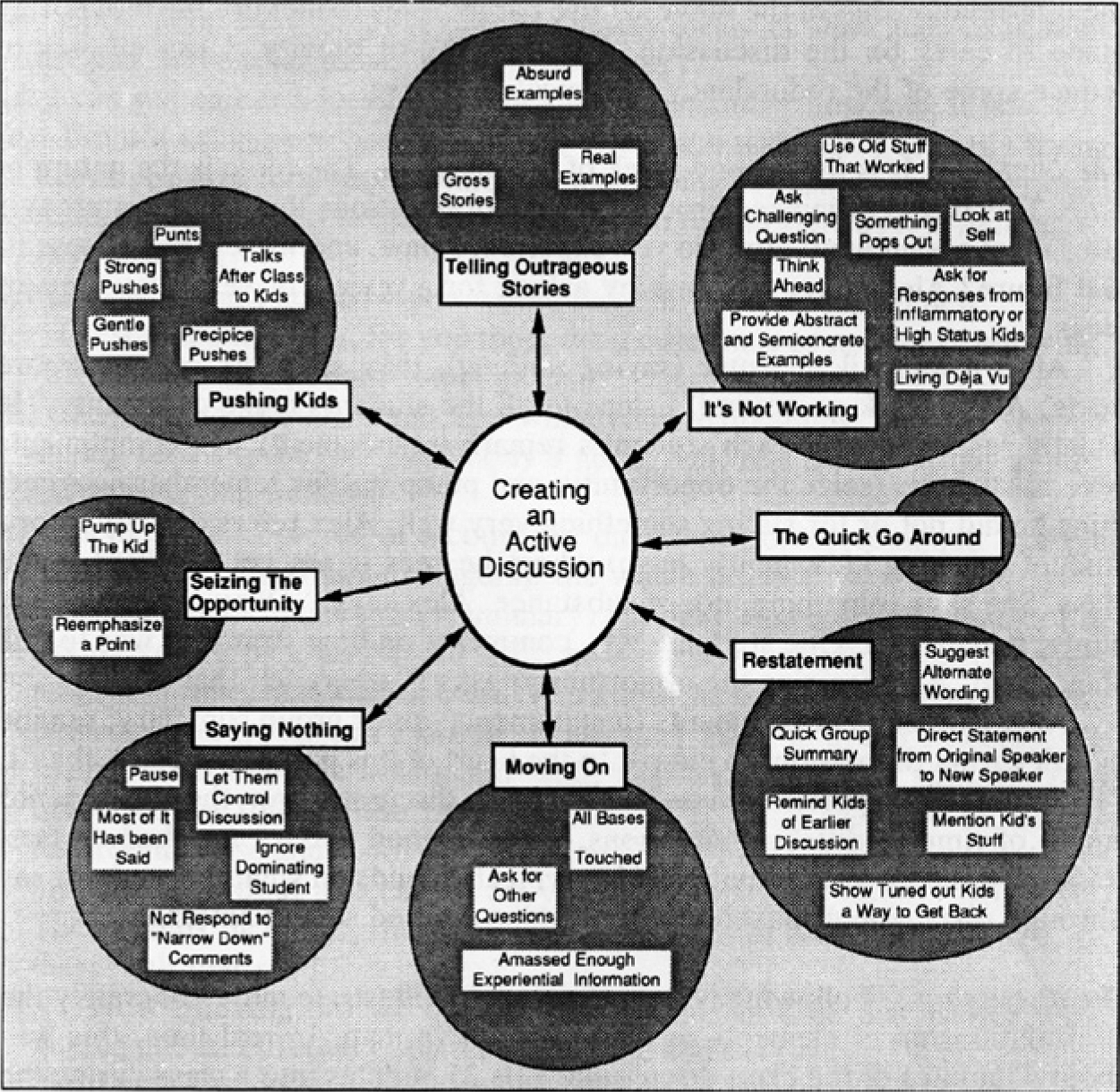
Cognitive map of a discussion.
These eight moves were highly developed routines, yet they seemed to retain some flexibility because of variants within any move. The way I have categorized the moves obscures the fact that they were more intertwined and less clearly differentiated than this presentation suggests. Figure 1 contributes to this simplistic notion because it portrays Alex’s cognitive map as two dimensional, linear, and predictable. In fact, his cognitive map is not two dimensional, because changing from one move to another occurs at more than one point; and it is possible that it is neither linear nor predictable. For example, a spontaneous question might be followed by an outrageous story or by silence. I am uncertain regarding how many dimensions are involved, but I believe two dimensions are inaccurate.
The Cognitive Map in Context
Because it is difficult to comprehend the interplay of cognitive map and action in a class, I present a brief sequence of instruction so that one can appreciate the interrelationship of the moves. I use parentheses to identify the move Alex made to carry on the discussion. For the sake of brevity, I use ellipses to reduce some of the redundancy of typical discourse.
The context
It is the second week of the program. The topic is the nature of time. This day is organized around two major questions that were yesterday’s after-class assignment: How do you experience time, and what is past, present, and future? Alex starts the class by asking for a review of yesterday’s major ideas.
After a long silent pause (saying nothing), they start. As comments are made, Alex (quick go around) listens to all the students make comments. He usually responds after each student’s remark (restatement). He compliments several students (seize the opportunity; and pump up) for remembering something he did not or for stating something very well. Alex refers directly to one student (pushing kids: gently push) whom he sees is not yet involved in the class. She says something, not of substance, Alex says, “Okay” (pushing kid: punts; moving on). One student, ML, comments on how strange it was to talk about time. Alex (seizing the opportunity) asks if others felt that way.
Alex uses student comments (restatements: quick group summary; remind kids of earlier discussion) to jump into the heart of this part of the class, that is, “How do you experience time?” The class discusses how they experience length of time in different situations, such as good classes and bad classes, stationary and moving activities. Alex typically builds on what the students say (through restatement, pushing kids, moving on, and saying nothing).
The discussion
Following is a short excerpt to illustrate more concretely the interrelationship of elements in Alex’s cognitive map. In real time, this was about 4 minutes of the class discussion. It is 35 minutes into a class during the second week. One student has been describing her sense of time during dreaming.
(Pushing kids) Just recalling other dreams, days whatever, when you are more aware of the dream. Does the time of the dream seem to be as the time like now?
Like what you are picturing in the dream?
Yeah, the time in the dream, when you are in the dream.
It seems like it takes the entire time you are asleep.
(Moving on) Okay, someone else, I’m sorry.
Aren’t dreams supposed to be really short or something?
(Seize the opportunity: reemphasize a point) That’s what people say, but they are not the person who is dreaming.
[Laughs] Huh.
I don’t see how, now that you mention it, I was really thinking about. . . how long you dream. I don’t think there is any way you can know . . . because you’re still asleep. I don’t see how you can think. “Well, I’m now starting my dream, well let’s see how long”.
Some people do. Some people are totally aware of what goes on in their dreams, have total recall, some people don’t.
I can remember a lot of stuff but I can’t remember how long it is.
I’m not asking you how long it was when you wake up. I’m really trying to ask you how long was it while you were doing it. How do you experience time? (pushing kids) Is time the same in that dream state as it is right now? Is it different?
[Pause] I don’t see how you would have any way of knowing it.
(Restatement) Okay, for you there is no difference or no way of knowing.
(Moving on) How about someone else?
Okay, I kind of understand, like while you are dreaming, the stuff you are seeing seems to be like everybody’s going real, real fast, or it did to me.
Okay (saying nothing).
It’s like over a period of a couple of days that I dreamed about, like the days went real fast [snaps fingers], the whole thing.
(Restatement: quick group summary) All right, that is something like I’m asking you to pick up on. All right, so . . . there are other kinds of time, bathroom time, that kind of stuff. You know the time you have to go to the bathroom and you can’t get in. [Laughter] Here it doesn’t necessarily happen with multiple toilets and stuff. (Telling outrageous stories). [Two quick stories follow: one based on his father using the toilet in a one-bathroom house and a story of returning from a long trip and wanting to get into the bathroom and can’t.] So you are hopping all around [laughter]. Those kinds of things, those are all experiences of time. Uh, all right, so there’s all that stuff.
Now (moving on) we have different kinds of time that people were talking about, different experiences of time and the [pause] I’ll change that [mutters]. The other thing to think about last night was what you felt was the past, what you felt was the future, what you felt was the present. What those times meant to you. Uh [pause] and those might be, by the way, experiential, they might be something else. . . . What you are going to be doing with today and yesterday’s discussion, this is part of what you’ll have some time for later, you’re going to try and draw a map of time.
The class continues for another 55 minutes. During the time there are many other examples of Alex trying to get the class to state what they believe are definitions of past, present, and future. Alex continues to employ moves that point the class to the assignment for that evening—drawing a map of time. This segment is intended to show how ordinary the map looks in the course of his instruction.
Conclusions
In this article, I reported the cognitive map of one teacher as he thought about and created discussions. I use term creation as opposed to other terms such as implemented or executed because my observations and interviews convinced me that what I saw was an act of creation that would not have taken place in this manner without the presence of this teacher. This teacher possesses a large repertoire of professional practical knowledge about how to create a discussion. I have chosen the term professional practical knowledge to encapsulate all that his experience has taught him about teaching. Professional practical knowledge cannot be separated from experience. Some of his professional practical knowledge is tacit knowledge. It is a special kind of knowledge because it does not “stand out” in the teacher’s mind. It is so habituated that he is barely aware of it. Telling outrageous stories is an example of this kind of knowledge because Alex never mentioned spontaneously any thoughts on this major part of his teaching repertoire.
Two weeks of observation revealed that the professional practical knowledge that informed the way in which he taught is stable and flexible. Each week Alex made a different impression as a teacher. In week 1 he was pushy and nasty at times, whereas in week 2 he was gentle and very supportive. The differences in the two weeks show that his teaching methods are flexible enough to accommodate differences he perceives in students and in groups of students. (I cannot say whether he would be flexible with different content because both classes were philosophy classes.)
The professional practical knowledge apparently influenced his decision to use the two instructional methods he selected. The discussion method, his primary method, was the perfect choice for what he was trying to do in the sense that discussion method is best at getting people to think and reflect (Gall & Gall, 1976). His secondary method, observational learning or modeling, was likewise appropriate. Alex consciously modeled the “philosophizing” behaviors he wanted students to value. Modeling, as a teaching method, is an excellent way to change attitudes about a topic (Coleman, 1985). It is significant that Alex used methods and moves, such as restatement, which were so appropriate, yet he never made any statements citing the literature on effective teaching as a rationale for their use. Rather, he used his experience as a successful teacher as the “authority” for his instructional decisions. This reference to experience has been noted by others as a characteristic of expert teachers (Livingston & Borko, 1989).
The cognitive map I present in this paper accepts the presence of tacit knowledge, of the gray backdrop, and so forth, as significant and influential factors in how Alex conducted a discussion. Those elements have been omitted from the actual diagram of the map to enable one to see the thoughts influencing the actual course of the discussion. Alex’s map presents eight moves and their variants. It is likely that another teacher who is skillful in creating discussions might have a different gray backdrop and different moves and, thus, a different map. It is also likely, however, that another teacher’s map would contain moves similar to Alex’s repertoire. I base this conclusion on an article that contrasts different kinds of discussion. Alpert (1987) described differences among three teachers who typify different kinds of discussions: silent, controlled, and active. Alpert’s description of an active discussion closely approximates my field notes. I infer the presence of a cognitive map similar to Alex’s in Alpert’s teacher. On the other hand, Alex’s cognitive map was discovered in a context in which he taught one kind of content, namely, philosophy. I wonder how different the map would be if he had been teaching another course. Obviously, his cognitive map is well fitted to philosophical content. Because 1 have not studied that situation, I am unable to answer my own question.
Alex’s thinking does not appear to occur as a straight, logical sequence of ideas extending from point A to point B. Rather, his thought and practice are recursive. He appears to continuously compare information gained as he teaches with his professional practical knowledge in order to modify his ongoing practice. One sees evidence of this recursive process by examining his in-class notes and by using the gray backdrop as the lens for examining his action during a discussion. Recursive thinking seems an integral part of his action thinking.
His cognitive map is not predictive, yet Alex’s moves are observable and are not random. One cannot say with much certainty that one move has a high probability of immediately leading to another move, but one can detect a direction to the discussion. Unquestionably, Alex’s moves were made with the “intent and hope” of keeping the class moving in the general direction he had set. He did not have a clear goal to which he was heading. He was cognizant that he could neither predict what the outcomes of specific moves would be nor precisely predict how a class would proceed. He knew that if he made certain moves, the probability of the class going in an appropriate direction was increased. He was disappointed, sometimes angry, and sometimes surprised, when a class did not work the way he wanted, but he seemed to acknowledge the uncertainty of what he was doing, and his years of experience had taught him that classes are salvageable. I suspect that his sense of being there before in a similar situation, a “living déjà vu,” is another important element in his ability to conduct a discussion with a class. In most cases, Alex was only vaguely aware of what, if anything, triggered a move. These moves just seemed to be underway before the teacher was cognizant of the move.
Implications for Research and Teacher Education
I used a research methodology that departs from the more typical research procedure, which uses a priori models of teaching in order to study teachers. This methodology presents an opportunity to get a different view of the act of teaching. My aim was to capture the teacher’s voice. Evidence that it is possible to reach such a goal comes from the sharing of my findings with Alex, who found them to be a “fascinating” and an “appropriate description of my thoughts.” From a study of one teacher in one context, it would be premature to generalize to other teachers of the gifted. Additional studies of other teachers of the gifted in different contexts should help us develop a clearer description of the professional practical knowledge of teachers of the gifted as they perform other aspects of their professional role. Armed with this information, preparation programs at the preservice and in-service levels of students who are gifted and talented could be improved.
A person who teaches teachers, or any teacher who reads this article, will learn how one teacher of gifted and talented children conducted a discussion. Using this report as a case study, it is possible to project Alex’s moves into one’s own teaching with most students. I know that my study of Alex has helped me look more closely at how I conduct discussions, and it has given me direction to try moves that might improve my own teaching. I have also learned that my presence helped Alex reflect on his own thoughts about teaching. I invite others to use the data in the same way so that they might understand what expert teachers can teach other educators.
Footnotes
Acknowledgements
I thank Tracy Cross for his suggestion for presenting these data and Kwang-Seon Kim for his assistance with the diagram.
Reprinted from “The Cognitive Map of a Master Teacher Conducting Discussions With Gifted Students,” by L. J. Coleman, 1992, Exceptionality, 3, pp. 1-16. Copyright © 1992 by Taylor & Francis LLC. Reprinted with permission.
Declaration of Conflicting Interests
The author(s) declared no potential conflicts of interest with respect to the research, authorship, and/or publication of this article.
Funding
The author(s) received no financial support for the research, authorship, and/or publication of this article.