



Abstract
High-achieving students in economically disadvantaged, rural schools lack access to advanced coursework necessary to pursue science, technology, engineering, and mathematics (STEM) educational and employment goals at the highest levels, contributing to the excellence gap. Out-of-school STEM programming offers one pathway to students’ talent development. Using a concurrent triangulation mixed-methods research design, this study was conducted to evaluate the experiences of 78 high-achieving students and their 32 teachers, participating in an extracurricular, school-based, STEM talent development program for rural students from economically disadvantaged communities. Findings suggest that students and teachers expressed satisfaction with program participation and that they thought more creatively and critically about their work. Results also showed that students’ perceptions of the mathematics and science activities were significantly different, which informs ways to improve programming for future high-achieving, rural students. These findings expand the literature supporting the use of informal STEM education environments for underserved gifted populations to increase engagement in and access to challenging curricula.
Science learning in the form of out-of-school science, technology, engineering, and mathematics (STEM) programs has the potential to positively impact children’s STEM understanding and reach underserved populations (Afterschool Alliance, 2014; Center for Advancement of Informal Science Education [CAISE], 2015). Research is clear on the attributes of out-of-school programming that are critical for student participation: programming must be appealing, respond to students’ interests and needs, and make connections (CAISE, 2015; National Research Council [NRC], 2015). However, there are significant gaps in the research concerning programming features linked to specific academic and psychosocial outcomes for students and teachers in extracurricular STEM learning environments. The research on the characteristics and outcomes of extracurricular STEM learning environments for underserved rural populations is even more sparse (CAISE, 2015; NRC, 2015). Research has shown that students from underrepresented populations, in particular, are more likely to participate in out-of-school programming than other students (Afterschool Alliance, 2014). Thus, creating and evaluating effective out-of-school STEM learning opportunities for economically disadvantaged, high-achieving rural students is crucial. Findings from this research have implications for the diversification of the STEM education and career pipeline, by informing how to expand participation and preparation in advanced STEM learning opportunities while students are still young enough for interventions to have an impact.
The President’s Council of Advisors on Science and Technology (Holdren & Lander, 2012) predicted a rapid rise in the number of STEM job openings in the next decade. They described an urgent need for students to engage in educational opportunities to prepare them for this workforce. In 2014, 62% of surveyed CEOs at major U.S. corporations reported challenges in filling positions requiring advanced computer and information technology knowledge. In addition, 41% reported struggling to find employees with advanced quantitative knowledge, and the CEOs participating in the report foresee that 60% of job openings by 2020 will require advanced STEM knowledge (Business Roundtable, 2014). These data suggest that effectively filling STEM occupations at the uppermost levels will require the advanced preparation of a diverse group of high-achieving students, and this preparation must begin well before high school. Increasing opportunities for effective STEM learning, specifically in out-of-school programming, is a crucial step in preparing these diverse high-achieving students for the workplace of the future.
Because out-of-school programs do not have the same constraints as the traditional school day, these STEM programs can engage students in education on their terms and make effective use of opportunities for significant learning. The substantial body of research on science attitudes and interest has crucial implications for the importance of out-of-school science learning. We know from decades of research (Osborne, Simon, & Collins, 2003) that students are becoming disengaged in science as early as elementary school. Their enjoyment of school science, attitudes toward science, and interest in science decline steadily from around age 9 onward. We also know that students are interested in having a voice in science content, level of challenge, pace of learning, and their ability to work with others (Osborne et al., 2003). Students are interested in having extended time for long-term investigations and discussions. Creating effective out-of-school STEM programs means constructing the types of educational opportunities students are telling us they crave. The purpose of the present research project was to investigate the perceptions, attitudes, and aspirations of the students and teachers who participated in the first year of the 3-year STEM Excellence and Leadership program (STEM Excellence)—an extracurricular, school-based, STEM talent development program for rural students from economically disadvantaged communities.
Conceptual Framework
The development and implementation of STEM Excellence draws from the research in talent development and informal science learning. Together, these frameworks shape the approach to learning and pedagogy used to support high-achieving students in rural school settings.
Acceleration and Talent Development
Educators and policy makers concerned with the erosion of U.S. power in mathematics and science have called for greater commitment to excellence since the launching of Sputnik in 1957. Reports including A Nation at Risk (National Commission on Excellence in Education, 1983), National Excellence: A Case for Developing America’s Talent (U.S. Department of Education, Office of Educational Research, 1993), and A Nation Empowered: Evidence Trumps Excuses Holding Back America’s Brightest Students (Assouline, Colangelo, VanTassel-Baska, & Lupkowski-Shoplik, 2015) highlight the missed opportunities to identify and serve gifted and talented students nationally. Despite pedagogical advances, achievement gaps persist, and a significant concern is an excellence gap (Plucker & Harris, 2015; Plucker & Peters, 2016). The excellence gap is exemplified by disaggregating the number of students scoring at the highest levels on the National Assessment of Educational Progress (NAEP) as shown by Plucker and Peters (2016). The authors reported that the percentage of fifth-grade students scoring at the advanced level on the most recent NAEP mathematics test is lower for students eligible for free or reduced-priced lunch (2%) than for students not eligible (13%). For science, the gap persists with students not eligible for free or reduced-priced lunch more likely to reach the advanced level (3%) than students eligible (0%). Therefore, underresourced students are less likely to reach advanced levels of achievement than their peers who are in more economically stable communities.
In addressing solutions to narrow the excellence gap, Plucker and Harris (2015) promoted one or more of the many forms of academic acceleration as effective academic interventions. Academic acceleration (Assouline et al., 2015) is the primary method of implementing a talent development trajectory (Olszewski-Kubilius, Subotnik, & Worrell, 2016) to achieve the highest levels of excellence. Assouline et al. (2015) asserted that despite research about the benefits of acceleration (e.g., Rogers, 2015), and some improvement in policy (e.g., VanTassel-Baska & Hubbard, 2015), there is limited implementation of acceleration as an intervention in most schools across the United States.
The Talent Search Model (Stanley, 1996) is one of the most successful methods of finding students who are ready for academic acceleration; however, Stanley (2005) found that working through schools is an impediment to providing the experiences needed by students ready for academic acceleration. Whereas Stanley’s model is widely adopted by universities and heavily researched (Lubinski & Benbow, 2006), it remains largely outside the purview of most preK–12 schools (Assouline & Lupkowski-Shoplik, 2012; Olszewski-Kubilius & Lee, 2005). Where it does exist, programming outside of the typical school day is a good and common source for enriched, fast-paced, content-based learning that delivers advanced instruction for high-achieving students (Southern & Jones, 2015).
Applying Stanley’s (1996) highly effective identification model to rural school settings, especially those with underresourced facilities and undertrained teachers, is a core principle for the STEM Excellence program. Stanley’s Talent Search model (Assouline & Lupkowski-Shoplik, 2012) begins with the goal of discovering students with domain-specific talent, especially in mathematics, via an above-level test at a young age (e.g., Grade 6). Once discovered, efforts should be made to develop students’ talents. The alignment between the assessment and discovery process (i.e., above-level testing) and talent development process (i.e., academic acceleration) are key steps in the STEM Excellence program. To increase the innovation and diversity in STEM fields, it is critical to identify and serve highly capable students in underresourced elementary and middle schools (Kitano, 2007).
Developing programs to support high-achieving students in middle school is particularly important to talent development, academically and socially (Olszewski-Kubilius & Limburg-Weber, 1999). For many advanced students, early adolescence is a period of time when fitting in with peers is more important than enhancing their abilities. Gifted students may downplay or even deny their talent to be accepted socially. These programs provide opportunities to interact with same-ability peers, therefore increasing social acceptance and continuing talent development (Olszewski-Kubilius & Limburg-Weber, 1999). Academically, high-achieving students need to participate in rigorous middle school coursework to prepare them for the advanced content they will encounter in upper level high school courses required for postsecondary success, especially in STEM courses (Newman, Dantzler, & Coleman, 2015).
Rural and Informal STEM Education
Rural schools face unique challenges preparing students for STEM postsecondary education and careers compared with schools in urban areas (Schafft & Jackson, 2011). Rural students contend with issues of geographic isolation and insufficient bandwidth (to support online access and full adoption of technological advances), they lack access to advanced coursework in mathematics and science, and they face economic barriers that inhibit future employment and educational opportunities (Lapan, Tucker, Kim, & Kosciulek, 2003; National Rural Education Association, 2016). For high-achieving rural students in particular, geographic, technological, and economic barriers present difficulties in reaching advanced levels of academic achievement necessary to pursue STEM academic and career success at the highest levels (Kittleson & Morgan, 2012). This may be because (a) rural schools are more vulnerable to high teacher attrition in STEM fields (Monk, 2007), (b) teachers in the STEM fields that rural schools are able to attract often have less education in their specialty areas (VanTassel-Baska & Hubbard, 2015), and (c) teachers frequently encounter little preservice education on giftedness and encounter barriers to accessing professional development focused on giftedness (Croft & Wood, 2015). Combined, these teaching factors create deficits in rural students’ STEM learning opportunities and experiences.
Nurturing students’ interest, engagement, attitude, motivation, knowledge, and persistence in STEM education is required to address national calls concerning the critical need for a diverse and highly qualified STEM workforce (Holdren & Lander, 2012). Developing informal STEM learning opportunities that are nontraditional and more appropriate for the local needs of rural schools and students can enable multiple pathways to STEM degrees and careers (National Science Board, 2014). Out-of-school programming designed to effectively engage underrepresented students in STEM learning opportunities can address this challenge (Congress.gov, 2015).
Because out-of-school programming has the potential to positively impact students’ cognitive (e.g., their knowledge, skills, abilities) and psychosocial development (e.g., motivation, sense of belonging, attributions, self-efficacy), this context may provide a robust STEM learning environment (Schwartz & Noam, 2007). Studies show that high-achieving students who participate in out-of-school STEM programs are more likely than peers who did not have such opportunities to pursue careers in the STEM fields (Milgram & Hong, 1999; Wai, Lubinski, Benbow, & Steiger, 2010). Participation in such programs is especially important for high-achieving students who may begin to foreclose on career options in middle school (Gottfredson, 2005; Greene, 2003, 2006). In addition, researchers found that rural students’ STEM success improves when the learning is connected to their daily lives and the lives of their communities (Avery, 2013; Jacobs, Finken, Griffin, & Wright, 1998). Wettersten and colleagues (2005) noted that rural youth who report more connection to long-term career plans also report stronger engagement in school (e.g., more time spent studying and achieving academically), a key component to academic success.
The STEM Excellence and Leadership Program
Effective informal learning environments that motivate participation in STEM education from a broader audience (NRC, 2009) are those that (a) account for students’ prior knowledge, experiences, and needs and (b) occur as partnerships between science-rich institutions and local communities. The design of the STEM Excellence program was particularly important for underserved student populations because STEM Excellence aimed to foster rural, underresourced students’ developing identities as students with STEM interest (Tai, Liu, Maltese, & Fan, 2006; Wenger, 1998) and high STEM potential. Understanding how locally controlled, centrally supported, out-of-school learning impacts the identities and learning trajectories of underrepresented, high-achieving rural youth was a focus of the STEM Excellence project and essential to advancing informal STEM education for diverse learners (CAISE, 2015; Duschl, Schweingruber, & Shouse, 2007).
STEM Excellence was designed to prepare rural, high-achieving middle school (Grades 6–8) students for advanced STEM educational pathways. The program worked to (a) enhance teachers’ ability to identify and prepare rural students for high-level mathematics and science classes, (b) expand middle school mathematics and science curricula, and (c) boost underserved middle school students’ preparation for and achievement in the highest level mathematics and science classes in high school and beyond. As previously mentioned, barriers in rural education often involve lack of access to advanced mathematics and science curricula (Lapan et al., 2003; VanTassel-Baska & Hubbard, 2015). An in-school talent search model (Assouline, Ihrig, & Mahatmya, 2017) was used to identify students for programming (see the “Method” section for details). Students who participated in STEM Excellence engaged in 96 hours of challenging curriculum in mathematics and science out of school. On average, students met 4 hours per week afterschool with their math and science teachers over a 24-week period throughout the academic year for 48 hours of mathematics instruction and 48 hours of science instruction.
Another barrier in rural education previously discussed is access to teacher preparation and professional development devoted to the needs of gifted learners. To address this barrier, teachers engaged in professional learning to develop an understanding of curriculum models in science and mathematics focused on student thinking, giftedness, and gifted identification. Although teachers received professional development grounded in the National Council of Teachers of Mathematics (NCTM; 2001) Navigation series and Lawrence Hall of Science (2009) Great Explorations in Math and Science (GEMS) curricula, the specific curriculum implementation varied among schools; thus, the implementation was not standardized. A key design feature of the STEM Excellence program was creating teacher agency through local decision making. This cornerstone of the program was based on recommendations of the NRC (2009) for informal science learning environments to account for students’ prior knowledge, experiences, and needs. Teachers decided how best to adapt and implement the program to fit the needs of their students, while still meeting program goals for curriculum and instruction. The aforementioned curricular resources were provided to teachers as a starting point to develop their local STEM Excellence programs. From there, organic local efforts dictated program design and curriculum selection. Local decisions were grounded in the practices modeled during the professional development, with attention given to students’ level of achievement, student interest, and community resources. The investigation of this program was guided by two research questions:
Method
Through a concurrent triangulation mixed-methods design, this investigation was designed to explore the perceptions, attitudes, and aspirations of educators and students participating in the STEM Excellence program. Specifically, it was designed to enable researchers to understand students’ experiences in the program, perceived affordances and barriers of implementing the program, the perceptions of the districts’ support of high-achieving students, and the impact of program implementation on teaching. The use of qualitative and quantitative data sources allowed the researchers to determine general trends in, as well as specific descriptions of, educators’ and students’ experiences with the program. The study was initially designed using the same modality of data collection for both students and educators (an online survey at the end of the program). However, a low rate of educator participation in the survey motivated a responsive research design where the data collection modality shifted to analysis of open-ended survey responses and conducting an educator focus group as a part of a STEM Excellence summer professional development session. Institutional review board (IRB) approval was granted for all sources of data and data collection procedures with educators and students.
Participants
Rural school districts from a predominately rural Midwestern state were invited to apply to participate in the STEM Excellence program. This grant-funded program had sufficient funding for up to 11 districts. Selection of the 11 participating school districts was based on their (a) commitment to the program as exhibited through the application process, (b) location (schools are located throughout the state), and (c) free and reduced-price lunch status. In the 11 participating schools, approximately 48% of the students qualified for free or reduced-price lunch, with a range from 23% to 70%. From the total population of rising sixth-grade students across the 11 schools (N = 1,146), students who earned scores at or above the 85th percentile on one or more of the tests on the Iowa Assessments were invited to participate in the in-school talent search. Whereas the general guideline for above-level testing as a means to talent identification is the 95th percentile on at least one subtest of a grade-level standardized test (Lupkowski-Shoplik & Swiatek, 1999; Swiatek, 2007), the guideline for STEM Excellence was adjusted to the 85th percentile to create a relatively broader talent pool of high-achieving students. The 85th percentile represents one standard deviation above the mean on a standardized test, which captures more students with above-average or higher achievement. Current or previous participation in a gifted and talented program was not required for participation in the in-school talent search.
There were 250 students (125 male, 125 female) across the 11 schools who participated in the STEM Excellence program in-school talent search (above-level testing) and comprised the talent pool sample. The equal representation of male and female participants in the talent pool sample across the 11 school districts was a random event. With university support, the STEM Excellence program coordinators and teachers considered their district’s above-level testing data and determined local benchmarks and guidelines for student selection. From the talent pool sample, a subsample of 151 students (79 male, 72 female) was selected to participate in the STEM Excellence program. STEM Excellence participants’ performance on the above-level instrument revealed that participants’ mean science scale scores are higher than their mathematics scores, but similar to national norms (Assouline et al., 2017).
Data Sources
This study focused on the program evaluation data collected as part of implementation. Qualitative program evaluation data sources included an open-ended survey and a focus group interview with STEM Excellence coordinators and teachers. Of the teachers and coordinators (n = 32) from the 11 school districts, 25 completed the survey, and eight volunteered to participate in the focus group. The survey was administered to all coordinators and teachers at the end of the academic year. One 45-minute focus group interview was conducted by research personnel with a smaller, voluntary group of program coordinators and teachers during the summer professional development session. For the survey and focus group, educators responded to questions regarding perceived affordances and barriers when implementing the program, perceptions of their districts’ support of high-achieving students, and the impact of program implementation on their teaching.
Quantitative program evaluation data sources included a close-ended, structured survey instrument completed by students about their experiences in the program and general demographic data. The online survey was administered by teachers at the end of the academic year. The survey consisted of two parts with 70 items in total. In Part 1, students responded to questions concerning their satisfaction with the program, perceived benefits of the program, and the impact of program implementation on their learning (37 items). In Part 2, students responded to questions concerning their academic motivation and perceptions of their ability (33 items). The current study focused on Part 1 of the survey responses. Seventy-eight students who participated in the program and consented to research participation completed the survey (52% of total student participants). Students responded to each question using a 4-point Likert-type scale (1 = completely disagree to 4 = completely agree).
Data Analysis
Investigators analytically coded the qualitative data provided by the coordinators and teachers from an etic perspective to determine common themes in responses (Merriam, 2009). Two reviewers independently examined the qualitative responses to increase credibility and trustworthiness of the resulting themes. Quantitative data from students’ surveys were analyzed using descriptive statistics such as frequency distributions. Because the survey data were measured at an ordinal level (i.e., response categories were on a Likert-type scale), nonparametric tests were used to analyze students’ responses. Specifically, given the nature of the data, chi-square tests of independence were used to examine differences in how students respond to their mathematics and science experiences in the program. Two by two (mathematics vs. science) and (agree vs. completely agree) chi-square tests were run with contingency tables. Quantitative analyses were performed using IBM SPSS statistics software version 23.
Results
Educator Qualitative Data
The analysis of the focus group responses and open-ended survey data yielded three primary themes that described the educators’ perspectives of their experiences in the STEM Excellence program: (a) Increased Understanding, (b) Increased Recognition, and (c) Enhanced Awareness. The first theme, Increased Understanding, reflected the educators’ observations of increased student awareness regarding different academic, career, and social opportunities. Educators specifically spoke to the blossoming positive perception that students had about interest in and aptitude for science and math fields. The second theme, Increased Recognition, was focused more on the educators’ perception of their own broadening understanding about the needs of high-achieving students. This extended beyond their work with their students during STEM Excellence activities. Educators spoke to the program creating a change in their teaching strategies to include more differentiation in their general education classrooms. Finally, the third theme, Enhanced Awareness, reflected questions and concerns about identification and programming. The issues mainly consisted of challenges in planning for the program when competing with other activities in a small, rural community; however, questions about program structure and identification process also were included in this theme as they were all areas for facilitators to enhance professional development. Table 1 displays an illustrative quote for each theme.
Educator Quotes Illustrative of Each Theme.

Note. STEM = science, technology, engineering, and mathematics; SEAL = STEM Excellence and Leadership.
Student Survey Data
Of those students who responded to the survey (n = 78, 52% of participants), most students agreed (43.6%) or completely agreed (50%) that they felt “a sense of satisfaction from studying in the [STEM Excellence] program.” Most students also agreed (11.8%) or completely agreed (76.3%) that, “if possible, [they] would attend the program next year.”
Reasons for attending the program
STEM Excellence students responded to four survey items that asked why they attended the program. Students responded to the following prompts, “I attended the program because: I was interested in science, I was interested in math, my parents wanted me to, and my teachers wanted me to.” Overall, more students attended the program because of their own interest in mathematics (32.5% agreed and 40.3% completely agreed) or science (37.7% agreed and 45.5% completely agreed) compared with parents (40.6% agreed and 14.3% completely agreed) and teachers (36.8% agreed and 7.9% completely agreed) wanting students to attend.
Benefits related to program participation
Students responded to seven survey items that asked about the benefits they perceived from participating in STEM Excellence. Students agreed (23.1%) or completely agreed (73.1%) that they were “proud to participate in the program” and “enjoyed the challenge of learning in the program” (38.5% agreed and 57.7% completely agreed). Students also reported that through the program, “my creativity was supported” (41.0% agreed and 53.8% completely agreed), “my abilities to think critically were supported” (44.9% agreed and 48.7% completely agreed), and, to some extent, “being in the program helped me deal with academic challenges” (53.8% agreed and 30.8% completely agreed). When thinking about the peers and teachers in the program, students reported that they enjoyed “studying with other students in the program more than in their regular classes” (42.3% agreed and 43.6% completely agreed). More students agreed instead of completely agreed (43.6% vs. 28.2%) with the following statement, “In my program, my teachers give me personal attention.”
Evaluations of mathematics and science components of the program
Students responded to 10 survey items about their mathematics experiences in STEM Excellence and the same 10 survey items about their science experiences. Table 2 displays the actual survey questions, percentages for agree and completely agree responses for each item, and chi-square results testing for statistically significant differences between mathematics and science experiences. Overall, students reported positive mathematics and science experiences as a result of participating in the program; however, science activities were endorsed a bit more positively, as indicated by the chi-square analyses. Chi-square analyses were run for each mathematics/science question pairing (non-shaded/shaded rows in Table 2); all but two of the pairings were found to reach statistical significance. This means that the differences found between students’ reports of their mathematics and science experience were not due to chance. For example, looking at the first two rows of Table 2, the chi-square statistic, χ2(1, N = 78) = 16.96, was found to be significant at the .001 level suggesting that how students responded to the questions “I experience new ways of learning MATH in the program” and “I experience new ways of learning SCIENCE in the program” were different beyond chance; the percentage of students who chose completely agree for science was significantly larger than the percentage of students who chose completely agree for math. The same rationale can be applied to interpret the subsequent, significant chi-square statistics. Across the significant results, students chose completely agree more often for their science experiences than their mathematics experiences, suggesting that students perceived their science activities a bit more favorably compared with the mathematics activities.
Summary of Chi-Square Tests for Differences in Students’ Responses About Their Mathematics and Science Experiences in STEM Excellence and Leadership.
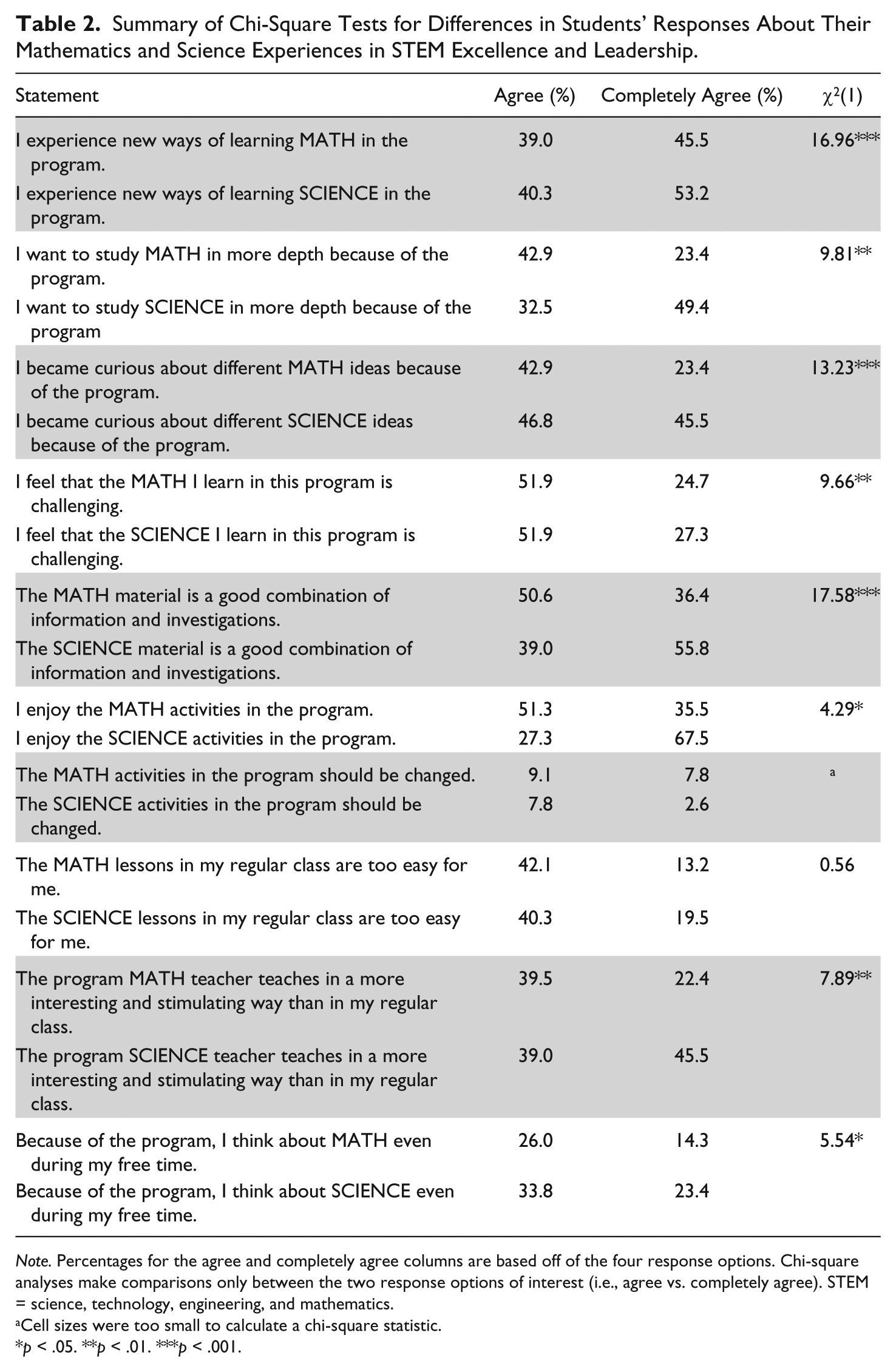
Note. Percentages for the agree and completely agree columns are based off of the four response options. Chi-square analyses make comparisons only between the two response options of interest (i.e., agree vs. completely agree). STEM = science, technology, engineering, and mathematics.
Cell sizes were too small to calculate a chi-square statistic.
p < .05. **p < .01. ***p < .001.
Discussion
High-achieving students in economically disadvantaged, rural communities face barriers to STEM learning opportunities that can limit their ability to pursue advanced STEM academics and occupations (Lapan et al., 2003; VanTassel-Baska & Hubbard, 2015). Drawing from the research on talent development and informal STEM learning, the goal of this project was to develop, implement, and evaluate an out-of-school STEM program aimed at boosting the mathematics and science achievement of rural, high-achieving middle school students. Previous research (Assouline et al., 2017) demonstrated that the talent search model of above-level testing, which is typically applied to the top 5% of high achievers, can be expanded and implemented effectively in rural school-based settings. Moreover, the research of Assouline et al. (2017) demonstrated that students participating in STEM Excellence programming achieved at higher levels in math and science following programming. This was expected because, in addition to the out-of-school STEM Excellence program instruction, students experienced a year’s worth of school-based instruction. Similar findings have been discovered for other informal learning environments (NRC, 2009, 2015; Schwartz & Noam, 2007). With this understanding of students’ achievement, the current study focused on the perceptions, attitudes, and aspirations of the STEM Excellence students and educators to better understand effective means for addressing the excellence gap (Plucker & Harris, 2015; Plucker & Peters, 2016) and contribute to our understanding of talent development in math and science in underresourced settings.
Results from the surveys and focus group indicate that both teachers and students benefited from their participation in the program. Academically, teachers benefited from being able to create and offer more challenging curriculum, and students benefited from completing the curriculum. Teachers and students alike expressed satisfaction with their role in the program and indicated that they would continue their participation, if possible. In addition, they showed that the program allowed both teachers and students to think more creatively and critically about their work. Finally, the teachers were able to gain a deeper understanding of the needs of high-achieving students, and the students gained from the more personalized attention. These results support conclusions from previous research that indicate students must feel interested in and challenged by informal STEM curricula as well as make a personal connection to it (CAISE, 2015; NRC, 2015). Although this previous research was conducted on a more general population, based on the current findings, the results also hold true for high-achieving students from rural school districts. The results add to the body of knowledge supporting the use of informal learning for STEM education—creating a more robust rationale for the tailored approach to curriculum implementation provided in the STEM Excellence program to meet students’ needs (NRC, 2015; Osborne et al., 2003).
The juxtaposition between students’ perceptions of the mathematics and science components of the STEM Excellence program and their reported level of challenge was an unexpected outcome. Whereas students have a positive view of both their mathematics and science experiences in the program, students view their science experiences both more favorably and more challenging as a result of the program. Given that students’ mean science scores were higher than their mean math scores and they were exposed to challenging mathematics and science curriculum, we assumed students would perceive their mathematics experiences to be more challenging. Perhaps the mathematics curriculum and instruction was not as demanding as the science. This may be because of the emphasis on supporting teachers in creating programs responsive to local context. Although teachers engaged in professional development modeling implementation of NCTM and GEMS curricular materials, these resources were provided to teachers as a starting point to develop their local programs. Extant research on the impact on student achievement when teachers work to adapt their teaching to implement inquiry lessons demonstrated that there was a dip in achievement scores as teachers learned to implement new models of instruction (Shymansky, Wang, Annetta, Everett, & Yore, 2013). Then, as teachers became more experienced in the new teaching model, students’ achievement scores rebounded. Given STEM Excellence students’ seemingly lower levels of aptitude in mathematics, they may not be experiencing, perceiving, or reporting the same level of challenge in math as they are in science. This may be due to teachers implementing instructional strategies in mathematics that are new and diverge from their typical instruction during the school day. There is reason to further explore the differences regarding instruction, challenge level, and impact on and/or by psychosocial variables. In the STEM Excellence program, the combination of mathematics and science programming seems to have created an engaging and challenging STEM learning environment. Findings suggest that students and teachers may experience mathematics and science differently. The reasons may be multiple:
An unexpectedly challenging mathematics environment may have disrupted some of the students’ confidence in their mathematics ability, which in turn shaped their level of enjoyment with the mathematics activities.
The math environment may have been less challenging and less engaging than the science environment as teachers worked to implement instructional models that vary from their typical instruction during the school day.
The teachers in the program also may have been more comfortable creating more in-depth and hands-on investigations and activities for the science programming, which made it a more engaging endeavor.
Although the science portion of the program seemed to keep students more engaged, students realized greater benefits in mathematics achievement. This is crucial for addressing the greater excellence gap in mathematics seen for these rural students.
Limitations and Future Research
Interpreting the data revealed many of the student and teacher perceptions of the program; however, there was a limitation to the data collection processes. The data from the students and the teachers were collected in different formats. The students’ data were collected via a computer-based survey that provided researchers with a large number of respondents, but lacked the depth in understanding about the responses. Furthermore, the students’ evaluation data were collected at the end of the program only; data were not collected a priori on their perceptions of the existing mathematics and science courses offered in their school, thus their perceptions of changes in the curricula are retrospective. However, teachers’ data were collected primarily through a focus group, which limited the number of participants but provided a rich understanding of their experiences. The data were also collected at one point in time, which limits researchers’ ability to make any inferences about changes in perceptions over the course of participation. Future research and additional years of program implementation will allow investigators to consider more longitudinal data collection processes.
Next, the students and teachers in the sample represent a specific geographic area, and thus, results cannot be generalized to all rural and/or high-achieving students. Future research may entail an exploration of the students’ satisfaction of each subject matter separately through multiple data sources such as attendance logs, student surveys, and focus groups. In addition, researchers could identify and observe schools that are conducting more in-depth science programs as well as programs that are able to successfully integrate the science and mathematics programs. Finally, the results of the student survey data show that the challenge of the mathematics curriculum may have an impact on psychosocial variables. This topic needs to be further explored and disaggregated by gender and challenge level.
Implications
This research has implications for rural educators and school districts as they work to create programming for their high-achieving mathematics and science students to close the excellence gap and achieve a broader diversity in STEM fields. First, the program data demonstrate that educators perceive that they have gained a deeper understanding of the needs of high-achieving students. This has translated to implementing differentiated instruction in the STEM Excellence program as well as their general education classrooms. By incorporating the lessons learned in the program, the STEM Excellence teachers have increased their opportunities to effectively reach rural high-achieving students in mathematics and science. Based on these results, rural educators can use the mathematics and science strategies implemented by the program as a method of increasing learning and engagement of high-achieving students in their classrooms. In addition, the data presented by educators reveal that the flexibility and individualization of the program makes it easier for rural school districts to incorporate into their informal curriculum. Educators in rural school districts can use the STEM Excellence program as a model of extracurricular programming designed to increase STEM talent development in their high-achieving students. The data support the conclusion that educators in rural school districts can customize the extracurricular program to fit the unique needs of their school and community while realizing positive results from their students and for themselves.
Footnotes
Declaration of Conflicting Interests
The author(s) declared no potential conflicts of interest with respect to the research, authorship, and/or publication of this article.
Funding
The author(s) disclosed receipt of the following financial support for the research, authorship, and/or publication of this article: Authors received funding for the research and writing of this article. STEM Excellence and Leadership was funded by a Talent Development Award from the Jack Kent Cooke Foundation (JKCF), a large scholarship-granting organization “dedicated to advancing the education of exceptionally promising students who have financial need” (Retrieved from  ).
).