




Abstract
The Peterson Proactive Developmental Attention (PPDA) model offers a framework for affective curriculum for gifted children and adolescents and for both formal or informal interaction with individuals. The model was developed in authentic clinical and educational settings in response to perceived needs but was also informed by considerable research focused on the social and emotional development of gifted youth. The proactive, developmental, and attention components are explained here, and findings from three studies of the model attest to its usefulness. The model is adaptable to a wide age range and can enhance communication across achievement levels, cultural groups, and socioeconomic levels. The small- and large-group applications can be facilitated by laypersons with brief training.
Keywords
In the field of gifted education, scholars and clinicians (e.g., Coleman & Cross, 2001; Silverman, 1993; VanTassel-Baska, 1998) have long advocated for a developmental approach to nurturing gifted students’ social and emotional growth. One pertinent consideration is asynchronous development (Silverman, 2013), inherent in the gifted label. The term asynchrony can refer to the difference between mental age and chronological age or between precocious cognitive development and a lower level of social and emotional development. Those differences are commonly understood to have implications for social and emotional health.
Hollingworth (1926) usually is given credit for the notion that both counseling and affective curriculum should be differentiated for gifted individuals to address concerns related to the differences. Certainly educators and counselors should keep cognitive strengths in mind when designing affective curriculum for gifted students and interacting with them formally and informally (Peterson, 2015). However, scholars have reported a lack of empirical evidence that gifted youth are more likely than the general population to have mental health concerns (Robinson & Reis, 2016). Nevertheless, that assertion implies at least a similar need for attention to social and emotional development and fits Capuzzi and Gross’s (2004) argument that “all young people have the potential for at-riskness” (p. 14).
Qualitative studies exploring how gifted students experience significant stressors, such as high expectations from self and others, and, for high achievers, pressure to maintain exceptional achievement, have usually not compared gifted and general-population students (e.g., Krafchek, 2017; Peterson, 2002, 2014; Peterson, Duncan, & Canady, 2009; Peterson & Ray, 2006; Peterson & Rischar, 2000). However, a common finding in those studies is important to consider here: that dangerous distress can be thoroughly hidden to avoid negatively affecting invested adults (Jackson & Peterson, 2003), to protect a positive public image (Jackson & Peterson, 2003; Peterson, Assouline, & Jen, 2015; Peterson & Rischar, 2000), or to avoid direct conflict (Peterson, 2002). Hiding or masking distress can potentially affect gifted students’ mental health, researchers’ foci, and even assessments of well-being. Students’ not communicating their concerns probably also affects gifted education teachers’ and coordinators’ perceptions of needs, potentially contributing to a narrow emphasis on academic rigor and the neglect of programming to support social and emotional development (cf. Moon, 2009).
Findings in a recent complex study underscore the above concerns and set a tone for this article. Krafchek (2017) explored disordered eating in high achievers, finding that high achievement could be both coping strategy and stressor, contributing eventually to disordered eating when a self-worth contingency was somehow threatened. She compared results of quantitative measures of coping, perfectionism, self-worth contingencies, self-perception, self-efficacy for self-regulated learning, and disordered eating with themes that had emerged during analysis of qualitative data. Themes pertinent here were related to peer relationships, teacher relationships, shifting self-worth contingencies, the changing role of academic achievement over time, emotions related to academics, the impact of extreme self-regulation, successful coping through achievement as an antecedent to stress, the length of time over which academic stressors contributed eventually to the disorder, and the effect of long-term stress and of multiple stressors. Noteworthy is that items related to these themes were not found in the several quantitative instruments. Their absence raises concerns about mental health assumptions based on them. Perhaps because high achievement and effective self-regulation, for instance, are socially endorsed behaviors, they had neither been studied as mental health concerns nor included in assessments of mental health status.
Erroneous assumptions about high-achieving gifted youth may serve as barriers to attention to their concerns and thus put them at risk for poor personal outcomes. Those assumptions may persist because of studies with narrow foci and noninclusive samples that reflect positive stereotypes. Relatively few studies have used qualitative methods to explore the internal, nonperformance-oriented experience of the school years, and quantitative measures may not capture complexity (Krafchek, 2017).
The Peterson Proactive Developmental Attention (PPDA) Model
The purpose here is to introduce the PPDA model to the gifted education field and to offer guidance about applying it with gifted children and adolescents individually, in small groups, or in classrooms to nurture social and emotional development. The model recognizes assumedly universal aspects of development as well as this population’s qualitatively different experience of development (Silverman, 2013) as described in clinical literature (Mahoney, Martin, & Martin, 2007; Mendaglio, 2007; Silverman, 1993; Webb, Gore, Amend, & DeVries, 2007). In addition, although the model can be used to address concerns that have caught the attention of parents or school personnel, the proactive dimension has potential to help to prevent and address concerns for all gifted students. According to the qualitative studies mentioned earlier and clinical literature (Peterson, 1990, 1998), the internal world may not be revealed in school or at home. Even close friends may not be aware of it.
The PPDA model offers a theoretical and structural framework for counseling and guidance. In its basic form, the model can be useful with any population (Peterson & Servaty-Seib, 2008) and in a variety of venues. It has been applied specifically to affective curriculum for gifted students since 1985 (Peterson, 1990), most recently in schools (Peterson & Lorimer, 2011) and summer programs (Jen, Gentry, & Moon, 2017; Peterson, 2013). It addresses the developmental concerns mentioned earlier, with implications for social and emotional well-being and, indirectly, for academic and social success. The model is not based on the assumption that gifted students are more likely than the general population to have mental health concerns. It simply takes seriously the notion that gifted youth can benefit from attention to social and emotional development, and that some may have urgent concerns. Nevertheless, although gifted persons may not be more at risk or particularly at risk, they may be differently at risk.
What distinguishes the model from other developmental models is the proactive aspect, how developmental is interpreted, and the empirical support for the model. In addition, the main emphasis is not on educational or talent outcomes, but rather on well-being and social and emotional development as ends in themselves. With those aspects secure, however, learning in the classroom may indeed be enhanced. In addition, when the PPDA model is not being applied in formal therapy, laypersons after brief training can apply it in small-group or classroom discussion, perhaps in tandem with a school counselor, but not necessarily. It can also inform interaction with individuals. That training will be discussed later here with attention to skills, potential biases, and ethical behavior.
Regardless of format, context, and demographics, the essential components of the model can guide adults’ interactions. Clinical professionals working formally with gifted youth can incorporate attention to personal strengths, developmental tasks, and how giftedness is experienced and understood. Regardless of whether concerns are expressed, developmental tasks related to identity, direction, relationships, autonomy, and emotional differentiation within and from family, for example, are worth discussing proactively. Even highly distressed students may be struggling with one or more of those tasks. Therefore the model can also serve as, or be part of, a theoretical framework for interventions.
The remainder of this article is focused on the PPDA model as it applies to working with gifted youth. First is a presentation of literature about characteristics associated with giftedness, development related to giftedness, affective concerns, and developmental models. Following descriptions of its components are discussions of what the PPDA model contributes, counseling dimensions, and empirical evidence of its effectiveness.
Pertinent Literature
During recent decades, several gifted education scholars and educators (e.g., Colangelo, 2003; Colangelo & Wood, 2015; Coleman & Cross, 2001; Dai & Speerschneider, 2012; Mahoney et al., 2007; Reis & Moon, 2002; Silverman, 1993; VanTassel-Baska, 1998) have argued that high-ability students have common developmental tasks, but giftedness affects how they experience them. Colangelo and Wood (2015) referred to “navigating the traditional developmental milestones from that unique experience” (p. 133). Various contributions to developmental literature have suggested that interaction between environments and characteristics associated with giftedness affects gifted students’ development in positive and negative ways (Peterson et al., 2015). Using a developmental lens when determining concerns can help to keep the focus on stuckness and progress when addressing them.
Characteristics
The PPDA model, when applied to gifted youth, is based on the assumption that giftedness should be acknowledged as an important overlay on life experiences (Yermish, 2010). Incorporating psychoeducation about giftedness into clinical work with gifted children and adolescents can help them make sense of feelings and behaviors (Peterson, 2015). Some characteristics commonly associated with giftedness, in addition to asynchronous development (Silverman, 2013), are heightened sensitivity to environmental stimuli (Mendaglio, 2007, 2008), emotional intensity (Daniels & Piechowski, 2009), and intellectual, emotional, imaginational, sensual, and psychomotor overexcitability (OE; Piechowski, 2013; Tieso, 2007).
Manifestations of these can be life-enhancing—energy, curiosity, self-awareness, empathy, ecstasy, fantasy, and spirituality, for example (Piechowski, 2014). Based on exploratory structural equation modeling, Vyk, Krieshok, and Kerr (2016) argued that OE is analogous to the multifaceted openness-to-experience factor of the five-factor model of personality (McCrae, 2010) but cautioned against broad application of the OE concept, including to identify giftedness (see also Wirthwein & Rost, 2011). Gifted youth can be diagnosed appropriately with emotional and behavioral disorders, but according to Webb et al. (2005), characteristics such as emotional intensity and psychomotor OE may be misdiagnosed as pathology instead of as manifestations of giftedness, with potential impact on development and sense of self.
Giftedness can be an asset when needing to make sense of complex situations, solve problems, and feel in control (Peterson, 2012, 2015). However, emotional intensity and reactivity may be a burden, and control may not be an advantage when it precludes feeling or expressing emotions. Characteristics associated with giftedness can affect emotions and relationships negatively, resulting in self-criticism (Mendaglio, 2008), isolation (Gross, 2004), and awareness of social stigma (Cross, Coleman, & Stewart, 1995), for example. The asset-burden paradox of giftedness (Peterson, 2012) has been documented in the research and clinical literature.
Development: Concerns and Models
Characteristics associated with giftedness interact with other personal qualities and contexts to influence how gifted students develop (Hébert, 2011; Robinson & Reis, 2016). Affective curriculum guided by the PPDA model can proactively address areas of their social and emotional development that might be challenging. Relationships resulting from activities included in affective curriculum, especially small-group discussion, may offer high-stress gifted students a safe harbor for support during stressful times.
Concerns
Research findings have illuminated developmental concerns. Peterson and Rischar (2000) found in a qualitative study of gifted gay, lesbian, bisexual, and transgender (GLBT) young adults (n = 18) that most had wondered seriously about their sexual orientation before leaving elementary school and had experienced depression (83%) and suicidal ideation (78%) during middle and high school. In a study of negative life events experienced by gifted youth (Peterson et al., 2009), school-level transitions and peer relationships were among the top four themes in narrative responses to an open-ended question about major challenges during the school years. In a study of high- and low-achieving gifted students after high school (Peterson, 2000), developmental themes in responses to a question about greatest adjustments and challenges were autonomy, identity, a significant relationship, and direction—in descending order of mention. Academic concerns, adjusting to a new environment, social challenges, finances, and critical life events were other themes with developmental overtones. In a rare longitudinal study of at-risk gifted graduates (Peterson, 2002), resolution of conflict with parents, reflecting at least some degree of emotional differentiation (Bowen, 1978), was associated with being able to focus on academics.
Scholars and clinicians have offered further evidence of risk and counseling needs. Pertinent to school violence and gifted youth (see Delisle, 2014), Peterson and Ray (2006) in a national study of bullying found that 29% of gifted eighth graders (37% of males) had violent thoughts, with percentages increasing steadily from kindergarten through Grade 8. With an examination of pertinent literature, Wood and Craigen (2011) provoked thought about gifted individuals’ vulnerability to self-injury: inability to express emotions verbally (Levenkron, 1998), feeling detached from body (Favazza & Conterio, 1988), sensitivities to sensory stimuli and emotions (Conterio, Lader, & Bloom, 1998), disordered eating (Leroux & Cuffaro, 2001), and negative responses to failure (Roberts & Lovett, 1994). Shaunessy and Suldo (2010) noted that coping strategies are likely related to long-term well-being and development. They found that gifted International Baccalaureate students responded to stress with anger, blame, sarcasm, and complaining, without recognizing potential repercussions. Diagnostically, high-ability students with Autism Spectrum Disorder were formerly categorized separately under Asperger Syndrome. Those who do well academically through most school years and are therefore not referred for assessment may self-isolate because of interpersonal limitations and concerns (Foley Nicpon, Assouline, Schuler, & Amend, 2011).
Ugur’s (2004) synthesis of studies about personality types underscored that the intuition-introversion type is associated with intellectual giftedness, with strengths related to abstraction, theory, possibilities, and aptitude tests. Findings reflected a shift in that direction during adolescence. Cassady and Cross (2006), exploring suicidal ideation in gifted adolescents, found that mental representations of it (e.g., suicide pragmatics, morbid fixation, social isolation, and social impact) differed from those in a normed sample. Krafchek (2017), studying high achievers diagnosed with disordered eating, found that they were particularly vulnerable to starting the disorder when academic work stopped over school breaks, although cumulative stress was the main catalyst.
One developmental task
An example of a multi-stage developmental task that can be addressed proactively with affective curriculum is finding career direction. Curriculum might be focused on personal qualities valued by employers; fit of personality, needs, and values with a career; personal definitions of success and life satisfaction; choosing a college and major area of study; and acknowledging and preparing for a changing employment landscape.
Older gifted students, more than their younger counterparts, want to talk about career choices with a caring adult (Jen, Wu, & Gentry, 2016), although Kim (2012) noted gender-related work stereotypes during early school years and the importance of elementary-level career guidance. Even young gifted children may already have anxiety about college, career, and adult roles (Hébert & Kelly, 2006). In addition, not all gifted children have readily available career models and mentors in the extended family with whom to discuss higher education. To counter anxiety related to “perfect” choices (Peterson, 2003), achievement-versus-affiliation choices (Rizza & Reis, 2001), and external pressures to decide direction (Marcia, 1993), applying the PPDA model may involve exploring options in a small group with an objective adult and intellectual peers, shadowing a professional for a day, or learning from local panelists who made career changes or applied college majors in unexpected ways (Peterson, 2003).
Other career development concerns also warrant attention. For students with high capability in several areas, multipotentiality may be a concern, with many reasonable career options and consequent vocational indecision and job vacillation (Sajjadi, Rejskind, & Shore, 2001; see Achter, Lubinski, & Benbow, 1996, for a contrasting view). When adults repeatedly remind high achievers that they are capable of success in any career, the latter may feel pressure from those high expectations and have difficulty finding a career direction (Greene, 2002; Webb et al., 2007). Hébert (2011) emphasized the value of counselors, mentors, teacher models, and open-minded parents as a career path develops.
Developmental models
Jen (2017) found only 17 empirical studies over more than 30 years, from 1984 through 2015, that examined direct affective interventions. However, gifted education scholars have emphasized development in models of counseling and affective curriculum. With Colangelo’s (2003) strengths-based developmental approach, a counselor uses expertise to establish an environment that is conducive to the educational growth of gifted students, instead of using therapy and problem solving as the primary modes. In Dai and Speerschneider’s (2012) Cope-and-Grow model, affective growth and cognitive growth are viewed as continually influencing each other, especially during transitions. Emphasis in an affective curriculum for talent development is on cultivating personal strengths, promoting personal vision, and addressing the burden of coping with adversity. The Gifted Identity Formation model (Mahoney et al., 2007) is a counseling model for working with individuals, with validation, affirmation, affiliation, and affinity contributing to a sense of a gifted self. That model assumes uneven development and consequent variances, broad characteristics reflecting complex interactions between the internal and external worlds, and a need for significant others to acknowledge and support giftedness. Finally, Seligman’s (2011) positive psychology PERMA model of flourishing, with positive emotion, engagement, relationships, meaning, and achievements as indicators, also is relevant to promoting mental health in gifted youth.
Components of the PPDA Model
The PPDA model has three main components: proactive, developmental, and attention. However, the first two are actually two aspects of the last component: that is, proactive attention and attention to development. The model can serve as a theoretical framework when educators and counselors design approaches to help gifted children and teens develop socially and emotionally (see Figure 1). The educational philosophy of this model is that students’ school experience can be enhanced through raised awareness and appreciation of self and others. The counseling philosophy is that intentionally proactive attention to developmental tasks and challenges can help counselors and educators recognize and attend to gifted students’ developmental concerns. Foundational assumptions are as follows: (a) all gifted youth are developing and can benefit from psychoeducation, regardless of achievement level, gender, sexual orientation, culture, socioeconomic status, disability, behavior, or mental health; (b) they may otherwise have little or no opportunity to discuss and make sense of their social and emotional development; (c) like other identified populations, they deserve counselors knowledgeable about them and able to differentiate counseling approaches appropriately (Peterson, 2015); (d) gifted youth may be at risk for poor educational and personal outcomes; (e) discussing development with intellectual peers can normalize challenges and help to lessen anxiety related to them; (f) developmental tasks are universal, but developmental goals and what constitutes task accomplishment vary from culture to culture; and (g) gifted children and teens can teach educators and counselors about how they experience development.
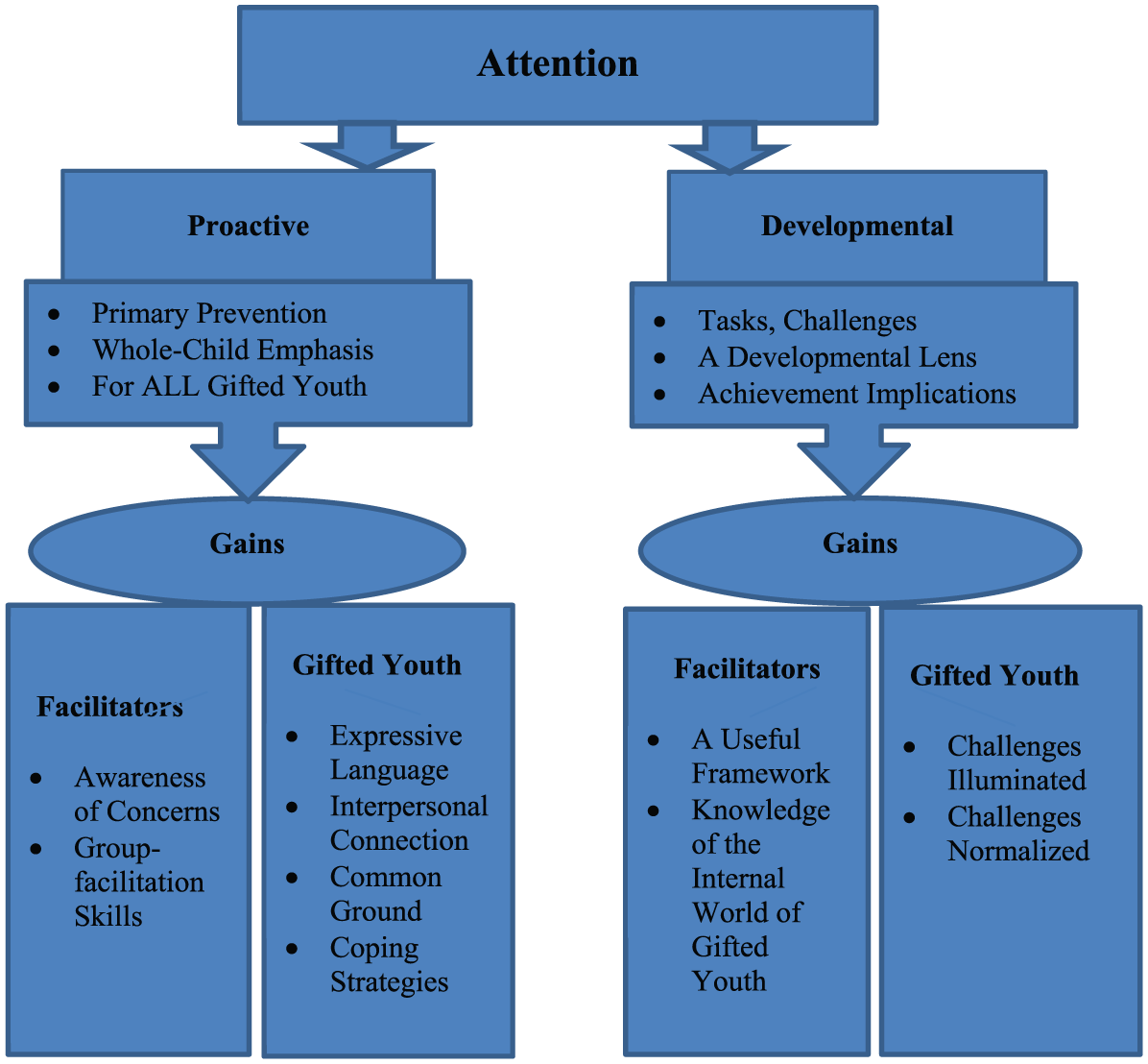
The PPDA model: A framework for nurturing social and emotional development of gifted children and teens.
The Attention Component
Proactive and developmental describe attention in the PPDA title. The model emphasizes paying attention before serious concerns are evident. Attention may seem to be a strange component in a model, as educators, administrators, and counselors assumedly pay attention to student concerns and well-being routinely. However, a nurturing kind, beyond attention to performance or nonperformance, is not a given, including for gifted students. Positive stereotypes of giftedness may preclude teachers’ giving, and students’ asking for, that kind of attention. One value of the PPDA model is that it focuses on more than academics and activities, though acknowledging that those do have social and emotional dimensions. The model embraces the perspective that growing up is not easy, regardless of life circumstances or school success.
Inquiring
With these realities and the PPDA model in mind, school counselors, teachers, mentors, coaches, and directors can all pay attention with simple inquiries about homework load, involvement in activities, or a job, for example. Engaging gifted students about day-to-day interactions and learning can prod them to self-reflect and develop expressive language for healthy relationships. Such interaction can also validate developmental progress.
Feedback about strengths
The attention component also includes giving feedback to gifted students about strengths (cf. Ivey & Ivey, 2003), personal assets (Seligman & Csikszentmihalyi, 2000), and personal resources (de Shazer, 1985)—beyond academic accomplishments and cognitive nimbleness. To counter self-criticism and perfectionism, counselors or lay facilitators of small-group discussions and individual conversations might compliment these students about personal problem solving, patience, kindness, helpfulness, having a calming influence, being genuine in communication, paying attention to whoever is speaking, taking care of themselves, and being interested and observant, for example. Such feedback helps gifted students make sense of themselves, self-affirm, and form identity.
Assumptions about needs
One clinical perspective inherent in the model is that, at any time, a relatively small percentage of students in the general population are in crisis, with behaviors ideally alerting teachers or counselors. An unknown larger percentage may be struggling quietly in considerable distress, without calling attention to it. Perhaps a similar percentage are dealing successfully with developmental challenges, but could benefit from discussion with peers and a compassionate adult about these. The small percentage of low-anxiety, low-stress, developmentally solid students could likewise benefit from enhanced intrapersonal and interpersonal awareness and skills currently and in the future. All students can benefit from application of the PPDA model.
All gifted students can benefit as well. Collectively they may reflect the assumed percentages in the general population, but it is difficult to know who is at risk. Because they may thoroughly hide their fears, doubts, and emotional pain, invested adults need to be attentive to signs of distress and, for no particular reason, inquire casually about well-being so that students do not hesitate to ask for help when in distress. Respectful curiosity (i.e., asking to be taught) about how giftedness affects school and home life demonstrates interest and might lead to a conversation. However, such interactions between adult and student are not about mutual needs. The focus stays on the student, nonvoyeuristically (Peterson, 2009).
Beyond crises
American School Counselor Association (ASCA, 2003) standards require that school counselors be able to respond to students in crisis but with the understanding that they are not to devote their entire work time to that relatively small percentage. Instead they are to be proactive and prevention-oriented, systematically conducting psychoeducational large-group discussions with all students at specific school levels (e.g., about unwelcome touching, tattling, bullying, a school tragedy, or postsecondary planning) or small-group discussion about broad developmental topics or a particular concern (e.g., when grief, bullying, anger or negative behavior is interfering with academics, relationships, or well-being). Gifted education teachers and coordinators can make sure that gifted students have access to these activities, including asking school counselors to conduct them with gifted students. Crucial trust is more likely when gifted students interact with intellectual peers (Peterson, 1990, 2008).
Biases
Adults providing proactive, developmental attention to gifted students can benefit from introspection about their own feelings—about stellar achievers, academic underachievers, various cultural groups, socioeconomic status, and parents of gifted students, for example. When school counselors, teachers, and discussion leaders feel competitive, negatively judgmental, or intimidated, they may be unable to develop a productive relationship with a gifted student. Even being in awe of great talent or intelligence can fuel a need to impress, precluding the openness and vulnerability necessary for effective counseling or beneficial small-group discussion (Peterson, 2016).
Ethics
In addition, regardless of role, professional background, or format, adults who apply the PPDA framework should have at least brief training about confidentiality, respect for privacy, and associated caveats, such as if abuse or neglect is suspected or revealed or a student is in danger or is a danger to others. In the PPDA model, the internal world of students is assumed to be complex, and adults should not demand entry. If trust has been established, however, some of that world might be articulated. Attending to social and emotional development in schools requires poise, follow-up, and referral for serious matters revealed during discussion, regardless of whether the facilitator is a counseling professional. Heavy student loads and concerns about equity of services usually limit school counselors’ availability for complex long-term therapy.
Ethically and because of liability concerns, laypersons should not claim to be counselors or call their work with affective programming “counseling.” A flexible, semistructured small- and large-group format (Peterson, 2008, 2016) gives noncounselors some control in sustaining focus on a topic and maintaining a nontherapy mode. Gifted education teachers and school counselors might also initially cofacilitate group discussions for several sessions, gaining skills and knowledge from each other, and, together, learning from group members.
The Proactive Component
The proactive aspect of the PPDA model is the emphasis on addressing expected challenges before they occur. However, students with significant behavioral or emotional concerns or diagnosable disorders can also benefit, since, like any of their peers, they are dealing with developmental tasks and struggles. In general terms, proaction and prevention contrast reaction and intervention, the latter pair appropriate when problems already exist and warrant specific responses.
School counselor preparation emphasizes the need to attend to the social and emotional development of all students (ASCA, 2003), not just those referred to a counselor because of behavior, emotional distress, poor academic work, or problematic family or peer situations. Gifted students are part of that 100%. A well-known metaphor in the school counseling field refers to catching children upstream, not just when they are going over the dam. Unfortunately, unless school counselors proactively organize a program that includes prevention, they may be occupied only with reacting at the dam. Gifted education teachers can likewise miss opportunities to be proactive and oriented toward prevention if they do not step back and plan accordingly. Underscoring the potential effects of proaction, Littrell and Peterson’s (2001) ethnographic study of school climate and culture was focused on how a school counselor systematically used small-group and classroom activities to change an elementary school from acrimony and violence to harmony and autonomous problem solving. A well-constructed prevention program (i.e., farther upstream) can gradually diminish the number of crises and the need for intervention.
Primary prevention
The PPDA model focuses on primary prevention, including through components incorporated into the classroom (Peterson, 2016). According to Capuzzi and Gross (2004), prevention efforts can stop or hinder risk—through primary prevention (e.g., psychoeducation, small-group discussion focused on development, classroom guidance lessons about feelings and behaviors, systematic career guidance, and activities to foster expressive language and skills), secondary prevention (i.e., early intervention to restore equilibrium and prevent distress from worsening, perhaps through support groups), and tertiary prevention (i.e., avoiding residual impairment after crises have been resolved, perhaps through individual and group counseling or posthospitalization support). Elements of the PPDA model can be incorporated into secondary prevention to address problems such as bullying, resistance to authority, or low motivation for academic work, and into tertiary prevention after an extended absence because of trauma, serious accident or illness, or treatment for addiction.
However, when gifted education coordinators and teachers associate needs with academic rigor only, they may not advocate for programming to support social and emotional development (Moon, 2009). In addition, as noted earlier, gifted youth often hide serious concerns. Distressed students may smile and do well academically, but concurrently experience internal emotional upheaval (Peterson & Rischar, 2000). Pertinent here, Grobman (2006), a psychiatrist, noted that early attention in childhood because of prodigious talent had resulted not only in a sense of personal power but also serious emotional struggles in early adulthood. Highly talented individuals were uncomfortably aware of the effect of their abilities on others (Grobman, 2009), but their social self-presentation did not suggest discomfort or distress.
Regarding substance use and abuse, which also may occur under the radar, Batty et al. (2008) found a positive relationship between childhood mental ability and problems with alcohol and amount of alcohol consumption in adulthood, a stronger relationship for females than for males. Wilmoth (2012) found a positive relationship between intelligence and recreational drug use. Schmeichel, Vohs, and Baumeister (2003) surmised that high-ability youth may not be concerned about addiction because of confidence in self-control.
The whole child
The whole gifted student can be the focus of proactive curriculum—that is, not just the parts of the whole that are visible and measureable as academic and talent performance. That whole person can struggle with disillusionment (Webb, 2016), sadness related to developmental and other life changes (Peterson, 2015), self-expectations, perfectionism, fears, control, relationships with peers and adults, social structures, asynchronous development, characteristics associated with giftedness—and stress and coping skills related to all of these. Information about developmental tasks can normalize challenges and lessen anxiety. Current information about ability to focus, anxiety, depression, suicidal ideation, trauma, and hyperactivity, perhaps provided by local mental health professionals, can be helpful. Large- or small-group formats are appropriate for such psychoeducation (Peterson et al., 2015), and all gifted youth, regardless of achievement level, can benefit. Helping them make sense of feelings and behaviors is basic to the PPDA model. Self-reflecting about the intersection of development and giftedness may otherwise not happen.
All gifted youth
High achievers academically and in talent areas can benefit from a proactive curriculum that encourages interaction with peers about stressors and developmental challenges. Perfectionism, anxiety, and having little time to relax and recoup may affect their well-being (Peterson et al., 2009). Based on 5 years of clinical observations during more than 1,000 hour-long small-group discussions, Peterson (1990) concluded that they may have frightening emotions, self-doubt, or difficult situations at home or at school but never speak of them even in a small group. However, interacting with peers about “growing up” and effective coping can help them survive extended personal crises. Gifted underachievers can also benefit from proactive attention. Affective curriculum that encourages self-reflection, expressive language, and meaningful interaction (e.g., in small groups) can engage withdrawn, disaffected, or culturally, economically, or socially marginalized gifted students in ways that connect them comfortably to intellectual peers and school. They may not be able or willing to engage academically during a particular developmental stage, transition, or difficult life circumstance, but continued contact with intellectual peers in a small group may be crucial to positive long-term development.
The Developmental Component
Because all students are continuously developing, albeit with varying tempo, the developmental component of the PPDA model applies to all gifted students. Helping them interact in a group with each other about development potentially helps them normalize struggles and reduce anxiety related to it. Individual counseling, whole-classroom affective curriculum, and informal conversations can focus on specific developmental tasks as well. In core subject areas in the classroom, the model can be applied to discussions of characters’ social and emotional development in literature, imagined personal fit in science-oriented employment, and change and loss during the Civil War, for example (see Peterson, 2016).
Tasks, challenges
The developmental aspect of the PPDA model is based on the assumption that basic developmental tasks are universal but expectations and behaviors vary from culture to culture (Broderick & Blewitt, 2010; Sigelman, 1999). Culturally, cognitive development may also differ (Sternberg, 2004). Gifted children and teens, like anyone else, are challenged with tasks related to identity, direction, relationships, and a culturally appropriate degree of autonomy, for example (Erikson, 1968; Scheidel & Marcia, 1985). However, because of characteristics associated with giftedness (e.g., sensitivity, intensity, and asynchronous development), how they experience developmental tasks and transitions may be different from how others their age experience them (Silverman, 2013). The assumption in the model is that gifted youth not only struggle with these but may also have little opportunity to talk about them with invested adults who can resist the impulse to give advice and instead invite gifted children and teens to talk without fear of judgment.
The PPDA model can be a framework for helping gifted students devise and share strategies for coping and develop expressive language about both positive and troubling aspects of development. When the model is applied to small groups, these students gain relationship skills and make meaningful, noncompetitive, nonperformance-oriented connections with intellectual peers. Encouragement from an attentive adult to self-reflect and find common ground with those peers may be rare. Ideally, social and emotional concerns such as isolation, alienation, harassment, doubt, cynicism, lack of connection, difficulties with authority, perfectionism, and withering morale can be discussed in an atmosphere of safety and respect. These areas can also be addressed in gifted education classrooms, likely with less of a sense of safety and intimacy because of the larger numbers, but with potential benefits nevertheless.
A developmental lens
When gifted education teachers and school counselors look through a developmental lens when interacting with gifted children and teens and refer to developmental tasks and task accomplishment, those students may gradually develop a developmental perspective themselves. For example, they may recognize that each family member is developing and that peers, both high and low achievers, are developing in both idiosyncratic and universal ways. They may find interesting the notion that high-functioning and highly invested parents, who have usually been able to control much of their children’s lives, might have difficulty with the latter’s developmental transitions, which require parents to adapt (Henshon, 2012). They can learn that social and emotional development is often not as advanced as cognitive development, and that they may be called “immature” even if they are like most of their age peers. They can make sense of feelings of loss and sadness in response to changes that have made life different from how it was previously.
When they discuss developmental tasks with intellectual peers, they are likely to learn that what they are experiencing is “normal,” including their intensities, conflicts, bumpy relationships, and struggles related to autonomy. They may be reminded that nothing stays exactly the same, including deep and frightening feelings. Ideally each is perceived to be much more than a performer or nonperformer—a whole child, with complex concerns. That notion, too, is worth discussing. They can become acquainted with, and self-reflect about, the indicators of well-being in Seligman’s (2011) PERMA framework, mentioned earlier. Finally, introducing them to the theory of positive disintegration (Dabrowski, 1970) might help them find developmental purpose in major, long-lasting struggles. Experiencing this kind of exploration with intellectual or talent peers might also help them embrace their differentness (Coleman & Cross, 2001) and feel that they “matter” in the school community (Dixon & Tucker, 2008), with implications for academic work and extra-curricular activities.
Achievement implications
When ability (e.g., capacity, potential) is emphasized as much as, or more than, achievement (e.g., earned grades, grade point average) during identification for programs, eligible students’ achievement levels may vary greatly, challenging common giftedness stereotypes, especially of underachievers (Peterson, 2000, 2001). Gifted high achievers and underachievers may have similar levels of intellectual ability (Peterson, 2002; Peterson & Colangelo, 1996). When the PPDA model is the framework, they can all interact in large- or small-group discussions about developmental tasks and other topics (Peterson, 2003). Preoccupation with performance and competition is unlikely when social and emotional development is the focus, as no one is likely to “excel” or be “done.” Discussion within an age-appropriate, development-oriented, topic-focused affective curriculum may help gifted youth calm high stress, be meaningfully social, be compassionate, feel emotions without fear—and challenge stereotypical thinking about giftedness. High and low performers can also move past common stereotypes of each other. Similarly, barriers between gifted cultural-majority students and gifted cultural-minority students, including those not yet proficient in the local language, can be diminished through nonacademic program components (Brulles, Castellano, & Laing, 2011) that provide access to intellectual peers.
High achievers
Adults may assume incorrectly that high achievers are relatively more successful with developmental tasks. According to longitudinal studies involving high and low achievers (Peterson, 2000, 2002), they can struggle with those tasks. Among several possible concerns are a narrow identity dependent on stellar achievement (Peterson, 2016) and premature foreclosure on a career path because of low tolerance for ambiguity or prescriptive advice from adults from whom it is difficult to differentiate. During extended education, some might have low levels of autonomy. In the midst of difficult circumstances, habits of high achievement may help to sustain high performance (Peterson, 2000) but mask concerns (Krafchek, 2017; Peterson, 2002, 2014; Peterson & Rischar, 2000). Intense, unexpressed conflict with parents may bind them emotionally even into young adulthood (Bowen, 1978; Peterson, 2001, 2002, 2014).
When the PPDA model is applied to programming, high achievers can make sense of troubling feelings and behaviors through interaction with other gifted individuals. Targets of bullying tend to believe that “not being known” contributes to vulnerability (Peterson & Ray, 2006), and small-group discussion can help to close that gap. Positive life events related to activities, leadership, service, developmental markers (Peterson, Canady, & Duncan, 2012), and summer enrichment programs (Kaul, Johnsen, Saxon, & Witte, 2016) can be positively life-altering, yet achievers can also be highly stressed by overcommitment and would like to be recognized and valued for more than performance (Peterson et al., 2009).
Underachievers
Gifted underachievers may likewise struggle with developmental tasks, but differently. It is possible that academic underachievement is largely developmental (Peterson, 2001, 2002). Developmental tempo varies (Peterson, 2001, 2002), developmental impasse in one or more areas may be related to low motivation for academic work (Peterson et al., 2015), and life circumstances can affect both development and achievement (Peterson, 1998, 2002, 2012, 2014). When concerns are conceptualized developmentally, the notion of stuckness can be a useful frame (Peterson, 2015). Some underachievers feel paralyzed by parents’, others’, or their own expectations, and some do not have a comfortable identity, sense of direction, or sense of competence (Peterson, 2002). Others may have a solid academic self-concept (McCoach & Siegle, 2003). Social relationships can take precedence over academics for some (Peterson, 2001), with intellectual competence then not validated. Peterson (2002) found that some underachievers were withdrawn, angry, and depressed. Bourque (2006) found that some rejected crucial adult guidance during adolescence and saw early sexual activity as “mature,” but were in toxic, nonegalitarian relationships that limited the development of a clear sense of self.
However, underachievers with those concerns may concurrently be actively working on developmental tasks (Peterson, 2001, 2002) and may begin or return to academic achievement before leaving high school (Peterson & Colangelo, 1996), during college (Peterson, 2000, 2002), or even later (Peterson, 2001). “Feistiness” in difficult circumstances during the school years has been associated with success in adulthood (Peterson, 2001), and even extreme underachievers can make dramatic positive changes after high school (Peterson, 2001, 2002). Offering hope for change, convergence of developmental task accomplishments has been associated with increased motivation for academic work (Peterson, 2002). Applying the PPDA model creatively and flexibly can help underachievers connect to intellectual peers during times of developmental impasse or difficult circumstances (Peterson, 2001, 2002).
What the PPDA Model Contributes
The PPDA model offers an explicit framework for working with gifted children and teens, applicable to a variety of approaches, formats, and venues. Development, particularly social and emotional, is overtly acknowledged and emphasized. Specific developmental tasks can be explored, with students asked to describe barriers, hindrances, support, and progress (see Peterson et al., 2009). The PPDA model is also proactive about development. Adults are encouraged to meet gifted children or teens where they are, developmentally, and to help them feel emotions, relate current feelings, thoughts and behaviors to developmental tasks, and anticipate and prepare for future challenges (see Peterson, 2009, 2016). When needed, requested, or simply pertinent, counselors and educators can offer psychoeducational information about areas such as depression, anxiety, perfectionism, underachievement, drug abuse, twice-exceptionality, bullying, counseling, how giftedness is defined, and levels of giftedness. Small- or large-group discussions are opportunities to interact with intellectual peers and a competent adult about developmental challenges and consider current and future application of new understanding of self and others.
Unlike in the Colangelo (2003) and Dai and Speerschneider (2012) models mentioned earlier, with development viewed ultimately in terms of education and talent, the PPDA model is open-ended, nonlinear, applicable to various areas and stages of a gifted individual’s life, and potentially a frame for any of several modes of delivery. Social and emotional development is the broad, primary emphasis. The Mahoney et al. (2007) model differs in its focus on formal therapy and on only one developmental task. However, like the PPDA model, it views that task as a task (i.e., forging an identity that embraces giftedness) with implications for other tasks, such as finding direction and developing increasingly mature relationships. The well-being emphasis of PERMA resonates with the PPDA, but its framework is not explicit about proaction and developmental tasks.
The PPDA model recognizes that helping gifted students maintain or improve mental health is not the purview of counselors only. Because preparation of school counselors (Peterson & Wachter, 2010) and psychologists (Pfeiffer, 2013) usually includes little or no attention to gifted youth as a special population, gifted education teachers may be de facto “counselors,” trusted because of frequent contact and an assumption that they chose to work with gifted students and are comfortable with them. However, depending on what was emphasized in their training, these teachers might not be attuned to nonacademic concerns. Applying the PPDA model can expand their awareness of needs.
Gifted students with learning and other disabilities (i.e., twice-exceptional) are among those whose affective needs can be addressed. Giftedness affects how disability, like other life aspects (see Yermish, 2010), is experienced. Educators and counselors knowledgeable about giftedness, including about the potential for misdiagnosis (Beljan, 2011; Webb et al., 2005), can normalize feelings and behaviors that reflect characteristics associated with giftedness.
Being knowledgeable about giftedness is essential for effective work with gifted youth (Pfeiffer, 2013). Therefore, the PPDA model encourages educators and clinical professionals to learn from gifted youth about giftedness. Those who include focus on social and emotional development can learn enough about how gifted youth experience the interaction of cognitive and affective to structure and deliver services accordingly. Mental health professionals, when respectfully curious about how giftedness is experienced, can develop a therapeutic relationship with both high achievers and underachievers, neither of whom might otherwise believe that anyone can understand them. Yermish (2010) found that many therapists did not inquire about the experience of giftedness, affecting the relationship negatively.
The PPDA Model: Counseling Dimensions
Reciprocal influences of research and clinical work led to the PPDA model. Topic-oriented affective curriculum was initially developed with small and large groups in schools (Peterson, 2008), but concerns discussed eventually led to applying basic tenets with individuals as well. This cross-disciplinary model bridges the counseling and gifted education fields and can inform each of those fields about the other. It offers guidance for differentiating counseling approaches for gifted youth (Peterson, 2015).
Counseling Tenets
Regardless of format and venue, the model reflects basic counseling tenets such as nonjudgment, focus on strengths, active listening, open-ended questioning, empowerment (Capuzzi & Stauffer, 2016), and respect for privacy (American Counseling Association, 2014). When the model is applied to topic-oriented discussion in classrooms (e.g., about intensity, fitting and not fitting common stereotypes, or coping with others’ expectations), or when affective dimensions (e.g., play, self-reflection, social interaction, and peer feedback) are integrated into regular gifted education curricular experiences, these elements also apply.
The small-group option both fits and does not fit classical group theory and common practice (Ehly & Dustin, 1989; Yalom, 1995). It reflects therapeutic factors in group work (e.g., self-understanding, cohesiveness, universality, and installation of hope; Yalom, 1995), but having development-oriented discussion topics is untypical. Being proactive, expecting depth on a single topic, embracing laypersons as discussion facilitators, and emphasizing discussion about “growing up” instead of problem-oriented therapy distinguish the model and make it useful for individual and large-group interaction as well.
Influencers
Few models of counseling gifted youth are available (Pfeiffer & Burko, 2015). However, Erikson (1968) noted challenges related to developmental tasks and the connection between high ability, active exploration of identity, and conflict, all of these aspects pertinent as the PPDA model was developed. In addition, Marcia (1993) associated identity development with struggle and connected career-decision status to identity in regard to commitment to occupation, beliefs, and self-constructed values. Bowen’s (1978) concept of emotional differentiation might explain some gifted students’ conflict with family (Peterson, 2001, 2002). These perspectives offer guidance for various clinical professionals. Silverman’s (1993) counseling approach influenced how the PPDA model frames curriculum and facilitator training, emphasizes well-being, and groups gifted youth with intellectual peers.
Empirical Support for the PPDA Model and Training Protocol
Although the model can be applied individually and in large groups, the small-group format is the most common application (see Peterson, 2008) and has been the only PPDA-related format examined empirically. Findings in three studies, utilizing small-group applications with gifted students at varying age levels and from diverse economic and cultural backgrounds, attest to the effectiveness of the model as applied in that format at various school levels.
In all three, the experiences of the group facilitators were of interest. Findings support the claim that laypersons can apply the model capably if they receive limited but intensive training and incorporate a focused, topic-oriented affective curriculum not intended to be therapy—that is, not to restructure personality, change behavior, or ameliorate symptoms of a disorder. In each context, facilitators reported that they also applied their brief training in classrooms and in informal interaction with individual students, underscoring that the PPDA model has potential for broad application. Typical training included information about giftedness and development, guided practice with listening skills in pairs (i.e., nonverbal responses, reflection of feelings, checking for accuracy, paraphrasing and summarizing, and open-ended questions), observation of a brief topic-oriented small-group demonstration, self-reflection about biases, and ethical guidelines.
A Private School for Gifted Early Adolescents
A 5-year, mixed-methods longitudinal study (Peterson & Lorimer, 2011) was focused on the implementation of a small-group, topic-oriented program aligned with the PPDA model (Peterson, 2008) in a private school for gifted children. After a half day of training, all teachers began facilitating weekly small-group discussion in Grades 5 to 8. Statistically significant positive change in the students (Peterson & Lorimer, 2011) occurred regarding talking about social and emotional concerns, believing that the groups had a positive effect on the school, perceiving that affective and academics are equally important, and perceiving a need to discuss concerns with peers. The teacher-facilitators (Peterson & Lorimer, 2012) gained confidence as group facilitators, ease with discussing social-emotional concerns and development, and belief that gifted youth need affective curricula, and they perceived a positive impact on the school. The program continued after the study ended.
A Summer Program for Economically Diverse Young Gifted Children
Using qualitative methods, Peterson (2013) examined the experience of seven grant-funded school counselors who facilitated small-group discussion, based on the PPDA model, during a summer program for young gifted children. The counselors worked directly with gifted children from low-income families in the groups, but assisted in economically heterogeneous classrooms. They were already trained in group work, but none had had training related to giftedness prior to this experience. One theme was that they had not expected the differences they observed between these children and the general-population children they normally worked with. Another was that they observed the heightened sensitivity they had learned about during brief training at the outset. They said they viewed gifted children in new ways and considered roles counselors could have with them at school.
Summer Residential Programs for Gifted Adolescents
Jen et al. (2017) conducted a comprehensive study of the PPDA model applied during three summer residential programs for gifted youth (Grades 5–6, 7–8, 9–12) from nine countries and three Native American tribes. She adapted a small-group curriculum (Peterson, 2008), which reflects the model, to fit the program structure and revised and reimplemented it for 3 years until it was robust. Outcome data were then collected through observations and interviews of campers (n = 77), young-adult group facilitators (n = 30), and the curriculum leader who trained the facilitators and led debriefings. Students from all backgrounds indicated that the small-group discussions had enriched their overall experience. Of the Native American students who participated in the retrospective part of the study (n = 24), 22 reported positive behavior changes during the past year because of the small groups the previous summer. Mentioned most were stronger self-confidence and being more open to people. Findings suggested that the group experience was perceived positively and had both short- and long-term benefits, supporting the PPDA model as an appropriate theoretical framework for an affective program component with small-group discussion facilitated by laypersons.
Summary of Gains
Figure 1 shows that gains for the children and teens in all three studies were in expressive language, interpersonal skills, coping strategies, and recognizing and normalizing common developmental tasks and concerns. Facilitators became acquainted with a useful framework for working with gifted students and learned about the latter’s internal world and concerns. Laypersons gained group-facilitation skills.
Conclusion
The PPDA model was developed in response to perceived needs in authentic settings and has been studied empirically. It offers a versatile framework for adults who recognize a need to be alert to, and respond respectfully to, gifted students’ social and emotional concerns. Conceptualized as preventive and developmental, the model encourages attention to challenges related to growing up, is adaptable to a wide age range, and can facilitate communication across achievement levels, cultural groups, and socioeconomic levels. The model can guide interaction with individuals as well. Expressive language, ease in talking about social and emotional development, common ground and social connection, and enhanced self-awareness are among potential benefits. Facilitators who are not professional counselors gain confidence in skills, become comfortable with discussing developmental topics, and become aware of the internal world of gifted youth regardless of format. Increased awareness of how gifted students experience development can help adults respond to concerns and advocate when warranted.
Footnotes
Authors’ Note
Enyi Jen is also affiliated to Radboud University, Nijmegen, the Netherlands.
Declaration of Conflicting Interests
The authors declared no potential conflicts of interest with respect to the research, authorship, and/or publication of this article.
Funding
The authors received no financial support for the research and/or authorship of this article.