




Abstract
In 19 (sub)samples from seven countries (United States, Austria, Germany, Costa Rica, Ecuador, Vietnam, Brazil), we analyzed the impact of parental education compared with wealth on the cognitive ability of children (aged 4–22 years, total N = 15,297). The background of their families ranged from poor indigenous remote villagers to academic families in developed countries, including parents of the gifted. Children’s cognitive ability was measured with mental speed tests, Culture Fair Intelligence Test (CFT), the Raven’s, Wiener Entwicklungstest (WET), Cognitive Abilities Test (CogAT), Piagetian tasks, Armed Forces Qualification Test (AFQT), Progress in International Reading Literacy Study (PIRLS), Trends in International Mathematics and Science Study (TIMSS), and Programme for International Student Assessment (PISA). Parental wealth was estimated by asking for income, indirectly by self-assessment of relative wealth, and by evaluating assets. The mean direct effect of parental education was greater than wealth. In path analyses, parental education (βEd) also showed a stronger impact on children’s intelligence than familial economic status (βIn, total effect averages: βEd = .30–.45, βIn = .09–.12; N = 15,125, k = 18). The effects on mental speed were smaller than for crystallized intelligence, but still larger for parental education than familial economic status (βEd→MS = .25, βIn→MS = .00, βEd→CI = .36, βIn→CI = .09; N = 394, k = 3). Additional factors affecting children’s cognitive ability are number of books, marital status, educational behavior of parents, and behavior of children. If added, a general background (ethnicity, migration) factor shows strong effects (βBg = .30–.36). These findings are discussed in terms of environmental versus hidden genetic effects.
Keywords
Man is only what education makes him . . . Those with any shortage of discipline and education are poor educators of children . . . Well educated parents are examples; imitating them, children flourish.
For nearly a century, research has been carried out on the relationship between parents’ education and their professional and socioeconomic status (SES) on one hand, and the intelligence, knowledge, and school performance of their children on the other hand. This topic has received increased scientific and public interest since the publication of the results of the international student assessment studies Trends in International Mathematics and Science Study (TIMSS), Programme for International Student Assessment (PISA), and Progress in International Reading Literacy Study (PIRLS), which demonstrate, in all countries, positive correlations between parental SES and students’ achievement. Similarly, older meta-analyses by White (1982) and newer ones by Sackett, Kuncel, Arneson, Cooper, and Waters (2009) report correlations with SES from r = .22 (Sackett et al., 2009; uncorrected with Scholastic Assessment Test [SAT]) to r = .33 (White, 1982; with IQ) and r = .42 (Sackett et al., 2009; SAT-corrected). As early as 22 months of age, development indices are correlated with parental SES (Britain; Feinstein, 2003). At age 2 years, the impact of parental SES accounts for 6 IQ points and increases throughout childhood up to 18 IQ points (Britain; von Stumm & Plomin, 2015). Offsprings’ vocabulary is affected by their family SES (Flynn, 2016). Even in communist countries such as the former Poland with egalitarian social, housing, and educational policies, social status (reflected by educational level of parents) and cognitive development were associated (r = .27–.29; Firkowska et al., 1978). The intergenerational transmission of cognitive competence is found everywhere, but the strength of the associations varies with different social and educational policy conditions, making it possible to shed light on their causes.
The popular interpretation of these findings in the media as well as in science is that they are caused by differences in the wealth of parents (for examples, see Rindermann & Baumeister, 2015): The rich can support their children through costly interventions that are beyond the ability of less wealthy parents, such as better housing, private schools, educational toys and computers, entrance to expensive museums, and hiring tutors. By the same token, the economically and socially disadvantaged poor cannot offer their children such supports. A straightforward intervention derived from this position was publicly formulated by Richard Nisbett in his keynote “Bring the Family Address” at the 2009 Association for Psychological Science convention in San Francisco: “If we want the poor to be smarter we should make them richer” (Wargo, 2009, p. 17).
However, a closer look at different empirical phenomena makes it doubtful that economic differences are really at the root of differences in intellectual outcomes as opposed to underlying causes that they proxy. Consider six types of suggestive evidence for the position that educational mechanisms are stronger drivers of offspring intelligence than economic ones:
In many countries, there is only a low or even no positive relationship between indicators of economic wealth of families (e.g., owning TV, mobile phone, computer) and cognitive student assessment results; and sometimes, the relationships are negative (see summary in Rindermann & Baumeister, 2015).
Similarly, in international comparisons with individual-level data (PISA 2006; Zhang & Lee, 2011), parental educational level is more strongly associated with children’s abilities than are parental wealth indicators.
Cognitive elites such as Nobel Laureates come less often from wealthy social strata than from well-educated ones (Zuckerman, 1977/1996).
A further type of evidence for educational mechanisms is indirect; rather than showing that parental education drives offspring intelligence, it shows that offspring’s education drives their own intelligence, thus implicating underlying cognitive processes that are inculcated through education as an important contributor to IQ differences. In a narrative review of the historical literature, Ceci (1991) found that each year of missed or delayed schooling led to a decrement in cognitive ability. For example, missed schooling due to family travel, summer vacations, illness, dropping out, or absence of teachers in remote regions all led to reduced IQ performance compared with children who had not missed school: Two adolescents with the same IQ score at age 14 differed by nearly 8 IQ points by the age of 18 if one of them remained in school until that age and the other dropped out at age 14 (Ceci, 1991). In a series of analyses, Winship and Korenman (1999) modeled IQ changes under different assumptions about the degree of measurement error. They estimated that the impact of 1 year of schooling results in an average IQ increase of about 2.7 IQ points for each year of school attendance. Taken together, these findings suggest that a child’s own educational experience affects cognitive outcomes.
Parental ability and attitudes create an important developmental environment for children as illustrated by a qualitative Austrian study (Großschedl, 2006): Some parents whose children were cared for and supported by a public social program (the state pays all the rent including water, electricity, and central heating) burned the books and learning materials supplied for their children “for heating” during vacations. They stated that these materials are not important and education is not important for girls, because they will marry later. Großschedl (2006) found that during home visits, it was difficult to create a learning atmosphere for applying the training program, for homework, and for consulting parents, because parents and their children wanted to watch TV all day.
Consistent with the above five sources of empirical research, there are also anecdotal examples that contradict the popular assumption that a more expensive environment favors intellectual development: In Atlanta (based on observations in 2008), there are two famous zoological institutions, the Georgia Aquarium and the Fernbank Museum of Natural History. The first has a very high admission fee even for young children from age 3 on (currently onsite including taxes around US$37), and it offers experiences in the form of visual and tactile stimulation: Fishes, whales, and other animals swimming in basins can be observed, in one basin, it is possible to touch the fish. Notwithstanding its amazing sensory offerings, there were few or no explanatory texts describing the animals’ habitat, evolutionary or ontogenetic development, and behavior. One film showed the transport of whales in an airplane to Atlanta. In contrast, a second institution (the Natural History Museum) has a lower admission fee (currently including taxes around US$19 for children) but offers age-appropriate cognitive stimulation from preschool to university: Its presentations are accompanied by relatively voluminous written and verbal explanations, for example, the descriptions of the habits and geographic regions of animals including the presentation of complex topics such as evolution and the Doppler effect; in two of its rooms, visitors can do their own experiments. During a visit by one of the authors, the first “museum” was 80% more expensive than the other; yet, it attracted far larger crowds of which the largest fraction appeared to come from seemingly lower SES strata. The cheaper but cognitively more stimulating Fernbank Museum, however, was nearly empty and the few people attending it appeared, according to Fussell (1983), from their dress and manner, to be from the middle or upper classes, many of them were whole families including fathers. Along these same lines, during a visit by one of the authors to the free Smithsonian Museums in Washington, few or no people from apparently poor backgrounds were in attendance (visited December 2010). Such observations suggest that, in some cases, a cheaper experience is more likely to lead to knowledge acquisition, and boost inductive and deductive reasoning, comprehension, and the formation of abstract concepts. Albeit the description of such unsystematic observations is no substitute for systematic research, these cases provide an existence proof that money does not invariably purchase better educational outcomes, and coupled with the other sources of evidence just reviewed, they are consistent with the suggestion that education influences cognitive outcomes more than familial wealth.
Thus, the above examples suggest that parental education and interest in education could be more important for the cognitive development of children than purely economic variables. But there is no systematic empirical research comparing samples from different ages, countries, and ability levels, using different operationalizations of constructs and—most important—directly comparing the relative effects of parental economic and educational variables in models where potential mediators can be tested. This is the goal of the present project.
Aims of Present Study
The purpose of this study is to compare the effects on offspring’s cognitive development of parental variables related to their education (and cognitive ability) with economic variables related to their present and long-term wealth. In addition, parental effects are related to concrete educational and behavioral variables influencing the cognitive development of children.
Conventionally, SES is measured by using sum values of parental income, parental occupational status, and parental education (e.g., Galobardes, Shaw, Lawlor, Lynch, & Davey Smith, 2006; Jeynes, 2002). Because global SES indicators mix educational with economic effects, they may mask the within-family impact of education on wealth. Such a catch-all variable can statistically account for a lot of variance without revealing (and possibly even obfuscating) causal relationships. In addition, parental occupation is uninformative in the case of retired or self-employed parents. Thus, we measure (a) education and wealth (assessed in different ways) independently and compare their effects on children’s cognitive ability. By using regression analysis, we acknowledge their statistical relationship and the dependency of family wealth on education. (b) Of course, both variables, education and wealth, have to be measured at the family level, with father and mother values combined. (If educational variables are not combined, the asymmetry in measurement and the high correlation between father’s and mother’s education will lead to an underestimation of education effects; e.g., Ganzach, 2014). (c) Education and wealth could work through shaping a more stimulating environment. Thus, to probe underlying causal paths, we also examine their indirect effects such as those operating through number of books in the home and quality of schools. (d) Finally, in acknowledgment of the interpretive challenges inherent in such analyses, we support the stability and generalizability of effects by using 19 subsamples from seven countries with children of different ages and ability levels and using a variety of cognitive tests, ranging from mental speed and fluid (nonscholastic) to Piagetian tasks and crystallized (knowledge and scholastic) scales.
This provides a rich panoply of measures to determine moderators and disentangle causal influences. Except for the National Longitudinal Survey of Youth (NLSY 1979; www.nlsinfo.org/content/cohorts/NLSY79) and a Brazilian subsample, we use subsamples and data collected by us or under our supervision. We added the U.S. subsample (NLSY) because it is the largest country in the western hemisphere and many investigators have used this data set, thus providing points of reference. In addition, due to larger wealth differences (higher Gini coefficient), a larger wealth effect could be expected (e.g., through buying education; see Johnson, Deary, Silventoinen, Tynelius, & Rasmussen, 2010). Larger wealth effects due to larger wealth differences were also expected for Brazil (data collected 2006–2009 by Flores-Mendoza and colleagues; e.g., Flores-Mendoza et al., 2013), a subsample that we use for comparison with our own Ecuadorian and Costa Rica subsamples. In addition, Brazil is the largest developing (emerging/newly industrialized) country in the western hemisphere.
We try to investigate how the parental education versus wealth effects work in a more detailed way using path analyses. Depending on the variables used, and the age cohorts and countries chosen, the mediating variables will differ between the models. Although environmental versus genetic effects cannot be distinguished with these designs, we discuss the possible effect of genes (e.g., as indicated by parental effects on children’s mental speed). We have posted detailed information about the single studies in the supplemental online appendix (see “Supplemental Material” note below).
Method
Data From the Single Studies
Studies, countries, subsamples, participating children and parents, variables, and single procedures and their results are described in detail in the online appendix. The largest subsample comes from the United States, 12 subsamples are from Austria. Data derived from tests and questionnaires given to children and parents and some subsamples also contain teacher estimates (e.g., on discipline) or expert ratings (e.g., kindergarten quality). Mediating variables included number of books, marital status (civic–burgher family), educational and cultural practices of parents, maternal smoking during pregnancy, quality of educational institutions, and the behavior of children themselves, and as a background variable ethnicity—race or immigration. Before being combined, the data were rescaled.
Statistical Method
Regression and path analyses are used to calculate direct, indirect, net, and sum effects of variables. In these analyses, the standardized path coefficients (β) are interpreted. Correlations (Pearson) are included (in parentheses following the betas). Correlations help to estimate quickly the influence of other variables in the model (the larger the difference between correlation and path coefficient, the larger is the influence of other variables), and they make it possible to check the model and to calculate the proportion of the explained variance in each factor (Σrβ = R² = 1 − error). We apply a two-fit index strategy using standardized root mean square residual (SRMR) and comparative fit index (CFI): “Good” values for fit indices (if models are not saturated) are SRMR ⩽ .08 (Hu & Bentler, 1998, 1999) or SRMR ⩽ .05 (Schermelleh-Engel, Moosbrugger, & Müller, 2003) and CFI ⩾ .95 (Hu & Bentler, 1999) or CFI ⩾ .97 (Schermelleh-Engel et al., 2003), and “acceptable” fit is reached with SRMR ⩽ .10 and CFI ⩾ .95 (Schermelleh-Engel et al., 2003). For these analyses, SPSS and Mplus were used. Significance tests were not used for interpretation (for an in-depth justification, e.g., Armstrong, 2007; Cohen, 1994; Gigerenzer, 2004; Hunter, 1997). More instructive for inductive generalization—which is not possible with significance tests—is the demonstration of the stability of relationships across different operationalizations of constructs, different measurement points, different ages of students, different (country) samples, and various studies by different authors. In all analyses, parental educational level versus parental income/wealth were tested for their effects on cognitive ability of their offspring. In addition, models were constructed to examine direct and indirect effects of education and wealth through these variables. These models differ from study to study and in their complexity because age differences led to the use of different variables (e.g., reading to children), also country differences (e.g., in Ecuador, height per age as a wealth–health indicator), and because the same variables showed different impact leading to different models with acceptable fits to empirical data.
In a final path analysis, we examined the effects in a combined sample with N = 3,925 observations. To better balance the different regions, countries, and development levels, the size of the U.S. NLSY subsample was randomly reduced. Because the other subsamples were much smaller than the NLSY, we used a random deletion method to sample only a fraction of the NLSY so that the United States, Europe, and developing nations each contributed 25% to 33% of the total data. (See online appendix for details.) In online Table A1, correlations between the most important variables are presented.
Missing data were treated in two different ways: Initial simple regressions started with listwise deletion and the results were compared with full information maximum likelihood (FIML; no listwise deletion in the case of missing data). Income/wealth was first used in natural units and then logged. All path models were done using FIML and logged income/wealth. The results of the different procedures were checked for robustness. The results from 18 subsamples (i.e., excluding the longitudinal study) were averaged using three different methods: (a) simple arithmetic means, (b) arithmetic means using Fishers z, and finally (c) using Fishers z and weighted by sample size.
Single and statistical results of cross-sectional path analyses are not sufficient to prove causal influence. We also use longitudinal designs and we try to offer theory-based interpretations. In addition, we consider studies of others using experimental or longitudinal designs and we discuss alternative views.
Results
Parental Education Versus Income and Their Impact Through Other Variables Influencing Cognitive Development
The 19 subsamples we employed are described briefly in Table 1; further details can be found in the supplemental online appendix. Generally, each study contains a parental educational-level measure, a parental wealth measure (in natural units or logged), and at least one cognitive ability indicator of the child. In the majority of studies there are additional mediating variables (e.g., number of books, quality of education, or marital status).
Overview of Subsample Characteristics for Parental Education vs. Income Effect Studies on Children’s Cognitive Abilities.

Note. Mean ability levels of subsamples in developed countries except for the German gifted subsample are around IQ 100 (95–105) in their country norms. Figure refers to figure number in the online appendix. See also notes for Table 2. ASVAB = Armed Services Vocational Aptitude Battery; CFT = Culture Fair Intelligence Test; CPM = Coloured Progressive Matrices; NLSY = National Longitudinal Survey of Youth; SPM = Standard Progressive Matrices; WET = Wiener Entwicklungstest; PIRLS = Progress in International Reading Literacy Study; PISA = Programme for International Student Assessment; TIMSS = Trends in International Mathematics and Science Study; ZVT = Zahlen-Verbindungs-Test.
Results from 18 cross-sectional and one longitudinal subsamples comparing the effect of parental educational level and parental income in seven countries, in developed and developing countries, for kindergarten, primary, and secondary school children and for young adults (see Tables 2 and 3) reveal a clear pattern: To explain differences in children’s intelligence, differences in parental education are more important than are differences in familial income (direct: βEd = .40 vs. βIn = .16, total: βEd = .45 vs. βIn = .12; Table 2). Because of the large differences between studies, both in size and mediating variables, the three methods (regardless of weighting N) led to somewhat different results ranging from βEd = .25 to βEd = .45 and from βIn = .12 to βIn = .16 (Table 2). However, the pattern suggesting a larger educational effect remains stable across the studies: With the exception of four subsamples, education (in direct effects) was found to be more important than income, in total effects except in only two subsamples (correlations become stable from Ns of 250 onward; Schönbrodt & Perugini, 2013). Differences between wealth measures (wealth in natural units, in monetary or logged units) are negligible.
Overview of Results (Betas) for Parental Education and Income on Cognitive Ability of Children.

Note. N refers to total sample size. Total N = 15,297. If listwise and FIML were calculated, FIML results are shown. “Parental income” = logged income or wealth indicators; “direct” = direct effects (path coefficients) in single comparison of parental education and wealth; “total (m)” = total effect in more complex models with additional variables summing up direct and indirect effects. In the subsample of Innerhofer et al. (2010), the cognitive ability sum was used. In the Pilko (2009) subsample, the result for the CogAT (comprising fluid and crystallized intelligence) was used. In the Schwab et al. (2010) subsample, for the model, the mean of SPM and Piaget was used. In the subsample of Perissutti (2009), income (and online Figure A12) was used. In the Pieber (2009) and Hoang (2013) subsamples, for “total (m),” the results for both countries together (online Figures A15 and A17) were used. The Rindermann and Heller (2005) subsample is not used for the summarizing analysis (a longitudinal study with control of former children’s ability and, therefore, not comparable). “Arithmetic” = simple arithmetic mean; “Fishers z” = mean correlations averaged using Fishers z transformation; “Weighted” = mean correlations averaged using Fishers z transformation and weighted for N. The Figures do not include the direct effects reported here in the table (see text). FIML = full information maximum likelihood; NLSY = National Longitudinal Survey of Youth; SPM = Standard Progressive Matrices.
Overview of Results (Bivariate Correlations in Simple Two Predictor Regression Models) for Parental Education and Income With Cognitive Ability of Children.
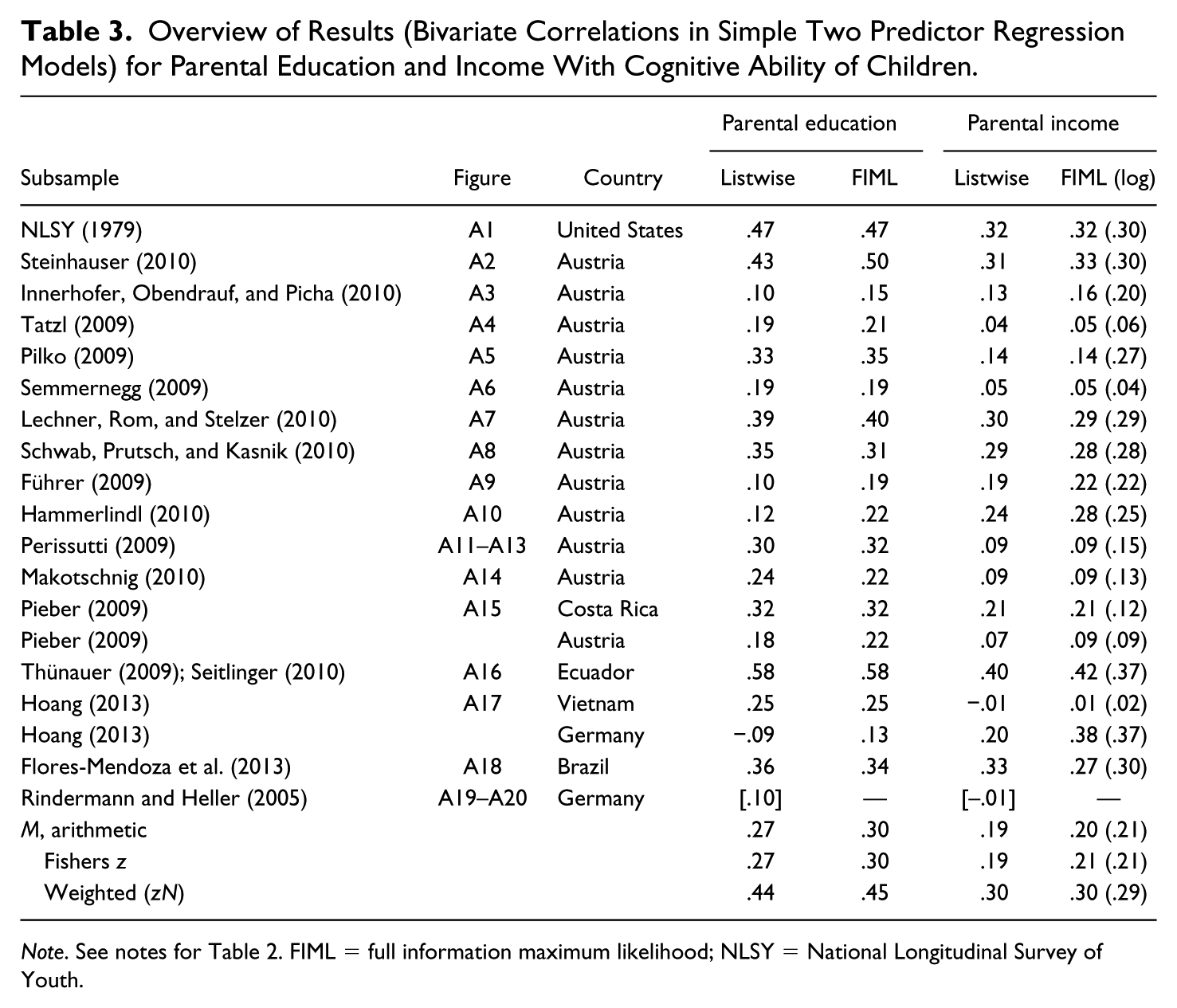
Note. See notes for Table 2. FIML = full information maximum likelihood; NLSY = National Longitudinal Survey of Youth.
With seven countries (Austria, Brazil, Costa Rica, Ecuador, Germany, United States, Vietnam), the country sample is rather small for systematic comparisons; therefore, comparative results are merely suggestive: Correlations of the difference between educational and income effects (based on Fishers z values) with country intelligence (own calculations; e.g., Coyle, Rindermann, & Hancock, 2016) and GDP 2003 (Human Development Report [HDR], 2005) are small (r = −.24 and r = −.17; not N weighted). The small negative correlation means that, in countries with higher cognitive ability level and wealth, the difference between education and income effects is somewhat smaller. For older children, there are slightly higher betas (parental education effect and children’s age: r = .15, parental wealth effect with age: r = .11). Because the effect of parental education on children’s intelligence is larger in lower IQ and in poorer countries (education: rIQ = −.39 and rGDP = −.22; vs. income: rIQ = −.01 and rGDP = .05) and larger in countries with strong income differences (Gini; HDR, 2005: education: rGini = .33, vs. income: rGini = −.02), it may be that more developed and homogeneous countries have higher quality instruction, teachers, schools, and school systems that buffer parental education effects. If true, however, this would not explain why there is no similar reduction of income effects; further samples from different countries are needed to answer this.
Differences between education and income in β effects are larger than in correlations (see Tables 2 and 3: direct β: .40 vs. .16; total β: .45 vs. .12; r: .45 vs. .29). Simple correlations mask effects due to relationships with other variables. They can be analyzed by looking at theoretically grounded indirect effects (for details, see online appendix). The difference between parental education and wealth effects on children’s cognitive ability increases when results of complex models are employed that include direct and indirect effects through further variables such as books, marital status, or quality of educational institutions: Parental education has a mean total (−t) effect of βEdt = .30 to .45, whereas income’s effect is βInt = .09 to .12 (Table 2). The validity of these numbers depends on the validity of assumptions underlying the models and their paths: Former education influences later wealth; education influences beneficial habits (e.g., books in home); intergenerational effects of parental wealth on children’s later wealth are smaller than intergenerational effects of parental education and intelligence on children’s later wealth (for empirical justification, see results from different modern countries: Deary et al., 2005; Irwing & Lynn, 2006; Kramer, 2009; Meisenberg, 2010; Nettle, 2003; Rindermann & Baumeister, 2015; Saunders, 1997, 2002; Strenze, 2007; von Stumm, Macintyre, Batty, Clark, & Deary, 2010). However, because these income effects are larger than zero, our models (assuming only an effect of parental education on parental wealth) will somewhat underestimate wealth effects. Nevertheless, between (total) βEdt = .30 to .45 on one side and βInt = .09 to .12 on the other is a sufficiently large distance that some over- or underestimations will not change the main result: Parental education is more important for children’s intelligence than parental wealth.
Not only crystallized intelligence but also mental speed is more influenced by parental education than by parental income (see Table 4). Crystallized intelligence depends more than mental speed on parental factors (crystallized: βEd = .36 and βIn = .09, speed: βEd = .25 and βIn = .00). However, the astonishingly high effect of parental education on speed (βEd = .25) cannot readily be explained by parental education via creating a more stimulating environment; processing speed is seemingly unrelated to experiences that fall within the typical range, given their simplicity and reliance on overlearned stimuli that are highly familiar to children from all social backgrounds (e.g., single digits). This strongly suggests there are stronger, nevertheless unknown genetic effects by which parents transmit neurological maturity, brain efficiency, and processing speed to their children.
Overview of Results (Betas) for Parental Education and Income on Cognitive Ability of Children—Mental Speed vs. Crystallized Intelligence.

Note. Total N = 394. FIML and logged income. For Pilko as “crystallized,” verbal ability (picture description) was used. For Schwab as “crystallized,” (verbal) Piagetian tasks were used. For Pieber as “crystallized,” the mean of PIRLS-, TIMSS-, and PISA-tasks in reading and math literacy were used. “Arithmetic”: simple arithmetic mean. “Fishers z”: mean correlations averaged using Fishers z transformation. “Weighted”: mean correlations averaged using Fishers z transformation and weighted for N. FIML = full information maximum likelihood; PIRLS = Progress in International Reading Literacy Study; TIMSS = Trends in International Mathematics and Science Study; PISA = Programme for International Student Assessment.
Finally, a longitudinal study analyzed the impact of parental educational level versus parental income in subsamples of gifted German children’s cognitive development, with n = 172 or n = 355 observations. Parental income, measured in currency units or in self-assessment of relative income compared with others, was irrelevant (βIn = −.01 and .01), parental education showed effects (βEd = .08 and .11). Because in longitudinal cross-lagged analyses, effects of former ability are controlled for and because the subsample is highly selected according to children’s intelligence and parental education, large effects of education and income could not be expected.
Mediating Variables Operating Between Parental Education and Income and Children’s Cognitive Ability
Effects of mediating variables in the models are theoretically relevant. They can help to understand how parental education and parental wealth influence cognitive outcomes:
Number of books is an indicator of parental education and familial culture and it is a causal factor via reading. Books, depending on parental education (arithmetically averaged βEd→Bo = .38), have an effect on children’s cognitive ability (in online appendix, please see Figures A2, A3, A5, A6, A7, A10, A13, A14, A16 averaged: βBo→CA = .18). Directly compared and reanalyzed for all studies with information on books, the effect of parental education on books is larger than the effect of parental income (βEd→Bo = .44 vs. βIn→Bo = .20). 2
Civic–burgher family describes children living with both biological parents who are married. It is an indicator of a burgher–civic lifestyle and creates a more supportive-stable developmental environment. Parental education has a positive impact on marital status (βEd→CF = .22). Civic–burgher family itself has an effect on children’s cognitive ability (see online Figures A3, A5, A6 averaged: βCF→CA = .17).
Quality of educational institutions comprises assessed preschool quality and level of school and should have as a supportive developmental environment a positive impact. In our study, this quality depends largely on parental education and less on wealth (arithmetically averaged βEd→QI = .23 vs. βIn→QI = .09), and it has an effect on children’s cognitive ability (in online appendix, Figures A2 and A12 averaged: βQI→CA = .35). 3
Educational and common cultural practices of parents with their children describes intellectual experiences such as reading to the child or attending museums. As cognitive stimulation, it should have a positive effect on children’s cognitive development. This behavior depends largely on parental education and less on wealth (βEd→EB = .26 vs. βIn→EB = .11), and it has an effect on children’s cognitive ability (in online appendix, Figures A4, A6, A10, A16 averaged: βEB→CA = .12). 4
Maternal smoking during pregnancy impairs prenatal development. It depends on education (βEd→Sm = −.10), and smoking influences children’s cognitive ability (online appendix, Figure A11: βSm→CA = −.18).
Finally, the behavior of children themselves—comprised of reading, leisure time activities, and discipline—should support cognitive development. It largely depends on parental education (arithmetically averaged βEd→BC = .31), and shows an effect on children’s cognitive ability (in online appendix, Figures A6, A16 averaged: βBC→CA = .19).
These results on mediating variables are much more tentative than the ones reported above for parental education and income. Small effects are not always detectable. Especially, the relationship between wealth and number of books is problematic; there are positive relationships standing for bidirectional paths depending on wealth level (number of books may depend more on wealth in developing countries, whereas in rich countries, the number of books is an additional indicator of education, ability, and values). The same is true for the assumption of a unidirectional educational effect on number of books: Longitudinally, they influence each other—books support education and education supports the acquisition, retention, and reading of books. To disentangle these possibilities, further longitudinal analyses are needed on reciprocal effects.
These results hint at how parental education may work to affect their offspring’s cognitive scores. It accomplishes this through forming a generally more stimulating, supportive, and stable cultural and social environment that furthers children’s cognitive development: more books, two parents in a stable long-term relationship, selecting better educational institutions from early childhood through adolescence, spending time in common culturally loaded and cognitively stimulating activities such as reading and attending museums, not harming the child by smoking during pregnancy (and also not harming oneself, partners, and other children), and finally through influencing children’s own behavior in a beneficial way. Any or all these factors may underlie the reason that parental education is more important than parental wealth.
Path Analysis Using a Combined Sample
Thus far, we have analyzed effects based on single samples and their subsequent averaging. In a final path analysis, using z-standardized variables, we look at the effects in a combined sample with N = 3,925 observations (as noted, the U.S. sample was randomly reduced). In a first direct comparison considering only the three variables parental education, parental income, and children’s cognitive ability (not shown as figure), the effect of parental education is larger than the effect of parental income (direct: βEd→CA = .34, total: β = .38; βIn→CA = .12). Also after considering intervening variables as shown in Figure 1, number of books, family characteristics, educational behavior of parents (with focus on intellectual education, “Bildung”), and children’s own behavior, education remains a stronger effect than parental income (βEd→CA = .20, βIn→CA = .10; Figure 1). Also, the effects of parental educational behavior (βPB→CA = .11) are somewhat stronger than income effects as is children’s own educational behavior (βCB→CA = .16). The total effect of parental education on children’s cognitive ability is β = .35 versus only β = .12 for income. Adding indirect effects increases the difference in effect sizes from .10 (.20 − .10) to .23 (i.e., .35 − .12). Compared with the effects achieved through averaging (see last rows in Tables 2 and 3), the pattern remains robust: Parental education is more important than parental income for children’s cognitive ability.
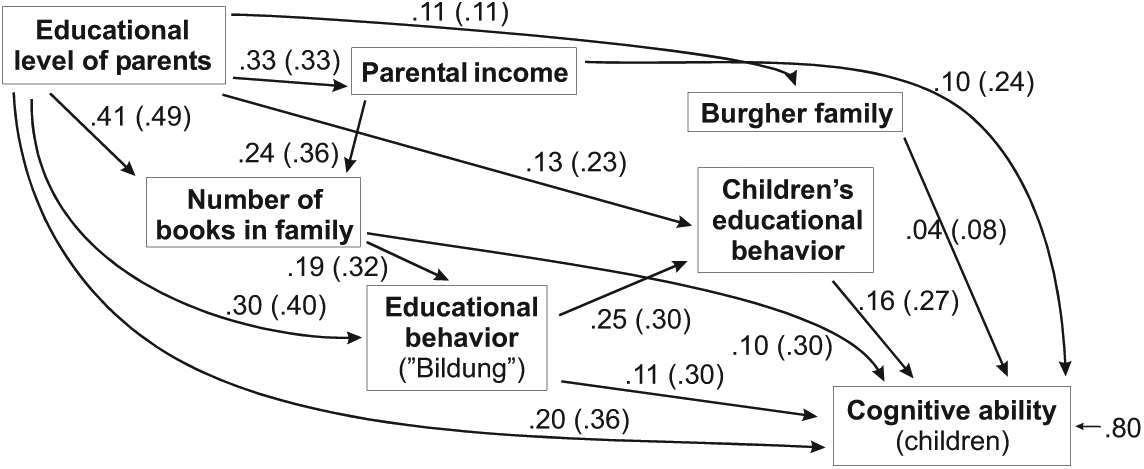
Path model for 18 subsamples from seven countries.
Finally, if a background variable is added (ethnicity and/or race in the United States, Brazil, and Ecuador, migration background in Europe), this variable reveals in such a model even stronger effects than education and income (direct: βBg→CA = .30, total: β = .36; βEd→CA = .21, total: β = .32; βIn→CA = .05, total: β = .07; online Figure A21). However, parental education, parental educational behavior, and children’s own behavior are still important. They form one part of a larger network of causal effects on children’s development.
General Discussion
Central Conclusion
The central question in this project is whether a child’s cognitive competence is more influenced by parental education or income: That is, is a highly educated family or a wealthy family more likely to produce high IQ offspring? To address this question, we conducted a series of path analyses using 19 sets of cross-sectional and longitudinal data, spanning highly developed nations such as America, Germany, and Austria, to developing countries such as Brazil, Costa Rica, Ecuador, and Vietnam. Cognitive test measures—information processing, fluid reasoning and crystallized psychometric, and Piagetian tasks—were gathered for students from kindergarten through high school and young adulthood. Their parents were asked about their educational attainment, income, cultural activities (museum attendance, library membership), reading to their children, and the like.
Despite the great variability across the 18 cross-sectional studies and one longitudinal study in seven different countries—with offspring aged 4 to 22 years; with families at various levels of education and income, from indigenous poor and poorly educated people in remote Andean areas to academic and comparatively rich samples with children attending high ability tracks; employing different measures of parental education, parental economic status, and children’s cognitive ability; and using different variables to represent attitudes and concrete educational behavior in families—one crucial result emerged: Embedded within the global concept of SES, the educational level of parents is statistically more important for children’s cognitive development than parental economic affluence (total effect averages: βEd→CA = .30–.45 vs. βIn→CA = .09–.12). Thus, the use of global SES indicators in research can be misleading. They do not illuminate parental effects on children’s development and they may seduce researchers and the public into misinterpreting parental effects as primarily economic effects.
As shown in five studies, family wealth could even have a negative impact on children’s’ ability (online Figures A4, A6, A8, A12, and A19). Wealth not generated in response to education (e.g., winning the lottery, inheritance, tort suits) may actually have a negative effect on cognitive development, contrary to conventional wisdom (Nisbett, see Wargo, 2009). Such a conclusion is confirmed by outcomes from Blau (1999): Passively received income, not gained by one’s own work, but by welfare, heritage, lottery, or other circumstances impedes competence development, possibly by presenting to children a negative role model and conveying to them that there are other ways, besides effort and education, that lead to success. This is consistent with analyses at the country level using data from PIRLS and TIMSS that show for the Gulf States that the vast revenues derived from petroleum resources have not delivered cognitive benefits to children (Rindermann & Ceci, 2009). Finally, at the historical level, countries do not benefit from wealth not based on own ingenuity as the case Spain in 16th to 19th centuries shows:
Spain, in other words, became (or stayed) poor because it had too much money. The nations that did the work learned and kept good habits, while seeking new ways to do the job faster and better . . . Reading this story, one might draw a moral: Easy money is bad for you. It represents short-run gain that will be paid for in immediate distortions and later regrets. (Landes, 1998, p. 173)
Nevertheless, there is also one study showing a negative impact of education. However, in the entire pattern of results, this one outlier with a small sample, n = 46, is an anomaly, deviating by .30 beta points from the next lowest effect of education on children’s cognitive ability.
To recap, the economic hypothesis appears to be unwarranted. The alleged economic basis of cognitive ability differences in modern societies seems to be based more on common sense intuitions and convictions than on empirically established facts, and they are open to the various biases associated with common sense explanations (Watts, 2011). As in other fields of research, such as health (Goldman & Smith, 2002; Gottfredson, 2004), education and cognitive ability show higher “returns” on desired outcomes than does wealth.
Nevertheless, social health differences continue to be attributed by many scholars to wealth differences. The interpretation of scientific results seems to be strongly influenced by general sociopolitical orientation and ideology (Ceci & Williams, 2018), frequently called “zeitgeist.” The view that education is less important than money, or that money will make up for a lack of education, is part of a larger ideological debate, and appears to be related to conflicting worldviews. On one hand, individual outcomes are seen as strongly influenced by external forces, such as “society.” This tradition of thought has its roots in a philosophical and political movement of the 19th and early 20th centuries—including in materialist and Marxist thinking—and is still influential. On the other hand, some view individuals as more influenced by internal forces, such as self-education and self-direction, response inhibition, ability and effort, personality, and “character.” This view has its roots in another philosophical and political tradition—in idealism and Enlightenment (e.g., Immanuel Kant) with their strong emphasis on education, thinking, knowledge, independence, and a self-direction. It is also strong in constructivism and in eastern, Confucian traditions. 5
Notwithstanding the demonstration that education has a greater influence on intellectual development than does familial income, our results still show that offspring’s intellectual development is somewhat influenced by their family’s income and wealth (average βIn→CA = .09–.16). In addition, in society, economic factors are generally not unimportant: For example, salary is a signal for attracting highly qualified and competent teachers who have a positive impact on children’s development (e.g., Eide, Goldhaber, & Brewer, 2004; see also “The Equity Project” in New York, www.tepcharter.org). The level of salary communicates esteem for work (quality, quantity), signals valuation and achievement orientation, motivates, and leads to positively selected employees. Studies with natural experiments show that for adults, the stress associated with poverty leads to a temporary intelligence decline of about 13 IQ points on the Raven’s Progressive Matrices (Mani, Mullainathan, Shafir, & Zhao, 2013). However, these declines were situation specific (they occurred under dire economic threats), and the cognitive loss could be recovered within weeks (e.g., if farmers had a successful harvest). And, using a longitudinal natural experiment in the United States—the introduction and increase of payments to poor families—Lundstrom (2017), based on Dahl and Lochner (2012), showed for a US$1,000 increase, an effect of 4.13% of a standard deviation in reading and mathematics equivalent to a 0.6195 IQ points gain. This is a positive effect, but it was given to the poorest families and it may show diminishing returns—larger increases would be even more difficult to achieve.
Thus, cognitive development is not totally independent from economic factors, but education and other factors such as number of books (βBo→CA = .18), marital status (βCF→CA = .17), educational behavior of parents (βEB→CA = .12), smoking during pregnancy (βSm→CA = −.18), quality of educational institutions (βQI→CA = .35 minus selection effect about βQI→CA = .10–.20), and behavior of children themselves (βBC→CA = .19) are at least similarly and most probably more important than parental wealth. Individuals could be active agents in their children’s and their own lives. Choosing to spend time reading to children is one notable example of the way individual choice can alter the microenvironment of the family in a positive direction.
Why are these variables relevant in development? First on parental education, it is not the parental educational degree itself as a mere title that is relevant (so-called “sheepskin effect”; Caplan, 2017), but as a proxy for ability (and to some degree, for personality and attitudes), acquired in an educational system. As for education, the other variables could be merely signals, but they also directly support cognitive development. Number of books increases the possibilities to read (reading by parents to their children and reading of children themselves), reading enhances cognitive ability through knowledge assimilation, through stimulation of thinking, forming of abstract concepts, and reflection (Greenfield, 2009). Smoking harms general health and neurological development (e.g., Yolton, Dietrich, Auinger, Lanphear, & Hornung, 2005). A civic–burgher family exposes children to a more extensive supply of models, educators, and linguistic input, and provides children with the benefits of social and emotional stability (e.g., Armor, 2003). Discipline increases learning time (Hattie, 2009; Rindermann & Ceci, 2009). Higher quality of educational institutions supports the development of children through more demanding curricula, more competent teachers, and more competent classmates (e.g., Eide et al., 2004; Rindermann & Heller, 2005). Attending museums and theaters stimulates knowledge assimilation, thinking, and reflection.
The majority of these factors were identified as early as 1913 by Zergiebel who described as beneficial factors not only wealth (before World War I) but also parental educational level, worldview, lifestyle, and an education guided by order. Today, we can describe such factors and their influence in a much more precise way. All these factors connote “middle-class” (or “burgher,” “civic,” “civil”) values and lifestyle, neither poor nor rich. Education and cognitive ability and all their accompanying attitudes, behaviors, and orientations (e.g., reading, diligence, endeavor, and behave in an ordered, well thought-out, and farsighted way) are typical “middle-class” or “burgher” phenomena first described by Leon Battista Alberti (1441/2004; Rindermann, 2009). Although the studies converge in a strong effect for education over income, several objections are possible and we turn to these next.
Possible Limitations and Recommendations for Further Research
Measurement and statistical limitations
Both parental education and parental wealth are potentially problematic variables: Education is not a scale with stable equidistant differences. Extra income such as state-sponsored income support, child benefits, or housing subsidies can be underestimated by parents. (In the present study, all information on families came from parents or from older children.) Responses to these variables could be distorted by social desirability as well as by knowledge deficits (e.g., how many shelves full of books a family has; Paulhus & Vazire, 2007). But it is difficult to assess how such problems could have distorted the present results because, if anything, they probably lead to an underestimation of the effects of all variables on children’s cognitive ability, not to an overestimation of only education.
To minimize measurement problems, we (a) combined different sources of information for a given construct and checked, when possible, reliability (e.g., parents and children were asked the same question, education was recorded both for school and professional training, both fathers’ and mothers’ education was coded as was both fathers’ and mothers’ income, wealth was coded as both income in currency and value of possessions, data were treated both in natural units and logged, different material possessions were recorded); (b) used different subsamples in different countries; (c) used studies conducted by different authors; and (d) used different indicators in different studies. These different approaches did not lead to systematically different results, which strongly suggests that methodological limitations did not distort the pattern of results in any substantial way.
Arbitrariness of path models
We have used in different studies different path models and different mediating variables to explore how parental education and wealth could exert effects. These models depend on constructs measured in the study, on local subsamples and their characteristics (e.g., migrant history, ethnic/race differences, age, and school-level differences), and on necessary adaptations to achieve a satisfactory model fit.
However, we have always tried to integrate—when possible—the most important general variables such as number of books (even if there were very small effects). And, we used the variables that were important in a specific context, such as immigration status in Austria, ethnic background in the United States and Brazil, height as indicator of long-term wealth in Ecuador, and level of school in secondary subsamples in Austria. The models have to differ according to differences between countries and different age groups. Finally, we constructed an integrative model using all given information of different indicators on constructs. Once again, the main results were unaffected.
Economic development
The studies were conducted in rich and poor countries. The small or sometimes even negative effects of wealth on child development in developed countries may attest to the success of established welfare policies. But contrary to our results demonstrating low impact of wealth on children’s cognitive development, many studies done in developing countries have shown a large impact of supplemental nutrition and health care for the cognitive development of children: For instance, additional meat in students’ diet in Kenya (Whaley et al., 2003) was associated with an increase in their cognitive competence; the relocation of children from Brazilian slums (favelas) to middle-class housing increased not only their height but also their intelligence (Paine, Dorea, Pasquali, & Monteiro, 1992); in the Philippines, the price of baby food is negatively associated with cognitive ability several years later (Glewwe & King, 2001); antiworm therapy in sub-Saharan countries increases school attendance and cognitive abilities (Glewwe & Kremer, 2006). There is evidence from both naturalistic and experimental studies suggesting that the quality of nutrition leads to higher intelligence even in highly developed nations (Eysenck & Schoenthaler, 1997; Lynn, 2009). Therefore, where wealth falls under a threshold for good nutrition and basic health services, wealth differences between families should become important for cognitive as well as general development. This is true today for developing countries as well as in former times for first world countries (e.g., Austria after the worldwide economic crisis of 1930 [Jahoda, Lazarsfeld, & Zeisel, 1933/2002], Germany around World War I [Zergiebel, 1913], in the Deep South of the United States [Mayer, 1997]). In our subsamples of Latin American countries, Costa Rica seems to be just above the threshold for strong income effects, but not Ecuador (Costa Rica βIn→CA = −.01, GDP 2003 US$9,606; vs. Ecuador βIn→CA = .21, GDP US$3,641; Brazil βIn→CA = .18, GDP US$7,790; see also Rindermann & Carl, 2017; Rindermann, Stiegmaier, & Meisenberg, 2015).
In poor countries, establishing beneficial developmental conditions may be less limited by wealth restrictions than by the improper distribution of the means that are available. Many developing countries suffer not only from poverty but also from corruption, leading to a misallocation of even their limited resources (Glewwe & Kremer, 2006). However, it has been shown that the cognitive competence level of societies is the most important determinant of governmental effectiveness, national wealth, and its growth (Rindermann, Kodila-Tedika, & Christainsen, 2015). Therefore, there are reciprocal effects between ability, government effectiveness, and wealth working, for example, via quality in the systems of health and education. Many important health and nutritional supplements are inexpensive. However, even if sufficient means are given to families, there is no guarantee they will be spent in a beneficial manner by parents, by the local authorities, or by the government (Glewwe & Kremer, 2006; Mbiti, 2016; Rindermann, 2013).
Accordingly, research in two other developing countries—in the Caribbean island of Dominica (Meisenberg, Lawless, Lambert, & Newton, 2006) and in Senegal (Glick & Sahn, 2009)—showed a stronger effect of intellectual stimulation in families and of parental educational level than of wealth on cognitive development. Further research in similarly poor countries would be extremely valuable.
Liberty and meritoric structure
The prerequisite for positive effects of formal education on wealth and what it stands for—intelligence, knowledge, working habits, civic attitudes, and behavioral patterns (“human capital”)—depends on a meritocratic structure of society (see Coyle et al., 2016). If classes or castes, racial or ethnic ancestries, political or ideological affiliations determine access to high quality education, if individual ascent through competence and diligence is not possible, but occurs through family connections, corruption, or political membership, then the path from parental education to children’s intelligence will be reduced, and as a consequence, the investment of persons in developing their competence will be lowered.
Our results show the United States as one example of a modern Western country in which children’s cognitive ability is more important than parental income for children’s later income as adults (online Figure A1); results for Germany provide another example (Kramer, 2009), as does the United Kingdom (Deary et al., 2005; Irwing & Lynn, 2006; Nettle, 2003; Saunders, 1997, 2002; von Stumm et al., 2010; also see meta-analysis for studies mainly from the United States: Strenze, 2007). 6 In addition, Austria seems to be at least partly meritocratic (mean for Austria within parents: βEd→In = .31, for United States: βEd→In = .31, Costa Rica: βEd→In = .39, Ecuador: βEd→In = .32, Brazil: βEd→In = .45, but socialist Vietnam: βEd→In = −.08). The latter does not mean that meritocratic aspects could not be improved. 7 Education has a four-way effect. First, it increases ability; second, it signals this ability (Caplan, 2017; Spence, 1973); third, it also modifies and signals attitudes (Caplan, 2017); and finally, it opens doors established through formal rules by the state and society (e.g., it is not possible to become physician without a high school diploma).
Hidden genetic effects
Behind the strong effect of parental education (and the smaller effect of wealth) on the cognitive competence of children lies the impact of parental education on the quality of the environment necessary for cognitive development (e.g., number of books, educational behavior, visiting museums). However, behind even this relationship might lie hidden genetic effects (Harden, Turkheimer, & Loehlin, 2007; Johnson, Mcgue, & Iacono, 2007; Lemos, Almeida, & Colom, 2011; Rowe, 1994). Accordingly, educational level could be a more reliable indicator of genetically driven intelligence and general competence than income, which is relatively more dependent on market and chance factors. And, such genes are transmitted to children resulting in intelligence. Therefore, environmental quality effects could be hidden “extended phenotype” effects (Dawkins, 1982), meaning that environmental attributes such as number of books and institutional quality might reflect genetic influence (Hunt, 2011, p. 68f). In the most pronounced version of this position, Lemos et al. (2011) view parental educational effects as being limited to their genetic heritage. In their words,
Adolescents’ intelligence scores will be genuinely associated with the educational level of their parents, because the latter can be considered a proxy estimate of their intelligence and relatives share genes influencing general cognitive ability . . . Brighter children are raised in homes managed by brighter parents, but their advantage should not be attributed to home facilities. (pp. 1063, 1066)
Consistent with such a view is the strong impact of the ethnic background variable in online Figure A21. Its causal meaning cannot be determined by this study. Following the literature, the underlying factors could range from culture to genes, from society to discrimination.
This does not necessarily mean that familial environmental quality has no influence on development, only that it might be underpinned by genetic aspects of parents and their children. The analytical approaches used in the present study cannot disentangle environment versus genetic hypotheses, as can twin research or other behavioral genetic designs. But mental speed, because of its sheer simplicity and resistance to training effects, 8 is a good indicator of the genetically determined component of intelligence, and here, we found a similar pattern of greater effect for education than income (βEd→MS = .25 and βIn→MS = .00).
Relatedly, other studies showed that “income effects” are stronger for parents’ biological adolescents than for their adopted children, suggesting genetic mechanisms may underlie environmental quality (Capron & Duyme, 1989; Scarr & Weinberg, 1978) and wealth. In addition, genetic aspects could stand for genes indirectly supporting intelligence development such as through self-discipline and diligence, or for genes reflecting a biological health dimension: In favor of such an interpretation, even height seems to depend more on education than on wealth (Sri Lanka, education and height r = .24, income and height r = .17, N = 4,477, difference at the 1% level significance; Ranasinghe et al., 2011). Finally, behavioral genetic research shows that the influence of shared environment decreases with age. This could have consequences for educational policy decisions arguing for support in early childhood when larger improvements in outcomes are possible (see Doyle, Harmon, Heckman, & Tremblay, 2009).
Causality
Statistical analyses, including path analyses, cannot prove causality in an unequivocal way. Only experiments with randomized assignment of persons to treatment and control groups are able to do this. None of the studies presented here could be categorized as an experiment. Nevertheless, experimental studies such as the Perry-Preschool program or the Abecedarian project (Barnett & Boocock, 1998; Cunha, Heckman, Lochner, & Masterov, 2006) have shown at least medium-term positive impacts of preschool education and parental consultation on children’s intelligence and school attainment. Saunders (1997, 2002) demonstrated in a longitudinal study that education leads to jobs with higher income and to success in society (see Ceci, 1991; Ceci & Williams, 1997). And, adoption leads to a rise in intelligence, for example, in a recent Swedish sample of N = 1,043 siblings about 5 IQ points (Kendler, Turkheimer, Ohlsson, Sundquist, & Sundquist, 2015).
Supplemental Material
RindermannCeciAppendix – Supplemental material for Parents’ Education Is More Important Than Their Wealth in Shaping Their Children’s Intelligence: Results of 19 Samples in Seven Countries at Different Developmental Levels
Supplemental material, RindermannCeciAppendix for Parents’ Education Is More Important Than Their Wealth in Shaping Their Children’s Intelligence: Results of 19 Samples in Seven Countries at Different Developmental Levels by Heiner Rindermann and Stephen J. Ceci in Journal for the Education of the Gifted
Footnotes
Acknowledgements
The authors are grateful to Elke Führer, Marion Gruber, Birgit Hammerlindl, Quyen Hoang Sen Ngoc, Helga Innerhofer, Marion Kasnik, Katharina Lechner, Nina Makotschnig, Alexandra Obendrauf, Christina Perissutti, Rifeta Picha, Eva-Maria Pieber, Heimo Pilko, Patricia Prutsch, Bernhard Rom, Silvia Schwab, Caroline Seitlinger, Nina Semmernegg, Kerstin Steinhauser, Katrin Stelzer, Katharina Tatzl, and Katharina Thünauer (all former master students from the Universities of Graz and Chemnitz) for their help in collecting data at Austrian, Costa Rican, or Ecuadorian schools. In addition, we want to express our gratitude to Carmen Flores-Mendoza and Marcela Mansur-Alves (Universidade Federal de Minas Gerais, Brazil) who gave us data from Brazil for a reanalysis. Gerhard Meisenberg kindly supported us in reanalyzing data from NLSY. The first author also wants to thank Kurt A. Heller for cooperation in the German high ability study. In addition, we want to thank all students and parents for participating in the studies. Naturally, the authors bear sole responsibility for the views expressed in the article.
Declaration of Conflicting Interests
The authors declared no potential conflicts of interest with respect to the research, authorship, and/or publication of this article.
Funding
The authors received no financial support for the research and/or authorship of this article.
Supplemental Material

Notes
Author Biographies
References
Supplementary Material
Please find the following supplemental material available below.
For Open Access articles published under a Creative Commons License, all supplemental material carries the same license as the article it is associated with.
For non-Open Access articles published, all supplemental material carries a non-exclusive license, and permission requests for re-use of supplemental material or any part of supplemental material shall be sent directly to the copyright owner as specified in the copyright notice associated with the article.
