



Abstract
The purpose of this exploratory study was to examine the coming out experiences of gifted LGBTQ (lesbian, gay, bisexual, transgender, and questioning or queer) alumni from a residential gifted high school. First, we found that gifted LGBTQ alumni (N = 106) realized their sexual orientation/gender identity around 16.6 years old, which is similar to the general population. The year of high school graduation did not correlate with the age of initial realizations, or when they shared. On average, when the participants did share, they waited 2.1 years to share with friends and 3.4 years to share with family. Furthermore, they felt more comfortable sharing within the residential gifted high school than in their home schools. In general, LGBTQ alumni felt more autonomous, competent, and connected to the residential school. Finally, participants reported many barriers to coming out, including both internal struggles (e.g., uncertain themselves) and social fears (e.g., fear of alienation or harassment). These findings can provide guidance for school personnel as they develop effective, support systems.
All individuals have universal psychological needs, and the fulfillment of these needs leads to psychological well-being, positive identity development, and the ability to become one’s most authentic self (R. M. Ryan & Deci, 2020). Self-determination theory (SDT) posits those basic psychological needs include the need for autonomy (i.e., agency over life conditions and behaviors), competence (i.e., ability to experience mastery and growth), and relatedness (i.e., connection with others; R. M. Ryan & Deci, 2017). Individuals are inherently driven to satisfy these needs; however, the actualization of these needs is not automatic, requiring the presence of a needs-supportive environment (Legate et al., 2012, 2017; R. M. Ryan & Deci, 2020). Although SDT acknowledges these universal needs, the theorical framework also recognizes how individual differences may influence the ways in which these needs manifest and how a needs-supportive environment must account for these individual differences (R. M. Ryan & Deci, 2020).
In the current study, we explored how gifted LGBTQ 1 (i.e., lesbian, gay, bisexual, transgender, and queer/questioning) individuals’ needs for autonomy, competence, and relatedness are facilitated, or inhibited, within specific environments, including within their families, friends, and schools. Within the gifted field, multiple publications have recognized the unique needs of this population (Friedrichs et al., 2017; Keener, 2013; National Association for Gifted Children [NAGC], 2015), yet in the last 20 years, to the authors’ knowledge, only three empirical studies have been published in peer-reviewed journals. All three studies used qualitative interviews to understand these experiences within a methodologically appropriate small sample (Hutcheson & Tieso, 2014; Peterson & Rischar, 2000; Sewell, 2020).
Although gifted, LGBTQ students share the same needs as all other humans as they develop their identities, and they may face specific hurdles unique to both their gifted and LGBTQ statuses. Specifically, gifted students are not often challenged in traditional school environments (Dixson et al., 2020; Peters et al., 2017; Rambo-Hernandez & McCoach, 2015), which may prevent them from fulfilling their need to develop new competencies, affecting their ability to develop their multifaceted identity. Furthermore, the development of LGBTQ students’ identities is connected to their ability (a) to autonomously actualize their LGBTQ status to become their authentic self and (b) to share that part of their identity to fulfill their need for relatedness (Riggle et al., 2017). This personal realization and sharing is encompassed within the “coming out” process.
Often, this initial coming out experience is a pivotal moment in students’ lives during which they first realize their own LGBTQ status (Pew Research Center [PRC], 2013). They must negotiate how this realization influences their perception of their own identity, who they should confide in, and what it means for their life (Human Rights Campaign [HRC], 2018). These early experiences may have lasting effects, making it important for teachers, parents, and peers to provide a safe and needs-supportive environment to ensure adaptive identity development (HRC, 2018; NAGC, 2015).
Research on the coming out experience can provide important information to guide the development of effective support systems (NAGC, 2015). Thus, the purpose of this exploratory study is to answer four fundamental research questions regarding the coming out experiences of gifted LGBTQ individuals across different environmental contexts: (a) When do gifted LGBTQ individuals first realize their sexual orientation and/or gender identity? (b) With whom do they share this information? (c) To what extent does coming out relate to gifted LGBTQ students having their psychological needs (autonomy, competence, and relatedness) met across academic environments (home school and a residential, gifted school)? and (d) What factors may prevent them from sharing? Collectively, these findings provide initial background information to educational practitioners and families, as they work to establish a needs-supportive environment for these individuals.
Theoretical Framework
Defining LGBTQ and Giftedness
LGBTQ is an acronym encompassing both gender identity (i.e., one’s concept of self as male, female, or neither) and sexual orientation (i.e., one’s characterization of their sexual identity, behavior, and/or attraction). Importantly, gender identity and sexual orientation can be fluid, fixed, and exist on a spectrum. Recently, Watson et al. (2020) examined a large national sample of sexual and gender minority adolescents (N = 17,112) and reported 26 distinct categories of labels, including pansexual, nonbinary, sexually ambiguous, metasexuality, and androsexuality. Although individuals adopt different labels and gender identity and sexual orientation are separate, diverse constructs, LGBTQ rights are often discussed collectively, unifying the community of LGBTQ individuals and activists (Human Rights Watch [HRW], 2009). Although considering gender identity and sexual orientation together loses some nuance within the population, it also yields a larger cohort/sample that identify as a part of the broader community and avoids the challenging task of parsing the group further due to the fluid, diverse, and spectrum nature of subgroup membership.
Defining giftedness presents an additional challenge. Theorists have proposed myriad conceptions such as wisdom, creativity, and intellectual capabilities (Heller et al., 2005; Renzulli, 2005; Sternberg, 2005; Sternberg & Davidson, 2005), and many states have developed their own definitions (McClain & Pfeiffer, 2012). Defining and identifying giftedness is essential to match students with appropriate educational placements (Peters et al., 2014). One potential placement is a residential gifted high school, which provides opportunities for gifted students to live and study in an academically challenging environment with like-minded peers (T. L. Cross & Frazier, 2010). Residential gifted public schools provide both academic and social benefits for gifted students (T. L. Cross & Swiatek, 2009; Pfeiffer et al., 2010). In addition to meeting gifted students’ academic needs, research has examined how attending residential gifted schools affects gifted students’ psychological well-being (e.g., T. L. Cross & Swiatek, 2009; Rollins & Cross, 2014), including increased feelings of peer acceptance (e.g., T. L. Cross & Swiatek, 2009).
In the current study, we examine gifted participants’ experiences within their home school and within a residential public gifted high school (henceforth labeled “GT School”). These participants’ high school experiences began in their geographic home school for the first 2 years, and then they moved to the residential state-supported gifted high school for their final high school years. The GT School endeavors to provide a social, intellectual, and physical environment where high-achieving and/or high-ability students can thrive.
Applying SDT
SDT proposes all individuals have specific, basic psychological needs, and the fulfillment of those needs promotes psychological well-being, optimal motivation, and positive identity development, which enhances all forms of performance (e.g., academic achievement; R. M. Ryan & Deci, 2020). The three basic psychological needs are autonomy, competence, and relatedness. The fulfillment of these needs is not automatic and individual differences affect how these needs are met (R. M. Ryan & Deci, 2020). Furthermore, needs-supportive environments are important to provide students opportunities to fulfill these needs and develop their identities (Weinstein et al., 2017). Thus, different environments (e.g., types of schools, family, friends) may all provide different levels of needs support.
To the authors’ knowledge, although no existing study has comprehensively examined the extent to which gifted LGBTQ students’ psychological needs are being met across environments, multiple studies have examined various components. Of all the SDT constructs, autonomy has been the most well studied within the LGBTQ literature (Legate et al., 2012, 2017; Weinstein et al., 2017). In general, individuals who were most able to integrate all aspects of their stigmatized identity into the self took greater ownership of their identity and experienced greater psychological health; however, the individuals’ ability to integrate their identity and share their authentic selves was significantly affected by the environment’s level of autonomy (Legate et al., 2012; Weinstein et al., 2017). For example, when the environment was deemed autonomy-supportive, individuals were more likely to come out, leading to higher levels of psychological well-being, including higher self-efficacy, fewer depressive symptoms, and less anger (Legate et al., 2012). Yet, coming out alone was not solely responsible for those positive outcomes; rather, it was the interaction between a supportive environment and coming out because when individuals came out in controlling environments, they experienced lower psychological well-being (Legate et al., 2012, 2017).
In addition to requiring an autonomy-supportive environment, gifted LGTBQ students also have unique environmental needs to promote competence development. To develop new competencies, gifted students must face appropriately challenging academic experiences (Reis & Boeve, 2009; Snyder & Linnenbrink-Garcia, 2013). Many gifted students enter traditional classrooms at least 1 year above grade level, yet they make little growth throughout the academic school year (Peters et al., 2017; Rambo-Hernandez & McCoach, 2015). In fact, some gifted students’ reading abilities grew more over the summer than they did during the school year (Rambo-Hernandez & McCoach, 2015). Furthermore, teachers recognize their inability to challenge their gifted learners, as they struggle to meet the needs of a wide range of student readiness in their classrooms and prepare students for standardized assessments (Farkas & Duffett, 2008; Firmender et al., 2013).
Finally, beyond autonomy and competence, both students’ giftedness and LGBTQ status may influence their feelings of belongingness/relatedness. Gifted students have reported hiding or downplaying their abilities and/or successes to appear to be a more typical student (T. L. Cross et al., 1993; J. R. Cross et al., 2019; Manaster et al., 1994); however, some gifted students may leverage their giftedness to make other gifted friends (Berlin, 2009), suggesting belongingness may also be highly dependent upon environmental contexts and/or individual differences. LGBTQ students may also struggle to develop a sense of belongingness, especially in environments that are hostile toward their LGBTQ status (McDonald, 2018; Wilson & Cariola, 2020). LGBTQ students are particularly vulnerable to feelings of isolation and experiences of rejection/marginalization (Wilson & Cariola, 2020).
Collectively, SDT anchors the current study for several reasons: (a) SDT has a robust empirical foundation, demonstrating the importance of fulfilling these main psychological needs to promote achievement, motivation, and well-being (e.g., Núñez & León, 2015; R. M. Ryan & Deci, 2020); (b) conceptually, gifted LGBTQ individuals may face unique struggles to have these needs due to the lack of needs-supportive environments; and (c) SDT has extensive, psychometrically tested instrumentation (Center for Self-Determination, n.d.).
Theoretical Models of the Coming Out Process
Within the LGBTQ community, coming out generally refers to the process of becoming aware of one’s own sexual orientation and/or gender identity and sharing it with others (Floyd & Bakeman, 2006). Due to a general heteronormative culture (i.e., the underlying expectation that everyone is heterosexual), coming out can be a stressful process that occurs multiple times throughout individuals’ lives. To understand this process, several models have been proposed (see Table 1 for overview).
Comparison of Coming Out Models.
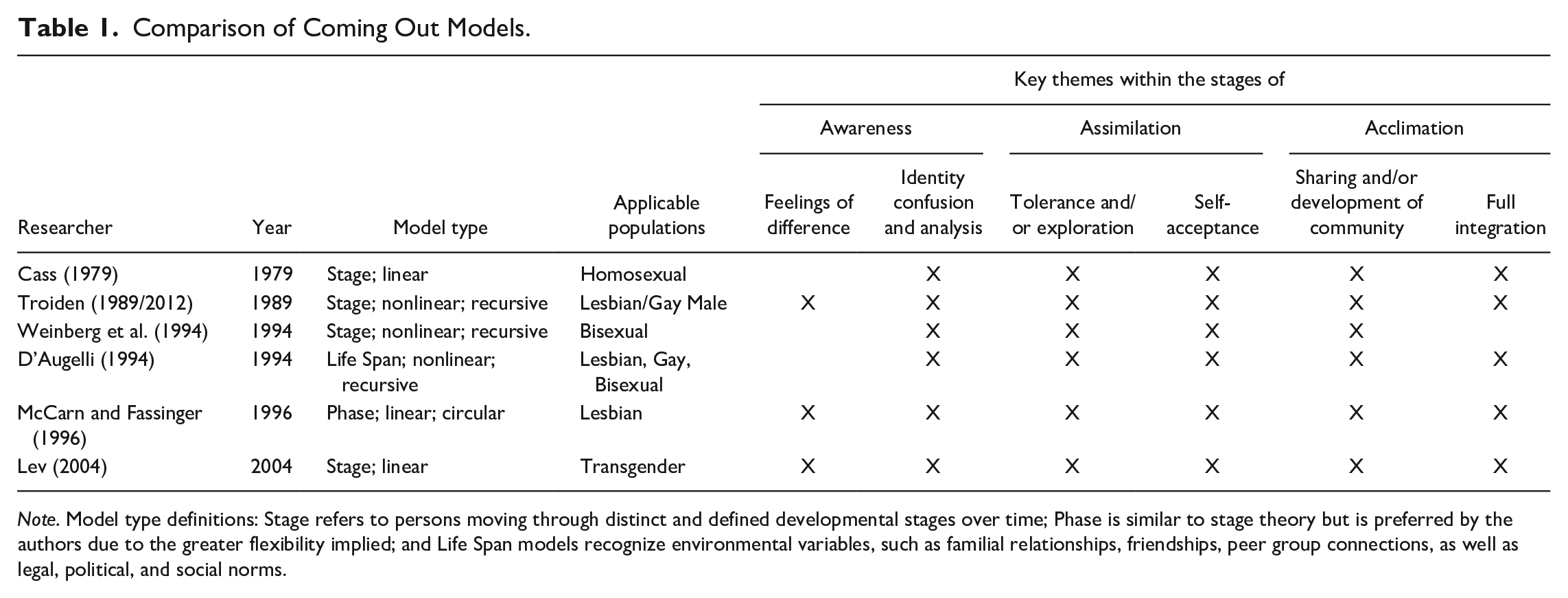
Note. Model type definitions: Stage refers to persons moving through distinct and defined developmental stages over time; Phase is similar to stage theory but is preferred by the authors due to the greater flexibility implied; and Life Span models recognize environmental variables, such as familial relationships, friendships, peer group connections, as well as legal, political, and social norms.
Many of the existing identity development models center on sexual orientation, rather than the more inclusive sexual orientation/gender identity collective, and particular emphasis is placed on the coming out process (Bilodeau & Renn, 2005; D’Augelli, 1994; Rosario et al., 2006). Because each LGBTQ+ person’s understanding of their own identity is unique, a single model that is inclusive of all identities is challenging; however, although the existing models make distinctive contributions, they also share commonalities across stages, discussing individuals who are (a) becoming aware of their sexual orientation, (b) resolving internalized homophobic feelings, (c) exploring their identity through social/sexual activities, (d) positively resolving any negative feelings following those activities, and (e) positively internalizing acceptance of their identity (Bilodeau & Renn, 2005; D’Augelli, 1994; Rosario et al., 2006).
Given these commonalities, we broadly anchored our work on D’Augelli’s (1994) model because it explicitly recognizes the importance of environmental variables, such as familial relationships, friendships, and peer group connections. The current study did not explore all the phases and nuances present in this model, but rather we focused on the personal awareness and social acclimation phases to provide an initial, exploratory examination of gifted LGBTQ individuals’ experiences across environmental contexts. Considering these environmental factors is particularly important to anchor recommendations to teachers, family members, and peers who wish to support gifted, LGBTQ individuals. Future work, however, should build upon this study to explore all the nuanced important phases.
Effects of Coming Out Experiences
Given the importance of the coming out experience to students’ identity development, myriad empirical efforts have examined the effects of LGBTQ individuals’ coming out experiences, including large-scale national surveys and both quantitative and qualitative studies. Large-scale surveys include the PRC (2013) study, which surveyed 1,197 LGBTQ adults, finding that although most participants felt current society is more accepting of their sexual orientation or gender identity, they still felt stigmatized and unaccepted. These adults’ experiences align with students’ reports of feeling unsafe at school and experiencing bullying and harassment (HRC, 2018). Prejudice is also differentially present within states that lack protections or fail to promote equity within the LGBTQ population; when LGBTQ individuals reside within these states, they are more likely to have mood/anxiety disorders and experience substance abuse (Hatzenbuehler et al., 2009). This range of stressors has been identified at both the individual and institutional levels and has been labeled as gay-related stress (Rosario et al., 2011) or minority stress (Frost et al., 2015).
These stressors have significant and dangerous effects (Meyer et al., 2015), such as substance abuse (Corliss et al., 2010) and attempted suicide (Haas et al., 2010). Specifically, individuals identifying as LGB were more likely to attempt suicide than heterosexual individuals (Haas et al., 2010). Furthermore, across multiple studies, this effect was particularly pronounced within adolescent and young adult populations (e.g., D’Augelli et al., 2001; Russell & Toomey, 2010). The elevated rates of suicide attempts have been linked to the stigma and discrimination associated with identifying as LGB, including bullying, rejection, prejudice, and hostility (e.g., Cochran et al., 2003; McCabe et al., 2010). This demonstrates that the combination of age, sexual orientation, and environmental stigma/prejudice/discrimination puts high school students identifying as LGB at higher risk for suicide attempts, making it essential for parents, high school educators, and counselors to understand how to support LGBTQ students as they are developing their identity.
Coming out to family is also particularly salient in identity development, as familial reactions can range on a broad spectrum from happiness to anger to abandonment. Roe (2016) conducted a qualitative study that examined the experiences of gay and bisexual adolescents coming out to their parents and family. Four themes connected to parental support were identified in the study: (a) coming out was necessary for mental health and to be their authentic selves, (b) the parent’s first reaction to their child coming out was typically not positive, (c) LGBTQ youth viewed familial religion as a barrier to parent support, and (d) LGBTQ youth want clear, unambiguous support from their parents and family members (Roe, 2016).
These qualitative findings provide additional information to illuminate previous quantitative results that found when family members reject students’ LGBTQ identity, these students are 8 times as likely to attempt suicide (C. Ryan et al., 2009). Furthermore, parental beliefs and reactions may be in part responsible for the disproportionate number of LGB adolescents who are homeless, as they compose 20% to 40% of the adolescent homeless population in the United States (Ray, 2006). More research is needed to understand transgender students’ experiences, as very little has examined this population directly (Haas et al., 2010).
Although these studies (and many others) provide essential information regarding the significant risks associated with students identifying as LGBTQ, a need remains to understand the extent to which this reflects gifted students’ experiences (NAGC, n.d.). Some members of the gifted field have suggested gifted students may know their sexual identity earlier than other students or be more sensitive (Treat, 2008), yet little theoretical or empirical data exist to support that assumption. Existing empirical qualitative studies found gifted LGBT students often demonstrated high achievement and strong dedication to extracurricular experiences while also feeling in danger, isolated, and depressed (Peterson & Rischar, 2000). To provide effective support, school professionals should be aware of several key variables, including when and how gifted, LGBTQ students navigate coming out experiences.
Current Study
The current study seeks to add to existing literature by providing quantitative data regarding the coming out experiences of gifted LGBTQ students across environmental contexts (i.e., home, friends, home schools, and GT School), including the extent to which their basic psychological needs were met using SDT. To add more depth to this examination, we also analyzed brief responses to open-ended survey items asking why the participants did not come out to certain individuals or within certain environments. We anchored this work on four research questions:
Method
This retrospective study examined gifted LGBTQ individuals’ coming out experiences using both quantitative data and brief open-ended survey responses. The quantitative data included participants’ responses to the following: (a) when they first realized their LGBTQ status, (b) when and with whom they shared this information, and (c) their satisfaction of basic psychological needs (Basic Needs Satisfaction in General Scale [BNSG-S]; Gagné, 2003) from both their home and the GT School. Furthermore, we analyzed participants’ written responses to the following open-ended item: why they decided did not to share with [a specific group]. The specific groups included family, friends, home school, GT School, and post high school. These responses provided information regarding factors that might prevent students from sharing, which could be used for advocacy and practical recommendations.
Participants
Environmental context of the state
The public GT School is in a highly conservative, Republican majority state within the United States. In 2015, the state adopted the Religious Freedom Restoration Acts (RFRA; Griffen, 2015). Although most of the 21 states who adopted the RFRA specify that it can only officially be used as a method of legal defense against government action, Indiana and Texas provide that it can be used when the government is not involved in the lawsuit (Griffen, 2015). Thus, the public believes the act permits businesses to discriminate against LGBTQ+ people citing religious grounds. In addition, within the state, 72% of the adult population report being Christian, 2% are of non-Christian faiths, and 26% are not affiliated with organized religion (Pew Research Center, 2014). A generalized overview of the religious stand on same-sex marriage indicated that Christian religions either prohibit or levy sanctions against it (Pew Research Center, 2015). Taken collectively, within the state, the conservative and religious majority have historically been unsupportive of LGBTQ rights.
Environmental context of the GT School
Within this state, the GT School is located approximately 50 miles northeast of the state’s capital and is easily accessible via interstate and multiple state highways. The school is located on a midsized state-supported public university, which is home to a nationally ranked teachers’ college, as well as a gifted and talented center, which provides services to schools and individuals throughout the state. The GT School was founded in 1988 and opened its doors in 1990 to its first junior class. The GT School is the state’s first and only public residential high school for high-ability students, with a dual mission of educating 300 of the state’s most academically advanced students, as well as providing a summer institute for teachers. Over the years, small changes have been implemented: In 2011, nonresidential students began to be admitted, and in 2015, the first international students were accepted. In this study, all participants attended in-state home schools and then transferred to the GT School for their junior and/or senior years.
As the state’s No. 1 College Prep Public High School (Niche, 2021), the GT School offers a liberal arts, collegiate-style education that has a curriculum that offers a depth and breadth of classes focusing on science, mathematics, and the humanities. The school offers 12 AP courses and 35 dual credit courses (Indiana Academy for Science, Mathematics, and Humanities, 2021a), which allows students to graduate from high school with many college requirements fulfilled. The GT School faculty are highly qualified content experts, as all faculty members have a master’s degree and one third hold a PhD. The school maintains an average student/teacher ratio of 13:1 (Indiana Academy for Science, Mathematics, and Humanities, 2021b). The majority of students live in the residence hall, which provides 24-hr security and has live-in Student Life Counselors (SLC), who must have minimally earned a bachelor’s degree.
Each year, around 170 students are admitted into the program. Admission into the GT School for study participants was primarily based upon past academic performance and noncognitive indicators such as drive, persistence, and motivation, as well as PSAT and/or SAT scores (Indiana Academy for Science, Mathematics, and Humanities, 2020). Each recruited class represents an equitable geographic distribution of the state with small pockets of students coming from the more densely populated areas. Up until the fall of 2006, students paid nothing to attend. The state covered room and board, textbooks, and all fees; however, due to the increasing difference between state support and the cost of attendance, the GT School was required to start charging for attendance. This has steadily increased and the current cost of attending for a residential student is US$3,780 per year, and for nonresidential students the cost is US$260 per year.
Participant information
The current study was a part of a larger study in which all 3,550 GT School alumni, graduating between 1992 and 2018, were contacted. Collectively, 371 alumni completed more than 30% of the survey, and 106 participants identified as a member of the LGBTQ population and, thus, those 106 participants’ responses were included in the current study. Of the 106 participants, 104 were residential and two were nonresidential. The majority of participants reported their birth sex as female (62%) and their race as White (90%). The current study population percentages for race fall within the percent ranges of the overall GT School population, except for Black/African American, which fell well below the average GT School population range, as well as the general statewide population.
All 106 participants were in-state students, and no international students participated in the survey. The participants’ geographic distribution is quite different from the state’s population density, as reported by the Center for Rural Development (2013). Only 3.8% of the participants indicated their hometowns would be considered urban, 47.2% indicated suburban, and 49.1% indicated rural. Nevertheless, the current study’s geographic distribution aligns with the larger school’s population distribution. See Table 2 for more information.
Demographic Information.

Note. GT School = residential public gifted high school; LGBTQ = lesbian, gay, bisexual, transgender, and queer/questioning.
State population was taken from the 2019 population state estimates (census.gov). bThe GT School reported ranges to demonstrate variance across classes; classes of 1992–2018. cOf the full study (N = 371), approximately 28.7% self-identified as members of the LGBTQ community. While this is more than what would be expected, the recruitment email did specify one of the study’s purposes was to explore participants who identify as a member of the LGBTQ community. Thus, those individuals may have been more likely to participate. dThese data were not available.
Procedures
All study protocols were approved by the university institutional review board. All alumni who graduated from 1992 through 2018 were invited to participate through an email and a Facebook post. The recruitment email and Facebook post explained the purpose of the study was to explore “high ability student’s sense of school belonging, differentiated by sexual orientation and gender identity.” The email also indicated the survey would take approximately 25 to 35 min to complete, and the data would be used to improve the educational climate and services offered to future high school students. No incentives were offered for participating in the study.
The survey was active on Qualtrics for 30 days, and reminder messages were sent on Days 15 and 29. The survey was structured as follows: Satisfaction With Life, Home School Questions (Basic Needs Satisfaction in General and in Relationships), GT School Questions (Basic Needs Satisfaction in General and in Relationships), and Post High School Questions (Basic Needs Satisfaction in General and in Relationships). Then, participants responded to demographic questions.
Measures
BNSG-S
Gagné (2003) adapted the Basic Needs Satisfaction at Work Scale (Ilardi et al., 1993) to create the BNSG-S. The BNSG-S includes 21 items, grouped into three subscales: (a) Autonomy was composed of seven items, including “I generally felt free to express my ideas and opinions”; (b) Competence was composed of six items, including “Most days I felt a sense of accomplishment from what I did”; and (c) Relatedness was composed of eight items, including “People in my life cared about me.” These items were scaled from 1 (extremely untrue) to 7 (extremely true). Nine items were reverse scored prior to analysis, and higher scores indicate higher levels of need satisfaction. Importantly, this scale was administered twice with different stems. First, participants considered these items with the stem, “At my home school . . .” and then, “At the GT School . . .” Within this sample, the subscale reliabilities were as follows: Autonomy (αHome = .83; αGT = .77), Competence (αHome = .71; αGT = .82), and Relatedness (αHome = .90; αGT = .90). All subscale correlations and reliabilities are presented in Table 3.
Scale Correlations and Reliabilities.
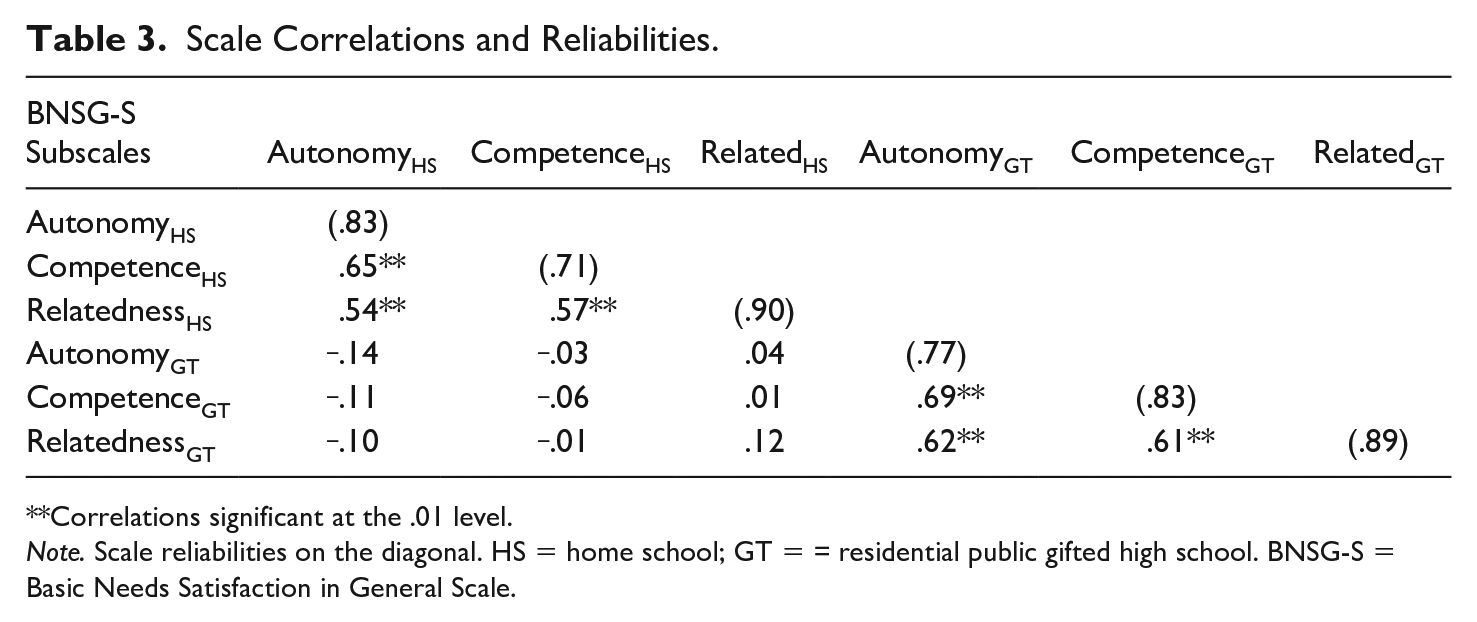
Correlations significant at the .01 level.
Note. Scale reliabilities on the diagonal. HS = home school; GT = = residential public gifted high school. BNSG-S = Basic Needs Satisfaction in General Scale.
General questions
In addition to the BNSG-S, participants responded to several questions regarding when they realized their LGBTQ status, when they shared within certain contexts, and what factors influenced them sharing. If participants indicated they did not come out to their family, friends, home school, or GT School, they were asked to respond to an open-ended question regarding why they chose not to come out (see the appendix for specific wording for general questions).
Missing data were not a significant issue within the current sample. We quantitatively analyzed four key data points in RQ3, and all had missing data well below the designated 5% threshold (Jakobsen et al., 2017; Schafer, 1999). Specifically, only one participant (<1%) did not complete any the Home School BNSG-S, yet that participant completed all other questions. That participant was deleted from the Home School analyses but was included all others. All participants completed the GT School BNSG-S. Participants were also grouped based off their responses regarding whether they came out in their home schools (one participant missing: <1%) or within the GT School (five participants missing: 4.71%). They were eliminated only from analyses using that item. Specifically, one person skipped the Home School question, and a different participant skipped the GT School question. Four additional responses to the GT School question could not be categorized in a group given the vagueness. Specifically, these four participants responded with write-in explanations: they “were not ready,” “didn’t make the connection then,” “came out to a few friends,” and “to some people there.” We could not determine how to categorize those participants. For example, “were not ready” could mean they did not come out because they did not know (Group 2) or because they did not feel comfortable sharing (Group 3). Thus, the truly missing data were <1% for each variable, and we did not deem there to be sufficient auxiliary information to address issues of randomness or possibilities of imputation for <1% (Madley-Dowd et al., 2019).
Analysis Plan
Both RQ1 (personal realization) and RQ2 (sharing) required a basic descriptive data analysis, including measures of central tendency. In addition, we were interested in the extent to which these ages might vary based on generational differences, as measured using their high school graduation year. To explore those questions, we used a correlational analysis. To further examine the age of first realization, we also completed a visual analysis using a bubble chart to provide a richer visual on any changes across time.
To address RQ3 (home and GT Schools’ ability to meet psychological needs), first, we compared participants’ feelings of autonomy, competence, and relatedness from their home school to the same feelings at the GT School. To address this question, we examined correlations and differences of means. Because the data violated the t test’s assumption of normal distribution (see Table 4), we used related-samples Wilcoxon signed-rank test to determine differences.
Subscale Means, Skewness, and Kurtosis.
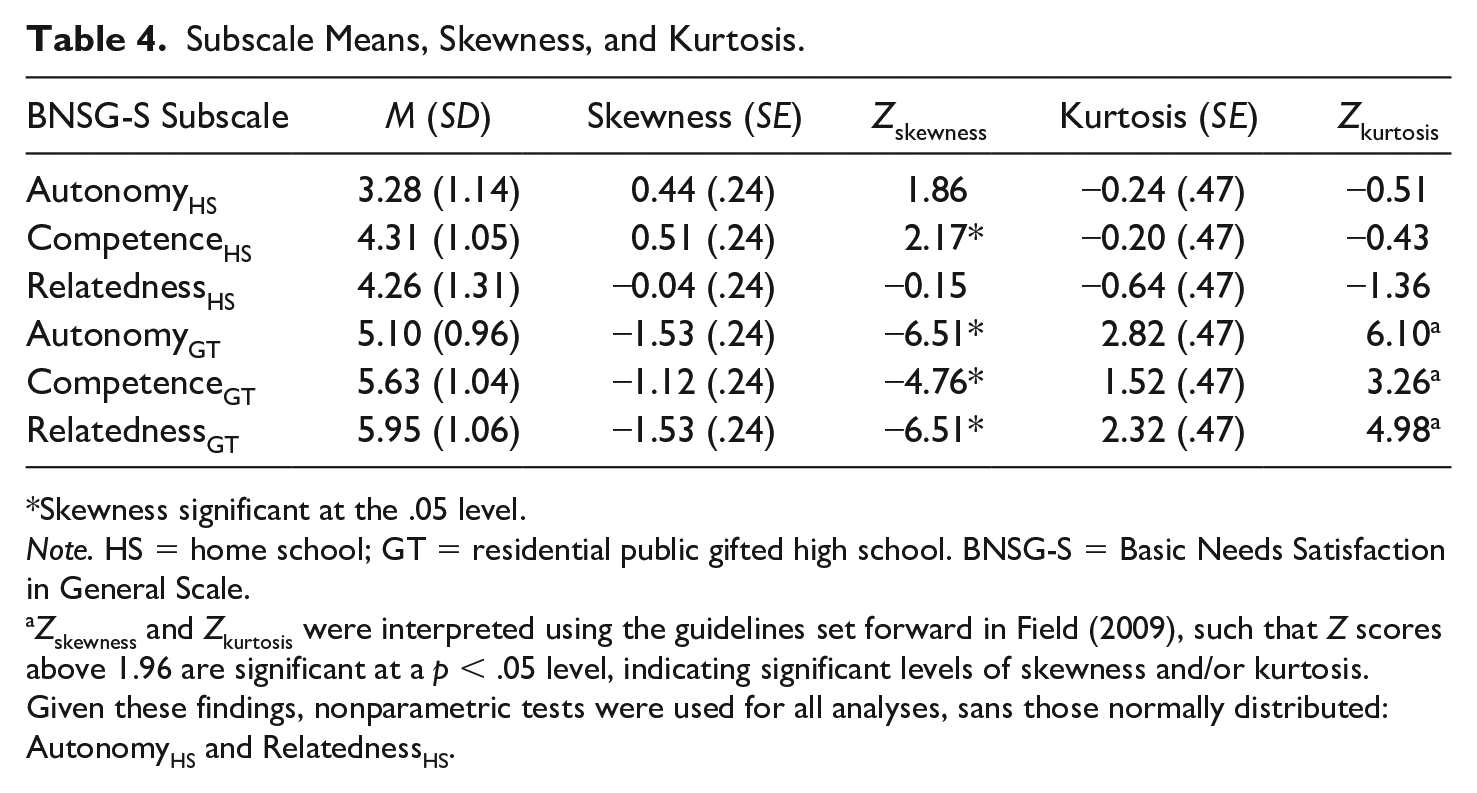
Skewness significant at the .05 level.
Note. HS = home school; GT = residential public gifted high school. BNSG-S = Basic Needs Satisfaction in General Scale.
Zskewness and Zkurtosis were interpreted using the guidelines set forward in Field (2009), such that Z scores above 1.96 are significant at a p < .05 level, indicating significant levels of skewness and/or kurtosis. Given these findings, nonparametric tests were used for all analyses, sans those normally distributed: AutonomyHS and RelatednessHS.
Then, we examined the extent to which the students’ coming out status related to feelings of autonomy, competence, and relatedness in either the home school or the GT School. We codified the Coming Out Status variable using three groups: (a) Group 1 (Out Group) included students who realized their LGBTQ status and came out within their school environment; (b) Group 2 (Unrealized Group) included students who did not themselves fully realize/recognize their LGBTQ status, and thus, did not share; and (c) Group 3 (Concealed Group) were students who realized but did not share within the school environment. Then, we analyzed the extent to which students’ group membership related to each of their basic needs being satisfied. As we were interested in the specific needs separately (i.e., autonomy, competence, and relatedness), we did not conduct a multivariate analysis of variance (MANOVA), which would have treated the variables as a composite and prohibited univariate post hoc analyses (Smith et al., 2020).
Rather, we had planned to complete a series of three analyses of variance (ANOVAs) for each outcome variable; however, a few of the variables violated the assumption of normal distribution, and in those cases, we used the independent-samples Kruskal–Wallis test. This analysis permitted specific follow-up procedures to learn whether there were group differences between the Concealed Group and the Out Group directly without necessarily considering the Unrealized Group. Furthermore, because we completed a series of analyses, we interpreted the significance level using a Bonferroni correction of p = .017.
To explore RQ4 (factors preventing sharing), we qualitatively analyzed the open-ended, expansion responses to the question regarding why participants had not come out to certain groups. Furthermore, we descriptively analyzed a closed-ended series of questions that listed potential barriers to coming out. The open-ended responses were somewhat limited given the nature of being included on a survey. Open-ended survey questions most often only elicit cursory responses, as O’Cathain and Thomas (2004) described the complexity of analyzing open-ended survey responses because these responses are often a few sentences or less, making it challenging to determine whether they should be considered quantitative data or qualitative data. Despite the brevity, the responses provided insight into these students’ coming out decisions, and two coders (i.e., the second and third authors) carefully coded these responses. Our goal was not to build a theory or produce overarching themes, but simply to summarize the data provided, so we used an inductive approach to coding that included summarizing the response and grouping similar responses (Merriam, 2009).
Specifically, we read the entire canon of responses across the five open-ended questions. In total, there were 216 total responses to code, including responses addressing why they did not come out to their families (n = 39), friends (n = 13), home schools (n = 85), GT School (n = 57), and post high school (n = 22). Each coder derived a list of possible responses separately and met to compare lists. Our lists contained fears of social isolation, bullying/safety, inciting drama, and religion/prejudice/judgment. We both also identified personal factors, including unawareness, feelings that it was unnecessary to share, and uncertainty/unreadiness. A few differences were present within the lists. Specifically, one coder uniquely identified responses that discussed how bisexuality was easier to conceal, and thus, it was unnecessary to come out. The other coder uniquely identified responses that discussed (a) how the lack of closeness with anyone prevented students from coming out and (b) how witnessing others coming out had prevented them from coming out. After discussing all the individual codes, we formed the two broad categories of personal and social factors. We decided to incorporate both the “bisexuality” code and the “lack of closeness” code even though only one of us identified those codes. Then, we integrated the “witnessing others coming out” code into the “fear of social alienation” code for parsimony.
After the codes were agreed upon, we developed the codebook that included the code, its definition, and a sample quote (see Table 5). Each coder applied the coding scheme to 20% of the sample and then met to establish interrater reliability (IRR). Before calculating IRR, we discussed how to code one type of response: when students said they were already out to explain why they did not come out in a certain environment. The coders decided that would be coded as “unnecessary to come out” and clarified that code. After that clarification, the coders agreed on the codes for 89% of the responses, which was deemed as acceptable (Miles & Huberman, 1994), and one coder coded the rest of the sample.
Coding Scheme and Frequencies Explaining Why Students Did Not Come Out.
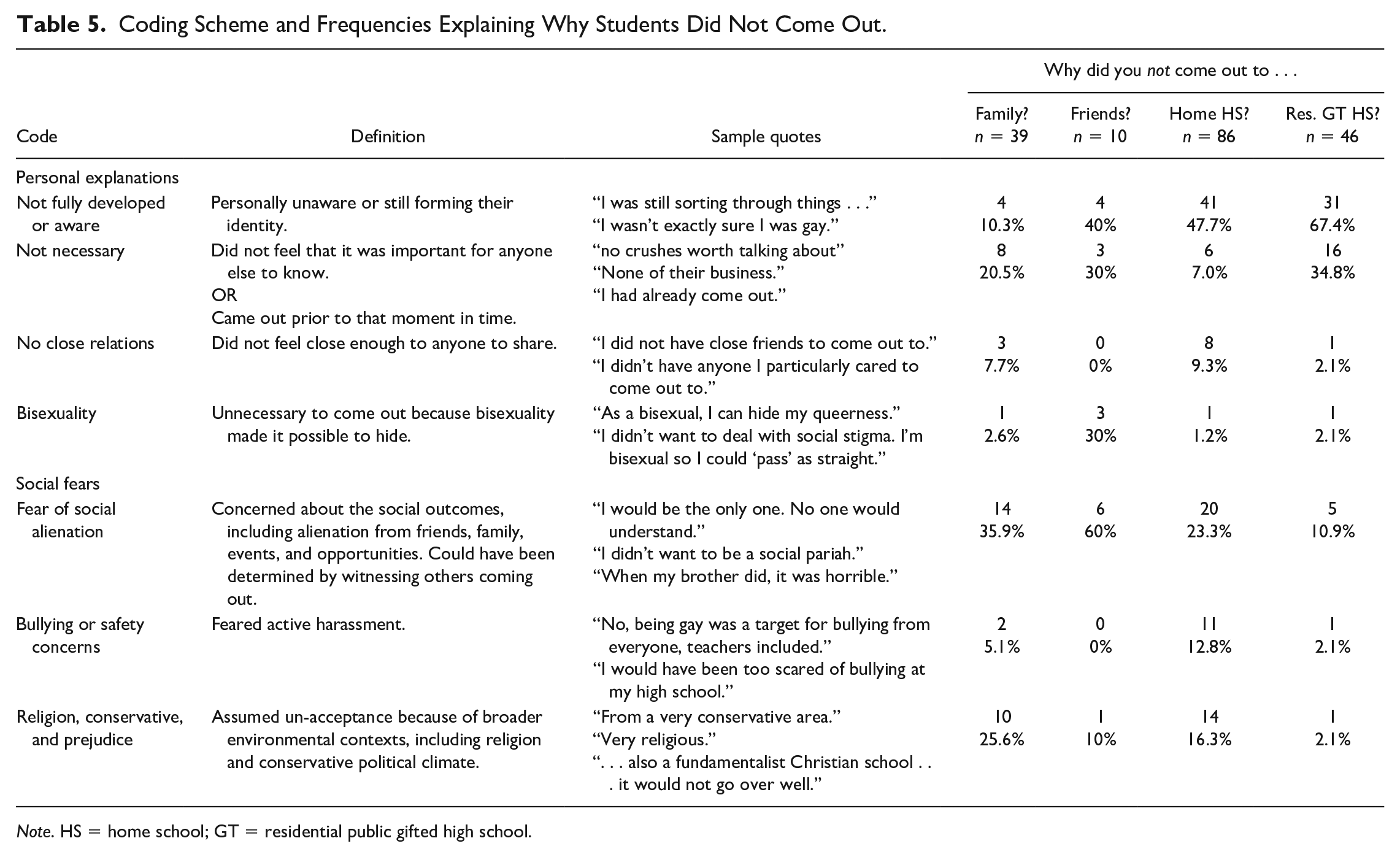
Note. HS = home school; GT = residential public gifted high school.
Results
RQ1: Personal Realization
Within our sample, gifted LGBTQ students reported realizing their sexual orientation/gender identity during late adolescence (Mage = 16.55 years), although there was great variance within this sample (SD = 4.94). A few students described how they had always known, and others only fully realized at age 35. To explore how this first realization may vary by graduation year, we visually analyzed a bubble chart (see Figure 1). Visual analysis suggests the range of first realization has narrowed over time, yet the average age was relatively consistent at around 16 years. There was not a significant correlation between the graduation year and the age of realizing one’s gender identity or sexual orientation (r = −.12, p = .21), suggesting the most recent generation of gifted students in this sample had not realized their LGBTQ status earlier than their predecessors. In fact, some individuals graduating in the more recent years may not have even realized yet.
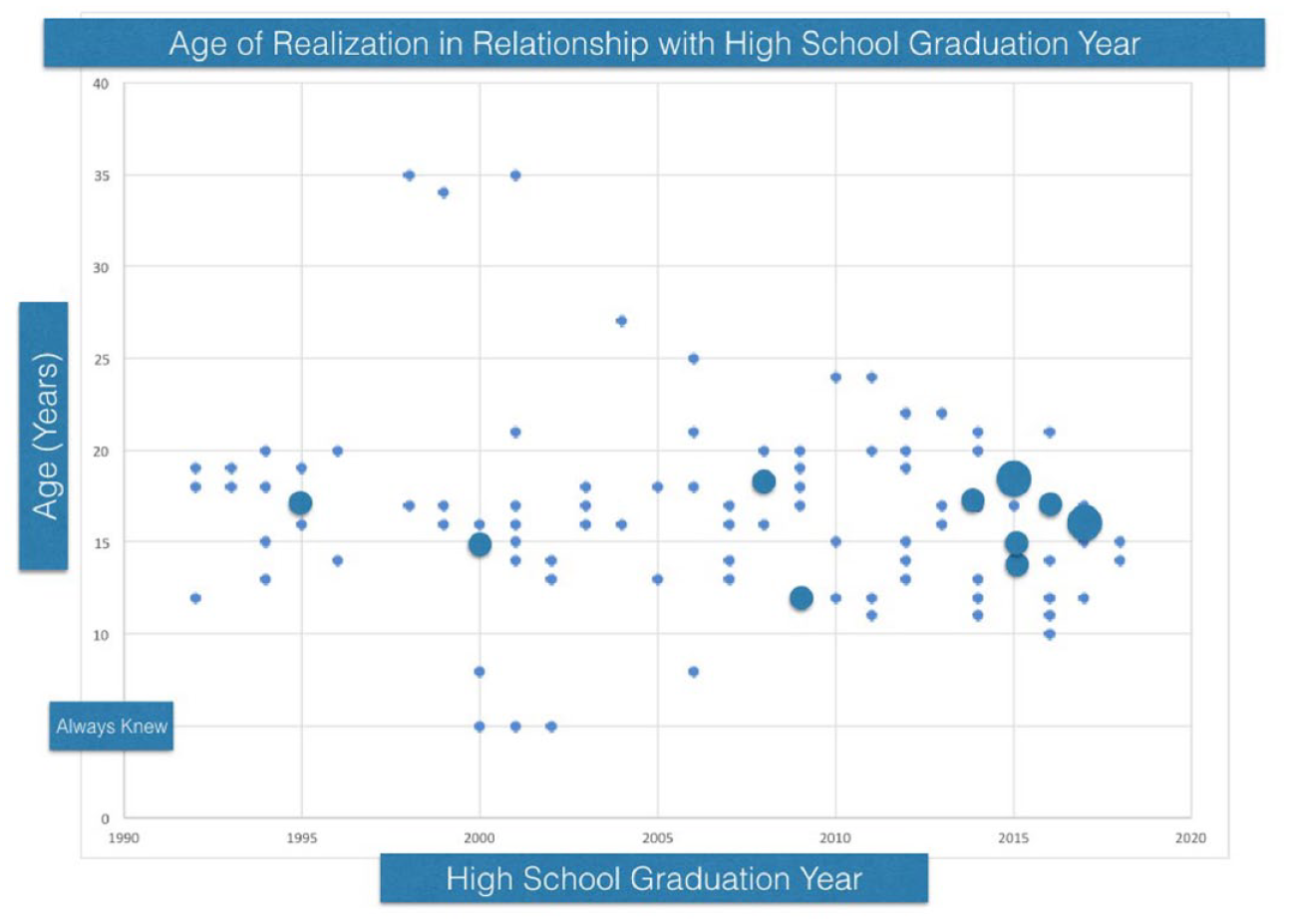
Students’ age of realization of sexual orientation and/or gender identity by high school graduation year.
RQ2: Sharing With Others
Friends and family
Students most typically shared with friends before coming out to their family, as 84.6% told their friends first, whereas only 5.8% told their family first. In total, approximately 85.8% of students have shared with their friends (Mage = 18.43 years, SD = 3.56), and when they shared, they shared, on average, 2.15 years (SD = 2.76) after they first realized themselves. Students shared later and less frequently with their family, as only 62.3% of students told their family. When they did share with their family, they were slightly older (Mage = 19.35 years, SD = 4.94), and they waited on average 3.38 years (SD = 3.81) after they realized to share with their family. The year of graduation did not correlate with the age at which students first shared their sexual orientation and/or gender identity with others, including friends (r = .03, p = .82) or family (r = −.01, p = .96).
Sharing at school
We also examined the extent to which students shared their gender identity and/or sexual orientation within their home school and GT School environments. Approximately 52.9% of students knew their orientation/identity while they were attending their home school, yet only 13.5% shared while there. As the students developed and moved to the GT School, 70.3% of them were aware of their orientation/identity, and many more students shared that information (47.5%). In other words, while students’ awareness of their LGBTQ status grew by 17.4%, their comfort in sharing grew by 34.0%. Again, graduation year was unrelated to whether students shared with their home school (r = .14, p = .16) or with the GT School (r = .14, p = .18).
RQ3: Environmental Contexts, Coming Out Status, and Psychological Need Fulfillment
RQ3a: Comparisons between home schools and GT School
The BNSG-S subscale correlations and reliabilities are presented in Table 3. Across all subscales, students’ basic needs’ satisfaction between their home school and the GT School were not significantly correlated. To explore these differences between the home schools and the GT School, first, we first examined the skewness and kurtosis of the subscales to test the assumption of normality, which was violated within these data (see Table 4). Thus, rather than using a t test, we employed a nonparametric approach, the related-samples Wilcoxon signed-rank test with the following results: Autonomy, Z = 7.94, p <.001, r = .77; Competence, Z = 7.11, p < .001, r = .69; and Relatedness, Z = 7.50, p < .001, r = .73. After accounting for a Type 1 error possibility using a Bonferroni correction (.05 / 3 = .017), there remained statistically significant differences for each of the three major psychological needs. Gifted LGBTQ students felt more autonomous, competent, and connected within the GT School environment as compared with their home school (see Table 6).
Type of Schools, Coming Out Status, a and Basic Needs Satisfaction.
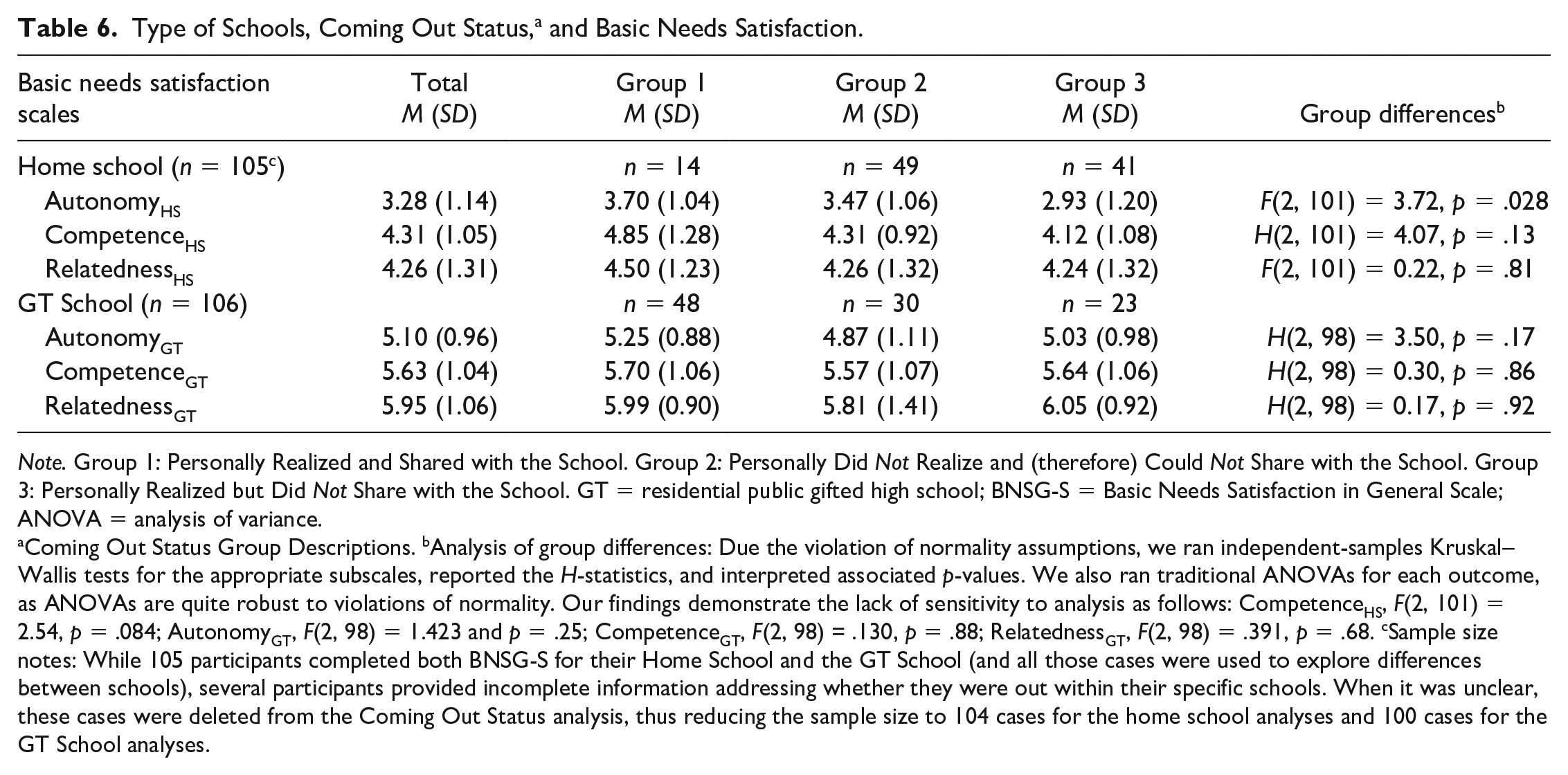
Note. Group 1: Personally Realized and Shared with the School. Group 2: Personally Did Not Realize and (therefore) Could Not Share with the School. Group 3: Personally Realized but Did Not Share with the School. GT = residential public gifted high school; BNSG-S = Basic Needs Satisfaction in General Scale; ANOVA = analysis of variance.
Coming Out Status Group Descriptions. bAnalysis of group differences: Due the violation of normality assumptions, we ran independent-samples Kruskal–Wallis tests for the appropriate subscales, reported the H-statistics, and interpreted associated p-values. We also ran traditional ANOVAs for each outcome, as ANOVAs are quite robust to violations of normality. Our findings demonstrate the lack of sensitivity to analysis as follows: CompetenceHS, F(2, 101) = 2.54, p = .084; AutonomyGT, F(2, 98) = 1.423 and p = .25; CompetenceGT, F(2, 98)
RQ3b: Relationship between coming out status and psychological needs-fulfillment in the home school
To address this question, first, we examined whether the data were normally distributed. Both AutonomyHS and RelatednessHS were normally distributed; therefore, we analyzed both subscales using ANOVAs. There were no significant group differences on RelatednessHS (p = .81). Furthermore, AutonomyHS (p = .028) was not significant after the Bonferroni correction at the .017 level. To examine group differences on the CompetenceHS subscale, we employed the independent-samples Kruskal–Wallis test due to the violation of the normality assumption: H(2, 101) = 4.07, p = .13. Thus, no significant differences existed among groups with regard to all home school BNSG-S subscales. In other words, gifted LGBTQ students’ fulfillment of their psychological needs for autonomy, competence, and relatedness was not related to whether they had (a) come out to their home school, (b) concealed their status, or (c) remained in an unrealized phase. All results are reported in Table 6.
RQ3c: Relationship between coming out status and psychological needs-fulfillment in the GT School
To address this RQ, we first determined the data on all three subscales were not normally distributed, and therefore, we ran a series of independent-samples Kruskal–Wallis tests to examine the relationships among group membership and the BNSG-S subscales, including autonomy, competence, and relatedness. None of the scales yielded significant results. Thus, the fulfillment of gifted LGBTQ students’ needs for autonomy, competence, and relatedness was not related to whether they had (a) come out to the GT School, (b) concealed their status, or (c) remained in an unrealized phase. All results are reported in Table 6.
RQ4: Factors Preventing Sharing
Qualitative analysis
Students provided two overarching reasons (personal explanations and social fears) to explain why they decided not to share their LGBTQ status with certain individuals (see Table 5 for codes, sample quotes, and frequencies). First, personal explanations included (a) individuals’ own ambiguity surrounding their sexual orientation and/or gender identity; (b) the belief that their orientation and identity was private, and others did not need to know or that they had already come out and everyone knew; and (c) the lack of close relationships. The second overarching reason encompassed social fears associated with coming out, including fears of alienation, bullying, and prejudice. Within different environmental contexts, specific factors were more influential in students’ decisions to come out. In the next paragraphs, we present each of these factors and integrate direct, entire quotes from the participants’ open-ended responses.
In general, students more frequently provided personal explanations to describe why they chose not to share with certain populations, especially within school environments. Some students were still trying to understand themselves or were completely unaware during their high school years: “I was still sorting through things.” Other students did not think disclosing the information was pertinent to others or necessary to share: “It was none of their business.” Finally, some were not ready, or they thought they could avoid sharing because they identified as bisexual and could blend into a heteronormative culture: “As a bisexual, I can hide my queerness.”
In addition to personal explanations, participants expressed social fears associated with coming out, especially within their home schools or within their families, whereas very few students discussed social fears within the residential GT School or among their friends. These social fears included fears of social alienation, safety/bullying concerns, and religious/ideology judgment. Within the context of the family, one participant described their fear of social alienation: “I wouldn’t be spoken to again.” Two participants discussed the extreme social isolation that accompanies coming out because they were currently in a committed heterosexual relationship and had children.
In their home school, many students expressed concerns for their safety or increased levels of bullying: “[I was] scared of bullying, and nobody at my school was openly gender queer.” Finally, in both the family and home school context, participants were concerned religious/ideology prejudice, as one participant simply wrote, “bigoted family members” and another, “My family is too conservative and religious.”
Quantitative frequencies
After participants responded to the open-ended questions, they also had the opportunity to rate how common concerns influenced their ability to come out (see Table 7). This captured the additional thoughts of participants who had come out, but still faced struggles in doing so. The fear of losing friends was most highly related to participants’ decisions to come out, whereas the lack of services was the least connected. At the end of this series of prompts, students were asked whether the researchers should consider any additional concerns, and participant responses included posttraumatic stress disorder (PTSD) trauma, lack of role models, lack of sexuality education, and a broader fear of violence within the U.S. culture.
Extent to Which Certain Fears Related to Students’ Coming Out Decisions a .

Note. HS = home school; GT = residential public gifted high school; PTSD = posttraumatic stress disorder; LGBTQ = lesbian, gay, bisexual, transgender, questioning, or queer.
These were close-ended prompts presented after participants discussed why they did not choose to come out to certain groups.
Discussion
This study provides an initial exploration of gifted LGBTQ students’ coming out experiences across environmental contexts and the extent to which gifted LGBTQ students’ psychological needs are met. Previous work in this area has qualitatively examined their experiences (Hutcheson & Tieso, 2014; Peterson & Rischar, 2000; Sewell, 2020); however, little quantitative work has provided specific information to students’ support teams regarding general trends on when gifted LGBTQ students come out, to whom, and why not. The current study fills that gap and provides actionable information to inform the development of needs-supportive environments.
First, one unanticipated finding was regarding the demographic data. Whereas Black/African American students compose 2.42% to 11.30% of the GT School population (depending on the graduation year) and composed 3.08% of those completing the survey, none of the participants identified as both Black/African American and a member of the LGBTQ community. Perhaps we should have anticipated this finding given Sewell’s (2020) discussion regarding the challenges associated with being Black, queer, gifted, and male. Furthermore, ethnoracial identities have been shown to significantly affect how sexual/gender minorities adopt their personal sexual/gender labels (Watson et al., 2020). Therefore, this is an area that will need careful future attention. Other findings, however, directly connected to the study’s objectives and lead to specific recommendations for peers, parents, teachers, and school systems.
Finding 1: Gifted, LGBTQ Individuals Did Not Realize Their LGBTQ Status Significantly Earlier Than What Is Reported Within the Larger, General LGBTQ Literature
In the current study, gifted individuals reported their first realization on average around 16.55 years old, compared with the initial realization age of 17 years old within the general LGBTQ population (PRC, 2013). This provides important information to parents, teachers, and counselors regarding when gifted LGBTQ students will need support in understanding this aspect of their identities. Our study suggests gifted LGBTQ students do not seem to need earlier supports than what would be expected for all students. Although, importantly, there was a wide range of ages when individuals realized, spanning from they “always knew” to 35 years old. Thus, it is important for individuals to be prepared to support LGBTQ gifted individuals at almost any age.
Similar to the general population, in our sample, gifted LGBTQ individuals also struggled to understand their own gender/sexual identity, again demonstrating gifted LGBTQ individuals share many needs with the general LGBTQ population. They often provided personal explanations for why they did not feel comfortable sharing, such as they were still figuring it out or they did not feel confident in their own identity. Thus, one important way counselors, parents, and teachers can support gifted LGBTQ students is to help them understand themselves. For example, the Trevor Project (n.d.) has a Coming Out handbook, which explains gender identity and sexual orientation and provides questions to help students determine their own identity. Additional ways to support students in understanding themselves is to provide opportunities to hear other individuals’ stories from the LGBTQ community, through means such as reading biographies, conducting interviews, listening to guest speakers, and connecting with LGBTQ mentors.
Finding 2: Gifted LGBTQ Individuals Often Share Their LGBTQ Status First With Their Friends
Although these participants, on average, waited 2.1 years to share with friends, they still disclosed to their friends first and most frequently. Specifically, participants in our sample felt most comfortable sharing with their friends and reported the school support systems were not significantly connected with their decisions to come out. Although friends were trusted most frequently, existing research suggests even friends may not respond appropriately. For example, more than a third of LGBTQ youth reported losing a close friend after coming out (D’Augelli, 2002). When peers do not respond in a supportive manner, LGBTQ students have their basic needs of autonomy and relatedness denied, which can result in deleterious outcomes ranging from poor psychological well-being to increased suicidal attempts (Haas et al., 2010).
Therefore, teachers and school support teams may want to direct resources to educating all students on how to best respond to their friends when they disclose their LGBTQ status, rather than simply providing adult-led support systems for LGBTQ students. One potential resource for all students is, again, the Trevor Project (n.d.), which provides comprehensive support for LGBTQ students directly, but also provides curricular resources to teach all students how to respond when their friends come out to them, including specific language to express support, love, gratitude, and happiness for their friend becoming their most authentic self (Riggle et al., 2017).
Finding 3: Gifted LGBTQ Individuals Struggle to Share With Their Family, as Only 62% of the Sample Had Shared With Their Family Even Into Their Adult Years
The current study provides insight into why they may not be willing to share with their family, which provides several areas for intervention. Specifically, gifted LGBTQ students were acutely aware of how their family members (a) responded to other individuals when they came out and (b) perceived LGBTQ individuals within their families’ religious and political cultures. This may vary across the United States and within different international contexts; however, within this conservative environment, participants were very aware of the social stigma associated with identifying as LGBTQ. Feeling safe to be their most authentic selves at home also affects how they interact with others in the school environment. For example, one participant indicated they did not come out in the GT School because their family may still find out from the school and pull them out of the GT School. Thus, a comprehensive support system would also include preparing families to support all facets of students’ identities.
Finding 4: The GT School Was More Successful at Fulfilling Gifted LGBTQ Individuals’ Psychological Needs Than Their Home Schools, but Their Coming Out Status Was Not Related to the Degree to Which Their Needs Were Met
We expected the finding that the GT School would be better positioned to help fulfill gifted students’ psychological needs because this school was designed to provide more complex, challenging learning experiences that support gifted students’ development of competence. Furthermore, by providing opportunities to be around other gifted students, students may feel comfortable being themselves and feel connected to others, as the residential gifted high school literature would suggest (Rollins & Cross, 2014). When a student is presented with an opportunity to grow and express themselves, their values, and interests within an environment where they feel systemic support, as well as empowered to make decisions, pursue interests, and be who they authentically are, their sense of overall autonomy increases (Deci et al., 2006; Legate et al., 2012), which is critical to their psychological health and overall well-being (Legate et al., 2012).
Unexpectedly, however, participants’ Coming Out Status did not significantly relate to needs-fulfillment in either environment. This finding was somewhat surprising. We especially thought that within the GT School, gifted LGBTQ individuals who were out would experience more autonomy and relatedness in comparison with those who were concealing their LGBTQ status. (We did not think there would necessarily be a difference with the gifted individuals who had yet to realize their status and those who were already out.) Potentially, the act of sharing alone may not lead to feelings of relatedness, especially if other students and teachers respond in an unsupportive manner, which some students in this study witnessed. Another explanation may be that being out to the school may be less important than being out to a handful of close friends/teachers (Legate et al., 2017).
In general, many gifted LGBTQ individuals did not share within either school environment: 39% did not share with their home schools and 21% did not share within the GT School even though they identified as LGBTQ at that point in time. Overwhelmingly, the participants were more likely to share their LGBTQ status at the GT School in comparison with their home school. This could be due in part to the different developmental stage they were in while at their home school in comparison with the GT School. However, the developmental stage is not the only possible explanation. When the qualitative data are considered, participants discussed social fears as reasons they did not share at their home school, but they explained their decision not to share within the GT School using personal factors. They felt safer to share their sexual orientation and/or gender identity within the residential gifted high school environment. This is particularly important because high-ability LGBTQ students may be prone to feel twice as alone in a traditional heteronormatively focused school environment (Hutcheson & Tieso, 2014). Understanding why gifted LGBTQ participants experienced fewer social fears in the residential GT School is complex. They may have felt safer away from their families, as many expressed extreme concerns that their families would not accept them if they knew. It may be an artifact of maturity, or it could be because they felt safer in the GT School environment in general.
To summarize, when gifted LGBTQ individuals are in high school (and even beyond), they may often be holding in this part of their identity, uncertain of who to trust, making it especially important for schools to create safe spaces for sharing to ensure students do not feel alone. We found it surprising that 15% of our sample still had not shared with anyone, years after realizing, and close to 35% still had not shared with their family. Thus, when we reported average length of time waiting to share, that time frame only includes people who eventually decided to share.
Feelings of autonomy, competence, and relatedness continue from a student’s high school environment into their adult lives, and the more needs-supportive environment, the greater the satisfaction with life (Tuite, 2020). Sexual orientation and gender identity and/or expression shape the way in which the nonheterosexual and noncisgendered person navigates within a heteronormative society (Baumeister & Leary, 1995; R. M. Ryan & Deci, 2017).
Although the social movement has made progress for the LGBTQ community, society continues to be heteronormative focused (Biegel, 2010; DeWitt, 2012, 2018; Robinson & Espelage, 2011), which could play a significant role in overall life satisfaction. Furthermore, without having these psychological needs met, those in the LGBTQ community are more likely to attempt suicide, have untreated mental health issues, and struggle with substance abuse (Haas et al., 2010). Thus, additional studies are needed to explore the more longitudinal development of autonomy, competence, and relatedness, and how different environments can provide adaptive, supportive methods for gifted students to come out and be their most authentic self.
Limitations and Future Research
Undoubtedly, multiple other data collection and analysis methods could have been employed for this study; however, the current study provides a foundation for future empirical explorations of gifted LGBTQ students. Some of the methodological decisions provided both benefits and drawbacks that should be addressed in future work. First, the current sample was heterogeneous in terms of cross-generations and specific groups within the LGBTQ collective community. This provided a broad overview of the largest sample to date of gifted LGBTQ individuals, yet it also may overlook the nuance that exists within the population. Future researchers may want to be more deliberate at parsing out specific group identification (e.g., gay men, transgender), but we would advise caution because of the fluid, diverse, and spectrum nature of group membership. We found elegance in classifying participants as a member of the LGBTQ community.
Despite examining the largest sample size to date, both the sample size and characteristics remain limiting. Several more complex analyses across environmental contexts would be possible with a larger, more diverse sample. Therefore, analyses may fail to detect small or medium effects.
Another, perhaps most significant, limitation is the retrospective nature of the study. First, retrospective studies rely on individuals’ memories of certain experiences, which, as Schacter (1999) described, could be affected by blocking, misattribution, suggestibility, and bias. Memories have the potential to be inaccurate, shift over time, or be affected by future outcomes (Schacter, 1999). The current retrospective nature of this exploratory study allowed for the collection of data from a larger sample who all attended the same GT School, but it missed the more immediate and intense, real-time life experiences that could be captured within a longitudinal study.
To address some of the flaws associated with the retrospective nature, future researchers may want to use an experience sampling method, similar to the approach taken when developing flow theory, which asked participants to reflect on certain questions at random points in time throughout the day (Larson & Csikszentmihalyi, 2014). This approach would be helpful for collecting large amounts of data in real time on gifted LGBTQ students’ perspectives. More recently, Legate et al. (2017) employed a daily diary methodology. They found that disclosure on a micro-conversation level only led to positive well-being outcomes when disclosure occurred in an autonomy-supportive environment.
Finally, this study only examined students’ sharing experiences/decisions with family, friends, and within school environments; however, social media has emerged as an influential platform (Ortiz-Ospina, 2019), providing students with both positive and negative experiences as they are developing their identity (Craig & McInroy, 2014). Thus, those born into this time period where access to various social media platforms is instantly available, regardless of time or location, may experience differences in their identity formation and development than for previous generations. Despite these limitations and need for future studies, this current study provides a foundation for understanding gifted LGBTQ students’ coming out experiences that can be used to affect change in classrooms and support gifted LGBTQ throughout their lives.
Footnotes
Declaration of Conflicting Interests
The authors declared no potential conflicts of interest with respect to the research, authorship, and/or publication of this article.
Funding
The authors received no financial support for the research and/or authorship of this article.

Notes
Author Biographies
Appendix
LGBTQ-Specific Survey Items a .
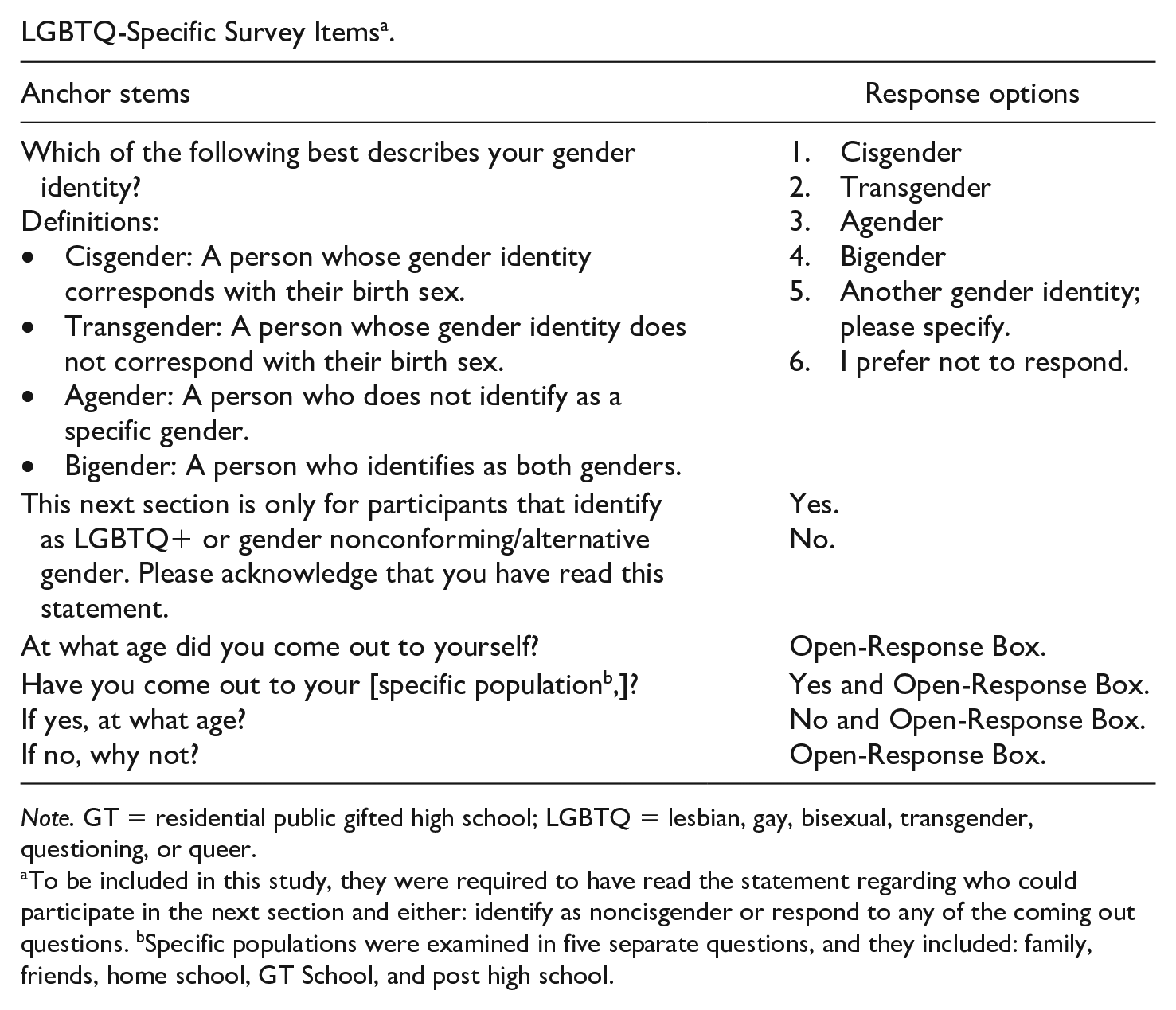
| Anchor stems | Response options |
|---|---|
| Which of the following best describes your gender identity? Definitions: • Cisgender: A person whose gender identity corresponds with their birth sex. • Transgender: A person whose gender identity does not correspond with their birth sex. • Agender: A person who does not identify as a specific gender. • Bigender: A person who identifies as both genders. |
1. Cisgender 2. Transgender 3. Agender 4. Bigender 5. Another gender identity; please specify. 6. I prefer not to respond. |
| This next section is only for participants that identify as LGBTQ+ or gender nonconforming/alternative gender. Please acknowledge that you have read this statement. | Yes. No. |
| At what age did you come out to yourself? | Open-Response Box. |
| Have you come out to your [specific population
b
,]? If yes, at what age? If no, why not? |
Yes and Open-Response Box. No and Open-Response Box. Open-Response Box. |
Note. GT = residential public gifted high school; LGBTQ = lesbian, gay, bisexual, transgender, questioning, or queer.
To be included in this study, they were required to have read the statement regarding who could participate in the next section and either: identify as noncisgender or respond to any of the coming out questions. bSpecific populations were examined in five separate questions, and they included: family, friends, home school, GT School, and post high school.