



Abstract
Teacher training is fundamental to the success of gifted and talented education (GATE). Unfortunately, in sub-Saharan Africa, which is still in the early stages of practicing inclusive education, knowledge about GATE is limited because preservice teacher training programs have yet to prioritize this subject area. The aim of this exploratory study was to examine the attitudes and self-efficacy of 304 preservice teachers regarding GATE at three education colleges in Ghana. Using Ajzen’s Theory of Planned Behavior as a framework, the results show a positive association between attitude and self-efficacy, with the latter emerging as a significant predictor of the former. Other background variables—such as gender, knowledge of inclusive education policy, specialization, and level of study—provide insights into the attitudes and self-efficacy of preservice teachers. Also discussed is the need for teacher training institutions to introduce training courses and develop culturally responsive policies, guidelines, and strategies for GATE.
Introduction
Inclusive education (IE) is an initiative for more-effective participation of students in education (Teixeira et al., 2018; Westbrook & Croft, 2015), which many countries have adopted (Teixeira et al., 2018). A large body of the literature shows that IE is a reform for education systems to enhance the education of all students in regular classrooms (Timberlake, 2018; Vermeulen et al., 2012; Wong and Chik, 2016; Yan & Deng, 2019). However, in most sub-Saharan African (SSA) countries that are striving to reform their education systems, inclusion is maily thought of as a way to serve vulnerable children (e.g., those with disabilities) in regular classrooms (Anthony, 2011). In some cultures, vulnerable children are typically categorized as incapable and dependent; however, children with disabilities can also be gifted (Heward & Ford, 2013; Nketsia, 2018; Singal et al., 2015). Although some studies have reported the challenges faced by teachers when it comes to practicing IE in SSA (e.g., Singal et al., 2015), the teaching of children who are above average—gifted and talented education (GATE)—is yet to come to the fore in discussions about IE. With preservice education being central to achieving the goal of expanding access to equitable and quality IE for all (Heward & Ford, 2013; Merrotsy, 2015; Troxclair, 2013), understanding the factors that may influence the attitudes and self-efficacy of preservice teachers (PSTs) toward GATE in the SSA context is important.
Despite ongoing debate and scholarly discussions, a lack of consensus about the definition of IE persists. While some scholars have defined IE broadly (e.g., Ainscow & Sandill, 2010), others have argued for a narrower conception of IE (e.g., Sharma et al., 2017). For the purposes of this study, IE is broadly conceptualized as the creation of opportunities for the effective participation of all children in regular education, regardless of their abilities, culture, race, and ethnicity, so that they have unfettered access to neighborhood schools (Ainscow & Sandill, 2010). However, in most SSA countries including Ghana, education is based on meritocracy (Opoku, 2021; Opoku et al., 2022). Students are screened based on their abilities, and once they can read and pass examinations, they are deemed educable. In such a system, the practice IE is difficult because those who demonstrate below-average intelligence are excluded from education (Anthony, 2011; Nketsia, 2018; Obeng, 2012). The promoters of the narrow approach to IE have suggested that limiting practices to specific groups allows their learning needs to be considered in the teaching process (Sharma et al., 2017), but defining giftedness based on high cognitive abilities seems narrow and limiting because other groups could be excluded from being identified or considered in gifted programs (Ford, 2014; Harris et al., 2007; Sternberg, 2007). Although Ghana is yet to develop a robust GATE program, it is useful to argue in favor of “decolonized broad GATE” that considers local knowledge and culture in teaching and learning.
In some advanced countries, such as Australia, Canada, and the United States, universities have developed graduate programs in GATE (with few undergraduate programs) (Heward & Ford, 2013; McCoach & Siegle, 2007; Merrotsy, 2015; Plunkett & Kronborg, 2011; Troxclair, 2013). The training of teachers in GATE is intended to enable them to be aware of the processes involved in teaching and learning of gifted students (Maker, 1982; Merrotsy, 2015). As contemporary classrooms become increasingly diverse, teachers need to be trained to deliver lessons to a broad category of students (Harris et al., 2007). Consequently, some experts have argued that developing an effective identification process is the first important step in ensuring that the needs of the gifted and talented are addressed (Harris et al., 2007). Also, training of teachers in GATE has contributed to the search for effective ways to teach or extend the learning of gifted students (Maker, 1982, Merrotsy, 2015). In context such as Ghana, teacher education ought to equip teachers with the requisite skills to identify and be able to teach effectively.
GATE is not without its challenges. In advanced societies in which the field of giftedness has been developed, there are critiques regarding the precise definition or conception of giftedness. For example, giftedness is extrinsically linked to high intelligence, which is measured using an IQ test (Stack et al., 2016), and students who achieve an IQ of above 140 are mainly described as gifted (Harris et al., 2007). However, relating giftedness to intelligence has been described as narrow, restrictive, and perpetuating the exclusion of students from other cultural backgrounds (Stack et al., 2016; Sternberg, 2007). In the U.S., students from minority cultural backgrounds are underrepresented in gifted programs because due to a host of issues regarding identification (Callahan, 2005; Ford, 2014; Milner & Ford, 2007). To optimize the development of all children, a social conception of giftedness (Baldwin, 2005; Sternberg, 2007) with emphasis placed on both the formal and informal processes that shape experiences has been proposed (Baldwin, 2005; Stack et al., 2016).
In the SSA context such as in Ghana, teachers are expected to demonstrate cultural competencies so as to offer accessible education to all. In particular, teachers are expected to contextualize teaching strategies if they have favorable attitudes and are committed to teaching gifted students. Unfortunately, in Ghana and other SSA countries, there are no GATE university programs or courses to promote discussion about developing the cultural competencies of teachers toward GATE. As a starting point, it is important to understand the attitudes and self-efficacy of PSTs in SSA countries such as Ghana.
GATE in Sub-Saharan Africa
According to the World Bank (2022), SSA comprises 49 countries located mainly in Western, Central, Eastern, and Southern Africa, and a striking characteristic of these countries is poverty and limited access to essential services such as education. Traditionally, people have known and acknowledged giftedness (Ngara, 2017). The people in SSA are believed to be of Bantu ethnic ancestry (Liu, 2019; Maccarella, 2020), and these groups share a common understanding of giftedness, which is considered a gift from a supernatural deity or a god or ancestors have endowed the child with exceptional skills to escape the travails of their people. It is also believed that such gifts are collectively owned by the society, meaning that there are peculiar gifts associated with a given ethnic group. The traditional understanding of giftedness also includes music, dance, and other cultural activities such as farming and fishing that are not recognized by educational systems (Ngara & Porath, 2007). Additionally, giftedness is related to the family, with people described as intelligent once they can maintain harmony at home.
Formal education was introduced in SSA by European colonizers during the scramble for African territory (Maree & Van der Westhuizen, 2009) and the education system established by these colonizers remains in place. Intelligence is measured by cognitive abilities (Stack et al., 2016), so the modern school system has failed to incorporate the development of traditional cultures and gifts (Maree & Van der Westhuizen, 2009; Ngara & Porath, 2004, 2007). Consequently, giftedness is not supported or nurtured in the formal education systems of SSA countries (Kolo, 2004; Maree, 2018; Milinga, 2021). Currently, with the exception of South Africa, there are a negligible number of countries in SSA with a GATE program intended to prepare PSTs to teach gifted students (Ngara, 2017). Even in South Africa, discussion of GATE has its roots in Apartheid that limited the participation of non-White populations (Maree & Van der Westhuizen, 2009). In efforts to develop a robust system in SSA, empirical studies are needed to provide a useful framework in which to situate GATE. Nearly all SSA countries have embraced the implementation of IE; however, there has been no discussion about gifted education. Teachers’ knowledge of GATE is fundamental to identifying gifted students and ensuring culturally responsive support for them in classrooms (Sternberg, 2007). Thus, the present study was conducted to explore the attitudes and self-efficacy of PSTs toward teaching in future inclusive classrooms in Ghana, one of the SSA countries.
Contextualization
Ghana is a West African country with a population of 32 million (Ghana Statistical Service, 2021). As a country, Ghana places a high premium on education, and policymakers have stated that equitable access to education is critical to national development (Ministry of Education, 2018; Mohammed & Kuyini, 2020). Consequently, since 1957, several policies and programs have been developed to give all children access education (Ameteppee & Anastasiou, 2015; Ministry of Education, 2018; Subbey, 2020; Vanderpuye et al., 2018). Colleges of education and two public universities in Ghana have taken the lead in training teachers to support the education of all students in basic (e.g., early childhood, primary, and junior secondary) schools and senior secondary schools (Ameteppee & Anastasiou, 2015; Nketsia, 2018). To teach all students, universities have designed courses in special education to equip PSTs with the skills, knowledge, and values to identify and address the diverse needs of students (Ameteppee & Anastasiou, 2015). Unfortunately, courses in GATE are very rare in Ghana. As part of courses in special education, students take a module on GATE, which mostly provides an understanding of GATE, identification characteristics, pedagogical strategies, and classroom management for gifted students (Nketsia & Saloviita, 2013).
Policies are lacking to guide GATE in Ghana and other SSA countries. However, the Inclusive Education Policy of 2015 can be seen as a major instrument for promoting GATE in Ghana. This policy stipulates the need for educational services to be extended to all children with special education needs (Republic of Ghana, 2015) and categorizes gifted students as a subset of such children who must be identified and supported. However, Nketsia and Saloviita (2013) found that PSTs were incapable of identifying and supporting a single gifted and talented student throughout their final year of teaching practice. This could be because of the lack of deliberate policies or programs stipulating how teachers should identify, teach, or provide extended educational programs to gifted students. The lack of specific guidelines on GATE could be one explanation for the marginal body of the literature in this area. Unsurprisingly, two qualitative studies conducted with in-service teachers reported their lack of knowledge about GATE and their inability to identify gifted students in Ghana (Allotey et al., 2020; Nyarko et al., 2017). Moreover, teachers’ perception of the implementation of IE has been negative because they feel unqualified and unsupported to teach all students in one classroom (Ameteppee & Anastasiou, 2015; Nketsia, 2018; Nketsia & Saloviita, 2013). The ineffectiveness of IE practices raises two critical issues: (a) the actual implementation of IE policy (Ameteppee & Anastasiou, 2015; Nketsia, 2018; Nketsia & Saloviita, 2013; Opoku, 2016; Singal et al., 2015) and (b) the quality of teacher training offered in schools (Nketsia, 2018; Nketsia & Saloviita, 2013; Opoku, 2016, 2021, 2022; Opoku et al., 2022). Because teacher education is vital to the success of GATE (Merrotsy, 2015; Plunkett & Kronborg, 2011), exploring the attitudes and confidence levels of future teachers toward GATE in Ghana is essential.
Ghana’s response to the Sustainable Development Goals has been to remove cost barriers to enhance access to free public education up to secondary-school level (Mohammed & Kuyini, 2020; Opoku et al., 2022). While these declarations have contributed to an increase in student enrollment (Mohammed & Kuyini, 2020), fundamental issues remain regarding the capacity of teachers and the resources needed to teach all students in the same classroom (Ameteppee & Anastasiou, 2015; Nketsia, 2018; Singal et al., 2015). The present study sought to raise awareness of the need for Ghana and countries with similar contexts to begin discussing GATE in the context of teacher training. Although the Inclusive Education Policy (Republic of Ghana, 2015) makes some reference to education for all students, the literature on GATE is very limited. Therefore, the main aim of the present study was to explore the relationship between the attitudes and self-efficacy of PSTs toward teaching gifted students.
Theoretical Framework
The beliefs of people are fundamental to understanding whether they will engage in a given activity (Ajzen & Fishbein, 1977). Over the years, several theories have been developed to explain the beliefs that influence human intentions and behavior toward a given phenomenon. Ajzen’s (1991) Theory of Planned Behavior (TPB) was identified as a useful framework on which to base this study. TPB is an extension of the theory of reasoned action, which explaining intentions toward behavior as the product of two beliefs—behavioral and normative (Ajzen & Fishbein, 1977). Ajzen (1991) later argued that a third belief—control—may directly (or indirectly via intentions) influence a given behavior. Ajzen (1991, 2011) argued further that three related beliefs (behavioral, normative, and control) mediated through intentions can help to understand behavior. These three related variables could be influenced by a person’s profile (e.g., gender) and how engaged they are in a given activity (Ajzen, 1991, 2011) (see Figure 1).
Theory of Planned Behavior.

In the present study, the components of the TPB are conceptualized. First, behavioral beliefs combine to form attitudes toward a behavior, referring to person’s perception toward the behavior. Once a person perceives a particular behavior in a positive way, they are likely to perform such an activity, and their associated attitude may be favorable toward the behavior. Second, normative beliefs develop into subjective norms, which refer to the influence of other significant people on a person’s performance of a behavior. If an important individual (such as a school leader) in a person’s life supports the performance of a given behavior, then the person may also be inclined to behave in that way. Third, control beliefs—which also accumulate into perceived behavioral control or self-efficacy—refer to a person’s confidence in their ability to perform a given behavior.
Overall, a positive relationship among attitudes, subjective norms, and self-efficacy could indicate a favorable intention toward a given behavior. However, people have control over only two of the three predictors of intention toward behavior—attitudes and self-efficacy (Ajzen, 2011), whereas subjective norms result from the influence of outsiders (Ajzen, 1991). Because an exploratory design is used in the present study, we focused on the variables of attitudes and self-efficacy. To the best of our knowledge, this study is the first on GATE to use Ajzen’s TPB.
Attitudes and Self-efficacy of Teachers
There is a large body of the literature on the attitudes of teachers toward gifted students, which could be because attitude is perceived as the first step toward assessing whether an individual will engage with a given behavior (Ajzen & Fishbein, 1977, 1980). However, the literature is inconsistent regarding teachers’ attitudes toward GATE: while some researchers reported that teachers were positive toward GATE (Erdogan, 2017; Juriševič & Žerak, 2019; Krijan & Borić, 2015), others reported either negative attitudes (Allottey, 2020; Nyarko et al., 2017) or ambivalence (Kunt & Tortop, 2017; Tortop & Kunt, 2013). Similarly, there is inconsistency among the variables in terms of providing further explanations regarding teachers’ attitudes toward gifted students. For example, in an Australian study of PSTs’ stereotypes toward gifted students Matheis et al. (2020), reported participant differences relating to gender; specifically, the PSTs indicated that male students were less socially emotional than female students. However, studies in Turkey (Erdogan, 2017; Tortop & Kunt, 2013) found no significant relationship between participants’ gender and attitudes towards gifted students. Also, some studies have found differences among teachers based on their area of specialization (Lassig, 2003), while others have reported otherwise (Tortop & Kunt, 2013). The fluidity of teachers’ attitudes toward gifted students may highlight the necessity for continuous comparative investigations.
Although few studies have assessed the self-efficacy of teachers toward gifted students, Dinçer (2019) found slightly higher self-efficacy. This study found no significant gender difference in self-efficacy; however, other differences were noted among the participants regarding age and gender on some of the subscales. In addition, a comparative study of Australia and Germany explored the self-efficacy of PSTs toward gifted students; although the PSTs reported lower self-efficacy on one subscale (maladjustment), the authors reported a significant relationship between self-efficacy and actual teaching behavior. The results of previous studies (Dinçer, 2019) suggested that developing teachers’ self-efficacy could have an impact on the teaching of gifted students. However, in SSA countries such as Ghana, studies on teachers’ attitudes and self-efficacy toward gifted students are rare, thereby lending support for the present study.
Overview of the Present Study
The purpose of this study was to assess the attitudes and self-efficacy of PSTs toward gifted students. In SSA, GATE remains underexplored and an urgent need to search for factors that may enhance future practices was needed. The intricate relationship between policy knowledge and teachers’ beliefs toward IE practices has been noted in the literature (see Chao et al., 2016). However, the literature on gifted students and the influence of policy knowledge on PSTs’ beliefs has yet to be explored. As Ghana has an IE policy, studying PST attitudes and self-efficacy toward gifted students could be of assistance. The present study answers the following research questions (RQs).
Is there a relationship between profile demographics (e.g., gender) and the attitudes of PSTs toward teaching gifted and talented students?
Does awareness of IE policy moderate the association between other demographics and the attitudes of PSTs toward gifted and talented students?
What are the predictors of the attitudes of PSTs toward gifted and talented students?
To what extent does the self-reported efficacy of PSTs predict their attitudes toward teaching gifted and talented students?
Methods
Study Participants
The study participants were PSTs enrolled in 3 of the 46 colleges of education in 3 regions in Ghana. The Colleges of Education were chosen because they support the training of teachers for students in early childhood, primary, and junior secondary school education. The colleges run four-year degree programs in early childhood and basic education (years 1–9); these programs began in 2018, so at the time of data collection, no students were enrolled in the final year. The decision on which colleges to select for data collection was based on convenience and proximity to the study’s authors.
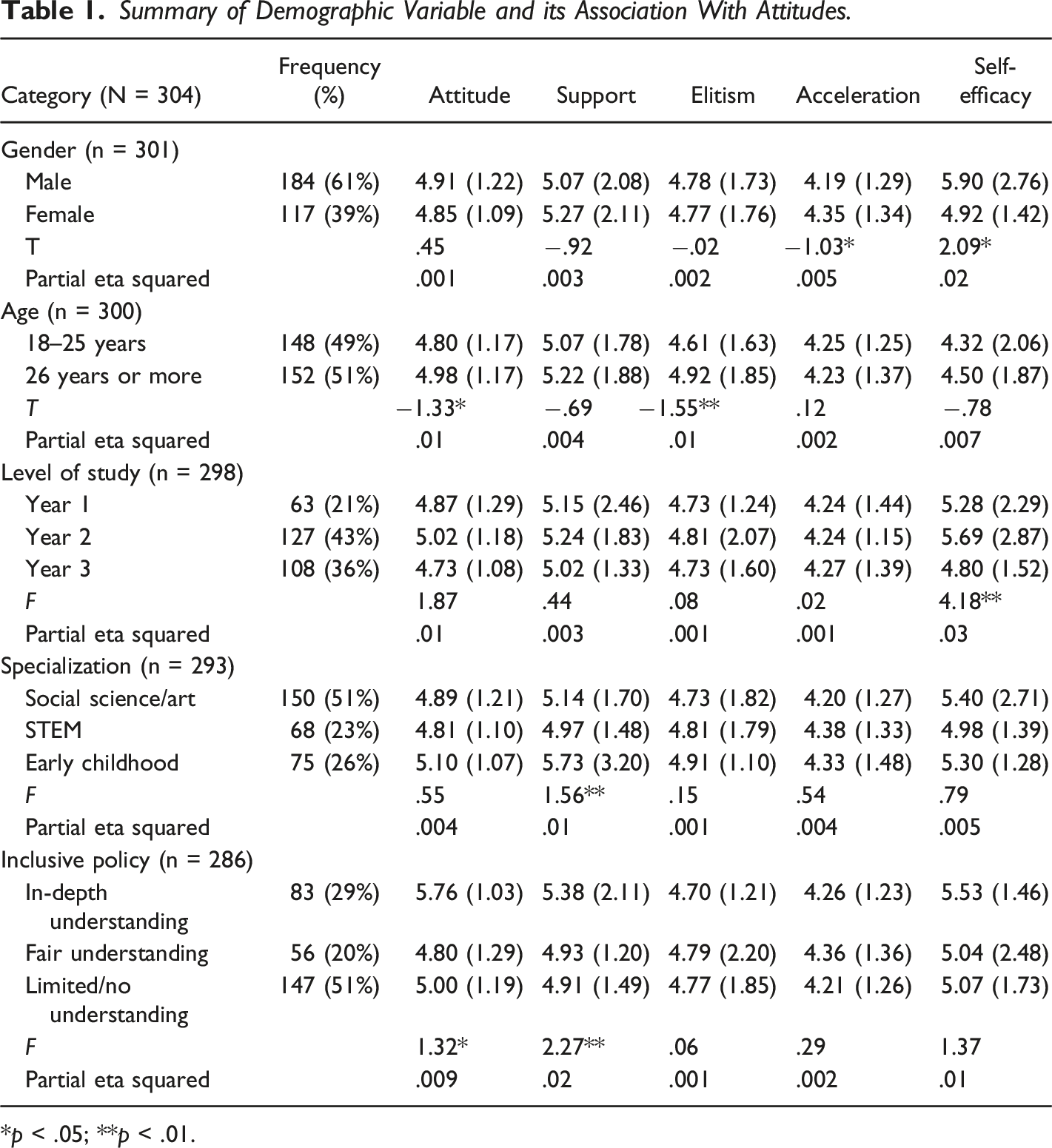
Summary of Demographic Variable and its Association With Attitudes.
*p < .05; **p < .01.
Instruments
A three-part questionnaire was used to collect data. Part One collected data on the demographic profile of participants: gender, age, level of study, area of specialization, and knowledge of IE policy. The decision regarding which demographic variables to include in the study was based on a review of the literature (Gagné & Nadeau, 1991, 2020; McCoach & Siegle, 2007; Plunkett & Kronborg, 2011) and suggestions for inclusion and exclusion from experts in GATE who reviewed the instrument in a draft form.
Part Two of the questionnaire was based on the Opinions About the Gifted and Their Education Scale (Gagné & Nadeau, 1991), which was designed to assess attitudes toward GATE (Kunt & Tortop, 2017; McCoach & Siegle, 2007; Plunkett & Kronborg, 2011). McCoach and Siegle (2007) modified the scale based on the results of a confirmatory factor analysis. Their results did not confirm the six-factor structure of the original scale, so the original scale of 34 items was reduced to 15 items with a three-factor structure. This study used the revised scale comprising three subscales, and all the questions on the scale were worded positively. The scale was anchored on a seven-point Likert scale (1 = strongly disagree, 2 = moderately disagree, 3 = slightly disagree, 4 = undecided, 5 = slightly agree, 6 = moderately agree, and 7 = strongly agree).
We reported the mean score instead of the total score because our view is that the former was easier to understand because it aligned perfectly with the Likert scale (Anderson & Bourke, 2000). We obtained the mean score by dividing the sum mean by the number of items on the scale or subscale, and a score of 5 or more was interpreted as a favorable attitude toward gifted students.
The first subscale of the Opinions About the Gifted and Their Education Scale (Gagné & Nadeau, 1991) was “support for GATE,” which comprised five items, including “Our schools should offer special education services for the gifted,” “Taxpayers should pay for special education for the minority of children who are gifted,” and “All special programs for the gifted should be maintained.” A mean score of at least 5 was interpreted as favorable support for GATE. The second subscale was “elitism,” which comprised six items, including “Special programs for gifted children have the drawback of creating elitism,” “The gifted are already favored in our school,” and “Special educational services for gifted children are a mark of privilege.” A score of at least 5 indicated a belief that GATE was the domain of elites in the society. The third subscale was “acceleration,” which comprised four items, including “Most gifted children who skip a grade have difficulties in their social adjustment to a group of older students,” “Children who skip a grade are usually pressured to do so by their parents,” and “When skipping a grade, gifted students miss important ideas.” A mean score of at least 5 indicated opposition to the acceleration of gifted students.
Part Three of the questionnaire was based on the Self-efficacy Toward Gifted Education Scale that was developed for the present study. We reviewed the literature (Ajzen, 1991, 2011; Gagné & Nadeau, 1991; Matheis et al., 2017) and devised eight items to measure the perceived efficacy of PSTs, including “I consider myself to be gifted,” “I believe I can teach gifted students,” and “I can adapt lessons for gifted students.” This scale was also anchored on a seven-point Likert scale, and a score of 5 or more was interpreted as favorable self-efficacy toward GATE.
The questionnaire was sent in a draft form to three experts in GATE to assess its validity for data collection in a novel context. Known as the Delphi process, this is used to validate the content of instruments by experts (Mengual-Andrés et al., 2016). One of the main recommendations from the experts was to word all scale statements positively. We then used Cronbach’s alpha to assess the reliability of the scales, and the Opinions About the Gifted and Their Education scale and the self-efficacy scale yielded acceptable scores of .71 and .63, respectively.
Procedure
The study was approved by X and X of the Ghana Education Service; then each of the three selected Colleges of Education reviewed the study protocols before their implementation. Next, the third author visited each school to invite them to participate in the study. Once approval was granted by school principals, the third author visited classrooms to introduce the study and its objectives to the students, and those who wished to participate were given copies of the questionnaire to complete at their convenience. They were given three weeks to complete the questionnaires before the third author returned to retrieve them directly from the students.
The data were collected from January 2019 to April 2019. The confidentiality and anonymity of the participants were assured by informing them that neither their identity nor school name would be used in the reporting of the study. The participants were also informed that there would be no financial reward for their participation in the study. Because English is the language of instruction at all school levels in Ghana, the instrument was completed by the participants in English, which took approximately 10 to 15 minutes.
Data Analysis
The data were analyzed using SPSS. First, the response values from the completed questionnaires were entered into an Excel spreadsheet for cleaning before being transferred to SPSS for further analysis. We computed Little’s missing-completely-at-random test to determine whether the missing values were missing at random (Pallant, 2020); the results showed that such values accounted for less than 5% of the total, so we then used the expectation–maximization algorithm to replace the missing values. We then ascertained whether the data were normally distributed using histograms.
Subsequently, we computed the mean scores for attitude and self-efficacy and the frequency count for demographics, and then we proceeded to answer the RQs. To answer RQ1 (Is there a relationship between background variables [e.g., gender] and the attitudes of PSTs toward teaching gifted and talented students?), we used a t-test (for two-level demographics, i.e., gender and age) and a one-way analysis of variance (ANOVA; for three-level demographics, i.e., level of study, specialization, and knowledge of IE policy) to explore the relationship among demographics, attitudes, and self-efficacy (Pallant, 2016). We then used outputs from Levene’s test to ensure that the homogeneity of the variances was not violated. We also checked the weight of the relationship among the participants by using partial eta squared (η2), with interpretation ranging from small (.01–.04) to medium (.06–.09) and then large (at least .10) (Pallant, 2016).
RQ2 (Does awareness of IE policy moderate the association between other demographics and the attitudes of PSTs toward gifted and talented students?) was answered using a two-way ANOVA to ascertain the interaction effect of knowledge of IE and other demographics on attitudes and self-efficacy. We checked to ensure that the assumption of homogeneity of variance was at an acceptable level.
Before answering RQ3 (What are the predictors of the attitudes of PSTs toward gifted and talented students?), we computed the relationship between attitudes and self-efficacy by using Pearson’s moment correlation coefficient, which we interpreted as follows: small (r = .10–.29), medium (r = .30–.49), and large (r = .50–1.0) (Pallant, 2016). We then computed linear regressions to determine the predictors of attitudes and self-efficacy, and we checked closely to ensure that the data met the assumptions of homogeneity of variance, homoscedasticity, and multicollinearity (Pallant, 2016).
To answer RQ4 (To what extent does the self-reported efficacy of PSTs predict their attitudes toward teaching gifted and talented students?), we used a hierarchical multiple regression to explore whether self-efficacy could predict the PSTs’ attitudes toward GATE. We entered self-efficacy in the first step and added the demographic variables in the second step, and we again checked closely to ensure that the data met the assumptions of homogeneity of variance, homoscedasticity, and multicollinearity (Pallant, 2016).
Result
We computed the mean scores for the attitudes of PSTs toward gifted students, and the results were as follows in terms of mean M and standard deviation SD: overall mean for attitude (M = 4.76, SD = 1.17); subscales: support (M = 5.15, SD = 1.81), elitism (M = 4.77, SD = 1.73), acceleration (M = 4.26, SD = 1.31), and self-efficacy (M = 5.28, SD = 2.34).
Association Between Profile and Attitudes
An independent-sample t-test was conducted to compare the relationship between the two-level demographics and the attitudes of PSTs toward gifted students. Although there were no significant differences in attitudes toward gifted students in terms of participant gender, there were differences in terms of acceleration and self-efficacy. First, there was a significant difference between male and female PSTs regarding acceleration (t (299) = −1.03, p = .03), with a small effect size (partial η2 = .005). Second, there was a significant difference between male and female PSTs regarding self-efficacy (t (299) = 2.09, p = .04), with a small effect size (partial η2 = .02).
In terms of age, there was a significant difference in the overall attitudes of the participants. For example, PSTs who were at least 26 years old held more-positive attitudes than did those who were between 18 and 25 years old (t (294) = −1.33, p = .02), with a small effect size (partial η2 = .01).
A one-way between-groups ANOVA was also used to assess the difference between participants. In terms of level of study, there was a significant difference among participants in one subscale only, that is, self-efficacy (F (2, 295) = 4.18, p = .02), with a small effect size (partial η2 = .03). A post hoc comparison using the Tukey HSD test showed that those in their second year differed from those in their third year.
In terms of area of specialization, there was a significant difference among participants regarding support (F (2, 290) = 1.56, p = .001, partial η2 = .01). A post hoc comparison revealed no difference among participants, but the mean scores showed that those in early childhood education were more supportive of gifted students than were those specializing in other areas.
In terms of knowledge of IE policy, there were differences among participants regarding overall attitudes and self-efficacy. First, there was a significant difference among participants regarding knowledge of IE policy and overall attitudes toward gifted students (F (2, 285) = 1.32, p = .04, partial η2 = .02); a post hoc comparison showed that participants who stated that they had in-depth knowledge of IE differed from those who did not.
Furthermore, there was a significant difference among participants regarding knowledge of IE and support for gifted students (F (2, 285) = −2.27, p = .001, partial η2 = .001); a post hoc comparison revealed no difference amongst participants.
Predictors of Attitudes
The strength of the association between attitudes and self-efficacy was analyzed using Pearson’s moment correlation coefficient. There was a significant association between attitudes and self-efficacy (r = .25, p = .001) and a small correlation between self-efficacy and two GATE subscales (elitism [r = .18, p = .002] and support [r = .25, p = .001]). However, there was no correlation between acceleration and self-efficacy (r = .05, p = .39). Between the subscales, the results showed small correlations between elitism and acceleration (r = .31, p = .001), elitism and support (r = .18, p = .002), and acceleration and support (r = .22, p = .001).
Regression of Demographics on Attitudes.

*p < .05; **p < .01.
Regression of Demographic on Support.

*p < .05; **p < .01.
Summary of Self- Efficacy Regressed on Attitudes.

*p < .05; **p < .01.
Interaction Effect of IE Policy on Attitudes and Self-Efficacy
Summary of Interaction Effect of Attitudes.

*p < .05; **p < .01.
Moreover, the computations showed an interaction effect between gender and IE policy (F (2, 286) = 2.48, p = .04), with a small effect size (partial η2 = .02). A post hoc comparison showed no significant difference among participants, but the mean score showed that female PSTs indicated that they were more knowledgeable about IE policy than were their male counterparts.
There was an interaction effect between area of specialization and knowledge of IE policy (F (4, 280) = 1.09, p = .01), with a small effect size. A post hoc comparison using the Tukey HSD test revealed no significant difference among participants. The mean score also showed that those who indicated a specialization in early childhood education were more knowledgeable about IE policy than were those specializing in other areas.
Regarding acceleration, there was an interaction effect of IE policy on the two demographics. First, there was an interaction effect between level of study and knowledge of IE policy (F (4, 283) = 1.30, p = .02, partial η2 = .02). A post hoc comparison revealed that those with a fair understanding differed from others. In addition, the mean scores showed that the first-year and third-year participants differed from those in their second year.
There was also a main interaction effect between IE policy and specialization on acceleration (F (4, 280) = 2.83, p = .03, partial η2 = .04). A post hoc comparison yielded an insignificant difference among participants in terms of their knowledge about IE policy, but the mean scores showed that participants specializing in early childhood and STEM (science, technology, engineering, and mathematics) were more supportive of acceleration than were those specializing in social sciences/art.
In terms of self-efficacy, there was an interaction effect between IE policy and the two other demographics. First, there was an interaction effect between IE policy and gender (F (2, 286) = 3.98, p = .001, partial η2 = .007). A post hoc comparison using the Tukey HSD test revealed no significant difference among participants in terms of their knowledge of IE policy, but the scores showed that the male PSTs were more positive about self-efficacy toward GATE than were their female counterparts. Second, there was an interaction between IE and specialization (F (4, 280) = 4.18, p = .001). A post hoc comparison using the Tukey HSD test showed that those who indicated that they had a fair understanding of IE policy differed from those who did not. The mean scores also showed that those specializing in early childhood and social science had more-positive self-efficacy about being gifted and talented than did those who indicated that they were specializing in STEM.
Discussion
Preservice education is fundamental in preparing teachers to support gifted students in the regular classroom. The present study was guided by the TPB (Ajzen, 1991, 2011), which has been used widely to study human intentions toward a given behavior. Two related beliefs over which individuals have control—attitudes and self-efficacy—were the main focus of this study, and the main goal was to explore the attitudes and self-efficacy of PSTs toward gifted students.
Findings confirmed the hypothesis between the positive relationship between attitudes and self-efficacy. Moreover, self-efficacy contributed more in the variance in attitudes toward gifted students. This suggested that attitudes of PSTs toward gifted students increased, and self-efficacy may also have increased. This finding partly substantiated the results of a previous study on the relationship between self-efficacy and attitudes toward gifted students (Camcı-Erdogan, 2015). In inclusive research on the teaching of students with disabilities, it has been argued that teachers’ attitudes and self-efficacy are both important in achieving the goal of education for all (Ahmmed et al., 2014; Sharma & Jacobs, 2016; Sharma et al., 2015). In Ghana and other SSA countries, giftedness is culturally perceived to be supernaturally endowed to students and not something that can be developed (Ngara, 2017). The expectation was for GATE programs to be built based on the traditional practices of the people, which is suggested for countries such as Ghana to promote gifted education. There is the need for a contextual formulation and inculcation of informal constructs into the formal school structures. In this way, teachers could form attitudes and teaching efficacy that would afford them the opportunity to identify gifts from the formal and informal structures and contribute toward students’ nurturance by society.
Ajzen (1991) identified attitude as an important variable in ascertaining whether an individual will engage in a given behavior. This suggested that positive attitudes may be required before an individual can participate in a behavior. However, this study’s PSTs were ambivalent in their attitudes toward gifted students. While this finding corroborated those of previous studies (Kunt & Tortop, 2017; Tortop & Kunt, 2013), it was inconsistent with others regarding positive attitudes of teachers toward gifted students (Erdogan, 2017; Juriševič & Žerak, 2019; Krijan & Borić, 2015). The findings of the present study could be attributed to the fact that GATE has yet to be developed in developing countries such as Ghana. In view of this, PSTs had little information or idea about the identification, behavior management, and appropriate pedagogical strategies required to teach gifted students, which contributed to their attitudes about GATE and their contribution to promoting the education of gifted children. Although previous studies revealed the inability of teachers in the non-Western world to identify gifted and talented students (Allotey et al., 2020; Ngara & Al Mahdi, 2015; Nyarko et al., 2017), the field of GATE is undeveloped in Ghana and SSA and so the ambivalence of participants toward GATE was understandable. This situation also could have an adverse impact on efforts to promote IE. Implementing IE means that all students will be effectively supported to achieve their potential. Without developing an appropriate GATE program which reflected the local culture, the PSTs who took part in this study would be unable to provide effective programs and services to address the learning needs of gifted and talented students. This could put gifted students at risk of not receiving the requisite educational support and participation in programs tailored to suit their unique needs. Therefore, prioritizing the development of GATE programs that consider the contextual understanding of giftedness is vital.
Ajzen (1991) argued that background variables could provide additional explanations as predictors of intention. In this study, knowledge of IE emerged as a significant predictor of attitudes: as knowledge of IE improved, so did attitudes toward GATE. These findings supported a previous study which found the lack of policy or guidelines for GATE made it difficult for teachers to determine the importance of gifted programs (Krijan & Borić, 2015). Ghana’s IE policy was the only policy which included gifted children. However, GATE requires substantial attention because it must be developed to include the needs of children from different cultural backgrounds. Therefore, exposing PSTs to gifted policies based on culture could enable them to develop positive attitudes toward the promotion of teaching of gifted children from different cultural backgrounds.
Area of specialization also provided additional insight into the attitudes of PSTs. Particularly PSTs specializing in early childhood education who indicated that they would be more supportive of gifted students than those PSTs specializing in STEM and social sciences/arts. These findings partly corroborated those of previous studies, which reported differences among teachers on attitudes toward gifted students based on their area of specialization (Lassig, 2003; McCoach & Siegle, 2007). Anecdotal evidence from SSA evidenced that early childhood education is not recognized or acknowledged as an educational context; rather, it is perceived as a necessary place for children to attend while their parents are engaged in economic activities. Also, a child who demonstrated extreme intelligence was hailed as a genius or wunderkind whose wisdom is from a supernatural being (Ngara & Porath, 2004, 2007), and such children were rarely supported to develop their talents in school. Based on this understanding, participants specializing in early childhood education possibly presumed that their work was much easier given the meaning of early childhood and the understanding of giftedness. However, such a position was erroneous in the sense that SSA countries, including Ghana, have challenges regarding the provision of quality early childhood education (Lemaire et al., 2013; Mensah & Badu-Shayar, 2016; Oppong-Frimpong, 2021), and early childhood teachers reported to struggling when teaching students with disabilities alongside their typically developing peers (Ackah-Jnr & Udah, 2021; Ntuli & Traore, 2013; Obeng, 2014). Therefore, the indication of higher attitude from early childhood teachers could be due to the contextual perception that their job was fundamentally easier than others. Such participants might have been complacent and could have faltered or even been unable to provide effective teaching services to gifted students. Potentially, this calls for teacher educators to develop a new GATE program based on the local culture, as well as approaches to providing gifted education in early childhood programs.
There were also differences among PSTs regarding their level of study and self-efficacy. Interestingly, PSTs who were in their first and second years of education were more efficacious than were those in their third year of study. According to Ajzen (2011), self-efficacy was the only predictor of intention, which may have a direct impact on actual behavior. This might be an important sign that teacher educators should be interested in developing the self-efficacy of PSTs as they approach the end of their training. Also, findings suggested that as PSTs approach the end of their training, their efficacy regarding teaching gifted students decreases; this was particularly relevant as they have reached the stage where they were about to enter the field and possibly encountered gifted students. If they had been adequately prepared to teach, then we would have expected them to be highly efficacious and willing to design or implement programs for gifted students. In Ghana, PSTs take only one course in special education in their second year (Nketsia & Saloviita, 2013), and it is possible that by their third year, the content is forgotten. Indeed, the education system in Ghana is based on meritocracy, theory, and little practical application (Mohammed & Kuyini, 2020). In efforts toward promoting GATE, PSTs may have considered those with high academic ability to compete in such a meritocratic education system as gifted. However, there was a possibility of exclusion especially for those who possessed other gifts which are not subjected to cognitive measures. This finding underscored the fact that PSTs may not be aware of learning needs of gifted and talented students and contributed toward the enhancement and learning of high-achieving students in the classroom. This lends support for stakeholders to design a GATE curriculum that is practical, sustainable, and culturally relatable to the people.
The variable of gender also provided additional understanding of the attitudes and self-efficacy of PSTs toward GATE. For example, it was noted that the male PSTs who took part in this study had higher self-efficacy than their female counterparts. Furthermore, as PSTs acquired knowledge of IE policy, males were more efficacious than their female counterparts. Moreover, female PSTs were more negative toward the acceleration of gifted students. In Ghanaian culture, male children are trained to be fearless and confident, expected to provide more-useful services to their communities (Opoku et al., 2022); conversely, female children are trained to be submissive and contribute toward the upkeep of the home. This situation was similar to other cultural contexts such as in Bangladesh, where the local culture has also encouraged women to be subservient to their male counterparts in the society (Ahsan et al., 2013). These cultural practices have had a negative effect on the development of women in the teaching profession. Specifically, female teachers continued to perceive themselves as incapable and even downplayed their potential (Ahsan et al., 2013). In efforts to promote a balanced GATE that integrates both the formal and traditional understandings of giftedness into the educational system of Ghana, educators could emphasize or acknowledge the role and competence of female teachers toward teaching gifted children in classrooms. This has the potential to improve the self-efficacy of all and the possibility of having culturally responsive teachers who would provide quality teaching services to gifted students.
Study Limitations
The study’s results should be interpreted with caution because of a number of limitations. First, the study participants were recruited from only 3 of the 46 colleges of education in Ghana, so the results may not be representative of the views of all PSTs in Ghana. However, all Ghanaian College of Educations followed the same curriculum, resources, and standards of teaching; in essence, all PSTs were offered the same knowledge and preparation for work in similar contexts. Given this, their experiences were similar to those of other PSTs from colleges not included in the study. Second, public and private universities that prepared teachers to work at various levels of education in Ghana were beyond the scope of this study. However, given the diversity of PST participants, we believed that the results reported were a good reflection of the views of PSTs from other training institutions. We targeted Colleges of Education because they trained teachers from the earliest levels of education in Ghana. Third, our study was limited to PSTs because we were interested in those who are preparing to enter the field. Future studies could be extended to in-service teachers to ascertain whether they are provided adequate in-service training to support and teach gifted students. Nevertheless, the present study has contributed significantly to the literature by exploring the relationship between the attitudes and self-efficacy of PSTs toward GATE in an SSA context.
Conclusion and Implications for Practice
This is the first large-scale study conducted in an SSA country to explore the attitudes and self-efficacy of PSTs toward GATE. This study also is the first to apply the TPB (Ajzen, 1991) to explore the relationship between the attitudes and self-efficacy of PSTs toward GATE. Furthermore, variables such as gender, knowledge of IE policy, level of study, and specialization provided explanations regarding attitudes and self-efficacy toward GATE. The study aslo offered useful information for policymakers to consider for future GATE policy development in Ghana.
Although Ghana has yet to develop a GATE program, there is a need to design one that considers local culture and contextual realities. In advanced societies, there are critiques of the narrow conception of giftedness that systematically side-line students from different cultural backgrounds from participating in gifted programs (Baldwin, 2005; Callahan, 2005; Ford, 2014; Milner & Ford, 2007). In the contemporary discourse and advocacy about GATE in Ghana and other similar contexts, it is important for educators to design guidelines that address the needs and nurture the talents of students from different cultural backgrounds. There is currently much emphasis on talent development, necessitating the need for teachers to be familiar with both formal and informal intelligence development. Most importantly, teacher educators should examine whether to introduce a comprehensive course in GATE that covers areas such as the social understanding and characteristics of gifted students, how to identify them, and instructional strategies to promote the development of gifted students from cultural backgrounds. Introducing a culturally responsive gifted program could help to improve or change the attitudes of PSTs toward GATE. Teacher educators should consider gender in the training of PSTs; focusing on developing the potential of PSTs to enable them to be efficacious and committed to providing quality teaching services to all students. Teachers’ efficacy could also be enhanced in the latter stages of preservice education. Each of these considerations are important to develop capable classroom teachers who can teach gifted students from a variety of cultural backgrounds.
Footnotes
Declaration of Conflicting Interests
The author(s) declared no potential conflicts of interest with respect to the research, authorship, and/or publication of this article.
Funding
The author(s) received no financial support for the research, authorship, and/or publication of this article.
