




Abstract
Gifted children and their parents often cope with challenges arising from their high abilities and the particular educational needs that these entail. The current research aims to map the available and desired resources for gifted children and their families in rural and central regions. The research stems from the resource-oriented approach to gifted education that identifies five exogenous learning resources, termed educational capital. As the availability of these resources can be context-dependent, the current study examines rural and central regions as diverse spatial areas. Using a qualitative approach, 26 in-depth interviews were conducted with parents and educators from two diverse regions in Israel. Thematic analysis found that parents and educators from both regions described the available resources similarly, with the exception of the economic, infrastructural, and didactic resources, which are less available in the rural region. In addition, parents and teachers in the rural region defined personal parental resources and educational knowledge as being more desirable than their counterparts in the center. The findings suggest that resources for the gifted are more family centered than community- or region-centered. Focusing on two different spatial areas, this study examines the possible interplay between location or geography and gifted children and their available educational capital.
Parents have views on the learning needs of their children and often have opinions as to how they can provide input on their children’s education. Parents of gifted children are no different. There is a lack of research exploring parents’ engagement in the education of their gifted children, especially on how parents from differing economic backgrounds and from peripheral/rural 1 regions in Israel use diverse resources in their involvement with their children’s education. When examining rural schools and gifted education in rural areas and comparing them to central areas, particularly in the United States, the literature suggests that rural schools encounter a variety of challenges that affect all students. Nevertheless, the way schools respond to these challenges has different implications for gifted students (Howley et al., 2009; Puryear & Kettler, 2017; Stambaugh & Wood, 2015). This can be seen as part of the general nexus of gifted education and geography (Stambaugh, 2022).
Gifted children comprise a very small part of the population (up to 3%); however, they should have access to specialized learning that addresses their high abilities. Formerly, the emphasis was on an individual approach addressing developmental processes, adaption, and how to work with the students, but recently, the emphasis has shifted to a cross-system approach emphasizing the essential connections between different systems and learning resources for the benefit of the individual (Bhargava & Witherspoon, 2015; Garbacz et al., 2017; McNeal, 2015; Riojas-Cortez & Flores, 2009; Ziegler et al., 2017).
The present research uses the resource-oriented approach to gifted education that considers endogenous and exogenous learning and educational resources (Ziegler et al., 2017). This categorization of learning resources is based on the Actiotope Model of Giftedness (Ziegler & Baker, 2013). The endogenous resources, termed as learning capital, relate to the internal individual component (e.g., physiological and constitutional resources, goals, cognitive abilities). The exogenous resources, termed as educational capital, relate to the environmental component. Following the context-dependent perspective, the current study focuses on exogenous resources, which comprise economic educational material, infrastructural educational capital, cultural educational capital, social educational capital, and didactic educational capital. As Ziegler et al. (2017) stated, “educational capital bears a relationship to achievement not only at individual or family level but also at the level of the educational system” (p. 312). It is, therefore, necessary to examine and address the resources available to gifted children. These types of educational and learning capital were examined, for example, among high-achieving mathematics students in Israel (Paz-Baruch, 2017). Further attention can be given to the environmental setting where the children live and where various facilities are located (Bessman et al., 2013). Previous studies had a limited focus on the perceptions of both parents and educators in gifted and talented centers regarding the significance of resources in various regions, such as rural and central areas. Addressing this gap can enhance our understanding of how to provide and support these resources in the locations where gifted individuals and their families reside and receive education.
Therefore, by integrating gifted children, the resources they require, and the geographical areas in which they live and learn, the current research endeavors to delineate the existing and preferred resources for gifted children and their families. This exploration is based on the perceptions of parents and educators in two distinct regions in Israel, central and rural, each characterized by differing geographic and socioeconomic characteristics. The differences between those two regions pertaining to educational processes are likely to be reflected in the experiences of teachers and parents working with and raising this exceptional population. In addition, knowledge gained from a resource-oriented approach to rural and central gifted education in Israel can further help policymakers, researchers, and teachers transfer findings to both rural and central settings beyond Israel.
Background
Giftedness
The traditional definition of giftedness emphasizes intellectual creativity, the ability to attain achievements, and to perform at an exceptionally high level, or the capacity to express exceptional ideas in various areas, which can contribute to society (Renzulli, 1987, 2002). As Sternberg (2023) noted, giftedness arises not just from the individual; rather, it should be seen as the interaction among person, task, and situation. In addition, the talents and abilities of the gifted require an environment with opportunities for development, practice, and implementation to enable flourishing in adulthood (Olszewski-Kubilius et al., 2017). The Three-Ring Conception of Giftedness includes three clusters of traits: ability, creativity, and task commitment (Renzulli & Reis, 2021). Although the current study was conducted in Israel, it is essential to examine gifted policy and systems beyond the national context. In the United States, gifted education is offered through special programs and schools, as well as through pull-out programs and acceleration within regular classrooms (National Association for Gifted Children [NAGC], 2021; U.S. Department of Education, 2019). The identification of gifted students is typically based on standardized tests, teacher recommendations, and other measures of exceptional ability (Gross, 2017).
In Israel, gifted education is provided through special schools and enrichment programs (Miedijensky & Tal, 2009, 2016; Zorman et al., 2016), as well as through enrichment programs within regular schools (Ministry of Education, 2023). The identification of gifted students is based on a combination of tests, school records, and teacher recommendations (Levin & Kupermintz, 2017).
In both the United States and Israel, gifted education aims to provide challenging and stimulating educational experiences for students with exceptional abilities, helping them reach their full potential and achieve their academic and personal goals. Similarities between these two countries can be found in the availability of special programs for the gifted among disadvantaged students; the lack of training in gifted education for teachers, particularly in mainstream classrooms; and the absence of legislation and nationally organized policies around gifted education (Miedijensky & Grinshtain, in press; U.S. Department of Education, 2019; VanTassel-Baska, 2018).
Parents of the Gifted
Understanding the traits associated with giftedness is relevant not only to the students themselves, but also to their parents. In recent years, parents’ general involvement and engagement in their children’s educational processes—formal and informal—has intensified (Hill & Tyson, 2009; Jeynes, 2012). The literature has given special attention to the positive link between family–school collaboration, school achievements, and academic aspirations (Benner et al., 2016; Hertzog & Bennett, 2004; Hornby & Lafaele, 2011). Although the role of parents in general became central in educational processes related to formal and informal systems, it may also be highly valuable among parents of gifted children (Mun et al., 2021). As mentioned by Howley et al. (2009), “parental and community support are critical to ensuring that the academic, social and emotional needs of gifted students are met” (p. 521). This role is supported by a recent study conducted in Israel focusing on the support given to gifted students in diverse socioeconomic environments, which found that high socioeconomic environments possess greater resources and provide richer experiences for their students (Paz-Baruch & Hazema, 2023).
Parents of gifted children exercise proactive interventions in learning processes (level and context) and in the emotional care of their children. This intervention derives from the parents’ high expectations regarding their children’s strong abilities and potential (Shechtman & Busharian, 2015) and stems from recognition of the need to supply resources that match their abilities. Callahan (2007), for instance, called for more interventions that involve parents through the formation of a master adult triad of teacher, parent, and mentor to support gifted students. Recent studies highlight the role of parents in choosing and identifying suitable educational institutions (Alkhawaldeh et al., 2023; Peebles et al., 2023). Emphasizing the role of gifted children’s parents, it is clear that the context matters. Parents do not act in a sterile environment detached from the characteristics of their neighborhood and city.
Gifted Children in Rural and Central Settings
The different geosocial contexts—rural and central—can construct different social and cultural experiences (Howley et al., 2014) and are likely to affect social interactions and educational processes (Putnam, 2015). The concepts of rural/periphery and center are complex and encompass both spatial and social dimensions (e.g., Shils, 1961). The geographic dimension highlights the distance from the center and the tendency to encompass large countryside areas and rural localities (for the complex meanings of rural and center, see Brown & Schafft, 2019; Halfacree, 2006; Puryear & Kettler, 2017; White & Downey, 2021). The sociocultural dimension focuses on economics (Dercon, 2009; Milgrom, 2015) and can also be extended to other fields to include cultural aspects (e.g., liberal values and attitudes), social networks (interaction intensity), and educational opportunities (Putnam, 2015).
Although comparative perspectives on power relations are explored for both areas, there is also a substantial body of literature that specifically examines either rural or urban education in the context of gifted children. Definitions and conceptualizations of rural educational settings are complex and challenging (Azano et al., 2021; Kettler et al., 2016). It seems that the further away from urban and central areas, the fewer opportunities there are for rural gifted students (Puryear & Kettler, 2017). Gifted children and their families in rural settings face two main challenges simultaneously: the context of their environment and the exceptional abilities of their children (Azano et al., 2014, 2017; Lawrence, 2009; Stambaugh & Wood, 2015). As “the focus of talent support is no longer just the individual, but the individual learning and developing in his or her socioecological context” (Ismail et al., 2022, p. 1), the challenges facing gifted children in rural settings should be studied from the viewpoint of parents (Vialle, 2017), teachers (Azano et al., 2014), and students (Gentry et al., 2001).
In their comprehensive review, Howley et al. (2009) presented four characteristics of rural schools that challenge gifted students: declining populations, endemic poverty, changing demographics, and ongoing accountability requirements. Some of the challenges have been well established by different studies. Hence, gifted children in rural areas seem to be disadvantaged regarding responses to their cognitive, social-emotional, and academic needs (Howley et al., 2009). Another literature review recently published indicates that the rural–urban excellence gap may be related to the comparatively lower access of rural gifted students to gifted programs and the comparatively lower levels of staff allocation to gifted education in rural schools (Jung et al., 2022).
Although the literature on rural education emphasizes the dual challenges faced by gifted students who are both academically advanced and geographically remote or isolated, studies focusing on urban schools and areas shed light on the challenges associated with underrepresented or impoverished groups within the gifted student population (Gentry et al., 2022; Kaplan & Mora-Flores, 2020; O’Brien, 2021; Ricciardi et al., 2020; Worley & Hines, 2023). Another development studied is the partnerships among organizations and urban and central schools to create innovative programs for gifted students (Boyle & Carpenter, 2023). These are also emerging in rural areas. Recent studies have emphasized the importance of developing place-based interventions in rural localities to improve the resources available to gifted students, thereby enhancing their chances of achievement (Azano & Callahan, 2021).
Finally, looking at both spatial areas, divides were found between rural and nonrural students regarding participation in advanced academic programs (Kettler et al., 2016), achievements (Callahan & Azano, 2021; Stambaugh & Wood, 2015), and well-trained teachers (Hernández-Torrano, 2018). Based on those findings, parents and educators need to consider and be aware of the needs of gifted students in diverse settings and the resources that can enhance their abilities and potential (Alkhawaldeh et al., 2023; Miedijensky, 2018).
Resources for the Gifted
Resources and capital can be regarded as means to attain a goal (Vladut et al., 2016) or as diverse assets that are used and activated across different fields (Bourdieu, 1986; Moore, 2008) and that enhance the power of an individual. Special attention was given to the resources available to gifted children. Exogenous resources—or educational capital (Ziegler & Baker, 2013)—are located in the environment of gifted children and demonstrate a constant exchange of matter, energy, and information between the child and their environment. Like the context-dependent notion of capital (Lareau et al., 2016; Schneidhofer et al., 2015), exogenous resources function as relational constructs that can be changed according to parents’ preferences or tendencies (Paz-Baruch, 2017; Vladut et al., 2016); they were found to be associated with greater robustness and resilience (Vladut et al., 2016). Ziegler et al. (2017) claimed that educators of gifted students should have these resources available at all points on the learning pathway. If such resources are missing, it can lead the gifted student to give up. In addition, the prioritization of resources is essential, as specific scarce resources may influence the educational process more than the sum of all the resources. It is, therefore, highly important to enhance knowledge regarding these resources in diverse regions. In a recent comparative analysis of six Arab countries that focused on educational and learning resources, a progress of supporting and nurturing gifted students was broadly described alongside highlighting “the importance of allocating more budget for gifted education and to pay more attention to the lack in essential resources” (Ismail et al., 2022, p. 2). Therefore, educational resources should be further examined in context, such as in rural and central settlements.
The Periphery/Rural and Central Israeli Setting
In Israel, the term periphery is used as a parallel to the term rural, emphasizing a geographic concept that is synonymous with distance from the center or location on the outskirts of the city (Israeli Central Bureau of Statistics, 2019; Kühn, 2015; Tzfadia & Yacobi, 2011). The term rural is used, for example, in Europe, Australia, and the United States, and refers to a population, housing, or territory that is not in an urban area. In the United States, a central definition for the term rural includes reference to population density, characteristics of land use and agriculture, and distance from urban areas with high population density. However, this definition has been made more flexible by federal organizations that service these areas (Seeling, 2021), defining them as nonmetropolitan districts that include a combination of open spaces, rural communities (of fewer than 2,500 residents), and urban communities with a population range of 2,500–49,999 residents. This broader definition allows greater flexibility in policy processes that involve allocating different resources to these areas (Marietta & Marietta, 2020).
Because the term periphery is less common in international literature, the focus in this article is on studies in which the concept of rural is used. Both terms denote remoteness, low density of population, and agriculture features. However, it is worth emphasizing that, in Israel, despite the significant proliferation of rural communities in peripheral areas, the periphery is also represented by urban settlements, which are usually smaller than cities in central areas. Therefore, the regions in Israel can be defined geographically and municipally. The geographic definition is based on measurement by a peripheral index. This index is based on the definition of an area that is far from essential services (e.g., markets, places of employment, health services), from activities (e.g., work, school, shopping, leisure), or from assets that exist in all areas, including the area itself. It is calculated according to the distance from the border of the Tel Aviv district, which constitutes Israel’s largest business and economic center (Israeli Central Bureau of Statistics, 2019). The index contains 10 degrees of peripherality according to these features (Israeli Central Bureau of Statistics, 2019). Clusters 1 and 2 are considered highly peripheral areas and are the farthest from the center. Clusters 3 and 4 are considered peripheral areas and are still distant from the center, but less so than settlements in Clusters 1 and 2. Clusters 9–10 represent the most central areas in Israel. The regions comprising Clusters 1–4 are the southern region (14.6% of the Israeli population) and the northern region (16.1% of the Israeli population). The two distant Northern regions are the Upper Galilee and the Golan Heights.
The municipality definition is based on the diverse types of settlement in a specific region, defined by governance (e.g., the Kibbutzim and Moshavim are part of rural settlements in regional councils). These two regions include both urban and rural settlements. All the settlements are characterized by low concentrations of residents (e.g., Kiryat Shmona, a large city in the northern periphery, formally established as a development town, has 24,000 residents). In addition, debates still exist in Israel regarding the notion of geographical periphery versus social periphery and on the political aspects of the periphery.
Geographic inferiority and social and economic disadvantage are reflected in the northern periphery of Israel, which is the focus of this research. In Israel, inequalities between the periphery and center are found in diverse domains. For example, the periphery has lower labor force participation rates and fewer employment opportunities (Swirski, 2005) and lower average wages and economic inferiority compared to the center (Arnon & Shamai, 2011; Milgrom, 2015). The number of high-tech employees is lower in the periphery compared to the center, which contrasts with the high number of employees in the industrial sector in the periphery compared to the center (Frenkel & Leck, 2017). In addition, there are fewer educational opportunities (Goldstein, 2008; Grinshtain, 2022), lower rates of high school diploma qualifications and admission to college or university (Dadon-Golan et al., 2019), and generally low achievement levels (Israeli Central Bureau of Statistics, 2019).
It is crucial to recognize the characteristics of rural and central settings given they may contribute to and shape the resources available to gifted students and their families. The research questions guided this study: 1. Which resources exist for gifted children in the two regions in Israel—rural and central—according to educators and parents? 2. Which desired resources are not available for gifted children in the two regions in Israel—rural and central—according to educators and parents?
Method
Context
Gifted children in Israel participate in an enrichment system called a pull-out program (Callahan et al., 2017; Kim, 2016; Ministry of Education, 2023; Olszewski-Kubilius & Lee, 2004; Renzulli, 1987; Tal & Miedijensky, 2005, Miedijensky & Tal, 2009) in which they leave their schools once a week to attend a special gifted and talented center located in their geographic area. The curriculum in these programs is taught using diverse teaching methods and includes subjects that are not found in the formal curriculum, such as arts, humanities, exact sciences, and life sciences. The Gifted and Talented Department in the Ministry of Education in Israel helps these pull-out programs design their curriculum and oversees their organization and pedagogy (Miedijensky, 2018; Miedijensky & Tal, 2009; Ministry of Education, 2023).
There are 59 centers offering pull-out programs in rural and central regions in Israel that are managed and run by the Israeli Ministry of Education. The rural region is represented by the Northern district (e.g., Golan Heights, Western Galilee, Upper Galilee, and Kiryat Shmona). The central region is represented by the city of Tel-Aviv and the Central district. Six samples were selected, three from each region based on peripheral index.
Participants
List of Participants.

The interviews with both parents and educators were conducted via Zoom and lasted from 50 to 90 minutes. Interviewing both parents and educators enhanced the triangulation of the data by using different sources of data (Denzin, 1970; Flick, 2018). The managers of the six centers were asked to cooperate with the researchers and recommended that the teachers and parents participate in the study. In line with ethical codes of research involving human beings, the participants were asked to contact the researchers. After receiving a full description of the aim of the research alongside the confidentiality measures implemented by the researchers, they could decide whether to participate in the study. Informed consent was then achieved and maintained.
Collecting narratives regarding both parents’ and educators’ experiences with the gifted provided a broader understanding of their resources. During in-depth interviewing of participants on various aspects of resources for the gifted, the interviewer could follow their lead and thus identify and understand their perceptions (Marshall et al., 2021). Sampling both parents and teachers was used in order “to elicit multiple perspectives on a given research question” (Guest et al., 2013, p. 43). Collecting data from two different populations enhanced data triangulation (Flick, 2018).
Interview Framework for Parents and for Educators.

Data Analysis
Exogenous Learning Resources.
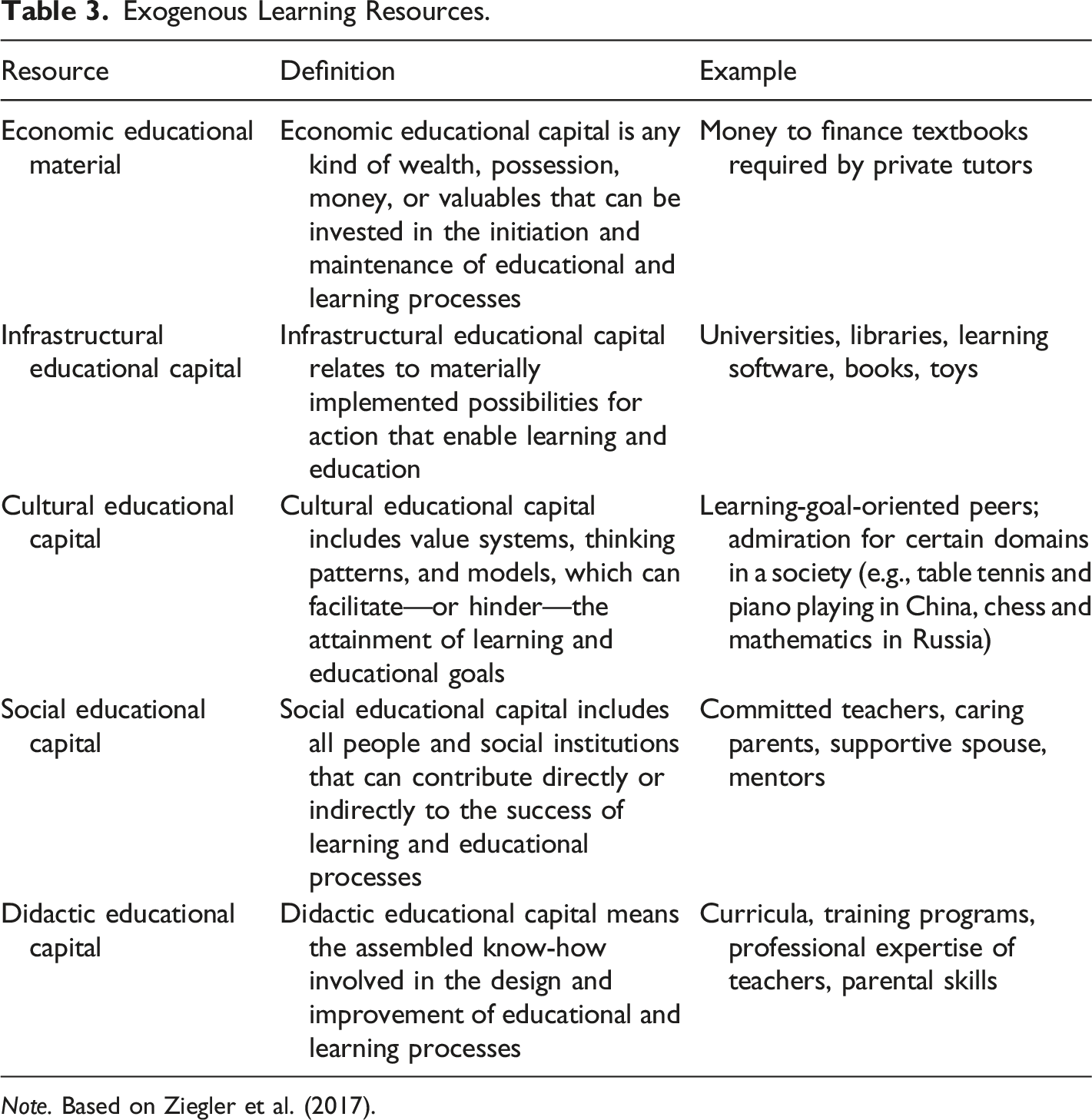
Note. Based on Ziegler et al. (2017).
In general, the categories identified in the first and the second stages were analyzed separately for teachers and for parents. In addition, this process was carried out manually and separately by each of the researchers. After each researcher achieved saturation, mutual agreement between the researchers was obtained. In the third phase, we combined the statements of parents and teachers into the themes revealed in the first and the second stages.
Findings
The findings that emerged from the interviews with educators and parents are presented in the context of exogenous learning resources. For each resource, both available and desired resources are presented as described by both parents and educators from rural and central regions.
Economic Educational Material
In general, as emerged in the current study, economic educational materials are always scarce and needed. Although in the center the availability was higher than in the rural region, the desirability of these resources seemed to be similar both in the rural area and in the center. Parents and teachers from central areas referred to the availability of economic educational material. “Our regular school is not representative of ordinary schools in any way. Whether it’s because its budgets are different because of parental payments or because it’s the agendas” (Parent 2.2.5). A teacher noted, “In our place, students come from towns and families that invest in the children, and generally have enough means to fund a better education” (Teacher 2.2.1). At the same time, parents and educators from rural areas highlighted the low availability of these resources for gifted children. “There is not enough budget for transportation and for activities” (Parent 1.2.1). The teacher shared: You must travel for anything or bring us lecturers, which is more expensive because our resources are very limited. We belong to the Ministry of Education; sometimes there are donations, but for the past two years it’s been really hard. (Teacher 1.1.6)
The statements indicate the diverse availability of economic material in the two areas. After the differences in available resources between rural and center, desired resources were the most frequently mentioned. Yet, the similarities here between the rural and central areas indicate a general shortfall of the budget in the educational system. As parents from the center explained, “We need more help with transportation, very much so. We carpool with friends from the neighborhood but it’s complicated and expensive” (Parent 2.2.5). In addition, “we’re getting on with the shuttle budget, but the state needs to make sure to take these kids and bring them back. It shouldn’t be at the parents’ expense” (Parent 2.2.6). Similarly, a teacher from the rural area commented: We are working in a private association, so I do not know who is budgeting, and I really did not go deep into budgetary matters. But it’s clear to me that it should be something systemic that does not depend on private associations and should be through the Ministry of Education, through government. (Teacher 1.1.3)
Regarding economic resources, the rural region was characterized by smaller budgets, inferior transportation, and lower investment as compared to the center. Funding for different activities was not guaranteed and depended on donations, parental contributions, or initiatives by teachers or local stakeholders. Parents had unequal abilities to afford transportation and activities. The lack of economic resources can therefore be regarded as a barrier to supporting gifted children.
Infrastructural Educational Capital
Infrastructural educational capital was described as low in the rural region. One teacher noted, for example: I have been “yelling” about the computers’ situation for a few years now; it’s really an issue. The computers are crashing in the middle of the lesson. I have nothing to do about it, except beg and I do it quite a bit. We sent letters to the municipality, but they sent only three new computers out of 30. (Teacher 1.1.3)
Similarly, complaints were raised regarding technical issues: “The computer system and the Internet are in a bad condition” (Teacher 1.1.1). Despite the low availability of infrastructure resources, particularly in rural areas, it was found that, in both regions, desired resources were described in detail. In the center, for example: I believe my thinking here is overnarrow because I’m too stuck in what’s out there right now. I’d build a lab. My daughter was never in a lab. Building a carpentry shop, so they can work with their hands, not just their heads. (Parent 2.2.4)
Examples from the rural areas were provided by the teachers: “We do need Internet communication so that children can write their stories and projects” (Teacher 1.1.1). Similarly, Teacher 1.1.2 noted, “I have so many dreams. First, there needs to be a school… We’re sitting on the third floor, and we don’t have accessibility, and we have kids for whom it’s a problem. We were pushed into a small school.”
It seems that infrastructure capital was usually scarce. Yet, it was particularly needed for extracurricular activities that are beyond the routine for gifted children. Therefore, having gifted and talented centers was not enough. Facilities and basic technological equipment are essential and were in particularly high demand in the rural region. Sometimes, parents were not aware of this lack of resources as teachers tried to manage with what they had. Yet, it might be helpful to notify parents so they are aware of and involved in resolving these shortage problems.
Cultural Educational Capital
The availability of cultural educational capital was perceived as similar in both regions. For example, a teacher in the center commented: In our gifted program, she [the director] took them to Rimon school [an art school for music, dancing and acting], exposed them to music. She took them to museums, all kinds, art and sculpture. Actors also come to school and do all sorts of things. (Teacher 2.1.2)
Meanwhile, in a rural area, a parent similarly observed that, “The advantage is that this is a very safe small town, which I think allows a little more independence for the child to go outside, explore, search, find friends, go around alone” (Parent 1.2.8). A teacher commented: There is a piano here, there are musical instruments and very good cameras. There is investment in these things. Speaking of cultural resources, if we are talking about lectures, many people are happy to come and talk. There are cultural resources that are free, and we try to use them. (Teacher 1.1.2)
It seems that in both regions, high levels of cultural educational capital were available for the benefit of gifted students due to local initiatives and personal forces. The desirability of such resources was reflected in the parents’ wishes to improve the existing situation; for example, parents in the center commented: They have occasional sports days, but once again they don’t take it forward to places where it can build something that remains, in my opinion. I mean, I would really like them to teach or explain the importance of sports, or enjoying sports, or developing something in sports. (Parent 2.2.4)
Parent 2.2.6 shared, “I want more cultural activities, particularly museums.”
As for cultural resources, in both regions, educators and parents described the high availability of cultural activities and investments. Usually, the cultural aspects were related to local facilities and opportunities. In the rural region, as in the center, music, sport, and art were made available by parents or local initiatives. A mother in the rural region described it as follows: “It doesn’t feel less because we are far from the center. We have good and talented youth and adults here who share their capacities and create a fine culture-oriented environment” (Parent 1.2.6).
This capital could be achieved or reinforced by creativity and local initiatives. Yet, there was a need for more institutionalized patterns of supporting and enhancing this educational capital.
Social Educational Capital
Like the similarities in cultural educational levels, it seems that the social educational level was highly valued in the two regions. In the center, a parent noted, “We have excellent teachers, highly dedicated and willing to help” (Parent 2.2.4). In rural areas, for example, it was discussed as follows: “In general, it’s up to the teacher. The formal setting for me is the homeroom teacher who cares about and is empathic toward my child” (Parent 1.2.2). In the center, parents opined, “In my opinion, the gifted child should be integrated into his or her position and given massive support from the mothers, teachers, mentors, and proper settings” (Parent 2.2.4). In addition, Parent 2.2.5 shared, “In the social sphere, they need to be provided with more frameworks to be with children like them.”
Desired resources were described in the two regions. For example, a teacher from the center stated: I think the emphasis should be more on emotional and social support for these children because there are children who come from large families and a weak population. The Gifted Center should give social and emotional support beyond the regular hours. It should be a framework in which children can reach out and share their difficulties and get tools on how to deal with their life. (Teacher 2.1.3)
Meanwhile, a parent in the rural region shared: “In general, it is up to the teacher. The formal setting for me is the homeroom teacher who cares about and is empathic to my child” (Parent 1.2.2).
Social capital was seen by some of the interviewees as a resource that depended on the personality or desire of individual teachers. However, social resources need to be built into educational systems, including gifted frameworks. Teachers’ commitment could be strengthened by continuing education and continuous learning. Furthermore, transforming a teacher into a mentor for gifted children necessitates the establishment of a systematic process within the education system. This process should be complemented by ongoing support and follow-up, alongside salary enhancements that integrate mentorship as an integral component of the teaching profession.
Didactic Educational Capital
The statements found in the interviews did not directly address didactic processes in the classroom. The main concern in the rural region was special projects or the existence of high-quality science and art subjects that were less available, for children in general and for gifted ones in particular. Teachers who worked in both regions, at different times, emphasized the lacuna in providing good training programs and teachers with professional expertise. Parents in the rural region were troubled by what their gifted children received as curriculum in special interest areas, such as space studies or chess. As a mother in the rural region described, “Teachers in special fields are rare, and usually, if there is a teacher, it means that he/she is obsessed by the topic. It’s all up to him/her. When he/she leaves, a huge vacuum is created” (Parent 1.2.6). Another parent in the rural region noted: I assume looking at Dor’s nephew [a friend] who is of the same age, he is in an excellence project in the city he lives in. There’s no comparison. What he gets there and access to teachers and special projects they do there, compared to what they get here. There’s no comparison. (Parent 1.2.8)
Yet, a local shortage emerged regarding a particular teaching role in the rural area: In terms of capabilities and budgets and what the school can find in such a small city, it’s a little problematic. For example, the music teacher retired a year and a half ago. They can’t find a good music teacher. (Parent 1.2.7)
Although this statement was specific, it reflected the difficulties and barriers in finding teachers for the gifted population. The previous statement suggested the low availability of specialized teachers but treated it as an individual problem rather than as a systemic issue. In the center, the availability of teachers is described as higher: There is tremendous richness in terms of the supply of things to offer children —in terms of the afterschool activities that can be found in the area. Every child can find himself here, whether in the fields of science and art or social things and sports. That’s why we live here. (Parent 2.2.5)
The desirability of qualified teachers in both regions was high. For example, in the center, and teacher shared: I’m sure we’ll say taking them on a gallery tour once every two months would have offered them so much. Is it possible? From the way I see it right now, it’s not going to happen, but if we’re here in a fantasy, yes. I think it’s going to contribute a lot to them now to break their normal framework of what a class looks like, and what a lesson that needs to happen looks like. (Teacher 2.1.3)
A parent, also in the center, noted: If you leave these children in regular settings, you need to invest resources in educating the educators, the educational staff to identify, to know such children, and to meet their needs. Because a kid like that who sits for 5 hours every day and you treat him like a normal kid, so you actually don’t meet his special needs and he has special needs. (Parent, 2.2.6)
A similar sentiment was expressed in the rural region: We do undergo some training, but there is no ongoing training to continue to specialize and understand more about gifted education. Much of my knowledge is from things I have read, that I have sought out. There should be more training. (Teacher 1.1.3)
Another teacher provided this perspective: “First of all there’s a need for a truly professional team that can teach [gifted children] … I think the most important is the professional team” (Teacher 1.1.4).
Regarding social capital, programs for nurturing gifted children in rural and central environments should involve constant improvement of the curricula and consideration of the added value required for gifted students that is not provided in regular classrooms and schools. The process should be about recruiting teachers with unique expertise and thinking about creative collaborations that might involve the wider community.
Alongside the five resources theorized, two additional resources emerged from the inductive analysis: personal parental capital, which was described both by rural and central parents and educators, and educational knowledge and information resources, which were mainly described by rural parents. These additional resources are discussed in the following sections.
Personal Parental Capital
The need for personal resources, such as time and help with the kids, was raised by parents from both rural and central areas. However, parents from the rural region focused on transportation in terms of distance and on the lack of available help in the form of private tutoring or special support. One parent shared, “I’m exhausted from having to divide my time between four children. When we travel in the afternoon for four hours with our child, the other three all need to have an arrangement. I should get more help” (Parent 1.2.1). Another noted, “The special program is a 45-minute drive away. It is impossible. I didn’t even consider it as an option” (Parent 1.2.3).
Another example was provided by a teacher from the rural region: We wanted to open a special program in humanities. I personally talked with the parents. I felt that they are not in a condition to say yes. They told me that the price is too high in terms of the other children, their time, their availability. (Teacher 1.1.1)
The lack of time was described by parents from the center, but more generally, in terms of parenting. One indicated, “I wish I had more time” (Parent 2.2.4), and another said, “I need to divide myself between the kids. When there is a higher demand for investment in a child who has special needs, it affects the distribution of time between all my children” (Parent, 2.2.3).
The identification of time as a limited resource illustrates the importance of serving gifted children in the context of their families. The interviewees were highly involved in their children’s development, a commitment that was hindered by a lack of help from their communities or government. Although parents are ultimately responsible for their children, community support could be harnessed to bolster their resources.
Educational Knowledge Resources
Another resource that emerged from the interviews was educational knowledge and information, which was scarce among rural parents. A parent in the center described it as follows: We have a lot of parents in the WhatsApp group who update each other on everything. Sometimes it’s a rush, but it helps to be in the loop. When there are entrance exams, what forms to submit. Yet, I wish it would be more formal. (Parent 2.2.2)
The description in the rural region was different, highlighting the relationship between a lack of knowledge, distance, and transportation issues: “Classes and programs are usually offered in distant areas far from our homes, and so we don’t know about them. I’d like our council to coordinate and update such information and publish it” (Parent 1.2.2).
Another parent in the rural area commented: I glean information, from here and from there. I constantly discover that I’m missing out on something that could be crucial. I found out about an important competition on the last day of registration. There are only a few of us here, and the information was relevant to a quite small group of parents and children. That is why we have to be notified. (Parent 1.2.8)
Much like personal resources, a lack of knowledge was discovered alongside the lack of external educational resources, revealing a deficiency in data or information that could be addressed through increased focus on parents in more remote communities. This could be achieved by establishing networks and communication channels to facilitate the exchange of information, thereby aiding parents residing in various geographical regions. The illustration of the summary of available and desirable resources can be found in Figures 1 and 2. The data in the two figures are organized both by the number of participants that referred to a particular resource and by the percentage representation of the participants’ responses out of the total number of respondents. Frequencies of themes: Available resources at rural and center areas. Frequencies of themes: Desired resources at rural and center areas.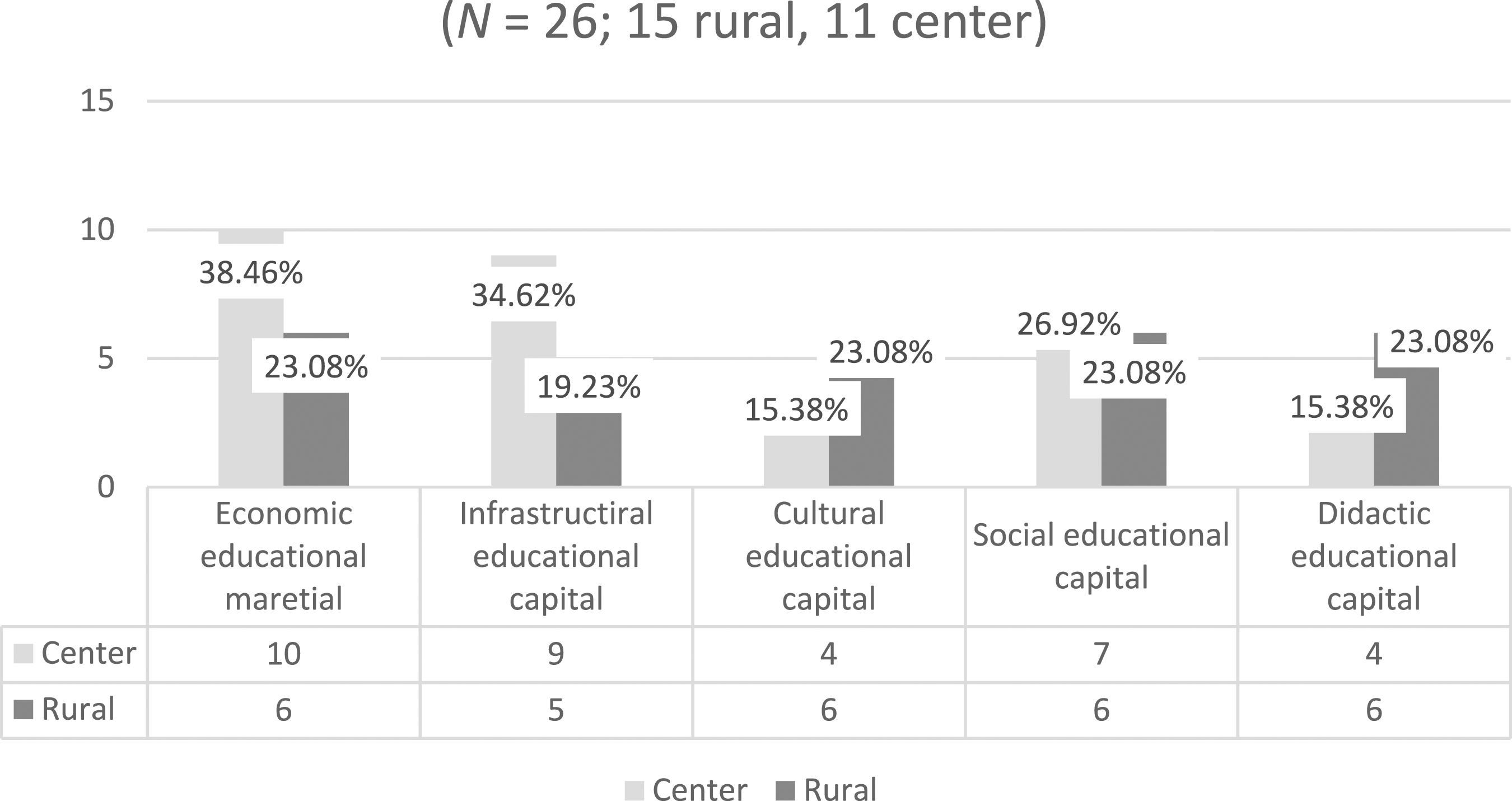

Discussion
The objective of this study was to identify the available and desired resources for gifted children and their families, as perceived by parents and educators in two regions in Israel—central and rural—with differing geographic and socioeconomic traits.
Significant differences emerged regarding the availability of resources. Availability appears to vary in each region, particularly regarding economic, infrastructural, and didactic resources. The study’s findings on economic resources align with previous research on low economic levels in rural, as opposed to central, regions (Kühn, 2015).
One main difference is the low availability of infrastructural resources in rural regions, whereas the center benefits from proximity to large hospitals, professional sport stadiums, shopping malls, and other features (McShane & Smarick, 2018). Funding in rural education is challenged by district size, transportation issues, and budget allocation, as previously noted in the literature (Johnson & Zoellner, 2016; Marietta & Marietta, 2020). The shortage of teachers in the rural area, particularly in science and English, supports the findings regarding didactic resources. The chronic teacher shortage in rural schools presents enormous challenges for principals and teachers (Azano et al., 2021).
The second main difference comprises desired resources. Personal resources and educational knowledge were perceived as highly desired in the rural region. The importance of information and know-how was perceived as highly significant in achieving this goal and can be explained by the notion of education-oriented capital (Addi-Raccah, 2020), which refers to the combination of educational networks and specific knowledge related to education. Thus, “knowing how to navigate and advocate within the educational system may substantially assist parents in their daily interactions…. and foster their power to represent parents and advance their interests and rights” (Addi-Raccah, 2020, p. 634). In general, Israeli parents with low socioeconomic status, who are strongly represented in rural settings, lack this resource. Parents of gifted children in rural regions are challenged both by being a small group in a small place and by having little data and specific knowledge regarding programs, benefits, and other useful information that can enhance their children’s high demand for activities. The study’s findings on economic resources align with previous research on low economic levels in periphery areas (Kühn, 2015).
Alongside these two differences, the findings suggest similarities in the perceptions of resources in the two regions. As for available resources, it seems that a more balanced attitude was found in the two regions regarding cultural and social resources. As for cultural and social resources, they appear to be setting-dependent; gifted children are offered diverse cultural and social options, some of them based on local human resources and including initiatives and unique capabilities. Thus, programs and services are offered in rural settings to enhance the cultural and social opportunities of rural education (White & Downey, 2021).
As for the desired resources, the respondents from the central and rural regions alike want more for their gifted children and seek ways to obtain it. This is true for parents in general. Aspirations and the need to do more or achieve more for one’s children is frequently described in the literature (Addi-Raccah, 2020). However, parents of gifted children tend to aspire for more options than do other parents, given they aspire to fulfill their children’s high potential (Mun et al., 2021). This is true not only regarding education, but in other areas as well. If a child has a unique talent in chess, sport, or art, for instance, their parents will do their best to provide an enriched environment and will be fully committed to nurturing their child’s talents (Luo & Kiewra, 2021).
Based on our findings on available and desired resources, our study reinforces the transition in conceptualizing giftedness, moving from an emphasis on individual abilities to a focus on environmental factors (Olszewski-Kubilius et al., 2017; Sternberg, 2023). Our findings indicate that resources for gifted individuals are derived from their environment, and this holds true for both rural and nonrural populations (Ismail et al., 2022). Specifically, rural education tends to offer pull-out programs that cater to the enrichment needs of gifted students, especially in cases where resources are scarce (Kim, 2016). Although many of the desirable resources are tied to remote areas (e.g., museums and transportation for activities), these programs partially address the needs of gifted students. However, it is worth noting that resources remain highly valued in these educational systems, as evidenced by the opinions of parents. Parents in the center and in rural regions are equally challenged by the availability of desired resources. The notion that parents in the rural region do not necessarily feel disadvantaged may imply that special efforts are being invested in rural regions to supply good education and resources to gifted students (Azano & Callahan, 2021). Both parents and teachers emphasized aspects within the family or the workplace, rather than in policy or at the governmental level. It seems that obtaining many of the resources that benefit gifted children ultimately depends on individuals who feel concern and responsibility for them. It is worth asking whether the essential experiences of gifted children should not expand beyond the local perspective into a more comprehensive view of needs and resources. As the study suggested, this perspective can benefit parents and teachers of gifted children in both regions. Diverse solutions can be offered according to the needs of the place, such as by providing transportation facilities or expert teachers to rural regions. Overall, for rural school districts, access to resources is an ongoing challenge.
As mentioned previously, there is a lack of research exploring parents’ involvement in the education of their gifted children, especially parents from peripheral and rural regions in Israel. The study highlights the importance of conducting studies that examines the existing and required resources for gifted students in peripheral regions versus central regions. Specifically, this research focused on parents’ engagements in the education of their gifted children in those areas. The findings are in accord with those studies, such as Hernández-Torrano (2018), that found a rural–urban excellence gap in Spain due to the low availability of infrastructural resources in rural regions and in Australia, where rural gifted students are facing numerous challenges that contributed to their educational needs being underserved (Townend et al., 2020). After all, officials in the Ministry of Education, the public, the parents of gifted children, and the entire education system should understand that rural gifted youth, like their urban peers, need stimulating opportunities to express their talent and potential, make a broad impact on society, and eventually contribute to their local communities.
Implications
The current research has several implications. The study enhances theoretical knowledge regarding gifted individuals in rural and central areas, with a focus on parents’ perceptions. It emphasizes the significance of the family or the pull-out programs, in providing resources and support for the unique needs of gifted individuals. The study highlights the importance of considering remoteness when evaluating desirable resources, thereby positioning exogenous educational resources as context-dependent. Rural areas receive special attention due to location-based processes for gifted individuals. From a methodological perspective, the study triangulates the views of parents and educators working together for the benefit of gifted children. Both perspectives demonstrate shared perceptions regarding available and desired resources, reflecting a broader understanding of the needs of educators and parents in teaching and parenting gifted individuals.
From an applied perspective, we can learn how each resource, such as transportation, special equipment, or pedagogical aspects—like special teachers, materials, or classrooms—can make a difference for gifted students. Considering these implications, it appears that resources for gifted education should be integrated into policy at a broader level, rather than relying on individual solutions provided by teachers or parents. The resources should be part of a plan or a policy, targeted at the scarcity faced in rural areas. Creative solutions regarding social educational capital include, for example, providing programs and support for parents as a group or as individuals, creating mentoring relationships among parents, or creating a community of practice for parents to share their resources in areas such as transportation and knowledge.
Limitations and Further Research
The current study had several limitations. First, a major part of the research was carried out during the COVID-19 period, during which there was a change in resources, and this may have affected the data. Second, this study focuses on the in-depth experiences of the participants. More quantitative information from parents of gifted children is required and would enable the expansion of the findings using a different method. For example, using quantitative methodology would enable researchers to examine differences between the academic achievements of gifted students from rural regions and those from the center in the context of the resources available and desirable to them.
In addition, case studies or action research could uncover how diverse schools in rural and central areas respond to the needs of gifted children and their families. It would also be beneficial to examine how activities and pull-out programs for gifted students in rural regions deal with the lack of resources. Moreover, further research is recommended to examine how aspects of geographic remoteness in Israel and in other countries in the world affect the availability of resources for the education of gifted students, and to examine gifted children and youth’s perceptions regarding available and desirable resources in relation to their education and optimal development. Finally, as rural areas include diverse and segregated settlements, future research attention should be given to the resources in these settlements, focusing, for example, on the differences between Jewish and Arab gifted students. Promoting the education of rural gifted children and supporting their families should be part of the context in which they learn and develop.
Footnotes
Declaration of Conflicting Interests
The author(s) declared no potential conflicts of interest with respect to the research, authorship, and/or publication of this article.
Funding
The author(s) disclosed receipt of the following financial support for the research, authorship, and/or publication of this article: This work was supported by the The Research Authority of Tel-Hai Academic College.
