




Abstract
Mobile technologies have shown great potential in various educational settings. Moreover, there is an emerging research base demonstrating how students view and interact with mobile devices to learn. As more of these technologies enter inclusive educational settings, an understanding of the extant research base for mobile learning (M-learning) and students with various exceptionalities including disabilities is necessary for technology developers, researchers, educators, and school administrators to support student success. To this end, this study used a synthesis approach to reviewing the literature published on M-learning for students with and without disabilities in formal and informal K–12 educational settings. It provides a comprehensive mapping of 47 studies from 2007 to 2016. The current review revealed that (a) most studies focused on the effectiveness of M-learning on teaching and learning, (b) mixed methods and experimental studies were the most popular methodologies, and most importantly (c) research outcomes were generally positive about the potential of M-learning to support the needs of students with disabilities in inclusive settings. Limitations and implications for future research on M-learning are also discussed.
Mobile devices are ubiquitous technologies. In fact, more than 6 billion people worldwide have access to a mobile device (Westlund, 2013). For some, the use of such devices is embedded in a broader digital inclusion agenda to enable all citizens to fully participate in their communities, benefit from online services, and make learning opportunities and workforce preparation more accessible globally (Cavanaugh, Maor, & McCarthy, 2014). In a study, Lenhart (2015) found that more than 75% of American adolescents (middle school and higher) have access to a smartphone. Compared to an Internet-connected computer, smartphones can bring students many learning opportunities with immediate and portable access to rich educational resources and build capabilities, such as online information searching, file sharing, and interacting with teachers and peers (Tao & Yeh, 2013). Increasing numbers of people use smartphones and other mobile devices to keep themselves informed and connected with the environment. The data show that for the majority of the 50 most visited online news and information entities, mobile visits started outpacing desktop visits in January 2015.
Sharples, Taylor, and Vavoula (2005) describe technology as any tool that serves the purpose of inquiry and enables individuals to address problems in context and to clarify and make meanings of them. Many modern technologies rely on the Internet to gather and transmit information. Mobile learning technology refers to a specific type of technology using mobile devices to support mobile learning (M-learning). O’Malley et al. (2005) defined M-learning as “learning that takes place when the learner is not at a fixed location, or learning that happens when the learner takes advantage of learning opportunities provided by mobile devices that are often connected to the Internet” (p. 7).
Alongside the growth of mobile technologies, educators must consider federal laws and policies for special populations. One major law is the Individuals with Disabilities Education Act Amendments (IDEA, 2004), which guaranteed a free and appropriate education in the least restrictive environment to all students. In line with the purpose of IDEA (2004), M-learning has great potential to facilitate teaching and learning, with the increasing use of mobile technologies to support the success of all students. In fact, United Nations Educational Scientific and Cultural Organization (2012) identified major features of mobile devices including portability, low-cost, and wide distribution that make M-learning important in people’s new learning experiences. For example, M-learning motivates students to learn and facilitates student collaboration and communication, which can be used to design inquiry-based learning activities (Duncan-Howell & Lee, 2007). Besides improving students’ motivation and eliciting engagement, mobile technologies innovate traditional learning environments into space that are more ubiquitous, connected, personalized, and supportive of the formation of self-directed learning communities (Kwon & Lee, 2010). Scholars argue that access to digital environments with the appropriate supports and environmental conditions, learners with disabilities demonstrate strengths that would otherwise go unnoticed (Basham, Stahl, Ortiz, Rice, & Smith, 2015).
Interestingly, with all the potential and importance of technology into education, it has been argued that technologies including smartphones and other mobile devices permeating students’ lives out of school are underutilized in K–12 schools (Mouza & Lavigne, 2013). This may be especially true for students with disabilities (SWDs, Ayres, Mechling, & Sansosti, 2013). Indeed, the introduction of mainstream mobile devices, and related applications and services to facilitate communication, collaboration, sharing, and learning for SWDs in educational settings have only just begun (Draper Rodríguez, Strnadová, & Cumming, 2014). To more thoroughly identify the potential of M-learning to support academic performance of SWDs, we conducted a literature review to examine how students, especially SWDs across various demographic populations, interact with mobile technologies in inclusive settings. The implications we draw from our findings have application for increasing the inclusion of M-learning for SWDs in both research and practice settings.
Research on M-Learning
Examining limited reviews of literature on M-learning that focus on students without disabilities reveals that current research has focused on mobile systems or specific applications (i.e., Jeng, Wu, Huang, Tan, & Yang, 2010; Zydney & Warner, 2016), mobile technology devices, as well as potential design of systems (i.e., Schwabe & Göth, 2005). For example, Jeng, Wu, Huang, Tan, and Yang (2010) published a literature review about the impact of mobile applications on learning strategy acquisition. Their review highlighted context awareness, pedagogical strategy–enhanced learning scenarios, and collaborative and socially networked M-learning as important goals for research. In another review of 63 empirical studies from 15 refereed journals, Liu et al. (2014) found that understanding the educational affordances of using mobile devices in instructional practices should be a primary research interest of scholars of that field. The potential for M-learning to bridge pedagogically designed learning contexts, facilitate learner-generated contexts and content (both personal and collaborative), provide personalization, and ubiquitous social connectedness that sets it apart from learning in more traditional environments (Cochrane, 2010). Additionally, Wu et al. (2012) conducted a literature review that investigated trends in mobile device types and their functionality, along with learner types, and the use of mobile devices across disciplines. Across these studies little substantive research on how students with various learning needs were accounted for in research on M-learning.
What is needed are understandings about the ways in which M-learning has been tailored to students with diverse learning needs and consideration of the learning context. In general, reviews of literature have overlooked SWDs in K–12 settings. Instead, work has focused on assistive technologies for these students (i.e., Beard, Carpenter, & Johnston, 2011; Campigotto, McEwen, & Epp, 2013). An emergent research base in special education related to the development of M-learning platforms suggests that attending to M-learning leads to improved outcomes for children with exceptional needs (i.e., Fernández-López, Rodríquez-Fórtiz, Rodríguez-Almendros, & Martínez-Segura, 2013). The primary purposes of this review were to (1) examine the issues and the trends that researchers have been investigating on the topic of M-learning for teaching and learning for students with and without disabilities in K–12 inclusive settings and (2) examine studies accounting for the interaction between students with and without disabilities and gender, socioeconomic status (SES), geographic locations, language proficiency levels, and the effectiveness of M-learning technologies on teaching and learning. With the previous research and our research purposes in mind, we examined the literature around M-learning to answer the following questions with a focus on learners with and without disabilities in formal and informal K–12 educational settings. What type of research has been conducted around the use of M-learning for students with and without disabilities? What contextual variables have been investigated in M-learning for students with and without disabilities?
Methods
This section describes the strategies for locating literature as well as the inclusion and exclusion criteria for the articles.
Search Procedure
For this study, multiple electronic databases were searched, including Google Scholar, ERIC, and SAGE. In addition, researchers performed a title search of articles from the Journal of Special Education and Technology (JOSET), British Journal of Educational Technology (BJET), and Journal of Educational Technology & Society (JETS) from 2007 to 2016. The following search terms were included: computer-assisted instruction (CAI), digital literacies, gaming, iPad, mobile technologies, tablet, smartphone along with inclusive education, special education, SES, and SWDs. After the electronic search, an ancestral or bibliographic search was conducted involving the examination of the reference lists of each found article (Wolery & Lane, 2014).
Inclusion Criteria
SWDs encompass all types of identified disabilities. Within this view, disability is interconnected with cultural practices and norms, rather than set preordained and intrinsic conceptions of existence (Munyi, 2012). Mobile devices include any device that is portable, distributable, relatively affordable, as a mediated means to support learning inside and outside the classroom environment (Kim et al., 2011). Context is critical to study of M-Learning because the variables associated with the interactions among device, learning environment, software, and users are necessary to support greater understanding across the design of these systems based on learners’ needs (Sharples, Taylor, & Vavoula 2005).
This review examined the literature on learners with and without disabilities from 2007 to 2016. The year 2007 was selected as a starting point due to the introduction of the iPhone and its importance of the first massively adopted digital mobile device with a near full time connection to the Internet (Liu et al., 2014). Finally, since this research aimed to understand the extant research base for mobile technology and disabilities in K–12 educational settings, we made the decision that we would look for empirical studies in all grades in K–12 settings. By empirical, we intended to find studies guided by a research purpose with experimental, descriptive, or mixed designs.
In summary, articles were reviewed with the following inclusion criteria for selection: (a) research published between 2007 and 2016 with a specific focus on M-Learning, which refers to any mobile device that is portable, distributable, and is used to support learning in the context (Sharples, 2013); (b) peer-reviewed journals, (c) that were empirical, including quantitative, qualitative, or single-subject design or was an empirical literature review, and (d) the research took place in either formal and/or informal K–12 settings and/or with research participants with disabilities.
Exclusion Criteria
Part of the ethos of M-learning is to make learning resources and opportunities more accessible and reduce barriers to learners. M-learning also strives for continuity of learning across contexts and devices while supporting various learning needs (Sharples, 2013). Thus, the definition of M-learning aligns with the purpose of inclusive education. Because not all the studies we found with students with and without disabilities in M-learning use the word inclusion, we looked at the context of whether and to what extent the SWDs were receiving education alongside their peers. That also meant that we embraced Marino’s (2010) suggestion for inclusion and exclusion criteria for studies about technology, and we excluded studies where technology in self-contained classrooms, residential or day treatment facilities, and hospital settings, even when the technologies were referred to as M-learning. Because of the concern whether SWDS appear in research studies that are not about assistive technology and/or do not focus on students in highly restrictive settings, our research purpose led us to seek literature about SWDs alongside studies of other special populations.
Article Selection
Selecting research articles for this review with aforementioned criteria took three steps. First, Google Scholar was searched, yielding 918 articles. All 918 abstracts were reviewed with a focus on the inclusion and exclusion criteria. Upon the review of abstracts, the included articles were narrowed to a collection of 12 articles. To confirm the findings on Google Scholar, the same methods were followed on ERIC and SAGE databases, where another 15 articles were found. In title search of JOSET, BJET, and JETS, another 20 articles were included. In total, 47 empirical studies met the criteria for further discussion in this study.
Coding
Two levels of coding took place to meet the aims of the review, including processes that permitted data to be divided, grouped, reorganized, and linked to search for patterns in data and to develop explanation for these patterns (Grbich, 2013). First, the references of the included articles were entered into a spreadsheet. Second, each article was read with a focus on the key features of the study. The following information was specifically gathered from each article: (a) purpose, (b) participant demographics, (c) research designs or research methods used, (d) topics covered, (e) types of mobile devices used, and (g) main findings. Finally, we gathered information on content knowledge acquisition, engagement, motivation, collaboration learning mode versus individual learning mode.
Participant demographic variables included disability status, ethnic background, gender, geographic locations, language proficiency (English Language Learners, hereafter ELLs), and SES. The types of mobile devices in this review included the Internet, smartphones, videos phones, GPS technology, iPads, iPod, apps, paper prototype of apps, personal digital assistants (PDAs), tablet personal computers, and quick response codes. The major findings were evaluated as a means of supporting or supplementing educational resources and facilitating teaching and learning for learners with and without disabilities, again, interacting with M-learning in educational settings.
One researcher leads the initial coding all of the data. However, as an additional strategy to increase the reliability of the findings, the researcher in charge of the coding consulted with another member of the research team who performed audit checks of the work (Marshall & Rossman, 2014). In this process, the consulting researcher checked codes and solicited explanations from the primary coding researcher.
Results
In this review, 47 empirical studies were examined. The articles in this review examined both the learning opportunities and affordances offered through M-learning in both K–12 formal and informal educational settings with a specific focus on learners with and without disabilities. The section will provide information of summary of findings (from research design, context, SWDs) and emerging themes of the reviewed studies. Table 1 provides a summary of the 47 studies with findings on positive influence of M-learning of the studies. Table 1 also provides a summary of studies with findings related to the context where learning happened, what research methods were used, and the demographic features of learners, including geographic locations of schools and information about users’ demographic variables (i.e., SES, gender, disability, and language proficiency). Six studies provided specific findings related to SWDs.
A Summary of Research Methods, Demographic Variables, and Findings.

Note. Demographic variables are SES, gender, locality, disability type. SWDs = students with disabilities; ELLs = English-language learners; SES = socioeconomic status; PDAs = personal digital assistants; MAIL = Mindtool-assisted in-field learning; M-Learning, mobile learning; N/A, not available.
Finally, the articles were coded by how users interact under the given context in the study, and major themes were identified and analyzed. A selected summary presents the results of content areas of research in Table 2.
A Selected Summary of Content Area Research.
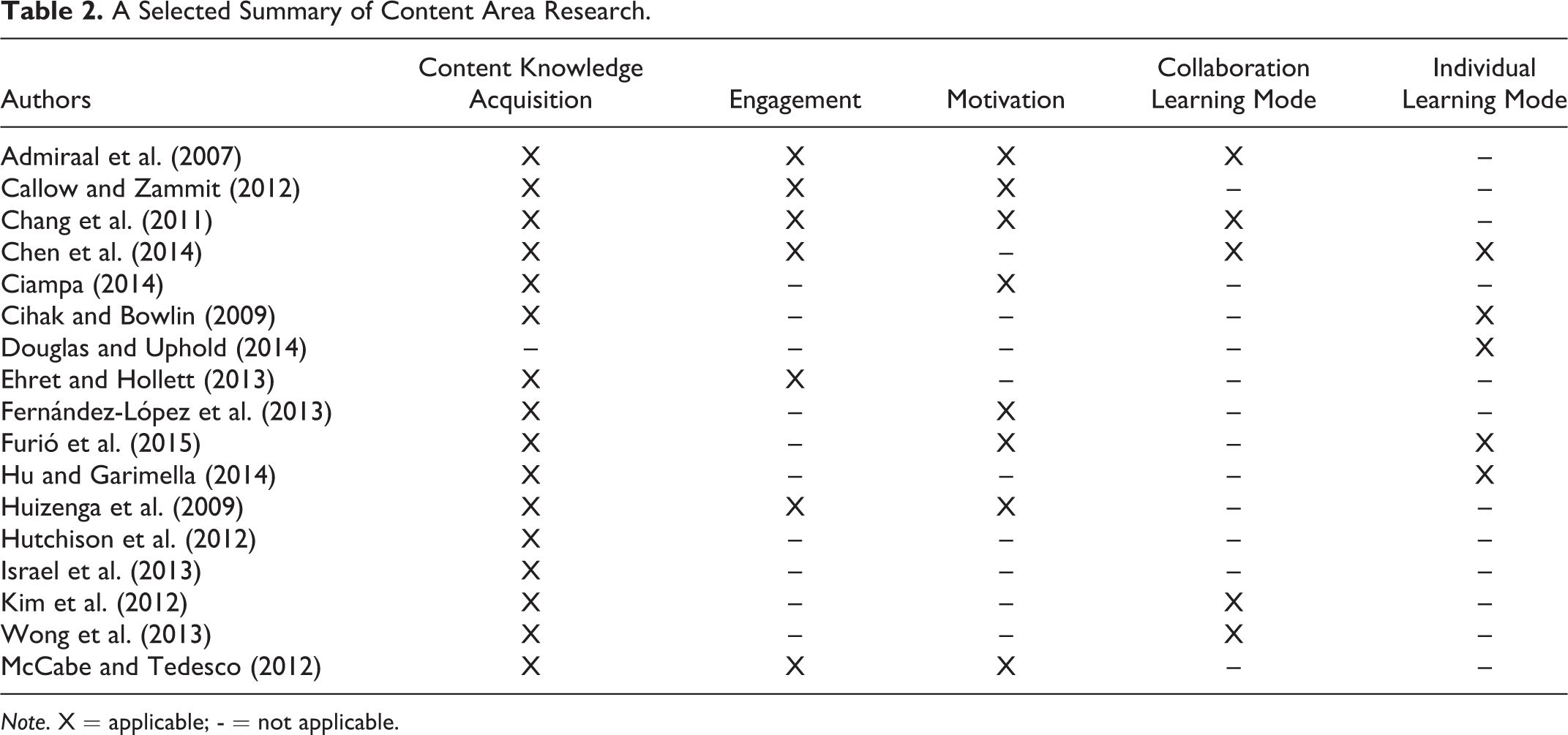
Note. X = applicable; - = not applicable.
Research Designs
The review analyzed research methods used across the 47 empirical studies. We found mixed methods were the most widely used in designing a research (i.e., Admiraal, Raessens, & Van Zeijts, 2007; Callow & Zammit, 2012; Israel, Marino, Basham, & Spivak, 2013). Many studies used experimental design (i.e., Chang, Chen, & Hsu, 2011; Chen, Shih, & Ma, 2014) or quasi-experimental design (i.e., Huang, Lin, & Cheng, 2010). Among three studies, the researchers adopted single-subject design methods to study SWDs in inclusive educational settings (i.e., Cihak & Bowlin, 2009; Douglas & Uphold, 2014).
Contextual Variables
The contextual information of the studies was presented in Table 1, including participants’ demographic variables, geographic locations of the studies, research methods. Five out of the 47 empirical studies focused on professional development, with teachers or practitioners working in K–12 settings as participants. Across the studies, 41 included students in formal K–12 education settings as participants, and only one study included data from parents of students. Nine of the studies found M-learning technology had potential to support learners from lower SES backgrounds (i.e., Callow & Zammit, 2012; Israel et al., 2013; Kim et al., 2012; Nowell, 2014). Six studies reported specific findings related to learners with disabilities (see Table 1).
SWDs Using M-learning
Among 47 studies, only 6 studies identified SWDs in their participant demographics. For instance, Fernandez-Lopez et al. (2013) examined the effectiveness of using learning platform Picaa on learning skills development for students with special needs. The study indicated that the adapted curriculum through M-learning made SWDs easily access to learning activities and improve SWDs learning skills and performance (Fernández-López et al., 2013). In another example, Cihak and Bowlin (2009) examined the effectiveness of using teacher-created video clips of basic geometry skills on handheld computers to support the geometry skills of three high school students with learning disabilities. The researchers designed the learning activities both at home and at school. Both studies had positive effects. Some studies also included SWDs and other special populations of learners, such as English learners and gifted students (Israel, Marino, Basham, & Spivak, 2013). In this study, the progressive complexity of learning concepts were increased with a game designed to improve students’ background.
Content Areas of Research
Four main themes emerged across all 47 research studies: (1) content knowledge acquisition (i.e., Huizenga, Admiraal, Akkerman, & Dam, 2009; Fernández-López et al., 2013), (2) engagement (i.e., McCabe & Tedesco, 2012), (3) motivation (i.e., Huizenga et al., 2009), and (4) communication and collaboration learning mode or individual M-learning mode (i.e., Admiraal et al., 2007; see Table 2). This section specifically analyzed SES and other demographic variables related to specific findings within each of these research themes.
Content knowledge acquisition
Forty-seven empirical studies on M-learning focused on content learning outcomes. Knowledge in the subject areas includes history, mathematics, science, botany, environment, and language learning in English, Chinese, and French (Furió, Juan, Seguí, & Vivó, 2015; Wong, Hsu, Sun, & Boticki, 2013). Research in classrooms in the subject areas of English, history, and science viewed that the key to learning in these areas increasingly relied on images, sound, animation, video, and multimodal texts (Callow & Zammit, 2012; Hutchison, Beschorner, & Schmidt-Crawford, 2012). Nine studies examined the content knowledge acquisition of students learning through M-learning considering SES status as a factor. Among these nine studies, the study results showed that M-Learning technology can positively support children with low SES in literacy development (i.e., Sun & Jiang, 2015), social skills (i.e., Nowell, 2014), numeracy development (i.e., Kim et al., 2012), and many other areas (i.e., Marty et al., 2013). One study focused on the interaction of struggling readers with M-learning, and four featured ELLs. In those studies, the goal was to support language and content learning (i.e., Shadiev, Hwang, Huang, & Liu, 2015; see Table 1).
Motivation
Within the 47 studies, 13 studied motivation and engagement as variables on the effectiveness of M-learning in teaching and learning (see Table 2). For example, Ciampa (2014) found that motivation could be enhanced through challenge, curiosity, control, recognition, competition, and cooperation. Researchers indicated a need for more thorough evaluation of the motivation variable and learning effects of mobile game-based learning (Huizenga et al., 2009).
Collaborative learning or individual learning
Some studies investigated the interaction of individual and collaborative learning modes within the design of these learning experiences (see Table 2). Eight of the reviewed studies explicitly discussed collaboration in the use of M-learning technology. Seven studies investigated the collaborative learning mode and found positive findings on the effectiveness of M-learning on teaching and learning in collaborative learning mode (i.e., Kim et al., 2012; Wong et al., 2013). Chen, Shih, and Ma (2014) also found the learning mode significantly affected learning. Specifically, they identified the effectiveness of the individual learning mode (Chen et al., 2014).
Discussion and Implications
The purpose of this literature review was to investigate issues, trends, and associated outcomes for M-learning in K–12 educational settings for learners with and without disabilities. Specifically, it focused on the investigation of how learners with and without disabilities leveraged M-learning technologies in formal and informal educational settings. Researchers were interested in understanding the contextual variables of learners associated with the design and research of M-learning environments (Sharples et al., 2005). It is not enough to examine the technological systems, applications, and M-learning devices, but researchers should also pay attention to diverse learner needs and the context where the learning activities take place. Highlighting context, Edyburn (2010) emphasized the similar necessity of examining the complex interactions between learning objectives, learner needs, and the technology. This review found only 47 peer-reviewed research articles that met the criteria established by this study and only 6 studies include SWDs. Thus, while there have been studies on M-Learning in schools, research in K–12 M-Learning is lacking relative to SWDs. This may be an oversight on the part of the research community, but it may also be because SWDS are only thought of as being fit for assistive technologies, rather than M-Learning in schools and/or research.
Even though there were only six studies about SWDs, these showed great potential for M-learning to adapt curriculum and provide learning opportunities for SWDs to improve academic performance and social skills; further, they show the promise in including SWDs more fully in general education (Cihak & Bowlin, 2009; Fernández-López et al., 2013). For example, researchers identified the advantages of using mobile devices with students with learning disabilities (LD) to improve their writing skills, to help them take notes, to increase motivation, to bolster self-efficacy, to provide immediate formative feedback to engage SWDs (Israel et al., 2013). Further, mobile applications can be used to guide children’s attention to content regardless of their cognitive ability (McEwen & Dube, 2015). Finally, the findings showed that children with little or no previous exposure to technology could not only use the M-learning technology but also overcome other challenges without instructional or interventional help from adults (i.e., Kim et al., 2012).
In addition, M-learning technology has great potential to provide educational resources to support students from low SES backgrounds, especially those students who live in the rural areas or small towns, urban schools, seriously lacking educational resources, and technology exposure. The development of multiliteracies was important for all students but especially for those from low SES backgrounds, where disengagement from education is a historical reality (Callow & Zammit, 2012). M-learning may provide the potential learning opportunities to engage fully with the multiliteracy framework (Callow & Zammit, 2012; Kim et al., 2011).
Mobile technologies play an increasing role in language and content learning, based on its three critical affordances, including using iPod touch to support language and content learning, facilitating differentiated instruction, and extending learning time across formal and informal educational settings (Cochrane, 2010; Liu et al., 2014). Mobile technology can benefit ELLs through interactive design platform, which integrated designed learning activities, for instance, within a tablet learning system to reduce cognitive load for ELLs (Shadiev et al., 2015). In addition, mobile technology can help learners share homework with peers, which allows further reflection, discussion, and collaboration in learning a language (Huang, Chiu, Liu, & Chen, 2011).
Implications for Practice and Design
In general, among the studies that investigated SWDs in K–12 settings, those studies demonstrated that M-learning with specific consideration for certain design features shows promise in both formal and informal settings (Douglas & Uphold, 2014; Israel et al., 2013). Specifically, M-Learning technologies were shown as an effective mediated tool with easy access for facilitating teaching and learning for students with diverse needs under the research of examining variables from a sociocultural perspective (i.e., Chen et al., 2014; Huizenga et al., 2009). The review specifically examined M-Learning effectiveness with relation to demographic variables, which revealed relationships among SES, disability type, gender, learners’ prior M-learning experience, and geographic locations. Many studies identified the effectiveness of M-learning used to support learning of students with diverse learning needs, but there was no specific information about the activities performance of SWDs as a group or at individual level. Therefore, it was difficult to tell the extent to which M-learning benefited these students and how it impacted individual learners. Further, there was little information to describe the educational settings in which the students were learning and the cultural contextual background of students they brought with them into the settings.
In examining how participants interacted within context, two major modes were found in this review: the collaboration learning mode and individual learning mode. The interactions between learners and the mobile technologies required communication (e.g., negotiation, consultation, feedback), support, and trust between the key players (Hutchison et al., 2012). Integrating various learning modes and associated learning activities should be matched with learners needs and learning objectives in M-Learning artifact and modern learning environment design.
We also note that the findings of this review indicate a need for the design of an M-learning experience to be more contextualized within the learning situation. This requires both educators and M-learning designers to have an understanding of the learner and contextual variability associated with supporting the desired learning outcomes. Specifically, designing and implementing M-learning experiences require considerations of learner variability, learning objectives, and integration of effective pedagogy. Specifically, it is necessary for both teachers and technology developers to consider the actual pedagogical orientation the technology itself has within the learning process (Basham, Smith, & Satter, 2016). Teachers must not assume that the technology itself will support effective learning, instead they must understand the role technology as well as other contextual variables play in the desired outcomes (e.g., teacher and learner use of effective strategies, learner engagement levels, need for self-regulation, supports within the physical environment). For instance, if learners require explicit instruction, then this must be effectively accounted for across the environmental design variables. Recall also that we are arguing for more inclusive contexts for all students, but doing so means that teachers must pay greater attention to what works for whom, when it works, and why.
With an aim of the use of mobile technology to support learning in context (Sharples, 2013) and reduce learning barriers for students with special needs, there is a need to design educational resources on mobile platform with a consideration of the Universal Design for Learning (UDL; CAST, 2011) instructional design framework. The UDL framework potentially provides one means to consider the variability needs that exist both across learners and the environment (Basham et al., 2016; Meyer, Rose, & Gordon, 2014). The use of mobile devices and their application within the learning process is well aligned to UDL (Reid, Strnadova, & Cumming, 2013) and it is important to conduct future research on integrating UDL into M-learning. To implement UDL, educators require an understanding of the variables that impact associated learning outcomes and generally take on perspectives associated with operating in the capacity of a learning engineer (Basham et al., 2016). Beyond educators, the same knowledge, skills, and process would be useful in developing applications for all learners.
Implications for Future Research
This review found that few peer-reviewed publications around M-learning actually involved empirical research on the K–12 inclusive education setting. Of the M-learning studies that existed, even fewer reported on learners with disabilities and made efforts to describe the learning contexts in which the students used the technologies. The disconnection between general education and special education with the use of M-learning technology emerged as substantial in this review. More academic attention and research efforts are needed to focus on how to design and use M-learning technology to provide inclusive education for all learners, but especially those with disabilities. Specific investigation is needed on how to effectively consider personalized learning needs. The recognition that learner needs can be met across the design and integration of M-learning systems in digital and blended formal as well as informal K–12 settings is an important consideration in the design of future research.
The way in which mobile devices are designed, used, and researched affect teaching and learning (Kim et al., 2012; Wang, Wu, Chien, Hwang, & Hsu 2015). Some studies have shown the effectiveness of M-learning technology in facilitating positive outcomes and demonstrated the potential to provide expanded literacy exposure advancing lifelong learning for learners with and without disabilities (i.e., Kim et al., 2012; Israel et al., 2013). With the influx of mobile technologies, research evidence increasingly showed the importance and great potential to conduct research on how to use technology to effectively support children with and without disabilities in all areas across the globe, especially learners who lack access to textbooks, computers but have cell phones in rural villages, urban schools, or remote areas. Research should consider the interaction and context of various demographic factors on guiding user interaction and associated outcomes (e.g., game-based learning environment, video modeling clips, interface, app development). While further research is needed on the effectiveness of M-learning, current research indicates some potential for M-learning in supporting learners, including those SWDs.
Another implication for research comes from the instructional perspective that mobile technologies can intensify the increasing shift from an instructor-centered classroom teaching to a learner-centered educational approach (Holzinger, Nischelwitzer, & Meisenberger, 2005). More research attention needs to focus on how to facilitate instructional pedagogy to promote learning and teaching practices in the application of M-learning technology. M-learning should innovate learning opportunities and help students with variety of needs better accomplish desired learning outcomes. For instance, Chen et al. (2014) designed a mobile cultural-based pervasive game to help students explore local culture and to understand their attitudes toward M-learning.M-learning provided multiple ways of presenting content knowledge to students. For instance, within this system, students had more options to support their own learning while also potentially receiving support across other students, teachers, and the environment itself. The increased levels of interactions among learners, digital systems, and teachers across both blended and fully online environments support new challenges for both researchers and teachers in the classroom. These challenges provide opportunities for researchers to consider new data collection techniques and research design types that consider the contextualized variables while also advancing the fields understanding and potential effective use of M-learning.
Limitations
This review focused on what is known about M-learning in K–12 educational settings for learners with and without disabilities. Certain factors limited the associated outcomes of the review. For instance, this review only included research and other literature reviews from refereed journals and did not include works from other sources (e.g., books, conference proceedings, white papers). Future reviews might include a different range of sources to provide more detailed and representative results. Given the pace of innovation, it is possible that new technologies, systems, and associated critical key words were missed in conducting this review. Moreover, the actual process of searching articles and the combination of the key words might have led to some studies being overlooked. Therefore, future reviews should revisit the keywords in locating articles. This process is important to ensure that all the related research studies in the field are included for analysis.
Conclusions
Marino (2010) asserted that mobile technologies hold a great deal of potential for all learners but especially those with disabilities. These technologies provide learners with dynamic, lightweight, portable, virtual toolboxes for various learning needs. In this article, we systematically reviewed current studies to find the overall research trends regarding the research purposes, methodologies, learning outcomes, academic content areas, and the interplay of demographic variables and the effectiveness of M-learning. The findings and implications of this review provide M-learning designers, educators, and researchers with valuable references and suggestions regarding the use of M-learning in designing and the implementation of lifelong learning plans for learners with disabilities.
Both practice and research should consider the instructional design of M-learning with a focus on learner needs and other environmental context factors, instead of only on mobile tools themselves. The various learner interactions that take place in an M-learning experience shape the associated outcomes. These interactions should be considered when designing, implementing, and researching these experiences. The rapid pace of development and adoption of M-learning devices intensifies the need for developers, educators, researchers, and the learners themselves to better understand how to effectively make use of M-Learning.
Footnotes
Declaration of Conflicting Interests
The author(s) declared no potential conflicts of interest with respect to the research, authorship, and/or publication of this article.
Funding
The author(s) received no financial support for the research, authorship, and/or publication of this article.