




Abstract
This study was to investigate the effects of a process-based approach to writing interview articles using class-wide social network site (SNS) on the writing abilities and self-esteem of middle school students with intellectual disabilities. It also aimed at investigating these effects on attitudes of the students’ peers who were interviewed. A multiple probe baseline design across participants was employed to assess the writing abilities of three students with intellectual disabilities. A one-group pre- and posttest design was used to examine the changes in the attitudes of peers toward the students with intellectual disabilities. The intervention improved the writing abilities of the three participants along with increases of their self-esteem. The participants’ peers in the inclusive classrooms also showed positive changes in their attitudes toward the students with intellectual disabilities. This study has significance in that teaching interview article writing using class-wide SNS was effective not only in promoting the writing skills of students with intellectual disabilities but in improving their peers’ attitudes toward them. Implications and directions for future research are discussed.
Keywords
Since promoting access to general education curriculum for students with disabilities has been receiving increasing attention from practitioners and researchers in special education (Lee, Wehmeyer, Soukup, & Palmer, 2010; Petersen, 2016), academic engagement and the progress of students with intellectual disabilities in inclusive classrooms have been emphasized (Carter, Sisco, Brown, Brickham, & Al-Khabbaz, 2008). In this respect, academic skills, including reading, writing, and mathematics, are beginning to be considered as among the important factors for academic achievement and successful inclusive education (Cannella-Malone, Konrad, & Pennington, 2015; Karvonen, Flowers, & Wakeman, 2013; O’Connor et al., 2017). Especially, writing is an important skill for participating in inclusive environments (Bray, Mrachko, & Lemons, 2014). In spite of that fact, lots of people with intellectual disabilities have deficits in written communication capacity such as delivering information (Belva, Matson, Sipes, & Bamburg, 2012). In addition, most students with intellectual disabilities have difficulties with expressing their thoughts through writing and with acquiring and maintaining writing strategies (Guzel-Ozmen, 2006; Konrad, Clark, & Test, 2017). To address these issues, various strategies have been suggested as useful tools to enhance writing skills and written communication, such as concept mapping to support generating content (Flanagan & Bouck, 2015), writing software for organizing proper structure (Park, Ambrose, Coleman, & Moore, 2017), a graphic organizer to help compose complicated written expression (Lee, Browder, Hawley, Flowers, & Wakeman, 2016), and writing dialogue journals to develop written expression (Regan, 2003). These strategies are applicable to writing instruction, which focuses on developing the sophisticated writing skills required in each stage of the writing process (Rogers & Graham, 2008).
In the process-based approach to writing instruction, students are encouraged to use specific strategies according to stages of the writing process such as planning, drafting, revising, and publishing (MacArthur, Graham, Schwartz, & Schafer, 1995). In the planning stage, students with disabilities can benefit from using mind maps in organizing the content of their writing (Sturm & Rankin-Erickson, 2002). Writing instruction using topics in which students are interested and focusing on specific genres of writing is useful for the drafting stage (Boscolo & Hidi, 2007; Joseph & Konrad, 2009). In addition, students in the revising stage, before publishing, can be supported by immediate feedback in a computer environment (Goldring, Russell, & Cook, 2003). In the publishing stage, one of the ways to provide natural reinforcement for students is to post their writing for real audiences. This might involve writing classroom newspapers (Alber-Morgan, Hessler, & Konrad, 2007). Newspaper writing instruction is beneficial in providing a structured way to generate and organize the content of writing such as focusing on who, when, where, what, why, and how (5W1H). It also allows students to get motivated and improve their attitudes toward writing (Olson, 1992). Of the various types of news articles, interviews are relatively easy for students to write because they are based on a simple question and answer format, and it is easy to convert the raw content of the interview into an article format (Kim, 2013). In addition, interview articles enable students to approach listening, speaking, reading, and writing comprehensively (Choi, 2010).
Given the fact that process-based writing instruction includes planning, drafting, revising, and publishing stages, online platforms (e.g., classroom website) have been used as effective tools in writing instruction (Arslan & Sahin-Kizil, 2010). In particular, social network site (SNS) provides convenient and accessible opportunities for students to share their writings with their teachers, and this has positive effects on the students’ affective development (Zaidieh, 2012). Engaging in online interactions through reading and composing written expressions contributes to improving social writing skills (Wang, Eberhard, Voron, & Bernas, 2016) and developing the self-esteem of students with disabilities (Holmes & O’loughlin, 2014; McClimens & Gordon, 2009). In this respect, writing intervention using SNS has potential in promoting academic achievement of students with intellectual disabilities as well as improve environmental factors such as relationships with peers (Caton & Chapman, 2016). As previously mentioned, it is obvious that students with intellectual disabilities can improve their writing skills, regardless of their disabilities, as long as effective strategies and supports are used in writing instruction across writing stages (Cannella-Malone et al., 2015). However, teachers are likely not to have high expectation of the writing performance of students with intellectual disabilities; therefore, they may not provide them with enough chances to learn how to write (Joseph & Konrad, 2009). This creates more serious problems in which the lack of writing skills in students with disabilities leads to low academic achievement, which causes them lose self-esteem and experience negative attitudes from peers without disabilities (Forts & Luckasson, 2011; Haager & Vaughn, 1995).
Therefore, the purpose of this study is to investigate the effects of an article writing intervention on (1) the writing abilities and self-esteem of students with disabilities and (2) the attitudes of their peers toward them, where the students with intellectual disabilities share their interview articles with their peers using class-wide SNS.
Method
Participants
The participants in this study were three middle school students with intellectual disabilities and 88 of their peers without disabilities in three inclusive classrooms in South Korea. The three students with intellectual disabilities met the following participant criteria: They (a) were diagnosed with intellectual disabilities, (b) understood the structure of sentences consisting of the six components—5W1H, (c) demonstrated sufficient fine motor skills to operate smart devices, (d) consented to participate in the study, and (e) were able to get consent from the inclusive classroom teachers, the special education teacher, and their parents.
Juwon was a 13-year-old 8th-grade male student. He was diagnosed with the mild intellectual disability, which indicates the IQ of 50–70 according to the Act on Welfare of Person with Disabilities in Korea. When given a writing task, he usually wrote a short sentence and attempted to finish as soon as possible because he did not like independently writing sentences by himself. Regarding his social skills, he displayed nervous behavior when speaking in front of a group of people. He owned a smartphone and liked playing computer games.
Jeeho was a 14-year-old 9th-grade male student. He was diagnosed with the moderate intellectual disability, which indicates the IQ of 35–50. He was highly dependent on others when writing because he struggled with processes such as sentence construction and word spacing. He often demonstrated on-task behaviors for only a short duration. Regarding his social skills, he tended to speak quickly and did not finish sentences when he was nervous. He owned a smartphone. His hands were often shaking when touching the smartphone screen.
Sunjae was a 13-year-old 8th-grade male student. Although his exact IQ score was not available because he was recently transferred from another school, he was determined to be eligible for special education by the special education support center, which indicates an IQ under 70. He was able to read aloud the interview scripts. He did not have previous experience using smart devices, but he was interested in using them.
Peers in the inclusive classrooms
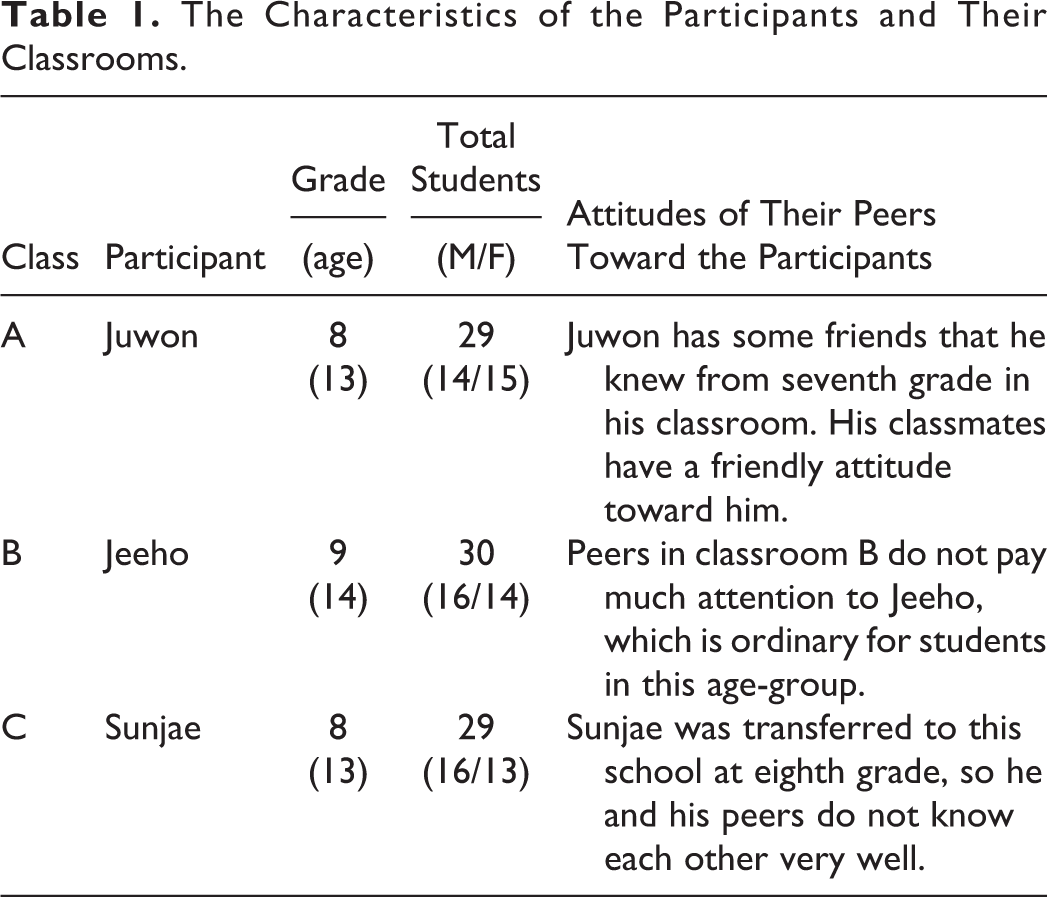
In the three inclusive classrooms of the participating students with disabilities, their peers also participated in this research. The peers are the same ages as the participating students with disabilities. Table 1 presents the characteristics of each participant and their classroom, which are collected from the researcher’s classroom observations and informal interviews with their special education teacher and two special education assistants.
The Characteristics of the Participants and Their Classrooms.
Setting
The study took place in a public middle school managed by Seoul metropolitan office of education in Korea. The school had a total enrollment of 690, with a student–teacher ratio of 15.3:1, and a special education student–teacher ratio of 5:1. All the students with disabilities and their peers in this study came from a homogeneous racial/ethnic group, Korean. The baseline, intervention, and maintenance sessions took place in a self-contained room at the middle school the participants attended. Pre- and posttests for their peers were conducted during the morning recess at the beginning and the end of the study.
Materials
Equipment
In the planning stage of the writing intervention, the students with disabilities were given two iPad applications: Simple Mind Plus and Draw Pad Pro. In particular, the applications helped students generate and organize the contents of their interview articles by allowing them to draw, edit, and restructure mind maps. A mind map is a diagram for representing the brainstorming process, which has been used in writing instruction especially for the prewriting stage (Flanagan & Bouck, 2015). Students created and edited mind maps on iPad using Simple Mind Plus, which enabled them to recall their memories from interviews and organize the contents according to the given structures of written expressions (see Figure 1). Using Draw Pad Pro, the students drew lines and circles on the mind maps, which they had created in Simple Mind Plus, in order to connect, group, and organize the components included in the mind maps.
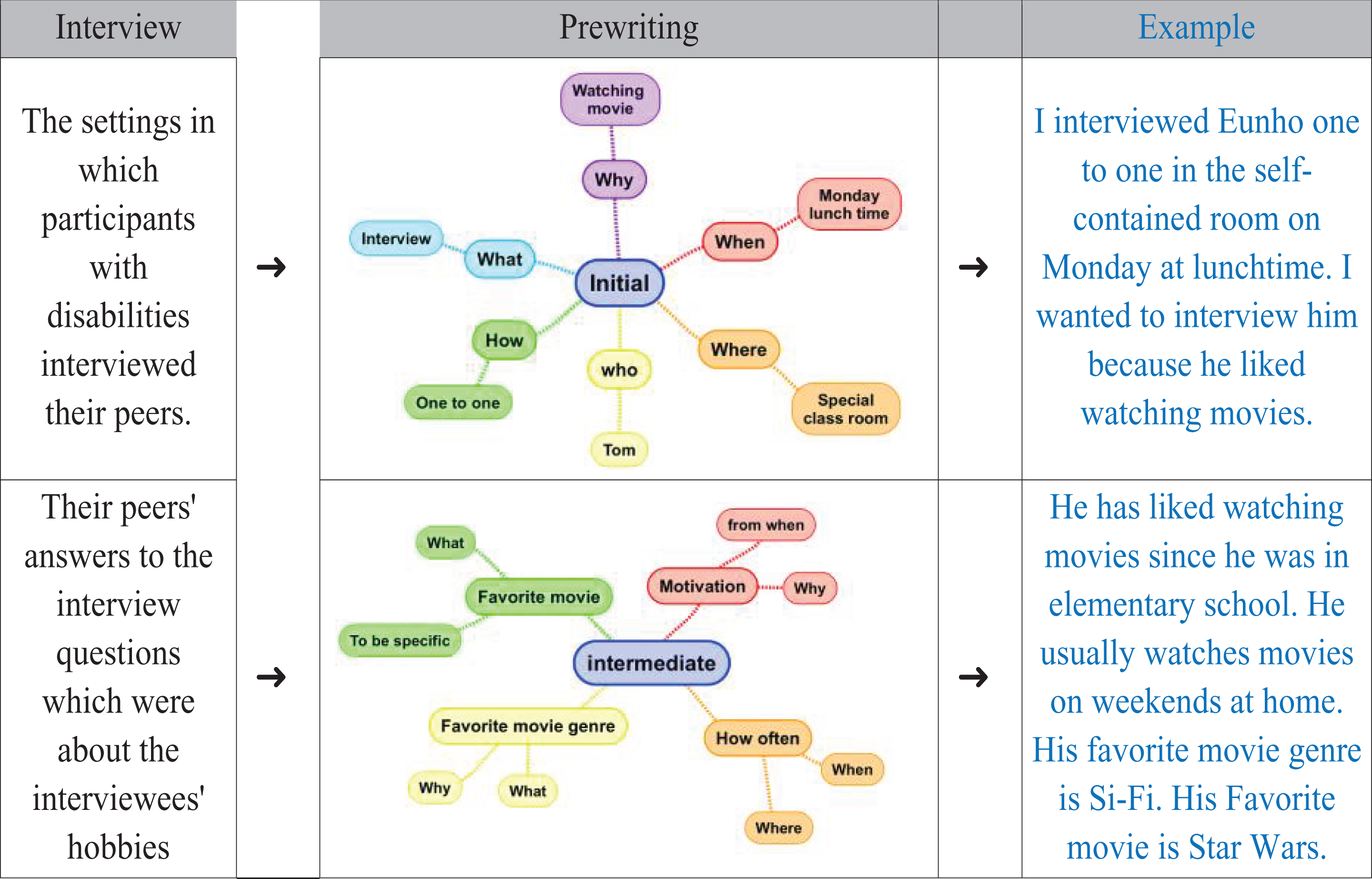
Create initial and intermediate mind map.
In the drafting, revising, and publishing stages in the intervention, the students used an SNS, Naver Café. It provided a convenient online platform in which the students could compose, revise, and post their interview articles. The researcher created three nonpublic online groups in Naver Café for each inclusive classroom, where each participating student with disabilities wrote and posted their interview articles to share with their peers.
Task analysis chart
The researcher showed the students a task analysis chart, so that they could visualize the four key steps of completing a mind map, organizing it, drafting, and revising through the task analysis for each process: planning, drafting, revising, and publishing. Figure 2 indicates the charts contained 26 steps and provided a guide for the students with disabilities to write their interview articles. In the intervention, the students were given the chart with small pictures such as icon and screenshots of the devices corresponding to each step in order for them to understand the steps and not to get confused in use of the devices.

Task analysis steps chart of writing performance.
Experimental Designs
Two difference experimental designs were used considering the purpose of this study. A multiple probe baseline design across three students with disabilities that consisted of baseline, intervention, generalization, and maintenance sessions to determine the effects of the intervention on the students’ writing abilities for 17 weeks. Changes in the students’ self-esteem were examined by comparing their pre- and posttest self-esteem scores. On the other hand, a one-group pre- and posttest design was used to investigate statistically significant changes in the attitudes of the three students’ 88 peers in the inclusive classrooms.
Dependent Variable and Data Collection
There are three dependent variables in this study: (a) the writing abilities of students with disabilities, (b) the self-esteem of students with disabilities, and (c) peers’ attitudes toward students with disabilities. Each dependent variable was defined and measured as follows.
Writing abilities
Writing abilities were the primary dependent variables in this study and were measured based on the following two components: (a) writing performance and (b) contents and length of the text. To measure the students’ writing abilities, the researcher observed each student’s independent performance without any interventions for the first 15 min of every session and collected the writing they produced. First, the writing performance was measured by the percentage of the completed steps with correct responses, as illustrated in Figure 2. Since the students could only proceed to the next step if they performed correctly in the current step, the observation stopped when the students showed incorrect responses first at any step. Second, the researcher measured the content and length of the texts that students produced in every session, while the researcher was observing their independent performances. The texts include interview articles produced in the baseline, intervention, and maintenance sessions and journals produced in the generalization sessions. The content score of an interview article was determined by the three major elements, the interview settings, the interviewee’s answers, and a summary of the interview. The content score of a journal was determined by its topics, structures, and expressions. The length score for an interview article and a journal was determined by the number of letters in the text, excluding words that were unnecessarily repeated or made no sense (see Figure 3 for the detailed rubrics for the measures). The rubrics in Figure 3 were reviewed for validity by a special education professor and three middle school special education teachers.
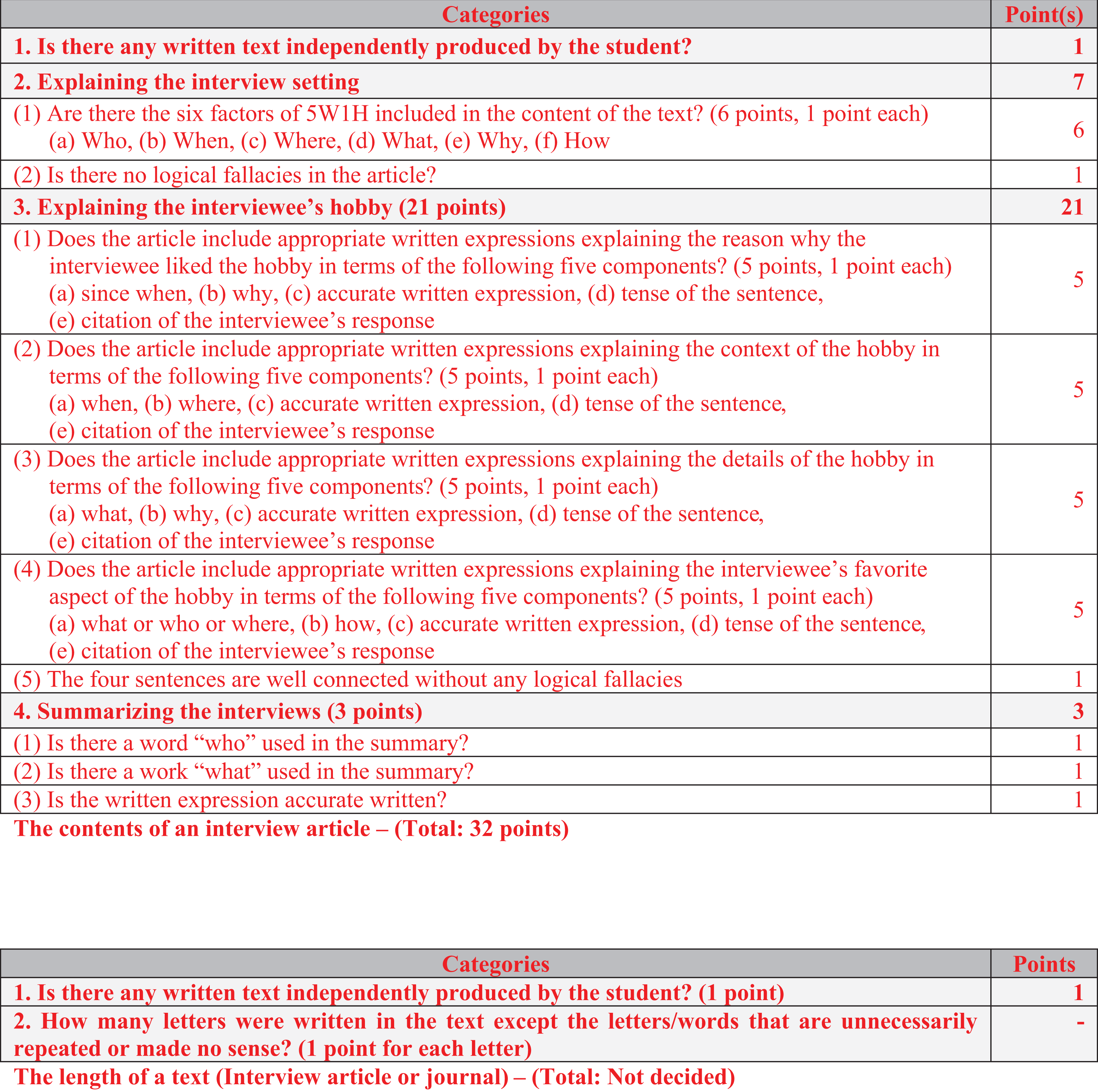
Rubrics for the contents and length of texts.
Self-esteem
Self-esteem was measured using the revised version of the Self-Esteem Inventory for middle school students with disabilities (Hwang, 2012). The scores are the sum of 32 item responses on four self-esteem subscales: global self-esteem (6 items), social peer self-esteem (9 items), home-parents self-esteem (9 items), and school-academic self-esteem (8 items) using a 5-point Likert-type scale. Total self-esteem is determined by summing the individual item scores, and the total scores range from 32 to 160.
Peers’ attitudes toward the students with disabilities
Attitudes of the students’ peers were measured using the Acceptance Scale developed by Voeltz (1980) and adapted by Lee and Park (2011). The scale consists of three subscales and 10 items: study activity, assist activity, and daily activity, and higher scores reflected more positive attitudes toward the students with disabilities. The reliability coefficients (Cronbach’s α) for the pretest and posttest were .96 and .92, respectively.
Independent Variable
The independent variable was a process-based writing intervention to teach the participants how to write interview articles. The researcher met with each participant individually for 45 min, 3 days a week, in the self-contained room. Before this writing intervention, researcher provided pretraining for the peers without disabilities in the inclusive classrooms. Then, each of the three students with disabilities conducted one-to-one interviews with their peers. In interview article writing intervention, the interviewer wrote an interview article, summarizing the interview, to introduce the interviewee to others in the class. These articles were posted on the class-wide SNS, and all students in the inclusive classrooms, including the interviewees, were encouraged to read the articles and write comments on the SNS.
Procedures
Pretraining of using devices
Before the baseline, the participants were trained on how to use an iPad and a laptop keyboard in order to allow them to learn the basic technological skills required in the intervention. After two training sessions, the three participants were able to use the iPad and keyboard, especially for launching appropriate applications and capture the screen of the device independently.
Baseline and pretest
The participants listened to an audio recording of an exemplary interview by the researcher and were given the task analysis chart of writing performance with an iPad. The researcher asked the students to perform by saying, “Let’s start writing articles based on the task analysis chart now that you listened to the interview. You may use apps on the iPad.” The students with disabilities were given a self-esteem pretest before the intervention, and their peers were given a pretest on their attitudes toward them.
Intervention
The intervention consisted of the following three components: (a) pretraining in inclusive classrooms, (b) interviews with peers, and (c) interview article writing intervention using the class-wide SNS.
Pretraining in inclusive classrooms
Before the intervention procedures began, the peers without disabilities were given a pretraining session. They were encouraged to read the interview articles written by the participating students with disabilities and write positive comments on the articles. The researcher conducted a survey on their hobbies for the interview. The inclusive classroom teachers gave certificates of appointment to students with disabilities in front of the other students, giving them roles as class reporters and encouraging them.
Interview with their peers
The three students with disabilities conducted interviews with their peers without disabilities and audio-recorded them; the students with disabilities were given the interview script, and they filled in specific information on each interviewee’s hobby in the blank of the script. The interviews were based on questions and answers using the prewritten script, and each student conducted a one-to-one interview for 5–10 min per day, 3 days a week. After the interview, they took a photo together for the purpose of posting on the article if the interviewee agreed. As shown in Table 1, all three students with disabilities were in different inclusive classrooms with different peers. In every session, each of the students with disabilities interviewed a peer in his class who had not been interviewed before.
Interview article writing intervention using class-wide SNS
The students with disabilities were taught a number of steps for writing an interview article: (a) completing mind maps using Simple Mind Plus, (b) organizing the mind maps using Draw Pad, (c) drafting articles using Naver Café, and (d) revising their articles. In the first two or three sessions of the interventions, the researcher first read aloud the instructions for each step in the task analysis chart and demonstrated the step for the students. After modeling the step, the researcher asked them to perform the step. When the students showed incorrect responses, the researcher provided direct verbal and gesture prompts by pointing at and reading aloud the instructions for the step to correct their errors. The researcher gradually faded out the direct modeling or prompts and provided indirect prompts by asking them to read aloud the instructions to correct their errors on their own. After each session of the intervention, the researcher provided the students with natural reinforcements for the interview article writing by encouraging them to read their peers’ positive comments on the articles. During the step of completing mind maps, the students were asked to make the initial and intermediate mind maps by recalling their interviews. During the step of organizing mind maps, students were asked to make sentences by drawing a line on the screenshot of the initial and intermediate mind maps. During the drafting step, they were required to put in an article title, upload interviewees’ photos, and write their articles using preorganized mind maps on Naver Café. During the revising step, they corrected spacing and spelling using the spelling-check function on the Naver Café menu and corrected their sentences by reading the articles out loud. Finally, the participants with disabilities posted three interview articles a week on Naver Café and checked their peers’ comments on their articles.
Generalization and posttest
To determine whether the effects of the intervention could be generalized to other types of writing, data were collected for three sessions after the intervention ended using the students’ homework journal writing. Since the researcher did not observe the students working on the homework at home, the writing performance in the generalization sessions was not measured. Only the content and length of the students’ journal writing could be measured because they did not use the mind maps for their journal writing. The students with disabilities took a self-esteem posttest, and their peers took a posttest on their attitudes toward the students with disabilities.
Maintenance
The researcher conducted the maintenance sessions under the same conditions as the baseline sessions. The maintenance sessions came 3 or 4 weeks after the intervention sessions with each participant were completed.
Inter-Observer Agreement (IOA)
IOA was assessed based on 25% of the baseline, intervention, and maintenance sessions that were randomly selected for each participant by researcher and observer. The researcher trained the observer until IOA reached a mean of 90%. For writing performance, the researcher and observer collected IOA data by independently viewing videotapes and recording each step as correct or incorrect based on the task analysis of writing steps. IOA was calculated based on the number of agreements with participant performance by dividing the number of agreements plus disagreements and multiplying that by 100. The IOA ranged from 97.2% to 99.3% with a mean of 98.3%. For text content and length, the researcher and observer collected IOA data using each participant’s written text. The interscorer agreement was calculated by dividing the lower score by the higher score among the two scores and multiplying that by 100. Agreement on text content ranged from 94.7% to 96.9% with a mean of 95.8%. Agreement on text length ranged from 99.5% to 99.8% with a mean of 99.7%.
Procedural Fidelity of Training
The researcher recorded all sessions with a videotape recorder and asked a special education expert to assess the fidelity by randomly selecting 30% of the sessions. She used a 6-item checklist of the writing interview article steps and scored the checklist by viewing the videotaped intervention sessions, marking either yes or no depending on whether the researcher had implemented each item. The fidelity ranged from 95.2% to 97.6% with a mean of 96.2%.
Social Validity
The 88 peers, the inclusive education teachers, the special education teacher, and parents of the participating students with disabilities completed brief questionnaires using a 5-point Likert-type scale and one open-ended question to assess social validity; the researcher used only 3-point Likert-type scale for the students with disabilities. The questionnaire included questions on availability, satisfaction, intervention effects, and whether the students thought the intervention would be used in their classrooms.
Results
Writing Performance
All three students with disabilities demonstrated improved writing performance, and the writing performance was maintained, giving evidence that the effects of the intervention remained after the intervention was over. Figure 4 displays the three participating students’ writing performance rates across the baseline, intervention, and maintenance sessions. The percentages of nonoverlapping data (PND) of the writing performance for the three participants are 94.7% for Juwon and 100% for both Jeeho and Sunjae. The PND indicate that this intervention was highly effective (Mastropieri & Scruggs, 1986). For Juwon and Jeeho, there were immediate improvements in writing performance in the intervention phases. But, Sunjae did not have an immediate improvement due to his long baseline phase between the pretraining for using devices and the intervention phase.

Writing performance rates of the three students with disabilities.
Juwon showed 5.12% of the performance on average in the baseline and 61.53% of the performance on average in the intervention. During the intervention, Juwon’s performance showed an improving trend, with performance rates ranging from 7.69% to 100%. However, Juwon’s writing performance points dropped in the 11th, 14th, and 15th sessions and did not show a steady increasing performance throughout the graph because he didn’t follow written directions and was often distracted by external factors including his emotional condition or noise.
Jeeho showed an overall increase in the performance from 3.84% on average in the baseline and 75.47% on average in the intervention. During the intervention, Jeeho’s performance showed an improving trend, with performance rates ranging from 7.69% to 100%. However, the eighth intervention session of Jeeho showed a steep decrease in the graph where he performed 9 days after the last session due to the curriculum of the school including field trip and midterm exam.
Sunjae’s mean writing performance at baseline was 0.00%, the lowest rate among the participants. However, his mean writing performance in the intervention increased to 48.71%, and his mean maintenance rate was 80.76%. Although he started with lower rates than those of the other two participants in the intervention, Sunjae’s writing performance rates improved steadily from 7.69% to 100% through the intervention, and they remained stable at a high level in the maintenance phases. His writing performance for the 11th intervention session is missing from Figure 4 because he was absent from school due to high fever.
Contents and Length of the Text
The effects of the writing intervention on the text contents are shown in Figure 5. At baseline, none of the three students demonstrated the ability to write interview articles independently; their content scores were consistently low and stable. In the early sessions of the intervention phases, they scored zero points on the contents of the text because they still had not reached the drafting stages and had not produced any written texts. However, their content scores increased meaningfully over the intervention phases and were generalized at the final level, except in the case of Jeeho. The three students’ mean article content scores 3–4 weeks following the intervention were higher than their mean scores in the intervention phases.
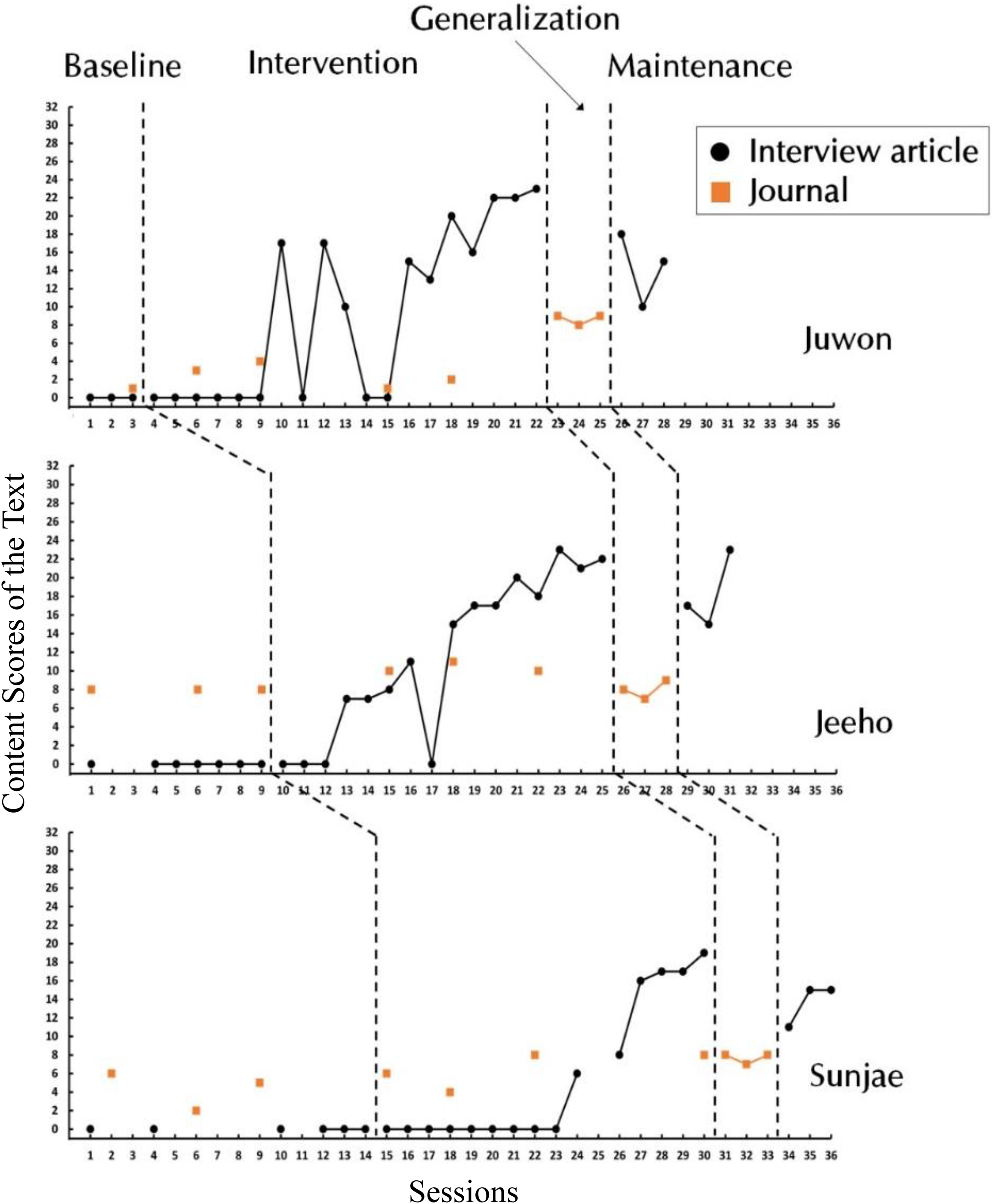
Content scores of the text of the three students with disabilities.
Figure 6 shows the number of letters in the texts written by the three students with disabilities across all phases. During the baseline sessions, the mean article length score was 0.00 for all three students, but they improved during the intervention phases, and they were also maintained, which indicates an effect of the intervention. Jeeho’s mean journal length score in the generalization was 44, which was similar to his mean score at baseline, 45.66. This was because Jeeho felt that he needed to write at least three to five sentences because keeping the journal was assigned as homework, and thus, he already had a high score at baseline. Sunjae’s mean article length score increased only slightly compared with the other students, but the writing intervention appeared to have had a positive impact on him in terms of using computers or smart devices. For instance, before the intervention, Sunjae typed slowly with two fingers, but as the intervention was repeated, he typed much more quickly and with greater accuracy. Sunjae’s mean journal length score in the generalization was 42.33, which was lower than his mean baseline score of 74.33. This was because, at baseline, he had mainly listed the foods he had eaten during the day in his journal, resulting in low journal content scores but higher journal length scores.
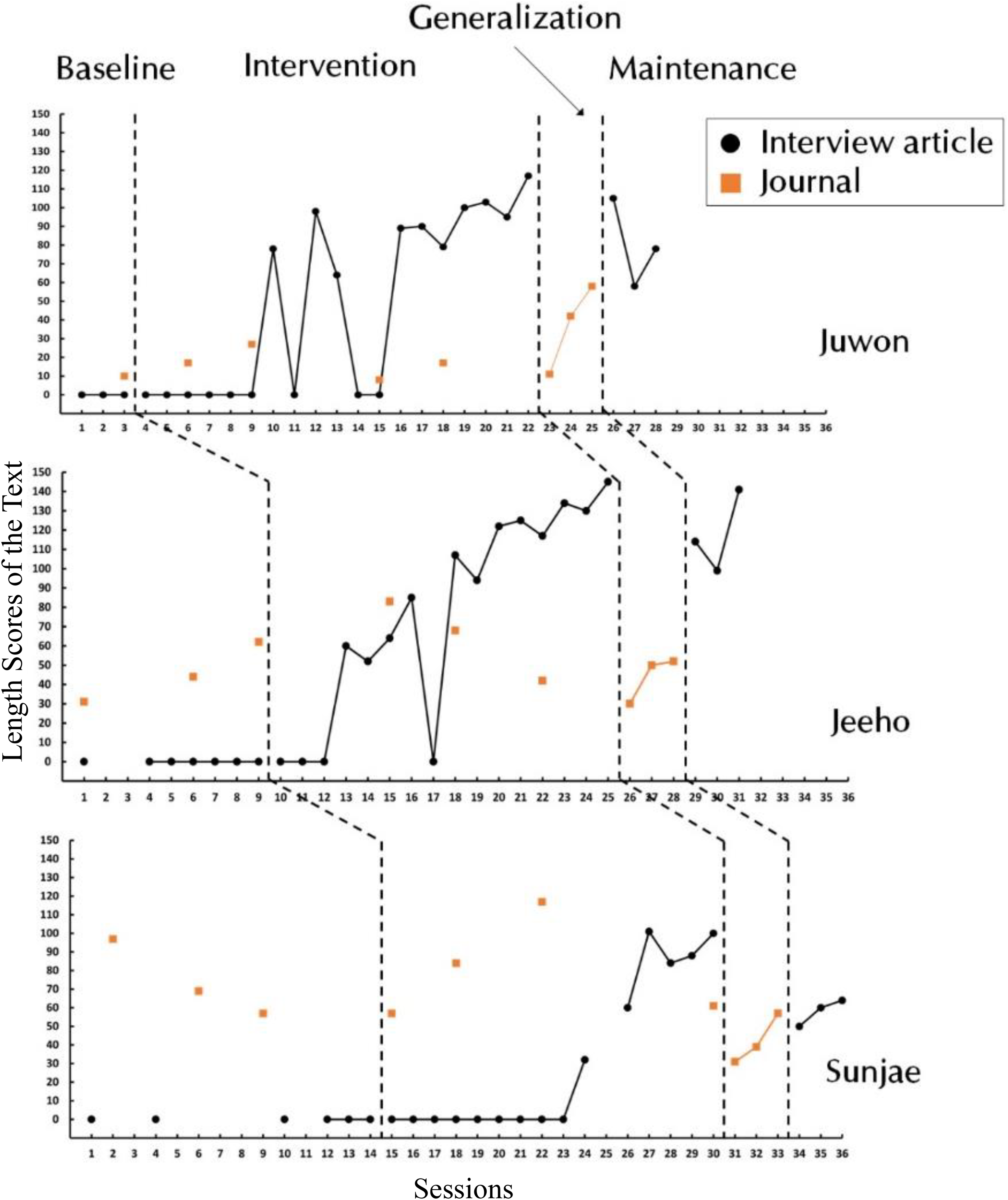
Length scores of the text of the three students with disabilities.
Self-Esteem
The participating students with disabilities showed improved self-esteem scores after the intervention compared with before. Juwon’s self-esteem score was the highest after the intervention, increased by 28 points from 120 to 148. His social self-esteem score, in particular, showed the greatest improvement among the three students. Jeeho had the lowest score before the intervention, but his score increased 32 points from 111 to 143, which was the largest increase. Sunjae’s score increased by 15 points from 113 to 128.
Peers’ Attitudes Toward the Student With Disabilities
The students’ peers without disabilities showed positive changes in their attitudes toward them by participating as interviewees in the interviews that the participating students with disabilities led and by responding to the students’ articles written. A paired t test of the differences between pretest and posttest showed statistically significant improvement in their peers’ attitudes toward the students with disabilities, shown in Table 2. The attitude test results indicated that Juwon’s class showed a gain of 9.62 (SD = 13.96) points, which was statistically significant (t = 3.71, p < .01). In Jeeho’s class, the score also showed a gain of 11.57 (SD = 12.77) points; there was a significant difference between the pretest and posttest (t = 4.96, p < .001). For Sunjae’s class, the improvement was 8.42 (SD = 11.98) also statistically significant (t = 3.78, p < .01). In short, the students’ peers’ attitudes toward them changed significantly following the intervention.
Pre- and Posttest Results for Peers’ Attitudes Toward the Students With Disabilities.
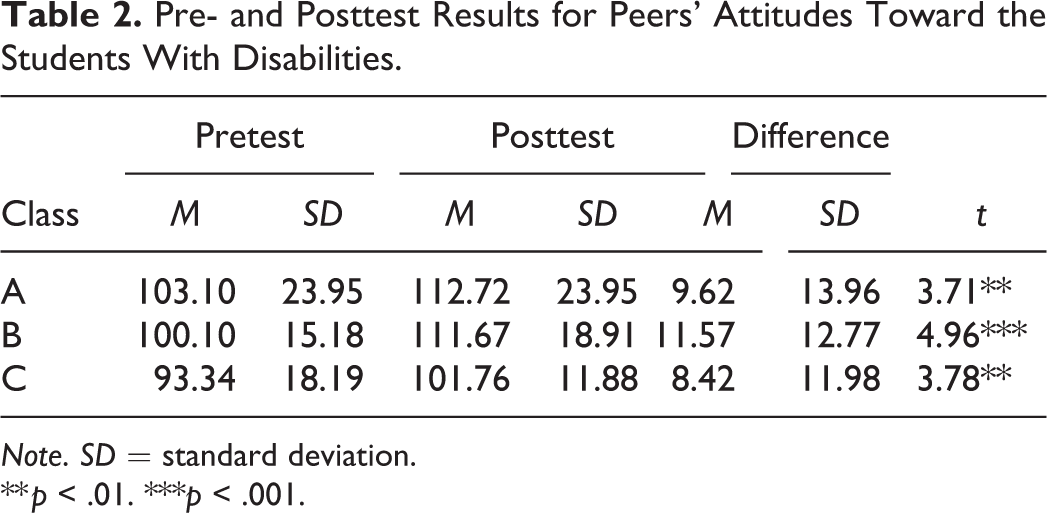
Note. SD = standard deviation.
** p < .01. ***p < .001.
Social Validity
The three students expressed positive opinions on the writing intervention (M = 2.7 of 3). For example, Juwon reported, “I could get along with other students by doing interviews.” Jeeho stated, “I had fun doing interviews and using iPad.” Sunjae also expressed, “It felt good doing interviews. I had fun writing articles.” The students’ 88 peers responded to the questionnaires with highly positive attitudes toward the students with disabilities compared with the average (M = 3.6). As they described, “Jeeho did a good job writing the articles. I learned what my friends’ liked.” “I am grateful to Juwon as he made me feel comfortable during the interview.” The three inclusive education teachers either agreed or strongly agreed that the writing intervention had improved the writing abilities of the students with disabilities along with the students’ self-esteem. Furthermore, the teachers responded that they would recommend the writing intervention to other teachers (M = 4.8).
Discussion
This study has significance in which teaching interview article writing using class-wide SNS was effective in promoting writing skills of students with disabilities, which is necessary for accessing general education curriculum. In addition, the study showed positive changes in the self-esteem of students with disabilities and in their peers’ attitudes toward them in the inclusive classrooms, which are important elements of social inclusion. Furthermore, the study intervention also increased the possibility of successful transitions for students with disabilities by helping them use computers, smart devices, and SNS for their independent living in society.
Writing Abilities
This study demonstrated the effectiveness of the intervention in improving the writing abilities of students with disabilities. Teaching the students with disabilities to write using a process-based approach helped them express their thoughts (Bouck, Meyer, Satsangi, Savage, & Hunley, 2015). In addition, their responses in the social validity survey indicated that they came to enjoy writing through posting and sharing their articles with others. This supports the existing studies that argued for the positive effect of writing for communication in classroom settings on the development of students’ writing interest (Boscolo & Hidi, 2007). The comments they received on their articles helped them gain the motivation to engage in writing (Magnifico, 2010), and furthermore, they were able to write independently and with greater effectiveness by utilizing digital mind maps and SNS applications on devices such as iPads and laptops. This was because students could write more when they used computer-based graphic organizer programs (Gonzalez-Ledo, 2013), and they focused on the content when they could use a program’s spelling-check function (Sturm & Koppenhaver, 2000).
Self-Esteem
The participating students with intellectual disabilities showed improved scores in self-esteem after the intervention of this study. Researchers have reported a positive effect of the process-based approach on improving students’ self-esteem (e.g., Stino & Palmer, 1998). In particular, the students’ improved writing abilities from the instruction of the study had positive effects on their self-esteem. This agrees with the finding that self-esteem is influenced by communication ability (Jackson, Cavenagh, & Clibbens, 2014) and that academic skills instruction in school-based interventions results in positive changes in the students’ self-concepts (Elbaum & Vaughn, 2001). As the positive effects of online interactions on developing students’ self-esteem in diverse online platforms such as Facebook (Holmes & O’loughlin, 2014) and blogging (McClimens & Gordon, 2009), the students’ developments of self-esteem in this study were positively affected by the experience of sharing their articles with their peers in the class-wide SNS.
Peers’ Attitudes Toward the Students With Disabilities
A paired t test on the pretest and posttest differences showed statistically significant improvement in the attitudes of the students’ peers without disabilities toward students with disabilities. This was because the peers interacted with the students with disabilities during the interviews, listening to the questions the students asked, and discussing their hobbies, which led them to have more positive attitudes toward the students with disabilities. This result agrees with the previous finding that the more often peers meet students with disabilities and learn about them, the more positive their attitudes toward these students (Hong, Kwon, & Jeon, 2014). Peers perceive students with disabilities more positively when they have practical interactions such as being best buddies with them rather than just being in the same classroom (Griffin, Summer, McMillan, Day, & Hodapp, 2012), which indicates that when people with disabilities copresented educational programs on understanding disability, other students’ disability awareness increased (Ison et al., 2010).
Limitations and Directions for Future Research
First, the participants in this study possessed basic reading and writing abilities and had adequate motor skills to use smart devices. Therefore, it is necessary to take care in generalizing the results of this study to all students with intellectual disabilities. Second, the content and the scoring systems for each of the analytical rubrics used for the journals and the articles were different. The total content score of the rubric was lower in the journal compared to the article. Third, the journal content scores from the generalization phases were lower than the article content scores from the intervention phases, so making exact comparisons between them is difficult because the graphs were not based on the percentages of the scores but on the raw scores. Finally, questionnaires were used to measure changes in self-esteem and in peers’ attitudes toward students with disabilities. However, there might have been disparities between the participants’ self-report questionnaire responses and their actual behaviors, which limits the interpretation of the study results.
The suggestions for follow-up research to this study are as follows: First, for students with disabilities to gain access to general education curriculum, it is necessary to develop programs that are appropriate for their ages and competence levels. Second, the applicability of smart devices can be expanded to not only within the curriculum but also in diverse interventions to improve the independent performance of students with disabilities. In addition, a class-wide SNS was a useful tool, and there is a need for various programs that enable students with disabilities and their peers to interact and perform tasks together by utilizing it; research should also be performed to investigate the effectiveness of this SNS.
Writing is a challenging task for students with intellectual disabilities. The intervention in this study addressed this challenge effectively through two types of interactions: verbal communications in face-to-face interviews with peers in inclusive classrooms and online communications in SNS through posting articles. Given the positive effects of writing intervention using SNS in this study, further studies are necessary to confirm and expand the potential of writing intervention using SNS.
Footnotes
Declaration of Conflicting Interests
The author(s) declared no potential conflicts of interest with respect to the research, authorship, and/or publication of this article.
Funding
The author(s) received no financial support for the research, authorship, and/or publication of this article.