




Abstract
This study reports the results of a single-arm, noncontrolled, Type 3 hybrid effectiveness-implementation trial evaluating virtual reality job interview training (VR-JIT) delivered in five preemployment transition programs comprising 15 schools, 10 administrators, 23 teachers, and 279 youth ages 16–21 years receiving special education preemployment transition services. Fidelity, expected implementation feasibility, and teacher and student acceptance of VR-JIT were high. Youth completed virtual interviews (M = 10.8, SD = 7.4) over 6–8 weeks. At the 6-month follow-up, teachers reported that youth using VR-JIT had employment rates higher than current national employment rates for youth with disabilities. A multinomial logistic regression revealed VR-JIT engagement was associated with greater employment rates by 6-month follow-up (odds ratio = 1.63, p = .002). This study provides promising evidence that VR-JIT may be feasibly implemented with high fidelity in special education preemployment transition services and can potentially enhance employment outcomes among transition-age youth receiving special education services.
Approximately 400,000 transition-age youth (ages 16–21 years) with disabilities who receive federally mandated transition services leave high school each year (U.S. Department of Education, 2019). As these youth enter the workforce, they face major disparities in employment compared to their same-age peers without disabilities. Specifically, 18.4% of 16- to 19-year-olds and 40.2% of 20- to 24-year-olds with disabilities are employed, compared to 31.4% and 68.5%, respectively, of nondisabled, same-age peers (Bureau of Labor Statistics, 2020). To target this employment disparity, the Individuals With Disabilities Education Act (IDEA, 2004) mandated the inclusion of preemployment transition services offered via secondary and postsecondary educational programs (Workforce Innovation and Opportunity Act, 2014).
Thus, the implementation of evidence-based practices is critical to supporting preemployment transition services for youth with disabilities entering the workforce. The U.S. Department of Education houses two resources where school administrators and teachers typically access evidence-based (and other) practices to support pathways to graduation, including preemployment transition services. The first resource is the What Works Clearinghouse (WWC; U.S. Department of Education, 2018) database, which includes practices that enhance employment outcomes via community-based work experiences (Cobb et al., 2013). The second resource is the National Technical Assistance Center on Transition (NTACT, 2020) website of recommended practices that provides rankings reflecting an ordered range from evidence-based practices to research-based practices to promising practices to unestablished practices for training in preemployment skills, job-specific tasks, social skills at work, and community-based work experiences (e.g., Project SEARCH; Persch et al., 2015; Wehman et al., 2019).
Job interviewing is one preemployment skill, among many, that is highlighted as an educational target by the U.S. Department of Education (2017). However, the only practice identified between the WWC and NTACT that targets job interview skills is a “promising practice” that evaluated the efficacy of video modeling (i.e., watching a prerecorded video of someone performing a skill and then practicing or modeling the observed behavior) to train job interview skills in 15 youth with disabilities (Hayes et al., 2015). Thus, there is a major gap in available effective practices targeting job interview skills.
Despite this gap, job interview training is a commonly offered component of transition services (Carter, Trainor, et al., 2010). Most preemployment transition services that include a job interview component rely on mock interview role-playing methods to facilitate practicing for job interviews among youth receiving special education (Lorenz et al., 2016; Wilczynski et al., 2013). However, as noted above, the field lacks a rigorously evaluated practice to support teachers in training students in job interviewing. Specifically, early evidence on in-person mock job interview training has been mixed regarding whether this method enhances interview skill or access to jobs (Campion & Campion, 1987; Tross & Maurer, 2008), and stakeholders with disabilities have voiced concerns about the difficulty of interviewing and the need for training (Jans et al., 2012; Sarrett, 2017). In response to this gap in evidence-based practices, novel job interview training tools recently emerged with evidence to support their initial feasibility and efficacy among youth and young adults with disabilities through small studies. Most groups refined the traditional in-person role-play methods (Hutchinson et al., 2019; Lindsay et al., 2015; Morgan et al., 2014; Rosales & Whitlow, 2019).
As technology has become more affordable and accessible, schools have begun embracing virtual learning environments (VLEs; i.e., virtual reality, computerized simulations) to facilitate education (e.g., science, technology, engineering, mathematics [STEM], physical education) for youth receiving special education services (Gregg et al., 2017; McMahon et al., 2019). Specifically, the infusion of VLEs into education takes advantage of the attraction students hold toward it and transfers that enthusiasm from entertainment into “infotainment” or “edutainment” (Gadelha, 2018). Using VLEs as a form of instruction increases engagement, interactivity, and motivation in students and may free up teachers to facilitate more individualized instruction or spend more time planning lessons (Politis et al., 2017; Thorsteinsson & Shavinina, 2013). Moreover, VLEs have emerged as one of the most widely affordable, accessible, and accepted options for the delivery of virtual content in schools (Bellani et al., 2011; Mikropoulos & Natsis, 2011).
In response the the emergence of VLEs, several groups recently developed VLE-based job interview training tools, which have notable strengths over traditional in-person, role-play methods and video modeling methods (Burke et al., 2018; Smith et al., 2014; Strickland et al., 2013). First, in-person role-playing and video modeling are resource intensive (German et al., 2018). Teachers have limited capacity, and conducting multiple mock interviews or giving feedback on video modeling are not standard practice (Gresham et al., 2001). Thus, youth receiving special education services are less likely to engage in the repeated practice needed to develop skills. Second, VLEs may be more scalable (e.g., there are more computers than teachers; Gray et al., 2010). Third, VLEs create safe and nonthreatening environments for youth with disabilities to make mistakes and learn without feeling embarrassed in front of role-players (Modugumudi et al., 2013). Fourth, VLEs provide clinician-led (Burke et al., 2018; Strickland et al., 2013) or automated feedback (Smith et al., 2014). Finally, VLEs are more acceptable and preferred by students, compared to role-plays with teachers (Spencer et al., 2019).
One recent VLE is virtual reality job interview training (VR-JIT, www.simmersion.com), which is a comprehensive internet-delivered job interview simulator. VR-JIT trainees review an e-learning curriculum to learn about several job interview skills adapted from a theoretical job interview framework (Huffcutt, 2011). Then, trainees complete a job application where their responses inform an algorithm that generates interview questions tailored to an open position chosen by the trainee. From here, trainees engage in repetitively practiced job interviews with a virtual hiring manager and receive feedback during and after their performance. Notably, VR-JIT has several strengths compared to the other VLEs. Specifically, VR-JIT feedback includes real-time nonverbal cues, automated performance assessments, and a large library of job interview questions (approximately 1,000; Smith et al., 2014). In contrast, the other VLEs have greater instructor-led training requirements and equipment needs (e.g., cameras), clinician-led feedback, and have limited job interview questions (approximately 15; Burke et al., 2018; Strickland et al., 2013).
Thus far, the efficacy of VR-JIT was evaluated in a series of five randomized controlled trials (RCTs) among adults with various disabilities (e.g., autism, depression, schizophrenia) in research laboratory settings. The results suggested that VR-JIT trainees improved their job interview skills, self-confidence, and employment rate as compared to control groups (e.g., Smith, Fleming, Wright, Jordan, et al., 2015; Smith, Fleming, Wright, Losh, et al., 2015; Smith et al., 2014). Moreover, the effects of VR-JIT were independently replicated in two noncontrolled small feasibility trials in postsecondary transition service and university settings (Arter et al., 2018; Ward & Esposito, 2018). Thus, there are sufficient data to suggest the effects of VR-JIT may be generalizable to youth receiving special education services. In comparison, the other VLEs and job interview interventions were evaluated in single pilot trials, and their generalizability is not yet known (Burke et al., 2018; Hutchinson et al., 2019; Lindsay et al., 2015; Morgan et al., 2014; Rosales & Whitlow, 2019; Strickland et al., 2013).
Given VR-JIT’s established efficacy at enhancing job interview skills and access to employment in controlled settings, a critical next step toward determining whether VR-JIT can be considered an evidence-based practice (based on the essential and desirable quality indicators, Gersten et al., 2005) is to conduct an RCT to evaluate VR-JIT within special education preemployment transition services. However, prior to conducting an RCT, we felt it would be prudent to first enhance our understanding of potential barriers and facilitators of VR-JIT implementation within a special education setting.
Thus, the purpose of the current study was to evaluate the feasibility and acceptability of VR-JIT implementation and its effectiveness for employment within special education preemployment transition services using a single-arm, noncontrolled Type 3 hybrid effectiveness-implementation trial design. The Type 3 hybrid design has the primary aim of determining the utility of a strategy for the implementation of an intervention and the secondary aim of assessing real-world outcomes associated with implementation (Curran et al., 2012). Thus, our primary aim is to gather empirical data reflecting the efforts and challenges that arise prior to and during VR-JIT implementation within existing transition services. Our secondary aim is to evaluate the preliminary effectiveness of VR-JIT in this setting. Hybrid designs allow for exploration of the relationship between implementation factors (e.g., acceptability of VR-JIT, fidelity to the protocol) and effectiveness outcomes for trainees, which is often overlooked in a typical effectiveness study. To our knowledge, this is the first hybrid design study to evaluate VR-JIT in multiple schools delivering preemployment transition services.
Our hypotheses and results related to VR-JIT implementation were organized using a well-established taxonomy in the field of implementation science salient to the early stages of implementation evaluation (Proctor et al., 2011). Specifically, we evaluated VR-JIT’s acceptability, usability, expected implementation feasibility, and fidelity, as well as the implementation context and delivery adaptations. Given that training providers to deliver interventions with high fidelity can be challenging (McHugh & Barlow, 2010), we carefully monitored whether fidelity to VR-JIT in this study was meeting or exceeding minimal standards established through prior research.
We also hypothesized that youth receiving special education preemployment transition services and VR-JIT will have an increased likelihood of obtaining employment by 6-month follow-up. Although single-arm, noncontrolled designs do not have a control group, we compared the observed employment rates in our study to the current national rates. We also explored whether trainee engagement in VR-JIT was associated with perceived acceptability of the tool.
Method
This study was reviewed by the University of Michigan’s Institutional Review Board and designated as exempt human subjects research.
Recruitment
School-level recruitment
Our team approached the Illinois Division of Rehabilitation Services (DRS) and Michigan Rehabilitation Services (MRS) administrations with an opportunity to evaluate VR-JIT effectiveness and implementation in transition-age youth receiving federally mandated special education preemployment transition services in secondary and postsecondary educational settings. The Illinois DRS administrators recommended partnering with the Illinois Secondary Transitional Experience Program (STEP; https://www.dhs.state.il.us/page.aspx?item=35174) network. This network consists of individual schools, school districts, regional educational cooperatives, and special education therapy and learning centers that are funded through contracts administered by DRS, which is within the Illinois Department of Human Services.
The STEP network serves approximately 12,000 youth receiving secondary or postsecondary preemployment transition services at approximately 700 schools. STEP provides classroom-based training on work readiness, self-advocacy, and disability awareness. STEP students receive DRS counseling during high school that includes help trying to find employment opportunities and on-the-job support and coaching. STEP students remain connected to DRS for vocational support after graduation. The STEP settings also support students who attend the classroom portion of STEP but do not have access to the additional DRS counseling supports. We refer to them as Non-STEP students. Following a recruitment meeting hosted by DRS, STEP coordinators representing 67 high schools (or educational cooperatives) agreed to learn more about the study before committing. After an in-depth review of the project, 44 STEP schools dropped out of the study, with STEP coordinators citing time commitment, competing priorities, and teachers declining participation as the reasons for dropout. The remaining 23 Illinois schools agreed to implement VR-JIT. After training the school partners, nine additional schools dropped out, citing the time commitment to complete the research measures. Thus, 14 Illinois schools (n = 9 public schools, n = 5 public separate settings) completed the study.
The MRS administrators recommended partnering with Michigan Career and Technical Institute (MCTI; https://www.michigan.gov/mcti). MCTI is an MRS-sponsored public separate postsecondary transition program that delivers a standardized transition curriculum where students receive vocational and technical training in 13 trades (e.g., electronics, retail). MCTI combines classroom-based preemployment, technical, and independent living skill training with a hands-on learning-by-doing approach. Overall, the 14 Illinois schools and MCTI completed VR-JIT implementation serving n = 279 students during the 2017–2018 academic year.
Staff-level recruitment
Administrative leaders (regional-level coordinators supervising the STEP curriculum; local special education directors or chairs) approached all teachers (classroom teachers, teaching assistants, and paraprofessionals) supporting transition students at each school to request that they participate in the study, telling the teachers that the choice was theirs and they could decline to have their classes participate.
The average age of the administrative leaders (n = 10) was 46.1 years (SD = 11.3); 83.3% were female. They had spent an average of 10.6 years (SD = 6.0) teaching and an average of 7.8 years (SD = 9.8) working in transition services. The administrative leaders were 90% non-Latinx Caucasian females and 10% non-Latinx Caucasian males. The administrative leaders had master’s degrees (70%), bachelor’s degrees (20%), or some college (10%). Notably, five administrative leaders were also teachers who implemented VR-JIT.
The average age of the participating teachers (n = 23) was 39.7 (SD = 13.0); 68.4% were female. They had spent an average of 12.6 years (SD = 8.3) teaching and an average of 5.2 years (SD = 3.2) working in transition services. The teachers were primarily female (95.7%) and Caucasian (95.7%), with 4.3% identifying as Latinx. The teachers had doctoral degrees (4.5%), master’s degrees (63.6%), bachelor’s degrees (27.3%), or some college (4.5%).
Student-level recruitment
Each participating teacher in the partner school offered VR-JIT to all eligible students in preemployment transition classes. Eligibility was defined as being aged 16–21, receiving special education services being enrolled in STEP, MCTI, or attending the STEP classes (i.e., non-STEP students) and being designated with one of the 13 disability categories according to IDEA (2004): autism, deaf-blindness, deafness, emotional disturbance, hearing impairment, intellectual disability, multiple disabilities, orthopedic impairment, other health impairment, specific learning disability, speech or language impairment, traumatic brain injury, and visual impairment (IDEA, 2004).
Students were eligible to participate whether they were currently employed or were not seeking jobs at the time of enrollment, as that status could change over the course of their reception of transition services, and the goal was to evaluate the real-world implementation of VR-JIT within transition services. We report the demographic, educational, and vocational characteristics for all student participants (n = 279) in Table 1.
Participant Characteristics.

a n = 166 students had available IQ data. b Percentages do not add up to 100% as students may fit into more than one category.
VR-JIT
Expanding on the description in the introduction section, VR-JIT is grounded in behavioral learning principles (Cooper et al., 2007) and strategies to implement high-fidelity simulations (Motola et al., 2013). Moreover, VR-JIT includes three tiers of learning: (a) Tier 1 is an e-learning curriculum reviewing appropriate social behaviors to engage in before, during, and after interviews. The e-learning also includes a review of eight job interview skills adapted from the Huffcutt (2011) job interview framework (e.g., coming across as a hard worker; highlighting that you work well on a team); (b) Tier 2 is an online job application that trainees practice completing for a fictional company, Wondersmart, and application responses inform the interviewing algorithm; and (c) Tier 3 is the virtual interview where trainees repetitively practice interviewing with “Molly Porter,” an actress who serves as a virtual hiring manager and has easy, medium, and hard difficulty levels. Trainees speak a response to Molly from a series of scripted responses (see Figure 1). Trainees receive three levels of feedback: real-time, nonverbal cues in response to their interview answers; a real-time transcript to provide feedback on their answers to Molly’s questions; and summary feedback on the eight job interview skills reviewed in the e-learning. Each virtual interview lasts approximately 25 min, and trainees receive a nonnormed 0–100 score after completion. Additional VR-JIT details are in Smith et al. (2014).
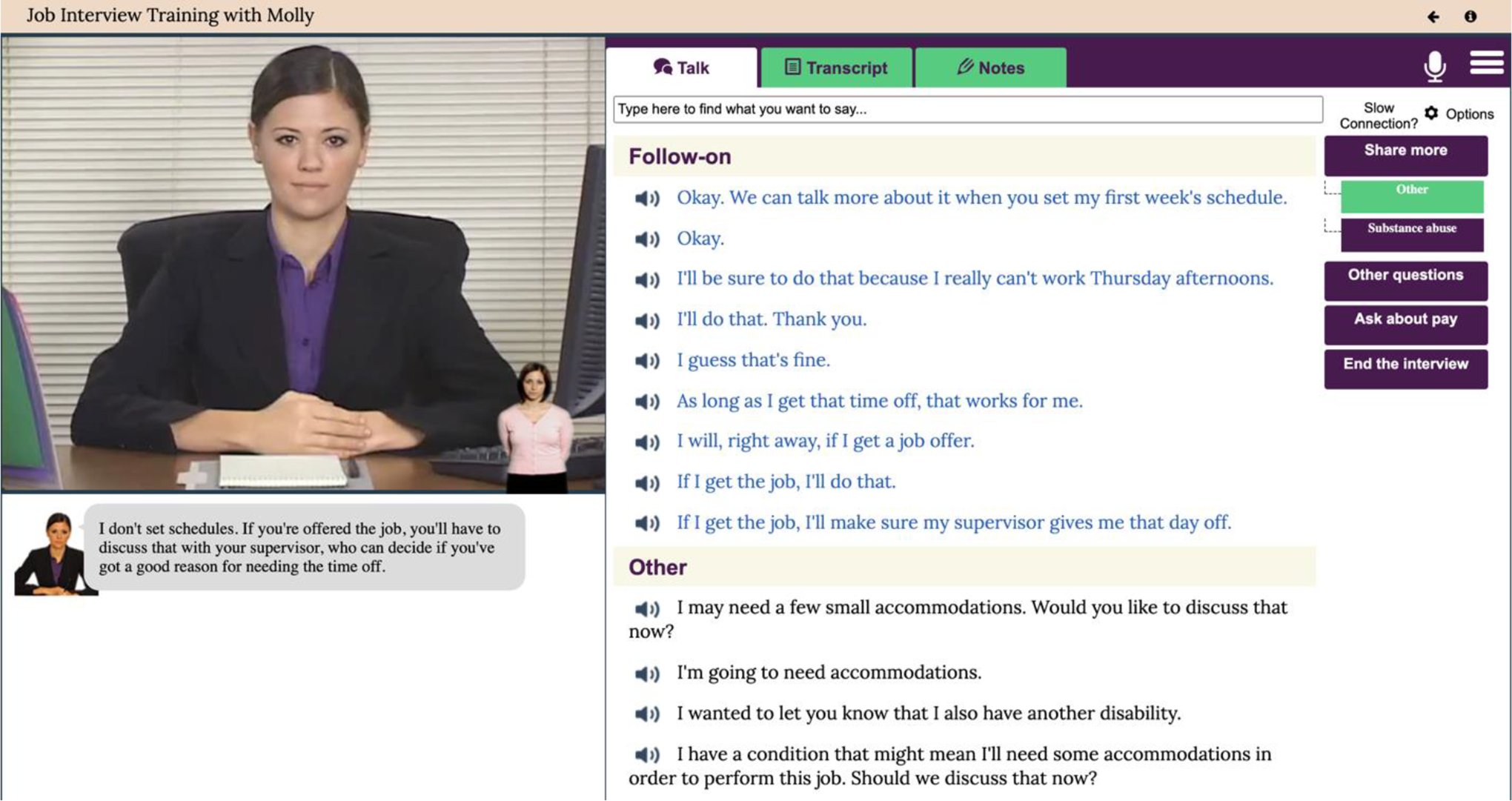
Virtual reality job interview training interface featuring Molly Porter.
Procedures
VR-JIT was designed to be a scalable, easy-to-use, internet-delivered, individualized learning experience that teachers could help students learn to use independently, with minimal supervision. The following strategies were used to support teachers to implement VR-JIT with fidelity.
Teacher training
The research team led a mandatory 60-min orientation session with teachers (via videoconference) on how to use VR-JIT. The research team provided each teacher with a copy of a fidelity checklist, adapted from prior VR-JIT studies (Smith et al., 2014). The research team oriented the teachers on how to use the checklist to navigate the e-learning curriculum with their students (e.g., reviewing the eight learning goals), complete an online job application, and interact with and obtain feedback from the virtual interviewer. The teachers then spent 1.5 hr interacting with VR-JIT to obtain practical knowledge of the tool, which was monitored and validated by the research team using the VR-JIT administrative portal (i.e., a website allowing the administrators to monitor teacher and student engagement [e.g., scores on virtual interview, minutes with virtual interviewer] with VR-JIT). After the videoconference was completed, teachers completed two role-plays with a peer to practice using the fidelity checklist (i.e., one role-play as the teacher and one role-play as the student). After the role-play, teachers were asked to confirm their readiness to implement VR-JIT by informing their school-level supervisor. Teachers were encouraged to complete additional role-plays if they reported a lack of readiness; however, all teachers reported feeling prepared to deliver VR-JIT. School-level supervisors reported role-play completions and teacher readiness to the research team.
VR-JIT implementation fidelity
Teachers (n = 26; including n = 4 leaders who also served as teachers) self-reported their fidelity at implementing VR-JIT. First, teachers looked at the checklist to identify which aspect of VR-JIT they needed to teach first, second, third, and so on. Second, the teachers taught students to use VR-JIT in the order presented on the checklist. Third, the teachers checked the box on the checklist reflecting each aspect of VR-JIT that they taught (of note, n = 1 teacher and n = 1 leader also serving as a teacher did not return a completed fidelity checklist). Teachers either completed an online version of the checklist during the orientation with students or they scanned the printed version of their checklist and emailed it to the research team. The research team reviewed the 36 checklists submitted, and 31 of 36 (86.1%) checklists were completed with high fidelity (at least 90% of boxes checked), two were completed with moderate fidelity (at least 80% of boxes checked), and three were completed with poor fidelity (less than 75% of boxes checked). Two teachers with poor-fidelity results were retrained, and their subsequent checklists achieved greater than 90% fidelity. One teacher with poor fidelity chose not to be retrained and did not orient additional students to VR-JIT (but continued to support students who had been trained).
Recommended VR-JIT curriculum
In the efficacy trials evaluating VR-JIT delivery, trainees completed an average of 15 virtual interviews that were associated with improved interview performance and increased access to jobs (Smith et al., 2014). Thus, we recommended that our school partners encourage students to complete this same number of virtual interviews while the teachers monitored the students’ progress through the easy, medium, and hard levels of difficulty. The teachers monitored whether students improved their scores and mastered the easy interviews before progressing to medium (and then to hard) interviews. Based on the protocol of a real-world effectiveness study of VR-JIT among adults with a range of disabilities (Smith et al., 2019), we recommended that students complete approximately three 45- to 60-min VR-JIT sessions per week over 4–6 weeks to complete the targeted 15 interviews. The efficacy studies of VR-JIT did not provide insight into the optimal amount of time trainees should spend on the e-learning and job-application completion. Thus, we advised teachers to focus at least one session on reviewing the e-learning curriculum and then we naturalistically observed the degree to which students engaged with this material via minutes spent on the e-learning web pages.
We encouraged teachers to develop their own strategies if they found that the recommended delivery plan was not feasible. Specifically, we encouraged them to adapt the recommended delivery plan to fit the context of their everyday teaching duties and asked them to note and then formally report these adaptations.
Study Measures
All teacher- and leader-focused research data were captured via electronic surveys. The surveys for leaders and teachers were sent via REDCap (Harris et al., 2009), an online data capture tool compliant with the Family Education Rights and Privacy Act of 1974. For surveys requiring student completion (i.e., VR-JIT acceptability and usability), the research team sent electronic survey links to teachers via an online data-capture system (Qualtrics, 2005), who then forwarded the links to students. No personal identifying information about students was collected. We used the National Center for Education Statistics (NCES) locale framework to group schools based on population size and U.S. Census Bureau definitions. We verified school names and addresses and then entered the addresses into the NCES Search for Public Schools database to determine the locale subtype for each school using 2016–2018 school-year data. The NCES locale subtypes include city—large, midsize, or small; suburban—large, midsize, or small; town—fringe, distant, or remote; and rural—fringe, distant, or remote.
Process measures
VR-JIT automatically captures the total number of completed virtual interviews (at each difficulty level), the overall highest score attained (range: 0–100), the amount of time (in minutes) trainees spend talking with the virtual interviewer, and the amount of time (in minutes) engaged in the e-learning curriculum. Teachers could review the students’ progress through their administrative access on the SIMmersion website, and the research team sent progress reports to the teachers. To reduce the number of contrasts and reduce measurement error, we used principal-components factor analysis with these four variables to create a composite variable of “engagement with VR-JIT.” Results of the principal-components factor analysis (no rotation) indicated a good fit to a one-factor solution (all component values ranged between .457 and .924). Intercorrelations among these four variables support the creation of a composite with a range of Pearson’s r = .23–.86 (p values all < .001; except the total score and e-learning minutes at r = .10, p = .089). A table of intercorrelations between all variables used for this article is available from the first author by request. Factor scores computed by SPSS Version 26.0 reflect “VR-JIT engagement.”
Implementation evaluation measures
Our implementation evaluation involved measuring core determinants, processes, and outcomes germane to hybrid Type 3 effectiveness-implementation trials within the Proctor et al. (2011) implementation research outcome domains taxonomy. Specifically, we evaluated the implementer perspective of VR-JIT orientation and initial training acceptability, VR-JIT appropriateness and expected implementation feasibility, and postimplementation VR-JIT acceptability and sustainability. We also assessed prospective delivery and teacher context and adaptation based on Stirman and colleagues’ adaptation coding taxonomy (Stirman et al., 2017; Stirman et al., 2013). Finally, we adapted the treatment acceptability rating form (Reimers & Wacker, 1988) to evaluate student-level acceptability of VR-JIT and adapted the system usability scale (Brooke, 1986) to evaluate student-level usability of VR-JIT.
Prospective delivery
Although we recommended that students complete approximately three 45- to 60-min VR-JIT sessions per week over the course of 4–6 weeks, we supported each transition program in adapting the a priori plan to achieve this target. We developed a prospective delivery survey for leaders to report on where, when, how, and how often they planned to deliver VR-JIT. The survey items were developed using the Stirman adaptation coding taxonomy (Stirman et al., 2017; Stirman et al., 2013). The survey included seven items (e.g., “Where will teachers deliver VR-JIT?” “When will teachers deliver VR-JIT?” “How many interviews do you expect students to complete each week?”).
Teacher context and adaptation
Our teacher context and adaptation survey used the Stirman adaptation coding taxonomy (Stirman et al., 2017; Stirman et al., 2013) for teachers to report on the context of delivery and the strategies actually used during the delivery. The teachers completed this survey after the first 2 weeks of VR-JIT implementation and after completing VR-JIT implementation. The survey included six items evaluating the delivery context (e.g., “What level of assistance did students need to complete the training?” “What other transition services did your students receive?”). The survey included four items evaluating adaptation (e.g., “Where was VR-JIT delivered?” “When was VR-JIT delivered?” “How was VR-JIT delivered?”).
VR-JIT orientation acceptability
This survey evaluated the acceptability of the orientation we provided to train teachers and leaders to orient students on how to use VR-JIT. The survey included seven items rated on a scale from 0 (not at all) to 4 (very). Sample items reflected satisfaction with orientation, satisfaction with opportunity to practice VR-JIT, feeling prepared to teach VR-JIT to students, and acceptability of orientation material. Internal consistency was high (α = .94).
VR-JIT appropriateness and expected implementation feasibility
We evaluated the extent to which teachers and leaders perceived VR-JIT as an appropriate tool for inclusion in transition services prior to implementation. The survey included five items rated on a scale from 0 (not at all) to 4 (very) that were summed for a total score. Sample items asked “How well do you think VR-JIT fits with students’ goals for job training?” “How likely do you think it is that students will be engaged in VR-JIT?” Internal consistency was high (α = .83). We evaluated the confidence teachers and leaders had in the expected feasibility of implementing VR-JIT, using the total score from nine items rated on a scale from 0 (not at all) to 4 (very). Sample items asked “How confident are you that you will deliver VR-JIT with fidelity and effectiveness?” “How confident are you that you will be able to support students to use VR-JIT after training them?” Internal consistency was high (α = .84).
VR-JIT acceptability and sustainability (postimplementation)
We evaluated teacher-level acceptability of VR-JIT as an intervention to be delivered within preemployment transition services. This survey included 10 items on a scale from 0 (not at all) to 3 (very) to assess acceptability (e.g., satisfaction with VR-JIT as a service, satisfaction with technology support, acceptability of VR-JIT content, how VR-JIT fit with transition services). Internal consistency was high (α = .83). Administrators and teachers evaluated the sustainability of delivering VR-JIT with three items on a scale from 0 (not at all) to 3 (very). Sample items reflected motivation to continue VR-JIT and the school being equipped to continue VR-JIT. Internal consistency was acceptable (α = .68). We computed total scores for each scale.
We evaluated student-level acceptability using the total score from a five-item self-report scale from 1 (e.g., very unenjoyable) to 5 (very unenjoyable). Sample items asked “How enjoyable was the VR-JIT training?” and “How helpful was the VR-JIT tool in preparing you for an interview?” Internal consistency was acceptable (α = .73). We evaluated student-level usability using the total score from a seven-item self-report scale from 1 (not at all) to 4 (very much). Sample items reflected “Was it easy for you to pay attention when learning VR-JIT?” and “Do you think you are good at using VR-JIT?” Internal consistency was acceptable (α = .74).
Effectiveness measures
We designed a survey in which teachers used all available student records to capture data related to the students’ demographics, cognitive ability (IQ, reading level), and employment history (at baseline and at 3- and 6-month follow-ups). The IQs reported by the teachers were generated via the Wechsler Intelligence Scale for Children V (Wechsler, 2014) or the Woodcock Johnson IV Tests of Cognitive Abilities (Schrank et al., 2014). The teachers reported whether students were currently employed (at baseline) or whether they sustained unemployment, became unemployed, obtained new jobs, maintained their jobs, or lost their jobs since the prior assessment period (at the 3- and 6-month follow-ups).
“Employment” or “a job” reflected a paid position in the community that was not set aside for someone with a disability (i.e., competitive, integrated employment). We used these data to code the primary outcome variable as: “0” for youth who either remained unemployed between baseline and follow-up or were employed at baseline, then became unemployed and remained unemployed at follow-up; “1” for youth (who were either unemployed or employed at baseline) who obtained new jobs between baseline and follow-up; and “2” for youth who were employed at baseline and maintained that employment through follow-up. Teachers completed 3- and 6-month follow-ups for 250 youth, 23 youth had a 3-month follow-up only, 1 youth had a 6-month follow-up only, and 4 youth did not have follow-up data. Thus, we obtained follow-up data on 275 of 279 youth (98.6%). For youth where teachers only reported the 3-month follow-up, we carried forward their outcomes to represent their final outcomes at 6-month follow-up.
Data Analysis
Given the variability in transition program type (STEP vs. non-STEP vs. MCTI), we conducted design-effect analyses on our employment-outcome variable to determine the amount of variance corresponding to the nesting within school locale and transition programming type. This variation could affect estimates of the standard error and require multilevel analytic approaches when significant. Muthen and Satorra (1995) specify that design-effect test statistics that are less than or equal to 2.0 suggest the presence of nonsignificant variation accounted for the nested data structure and therefore do not require multilevel analyses. Both school locale and program type had design-effect estimates below 2.0. Thus, we did not include the multilevel nature of the study design in our analyses.
We used descriptive analyses to characterize the process outcomes (i.e., VR-JIT performance), demographic and cognitive characteristics, and youths’ employment history. To evaluate our implementation outcomes, we report the descriptive statistics (i.e., mean, standard deviations, range) of VR-JIT implementation (prospective delivery; teacher context and adaptation), acceptability, expected implementation feasibility, and sustainability. We also conducted paired-sample t tests to evaluate whether there were differences between implementation strategies at delivery midpoint and end point.
To analyze VR-JIT effectiveness, we conducted a multinomial logistic regression to evaluate the student’s new employment (compared to unemployment) and sustained employment (compared to unemployment). The model focused on VR-JIT engagement as the primary independent variable and included biological sex, overall IQ, and grade level as covariates as they are known contributors to employment (Power et al., 2008; Southward & Kyzar, 2017; Wehmeyer & Palmer, 2003). We evaluated the regression model for the presence of multicollinearity, and all variance-inflation factors were observed below 2.0. Exploratory associations were conducted using Pearson’s correlations with two-tailed tests.
We observed that more than 39.1% of the sample was missing overall IQ data. In an effort to control for overall IQ (known to be a significant predictor of employment), we imputed data using the expectation-maximization algorithm (Dempster et al., 1977), which is a maximum likelihood estimation method that generates unbiased estimates when data are missing completely at random (MCAR). Using (Little, 1988) MCAR test, we observed that the IQ data were MCAR, χ2(7) = 8.75, p = .27, and the imputation of the missing data did not introduce bias into the analyses.
Results
VR-JIT Process Outcomes
We observed heterogeneity in the students’ engagement with VR-JIT. Although all 279 students completed at least one virtual interview, we observed that 26.2% (n = 73) completed 1–5 virtual interviews, 43.0% (n = 120) completed 6–14 virtual interviews, and 30.8% (n = 86) of students completed the recommended 15 virtual interviews. The total mean completions were 10.8 (SD = 7.4; range: 1–37 interviews) with a mean completion score of 77.5 (SD = 14.1 of 100 points) and a mean high score of 90.6 (SD = 11.8). We observed that students completed a mean of 22.1 min (SD = 25.3) using the e-learning curriculum (range: 0–194 min) and a mean of 198.7 min (SD = 130.6) of virtual interviews (range: 14–676 min).
VR-JIT Implementation Outcomes
VR-JIT orientation acceptability, appropriateness, and expected implementation feasibility (preimplementation)
Administrative leaders (n = 9) and teachers (n = 41, including n = 21 teachers or support staff who completed orientation but did not lead VR-JIT implementation) reported the VR-JIT orientation was acceptable (M = 21.56, SD = 4.82; range: 0–28) and that VR-JIT was appropriate for transition services (M = 16.02, SD = 2.60; range: 0–20). In addition, teachers and administrative leaders expected that implementation of VR-JIT would be feasible in their programs (M = 24.55, SD = 4.62; range: 0–364). One teacher who served 36 students had an outlying total score on the expected feasibility subscale of 2, which was removed. Ranges reflect possible scores.
Prospective implementation
Administrative leaders (n = 10) revealed that the planned primary implementation location was the school, with 40% of leaders reporting that there would be no secondary implementation location, 30% reporting that a secondary implementation location would be an external job-training site or public place (such as a library), and 30% reporting that a secondary implementation location would be the student’s home. Within the school setting, 70% of leaders planned to implement VR-JIT within the transition classroom, 20% during study hall, and 10% during homeroom. Within the classroom setting, 90% of leaders planned to implement VR-JIT in a group setting where students had their own computing devices (e.g., tablet, laptop, desktop), while 10% planned to do so individually in a private or semiprivate setting. Leaders noted that a planned secondary strategy was to implement VR-JIT with students individually in a private or semiprivate room (50%) or with students in a single group setting with a single device (30%), while 20% had no secondary delivery strategy. Finally, 90% of leaders (1) expected teachers to adhere to this strategy to a large or very large degree, (2) supported teachers having occasional-to-moderate freedom to adapt this strategy to ease delivery, and (3) expected students to complete one to four virtual interviews per week, as suggested by the research team.
Teacher context and adaptation
Overall, 26 teachers (including four administrative leaders who served as teachers) supported a mean of 13.56 (SD = 8.11) students using VR-JIT. Over the course of training, teachers reported on the delivery context and implemented adaptations at the midpoint of training and again at the endpoint of training. In addition, one teacher taught two cohorts of students with differing implementation strategies and completed the surveys for each cohort (of note, n = 1 teacher and n = 1 administrative leader serving as a teacher did not complete these surveys). We did not observe any statistical differences using paired-sample t tests between delivery strategies at midpoint and endpoint (all p > .10). Thus, we present the means between midpoint and endpoint. As a result, means within categories may not add up to 100%. Teachers reported that 24.1% of students needed no guidance when using VR-JIT, 50.8% of students needed a little or some guidance, and 20.7% of students needed a lot of guidance (e.g., discussing the feedback on the transcripts or why a response received a negative reaction by the virtual coach). Teachers also reported that 86.8% of students used VR-JIT at school, while 11.3% used VR-JIT at home, at a job placement, or in another setting.
Within schools, teachers reported that 80.5% of students used VR-JIT during transition class and 16.7% of students used VR-JIT during homeroom, study hall, after-school programming, or free periods. Further, teachers reported that 72.5% of students used VR-JIT in group settings with their own devices, 22.3% used VR-JIT in private or semiprivate rooms with their own devices, and 3.7% used VR-JIT in group settings with a single device. Teachers reported that 52% of students completed one to four virtual interviews per week, 39.6% of students completed five or more virtual interviews per week, and 4.9% of students completed fewer than one interview per week. Teachers reported that most students were receiving some level of typical transition services concurrently with VR-JIT. Specifically, 71.2% of students were working on job-skill development, 58.6% were working on resumes, 40.2% were mock-interviewing with teachers, and 12.3% were mock-interviewing with community employers.
VR-JIT acceptability and sustainability (postimplementation)
Postimplementation, administrative leaders (n = 10) and teachers (n = 21) reported that VR-JIT was highly acceptable (M = 25.64, SD = 3.86; range: 0–30). In addition, administrative leaders (n = 9) and teachers (n = 15) reported that VR-JIT implementation would be sustainable (M = 7.79, SD = 1.35; range: 0–9). Students (n = 115) reported that VR-JIT was acceptable (M = 19.00, SD = 3.26; range: 5–25) and usable (M = 19.48, SD = 3.77; range: 7–28).
VR-JIT Effectiveness Outcomes
We observed that 133 students remained unemployed (48.4%) between baseline and follow-up, 90 students obtained new jobs (32.7%) between baseline and follow-up, and 52 students sustained jobs between baseline and follow-up (18.9%). Among unemployed students, 23 (17.3%) obtained either a paid or unpaid internship by the 6-month follow-up.
For the multinomial logistic regression (see Table 2), the likelihood ratio test for model fit was significant, χ2(12) = 47.1, p < .001; Nagelkerke R 2 = .180. The results suggested that compared to students who were unemployed at follow-up, those who obtained competitive, integrated jobs were more engaged in VR-JIT (odds ratio [OR] = 1.63, p = .002) and more likely to have higher overall IQs (OR = 1.06, p < .001). Sophomores (OR = 0.07, p = .001), juniors (OR = 0.16, p = .007), and seniors (OR = 0.42, p = .035) were less likely to obtain jobs than “super seniors” who had completed their senior year and were engaged in prediploma transition services.
Multinomial Logistic Regression Results.
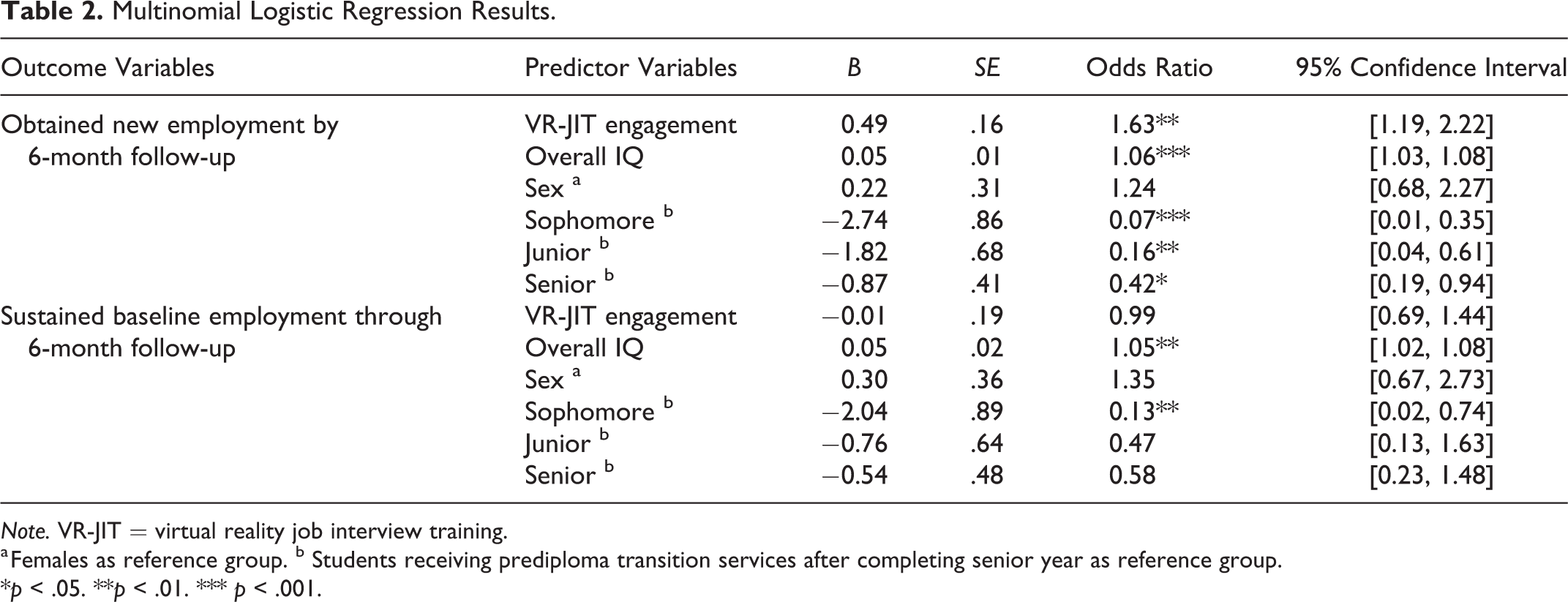
Note. VR-JIT = virtual reality job interview training.
a Females as reference group. b Students receiving prediploma transition services after completing senior year as reference group.
*p < .05. **p < .01. *** p < .001.
We observed that students who sustained jobs from baseline were more likely to have higher overall IQs (OR = 1.05, p = .002) and less likely to be sophomores (OR = 0.13, p = .021). Engaging in VR-JIT, biological sex, and being a junior or senior were not related to the likelihood of sustaining jobs (all p > .10).
Post Hoc Analyses and Results
Although school partners implemented VR-JIT for all their transition students, n = 82 youth were not actively seeking jobs. We used χ2 analyses to compare the employment rates for youth who were unemployed at baseline and were either seeking jobs or not seeking jobs. We observed that 45.8% of youth who were unemployed and seeking jobs at baseline had obtained jobs by the 6-month follow-up, compared to the 22.0% of youth who were unemployed and not seeking jobs at baseline who had obtained jobs by the 6-month follow-up, χ2(1) = 11.53, p < .001.
We then evaluated the relationship between students’ VR-JIT performances and their postimplementation assessments of VR-JIT acceptability and usability. Pearson correlations revealed that the latent variable representing VR-JIT engagement (total number of virtual interviews completed, high score, number of minutes with e-learning, and number of minutes talking to Molly) was significantly correlated with the total scores representing VR-JIT acceptability (r = .23, p = .014) and usability (r = .19, p = .041).
Discussion
This Type 3 hybrid effectiveness-implementation trial aimed to evaluate the implementation of VR-JIT in special education transiton services and the effects of VR-JIT on employment among students within transition services. The primary focus being on VR-JIT implementation reflects the multitude of challenges faced when translating research evidence to more “real-world” contexts. We observed that teachers and administrators found the implementation of VR-JIT feasible and appropriate, that training for teachers was acceptable, that teachers implemented VR-JIT with fidelity and minimal adaptation, and that teachers reported that VR-JIT was acceptable and sustainable. Most program administrators planned to implement VR-JIT in schools during transition class time, with students using their own devices to engage the tool. Thus, our guided yet flexible approach to implementation is consistent with current perspectives from the field of implementation science. That is, a recognition that adaptation to the way interventions are implemented is not only inevitable but a necessary process for sustainability (Chambers et al., 2013). This does not, however, suggest that implementation occurs without guidance or parameters, but that flexibility of implementation is afforded prospectively to aspects of delivery that are not expected to impact the core functions of the intervention responsible for its observed effects in prior research (Perez Jolles et al., 2019). The methods by which delivery occurs are allowed to vary, but the functions that must be achieved to ensure fidelity are maintained. Thus, the observed relationship between VR-JIT engagement and employment in this study attests to VR-JIT having maintained its core functions.
We observed that teachers primarily used VR-JIT with fidelity as specified a priori when they were successful in completing and submitting the fidelity checklists to the research team for review. The teachers implemented VR-JIT with minimal adaptations, reflecting that approximately 10% more students than anticipated used VR-JIT during transition class time. Another adaptation reflected that approximately 12% fewer students used VR-JIT in group settings with their own devices than anticipated; instead, they used VR-JIT by themselves in private settings. Teachers and leaders reported that they found VR-JIT to be an acceptable and appropriate tool for transition services and that the use of VR-JIT would likely be sustainable within their programs. Notably, teachers and administrators reported that the ongoing financial costs of VR-JIT (55.6%) and training to deliver VR-JIT (44.4%) might be barriers to sustainability. However, 77.8% of teachers and administrators reported that future implementation of VR-JIT would be a priority. Despite these noted challenges to sustaining VR-JIT, teachers and administrators wanted to continue providing this intervention to transition-age youth receiving special education services and expected they could sustain its use over time. Presumably teachers and administrators perceived that VR-JIT was a benefit to both students and the school. However, additional evaluation of the precise nature of these perceived benefits is needed to understand the multilevel considerations in the decision to sustain, which is a complex process for delivery systems such as schools. At this time, the evaluation of VR-JIT sustainability has been understudied, but efforts are ongoing to improve measurement and planning tools (Calhoun et al., 2014; Palinkas et al., 2019).
We observed that 32.7% of transition-age youth receiving special education preemployment transition services who engaged with VR-JIT were employed by 6-month follow-up (compared to a national rate of 18.4% among youth with disabilities; Bureau of Labor Statistics, 2020). We also observed that these same youth seeking jobs at study entry and youth who were not seeking jobs at study entry had higher employment rates (45.8% and 22.0%, respectively) than the national average after using VR-JIT. Moreover, transition-age youth who engaged with VR-JIT were 1.63 times more likely to be employed by 6-month follow-up after controlling for factors related to employment such as biological sex, IQ, and grade level (Carter, Ditchman, et al., 2010; Newman et al., 2011; Power et al., 2008; Southward & Kyzar, 2017; Wehmeyer & Palmer, 2003). These initial results suggest that VR-JIT engagement explains significant variation in employment outcomes for youth receiving special education preemployment transition services. However, we emphasize caution when interpreting the results as we could not directly compare employment rates between youth in our study and youth who did not use VR-JIT in similar settings.
Additionally, students reported VR-JIT to be acceptable and usable, and those with stronger metrics of VR-JIT engagement reported higher levels of acceptability and usability for the tool. Importantly, the association between VR-JIT engagement and acceptability observed in our sample will be critical for successfully implementing VR-JIT in future settings as intervention acceptability by end users significantly predicts intervention effectiveness (Elliott, 2017).
Implications and Future Directions
This study is forward-thinking in its use of a Type 3 hybrid effectiveness-implementation design and focuses on the implementation processes and outcomes of delivering VR-JIT in schools for transition-age youth in need of employment. Specifically, we observed VR-JIT implementation feasibility, and teacher and student acceptability, which suggest there is strong potential for uptake of VR-JIT as a means of enhancing transition services. Of particular importance is the potential instructional relief that VR-JIT could provide teachers who transition from one-on-one role-play models to using VR-JIT. The prevalence of technology in schools in the United States suggests VR-JIT could be a potentially cost-effective solution for schools (Gray et al., 2010). Also, our findings suggest that providing prospective guidance on acceptable means of implementing VR-JIT while also allowing for adaptations to the delivery approach may have helped enhance employment outcomes for students and was highly acceptable, feasible, and sustainable. Moreover, we observed these facilitating factors of future implementation despite the presence of the considerations of costs and time needed to train school staff that are challenges for future scale up and sustainability.
Although this initial study suggests that VR-JIT may be an effective tool that it is feasible to implement with strong support for sustainability, there are critical areas for future research. First, the current study was intentionally designed to be noncontrolled and nonrandomized to meet the needs of our school partners, who suggested that a controlled trial may lack feasibility to conduct and could be unethical to withhold VR-JIT from their students given its established efficacy. That said, the results suggest VR-JIT may have incidence validity (i.e., the potential to impact large numbers of people) given its potential for scalability and impact validity (i.e., the potential for serious and enduring consequences) given the potential effects on employment. Thus, both validity types are critical requirements of evidence-based practice in special education and support further evaluation of VR-JIT in a future RCT to validate its effectiveness (Gersten et al., 2005). Second, although we observed that VR-JIT engagement predicted greater employment by the 6-month follow-up, the potential of a VR-JIT dose response must be evaluated to help clarify whether there is an optimal dose associated with improved employment. Third, future research is needed to evaluate the differential effects that VR-JIT may have on employment across the individual IDEA categories. Fourth, although VR-JIT may be effective and have strong implications for implementation, future research is needed to evaluate whether schools can deliver it in a cost-effective manner. Finally, the potential for expanding the use of VR-JIT to the district, regional, or state level requires additional research, likely with a primary focus on the economic model needed to sustain delivery.
Limitations
Although there is evidence that VR-JIT may help enhance preemployment transition services, study limitations must first be discussed. First, we evaluated the presence of transition services delivered concurrently with VR-JIT at the teacher level. Although our design analysis suggests that school and student type (e.g., STEP vs. non-STEP) do not account for the observed differences in delivery of transition services, future studies could explore the relative contribution of these specific transition-service components. Second, although the race and ethnicity of our youth represented the demography of Illinois and Michigan, future studies of VR-JIT could be strengthened by recruiting a larger sample of youth from underrepresented communities. Third, participating youth were primarily from rural, town, and suburban schools, so our findings have limited generalizability to schools and youth in large city locales. Fourth, approximately 70% of the schools we approached declined to participate (or didn’t respond to recruitment solicitations). Moreover, we observed that the schools who declined to participate cited competing priorities and potential teacher burden (completing research documentation) as reasons for the decline. Thus, our sample has limited generalizability to schools who may be underresourced to participate in a large-scale evaluation. Fifth, teachers self-reported their own fidelity checklist, although ideally, this checklist would be completed by an independent observer. Sixth, the 18.4% employment rate for youth with disabilities reported by the Bureau of Labor Statistics (2020) focuses on parent- or self-identification of a physical, mental, or emotional condition and may not represent all IDEA categories. Finally, we did not evaluate the quantity of in-person interview role-plays youth completed with teachers and cannot evaluate this as a covariate in our statistical models. Anecdotally, teachers reported that students completed zero to two job interview role-plays during their preemployment training. Also, teachers did not receive standardized training on how to conduct these job interview role-plays.
Conclusions
This study provides promising evidence that VR-JIT may help enhance the effects of transition services at increasing employment and can be feasibly implemented in school settings with minimal adaptations. Several results from this study suggest that VR-JIT is emerging as a potentially effective, readily scalable, feasibly delivered, and sustainable tool that is highly acceptable to administrators, teachers, and students. However, we temper our enthusiasm by recognizing that this trial was not controlled; an RCT will be needed to validate the effectiveness of VR-JIT. Moreover, future studies will need to consider the costs of VR-JIT implementation and long-term sustainability.
Footnotes
Authors’ Note
The content is solely the responsibility of the authors and does not necessarily represent the official views of the National Institutes of Health. Justin D. Smith is also affiliated with Department of Population Health Sciences, University of Utah School of Medicine, Salt Lake City, UT, USA.
Acknowledgment
We would like to acknowledge the Administration and Staff from the Division of Rehabilitation Services, Department of Mental Health, and Secondary Transitional Experience Program within the Illinois Department of Human Services; and Michigan Rehabilitation Services. We would also like to acknowledge the administrators, educational staff, and students from our school partners for participating in this project.
Declaration of Conflicting Interests
The author(s) declared the following potential conflicts of interest with respect to the research, authorship, and/or publication of this article: Dr Matthew J. Smith will receive royalties on sales of an adapted, unpublished (at the time of this submission) version of virtual reality job interview training that will focus on meeting the needs of transition-age youth with autism spectrum disorders. Dr Smith’s research on the effectiveness of the adapted version of VR-JIT is independent of the data reported in this article that reports on the original version of VR-JIT. No other authors report any conflicts of interest.
Funding
The author(s) disclosed receipt of the following financial support for the research and/or authorship of this article: This study was funded by the Kessler Foundation (1003-1958-SEG-FY2016, PI: Matthew J. Smith). Marc S. Atkins was supported by the National Center for Advancing Translational Sciences, National Institutes of Health, through Grant UL1TR002003.
