



Abstract
Universal Design for Learning (UDL) and Blended Learning (BL) formats, are widely adopted across K–12 learning environments. Upon graduation, preservice teachers may be expected to implement UDL and BL practices. The present study was motivated by the need to provide preservice teachers with live modeling of UDL and BL concepts. Learning analytics data from 197 preservice teachers was examined for engagement with UDL/BL Access features (location, day-of-the-week, time-of-day, and regularity), Content features (screencasts and quizzes), and to determine if there was a relationship between engagement and achievement. Examination of the learning management system login data revealed regular access to the digital content across differing locations, week days, and time of day. Associations were significant between academic performance and all features. Designing the BL digital course components following UDL principles appears to have served as a self-regulation enabler for preservice teachers themselves while providing exemplars to adopt in their future practice.
Keywords
The present study was motivated by three influences shown to support teaching of diverse learners within K–12: Universal Design for Learning, Blended Learning, and live modelling. Teachers who lack skills and knowledge of these concepts and approaches may not be able to support the diversity of learners in their classrooms; that is, they cannot teach what they do not know (Applegate & Applegate, 2004). If preservice teachers do not experience and engage with content, strategies, and approaches in their coursework known to support school success for diverse learners it is unlikely that they will be effective in their instruction. Thus, the present study focused on intentionally planned and live modeling of UDL instructional experiences and blended learning delivery incorporated into a course on inclusion to provide preservice teachers with first hand experiences on how their own learning is affected and offers a springboard for curriculum design in their future classrooms.
Universal Design for Learning (UDL)
UDL is more than just good teaching. UDL is an instructional framework designed to address learner variability by removing barriers in the curriculum (Burgstahler, 2010; Lowery et al., 2017). The goal of UDL is to facilitate the education of all learners, that is, learners who are diverse across many dimensions, such as ability, age, ethnicity, gender, and socioeconomic status in the context of the 21st century educational environments (Edyburn, 2010; Meyer et al., 2014). Unlike differentiated instruction and instructional adaptations which are implemented after a teacher is familiar with student needs, UDL is implemented prior to students entering the classroom through intentional planning with learner diversity at the forefront.
The UDL framework developed at the Center for Applied Special Technology (CAST, 2011) is based upon neurological research and learning theory. The framework sets out three principles to facilitate the elimination or reduction of learning barriers. Multiple Means of Representation, based on recognition networks of the brain focusses on the “what” of learning which involves providing multiple ways for learners to access and acquire information. Multiple Means of Action and Expression is based on the strategic networks of the brain and focusses on the “how” of learning which entails offering flexibility in the way learners apply information and demonstrate their learning. Multiple Means of Engagement, based on the affective networks of the brain focusses on the “why” of learning which involves promoting learner motivation and interest to engage with curriculum content (CAST, 2011; Lowery et al., 2017). Each principle comprises a set of guidelines to support curriculum design. Thus, through intentional planning and application of UDL principles and guidelines, educators can address the variability in learner ability to access, understand, and engage with curriculum content (please go to www.cast.org for more information about UDL).
Studies have examined UDL implementation across a range of curriculum content areas such as reading (e.g., Kennedy et al., 2014), science (e.g., Marino et al., 2014), and mathematics (e.g., Kortering et al., 2008) all revealing positive impacts on student engagement and academic outcomes. Other studies have examined UDL designed curriculums in K–12 inclusive education classrooms, specifically to explore the success of students with disabilities. Results have been positive in demonstrating gains in both academic and social outcomes for students with a range of diagnoses and disability severity levels (e.g., Marino, 2009; Rappolt-Schlichtmann et al., 2013). Such findings have led to the National Educational Technology Plan (2016) and Every Student Succeeds Act (2015) to promote UDL as an important means for creating learning environments for diverse learners, but especially for learners with disabilities.
Further, research on teacher use of UDL designed curriculums revealed increases in teacher efficacy, instructional efficacy, and self-efficacy (Lowery et al., 2017). Teachers also report greater success in reaching diverse learners (Katz, 2015) and increasing student engagement (Marino et al., 2014).
Implementation of UDL principles has also been successful across a wide range of educational contexts from preschool (e.g., Lieber et al., 2008), K–12 (e.g., Rappolt-Schlichtmann et al., 2013) to post-secondary (e.g., Montgomery et al., 2015). Important to the current study are the positive findings for post-secondary contexts because preservice teacher education programs are increasingly attracting individuals from varied cultural, linguistic, and experiential backgrounds, but also students with disabilities (Burgstahler, 2010; Hall & Marks, 2018). Since intentional planning for learner variability is foundational to the framework of UDL “good design for people with disabilities benefits everyone” and provides a powerful rationale for exploring the large-scale application of UDL (Edyburn, 2010, p. 2).
Edyburn (2010) explains that digital technology provides a high degree of flexibility in information representation, expression and engagement (e.g., font size; font color and contrast; text-to-speech and speech-to-text options; hyperlinks; explanatory aids; strategy suggestions; multimedia supplements to written text). Thus, intentional instructional design utilizing the UDL framework allows access to learning for children and adults, regardless of diversity in a way that was not possible in previous decades due to advances in digital technology. Such advances also enhance available learning opportunities in online learning environments such as online components of Blended Learning formats course which allow instructors multiple ways to represent course materials, and multiple ways for students to demonstrate their learning and engage with course content (McGhie-Richmond & Howery, 2014).
Blended Learning
Although labels differ (e.g., blended, flipped, hybrid, integrated), there is general agreement that blended learning course delivery formats comprise an integration of face-to-face (F2F) and online instructional components (Picciano, 2014). Francis and Shannon (2013) suggest that for blended learning course delivery formats to be successful, the F2F and online elements need to be complementary and interdependent; wherein, technology components are completely integrated into the instructional process. In the present study, the blended learning format followed the Flipped Classroom format (Baker, 2000) wherein students rotate on a fixed schedule between F2F instruction and online instruction that can be completed independently from off-campus locations.
The creation of blended learning environments in K–12 and post-secondary educational contexts have flourished over the past decade due to a number of factors; (a) advances in digital technology, (b) attempts to meet the needs of diverse learners, (c) increases in the demand for access to post-secondary education, and (d) growths in flexibility and accessibility of curriculum content. Investigations into post-secondary student learning outcomes and engagement with online course elements within blended learning contexts remain limited (e.g., Hall & Marks, 2018; Montgomery et al., 2015) despite the fact that blended learning course delivery formats have shown improvements in post-secondary student learning. For example, improvements have been reported in student self-monitoring of progress through a course (Yapici & Akbayin, 2012a), time management skills (Hsu & Hsieh, 2011), self-regulation behaviors (Montgomery et al., 2019), motivation (Cottle & Glover, 2011), content understanding due to opportunities to work at one’s own pace (Horn & Staker, 2011), along with a decrease in course withdrawal rates (Owston et al., 2013). Important to the current study is that many of these earlier studies have leveraged readily available learning management system data to examine student engagement with digital course content via access patterns. In blended learning contexts, where, when, and how regularly students accessed digital course materials has repeatedly shown significant correlations with a variety of factors (e.g., achievement, motivation, comprehension).
Further, increases in student satisfaction (e.g., Wanner & Palmer, 2015) and student preference for blended learning course delivery formats (Hayward & Wasniewski, 2015) have been noted. For example, Hayward and Wasniewski (2015) examined course preferences of 170 undergraduate preservice teachers and found, that while no single course delivery format (F2F, blended learning, online) was preferred by all students, more students (70%) preferred the blended learning option. Interestingly, students reported that blended learning captured many of the best aspects of solely online or F2F formats. These included (a) flexibility in the ability to complete course work from remote locations; (b), accountability afforded by regular class attendance to support meeting course deadlines and comprehension of course content; (c) connectivity during F2F classes to discuss ideas and clarify ideas with the instructor and classmates; and (d) flexibility in completing course work at a self-direct pace and at personally convenient times.
The increase in virtual classroom components has created new learning opportunities for students in K–12 and post-secondary contexts. However, there has been a tendency to assume that digital access and technology automatically eliminates many barriers, but as McGhie-Richmond and Howery (2014) point out, without specific attention to accessibility design, digital media and technology can be just as inaccessible and barrier laden as traditional print-based learning formats. It is important to understand the benefits and challenges of digital learning opportunities created in a blended learning format.
Kim (2013) describes our knowledge of blended learning formats as in its infancy; nonetheless, the studies conducted thus far serve to create a knowledge base with respect to the benefits and challenges of blended learning course delivery formats. Importantly, the available evidence supports the blended learning format as a good fit to explore the implementation of UDL principles in online course component design and student engagement with that content.
Live Modeling
The imperative for live modeling of UDL and blended learning in a teacher education program comes from research showing that teachers cannot teach what they do not know. Applegate and Applegate (2004) labeled this phenomenon the “Peter Effect” (p. 556), wherein they likened teachers who lacked skills, knowledge and/or the enthusiasm required to teach children specific curriculum content to the Apostle Peter who when asked for money by a beggar replied he could not give what he did not have (Acts 3:5). Binks-Cantrell et al. (2012) adopted the term to describe university instructors who, because of their lack of knowledge of English language structure, were not able to provide preservice teachers in their classes with an understanding of concepts known to be essential for reading success, resulting in future teachers lacking fundamental knowledge to support reading success for children in their classrooms. Applegate and Applegate (2004) state that institutions preparing future teachers have a significant obligation to address the attitudes, beliefs, and skills that will be needed in K–12 classrooms. Thus, preservice teachers need direct experiences engaging with content, strategies, and approaches in their coursework to support their classroom instruction.
A conceptual overview of the study is provided in Figure 1. Intentionally planned UDL principles and Blended Learning course delivery features were incorporated into the learning management system of a course on Inclusive Education. Within the course, live modeling of these features aimed to provide preservice teachers with first hand experiences on how their own learning is affected and as a springboard their own curriculum design in their future classrooms. Student engagement with digital course components was examined along with the relationship between student engagement with these intentionally planned digital course components and their academic achievement.

Conceptual overview.
Method
Participants
The learning analytics data from 197 undergraduate, elementary education preservice teachers (i.e., kindergarten to grade 6) enrolled in a 4-year, Bachelor of Education program at a large Western Canadian university were examined. The preservice teachers were registered across four sections of a required introductory course focused on inclusive education and approaches to adapting and enhancing classroom contexts for students with diverse needs. All four sections were taught by the first author. Data was not examined until the course was completed and all grades were submitted, student user names were replaced with anonymous identifiers.
Course Format
The Blended Learning design for the course described in the present study rotated on a fixed schedule of 50% F2F and 50% online instruction. The online components were designed to replace the majority of the lecture material from a previous F2F-only course, allowing for an increase in the experiential application-based activities in the F2F, in-class component, to enhance and expand connections and relationships between and among course topics (Montgomery et al., 2015). Students were expected to come to the F2F classes prepared to discuss and apply the conceptual knowledge engaged with during the online learning component (e.g., Monday—online component paired with Tuesday—F2F component). Thus, the F2F and online components are complementary and interdependent.
UDL designed digital course content
The course content spanned four major topic areas: Differentiated Instruction (DI), Contextualized Learning and Instruction (CLI), Universal Design for Learning (UDL), and Teacher Beliefs and Attitudes about Disabilities (TBAD). A series of screencasts (i.e., instructor-made videos) were created to teach key course concepts and designed to be completed prior to each of the F2F classes. All screencasts included oral narration accompanied by PowerPoint presentations, graphic elements (diagrams, charts, images), videos and, embedded English closed captioning. Screencasts incorporated guiding questions to support acquisition of key ideas, to promote student reflections on applicability of particular instructional approaches, and highlight concepts that would be further discussed in the F2F classes. Screencasts could be viewed in full, in part, and repeatedly, for the purposes of review, clarification, expanding comprehension, and as a study aide for topic quizzes and the final exam. Each screencast was accompanied by a written transcript and a Study Note-taking template (see Figure 2). All text documents could be customized in terms of size, contrast, color, layout, and font. The screencasts and accompanying text resources provided live modeling of two UDL principles, Multiple Means of Representation and Multiple Means of Engagement.
Assessment in the asynchronous environment was accomplished through course topic quizzes for each course topic (DI, CLI, UDL and TBAD) which, although timed, provided student flexibility with respect to (a) access through the Learning Management System from any device, any time, and any place, and (b) a range of days to complete each quiz. Students were provided two attempts at each quiz (course grade was the average across attempts) and immediate feedback was available upon completion of each quiz. These features provided live modeling of Multiple Means of Engagement and Multiple Means of Action and Expression.
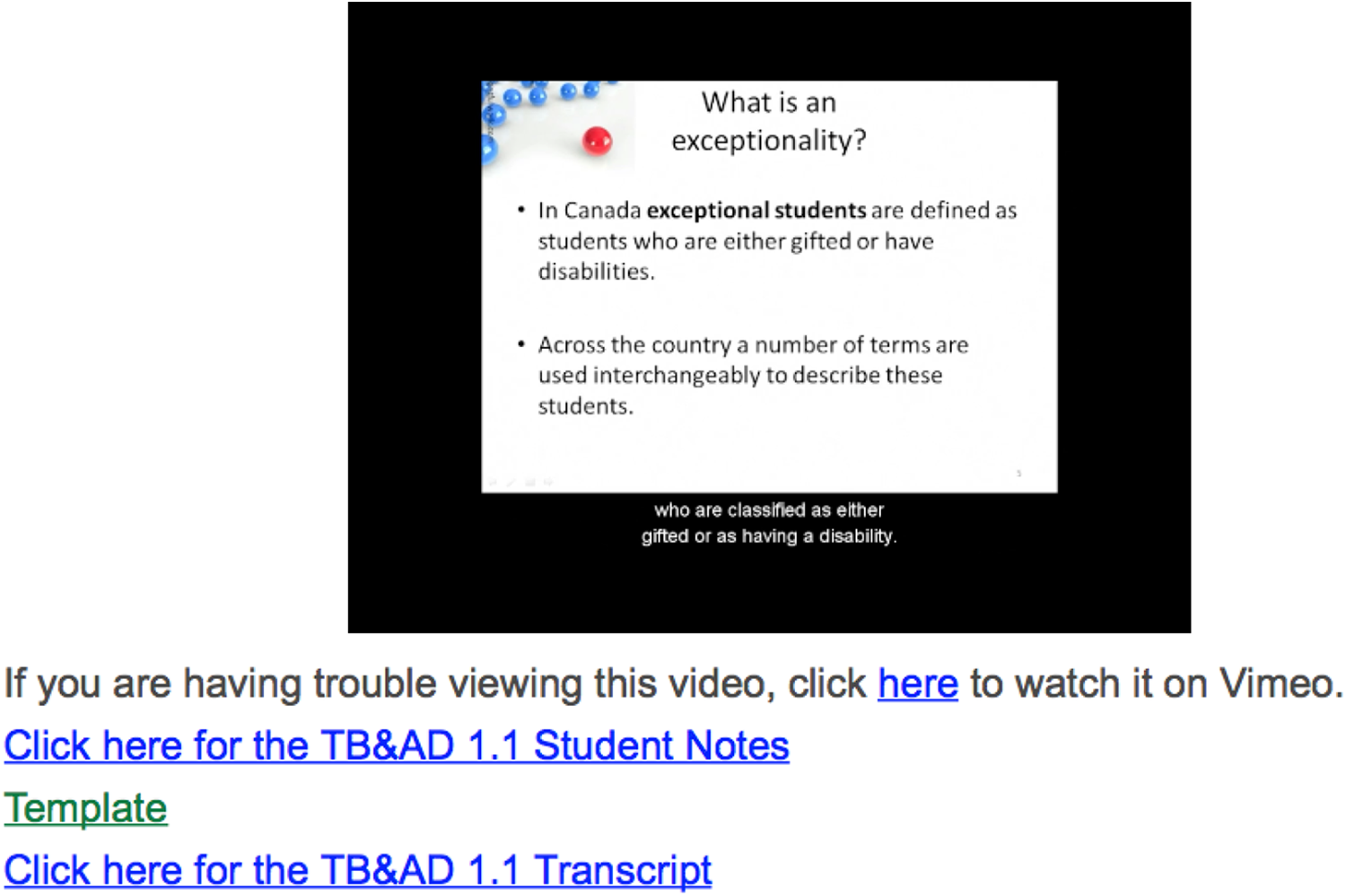
Screen example showing screencast, closed captioning, and links to text documents.
Data Collection Procedure
In the online space of our blended learning course, the Moodle learning management system platform was used to support the organization and delivery of course materials. This learning management system platform enabled us to: a) store and administer our digital instructional resources and quizzes; and, b) monitor and track an individual student’s interactions with the instructional resources and quizzes.
The log files produced in Moodle were used to examine student engagement with the digital components of the course and included: (a) information about the IP address students used to access the course site, (b) day, time, and frequency of access, (c) student actions on the course site (e.g., course view, screencast view, quiz attempt), and (d) information corresponding to student actions. Learning analytics focusses on searching for patterns in data and a common approach to explore students’ time spent online, access location, and navigation patterns that are captured within a learning management system (You, 2016).
Measures
Students engaged with various access and content blended learning features that were designed to align with live models of UDL principles. The Australian Council for Educational Research (2010) defines student engagement as the “time and effort students devote to educationally purposeful activities” (p. 1) and is an important factor in determining successful learning in post-secondary contexts irrespective of instructional format (Montgomery et al., 2019; Trowler & Trowler, 2010). In the present study student engagement was operationalized as the frequency and pattern with which students accessed online system and digital content. Student engagement can be measured by a range of behavioral indicators such as the number of logins, the number of questions asked, quizzes taken, and times that they participated in online discussions among others (Henrie et al., 2015).
Access features
The log file recorded student learning management system access behaviors from which location, day-of-the-week, time-of day, and regularity of access were examined. Since the log files contained only raw data, attributes of this raw log data were used to define the access behavior variables as follows: (a) Location: the IP address that students used to access the learning management system. Location was classified as “On-campus” if access occurred via a dedicated university IP address and “Off-campus” otherwise; (b) Day-of-the-week: the log file recorded the date of online access and the day of access was extracted for this variable. Any log data collected during F2F class times was not included in the data set; (c) Time-of-the-day: time of student access was extracted from the log file and divided into four time periods. Accessing the online component of the course between 5:00 am and 11:59 am was defined as “Morning,” between 12:00 pm and 5:59 pm as “Afternoon,” between 6:00 pm and 11:59 pm as “Evening”; (d) Regularity: the average number of log ins across the period of the course per week was used to define this measure: less than 80 log ins per week was defined as “Not Regular,” between 80 and 120 log ins per week as “Regular,” and more than 120 times per week as “Highly Regular.”
Content features
Student access patterns for two UDL designed digital course components was examined (a) screencast content (i.e., screencast videos and written transcripts), and (b) quiz content (i.e., topic quizzes and final exam review quizzes).
The structure of the course required students to view a series of 5–15-minute screencasts across the four topic areas (DI, CLI, UDL, and TBAD). Students also had the option of reading a written transcript of the screencast content. After each screencast topic was concluded, students completed an online quiz comprising 9–11 questions for each topic. Students were provided two attempts for each topic quiz and feedback for accuracy was supplied through the learning management system after each quiz attempt. Additionally, review quizzes were created as a final exam study aid for students. These quizzes were not part of a student grade and could be attempted as often as students desired.
The frequency of access to screencast materials and quiz content was used to examine students’ learning management system access pattern and defined as follows: (a) Screencast Content: the information recorded in the log file indicating the number of times that a student viewed screencast content corresponding to each of the four topics (i.e., DI, CLI, UDL and TBAD); (b) Quiz Content: for Topic Quiz attempts, log file recorded whether students attempted each of the topic quizzes once or twice, for Final Exam Review Quiz attempts, the log file recorded the number of times a student accessed online review quizzes for each of the four course topics; and (c) Academic performance
Data Analysis
In order to examine the relationship between academic achievement and learning management system access behaviors within Blended Learning, the Cramer’s V coefficient was utilized to assess the association between categorical variables and categories of Academic performance. The Spearman’s ρ correlation coefficient was used to measure the relationship between non-categorical variables and course grade. Descriptive statistics such as frequencies, percentages, minimum mean and maximum scores were used to describe different variables in the study in addition to different types of graphs. The choices were made based on the type of variable (i.e., categorical vs continuous). A bias corrected confidence interval (CI) with 1,000 replications was also carried out to ensure that the results were not affected by the potential non-normality of data.
Results
First, student use of blended learning online access and content features aligned with UDL principles was examined. Descriptive statistics (frequencies and percentages) were used to describe student access.
Access Features
Recall the variables of interest included Location, Day-of-Week, Time-of-Day, and Regularity. Log in data showed that 77% of accesses to the course learning management system occurred “Off-campus” while 23% were “On-campus” (Location feature). Learning management system access was generally consistent across all days of the week: Mondays = 18%, Tuesdays = 19%, Wednesdays = 24%, Thursdays = 16%, and Friday-to-Sunday = 23% (Day-of-the-Week feature). Students tended to access the learning management system more often in the afternoon and evening: Mornings = 27%, Afternoons = 40%, and Evenings = 33% (Time-of-Day feature). Regularity of access classified 8% of students as Not Regular (<80 log ins/week), 60% as Regular (80–120 log ins/week), and 32% as Highly Regular (>120 log ins/week).
Content Features
Content features included screencast and quiz content access. Students accessed screencast content 6,766 times over the 5-week course. For each topic access was as follows: DI Screencasts (10 videos) = 2,109 views, CLI Screencasts (6 videos) = 1,666 views, UDL Screencasts (9 videos) = 1,786 views, and TBAD Screencasts (5 videos) = 1,206 views. As can be seen in Figure 3 access for each topic was consistently high as it was covered in the course.

Screencast content access by week and course topic.
Quiz Content comprised two measures; Topic Quizzes and Final Exam Review Quizzes. Examination of Topic Quizzes was of interest because students were provided the option of two attempts at each quiz. Many students took advantage of the two quiz attempts to improve their mark but differences were revealed for each topic. The percentage of students who chose to attempt topic quizzes twice were as follows: DI Topic Quiz = 46%, CLI Topic Quiz = 80%, UDL Topic Quiz = 39%, and TBAD Topic Quiz = 47%.
The second Quiz Content measure we examined was Final Exam Review Quizzes. Short online quizzes were created for each course topic. Students accessed these quizzes repeatedly (18,302 attempts). For each topic total access was as follows: DI Review Quiz = 3,877 attempts, CLI Review Quiz = 4,703 attempts, UDL Review Quiz = 5,120 attempts, and TBAD Review Quiz = 4,602 attempts.
Academic Performance
Second, an examination of possible relationships between a measure of academic achievement (course grades) and student access behaviors in the learning management system platform was undertaken. The Cramer’s V coefficient was utilized for categorical variables and Spearman’s ρ correlation for non-categorical variables. The average GPA in the course was 3.2 (range 2.7–4.0) which aligns with letter grades of A+ to B−.
Academic performance and access features
Associations between academic performance and access features were significant for the four measures, Location (Cramer’s V = 0.06, CI: 0.05–0.07), Day-of-the-week, (Cramer’s V = 0.06, CI: 0.05–0.06), Time-of-the-day (Cramer’s V = 0.06, CI: 0.06–0.07), and Regularity. However, the strongest association was for Regularity (Cramer’s V = 0.26, CI: 0.25–0.26). In this case, students who accessed the course on a regular basis tended to receive higher course grades.
Academic performance and content features
The Spearman’s ρ correlation coefficient between the number of screencast content views for each topic and students’ course grade were statistically significant: DI (Spearman’s ρ = 0.14, CI: 0.00–0.28), CLI (Spearman’s ρ = 0.17, CI: 0.05–0.30), UDL (Spearman’s ρ = 0.16, CI: 0.02–0.28). Figure 4 shows the smoothed relationship between screencasts and course grades. With the exception of TBAD (Spearman’s ρ = 0.09, CI: −0.04 to −0.22), increased engagement with screencast content resulted in higher final course grades.
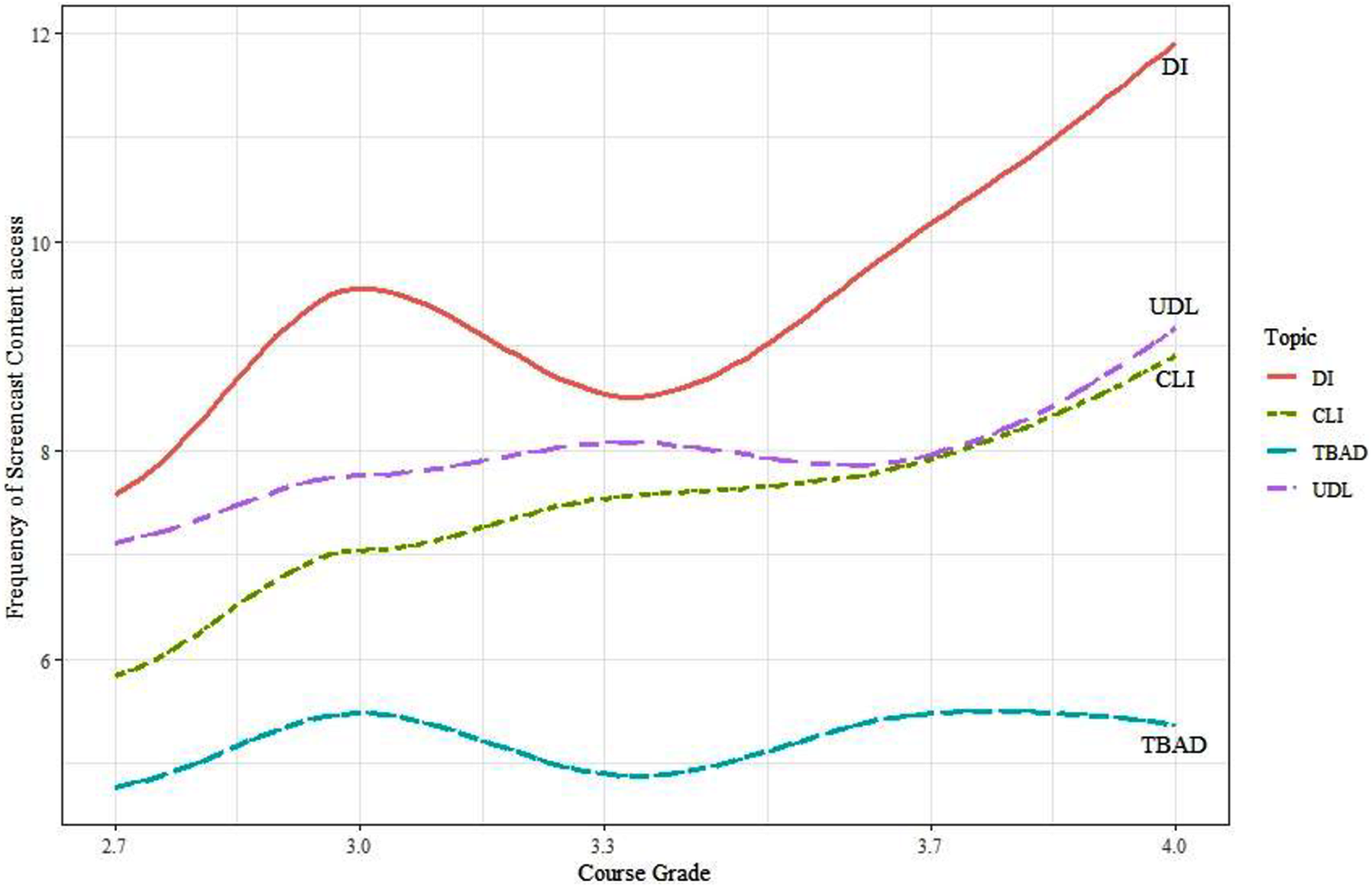
Smoothed relationship between the frequency of screencast content accesses and course grades.
Examination of the Quiz Content features also revealed significant associations. Interestingly, this association was not uniform across topics. The association was statistically significant only for the CLI (Cramer’s V = 0.14, CI: 0.10–0.34) and UDL (Cramer’s V = 0.277, CI: 0.19–0.40) topics and not across all grades. There was a statistically significant association for students with grades A− to B+ in both CLI and UDL (p ≤ 0.05). In other words, students who took advantage of two quiz attempts in CLI and UDL were more likely to receive grades A− to B+. Finally, the relationship between Final Exam Review Quizzes and academic performance was statistically significant but negative only for DI (Spearman’s ρ = −0.15, CI: −0.278 to −0.01) and UDL (Spearman’s ρ = −0.20, CI: −0.32 to −0.05) suggesting students who accessed these quizzes more frequently had lower grades.
Discussion
Both UDL principles and blended learning formats are being widely adopted across K–12 and postsecondary learning environments in North America. Thus, preservice teachers will be expected upon graduation to implement evidence-based UDL and blended learning practices in their classrooms. As pointed out in previous research (Applegate & Applegate, 2004; Binks-Cantrell et al., 2012) teachers cannot, and do not, teach what they don’t know so without direct engagement it is likely that preservice teachers will feel ill-equipped or fail to implement these concepts. The present study was motivated by the need to provide preservice teachers with live modeling of UDL and blended learning embedded in online course features in a required course on Inclusion.
Engagement With Access and Contents Features
How did the preservice teachers engage with the online features developed for the inclusive education course? Recall, the online blended learning access and content features were developed to be connected with UDL principles (see Figure 1). Aligned with the principle of Multiple Means of Representation, screencasts could be watched accompanied by oral narration and closed captioning or read as a written text customizable in size, contrast, color, layout, and font. Additionally, screencasts were aligned with the principle of Multiple Means of Engagement in that they could be watched or read repeatedly, in full, in part for the purposes of review or clarification, or to increase comprehension, from any device, location, and time of day. The quiz components were developed to align with the principles of Multiple Means of Action and Expression and Multiple Means of Engagement. Topic quizzes and Final Exam Review quizzes which although timed could be completed on any device, location, day of the week, and time of day. Additionally, the two attempts provided for Topic quizzes with immediate feedback on accuracy provided students with opportunities to review material and demonstrate increased understanding on the second quiz attempt.
Examination of the learning management system login data revealed that the preservice teachers took full advantage of these features. The 30 screencasts were watched 6,766 times by this group of 197 preservice teachers and as shown in Figure 3 engagement corresponded with topic coverage in the course. Final Exam Review quizzes were also viewed repeatedly (18,302 views). Approximately 50% of students used the two quiz attempts opportunity for the DI, UDL, and TBAD topic quizzes and 80% for the CLI quiz. Although not definitive, a possible explanation for the higher number of CLI quiz attempts is that students had some previous exposure to the other course topics in their undergraduate program but this may have been the first course with content related to developing specific supports for students with disabilities, a focus of the CLI topic, and thus required more attention and study than students initially thought to acquire and understand the new material.
Implications for Access and Contents Features
Technology is an integral part of UDL and as such offers a critical means by which to overcome learning barriers and to design learning environments with fewer barriers right from the start (Meyer et al., 2014). It was reasoned that the blended learning format would inherently capture UDL principles and thus was a good fit in making intentionality regarding UDL highly visible for these preservice students. Edyburn (2010) describes UDL as a learned skill, and one that is refined over time; thus, live modeling of access and content features aligned with UDL principles provided exemplars for preservice teachers to adopt and cultivate in their future teaching practice. Burgstahler (2010) adds that experience with digital solutions can change attitudes about diversity and disability and support destigmatising disability. In fact, our preservice teachers with vision, learning, language, or reading difficulties indicated that this was the first course they didn’t need to ask for accommodations because they were built into the online components.
Further, it can be challenging for instructors to know if students are completing textbook readings with traditional textbooks. Replacing traditional textbooks with online materials makes it possible for instructors to monitor when and how often students engage with the material. Knowing that students are engaging with course materials is not only helpful for course instructors, but live modeling of such techniques provided these preservice teachers with exemplars they can apply in their future careers.
Specific to post-secondary contexts, similar to previous research (e.g., Montgomery et al., 2019; Owston et al., 2013) the present study revealed that the blended learning format allow students to successfully navigate multiple responsibilities of school, work and family. Hayward and Wasniewski (2015), who examined student course format preferences with the first cohort of students taking the same inclusive education course in the same format reported students preferring blended learning because of accessibility to course material and resources, flexibility of learning pace, and management of work and home life responsibilities.
The online screencasts played an integral role in reducing the attentional resource demands that can be problematic for many undergraduate students in traditional lecture formats, for example, information missed due to absence, distractions during a lecture, and reluctance to ask for clarification or repetition of content not heard or understood in the moment. Owston et al. (2013) and Hayward and Wasniewski (2015) also found that well designed online content increased time and spatial flexibility for study.
Achievement
What were the relationships between student engagement with the online access and content features and academic achievement in the course? Significant but small associations were found across all four access features (Location, Day-of-Week, Time-of-Day and Regularity) but only for Regularity was the association considered moderate. This finding reinforces the growing empirical evidence from previous studies on blended learning across different disciplines (e.g., Montgomery et al., 2019; You, 2016) that students who access course materials on a regular basis are also higher achievers.
Additionally, significant associations were found for content features and academic achievement. More frequent viewing (i.e., watching or reading) of screencast content was associated with higher final course grades. The quiz data revealed that offering two quiz attempts did not impact the highest (A+ to A) and lowest (B to B-) achievers in the course. Owston et al. (2013) suggests that high achievers tend to have a set of strategies that support achievement in any course format but the lowest achievers may require further consideration. These preservice teachers were only the second cohort of students to take the course in a blended learning format. The course had previously been taught in a traditional F2F lecture format. Interestingly, the same letter grade cut points were used across both formats and the lowest grade achieved in the blended learning cohorts was a B− while in the F2F formats letter grades as low as C− were common. Thus, the blended learning format may have supported better achievement for a wider group of generally lower performing students than anticipated and confirmed the US Dept. of Education (2010) finding that students who took blended learning performed better on average to those taking it as F2F.
An unexpected finding was the negative relationship we found between Final Exam Review quizzes and course grades wherein the more often students reviewed these quizzes the lower their letter grade. Review quiz questions were drawn from the Topic quiz question bank so students had previously seen or been exposed to similar questions. Interestingly, review quizzes are frequently requested by students to aid in their Final Exam study; however, it may have been that lower achieving students place too much emphasis on review quizzes as a study strategy rather than as one component of an exam study regimen. It would be of interest in future studies to determine what course components students use to support final exam preparation.
Implications for Achievement
Although GPA provides an incomplete image of academic success it is a commonly used measure. Previous research suggests that achievement in blended learning is influenced by a student’s ability to accept responsibility for their learning particularly outside of the classroom (Owston et al., 2013). Additionally, Dalfen et al. (2018) found that students tend to have higher course grades when course quizzes provided information on the accuracy of their answers, similar to the Topic quiz structure in the present study; however, Dalfen et al. found this effect was greater for higher performing students. Owston et al. (2013) suggest that lower performing students might need more structure and may not have the independent study skills that blended learning requires.
The design of the course in the present study was organized around UDL principles to create a learning flow that prompted frequent and regular engagement with online materials. Screencasts in the course are related to F2F active learning, to topic quizzes, and the final exam; thus, the course structure encouraged students to access online content more regularly and verified in the Regularity data, wherein only 8% of students did not access the online course content regularly. While higher achieving students may have well developed self-regulation strategies that they deploy irrespective of course format, designing the course following UDL principles which by their nature addresses learner variability and removes or reduces barriers in the curriculum (e.g., course materials, sequence of course activities and quizzes, link between course content and quizzes) may have served to co-regulate student engagement with course content and functioned as a self-regulation enabler by providing structural support that Owston et al. (2013) report lower performing students need.
Limitations
It is important to acknowledge that live modeling of UDL in the digital course components of a blended learning course was not a perfect model. Live modeling of the three UDL principles was provided but each UDL principle has 9–12 guidelines. Not all guidelines apply in every circumstance so it is important for postsecondary instructors and future K–12 teachers to examine each principle and guideline to determine which are relevant to supporting curriculum access for the diverse students in their classrooms.
Further, for this group of 197 preservice teachers, it was the first course taken within a blended learning format. It may be that different levels of engagement may have been observed with students who have greater student familiarity with the blended learning delivery format. Only preservice teacher engagement in terms of their log actions for online components of the course was examined. No data was collected regarding engagement during the F2F course components or learning about UDL or blended learning that they can see themselves applying in their future practice. The addition of preservice teacher interviews could add richness to this quantitative data on engagement in future studies. Additionally, future studies could follow preservice teachers longitudinally to examine which features incorporated into their teaching practice.
Significant relationships between students’ engagement and academic achievement reported in this study are correlational, and as such, do not imply causation. There are links between achievement and various student factors (e.g., background, maturity, level of class attendance, subject content etc.). However, lower performing students may need more structure or different levels of types of supports. Although anecdotal, students taking the course in the blended learning format with UDL designed access and content features performed better than students who had taken the course in the F2F format so these features were supportive. Nonetheless, 8% of students did not participate regularly even with such intentional course design. In light of this finding it would be of interest in future studies to interview low performers or low participators to discover what factors led to their lack of regular engagement to determine if there are solutions that could be incorporated into the curriculum course delivery.
The generalizability of our results is limited by our sample selection, the context in which the study occurred, and the specific approach to the observational data we collected. Our findings provide a general framework for how the principles of UDL and blended learning can be used together in the context of this study and post-secondary course. Future studies can plan for more robust research designs such as Randomized Control Trial and measures of student engagement that allow for multivariate analyses. Such consideration can help improve the generalizability of findings.
Conclusion
Institutions of higher education have an opportunity to lead the change in terms of creating accessible environments of postsecondary learners. In a Faculty of Education this is particularly important since preservice teachers will be responsible for educating students in K–12 environments (Hall & Marks, 2018). The present study has shown that intentional design and live modeling of UDL principles and a blended learning delivery format supported student engagement with the learning management system and content and overall course achievement. This format provides future teachers and university instructors with exemplars of UDL principles and tools to monitor engagement with course content. Results regarding Regularity found in the present study lend support to growing cross-disciplinary evidence that regular engagement is integral to student success in any blended learning model. Interestingly, our work suggests that a blended learning /UDL format provided co-regulation, particularly for lower performers and non-regular participants, and merits ongoing investigative consideration.
Footnotes
Declaration of Conflicting Interests
The author(s) declared no potential conflicts of interest with respect to the research, authorship, and/or publication of this article.
Funding
The author(s) received no financial support for the research, authorship, and/or publication of this article.
