




Abstract
This manuscript describes an early childhood educator working collaboratively with a speech language pathologist and using an augmentative and alternative (AAC) device (iPad™ application) to label target vocabulary during shared book reading as an inclusive practice. The child throughout the vignettes includes a young boy identified with autism spectrum disorder who has limited verbal communication. The focus of this manuscript is using traditional wh- questions within level one of dialogic reading paired with an AAC device during shared book reading sessions. Step-by-step procedures that can be used widely including adaptations and considerations for individualizing instructions are provided. Resources and additional supports are discussed.
Keywords
Harold is a 4-year-old, African American boy who receives special education services for Autism Spectrum Disorder (ASD) and developmental delay (DD) in an inclusive preschool classroom. Harold has limited verbal communication skills and typically communicates with peers and educators through vocalizations and a few single-word utterances (e.g., dog, yes, no). Although Harold’s vocabulary repertoire is limited, his verbal communication can be understood by his peers and educators. He demonstrates an interest in books that are available in the classroom by often bringing a book to his teacher, Ms. Leigh, during free play. During these instances, Ms. Leigh utilizes shared book reading techniques including Dialogic Reading (DR); however, Ms. Leigh is concerned about Harold’s ability to actively participate.
Ms. Kim, Harold’s speech-language pathologist (SLP), has collaborated with Ms. Leigh to introduce an augmentative and alternative communication (AAC) system to address Harold’s Individualized Education Program (IEP) goal of using words to express his wants and needs during classroom activities. As Ms. Leigh thinks about Harold’s use of the AAC system, she wonders if Harold might be more engaged in DR if he were able to use the AAC system to communicate. She decides to discuss this with Ms. Kim at their weekly team meeting.
Vocabulary acquisition is a key component of oral language development (Carlson et al., 2013). Vocabulary development is a foundational element for reading comprehension (Dickinson & Darrow, 2013). If a child is able to read words, but does not understand the words they are reading, they will be unable to comprehend text (Whalon et al., 2009). Many Children with disabilities experience challenges with both vocabulary and reading comprehension (Carlson et al., 2013).
Children with ASD experience deficits in expressive language, play, joint attention, and imitation, which are all associated with later language outcomes (Luyster & Lord, 2009). In addition, children with ASD are particularly important to focus on as they are increasing in prevalence (Center for Disease Control, 2020). Therefore, it is important to intentionally embed language interventions that enhance vocabulary development in order to support future reading comprehension (Dickinson et al., 2010; National Early Literacy Panel [NELP], 2008). With the majority of children identified with ASD receiving special education services in early childhood environments (Center for Disease Control, 2020), it is critical to consider how vocabulary interventions can be embedded within classroom routines.
Everyday activities in early childhood classrooms include child-led activities, teacher-led activities, and routine activities (Johnson et al., 2015). Each of these can be used to effectively teach vocabulary (Rahn et al., 2016). One teacher-led routine that regularly occurs within preschool classrooms is shared book reading, a process in which educators read storybooks to children and engage in discussion throughout the book (Bowman et al., 2001; Snow et al., 1998). A specific type of shared book reading that is associated with evidence of enhancing vocabulary acquisition is DR (National Early Literacy Panel, 2008; What Works Clearinghouse, 2007). In DR, the educator first reads the story, then asks questions regarding the illustrations to enhance children’s identification and understanding of the vocabulary pictured within the story (Fleury, 2015). The educator asks questions by providing three levels of prompts (Flynn, 2011). In level one, the goal is to develop the necessary vocabulary from the pictures in a story by using wh- questions (e.g., “What is this?” “What is it used for?”). During levels two and three the educator asks open-ended questions and prompts children to make connections with their personal experiences (Flynn, 2011).
During each level of DR, the child assumes an active role by engaging in a dialogue in response to adult-directed question prompts (Flynn, 2011; Whitehurst & Lonigan, 1998). To engage and appropriately respond to children, the educators use a PEER sequence (see Figure 1). This includes
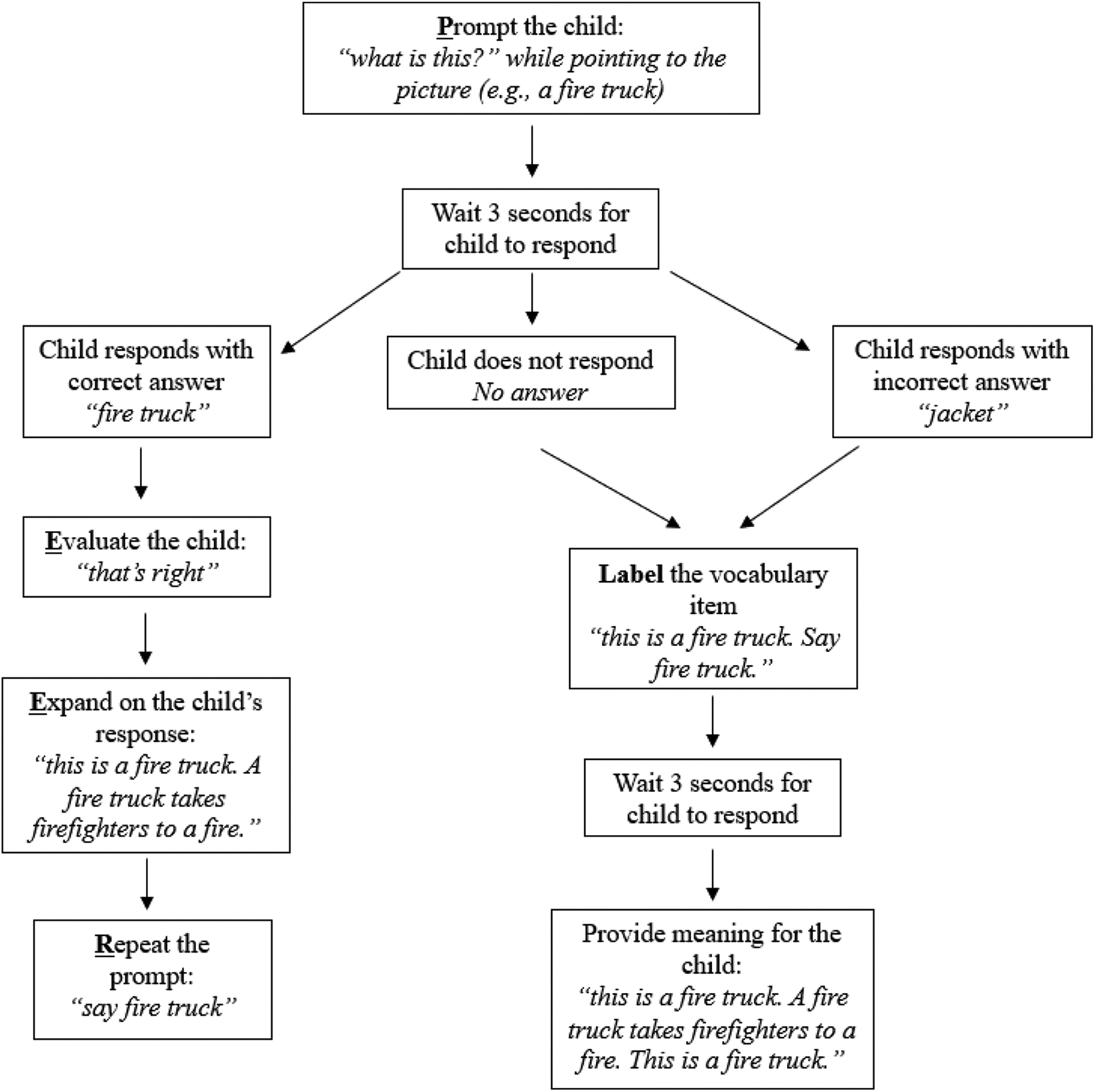
Visual decision tree for PEER sequence.
Resources for DR Techniques and Selecting AAC Devices.

For children with ASD or DD to benefit from DR, it is important that they have access to and receive appropriate support (DEC/NAEYC, 2009). Inclusive early childhood programs ensure the right of all children and their families to participate in a broad range of activities when they provide adequate access, participation, and support (DEC/NAEYC, 2009). Although DR has been identified as an evidence-based practice (EBP) for children at risk for delays and has demonstrated effectiveness for other populations, researchers have been studying how to make DR accessible and engaging to all learners. This includes supports such as attentional cues, prompts, or technology-enhanced stories (Rahn et al., 2016; Fleury & Schwartz, 2017; Plattos, 2011). Evidence from these studies suggests DR is promising for improving the oral language, target vocabulary, and engagement of young children with ASD (Rahn et al., 2016; Fleury, 2015; Fleury & Schwartz, 2017; Pamparo, 2012; Plattos, 2011).
For young children who have experienced difficulties with language and communication delays, additional support such as AAC systems may be necessary (American Speech-Language-Hearing Association [ASHA], 2005). The use of AAC systems to enhance the social-communication of individuals identified with ASD is common (Morin et al., 2018). For children with ASD who have limited or no verbal communication skills, AAC systems may be necessary to support participation during literacy activities (Gevarter et al., 2014). AAC systems, which can provide voice output when the child activates the system, allow the child to communicate with others in the environment. AAC systems have been associated with increased language and literacy outcomes for young children with ASD and other disabilities (Dunst et al., 2012). Although AAC systems may be an appropriate accommodation for some children, it is critical that educators intentionally consider children’s strengths and needs to identify appropriate accommodations during shared reading activities such as DR.
Implementing DR
Children with ASD or DD who have limited verbal communication can use an AAC system paired with a system of least-to-most prompts (e.g., verbal, gesture, hand-over-hand) (Barton & Wolery, 2010) to participate in shared reading experiences while demonstrating their ability to label target vocabulary during DR. By following a sequence of steps, children with ASD or DD who have limited verbal communication can use a technology-enhanced AAC system to increase participation and vocabulary use during DR. Although DR can be used in small and large group settings, this example focuses on the implementation with one child.
At their weekly team meeting, Ms. Kim and Ms. Leigh talk about Harold’s use of the AAC system in the classroom. Ms. Leigh brings up her idea of using the AAC system during DR. Their observations and data on Harold’s IEP goal suggest that he is beginning to use the AAC system to communicate his wants and needs. They are both excited about his progress. Ms. Leigh feels that this technology-enhanced support would increase Harold’s engagement and participation during shared book reading by giving him a way to use key vocabulary to answer wh- questions. Ms. Kim agrees that this would be a great way to increase Harold’s vocabulary and provide additional opportunities for communication. Ms. Leigh and Ms. Kim do some research on prompting to support Harold’s ability to respond during DR. Ms. Leigh finds that least-to-most prompting strategies can support a child’s ability to attain new skills (Snell & Brown, 2011). Together, they begin planning to implement adapted DR paired with least-to-most prompting strategies for Harold as part of Ms. Leigh’s upcoming unit on community helpers. Additionally, Ms. Leigh considers strategies to let Harold know when it is time to work one-on-one. Ms. Leigh selects a first-then card to initiate Harold’s transition from play to DR. Ms. Leigh also knows it is important to navigate through a series of steps to implement DR effectively for all children.
Step 1: Selecting Appropriate Materials
The first step is selecting appropriate materials for DR. Books are the primary materials that educators use when delivering DR. DR books should have limited text, and a variety of illustrations that will introduce new vocabulary to support expressive language (Buysse et al., 2011; Flynn, 2011). Books selected for DR should contain illustrations that are realistic because the pictures will be used as models for target vocabulary. Additionally, educators should consider child preferences and interest as this may impact child engagement (Robertson et al., 2017; Scarborough & Dobrich, 1994). One way that educators can assess child preferences is by following the child’s lead. For example, the theme of the appropriate materials should follow the interest of the child to enhance engagement (Lahey, 1988). Educators can also engage in a preference assessment in which they present various stories to the child to determine which one the child selects. For example, the educator can choose six stories presenting two stories at a time and prompt the child to pick one. Once the educator goes through each round (total of three), the educator would have the child’s top three choices. Then the educator could present these three stories, and prompt the child to pick one until there is only one left. This would provide the educator with the child’s story preferences (Fisher et al., 1992). Interest-based learning may provide additional opportunities for teaching vocabulary throughout classroom routines as educational materials can be embedded into the curriculum (Boyd et al., 2012).
Harold’s family lives down the street from a local Firehouse. He often plays in the block area with the fire trucks, scooting them back and forth of the street carpet. As part of the unit on community helpers, and keeping Harold’s interests in mind, Ms. Leigh selected the book
Step 2: Identifying Target Vocabulary
Target vocabulary should be developmentally appropriate, clearly illustrated in the book, and novel (Coogle et al., 2018; Flynn, 2011). Research suggests the educators should select Tier 2 words, which are likely unknown to preschoolers and occur in other contexts outside of the book reading (Beck et al., 2002; Flynn, 2011). To identify Tier 2 words, the educator reviews the book and selects words that are probably unfamiliar, but represent concepts or ideas children already know (Beck et al., 2002). For children who are non-verbal or have limited vocabularies, educators may also consider including high-frequency Tier 1 words (e.g., dog, baby) that usually do not require teaching. Educators should select a variety of types of Tier 1 and Tier 2 words using their knowledge of the child’s language and vocabulary development. By teaching a combination of Tier 1 and Tier 2 words, educators will help build the child’s vocabulary knowledge and ensure the child’s ability to participate meaningfully in shared reading activities (e.g., by being able to use an AAC system to answer questions about the book) with their peers. After selecting a variety of Tier 1 and Tier 2 words, educators should conduct a pretest.
Ms. Leigh selected primarily Tier 2 words that she would focus on as she read the book to her whole class using DR. For Harold, however, she realized that she may want to teach a combination of Tier 1 and Tier 2 words. Ms. Leigh and Ms. Kim met to discuss which words they would want Harold to learn during DR and which words would support Harold in engaging with his peers during routines such as Dramatic Play and Recess. Potential words included: ambulance, binoculars, boots, dog, firetruck, flashlight, hat, hose, jacket, ladder, phone, and watch. Ms. Leigh and Ms. Kim also identified the page where each illustration best depicted the target vocabulary so that Ms. Leigh would know when to engage in the PEER sequence.
Step 3: Conducting an Informal Pretest
After selecting potential target vocabulary, the next step is conducting a pretest to determine which of these words the children already know. Conducting a pretest to determine a child’s receptive understanding of each word is an important step in determining which words to teach. Although the intervention is focused on the child’s use of target vocabulary (i.e., expressive use of a word), we recommend assessing receptive understanding in the pretest because children with ASD may have limited verbal communication skills, but may be able to receptively identify an object since this is usually an earlier developing skill. Given that children with ASD may have atypical receptive-expressive language profiles (McDaniel et al., 2018; Woynaroski et al., 2016), educators may want to also assess the child’s expressive understanding prior to selecting words to teach (e.g., showing the vocabulary item and asking “What is this?”). This informal assessment sets the stage for realistic expectations of children including the creation of measurable goals (Wilczynski et al., 2007). By identifying measurable goals, educators can consider interventions that intentionally align with the goals. In this case, the intervention should be aligned with unknown vocabulary words.
Ms. Kim Administered an informal pretest to determine which target vocabulary words from the book Harold already knew (see Supplemental Appendix A). During the adult-led centers, Ms. Kim worked one-on-one with Harold to administer the pretest by opening the book to the first page containing a pretest vocabulary item, and saying, “Where is the dog?” or “Show me the dog,” and recording Harold’s response as correct or incorrect. A response was correct if Harold pointed to or touched the vocabulary item, and a response was incorrect if Harold did not respond, or pointed to something other than the intended picture. This process was repeated for the remaining pretest vocabulary items in the order they appeared in the book.
After completing the pretest with Harold, Ms. Leigh and Ms. Kim selected eight vocabulary words that Harold did not yet correctly point to and that would be most useful in building his vocabulary. Because introducing eight words at a time would be overwhelming for Harold, and because they wanted to see if Harold would learn the words using DR, Ms. Leigh selected four of the vocabulary words. Since Harold was learning new vocabulary and working with an AAC system, Ms. Leigh decided that one of Harold’s goals for this learning unit was to correctly identify four vocabulary words using his AAC system with prompts as needed. Ms. Leigh then used sticky notes to flag pages within the book to identify where DR prompts and responses should be used.
Step 4: Considerations for Accessibility
When working with young children who are non-verbal or have limited vocabularies, additional considerations should be made regarding the need for and selection of technology, AAC, and/or technology-enhanced AAC systems. In alignment with the guidelines from the ASHA, the selection of an AAC system should be flexible, adaptable, and build on the strengths and needs of the child (ASHA, 2020).
Ms. Kim and Ms. Leigh met to discuss how to use Harold’s AAC system during DR, including options for programming it with vocabulary from the storybook. Ms. Kim selected an iPad™ with GoTalk NOW Lite™, a communication application with picture symbols and speech-generating capability, as Harold’s AAC system. She chose GoTalk NOW Lite™ because of its affordability (Muharib et al., 2019) and compatibility with the iPad™, which Ms. Leigh already utilized in the classroom. She then created a GoTalk NOW Lite™ page with four color photographs similar to those in the book, one for each of the four vocabulary words (see Figure 2). This would allow Harold to touch the picture to answer wh- questions during the book reading. Ms. Kim recruited one of Harold’s peers to help them program a voice recording of each vocabulary item. Ms. Leigh and Ms. Kim also discussed how they would measure Harold’s progress during the intervention. They decided to use a checklist (see Supplemental Appendix B) to record Harold’s responses to the wh- questions during each book reading including the level of prompting needed. They agreed that Ms. Leigh would implement the intervention with Harold one time per day, three to four times per week and that they would meet in 2 weeks to discuss his progress. With the materials ready, Ms. Leigh and Ms. Kim were eager to begin intervention.

Sample communication page using GoTalk NOW Lite™ Application (image used with permission of Attainment Company, Inc.).
Step 5: Delivery of Vocabulary Intervention
The next step is delivering the vocabulary intervention (DR). The educator first reads the story at least one time by presenting the title, author(s), and illustrator(s) of the book, and introducing the premise of the story (e.g., “this book is about children going on a trip to the firehouse.”). After this initial reading, the educator provides prompts by moving through the procedures of DR (i.e.,
During free play, Ms. Leigh gathered the DR materials including the storybook and the iPad™ with the GoTalk NOW Lite™ application. After using a “first, then” card to let Harold know that they would first read and then he could play on the computer, Ms. Leigh sat on the floor of the library area next to Harold. She held the book in front of him and placed the AAC system open to the GoTalk NOW Lite™ application in front of Harold. She showed Harold the cover of the book, read the title, and then read a shortened version of the book that included pages critical to the storyline. For each target vocabulary item, Ms. Leigh used an orienting cue to get Harold’s attention (Koegel et al., 2009), pointed to the picture, and delivered the wh- question (e.g., “what is this?” or “what are these?”). If Harold answered correctly (i.e., said the target vocabulary item or pushed the corresponding button on the AAC system), Ms. Leigh provided a confirmatory response (e.g., “Yes, that’s a jacket”). Ms. Leigh then told Harold the function or meaning of the word (e.g., “A jacket helps keep a firefighter’s body safe. Look, they are getting ready to put their jackets on.”). Ms. Leigh continued reading the book, pausing to teach the remaining three target vocabulary items. If Harold did not answer correctly, Ms. Leigh followed a series of least-to-most prompts to scaffold his learning of the word.
When Harold said nothing or answered incorrectly (i.e., said anything other than the target vocabulary item, pushed a button on the AAC system for any item other than the target vocabulary item), Ms. Leigh
Step 6: Ongoing Data Collection and Data-Based Decision Making
The next step is using ongoing data collection to inform decision making. When educators identify measurable goals for individual children, they can select interventions (e.g., DR) and track progress (Wilczynski et al., 2007). Educators should meet regularly (e.g., bi-weekly) to discuss data, progress, and areas of need to shift learning experiences as necessary.
After implementing one DR intervention session per day for two weeks, Ms. Leigh met with Ms. Kim to review the data she collected on Harold’s vocabulary word learning. Reviewing the data, they found that Harold was demonstrating an increase in spontaneous vocabulary responses and responding with varied levels of support from Ms. Leigh (See Supplemental Appendix B). They also found that Harold was making greater progress on the vocabulary being taught using DR than on the vocabulary not being taught at all. This suggested that the adapted DR procedures were helping Harold learn new vocabulary words and encouraged them to continue using DR with the GoTalk NOW Lite™ application with Harold.
Step 7: Extending Vocabulary Learning
The next step is to continue to embed experiences for children to extend their vocabulary learning to maintain these target words in their repertoire (Lonigan & Flynn, 2012). For children who are non-verbal or have limited vocabularies, the educator is encouraged to embed expansions that are short and simple, add to the child’s original response, and stress new words (Flynn, 2011). Level three of DR includes opportunities for the child to connect the book to their life (Flynn, 2011). This includes asking the child questions about the book’s theme (e.g., “Have you ever seen a fire truck?”). In level four of DR, the educator provides opportunities for children to practice the newly learned vocabulary in different activities throughout the day (Lonigan & Flynn, 2012). For example, educators can reinforce new vocabulary by planning art activities related to the book and providing dramatic play materials and toys focused on the theme are available in the classroom (Rahn et al., 2016; Lonigan & Flynn, 2012).
Although the classroom unit of community helpers was coming to an end, Ms. Leigh continued to look for opportunities to embed Harold’s target vocabulary into the classroom routine to support maintenance and generalization of those words. For example, the fire station toy would remain in the free play area of the classroom, providing an opportunity for Harold to use the iPad™ with the GoTalk NOW Lite™ application to communicate during play. Ms. Kim and Ms. Leigh both joined Harold in the free play area and made sure the AAC system was available to him, giving him opportunities to use newly learned vocabulary when interacting with peers during play. In their weekly planning meetings, they discussed books and vocabulary words they would teach Harold during DR as part of an upcoming unit on transportation.
Strengths of DR
DR is a widely used, shared reading intervention approach with evidence of positive effects for young childrens’ expressive vocabulary (NELP, 2008; Whitehurst & Lonigan, 1988). Consistent with research related to shared reading, DR has been shown to be effective in oral language development (WWC, 2007). Further, DR has evidence of support for children from low-income families (Rahn et al., 2016; Lonigan & Whitehurst, 1998; Whitehurst & Lonigan, 1998), children with language delays (Crain-Thoreson & Dale, 1999; Hargrave & Sénéchal, 2000), and children with disabilities (Fleury et al., 2014). The implementation of DR is also a benefit as educators are trained in a short period of time within minimal ongoing support and adaptations can be implemented across a variety of children’s books (Fleury et al., 2014).
Considerations for DR
One limitation of DR is the small number of studies that have been conducted on using DR with children with ASD (Fleury et al., 2014). Further, there are discrepancies between the receptive-expressive profiles of children with ASD (McDaniel et al., 2018; Woynaroski et al., 2016), indicating a need to add to the body of literature in this area. Further, there are additional evidence-based practices that can be used to enhance expressive vocabulary for children with ASD (e.g., naturalistic intervention) (Odom et al., 2010). Naturalistic intervention provides opportunities for children to practice developmentally appropriate and socially meaningful skills within the context of everyday routines and activities (DEC, 2014). It is important to individualize intervention to the needs of the child.
Conclusion
In summary, it is important to consider the ways in which educators can include children with ASD in shared book reading activities such as DR as this approach can be used to enhance the expressive vocabulary of all children. Further, it is critical to ensure that all children have access to, and receive the support needed to participate in the classroom (DEC/NAEYC, 2009). The challenges many children with ASD experience can restrict access and engagement particularly during embedded vocabulary interventions such as DR (Koegel et al., 2009). The use of instructional strategies (i.e., attentional cues and prompts) and support from technology-enhanced stories have shown to support the access, participation, and support of young children (Rahn et al., 2016; DEC/NAEYC, 2009; Fleury & Schwartz, 2017; Plattos, 2011). Research has established evidence to support DR as a method for enhancing the oral language, target vocabulary, and engagement of young children with ASD (Rahn et al., 2016; Fleury, 2015; Fleury & Schwartz, 2017; Pamparo, 2012; Plattos, 2011). However, for young children who have experienced difficulties with language and communication delays, the exposure to EBPs may not be enough to support their participation and engagement. The use of AAC systems to enhance support for young children with ASD may enhance their social-communication (Morin et al., 2018) and further support their access and participation within early childhood classrooms (DEC/NAEYC, 2009). Therefore, early childhood educators can ensure access and participation of children with ASD in DR activities through specific accommodations such as technology-enhanced AAC systems.
Supplemental Material
Supplemental Material, sj-docx-1-jst-10.1177_0162643421999004 - Technology-Enhanced Dialogic Reading Experiences for Children With Developmental Disabilities
Supplemental Material, sj-docx-1-jst-10.1177_0162643421999004 for Technology-Enhanced Dialogic Reading Experiences for Children With Developmental Disabilities by Sloan O. Storie, Christan Grygas Coogle and Naomi L. Rahn in Journal of Special Education Technology
Supplemental Material
Supplemental Material, sj-docx-2-jst-10.1177_0162643421999004 - Technology-Enhanced Dialogic Reading Experiences for Children With Developmental Disabilities
Supplemental Material, sj-docx-2-jst-10.1177_0162643421999004 for Technology-Enhanced Dialogic Reading Experiences for Children With Developmental Disabilities by Sloan O. Storie, Christan Grygas Coogle and Naomi L. Rahn in Journal of Special Education Technology
Footnotes
Declaration of Conflicting Interests
The author(s) declared no potential conflicts of interest with respect to the research, authorship, and/or publication of this article.
Funding
The author(s) received no financial support for the research, authorship, and/or publication of this article.

Supplemental Material
Supplemental material for this article is available online.
References
Supplementary Material
Please find the following supplemental material available below.
For Open Access articles published under a Creative Commons License, all supplemental material carries the same license as the article it is associated with.
For non-Open Access articles published, all supplemental material carries a non-exclusive license, and permission requests for re-use of supplemental material or any part of supplemental material shall be sent directly to the copyright owner as specified in the copyright notice associated with the article.
