



Abstract
There is a growing recognition of the importance of effective instruction in the STEM subjects, including science. The movement towards increased requirements and expectations in science presents a challenge to both students and teachers as many students with Learning Disabilities (LD) often struggle, particularly in their science classes. The purpose of this study was to investigate the use of a technology intervention targeting the acquisition of science vocabulary for adolescents with LD in a general education secondary biology classroom. Additionally, a purpose was to examine the usability and feasibility of a tech-based science vocabulary intervention for secondary science teachers. Participants for this study included three secondary students with LD who were enrolled in a biology class. A multiple treatment reversal design was used to compare the effects of a keyword mnemonic vocabulary intervention via index cards or iPod touch on student vocabulary acquisition. All students acquired the content vocabulary equally well during both conditions. It was clear that the students had a strong interest in using technology to increase their grades and engagement; however, the teachers had little access and training on using technology to support their students with disabilities.
Keywords
The challenges for students with Learning Disabilities (LD) are specifically prevalent in Science, Technology, Engineering and Math (STEM) coursework, given the hefty demands of vocabulary terms and concepts (Therrien et al., 2011) as students with LD tend to struggle with vocabulary and language-based learning activities (Jitendra et al., 2004). Students with disabilities generally earn lower grades than their peers in general education (Newman et al., 2011) and specifically perform significantly below their peers without disabilities in science, reading, mathematic, spelling, and written expression (Scruggs & Mastropieri, 1993; Reid, Gonzalez, Nordness, Trout, & Epstein, 2004). Specifically troubling for students with disabilities, science is often associated with the memorization of vocabulary that fits within complex theories and processes. This is a particular concern in that vocabulary knowledge directly contributes to comprehension of the curriculum (Snow, 2002). Moreover, fluency of content area vocabulary use has a direct effect on understanding of more complex concepts (Rupley & Slough, 2010). The movement towards increased requirements and expectations in science (NGSS Lead States, 2013) presents a challenge to both students with disabilities and teachers; and the requirement to pass a state subject exam is a formidable challenge as many students often particularly struggle in their science classes (Mallow et al., 2010; Millar, 1991; Myers & Fouts, 1992). A larger concern is that this challenge may become an impasse for students in special education.
There is evidence that students with disabilities struggle in science. The National Center for Educational Statistics (NCES) reported that the average achievement-level results for students with disabilities in 4th, 8th, and 12th grades in public schools were drastically lower than for students without disabilities (Aud et al., 2011, US Department of Education, 2019). Over 50% of 4th grade students with disabilities averaged a score below basic, compared to 26% for students without disabilities. For eighth graders, 67% of students with disabilities were below basic, compared to 34% for students without disabilities. For 12th graders, the average score was 117 for students with disabilities and 152 for students without disabilities (percentage of students reaching at or above basic was not available) (Aud et al., 2011; Planty et al., 2009). These scores and differences follow the trends over the last 25 years. (National Center for Education Statistics, 1996; 2000; 2005).
The Promise of Technology
While technology has been found to be highly valued and supported for students with disabilities (Christ, 2008; Jones et al., 2020; Zabala et al., 2000), little research has been conducted on how it can support the academics and engagement of students with LD in a science classroom (Leddy, 2010; Shifrer & Callahan, 2010). Likewise, while technology has shown promise for the specific acquisition of vocabulary (Kuder, 2017), little has been studied on the use of educational technology to support learning science vocabulary (VanUitert et al., 2020). One exception, specifically for secondary students, includes VanUitert and colleagues (2020) recent study that demonstrated enhanced vocabulary based on incorporation of multimedia videos. Additionally, these researchers showed that the more students viewed the videos, the better their scores.
Even though little research has been conducted to determine if the use of technology increases the academic success (learning) of students with disabilities in a science classroom, data from other disciplines are promising and this practice should be investigated further. For example, Arthanat and Curtin (2013) found that for students with developmental disabilities (DD), academic scores improved during the course of iPad use (compared to standard computer use). Similarly, McClanahan et al. (2012) found that the use of an iPad facilitated both attention and learning. So much so that the student gained 1 year’s growth in reading within a 6-week time period. Even more promising, Marino (2010) suggests that technology-enhanced science curricula may improve the accessibility of science content for students who struggle with reading. However, Bixler (2019) found that although a one-to-one program using iPads helped promote the use of constructivist activities through the use of technology, it had no effect on academic achievement in the middle school mathematics and science classrooms. Further, research demonstrates low rates of Assistive Technology (AT) use among students with disabilities, even for students who may benefit from it (Bouck, 2016; Bouck & Long, 2020).
Statement of the Problem
While learning science may be unproblematic for some students, it can be overwhelming for others, especially those with disabilities. The consequences of not learning science or STEM in general has long-lasting disadvantages and reduces long term success in one’s life (Leddy, 2010; Matthews, 2007). For example, the National Research Council (Singer et al., 2005), reported, “most people in this country lack the basic understanding of science that they need to make informed decisions about the many scientific issues affecting their lives” (p. 1). Science teaches students how the natural world works and provides inquiry-based skills (e.g., problem solving, establishing hypotheses, and career training) (NGSS Lead States, 2013).
Justification for the Use of the Test of Vocabulary
Science has its own set of vocabulary with terms usually based in Greek and Latin roots. This vocabulary enables scientists, regardless of native language or location, to communicate and express ideas. Unfortunately, this vocabulary may be difficult for students with LD to master, as students with LD often struggle with memorization (Swanson & Zheng, 2014). Of particular challenge for students in a science classroom is that secondary level science textbooks have been determined to contain more vocabulary than that in junior high and high school foreign language courses (Yager, 1983). A compounding concern is that, specifically, biology has a larger vocabulary than any other branch of science (Herr, 2008). Additionally, compared to other content areas, the vocabulary used in a biology class can be categorized as words whose frequency of use is quite low and often is limited to the specific domain (e.g., Tier three words) (Beck et al., 2002). In order to be successful in science learning, all students, but in particular, those with disabilities, must be provided ongoing vocabulary support to develop the necessary language comprehension skills and to become competent content readers.
Justification for the Use of Imposed Keyword Condition Material
Imposed keyword condition is an intervention technique that already has a strong research base demonstrating its effectiveness (Mastropieri, 1994; Scruggs & Mastropieri, 2000). In the keyword mnemonic strategy, the keyword refers to a chosen word to represent a given vocabulary word. The keyword mnemonic strategy pairs the keyword with an illustration demonstrating how the keyword is related to the vocabulary word. The keyword and illustration are used as a prompt for students to redevelop the correct definition of the represented vocabulary word (Atkinson, 1975). King-Sears et al., (1992) modified this condition in their research study by using two cards. The first card had the vocabulary word on one side and the keyword on the other side. On a second card there was the keyword, the vocabulary word, its definition, and an illustration of the keyword and term. For example, on one side of a card may be the vocabulary word, “biomes.” On the same side would be a picture of a biome along with the definition, “large land areas where specific animals live.” On the second side, the word, “homes” would be added to connect that biome sounds like the word home (King-Sears et al., 1992). With the established research base of this technique, the intervention tested in the present study is to examine the effects in the acquisition of science content vocabulary words presented through traditional instruction medium compared to the acquisition of vocabulary presented through a technology device. The goal was not to test mnemonic interventions, but the use of the device.
The Current Study
Although data and research are available to explain why students with LD struggle in science, little research has identified how to develop appropriate curriculum and methods to effectively teach students with LD science; that is, to close the proficiency gap between students with and without disabilities. Based on a lack of research within the field of special education, it appears that further research is needed on how students with LD are able to acquire science concepts and to evaluate what academic interventions are effective to enhance their science-learning skills (Leddy, 2010; Shifrer & Callahan, 2010). This group of students has been shown to struggle in science and require interventions that can increase relevant vocabulary, engagement, and scientific understanding. Additionally, it is imperative that these interventions are learned and practiced by the general education teacher in a cost-effective manner.
The goal of this study was to increase the vocabulary and access to the general education science curriculum for the students. Specifically, the purpose of this study was to investigate the use of a technology intervention targeting the acquisition of science vocabulary for adolescents with LD in a general education secondary biology classroom. Concurrently, by gaining access to the general curriculum, students would approach the grade level standards and material that is found on the mandated high-stakes assessments. Therefore, we asked the following research questions: (1) Is there a difference in the acquisition of science content vocabulary words presented through a traditional instruction medium compared to the acquisition of vocabulary presented through a technology device? (2) Is there a difference in how students with LD and their teachers perceive the social validity of the traditional or technological instructional mediums to learn general education core content words and definitions?
Method
Participants and Setting
This study was conducted in a public high school in the Pacific Northwest. Overall school enrollment included approximately 1211 students in grades 9–12. The school’s population is approximately 1.4% Native American/Alaskan Native, 25.7% Asian, 0.8% Native Hawaiian/Other Pacific Islander, 26.5% Asian/Pacific Islander, 18.6% Black, 15.1% Hispanic/Latino of any race(s), 34.9% White, 3.5% Two or more races, a free or reduce-price meal rate of 46.7%, and 11.6% qualifying for special education services.
The participants for this study were drawn from two biology classrooms. In the high school included in the study, students primarily take biology during the 10th grade. The curriculum used was assigned by the district and followed a textbook founded around inquiry-based instruction. The instructional setting for biology was a small group. Students participated in the general education class with one student receiving support from a para-education professional.
Student Demographics.

Note. LD – Learning Disability.
Katie was a White, sixteen-year-old female student in the 10th grade. She received special education services under the category of LD for reading and writing. Ashley was an African American, sixteen-year-old female student in the 10th grade. She received special education services under the category of LD for reading and writing. Lisa was a Vietnamese American, sixteen-year-old female student in the 10th grade. She received special education services under the category of LD for reading and writing.
Research Design
A multiple treatment reversal design (Gast, 2010) was used to compare the effects of two (independent variables) instructional conditions (i.e., vocabulary intervention via flashcards or iPod touch) on student, content specific, vocabulary acquisition. The design incorporated five phases (Baseline, A1, B1, A2, B2) with 3 probes per phase where A = traditional flash cards and B = iPod touch. The A-B-A-B design is commonly used to evaluate the effectiveness of technology (Gast, 2010). At least three times per phase, students were assessed for vocabulary acquisition. During the baseline data collection period, students were given three probes of biology vocabulary words used in lessons from their textbook and provided curriculum (“Business as usual”). All vocabulary for the experiment was provided by the teachers or taken from the current chapter of the students’ biology textbook. Students met with the researcher in an empty prep-room adjacent to the classroom for approximately 5 minutes at the start of the period, during “warm up time.”
Procedure
The study was conducted over a period of 7 weeks. The baseline phase was 3 days. The intervention phase lasted 6 weeks and was implemented for approximately 5 minutes/day. Follow up data were collected at week seven of the study.
Student Screening
Student screening began in March of the 2014 academic year and resulted in identifying three students meeting the criteria for inclusion. Students meeting the criteria were offered an invitation to participate in the study. Prior to baseline, students completed a 10-word matching vocabulary quiz to assess prior vocabulary and content knowledge. Students that received above a 60% were excluded from the study, as only students that had room to detect improvement were included.
Independent Variables
Traditional (Flash Cards)
For the traditional flash card variable, 3 x 5 index cards were used. Following the demonstration of three sample words on Day 1 of the study, the researcher provided students index cards of five vocabulary words. Modifying the procedures by King-Sears et al. (1992), each index card had a vocabulary word on one side as well as the keyword. On the second side, there was the keyword, the vocabulary word, its definition, and an illustration of the keyword and term (e.g., vertebrate/verte-break, with a picture of a cartoon character with a hurt back). For consistency, the researcher created the flash cards online using the app “quizlet”, printed each side, and glued the information to each side of an index card. Students were given the index cards and were allowed to study as much as they wanted for up to 5 minutes.
High-Tech Device (iPod Touch)
For the iPod touch, the researcher uploaded digital flashcards to each technology device (via app, e.g., quizlet) that matched the look, vocabulary level, keywords, definitions, and pictures in the traditional condition. Therefore, the only difference was the delivery method of the vocabulary learning activity.
Vocabulary Probes
To determine the acquisition of science content vocabulary words, students were assessed on how many vocabulary words they learned via a short, 5 words, vocabulary probe (matching). Students were given a probe every 2 days. For example, a vocabulary schedule consisted of 5 new words on Monday and 5 minutes to rehearse. Students were then given an additional 5 minutes to rehearse the same words on Tuesday, followed by the vocabulary probe. Wednesday the students would be given 5 new words. A final probe that included words from each treatment phase was given at the end of the study to assess vocabulary retention via each acquisition method. Words from each method were flagged for comparison.
Teacher Assessments
The researcher requested traditional exam, unit, and quarter grades from teachers. These grades were used to measure if the intervention translated into a change in academic grades for each student.
Intervention Acceptability
To determine how the intervention was received by the students and teachers, surveys were used to measure teacher and student perceptions and academic growth. The surveys, adapted from Flanagan and colleagues (2013), asked various questions about their knowledge, use, and training around science vocabulary and technology. Students were also asked to perceive their experience using the index cards and iPod touches after the study was complete. Additionally, teachers were asked of their interest in continuing to use and integrate technology in the classroom after the study.
Creswell (2009) addresses various types of threats to both internal and external validity. In this experiment, threats to internal validity included regression and mortality. Research addressed each of these threats. In order to lower the chance of student attrition, three students with regular attendance were selected to participate. Additionally, iPod touches were offered to the teacher after data collection had been completed to provide an opportunity for other students to use them.
Procedural Fidelity
The primary experimenter and a secondary observer independently reviewed 40% of probes and completed a checklist of experimental procedures. Additionally, intervention adherence was assessed using a checklist describing the procedural steps involved in the intervention for 100% of the sessions. For the traditional condition, the adherence checklist included: (a) distribute flashcards and review instructions, (b) students review words for up to 5 minutes, (c) return the flash cards to the researcher. For the iPod touch condition, the adherence checklist included: (a) distribute iPod touches and review instructions, helping students get to the appropriate application and providing instructions, (b) have students review words for up to 5 minutes, (c) return iPod touches to the researcher.
Inter-Observer Agreement
Inter-observer agreement was assessed for 40% of observation sessions and was collected by a university graduate student that did not play a role in the study other than conducting inter-rater reliability. The researcher trained the second observer to collect data during the treatment condition and the number of correct vocabulary words each student scored for each probe. Interscorer agreement was assessed for 40% of probes with an agreement of 100% on all probes.
Data Analysis
Visual analyses were the primary method for interpreting the results of the study. The visual features mostly used to assess graphed data are level, trend, and immediacy of effect after the intervention has been implemented. In addition to visual analysis, mean values for dependent variables and ranges were reported. Data were assessed during each phase of the study—using at least 3 data points and measured for stability and trend.
Results
The data were interpreted using a combination of visual inspection and analysis of surveys from teachers and students. Data analyses and results are presented in the following sequence in accordance with the study’s research questions of vocabulary acquisition and perception of intervention mediums (flash card or technology).
Vocabulary Acquisition
Figure 1 provides a visual representation of the number of correct responses per probe for each participant across baseline and the two experimental conditions. The percentage of correct responses was highest during both Treatment A2 and B2 using both conditions for all three students. All participants improved their percentage of correct vocabulary terms from initial baseline probes. As a group, the mean scores on the baseline probes were 6.6% and 15%, respectively, with an overall group increase of 75.67% at treatment A1 (traditional 1), 64.39% at treatment B1 (iPod Touch 1), 84.56% at treatment A2 (traditional 2), and 84.56% at treatment B2 (iPod Touch 2) from baseline. Table 2 provides a summary of the means and ranges for the number of vocabulary words each student correctly acquired in each condition. Vocabulary probes per student. Means and Ranges for Number of Correct Vocabulary Words In Each Condition.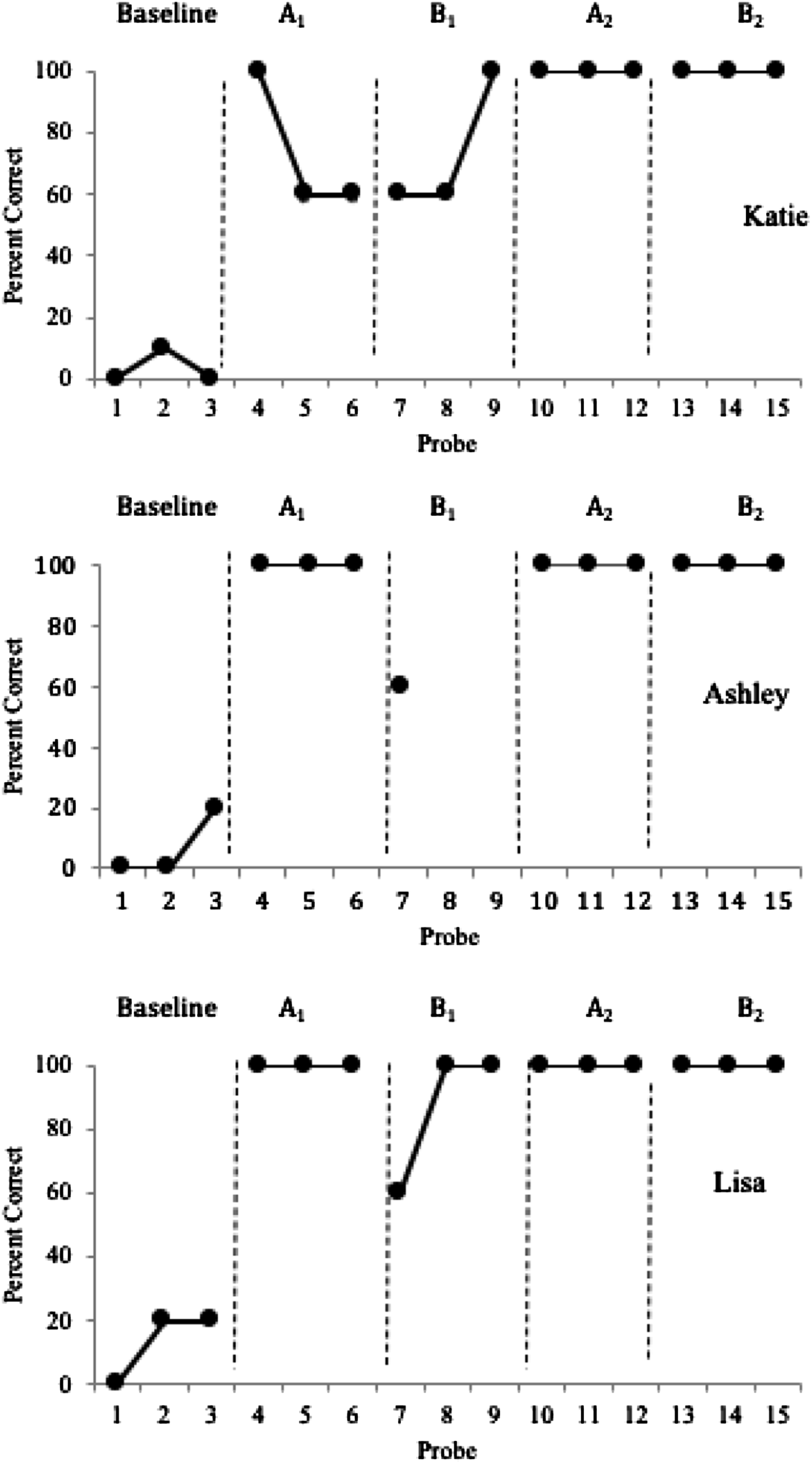

Vocabulary Probes
All participants displayed low percentage scores for vocabulary acquisition during the baseline phase with a group mean of 15.44%. When the treatment A1 intervention was implemented for all three participants, an immediate change in vocabulary acquired was noted. The mean score for the traditional phases was 95.56% and the mean score of the technology treatments was 89.92%. Following all treatments, all participants continued to display a gained understanding of the vocabulary from the previous probes with a mean score of 73.33%. The following section details the results of each participant in Figure 1.
Katie
During baseline sessions (n = 3), Katie’s initial vocabulary acquisition was a 6.66% mean correct answers on baseline probes. Katie’s mean score for treatment A1 of the intervention was 73.33%. Likewise, her mean score for treatment B1 was also 73.33%. During the second traditional intervention phase, treatment A2, her mean score was 100%. Likewise, during treatment B2, the second technology phase, Katie’s mean score was also 100%. When comparing the pre-intervention screening quiz to the post intervention probe, Katie correctly answered 80% more words correctly, with an initial quiz score of 0% and a post intervention probe score of 80%. On the post intervention probe, when specifically comparing if the vocabulary words were from either the traditional or technology intervention phases, Katie earned 80% correct from words in the traditional phases and 80% from words in the technology phases.
Ashley
During baseline sessions (n = 3), Ashley displayed a low percentage score for correct answers for vocabulary acquisition in her usual class environment earning a mean score of 13.33% on baseline probes. Ashley’s mean score for treatment A1 was 100%. Ashley was absent for two of the three probes during the first technology intervention phase, treatment B1, but earned a 60% on her one probe that was taken. During treatment A2, her mean score was 100%. Likewise, during the second technology treatment, Ashley’s mean score was 100%. When comparing the pre-intervention screening quiz to the post intervention probe, the student’s growth of correctly answering the probe was 60%, with an initial quiz score of 0% and a post intervention probe score of 60%. On the post intervention probe, when specifically comparing if the vocabulary words were from either the traditional or technology intervention phases, Ashley earned 40% correct from words in the traditional phases and 80% from words in the technology phases.
Lisa
During baseline sessions (n = 3), Lisa displayed an initial vocabulary acquisition of a 26.66% mean on baseline probes. Lisa’s mean score for treatment A1 was 100%. Similarly, her mean score for the first technology intervention, treatment B1, was 86.66%. During treatment A1, her mean score was 100%. Likewise, during treatment B2, Lisa’s mean score was 100%. When comparing the pre-intervention screening quiz to the post intervention probe, her growth of correctly answering the probe was 60%, with an initial quiz score of 20.0% and a post intervention probe score of 80%. On the post intervention probe, when specifically comparing if the vocabulary words were from either the traditional or technology intervention phases, Lisa earned 80% correct from words in the traditional phases and 80% from words in the technology phases.
Course Quizzes, Exams and Reported Grades
Katie
This intervention began the first day of the 4th quarter. Katie’s 3rd quarter grade was 65.58%. Katie often did not turn in or complete her assignments. In the 4th quarter, she missed 3 out of 9 assignments and 1 out of 2 assessments. Of the work that Katie did complete, she earned an average score of 80% on assignments and 65% on assessments. Her final quarter grade was an F at 36.80%.
Ashley
Ashley’s 3rd quarter grade was 70.63%. She did not complete 3 out of 9 number of assignments and 1 out of 2 assessments in the 4th quarter. Of the work that was completed, she earned an average score of 85% on assignments and 65% on assessments. Her final 4th quarter grade was an F at 37.64%.
Lisa
Lisa’s 3rd quarter grade was 51.88%. She did not complete 5 of the 15 assignments and did complete all of the assessments given during the 4th quarter. Of the assignments she did complete, she earned a 78.09% on her assignments and a 49.71% on her assessments. Her final grade for the 4th quarter was an F at 45.51%.
Social Validity
Prior to the study, both teachers completed a survey, which indicated a difference in how often they used technology. Both teachers indicated an agreement in willingness to use technology and strongly disagreed with statements of having access and training around technology to support students with high incidence disabilities. After all phases of the study, teachers indicated that they agreed that integrating technology into instruction can help improve the academics for their students.
In one teacher survey, when asked how often she or her students used technology and which devices were used, the teacher answered that she daily used Internet searches and smartphones, a projector with presentation software 3 to 4 times a week, and concept mapping/outline software & word prediction software less than once a week. When asked which devices were effective in instruction and/or influenced student learning in science, she replied that concept mapping/outlining software, word prediction software, projector with presentation software, internet search, and smart phones could be effective.
When asked what factors hinder using any type of technology during instruction, the first teacher indicated that high cost, additional training/no training, no knowledge of how to use each product or what was for, a lack of access, and devices not being available as limitations to their use in her classroom. For factors that encourage using any type of technology, she answered that technology has the ability to assist students individually, are quick to set up or customize for a student, can be used with more than one student, are easy for students to use and easy to integrate into the classroom and instruction. The teacher agreed with the statement that technology can potentially help students improve academics and that she wanted to use technology in the classroom. She strongly disagreed with all statements around having access, preparation, and training of technology.
Finally, this teacher commented that she would like recommendations on how and which technology can be used in the classroom and to share those recommendations with the school’s special education faculty as well as the school and district’s administration to increase access and training for technologies. In the post-study survey, she reported that she agrees that technology can potentially help improve academics for her students and wants to continue to use the iPod touch in the classroom but also reported that to effectively integrate the technologies into her instruction, she would require more options and information.
In the second teacher’s pre-study survey, he indicated that he and his students use screen magnifiers, word prediction, projector with presentation, and Internet search daily. Spell check and smart phones were used 1 to 2 times a week. Concept mapping/outlining software, electronic dictionaries, multimedia software, and Internet games were used less than once a week. When asked which devices were effective in instruction or influenced student learning in science, he responded that audio books, communication devices and/or Boardmaker (or other picture symbols software), concept mapping/outlining software, electronic dictionaries, instructional software (e.g., a reading software program), multimedia software, word prediction software, SMART Board, projector with presentation software, internet search, tablet computer with apps, iPod touch, smart phone, and eReader could be effective. He indicated that he does not feel that adaptive keyboards/mice nor AlphaSmart or similar devices would be effective in instruction or for student use.
When asked what factors hindered using any type of technology during instruction, this teacher answered that limitations included high cost and the additional time required to set them up. When asked what factors encouraged using any time of technology during instruction, he responded that ease of integration into classroom and instruction promotes technology use. He agreed with statements that technology can potentially help improve academics for his students, that he wanted to use or continue to use technology in the classroom and that he felt that he had had sufficient training in how to use technology in general. However, he disagreed with statements of having easy access to information around technology and training around how to specifically use technology to support students with disabilities. In this teacher’s post survey, he indicated that he had no opinion around continuing to use technologies in the classroom but agreed that he can effectively integrate technology into his normal instruction.
Katie
In her pre-study survey, Katie indicated that she sometimes uses Word prediction software, Internet search (e.g., Google), and a smartphone (e.g., iPhone, Android, and Windows) in class to help her learn. When asked what types of devices does she think could help her learn science, she indicated interest in Internet games, iPod touch, and an eReader (i.e., Kindle eReader, and BN Nook). When asked if technology could make her more engaged in class, compared to traditional instruction, she agreed. Similarly, she agreed with the statement that technology could improve her grades. When asked if she would want to use technology in class, Katie strongly agreed. In the post-study survey, Katie indicated that she specifically was interested in using the iPod touch more to improve both her grades and engagement.
Ashley
Ashley indicated in her pre-study survey that she sometimes used a SMART Board, Internet search, and a smart phone in class to help her learn. She answered that she would be interested in Internet games, iPod touch, and an eReader as technologies that could help her learn science. She agreed with statements that technology could make her more engaged in class and technology could help improve her grades. She marked that she strongly agreed with the statement of wanting to use technology in class. In her post-study survey, Ashley reported that she wanted to use the iPod touch more to increase her grades and engagement in class.
Lisa
In her pre-study survey, Lisa indicated that she sometimes used word prediction software, Internet search, Internet games, and a smart phone in class to help her learn. When asked what types of devices she would be interested in using in her science class, she answered that she would be interested in using a projector with presentation software (e.g., PowerPoint, Keynote), Internet search, a tablet computer with Apps (e.g., iPad, Kindle Fire), and an iPod touch. When asked if technology could make her more engaged in class she agreed, but she neither agreed nor disagreed if technology could help improve her grades or if she wanted to use technology in class. According to Lisa’s post-study survey, she reported that, when comparing the index cards and the iPod touch, she thought the iPod touch helped more and worked better.
Discussion
This study extends the literature on how students and teachers use and perceive the use of technology. Noteworthy, it is the one of the first studies to specifically investigate the use and perceptions of technology in the science classroom. One aspect of this study was to explore the influence of the iPod touch as opposed to the influence of index/flash cards on the vocabulary acquisition of three adolescents in a biology class when using a keyword mnemonic intervention. Specifically, two research questions were investigated: a) Is there a difference in the acquisition of science content vocabulary words presented through an index card medium compared to the acquisition of vocabulary presented through a technology device? and b) Is there a difference in how students with LD and their teachers perceive the social validity of the index card or technological instructional mediums to learn general education core content words and definitions? This study operated under the belief that improving science vocabulary knowledge involves the use of systematic review and can be taught through the use of mnemonics (Mastropieri et al., 1994; Scruggs & Mastropieri, 2000).
Several important findings emerged from this study. First, all students acquired the content vocabulary equally well when using a technology device when compared to an index card method. Second, it was clear that the students had a strong interest in using technology to increase their grades and engagement; however, the teachers had little access and training on using technologies to support their students with disabilities.
Vocabulary Acquisition
This study provided support for the use of keyword mnemonic interventions to promote vocabulary acquisition. More importantly, this study furthered the support of the intervention by bringing its use to technology not available when the intervention was established. Previous studies around this methodology have used various types of ink and paper delivery methods and current technology devices (e.g., iPod touch) did not yet exist. The first area of interest in this study was how students acquire content vocabulary and to compare two delivery models: index/flash card and technology compared to traditional instruction. Given that the intervention has previously been shown to be effective through the use of index cards (King-Sears et al.,1992) it served as a foundation to compare a new delivery method; the new delivery method would have to demonstrate equal or better results than the traditional model to be deemed effective. Three important findings are highlighted with regards to improved vocabulary acquisition: (a) the success of a keyword mnemonic intervention via an index card method of delivery compared to the pre-intervention quiz and baseline, (b) the success of a keyword mnemonic intervention via a technological method of delivery compared to the pre-intervention quiz and baseline, and (c) the comparison of success between the two conditions.
Prior to this study, all three students received their vocabulary and content instruction consistent with teacher directed, inquiry-based, lessons. In doing so, students were expected to learn biology content vocabulary and concepts through traditional science instruction, primarily by teacher-guided readings, activities, and written assignments out of the textbook. For students with LD, who may struggle with reading and writing, unsurprisingly, this method may be difficult. During the intervention however, the vocabulary was provided to the participants during the standard warm up time (the first five minutes of class) through a keyword mnemonic intervention delivered via index cards or a technology device (iPod touch).
Acquisition Presented Through Index Cards
The instructional intervention, when presented via index cards, produced outcomes consistent with previous research (King-Sears et al., 1992; Mastropieri et al., 1994; Mastropieri & Scruggs, 1992); all three students, when presented with the index card vocabulary intervention, increased their vocabulary acquisition when compared to their pre-study quiz and baseline probes. As the participants completed the baseline phase of the study, their initial lack of vocabulary knowledge was remarkably low, with mean scores for all three at 15.44%. Having a clear baseline is critical in establishing the effectiveness of an intervention with the hopes that once the intervention is introduced, an obvious and immediate increase of scores will follow.
As shown in Figure 1, for the measurement of the first dependent variable (vocabulary probes), all three students immediately earned a 100% on their first probe after baseline. All three students continued to earn scores clearly above baseline for the rest of the traditional phase (A1) and again earned 100% for all three probes when the condition returned to the index card treatment (A2). While the results of this treatment were productive to strengthen the research base around using flash cards as a keyword mnemonic strategy, as stated earlier, the goal was to determine if there were differences between student performance in the keyword mnemonic intervention when compared to the use of a technology device for students with LD.
Acquisition Presented Through a Technology Device
The goal of the first research question was to compare the vocabulary acquisition when presented through the iPod touch compared to the index cards. Interestingly, when the students were introduced to the first technology phase (B1), all three students earned a 60% on their first probe of the phase. However, by probe 8 for Lisa, and 9 for Katie (Ashley was absent for probes 8 and 9), the students’ scores returned to 100% and remained there, including when the treatment condition returned to the technology device (B2).
A possible explanation for the initial drop in scores is that students might require a few days to acclimate to the technology device as an academic tool and not a social device. This was clearly observed as Ashley initially used the iPod Touch for taking pictures when the first technology treatment was introduced. However, once the transition was completed, and once the technology treatment was reintroduced (B2), all three students earned a 100% on vocabulary probe #13. The data illustrate the importance of allowing time for transition and adjustment when introducing a technology device as students may need time to transition from perceiving the device as a social mechanism to an academic tool.
When comparing the visual analyses of the students' scores between the two delivery methods (index cards vs. iPod touch), the scores from both conditions were both clearly above baseline. Additionally, when comparing the means, between the two treatment conditions, both were similar (95.56% for the index card condition and 89.92% for the iPod Touch condition). Additionally, when comparing the scores from both the second treatments (A2 and B2), all three students earned a 100% in both conditions. Therefore, these findings suggest that a technology device, compared to a traditional index card keyword mnemonic intervention, is equally effective for the acquisition of science vocabulary, once the students learn how to effectively use the technology device. Additionally, students may need some training and orientation if a more sophisticated system is used.
Student Surveys
The present study demonstrated the social validity of using technology as an intervention method for teaching students with LD via a keyword mnemonic vocabulary strategy. As stated earlier, prior to the study, students were asked about their current use and desire to use technology in the classroom. Students were also asked if they believed technology could improve their grades as well as increase their engagement in class. Interestingly, even though both the index cards and the iPod touch were effective, on the post-study survey, all three students noted that they either enjoyed more or thought the iPod touch delivery system worked better.
While that data show that both intervention mediums were effective, student buy-in was centered on the desired continued use of the technology device. This study points directly to the students’ perception of an intervention that they would want to use. It is clear from the surveys that not only do the students have an interest in technology, but specifically believe that incorporating technology into their instruction will improve both their grades and their engagement. In previous literature, Marino (2010) reported that handheld devices had great promise as students become more and more used to using their smartphones and iPads for learning activities. Further, Edyburn (2013) explained, as technology is changing, it is crucial for interventions to progress alongside the advancement of technology. With the ability of technology to both increase the academics and engagement behaviors of students’, much promise exists in the use of technology. As Rodriguez et al. (2013) noted, technology is important for student engagement in academic tasks and the students in this study were in agreement with these studies and found the iPod touch to be more appealing than the typical index card method.
Teacher Surveys
When looking at what types of technologies the teachers and students currently use, teachers reported using technology, however, they also reported not using or knowing how to use technology to support or engage their students with disabilities. This suggests that regardless of how effective an intervention is, if teachers and students cannot access or use technology, it cannot be beneficial to the teacher or student. Interestingly, one teacher, Kelly shared that previous to the study, she had attempted to use flash cards with her students, but the students found writing all of the words and definitions boring and strenuous, and quickly lost interest.
Prior studies have noted this lack of access and professional development for teachers around Assistive Technology (AT) content (Okolo & Diedrich, 2014). It appears that in-service training should focus on the use of iPad and iPod so that content teachers can leverage this approach. Flanagan et al. (2013) conducted a survey to study the perceptions and use of AT by teachers in literacy instruction and found similar results. In their study, they found that while teachers perceived AT to be an effective tool, they reported that training and experience were large barriers, limiting a teacher’s use.
A considerable advantage to creating flash cards via a technological application (e.g., quizlet) is ease of use. While not calculated on the amount of time saved, creating the technological device flash cards alone take less time than creating traditional flash cards, printing them and gluing them to each set of index cards per student, or having students write them out by hand. By creating one set online (through the application’s online website), and then allowing the mobile application to utilize the words from the “cloud,” not only is time saved, but in this study, each student gained access to the intervention on their own iPod touch via the app. Additionally, students may be more willing to use this type of technological support on iPod touches or smartphones because these materials are commonly used by their peers as well; this type of strategy may decrease potential stigmatization of students with LD.
Implications
Future research should be conducted to determine the effectiveness and efficiency of instruction in a group setting or in typical classrooms. Because students with LD typically spend most if not all of their time in an inclusive setting, it is important to establish effective interventions appropriate for the general education environment. It is important to study the practicality of implementing the interventions for both students and teachers. Additionally, as just one component of a science lesson, future research should determine how this intervention could be incorporated within larger curricula. For example, research could study how these findings would translate to other parts of a science lesson (e.g., lab experiments, assessment review, and components of the scientific method).
Once these questions are addressed, future research should expand on these findings to enhance work in other content areas, including other STEM subjects. Additionally, these findings should be translated to studies across other disability categories that share characteristics of students with LD (e.g., EBD and ADHD) as well as the teacher training needed to support the interventions.
Limitations
This study had a number of limitations that should be considered and might limit the generalization of the findings: sample size, instructor bias, and intervention setting. First, this study included only three participants, all of whom were female. This intervention was only tested on one sample of three students in 10th grade. A more ideal approach to the sample would have been to randomly assign a large sample of students to two groups, and compare that data between them. However, since the inclusion criteria was set to specifically study the effects of the intervention on a specific population of students (students with LD in the biology classroom), a larger sample size was difficult to obtain.
Second, since the researcher of this study implemented all the interventions and probes, instructor bias cannot be ruled out. To address this concern, vocabulary was specifically taken from the students’ teachers as well as the textbook. Additionally, to address any bias the researcher may have had while conducting and grading the probes, a second observer was utilized to measure and score 40% of all probes.
Third, the intervention took place in a teacher prep-room outside the classroom and not during normal instruction. All the students in this study were taken out of their regular classroom during the first five minutes of the classroom period and worked with the researcher in a room that connected the two classrooms. This potentially limited any distractions that the students might have in the normal classroom environment, such as distractions from peers and classroom materials. Additionally, this enabled the students to receive close attention and support from the researcher, which is atypical of the inclusive classroom environment.
Conclusion
The intent of this project was to add to the existing knowledge concerning the academic and behavioral support for students with disabilities. Prior to this study, limited research existed on providing support for students with disabilities within the science classroom. Even fewer studies existed on how to use technology to teach science to students with disabilities as part of a general education curriculum. This study provides preliminary research on the effectiveness of a keyword mnemonic intervention used through a technology device to improve the acquisition of biology vocabulary for high school students with LD. There is little doubt that continued research is warranted and needed on this topic, not only to support students with LD, but across all disability categories and across the various STEM subjects. The promising outcomes from this study, however, only demonstrate the potential that our students with disabilities have within the sciences.
Footnotes
Declaration of Conflicting Interests
The author(s) declared no potential conflicts of interest with respect to the research, authorship, and/or publication of this article.
Funding
The author(s) received no financial support for the research, authorship, and/or publication of this article.
