



Abstract
Novice special education teachers often face challenges in developing high-quality Individualized Education Program (IEP) goals for children with autism. The use of artificial intelligence (AI) tools, such as ChatGPT, has shown potential in supporting teachers in IEP development. This study aimed to investigate the impact of ChatGPT on the quality, content, and time spent on IEP goal development for novice special education teachers. Moreover, impact of previous training on IEP and goal development was examined. 22 novice special education teachers were randomly assigned to either the ChatGPT group or the control group. Participants developed IEP goals for five children with autism, and the quality of the goals was assessed using the Revised IEP/IFSP Goals and Objective Rating Instrument. The use of ChatGPT significantly improved the quality of IEP goals developed by novice special education teachers, regardless of previous training status. Moreover, novice teachers who used ChatGPT spent significantly less time developing IEP goals compared to those who did not use ChatGPT. Furthermore, the IEP goals developed by the ChatGPT group were more comprehensive, addressing specific strengths and needs of children with autism, in comparison to the goals developed by the control group. The findings suggest that the use of ChatGPT can be a valuable tool in supporting novice special education teachers in developing high-quality IEP goals efficiently. The study highlights the importance of providing training on IEP development and the potential benefits of AI tools in general and special education practice.
Keywords
The Individualized Education Program (IEP) is a document that is mandated by law and details the specialized education and related services that are provided to students with disabilities. A team consisting of educators, parents or legal guardians, and other professionals who are involved in the student’s education collaboratively develop the IEP. The primary purpose of an IEP is to ensure that students with disabilities receive an education that is tailored to their specific needs and that they have equal access to educational opportunities as their non-disabled peers. The IEP goals are a vital aspect of the Individualized Education Program, as they are the driving force behind the development of other sections of the document including accommodations, special education and related services, and timeline (Rakap, 2015). The IEP goals should be carefully crafted to ensure that they are clear, understandable, and measurable (Jung, 2007). They serve as a roadmap for tracking the student’s progress and guiding their education. Moreover, the IEP goals are not static but are regularly reviewed and adjusted as needed. This process ensures that the goals remain relevant and achievable, and that the student receives the support they need to make progress (Rakap et al., 2019).
In tandem with the ongoing effort to refine this essential process, it is important to explore the potential of innovative tools like ChatGPT, an AI-driven technology, in the area of goal development. This study seeks to examine how AI and special education teachers’ insights intersect, emphasizing their complementary roles rather than substituting one for the other. This exploration underscores the potential of ChatGPT in bolstering the expertise of special education teachers during goal formulation. Such an exploration marks a notable advancement in the field of goal development, blending human input with advanced AI technology.
Research indicates that well-written IEP goals can significantly impact a student’s academic outcomes. Goals that are specific, measurable, and achievable provide clear direction for teachers, parents, and students, and can lead to improvements in academic performance and overall achievement. Moreover, high quality IEP goals can enhance communication among IEP team members, support student motivation, engagement and learning, and help to align instruction and instructional strategies with individual student needs (Rakap, 2015).
High-quality IEP goals are crucial, and there is a growing body of literature that emphasizes their importance. Studies show that creating goals that are challenging yet achievable, based on valid data and assessment results, and relevant to the student’s strengths, needs and interests are essential for promoting academic success (Konrad et al., 2014). The present level of performance (PLOP) serves as a foundation for developing IEP goals. Present level of performance is the starting point for evaluating a student’s academic and functional performance, strengths, needs, and weaknesses. By analyzing this information, the IEP team can develop goals that are specific, measurable, achievable, relevant, and time-bound (SMART; Jung, 2007). SMART goals help to focus instruction, provide a clear roadmap for progress, and enable the IEP team to monitor and adjust the student’s program as necessary.
Developing high-quality IEP goals and objectives is a critical aspect of special education services, but it can be a challenging task for many special educators for various reasons (Diehm, 2017). New special educators may not have the necessary experience in developing IEPs and may require additional support to create high quality goals. Limited time due to a large caseload of students can also make it challenging to devote enough time to individualized goal development. Moreover, the complex needs of some children with disabilities require a thorough understanding of their strengths and weaknesses, which can further complicate the process of tailoring goals based on individual needs. As a result, special educators must be equipped with the necessary skills, tools, and resources to create meaningful and achievable goals that lead to improved outcomes for their students (More & Hart-Barnett, 2014).
Research examining the quality of IEP goals has revealed a great deal of variability, with many studies reporting poor quality (e.g., Boavida et al., 2010; Rakap, 2015). Findings from these studies suggest that IEP goals often lack specificity to the child’s disability (Catone & Brady, 2005; Pretti-Frontczak & Bricker, 2000; Smith & Simpson, 1989) and have missing components, such as an observable behavior, condition, or criterion (Boavida et al., 2010; Michnowicz et al., 1995; Rakap, 2015). Additionally, many goals are not functional for the child (Boavida et al., 2014; Goodman & Bond, 1993), target skills that are not generalizable across settings (Kurth & Mastergeorge, 2010; Rakap, 2015), or include very limited information about the generalization of the targeted skills (Billingsley, 1984; Boavida et al., 2010, 2014). Finally, many IEP goals lack measurability (Boavida et al., 2014; Ruble et al., 2010), making it difficult to determine progress and make data-driven decisions about interventions.
Several studies have been conducted to develop training procedures to help practitioners improve the quality of IEP goals written for students with disabilities. Pretti-Frontczak and Bricker (2000) investigated the impact of a 2-day training on IEP goal writing for early childhood special education coordinators and program directors. Ruble et al. (2010) studied the effects of a teacher consultation intervention on improving the quality of IEP goals for children with autism. Lowman (2016) compared the impact of three professional development strategies on the quality of standards-based IEP goals written by speech-language pathologists. Russo-Campisi (2020) examined the impact of web-based training on the quality of IEP goals developed by pre-service teachers, and Dietz (2021) investigated the impact of an asynchronous web-based IEP goal training module on teachers’ competencies in IEP goal writing. Rakap et al. (2023) examined impact of a training program on the quality of IEP goals written by special education preservice teachers. In each of these studies, the quality of IEP goals exhibited improvements following the training interventions, underscoring the efficacy of these procedures in enhancing the quality of IEP goals. However, despite the positive outcomes, many of these studies necessitated teachers’ participation in a series of in-person or web-based training sessions. While effective, these programs demand a substantial investment of time and effort. Furthermore, these training opportunities might not always be readily available on-demand, making it challenging for educators to access them when most needed or convenient.
Some special education teachers use computer software or online resources, such as goal banks, to develop IEP goals (Diehm, 2017). While relying solely on pre-written goals from these resources is not recommended (Kowalski et al., 2009), they can be used as a starting point for creating IEP goals, as they provide a foundation that can be modified to meet the unique needs of each student. Another technology with the potential to assist teachers in developing IEP goals is artificial intelligence (AI). Artificial intelligence has emerged as a transformative technology with profound implications across various domains, including education (Russell & Norvig, 2022). At its core, AI refers to the development of computer systems that can perform tasks that typically require human intelligence. These tasks encompass a wide range of activities such as problem-solving, decision-making, pattern recognition, and language understanding. Artificial intelligence systems learn and enhance their performance through data-driven iterative processes (Russell & Norvig, 2022). Within the expansive domain of AI, Natural Language Processing (NLP) emerges as a particularly promising subfield within the educational landscape.
Natural Language Processing is a branch of AI centered on empowering computers to comprehend, interpret, and generate human language in ways that are contextually meaningful (Jurafsky & Martin, 2023). Natural Language Processing algorithms leverage an amalgamation of linguistics, statistics, and machine learning techniques to unravel the intricacies of language. This encompasses an array of tasks such as language translation, sentiment analysis, text summarization, and question-answering (Jurafsky & Martin, 2023). Natural Language Processing technologies have become increasingly sophisticated, enabling machines to engage in human-like interactions.
A notable application of NLP is ChatGPT, a language model developed by OpenAI. Positioned as a pioneering advancement in the domain of conversational AI, ChatGPT demonstrates the ability to engage in extended dialogues with users, answering questions, providing explanations, and even offering creative input (Ray, 2023). This capacity for interactive and informative discussions makes ChatGPT a versatile tool for educational contexts. It can facilitate personalized learning experiences, offer on-demand explanations of complex concepts, and triggers critical thinking through stimulating conversations. Constructed upon the foundational architecture of Generative Pre-trained Transformer (GPT), ChatGPT has demonstrated the ability to engage in natural and contextually coherent conversations with users (Radford et al., 2019). This model’s extensive training on vast and varied text sources equips it to generate responses reminiscent of human expression in response to user inputs (https://chat.openai.com).
With the help of AI, teachers can input data on a student’s strengths, weaknesses, and other relevant information, and receive customized suggestions for IEP goals that are tailored to the individual student’s needs. Artificial intelligence-powered tools can also analyze a student’s progress over time and make adjustments to the IEP goals as necessary. This can help ensure that the student’s IEP goals remain relevant and effective and can lead to improved learning outcomes. In addition, AI-powered tools can save teachers time and effort, as they automate many of the tasks associated with developing and monitoring IEP goals. It is important to note that AI should be used as a tool to assist teachers in the IEP development process, rather than as a replacement for human judgment and expertise. Teachers should still be actively involved in the development and monitoring of IEP goals and should use their professional judgment to make decisions about what is best for each individual student. While previous studies have explored the effects of using computer software or online resources on the quality of IEP goals developed by professionals and teachers (e.g., Kowalski et al., 2009; More & Hart-Barnett, 2014; Muller et al., 2022), no research has yet investigated the potential of AI technology to assist in the development of IEP goals.
The purpose of this study is to examine the impact of ChatGPT, an AI technology, on the quality of IEP goals developed by novice special education teachers. Specifically, the study aims to compare the quality and content of IEP goals developed using ChatGPT to those developed without the use of ChatGPT. Additionally, the study will investigate whether there are any differences in the domains of IEP goals developed by the two groups. Furthermore, the study will explore the impact of previous experience in IEP development and goal writing on the quality of IEP goals developed by the two groups. Lastly, the study will examine whether there are any differences in the amount of time spent in developing IEP goals between the group of novice special education teachers using ChatGPT and those who did not use it. The findings of this study will contribute to the existing body of knowledge on the use of technology to support the development of high-quality IEP goals and inform best practices for special education teachers working with preschool children with autism. The following questions are addressed in the present study: 1. What is the impact of using ChatGPT on the quality of IEP goals developed by novice special education teachers, in comparison to those who did not use it? 2. Are there any differences in the domains of IEP goals developed by novice special education teachers who used ChatGPT versus those who did not? 3. Does the previous training in IEP development and goal writing impact the quality of IEP goals developed by novice special education teachers using ChatGPT compared to those who did not use it? 4. Does the amount of time spent on developing IEP goals differ between novice special education teachers who used ChatGPT and those who did not?
Method
Participants
In collaboration with a local education agency, 22 special education teachers who worked with preschool children with autism in public schools were recruited to participate in this study. Each teacher was randomly assigned to either the ChatGPT group (n = 11) or the control group (n = 11). The ChatGPT group comprised 8 female and 3 male teachers, ranging in age from 23 to 27 years old, with a mean age of 24.5 years. All participants in the ChatGPT group held a bachelor’s degree in special education, and one had a master’s degree in the same field. On average, the participants in the ChatGPT group had 14 months of experience in special education (range = 6–21 months). Out of the teachers in the ChatGPT group, four (36%) reported having attended a formal training dedicated to IEP development within the past 2 years. The control group consisted of 9 females and 2 males, with ages ranging from 22 to 27 years old (M = 24.1 years). All participants in the control group had a bachelor’s degree in special education, and two had a master’s degree in the same field. On average, participants in the control group had 15 months of experience in special education (range = 4–23 months). Among the control group, five teachers (45%) indicated that they had participated in a formal IEP development training within the past 2 years. Participants in this study were specifically selected to have a maximum of 2 years of experience working as special education teachers and provided written consent before taking part in the study, which was authorized by a university institutional review board.
Procedures
Self-Study on SMART Goal Writing
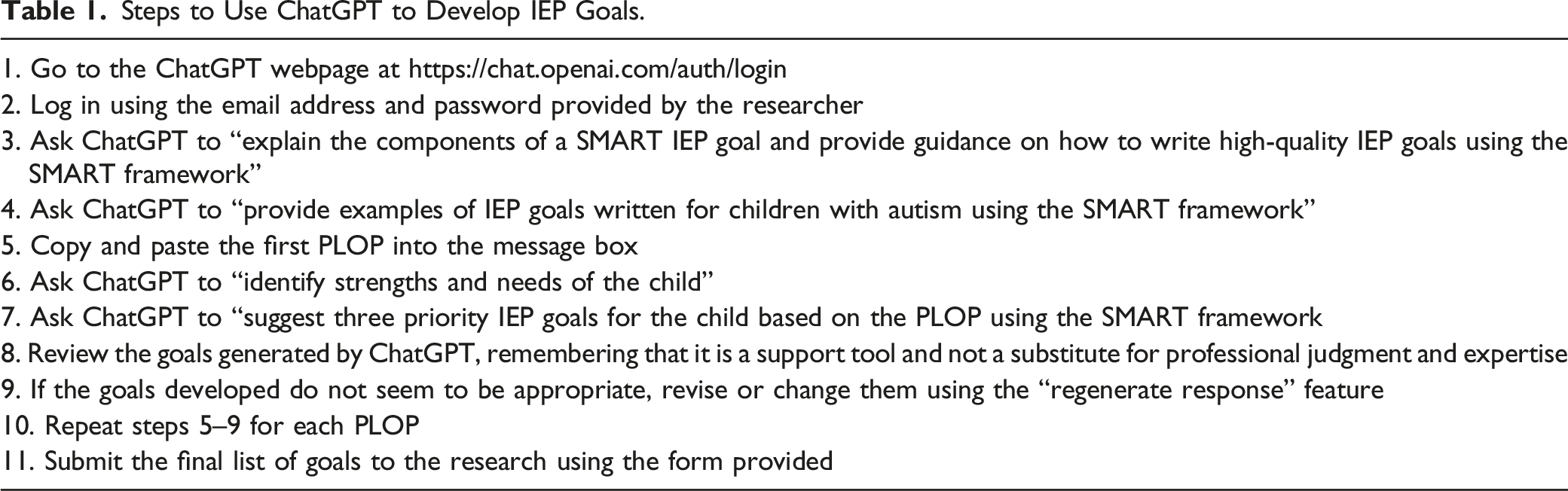
The special education teachers in both the ChatGPT and control groups were provided with a written guideline for writing SMART IEP goals (Jung, 2007). Before developing IEP goals for the study, teachers were asked to review the guidelines and required to pass a 20-question knowledge test with a perfect score of 100%. There were no restrictions on the number of attempts teachers could make to achieve a passing score. Apart from the written guideline, the ChatGPT group teachers were given a handout that detailed how ChatGPT could assist them in the IEP goal writing process.
Development of IEP Goals
Steps to Use ChatGPT to Develop IEP Goals.
Instrument
The present study utilized the Revised IEP/IFSP Goals and Objective Rating Instrument (R-GORI; Notari-Syverson & Schuster, 1995) to evaluate the quality of the IEP goals developed by the teachers. This instrument assessed four dimensions of goal quality: functionality (2 indicators), generality (3 indicators), measurability (3 indicators), and instructional context (2 indicators). Functionality refers to evaluating whether the skill is necessary for the child in the majority or entirety of their daily activities, encompassing behaviors that enhance independence and adaptability within their surroundings. Generality pertains to ascertaining whether the goal possesses the potential to be implemented across diverse materials, settings, and people. Measurability refers to assessing whether the goal incorporates a quantifiable qualitative or quantitative element. Instructional context involves assessing if the skill can be taught in real-world situations, by caregivers (e.g., teachers, parents), and easily prompted during classroom or home activities. Each IEP goal was rated independently for the presence or absence of these indicators, using a 0 or 1 scale. The overall quality score of each IEP goal was then calculated by adding up the ratings across the indicators, resulting in a score ranging from 0 to 10. A higher score indicates a higher quality goal. The total scale score was used for analysis in this study.
Notari-Syverson and Schuster (1995) investigated the content validity and interrater reliability of the instrument with the participation of seven experts in the field of early childhood special education. This panel of experts collaboratively evaluated a comprehensive set of 24 long-range goals and short-term objectives. The interrater reliability assessments displayed a range of scores between 75% and 88%, with an overall mean of 82% calculated across the ten indicators. These indicators, derived from contemporary literature, garnered agreement from all seven experts, highlighting their acknowledged appropriateness and comprehensive nature. Furthermore, the content of each IEP goal was categorized based on the developmental domains addressed by the goals. These domains included communication, self-help, motor/sensory, social, pre-academic/cognitive, and behavior. Furthermore, the researchers employed a demographic information form to gather data regarding the participating teachers. This form included a yes-or-no question about whether the teachers had received formal IEP development training within the last 2 years.
Training of Raters and Interrater Reliability
Two graduate students received a 60-min training session on how to use the R-GORI and the developmental domain categorization system. During the training, the researcher provided detailed instructions on how to rate each R-GORI dimension with examples. The researcher also explained how to categorize IEP goals based on developmental domains and provided practice examples for coding and categorization. During the training, graduate students had the opportunity to code and categorize sample IEP goals and receive feedback from the researcher. After the training, the raters were required to achieve a minimum of 80% agreement with the researcher across three sets of IEP goals before they started rating the IEP goals for the study. After the completion of the training, the raters, who were blind to the study conditions, independently coded each IEP goal using the R-GORI and categorized them based on the developmental domains. Interrater reliability was established by randomly selecting 20% of the IEP goals and having both raters code them. Any discrepancies in coding were resolved through consensus meetings between the raters. The interrater reliability percentage score was 95% (range = 90%–100%), while the Kappa coefficient was .86.
Data Analysis
To answer the first research question, the mean scores on the R-GORI scale were calculated for each group, and a two-sample t test was used to determine if there was a statistically significant difference in mean scores between the ChatGPT and control groups. To answer the second research question, the number and percentage of IEP goals in each developmental domain was calculated for each group. Chi-square analysis was used to determine if there was a statistically significant difference in the distribution of domains between the two groups. To answer the third research question, a comparison was made between the mean scores on the R-GORI scale for each group and training status (training within a year, or no training). A one-way ANOVA was used to determine if there was a statistically significant difference in mean scores between the four groups. When a significant difference was found, post-hoc tests were performed to identify which groups differ significantly. To answer the fourth research question, the amount of time spent on developing IEP goals was compared between novice special education teachers who used ChatGPT and those who did not. The mean time spent on developing IEP goals was calculated for each group, and a two-sample t test was used to determine if there was a statistically significant difference in mean time spent between the two groups. Moreover, the Pearson product-moment correlation was calculated to examine the relationship between the amount of time spent on developing IEP goals and the quality of the goals developed.
Results
Quality of IEP Goals
A two-sample t test was conducted to compare the quality of IEP goals developed by teachers in the ChatGPT group to those in the control group. The ChatGPT group had a mean score of 9.56 (SD = .69), while the control group had a mean score of 6.78 (SD = 1.13). Results showed a statistically significant difference between the two groups (t(328) = 27.06, p < .001), indicating that the quality of IEP goals developed by teachers in the ChatGPT group was significantly higher than that of the control group. Moreover, there was higher within-group variation in the quality scores for the control group (SD = 1.13) compared to the ChatGPT group (SD = .69). The mean quality score for teachers in the control group ranged between 5.5 and 7.8, while the mean quality score for teachers in the ChatGPT group ranged between 9.4 and 10.
Content of IEP Goals
Chi-square analysis was conducted to examine the relationship between the study group (ChatGPT vs. control) and the content of goals in six developmental domains. The results revealed a statistically significant association between the study group and the content of goals in all six developmental domains (p < .01). In the ChatGPT group, a higher percentage of goals were developed in the communication domain (31%), followed by social (27%), motor/sensory (15%), behavior (12%), self-care (10%), and pre-academic (6%) domains. In contrast, in the control group, a higher percentage of goals were developed in the preacademic and behavior domains (25%), followed by communication (20%), social (15%), motor/sensory (11%), and self-care (4%) domains. Overall, the results suggest that the ChatGPT group had a higher proportion of goals developed in the communication and social domains, while the control group had a higher proportion of goals developed in the preacademic and behavior domains.
Impact of Previous Training
A one-way ANOVA was conducted to compare the mean scores of the four groups: ChatGPT with previous training, ChatGPT without previous training, control with training, and control without training. The ANOVA revealed a significant main effect of group, F(3, 326) = 421.35, p < .001, partial eta squared = .80. Post-hoc tests using Tukey’s HSD indicated that the ChatGPT group with previous training (M = 9.63, SD = .69) had significantly higher mean scores on the R-GORI scale than both control groups with training (M = 7.61, SD = 1.72) and without training (M = 6.08, SD = .92), p < .001. Similarly, the ChatGPT group without previous training (M = 9.52, SD = .70) had significantly higher mean scores on the R-GORI scale than both control groups with training and without training. Moreover, the control group with training had significantly higher mean scores on the R-GORI scale than the control group without training, p < .001. However, there was no significant difference between the ChatGPT group with previous training and without training, p = .812. Overall, these results suggest that previous training in IEP development and goal writing can positively impact the quality of IEP goals developed by novice special education teachers, and the use of ChatGPT can further enhance the quality of goals, regardless of previous training status.
Time Spent to Develop Goals
A two-sample t test was conducted to compare the time spent to develop IEP goals by teachers in the ChatGPT group to those in the control group. The results showed that novice special education teachers who used ChatGPT spent significantly less time developing IEP goals (M = 15.58 min, SD = 4.94) compared to those who did not use ChatGPT (M = 25.53 min, SD = 5.95), t(328) = 16.53, p < .001. This suggests that the use of ChatGPT can significantly reduce the amount of time required for developing IEP goals for novice special education teachers. The mean time spent developing IEP goals for teachers in the control group ranged between 23 and 27 min, while the mean time spent for teachers in the ChatGPT group ranged between 14 and 17 min. Overall, these findings suggest that the use of ChatGPT can be a time-saving tool for novice special education teachers in the development of high-quality IEP goals.
The Pearson product-moment correlation was calculated to examine the relationship between the amount of time spent on developing IEP goals and the quality of the goals developed. The analysis revealed a statistically significant moderate negative correlation (r = −.529, p < .001) between the two variables. This suggests that as the amount of time spent on developing IEP goals increases, the quality of the goals developed decreases. The negative correlation may indicate that novice teachers who spent more time on developing IEP goals may have become fatigued or overworked, leading to a decline in the quality of the goals developed.
Discussion
The purpose of the present study was to investigate the effectiveness of AI technology, ChatGPT in supporting novice special education teachers in developing high-quality IEP goals. The results indicated that ChatGPT can be an effective tool in improving the quality of IEP goals written by novice special education teachers, especially those who do not have prior training in IEP development and goal writing. In addition to the main findings, the present study also sheds light on several important factors that may influence the effectiveness of ChatGPT, such as the developmental domains targeted in the IEP goals, and the amount of time spent on goal writing. In this section, we will further elaborate on these findings and their implications for special education practice and future research.
In this study, we found that the use of ChatGPT significantly improved the quality of IEP goals developed by novice special education teachers. The ChatGPT group had a higher mean quality score and a lower within-group variation in the quality scores compared to the control group, indicating that using ChatGPT may result in more consistent and higher-quality IEP goals across a broader range of teacher. Additionally, the higher within-group variation in the control group suggests that traditional methods may not consistently produce high-quality IEP goals. Overall, these results support the growing body of research that highlights the benefits of NLP and machine learning in improving the quality of written work (e.g., McNamara et al., 2013; Wulff et al., 2023). Specifically, our findings suggest that the use of ChatGPT can be an effective tool for improving the quality and consistency of IEP goals developed by novice special education teachers. By leveraging the power of machine learning algorithms to provide real-time feedback and suggestions, ChatGPT may help to reduce inconsistencies and errors in the development of IEP goals, ultimately leading to better outcomes for students with disabilities.
The results of the study provide valuable insights into the types of goals developed by teachers in the ChatGPT and control groups for children with autism. It is well-established that children with autism often struggle with communication and social interaction, while also exhibiting challenging behaviors (Gates et al., 2023). Therefore, it is encouraging to see that the ChatGPT group had a higher percentage of goals developed in the communication and social domains, as these domains are pivotal for the holistic development of children with autism, addressing core areas that significantly impact their quality of life. On the other hand, the control group’s inclination towards behavior and pre-academic domains merits a closer look. The rationale behind the observation that behaviors may not be the primary focus for preschool children with autism is rooted in the understanding that behavioral challenges often stem from underlying communication and social difficulties. Addressing these foundational areas can alleviate behavioral issues. The intricate interplay between communication, socialization, and behavior is well-documented (Lerner & Mikami, 2012). By prioritizing communication and social goals, the ChatGPT group aligns with a comprehensive approach that not only cultivates foundational skills but also potentially mitigates challenging behaviors by addressing their root causes. This nuanced perspective underscores the importance of tailoring interventions to individualized needs of young children with autism. The results suggest that the ChatGPT has the potential to be a useful support tool for teachers in developing IEP goals that prioritize critical areas of development for children with autism, such as communication and social skills.
An intriguing insight drawn from the above-mentioned findings centers around the marked divergence in IEP goal domains addressed by the two groups. Notably, the observation that generative AI seems to incline IEP goals towards social and communication raises interesting questions. Does this bias emerge due to the accessibility of communication-related information to the algorithm? The prominence of communication/social goals may suggest that academic and behavioral goal information could be less accessible due to potential paywalls or algorithmic prioritization. Additionally, the control group’s higher production of pre-academic and behavioral goals (25%) poses a query about teacher preparation. Furthermore, the 6% disparity between the two groups in the life skills domain underline the distinct perspectives of humans and machines regarding goals, irrespective of their quality. Further exploration in this area has the potential to offer a nuanced perspective on the intersection of generative AI’s influence and teacher-driven goal formulation, thereby prompting profound reflections on the dynamic evolution of education in the digital age.
Findings also suggest that previous training in IEP development and goal writing can positively impact the quality of IEP goals developed by novice special education teachers. This finding is consistent with previous research indicating that professional development and training can improve teacher knowledge and skills in writing effective IEP goals for students with disabilities (e.g., Auhtor, 2023; Lowman, 2016; Russo-Campisi (2020); Ruble et al., 2010).
It is important to note that the ChatGPT group, regardless of previous training status, had significantly higher mean scores on the R-GORI scale compared to the control groups. This suggests that the use of ChatGPT as a support tool can further enhance the quality of IEP goals developed by teachers, even if they have not received previous training in IEP development and goal writing. The finding that the control group with training had significantly higher mean scores on the R-GORI scale than the control group without training also highlights the importance of providing professional development and training to teachers in IEP development and goal writing. However, it is also important to consider that the quality of IEP goals developed by teachers can be further improved through the use of technology-based support tools like ChatGPT.
We also found that novice special education teachers who used ChatGPT spent significantly less time developing IEP goals compared to those who did not use ChatGPT. This finding suggests that ChatGPT can be a useful tool for novice special education teachers who are struggling with time constraints and need to develop high-quality IEP goals efficiently. The use of ChatGPT may allow teachers to spend less time on the administrative aspects of IEP development and focus more on the individualized needs of each student. Furthermore, the Pearson product-moment correlation analysis revealed a significant moderate negative correlation between the amount of time spent on developing IEP goals and the quality of the goals developed. This finding implies that spending more time on IEP development may not necessarily lead to better-quality goals. Instead, it suggests that teachers who spend more time may experience fatigue or become overworked, leading to a decline in the quality of the goals they develop. This finding highlights the importance of using tools such as ChatGPT that can save time and allow teachers to focus on other important aspects of IEP development, such as individualized goal setting and progress monitoring.
While technology offers the potential to improve efficiency and provide insights, its incorporation into this context prompts a need for thorough ethical exploration. Central to this consideration is the need to individualize education, particularly for children with unique needs.
While ChatGPT plays a role in generating goal statements, the profound understanding and empathy conveyed by teachers remain distinct qualities. The ethical dimension of professional judgment further emerges. The decision on whether technology should complement teachers’ professional judgment requires contemplation. Achieving a balanced harmony between technological insights and those of teachers underscores the value of preserving teachers’ in-depth understanding. Ethical imperatives encompass informed decision-making and transparent communication. All stakeholders, including teachers and parents, should possess a comprehensive grasp of ChatGPT’s capabilities and limitations. Transparency is vital to ensure a clear comprehension of the technology’s role and its implications for the IEP development process. Data privacy and security introduce ethical aspects to the conversation. Sharing student data with external platforms necessitates stringent data protection measures to secure sensitive information. This encompasses the duty to employ data solely for intended purposes, refraining from sharing identifiable information with ChatGPT. Another ethical dimension revolves around reconciling standardization and individualization. While technology may lean towards standardized goals, the ethical essence of special education underscores the significance of tailored interventions that acknowledge the unique strengths and challenges of each child. Above all, ethical practice is rooted in accountability and responsibility. Despite ChatGPT aiding in goal development, the primary responsibility for goal quality and student success ultimately rests with teachers. Striving to establish a balanced harmony between technology and human expertise, while upholding the principles of individualization and transparency, ensures the ethical integrity of integrating technology into the process of IEP goal development.
Implications for Research and Practice
Based on the findings of the current study, there are several implications for future research and practice in the field of special education. First, future research can explore the effectiveness of ChatGPT in other areas of special education beyond IEP development. For example, ChatGPT could be used to generate lesson plans, instructional strategies, and behavior intervention plans. Further research can also investigate the potential of ChatGPT to support other groups of teachers, such as general education teachers and paraprofessionals.
Second, future research can examine the effectiveness of ChatGPT in improving the quality of IEP goals for students with various disabilities, beyond autism. This would provide a more comprehensive understanding of the potential benefits of using ChatGPT in IEP development.
Third, future research can explore the feasibility of integrating ChatGPT into existing systems used in special education, such as online platforms for IEP development. This would provide teachers with greater access to ChatGPT and facilitate its use in IEP development. Finally, the findings of this study suggest that novice teachers may benefit from additional training in IEP development and goal writing. Future research can investigate the most effective methods for providing such training, including the use of technology-based tools like ChatGPT.
In terms of practice, the findings of this study underscore the promising potential of ChatGPT as a valuable tool for novice special education teachers seeking to craft high-quality IEP goals while also streamlining the process. The integration of ChatGPT into educational practice presents an avenue for practitioners to harness its capabilities, thereby optimizing their goal-writing efficiency. As educators explore the incorporation of ChatGPT into their workflow, it becomes crucial to complement this integration with effective training modules. Training sessions designed to acquaint teachers with the nuances of utilizing ChatGPT can empower them to wield this technology adeptly and capitalize on its benefits. Moreover, schools and districts can strategically consider a two-fold approach to enhancing IEP goal quality for students with disabilities. First, offering comprehensive training sessions to educators regarding the synergistic use of technology-based support tools and human expertise is paramount. This empowers teachers to harness the strengths of ChatGPT while respecting their professional judgment and experience. Second, providing educators with access to technology-based support tools such as ChatGPT equips them with a supplementary means to expedite goal development without compromising precision and thoroughness. However, it is imperative to navigate this technological integration prudently, especially when dealing with the welfare of vulnerable student populations and the legal implications entailed in IEP development. While ChatGPT offers efficiency and insights, it must be used as an adjunctive tool that enhances educators’ competencies, rather than replacing their professional discernment. Special education professionals are uniquely positioned to gauge the multifaceted needs of students with disabilities, including those that extend beyond language. Adhering to the principle of prudence, educators should exercise caution in relying solely on technology, ensuring that human expertise remains the cornerstone of decision-making throughout the IEP goal-setting process.
Limitations
There are several limitations to the current study that should be considered when interpreting the findings. First, the study was conducted using a convenience sample of novice special education teachers from a single school district, which limits the generalizability of the results to other populations. Future research should aim to replicate these findings with larger and more diverse samples. Second, the study did not control for individual differences among the participants, such as their previous experience with IEP development and goal writing. While the study did examine the impact of previous training on IEP goal quality, other individual differences may have influenced the results. Future research should aim to control for these factors to better understand the impact of ChatGPT on IEP development.
Third, the study focused on the use of ChatGPT as a tool for IEP goal writing but did not examine its use in other areas of special education practice, such as behavior intervention planning or progress monitoring. Future research should investigate the potential applications of ChatGPT in other areas of special education practice. Fourth, the study did not examine the long-term effects of using ChatGPT on IEP goal quality or teacher performance. Future research should investigate whether the benefits of using ChatGPT persist over time and whether its use is associated with improved outcomes for students with disabilities. Finally, the study’s findings underscore the potential of ChatGPT in streamlining the IEP goal writing process, notably by reducing the time required for this critical task. However, a comprehensive examination of its integration warrants a consideration of potential trade-offs that extend beyond time savings. One such consideration centers around the extent of teacher input required in the ChatGPT-assisted goal crafting process. While ChatGPT can expedite the formulation of goal statements, it is imperative to discern the balance between efficiency and the level of teacher engagement. Special education teachers bring a wealth of expertise, grounded in their deep understanding of students’ individualized needs, learning styles, and behavioral profiles. The significance of human insight in setting IEP goals, particularly those aligned with the nuanced requirements of students with disabilities, cannot be overstated. Moreover, an expansive perspective necessitates a cautious analysis of potential limitations associated with technology reliance. These may encompass concerns related to the technology’s capacity to fully capture the nuanced objectives of IEPs, the potential for perpetuating standardized or formulaic goal statements.
Conclusion
In conclusion, this study investigated the use of ChatGPT as a tool for developing IEP goals by novice special education teachers. The results showed that ChatGPT can significantly improve the quality of IEP goals, reduce the time required to develop them, and benefit teachers who have had previous IEP training. The findings also suggest that the use of ChatGPT can help teachers address the unique needs of each child with autism and develop goals that are tailored to their specific strengths and challenges. Despite some limitations, such as the sample size and the inability to generalize findings beyond the scope of this study, the results have important implications for future research and practice. Further research is needed to explore the use of ChatGPT in the context of other disability categories, as well as to investigate the long-term impact of using ChatGPT on student outcomes. Additionally, it is important to consider the ethical implications of using AI in special education, including issues related to privacy, data security, and human bias. Overall, the findings of this study suggest that ChatGPT has the potential to be a valuable tool for special education teachers in the development of high-quality IEP goals, particularly for those who have limited experience or training in this area. By using ChatGPT, teachers can focus on individualizing education plans for their students with autism and help them reach their full potential.
Footnotes
Declaration of Conflicting Interests
The author(s) declared no potential conflicts of interest with respect to the research, authorship, and/or publication of this article.
Funding
The author(s) received no financial support for the research, authorship, and/or publication of this article.
