




Abstract
The authors used state-of-the-art concept mapping approaches to examine structural institutional effects of church and secular high schools on the types of sexual and HIV-prevention education messages transmitted to learners in Zimbabwe. Participants were school teachers (n = 26), school counselors (n = 28), and pastors involved in student pastoral care (n = 14; males = 27, females = 41). They reported on messages perceived to influence sexual decisions of learners in their school setting. The self-report data were clustered into message types using concept mapping and contrasted for consistency of content and structure both between and within type of school. The authors also engaged in curriculum document study with member checks in the participant schools to determine convergence of the evidence on school-type effects of the messages transmitted to students. Church schools prioritized faith-informed sexual and HIV-prevention messages, whereas both types of schools prioritized Life skills education and a future focus. Secular schools prioritized sex and HIV messages in the context of community norms. Facts about HIV and AIDS were relatively underemphasized by church schools. The implicit knowledge values that differentiate types of schools influence learner access to information important for their sexual decisions.
Critical pedagogy theory (e.g., Jansen, 2009; Karmon, 2007) posits that schools expose learners to implicit encoded knowledge reflecting the dominant beliefs and values that institutional members or participants (e.g., learners, teachers, and pastors) hold. The shared, encoded knowledge guides the behavior of the participants to enhance the functions and identity of the institution. For instance, educators and learners in a church-affiliated school would share certain faith-oriented beliefs that both define them as members of a church community and also guide their behaviors to actualize the church mission values. Thus, in addition to the documented curriculum comprising what is formally taught in the classroom, characteristics and qualities of the specific school institution communicate to its members acceptable forms of knowledge and recognized ways of knowing that differentiate one school-type environment (e.g., church) from another (e.g., secular). The nature of the specific sexual and HIV-prevention education message that church and secular schools perceive to transmit to learners to influence their sexual decision making is unknown, although such knowledge would be important to in-school health policy implementation.
For the present study, we sought to understand school structural policy influences on sexual decisions by learners attending church and secular schools from the perspective of teachers and pastors from the district of Manicaland in Zimbabwe. Manicaland District hosts several Christian faith organizations, of which the United Methodist Church (UMC) is a major education and health services provider. Its social services complement those provided by the Zimbabwean government and often substitute for the public services of health clinics and orphan relief aid. We conducted the study in a sample of UMC high schools and community schools in the same neighborhood. Schools in Zimbabwe are required to teach a life skills curriculum (Ministry of Education, Sport & Culture, 2003). This curriculum teaches learners self-awareness, social skills, knowledge of community resources, and pathways to health and well-being. However, our premise was that if school context explained the quality of transmitted education, then two types of school systems (i.e., church and secular) would offer qualitatively different learning contexts for sexual and HIV-prevention education. For instance, UMC schools follow Christian missionary values and would place an emphasis on faith-informed concepts regarding sexual and HIV-prevention education. Faith-informed concepts include those pertaining to beliefs in the influence of a higher spiritual authority in human affairs. They also would include teachings about adherence to sexual abstinence if not married and being faithful to one’s partner if in a marital relationship. Individuals subscribing to faith explanations of health and well-being likely would ascribe the experience of a disease causing agent (e.g., HIV) to their relationship with a superior spiritual power (e.g., retribution for having transgressed). On the other hand, secular schools' sexual and HIV-prevention education would emphasize Life skills education in the context of local cultures and customs. For instance, a life skills curriculum would teach local customs about transitioning to adulthood in the context of self, social, and community awareness. Thus, school context would influence the sex and HIV education messages transmitted to learners.
Teachers (and pastors) are knowledge validators in the school setting (Jansen, 2009) and the main instruments for translating this policy into practice. What they elect to teach is the actual curriculum at the school or classroom level. The curriculum implementation practices they adopt and school institutional values that they project to learners will likely align with the type of school they serve. In their professional socialization, teachers would likely be influenced to uphold the values of the type of school by which they are employed. There is need for studies to examine school type effects on the sex and HIV messages transmitted to learners in order to be better able to adapt them to the context of learning.
Goals of the Study
The study investigated school epistemic effects on the type of sex and HIV education messages teachers (and pastors if in a church school) perceived to transmit to learners. First, we hypothesized that the teachers and pastors in church schools would perceive to transmit messages that were mostly faith-oriented whereas those in secular schools would emphasize life skills-oriented messages. Second, we hypothesized that church and secular schools would be consistent in their use of curriculum resources with their institutional values so that value contrary resources would be excluded or de-emphasized. Third, we hypothesized that teachers would use sexual health curriculum materials to reflect, support, and reinforce school institution values.
Method
Participants and Setting
Participants were school counselors (n = 28), regular classroom teachers (n =26), and pastors (n = 14; if church school; see also Table 1 ). School counselors in this context are teachers with the special assignment to also provide student counseling. They are not professionally qualified counselors but may have participated in brief workshops on counseling from the public education authority or church organization (if working in a church school). Regular class teachers were randomly selected from the school’s teaching roster to participate in the study. The school counselors, regular class teachers, and pastors were retained to participate in subsequent phases of the study, once selected for the initial phase of the study (as described below).
Mean Importance Ratings (and Standard Deviations) for Clusters of Transmitted Sex and HIV Education Messages by Type of School and School Personnel Demographics
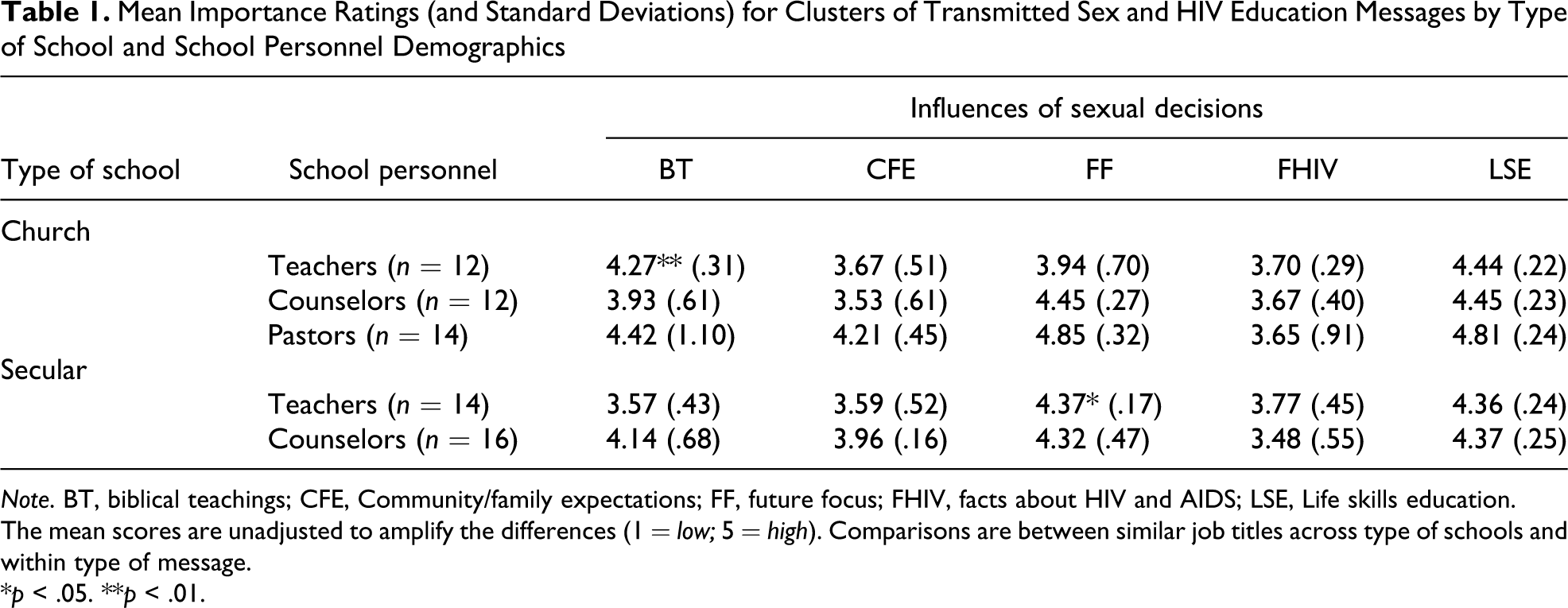
Note. BT, biblical teachings; CFE, Community/family expectations; FF, future focus; FHIV, facts about HIV and AIDS; LSE, Life skills education.
The mean scores are unadjusted to amplify the differences (1 = low; 5 = high). Comparisons are between similar job titles across type of schools and within type of message.
*p < .05. **p < .01.
Data Collection
Data collection comprised concept mapping, extended document study, and member checks. In addition, participants provided demographic data on themselves, including their specific role within the school.
Concept mapping
We used concept mapping to construct the structure and content of the types of sex and HIV education messages school personnel believed were being transmitted to learners or consistent with school policy. Concept mapping (Concept Systems, 2010) is a mixed method approach that combines qualitative techniques (e.g., brainstorming) with quantitative analysis (i.e., Multidimensional Scaling [MDS], Hierarchical Cluster Analysis [HCA]), allowing for rich profiling of the phenomenon under study (Kane & Trochim, 2007). The data collection is carried out over 3–4 short workshops and includes brainstorming, sorting, and rating of statements.
Brainstorming
For the brainstorming, we presented in writing on a flip chart the following prompt to capture the perceived messages to influence sexual decisions by learners:
Think about the in-school sexual and HIV related messages. As you think about these messages, please generate as many statements (short phrases or sentences) as you can and write them in the numbered blank spaces on this form. Use this statement probe to guide your responses: In-school sexual and HIV related messages taught to teenagers include ____.
Sorting and rating tasks
For the statement sorting, each participant used a bundle of cards with numbered individual statements from the brainstorming session in order to group the statements into piles “in a way that make sense to you.” We asked participants to write the number for each statement on a record sheet so that the statements they grouped together were in the same cluster. Participants provided a short descriptive label for each of the clusters to capture their perceived core meaning for a statement grouping. The participants also rated each of the statements on a 5-point Likert-type scale on relative importance to the teaching of sexual and HIV-prevention education at their school (relatively unimportant = 1 to extremely important = 5).
Document sampling
During visits to the participant schools (every 6 months over a 2-year period), we identified curricula materials, posters, and other ancillary documents used to communicate sexual and HIV-related messages. Criteria for the admissibility of document study data were that the document (1) must have been used or was currently being used as part of sexual and HIV-related education; (2) must be available at the school and in teaching centers (e.g., classrooms, hallways, libraries); and (3) must communicate a clear sexual and HIV-related message. The resulting initial record was one which we updated at subsequent visits to document any additional sex and HIV-prevention education resources since our previous visit.
Member checks
The lead author carried out focus group discussions with eight of the teachers from two selected church schools for their stronger mission presence (i.e., with the resident senior pastor) and 12 teachers from two of the high functioning secular schools (i.e., with higher academic reputation) to clarify the likely role of type of school on the sex and HIV education transmitted to learners. The teacher informants also were asked to share their views on their professional socialization within the school that influenced the ways they provided sex and HIV education at their school.
Procedure
Permission for the study was granted by human research ethics institutional review boards for the University of Sydney, Pacific Institute for Research and Evaluation, the Zimbabwe Research Council, and Zimbabwean Ministry of Education, Sports, and Culture. The participant teachers and pastors granted individual written consent. Data were collected during normal school hours.
Data Analysis
The Concept System program (Version 4.0) was used for data capture and analysis. The program applies MDS and HCA to construct participant-driven program qualities from the participants' statements. The Concept System software computes HCA with Ward’s criterion (Everitt, 1980) on sortings and ratings data as previously described. We used a concept mapping split-plot procedure to disaggregate the data by school type in order to determine the influence of type of school on sex and HIV education messages transmitted to learners. We applied the Dunn–Bonferonni procedure and report statistically significant findings at p < .05, reducing possible inflation of Type 1 error due to the multiple pairwise comparisons on importance ratings for message clusters by type of school.
For the document study analysis, we used panning (Tesch, 1990) to recursively record the types of curriculum documents at each school to which students prospectively were exposed. We then used thematic analysis to discern the major trends in types of curriculum materials by type of school. In analyzing the data from the member checks, we documented informant perspectives on school institution values important for understanding sex and HIV education at the church and secular schools.
Results
We report the relative importance of the sex and HIV education messages between and within each school type as an epistemic environment. Next, we report on the evidence from the document study with member checks to further clarify how school-type context influenced the sex and HIV education messages transmitted to learners.
School-Type Effects on Transmitted Sex and HIV Education
The two school environments transmitted similar types of messages, although with different degrees of emphasis: Facts about HIV and AIDS, Biblical teachings, Life skills education, Community/family expectations, and a Future orientation. Figure 1 presents the concept mapping pattern match comparing the relative emphasis of perceived transmitted messages both between and within type of school learning environments. A pattern match allows for a visual representation of the relative position of each type of messages (or message cluster) as scaled on the importance criterion both within and between types of school. The higher the correlation between the clusters by school type, the lower the difference in the perceived types of HIV and AIDS messages transmitted. A low pattern match comparison correlation of .33 was observed (see Figure 1), which further supports the hypothesis that church and secular schools emphasize different types of messages, consistent with their ethos.
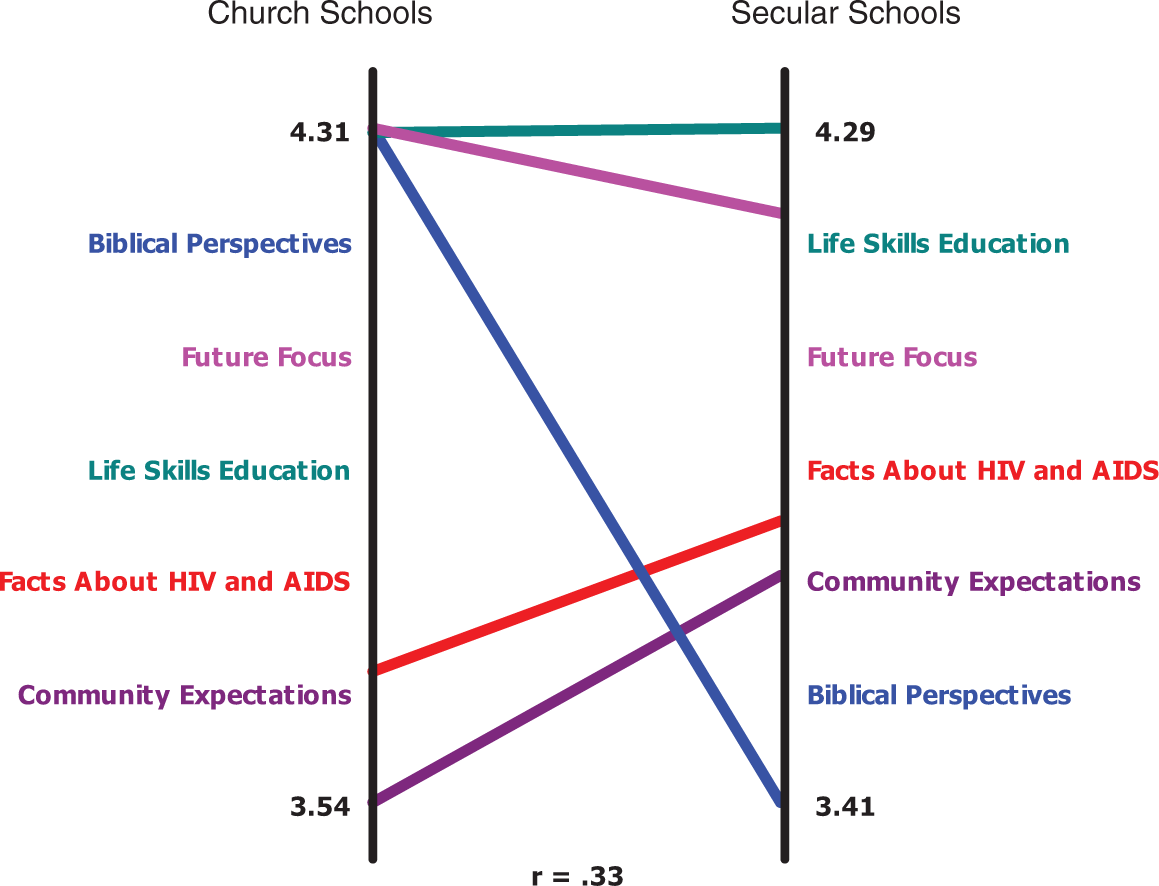
Pattern match map (with within-group adjusted mean scores) contrasting perceived priority cluster of sex and HIV education messages within and between type of school, and in their relative importance (1 = low, 5 = high).
For instance, the pattern match within type of school-adjusted mean scores shows that church schools prioritized messages about Biblical teachings (M = 4.31, SD = .28) equally with Future focus (M = 4.30, SD = .20) and Life skills education (M = 4.29, SD = .26). By contrast, secular schools prioritized Life skills education (M = 4.29, SD = .24), followed by Future focus (M = 4.21, SD = .17), and then Facts about HIV/AIDS (M = 3.62, SD = .45). Overall, Biblical teachings on sex and HIV-prevention education were comparatively more valued by church schools (M = 4.31, SD = .28) than by secular schools (M = 3.41, SD = .43), t(66) = 10.37, p < 001. As an example, the faith aligned statement “God will provide the right marriage partner when the time comes” was a more highly endorsed message at the church schools (M = 4.43, SD = .28) than at the secular schools (M = 3.72, SD = .43), t(66) = 8.18, p < .001. Use of condoms was rated lower at church schools (M = 2.36) than at secular schools (M = 2.76), t(66) = 4.61, p < .001.
Table 1 presents the results for the analyses by professional designation of the school personnel involved with learner counseling. Teachers at the church schools endorsed Biblical teachings (M =4.27, SD = 31) more than those at secular schools (M = 3.57, SD = .43), t(66)= 7.78, p < .001. Although teachers at secular schools emphasized messages about Future Focus (M = 4.37, SD = .17) more than those at church schools (M = 3.94, SD = .51; p < .05), overall, church schools endorsed Future Focus messages more than did the secular school.
The hypothesis that school epistemic environments influenced the types of messages perceived to be transmitted to students is supported by these findings.
Curriculum materials audit
Our extended documents audit revealed that secular schools comparatively had more of the prescribed curriculum materials (mostly textbooks and wall charts) addressing sexual and HIV prevention and from the Zimbabwean Ministry of Education, Sport, and Culture than did the church schools. For instance, secular schools had comparatively more of the prescribed textbooks than church schools, χ2 (df = 1) = 3.76, p < 05, and also displayed more public health posters than church schools, χ2 (df = 1) = 6.40, p < .01. One of the church schools had virtually none of the prescribed curriculum materials.
The church schools posted faith-oriented display charts with messages such as: Have self control, Value your body, Abstinence is the way to go, and Respect yourself. Secular schools posted charts mostly with a life skills focus and hardly any posters on aspects of faith related to sex and HIV education. Examples of life skills posters at secular schools included “Know your HIV status.” Our hypothesis that school institution ideology (church vs. secular) influences the type of sex and HIV education curriculum materials prioritized by church and secular schools was supported by the evidence.
Member check audit
Teachers from two of the mission church schools observed that they were required as a matter of policy by the church authority (station master) to underemphasize secular HIV-prevention concepts (e.g., use of condoms) in preference for faith-based concepts (e.g., abstinence). The church school teachers noted that they were required on hire to sign a contract to observe church mission values (e.g., not to teach about the use of condoms). Church school teachers were required to teach biblical lessons to the school assembly at least once a semester (in turns), which is not required at secular schools.
Teachers and counselors from two of the higher functioning secular schools emphasized that they taught life skills for healthy community living. The secular school teachers reported that they were socialized in their teaching roles by peers, who also tended to value secular approaches to health and well-being. Given the fact that neither type of school strongly supported teaching about condoms, we conclude that the evidence partially supports our third hypothesis that the school instructional culture constrained school personnel in the sex and HIV-prevention education they transmitted to learners.
Discussion
School institutional values influenced the sexual and HIV-prevention messages teachers and pastors perceived they transmitted to learners. Church schools ranked Biblical teachings about equal with Future Focus and Life Skills as important messages for HIV prevention. In contrast, secular schools ranked Life Skills at about the same priority as church schools. These results suggest that church schools link a strong faith perspective with positive living and positive life goals, including academic achievement, as a combined message to protect teenagers from sexually transmitted disease. Secular schools, on the other hand, focus on life skills first, life goals second, and HIV-specific facts third for their HIV-prevention message arsenal. Thus, each school type translated national sexual health education policy in a way that was consistent with its knowledge values.
The differences in relative emphasis on type of messages by school type suggest that schools as epistemic environments constrained the sexual health messages transmitted to learners. Specifically, the encoded knowledge value systems of the schools (Jansen, 2009; Karmon, 2007) influenced the importance attached to particular types of sex and HIV education messages. Teachers are influenced in enacting their professional roles both by the preservice training they receive, and, even more, by the professional socialization by others (Shulman, 1990). We found evidence to suggest that teacher socialization to the school institutional ethos influenced how teachers valued types of sex and HIV-prevention messages they transmitted to teenage learners. These findings add to the significance of the underlying knowledge value system of the school as an influence on the sexual health education of learners.
Implications for In-School Sexual Health Education Program Policies
Sources of variation in how institutions, such as schools, provide and implement prevention programs are important to the design and delivery of public health interventions (Elliott & Mihalic, 2004). Contemporary public health intervention efficacy studies have focused on four types of variation in program qualities: (a) extent of intervention exposure (dosage), (b) quality of implementation (fidelity), (c) relationship with provider (alliance), and (d) level of interest in and perceived utility of the intervention by participants (or satisfaction with the intervention; Higgins, Mpofu, Hawkins, & Brock, 2011; Karver, Handelsman, Fields, & Bickman, 2005; McKay & Bannon, 2004; Payne & Eckert, 2010). Singly or in combination, these qualities influence the likely impact of a treatment intervention (Hoagwood, 2005). Missing from intervention efficacy studies has been attention to the fact that health intervention implementation is constrained by the compatibility of the target intervention with the epistemic environment in which it is appropriated.
The potential for epistemic environments to vary treatment intervention effects has significant implications for the design and delivery of in-school sexual health education program policies. First, as evident from this study, school epistemic qualities influenced the value attached to particular HIV-prevention teaching resources and the likelihood that they would be taught to the learners. Health education policies customized to the knowledge values of the type of schools are likely to achieve adherence. Second, in implementing intervention treatments, an epistemic environment study would help determine how and which components of the intended intervention program will need to be (a) changed or addressed differently, (b) replaced with an equivalent component, or (c) discarded or negotiated with user–consumer institutions.
Limitations of the Study
The study examined teacher, school counselor, and pastor perceptions of influences on sex and HIV education messages transmitted to teenage learners by type of school. The self-reported information from teachers and pastors was corroborated by the evidence from the extended document study in the same schools. Nonetheless, the lack of direct and extended observation of teachers actually teaching their sexual health curriculum is a limitation. The study focused only on messages transmitted by the teachers, school counselors, and pastors rather than messages received by the learners. Future studies should investigate received education by the learners to determine the correspondence between messages received with those believed to be transmitted to them. In addition, direct observation studies of sexual health education in the schools would further clarify the role of school type on the sexual health education received by learners.
Summary and Conclusion
The sex and HIV education messages transmitted to learners in church and secular schools in Zimbabwe are influenced by the knowledge value systems of these schools. School personnel reported influences on sex and HIV education, and the evidence from the extended curriculum documents seems to suggest a preference for a combination of faith-oriented, future focus, and life skills messages in church schools, and life skills-oriented messages in secular schools. The evidence from the curriculum documents study suggests that sex and HIV education materials prescribed by the public education policy are more likely to be used by teachers in secular schools than in church schools. Messages contrary to the schools' values are underemphasized in both types of schools. We conclude that school epistemic environment influences the structure and content of sex and HIV education messages that teachers, school counselors, and pastors perceive to transmit to learners. Implementation of sex and HIV education policy varies among types of schools depending on their knowledge traditions or values, and regardless of public health education policy guidelines.
Footnotes
Acknowledgments
The authors gratefully acknowledge the contributions of our key informants, the school and church personnel.
Declaration of Conflicting Interests
The authors declared no potential conflicts of interest with respect to the research, authorship, and/or publication of this article.
Funding
The authors disclosed receipt of the following financial support for the research, authorship, and/or publication of this article: This study was funded by a grant from the Eunice Kennedy ShriverNational Institute of Child Health and Human Development, National Institutes of Health (R01HD55838, Denise Hallfors, P.I.). The content is solely the responsibility of the authors and does not necessarily represent the official views of the Eunice Kennedy Shriver National Institute of Child Health & Human Development or the National Institutes of Health.