




Abstract
Studies documented 17 years of transfer time from clinical trials to practice of care. Launched in 2002, the National Institutes of Health (NIH) translational research initiative needs to develop metrics for impact assessment. A recent White House report highlighted that research and development productivity is declining as a result of increased research spending while the new drugs output is flat. The goal of this study was to develop an expanded model of research-based innovation and performance thresholds of transfer from research to practice. Models for transfer of research to practice have been collected and reviewed. Subsequently, innovation pathways have been specified based on common characteristics. An integrated, intellectual property transfer model is described. The central but often disregarded role of research innovation disclosure is highlighted. Measures of research transfer and milestones of progress have been identified based on the Association of University Technology Managers 2012 performance reports. Numeric milestones of technology transfer are recommended at threshold (top 50%), target (top 25%), and stretch goal (top 10%) performance levels. Transfer measures and corresponding target levels include research spending to disclosure (<$1.88 million), disclosure to patents (>0.81), patents to start-up (>0.1), patents to licenses (>2.25), and average per license income (>$48,000). Several limitations of measurement are described. Academic institutions should take strategic steps to bring innovation to the center of scholarly discussions. Research on research, particularly on pathways to disclosures, is needed to improve R&D productivity. Researchers should be informed about the technology transfer performance of their institution and regulations should better support innovators.
Keywords
Introduction
Innovation is the central issue in economic prosperity (Michael Porter). Often, the term innovation is interpreted broadly, to include not only a new product or service design but also the segments it serves, method of production, marketing, and support (Porter & van der Linde, 1995). Drucker (1974) suggested that the two essential activities of business are “innovation” and “marketing.” By recognizing the economic impact of research, universities and sponsors of research, like NIH, are increasingly defining themselves as essential sources of innovation for economic prosperity.
Scientific research leads to replicable and generalizable knowledge. Much of the new scientific knowledge is also expected to be profoundly novel, nonobvious, and useful. In other words, the best scientific results not only meet but also significantly exceed patenting requirements by offering broadly usable and trustworthy solutions for new product or service design. Indeed, there is an increasingly apparent synergism between science and economic prosperity.
In the field of biomedical research, a study concluded that it takes about 17 years to transfer about 15% of clinical trial results to patient care (Balas & Boren, 2000). In 2002, NIH launched the roadmap program and its translational research initiative that became a rallying point in many scientific discussions. After nearly a decade, reference to translational research has not lost its popularity, but many evaluations of actual impact are inconclusive. A recent White House report highlighted that R&D productivity is declining as a result of increased research spending while the new drugs output is flat (President’s Council of Advisors, 2012).
For investigators with Federal grants at the end of the grant period, the investigator is prompted, usually by their institution’s research services group to disclose to the government any inventions that were made in whole or in part with Federal funds during the grant period. The system in which the data are entered is named iEdison (which stands for Interagency Edison). It helps government grantees and contractors comply with a federal law, the Bayh-Dole Act (37 CFR 401). The Bayh-Dole regulations require that government-funded inventions be reported to the federal agency who made the award. The same Act also stipulates that royalties from the sale or licensure of inventions be shared with the investigator/investigators who made the discovery. iEdison is an interagency because it provides a single interface for grantees and contractors to interact with any participating agency. This disclosure is separate from and does not preclude disclosure of intellectual property (IP) to the inventor’s institution or the publication of research results.
In most analyses of the relationship between science and product innovation, commercialization of research results takes the center place without much attention to how the most valuable research results are produced. Measures of innovation often do not help those who are actually producers of new scientific knowledge. The purpose of this study is to present an integrated model of research-based innovation and offer some metrics to support progress toward more and greater impact.
Attempts to Measure the Level of Innovation
According to the Advisory Committee on Measuring Innovation in the 21st Century Economy, Department of Commerce (2008), innovation is the design, invention, development, and/or implementation of new or altered products, services, processes, systems, organizational models for the purpose of creating new value for customers and financial returns for the firm.
Measuring the level of innovation has great practical and also leadership significance. It is often stated that if you cannot measure it, you cannot improve it. Considering the central role of research-based innovation in advancing society, there has been a great interest in proposing responsive measures of innovation (Smith, 2005). However, there is much controversy surrounding various recommended measures of innovation.
Obviously, commercial success cannot be equated with beneficial health outcomes and innovation success. Ever since the appearance and disappearance of gold therapy in the treatment of tuberculosis in the 1920s, clinicians have been highly skeptical about technologies that fail to show health benefits in clinical testing. Gold therapy was a profitable commercial success without adding value to patient care or outcomes. In today’s university statistics, licensing revenues often appear as indicators of innovation. However, licensing revenue statistics of universities can also be distorted by having a single extraordinarily well performing patent that can obfuscate otherwise low innovation performance in the background.
Generally, the scientific community has been extensively using amount of research expenditures, publication numbers, journal impact factors, citation numbers, and grant awards received as measures of productivity and perhaps indirectly innovation. Unfortunately, these measures do not say much about the practical impact of research on clinical practice patterns and patient outcomes. In 2011, J. M. Litwin presented statistics about university productivity measured by the money spent on their research per paper published from 1989 to 2004. Subsequently, the ranking list of most productive and least productive research universities generated a wave of criticism.
More recently, there have been attempts to measure university innovation by the amount of accumulated IP, particularly the number of patents. For several years, the Department of Commerce’s United States Patent and Trademark Office (USPTO) released the list of top 10 universities receiving most patents in the previous year. However, the list has been widely criticized that counting patents offers few insights on its own and the USPTO discontinued the publication of such lists (Adelman & DeAngelis, 2007). It is also recognized that nearly half of all patent applications are approved making it easy to inflate statistics. Meanwhile, a large number of university patents are nonperforming, that is, never licensed to or used by anyone (Jensen &Thursby, 2001). The number, revenues, and job creation of university start-up companies are also used as indicators of innovation and economic significance. Two Stanford professors estimated that Stanford alumni and faculty have created 39,900 companies and 5.4 million jobs since the 1930s (Eesley & Miller, 2012). A similar study was also developed for the Massachusetts Institute of Technology (MIT) (Roberts & Eesley, 2009). It concluded that 25,800 currently active companies founded by MIT alumni employ about 3.3 million people and generate annual world sales of $2 trillion. The problem with smaller scale replication of these studies is that the methodology is expensive and the number of startup companies can be distorted by incorporating and reporting companies that do not deliver significant new products based on research. Particularly in the biotechnology area, companies are cash burners for many years and the chances of success appear to be much smaller than in informatics and other engineering areas.
In the corporate environment, innovation is often measured by the amount and relative percentage of R&D spending. This is an obvious resource indicator that has been frequently criticized for lacking relevance to actual innovation and commercial success. Another measure of innovation is representation as an intangible asset that appears in the company valuation above and beyond revenues and other tangible assets.
In summary, none of the widely used measures can characterize innovation alone and research innovation. Any practically useful measure of university research innovation should probably be based on annual administrative data reporting for easy calculation and comparisons. Furthermore, the intellectual process of innovation should get a more comprehensive view as opposed to focusing on a single aspect such as patents filed.
General Model of Research Innovation
The National Science Foundation (NSF, 2007) organized a workshop titled “Advancing Measures of Innovation.” While the discussion focused primarily on data needs, there was also recognition of the need for new or improved models, theories, or conceptual frameworks.
The process of research reaches a turning point when disclosure is made (i.e., decision to publicly disseminate the results). A comprehensive model of various pathways of dissemination can conceptualize the connection between research and public health outcomes.
Peer-Reviewed Publications (PRP) Pathway: Most frequently, dissemination happens through scientific publications, particularly peer-reviewed articles. The general assumption is that readers of the publication simply accept conclusions and change their practices. Recently, Grimshaw, Eccles, Lavis, Hill, and Squires (2012) suggested that most clinical research becomes actionable through scientific reviews that synthesize knowledge for practical implementation. The economic impact of primary PRP is generally acknowledged but not quantifiable currently. Through this line of disclosure, knowledge becomes publicly and essentially freely available to anyone who might be interested in adopting it. Accordingly, the scientific peer-reviewed publication pathway can be represented by the following diagram:

IP disclosure pathway: The other pathway is two-step disclosure and IP protection of results that are novel, useful, and nonobvious. Typically, the process starts with confidential intramural disclosure to the technology transfer office of the university to assess the potential for IP protection and commercialization. The disclosure should provide description of the research results with an assessment of their commercial potential. After IP protection and registration, most frequently patenting but also copyright registration, the research result is publicly disclosed in a replicable manner. Subsequently, the protected IP can be licensed to companies interested in using it. This pathway creates economic value that can be commercialized down the road and made available through innovative products and services. Sometimes the inventors and other entrepreneurs launch new start-up company to further advance, license, and commercialize the IP arising from research. Accordingly, the IP disclosure pathway can be represented by the following diagram:

In the general model of research disclosure innovation, it is apparent that the steps are fairly well defined after the disclosable research results have been reached. Much less is known about the research that leads to disclosable and practically meaningful results.
Road to Research IP Disclosure
In spite of growing interest in the process of innovation, there has been very little research on the road leading to disclosable IP. The usual assumption that biomedical research accidentally bumps into disclosable IP might be true occasionally but probably often misleading. There is a need to get a better and earlier understanding of the kind of research that leads to major impact on public health.
Many case studies of landmark innovations and serial inventors show not accidents but systematic learning and purposeful development. (e.g., smallpox vaccination by Edward Jenner, slow release of microencapsulated doses of large molecule drugs by Langer).
Case studies of innovation successes offer some insights, not universal rules but compelling associations (e.g., Nobel Prize winners, Lasker Award recipients, USPTO National Inventors Hall of Fame, and others). Four important lessons include the following:
Prior to launching their research, many successful innovators show exceptional recognition of a public health need, purposeful search for new technology solution, and the passion to find a solution to a specific problem (e.g., Schinazi on the challenges addressed by his anti-HIV drug discoveries)
Early in the research process, many successful inventors develop a somewhat vague but compelling vision of the likely solution. Subsequent research becomes realization of the initial vision (e.g., Willem Kolff on the development of artificial kidney)
New understanding of the problem and innovative solutions often come from the interaction of very different disciplines (e.g., ultrasonic phacoemulsification from the interaction of ophthalmology and dentistry, Gatorade from the interaction of athletic training and nephrology)
Many successful innovators developed important technologies by learning from nature (e.g., Jenner’s observation of the protective effects of cowpox, Langer’s studies on large molecule delivery)
Composite Metrics of Innovation
As described above, measuring research-based innovation remains an unmet need, as single aspect measures have repeatedly failed to provide convincing results. One of the key challenges is that the metrics many companies use to measure innovation run a high risk of actually leading them in the wrong direction (Anthony, Johnson, Sinfield, & Altman, 2008). A composite measure is needed to meet the following criteria:
Captures all major steps of University research innovation;
Understandable and actionable to researchers and other producers of innovation;
Nonsurvey-based measure that is built on administrative databases;
Correctly identifies institutions that are known to be high performers;
Can be calculated based on publicly available databases;
Can characterize the level of innovation at the institutional level but also at state and national level;
Can effectively measure change over time.
Coincidentally, a recent letter signed by 165 U.S. University presidents and chancellors points out the economic promises of university innovation and also the likely measures of success (Association of American Universities, 2013). The letter urged the President and members of the 113th Congress to close the innovation deficit and increase investments in research and education: “Ignoring the innovation deficit will have serious consequences: a less prepared, less highly skilled US workforce, few where US-based scientific and technological breakthroughs, fewer US-based patents, and fewer US startups, products, and jobs.” As discussed above, researchers can significantly influence the economic impact of their studies by targeting results that meet great societal needs and increase chances of future commercialization.
In other words, the letter identifies several major economic impact measures of innovation arising from University research. The number of IP disclosures is reported annually by universities to the Association of University Technology Managers (AUTM). Accordingly, this study analyzes innovation performance as measured at each step of the IP pathway: (i) research; (ii) disclosure; (iii) patents or copyright; (iv) licensing; (v) royalties (license revenues); and (vi) university startups.
Transfer Ratios of the IP Pathway
In this study, the latest, 2011 database of the AUTM was used. This database provides self-reported technology transfer data on 181 institutions of higher education nationwide. For several but not all indicators, 2009–2011 cumulative data are also available.
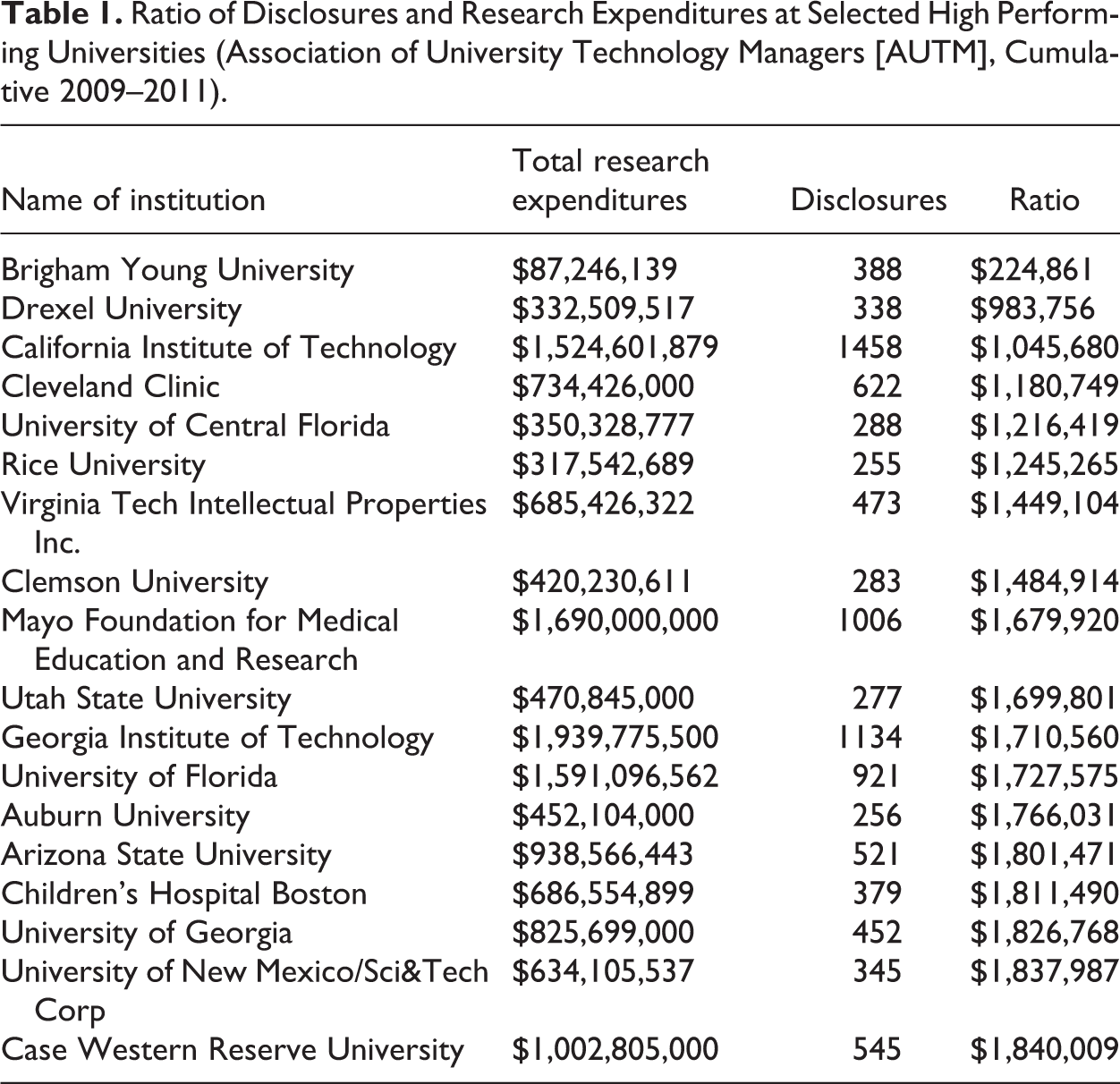
To illustrate the methodology, Table 1 shows the average amount of research spending that generates one disclosure in a selected group of institutions. This table lists the most cost-effective institutions that generate the largest number of disclosure on the same amount of research spending. Based on 2009–2011 cumulative national data, about $2.7 million spending on research should produce a disclosure. However, best innovation universities produce a disclosure on $500,000–$1,500,000 research.
Ratio of Disclosures and Research Expenditures at Selected High Performing Universities (Association of University Technology Managers [AUTM], Cumulative 2009–2011).
More generally, one of the most practically relevant questions is the effectiveness of each transfer along IP pathway. Comparison with national benchmarks at each step could help institutions in improving their practices along the entire pathway, not just at a particular step. Table 2 provides comprehensive overview of the transfer ratios along the IP pathway. It lists the various ratios and also specifies the median, upper quartile, and upper decile performances (called threshold, target, and stretch goals, respectively). For example, lowering the research expenditure to disclosure ratio means more and better performing disclosures per dollar spent on research.
Transfer Ratios on the Intellectual Property (IP) Pathway (Median, Upper Quartile and Upper Decile, Association of University Technology Managers [AUTM] 2009–2011).
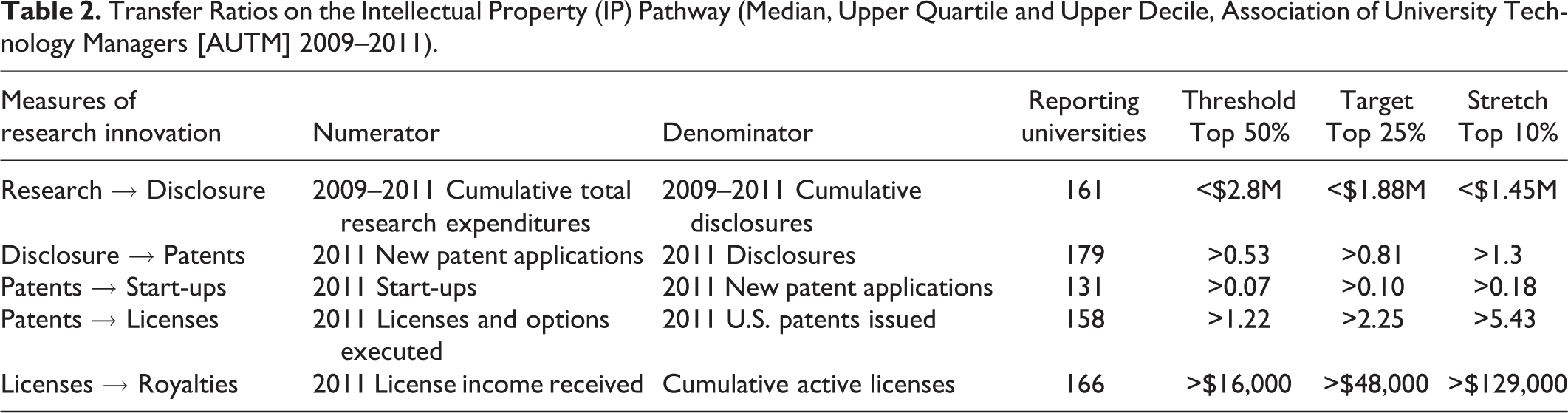
In comparison with these national benchmarks, universities can assess and improve their institutional practices. For example, transfer ratios on the IP pathway at the University of Utah indicate $1,884,416 research spending per disclosure (near best quartile); 0.53 patent applications per disclosures (above median); 0.15 start-ups per patent applications (upper quartile); 1.72 licenses per patents (above median); and $129,110.61 income per license (upper decile). Based on the reported data, this university achieved a consistently solid performance at each transfer step during the reporting period. Many other universities show much less consistency and many more fail to achieve threshold levels of performance along the IP pathway. According to AUTM, only 212 of the 38,600 active licenses generated more than $1 million in FY2011.
Discussion
The recent Institute of Medicine (IOM) report on the NIH Clinical and Translational Science Awards (CTSA) Program underscored that the translation of scientific findings to clinical and community practices need to be accelerated. Clearly defined, measurable goals are needed to provide the program with a basis for evaluation, reporting, and accountability for the individual CTSAs and the overall program (Leshner et al., 2013).
Many academic leaders have expressed that adapting liberal arts education means increased emphasis on intellectual skills, such as creativity and critical thinking, as well as interpersonal and cross-cultural communication that are essential for successful innovation. These and other recommendations appear to address some of the core issues of increasing effectiveness in innovation disclosure.
Innovation measurements could be further improved by adding two factors, faculty size and IP asset portfolio of the university.
Pulling faculty size from the Integrated Postsecondary Education Data System (IPEDS) system of the U.S. Department of Education can be used to calculate per faculty innovation productivity. IPEDS reports the number of full-time instruction/research/public service faculty (with tenure, on tenure track, or not on tenure track).
Additionally, to describe the IP assets portfolio of the university and also characterize the general culture of IP creation, the number of patents owned by the particular university can be retrieved from the USPTO Patent Full-Text and Image Database.
While research surrounding IP disclosure is somewhat more advanced, there is much less known about the scientific publication pathway. Close to 20,000 randomized controlled clinical trials are registered in the NLM PubMed database annually but very few of them match the landmark significance and public health impact of the diabetes control and complications trial (DCCT 1993). Clearly, better understanding of distinguishing factors of innovation success is needed on the scientific publication pathway as well.
In the current environment, many investigators often do not feel that disclosing inventions to their institutions that the IP will be well handled, that the disclosure may affect their academic freedom and ability to publish, and that the royalties will come back to support their research programs. Investigators who are creating research results that can lead to an invention must be supported by regulations and policies and procedures that make that disclosure safe with regard to their ongoing research agenda.
Technology transfer must not interfere with ongoing programmatic research. If the invention is better than what is available in the market today but work needs to be done to continually improve the invention then that work of the inventor must not be barred by the terms of the technology transfer. Institutions should provide inventor/inventors with regular updates of the royalties that the institution has received for the inventions disclosed by that inventor. Providing inventors with the reassurance that they are safe to disclose inventions to their institutions will greatly improve the rates of IP disclosure and the effectiveness of those disclosures. Research-based innovation is the life’s blood of the economy and needs regulatory support that is consistent with its societal significance. Evaluators in clinical and translational science need to assess institutional capacity for technology transfer and track record in commercialization.
Footnotes
Declaration of Conflicting Interests
The author(s) declared no potential conflicts of interest with respect to the research, authorship, and/or publication of this article.
Funding
The author(s) received no financial support for the research, authorship, and/or publication of this article.