



Abstract
The opioid epidemic in the United States continues to disproportionately affect those in rural, compared to urban, areas due to a variety of treatment and recovery barriers. One mechanism to increase capacity of rural-serving providers is through delivery of training and technical assistance (TTA) for evidence-based programs by leveraging the Cooperative Extension System. Guided by the Interactive Systems Framework, the current study evaluates TTA delivered by the Northwest Rural Opioid Technical Assistance Collabroative to opioid prevention, treatment, and recovery providers on short- (satisfaction, anticipated benefit), medium-, (behavioral intention to change current practice), and long-term goals (changes toward adoption of evidence-based practices). We also evaluated differences in short- and medium-term goals by intensity of TTA event and rurality of provider. Surveys of 351 providers who received TTA indicated high levels of satisfaction with TTA events attended, expressed strong agreement that they would benefit from the event, intended to make a professional practice change, and preparation toward implementing changes. Compared to urban-based providers, rural providers reported higher intention to use TTA information to change current practice. We conclude with a review of remaining gaps in the research to practice pipeline and recommendations for moving forward.
Keywords
Introduction
The opioid epidemic has devastated communities across the United States (US), and rural areas are both disproportionately affected and less equipped to manage the crisis compared to urban areas (Lister et al., 2020). Barriers to effective care for rural residents include longer drive times to access opioid use disorder (OUD) care (Kiang et al., 2022), fewer OUD providers (Andrilla et al., 2019), and limited access to broadband internet for tele-health services (Drake et al., 2019). In addition to treatment barriers, evidence-based prevention and harm reduction services are also lacking (Swann et al., 2021). Rural individuals who use opioids face more stigma than their urban counterparts, including greater bias from health care providers (e.g., viewing opioid use as immoral), and lack of anonymity when accessing services (e.g., smaller population increases likelihood of knowing provider or being seen seeking services) (Franz et al., 2021; Sexton et al., 2008).
Rural opioid services providers face unique challenges in comparison to their urban counterparts, which requires greater flexibility and adaptations to evidence-based programs, practices, and policies (EBPs 1 ). For example, Watson et al. (2022) identified that peer support specialists (i.e., individuals with lived experience partnered with others in or seeking recovery) based in emergency departments encountered more barriers when working with rural providers, such as navigating privacy requirements and overcoming entrenched provider beliefs about their contributions (e.g., that a peer could provide quality services). Local harm reduction efforts can also be more resource-intensive in rural areas and often lack local support to sustain activities (Montaque et al., 2023). Ultimately, rural providers need support to identify, adapt, implement, and sustain EBPs that best meet their local needs.
Systems to support delivery of EBPs exist often through federal agencies, universities, and non-profits. These systems provide training and technical assistance, or TTA, which supports the implementation of evidence-based, culturally, and linguistically relevant interventions by offering guidance, training, or expertise to build community and practitioner capacity (Dunst et al., 2019). The provision of TTA bridges gaps in capacity, experience, and training for communities and practitioners as a way to improve self-efficacy and increase the likelihood of selecting appropriate EBPs, implementing and adapting them, and achieving intended outcomes (Katz & Wandersman, 2016). Rural communities and practitioners require TTA that is both delivered by credible and familiar sources aware of the local culture and context and includes content that is tailored to their unique needs such as responding to local substance use trends. The current study describes and evaluates TTA efforts, delivered within the Cooperative Extension System, for rural communities and practitioners to address opioid use.
Cooperative Extension’s Role in Delivery of Evidence-Based Practices
Federal funding agencies have recognized the need to provide focused support for delivery of EBPs in rural communities to address the opioid epidemic. As a result, they turned to an institution with a network and infrastructure in rural communities across the US – the Cooperative Extension System. The Cooperative Extension System, or Extension, was developed on the premise of delivering educational outreach, or “diffusing…useful and practical information,” to the US public (Smith Lever Act, 1914). Extension is effectively a century (plus) old national research to practice system for the delivery of direct education and outreach programming and TTA. This mirrors a community-centered model for building capacity, in contrast to a top-down research-to-practice model (Flaspohler et al., 2008). A key strength of the Extension system is the available infrastructure, capacity to reach rural audiences, and established role as a trusted community partner (Buys & Rennekamp, 2020). Extension’s trusted relationship with community members and partners serves to both translate research to communities as well as facilitate adoption of EBPs (Le et al., 2016; Weybright, et al., 2024).
The US Department of Agriculture (USDA), a key funder of land-grant institutions housing Extension, funded opioid efforts through the Rural Health and Safety Education mechanism. The purpose of this mechanism was to “address the needs of rural Americans by providing individual and family health education programs...to support the utilization of telehealth, telemedicine, and distance learning strategies for education and training in minority rural communities related to opioids…” (United States Department of Agriculture, 2020, p. 3). In partnership with USDA, the Substance Abuse and Mental Health Services Administration (SAMHSA) funded land-grant institutions through the Rural Opioid Technical Assistance program to “develop and disseminate training and technical assistance for rural communities on addressing opioid issues affecting these communities.” (Department of Health and Human Services, 2019, p. 4). Collectively, this infused almost $23 million dollars into land-grant institutions, and the rural communities they served, for opioid focused work between 2018 and 2020 (Washburn et al., 2022).
Land-grant institutions and Extension have a long history of providing TTA. However, they have done so separately from formal implementation science constructs, models, theories, or frameworks that can provide a shared language and understanding while also inform the planning, delivery, and evaluation of TTA for rural behavioral health practitioners (for distinction between theory, model, and framework see Nilsen, 2015; Proctor et al., 2011). Extension professionals focused on behavioral health would benefit from a basic level of knowledge related to implementation science. Similarly, information on how to engage in behavioral health work is needed. In a survey of Extension professionals, Washburn et al. (2022) found about half had existing relationships with behavioral health partners locally and although many lacked specific knowledge about how to engage in opioid-related work, they were eager and ready to do so. Given Extension’s historical focus on agricultural settings, additional programmatic foci require investment from federal, state, and/or local funders. Over the past few decades, and with support from federal funding sources, TTA delivery has expanded to include behavioral health.
A recent scoping review of behavioral health programming delivered in Extension found that 29% of programs, activities, and strategies delivered were considered evidence-based and another 14% were evidence- or research-informed (Hagaman et al., 2023). The remainder were categorized as activities (16%; e.g., distribution of Naloxone kits), initiatives (5%; e.g., Recovery Friendly Workplace), trainings (31%; e.g., training to administer Naloxone), or resources (17%; e.g., fact sheets). The authors concluded that “significant opportunities exist for local adoption of evidence-based practices aimed at mitigating SUD [substance use disorders]” (Hagaman et al., p.1). Despite the increase in delivery of behavioral health programs, activities, and strategies in Extension, there has not been equivalent growth in the evaluation of such efforts to understand their effectiveness in promoting adoption of EBPs. This is the focus of the current study – to evaluate the effectiveness of opioid-related TTA provided through Extension. Extension is unique in that it promotes use of EBPs in two ways – both in the direct delivery of programs and by supporting community partners and practitioners’ delivery (Spoth et al., 2021). The latter role of Extension as TTA provider is the focus of the current study. One framework for better understanding these roles is the Interactive Systems Framework.
Foundational Theory and Frameworks
The Interactive Systems Framework for Dissemination and Implementation (ISF) was created to address research-to-practice gaps and outlines the infrastructure and systems necessary for implementation and dissemination of EBPs (Wandersman et al., 2008). ISF proposes three inter-related systems focused on 1) synthesizing and translating information to users, 2) supporting capacity building efforts, and 3) delivering evidence-based programming. The synthesis and translation system (#1) supports EBP implementation and dissemination by translating research and related content to a more digestible format to be understood and applied by practitioners. The support system (#2) builds capacity both generally and for implementation of specific EBPs, also called innovations in the ISF. The support system is the focus of the current study – a federally funded technical assistance center, the Northwest Rural Opioid Technical Assistance Collaborative (NW ROTAC), which was administered through a land-grant university and Extension network in the northwest US. The delivery system (#3) includes organizational and individual capacities that support implementation of EBPs. The delivery system includes community-based individuals (practitioners) providing prevention, treatment, and recovery programming addressing opioid use in rural communities.
The current study also incorporates an expansion of the ISF, the Evidence-Based System for Innovation Support, or EBSIS. The EBSIS serves to connect ISF’s support and delivery systems with four main support components of 1) tools, 2) training, 3) technical assistance, and 4) quality assurance/improvement (Wandersman et al., 2012). The EBSIS proposes these four support components are additive, building on one another, to achieve the outcomes desired from EBP implementation in the delivery system. Three of the EBSIS’s main support components (tools, training, and TA) were present in the NW ROTAC.
Connecting delivery of TTA within a support system to implementation of EBPs within the delivery system is complicated, particularly because the aim of this study is to capture intention to change behavior among opioid practitioners – rather than among the individuals they may treat. In addition to the ISF, behavioral theories help us to appreciate the complexity and dimensions of practitioner and organizational adoption of EBPs, and how TTA can support change. The Theory of Reasoned Action (TRA; (Fishbein & Ajzen, 1975; Fishbein et al., 2007) posits that attitudes and subjective norms influence behavioral intentions, which then predict behavior. TRA is frequently used to understand and explain health-related behaviors (e.g., substance use) but can be used as a framework to understand change in behavior in other domains such as prevention interventions (Romano & Netland, 2008). In the current study, TRA is used to investigate key factors (e.g., behavioral intention) associated with practitioner behavior change toward adoption of EBPs. One critique of the TRA is a disconnect between behavioral intention and actual behavior (i.e., that changes in behavioral intentions are associated with minimal change in actual behavior; Sheeran & Webb, 2016). To address this critique, we incorporated the Transtheoretical Model (TTM; Prochaska et al., 2001), which reflects a process of intentional behavior change. The TTM recognizes that change is an ongoing, nonlinear process that individuals or organizations proceed through as they attempt to achieve goals. Applied to our provision of TTA, we acknowledge that individual practitioners and organizations alike may need time to contemplate and prepare before making changes to practice. In the current study, TTM is used to investigate movement toward adoption of EBPs. Individuals may need different TTA supports at different stages of change and based on their readiness to adopt EBPs within their own practice. In the current study, we expect behavioral intention (TRA) and stages of change (TTM) to provide a complementary and therefore more comprehensive view of behavioral intentions resulting from provision of TTA with subsequent behavior change.
To connect framework, theory, and model in the current study, we provided Figure 1 as a conceptual model. In this model, NW ROTAC serves as the support system by developing and disseminating tools, training, and technical assistance to the delivery system while leveraging the trusted relationships foundational to Extension. The goal of NW ROTAC is to build capacity among rural practitioners for delivery of EBPs. As a result, rural-serving practitioners within the delivery system demonstrate short-term (i.e., satisfaction with and anticipated benefit from TTA events), medium-term (e.g., greater behavioral intention to adopt EBPs) and long-term goals (i.e., behavior, practice, or organizational change to adopt EBPs) consistent with TTM and TRA and timelines with which these processes unfold (Leeman et al., 2017). Long-term, we expect greater availability of EBPs in rural communities and, relatedly, adoption of EBPs by practitioners to positively impact the clients and individuals served and reduce opioid use. Conceptual Model Integrating Framework, Theory, and Model used in the Current Study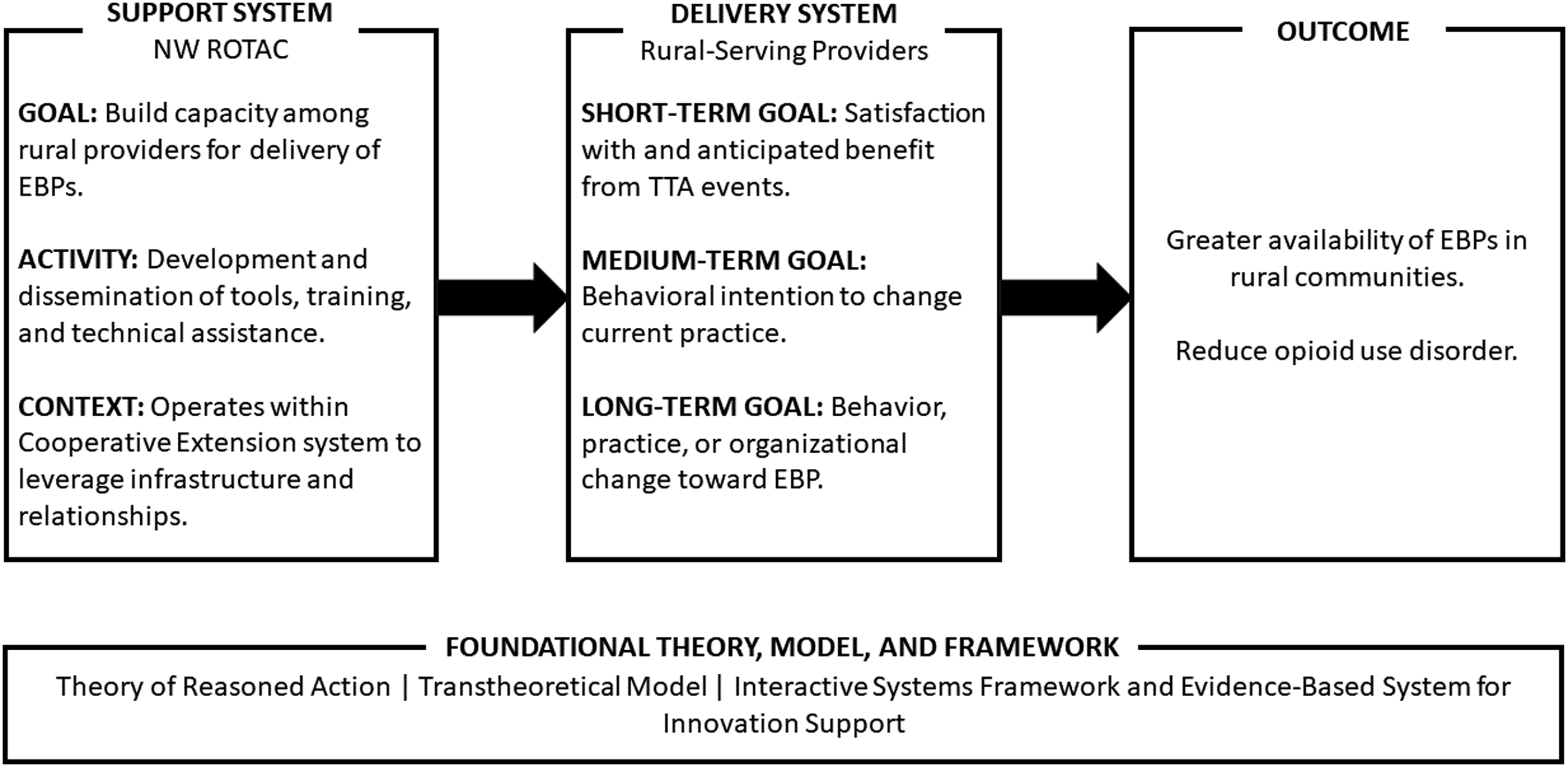
Current Study
The NW ROTAC activities centered on developing and disseminating TTA to rural communities for prevention, treatment, and recovery from opioid use and was developed with funding from SAMHSA’s Rural Opioid Technical Assistance mechanism. A unique feature is the NW ROTAC leveraged the statewide Extension network, infrastructure, and trusted relationships to provide rural communities with the high quality TTA needed to address the opioid epidemic. The current study used evaluation data from TTA provided to opioid prevention, treatment, and recovery practitioners to support implementation of EBPs in predominantly one state in the US. Broadly, this evaluation sought to understand the effectiveness of TTA delivered, in context of the Extension system, on practitioners’ intention to adopt EBPs. In Research Question 1, we expected TTA delivered through the NW ROTAC to positively impact short-, medium-, and long-term goals as outlined in Figure 1. Specifically, we hypothesized practitioners would demonstrate a) satisfaction with TTA events and anticipated benefit (short-term), b) behavioral intention to change current practice (medium-term), and c) behavior, practice, or organizational changes toward adoption of EBPs. In Research Question 2, we explored differences by intensity of TTA. We hypothesized those attending multi-session events, compared to one-time events, would demonstrate greater a) satisfaction and anticipated benefit and b) behavioral intention to change current practice. Finally, given the focus on rural-serving practitioners, Research Question 3 explored differences in rurality of practitioner (i.e., urban-vs. rural-based.) TTA events were tailored to rural settings by engaging in targeted outreach to rural communities, including rural presenters/panelists when possible, and offering intensive TTA when possible. Intensive TTA allows for responding to local needs (e.g., local drug trends), and talking through work flows where flexible programming is required in the face of fewer staff filling multiple roles. Because we tailored TTA to rural communities, we hypothesized, compared to urban-based practitioners, rural-based practitioners would demonstrate greater a) satisfaction and anticipated benefit and b) behavioral intention to change current practice. After a review of results, we discuss recommendations and implications based on our initial evaluation.
Method
Description of Training and Technical Assistance Events

Note. 5 participants did not select an event and therefore were excluded.
At the time of data collection, SAMSHA required grantees to administer post-event and follow-up GPRAs to TTA attendees. Post-event GPRAs were administered at the conclusion of attending or viewing the event. Follow-up GPRAs were administered via email, to those who attended an event which was 3 hours or longer, 30 days after the event, per funder requirements. Post-event evaluations were distributed immediately upon viewing or participating in the event to 844 participants, 351 of which (41.6%) completed the survey. A total of 264 eligible participants were invited to complete a follow-up evaluation in addition to the post-event survey. Of the 264 participants invited, 37 (14.0%) completed the follow-up survey. On average, 9 post-event evaluation surveys were completed per event (SD = 10.7), with a range from 1 to 62 surveys. Data included post-event (N = 351) and follow-up evaluations (n = 37) from practitioner participants. The Washington State University Institutional Review Board reviewed the current study and determined it as exempt.
Sample
Participants identified as mostly female (85.8%; 12.8% male, 1.1% transgender, 0.3% other) and White (79.2%; 9.1% Hispanic/Latino, 5.7% Black, 2.6% American Indian, 2.0% Native Hawaiian, and 1.4% Asian). Higher education was most often reported as the principal employment setting (22.2%) followed in decreasing order by substance use disorder prevention program (12. 5%), other (12.3%), community coalition (9.1%), and substance use disorder treatment program (8.3%). About half of respondents reported being an urban- (51.7%; defined as Levels 1-3 by National Center for Health Statistics [NCHS] classification), compared to rural-based practitioner (48.3%; Levels 4-6; Centers for Disease Control and Prevention [CDC], 2017). Although TTA events targeted rural-serving practitioners, all practitioners were welcome regardless of geographic location. Comprehensive behavioral health workforce demographic data for comparison were not available, although desired by state agencies (e.g., Washington Workforce Training and Education Coordinating Board, 2022).
Measures
Post-event and follow-up survey items were taken from standard GPRA TTA evaluations (SAMHSA, 2023). The post-event survey included items related to TTA provision. TTA satisfaction was captured with the item “How satisfied were you with the quality of this event?” with response options ranging from 1 (Very dissatisfied) to 5 (Very satisfied) and “I would recommend this event to a colleague” with response options of 1 (No) and 2 (Yes). Anticipated benefit was captured with the item “I expect this event to benefit my professional development and/or practice” with response options ranging from 1 (Strongly disagree) to 5 (Strongly agree). Behavioral intentions were measured with the item “I will use the information gained from this event to change my current practice” with response options ranging from 1 (Strongly disagree) to 5 (Strongly agree). Follow-up GPRAs contained two open-ended items, one capturing organizational or practice changes (“What has improved in your organization/practice because of this event?”) and one requesting an example of practice change (“If you made a change to your practice as a result of this event, please describe briefly”).
Analytic Plan
Research Question 1 was addressed using descriptive statistics for Hypotheses 1a and 1b. Hypothesis 1c used open-ended items, which were thematically coded by two co-authors and emergent themes triangulated with remaining co-authors. Research Question 2 and 3 were examined by conducting mean comparisons among key groupings including intensity of TTA provided and rurality (using the National Center for Health Statistics classification scheme 1-3 vs. 4-6). Comparisons were conducted using Students’ t-tests for items with Likert-scale response options and Fishers Exact Test for items with dichotomous No/Yes response options. Effect size was reported as Cohen’s d.
Results
TTA Impact on Delivery System Goals
Post-event surveys were used to answer Research Question 1. The results supported Hypotheses 1a and 1b. Descriptive statistics indicated participants were satisfied with the quality of events (98.3% satisfied or very satisfied; M = 4.75, SD = 0.47), would recommend the event to a colleague (80.9% yes), expected the event to be beneficial to their professional development or practice (96.3% agreed or strongly agreed; M = 4.60; SD = 0.60), and planned on using the information gained to change their current practice (80.9% agreed or strongly agreed; M = 4.23, SD = 0.82).
Hypothesis 1c. was also supported. Qualitative analysis of open-ended follow-up survey responses indicated participants were in various stages of change with respect to improving their organization or practice as a result of the event. In response to the question of “What has improved in your organization/practice because of this event?,” almost half of respondents (n = 13) were contemplating a change (e.g., “We haven’t made full on adjustments yet but we have been having discussions.”) and a smaller number (n = 4) had implemented a change such as “team meetings revisiting current practices.” Approximately 40% of responses (n = 11) also indicated that participants found value in making/growing professional connections whether through networking, referrals, or creating new partnerships (e.g., “Contacts that support common practice efforts.”), which is preparatory and can prompt action (Fishbein et al., 2007; Prochaska et al., 2001).
When asked, “If you made a change to your practice as a result of this event, please describe briefly,” participants again noted increased professional connections (n = 4; e.g., “Made connections with other institutional colleagues…”) but also the sharing of resources from the event with other professionals (n = 2, e.g. “I shared the…curriculum with a colleague.”) thus expanding the reach of the trainings. Responses to this question again reflected participants in various stages of change, from pre-contemplative (n = 5, e.g., “No change yet, but info was useful going forward.”) to planning (n = 1, e.g., “I will use the…model for group brainstorming/prioritization.”) to action, (n = 5, e.g., “We will be implementing this program into our practice.”). Although some responses were brief, they indicated preparation toward implementing changes, which at the individual or organizational level may involve a decision-making process that takes time to fully propagate.
Differences by Intensity of Event and Rurality of Practitioner
Mean and Standard Deviation or Percentage Comparisons in Training and Technical Assistance Measures by Intensity of Event and Rurality of Provider
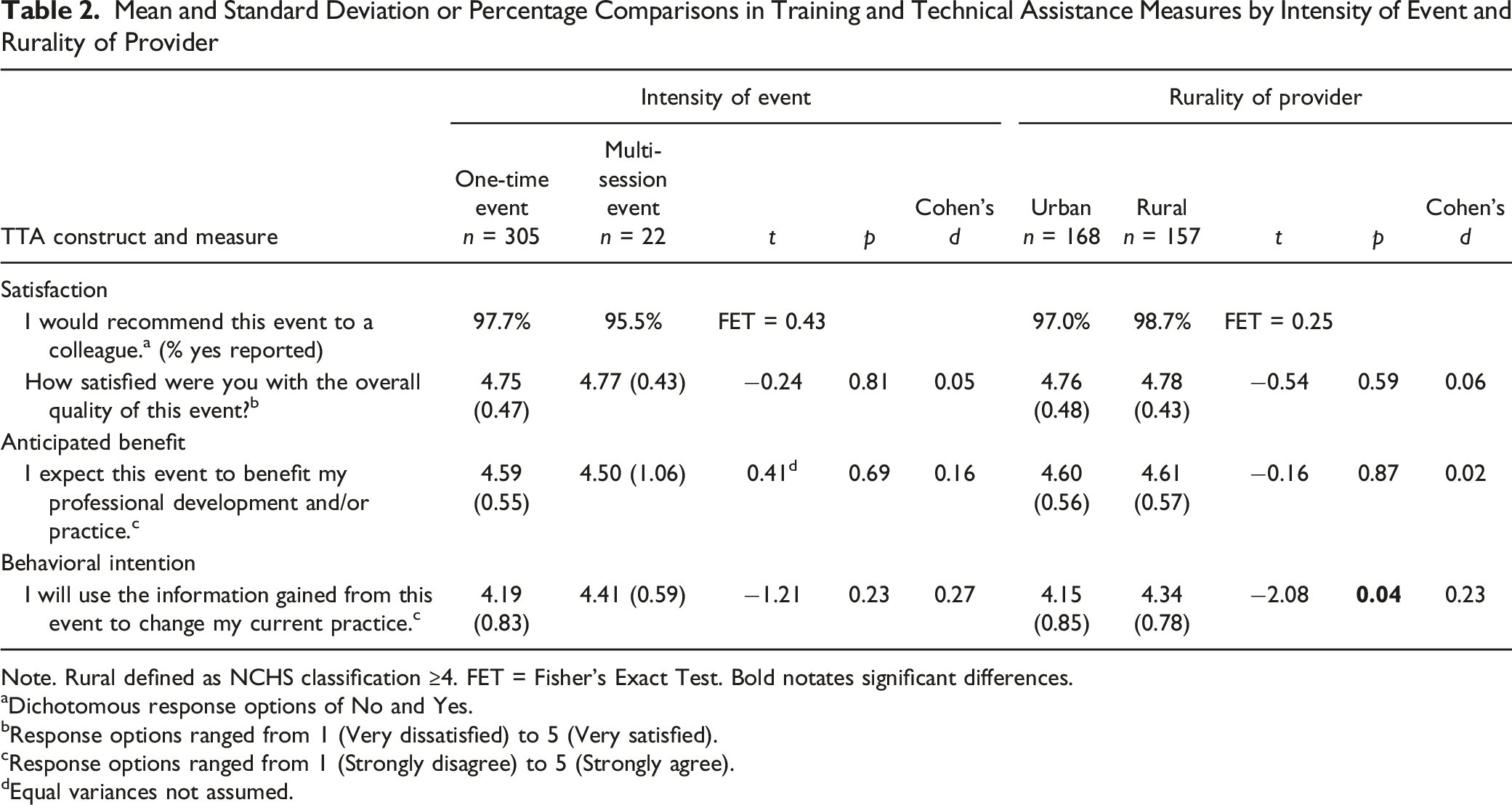
Note. Rural defined as NCHS classification ≥4. FET = Fisher’s Exact Test. Bold notates significant differences.
aDichotomous response options of No and Yes.
bResponse options ranged from 1 (Very dissatisfied) to 5 (Very satisfied).
Response options ranged from 1 (Strongly disagree) to 5 (Strongly agree).
dEqual variances not assumed.
Discussion
In summary, evaluation results indicated participants were highly satisfied with the TTA events they attended and expressed strong agreement that they would benefit from the event and intended to make a professional practice change. Qualitative data, although limited, suggested participants were indeed in various stages of change with respect to acting on either individual or organizational changes to practice. In particular, rural practitioners were significantly more likely than urban practitioners to report behavioral intention to change their current practice based on TTA. There are many possible reasons for this difference, which may be related to the TTA itself (e.g., TTA was delivered by a trusted source familiar with the local and rural contexts). Conversely, the differences may reflect larger urban/rural differences, for example rural organizations being smaller and therefore perhaps more flexible when it comes to implementing change.
The ISF provides a conceptual framework to critically examine how the provision of TTA leads to adoption of EBPs. In the current study, and from the results available, we infer that NW ROTAC is functioning satisfactorily as a Support System, at least to those who participated in TTA, and contributing positively to the community-based Delivery System. Due to limitations in available evaluation data, including small follow-up sample size and limited qualitative data, we cannot provide further description of that contribution, nor can we give more context to the relational element, or bidirectional communication, we know to be so crucial when working in rural areas. Despite these limitations, our evaluation results provide evidence of behavioral intent (short-term practitioner outcome), especially among rural practitioners. This is an important initial step in a comprehensive analysis regarding TA practitioner change and impact of TA on the communities served. Consistent with theoretical logic, behavioral intent (our measured short-term practitioner outcome) can lead to behavior change among TA practitioners (Fishbein et al., 2007; Prochaska et al., 2001). Within rural communities where fewer EBPs are implemented, supporting practitioners with rural focused TTA is especially critical. Testing this postulate would be a next step and contribute to ongoing quality improvement within NW ROTAC. Our aim is that ultimately, as a result of NW ROTAC’s role as a Support System, practitioners within the Delivery System will adopt EBPs which, in turn, benefit those served and related opioid use outcomes. Future inquiry will help determine if the short-term outcome measured led to the theoretically-informed cascade of outcomes. Given that rural areas tend to experience more challenges implementing EBPs while also experiencing resource deficits (Smith et al., 2016), it seems imperative to maximize all aspects of dissemination and implementation systems. We cannot assume TTA provision will impact opioid outcomes like reduced deaths related to opioids. That said, we know that EBPs targeting opioid use, such as medication treatment for opioid use disorder, have immense impact and are thought to “save lives” (National Academies of Sciences, Engineering, and Medicine, 2019). With this EBP in particular, TTA has been demonstrated to be key in increasing access to it, as evidenced by a cross-sectional study showing state-targeted funding for TTA was associated with increased adoption of EBP for opioid use disorders (Abraham et al., 2018). Such results remind us of the important role of TTA, even in the absence of evidence suggesting it directly saves lives.
Improving the TTA Support System to Close the Research—Practice Gap
Models like the ISF and EBSIS are helpful to provide a comprehensive view of factors contributing to the translation of research into practice to improve behavioral health outcomes. However, gaps remain in key areas related to a) application of TTA frameworks within Cooperative Extension, b) the importance of relationships, c) addressing the entire behavioral health continuum from health promotion through recovery, and d) funder accountability. We review these gaps and identify key recommendations.
Application of TTA Frameworks in Extension
The Cooperative Extension System has delivered TTA for over a century, but at times absent of formal TTA theory, models, and/or frameworks. The current study in behavioral health finds that TTA, through or in partnership with the Extension network, holds promise. National Extension leadership (e.g., the Extension Committee on Organization and Policy) currently does not provide a definition or framework for TTA efforts. The Extension system can uniquely facilitate TTA for myriad health behaviors and outcomes, especially in rural communities, because of its longstanding relationships, infrastructure, and reputation as a trusted community partner (Buys & Rennekamp, 2020). This creates an opportunity for Extension, which has historically been most visible in agricultural settings, to leverage existing networks for the delivery and provision of TTA (e.g., Spoth et al., 2021). We recommend national Extension leadership adopt the use of research-based frameworks, like the ISF and EBSIS, to guide delivery of TTA across the system and formalize Extension’s role. Extension as a national and state entity has roles in all three ISF systems – it translates research for public use, provides TTA to support implementation of EBPs, and delivers EBPs locally. Although the current study focused on Extension as a Support System, the contribution of Extension to all three ISF systems could be strengthened by using ISF as a framework to guide work in each of these areas. EBSIS and the integration of Getting to Outcomes (GTO; Wandersman et al., 2012) provides structure, formalization, and guidance for Extension professionals internally, and a means of communicating Extension’s work externally. This serves to increase the likelihood of EBP adoption within the Delivery System, and also facilitates identification and communication of system-wide inputs, activities, and impacts. Ultimately, the more Extension can use evidence-based theories, models, and frameworks to guide their work, the more likely they are to achieve their intended outcomes – which in the case of the current study are delivery of EBPs targeting opioids.
Importance of Relationships
Trusted relationships are a critical link between the ISF’s Support and Delivery System and a key element of EBSIS, yet an often-overlooked factor in research of TTA and implementation science broadly. Relationships are often characterized by elements of trust and mutual respect and can influence the receptivity, or openness, of individuals in Delivery System to accept TTA from the Support System, as well as the quality of TTA provided. Wandersman et al. (2012) call for further investigation of relationships within the ISF but guidance on how to do this and what it looks like has not been formalized. As a starting point, Katz and Wandersman (2016) identified key features of relationships such as trust, respect, and collaboration. We recommend investment in research to understand features of relationships which serve to facilitate TTA and uptake of EBPs among practitioners. The ability to establish long-term collaborative interpersonal relationships is a core competency of Cooperative Extension professionals who live and work in all ∼3100 US counties (Maddy, et al., 2002). An opportunity exists to leverage the history and expertise of Extension, as well as the community social capital they possess (e.g., their connections, access, and network of local partners) in future research. Specifically, the bridging type of social capital present among Extension professionals provides greater access to resources and services which ultimately impact individual and community well-being, which is especially critical in rural areas (Chilenski et al., 2014).
In the current study, relationships were important to TTA recipients, and not just relationships with TTA providers. Making connections and networking was a frequent benefit cited by our participants. This finding aligns with TTA efforts in other fields, such as cancer prevention and control, which emphasizes practitioner-to-practitioner networking as necessary for the uptake of EBPs. For example, Leeman et al. (2015, 2017) have shown that practitioners benefit from sharing their own stories from the field and from strengthening social and community partner networks. The 2018 “Life In Rural America” survey identified that most rural Americans believed outside help would be needed to address their most concerning problem – drug use; moreover, a large majority of survey respondents felt deeply attached/connected to their communities and placed value on neighbors helping neighbors (Robert Wood Johnson Foundation et al., 2018). Afifi et al. (2022) argue that use of EBPs in rural communities is not feasible without authentic and meaningful community member engagement. Related to opioid use, consistent, sustained partnerships with rural communities are critical to improve the healthcare delivery system and reduce barriers to care (Douthit et al., 2015). In a similar vein, delivery of TTA which best meets the needs of rural communities, is sustainable in the long-term, and provides higher levels of intensity (e.g., coaching), cannot occur without hearing from rural practitioners. Authentic engagement of rural practitioners, such as involving community members in leadership roles to inform program planning and implementation, is necessary within the Support System and therefore a recommended action.
Addressing the Behavioral Health Continuum
The Institute of Medicine’s (IOM) (Committee on Fostering Healthy Mental, Emotional, and Behavioral Development Among Children and Youth et al., 2019) behavioral health continuum of care serves as a guide to organize and understand types of behavioral health from promotion and prevention, through treatment and recovery. Importantly, efforts must target all aspects of the continuum to most effectively address substance use. When it comes to disseminating evidence-based treatment for opioid use disorder (i.e., medication treatment for OUD; MOUD), prior research has demonstrated processes that work to both provide TTA to practitioners and, more importantly, increase access to evidence-based care for people who could benefit. Specifically, federal Opioid State Targeted Response/State Opioid Response funding mechanisms used in Washington State expanded MOUD availability by developing evidence-based models of care and subsequently implementing these models through robust statewide TTA efforts (Reif et al., 2020). The first 18 months of this programming resulted in 5000 patients being started on evidence-based medications for OUD. Large-scale TTA rollouts can increase adoption of evidence-based OUD treatment, and this model can be leveraged to address the remainder of the continuum. Despite the initial indication that individuals with OUD are better able to access treatment services, we know that treatment is not enough. To most effectively address opioid use in rural communities, prevention and recovery supports are needed to address the entire behavioral health continuum. We recommend translating our understanding of how TTA delivery works for treatment practitioners to opioid prevention and recovery practitioners.
Greater Funder Accountability
We echo the conclusions of Smith et al. (2016) and Hagaman et al. (2023) who acknowledge that to most effectively promote health within rural communities, we need to involve a range of community partners holding complementary roles, and to better coordinate federal funders’ dissemination strategies that impact the local level. Federal funding entities supporting TTA work, like SAMSHA, influence factors such as application of TTA theories, models, and frameworks (e.g., ISF), intensity and variety of TTA provided, and constructs targeted in TTA evaluation (Scott et al., 2022). We need sensitivity (i.e., ability to discriminate differences) in measurement that help us to better understand what TTA works and how. As the current study illustrates, existing required TTA evaluation measures do not fully capture underlying mechanisms of change or how uptake of EBPs diffuses through rural areas. Neither do they fully capture organizational factors serving as facilitators or barriers to delivery of EBPs, an issue not addressed in the current study. For example, additional evaluation is needed to understand mechanisms of change that are theoretically or conceptually linked in the current study as illustrated in Figure 1, as well as additional factors not included that we know to be influential. Currently ROTA grantees are required to administer the GPRAs used in the current study. Aligning with models of implementation and dissemination, such as Reach, Effectiveness, Adoption, Implementation, and Maintenance (RE-AIM; Glasgow et al., 2019), and Practical, Robust Implementation and Sustainability Model (PRISM; Feldstein & Glasgow, 2008) would be advantageous to provide greater guidance to grantees, identification of adoption of EBPs, and accountability to federal funders (e.g., Melhado et al., 2023).
At the same time, those involved in providing TTA must acknowledge the current situation in rural areas – that practitioners are overworked and under resourced, and may not have the bandwidth to engage in intense evaluation efforts. Inherent in creating a new generation of models may mean critically questioning long held research and evaluation standards. A complicating yet important factor is that reporting requirements, like GPRAs, need to be balanced with local capacity to implement and relevance to their needs. How do we rigorously evaluate TTA without burdening rural communities? Exploring this answer will require supporting evaluations that may look different from current practices such as moving to community-engaged approaches to understand reach and impact rather than online surveys.
Limitations
The current study was limited to GPRA survey administration requirements for grantees. In part, this was to illustrate the utility of GPRA post-event and follow-up surveys to understand the adoption of EBPs among opioid providers. A key limitation in GPRA surveys is the lack of specificity and sensitivity to detect behavioral change among providers toward adoption of EBPs and the factors that serve as barriers or facilitators. Although the response rate for the post-event survey (41.6%) was in line with average response rate of online surveys (44.1%; Wu et al., 2022) the response rate for the follow-up survey was low at 14%. The low response rate may have contributed to null findings and have introduced greater bias into study findings, in part, due to issues of social desirability.
Conclusion
The current study outlines the acceptability and success of a grant-funded program as a support system for opioid use disorder practitioners. Practitioners who received TTA were highly satisfied and expressed interest in making changes in their practices. Within the ISF and EBSIS framework, NW ROTAC served as a support system for rural serving practitioners to improve EBPs, and therefore lead to better outcomes for those with OUD in rural communities. Future studies should further examine the role relationships and TTA framework play to benefit dissemination of evidence-based practices in said communities. We also recommend examining current practices for the evaluation of funding mechanisms, and ways to improve evaluation to in turn better serve those receiving TTA.
Footnotes
Acknowledgments
Authors would like to acknowledge Michael McDonell for his contribution to acquiring funding and collecting data.
Declaration of Conflicting Interests
The author(s) declared no potential conflicts of interest with respect to the research, authorship, and/or publication of this article.
Funding
The author(s) disclosed receipt of the following financial support for the research, authorship, and/or publication of this article: This work was supported by funding from the Substance Abuse and Mental Health Services Administration (SAMHSA), U.S. Department of Health and Human Services [H79TI082557]. The content of this article is solely the responsibility of the authors and does not necessarily represent the official views of SAMHSA.
