



Abstract
There are many ways proposed to achieve better societal outcomes (e.g., in health, education, and well-being) including: (1) bridging research and practice, (2) building the motivation and capacity of service delivery organizations (e.g., schools, hospitals, clinics, and community-based organizations) to innovate, and (c) providing service delivery systems with high-quality support via training and technical assistance. The Interactive Systems Framework for Dissemination and Implementation (ISF) was developed to describe how relevant systems, organizations, and processes can interact and work toward these goals. Stimulated by the 13 articles contained in the two special issues of Strengthening the Science and Practice of Implementation Support: Evaluating the Effectiveness of Training and Technical Assistance Centers, we describe several enhancements to the ISF including: how service delivery systems can operate better, how motivation and capacity can be built, and how training and technical assistance centers can provide more evidence-informed technical assistance and other promising innovations. ISF 2.0 incorporates these and other enhancements with the goal of achieving better outcomes. We conclude that the actions and accountability of funders and of organizations and systems to funders would accelerate progress in the systems to achieve outcomes—and result in improving the science and practice of implementation support.
Keywords
Introduction
Hundreds of billions of dollars are spent every year in the U.S. on service systems (e.g., health care systems, non-profit service organizations, state and local health departments, social service agencies, and schools) with the goal of delivering treatment, prevention, or education services. In relation to the delivery of these services and the enormous tax and private sector costs, the public often asks questions like: “Why are our children falling behind other countries in math and reading?” “Why are there health disparities in different parts of our cities?” “Why are there so many common medical errors and poor practices in hospitals?” and “What can be done to improve outcomes?” The public naturally looks to government-funded service systems to achieve better outcomes. This often requires doing something new in an organization, for instance, implementing a program, policy, practice, or process that is new to that organization (we call that an innovation for that organization) and implementing it effectively.
First, having a service system implement an innovation requires the service system to be clear about what outcomes it desires to achieve. Second, it needs to know about which innovation to choose and the who, what, when, where, and how of the innovation and especially what outcomes should be expected—if it is implemented with quality. This leads to the need to have a system of usable knowledge about what works and what does not. Third, implementing innovations more effectively often involves a need for implementation support (e.g., training, technical assistance or coaching, subject matter expertise, networking, and other forms of capacity-building needed for quality implementation).
Acronyms

ISF 2.0—Systems and Enhancements

The Original ISF: A Determinant Framework for Dissemination and Implementation
In the early 2000s, the Centers for Disease Control and Prevention (CDC) Division of Violence Prevention was concerned about the gap between having evidence-based youth violence prevention programs and child abuse prevention programs available in the empirical literature but not being used in the field. This led the CDC Division to form a project, headed by the first author, to convene researchers, funders (i.e., CDC), and practitioners to determine ways to bridge the gap between research and practice. An extensive process of stimulus papers and in-person meetings led a team to develop the ISF (Wandersman et al., 2008). The ISF proposes ways to bridge the gap by describing three crucial systems and the interactions between those systems. A major driver in developing the ISF was the premise that the usual research→practice direction was a one-way street; models such as the Institute of Medicine’s research-to-practice model (Mrazek & Haggerty, 1994) were insufficient to drive change in community settings. Research-to-practice models needed to be complemented by a community-driven/practice-driven model. Individuals, organizations, and communities should also be the drivers of change (e.g., requesting types of support and/or research and contributing practice-based evidence) and not just be passive recipients of science.
The ISF consists of three systems (see Figure 1 for the original ISF). The delivery system is the organization(s) (e.g., health care systems, mental health centers, and/or schools) or community setting that is responsible for the implementation of an innovation. The support system is responsible for supporting the delivery system through strategies like training and TA, which strengthens the delivery system’s ability to implement innovations with quality. The synthesis and translation system synthesizes the products of research and translates them into user-friendly formats that can be easily accessed and understood by practitioners in the support and delivery systems. The double-headed arrows between the systems indicate the three systems synergistically interact, and there is a circle encompassing context that surrounds and influences the three systems.
1
The Original Interactive Systems Framework for Dissemination and Implementation (ISF)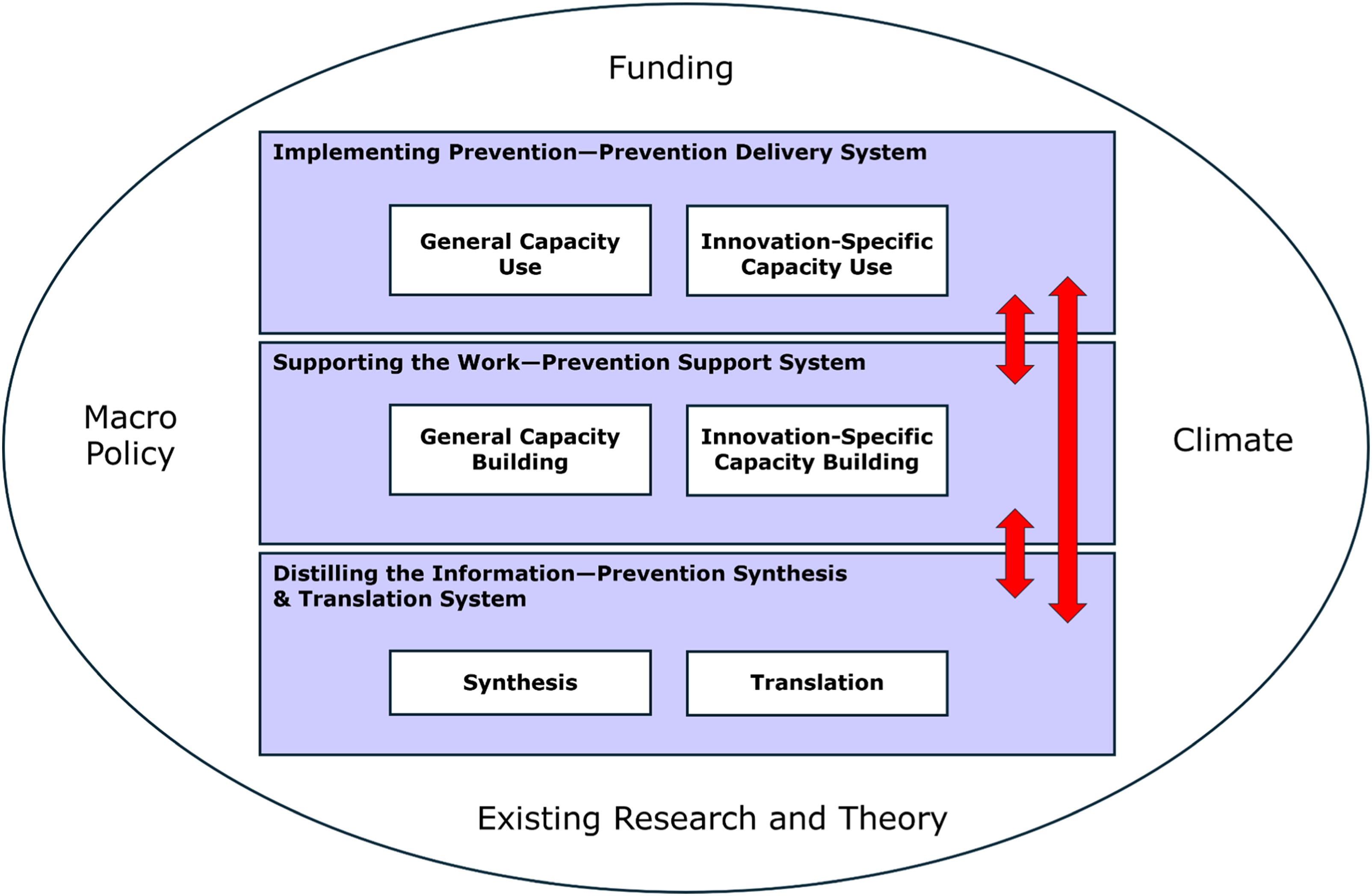
Introduction to ISF 2.0
The original 2008 ISF has been an important contributor to implementation science for bridging the gap between research and practice (at the time of writing this commentary, the original framework was cited more than 1660 times). Since its origins, several refinements have been made to the ISF (Gregory et al., 2012; Scaccia et al., 2015; Wandersman et al., 2012) to maintain its organic nature. As a result, the ISF has grown to keep pace with the overall growth of implementation science.
In this section, we outline the key ingredients to an enhanced ISF—known as ISF 2.0—based on empirical advances and stimulated by articles in the two special issues, other relevant publications, and by our own cumulative experience in the field. The ISF 2.0 is foundational; it incorporates key enhancements and opens the door to more depth and breadth. In outlining the basic structure of ISF 2.0, we focus on two areas: (1) enhancements within each of the major ISF systems (delivery, support, and synthesis and translation) and (2) enhancements related to how these systems work interactively to facilitate change. ISF 2.0 is a framework that promotes evolving theories of change for bridging the gap between research and practice for the purpose of achieving beneficial societal outcomes. In this commentary, our aim is to highlight and illustrate key advances (rather than provide comprehensive detail); we present an updated version of the ISF that both synthesizes the current state of knowledge and facilitates ongoing empirical work. The reader is encouraged to refer to the rest of the special issue and the key citations to obtain more details. We also encourage the reader to think about ISF 2.0 as a living skeleton to be filled out with further research and creative, systematic practice.
Enhancements to the Overall Framework
In comparison to the original version of the ISF, ISF 2.0 adds two large critical aspects to the overall framework that embed the three systems into a broader context of implementation: (1) an increased emphasis on society and (2) the explicit addition of the implementation arrow and outcomes boxes (see Figure 2 for ISF 2.0). The Interactive Systems Framework for Dissemination and Implementation 2.0
Emphasis on Society
In the original ISF, the focus was on the three interactive systems. There was acknowledgement that the systems were embedded within a broader context, as indicated by the circle that surrounded the three interactive systems (which included contextual factors such as existing science and practice, funding, macro-policy, and climate). However, there was little discussion of these factors and how they influence the three systems. In ISF 2.0 we acknowledge the need to explicitly emphasize the importance of the complex societal factors that surround the three interactive systems. The interactive systems are not simply embedded within a given context; they are both influenced by and influence the context. Dynamics like public pressure, social norms, funding availability, and changing geo-political landscapes shape the ways in which innovations are implemented.
In ISF 2.0, we illustrate these active relationships more clearly through the inclusion of society built into the model. We currently view society as consisting of two components that influence each other: (1) the public and (2) societal structure and functioning.
The Public
The public embodies the human element of the contextual setting. It includes people outside of those expressedly contained within the interactive systems but have a role in the success of what the system is trying to achieve. We consider different levels of society including: (a) recipients of services and additional beneficiaries of the services of the delivery system (The Center for Implementation’s ISF, 2021), (b) people with lived experience that relate to a service who can both benefit from a service and help improve it, and (c) society in general and specific sectors within society (e.g., senior citizens, minorities, infants, and incarcerated people). The public can influence and be influenced by each ISF system. For example, Acosta et al. (2024) and Holdheide et al. (2024), in the second special issue, demonstrate how an equity lens in the ISF can assure that each system gains experiential knowledge of the people with lived experience that the delivery system interventions are meant to benefit. Both articles discuss including people with lived experience across the three systems. In this manner, the authors of these articles propose processes that go beyond information-sharing to collaboration and co-design of meaningful synthesis and translation and support strategies that align with the culture, needs, priorities, practices, and languages of the populations in question. In this way, inclusion of the public connects the domains in the circle of the ISF with the three systems.
Societal Structure and Functioning
The three ISF systems are embedded within other societal systems that influence and are shaped by the ISF systems. These are often considered contextual factors and include dimensions like: • Culture and climate • Existing research and practice • Funding • Policies and laws (see Damschroder et al., 2022’s Consolidated Framework for Implementation Research 2.0 for additional information about outer context and its dimensions)
Delivery and support systems are embedded in societal structure and functioning. For example, Gallagher et al. (2024) in this special issue describe how the Department of Defense (DoD) responded to internal and external pressures to mitigate harmful behaviors in the military like sexual assault and suicide. The DoD proposed and is currently hiring a major prevention workforce, which requires substantial training in prevention and evaluation. This effort led to a collaboration with the CDC to develop a TTAC that could provide an innovative approach to implementation support.
Emphasis on Implementation and Outcomes
In this section, we add the following to the original ISF figure: an implementation arrow, implementation outcomes, and individual and/or community outcomes (e.g., health, education, and well-being outcomes). Although the primary purpose of the ISF is to organize and coordinate complex systems to help them implement with quality in order to achieve outcomes, in the original ISF, we focused on the three systems and did not specify the precise linkages to outcomes. Wandersman et al. (2012) then enhanced the ISF by explicitly introducing an implementation arrow and an outcomes box (to the right of the delivery system). Picturing implementation as an arrow visually illustrates that implementation of an innovation is an ongoing, dynamic process.
Quality of Implementation Matters
Implementation science (Durlak & DuPre, 2008; Meyers et al., 2012) and educational change theory (Hall & Hord, 2014) are clear that innovations need to be implemented with quality in order for them to have their intended outcomes. When desired outcomes from innovation implementation are not realized, it is important to distinguish between quality of implementation and quality of the innovation. This helps determine whether intervention efforts fail because implementation was conducted with poor quality or if the program theory is not developmentally sound or inappropriate for the particular population—i.e., implementation failure or theory failure. Therefore, in ISF 2.0, we describe two types of outcomes: implementation outcomes, which are identified through a process evaluation and reflect the degree to which the innovation is implemented with quality, and individual- or community-level outcomes (e.g., health, education, and well-being), which are the desired outcomes for the selected innovation in the population of focus. Including two outcomes boxes in Figure 2 emphasizes the importance of implementation and builds accountability into the process by illustrating how attention must be placed on quality implementation in order to achieve desired outcomes.
Enhancements to the Delivery System
The delivery system is described as the individuals, organizations, groups, and communities that carry out activities necessary to implement innovations. A taxonomy of innovation-specific and general capacities at the individual, organizational, and community levels was identified as central to the adoption of new programs, processes, practices, and policies in the delivery system (Flaspohler et al., 2008). A support system is tasked with building innovation-specific and general capacities in the delivery system (in the readiness section below, we describe innovation-specific capacities and general capacities). The major enhancements for the delivery system relate to: (1) deepening the role of the delivery system to processes beyond implementation alone and (2) readiness of the delivery system to achieve quality implementation.
Expanding the Role of Process in the Delivery System
In the original ISF, the role of the delivery system was operationalized as having the capacity to deliver an innovation. ISF 2.0 expands the understanding of how the delivery system operates in terms of a process of planning, implementing, and evaluating an innovation. In particular, we emphasize adding the importance of selecting an innovation and evaluating the implementation process and outcomes. The important point here is that high-quality implementation of an innovation should follow a systematic process for innovation selection and that evaluation, improvement, and sustainability are part of the implementation cycle. This fuller process is important to recognize because it better sets expectations for the delivery system—in terms of what is needed to fully implement an innovation with quality. In practice, we have observed many scenarios where individuals operating within the delivery system wanted to jump into implementation without first engaging in the necessary steps for appropriate selection of an innovation. In sum, ISF 2.0 explicitly acknowledges the need for the delivery system to engage in a systematic process of planning, monitoring, and evaluating implementation and outcomes. To achieve these goals, we encourage funders to build funding and timelines for a systematic process into their appropriations to the delivery system.
GTO Accountability Questions and Supporting Literature Base

Readiness
R=MC2 Readiness Components and Subcomponents

Note. Scaccia et al. (2015).
In the second special issue, Lamont et al. (2024) enhance our understanding of capacities by recognizing the difference between general capacities that describe general everyday functioning of the organization and general capacities as they align to the innovation. They illustrate the difference between these two capacities in the case example of a well-functioning training center that was seeking innovative ways to incorporate TA. The functionality that supported a training center was not the same functionality that would support a high-quality TA center, and this led to changes in the everyday general capacity subcomponents. Attention to both of these approaches to general capacity was needed; Figure 2 illustrates the overlap of general and innovation-specific capacities.
Enhancements to the Support System
The support system is tasked with supporting the delivery system to facilitate implementation with quality to optimize the probability of beneficial outcomes. In the original ISF, this was accomplished by building the general and innovation-specific capacities of the delivery system; in ISF 2.0, this involves building the readiness of the delivery system and providing direct implementation support as-needed (Lamont et al., 2024). Research on the support system—in particular, in terms of TA—has increased substantially in the past decade. Both special issues indicate progress in understanding high-quality support. In this section, we reflect on several key areas of expansion in the literature, which are now incorporated into ISF 2.0. Specifically, we focus on two levels of support system enhancement: organizational level and TA-provider level.
Organizational Level
Key enhancements include guiding principles, such as standardization; internal operations, the latter including workforce development; and a two-tier support system.
Guiding Principles
The growing body of literature in TA suggests that a set of guiding principles should be developed for the support system (Holdheide et al., 2024; Metz et al., 2020). Holdheide et al. (2024) describe the American Institutes for Research’s (AIR) Four Core Principles of TA: (a) client-focused; (b) intentionally designed; (c) grounded in diversity, equity, and inclusion; and (d) evidence-informed and evidence-generating. Each principle defines “why” and “how” TA is conceptualized, operationalized, implemented, and anticipated in the real world. Holdheide et al. (2024) discuss how AIR was in the process of developing a common TA approach across multiple TTACs to ensure fidelity and increase capacity. This requires establishing an overall vision for the TA system including TA core competencies and TA provider assessments. The authors provide examples of operationalizing key TA principles. For example, the principle of client-focused TA sets the stage that the TA provider places the recipient front and center and prioritizes their goals and needs.
The call for standardization, another important guiding principle, ensures that a higher quality of TA is consistent across providers (Lamont et al., 2024). Often, TA providers have relied solely upon their past experience and instincts, which impacts the consistency of what TA recipients receive, and this can affect TA outcomes. Lamont et al. (2024) found at the beginning of their TA system innovation that TA providers came from different backgrounds; some had extensive training experience but little background in TA techniques and competencies. Therefore, these individuals provided only reactive, problem-solving support rather than a comprehensive TA plan. Standardization ensures a certain level of quality no matter who serves as the TA provider. At the same time, Lamont et al. show that a standard approach can be used to customize TA to fit each individual recipient and delivery system organization.
Internal Operations
Lamont et al. (2024) also demonstrate the importance of developing an internal structure and operations that are clear about expectations for TA providers and support them in their work. They use the “Big 6” internal operations factors: policies and practices, workforce development, supervision, workflow, employee recruitment and orientation, and admission/conclusion of TA with recipients. In workforce development, for example, the empirical literature on building a TA workforce emphasizes that building the capacity of TA providers should be integrated and offered on a regular basis, including self-paced and in-person trainings, as well as peer learning and individual coaching.
Two-Tier Support System
Sometimes a TTAC itself wants to do something new and requires support for their innovation. Lamont et al. (2024) introduce a structural solution to the issue of ongoing professional development and mechanisms for quality control. They present the concept of an “external” or “secondary support system,” which is a system (often comprising program developers or people with expertise in a particular TA system) that provides support to the TA providers in the form of tools, training, TA, and quality assurance/quality improvement (QA/QI).
Secondary support systems often work at two levels of the organization: with TA providers to develop TA capacities and with leadership within the organization to address organizational needs for implementation support. For example, Lamont et al. (2024) develop a secondary tier of support (from initial developers of the TA system) that provides support to the support system organization; this secondary support system works both with the TA providers to develop their knowledge, skills, and abilities while simultaneously working with leadership to restructure the organization to align with the innovation.
TA Provider Level
Key enhancements include: TA core competencies and TA techniques.
TA Core Competencies
Metz et al. (2020) laid the foundation for TA competencies, including relationship development, team development, assessing needs and assets, understanding context, facilitation and co-design, communication brokering, cultivating leadership, tailoring of capacity-building support, and conducting improvement cycles. This is also highlighted by Holdheide et al. (2024) who examine the operations of AIR in the context of TTA. While core competencies should be project- or organization-specific—such that they are agreed upon, based on the needs of the organization, TA topical areas, and needs of the TA recipients—the empirical literature has highlighted a few universal core competencies for an effective TA provider. Scott, Temple, and Jillani (2024) developed the TA Engagement Scale, which contains items assessing core competency relational domains (professionalism, trust, collaboration, communication, tailored, and accountability).
Techniques
The competencies must be accompanied by techniques that strengthen provision of TA. Ward et al. (2024) describe TA techniques or mechanisms such as prompting, performance feedback, training, assessments and data usage, scaffolding, and resource sharing as integral parts of the TA system. Integrating techniques and competencies effectively is an important area for the growth of the science and practice of TA.
Readiness at the TA Provider Level and TA Organizational Level
Similar to the inclusion of readiness in the delivery system, we include readiness in the support system as well (cf. Holdheide et al., 2024). Support systems have varying levels of readiness to support innovations at the individual level and at the organizational level. At the TA provider level, the question can be asked about how ready the TA provider is to provide TA to a specific recipient. It is impossible for any given TA provider to know every possible intervention or how to respond to every TA recipient issue that may arise during implementation. Therefore, the organizational level needs to assess its readiness to effectively deliver TA in such a vast knowledge landscape, including the use of team approaches to TA and access to subject matter experts (Lamont et al., 2024).
Synthesis and Translation System
For evidence-based strategies to have impact in applied settings, it is important that research is communicated to the end users in ways that the delivery system and support system understand. The synthesis and translation system represents a fundamental component to bridging the gap between research and practice—its primary purpose is to make science accessible to non-scientists. Notably, the development of this system has been fragmented with relevant insights dispersed across various disciplines. While best practices for research synthesis have been well-developed in scientific communities (e.g., meta-analyses and Cochrane reviews), the application and translation of this work into practice is underdeveloped. Roughly 100 different terms have been used to describe knowledge translation with few frameworks having a sufficient evidence base for describing use (Esmail et al., 2020; Strifler et al., 2018). While there are many opportunities for improvement of synthesis and translation, we highlight two key areas: user uptake and mass dissemination.
User Uptake
In the first special issue, Gayles et al. (2024) note the impact on TA quality when there is better interaction between the support system and the synthesis and translation system. A fundamental question remains: “How do the delivery and support system uptake information from the synthesis and translation system?” Multiple factors beyond the effectiveness of programs are used in the delivery system decision-making process (Agley et al., 2024; Reho et al., 2024). We hypothesize that the uptake and decision-making processes largely depend upon both the characteristics of the delivery system and support system readiness, as well as the readiness of the synthesis and translation system to communicate scientific findings in ways that fit with the needs of the delivery system. Issues such as costs, feasibility, and other contextual factors affect the uptake of evidence-based practices (Bauer & Kirchner, 2020; Breimaier et al., 2015). First, the synthesis and translation system can be enhanced through the consideration of readiness in the way it approaches translation. For example, for any given synthesis and translation of the literature, one can use the motivational subcomponents to ask about the complexity of navigating the system, compatibility to user language and practices, descriptions of relative advantage of different interventions, etc.
Second, the synthesis and translation of science can be enhanced through an increased emphasis on the relationship between the delivery system and the synthesis and translation system. This relationship is pictured in the bidirectional arrow connecting the two systems in the original ISF. Yet, in practice, connection between these systems has been predominantly unidirectional, where the scientific literature is considered the “best practice” that needs to be translated to the delivery system. Most evidence-based intervention registries and syntheses of the empirical literature have failed to consider contextual factors that affect adoption, presenting instead objective lists of EBPs. Acosta et al. (2024) discuss the importance of community-defined evidence as integral to ending the cycle of inequities in underserved communities. The samples used in clinical trials may not align with the characteristics of underserved communities; this can create a situation where the outcomes of research syntheses do not fit with a community’s needs. Community-defined evidence is a mechanism for understanding what works within a particular context from the perspectives of the population of focus. In the first special issue, Reho et al. (2024) demonstrated that stakeholder and target audience input and need were the most important considerations for which evidence-based programs to disseminate through the Substance Abuse and Mental Health Services Agency’s Technology Transfer Center Network. Community-defined evidence and practice can help improve the synthesis and translation system.
Wide-Scale Dissemination
Since the publication of the original ISF in 2008, significant cultural shifts have occurred in relation to how the public digests and desires scientific knowledge. In 2008, scientific knowledge largely existed within academic journals and behind publisher paywalls, and the resulting evidence would be “released” at some point when the researchers felt it was substantial enough to go to the public. Over the years, the culture surrounding scientific knowledge has changed substantially. The acceleration of open access and preprint services, as well as social platforms such as ResearchGate and Academia.edu and numerous podcasts, make the dissemination of research more accessible to a widespread audience. There is a growing recognition of the need for more effective, direct communication with the public through media like TED Talks, social media (e.g., Facebook working groups and LinkedIn), podcasts, and other public-facing platforms. Empirical exploration of the ways in which the public or specific target audiences uptake information is crucial.
Connections Between Systems (Bridging the Gaps and Reducing the Gaps Between Systems)
As noted in the introduction to the commentary, the ISF is not just a taxonomic classification of systems—it is concerned with how these systems can interact and function better together. Gaps between systems must be overcome. Metaphorically, bridges recognize that there are gaps between the systems and that the systems have different functions—and that the connections between the systems (bridges) can be upgraded (e.g., from a rickety pontoon bridge to a more structurally sound Golden Gate Bridge). On the other hand, the spaces between systems can actually be reduced by filling in the gaps (e.g., building some of the functions of one system into another system, which serves the function of creating necessary system redundancies).
Bridging the Gaps
The bridges in the ISF are visually represented in Figure 2 by the double-headed arrows between the three interactive systems. While these arrows have always been present in the ISF figure, they are often under-emphasized in the utilization of the ISF in practice. In ISF 2.0, we highlight the importance of these arrows, focusing on two areas of enhancement: (1) what is done to bridge the gap between systems and (2) how to do so.
“What” Can Be Done to Bridge the Gaps
An important enhancement to the ISF was published by Wandersman et al. (2012) where the authors described four support strategies that can be used to support the delivery system (tools, training, TA, and QA/QI). Referred to as the Evidence-Based System for Innovation Support (EBSIS), Wandersman et al. (2012) proposed: (a) the importance of the four types of support to be evidence-based (e.g., evidence-based tools and evidence-based approaches to TA) and (b) that the provision of high-quality and evidence-based innovation support should incorporate all four strategies in the delivery of support.
“How” the Gaps Can Be Bridged
Compared to what strategies the support system offers, much less focus has been placed empirically on how TA is delivered. The two special issues bring this issue to the forefront, with many articles delving deeper into how to enhance connections between the support system and delivery system. Strategies linking the delivery and support system that are featured in the special issues included TA logic models (Scott, Chagnon, & Wandersman, 2024), techniques of TA (e.g., Lamont et al., 2024; Ward et al., 2024), and theories of change for TA (Lamont et al., 2024; Scheier, 2024). For example, while delivery systems often use a logic model to plan or implement an innovation, it is much less common for support systems to develop a logic model for guiding its own work. Scott, Chagnon, and Wandersman (2024) described the importance of having a separate TA effectiveness logic model (guiding the TA interactions between the delivery system and the support system) from delivery system logic models (e.g., a process model of how the delivery system plans, implements, and evaluates an innovation—see section
Relationships are an important bridge between the support system and the delivery system. Articles in the special issues provide important information about the importance of relationships between the support system and delivery system and highlight some strategies for fostering the relationship for effective TA. Ward et al. (2024) identify the importance of co-design and participatory approaches within the TA provider/TA recipient relationship. Holdheide et al. (2024) emphasize the importance of understanding cultural and contextual factors of the TA recipients and the communities that they represent. The success of any given support strategy will be contingent upon the quality of the relationship upon which the support is provided (Katz & Wandersman, 2016). We encourage funders to consider the importance of relationship building in the funding expectations and timelines for resource distribution.
Reducing the Gaps
A specific strategy for reducing the gap between the systems is to create overlap in their functions. One promising example is through learning communities/communities of practice (Bohnenkamp et al., 2024; Olson et al., 2024) in which members of the delivery system support each other with their experiences and problem-solving in ways that are facilitated by support system expertise that also brings in information from the synthesis and translation system. The structure of learning communities/communities of practice can minimize the power dynamic that can be implicit in the TA recipient/TA provider relationship, often providing an opportunity that is more informal and highlights shared learning.
The Need for Accountability of Funders and Accountability to Funders: A Call to Action
“If we keep doing what we have been doing, we will keep getting what we have been getting” (Wandersman et al., 2008, p. 171). While this commentary makes it clear that there are many ways that roles and systems described in the ISF should improve (see Table 2), there is a major need to: (1) accelerate improvements in the roles and systems (e.g., funders, TTACs, TA providers, delivery systems, and the public) and their interactions and (2) move from knowledge (e.g., as accumulated in ISF 2.0) to wisdom about how to optimize our resources, and then create more knowledge so that we can continuously improve. We conclude with a proposal about some ways this can be achieved.
Funders play a pivotal role in accelerating and scaling up changes in the science and practice of implementation support→to increase the probability of achieving better outcomes. ISF offers funders a vision about how key systems can operate and what pathways (e.g., theories of change) exist to achieve the desired outcomes (box at top right in Figure 2). They should not expect that, by itself, the support system (e.g., TTACs) can achieve the desired health, education, and well-being outcomes because the support system does not usually have the power to make the delivery system implement an innovation with quality. And delivery systems often cannot make important changes without support and motivation to change.
The pivotal role of funders has been in our sights and part of our assessment over the past few years. Their pivotal role is further reinforced by reading the articles contained in the special issue and by the Bumbarger et al. (2024) commentary in the special issue. Funders already spend hundreds of millions of dollars each year on TTACs. It would not take much new funding to maximize the utility of what is already being spent. We will briefly describe two related areas: accountability and best practices.
Accountability
ISF 2.0 clearly describes how the three ISF systems and the interactions between the systems can be enhanced in order to achieve outcomes. Multiple logic models and theories of change can be used to strengthen actions and accountability in the pathways portrayed via the boxes and arrows in ISF 2.0 (e.g., the approaches of readiness and the GTO accountability system in articles in the special issue and earlier in this commentary). According to Wandersman et al. (2016, p. 546), “a proactive approach to accountability involves being strategic and results-oriented with limited time, energy, and money.” While all of the systems in the ISF and funders should be accountable, the call to action focuses on funders. Society (societal structure and functioning/public) has needs and resources. The needs are expressed to funders (e.g., through legislative action and congressional appropriations). Then, funders in collaboration with key constituents can proceed to consider addressing the needs. Funders should have a transparent accountability process that: (1) shows how they are being accountable in meeting needs with their limited resources, (2) has clear goals, and (3) uses a testable process of how the goals can be reasonably accomplished with best practices, good planning, and quality implementation. In footnote 2, we provide an illustration of how this might be accomplished using the GTO accountability system. 2
Best Practices
Public and private funders have fueled growth of TTACs to support dissemination and implementation of evidence-based programs, policies, and practices. However, the support activities performed by TTACs, ironically, are not usually evidence-based (Wandersman & Scheier, 2024). ISF 2.0 presents funders with a number of directions for developing best practices for evidence-informed and evidence-based support activities. The development of best practices would not necessarily require funding of basic research. Based on the premise that you cannot do good work unless you evaluate what you are doing—funders could capitalize on the hundreds of millions of dollars being spent on TTACs by funding relatively inexpensive participatory and empowerment evaluations of ongoing activities (e.g., Fetterman et al., 2015). Funders could break new ground through supporting theory-based planning and formative and summative evaluation of TTA. Results from these evaluations could yield evidence for how different training approaches (e.g., online vs. in person) might impact learner engagement, uptake of knowledge, and impact on implementation quality. Similarly, sparse evidence exists in terms of best practices to guide synthesis and translation in the development of clearinghouses. Funders could support evaluation of clearinghouse accessibility and user experience to identify high-quality standards for future clearinghouses. Investment in evaluation in these and many other areas could provide best practices for support systems to help practitioners adopt and implement programs and services that lead to improved outcomes in service delivery systems.
Conclusion
There are many ways to make the money, time, and energy spent on programs, policies, processes, and practices more effective. However, change is hard and often requires implementation support. The two special issues and this Commentary offer tangible pathways to achieving better outcomes by stretching what we know now about implementation support and its context (e.g., Acosta et al., 2024; Bohnenkamp et al., 2024; Scott, Chagnon, & Wandersman, 2024) and by pointing to new directions about how support systems can operate (e.g., Gallagher et al., 2024; Holdheide et al., 2024; Lamont et al., 2024; Stanley et al., 2024).
We used ideas and inspiration from the special issues to enhance the ISF→ISF 2.0. We illustrated how these enhancements could be leveraged to bridge and reduce the gaps between research and practice and between systems—through multiple pathways connecting the interactive systems with each other and with society to increase the probability of achieving desired outcomes (e.g., well-being, education, and health). The pathways represent fruitful areas for further research and practice with the aspiration of achieving a beneficial collective impact for society.
Footnotes
Acknowledgments
The order of authorship reflects the contributions of the authors to the final article except that Andrea Lamont played a crucial second author role in conceptualizing and implementing the manuscript process. This is reflected in listing her last which is aligned with customs in health and medical journals. We would like to thank Moss Blachman, David Osher, Rohit Ramaswamy, and Larry Scheier for their valuable feedback on earlier drafts and Marilyn Thomas for excellent editorial and copy editing of multiple drafts.
Declaration of Conflicting Interests
The author(s) declared no potential conflicts of interest with respect to the research, authorship, and/or publication of this article.
Funding
A project supported by the U.S. National Institute of Mental Health Center for Global Mental Health (5U19MH113201) that aimed to scale up an evidence-based mental health intervention in Thailand contributed to conceptualizations about TA effectiveness, readiness, and implementation support in this article.
