



Abstract

Monopolies are a terrible thing – unless you have one. (Rupert Murdoch, quoted in Neil, 1996: xiii). Behind the faux candour of Murdoch senior, and the bland evasions of his son, lies a story in which democracy – not just in the UK but in the US and Australia and elsewhere – has been consistently and wilfully undermined in pursuit of profit but, far more corrosively, of power. For the past 30 years, the Murdoch Empire has sought to undermine and destablises elected governments and independent regulators in pursuit of a political agenda that, while hiding behind a smokescreen of free market orthodoxies, is in the end nothing less than a sophisticated attempt to optimise the power and influence of News Corporation and its populist, right wing agenda. (Lord (David) Puttnam Labour peer and chairman of the Joint Parliamentary Scrutiny Committee for the 2003 Communications Act)
The second half of 2011 was arguably a unique moment in contemporary media history as revelations about the true extent of phone hacking at the News of the World became public knowledge, first via The Guardian and then as a result of the Leveson Inquiry hearings. However, what might be of greater import in the long run are the concurrent revelations that have emerged about the extent of the contacts between the Conservative-led coalition government and the Murdoch empire, revelations which could well lead to terminal damage to what, until now, has been an unhealthily cosy relationship between News International and the governments of the United Kingdom (regardless of party).
Murdoch and the ministers
In particular there were the general revelations that emerged from the evidence of Rupert Murdoch, during which it became clear that, despite his denials to the contrary, for much of the last 30 years his relationship with the three pivotal occupants of Downing Street in this period – Thatcher, Blair and Cameron – had been remarkably intimate. Perhaps more damaging were the revelations as to just how closely News International had liaised with the private office of the Culture Secretary, Jeremy Hunt, when the latter was supposed to be acting in a quasi-judical manner in deciding whether News International would be allowed to acquire a controlling interest in BSkyB.
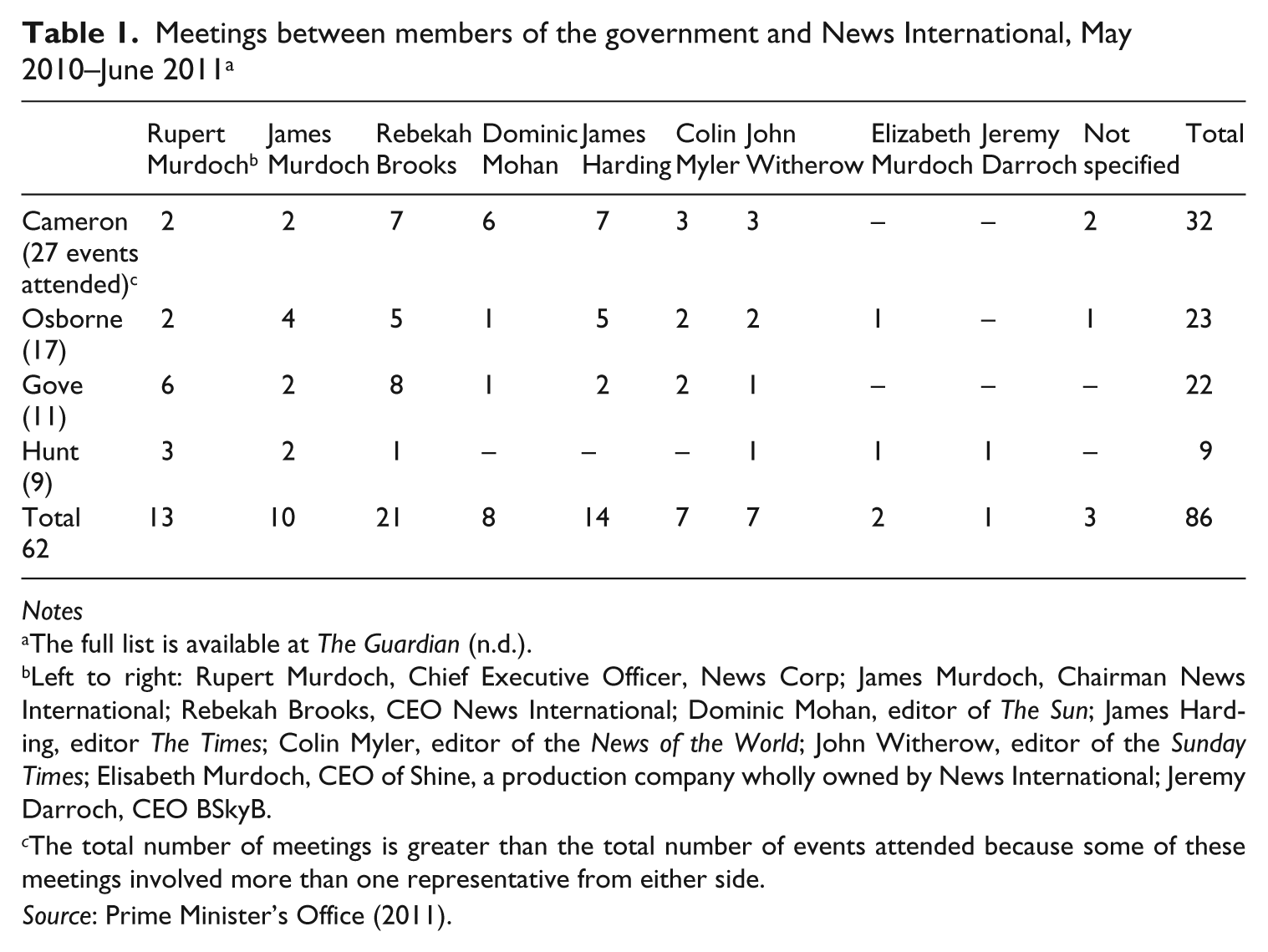
The first indications of the closeness of the Murdoch/Cameron relationship came during an emotional debate in the House of Commons at the height of the phone hacking scandal, when Prime Minister David Cameron was forced to give an undertaking that he would publish the full extent of the meetings he, and colleagues, had held with senior executives of News International. These are set out in Table 1.
Meetings between members of the government and News International, May 2010–June 2011 a
Notes
The full list is available at The Guardian (n.d.).
Left to right: Rupert Murdoch, Chief Executive Officer, News Corp; James Murdoch, Chairman News International; Rebekah Brooks, CEO News International; Dominic Mohan, editor of The Sun; James Harding, editor The Times; Colin Myler, editor of the News of the World; John Witherow, editor of the Sunday Times; Elisabeth Murdoch, CEO of Shine, a production company wholly owned by News International; Jeremy Darroch, CEO BSkyB.
The total number of meetings is greater than the total number of events attended because some of these meetings involved more than one representative from either side.
Source: Prime Minister’s Office (2011).
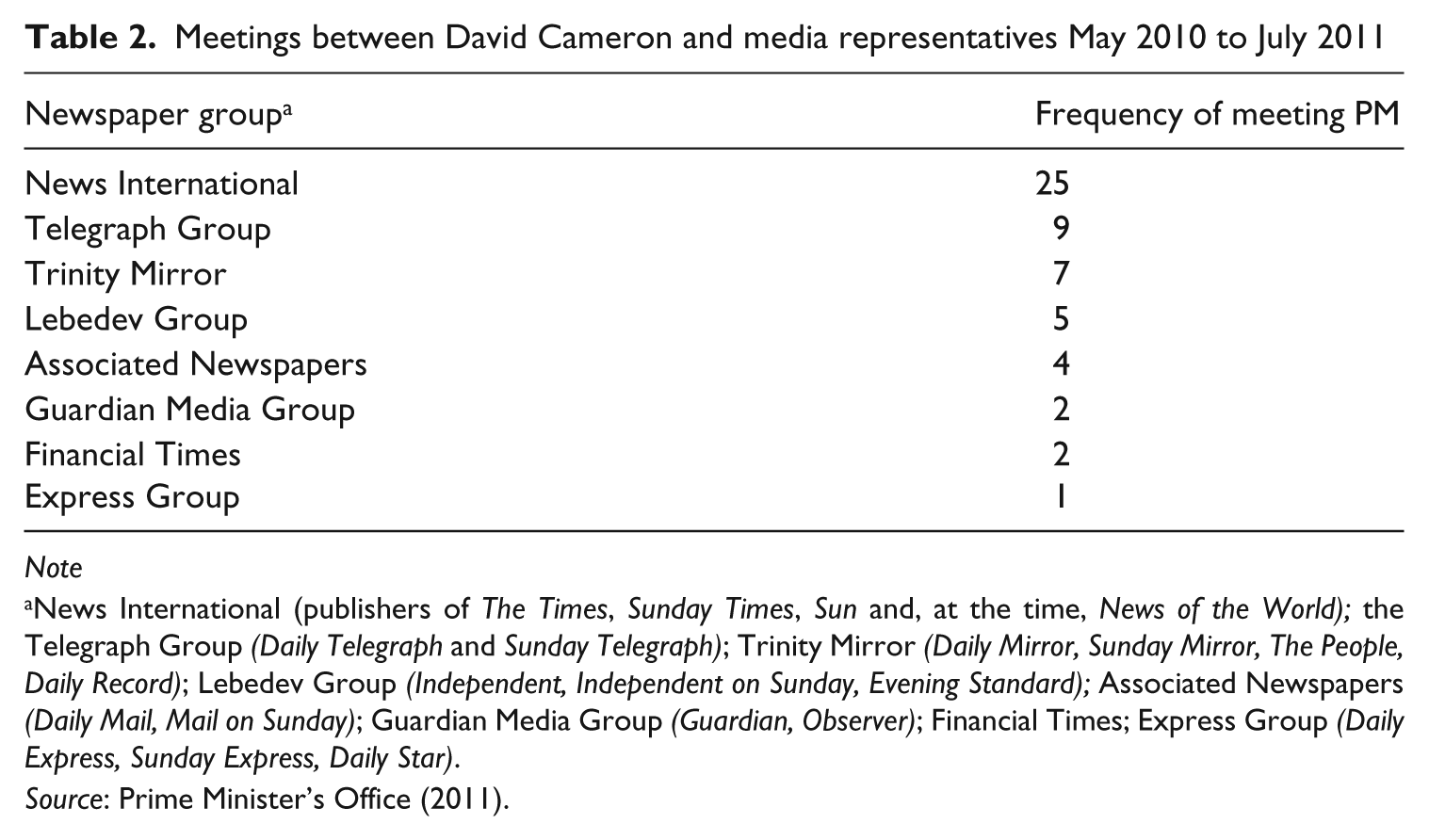
Meetings between David Cameron and media representatives May 2010 to July 2011
Note
News International (publishers of The Times, Sunday Times, Sun and, at the time, News of the World); the Telegraph Group (Daily Telegraph and Sunday Telegraph); Trinity Mirror (Daily Mirror, Sunday Mirror, The People, Daily Record); Lebedev Group (Independent, Independent on Sunday, Evening Standard); Associated Newspapers (Daily Mail, Mail on Sunday); Guardian Media Group (Guardian, Observer); Financial Times; Express Group (Daily Express, Sunday Express, Daily Star).
Source: Prime Minister’s Office (2011).
The bare facts that emerged are that, in the year following the formation of the coalition government in May 2010, David Cameron met Murdoch, or his senior executives, on 27 separate occasions; and that he and three other ministers had a total of 86 individual encounters with senior staff from News International – this at a time when the government was considering whether to permit the company to take over that part of the BSkyB television network that it did not control. This revelation raises the question: was this level of contacts unique to the Cameron government, at this particular moment in time, or was it indicative, and typical, of the amount of traffic that has been taking place between Murdoch and senior members of British governments for the past three decades, and specifically during the premierships of Margaret Thatcher, Tony Blair and David Cameron (the politicians who appear to have had the strongest reciprocal relationship with the Murdoch empire)?
The data released by Downing Street show that at a time when, one assumes, the British PM was preoccupied with forming a new government, navigating his way through the euro-crisis and fighting a war in Libya, he found time to meet with News International executives and editors on an almost fortnightly basis. If nothing else, these raw figures reveal a staggeringly intimate web of relationships between the Murdoch and Cameron clans. We can compare this with the frequency of meetings that Downing Street subsequently revealed that the PM had had with other newspaper groups over the same period. These figures graphically demonstrate how News International monopolized the Prime Minister’s media ‘face time’ – showing that they had almost as many meetings with David Cameron as did all other newspaper groups put together.
No similar data has been produced for meetings between Murdoch and Thatcher and Murdoch and Blair. 1 However, despite Mrs Thatcher’s memoirs making no reference to Murdoch at all (Thatcher, 1995) it has recently been revealed that she had at least one secret meeting with Rupert Murdoch. This was in 1981 when Murdoch was trying to take over The Times and the Sunday Times which he was allowed to do, without the usual reference to the Monopolies and Mergers Commission. That any such meeting ever took place was denied in the official history of The Times (Stewart, 2005: 28) “In 1981, Margaret Thatcher and Rupert Murdoch scarcely knew one another and had no communication whatsoever during the period in which The Times bid and referral was up for discussion.” Documents released by the Thatcher Foundation in March 2012 revealed that not only did such a meeting take place but it was deliberately kept secret because of the political embarrassment that such an encounter would have engendered at the time. For although a formal record of the meeting was kept, Mrs Thatcher’s Press Secretary sent her a note confirming her wishes that that the meeting, and its contents be kept secret. Specifically the Press Secretary, Bernard Ingham wrote on 5 January 1981: “Attached is a record of the salient points of your lunch with Rupert Murdoch yesterday. In line with your wishes the attached has not gone outside No. 10 and is, of course, to be treated ‘Commercial in confidence’”.
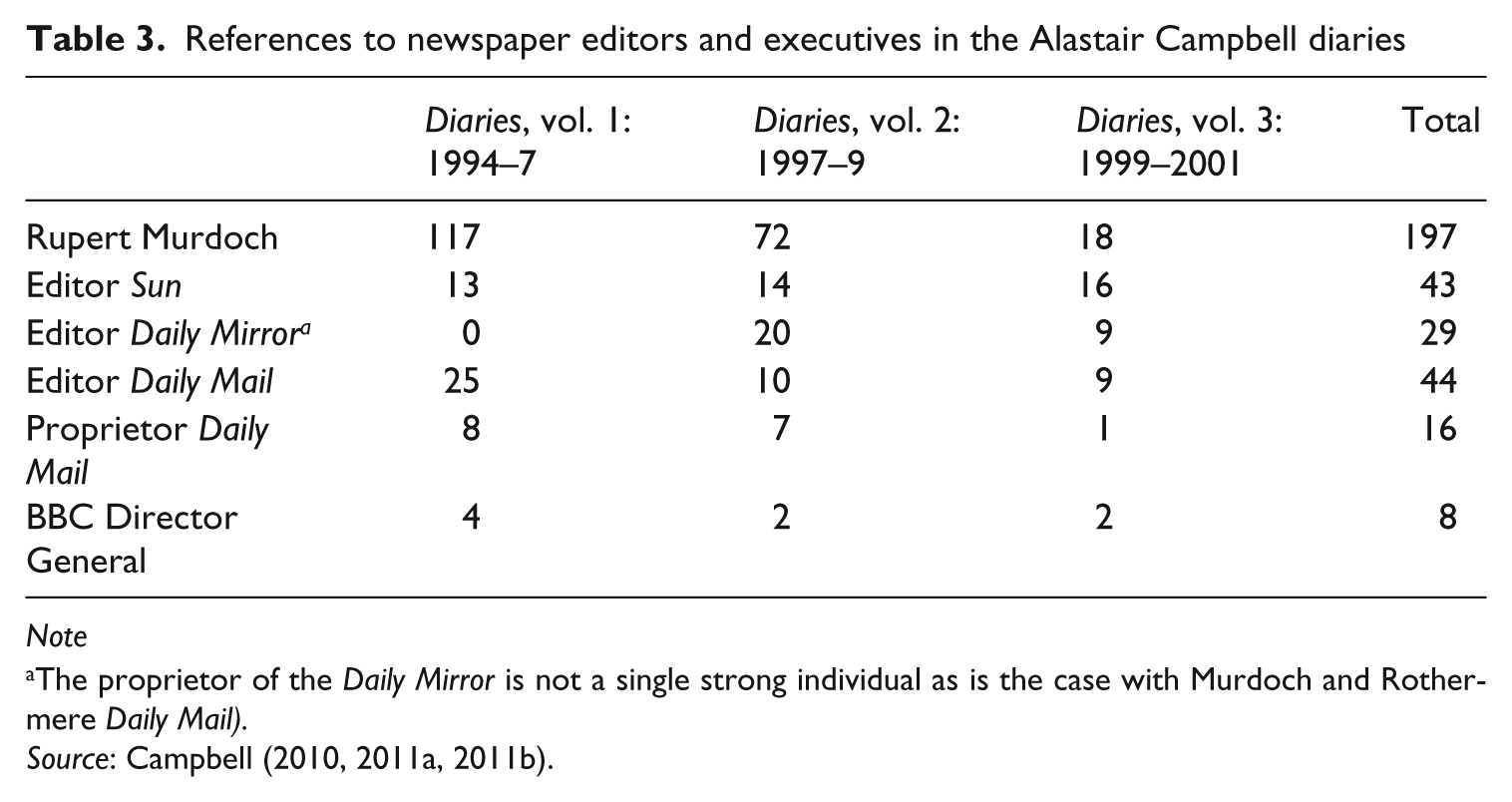
One vivid example of Rupert Murdoch’s influence over Mrs Thatcher comes from the diaries of former Labour politician Woodrow Wyatt when Murdoch expressed his disapproval of Mrs Thatcher’s appointment of a former Times Managing Director to the chairmanship of the BBC; Wyatt quotes her as saying: “I wouldn’t have done it if hadn’t had a strong recommendation from Rupert” (Page, 2011: 6675). 2 Tony Blair goes a little further in admitting to the level of his contacts with Murdoch, but with just five references in his autobiography (Blair, 2010), the full story is far from revealed. According to Rupert Murdoch’s testimony submitted to the Leveson Inquiry (Leveson Inquiry 2012) between June 1997. However, to some extent the blanks are filled in by the diaries of Blair’s Press Secretary, Alastair Campbell (2010, 2011a, 2011b).
These references (Table 3) reveal, very starkly, the phenomenal importance that New Labour attached to Rupert Murdoch during the years covered by the published diaries (1994–2001). There are more references to Murdoch alone than to the editors of The Sun, the Daily Mirror and the Daily Mail, the Mail proprietor and the editor-in-chief of the BBC (the Director General) combined. This Murdoch domination is particularly noticeable in the period leading up to the 1997 election and Blair’s endorsement by The Sun and the News of the World. Significantly, the diaries also reveal that the Daily Mail, with its undisguised hostility to Labour throughout this period, was seen as more important than the Labour-supporting Daily Mirror, despite the herculean efforts of Piers Morgan, its editor during this period, to insert himself into Downing Street’s inner circle.
References to newspaper editors and executives in the Alastair Campbell diaries
Note
The proprietor of the Daily Mirror is not a single strong individual as is the case with Murdoch and Rothermere Daily Mail).
Source: Campbell (2010, 2011a, 2011b).
What’s so special about Rupert?
Rupert Murdoch is, to state the obvious, a very influential and successful media magnate, although after the revelations at the Leveson Inquiry it is arguable whether this will continue to be so in the future. However, if that was all it would not mark him out as a uniquely powerful press proprietor, as it is here being argued; this ‘uniqueness’ can be attributed to three key factors.
First, media magnates, both past and present, have tended to use their media interests in one of a number of causes – to advance a political cause, their business interests, their family interests or simply, themselves; for Murdoch all four seem to be equally important.
Second, unlike most other magnates, Murdoch has not confined himself to one medium or one country, but has used his newspapers, broadcasting and online outlets to ruthlessly cross-promote his global media interests both to defend them against potential predators and to attack and undermine real and potential competitors.
Third, Murdoch is probably even more ruthless than other magnates. He is ruthless in both jettisoning executives and editors and, more importantly, in jettisoning publicly undertaken commitments when he believes his corporate interests require him to do so. 2 In the words of one of the most distinguished editors that Murdoch ever sacked, Harold Evans, ‘Murdoch is the Houdini of agreements’ (Evans, 2011: xxix).
Thus it could appear that these factors explain why those governments that have tried to regulate Murdoch have found it so difficult; but in addition, lurking beneath the surface a more subtle exercise of power is taking place, here termed Murdoch’s three-card trope, which has enabled him and his global interests to survive, prosper and expand – at least, that is, until the phone-hacking scandal broke.
Trope one
The first trope is that Murdoch likes to give the impression that, despite the fact that he appears to be a media magnate bestriding the globe, at heart he’s just a simple newspaper ‘junkie’ with a passion for newsprint, and that News Ltd in Australia, News International in the UK and News Corporation in the US have evolved almost accidentally into multi-media conglomerates. As Murdoch himself put it:
We start with the written word. Then we get to TV, originally with the idea that it will protect the advertising base and it then progresses into a medium of its own with news, programmes and ideas. You then look at TV and you say: ‘Look, we don’t want to just buy programmes from a Hollywood studio, we’d better have one. (Harding, 2002)
But Murdoch is not the ‘newspaper junkie’ who has somehow, even reluctantly, become the boss of a multi-media empire. He is a ruthless businessman who has always put corporate interests above and beyond his media passions. He did this, par excellence, when he took the decision to close down the News of the World, despite the fact that this paper was characterized as representing something special to Murdoch, being his first purchase in the UK – its conduct and continued existence threatened NewsCorp’s global interests, so it had to go.
Similarly, his long-term pursuit of the Wall Street Journal has been characterized as another example of his newspaper heart ruling his corporate head. Former Guardian editor Peter Preston opined:
Was that $5bn price tag for the Wall Street Journal good value? Not really: but Rupert wanted it, because he loves newspapers. Who loves the New York Post he bought for a second time 18 years ago? Nobody but Rupert: it keeps losing big bucks – $20m and up – year after year. What about the Times and Sunday Times? Losses of £50m, £87.7m and £45m in the last three financial years. (Preston, 2011)
But what this analysis leaves out of the picture is the fact that by owning loss-making ventures such as the Wall Street Journal, The Times, the Sunday Times and also (falling into this category) Sky News, Murdoch is achieving three things, all of which advance his corporate interests. First, there is the ‘respectability’ which – although he affects to be contemptuous of it – his companies require. Second, by owning such vehicles he gives himself significant political clout – The Times and the Sunday Times might lose substantial sums of money, but they do attract the attention of politicians and other opinion formers whose views around issues such as the takeover of BSkyB, are enormously significant. Finally, Murdoch does it simply to stop such valuable properties – in prestige rather than cash terms – falling into the hands of his rivals who, among other things, might use them to attack and undermine the Murdoch empire.
Trope two
The second trope is that Murdoch uses his media holdings to pursue his own right-wing political agenda, even if this might at times conflict with his corporate interests. While it is undoubtedly true that Murdoch’s politics are on the right, and sometimes the far right of the political spectrum (though occasionally, as with his well-advertised Republicanism, he can appear to be taking ersatz left-of-centre positions) more pertinently, in terms of the trope, he does not pursue his political interests in a vacuum. The political allegiances of his newspapers reflect his corporate interests – thus he has never had any compunction about switching his papers’ support from right to left and back again, on the basis that he has always sought to position himself, and his papers, as supporting the winning side. In other words Murdoch is both politically ruthless but also politically promiscuous – a deadly combination for politicians to handle.
As one of his former editors, has observed. ‘The secret of Murdoch’s power over the politicians is, of course, that he is prepared to use his newspapers to reward them for favours given and destroy them for favours denied’ (Evans, 2011: xxiii). Evans’ successor at the Sunday Times, Andrew Neil, records that:
The decision to place his two Tory tabloids – the biggest selling in Britain – behind Blair and the Labour Party was entirely Rupert’s. The editors played almost no part in the decision and many of the staff, especially on the Sun, were very unhappy about it. But they had no say in the matter and were never consulted. (1996: xxiv)
Neil adds ‘I’ve never seen anyone more astute at manipulating politicians to his advantage than Rupert Murdoch’ (1996: xxvii).
This political promiscuity began in Australia when, in 1972, after many years of supporting the ruling right-wing, conservative governments, he switched support to Gough Whitlam, the Labour leader, who looked to be the likely winner of that year’s general election. But subsequently, as public support for Whitlam’s government drained away so Murdoch withdrew his support and helped engineer the coup that brought Malcolm Fraser’s right of centre party into power; eight years later Murdoch switched again, this time supporting Labour’s Bob Hawke in his successful bid to win back power for Labour.
A similar pattern can be seen in the UK. He began with his well-known courtship (or was it vice versa?) of Margaret Thatcher; his papers stayed loyal to the Tories despite his growing disillusionment with her successor John Major; he then switched to support Tony Blair and New Labour in 1997. But, as if to indicate who was in charge, Blair was required to fly out to an island off the Australian coast and address the annual Murdoch corporate get-together in order to confirm his support. As Blair put it, unabashedly in his autobiography:
. . . now it seem obvious: the country’s most powerful newspaper proprietor, whose publications have hitherto been rancorous in their opposition to the Labour Party, invites us into the lion’s den. You go, don’t you? (Blair, 2010: 96)
While New Labour continued to serve Murdoch’s corporate interests (which it did on numerous occasions), and did not too greatly offend those political principles that were personally important to him, Murdoch kept his papers loyal to New Labour. But once it was clear that new leader, Gordon Brown, was unlikely to win the 2010 election, Murdoch switched his support back to the Conservatives.
It is this very promiscuity that has made politicians so nervous about Murdoch; they know his political beliefs but they never feel sure about his loyalty, hence they make, or at least until ‘hackgate’, made great efforts to try to maintain his support or, at the very least, not to incur his wrath.
The other side of this political coin has been the sheer ruthlessness that Murdoch’s papers have displayed against those they regard as their political enemies. As the hacking scandal unfolded during 2011 politicians finally came to admit the extent to which fear of intimidation by News International papers had played a key role in inhibiting their criticisms of the Group. The mood was captured most graphically by the MP Tom Watson, the politician who did more than any other to reveal the truth about phone hacking. Speaking in a parliamentary debate he said:
It is almost laughable that we sit here in parliament, the central institution of our sacred democracy – among us are some of the most powerful people in the land – yet we are scared of the power that Rebekah Brooks [former CEO of News International] wields without a jot of responsibility or accountability. The barons of the media, with their red-topped assassins, are the biggest beasts in the modern jungle. They have no predators; they are untouchable. They laugh at the law; they sneer at parliament. They have the power to hurt us, and they do, with gusto and precision, with joy and criminality. Prime ministers quail before them, and that is how they like it. That, indeed, has become how they insist upon it, and we are powerless in the face of them. (Watson, 2012)
Trope three
The third part of the trope, and this is perhaps the cleverest and least understood, is Murdoch’s ability to sound as though he, and his media, represent the voice and views of the ‘ordinary bloke’, or in Australian parlance the ‘ocker’, against the establishment. 3 In media terms the ‘ocker’ tradition can be seen in the worldview of The Sun, the News of the World or Fox News. They articulate the notion of ‘standing up for the little guy against the elites’. Thus Murdoch’s appeal both to, and for, politicians is that by being seen to befriend him and his media, they can demonstrate just how ‘in touch’ with ‘ordinary people’ they really are. The language of The Sun’s bombastic claim (following the Conservatives’ surprise victory in 1992) that: ‘It’s the Sun Wot Won it” (The Sun, 11 April 1992) epitomizes this trope.
Murdoch is, of course, anything but the ‘little bloke’. Not only is he very rich – in September 2011 the Forbes Rich List valued his wealth at $7.4 billion 4 – but he is also a long, long way from being one of those self-made men with whom he seeks to identify. He grew up in Australia in a very wealthy family, the son of one of the country’s leading press barons. He attended the Australian equivalent of Eton and then went on to study at Oxford. 5 As one of his former senior journalists, Godfrey Hodgson (2003) has put it: ‘There is something ridiculous about a billionaire with access to No. 10 and the White House portraying himself as the arch-enemy of established power’. When Harold Evans was editing the Sunday Times, prior to it being taken over by News International, Murdoch once refused to give the paper an interview because, according to Evans, he saw the paper as ‘part of a ‘conspiracy to do him in, a conspiracy by elitist snobs who don’t like Australians coming to Britain’ (Evans, 2011: 218).
In particular, Murdoch has always had a problem with what he has characterized as the ‘liberal media’, an obsession that can be seen as the driving force behind his Fox News Network. What in fact he is opposed to is those media that don’t share his own ideology of libertarian economics and authoritarian foreign policy interventions (see his media’s unstinting support for the US-led invasion of Iraq). For Murdoch, it is the BBC that represents, par excellence, everything that he is opposed to, and by attacking it (which very much suits his corporate interests) he is able to maintain what Bruce Page describes as Murdoch’s ‘revolutionary disguise … necessary camouflage for a business specializing in privatized government propaganda’ (2011: 411) Perhaps Murdoch’s best articulation of this faux anti-elitism came in his MacTaggart Lecture in 1989 at the Edinburgh Television Festival (at a time when he was just launching Sky TV in the UK), portentously titled ‘Freedom in Broadcasting’. He began by lambasting the BBC/ITV duopoly and the Reithian philosophy that had inspired it:
For fifty years British television has operated on the assumption that the people could not be trusted to watch what they wanted to watch, so it had to be controlled by like-minded people who knew what was good for us…. Much of what passes for quality on British television really is no more than a reflection of the values of the narrow elite which controls it and which has always thought that its tastes are synonymous with quality – a view incidentally, that is natural to all governing classes. (in Franklin, 2005: 134)
He concluded his lecture by claiming: ‘We see ourselves as destroyers of monopoly power and as creators of choice’ (in Franklin, 2005: 137), which, given Murdoch’s own track record, neatly epitomizes Evans’ description of him as a man who ‘has chutzpah like nobody else’ (2011: xviii). Or, less pleasantly, as one of his executives is reported to have said to a potential competitor: ‘understand this: if you ever get into any of our businesses, I will destroy you. I work for a man who wants it all, and doesn’t understand anybody telling him he can’t have it all.’ 6 Up until now he has had it all, including unrivalled access to politicians in the UK and elsewhere, but following the revelations about phone-hacking and the degree of undue political influence he has wielded, that now will surely change?
For with the damning, and somewhat surprising, verdict brought in on Rupert Murdoch by a majority of the Commons’ Culture Select Committee – that he is not “a fit person” to run an international company – the reign of the Wizard of Oz must be coming to a close. Certainly it will be impossible for Murdoch to ever again exercise the power and influence that he has wielded over successive British prime ministers from Mrs Thatcher onwards. Whether this also means that the board of News Corporation in the US decides that its British newspaper holdings are more trouble than their worth is, at the time of writing (May 2012), unclear. Such a move would be hard for Murdoch to take, for whilst he is a corporate man, and the bottom line is important to him, being forced to sell, or close his UK newspaper holdings would be a wrench and an ignominious personal humiliation. For it was his audacious swoops for the News of the World in 1968 and The Sun a year later, that announced his arrival on the international media stage. And he will find it similarly painful to de-couple himself from the British political scene. For although in recent times his actual presence in the UK has been sporadic, when here, it was the company of politicians that he appeared to seek out most, as he revealed to the Leveson Inquiry. Between 1997 and 2007 he claimed to have met with Tony Blair 31 times and, in David Cameron’s his first year in office, Murdoch claimed to have met with him on nine occasions (though Downing Street claims the real figure is six). Whatever the correct number, the fact remains that Murdoch was, is and will forever be a “political groupie” but as a result of the cumulative effects of the phone-hacking revelations, the Leveson Inquiry and the parliamentarians’ report, the pleasures of consorting with British prime ministers will now be an increasingly distant memory. All of which leads to the final thought – have the Murdoch tropes lost their magic? And if they have, has the time come for the 81-year-old Wizard of Oz, to take his final bow, hang up his wand and retire gracefully behind the velvet curtain?