



Abstract
Since the election of Hugo Chávez in 1999 and the subsequent growth of Venezuelan immigration to the United States, there has been an explosion of Venezuelan media in South Florida. These media are focused on local issues confronting this expanding immigrant community. However, the mediated communication being produced among its members is also transnational in scope; events taking place in Venezuela heavily inform the content of these outlets. This research analyses 34 interviews with Venezuelan journalists in South Florida in order to further our understanding of the production of immigrant media within a transnational context. The results point to a hybrid form of journalism, one that draws on cultural background and national identity while also relying on ideology and connections to fellow immigrants. The outcome appears to be the production of transnational media spaces that represent new directions for the study of diasporic communication and the formation of transnational networks.
Transnationalism has been defined as the ‘multiple ties linking people or institutions across the borders of nation-states’ (Vertovec, 1999: 447). Research on the topic has also emphasized the ‘fluid social spaces’ that are formed and reformed through the activities of migrants that are simultaneously embedded ‘in more than one society’ (Levitt and Jaworsky, 2007: 131). Furthermore, as Portes (1999: 464) has pointed out, these activities can be carried out by larger, institutional entities, such as corporations, but also by a ‘mass of ordinary people’, all of which require ‘a series of time and space-compressing technologies and their commercial diffusion’. Since the election of Hugo Chávez in 1999 and the subsequent rapid growth of Venezuelan immigration to the United States (Semple, 2008; U.S. Census, 2010), there has been an explosion of Venezuelan media in South Florida (Ocando, 2009). These media are focused on local issues confronting this expanding immigrant community. However, the mediated communication being produced and distributed among its members has components that could also be described as transnational in scope, as events taking place in Venezuela heavily inform the content of these information outlets (Ocando, 2007).
Numerous studies have examined and theorized the processes and outcomes of the consumption of media by immigrant and diasporic audiences (Appadurai, 1996; Georgiou, 2006, 2007; King and Wood, 2001). Researchers have also examined the resulting hybridity and ‘glocalization’ that often manifest in the identities of these deterritorialized communities (Kraidy, 2005; Morley, 2000; Thompson, 2002). However, there have been very few studies that have attempted to describe and explain more clearly the ideologies, mental models and professional norms – sociological elements that are often the focus of investigations into journalistic practices (Benson, 2004; Deuze, 2004, 2005; Hughes, 2006; McNair, 1998) – that guide the work of the producers of media intended for immigrant audiences. This is an essential undertaking if we are to more closely understand the processes and outcomes where media and migration intersect, particularly in light of the scholarly activity surrounding the idea of nationality as a narrated, collective identity (Anderson, 1983; Bhabha, 1990, 1994; Ong, 1999).
Even though mediated communication has been shown to be an important factor in shaping how transnationalism is lived and experienced by immigrants (Aksoy and Robins, 2003; Christiansen, 2004; Dayan, 1998), we still have a limited understanding of the production of media for immigrant audiences, with a few notable exceptions. Hamid Naficy (1993) has documented the creation of an exile identity through television production among Iranians in California, while Dukes (2006) has examined the creation of a ‘transnational, exile’ belonging imagined through various types of storytelling by members of the Tibetan diaspora. There is also the history of Hispanic immigrant media in the United States, including Mexican and Mexican-American media in the Southwest (Cortés, 1987; Kanellos, 2000), Puerto Ricans in the Northeast (Fitzpatrick, 1987), and, perhaps most relevant in this case, the influence of the Cuban exile community on the mediascape of South Florida (Portes and Stepick, 1994; Soruco, 1996).
The social phenomenon of immigrant communities producing and consuming media relevant to their communities is not unique to the current era of globalization. As early as 1916, Randolph Bourne was writing in the Atlantic Monthly about the impact of immigrant communities in the United States and their refusal to shed national identities with an article titled ‘Transnational America’, and in 1918 Thomas and Znaniecki produced one of the seminal texts on transnational migration with The Polish Peasant in Europe and America. Indeed, as Park noted in The Immigrant Press and Its Control (1922), there were often more newspapers published in the mother tongue among immigrant groups in the United States at the turn of the century than had been published in their home country. In a sense, what was observed a century ago, as well as what is seen today, among transnational communities with their sustained, simultaneous connections to home, can be seen as an extension of Hobsbawm’s concept of proto-nationalism and the nationalistic identities that have ‘no necessary relation with the unit of territorial political organization which is a crucial criterion of what we understand as a “nation” today’ (1990: 47, emphasis in the original). So, in light of these historic examples, what is new? The reach and scope of electronic, globalized media have created an unprecedented increase in both the forms as well as sheer amount of connectivity among immigrant populations; these connections are also more sustained and simultaneous in nature than during any previous periods of increased immigration. As Pedraza (2006: 423) has pointed out, transnationalism in the 21st century is ‘qualitatively different. Because the new technologies allow immediate communication, immigrants can experience the world they left behind as if they were still there’. It is precisely these reasons that make this topic worthy of social scientific inquiry.
A final theoretical field that is helpful in setting the framework for this investigation is the recent work that has been done in the field of production studies (Caldwell, 2008; Holt and Perren, 2009; Mayer et al., 2009). As Holt and Perren (2009: 5) note, the study of media industries needs to take an approach that ‘perceives culture and cultural production as sites of struggle, contestation and negotiation between a broad range of stakeholders … [the study of media industries] is no longer bound to old frameworks that operated predominantly in terms of nation-based media systems’. Caldwell has also written about the spaces of production, in which the workers, whether consciously or not, are acting out prescribed cultural roles that are defined and determined by the industry (2008: 71). As he points out, the workers themselves often offer a reflexive critical analysis of their own work and the spatial interactions that take place. Finally, Mayer (2009: 15) has argued that by firmly placing the study of media production in local spaces, we can ground theory and connect the macro-context to the micro-processes, thus ‘showing us how specific production sites, actors, or activities tell us larger lessons about workers, their practices, and the role of their labors in relation to politics, economics, and culture.’
Building on this background, this investigation is an attempt to answer a central question: What are the professional motivations and ideologies that guide the producers of immigrant media? By delving into this question, insight is also gained into both how media for transnational immigrant communities are produced, as well as why these media turn out the way they do. This research analyzes and places in theoretical context 34 in-depth, semi-structured interviews with Venezuelan media producers in South Florida to expand our understanding of the production of immigrant media within a transnational framework by examining the day-to-day experiences and mental models that motivate and shape the work of these producers. Using grounded theory to draw out the interconnected themes that weave these interviews together, a detailed case study of the production of immigrant media emerges.
The core findings from a close analysis of the interview transcripts are laid out in three sections:
For these journalists, immigration, cultural conditioning and the production of mediated communication are intimately linked. The interviewees spoke of living in ‘two worlds,’ being heavily influenced by the training they had in Venezuela and at the same time, conflicted by the different forms of professionalism they experienced on arrival in a new country. They spoke of wanting to connect their fellow immigrants with events taking place at home while at the same time seeing their work as also being important in helping members of their community adapt to their new life as immigrants.
The ideological factors shaping the work and professional identity of these immigrant journalists were equally as important as the experience of immigrating, and in many instances also closely tied to their identity as Venezuelans. To understand the work of this group, it is essential to understand what drives them, from the struggle to remain objective while at the same time feeling the need to advocate on behalf of their community, to the ideological underpinnings inherent in the work of nearly all journalists. This effort is contextualized by drawing on the insights gained in the field of production studies as well as ethnographic and theoretical research conceptualizing how media professionals give meaning to their work.
The context of production as well as the confluence of contrasting journalistic cultures in home and host country and the ideological motivations influencing the work of these immigrant journalists results in the production of transnational media spaces. These new spaces of symbolic production span cultural and geographic borders, create transnational linkages, and are a clear outcome of the forces of globalization. The context of Venezuelans in South Florida, combined with the new forms of instantaneous communication and interconnectivity that are hallmarks of life in the early 21st century, present a unique vision of immigrant life and the role of mediated communication in transnational communities.
Methodology
Given the scarcity of similar research, a grounded theory inquiry, defined by Bryant and Charmaz (2007: 1) as ‘a systemic, inductive, and comparative approach for conducting inquiry for the purpose of constructing theory’, was used to investigate the work of Venezuelan journalists in South Florida. This effort resulted in 34 in-depth, semi- structured interviews that yielded over 500 pages of transcripts (see Table 1 for an overview of the group’s characteristics). The themes and findings outlined below emerged through a careful application of grounded theory methodology, using what practitioners of this method refer to as a process of ‘constant comparison’ (Bryant and Charmaz, 2007: 607).
Demographics for sample Venezuelan immigrant journalists (n = 34)

The researcher was looking for notions of professionalism and ideological motivations for pursuing the practice of journalism as well as the influence of the transnational context in which the participants live and work. As related concepts began to emerge from the analysis, they were grouped together into different categories. The categories took shape in a fluid process, in which new concepts emerged, older versions were discarded, and others were merged together. Comparisons across the interviews were repeatedly crosschecked for accuracy and clarity of organization and conceptualization.
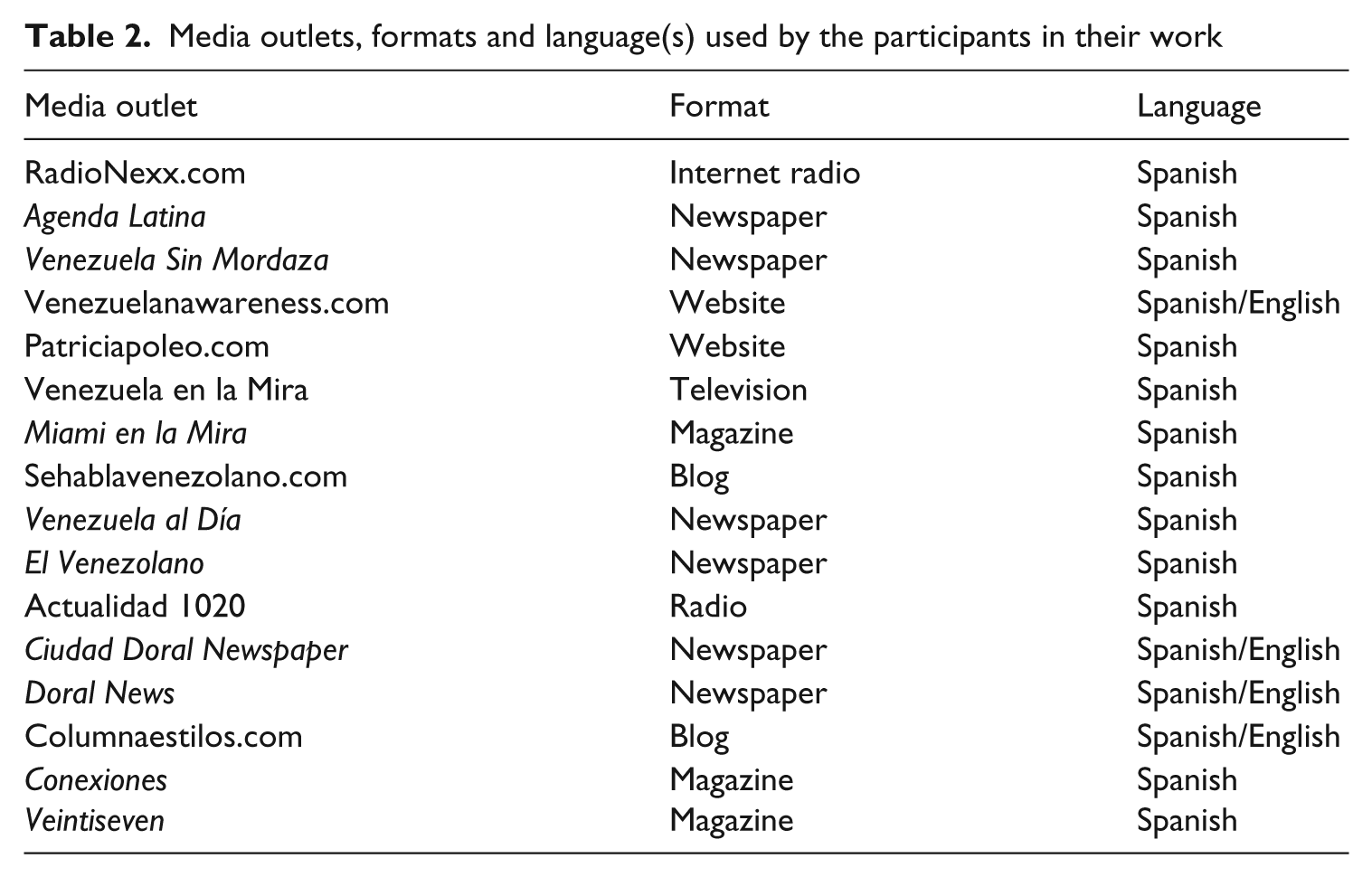
The interviews were conducted during 2009–10. Each interview lasted from 45 minutes to an hour and a half. Because of the relatively small population of Venezuelan media producers in South Florida and the qualitative nature of the research, snowball sampling was used to recruit participants, and the recruitment of participants ended when a sufficient level of theoretical saturation had been achieved, that point ‘determined by the discovery that additional interviews are yielding so little new information that more interviews would be a waste of time’ (Hood, 2007: 161). The interviewees all self- identified as journalists and worked in a diverse variety of media outlets, ranging from online radio to community newspapers (see Table 2).
Media outlets, formats and language(s) used by the participants in their work
The context of Venezuelan immigrant journalism
Before moving on to an analysis and interpretation of the interviews, it is critical to first situate the interview material within the socio-economic, cultural and political landscape facing the Venezuelan immigrant community in South Florida. As mentioned in the discussion of production studies above, the influence of the ‘spaces’ of production are essential to a more thorough understanding of the work of media producers. Venezuelan immigrants, at least at this point in their immigration history in the United States, hold a somewhat enviable position in comparison to other immigrant groups in South Florida and Miami-Dade. Given the social and economic capital that Venezuelan immigrants still maintain, 1 members of this community are able to maintain links to home and capitalize on these connections more readily then other, more marginalized groups of immigrants.
There are also clear power hierarchies that affect media production among immigrant communities in Miami-Dade. Hughes et al. (2010) outlined these hierarchies in a recent work on Haitian media in South Florida. The authors criticize the use of a ‘triadic’ racial lens to view the racial make-up of the region – Afro-American, Latino and Anglo – and they argue that this overarching narrative is accentuated by the larger Spanish-language media outlets, who view reality ‘through a lens that is culturally proximate to Anglos and acculturated Hispanics’ (2010: 25). The result is that the Haitians view the media, English as well as Spanish, as focusing primarily on Anglos and Cubans, therefore reinforcing and ‘reflecting the status and cultures of the two elite groups (Anglos and Cubans) that control political and economic power in the county’ (2010: 25).
The perspective of immigrant groups who have less status in terms of class, legality and racial make-up is in contrast, then, to the responses given by many of the Venezuelan media producers in this study. According to the model built up by Hughes et al., Venezuelans would be more positively impacted by existing Cuban exile power structures among Miami immigrant groups because of their class status and a framing of the Chávez project in Venezuela as similar to Cuba (Ocando, 2007). This tendency among Miami media to cater to the dominant Cuban narrative, particularly the Miami Herald and its Spanish counterpart, El Nuevo Herald, has been well documented by previous researchers (Croucher, 1997; Portes and Stepick, 1994).
Understanding the social, political and economic environment created by the city of Miami and the influence it has on Spanish-language media producers is also essential to creating a contextual account of Venezuelan immigrant journalism. Since at least the mid 1980s, Miami has increasingly come to be seen as a ‘world (or global) city’ (Grosfoguel, 1995); however, the city does not fit well within traditional economic models of how and why cities become important centers of global capitalistic activity. Instead, as Portes and Stepick (1994: 205) write, ‘in Miami’s case it was not so much economic as political geography that played the determining role’. They are referring to the impact of continuous waves of migration that have marked the city and transformed it during the latter half of the 20th century. Thus, in the case of Miami, politics preceded economic growth, with the heavy influence of the United States throughout the Caribbean during the 20th century transforming Miami into a natural destination for immigrants from the region.
The influx of these foreign groups produced a ‘resurgence of ethnicity and, along with it, a transformation of the fabric of local society’ (Portes and Stepick, 1994: 210). This includes the rise of ethnic enclaves, immigrant groups defined not by their marginalization within the host society, but instead by their relative success and the ability of their members to turn inward for important social, political and economic resources (Forment, 1989). The most obvious example of this phenomenon, particularly in Miami, is that of the Cuban community. However, this concept of ethnic enclave also provides at least a partial explanation for the experiences of multiple immigrant groups in South Florida and will be helpful in understanding the experiences of Venezuelan immigrants and the context of arrival that shapes the media practices of the journalists under investigation.
Finding I: Negotiating new identities – immigration and media production
María Eugenia Pardo, an advertising and marketing executive who moved to Miami with her family from Caracas in 2008,
2
writes a popular blog called ‘Se Habla Venezolano’. In a blog post from September 2009, titled ‘Mis Dos Mundos’, she wrote about the dual reality and ‘in between’ existence of having recently immigrated:
On one side, I have a new, prosperous and beautiful life … in Miami. But on the other, there is an entire other world that I don’t belong to any more because I am not there, but that continues to affect me in nearly everything that I do, think, and feel.
For Pardo, the blog started as a way to chronicle her new life in the United States and the experience of what it means to immigrate; however, as she observed events taking place in Venezuela from afar, she felt the need to proclaim more forcefully her opposition to those events. She also felt a developing loyalty to her readers: ‘So, the blog stopped being anonymous, and one day I said, I’m a journalist, here is my carnet, completely identified, with my journalist number, my identity card’ (personal communication, 20 April 2009; unless otherwise indicated, all interviews were conducted in Spanish and translated by the author).
Pardo’s narrative of immigration reflects the experiences shared by most of the interviewees: uprooted from their lives and careers in Venezuela, dislodged by what they saw as the abrupt and large-scale changes in society there and often by their direct opposition to those changes, they arrive in South Florida seeking out new opportunities for media production, drawing on the professional formation they had in Venezuela, but also influenced by the Venezuelan media landscape and the levels of polarization and conflict between conservative mainstream media and the government that currently exist. At the same time, they were all confronted by the realities of producing media in South Florida, as well as the differentiation they felt when comparing their particular vision of what it means to pursue journalism and what they observed in the work of fellow media producers.
Two important factors shaping the professional vision of the interviewees emerged from the interviews. The first is what the interviewees saw as the complete deterioration of the media environment in Venezuela. The idea that democratic processes have been undermined by government censorship was cited repeatedly by the interviewees, as in this comment from Alexis Ortiz, an exiled opposition politician and journalist: ‘I see the mass media as being … gagged, brought to their knees’ (personal communication, 9 February 2010). The idea that there has been a decrease is press freedoms in Venezuela in the past decade, at least in the eyes of western monitoring organizations, is not controversial. Reporters without Borders (2011) has been strident in its condemnation of the state of press freedoms in Venezuela, ranking the country 117 out of 178 in their latest worldwide index (tied with Fiji, Oman and Zimbabwe). Human Rights Watch has been similarly condemnatory in its appraisal of the state of freedom of expression under the Chávez government (2008: 64).
However, historical context is very important when discussing Chávez’s complicated relationship with the powerful commercial media in his country, which for decades had been owned by and operated primarily in support of the political and economic interests of the ruling elites. In fact, the mainstream media played a key role in supporting a failed coup attempt in 2002, refusing to broadcast the images of Chávez supporters filling the streets while the president was held for 48 hours (Jones, 2007), and were even accused of doctoring footage to make it look as if pro-Chávez protesters were firing at coup supporters in the streets. Because of their primary role in the events of 2002, the broadcast license of RCTV, the country’s oldest broadcasting outlets, was not renewed in 2007, and the relationship between the Chávez government and the remaining commercial broadcasters has continued to deteriorate ever since.
The second important factor influencing the interviewees’ conceptualization of their work was their regard for the professional training and formation they received in Venezuela. This level of preparation, based on the education received in the country’s universities as well as the training they received in the workplace, was often presented in contrast to the less developed levels of professionalism that participants perceived among fellow journalists in South Florida. As Patricia Poleo, a well-known journalist who was forced to flee Venezuela after playing an integral role during the coup attempt in 2002, put it:
We’re not accustomed to certain things you see here … [for example] there are television programs that are competitors, and so, when one program finds out that the other has a certain guest, they will try to steal the interview, and in Venezuela, that kind of thing doesn’t happen (personal communication, 16 April 2010).
The phenomenon of comparing the professionalism of other journalists and trying to distinguish ‘real’ journalism from practices considered to be sub-par has been noted extensively in literature devoted to the ideological underpinnings of the professionalization of the profession and efforts to ‘reproduce a consensus about who was a “real” journalist, and what (parts of) news media at any time would be considered examples of “real” journalism’ (Deuze, 2005: 444).
Through multiple references regarding levels of professional preparation and responsibility, this group revealed itself to be following similar guidelines. However, their constant references to a particularly Venezuelan form of journalism also distinguishes this model through its reliance on national identity, which in turn contributes to the transnational scope of the norms and mental models that guide the work of these interviewees.
The Venezuelan journalists interviewed during this research draw on their experiences both as Venezuelans and as immigrants to inform their work. The emphasis on both local and global information, of overcoming the inherent difficulties in immigrating and drawing on these experiences as a way of moving forward and finding a ‘new identity,’ are closely connected to the theorization of hybrid identities that are created through the confluence of migration and media. The work of these journalists, given their constant connection with events in Venezuela combined with the need to understand the tastes and preferences of local audiences, can be viewed through the theoretical prism of what Appadurai (1996: 196–7) calls ‘puzzling new forms of linkage between diasporic nationalisms, delocalized political communications, and revitalized commitments at both ends of the diasporic process’ that in turn create a ‘more complicated, disjunct, hybrid sense of local subjectivity’. This idea of being engaged at ‘both ends of the diasporic process’ is captured by Yolanda Medina, a journalist who has worked at El Venezolano, South Florida’s oldest Venezuelan community newspaper, for 15 years: ‘We here are like a sounding board for what happens in Venezuela …’ (personal communication, 10 March 2010).
Finding II: The role of ideology in immigrant journalism
Journalism has long been recognized as containing ideological elements that set it apart from other professions (Deuze, 2004). This focus on ideology, combined with the media reality that exists in Venezuela and the impact that this transformation has had on these journalists, will go some way toward explaining how the spaces that these producers create with their work are distinctly transnational in scope. This work builds on ethnographic research into the routines and rituals of working journalists, pioneered by Tuchman (1972, 1973, 1978) and Gans (1979), as well as past research on the transformations that have taken place among other groups of media producers during periods of change. In Mexico, as an example, a generation of journalists transformed deeply institutionalized practices because their value systems and lived experiences produced mental models of the world in opposition to the long-standing single party system in that country and de-legitimized form of journalism that helped sustain that system (Hughes, 2006: 30–7). The work on production studies is also key to understanding the motivations of these interviewees, since researchers working in that field are ultimately attempting to understand ‘how media producers make culture and, in the process, make themselves into particular kinds of workers in modern, mediated societies’ (Mayer et al., 2009: 2).
Drawing on this theoretical foundation, three distinguishable forms of journalistic ideology emerged from the interviews.
A calling and/or personal sacrifice. For many of the interviewees, a passion for communication emerged at an early age. They described the desire to engage in mediated communication as an affinity that was discovered very early on in their careers, sometimes as early as childhood. As Julio Cesar Camacho, news director at one of Miami’s top Spanish talk-radio stations, relates: ‘From the time I was a child, I felt that journalism was my future, because I saw in journalism a way of serving the community’ (personal communication, 8 February 2010).
The interviewees discussed multiple personal motivations that propelled them into the profession. There is an enthusiasm for this work that drives them forward, compelling them to push harder and make personal sacrifices in achieving their goals. For Militza González, co-founder of a Hispanic-oriented magazine titled Veintiseven, this drive to produce media has involved a great deal of sacrifice, since the magazine was launched with no outside investment and a complete reliance on volunteers (personal communication, 6 April 2010; interview conducted in English). However, for many of the interviewees, the sacrifices went much further. Of the 34 journalists interviewed for this research, 13 were forced to leave Venezuela as a result of their work. 3 Ricardo Guanipa began receiving death threats after being contracted as a correspondent for Radio Martí in Caracas and was forced to flee the country. He now anchors a weekly community television talk show in Miami dedicated to covering events in Venezuela, and has made personal and economic sacrifices in order to pursue his career. ‘I live from Monday to Monday for my journalism’, he says (personal communication, 11 February 2010).
Providing an important service. This ideological component draws on the belief expressed by the participants that being a journalist is much more than a career. They view it both as an essential component of democracy and as a vital resource for their community of fellow immigrants. Regardless of the scope, these journalists derive meaning for their work by seeing it as important within a larger societal context. Lourdes Ubieta, a radio talk show host who was one of the first journalists granted access to the coup plotters in 2002 as they briefly occupied the presidential palace of Miraflores, sees her work as an avenue for resisting Chávez from abroad: ‘I love my country, and I know what we are losing and where we are going, but there’s nothing I can do, but being on the radio and saying what is happening’ (personal communication, 2 March 2010; interview conducted in English).
Objectivity versus subjectivity. A dialectical tension emerged from the interviews between the desire to remain objective and balanced as a way of maintaining journalistic credibility, while at the same time, given the personal histories and political leanings of most participants, the desire to be critical and report on issues from an oppositional standpoint. Carla Croes, who comes from a family of journalists and whose father publishes an important magazine in Venezuela, described the objective model of journalism that was idealized in her family: ‘If you are an independent journalist, you can’t be a fan of one side or the other. If not, where will your credibility lie?’ (personal communication, 13 April 2010).
On the other side of this divide are those like Roger Vivas, an exiled journalist with a radio talk show in Miami focused on Venezuela. ‘When they tell me, “You’re more of a political commentator than a journalist,” I say that I’m a journalist with clear positions,’ he says (personal communication, 6 April 2010). This kind of approach lends itself to a particular form of oppositional journalism that was a recurring theme in a number of interviews. However, it is worth noting that these oppositional journalists also see themselves as providing outside information that is accurate and verifiable, in contrast to what they see as the propaganda put forth by the Chávez government. Luis Ortiz hosts a news and analysis program on an internet radio station called RadioNEXX: ‘What Hugo Chávez has is … a dictatorship disguised as a democracy … because one always has to defend the truth. That is what I’m trying to do. Use the truth as a weapon’ (personal communication, 18 February 2010). For Rafael Poleo, whose family has paid a high price for their outspoken criticism of the government, 4 the drive to speak out against official abuse and denounce what he viewed as injustice was simply a part of the profession (personal communication, 10 May 2010).
Finding III: The search for immigrant audiences and production of transnational media spaces
Thus far, the results of this inquiry have focused on the deterritorialization, hybrid identities and ‘neither-here-nor-there’ existence of a group of Venezuelan immigrant journalists, as well as the ideologies and mental models, formed in part by these experiences, that motivate them in their work. The final section will add theoretical context to this process of producing transnational media spaces by drawing on the experiences of these journalists as they arrive in Miami, a global city (Sassen and Portes, 1993; Yúdice, 2003), and seek out audiences for their work among fellow immigrants.
The concept of transnational media spaces that span borders and create new areas of cultural meaning is not new. Since the popularization of globalization studies in the 1980s, media and communication have been seen as instrumental in the compression of time and space, a contributing factor to globalization (Castells, 2000; Giddens, 1990; Robertson, 1992; Tomlinson, 1999). The implications for traditional notions of nationality – phenomena theorized as being formed in part through shared communication and culture (Anderson, 1983) – resulting from instantaneous connectivity facilitated by globalized communication networks have also been written about extensively (Carey, 1998). Further, it is apparent that these transnational spaces are constantly shifting, particularly among diasporic communities (Dayan, 1998). As Curran and Morley (2006: 72) point out: ‘The new media space of transnational cultures is now a far more complex matter, with all kinds of new media networks layered across the old space of the national.’
The search for a space of mediated communication among the ‘layered’ immigrant audiences in Miami and South Florida took various forms for these journalists: among fellow media producers (in the competition for audiences), among Venezuelans and other immigrant communities, among those ideologically opposed to Chávez, and among different segments of the Spanish-speaking audience. However, in spite of this diversity, the interviewees repeatedly used the metaphor of finding a ‘space’ when asked to describe how they began their work as journalists after immigrating.
The experience of Eli Bravo, a radio host with an established career in Venezuela before launching his career in Miami, touches on multiple facets of this process – connections with Venezuela, trying to gain a foothold in the local market, as well as being driven by a desire to continue his work as a journalist:
I used to have a radio show that I broadcast from Miami, to Venezuela.… And all this time I was here, making my show for Venezuela, I never had … a foot here in this market. And I was trying to get, like some kind of program, but I would say I never found my space until Enrique Cusco, who’s the owner [of Union Radio], said, ‘Well, you know, you’ve been asking me a lot about it why don’t we start a radio station? And I said, ‘Absolutely.’
Bravo’s afternoon talk show is now among the top-rated Spanish-language talk-radio shows in Miami, a tribute to the fact that the station’s management has found a successful niche among Spanish-speaking radio audiences in Miami. However, the programming on Union Radio, a station staffed almost entirely by Venezuelans, continues to have a focus on Venezuela and the Venezuelan community in South Florida, an aspect of the station’s programming that was confirmed not just by Bravo, but also by the two other journalists at Union Radio interviewed for this project, Lourdes Ubieta and Julio Cesar Camacho.
Reflecting on her experience as an immigrant, Militza Rodríguez saw a clear need for the type of media she wants to produce – in her case, a glossy, bi-weekly magazine focused on the day-to-day issues facing Hispanic immigrants. She and her collaborators conducted extensive market research and they hope that their magazine will ‘have its space, just like the rest of the [Hispanic] magazines and publications in the American market’. However, like Union Radio, and because of its publishers’ connections to the community, Veintiseven has drawn heavily on the resources of Venezuelan media professionals living in Miami, a fact that Rodríguez admits would make it easily recognizable as a ‘Venezuelan’ publication to her fellow immigrants. The experiences of Rodríguez and Bravo illustrate the unique transnational character of the immigrant journalism at the heart of this research: regardless of the conceptualization of an ideal audience and the desire to present information that will have a broad appeal, as Venezuelans, these producers bring a particular background, media experience and set of skills to their work that will ultimately influence how they go about producing their particular form of mediated communication.
Theoretical implications and conclusion
The influences shaping the production of immigrant journalism presented here all impact the forms of transnational media spaces taking shape among this community of Venezuelan immigrants. At the same time, it is clear that the outcomes of this production are not uniform in nature or content. As Jurgens (2001: 100) has noted ‘while transnational social spaces unsettle national identities … they do not de-territorialize identity completely’. This is much in line with broader research into the nature of globalization, as has been noted in the work of Hirst and Thompson, who write:
There can be no doubt that the era when politics was conceived almost exclusively in terms of processes within nation-states and their external billiard-ball interactions is passing. Politics is becoming more polycentric, with states as merely one level in a complex system of overlapping and often competing agencies of governance (1999: 268).
What, then, are the characteristics that define the production of the transnational media spaces emergent in this research? First, the producers draw upon their experiences as Venezuelans and immigrants to create a ‘symbolic space’ (Carey, 1998: 44) that addresses the transnational nature of their audience and their need for a cultural identity that is appropriate to their new reality as immigrants living with ‘a foot in both worlds’ (Basch et al., 1994: 2). Second, there is the search by these journalists for a place among immigrant audiences; in the process of seeking that niche, they must find a model of journalism that can be received by its intended audience. Finally, there is the question hanging over the heads of all of these producers, who often make great sacrifices in their quest for a suitable model of mediated communication, as to whether or not the model they eventually adopt will be economically, culturally and politically sustainable.
The results of this study raise further questions regarding older arguments of cultural assimilation versus pluralism, particularly given the social-immigrant make-up of a city like Miami. As the journalists in this study go about the work of narrating the experience of migration within their community, keeping a bi-national focus that varies in degree and intensity on either the home or host country, their work must be viewed as playing a role in the process of adaptation for their audience. It is thus worth asking whether or not long-term exposure to the types of immigrant journalism profiled in this research will have a lasting impact on the ways and extent to which immigrant communities adjust to life in a new country. Given the significant amount of attention that has been paid to the ‘newness’ of the impact that communication technologies are having on the lives of modern diasporas (Georgiou, 2006; Pedraza, 2006), it is possible that immigrant researchers in the coming decades will witness a significant re-evaluation of older theories of assimilation and acculturation as the implications of production and consumption of immigrant media and the resulting connectivity are better understood.
As early as 1986, Subervi-Vélez recognized that ethnic media have a key role to play in understanding processes of assimilation versus cultural pluralism, noting at the time that social scientists had ‘paid little attention to the role of mass media in ethnics’ adaptation’ (1986: 72). Writing nearly 15 years later, Viswanath and Arora (2000: 40) make very similar observations. However, these authors, along with Subervi-Vélez, are more interested in the effects on the audiences for whom these media are intended, and spend little or no time on the producers themselves. Thus, this research can be seen as providing new theoretical insights into a discussion that has now been taking place for several decades.
It is also important to point out that journalism is also heavily implicated in the study of the effects of globalization on modern institutions. As Reese (2010: 7) has written: ‘Technology-enabled connections permit a redistribution of relationships, creation of new communities, and growth of new subnational, supranational, and transnational spaces.’ The transnational media spaces created by the work of immigrant journalists must be seen as one facet of these ‘significant new spaces’. The fact that these spaces are created at the local level also helps us to move beyond the homogenizing effects attributed to transnational media corporations by theories of cultural imperialism (Beltrán and Fox, 1979; Schiller, 1991). It also prevents all immigrants being seen as transnational, but instead focuses on a particular transnational social space, one that is created by mediated communication produced by and for immigrant communities.
In the introduction to Nation and Narration, Homi Bhabha recognizes the ambiguity and identity crises that can ensue when traditional notions of ‘nation’ become blurred through mass migration and the widespread consumption of instantaneous, electronic media: ‘[in the] large and liminal image of the nation … is a particular ambivalence that haunts the idea of the nation, the language of those who write it and the lives of those who live it’ (1990: 1, emphasis added). This ambivalence toward the idea of the nation and the challenges presented therein for the ‘language of those who write it’ is reflected in the work of the immigrant journalists profiled in this research. In their efforts to both continue the narrative of nationality and at the same time address the realities of life in a new country, these Venezuelan journalists are operating on what Bhabha calls the ‘ambivalent margin of the nation-space’ (1990: 4).
By choosing to look specifically at the motivations driving the work of immigrant journalists, this research addresses a lack of knowledge surrounding how the narratives of collective experience essential to national and transnational identities actually come into existence. Future research in this area should look more closely at the response by audiences to the media being produced by immigrant journalists and draw the connections between the two groups, as well as thoroughly analyzing the content being produced by these journalists. Only through a more nuanced understanding of the production of immigrant media and how these media artifacts take shape can researchers who study the intersections between media and migration form a more complete picture of 21st-century immigration.